Shelling Black Walnuts
Reading edition
By G. J. Korn, Berrien Springs, Michigan
The methods used in the shelling of black walnuts by one of the commercial growers in southeastern Pennsylvania may be of interest to some of our NNGA members. For the last three seasons I have helped this grower with the harvesting and shelling of his crop. The Thomas variety predominated in his 40-acre nut orchard. This variety is truly a very outstanding nut when properly grown. The Thomas is large, cracks well, its kernels may be readily removed in large pieces, mostly quarters, and they are of excellent flavor and color.
Care in selecting the orchard site, soils, methods of cultivation, fertilizing and spraying appear to be of prime importance in the production of high quality nuts. The matters I shall speak of in this article, however, will have to do mostly with the harvesting, husking, curing and cracking of the walnuts and picking their kernels.
When the walnut husks may be easily dented with the thumb they are ready to gather. This is usually about October 5 in that locality. The harvesting is begun immediately, as the kernels will become somewhat damaged as to flavor and color if the husks are allowed to darken and decompose. When the nuts have ripened they do not remain in prime condition for harvesting for more than about 10 to 15 days. By this time the husks will have begun to decompose and darken the kernels. Just as soon as the nuts are ripe they are shaken from the trees. The nuts are gathered into bushel baskets and hauled in a pick-up truck to the husker. One of the old cannon type corn shellers, once quite common in Pennsylvania, is used to husk the nuts. A farm tractor furnishes the power to run the husker. The nuts are run through the husker a couple of times to assure a clean job of husking. The cleanly husked nuts drop into a basket at the end of the husker. Only 3 minutes or slightly more time is required to turn out a bushel of husked nuts. The freshly husked nuts are washed in a large copper kettle of water by vigorously stirring them a few minutes with a common garden hoe. About 1½ bushels of nuts are washed in each batch. All nuts that float lightly on the water are skimmed off and discarded. The nuts are then spread out about 2 or 3 nuts deep on trays to dry. The frames of the trays are made of 1x3 inch lumber and are 1½ feet wide and 3½ feet long; ¾ inch mesh galvanized chicken wire netting forms the bottoms of the trays. Walnuts dried indoors in the shade produce lighter colored and finer flavored kernels than do those dried outdoors in the sun and rain. When nuts are being dried indoors, care should be taken to see that they have a good circulation of air or the nuts may start molding in the early stages of their curing. Although the outside of the walnut shells may dry off quite rapidly, it takes considerable more time for the inside of the nut to cure properly for storing. The nuts should be left on the trays for a few weeks to insure thorough curing.
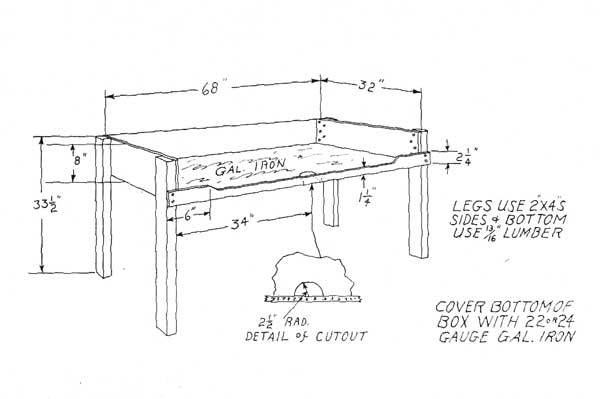
The cracking of the nuts is done with one of the small mechanical crackers that is to be found on the market. The more care exercised in the cracking at the nuts, the less work and time will be required in separating the kernels. After cracking the nuts they are sifted through a series of screens. This helps very materially in preparing them for rapidly picking their kernels. It is quite important that this operation be done properly if the kernel picking is to be made simple and rapid. The cracked nuts are first sifted through a screen made of 1-inch mesh chicken wire netting. Next the nuts are sifted through a screen made of ½-inch mesh hardware cloth. All material which will not pass through this screen should be kept separate. Some of these pieces will require recracking and kernel picking with the fingers. The material which has passed through the ½-inch mesh screen is now sifted on a hardware cloth screen with 5 meshes to the inch. Only the very fine material will pass through this screen which is not suitable for further kernel recovery. The material which remains on the ½-inch mesh screen is now placed on the table especially made for kernel picking. This table is shown in the accompanying sketch. The table is of suitable size to allow two people to use it at the same time. The operators sit on stools about 20 inches in height, and work from the low side of the table. A small amount of the material is brought forward and spread out very thinly before the operator. A piece of ½-inch softwood dowel about 5 inches long with 4 No. 9 sewing needles imbedded in one end is used to pick up the kernels. The needles are placed in the form of a square and should be only about 3/32 of an inch apart to do the best work. The picks should not be used to pry kernels from the shell, as the needles would soon become bent and worthless. The picks are meant to be used only to pick up the kernels from among the shells. As soon as the operator has removed all the kernels from the small amount of material he has brought forward from the rear of the table, he shoves the shells into the hole at the edge of the table and they drop into a receptacle. The pick is used with the right hand, and the kernels are removed from the pick with and into the left hand. As soon as a convenient handful of kernels has been obtained, they are dropped into a small pan which sets on the table near the operator's left hand. The rapidity with which kernels may be picked by using these methods is surprising. It is sometimes necessary to moisten the nuts and hold them in this condition for 2 or 3 days before cracking them, to keep the kernels from shattering unduly. After the kernels are picked out they are dried very thoroughly. Trays whose bottoms are lined with screening somewhat finer in mesh than that used for windows, are used to dry the kernels. Care should be taken to not overheat the kernels, or their flavor and color will be impaired. Good clean lard or similar cans with tight fitting covers are used for storing the kernels. The kernels are stored in a cool dry place. Any kernels which are to be kept over the summer months, are placed in cold storage.