Colby, a Hardy Persian Walnut for the Central States
Reading edition
J. C. McDaniel, Extension Horticulturist, University of Illinois
When the Reverend Paul C. Crath of Toronto imported walnut seeds and scions from his native Ukraine region and adjacent areas of Poland in the 1920s, he started a chain of propagation and selection which promises to establish the Persian walnut (Juglans regia) as a commonly grown nut in southern Ontario and the north central states. The best of his importations, and seedlings from them, are fruiting in such states as Wisconsin, Iowa, Illinois and Missouri, showing in many cases a degree of hardiness which must reverse the conclusion of an older generation of pomologists that Persian or "English" walnuts were too tender for successful cultivation in most of the middle west.
The time has now arrived when there are enough fruiting trees of the "Crath Carpathian" walnut seedlings in many states that comparisons can be made and the more promising ones named and disseminated for propagation. The nuts which the Reverend Mr. Crath imported in greatest quantity during the middle 1930s came from more than 100 different seedling trees selected in Poland. Their seedlings exhibit much variability in characters of trees and nuts. Some are much less hardy than others under our conditions. Not all are as large fruited as their seed parents (and some of the parent trees bore small nuts). Though many have smoother shells than Mayette or Franquette, there is also much variation in shape, thickness, and color of shells. Color and flavor of kernel vary from tree to tree. The season of nut maturity, though variable, is generally early enough in locations where the trees are winter hardy. The parents were selected for good filling of kernels, and this character generally has carried over to the seedlings fruited in America. As with other walnuts, some of the Carpathian seedlings are apparently more susceptible than others to fruit damage by the husk maggot. Walnut blight has infected them in some localities.
The COLBY Persian walnut, named in August 1951, and released to nut nurserymen for propagation early in 1952, is the best to date of thirteen Carpathian seedlings (each from a different parent tree) planted at the University of Illinois Agricultural Experiment Station from 1937 to 1939. It is the first Persian walnut variety to be named at this station.
The name, Colby, honors Dr. Arthur S. Colby of the Department of Horticulture at the University of Illinois, who has been in charge of nut investigations here since 1919. It was given to this variety, with his permission, by members of the Northern Nut Growers Association during their 42nd Annual Meeting, held at Urbana in August, 1951. Dr. Colby is a former president of the Northern Nut Growers Association.
Colby is a seedling of the tree designated as Crath No. 10. The seed was collected in 1934 from the parent tree near Cosseev, in the Carpathian mountain region of southern Poland as then constituted, planted in the nursery of S. H. Graham, Ithaca, New York, and the seedling transplanted to Urbana, Illinois at the age of two years. It has been fruiting annually here since 1942, with crops of up to 1-1/4 bushels in recent years. The accompanying cut shows nuts of the 1951 crop, a little less than 2/3 natural size. They are thin shelled, like the parent Crath No. 10, well filled with kernels of rich flavor, and are medium in size for varieties of this species.
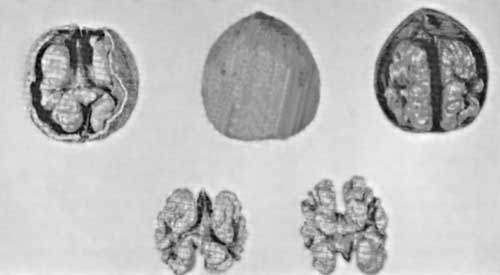
Colby walnuts of 1951 crop, showing thin shells and plump, bright kernels.
The Colby tree is rather upright in growth, with strong branches, being the most vigorous among the four hardiest Carpathian seedlings at Urbana. It was one of two trees on which most catkins survived the winter of 1950-51, when temperatures at Urbana fell to -19° F. It is among the earliest Persian walnuts to start growth in spring, blossoming at Urbana normally in the first half of May. Flowering is protandrous (male flowers first) but with enough overlap of staminate and pistillate blossoms to secure a large degree of self-pollination from the abundant large catkins. Fruit set might be improved, however, by planting nearby another variety with later staminate catkins.[20] The nuts mature from the middle to the last of September and have not been seriously affected by walnut husk maggot or walnut blight at Urbana. The tree is relatively early in wood maturity, shedding its foliage usually before November, a characteristic shared by the other hardiest Carpathian seedlings in Illinois.
Prior to 1952, scions of the Colby walnut (previously designated Illinois No. 10) were propagated for test by top working on native eastern walnut (Juglans nigra) at two widely separated locations. It fruited in 1951 at Greensboro, North Carolina, where the early growth sometimes is injured by spring freezes. (This is common with Carpathian walnuts in the southeast.) It has survived three winters at Sabula, Iowa with no cold injury and made unusually vigorous growth there. At both Urbana and Sabula, it has been compared with Broadview Persian walnut, a British Columbia origination considered a hardy variety. Broadview has often suffered winter injury at both locations, and in 1950-51 was killed to the understock at Urbana.
The suggested test regions for the Colby Persian walnut include those with a climate similar to central Illinois, and where spring freezes are not generally a problem. The suggested understock is black walnut (J. nigra) though established hardy Carpathian and other Persian walnuts may be satisfactory for top working.
Additional wood for propagation of the Colby will be available in small quantities next August to nut nurserymen and other experiment stations. (Walnut scions cannot be sent from Illinois to California.) Trees of Colby should be available from several cooperating nurseries in the fall of 1953.—Reprinted from Fruit Varieties and Horticultural Digest, 6(4):72-75. 1952.