STATUS AND POSSIBILITIES OF NUT CULTURE IN THE NORTH
Reading edition
T. P. Littlepage, Washington, D. C.
The purpose of the Northern Nut Growers Association is to stimulate the production of nuts in the North. We distinguish the North from the South in this regard not because we feel any less interest in the nut industry in the South. The man who once becomes a nut enthusiast is no respecter of Mason's and Dixon's Line or any other line that separates him from an interesting nut tree or from a section in which nuts may be successfully grown. His local interest, however, will naturally be around his own dooryard and neighborhood. So we speak of northern nut culture and northern nut trees because we live in the North and because this is the section of the United States that needs at the present time the most intelligent direction. The South has been forging ahead for a number of years in this field. In fact, pecan culture promises to become second only to the cotton industry in many sections of that country and interest in its possibilities has attracted to it many conscientious, able and prominent horticulturists who are today engaged in pecan growing in the South and who are doing much to put the pecan industry on an honest and intelligent basis. These men have become specialists in the pecan industry and they know more about it than we do in the North. Consequently they do not need our assistance, even if we were able to give it, and, therefore, without any fear of our being criticised for using the adjective "northern" we can limit our investigations and discussions to nut culture in the northern part of the United States with a full knowledge that our southern brethren can take care of themselves, and, in addition, can render us much valuable assistance which assistance we most cheerfully invite.
At this point, however, in connection with the use of the terms "northern" and "southern," it may be relevant to make a few observations as to the possibilities in either section. While it is true that the South has a long start of the North in pecan culture, yet the North affords an opportunity for the cultivation of nuts which is not possible in the South. The South is today the home of the delicious varieties of pecan which are a delight to the consumer and a source of fascination and profit to the intelligent producer, but it must be remembered that the northern pecan belt has many excellent varieties that are "good enough." In addition to this, the North is the home of the black walnut, the fine shagbark hickory, the butternut, the chestnut, the hazel-nut, and the chinkapin, and is also adapted to the hardy varieties of the English and Japanese walnuts. All of the nuts just named certainly offer an ample field for our interest and enthusiasm, and, in addition to the keen delight which comes from the successful growing of these trees, there is a possibility of profit which I do not think is excelled in any horticultural undertaking today.
First then, what word of advice or instruction can the Northern Nut Growers Association bring to the prospective nut grower which will be of help? For, after all, the success or failure of this association depends largely upon its ability to help the grower or prospective grower. Before we undertake to give suggestions about the development and culture of nut orchards or to make prophecies as to possibilities, let us stop and take stock for a moment of the present status of the nut industry in the North and consider what we have to build upon and what materials we have with which to work. Mistakes have been made in the past by the prospective nut growers because they did not stop to consider the possibilities of the nuts that were native in their own locality, but looked abroad for something else. This is characteristic of many people. "Distant fields look green," and, of all the imported nut trees, none except the English walnut have been of any success here whatever, while, in one instance at least, their importation has resulted in introducing into this country the fatal chestnut blight, which probably came in on uninspected stock from Japan. We have better native chestnuts in this country than any foreign chestnut and the blunder of trying to get something different is costing the country millions of dollars through the scourge of the chestnut blight, which threatens to wipe out the industry. It reminds me of the epitaph on the tombstone which read: "I was well and wanted to be better, took medicine and here I am." Therefore, let us consider what nuts we have worth while.
The Pecan
First, we have the northern pecan which is native in certain portions of a belt approximately 150 miles wide, with Evansville, Indiana, on the 38th parallel, as the center. I do not mean to say that the pecan will succeed in all portions of the northern half of this belt or that it may not succeed in many sections farther north. The question of climate, as modified by proximity to oceans and large bodies of water or as made more rigid by absence of these protections, may decrease or increase the latitude at which the pecan can be successfully grown. The orange, for instance, is one of the tenderest fruits and yet, on the western coast, orange groves are flourishing at the same latitude as Philadelphia, which is nearly on the 40th parallel, although it is unnecessary to say that an orange grove would not survive within four or five hundred miles of the 40th parallel any place else except on the favored western coast. The southern varieties of pecans will not flourish in the north and we do not know whether the northern varieties will flourish in the South.
The pecan is a hickory and the northern trees are very hardy and thrifty. Many varieties have been discovered the last few years which are thought to be worthy of propagating. Among them are the "Indiana" and "Busseron," from near Oaktown, Knox County, Indiana; the "Niblack," from Vincennes, Knox County, Indiana; the "Warrick," "Green River," "Major," "Kentucky," and "Posey," all from the Evansville section; the "Norton" from Clarksville, Missouri, and several other varieties.
English Walnut
The next most important nut, and probably competing very closely with the pecan for popular favor, is the English walnut, which is perhaps the only nut that has been successfully imported for growing. Since the earliest Colonial days, seedling nuts have been brought from France, Germany and other parts of Europe and have been planted up and down the Atlantic Coast. Most of the trees from these plantings have not been able to permanently withstand climatic conditions, but, scattered here and there throughout the North and East, are individual trees of apparent hardiness which bear nuts in size and quality comparing favorably with the English walnuts we see on the market. Among the various hardy varieties of the English walnut are the "Rush" and "Nebo," from Lancaster County, Pennsylvania, introduced by Mr. J. G. Rush, the pioneer propagator in the Eastern States. Another is the "Hall" from the shores of Lake Erie, the "Pomeroy" from Lockport, N. Y., a short distance from Niagara Falls; the "Rumford" from Wilmington, Del.; the "Ridgway" from Lumberton, N. J.; the "Holden" from Hilton, N. Y.; the "Boston" from Massachusetts; the "Potomac," "Barnes" and "Weaver" from Washington, D. C.; and a number of other varieties. The location of the parent trees just named will give some idea of the probable hardiness of these varieties.
Shagbark Hickory
The thin-shelled shagbark hickory is a nut that is coming more and more into favor and is well worthy of propagation. The first shagbark recognized as a distinct variety was the "Hales," located and named by Henry Hales of Ridgwood, N. J., about 1874. This is a very large, attractive, thin-shelled nut, but has been somewhat superseded by other and superior shagbarks. Dr. Robert T. Morris of New York has been making a systematic search for several years for trees bearing shagbarks of high quality and merit, and has been very successful in bringing a number of such nuts to public attention, including the "Taylor" and "Cook." The "Swaim" from South Bend, Ind., is an excellent shagbark; the "Weiker," from Lancaster County, Pennsylvania; the "Kirtland," from New England; the "Rice," from Illinois; and another very superior and fine shagbark from northern Kentucky which was brought to public attention by R. L. McCoy of Lake, Ind.
Black Walnuts
Throughout the whole north are tens of thousands of seedling black walnuts, many of which are of excellent quality, but, so far as is known, there are but two recognized varieties, the "Thomas," introduced during the eighties and propagated to a limited extent, and another from Lamont, Mich.
Butternut
The butternut is also quite common in much of the same territory as is the black walnut and even in regions farther north, but, so far as I have knowledge, not a single variety has been named.
Japanese Walnuts
Seedlings of two species of Japanese walnuts are quite common along the Atlantic Coast and as far inland as the Mississippi River. They are also grown on the Pacific Coast to some extent, but apparently no varieties have been recognized.
Another nut which is confused with the Japanese walnut is botanically known as Juglans Mandshurica. In character of growth the tree quite resembles the Japanese species, but the nut resembles more our American butternut and sometimes they are confused. A short time ago a gentleman in New Jersey who had planted some nuts of the Japanese varieties later cut down the mature trees because he thought they were American butternuts.
Hazel-nuts
It is never safe to use the term "hazel" without explaining that it correctly applies also to the species brought from Europe and more commonly called filberts. According to the late Mr. Fuller, the Germans discriminated between hazels and filberts entirely by the shape of the husk. A nut having a husk which extended and came together beyond the end of the nut was called filbert, meaning beard. Those having shorter and more open husks, so that the nut protruded, were called hazels after the German word "hassel,"—hood, in English. It will readily be seen that once the nuts were separated from the husks, it would be impossible by their classification to determine whether they were hazels or filberts. The Americans generally accept the use of the term hazel to apply to both the American and European species.
In the early history of our country extensive and persistent efforts were made to introduce the European hazels, and no wonder, for of all nut trees this species seems to yield most readily to garden culture. They are readily capable of adapting themselves to most any kind of soil and even to rocky ledges which would be impossible to cultivate. They attain their greatest perfection in good soil and, under proper cultivation, the trees come into bearing early and the nuts mature early in the fall, well in advance of other species. The hazel, however, like the chestnut has met with a fatal disease. It is a blight which seems to exist everywhere except on the native species, which are so far immune as to show little or none of its effects. The American hazels, however, act as host plants to the blight, which thus quickly spreads, with fatal results, to the European species. Of all the plantings which have been made during the past one hundred and fifty years, it is safe to say that there are less than half a dozen hazel orchards in the eastern states which have not succumbed. It seems quite probable that a golden opportunity is awaiting someone who is willing to go through the forests of our eastern states, especially those in lower New England, in search of individual hazels from which to propagate new varieties. Among the heavy bearing shrubs, which exist in the section referred to, it is certain that many hazels could be found well worth propagating.
Turning now from this brief history of northern nut trees, let us consider the future of the industry as viewed in the light of sound theory and actual observation. It is unnecessary to present any argument why nut trees should be planted. Nuts afford the highest grade food known to science. They are wholesome, healthful, strengthening,—in fact, without a single objectionable feature so far as I know as an article of food and, when one considers that food is the basis of human existence, no further argument is necessary to warrant interest in one of the best foods known.
Then how shall we advise the prospective grower of a nut orchard? First, let him determine what kinds of nuts thrive in his vicinity. The prospective grower in the latitude of Evansville can indulge himself to his heart's content, for he can grow successfully the pecan, English walnut, black walnut, butternut, hazel and, up to date, the chestnut. But, success in growing any of these trees depends upon proper information, proper varieties, proper soil and proper care. Suppose a man, in the Evansville latitude, for instance, desires a pecan orchard. What should he do? His quickest way, if he has wild seedling pecan trees growing on his farm, would be to have the wild trees top-worked to well-known varieties. If he has no seedling trees, then his next best plan is to purchase budded trees of good varieties from some honest nurseryman, set them not less than sixty feet apart and cultivate and care for them. Will they grow around fence corners and creek banks? Yes, if you have plenty of time to wait. They will not, however, be in a hurry, and it may be your grandchildren who will gather the nuts. But, a cultivated orchard of budded pecan trees of the right varieties ought to come into commercial bearing as soon as does an apple orchard. Mr. W. C. Reed of Vincennes reports Busserons that were budded fourteen months ago setting as high as sixteen nuts this year. That is, the second summer after they were budded. If the trees are of the right varieties, well cultivated, in good soil, and if you care enough for them to throw some fertilizer around them, they will please you by their growth and soon become very profitable.
Now suppose one wants an orchard of English walnuts. Almost identically the same instructions hold true. If you have wild black walnut seedlings on your farm, by all means have them top-worked to fine varieties of English walnut, for the black walnut is the best root for the English walnut. If you have no seedling trees, go to some reputable nurseryman and buy known varieties of hardy English walnuts budded on hardy black walnut stocks. Set them not less than fifty feet apart and cultivate and care for them. Mr. Rush reports one of his budded Rush trees four years old bearing fifty-seven walnuts this year. I saw a Rush in Washington City the other day, two years old, carrying about a dozen walnuts; also a Hall, of the same age, carrying about the same number. Both trees were thrifty and not much over waist high, and every terminal twig had from one to two nuts on it.
If you have wild hickory trees growing on your farm, have them top-worked by the slip-bark or budding method to fine varieties of shagbarks. In the absence of wild hickories, I believe the future will prove that the next best method of starting an orchard of budded shagbark hickories is to buy them budded on hardy northern pecan stocks. The hickory is not the best stock for the pecan because it is of slower growth, and for the same reason the pecan ought to be the better stock for the hickory. But the hickory does not grow as rapidly as does the English walnut or the pecan and requires more patience.
The hazels are going to afford a great field for the nut grower, as they are native to a wide territory embracing the Middle West, the North and the East, and ought to be profitable. A few years ago I found a very fine large hazel growing on my farm in Warrick County, Indiana. I dug up some of the roots of this bush and planted them in my garden at Boonville, and in three years they were bearing fine clusters of hazels larger than those borne by the parent bush. I think farmers would find it profitable to set out hedges of native hazel bushes around their fields and fences and on hillsides.
Butternuts, black walnuts and beechnuts also offer a fertile field for experiment. Any varieties of butternut or black walnut can be propagated by budding or top-grafting them on seedling stocks.
I should like to suggest that every farmer in the nut growing belt set aside at least ten acres of land for a nut orchard. It will give him a new interest in life and afford him more pleasure and relief from the ordinary monotony of farm work, I believe, than any other line of work he can pursue. If Ponce de Leon had planted a nut orchard in this country instead of wasting his time searching for the fountain of perpetual youth he could have spent his old days in interesting, profitable and fascinating work instead of in despair and disappointment.
But some of the practical questions asked are, "What is the cost of a nut orchard?" and, "How soon will it bear?" and "What will it be worth when it does bear?" No man can answer these questions with any degree of certainty, for everything that man attempts has its drawbacks and disadvantages. First-class budded nut trees cost from one to two dollars apiece. The balance of the cost depends largely upon the intelligence and efficiency of the labor applied in setting and cultivating. When will they bear? That depends altogether upon who owns them. If properly cared for they will begin setting some nuts in a few years and will increase the crop as the years go by. A pecan tree ought to bear successfully for fifty years—possibly longer, and ought to be bearing nicely in eight years if properly cared for. But, success depends upon the care and intelligence with which the original selection of trees and soil is made, and upon proper cultivation. I have set an orchard of northern varieties of pecans budded from the parent trees in the Evansville section on my farm in Maryland this spring. The land cost me sixty dollars per acre. When they are ten years old they ought to be worth at least five hundred dollars per acre. I do not know how much more this grove of nut trees will be worth in ten years, but I would not option them at the present time for that price. I have about the same confidence in the English walnut.
I have always been conservative on these matters and always expect to be because in conservatism lies safety. These figures I have given you are merely my personal opinion. I have seen pecan groves ten and fifteen years old for which I would not have given any more than the land was worth on which they were growing. If any one has a notion that he can make money in nut culture, without intelligent exertion, he had better go into some other line of business in which there are men having a fair degree of success with unintelligent effort. I know of no nut grove in the whole United States that is succeeding without intelligent application, and on the other hand I do not know of a single grove which with intelligent application is not succeeding. I am a "conservative-optimist." I have been talking nut culture for a number of years and expect to see every hope and estimate which I have expressed fulfilled, and after all has been said and considered my final advice is to Plant Nut Trees.
The President: The chair invites a very active discussion of this paper.
Professor Smith: It would be unkind to criticize so very instructive an address but there is one thing laid down in that paper I wish to speak about. I believe we were told we must cultivate our nut trees. I believe the fact is that in the greater portion of the United States, we can grow trees, even nut trees, without cultivation. If anybody doesn't believe that, go to Washington by the Chesapeake Railroad and you will see thousands of walnut trees along the way. I believe the human race can grow trees on a hillside without cultivation, and I want to suggest to persons putting out nut trees to put out a few in places where they don't have to be plowed, and see if they don't get good results. Cultivation is not a fundamental element of agriculture or plant life, but is the quick way to get results.
In many places in Ohio the state experimental work in horticulture, especially that carried on by F. H. Ballou, has done some wonderful things in waking up apple orchards that had not grown a quarter of an inch in years. Merely giving them food has caused them to wake up and bear. I have seen them, and know. The books say that while apples may grow without cultivation, peach trees must be cultivated in order to bear. I have peach trees that are three years old in a rocky piece of ground. I can't plow it but I have fed some of the peach trees and a few I did not, that is not much, and the ones that were fed as they should be are much the biggest and are bearing well. My point is this, keep the grass well scraped away to prevent trunk injury, and feed even a peach tree and it will do well. I think the same is true of the nut tree.
Whether a tree that is set out, liberally fed, and the grass kept away will do as well without cultivation, is a subject worthy of your consideration and experiment.
The President: The chair especially desires to call attention to Dr. Smith's remarks because he has made a very careful study of this question and his suggestions are worthy of very great consideration. I have talked these things over with him a great deal and I commend his remarks especially to the Association for discussion.
Dr. Morris: In connection with the matter of cultivation I would also like to have Mr. Reed discuss that. I want to say, however, that, in using fertilizers, you will often very easily overdo the matter. Sometimes in my experience professionally, I give a patient medicine enough to last a week, with directions that a teaspoonful be taken twice a day, and the patient may believe if she takes the entire bottle at one dose she will be well in an hour, and consequently suffer from an overdose. That same idea is sometimes carried out in the fertilization of trees by horticulturists. You don't intend to do it but sometimes you can kill with kindness and be too good in feeding your trees if you don't understand how much fertilization the tree needs. That is the idea, you have got to give your trees the ratio that they need. If you give them too much pie or pudding, your trees will have indigestion and will not thrive and may die. I have lost a great many good trees, and a great many nut trees, and have checked the growth of a great many by not realizing this. I wish Mr. Reed would speak to us about it.
Mr. Potter: I want to state some experience I have had and when Mr. Reed talks, I wish he would give me some information. I set out some pecan trees on my lawn in the front yard, and of course there is not much cultivation there except around the trees. It is like most other lawns in southern Illinois, mostly clay and what other soil we put on top. Now the clay is very hard and in setting the trees I had my man dig a hole three feet deep and two feet across and in setting the trees I packed good dirt around them. The question is how should I feed those trees? I have put barn manure around them and they are now growing and doing very nicely, I want to know if I have pursued the right course.
Mr. McCoy: I believe this question of growing trees in fence corners and on hillsides is not so large a question. The main thing is to give them plenty of water. There is very little land in the Mississippi valley that won't grow pecan trees or most any other kind, if you will give them sufficient mulch and plenty of water, because they take their food in the form of soup. Unless they have water, they won't grow. I believe the best cultivation you can give a tree of any kind is a good mulch of straw and manure. You that have had experience in this part of the country know that is the best way to cultivate trees.
I grew a peach orchard once in one year, but I have quit that, I have learned better. It is simply a question of water and plant food. If you will mulch any kind of a tree, nut tree or any kind, with ten or fifteen inches of straw and stable manure, you will have a steady growth from early spring until late in the fall, and it will make a strong tree.
Professor Smith: While we are waiting for Mr. Reed I want to take up Mr. McCoy's soup suggestion. Water doesn't make good soup without something in it. Experiments show that you can mulch ground in some places and not wake up the tree, but fertilizer will wake it up the first year.
Mr. Potter: What kind of fertilizer did you use?
Professor Smith: One must experiment to see what his land is short on. Sometimes you can fertilize your trees without any result. Sometimes potash will not do any good and sometimes it will. You will have to see what your ground needs. For young apple trees I found in my particular situation that nitrate of soda is all I want. I have what is called a Porter's clay soil on the Blue Ridge Mountains of Virginia. I use that and then my trees get busy and grow. They make rapid growth even the first season with a handful of nitrate and for my three year old trees half a pound is enough. That is what my soil seems to need and we must use what the soil is short on. That is my interpretation of my situation and it works.
The President: Who can tell us whether nitrate of soda is good for nut trees? Can you, Mr. Simpson?
Mr. Simpson: In the South, we do not think so.
The President: The reason I asked, is that I have been studying that. I wrote Mr. Potter a letter suggesting that he use some on his young nut trees to see what it would do, and later I found out that all through the South it was not regarded as desirable. It seems they claim it starts pecan trees into an active growth but when they stop they make a very sudden stop and don't start growing any more. I want to get this in the record right here. You understand that is the general belief throughout the South, do you not?
Mr. Simpson: Yes sir, it is not considered good.
The President: Dr. Smith has made a very careful study of fruit trees and knows its effect on them from experiments, but it is well perhaps to consider fruit and nut trees separately.
Professor Smith: I should suggest to anybody who is thinking of working with trees, to get some seedling pecans and plant them and then fertilize some of them and others not, in the same kind of soil. In that way he can get his own fertilizer conclusions at a small expense and then he will know what his own soil needs.
Mr. McCoy: We fertilized seedling pecans in a clay soil and we decided the trees we did not fertilize got along better than the ones we did. Of course that ground is better where the trees are than on the average farm. We used nitrate of soda and potash but we decided the ones we didn't fertilize did the best.
Mr. Potter: I put two pounds of nitrate of soda around each tree and the English walnuts I used it on budded out very shortly after using it, but along about June they died. The pecan trees we used it around grew fairly well, but some of them, one in particular, appeared to remain dormant, almost, until about two months ago when it commenced growing and is now growing very rapidly. So you see I don't know where I am at.
The President: In writing you I did not understand the size of the tree. On some trees I have been using a tablespoonful, about that, and I was afraid I got too much.
Mr. Potter: Evidently I got too much.
The President: Evidently we got mixed up on the quantity. I know I never used more than two tablespoonfuls at any time and I should imagine two pounds would be a big overdose. I remember talking to Dr. Smith about that time about some old apple trees around which you can use five or six pounds of nitrate of soda and I suppose that is the way we got mixed up. I must have had that in mind as I did not intend to advise that amount for young nut trees.
Mr. Pomeroy: How long a season should the tree keep growing? From early spring to late in the fall? My experience is they will stop about the first of August, and let the wood ripen up and harden for the cold weather. Some might keep the trees growing longer, but you will hurt the trees I think.
The President: We have not heard from Mr. Reed yet.
Mr. C. A. Reed: I am glad the discussion has proceeded as it has since it has given me time to reconnoitre. I hardly know what to say on this subject that Professor Smith has brought up. I guess he knows what he is talking about so far as his experiments have taught him. The department does not like to discourage a good thing nor to encourage a thing that is too risky. There is one thing quite sure and that is that so long as nut trees are selling for from one dollar to two dollars apiece, very few people are going to buy them and plant many of them on these hillsides and experiment with them. People cannot afford to do that. We have found, taking the country over, that nut trees thrive best when they are given treatment; that is they must be given cultivation and fertilization; be given some degree of attention the same as an apple or peach orchard. Colonel Sober, however, will show you quite a different thing. He will show you chestnut trees that are not cultivated at all, so there is a staggering blow to my argument, and yet Colonel Sober gets something like three and a half bushels to the tree. You don't fertilize those trees, do you, Colonel Sober?
Colonel Sober: No sir, not at all. Haven't yet.
Mr. Reed: So there is an argument that silences me and still it is true that we can't safely plant hickories and pecans without some degree of cultivation. I don't think Professor Smith has planted any on these hills.
Still we all agree with Professor Smith in a way. Something ought to be done to the surface to prevent the land from washing, and there is no better way of doing that than by planting trees. Then the roots will prevent washing and they can take care of themselves better than a surface crop. Especially is this true on the hillsides, so there is a good deal in Professor Smith's argument. And yet there is the danger that those trees will be infected with disease and insects. On plants and trees that are attended to and cultivated we find those pests will be kept in check. So there are two sides to that argument.
Professor Smith: The point I raised was this, that it is possible in some places to attain by fertilization the advantage that comes by cultivation in other places. Great things have been done without fertilization. There are chestnut orchards in Corsica of grafted trees, ranging from the size of my wrist to eighteen to twenty feet in circumference. They have not been fertilized in centuries, and they yield enough to support the entire population.
The President: We would like to hear from Col. Van Duzee, and I want to say that, as President of the National Nut Growers Association, he is well acquainted with these things. I commend him to you and promise that whatever he may have to say to you is worthy of your very careful consideration. I have the honor to belong to the association of which he is the president, and know it is seldom we have an opportunity to hear men like him.
Col. Van Duzee: Gentlemen, I am going to side step this argument for I do not think it worth while taking up the time. We are here for other purposes. Personal experiences are not the general rule because each one's experience differs from that of others. We might all tell our personal experiences and after we were all through we would not have accomplished anything. I want to take you back to the point from which we started this, in order to know what we are talking about. To illustrate what I want to say to you, we can take the root pasture of a tree and analyze it in every possible way so as to bring to bear upon it the best judgment we have from all sources. The tree grown upon a hillside has a root pasture which is entirely different in many ways from the root pasture in the river bottoms. If we have a tree growing on a hillside in a soil that easily transmits moisture and it gives that tree constantly a stream of pure water going through its root system, and there happens to be enough fertility in that vicinity, that moisture is impregnated with plant food, and the tree will get all it wants. You can't speak in the same breath of the tree growing in the river bottoms whose entire root pasture is entirely different. The root pasture may become contaminated by various things which may cause, so to speak, ptomaine poison. Therefore I say that every locality, every soil, every climatic condition, every variety of tree must be taken as individual. What would be good for an apple orchard in Virginia might be fatal to an apple orchard immediately south of Lake Brie in Ohio. The use of commercial fertilizer that would be good in one locality would be bad in another. Therefore I disapprove of this kind of a discussion, because we are not speaking to a definite point. I want to bring your minds to this point, that every individual tree and its locality, and the man that is responsible for its welfare, must be analyzed before you can speak intelligently about what must be done.
I am going to tell you the same story I told the societies at Pharoa, Alabama. They wanted me to talk on this subject and I said, "You remind me of a backwoods character I have come in contact with in the woods of Florida who is ill and doesn't know what is the matter with him. He knows he needs medicine and he goes down to the general store and buys a bottle of patent medicine recommended by the groceryman and he takes it and maybe it helps him and maybe it don't, but if he don't get better he goes and gets advice from some other man like the grocer." I said, "That is the way you are demonstrating fertilizer." The first thing I would advise would be this: to analyze the individual pasture of the individual tree and take everything that enters into the history of that tree and everything that bears upon it. All the accumulated wisdom of others won't help us very much. We have to use common horse sense. We can't talk about these things generally. In poor soil and under bad conditions the pecan tree will do nothing. There are trees I know twenty-six or twenty-seven years old that are not as large as my wrist, that have never borne a nut and never will. I can also show you trees in that immediate vicinity, planted at the same time from the same nuts with favorable conditions, that are seventy or eighty feet high and bearing good crops of nuts. Those nuts came out of the same bag the same day, and were planted by the same man in the same locality, and that proves, as I have said before, that you cannot discuss things of this kind in general terms and it is a waste of the time of the association to do so. I would be glad to answer definite questions as to definite points.
The President. The next will be a talk by Dr. R. T. Morris of New York.
Dr. Morris: Mr. Chairman, and Members of the Association: My subject relates to personal experiences with hybridization work. This is work which is to be done more and more by various members of our association, and we are thus to create new species of trees. Nature's whole endeavor is to preserve the mean type among races of organisms. There are mutants among all trees, among the hickories and walnuts, as well as among the peaches and pears. In fact all species undergo mutation. We select the most desirable mutants and we try to fix a given type by grafting and propagating. Seedlings will go back toward the mean type. The mean type hickory, walnut or chestnut is the type that nature wishes to preserve, but these are not best for man's purposes. What is best in nature's plan is not always best in man's plan. We have got to dynamite nature. We have got to put a charge of dynamite under nature's seat and blow her up, in order to get what we want for our own purposes. How do we do it? How do we break up the mean type of a variety or species? By crossing the flowers and bringing together the parents we wish to unite in the hope of growing new forms, among which will be some that are particularly desirable for our purposes.
Now in doing this work, I have had to get by experience a number of points which will be of value to members of this association. First, in regard to collecting pollen. Sometimes species, which we wish to cross, flower at widely different times. They bloom perhaps two or three or four or even six weeks apart, and it is a question how long we can keep the pollen viable. What can we do about it? There are two good ways. First, get your branches of male flowers before they are open, put them in cold storage, or in an ice house, or in a dark room, and keep them anywhere from one to six weeks dormant. When you want to use them, and your trees of the pistillate flowers are ready, take the branches of staminate flowers out of the ice house and put them in jars of water in a warm room in the sunshine. They will blossom and make good pollen shortly. Another way is through correspondents living at a distance. These correspondents will send you pollen from a species which blossoms later further north or earlier further south, at the time which you wish for your pistillate flowers. For instance, in crossing chinkapins with oaks, the chinkapins will blossom about the 12th of June in Connecticut but most of the oaks are through blossoming by the 12th of May. There we have a month's difference. How can I use oak pollen upon my chinkapin trees? I do this by sending away up to the northern limits of the growth of the oak tree, up in Canada. The red oak tree blossoms there in June, the same species that blossoms with me early in May. Pecan pollen that I wish to use upon shagbarks and walnuts I get from Texas. Now how are we to keep pollen when we have collected it, if we are not ready to use it immediately? I have had pollen sent to me from a distance in tightly corked bottles. It was probably ruined at the end of three or four days, because it could not breathe. Every grain of pollen has to breathe just as surely as a red squirrel in the top of a tree has to breathe. The pollen grain is a living organism, and if it is sent in a closely corked bottle it smothers and dies. You must have it sent in paper or wooden boxes in order to have it in good condition when it arrives, and it must be kept in a cool place, not too dry and not too damp. If it is kept in a place that is too damp, various fungi appear, and begin to attack it at once. If it is too dry, it loses its water content, and its protoplasm does not make combination with that of the other flower. So we must keep our pollen in a cool place, not too dry, not too warm and not too moist, and where it can breathe. We may put it in cold storage but not at a temperature below freezing. We may put it into the cold storage which florists use, and keep it for a long while. Some pollen will keep, viable for three weeks, under these conditions, possibly longer. It is important to keep your pollen boxes open at the top. They must be kept where the wind doesn't blow your pollen from one box to another. I had not been impressed by that point until this year. I had eight different kinds of pollen about the farm house, in different rooms, in order to be sure to keep them far apart. One day on my arrival from town ready for pollenating a number of trees, I found that a very neat housekeeper had found it undesirable to keep such boxes scattered about in so many places. She had put them all neatly together in a closet on one shelf, and there was none of the pollen that I could use, because the wind had mixed the kinds all up. I had eight kinds of pollen across which one kind of wind had blown.
There is one practical point in cross pollenizing flowers that I have recently learned. Pollen of one variety may not combine with the ovule of another variety or species but may stimulate the ovule to go on and develop all alone, without taking to itself the added pollen. That is a very important point, and possibly a new point. I was deceived, and reported that I had crosses of certain trees, and that such hybrids were growing. I knew that the flowers of parent trees had been properly protected from their own pollen. Now when these young trees are two years of age, I find they are true to one parent type; so true that they are evidently not hybrids. They have developed from the pistillate parent only. In ordinary parthenogenesis the fruit grows without any pollen influence at all. This forced parthenogenesis which I have described seems to be a phenomenon with which botanists are unfamiliar. Until I learn that it has been described and named by others I shall call it Allergic Parthenogenesis (Allos, ergon). The pistillate flowers accept absolutely no pollen, but go on and develop because of its impulse given. In cross pollenizing flowers, I find one point of great practical consequence. When covering the female flowers with paper bags to protect them from their own pollen you give protection to a great number of insects. The insects remain inside these bags and destroy the leaves and flowers. They are protected there from their enemies, predatory insects and the birds. When the bags are taken off, perhaps a week later, for the purpose of adding pollen to pistillate flowers, insects may have destroyed the leaves and even the flowers. Consequently, I find it best to sprinkle the leaves with Persian insect powder and to put some of it in the bags that are to cover the flowers. Insects can't live in an atmosphere of this insect powder. They sneeze themselves to death. I have taken the bags from leaves and flowers which were so badly injured by insects you could distinguish them at a considerable distance. Those are all the points that I jotted down for this address today, but no doubt many other points will be brought out in the subsequent discussion.
Mr. McCoy: I would like to inquire how far it is possible under a microscopic examination to determine the species of the pollen.
Dr. Morris: It is possible to determine the species but not the variety so far as I know. It may be possible to determine a variety but I don't know the extent to which that is possible, from microscopic examination of the pollen. If we wish to know whether pollen is still good or not we may in twenty-four or forty-eight hours cause it to "sprout," and in that way know whether it is viable and good. We may save ourselves a good deal of trouble by making this examination and determining whether or not a given lot of pollen is viable before putting it on the flowers. We can cause it to sprout in a sugar solution.
The Secretary: What is the strength of the sugar solution?
Dr. Morris: That is technical work and must be done by a plant physiologist. He will do it for us at the State Agricultural College and telegraph his report.
Mr. Dorr: Is this work you have outlined of sufficient definiteness to get results? That is the important thing. We farmers sometimes discover a plan accidentally that will outclass anything we can get in an agricultural college.
Dr. Morris: That is very important. We are to produce nuts that are better, and also in greater quantities. The question if hybridizing work is valuable has been already answered in the case of roses and soft fruits. Our best types are largely the ones which have been secured by hybridization and the same will be true of nuts. The subject has not been so largely taken up as yet with nuts. Very few of us are doing with nuts what has been done with other fruits.
The President: The chair wishes to say that the members of this association have a very great and rare opportunity to secure information on this subject. Dr. Morris has made a very careful study of it.
Dr. Morris: The more study I make, the less I seem to know. Consequently I shall be very modest in my replies.
Mr. Dorr: I have been working with different things and find so many things I can't get at the truth. In the last year I have made experiments in breeding cattle to get colors, and I was agreeably surprised with my own success. I want to know if you can get similar results. I can observe the results so readily that I know exactly how I get them.
Dr. Morris: As a general statement the same thing you get from working with animals we may expect to get in working with plants. The protoplasm of plants is now known to act like that of animals, but not quite so quickly or freely in response to cultural methods. We can breed to size and breed to quality and character of fruit, and we find we may do with plants just about what we do with animals, only not quite so quickly, because animal protoplasm responds more readily.
Mr. W. C. Reed: I would like to ask if in a cross between the Persian walnut and the shagbark hickory there is a cross pollenization, or is it an increased vitality given by the pollen? Is there really a cross there?
Dr. Morris: I made one cross between the Persian walnut and the shagbark hickory that was evidently a good hybrid. It showed character of both parents, but I lost that entire lot. I wasn't careful enough in protecting them. I have another lot of crosses between these two flowers in which the type often is so definitely shagbark hickory that I doubt if there is any walnut there at all. Under certain conditions we may get hybrids, yet miss it at another time, even when working with the same parents. Somebody has probably made a better study of this point and recorded better ideas. I think we may safely say that we may expect an actual cross between some walnuts and hickories.
Mr. McCoy: Would it be possible to cross the English walnut and the black walnut and produce a nut of superior quality?
Dr. Morris: Yes, it is possible to cross them, but you do not often get a nut of superior quality. The tendency seems to be to have a nut of thick shell and of not high quality, but if you make a thousand of those crosses, out of the thousand you may get a few of just what you want.
Professor Close: I want to ask if you are always careful to apply the pollen when it is well ripened?
Dr. Morris: Yes, I have always been careful to apply it at just the time when it was well ripened, and that is of great importance in its bearing upon Mr. Reed's question. If I have pollen which is quite ripe I may perhaps catch it upon an ovule, but if it is not ripe I won't got the cross. I may add it a little too early or too late when the pistillate flower is unprepared and I won't get a cross. If I get my pollen just at the right time upon the pistillate flowers I may have a good cross, between varieties which do not cross readily.
Professor Close: In my experience in breeding apples, formerly I always waited until the pollen was ripe, and that meant I had to cover the blossoms with bags and depend on the weather for conditions favorable to pollenation. But four or five years ago I began pollenating much earlier and I have had good results.
Dr. Morris: That is a very important point.
Professor Close: By doing that I know it is pollenated. I have been failing so many years I felt it was a loss of all the first part of the work.
Dr. Morris: It is a great convenience to be able to pollenate at the same moment when you emasculate.
A Member: I would like to have you kindly explain to what extent cross pollenation can be made practical to the ordinary grower.
Dr. Morris: Let's say that in case of the butternut we wish to experiment with removal of the thick shell, and also to obtain less of that strong oily flavor; we wish to get rid of those two things. In order to do that I would first think of the Japanese walnut, juglans cordiformis, which has a much thinner shell and is less oily and more bland. Crosses between this Japanese walnut and the butternut we may fairly expect will sometimes give us a large, thin shelled butternut of good character. The next question is, who is going to do it? The men about my place are pretty busy, and this is rather delicate work. It is going to be a most inspiring field for the young folks and the ladies, because it is nice, pretty, ladylike work, and beside that its returns may be large. If your little daughter, ten years of age, knows that she may get $2,000 for a single cross that she has made, it is stimulating, because it is not every child ten years of age who can put $2,000 in the bank, as personal earnings of increment.
Mr. Mosely: I would like to ask just what results you expect from the cross pollenization of these nuts, and just how far they will differ from the parent type?
Dr. Morris: You are bound to have continuance of one parent type, but in crossing with pollen from hybrids you may carry desirable characteristics through a series of generations and breed for what is wanted, possibly to the sixth generation or even further with some species.
Mr. Mosely: Then the type is not fixed until pollenization?
Dr. Morris: By selecting the one showing the dominant characteristics you wish to preserve, you could breed through several generations and have an ideal type eventually.
Mr. Doan: I would like to ask how far the buds are developed in cold storage before the pollen can be used?
Dr. Morris: For instance, take the hazel when its catkins are just beginning to elongate. It may be put in the ice house and kept there, for two or three weeks dormant. When we wish to develop those flowers we put the branches in a jar of water in a warm room and in about three days the plants are shedding pollen. I got some hazel catkins this spring that were elongating. It was the latter part of February when we had one or two warm days and I believed my pistillate hazels were about ready for pollen. I got those branches from Rochester. We had unexpected cold weather and storms and my pistillate hazels did not bloom until more than two weeks later. I kept these undeveloped catkins that I had received in a cold dark place. When I wanted to use them I put them in a jar of water and in less than three days they were shedding pollen freely, at a time when my pistillate flowers were ready for pollen.
Mr. Mosely: I would like to know the object in crossing the oak on the chinkapin.
Dr. Morris: My idea is to get a chinkapin tree twice as large as an oak, perhaps. I shall hope to have a chinkapin tree as sturdy as the red oak, with nuts larger than acorns and of as good quality as the chinkapin nut. Of course that extravagant possibility only appeals to one with a speculative nature.
The President: Pursuant to the authority conferred on the President this morning, the following committees are announced:
On Nomination—Robert T. Morris, Chairman: C. P. Close, J. L. Doan, R. T. Olcott, C. A. Reed.
Exhibits—Prof. C. P. Close, Chairman; J. P. Wilkinson, E. A. Riehl, Colonel Sober, W. C Reed.
Resolutions—W. O. Potter, Chairman; H. R. Weber, J. Russell Smith.
The chair also wishes to place an additional member on the membership committee, in the place of Mr. Corsan, who has not been able to attend the last two meetings, and will appoint Leon D. Batchellor of Utah.
Committee on Revision of Constitution and Rules—Prof. C. P. Close, Dr. W. C. Deming.
I will also add to the committee on nomenclature C. A. Reed and R. L. McCoy.
The President: We have a few minutes before time for adjournment and Mr. Evans, a dynamite man, will speak to us.
Mr. Evans: Mr. Chairman: The question arises as to what kind of dynamite to use in the different soils. Most pecan land contains clay and can best be worked by dynamite. Don't buy ordinary dynamite, because it is too high an explosive. For several reasons it is not the kind of an explosive you wish. In some places dynamite can hardly be put on the market as many people are afraid of it and so the word dynamite has been eliminated, and we now have what we call Red Cross Farm Powder. It will work in any part of the country, it is not a high explosive and the price is lower as the hardware dealers have it direct from the Dupont companies. By using this Red Cross Farm Powder, less labor is required and it doesn't cost very much. For labor and all it will cost you about five cents per hole, and that includes the dynamite caps, fuse and labor.
Professor Smith: How much do you use?
Mr. Evans: That depends on the soil and also on the depth to which you want to shoot the hole. Nurserymen have different opinions on that subject, but in the southern field where I have been working they usually go from two and a half to three feet deep. They use one-half stick 20 per cent dynamite, or one quarter of a pound as it weighs two sticks to the pound. That should make a hole two and a half or three feet deep. Fuse is cheap and you should use plenty of it. A man has to be governed always by the kind of soil he is dealing with.
Mr. Pomeroy: In shooting an old apple orchard how deep would you go?
Mr. Evans: Where I have been working from three and a half to four feet, but as I said before it will depend largely on the soil.
Mr. Pomeroy: How far from the body of the tree?
Mr. Evans: I have never made a study of that.
Mr. Potter: In limestone soil, for instance, built up with clay, how near the trees would you use the dynamite if you want to loosen up the soil?
Mr. Evans: What kind of trees?
Mr. Potter: Pecan.
Mr. Evans: About six feet. I think that is close enough.
Mr. Potter: Would you make more than one hole around the tree?
Mr. Evans: Use your own judgment about that.
Mr. Potter: How far out will it loosen or break up the ground?
Mr. Evans: Probably six feet. You can distinguish on the top of the ground where it takes place.
Mr. Potter: How deep will it be?
Mr. Evans: About a foot deeper than the charge is placed.
The Secretary: With me the most important thing in using dynamite is the question of headache. I used the 20 per cent at first and it had no effect. I had heard of its causing headaches and knew some people couldn't use it but I thought I was immune. Then I began to use 70 or 80 per cent and I got knocked out for twenty-four hours. The more I used it the more susceptible I became. When I went back to handling the lower percentages I got the same results, was completely knocked out and had to go to bed. Sometimes the effect would come on a long time after I used the dynamite, perhaps hours afterwards, and the headache would increase, until I was intensely nauseated and had to give up entirely. Is there anything to prevent that? Is it caused by the fumes after the explosion?
Mr. Evans: Some say it is from handling the dynamite, others say it is the fumes after the explosion. Red Cross has ammonia in it and that ought to help some. Dynamite contains nitro glycerine and if you handle it bare handed it gets in the pores of the skin and causes rapid heart action. In dynamiting holes for tree planting you will get the fumes and you will get a headache. If a man could work with gloves on he could avoid this to a very great extent. You can't do it easily but if you can do it without taking off the gloves I don't think it would bother you much. I neglected to state that dynamite by itself is not dangerous because it will withstand shock or fire or anything like that. The danger is in the cap. It contains the most powerful explosive known. If you handle them carefully, there is absolutely no danger. This year we are slipping little copper disks into the caps with a pin hole for the fire to strike through.
Mr. Hargis: I have difficulty in making the shots. Should you put your cap at the bottom or the top of the stick?
Mr. Evans: I should advise the top. A misfire is always expensive. If you think it is necessary put in a cap in the bottom and one in the top.
Mr. Pomeroy: If you have a misfire and the men don't like to monkey around it, and neither do you, just step off a few inches and stick in another one and let her go. Will that fix the stick that didn't go off?
Mr. Evans: That is the safest way.
Mr. Hargis: In tamping say you have a hole in a rock four feet. I have had men tell me to pour the hole full of water. Is that right?
Mr. Evans: That is the best method known.
In tree planting you will always have to use your own judgment. Go down four or five or six feet to learn the character of the soil, tamp the cartridge well and as fuse is not expensive, always use plenty of it.
The President: Any further discussion of this, or any further questions on the use of dynamite?
Mr. Doan: Mr. President, I would like to mention a method I found helpful. That is to make two holes in the cartridge, one diagonally down from one side, thrusting the fuse bearing the cap through that, and then making a hole diagonally in the other side and thrusting the cap in it.
Mr. Evans: We do not advocate using that method because dynamite will become ignited from the fuse and will burn. To be frank with you that is the method we use, but the company does not approve of it and we should not use it. You are liable to have a misfire. In warm weather there is no danger but in cold weather don't use it. The best method is to bore right in at an angle of forty-five degrees.
Mr. Potter: Do you advise us to use dynamite?
Mr. Evans: Yes, we have men making a business of it.
Mr. Potter: To be frank with you I don't like to use it.
Mr. Evans: Dynamite is not dangerous. It is the caps, though they look safe. It is that white stuff in the dynamite cap. There is where the danger is.
The President: We will stand adjourned until 1 o'clock.
Re-convened at 1 P. M.
The President: I will ask W. C. Reed to state something of his program for Saturday so the members may know about it.
W. C. Reed: Our plans for Saturday morning are that we are leaving Evansville at 7:30, arriving in Vincennes at 9:30; several automobiles will be in waiting there to take all the party out to the nurseries and get back to the station for the 2 o'clock train going north to Oaktown, where there will be automobiles in waiting to take us out to see the original Busseron and Indiana trees, coming back to Oaktown in time for the 6:40 train south, arriving in Vincennes at 7:07, or the train north out of Oaktown to Terre Haute, to connect for Pittsburgh over the Pennsylvania Lines or Big Four if anyone wants to go that way. We would like to have everyone go with us Saturday, if possible, and would also like to know sometime this afternoon before we adjourn how many are going, so I can notify them tonight how many automobiles there will be needed at each point.
The President: That is rather an important visit for the members to make for two or three reasons. Those of you who haven't had the opportunity of seeing the pecan propagated in Mr. McCoy's nursery will get a chance to see Mr. Reed's nursery; and you will get to see the parent trees of two good northern Varieties. We know very much depends on the location of the original parent tree, notwithstanding it is sometimes said it is the location of the nursery that determines the hardiness. We know that has nothing to do with it. You cannot, by putting a tree in a nursery for six months, change its nature. If you take this trip Saturday, you will have a chance to see the Busseron and the Indiana.
Mr. Reed: We will also visit the Niblack tree if we have time.
The President: I would suggest that all go who can. I want also to urge all of you to make the trip tomorrow and see the big seedling pecan trees bearing nuts hanging almost to the ground. You cannot always see that because usually they are so tall. I also want to call your attention to the exhibits in the other room. Mr. Wilkinson has a very fine collection in there. Col. Sober has some very fine exhibits of chestnuts, both of burrs and nuts, and Mr. W. C. Reed has a very fine collection and possibly there are many others I should mention. You ought to examine all of them, because the only way of drawing correct conclusions about these things comes from careful study, and it cannot be done hastily. The next on the program this afternoon will be Mr. McCoy's talk.
Mr. McCoy: I have no set speech to make I thought maybe there were some things I might say to be a help to some of you; some things that would have been lots of help to me a year or two ago from some one, because nut trees are more difficult than any other nursery stock to propagate, and for another reason it is more difficult in the North than in the South. Mr. Paul White and Mr. Ford Wilkinson have both worked in the North and in the South, and after coming back home these boys say that anybody can propagate pecans in the South, but with us it is different. We have kept at it, though, and our president has been our good friend and has always helped us out. There have been three of us incessantly at the work. Mr. Littlepage would come down home and get us together and ginger us up, and we would go back and go to work and try again. It has been one continuous line of failures, but every year we have learned some things, or at least learned how not to do it. This spring we were fortunate in having an expert from the South who came to my nursery and stayed there until midsummer, and we saw our own work compared with his. We all had great respect for him and he is able, too. I don't think he had much respect for us when he got here but he had a whole lot when he went away for he made a miserable failure like the rest of us. Mr. Jones, you know, is an authority on grafting. He is the man that introduced it to the nut world, at least in the East. I think it had been tried in California before. We have tried his methods and everything else that government experts or any other expert told us about, and we have read all the magazines that were published from the South to the North. Everything seemed to be a failure and finally I got disgusted and said "We will do it to suit ourselves." After we had tried all the hard ways in Christendom I think we have at last found an easy way to do it. Like everything else it is easy when you know how. I believe it is a fact—and I am saying nothing but what I believe—I don't believe you will ever successfully graft pecan trees in the North, unless you equalize your sap flow by pruning your roots. I tried it and failed. It is possible you may be able to side graft under most favorable conditions. You may make a side graft take if you leave the top on to take care of the extra sap flow. You take off the top of a pecan tree, or any other nut tree in this country, and you ruin your root system because your sap comes with such vengeance—and it comes! One day there is no show of sap and the next day it comes with vengeance. Differences in the soil, of course, makes some difference. At Mr. Littlepage's place, Paul had the sap a week before I did and Mr. Wilkinson had it four days before. A great many of our top works are going to the bad because we ruined the root system when we cut the tree. And I want to say it again, I don't believe we can make a success of it in the North. You may do it in Oregon where you have a distributed sap flow. The Oregon fellows say you can't bud, because they don't know how. They say the only way you can produce trees is to graft. That may be true out there but you can't graft in Indiana, I know, especially on my place. Of course the soil of each particular farm has something to do with it. To illustrate my point, the first year I was in the state of Wisconsin, on the 20th of June, I was out in the country and saw a man setting tobacco. I knew him and I said, "Won't that tobacco get frost bit?" and he said, "I reckon not. It might but it never did." I thought it would, but I went that way in two weeks again and I changed my mind. I had been used to seeing tobacco growing in the Ohio valley where it does its growing in the latter part of the season. In the South the sap flow is much better distributed than it is in the North.
Now, then, I have brought a board along with these young trees stuck in it, because I thought some of the members would like to see a demonstration. The tools I have here are not adequate, hardly, for the job. For a tree that size we take a saw to it.
(Here Mr. McCoy makes a demonstration of cleft grafting.)
Mr. Potter: Would you have a scion as long as that in actual work?
Mr. McCoy: Many of them are, but it would be better smaller, probably. That is a matter I don't think there is much to, whether the scion has one bud or ten. I think three is perhaps about right.
Mr. Potter: They come together right there?
Mr. McCoy: Exactly on the front side. Now you understand this grafting is done when the sap is flowing, or about the time the sap flow begins. Usually at our latitude here you will commence grafting anywhere from the 6th of April to about that time in May. Of course when you are cutting trees at that time you have got an immense flow of sap. Mr. Jones tried this method without drainage, that is the way they do out in Louisiana, but he only got ten per cent to stick, so we had to work out a drainage for ourselves. Take a piece of heavy wrapping paper, rather good quality such as you can get at any paper store, and put it right over your graft, and a little bit below the cut on your stock. Then simply take a piece of raffia and wrap. Then make the ordinary tie that anyone knows how to make with the cotton or twine, or sometimes with the raffia, and you have the drainage of this paper. The tie, of course, is simply to re-enforce the strain on the graft and hold it. Then you apply the grafting wax. The one we use is three of resin, one of beeswax, and lampblack and a little bit of linseed oil. Cover up the graft entirely, except don't cover over the lower end of this paper because there is the drainage where the sap flows out. Then you put an ordinary paper sack right over it, and leave it on for about three weeks.
A Member: You don't tie the paper below the raffia?
Mr. McCoy: That does not make any difference.
A Member: At what time do you cut a hole in the bag to give it air, or do you do that?
Mr. McCoy: Not for two or three weeks.
(Mr. McCoy now gives a demonstration in budding.)
We will suppose this is a seedling and I want to bud it. I place my budder on like that. Now I have got my shield up. Now I lay my budder on the stock something like that.
Mr. Smith: Why not wrap over the bud?
Mr. McCoy: Because it will injure it. It is essential to cover all the cut surface you can. Make it waterproof at the top, and have it open at the bottom.
Mr. Potter: How long does that stay on the bud?
Mr. McCoy: I don't know as that makes any difference unless you want to force the bud.
Mr. McElderry: When do you take that off?
Mr. McCoy: I don't know as that makes any difference. I have thousands of them that have been on five or six weeks. I take it off when action begins. It varies, it may be two weeks and it may be six and it might be six months. If you have maximum budding conditions generally the tree itself will tell the story. We frequently take it off and have to rewrap.
Mr. W. C. Reed: Would ten days be too quick?
Mr. McCoy: In most cases, yes.
Mr. Reed: Fruit trees is two weeks, but pecan trees are not quite as quick?
Mr. McCoy: Pecan trees will come through the rye about as quick as a peach tree.
Mr. Reed: I am talking about cherry trees.
Mr. McCoy: I think about twenty or twenty-five days is about right. You know as well as I do that cases are not all alike, and you have to know when to unwrap.
Professor Close: How can you tell this if the bud is covered up?
Mr. McCoy: You can tell easy enough if the bud is alive, just like anything else.
Mr. Mosely: You say you can't graft pecan trees here?
Mr. McCoy: I don't think so.
Mr. Webber: What do you graft?
Mr. Potter: And what will you do about the nut trees?
Mr. McCoy: I will bud.
Mr. Webber: What value is the grafting to us?
Mr. McCoy: You may be able to graft.
Mr. W. C. Reed: We can graft.
Mr. McCoy: Maybe you can, but I can't.
I don't think root grafting is a success, although we have some fine trees that are root grafted. I don't know what it is but there is something wrong; some of them are all right, to be sure but I don't find it a general success. Of the two methods, grafting and budding, I will bud.
Mr. Hargis: Mr. McCoy, I have a number of seedling pecan trees in good healthy condition and I want to transform them into good bearing trees. What shall I do?
Mr. McCoy: Mr. Littlepage will cover that.
The President: I don't know about that, whether I can or not, but that will come later. There is one thing that ought to be covered, or demonstrated here, and that is the method of working the hickory and the pecan by the slip bark method. I think the slip bark method in the hickory and pecan is a method that everybody ought to know, and also this ought to be used with the walnut tree. Some of the walnuts ought to be top worked to English walnuts in the North. And it's the same way with the hickory through this section. There are thousands and tens of thousands that ought to be top worked to fine shagbarks, and I am going to call on Mr. White who is the most successful man in this topwork method I have ever seen. I top worked twenty-six this spring, and got twenty-three to grow; he did twenty-two and made twenty-one grow, so that record beats mine. I will say also to those of you who are interested, get a copy of Mr. Olcott's Nut Journal and you will see a lot of good cuts showing the results of top working. To those of you who do not know Mr. White I will say that he is associated with me in some tree work and I think he is perhaps one of the most successful top workers I have ever seen. Paul, you will now give us your demonstration.
(Paul White now gives demonstration of top working.)
Mr. Riehl: I would like to say a few things right here, I don't want to be thought altogether idle. I live in Illinois, your neighboring state. I have learned lots of good things here and I want to give a little. I have been experimenting in the nut business for some time; I have studied propagation and there is one point I think will be new to you. I had difficulty in propagating hickories and pecans until I got the thought of hermetically sealing the scion. I first used gum shellac, but later I found that by covering the scion with grafting wax completely it serves the same purpose as the paper. It takes the place of all that wrapping, except right at the wound, and does away with the sacks. I have tried them and I much prefer covering with grafting wax. Your buds will come right through the wax, and you don't have to bother about taking off the sacks, and there is no danger of leaving the sacks on too long.
The President: That is a very good suggestion, Mr. Riehl. There might be some discussion of that. It occurs to me that with that method it is very essential you have the right kind of grafting wax, otherwise it might injure your bark. Are there any suggestions or questions before we finish the grafting demonstration?
Mr. Riehl: I wish to emphasize the fact that the wax must not be too hot.
The President: What is your formula, Mr. Riehl?
Mr. Riehl: Four of resin, two of beeswax and one of linseed oil.
The President: Are there any further questions?
Mr. Dorr: Suppose I wanted to get a certain variety of tree by grafting. For instance if I couldn't buy the white Heath Cling peach then my only resource would be to bud on another tree. But suppose I struck a nursery where I could get good seedlings of this tree. Wouldn't a natural tree be preferable to the budded one?
The President: There are no true seedlings, so far as I know.
Mr. Dorr: Do you mean there are none at all true to seed?
The President: No, nut trees do not come true to variety. In other words, Mr. Dorr, I might put it this way. In the big Green River orchard over here there are some of the very best pecan trees, but those of us who have been observing them for years have found it is only through propagation we can get a Green River and a Major. It would be a failure to get the nuts and plant them and hope to get the varieties that exist there, just as it would to plant some nut that grows a hundred miles away, because the pollen up and down the river would mix in these varieties. It is the same way with the walnut, when you undertake to plant an English walnut and get it true to the seed, you are going to have a failure. If you plant a Rush walnut you may get a nut that resembles it but there is no probability of its being a true Rush walnut. That is why we have these discussions of budding and grafting. We should be glad if seedlings would come true but they do not. I will show you tomorrow, at Enterprise, the great variety of seedling pecans, and I want you to look them over well.
Professor Smith: May I answer his question? I think he asked, which is better the tree from the nursery, the natural tree, or a grafted tree?
The President: If he did, I didn't understand.
Professor Smith: That was the question, and I will say he can't find a Heath Cling, unless it is top worked.
Mr. Dorr: Some farmers who have tried a great many experiments hold to this theory: If you select the seed properly you can produce fruit as good as the nurseries produce it. The things the schools teach don't coincide with what those practical farmers observe.
Professor Smith: When you try to find farmers more practical than these men here, you have got some to find.
The President: The farmer who says he can do that is mistaken.
Mr. Dorr: He says the same thing about you. When I buy a grafted tree a storm comes along and breaks it where it was grafted. If I can get a perfect seedling I will have a stronger tree.
Mr. McElderry: The very thing he is inquiring about has cost Posey County thousands of dollars. Men tell them they have trees that are better than the nurserymen sell and they bite and find they are mistaken. But they get them and pay from ten to fifteen cents more than they would to the dealer. There is no man on earth that can keep the Heath Cling true in that way, or any other variety on earth.
Professor Close: I want to say a word. Two or three people have made the statement here that it is absolutely impossible to propagate any peach or other fruit true from seed. We have been doing it for years. I believe the orchard peach will come true to the seed. With apples there are groups that will come true to the group but not the variety.
The President: I am glad to hear that statement. I have understood that the Indian peach will come true to that group but it will not be the big Indian peach you have planted. It is a fact that some of those groups have a tendency to come true to the group.
Professor Close: Yes, they come true to the group and so will apples.
Mr. Dorr: May I ask another question? What has become of some of those beautiful, delicious seedlings in southern Indiana they had when I was a boy?
The President: The same thing that became of Washington and Lincoln—they died.
Mr. McElderry: It is a boy's taste, not the peach, that makes it seem better than the ones we have now.
Mr. W. C. Reed: I feel that Mr. McCoy discouraged us too much about grafting. I think either method he used will succeed very well. The main point is the time of the year it is done. Up to a year ago we began grafting a few days after the first of April, and continued up to the first of May, and our success varied from ninety per cent to nothing. We decided there was too much sap and went to budding. The last grafting we did gave us the only real good stand we got, that which we did from the first to the tenth of May. We had as good results then as we did in budding.
The President: That is good, Mr. Reed. I think those facts ought to be brought out and made a matter of a record.
Mr. Reed: I think it is more the time in grafting than anything else.
Mr. McCoy: Mr. Reed has a clay soil and that does not furnish the rapid flow of sap that a warm sandy soil does.
Mr. Reed: You would have to begin grafting earlier.
Mr. McCoy: Yes sir.
Mr. White: Do you leave that cover of paper on when you coves it with wax?
Mr. Reed: On part of them we did and on part of them we did not. In grafting walnut trees this season we left some of it on.
Mr. Woods: Just a question as to the strength of that slip grafting. Will it blow off easily?
Mr. White: The first year it will blow off a little bit easily. The first year you will have to tie it.
The President: Are there any further suggestions? If not the next thing on the program will be a talk by Dr. J. Russell Smith of the University of Pennsylvania.
Professor Smith: Mr. Chairman, and Ladies and Gentlemen: We have to educate the public—my good friend down by the window, I hope he will not take my remarks personally—is a case in point. He has come in with an argument, which the gentlemen next him says has cost his county lots of money. I am a grower of apples, an experimenter in nuts and I raise peaches to eat. I am planting seedling peaches and I know that when I go on that hillside of mine I can get little red seedling peaches and plant them and get the same kind, which have, I think, as much sugar and flavor as any big peach two inches or two and a half in diameter. I raise them true to the type too, but I would not think of putting out a commercial orchard of seedling peaches. My neighbor tried it, to his financial sorrow.
But it is surprising how this seedling error sticks. People are going to be buying seedling trees twenty-five years hence and thinking they are getting the best to be had. Here is an article that bears me out. Here is an editor who has published a very glaring thing. This is No. 139, Vol. 113 of a paper devoted primarily to ginseng. This question was asked: "What do you know about the Pomeroy English walnut trees and fruit?" and the editor answers: "The Pomeroy walnut trees are all right and you will find at least nineteen out of twenty hardy. That is what I find here and we often get it down to 20 below zero. The nuts are of good quality. Beware of the Pomeroy trees offered by the Rochester nurserymen. These are grafted trees. Pomeroy raises his trees on their own roots, all of them are true seedlings, and that is why once in a great while one turns out tender."
J. RUSSELL SMITH President of the Northern Nut Growers Association
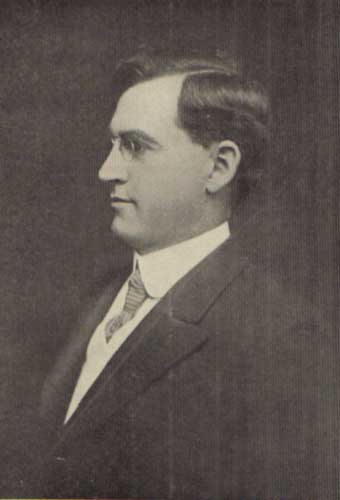
Mr. Dorr: I believe I am as old as you are and have gone the same gait exactly. I lost my job and went to farming. I was once a college professor, too, but there are things I find now I didn't find then. Two nurserymen come to me and sell me two Grimes Golden apples. I plant them side by side and they do not turn out alike. Why not if they are grafted trees? I am not knocking, you misunderstand me, I am a truth seeker.
Professor Smith: I believe that. We always find something we didn't buy. My head man says they jump in. I have some very fine specimens that came by accident, and of course we have a certain amount of bud variation. We find variety even by propagation. The trees will vary the same as people will but they will vary a great deal more if we get the seedlings. The successful growth of nuts, as of any other fruit, demands the use of top worked trees from the best known parentage. That is the way we do with apples, peaches, pears, and cherries. Nuts will have to come in the same class from the best known parentage. The big thing today is to find out the best known parentage and then spread knowledge so that no editor will be capable of fooling people as in the article I read a few minutes ago.
That is point number one. My point number two is a different one. It is the question of the names of the varieties of northern nut trees, particularly the names of the pecan trees. Twenty years from now there will be a million people in the North who will gravely tell us the pecan grows down South, not in Indiana, and that you can't grow them up here. I haven't a doubt there will be a million people that will believe that twenty years hence. How can we get that idea out of their heads? I think we have an agency in the mere names of the trees which will cause people to buy more, yes a hundred thousand or two hundred thousand more trees, than they do at the present time. If we pick out one name, Indiana, what does it mean? It will make a man ask questions, and if he has any curiosity at all he will want to know if it grows in Indiana and if it will grow in any state with practically the same latitude as Indiana. But if he hears the name Schley, what does it mean? Nothing, because practically everybody has quit thinking about Admiral Schley. I recall eight varieties of northern pecans three of which have good names and three perfectly worthless ones. Indiana, Kentucky and Green River are the good ones. Green River is the least valuable because it is not well enough known. Indiana and Kentucky are great names because they are the names of great states. Then we have Busseron, Warrick, Posey and Buttrick. The Busseron nut which grows up at Vincennes ought to be renamed Vincennes. There will be thousands more sold in Vincennes when it is known from the name that it did not originate in Pennsylvania but that it is a product of Vincennes. My point is this, it gets a name that shows it to be a northern product. I am not going to fight for that particular name but it is growing at Vincennes and that is a perfectly good reason for it to be named after that well known city. Now we come to the Posey. It grows on the banks of the Wabash and ought to be named the Wabash. Nobody knows anything about Posey County and what the reason is for the name, but the banks of the Wabash where it grows have been made famous in song. We can hook a sign on that pecan that will sell twenty or thirty thousand more Poseys than are sold now. Next we have the Buttrick which is found growing in Illinois. That is the reason why those Buttrick pecans will sell under the name of Illinois. It is named for a man but it doesn't mean anything in the world but women's dress patterns and is not a good name for a pecan.
Mr. McCoy: A change in a name like Buttrick to Illinois is a good one. Any name like this that tells by itself the fact that the nut is from the North is worth a lot to the people who want to sell pecan trees, and to the people who want to eat pecans, and can buy them reasonably. Therefore, Mr. Chairman, I move that a special committee be appointed to consider changing the names of these pecans and giving them names showing that they are northern nuts.
Mr. Potter: I second that motion.
The President: It has been moved and seconded that a committee be appointed to consider the matter of changing the names of some of the pecans.
A Member: Isn't there a Vincennes in Europe?
The President: There might possibly be more suggestions, and we should be glad to hear from anyone along this line.
Mr. Reed: I agree with Professor Smith in part of his remarks. We have a walnut called the Ontario from Greene County, Michigan. If we should call it Michigan that would indicate where it came from. But it is widely known now as the Ontario, and would it be best to change its name, even though it comes from Michigan?
Mr. McCoy: Wouldn't it have been better to have called it Michigan to start with?
Mr. Reed: I think so.
Mr. McCoy: We have pursued these things for many years and we have made some misnomers in naming them. I think it's a good idea to change them.
Mr. Potter: I am very much pleased with the idea Professor Smith has advanced for renaming these trees. They don't mean anything now as he says, and I think it would be a great forward stride for this association to rename these trees.
Mr. Simpson: I think Professor Smith's idea is a move in the right direction. We were the first people that propagated any of these northern varieties, and my idea is to call that variety Indiana, for the very reason he mentions here, that it distinguishes it as a northern variety. I think his suggestion ought to be followed out as far as it is possible. At least with several varieties.
The President: The chair takes the opportunity of saying that the suggestion meets his most hearty approval. I have taken up pages of letters in writing to people about nuts, and explaining to them that the nursery from which they bought had nothing to do with the hardiness of the tree, that it was the location of the parent tree that determined this. I was struck by an advertisement last year which said, "buy them from the nursery furthest north." That hasn't a thing in the world to do with it. You may take some of this very wood we have here and propagate it on the McKenzie River, or the Yukon, and say you are selling trees propagated in Alaska, but the hardiness all depends on where the parent tree is. These parent trees have been placed there by nature, and when we distribute them we will distribute what nature has put into the parent tree. These trees are there because they have withstood all the climatic conditions, and nothing would be of more value, it appears to me, than to adopt the suggestion for renaming them. In the first place many of these trees are named for men not entitled to have them named for them. Many of those who own these trees do not know their value and object to anyone that knows anything about a nut tree going in and getting bud wood, and are contrary and mean about it. It is very rare that the importance of these seedling pecans is known to their owners, and they are not entitled to any consideration themselves. They are generally discovered by some outsider who had to beg to go in and get a stick of bud wood. Is there any further discussion?