THE RIGHT BANK OF THE RIVER
Frederick Lawton translation
The Arsenal quarter, built over the site of the two Royal Palaces—the Saint-Paul mansion, the Tournelles palace—and the soil of the Louviers Isle, joined to the river bank in 1843, serve as a natural transition from the old to modern Paris.
THE LESDIGUIÈRES MANSION
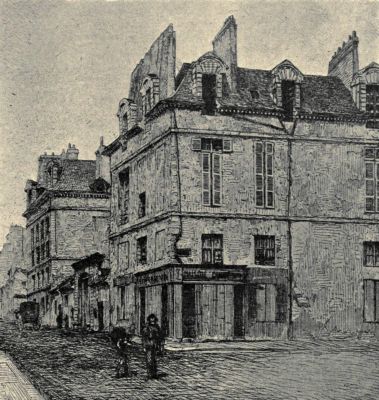
Notwithstanding its warlike name, the Arsenal quarter is one of the most peaceful parts of the Capital. Centuries ago, the palaces disappeared that brought it its wealth, life and movement. On their ruins and their huge gardens, humble, tranquil streets have been made: the Rue de la Cerisaie, where Marshal Villeroy received Peter the Great in the sumptuous Zamet mansion; the Rue Charles V., where once was the elegant home of the Marchioness de Brinvilliers, now at No. 12, premises in which a white-capped sister-of-charity distributes cod-liver oil and woollen socks to poor, suffering children; the Rue des Lions-Saint-Paul; the Rue Beautreillis, where Victorien Sardou was born; near there the great Balzac dwelt. "I was then living," he says in his admirable Facino Cane, "in a small street you probably don't know, the Rue de Lesdiguières. It commences at the Rue Saint-Antoine, opposite a fountain near the Place de la Bastille, and issues in the Rue de la Cerisaie. Love of knowledge had driven me into a garret, where I worked during the night, and spent the day in a neighbouring library, that of Monsieur. When it was fine, I took rare walks on the Bourdon Boulevard." This modest Rue de Lesdiguières still exists in part; on the site occupied by Nos. 8 and 10, could be seen, a few years ago, one of the containing walls of the Bastille; narrow houses have been stuck against it; and, at No. 10, it is the very wall of the old Parisian fortress which constitutes the back of the porter's lodge! What a destiny for a prison wall!
Of what was once the Arsenal only the mansion of the Grand Master is left; it is, at present, the Arsenal Library—formerly called, as Balzac says, the Library of Monsieur. It used to be a fine dwelling, the home of Sully, and possesses priceless books and autographs, and most valuable writings. In a coffer, covered with flower-de-luces, may be admired Saint Louis's book of hours, side by side with a fragment of his royal mantle, the blue silk of it, worn with time, being strewn with golden flower-de-luces; the old book bears this venerable inscription: "It is the psalter of Monseigneur Loys, once his mother's;" and was taken from the scattered treasures of the Sainte-Chapelle. Then there is Charles the Fifth's Bible with the King's writing on it: "This book (belongs) to me, the King of France;" and a missal, each leaf of which is framed with an incomparable garland due to the brush of the "master of flowers," a great artist whose name is unknown to us. Besides, there are rare manuscripts, marvellous bindings, unique editions, romances of chivalry, classics, poets of every age, complete in this fine palace; together with Latude's letters, the box that served for his ridiculous attempt against Madame de Pompadour; and, near them, the cross-examination of the Marchioness de Brinvilliers, and the death-certificate of the Man in the Iron Mask; Henri IV.'s love-letters too, with his kisses sent to the Marchioness de Verneuil, and the documents relating to the affair of the Necklace. How many more things in addition...!
Let us add that the curators—Henri Martin, so learned and obliging, Funck-Brentano, the exquisite historian of the Bastille, the picturesque relater of all its dramas. Sheffer and Eugène Muller are not only scholars needing no praise but most courteous and genial men—and you will quite understand why the Arsenal is one of the few corners in Paris where it is delightful to go and work or to saunter about. Indeed, it is a tradition of the house. Nodier, good old Nodier, who was one of Monsieur de Bornier's predecessors and a predecessor also of J. M. de Heredia, the master who has so recently gone from us, Nodier, the admirable author of the Trophées, had succeeded in making the Arsenal the centre of literary and artistic Paris. Hugo, Lamartine, de Musset, Balzac, Méry, de Vigny, and Fr. Soulié used to meet there; and fine verses were said while regarding the sun glow with red flame behind the towers of Notre Dame.
"The towers of Notre Dame his name's great H composed!"
wrote Vacquerie.
Of the Bastille nothing remains except a few stones which formed the substructure of one of the old towers; and these have been carefully removed to the Célestins Quay, along the Seine, where they are visible to-day. In vain, therefore, would any one now seek for a vestige of the sombre fortress over which so many legends hovered. Latude's great shade itself would hardly locate the spot; and yet how full Paris history is of this traditional Bastille, which the people, amazed with their easy victory, could not tire of visiting after the 15th of July 1789. Such was their curiosity and such their eagerness that Soulès, the governor appointed by the Parisian municipality, was compelled to stop the visits, on the curious ground "that such damage had already been done to the fortress by visitors that more than 200,000 livres would be required to repair it." Repair the Bastille! The souvenir manuscripts of Paré tell us the fury excited by this strange pretension in Danton, sergeant of a section of the National Guard, who, with his company, was turned back by the order.
Danton had himself admitted into the presence of the unfortunate Soulès, seized him by the collar and dragged him to the Town Hall; the prohibition was removed; and Citizen Palloy was thenceforth allowed to exploit the celebrated State prison. The stones were "hewn and cut into images of the fortress and dedicated to the various departments and assemblies," or into "commemorative slabs intended to rouse people's courage." Palloy cut up the leads into medals, and made rings with the iron chains; out of the marble he manufactured games of dominoes, and had the delicate thought to offer one of these games to the young Dauphin to inspire him with "the horror of tyranny."
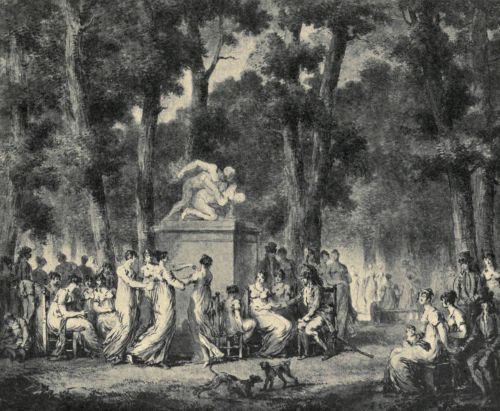
COMMEMORATIVE BALL ON THE RUINS OF THE BASTILLE Dancing here From a coloured engraving of the eighteenth century
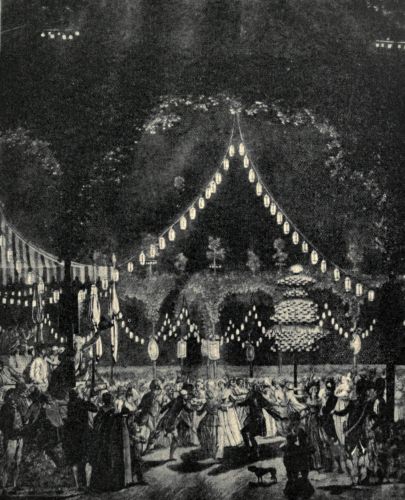
Balls were held on the site of the Bastille. Wine flowed, fiddles were scraped, and printed calicoes of that period show us the ruins of the old Parisian citadel surmounted with this inscription: "Dancing here."
The huge space left vacant by the demolition had to be filled up. Napoleon I., whose artistic conceptions were sometimes disconcerting, had constructed there, in 1811, by Alavoine, a strange sort of fountain of bizarre appearance: it was a colossal elephant, twenty-four metres high, which spouted water from its trunk. Built temporarily in plaster and mud, the elephant quickly crumbled away under the action of weather and rain; and soon became a lamentable débris surrounded with disjointed planks. The urchins of the district made it the scene of Homeric struggles; but the real familiars were the rats that had made their home inside the structure, so that, when the demolition began, regular battues had to be organised with men and dogs; and, for months, these dreaded rodents infested the terrorised quarter. In 1840, the present column was erected; since then, the genius of Liberty has poised over Paris his airy foot, and Barye's fine lion watches over the repose of the victims of 1830 that are interred within the crypt of the monument.
THE SENS MANSION ABOUT 1835 From a lithograph by Rouargue
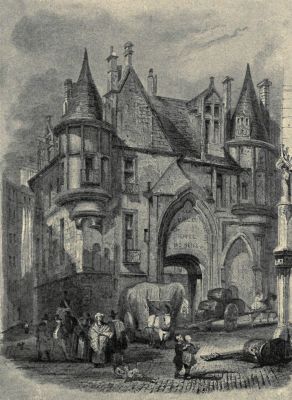
The Rue Saint-Antoine contains certain handsome mansions: the Cossé mansion, where Quélus died; the Mayenne and Ormesson mansion, built by du Cerceau on the remains of the Saint-Paul mansion and Germain Pilon's studio; the Sully mansion, whose noble front was not long ago mutilated. Hard by, at the corner of the Rue du Figuier and the picturesque Rue de l'Hôtel de Ville, which latter used to be the Rue de la Mortellerie, stands what is left of the Sens mansion, the only specimen, together with the Cluny Museum, of what private architecture was in the fifteenth century. After being inhabited by Princes of the Church, Bishops, Cardinals, and also by Marguerite de Valois (Queen Margot), the Sens mansion fell on evil days. It became the "Diligence Office"; and from its courtyard is said to have started the famous courier whose murder was attributed to Lesurques, the unfortunate Lesurques popularised by the well-known drama performed at the Ambigu, which caused so many tears to flow.
In more recent times, the Hôtel de Sens derogated further still. It became a manufactory of sweets!
At No. 5 of the Rue du Figuier, we meet with a draw-well, the top of which is finely sculptured; the spot brings back the memory of Rabelais, the admirable Rabelais, who died quite near, in the Rue des Jardins. At No. 15, opened the sixteenth-century door through which the actors of the illustrious theatre established on the ancient site of the Jeu de Paume de la Croix-Noire, proceeded to their private stage-room. It was before this door that Molière was arrested and taken to the Châtelet, because he owed "142 livres to Antoine Fausseur, master-chandler, his purveyor of light."
Let us cross the Place de la Bastille and go down the Rue du Faubourg-Saint-Antoine. There, at No. 115, in front of an old eighteenth-century house, the Deputy Baudin was killed against a barricade, on the 3rd of December 1851. At No. 303, in the reign of Napoleon I., stood Dr. Dubuisson's private hospital, where General Malet was confined. There he hatched the prodigious plot the disconcerting history of which we intend shortly to relate. Farther on, near the Rue de Montreuil, we pass by the remains of Réveillon's wall-paper stores, pillaged on the 17th of April 1789; it was one of the preludes of the Revolution.
Last of all, at No. 70, in the Rue de Charonne, Dr. Belhomme's private hospital stood, which was used as a special prison under the Revolution. Only those were admitted who could pay and pay well. The irrefutable memoirs of Monsieur de Saint-Aulaine reveal to us a Belhomme familiar, cynical, exacting his fees and thouing Duchesses short of money who haggled with him on the question of their life. The most amiable of historians, my excellent friend G. Lenôtre, whom it is always necessary to quote when facts of the Revolutionary epoch are in question, has reconstituted the terrible and surprising story of the Belhomme institution where they laughed, danced, or even flirted under the dread eye of Fouquier-Tinville; and has related, with his habitual documentation, the bizarre liaison of the Duchess of Orléans, widow of Louis-Philippe Egalité, with Rouzet, the Conventional, buried later at Dreux under the name of the "Count de Folmon" in the Orléans family vault.
Pursuing our way and passing by the Church of Sainte Marguerite, in which Louis XVIII. was interred ... or his double, we reach the barrier of the Throne (the Throne overthrown, people said in 1793). The scaffold, which had temporarily quitted the Revolution Square, was put up here during the most terrible period of the Terror, and the "great batches" were executed upon it. In six weeks, 1300 victims perished, among them, André Chénier, the Baron de Trenck, the Abbess of Montmorency, Cécile Renaud, Madame de Sainte-Amaranthe, the poet Roucher, and many others. The bodies of these unfortunate people, stripped of their clothing, were loaded each evening on covered waggons, with their severed heads between their legs; and the horrible vehicle, dripping with blood along the road, was tipped into some pit dug at the bottom of the Picpus Convent Gardens, where still exists the cemetery of those that were executed during the Revolution.
Retracing our steps, we arrive at No. 9 of the Rue de Reuilly; here was once the Hortensia Tavern, kept in 1789 by the famous Santerre, a major in the National Guard. The house has not much changed; at present, however, it is a girls' boarding-school which occupies the large rooms where the thundering General organised those terrible descents on Paris and launched those dreadful battalions of the faubourg that terrorised even the Convention itself.
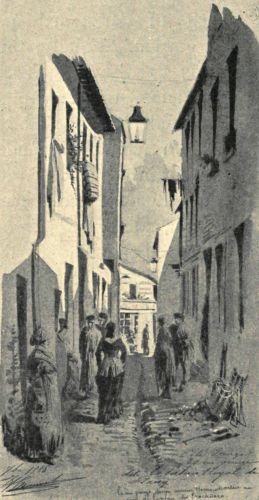
THE PROVOST HUGUES AUBRYOT'S MANSION CHARLEMAGNE'S COURTYARD AND PASSAGE IN 1867 Drawn by A. Maignan
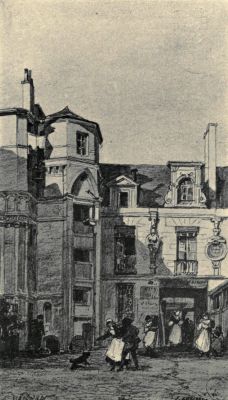
On the other side of the Place de la Bastille, in the Rue Saint-Antoine, near Saint Paul's Church, is the Charlemagne Passage, most picturesque by reason of the old souvenirs it contains and the strange population it harbours: chair-menders, mattress-carders, milk-women, open-air flower-women gather round the ruin of the charming mansion which, under Charles V., was the sumptuous abode of the provost, Hugues Aubryot.
The front, which is still remarkable and fine-looking, is an astonishing contrast to the poor, low houses that huddle round it. Fowls peck at the foot of the fifteenth-century turrets, which enclose a handsome staircase; and patched linen dries on iron wire stretched between the caryatide windows of the seventeenth century, replacing those behind which once mused the Duke d'Orléans and the Duke de Berri, as also, in 1409, Jean de Montaigu, beheaded for sorcery! who were formerly illustrious guests in this elegant dwelling.
And now, let us stop at the Vosges Square on the other side of the Bastille. It is another rare nook of our old City, which, through the centuries, has preserved its ancient character very nearly intact. The houses there, in Louis XIII. style, have not changed. The scenery has remained the same. The Précieuses could take their favourite walks there; and those punctilious in honour might draw their sword, as in the time of Richelieu and the Edict-malcontents; only the public of spectators would be quite different. The fine ladies of the country hight Tender, the Cydalises and Aramynthas, the lords once living in those noble dwellings, they who, on the 16th of March 1612, were present at the tournament given by the Queen Regent, Marie de Médici, in honour of the peace concluded with Spain, or they who proceeded in grand coaches to the fair Marion de Lorme's or to Madame de Sévigné's, are to-day replaced by petty annuitants, modest shopkeepers retired from business and pensioned-off officers. Humble charwomen work at their tasks in the spots where Mazarin's nieces paused in their sedan-chairs; and the numerous Jews that live in the quarter meet there on Saturdays. It is a curious spectacle to see these men and women of strongly marked type betaking themselves to the Synagogue, which is near a partially subsisting eighteenth-century mansion still bearing delicate decorations, but at present occupied by a butcher, in the Rue du Pas-de-la-Mule. Not a few old men wear the long gaberdine, their hair in corkscrew curls, and earrings in their ears. Velvet-eyed girls coifed with bands, wonderfully handsome and peculiarly dressed, assemble there on certain religious feast-days. It is a strange evocation; 'twould seem that in these peaceful quarters biblical traditions have been preserved in some Jewish families.
THE PLACE ROYALE ABOUT 1651 (NOW THE VOSGES SQUARE) Israël, del.
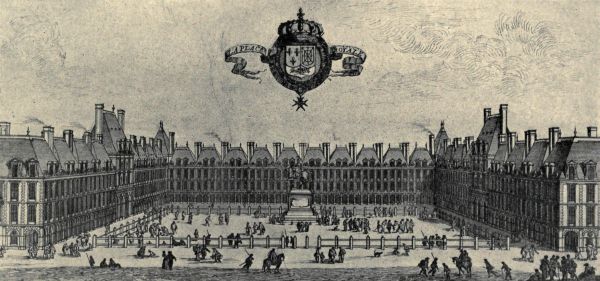
The old-time animation, however, is an exception. The Vosges Square, once the Place Royale, where Richelieu lived and Fronsac, Chabannes, Marshal de Chaulnes, Rohan-Chabot, Rotrou, Dangeau, Canillac, the Prince de Talmont and Mademoiselle du Châtelet, where Madame de Sévigné was born, where the tragic actress Rachel dwelt, and Théophile Gautier and Victor Hugo, is to-day completely neglected; and this delightful Paris nook, where so much wit was spent, such fine ladies rivalled in grace and elegance and so many exquisites drew their swords, is now nothing but a large, lonely garden, provincial and melancholy, frequented almost exclusively by the pupils of neighbouring boarding-schools, who play there at prisoners' base, and leap-frog, beneath the debonair shadow of Louis XIII.'s statue, with its philosophic frame of a Punch-and-Judy show and a chair-woman's stall.
In the ancient Rue Culture-Sainte-Catherine (at present called the Rue de Sévigné) on the site now occupied by No. 11, formerly stood the Marais theatre, built with money provided by Beaumarchais. In 1792, the Guilty Mother was performed there, for the benefit, said the play-bill, "of the first soldier who shall send citizen Beaumarchais an Austrian's ear." The modern building is a modest private-bath establishment, with a small garden in front in which grow some spindle-trees—in boxes, and which is adorned with silvered balls. The huge wall, all grim and grey, backing the slightly-built bath establishment, is the old wall of the Force Prison, where, on a post at the corner of the Rue des Balais, Madame de Lamballe was executed, where also Madame de Tallien was transferred, and Princess de Tarente was confined, the latter, the grandmother of the kind, courteous and learned Duke de la Trémoïlle, who had only to dip into his incomparable family archives to give us the most precious documents of French history, and to whom we are indebted for those picturesque and exciting "Souvenirs of Madame de Tarente," one of the most valuable narrations by an eye-witness of the Revolutionary period.
The Carnavalet mansion, Madame de Sévigné's "dear Carnavalette," is close by, as also the ancient Le Peletier-Saint-Fargeau mansion, to-day the City of Paris Library. It is a fine, large building of noble appearance, which contains wonderful books, maps, plans and manuscripts. The written history of Paris is there; and all workers know the pretty, sculpture-ornamented room of Monsieur le Vayer, the erudite, obliging Curator of these fine collections. Messieurs Poète, Beaurepaire, Jacob, Jarach and Wilhem, in the Library; Messieurs Pètre and Stirling in the History room are the wise and welcoming hosts of this admirable Parisian Library.
All this Marais quarter, indeed, contains sumptuous mansions, not one of which, alas! has been respected. All are given over to business and manufacturing. The Lamoignon mansion is occupied by glass-polishers and garden-seatmakers; the Albret mansion by a bronze lamp-dealer; those of Tallard, Maulevrier, Sauvigny, Brevannes, Epernon, &c., are still standing, but in what a state! The Rue des Nonnains-d'Hyères offers us its curious bass-relief, in painted stone, representing a knife-grinder in eighteenth-century costume. In 1748, a Madame de Pannelier kept a "wit-office" in this same street; Lalande, Sautereau, Guichard, Leclerc de Merry used to attend meetings there. They were held on Wednesdays, and were preceded by an excellent dinner. The tradition has happily been preserved in Paris.
In the Rue François-Miron, one sees a spacious, handsome mansion with circular pediment, escutcheons and garlands. It is the Beauvais mansion, built by Le Pautre in 1658.
To look at it now, old and in a dull street, one would hardly think that the coaches of Louis XIV.—King Sun—had passed under the dark vault of the entrance gate and that, from the top of the central pavilion balcony, Queen Anne of Austria, in company with the Queen of England, Cardinal Mazarin, Marshal de Turenne and other illustrious nobles, had watched her son Louis XIV. and her daughter-in-law, the new Queen Marie-Thérèse of Austria, go by as they made, through Saint-Antoine's Gate, their solemn entry into Paris on the 26th of August 1660![3]
On account of its picturesque aspect and the fine mansions it contains, the Rue Geoffroy-l'Asnier is one of the most curious in Paris. At No. 26 stands the Châlons-Luxembourg mansion, with its monumental door and wonderful knocker. At the bottom of the courtyard is an exceedingly elegant Louis XIII. pavilion in brick and stone, and of delicate proportions. The mansion was built for the second Constable of Montmorency, and though it is quite lost in this gloomy quarter, it maintains its proud bearing.
After the Revolution, this street, whence nearly all the owners of houses had emigrated, if they had not been guillotined, was completely stripped of its former splendour. Petty annuitants, small clerks, and poor people took up their abode in the abandoned buildings. Grass grew in the streets; many of the dwellings had been sold as national property; and the Rue Geoffroy-l'Asnier underwent the common fate; it became democratic.
THE RUE GRENIER-SUR-L'EAU IN 1866 Drawn by A. Maignan
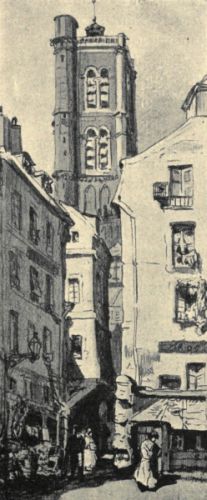
Between this street and the neighbouring Rue des Barres, one is surprised to see a sort of fissure so narrow that two persons would find it difficult to walk abreast through it, a sort of corridor along which the wind sweeps past dilapidated, leaning houses on either side. It is the Rue Grenier-sur-l'Eau, wretched and dirty enough, but quaint, with the glorious tower of Saint-Gervais-Saint-Protais in the background, rising and standing out against the sky.
The proper moment to take a look at the sinister little Rue des Barres is on a stormy night, behind the church of Saint-Gervais. It is then easy to imagine what this quiet quarter must have been like when, on the 9th of Thermidor, about eleven in the evening, 'mid torch-lights, calls to arms, the noise of the tocsin and shouts of the multitude, the dead body of Lebas was brought thither, and, on a chair, Augustin Robespierre, who had broken his thighs in leaping from one of the Town Hall windows. The dead man and the dying man were dragged to the Barres mansion transformed into a Sectional Committee Tribunal. On the morrow Lebas was buried, and Robespierre was carried before the Committee of Public Safety, who sent him to the scaffold.
THE SAINT-PAUL PORT Water-colour by Boggs (G. Cain Collection)
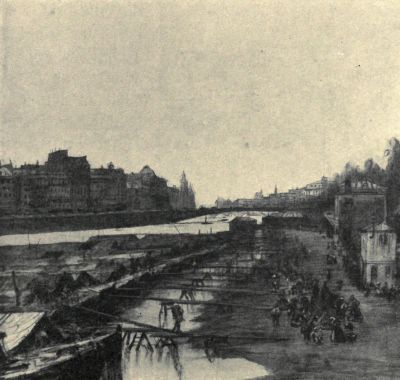
The Rue des Barres descends to the Seine, near the old Town Hall Quay, where the big, flat boats laden with apples, stones, or sand take their moorings. Into it opens one of the exits of the charming Church of Saint-Gervais, whose fine painted windows, masterpieces of Pinaigrier and Jean Cousin, were almost totally destroyed twenty years ago by an explosion of dynamite. Against the church walls, in the laicised ruins of an ancient chapel, a sweet manufacturer has installed his alembics and copper pans; and it is a curious sight to see the lighted fires of this strange kitchen beneath these antique Gothic arches, between these blackened pillars still bearing traces of the candles that once burned in front of the holy images, on a ground formerly used for burying and even now concealing bones. The out-offices of the old church still remain, wonderfully picturesque, and open into the Rue François-Miron, No. 2, on the left of the entrance portal of the church, between a laundress's establishment and a furniture-remover's premises!
THE BARBETT MANSION The Rue Paradis-des-Francs-Bourgeois and the Rue Vieille-du-Temple in 1866 Drawn by A. Maignan
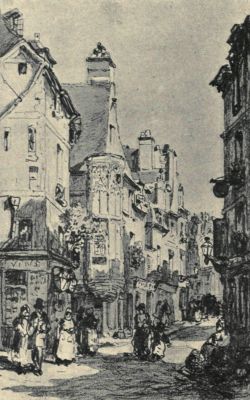
On one side, the little Rue de l'Hôtel-de-Ville brings us to the Rue Vieille-du-Temple, where we can admire, at No. 47, what is left of the quaint mansion of the Dutch Ambassadors, where "Monsieur Caron de Beaumarchais and Madame his spouse," as an almanac of 1787 called them, established in 1784 a Provident Institution for poor nursing mothers. Indeed, it was for the benefit of this undertaking that the fiftieth performance of the Mariage de Figaro was given. Farther on, to the right, at the corner of the Rue des Francs-Bourgeois, stands the pretty turret built about 1500 for Jean Hérouet; and, last of all, the fine Rohan palace, which to-day is the National Printing House. This last is a noble and spacious building which the elegant Cardinal that once lived in it took pleasure in sumptuously decorating. A masterpiece may be seen there, "the Horses of Apollo," in a wonderful bass-relief by Pierre Le Lorrain. The saloon of the Apes, by Huet, is charming, and the private room of Monsieur Christian, the witty and learned Director of the National Printing House, contains a beautiful Caffieri time-piece. Why must, alas! this fine palace be condemned soon to disappear? The Rohan mansion is to be demolished, and the State will commit the sacrilege! May the endeavours of lovers of Paris succeed in preserving for us this precious vestige of a past that each day removes farther from us!
A cabman whose astonishment must have been great was a certain George who, on the 22nd of October 1812, at half-past eleven in the evening, amid a driving rain that turned the miry soil of Saint-Peter's pudding-bag (now the Villehardouin blind alley) into a veritable bog, saw get out of his cab, near the Rue Saint-Gilles, a completely naked man, with his uniform under his arm—a soldier whom, twenty minutes before, he had picked up in the Louvre Square. This strange passenger was Corporal Rateau, proceeding to the appointment made with him by General Malet, inside Dr. Dubuisson's private hospital and asylum, 303 Faubourg-Saint-Antoine, where the latter was confined by the authorities. In his haste to put on the fine uniform of an orderly officer, which was ready for him in exchange for his own, Rateau had undressed in the cab; and up the dark staircase of the gloomy house in the gloomy street he rushed with absolutely nothing on.
The little house still exists, wretched and dingy-looking, where Malet appointed to meet his accomplices, on the third floor in the abode of the Abbé Cajamanos, an old bewildered Spanish priest who had quitted the Bicêtre asylum.
This adventure of General Malet's is both prodigious and disconcerting. For, in 1812, at the moment when Napoleon seemed to be at the summit of his power, Malet, in a sort of dungeon, with the help of five or six obscure assistants, an old priest with hardly any knowledge of French, a half-pay officer, an almost illiterate sergeant and a few other hare-brained people, had been able, even while confined, watched and suspected, to combine everything, prepare everything, so that the report of the Emperor's death might be believed—the Emperor being absent in the icy steppes of Russia, and no news arriving from him. And his calculations were justified. All the Imperial functionaries, from Savary, the head of the police, down to Frochot, the Prefect of the Seine, accepted General Malet's allegations, without testing or discussing them. Especially, all believed his fine promises; and it is hard to say where the hoaxer would have stopped if an officer, simply obeying his orders, had not refused to be gained over with fine words, and asked for proofs. Malet, being taken aback, grew impatient, and replied with a pistol-shot. Major Doucet forthwith arrested him, and the comedy ended in a tragedy.
All the more haste was made to get rid of the organisers of this plot, which had so nearly succeeded, as it was necessary to suppress as quickly as possible their awkward testimony to such cowardice, lying, and compromise.
The poor dwelling in the Villehardouin blind alley was searched by all the Paris police; papers, uniforms, cocked hats, and swords were fished out of the little well, still existing, into which they had been wildly thrown. In a few hours, Malet, Lahorie, Rateau, and Guidal were tried, condemned, and executed. The replies of the General to the Tribunal that so summarily judged him were home-thrusts. Asked (somewhat late) who were his accomplices: "All of you," he said, "if I had succeeded!"
Taken to the wall of evil memory in the plain of Grenelle, he insisted on giving the firing-order to the execution-platoon; and, as if he had been on the drill-ground, made the soldiers repeat the aiming movement, which had not been carried out with military precision. Rateau, who, as a matter of fact, had understood nothing of this strange drama, in which he had been one of the most picturesque confederates, is said to have died in crying: "Long live the Emperor!"
Between the Archives and the Rue Sainte-Croix-de-la-Bretonnerie, there was once a large monastery, which, in 1631, became the property of the Carmelite Billettes,—the name being derived from an ornament worn by these monks on their gowns. The Revolution suppressed the monastery; but the small cloister has come down to us with its charming proportions and its monastic cosiness. To-day, it is a Town School, and the neighbouring church is devoted to Protestant worship.
THE RUE DE VENISE Water-colour by Truffaut (Carnavalet Museum)
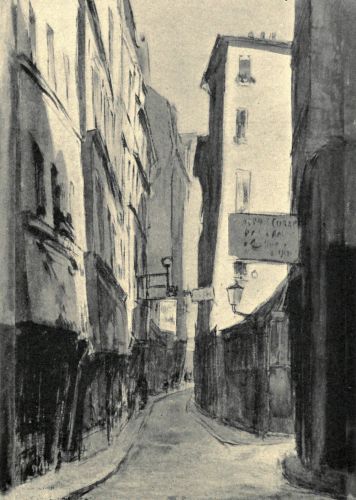
The Rue de Venise, one of the most ancient Paris streets, is not far away. It is now a low, bad-smelling lane inhabited by vagabonds of both sexes. Women, whose age it is impossible to tell, trail and traipse in front of alleys within which loom greasy, black staircases. Mended linen hangs from the windows; acrid smoke issues from between thick bars protecting old mansions now degenerated into mere dens, defended, however, by heavy doors studded with rusty nails.
It is hideous, yet quaint, as indeed all this quarter, which is made up besides of the Rue Pierre-au-Lard, the Rue Brise-Miche, and the Rue Taille-Pain; not forgetting Saint-Merri's cloister, the name being that of the old church whose tocsin so often sounded the alarm during the riots in the reign of Louis-Philippe.
At the least popular excitement, this inextricable labyrinth of small streets used to bristle with barricades. At the crossing of the Rue Saint-Martin and the Rue Aubry-le-Boucher was raised the terrible barricade defended by Jeanne and his intrepid companions. Following on the burial of General Lamarque, who died while pressing to his lips the sword offered to him by the Bonapartist officers of the Hundred Days, an immense revolutionary movement had galvanized Paris. The old soldiers of the Empire, the survivors of the Terror and those of 1830, allied in their common hatred of Louis-Philippe's government, had joined the malcontents of all parties and the members of the then numerous secret societies. In the evening of the 5th of June 1832, the centre of Paris was covered with barricades; and both troops and National Guard had been obliged to reconquer, one by one, the positions that had been lost. Slaughter had been going on the whole night. When the dawn of the 6th of June tinged the house-roofs with pink, the large Saint-Merri barricade was seen to be holding out; its defenders, a handful of heroic men, had sworn to bury themselves under its ruins. Already they had repulsed ten furious assaults; now they were awaiting death; and the loud tones of the Saint-Merri tocsin, unceasingly sounding above their heads, seemed to be tolling their funeral knell! Part of the Paris army had to be utilised to vanquish these dauntless insurgents. Firing went on from windows, cellars, the pavement. Round the barricades, dead bodies of National Guards and soldiers, riddled with balls, crushed beneath blocks of stone hurled from roof-tops, testified to the frightful savagery of this intestine struggle. For long afterwards, the ground was red with blood! What numbers of balls and bullets, what quantities of grapeshot all these old house-fronts have received in the haphazard of riots, frequent during the reign of Louis-Philippe.
The drums no sooner beat than the citizens armed and hurried to defend order ... or to attack it; anxious women, cowering behind closed shutters, watched for the biers.
Things resumed their ordinary course immediately the disorder was over; the insurgent hobnobbed with the honest National Guard whom he had aimed his gun at on the day before. Sometimes, however, grudges remained.
THE RUE DU RENARD-SAINT-MERRY Etching by Martial
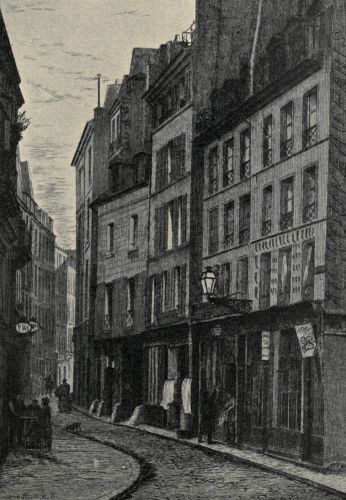
My parents knew an old woman, living in the Rue Saint-Merri, who, for forty years after 1836, never passed without trembling by the door of the tenant underneath her flat. As people were surprised at this persistent apprehension, she said: "If you only knew what happened to me!" and she related that, one evening when there was a riot and her husband had been absent all day firing in the ranks of the National Guard, she was in the house alone, mad with anxiety; suddenly, at the corner of the street, she saw a stretcher appear, covered with sacking, which the bearers deposited at her door. Was it her husband that they were bringing home dead? She rushed out, raised the edge of the cover and recognised in the person lying with smashed jaw, haggard eyes, bleeding from a ball in the cheek, the tenant underneath: "Ah, what a good thing!" she cried; "it's you, Monsieur Vitry!"
Since that day Monsieur Vitry had given her the cold shoulder.
In the reign of Charles VI., under pretext of purifying the quarter—the pretext and the Vicar of Saint-Merri's complaint being only too well grounded—these "hot streets" were cleared of the majority of low, lewd people who had taken up their domicile in them. But, if morality had its claims, business also had its interests; and the worthy shopkeepers of the neighbourhood, deeming these of more importance than decency, energetically protested against the measure so prejudicial to their petty commerce. They gained the day, and, on the 21st of January 1388, Parliament reversed the Provost's decision, the result being that the merry band returned in triumph to their old haunts, celebrating the event with feasting and banqueting.
THE RUE DES PROUVAIRES AND THE RUE SAINT-EUSTACHE ABOUT 1850 Water-colour by Villeret (Carnavalet Museum)
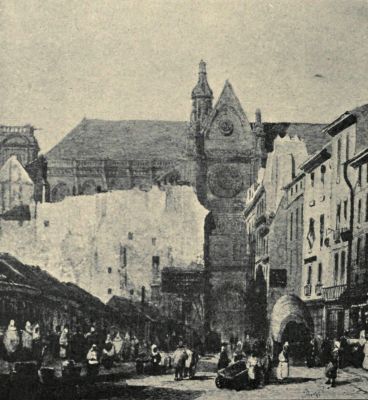
In his Chronicle of the Streets, our learned friend, Beaurepaire, librarian of the City of Paris, asserts that the Rue Pirouette, near Saint-Eustace's Church, owes its singular name to the "Market Stocks that stood at this spot. It was an octagonal tower with lofty ogival windows, in the centre of which was an iron wheel pierced with holes for the head and arms of vagabonds, murderers, panders, and blasphemers, who were exposed thus to public derision. On three consecutive market-days, for two hours each day, they were fastened in the stocks and turned every half-hour in a different direction. In other words, they were forced to 'pirouette,' whence the name of the street."
THE CENTRAL MARKET FOOT-PAVEMENT, NEAR THE CHURCH OF SAINT-EUSTACHE, IN 1867 Drawn by A. Maignan
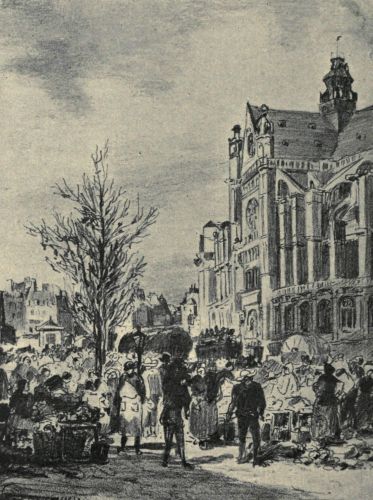
After doing penance there, in the olden times, malefactors betake themselves thither to-day to sup. The "Guardian Angel," a thieves' restaurant, exhibits its signboard almost at the corner of the street: in it rogues laugh, drink and sing, and hatch their morrow's exploits. The Staff of the army of vice make it their meeting-place. It is the fashionable resort, a sort of burglars' "Maxim-restaurant," where Paris hooligans deem it elegant to appear. Casque-d'or and his pals reign there, and the scoundrel who has just committed an evil deed is certain to secure good lodging within, and all else he requires. But it is not only knights of the blood-letting industry who inhabit this noble dwelling; other lords come there to eat snails and drink champagne: suspicious-looking young men with plastered hair, who noisily spend their money gained by blackmailing or some other reprehensible action. The place is a disgrace to the Capital. The landlord affirms that there are honest folk among his customers. The thing is possible—anyway, they must find themselves in very bad company.
Quite close, almost next door, at No. 5, is the "Helmet Courtyard," which gives us a striking impression of what ancient dwellings were. It was, in fact, once a sumptuous fourteenth-century mansion; to-day, it is only a hand-cart repository, where shafts point up to the old ceilings with their projecting beams, shafts shiny with use, and a fishmonger's warehouse, in which Burgundy snails, and cooked or raw lobsters are sold. The nook is a quaint one, and the quarter also, with its remains of the Rue de la Grande-Truanderie, where, on the 10th of May 1797, one of the ancestors of Communism, Babœuf, was arrested.
Not far away used to be the Rue de la Tonnellerie, where Molière lived. This street disappeared when the Rue Turbigo was cut.
THE CENTRAL MARKET IN 1828 Canella, pinxit
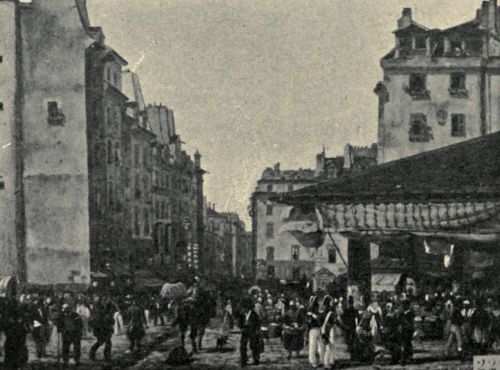
In the Central Market quarter, where every one works, where each shop offers to Paris gourmands the best victuals, the freshest vegetables, the daintiest fruits, where, every night, long files of market gardeners' carts bring in loads of provisions of all sorts, each street has, so to speak, its speciality. Housewives know where to find their poultry, crayfish, cheese, or oranges. All the little streets, skirting the Halles, are full of astonishing shops contrived in door-corners, or cellar-corners, all of which for generations have been kept by worthy husbandmen, petty dealers, hucksters, or basket-hawkers, having their own line, their own customers. In the curious Rue Montorgueil, old abodes that amaze one are still to be found; for instance, between Nos. 64 and 72, the ancient Golden Compass Inn, which was the calling place for so many generations of carriers. Its double entrance, blocked up with small butchers', tripe-dealers', and poulterers' stalls, opens on a huge yard, where fowls peck on heaps of golden dung, where ducks quack, and goats bleat under the eyes of some thirty horses, peaceful tenants of the ground floor, with their inquisitive heads thrust over the half-doors, through the low windows or open air-holes. At the back, beneath the spacious shed, the carriages and carts are put up, 'midst a healthy country smell of verdure and hay; and it really is a curious sight to see such a silent nook, with its farmyard, at the back of the noisy, populous, crowded street, full of workmen, pedlars, and shouts or cries of bubbling life and movement.
THE CENTRAL MARKET IN 1822 Canella, pinxit
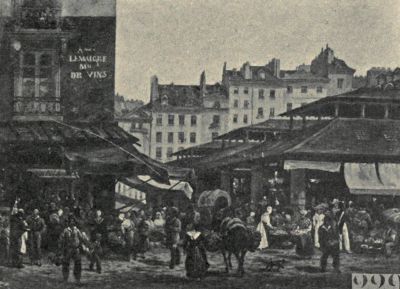
What is left of the Rue Quincampoix, behind the old Tower of Saint-Jacques-la-Boucherie, emphasises the strangeness of this neighbourhood, in which the exterior, though renewed, has been partly preserved, but which has been more modified and transformed as regards inhabitants and customs than perhaps any other quarter. It was, in fact, in the Rue Quincampoix that the famous Law established his offices of the Mississippi Bank. There, all Paris suffered the fever of speculation. The madness was general. For months nothing but folly and ruin reigned. All gambled—duchess, priest, philosopher and courtier, shopkeeper and ballet-actress, peer and lackey, excise-farmer and his clerk. In order to profit by proximity to the celebrated stock-jobber, each shop, room and cellar even, rented at foolishly high prices, was turned into a gaming establishment; and the case is quoted of a cobbler who hired for a hundred livres a day his stall stinking with wax and old leather; the gold mania had broken down all distinctions. And then the fatal crisis came, the panic, the crash. In the Rue Quincampoix one saw none but despairing faces. Every day there was a series of murders, suicides, attacks of lunacy. On one single occasion, twenty-seven bodies of suicides or murdered people were fished out of the river at the nets of Saint-Cloud. To speculate still, money at any price was needed. Highway robbery was practised, and the footpads were of all classes of society. One of these, the young Count de Horn, a relative of the Regent, and already notorious through his follies, hired two rascals of his own kind, enticed a rich young stock-jobber into an inn of the Rue de Venise, stabbed him and took his money. The scandal was enormous! Both Court and City lost their heads. Would justice at last act and severity be shown? There was a good deal of intriguing and excitement; but, finally, the Lieutenant for criminal affairs, acting on the orders of the Regent, arrested the Count de Horn, on the 22nd of March 1720; and, four days after, the latter was broken on the wheel and executed in the centre of the Grève Square, amidst the applause of all Paris.
MOLIÈRE'S HOUSE IN THE RUE DE LA TONNELLERIE Water-colour by Hervier
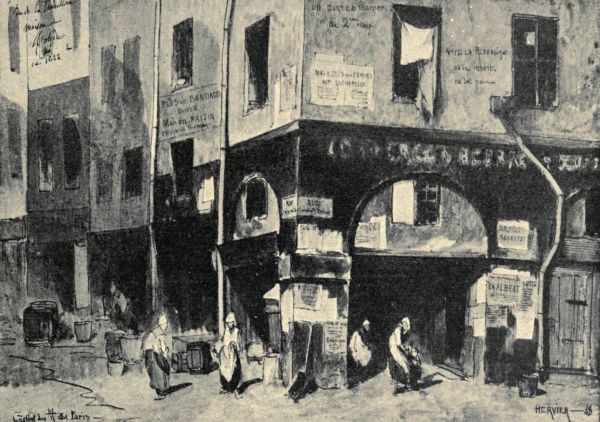
The Rue Quincampoix likewise contains some few old mansions now inhabited by certain "medical specialists," cheese-dealers, eau-de-seltz makers, &c. At Nos. 58, 28, 14, 15, and, notably, at No. 10, are seen remnants of forged iron, broken balconies, chipped grotesque masks of stone.... But the whole is tumbling to pieces, and to ruin, and only by a strong effort of the imagination can one reconstitute, out of these wretched fragments, the life of luxury, fever and stock-jobbing that once filled this old street, now foul with chemical smells and rancid odours of fried potatoes.
Collé's prophecy has been fulfilled: "One no longer belongs to Paris when one belongs to the Marais!"
Trade has laid hold of the fine mansions of yore; druggists have set up their distilleries in them, toy-makers sell their puppets in them, and the hawker with his Paris article is the monarch that governs them.
The population at present is poor, laborious, yet intelligent and active; and the contrast between it and the transformed dwellings wherein it dwells is not without interest and grace. A visit to the Archives, Marais and Saint-Merri quarters is certainly something no one should omit.
The picturesque line of central boulevards extends from the Bastille to the Madeleine Church. There Paris life may be studied under the most varied aspects, as well as the most elegant.
To speak of there being a general characterisation of the boulevards would be hardly correct, inasmuch as each of them has its special physiognomy.
THE TOWER OF SAINT-JACQUES-LA-BOUCHERIE ABOUT 1848 Lithographed by A. Durand
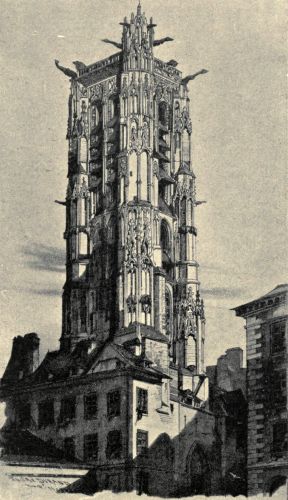
The Beaumarchais Boulevard has an atmosphere of middle-class tranquillity about it. Nothing has survived of the fine mansion, surmounted with a feather-shaped weather-cock and flag, which was built there by the author of the Mariage de Figaro, nor yet of the famous gardens, once the wonder of Paris, which could only be visited with a special card signed by Beaumarchais himself and given but to few. Yet some one of our own generation has known them, and penetrated into what for a while remained of the gorgeous abode; and that some one is Victorien Sardou. Did he have a presentiment that, in talent and wit, he would one day be the successor of the Beaumarchais whose property he thus intruded on? Anyway, in 1839, Victorien Sardou, aged seven, was living with his parents in the Place de la Bastille. With his little companions he used to play at ball or with hoop round the elephant and the canal banks. At the entrance to the Beaumarchais Boulevard of to-day some long, worm-eaten palisades bordered a piece of waste ground. On the palisades were hung halfpenny pictures of actors, actresses, and soldiers; and no one was fonder of looking at them than the little Sardou.
One day, while enjoying his open-air picture-gallery, he caught a glimpse of a huge garden through the interstice between two of the palings. "What was this garden?" "Suppose he entered!" So he and another urchin of his own age wrenched away a paling with the sticks of their hoops, and in a delight of terror slipped into the unknown domain. What an amazement! They found themselves in a Sleeping Beauty's realm. Weeds, lianes, branches, trees had grown over everything. It was a flora and fauna of the virgin forests; rabbits, birds and butterflies were its denizens; and Robinson Crusoe was not more surprised in exploring his island than these two youngsters in wandering about this jungle.
Sardou vaguely remembers there being a ruined pavilion and some tumble-down old walls; what he recollects better are the banks, ditches, and slopes where he and his companion had such delightful escapades; and nothing is more interesting than to hear this witty and charming talker relate his stories of the bygone Paris which he regrets so much and remembers so well.
The old dwellings have disappeared. A single one still exists at the corner of the Rue Saint-Claude, No. 1. It is the celebrated abode in which the talented charlatan, Cagliostro, installed his furnaces, his crucibles, his alembics, his transformation machines, all the weird utensils that served for his magic sittings.
The house has not been much altered. It remains, as always, strange, enigmatical, mysterious, with its staircases constructed in the body of the walls, its secret corridors, its mechanical ceilings, its cellars of many exits. The greatest lords, the noblest dames frequented this abode. Cardinal de Rohan was a familiar guest. The report ran that gold was made there, and that Cagliostro, the great Copht, had discovered the secret of the philosopher's stone! He offered, continued the legend, repasts of thirteen covers at which the guests were enabled to call up the dead, which was why Montesquieu, Choiseul, Voltaire and Diderot had taken part at Cagliostro's last supper.
All that made a stir; there were murmurs; the thing was proclaimed a scandal. Louis XVI. shrugged his shoulders and Marie Antoinette forbade any one to "speak to her of this charlatan." But every one tried to obtain entrance into the "divine sorcerer's house," and Lorenza, his wife, was obliged to open a class of magic for the benefit of the ladies of the upper circles.
Then came the affair of the necklace. Cagliostro, being compromised with Cardinal de Rohan and Madame de Lamotte, was arrested and thrown into the Bastille; and it was not until ten months later, on the 1st of June 1787, that he was able to return to the house in the Rue Saint-Claude, escorted by a crowd of eight to ten thousand persons, blocking the Boulevard, the courtyard of the house and the staircases. He was cheered, embraced, carried in triumph. This grand day was a climax. A few hours after it, a King's order banished him from France, and the house was shut up. Only in 1805 were its doors reopened for the sale of the furniture; and the sight must have been a curious one! In 1855, the building was repaired; the leaves of the entrance gate were changed; those to-day opening into the Rue Saint-Claude came from the ancient buildings of the Temple; so that the gates of Louis XVI.'s prison give access now to the mansion where Cagliostro once performed his marvels.
In the Filles-du-Calvaire Boulevard stands the Winter Circus, still unchanged, with its Icarian Games and its equilibrists, its smiling horse-women who for so many years have leaped through the same paper-filled hoops and made the same pleased bow to the worshipping crowd. But, if the spectacle is not much varied, the public of youngsters is constantly renewed, and the laughs we heard in our childhood still welcome the same clowns' grimaces. Only Monsieur Loyal is no longer there, the admirable, imposing Monsieur Loyal, tight-buttoned in his fine blue coat, who, with such noble gesture and slashing whip, restrained the mocking clown's quips and quirks or the shyings of the mare Rigolette exhibited at liberty.
ALEXANDER'S GRAND CAFE ROYAL ON THE TEMPLE BOULEVARD Water-colour by Arrivet
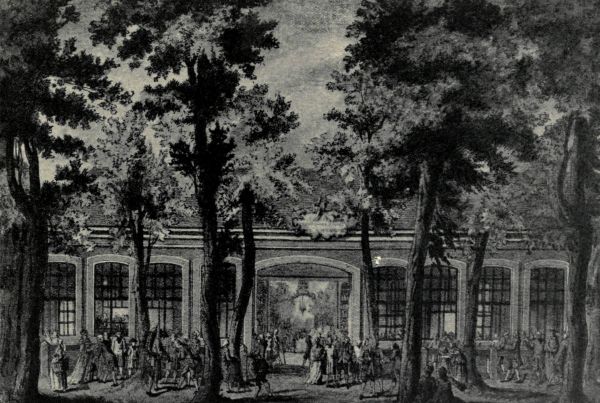
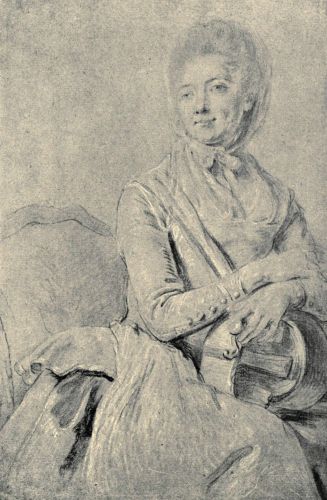
Would any one now believe that for more than a century the Temple Boulevard was the centre of Paris gaiety? A charming engraving by Saint-Aubin shows us it joyous, smart, and full of life. Coaches, cabs, and other vehicles pass and repass; grand ladies and fashionably dressed women rival with each other in grace, manners and toilet, the latter of the strangest names; and the draughtsman Briou can write below a fashion engraving of the period: "The provoking Julia reposing on the Boulevard, while awaiting a stroke of good fortune; she is in morning gown with a Diana hat that flying hearts adorn." At Alexander's Cafè Royal, there is supper and dancing; people crowd to listen to Nicolet's patter; and a circle of hearers surround Fanchon, the hurdy-gurdy player. On the same Boulevard, Curtius sets up his luxuriously arranged wax-work saloons; and, later, the parades of Bobèche and Galimafré will be the joy of Paris; for a long time, the fair will continue.
FANCHON, THE HURDY-GURDY PLAYER Original drawing (Ch. Drouet Collection)
The Ambigu, the Historic Theatre, the Gaiety, the Funambules, the Olympic Circus, the Little-Lazari, the Délassements Comiques,—ten theatres or so will add to the excitement with their strange, nervous, grandiloquent, noisy companies of actors. The gay apprentices, at all times fond of plays, will cheer as they go by the heroes of all these dramas and melodramas, so numerous that popular slang had nicknamed as Crime Boulevard the thoroughfare where, at twelve each evening, so much blood flowed on the boards of these theatres. There were Madame Dorval, Mademoiselle George, Mademoiselle Déjazet, Messieurs Bocage, Mélingue, Bouffé, Dumaine, Saint-Ernest, Boutin, Colbrun, Lesueur, Deburau—the ideal Pierrot—and also Gobert, so like Napoleon I., as was Taillade, who, thin and nervous, was incarnating Bonaparte. It was the period when the Bonapartist epopee turned people's heads to such an extent that the poor comedian Briand, who, in one of the many Napoleon plays, was acting the ungrateful part of Sir Hudson Lowe, said: "I shall never have a similar success. Yesterday, I was waited for at the theatre door and thrown into the Château-d'Eau canal basin!"
VIEW OF THE AMBIGU-COMIQUE ON THE TEMPLE BOULEVARD Lallemand, del. (Carnavalet Museum)
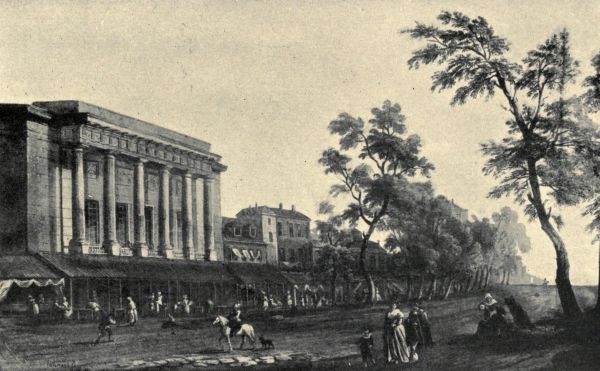
All the quarter waxed enthusiastic about its favourite actors, espoused their quarrels, repeated their witticisms or their adventures: Frédéric Lemaitre especially, a tragic, dare-devil, drinking, extravagant yet talented artist, decking himself in private life, as well as on the stage, in the frayed-out plumes of Don Cæsar de Bazan, had his own story. People went into ecstasies over his amours with Clarisse Miroy, interwoven with thrashings and fond tenderness. On the day after one of these noisy quarrels, Frédéric is said to have rung at his lady-love's door, which was opened by Clarisse's mother. The good dame, frightened at the brutal actor's appearance, raised her arm instinctively as if to ward off a blow.... "I beat you, I!" thundered Frédéric in Richard d'Arlington's tones, "I beat you! Why?... Do I love you?"
THE FUNAMBULES THEATRE ON THE TEMPLE BOULEVARD Water-colour by Martial (Carnavalet Museum)
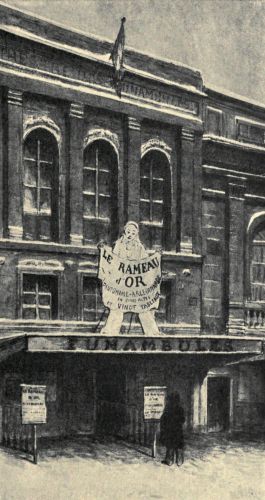
The Historic Theatre subsequently became the Lyric Theatre, and the wonderful Madame Miolan-Carvalho, the queen of song, was there to create, with her magnificent art, Faust, Mireille, Jeannette's Wedding, Queen Topaz, &c. About 1861, the celebrated composer Massenet, yet a pupil at the Conservatory and on the point of obtaining his Rome prize, discharged in the theatre orchestra the duties of kettle-drummer, for the modest salary of forty-five francs a month.
THE AMBIGU THEATRE AND BOULEVARD ABOUT 1830 Canella, pinxit
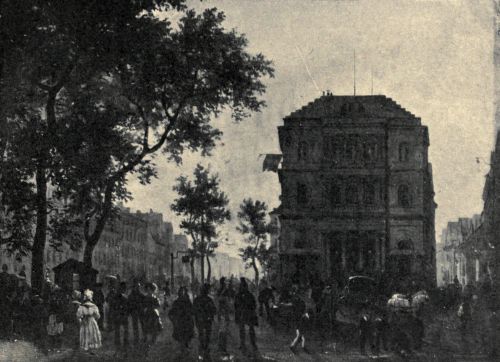
Others to perform there were the Davenport brothers and the conjurer Robin, with their amusing séances of hypnotism and white magic. On this always-to-be-remembered Temple Boulevard were to be met the various fashionable authors: Dennery, Théodore Barrière, Victor Séjour, Paul Féval, Gounod, Berlioz, A. Adam, Clapisson, Saint-Georges, the Cogniard brothers, Clairville; and the great Dumas used to pass in triumph, shaking hands with everybody as he went. The coffee-houses had to turn customers away; orange-sellers made fortunes, while boys sold checks, conveyed nosegays to pretty actresses, and hailed cabs. People called to each other, shouted, disputed, laughed above all, under the indulgent eye of the police and to the noise of liquorice-water-seller's bell: it was the golden age!
In 1862, a regrettable decision of Baron Haussmann, the Prefect of the Seine, suppressed this bit of Paris, so lively and gay; and, on the ruins of all these theatres, which brought money and mirth to the quarter, were built Prince Eugène's barracks, the ugly Hôtel Moderne, and the wretched monument of the Republic Square. Of all this fine, artistic past nothing is left except the tiny Déjazet Theatre, at the corner of the Vendôme Passage, and the Turkish Coffee-house; the latter different far from what it was when Bailly depicted it under the Directory. Elegant dames, the Merveilleuses, the Incroyables used to frequent it for the purpose of nibbling an ice or sipping little pots of cream, while listening to cithern concerts. Young Savoyards made their marmots dance in presence of "sensitive souls," and thrifty burgesses of the quarter took their family to get an idea of the high Parisian life which made the Turkish Coffee-house one of its favourite meeting-places.
Restaurants were numerous, being souvenirs of coffee-houses formerly renowned, like the Godet and Yon cafés. There one found singing and dancing, and, now and again, plotting. It was at the Burgundy Vintage Restaurant in the Temple faubourg, the ordinary rendezvous of Paris wedding-breakfasts or National Guard love-feasts, that—on the 9th of May 1831, at the end of a banquet given to celebrate the acquittal of Guinard, Cavaignac, and the Garnier brothers, charged with plotting against the State—Évariste Gallois, with a knife in his hand, proposed in three words this threatening toast: "To Louis-Philippe!"
The great Flaubert lived on the Temple Boulevard at No. 42. There, on Sundays, he gathered his disciples at noisy lunches—Zola, Goncourt, Daudet, de Maupassant, Huysmans, Céard, George Pouchet—a few yards away from a building of tragic fame. No. 50, in fact, was the wretched house whose third-story Venetian blinds concealed Fieschi and the twenty-five pistol barrels loaded with bullets which constituted his infernal machine. A train of powder passed over twenty-five lights. The discharge of grapeshot to be vomited by this dreadful instrument of death was terrible. The grocer Morey, who had helped to prepare the monstrous crime, had even taken the useful precaution to damage four of the gun-barrels, whose explosion was to suppress Fieschi himself.
Pépin, another accomplice, had been careful to walk his horse several times past the fatal window; and from behind the Venetian blinds, Fieschi, who was an excellent shot, had been able at his ease to regulate the aim of his horrible slaughtering-machine. It was intended that Louis-Philippe, who had ten times escaped the assassin's hand, should, on this occasion, be struck by it. The conspirators, however, had not calculated that the King, when reviewing the National Guard, would avoid the middle of the Boulevard, which sloped down towards the sides for draining purposes, and would keep to the lower portions, along which the troops were stationed. The rain of bullets therefore passed over the King's head, touching only the top of his cocked-hat, and mowed down women, children, officers and other spectators that were on the King's left. It was a frightful butchery; the Boulevard streamed with blood. More than forty victims lay on the road, among them being the glorious Marshal Mortier, who expired on one of the marble tables in the Turkish Coffee-house, whither the dead and wounded had been transported. Fieschi, who was wounded, was arrested in the backyard of the next house, while trying to fly through the Rue des Fossés-du-Temple. On the 19th of February 1836, he ascended the scaffold with his accomplices, Pépin and Morey.
At the corner of the Temple Boulevard, to the right, in front of the first house in the Voltaire Boulevard, the barricade was raised where Delescluze was killed in May 1871. At this spot, formerly stood the Gaiety Theatre; while the Lyric Theatre opened its doors on the present site of the Metropolitan railway station in the Republic Square.
THE PORTE SAINT-MARTIN Houbron, pinxit (G. Cain Collection)
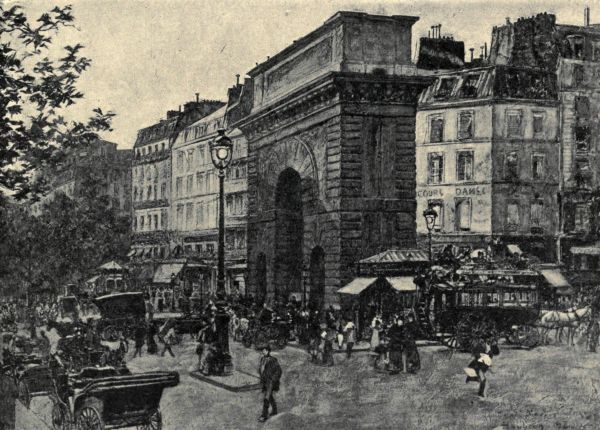
The Saint-Martin Boulevard, where Paul de Kock took up his abode, in order to study from his windows, which were on the first story, near the Porte Saint-Martin, the seething life of the Capital, now has no animation except in the evening. Four theatres—the Folies-Dramatiques, the Ambigu, the Porte Saint-Martin, and the Renaissance—add life and movement to it then; and nothing is more amusing than the hour following the end of the performances. The coffee-houses fill with visitors, cigarettes are lighted, newspaper-vendors shout the latest news; people hustle, and touts run after carriages, in which one sees a rapidly passing vision of pretty women in light-coloured dresses and opera-cloaks. Afterwards issue the actors, with blue chins and turned-up collars, and often looking cross. Last of all, come the handsome actresses, who quickly step into their brougham, inside which may frequently be seen, dimly outlined behind the red point of a cigarette, the form of an expectant friend.
THE RUE SAINT MARTIN (1866)—THE GREEN-WOOD TOWER Drawn by A. Maignan
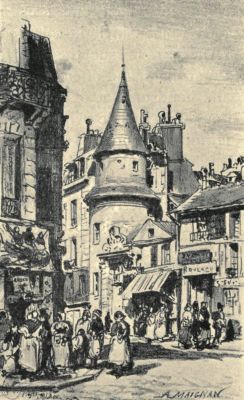
Near the Porte Saint-Denis, at the entrance to the narrow Rue de Cléry, there was formerly a rise in the road, which was the scene of a tragic occurrence. There, on the 21st of January 1793, the intrepid De Batz had appointed to meet a few companions. It was determined that a forlorn hope should be led with a view to snatch Louis XVI. from the shame of the guillotine. The plan was to force the line of soldiers, to overpower the escort surrounding the carriage, and to carry off the King.
But, already, on the day before, the Committee of Public Safety had been warned "by a well-known private individual," say the police reports, of the mad plot that was in preparation, and every necessary precaution was taken. During the night all the persons denounced in the warning as suspicious were placed under arrest. De Batz, who thought to find a hundred and fifty confederates at the meeting-place, only found seven. Notwithstanding their small number, they did not hesitate, and rushed at the horses' heads. The Guards cut them down. Three were killed. De Batz managed to escape.
THE RUE DE CLÉRY Lansyer, pinxit
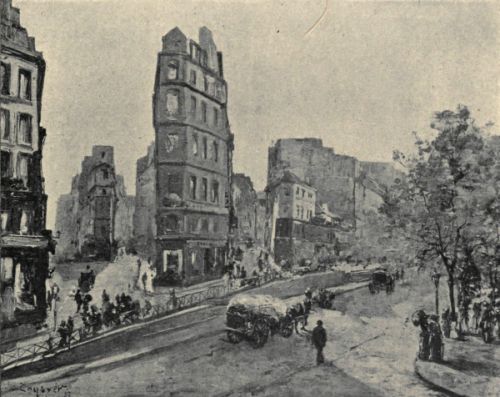
This strange, winding Rue de Cléry, whose thin edge stands out so curiously against the sky, was the scene of another drama. The father of André and Marie-Joseph Chénier lived at No. 97. There, on the 7th of Thermidor, he was anxiously waiting for the liberation of his son André, who for long months had been a prisoner at Saint-Lazare. The poor man had foolishly taken it into his head to appeal to Collot d'Herbois' heart(!) and to ask him to free his son. Collot d'Herbois had once been an actor; and now, on another sort of stage, revenged himself for having been hissed. He had not forgotten the lines in which André Chénier had satirised him in such masterly fashion, but he did not know in what prison his enemy was confined. Marie-Joseph, the brother, himself an object of suspicion, had been able to lengthen out the proceedings and to keep as a secret the place where André was confined. At this supreme hour of the Terror, it was the only possible chance Collot d'Herbois had to satisfy his vengeance; and the information thus unadvisedly but innocently given by the prisoner's father was utilised by the revengeful actor. "To-morrow," Collot assured the unhappy father, "your son shall quit Saint-Lazare." He kept his word; and, on the 7th of Thermidor, just at the hour when the guest was so impatiently expected, André got into the cart to go to the scaffold, erected that day at the barrier of the Throne Square.
Round about the picturesque Rue de Cléry, the quarter is an odd medley of little streets, lanes, and alleys: the Rue Notre-Dame-de-Recouvrance, the Rue Sainte-Foy, the Rue des Petits-Carreaux, the Rue de la Lune, in which last Balzac lodged his Lucien de Rubempré watching over Coralie's dead body, and composing libertine songs, in order to gain the money required for his mistress's funeral.
In these tortuous, sombre, narrow streets it is easy to reconstitute the physiognomy of the older Paris; ancient dwellings are still numerous enough; but, as in the Marais, are given over to petty trade and industry. After the Egyptian campaign, the Consulate cut a certain number of new streets bearing the names of victories: the Rues de Damiette, d'Aboukir, du Nil. On the site of the Cairo Square, once stood the mansion of the Temple Knights, or Knights Templars. A portion of an old Gothic Chapel, in which were preserved the helmet and armour of Jacques Molay, founder and Grand Master of the Order, was used in 1835 as a meeting-place by surviving adepts of this rite; and Rosa Bonheur's father, who was a Knight Templar, had his daughter baptized there beneath an "arch of steel" made by the crossed swords of the Order, clad in white tunics, with a red cross embroidered on their breasts, booted in deer-skin, and coifed with a white cloth square cap surmounted by three feathers—one yellow, one black, and one white!
THE POISSONNIÈRE BOULEVARD IN 1834 Dagnan, pinxit (Carnavalet Museum)
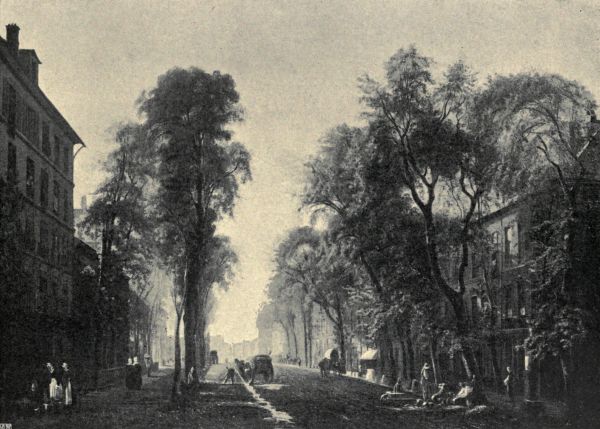
A delightful picture by Dagnan, which is now in the Carnavalet Museum, shows us the Poissonnière Boulevard in 1834. Most of the houses remain to-day; but, alas! the tall, thick-foliaged trees that made the Boulevard a sort of park avenue have long since disappeared. That lover of Paris, Victorien Sardou, who was born in it, and who is cheered, loved, and honoured in it, very well remembers seeing the trees as they used to be, and his long saunterings in front of the Gymnase Theatre. Did he foresee the successes he was to gain with les Ganaches, les Vieux Garçons, les Bons Villageois, Andréa, Féréol, Séraphine, Fernande, &c.?
THE GYMNASE THEATRE Etching by Martial
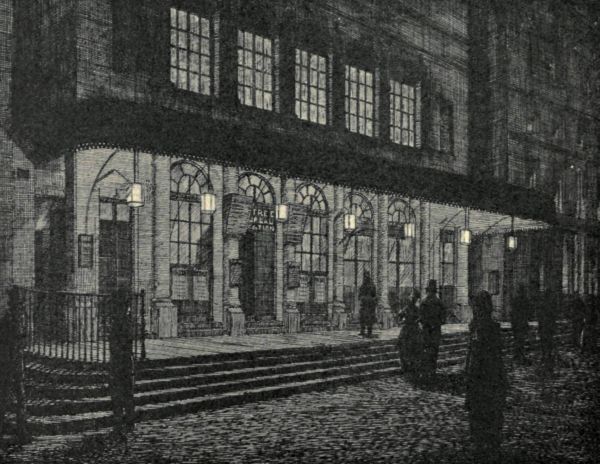
Further on, we come across the ancient Variety Theatre, whose antique front speaks of a glorious past; Duvert, Lauzanne, Bayard, Scribe, Meilhac, Ludovic Halévy, and, above all, Offenbach, whose haunting music bewitched Paris for twenty years.
Ludovic Halévy, who was a charming chronicler of Paris life, has left us an interesting sketch of the Montmartre Boulevard towards 1810: "The Variety actors had been obliged to quit the Montansier hall; their vaudevilles had more success than the tragedies at the Théâtre Français. The Emperor made a decree depriving them of the Palais-Royal premises; but they were allowed to move to new premises on the Montmartre Boulevard!... A frightful quarter for a theatre!... It was almost in the country; not one of the large houses existed which you see there! Nothing but little single-story shops, wretched wooden stalls, and the two small panoramas of Monsieur Boulogne.... No foot-pavements, a road simply of beaten earth between two rows of tall trees.... A few old cabs and carriages passed now and again.... In fine, the country.... It was the country!!.."
THE VARIETY THEATRE ABOUT 1810 From a sepia of the period (Carnavalet Museum)
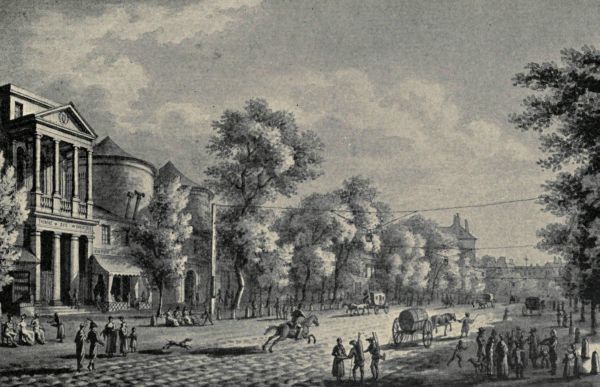
With the Variety Theatre began what was called, without epithet, The Boulevard. For idlers, saunterers, wits, clubmen, writers, journalists, under the second Empire, it was a sort of sacred ground. Grammont-Caderousse, the Prince of Orange, Khalil-Bey, Paul Demidoff, Aurélien Scholl, Roqueplan, Aubryet, Jules Lecomte, Auguste Villemot were kings there. The Café Anglais, the Maison Dorée, Tortoni's were frequented by the fashionables of society and literature. The gas flared, champagne corks flew, and one had only to open pianos for them to play automatically the Evohe of Orpheus in Hades! An apropos witticism stopped a quarrel. The princes of intelligence held their own with princes of the blood or of money; as, for instance, on the day when, at Tortoni's, the Duke de Grammont-Caderousse flung a packet of goose-quills in the face of Paul Mahalin, who, the day before, in a small newspaper had severely animadverted on the diva S——, she being under the Duke's protection.
"From Mademoiselle S——," said the Duke.
Making his grandest bow, Mahalin retorted: "I was aware, Monsieur, that Mademoiselle S—— feathered her lovers, but I did not dare hope it was for my benefit."
THE BOULEVARDS, THE HOTEL DE SALM, AND WINDMILLS OF MONTMARTRE View taken from the hanging gardens of the Rue Louis-le-Grand Water-colour of the eighteenth century (Carnavalet Museum)
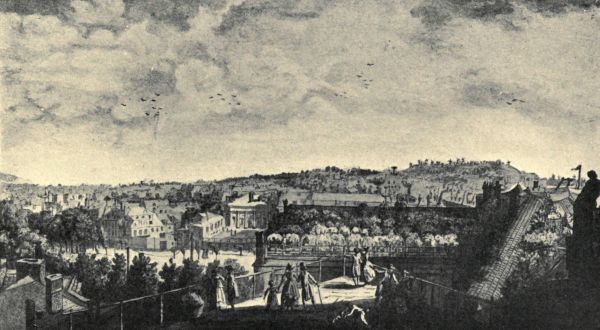
Since the dark days of 1870, the elegant Boulevard has become more democratic. The old dwellings themselves have changed their uses; and electro-plate is sold in the beautiful pavilion built by Marshal de Saxe—after the Hanoverian wars—at the corner of the Boulevard and the Rue Louis-le-Grand. In the eighteenth century, some one took it into his head to decorate with flowers the roofs of the houses in the vicinity of this fine mansion; so that it was possible to dine merrily—under the shade of hornbeams—while watching the windmills of Montmartre turn in the distance. The example has been imitated in our own times—people cried that it was an innovation; this is only another error; there is nothing new under the sun. What is done is merely a modification, and generally the alteration is for the worse! Tortoni's flight of steps has disappeared. Taverns, with their onion soup and their sourcrout and sausage, replace the aristocratic restaurants of yore. The features are different; but still it is a Paris nook, really gay, amusing, and original. A walk in it is delightful, though nothing, alas! can be said to vividly recall the past, since the terrible fire of 1887 destroyed the Comic Opera of our fathers; the Opera of Grétry, Dalayrac, Méhul, Boïeldieu, and Hérold; the Opera whose façade does not open on the boulevard, according to the desire formally expressed in 1782 to Heurtier, the architect, by the King's Comedians refusing to be confused with the "Boulevard Comedians"; the Opéra-Comique where, every evening, in the spacious foyer adorned with busts of dead musical celebrities and composers that had contributed to the theatre's fame, the habitués met whose attendance was a protest against modern music: Auber, Adam, Clapisson, Bazin, Maillard; later, and with another æsthetic doctrine, G. Bizet, Léo Delibes, V. Massé, J. Massenet, Carvalho, Meilhac, Halévy, and old Dupin, the last an astonishing centenarian who, one evening, with rancorous eye looked at Hérold's bust and grumbled: "How that urchin used to rile me!" In presence of the general bewilderment he explained: "I was his school companion, in 1806, at Saint-Louis' College!" we were then in May 1885! This was the obstinately reactionary Dupin who once drew from a contradictor the threatening retort: "We missed you in '93. When the next Revolution comes, we'll take good care not to!"
THE RUE DE LA BARRE, AT MONTMARTRE Houbron, pinxit
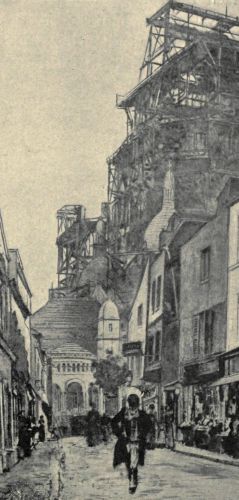
The amiable chats, the agreeable meetings which brought together so many witty people, clever talkers, artists, men of the world, those of the Comic Opera foyer, of the Grand Opera, or the Comédie Française are now hardly anything but a memory. Not that the practice itself is abolished. Art gatherings are quite as frequent and as well attended; but they have emigrated,—many of them to Montmartre, to the "Butte Sacrée," the holy mound, "the teat of the world," yelled the astonishing Salis in his Chat Noir patter; and truly the spot is one of the Capital's curiosities.
Gay, industrious, cynical, flippant, and yet religious, this composite quarter offers the most singular mingling of poets, painters, sculptors, lemonade-makers and pilgrims. On the Clichy and Batignolles Boulevards, the revolving lights of the Moulin Rouge illuminate a population of rakes, dandies, artists, lemans and bullies. Each wine-shop—and there are many—harbours one or several poets, more or less comic, but always railers and rosses,[4] as the witty Fursy says, one of the best performers in these "music-boxes." In these latter the great ones of the earth, politicians, ministers, are unmercifully berhymed, as also the events of the day; a minister's latest speech, Pelletan's elegance, Le Bargy's cravats, Santos-Dumont's ascent, the Pope's latest Encyclical letter, the automobile tax, the divorce of the moment, the King of Spain's recent visit, or that of the Prince of Bulgaria, all put into couplets.
A STREET IN MONTMARTRE Houbron, pinxit (Carnavalet Museum)
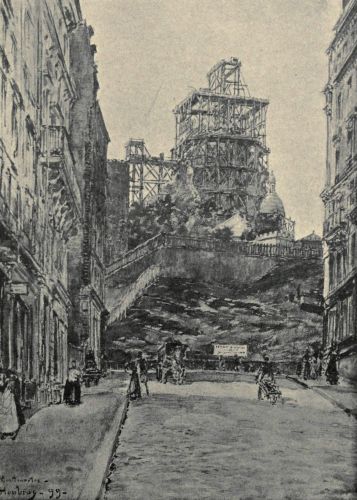
Montmartre is the Capital's pot-house; it is all good-humoured laughter and chaff. People enjoy themselves at night and work in the day, for it has always been a favourite abode for artists of every kind: Henri Monnier, the Duchess d'Abrantès, Madame Haudebourg-Lescot, Mademoiselle Mars, Horace Vernet, Berlioz, Ch. Jacque, Reyer, Victor Massé, Vollon, Manet, André Gill, Steinlen, Guillemet, Willette, Jules Jouy, Mac-Nab, Xanrof, Maurice Donnay. Their memory there is alive and respected, the legend of their prowess is preserved. It is Montmartre's Iliad.
THE RUE DES ROSIERS Etching by Martial
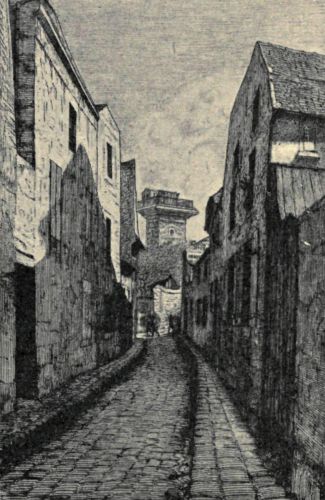
A few yards from these noisy streets, the "Butte" begins, on which, at the close of the 1871 siege, the Parisians had hoisted the National Guards' cannons. In vain the Government tried to regain possession of them; and the rest is known:—the resistance, the troops disbanded, Generals Clement Thomas and Lecomte arrested, dragged into a small house in the Rue des Rosiers and shot against a garden wall.
Part of the wall still stands; and though the house has disappeared in which this tragedy of the 18th of March was played, a little of the garden itself remains, behind the modern buildings of the Abri Saint-Joseph, vast sheds used as refectories by the crowds of pilgrims attracted to the basilica of the Sacré-Cœur.
Indeed, all this quarter is melancholy-looking, silent, quaint, and monastic. Chaplet, scapulary, candle, missal, and pious picture-dealers have their shops in it. The spot is a sort of religious fair; even the streets have liturgical names: Saint-Eleuthère, Saint-Rustique, near the Rue Girardon, and the Calvary cemetery, overlooked by the awkward outlines of the old Galette Windmill, the ordinary rendezvous for idlers, boulevard inquisitives, artists' models, lemans and bullies of the neighbourhood. The ancient Montmartre, with its picturesqueness, is again met with in the Rue Saint-Vincent, in the Rue des Saules containing the "Lively Rabbit" tavern, and in the Rue de la Fontaine-du-But, sordid streets, bordered with sorry habitations whose windows are hung with linen drying, and which seem at each story to harbour a different poverty; strange streets, running for the most part between a crumbling old house and a hoarding mossy with rain and covered with inscriptions. As a matter of fact, these palisades serve as an outlet for the confidences of the "pals" and their "gals" of the quarter. Amorous effusions may be read side by side with threats, and the great ones of the earth are sometimes severely dealt with. The epithet is always a bitter one. It savours of debauch, vice and crime.
THE PLACE DE LA CONCORDE IN 1829 Canella, pinxit (Carnavalet Museum)
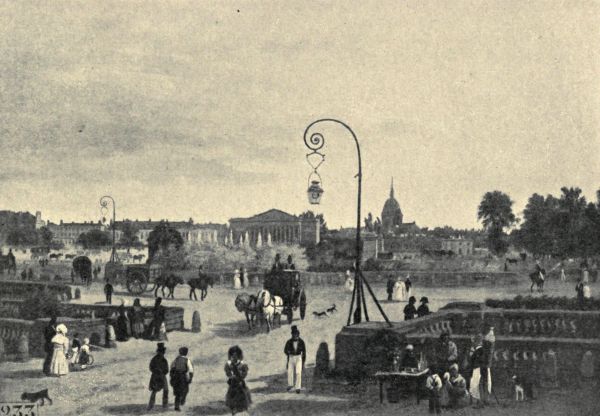
And yet, in this corner of Paris, which modern embellishments will soon have made unrecognisable, bits of admirable scenery are to be met with, exquisite lanes of verdure, birds, tame pigeons, whistling blackbirds; and one might fancy one's self far away in some peaceful country-place, if, at the end of all these streets, were not seen the huge violet-coloured mass of the Capital, in fairy panorama, an ocean of stone, whence heave, like masts, the bell-towers of palaces, the turrets, belfries and steeples of churches, with domes, roofs and gardens—an incomparable vision of art, grandeur and beauty.
The great Balzac informs us that César Birotteau was ruined by speculations he engaged in on the "waste ground round about the Madeleine church." He lost in them the profits realised by his "Eau Carminative" and by the "Double Pâte des Sultanes." His "Rose Queen" perfumery was swallowed up in them....
And, however, César Birotteau was right in his reasoning. To-day, the Madeleine building ground is the highest quoted in Paris.
In 1802, the surface was occupied by foundation works and scaffolding, showing the pillars of the church so long since commenced and still in the building.
INGENUOUS BENEVOLENCE Duplessis-Bertaux, inv. et del.
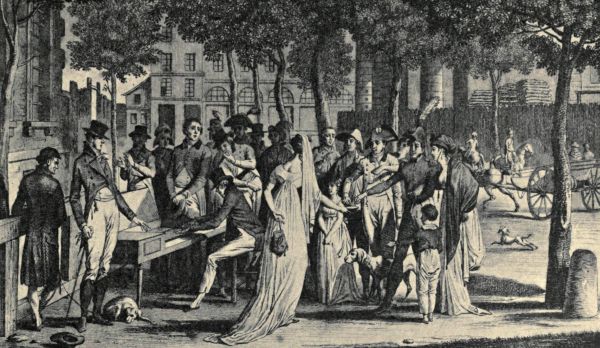
There took place the charming episode depicted by Duplessis-Bertaux, under the pleasing title: "Ingenuous Benevolence" (an historic fact of the 5th Messidor, anno X.). A long notice, beneath the picture, tells us that Pradère, Persuis, Elleviou and "his spouse," walking one evening along the Magdalene Boulevard, met a blind street-singer, who "by the strains of his piano was soliciting public charity." The receipts were wretched; so our kind artists improvised a little open-air concert and remedied the ill-fortune of the poor fellow. After delightfully singing, Madame Elleviou, her husband and Pradère made a collection, and poured the proceeds, thirty-six francs, into the blind man's hands trembling with emotion!
THE PLACE DE LA CONCORDE (Second View) From a sepia of the eighteenth century
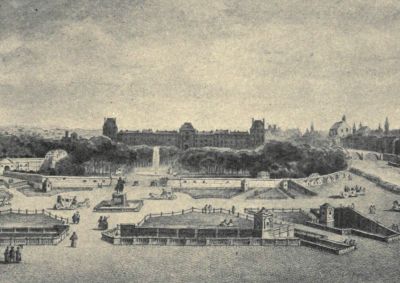
Along the Rue Royale, we reach the Champs-Elysées, after stopping for a moment at the "Cité Berryer," a strange alley in which once stood the hotel of the King's Musketeers. It is a sort of poor market lost in this rich quarter.
THE ENTRANCE TO THE TUILERIES, OVER THE SWING-BRIDGE, IN 1788 Original water-colour of the eighteenth century (Carnavalet Museum)
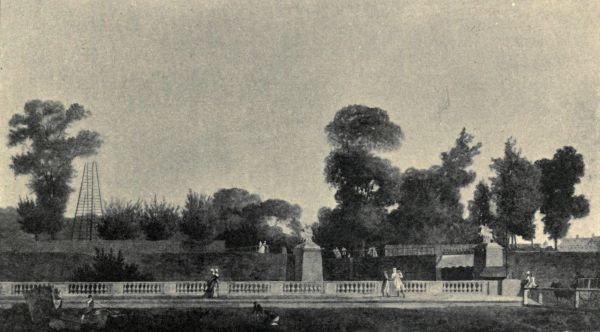
Then comes the Place de la Concorde, the finest Square in the world, with its unrivalled perspectives of the Champs Elysées, the Seine, the Tuileries, the Garde-Meuble, the Crillon mansion, and the charming house of Grimod de la Reynière, to-day the Cercle de l'Union artistique, at the corner of the Rue de "la Bonne Morue"—at present the Rue Boissy d'Anglas—in front of which still stood, until the second Empire, one of the corner pavilions erected by Gabriel. What souvenirs! the raising of Louis the Fifteenth's statue; the festivities in honour of the Dauphin's marriage to Marie Antoinette, so tragically terminated by a catastrophe—the crowd that had come to witness the fireworks being crushed in the moat—which was the beginning of the hatred against the "Austrian woman"; the reviews of the Swiss Guards; the military charges of Lambesc; the people's storming of the swing-bridge, the gates forced, the ditches crossed, and then the sinister scaffold, smoking in front of the statue to Liberty, and the Conventionals terrified, stopping before they entered their hall and taking a close look at the death which, each day, hovered over them. "Yesterday, as I was proceeding to the Assembly with Pénières," writes Dulaure in his Memoirs, "we perceived, as we passed through the Revolution Square, preparations being made for an execution. 'Let us pause,' my colleague said to me; 'let us accustom ourselves to the sight. Perhaps we shall soon need to make proof of our courage by calmly ascending this scaffold. Let us familiarise ourselves with the punishment.'"
CORNER PAVILION OF THE LOUIS XV. SQUARE At the angle of the Rue de la Bonne-Morue about 1850 (to-day the Rue Boissy-d'Anglas) Etching by Martial
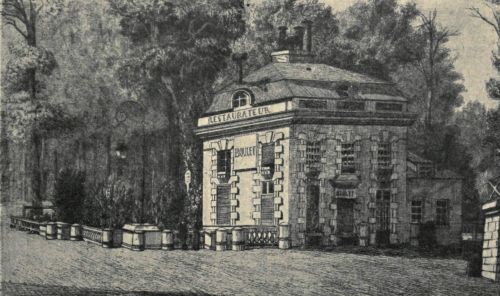
Severed heads were exhibited by the executioner at the four corners of the huge Square: Danton, Camille Desmoulins, Hérault de Séchelles, Charlotte Corday, Madame Roland, Louis XVI., Marie Antoinette, and Robespierre. A dreadful pell-mell, a disastrous butchery; the ground was red with blood. Then followed the soldiers of the Empire, singing as they defiled, on entering the Tuileries to cheer their triumphant Emperor at his return from some victorious campaign.
A white head, big golden epaulets, a blue ribbon: such was the appearance of Louis XVIII., impotent, with paralysed legs, who, in his carriage surrounded with body-guards, galloped through the Square at full speed.
It was at the corner of this Place de la Concorde that, on the 28th of February 1848, Louis-Philippe, broken and vanquished, got into the humble cab that proved to be the hearse of the Monarchy.
Napoleon III., with his blue dreamy eyes, used to cross it nearly every day, driving his phaeton; and the boy, whom the Parisians of that time called "the little Prince," would show his pretty fair head of hair at the window of the "berline" escorted by the household troops.
VIEW IN THE TUILERIES GARDENS IN 1808 Drawn by Norblin (Carnavalet Museum)
The gates of the Tuileries were again to open, on the 4th of September 1870, under the pressure of the invaders; and, during the siege of Paris, artillery were to camp in the vast ruined garden. Finally, the palace of the kings of France was to disappear in a cloud of fire, 'midst the last convulsions of the expiring Commune; and, to-day, a poor fellow, in a shabby sun-faded cloak and wearing an old felt hat, spends his time distributing bread and grain to the Paris pigeons and sparrows, on the very spot where once stood the rostrum of the Convention, some yards from the place where the four hoofs of the Emperor Napoleon's white horse pranced, as his rider reviewed the Guard, before flying his victorious eagles towards Moscow, Madrid, Rome, Vienna, or Berlin!
The Champs Elysées are of almost modern creation. A decade ago, the fine avenues surrounding the Arc de l'Etoile—the Avenue Kléber, the Avenue Wagram, the Avenue Niel, the Avenue de l'Alma—offered most picturesque contrasts; beside a sumptuous mansion, subsisted wretched little houses, remains of old hovels that once were scattered all over this luxurious quarter, where now nothing recalls the waste pieces of land, dangerous even to cross, of sixty years ago. Under the Directory, Madame Tallien's cottage (Notre Dame de Thermidor, she was called) to which the Incroyables and the Merveilleuses dared not go without escort, was situated as far up as the Avenue Montaigne. Dancing-gardens and open-air bars occupied the space now filled by restaurants and cafés-concerts. An engraving by Carle Vernet shows us a Cossack encampment round a humble, country-looking inn. Now the Le Doyen restaurant stands there!
THE RUE GREUZE IN 1855 Chauvet, del.
Under Louis-Philippe, the Champs-Elysées were at length altered: side avenues were laid out, the main avenue was widened; and Emile Augier used to relate that, in the hollow of one of the trees numbered for trimming (No. 116, I believe), the ticket porter belonging to the Gymnase Theatre deposited the one intended for Balzac at the time of the rehearsals of Mercadet. The great novelist, in order to escape from his numerous creditors, was lodging at this period in the Rue Beaujon, under the name of Madame Dupont, widow. Gozlan, who ultimately discovered his illustrious friend's address, added on the envelopes he sent to him—"née Balzac."
THE MADRID CHÂTEAU L. G. Moreau, pinxit
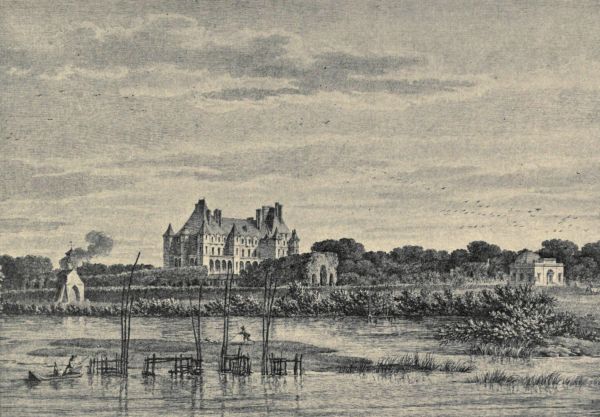
The curious Memoirs of the Abbé de Salamon, a Papal internuncio, give us a striking picture of the Bois de Boulogne under the Revolution: a sort of forest, or jungle, in which those took refuge who, being suspected, were tracked by the Committees and the police, and to whom the precious citizens' card had been refused. "I continually remained in the thickest part of the Bois de Boulogne," he says. "It seemed to me that each person I met read on my face that I was outlawed and was hastening to deliver me to the headsman. I took up my abode in the loneliest place of the wood. I lit a fire with a tinder-box and some twigs, and cooked my vegetables; my soup was excellent.... Later I discovered another fairly convenient spot, on the side of the Bagatelle Villa, quite near to the Pyramid and not far from Madrid.
THE BAGATELLE PAVILION L. G. Moreau, pinxit
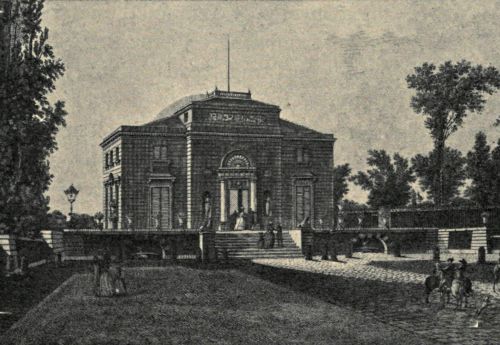
"One night, I was wakened in the middle of my dreams by the piercing cries of two women, who drew back terrified on beholding me through the darkness of night.
"It was a mother and her daughter, who also were flying from an arrest-warrant. I called to them: 'Keep silence, whoever you are! You have nothing to fear.' They asked me what I was doing in the wood so late: 'The same thing as you no doubt are doing yourselves,' I answered."
Subsequently it became the ordinary meeting-place for duellists. Already, in the time of Louis XV., some ladies, the Marchioness de Nesles and the Countess de Polignac, had exchanged pistol shots in it on account of the Duke de Richelieu. Under the Revolution, in 1790, Cazalès and Barnave went there to settle a political quarrel: "I should be sorry to kill you," exclaimed Cazalès; "but you annoy us considerably, and I want to keep you away from the rostrum for a while." "I am more generous," retorted Barnave; "I wish merely to touch you; for you are the only orator on your side, whereas on mine my absence would not even be perceived." Afterwards it was Elleviou and Monsieur de Bieville; General Foy and Monsieur de Corday; Marshal Soult and Colonel Briqueville; Benjamin Constant and Forbin des Essarts; with this peculiarity in the last duel that the two adversaries fought at ten yards' distance, sitting in two armchairs, which were not even grazed! And how many others!...
A PERFORMANCE AT THE HIPPODROME ON EYLAU SQUARE UNDER THE SECOND EMPIRE
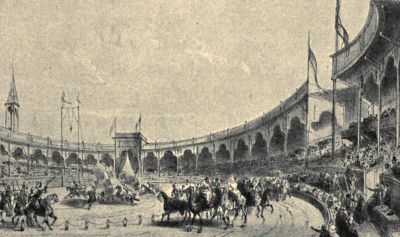
Under Louis-Philippe, the Duke d'Orléans, the Duke de Nemours, Lord Seymour, the Duke de Fitz-James, Ernest Le Roy—the Jockey Club at its formation—organised races there. The stakes were modest; most often, a few bottles of champagne were gained and lost. Then fashion took hold of the thing. More importance was attached to racing; and, to-day, it is the great Parisian event—in festivities. As early as 1850, the Hippodrome of the Eylau Square revived the souvenir of Antiquity's favourite chariot-races.
The Bois de Boulogne became the rendezvous of society. There, was displayed the luxury of the Second Empire. Its trees and avenues formed an exquisite framework to elegance and worldly show. In the Curèe, Emile Zola was able to write: "It was four o'clock and the Bois awoke from its afternoon sultriness. Along the Empress' Avenue, clouds of dust were flying; and, afar, lawns of verdure could be seen, with the hills of Saint-Cloud and Suresnes beyond, crowned with the grey of Mont Valerien. The sun, aloft on the horizon, sailed in an effulgence of golden light that filled the depths of the foliage, flamed the top branches, and transformed this ocean of leaves into an ocean of luminousness.... The varnished panels of the carriages, the flashing of the copper and steel mountings, the bright colours of the dresses streamed together with the horses' regular trot, and cast on the background of the Bois a broad, moving band, a beam from the welkin, lengthening as it followed the curves of the road. The waved roundness of the sunshades radiated like metal moons."
The sight has not changed. It is the same triumphal defile, which each day gathers within these select surroundings the most elegant women in Paris, fashionable horsemen, vibrating autocars with their chauffeurs, clubmen as well as artists and workmen, who come to enjoy the fair spectacle, this feast of the eyes, this unique scenery: the Bois de Boulogne, the Avenue du Bois, the Champs Elysées.
THE ARC DE TRIOMPHE ABOUT 1850
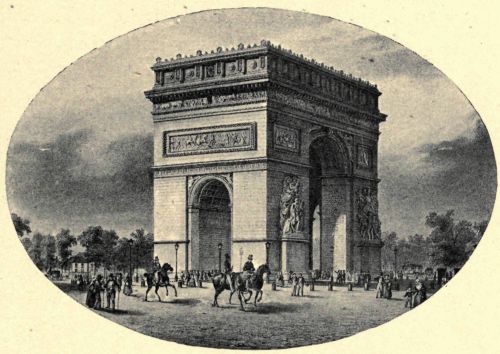
From the top of the Arc de Triomphe, 'mid the twilight of May, the vision is a magic one; it is from the terraces of the portico erected to the glory of the Grand Army that a view is obtained of the sumptuous quarters of modern Paris.
Some sixty years ago, Balzac showed his hero dreaming on the hill of Père-Lachaise, and contemplating, as it lay in the valley, the Monster he intended to tame. To-day Rastignac would have to mount the Arc de Triomphe, if he wished to threaten Paris. Thence, he might launch his famous defiance: "It is a struggle between us now!" for, if the aspect of things has altered, the impression made by the immense City is still and ever the same: an impression of weight, of imperious conflict, of hard victory. In verity, no one disembarks without a sort of anguish in this great Paris,—Paris, so redoubtable to the valiant that attempt its conquest and so prodigal to the fortunate ones that have known how to win its favour.
GEORGES CAIN.