THE LEFT BANK OF THE SEINE
Frederick Lawton translation
No less than the old part of the City, the left bank of the river is rich in souvenirs. There the Roman occupation left the deepest traces. We find the arenas of Lutecia, and, above all, the Thermae of Julian, saved from destruction by the taste and initiative of Du Sommerard at the moment when these grandiose ruins, which were being used as coopers' store-rooms, were about to be pulled down, involving in their fall that jewel of the fifteenth century, the marvellous Hôtel de Cluny. Quite recently, remains of Roman substructures have been discovered near the College de France, in the Rue Saint-Jacques and the Saint-Michel Boulevard; but the glory of the left bank of the river was, in particular, the University and the Sorbonne.
Little to-day is left of these old walls; but, ten years ago, the hill of Sainte-Geneviève still preserved much of its whilom picturesqueness.
THE COLLEGE OF LOUIS-LE-GRAND H. Saffrey, Sculpt.
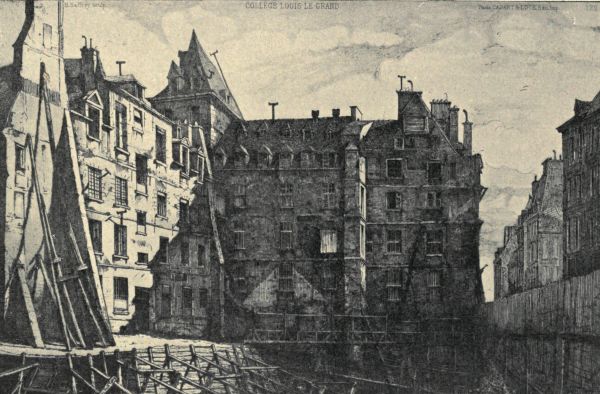
There was the Rue Saint-Jacques, with its old book-sellers and seventeenth-century houses, and especially—what dread reminiscences!—the heavy-leaved gate of the Louis-le-Grand Lycée, where Robespierre, Camille Desmoulins, and the future Marshal Brune had studied under the mastership of the good Abbé Berardier. I confess that the Louis-le-Grand of our boyhood was black, and gloomy enough also, with its moss-grown playgrounds, its smoky rooms, its punishment chambers up under the roof, where one was frozen in winter and stifled in summer, its punishment chambers in which tradition relates that Saint-Huruge was confined; quite near to the Saint-Jacques blind alley where Auvergne dealers sold such fine trinkets, and to the little Rue Cujas, noisy with the noise of rowdy students—but which rendered us pensive.
There was the Sorbonne, with its paved courtyard, where we used to wait, pale, feverish and anxious, for the posting of the small white notice bearing the names of those candidates for the Baccalaureat that were admitted to the vivâ voce; and we were half-dead with fear at the idea of appearing before the terrible Monsieur Bernès, while we blessed the gods to have given us as examiner the witty and indulgent Monsieur Mézières, who, at least for his part, has not grown old.
THE INNER COURTYARD OF THE ECOLE POLYTECHNIQUE Etching by Martial
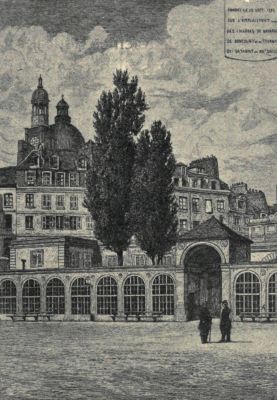
Further on, in the rear of Sainte-Barbe, we come to the Rue de la Montagne-Sainte-Geneviève, alive and teeming with its old mansions converted into dispensaries or business premises, its petty trades, its popular dancing-rooms, and, last but not least, its celebrated École Polytechnique, dear to all Parisians, which adds its note of cheerfulness to this somewhat sombre quarter.
THE RUE CLOVIS IN 1867 Drawn by A. Maignan
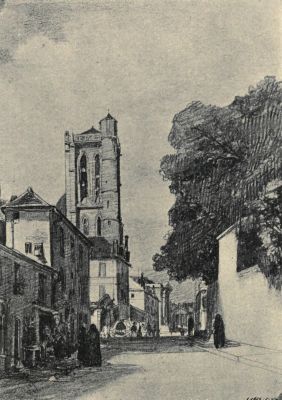
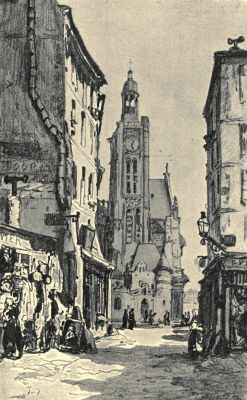
Quite near there is the Rue Clovis, where formerly stood the Abbey of Sainte-Geneviève, whose square tower still remains and makes us regret the part that has disappeared. In this Rue Clovis may be seen, crumbling to decay and half-buried under climbing plants—lichens, ivy, sage and moss—a big side of a primitive-looking wall, a fragment of the fortifications of Philippe-Auguste, the belt of stone and lofty strong towers behind which for centuries were heaped houses, palaces, colleges, churches and abbeys, huddling against one another. The church of Saint-Etienne-du-Mont opens its elegant portal a few yards away from the Rue Clovis. Illustrious dead were buried there: Pascal, Racine, Boileau.
A crime was also committed in it.
On the 3rd of January 1858, the first day of the novena of Sainte-Geneviève, whose relics repose in one of the side-chapels of the church, dreadful cries were heard: "They have just murdered Monseigneur," and soon a man of haggard looks, clad in black, with blood-red hands, was seen on the Square in the grasp of some policemen who had just arrested him. It was Verger, a half-mad, interdicted priest, who had stabbed to the heart Monseigneur Sibour, Archbishop of Paris!
This charming church should be seen in the early days of January.
A sort of small religious fair is then held in front of the porch. A veritable liturgical library is there for sale, under umbrellas resembling those that used to shelter the orange-dealers: "Mary's Rose-trees," "Miracles at Lourdes," "Synopses of Novenas," "Acts of Faith," "Acts of Contrition," "Lives of the Saints," "Glorifications of the Blessed." Chaplets are sold, holy images, devotional post-cards, orthodox rituals, medals, scapularies—and unfortunately these objects have less artistic value than sentiment about them. It is a delightful Parisian tableau in one of the prettiest settings of the great town.
At the end of the Rue Clovis, is the Rue du Cardinal-Lemoine, where the painter Lebrun possessed a lovely house, still standing at No. 49, over-run with ivy and honeysuckle, two or three yards distant from the Scotch college—at present the "Institution Chevallier,"—converted into a prison during the Terror, like most educational institutions. Saint-Just was conveyed thither, after being outlawed on the 9th of Thermidor; and his friends came there to fetch him at eight o'clock in the evening, as well as his colleague Couthon, who was confined in the Port-Libre (the old religious house of Port-Royal). It is easy to imagine the gendarmes, on the steep slopes of the Rue Saint-Jacques, running round the mechanical seat which the impotent Couthon feverishly worked and propelled with handles levered to the wheels, and which travelled rapidly over the hard stones, amid shouts and frightened "sectionnaires,"—easy to conjure up before one's senses the call to arms, the sound of the tocsin, under the downpour of the storm that dispersed the Robespierrian bands camped about the Town Hall, and enabled the troops of the Convention to invade the "Maison Commune" without resistance.
THE RUE DE LA MONTAGNE-SAINTE-GENEVIÈVE IN 1866 Drawn by A. Maignan
An hour later, Robespierre had his jaw smashed by Merda's bullet; his brother sprang through the window; Le Bas committed suicide; Saint-Just, haughty and impassible, allowed himself to be arrested in silence; Couthon, with his paralysed legs, was flung on to a rubbish heap, and then, bleeding and motionless, was dragged by the feet to the parapet of the quay. He pretended to be dead. "Let us cast him into the water," howled a multitude of fierce voices. "Excuse me, citizens," murmured Couthon, "but I am still alive." So he was reserved for the scaffold.
Behind Saint-Etienne-du-Mont, there is a nook almost unknown to Parisians: a little cloister close to the apse of the church, and containing some admirable painted glass windows by Pinaigrier, the great artist, who, in 1568, charged for the "Parable of the Guests," a three-compartment window painting, which masterpiece now adorns the chapel of the Crucifix, "92 livres 10 sols, including the leading and iron trellis."
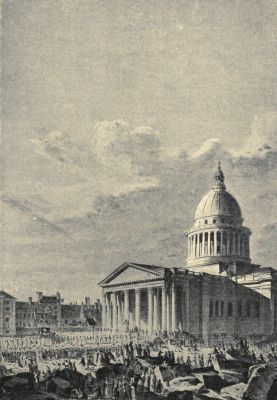
THE PANTHÉON, IN BUILDING
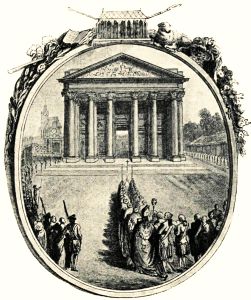
It is one of the retreats for poetry and devotion so common in Paris, and yet ofttimes so unsuspected amid the city's noise; and one never forgets the impression produced when leaving the Latin Quarter, with its laughter and songs, and plunging suddenly into this deserted cloister full of dream and melancholy, though so close to the sunny, busy square of the Panthéon, where, on the 27th of July 1830, to the shouts of the people and the army, an actor at the Odéon Theatre, Eric Besnard, replaced once more the inscription: "To her great men the grateful mother country" on the fine temple built by Soufflot, which the Restoration had consecrated to the worship of Sainte-Geneviève.
The Panthéon is certainly the one Parisian building which has been most often baptized and re-baptized. Constructed in consequence of a vow made by Louis XV. when ill at Metz, on the gardens belonging to the original Abbey of Sainte-Geneviève, the money that paid for it was derived from a portion of the funds raised by three lotteries drawn every month in Paris.
Soufflot, whose grandiose plans had been accepted, set to work in 1755. Towards 1764, the edifice began to assume shape, and the Parisians in enthusiasm admired the magnificent forms that modified the ancient outlines of their city. But cracks and fissures and sinkings-in occurred; a mad terror succeeded to the wonder: "The building will tumble, and its fall will involve a part of the old quarter of the Sorbonne," people said. Works of shoring up, embanking and strengthening were carried out. Paris breathed again; but poor Soufflot, in despair, could not survive so many tragic emotions. He died in 1781 without finishing his undertaking.
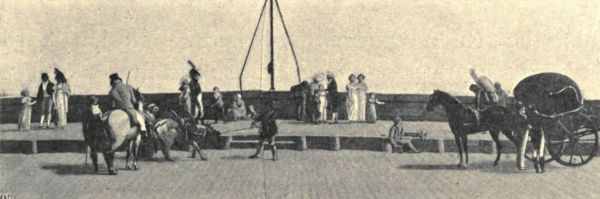
PROCESSION IN FRONT OF SAINTE-GENEVIÈVE Meunier, fecit (Carnavalet Museum)
In 1791, the constituent Assembly set apart for the "Honouring of Great Men" the church primitively dedicated to Sainte-Geneviève; and Mirabeau's body was conveyed thither in triumph "to the sounds of trombone and gong, whose notes, by the intensity with which they were produced, tore the bowels and harrowed the heart," says a chronicle of the time.
The great tribune was destined to make but a short stay in the Panthéon,—this was the name given to the secularised church—for on the 27th of November 1793, at the instigation of Joseph Chénier, and after study of the documents found in the iron safe, documents that left no doubt as to "the great treason of the Count de Mirabeau," the Convention, "considering that a man cannot be great without virtue, decreed that Mirabeau's ashes should be removed from the Panthéon, and that those of Marat should be buried there." The sentence was carried out by night, and the "virtuous" Marat took the place of Mirabeau; not for long, however, since, some months later, Marat's body, "depantheonised" in its turn, was cast into the common grave of the small graveyard belonging to Saint-Etienne-du-Mont. Voltaire and Rousseau were, in their turn, triumphantly interred. Voltaire's body, after remaining all night in the ruins of the Bastille, had been brought to the Panthéon on a triumphal car, escorted by fifty girls dressed in antique style through David's care, and by the actors and actresses of the Théâtre Français in their stage dresses. The widow and daughters of the unfortunate Calas walked behind, close to the torn flag of the Bastille. In order to make this interment a never-to-be-forgotten fête, its organisers had provided for everything except for the weather. A dreadful storm descended on the heads of those composing the procession: Mérope, Lusignan, the Virgins, Brutus, and the delegates sent in the names of Politics, the Arts, and Agriculture, were wet to the skin; and, covered with mud and in wretched plight, were compelled to huddle into cabs or shelter themselves under umbrellas.
And thus it was that, on the 12th of July 1791, Voltaire made his entry into the Panthéon.
THE APOTHEOSIS OF JEAN-JACQUES ROUSSEAU His translation to the Panthéon on the 11th of October 1794 Girardet, inv. et del.
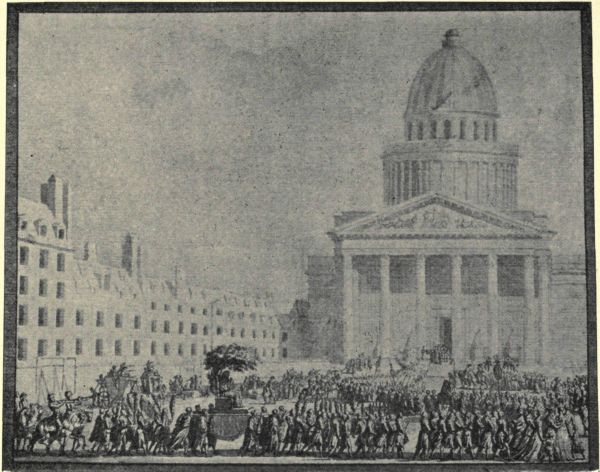
Jean-Jacques Rousseau followed him there on the 11th of October 1794; his body brought back from Ermenonville, beneath a bower of flowering shrubs, to the agreeable sounds of the "Village Seer," had passed the preceding night on the basin of the Tuileries, transformed for the occasion into an "Isle of Poplars." While yet not so popular as that of Voltaire, his triumph was "one of sensitive souls," and "the man of nature" was interred according to the rites he had himself prescribed. Later, Napoleon peopled the Panthéon with the shades of obscure senators and some few artists, admirals, and generals. Subsequently, the Second Republic made a definitive assignment of the edifice to the cult of great men; and there, on a sunny day, the 3rd of May 1885, Victor Hugo's body was brought in the humble hearse of the poor, amid the acclamations of an immense concourse of people, after spending a night of apotheosis under the Arc de Triomphe, which he had so nobly sung. Since then, Baudin, President Carnot, La Tour d'Auvergne have been buried there; and an admirable decoration, the work of our best contemporary artists, covers the vast walls of this necropolis. Puvis de Chavannes, Humbert, Henri-Lévy, Cabanel, Jean-Paul Laurens are finely represented in it; and, last of all, Edouard Detaille, surpassing himself, has, in an admirable soaring of art, created on the canvas—in Homeric proportions—a mad rush of horses and riders, the old cavaliers of the Republic and the Empire, towards the radiant image of the Motherland, with standards conquered from the enemy by their dauntless heroism.
Around the Panthéon, there used to be, and still is, a labyrinth of little streets, poor and crowded together, once inhabited by those that attended the schools, so numerous in that quarter of the Sorbonne.
The Rue des Carmes remains to us as a perfect specimen of the past, with its houses whose shaking walls support each other, its crumbling façades, its dilapidated staircases; and then, here and there, the relics of a vanished splendour, the entrance to two important colleges, to-day dwindled down into dens of misery, into lodgings of the poor. Narrow and uneven, the Rue des Carmes ascends toilingly between shops whose paint has been streaked by storms, faded by dust and wind; and yet it continues to be full of charm and poetry, this sorry-looking street, crowned at the top by the august proportions of the Panthéon, and framing at the bottom, with its two lines of dingy houses, mean hotels, and dancing-rooms, the delicate and elegant spire of Notre-Dame aloft on the horizon of the clear sky.
It was at the corner of this Rue des Carmes and the Rue des Sept-Voies, not far from Sainte-Geneviève's church, that, at seven o'clock in the evening of the 9th of March 1804, George Cadoudal sprang into the cab that was to take him to the fresh hiding-place which his friends had prepared for him in the house of Caron, the royalist perfumer of the Rue du Four-Saint-Germain. George was narrowly watched, all the Paris police being on the alert. He was recognised, and pursued by the Inspectors of the Prefecture, two of whom pounced on him at the corner of the Rue Monsieur-le-Prince and the Rue de l'Observance. The one he killed with a pistol bullet in his forehead, the second he wounded. Meanwhile, the assembled crowd hindered his flight; and a hatter of the neighbourhood seized the outlaw and dragged him to the Police Station. His calmness and dignity and the wit of his replies disconcerted his adversaries. Reproached with having killed a married detective, the father of a family: "Next time have me arrested by bachelors," he retorted. After he had owned to the dagger found upon him, he was asked if the engraving on the handle were not the English hall-mark. "I cannot say," he replied, "but I can assure you that I have not had it[1] hall-marked in France."
THE LUXEMBOURG, ABOUT 1790 Maréchal, del. (National Library)
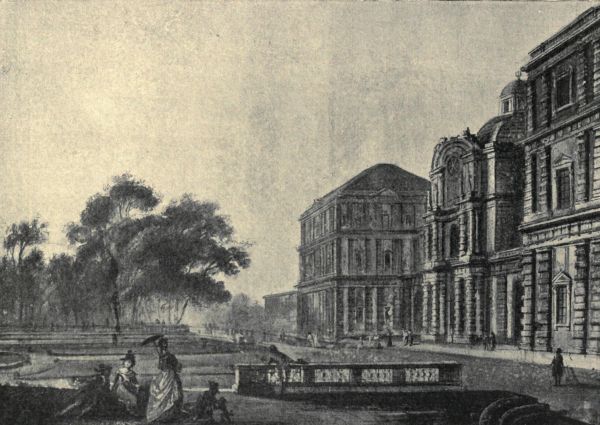
Quite near, is the Luxembourg, both palace and prison, the Luxembourg, where Marie de Medici gave such magnificent fêtes, where Gaston d'Orléans yawned so much, and where the Grande Mademoiselle sulked, sighing for the handsome Lauzun; where also the Count de Provence so cleverly prepared, with Monsieur d'Avaray, his escape from France, on the same evening that Louis XVI. and Marie-Antoinette made such bad arrangements for the lugubrious journey that was to lead them to Varennes; the Luxembourg, whose courtyard was used as a promenade by such prisoners as the Terror crowded there; the Luxembourg, whence Camille Desmoulins wrote to his Lucile those heartrending letters that still bear the traces of tears; the Luxembourg whither, a few weeks later, Robespierre was brought as a prisoner, and where, "for want of room," Hally, the porter, refused to receive him; the Luxembourg where, after Thermidor, the artist David painted, from, his dungeon, the shady walk in which he could see his children playing at ball; the Luxembourg of Barras, of Bonaparte, of the Directory fêtes; the Luxembourg, too, of Nodier, of Saint-Beuve, of Murger, of Michelet, of the students, of the workers of Bohemia, of the songs of the worthy Nadaud and Mimi Pinson, near to Bullier's and the Lilac Closerie and also to the Observatory and the ill-omened wall "scored with bullets" where Marshal Ney fell. Everywhere, the same mingling of mirth and sorrow, of laughter and blood. The reason is that each street, each cross-road, almost each house has seen some dark procession pass by or some victorious fête celebrated.
FRATERNAL SUPPERS IN THE SECTIONS OF PARIS On the 11th, 12th, and 13th of May 1793, or the 21st, 22nd, and 23rd of Floreal, Anno II. of the Republic. Drawn by Swebach-Desfontaines (Carnavalet Museum)
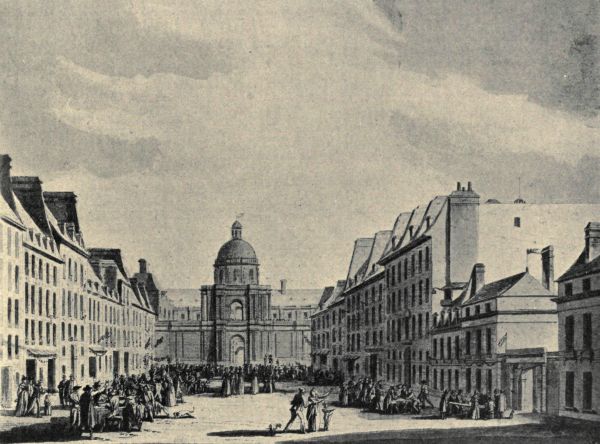
On all these dingy walls of Paris, hands of women or of artists have contrived to put flowers or bird-cages; and no alley is so dismal that it does not harbour a little poetry and dreaming, some gillyflowers and songs.
Not far away is the Carmes prison, in the Rue de Vaugirard, at the corner of the Rue d'Assas; and there all the externals are the same as they were at the moment of the terrible massacre of 1792. At the foot of the staircase one sees still the tiled floor of the small room where, between two corridors, Maillard placed the chair and table that formed the bloody tribunal of the September slaughter; the balcony covered with climbing plants through which issued the unfortunates that were felled, stabbed with pikes, or shot in the large garden; and, at the top of the first story, on the wall bearing even now the red marks of the blood-dripping sabres used by the slayers, may be read the signatures of the fair prisoners who, day after day, in terrified anxiety, waited, each evening, for the fatal order to appear before the Tribunal: Mesdames d'Aiguillon, Terezia Cabarrus-Tallien, Joséphine de Beauharnais. At this date, Tallien, himself suspected and followed by a band of spies, prowled from eve till morn round the sinister prison in which the woman he loved was confined. One day, on his table, 17 Rue de la Perle, he found a poniard that he recognised, a gem of Spain with which Terezia's hands were familiar. It was an imperative order; and on the 7th of Thermidor this note was transmitted to him from "La Force." "The head of the police has just gone from here. He came to tell me that to-morrow I shall ascend to the Tribunal, that is, to the scaffold. It is different from the dream I had in the night: Robespierre dead and the prisons opened.... But, thanks to your signal cowardice, there will soon be no one in France capable of realising it!"
As a matter of fact, the fair Terezia, being more especially aimed at by the Committee, had been mysteriously transferred from the Carmes prison to La Force; and it was from this latter place that she sent her will and testament of vengeance and death. Then, Tallien swore to save his country; the mother country for him was the woman he worshipped. Mad with love and rage, rousing against Robespierre every rancour, terror, and hatred, he spent the night and the day of the 8th in preparing the dreadful and tragical sitting of the 9th of Thermidor, which was a merciless duel between the two sides. He appealed to Fouché, to Collot d'Herbois as to Durand-Maillane and Louchet, to Cambon as to Vadier, to Thuriot as to Legendre, to the few remaining Dantonists as to the eternal tremblers of the Marais; then, springing to the rostrum with a dagger in his hand, he threatened Robespierre, who was nervous, uneasy, distraught, from the presentiment that his power was escaping him; and, at length, after a fearful five hours' struggle, obtained the dread decree outlawing and condemning to the guillotine those who themselves for two years had been mowing down the members of the Convention.
FÊTE GIVEN AT THE LUXEMBOURG ON THE 20TH OF FRIMAIRE, ANNO VII. Bonaparte hands to the Directory the treaty of Campo-Formio
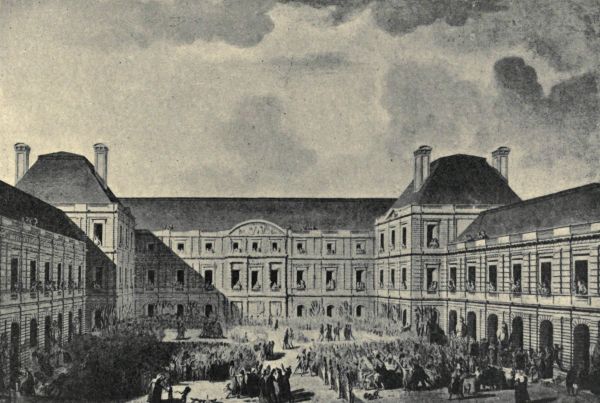
Opposite the Luxembourg, is the Rue de Tournon, where Théroigne de Méricourt and Mademoiselle Lenormand lived; the Countess d'Houdetot dwelt at No. 12, the appearance of which has hardly changed since. If he were to come back and wander about these parts, Jean-Jacques Rousseau would again find almost intact the home of her he chiefly loved, quite near to the Rue Servandoni, a dark, damp lane lurking beneath the walls of Saint-Sulpice, where Condorcet, during the Terror, succeeded in safely hiding himself at the house of Madame Vernet, No. 15. There he terminated—under what sorry conditions!—his Tableau of the Progress of the Human Mind. His wife was living at Auteuil and there painted pastels. No industry prospered under the Terror. "Every one," says Michelet, "was in a hurry to fix on the canvas a shadow of this uncertain life." On the 6th of April, his work being finished, Condorcet dressed himself as a workman, with long beard and cap down over his eyes, a "Horace" in his hand, and in his pocket some poison, for a case of need, prepared him by Cabanis; and escaped from Madame Vernet's. All day, he roamed about the country, in the vicinity of Fontenay-aux-Roses, hoping to find with some friends, Monsieur and Madame Suard, a shelter that they refused him. He spent the night in the woods; then, on the morrow, haggard and starved, he entered a Clamart public-house. There, he made a ravenous meal, while reading his dear Horace. Being questioned and suspected, he was carried off to the district, put on an old horse and thus conducted to the prison at Bourg-la-Reine. At dawn, the gaolers, on going into his cell, stumbled over his corpse. Poison had made an end of this noble life of work, glory, and misery.
Aloft in the same quiet quarter, Saint-Sulpice rears its two unequal towers, on which Chappe planted the great arms of his aërial telegraph. It was in the fine vestry of this imposing church, which has preserved its admirable wood-carvings, that Camille Desmoulins signed the marriage register, when, on the 29th of December 1790, he married his adored Lucile Duplessis. The marriage was a veritable romance; and all Paris crowded to the gates of Saint-Sulpice to see the procession go by. The bride and bridegroom were congratulated; and cheers were given for the witnesses, whose names had already become popular; Sillery, Pétion, Mercier, and Robespierre. Then, the wedding party ascended the Rue de Condé to go and breakfast at Camille's home, No. 1 Rue du Théâtre François (to-day, No. 38 Rue de l'Odéon), on the third floor. There, on the 20th of March 1794, the day of his mother's death, he was arrested, bound like a malefactor, and thence was taken to the Luxembourg hard by. On the 5th of April, Camille was executed amid the shouts of the people who had so flattered him. Lucile followed him to the scaffold a week later! They had sworn to love each other in life and death.... The idyll finished in blood.
Round about Saint-Sulpice, one comes across the Rue Férou, the Rue Cassette, the Rue Garancière, the Rue Monsieur-le-Prince, the Rue Madame, with their ancient names and provincial aspect, devout and silent quarters of monastic and semi-mysterious life, and, for this reason, full of infinite charm.
There, on all sides, are heard convent bells and liturgic sounds. The few shops that exist are austere in air and devoted to religious purposes: chasuble makers', holy image dealers', church book and jewellery sellers'. Behind long, sombre walls, shoots of verdure, the plumes of a tree joyously bursting forth remind one of large, unkempt gardens, where all grows wild, full of flowers and birds, inhabited by pious persons and old people who pray as they walk and regretfully dream of the times that are no more.
In the huge Paris, noisy and flippant, mad with sound and movement, tramways and underground railways, it is the refuge of the past, the quarter for prayer, silence, and oblivion; there still seem to live "a few dolent voices of yearnings for the past, which ring the curfew," says Chateaubriand in his Memoirs from beyond the Grave.
Old mansions are numerous.
In the Rue de Varenne alone, each portal awakes a remembrance of the most illustrious names of France's nobility: Broglie, Bourbon, Condé, Villeroy, Castries, Rohan-Chabot, Tessé, Béthune-Sully, Montmorency, Rougé, Ségur, Aubeterre, Narbonne-Pelet, &c., and some of the hosts of these aristocratic dwellings were certainly found disguised, dressed up as horse-dealers, drovers, peasants, workmen, in the Golden Cup hostelry at the corner of the Rue de Varenne, which was celebrated in the history of the Chouannerie: the heroes of Tournebut, my dear friend Lenôtre's interesting work, put up there, says the author, who, himself filled with enthusiasm, knows how to inspire his reader with the same. It was one of the meeting-places used by the sworn companions of George Cadoudal, who hid there several times; and there, too, the royalist conspirators met to complete, for Vendémiaire, Anno IV., their arrangements relative to the abduction of the Convention.
THE RUE DE L'ECOLE DE MÉDECINE IN 1866 House where Marat was assassinated Drawn by A. Maignan
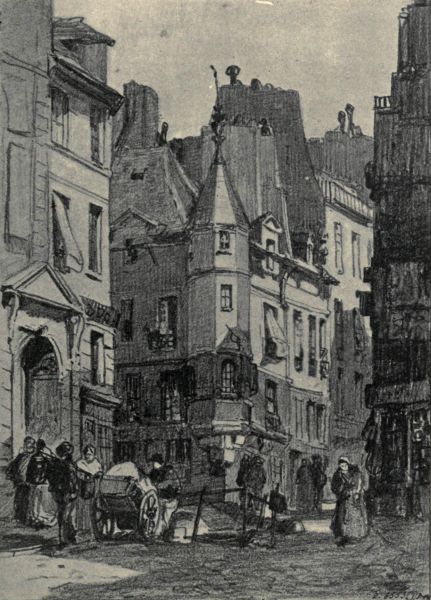
At some little distance, in the Rue Canettes, another rendezvous existed, for emigrants and chouans, in the house of the perfumer, Caron, where a famous hiding-place was used. Hyde de Neuville tells us, in his picturesque memoirs, that one needed only to slip behind the picture, serving as signboard to the perfumery—a picture overhanging the street—then to draw over one the shutter of the neighbouring chamber, for all the police Fouché employed to be tricked, in spite of searching, as they frequently did, the house through and through.
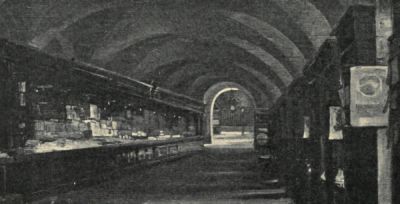
Next, we come upon the Odéon—the old Odéon—still standing on its base, in spite of the countless jests levelled at it, with its famous galleries, where, for many a long year, saunterers have gone to have a look at the last productions of contemporary literature. How often have we lingered in front of the old books or new ones, turning over the leaves, or reading between two pages yet uncut?
It was in 1873 that, under three arcades of the Odéon galleries, the most amiable of publishers, Ernest Flammarion, installed himself in partnership with Ch. Marpon; both of them indefatigable workers, benevolent and witty, they spent treasures of contrivance to get into too narrow a space all the nice, fine books they loved so well, and understood so well how to make others love.
But soon the three arcades were really inadequate; and, progressively, the untiring Flammarion spread round two sides of the big building, before starting out to conquer Paris, and to establish in the city so many bookshops. He had his faithful readers: an old book-lover of narrow purse owned to him that he had read the whole of Darwin's Origin of Species (450 pages) while standing in front of the stall!
Other customers less scrupulous have sometimes carried off the volume they had begun; but the good Flammarion is infinitely indulgent to such "absent-minded" individuals. "The desire to instruct themselves is too strong for their feelings," he murmurs by way of excuse, and, philosophically, he smiles and passes these petty larcenies to his profit and loss account.
Along the Rue de l'École-de-Médecine, passing by the Dupuytren Museum, which was formerly the refectory of the Franciscan monastery, we reach the Boulevard Saint-Germain, the cutting of which did away with so many precious relics; among others, the abode where Marat was assassinated, the Mignon College, and the Saint-Germain Abbey, the front of which opened opposite the row of old, curiously gabled houses which so far have been left alone by architects and builders. These latter heard the cries of the victims that were massacred in the September slaughters. They were lighted by the reflection of eighty-four fire-pots supplied by a certain Bourgain, the candle-maker of the quarter, in order that the families of the slaughterers and the amateurs of fine spectacles might come and contemplate the work; the shopkeepers of the quarter, who were complaisant witnesses, supplied details. These houses also saw Billaud-Varennes congratulate the "workers" and distribute wine tickets to them; and Maillard, surnamed Strike Hard, they saw leave, when his work was done, with his hands crossed behind the skirts of his long grey overcoat, and walk quietly back to his home, like a worthy clerk quitting his office, coughing the while, for he had a delicate chest.
THE GALLERY OF THE ODÉON (RUE ROTROU)
Together with the present presbytery, they form the sole extant witnesses of that dreadful butchery.
Within a stone's throw, once there was the Passage du Commerce, where resounded the butt-ends of the guns of the sectionaries who, on the 31st of March 1794, came at daybreak to arrest Danton and conduct him to the Luxembourg; and it is easy to fancy what must have been that hour of fright and stupefaction. Arrest Danton! the Titan of the Revolution, him whose formidable eloquence had raised fourteen armies from the soil! the Danton of the 10th of August, Danton till then untouchable! It was only a few days after the arrest of Camille with his cruel wit; the Camille of the Palais-Royal, of the Lanterne, the Revolutions of France and Brabant, the Brissot unmasked; the Camille of the "Vieux Cordelier," that masterpiece of wit and courage, in which he dared to speak of clemency to Robespierre and of respect for his fellows to the ignoble Hébert! On the site of Danton's house, the tribune's statue stands to-day; we regret the house.
THE ROHAN COURTYARD IN 1901 Water-colour by D. Bourgoin
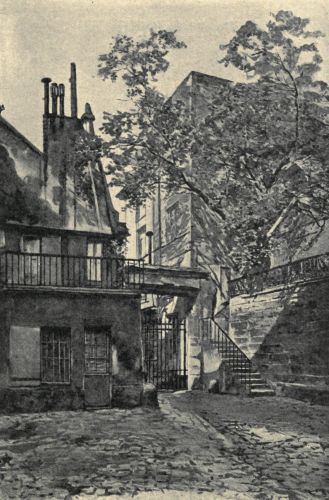
The Rohan courtyard (the word ought to be written Rouen, for, in the fifteenth century, the yard depended on the old mansion possessed by the Cardinal de Rouen) joins the Passage du Commerce, a few steps from the bookshop where the philanthropic Doctor Guillotin tried on a sheep the knife of his "beheading machine"; it is picturesque and curious, this Rohan courtyard, where you can still see the well of the house once inhabited by Coictier, the doctor of Louis XI.; where, too, the "mule's step" may be found, that Sorbonne doctors, who frequented this quarter, used in order to get off their steeds, and which preserved a very old wall round a garden planted with lilac and turf—alas! destroyed last year. The wall, like that of the Rue Clovis, was a fragment of Philippe-Auguste's fortification, the base of one of whose towers is still to be made out in the Passage du Commerce, No. 4, at the house of a locksmith, who has set up his forge upon it!
THE ROHAN COURTYARD IN 1901 Second view
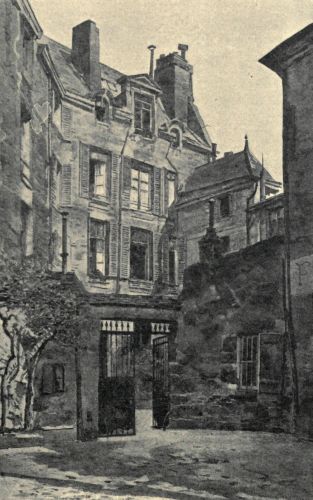
The houses there are old, dilapidated, and sordid, but perfect in their picturesqueness; the strangest industries flourish in them, and quite recently one might read there this characteristically Parisian advertisement, "Small hands required for flowers and feathers," beside a plate pointing out the address of the newspaper, Heaven, on the fourth floor, door to the left!
The Rue de l'Ancienne Comédie is on one side; it is the ancient Rue des Fossés-Saint-Germain, where Marat set up his press and printing-machine in a cellar. At No. 14, in the courtyard of an old mansion occupied by a wall-paper merchant, once stood the premises of the Théâtre-Français. The large entrance door, the staircases leading to the actors' private rooms, the slanting pit of the hall, and even the friezes are still in existence. The King's Comedians played there, on April 18th, 1689, Phèdre and the Médecin malgré lui, and performed in the same building until 1770.
The encyclopædists, d'Alembert, Diderot and his friends, used to meet opposite at the Procope coffee-house, the handsome iron balcony of which is yet subsisting, from where it was so agreeable to hobnob with the balcony of the Comedy. The Procope coffee-house, celebrated in the eighteenth century, was even more so under the Second Empire. In 1867, on the eve of the Baudin trial, Gambetta poured forth in it, to the students of the various University schools, the thunder and lightning bursts of his admirable eloquence. The great orator in 1859 lived at No. 7 Rue de Tournon, in the hotel of the Senate and the Nations, at present to be found there. His small room afforded a fine view over the roofs of Paris, and also remains as it was then.
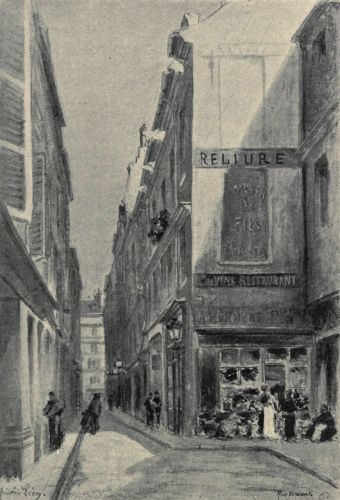
THE RUE VISCONTI Water-colour by F. Léon
Near the spot, at No. 1 Rue Bourbon-le-Château, on the 23rd of December 1850, two poor women were assassinated. One of them, Mademoiselle Ribault, a designer on the staff of the Petit Courrier des Dames, edited by Monsieur Thiéry, had the strength to write on a screen with a finger dipped in her own blood: "The assassin is the clerk of M. Thi...." This clerk, Laforcade, was arrested the next day.
How many delightful nooks besides, hardly known by Parisians, are to be met with on the left bank of the river!
ALFRED DE MUSSET AT 23 YEARS OF AGE Drawn by Lépaulle (Pigoreau Collection)
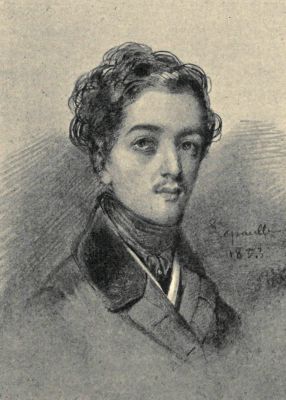
Not all have disappeared for ever of those vast melancholy gardens, those hoary mansions buried in streets where the grass grows, and whose noble but gloomy façades would never cause one to suspect the riches they contain. Many are in the vicinity of the Hôtel des Invalides. Others are in the Rue Vanneau, the Rue Bellechasse, the Rue de Varenne, the Rue Saint-Guillaume, the Rue Bonaparte; some also in the Rue Visconti, which dark narrow lane possesses illustrious souvenirs. The famous Champmeslé, Clairon, and Adrienne Lecouvreur lived in the Ranes mansion, built on the site of the Petit-Pré-aux-Clercs, and J. Racine died there in 1697. This house, which bears the number 21, is to-day a girls' boarding-school! And last of all, at No. 17 the great Balzac established the printing-press that ruined him, and that later became the studio of Paul Delaroche. There, was played the sentimental and commercial drama whose poignant phases have been related to us so eloquently by Messieurs Hanoteaux and Vicaire.
All these houses, so pregnant with history, are still visible; yet how few Parisians are acquainted with them!
On the Voltaire Quay lived Vivant, Denon, Ingres, Alfred de Musset, Judge Perrault, Chamillard, Gluck, and Voltaire himself who died there, and whose corpse, wrapped in a dressing-gown and held up by straps, like a traveller asleep, started by night in a travelling-coach, on the 30th of May 1778, from the courtyard of Monsieur de Villette's mansion, with its entrance still in the Rue de Beaune, to be buried outside Paris at the Abbey of Scellières in Champagne.
The flat in which Voltaire passed away has not been altered, and its decoration has remained almost intact, with its wall mirrors, its painted ceilings, and its small mirrored salons contrived in the thick walls.
THE FAÇADE OF THE INSTITUTE From an original drawing of the Revolutionary period (Carnavalet Museum)
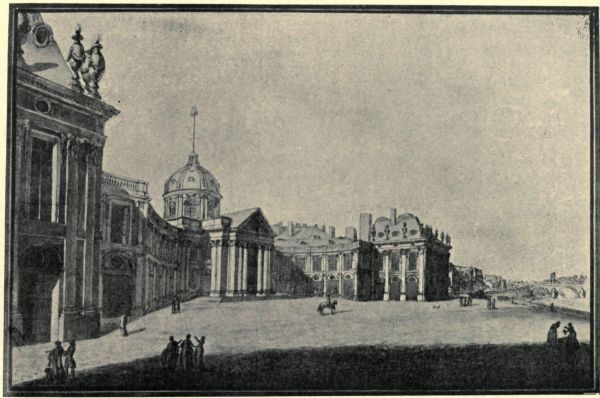
The Institute is not far, but for the ancient College of the Four Nations to produce its best impression, it needs a special day—an extraordinary sitting, a sensational reception, when the prettiest costumes of the most elegant Parisian dames contrast with the Academicians' green uniforms. On one side, are beauty, charm, and grace; on the other, some of the noblest intelligences, the most illustrious names in Literature, Art, and Science. It is the great intellectual banquet of France in one of the fairest sights of the Capital.
If, however, we wish for something to amuse us, something original, we must mount the endless staircases of the Institute and seek it in the attic portion of the palace, visiting the tiny chambers where formerly it was the custom to put candidates for the Prix de Rome in the competitive music examination.
Inside these closets, at which the sumptuously lodged prisoners of Fresnes-les-Rungis would grumble, on these decrepit walls, the finest talents of our modern school have left traces of their whilom presence—bars of music, verses, drawings, writings of varied nature. I confess I should not dare to reproduce, even expurgated, the inscriptions which confinement and absence from Paris streets and acquaintance have suggested to many an admirable composer of to-day. Saint-Saëns would certainly blush, Bizet's great shade would be troubled, our great and witty Massenet would surely refuse to accept the paternity of his vigorous apostrophes, and—I will be discreet; never mind—it's something very enjoyable, very funny, and quite in the character of the language.
Between the Mint and the lion-poodle of the Institute (from the shelter of which, if we are to believe his delightful Memoirs, Alexandre Dumas contributed so valiantly to the triumph of the 1830 Revolution) nestles a small, provincial-looking Square; Madame Permon, mother of the future Madame Junot, Duchess of Abrantès, lived there until the Revolution. In a small garret of the same house, at the left corner, on the third floor, Bonaparte used to lodge during his rare holidays from the École Militaire. The fine, carved wainscotings are still round the walls of the drawing-room on the ground floor, overlooking the Seine, which the Cæsar that-was-to-be used to enter and there speak of his hopes, and the marble chimney-piece is in its old place; at it he would come and dry his big patched boots that "smoked again," the talkative Madame d'Abrantès tells us. So, while dreaming, the little sub-lieutenant might, from the window, see opposite him the palace whence, for a number of years, he was to conqueringly dispose of the destinies of the dazzled world.
In front of the Institute is the Pont des Arts. There the sight is an enchanting one; the Seine—the gayest, most lively of rivers—crowded with passenger-boats, tugs, barges, and barques. The grey or blue sky is reflected in the water, and the river flows majestically between two verdure-clad quays, surmounted by book-sellers' cases, and inhabited by the most picturesque of populations.
What strange trades there are on the river sides!—watermen's barbers, dog shearers, dockmen, and sand-carters, tollmen and mattress-carders, anglers, bathmen, washerwomen; it is a separate population with its own customs, habits, and peculiar language. And what a splendid frame is round this odd little world seen from the Pont des Arts!
VIEW FROM THE LOUVRE QUAY Noël, pinxit
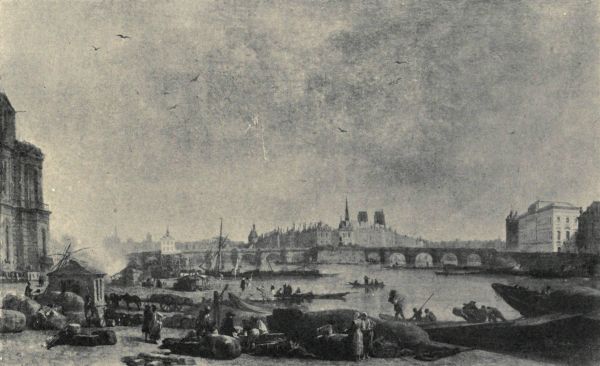
On the one bank, the Louvre, the green foliage of the Tuileries, and the Champs-Elysées, with the minarets of the Trocadero and the heights of Chaillot on the horizon; on the other, all old Paris, a series of monuments haloed with souvenirs—the Palais de Justice, the Conciergerie, the Sainte-Chapelle, Notre-Dame; the churches of Saint-Germain-l'Auxerrois, Saint-Gervais, Saint-Paul; the Pointe de la Cité.
PARIS FROM THE POINTE DE LA CITÉ Photographed by Richebourg
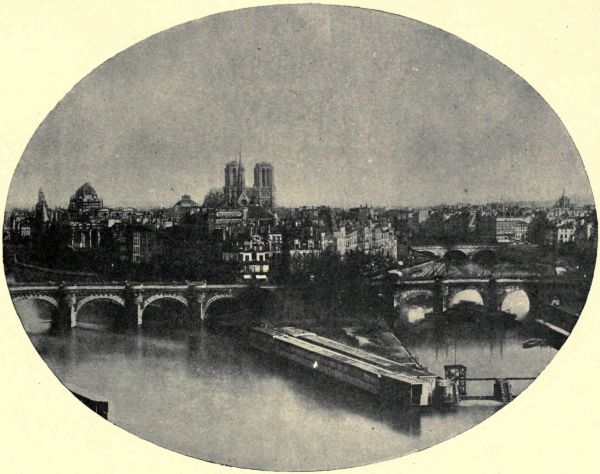
At night, these noble, suggestive silhouettes assume a still more imposing majesty—modern blemishes, glaring colourings, shameless advertisements are blotted out.
The moon spreads its delicate white light over the old walls, and a silvern Paris rears itself in the darkness. At times, too, underneath a storm-red sky, an entirely sombre town arises, made known only as a tragic vision in successive flashes of lightning.
Either we have a Paris of sunny mirth or a Paris bathed in night's gloom.
Descending once again towards the Seine, through the picturesque streets that surround the Institute—the Rue Dauphine, the Rue de Nesles, the Rue Mazarine—we discover in the Rue Contrescarpe-Dauphine—at present the Rue Mazet—the remains of the old White Horse Inn. The stables, with their ancient mangers and quaint eaves, still exist. They date back to Louis XIV. In that time, every week the huge inn-yard was filled with travellers going to Orléans and Blois; and the unwieldy coach started in a cloud of dust, amidst crackings of whip, trumpetings, adieus, and shakings of handkerchiefs; horses pranced, women wept, dogs barked, postilions swore. To-day the animation has disappeared, but the scene has remained, age-stricken, impressive, still charming, so much so that Massenet, moved by it, murmured one morning: "It must be here that Manon[2] alighted from the diligence!"
The neighbouring house was once the Magny restaurant, at which those celebrated dinners were given that Goncourt speaks of so often in his Memoirs, dinners shared by Renan, Sainte-Beuve, Georges Sand, Flaubert, Théophile Gautier, Gavarni, and many others.
Not far away, and connecting the Rue Mazarine—where Molière and his company played—with the Rue de Seine, let us go through the Passage du Pont-Neuf, occupying the site of the ancient entrance to the theatre, and being the scene of Zola's terrible novel Thérèse Raquin.
It is a typical nook—sordid, dingy, and malodorous, but strangely attractive, with its fried-potato sellers and Italian modellers. The shops in it seem to belong to another century; some months back, one only was frequented by customers, that of a drawing-paper dealer. The artist, Bonnat, told us he had bought his "Ingres paper" there, when he was a pupil at the School of Fine Arts, of which to-day he is the eminent head. The shop had not altered for sixty years, and the saleswoman asserted that the "stomping-rags she sold were exactly similar to those used by Monsieur Flandrin." In front of us is the Institute, and it is impossible to walk along the interminable black-looking wall enclosing it, on the side of the Rue Mazarine, without thinking of the painful paragraph in the preface of the Fils Naturel, wherein the younger Dumas, speaking of his childhood, recalls the souvenir of the return from the first performance, at the Odéon, of Charles VI. chez ses grands vassaux, on the 20th of October 1831.
The evening had been a stormy one, and the success of the play was doubtful. Consequently, a continuation of their poverty was to be expected. Alexandre Dumas had heavy burdens to support—his mother, a household, a child. He had to live himself and to keep his family on the meagre salary his situation under the Duke d'Orléans procured him. It was not of his talents but of his star that he doubted; and the younger Dumas always remembered his father's broad shadow cast by the moon on the dark, gloomy wall of the Institute, and himself timidly guessing at his father's anxieties and endeavouring, with his little eight-year-old legs, to follow and keep up with the studies of the good-natured giant.
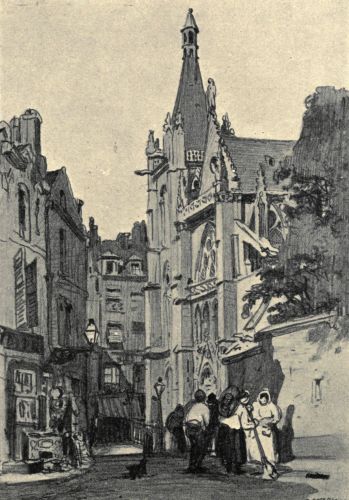
THE RUE DES PRÊTRES-SAINT-SÉVERIN IN 1866 Drawn by A. Maignan
It was in the Rue Guénégaud, in the Hôtel Britannique, that Madame Roland took up her quarters in 1791. There, joyous and confident in the future, she opened her political salon. What a pleasure for the little Manon to show to all the Pont-Neuf neighbourhood, where her childhood had been spent, that she had become a lady and received people of mark. Brissot, Buzot, Pétion, Robespierre, Danton himself, were pleased to come, between two sittings, and talk at this amiable woman's house; and I fancy what attracted them was far more the pretty Parisian's qualities than the virtues of the austere husband, who must have been a great bore! On the 26th of March 1792, Dumouriez came to Roland's door and rang to tell him that he was appointed Minister. On the morrow, the little Manon of the Quai des Lunettes settled in triumph at the Calonne mansion. It was the way to the scaffold.
Skirting the quays, we reach the Saint-Michel Square, then the Rue Galande. In spite of recent demolitions, this old street still contains some ancient abodes; but it has lost the singular house called the Red Castle, or more prosaically, "the Guillotine."
In what was, during the seventeenth century, a sumptuous dwelling—the mansion, 'tis said, of Gabrielle d'Estrées—behind the huge, tall front steps at the back of the courtyard, was the dingy, smoky habitation, stinking of wine, dirt, debauch, and vice.
One had to step over the bodies of male and female drunkards to get inside the dens where such poor wretches came seeking some sort of lodging and an hour of forgetfulness. It was at once hideous and lugubrious. Amateurs of ugly sights might continue their studies hard by, on the premises of "Gaffer" Lunette, in the Rue des Anglais. The inhabitants were similar; a prison population—"bestiality in all its horror," as Mephistopheles sings in the Damnation of Faust. Recent building and sanitary improvements have done away with the "Red Castle."
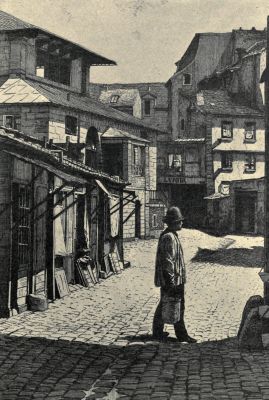
THE PASSAGE DES PATRIARCHES Etching by Martial
The Rue Saint-Séverin is a picturesque medley of old houses round the ancient Gothic church—"that flora of stone"—one of the most curious perhaps in Paris; one of those that best preserve the traces of a past of art, devotion, and prayer.
The sublime artists who, in several centuries, knew how to create the forest of fine carvings with which the apse is adorned, have, alas! left but sorry successors. By the side of old painted glass windows, brought from the church of Saint-Germain-des-Prés, other cold, modern stained windows of loud colour have taken from Saint-Séverin's the religious, poetical mysteriousness, the inviting half-obscurity that appeal to the soul of the believer; and their crude light renders only too visible the marks of successive mutilations inflicted on this fine church. In the next street, the present clergy-house is built on the old graveyard, where, in 1641—as the erudite Monsieur de Rochegude informs us—the first operation for gravel was publicly performed on a criminal condemned to death, who, happy man, was cured, and pardoned by Louis XI. The whole of the quarter is one of the busiest in Paris. It would seem as if the vagabonds, the lewd and their lemans, the tatterdemalions of bygone centuries, had left there a direct line of descendants. People live in the street, eat scraps in low drink-shops; a smell of spirits floats in the air at the corners of the various cross-roads; bars and petty restaurants are thronged with customers. Part of the money begged or stolen in Paris is spent there.
Saint-Médard's church is quite close, with its small, dusty, quaint Square, and its round tower at the end of the Rue Monge and the corner of the Rue Mouffetard. It is a gloomy, rat-gnawed, poverty-stricken church, looking as if worn-out with age; and is blocked in by old houses covered with gaudy-coloured advertisements. It has left, far behind in the past, the days when the tomb of the Deacon Pâris in it performed its miracles, when the townsfolk and courtfolk crowded in the small graveyard, a door of which still exists, the one perhaps whereon was written the famous couplet:—
"In the King's name, forbid is God To work a wonder on this sod."
THE RUE MOUFFETARD Charcoal Drawing by P. L. Moreau
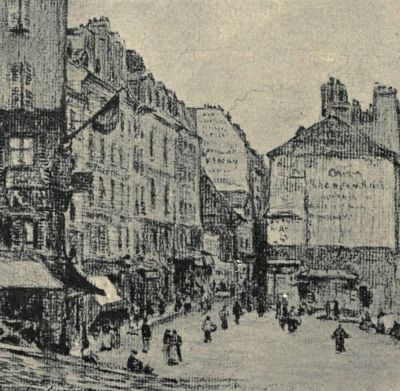
The Rue Mouffetard passes in front of the church porch, overflowing with life and activity. A hundred petty trades are exercised in it; the house doors themselves—old eighteenth-century doors—shelter women-sellers of flowers, milk, fried potatoes, cooked mussels; children play about the middle of the road; carriage traffic is rare. Housewives gossip on their doorsteps, people live together—and in the street. The Passage des Patriarches, which opens at No. 99, was famous in days of yore. The Calvinists, who used to preach there, had bloody quarrels with the Catholics of Saint-Médard's. To-day, it is nothing but a dank, dirty, melancholy alley, inhabited by bric-à-brac dealers, old-iron sellers, and petty hucksters; and smells of rags, old lead, and cauliflower!
THE RUE GALANDE Lansyer, pinxit (Carnavalet Museum)
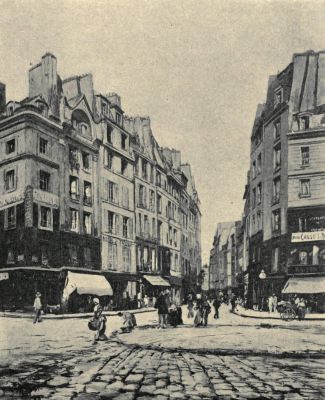
Maubert Square is the converging centre of these strange streets. At present, modernised and rearranged—adorned, if I may say so, with a wretched statue of Etienne Dolet, who was burnt there in 1546—the Square only vaguely resembles the "Plac' Maub'," still visible six or seven years ago, ill-famed, narrow, bordered with old steep-roofed houses, a den of vagabonds, full of suspicious lurking-corners where the police might be sure of making good hauls. Near at hand, in the Maubert Blind Alley, Sainte-Croix used to dwell; and it was in the same mysterious retreat that Madame de Brinvilliers, the sorry heroine of the Poisons drama so well told by our witty friend, F. Funck-Brentano, used to meet her accomplice and with him prepare the terrible "succession powder," composed, according to her avowal, of "vitriol, toad's venom, and rarefied arsenic," which she made use of to poison her father, her two brothers, and to try to make away with her sisters and husband.
THE PLACE MAUBERT Lansyer, pinxit
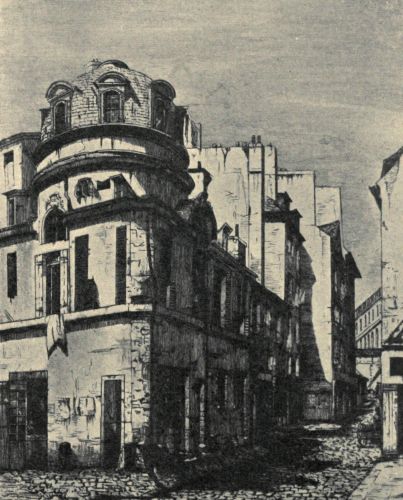
In 1304, Dante attended, hard by, one of the numerous schools of the Rue du Fouarre; and, at the corner of the Colbert-Mansion Street, the Faculty of Medicine had its amphitheatre. This curious building is still almost intact with its ancient cupola, and would supply an admirable piece of decoration to some retrospective museum of surgery.
THE OLD AMPHITHEATRE OF SURGERY At the corner of the Colbert Mansion Etching by Martial
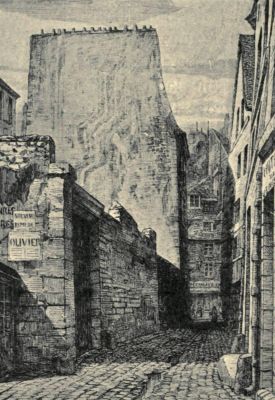
Not far from this spot, the Rue Maître-Albert—which up to 1844 was called the Rue Perdue—owes its present name to the Dominican Maître Albert who, in the thirteenth century, taught in the open air in Maubert Square. It contains curious houses, to-day dens for tramps, who spend the night in them. In 1819, an old negro of miserable appearance and strange manners used to go down this dark street every evening, trying his best to escape observation, and used to seek food and shelter in one of its sorry eating-houses. People pointed him out as he went, whispering that he was formerly Dubarry's black servant, Zamore, whom Louis XV. had played with; Zamore who became a power, petted and courted by noble lords, fine ladies, and princes of the Church that emulously strove to gain the favourite's good graces. Later, having been appointed a municipal officer under the Terror, he vilely, ungratefully, and in a cowardly way, betrayed his benefactress, gave her up, and cast her beneath the knife of the guillotine. At length, sinking lower and lower, Zamore came and hid himself at No. 13, on the second courtyard floor of this gloomy Rue Perdue, and died there on the 7th of February 1820.
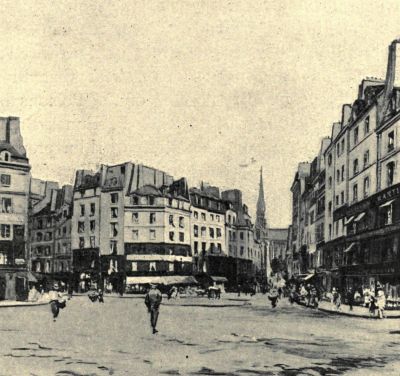
THE CHURCH OF SAINT-NICOLAS-DU-CHARDONNERET, AND THE RUE SAINT-VICTOR Drawn by Heidbrendk (Carnavalet Museum)
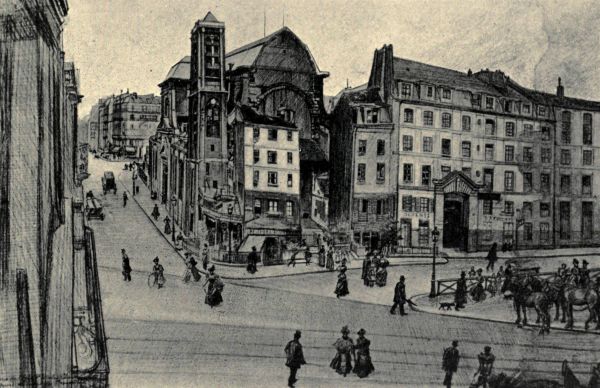
The two churches nearest the spot are those of Saint-Nicolas-du-Chardonneret and Saint-Julien-le-Pauvre. Connected with the former is a dismal little seminary, in which, under the guidance of the Abbé Dupanloup, the eminent philosopher Ernest Renan went through part of his theological studies. Every one should read in the Souvenirs of my Childhood and Youth the admirable pages this marvellous writer has devoted to his stay in this studious home. "The parish, which derived its name from the field of thistles well known of the students at the Paris University in the Middle Ages, was then the centre of a rich quarter inhabited chiefly by the legal profession. The boarding-school régime weighed heavily upon me. My best friend, a young man from Coutances, I think, like myself, full of enthusiasm, and of excellent heart, held himself aloof, refused to reconcile himself, and died. The Savoy students showed themselves still less acclimatisable. One of them, older than I, owned to me that, each evening, he measured with his eye the height of the three-storey dormitory above the pavement of the Rue Saint-Victor. I fell ill; apparently I was doomed. My Breton soul lost itself in an infinite melancholy. The last angelus of evening I had heard resound over our dear hills, and the last sunset I had watched over the tranquil landscape came back to my memory like sharp arrows. In the ordinary course of things I ought to have died. Perhaps it would have been better if I had...."
THE RUE SAINT-JULIEN-LE-PAUVRE Etching by Martial
The artist Le Brun's mother is buried in the Saint-Charles chapel of the church of Saint-Nicolas-du-Chardonneret, and also Pierre de Chamousset, the inventor of the petty Postal service. Parisian ladies, bless his memory!
The church of Saint-Julien-le-Pauvre is set apart for the Greek ritual. Enclosed on its sides and rear by the ancient buildings of the Hôtel-Dieu, this melancholy-looking chapel is falling to ruin; a stopped-up well with meagre weeds growing from its border-stones seems to guard the door, which opens on a dirty, rubbish-strewn courtyard where a few half-starved fowls peck their scanty meal. It is a nook of poverty and suffering. The walls are damp and dingy; in these sombre yards, where a few sickly trees barely exist, all is solitude and abandon. Only three years ago, stretchers or ambulance carriages still stopped from time to time in it, and from them were taken victims of crime, disease, or accident, that had fallen in the street. Through the vast Paris, busy and indifferent, monopolised by its pleasures or its cares, one or another human wreck was brought to the Assistance Publique in this dismal Rue Saint-Julien-le-Pauvre with its suggestive name.
THE JARDIN DES PLANTES—THE CEDAR OF LEBANON AND THE LABYRINTH Water-colour by Hilaire (National Library)
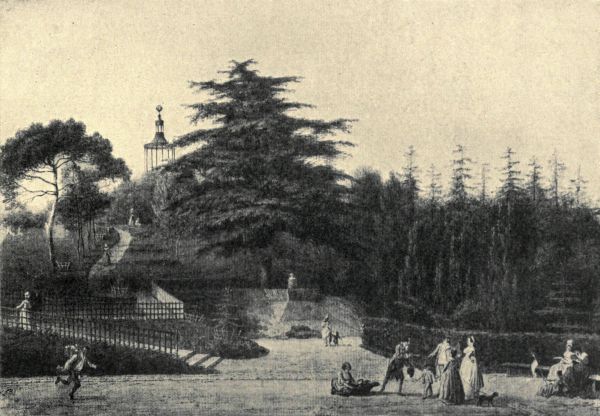
To refresh ourselves after so painful a spectacle, let us come back to the lovely Parisian quays, and walk along the fair river, quivering in the daylight or in the moon's nightly rays; let us pass by the beautiful mansions of the Miramionnes, of Nesmond, of Judge Rolland, in front of the wine market—"catacombs of thirst," and pause at the old Jardin des Plantes, dear to Buffon. A touch of the charm of things past, but not entirely vanished, lingers yet!
The trees are centuries old, the ornamental hornbeams have not been altered; there are aviaries and goat-pens which are the same as when Daubigny and Charles Jacques sketched them in 1843, to illustrate the handsome work published by Curmer.
THE JARDIN DES PLANTES IN THE EIGHTEENTH CENTURY Water-colour by Hilaire (National Library)
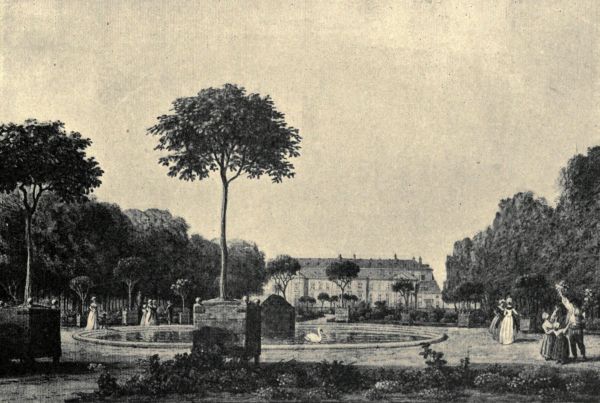
The reptiles are better housed than in our childhood; but the hippopotamus wallows in the same basin; the giraffe stretches his neck over the same enclosures, and the elephant holds through the same railings his gluttonous trunk in search of rolls.
The bear-pit has not changed; and the crowd of idlers continue to tempt the eternal "Martin" to climb up the same tree. Still to the noisy children the delightful labyrinth offers its capricious meandering; and the cedar of Lebanon (Cedrus Libani) [Linnæus], which tradition tells us Monsieur Jussieu brought back in his hat, has not ceased to wave its ample branches over dreamers, loungers, workers, or grisette—the grisette that comes and sits beneath its venerable shade to read the exciting magazine story which fills with sweet emotion her heart athirst for the ideal!
And, in fine, is there anything nattier than the tiny rooms of the Louis XVI. buildings? which once formed Buffon's natural history cabinet, and whose delicate grey wood carvings made such a suitable framework for the admirable butterfly collections brought from every country.
Within these finely decorated and cosy rooms there was, so to speak, an ideal assemblage of blossoms, a fairy scene of exquisite colours, an enchantment wrought by a brilliant palette.
There they were, all of them, beautiful butterflies, with their metallic lustres from India and Brazil, French butterflies of a thousand tints, both the great death's-head sphynx and the little blue creature of the meadows.
Perhaps time had powdered and somewhat dimmed the marvellous brightness of their first colouring; but it was better so. Their pristine lustre would have been too great a contrast in the quaint surroundings, and it was an extra charm to see such gems of the air thus lightly decked with the dust of the past! To-day, alas! these rooms, flowering with sculpture, are closed and forsaken; a part of their wainscoting has disappeared.... Where have decorations so pleasing gone?... Why these everlasting, culpable mutilations, which I know are a grief to Monsieur Périer, the eminent Director of the Museum? The collections of butterflies are now transferred to the vast and sumptuous central hall of the new pavilion devoted to natural history. I liked them better in the charming rooms which once contained them and suited them so well!
The water-flowers bloom, as of yore, in the same low, stifling hot-houses, near the bizarre-shaped orchids; and it was in the old amphitheatre, where so many illustrious scholars taught, that the noble artist Madame Madeleine Lemaire,—the only "woman professor" that has ever held a post at the Museum,—initiated her attentive, spell-bound audience into the divine beauty of flowers!
In all periods, artists have come and installed their light easel or their modelling-stands in front of the lions' cages, or in the Garden itself, on the grass, opposite the antelopes, hinds, walla-birds, or the goats of Thibet.
We remember, my brother and I, having, as little boys, accompanied our father, who was modelling from life the tigers and lions in the wild beasts' corridor. The odour was pungently alkaline, the heat sultry; we heard the hissing of polecats in the entrance and exit rotundas; sometimes a terrible roar, a complaint of anger, pain, or ennui, arose and shook the panes.
Most of these unfortunate animals, deprived of air and light, shut up in the horrible, narrow, stinking cages, died a lingering death of consumption. Indeed, they quickly grew familiar with those who spent whole weeks studying them; and their huge heads rubbed caressingly against the thick cage-bars, while their eyes became soft and almost tender.
Often we went, inquisitive, ferreting school-boys, to the reptiles' menagerie, an old building crumbling with age, and passed long hours peeping at the chameleons, gazing at the boa-constrictors, trying to rouse the sleepy crocodiles, which seemed to be already stuffed! What reminiscences and souvenirs in the dear old Jardin des Plantes, one of the few "Nooks and Corners of Paris" that have remained almost untouched!
THE JARDIN DES PLANTES—CUVIER'S HOUSE Water-colour by Bourgoin (Carnavalet Museum)
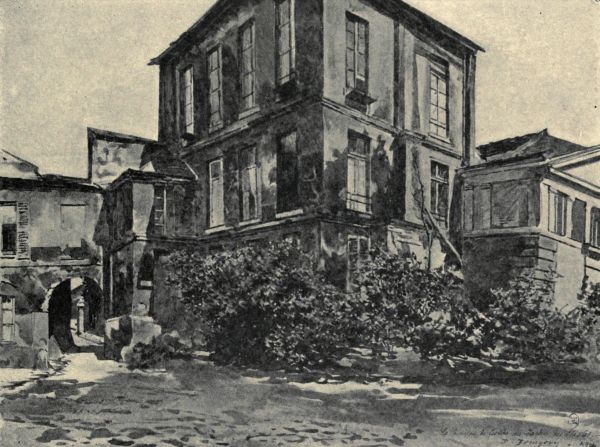
On the side, the ancient house Cuvier lived in does not look very stable, and perhaps would go to pieces but for the network of plants round it: ivy, birthwort honeysuckle, lianes of all kinds caparisoned it with verdure. They are carpets, cascades of glossy green, shining together: a nosegay of leaves in a garden.
Behind the Jardin des Plantes is Salpêtrière with its walls of evil memory, the Salpêtrière of the September massacres, the Salpêtrière whence Madame de Lamotte so easily escaped after her condemnation; with its broad gardens and its ugly covered-yards surrounded by railings, where, as De Goncourt said, "Women madder than their fellows" are confined. The dome, visible from everywhere, commands, like a lighthouse of misery, all this quarter infected by the Bièvre, the poor, sacrificed river, which is now in part walled over; the oily Bièvre, streaked with tannery acids, reddened by skins of sheep recently flayed that steep in it; the Bièvre which flows miserably and sordidly, but yet so picturesquely, amidst starch factories, fellmongers' stores and other works, after traversing the tiny gardens of Gentilly and creating the illusion of a landscape in the quarter of the Fontaine-à-Mulard.
Gone is the time when this ill-starred river washed the banks of smiling meadows and reflected the willows in its clear waters. Tamed, domesticated, adapted to tasks of every sort, unceasingly used by tanners, curriers, tawers, dyers, it flows dirty and putrid! To follow it in its windings, the Rue du Moulin-des-Prés must be ascended, and entrance made into the Rue de Tolbiac. There, through a gate, it enters a dark, dismal passage, whence it will issue only to glide in a kind of sinister-looking canal between black, repulsive manufactories. Here and there, along the scanty banks, a few washerwomen have fixed their tubs on a level with the water, and sing as they dolly their linen; elsewhere, wretched urchins endeavour to catch a stray fish that might have lost its way in the mephitic stream. Then the Bièvre disappears once again and this time underground, coming to view afresh in the Rue des Gobelins. At this spot, some rare traces of a glorious past are discovered. The ancient houses have many of them remained. But how often transformed! The owners of works and of shops, after enslaving the river, have taken possession of the houses bordering it.
THE RUE DE BIÈVRE Drawn by Heidbrendk
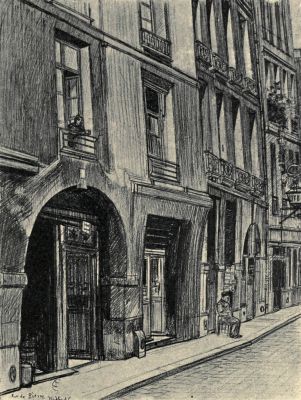
Offices, warehouses, leather stores have invaded the noble mansions of the sixteenth century, and the Bièvre winds, as if ashamed, through poor gardens, like it, fallen from their antique splendour.
THE BIÈVRE TANNERIES Etching by Martial
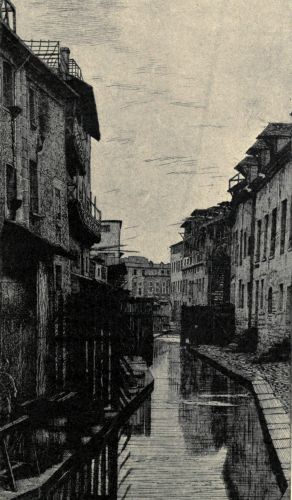
Further on, there are more works and tanneries, black corners mean and malodorous, where thousands of rabbit-skins, hanging in mid-air, hard and dry, clash together with a noise of wood. To the very end, the unlucky river, harassed and exploited, cleans blood-stained skins, moves heavy wheels, or washes ghastly offal, amidst a smell as of barege. Finally, it runs to earth once more beneath the Hospital Boulevard, within evil-smelling, dark holes.
But before the last fall, the Bièvre passes through an astonishingly strange lane, one of the oddest in this odd quarter: the Ruelle des Gobelins. It flows as a stream of red, green, and yellow tints, between patched-up, mouldy, tumble-down houses, in an odour of ammonia. And yet, near these hovels, among the heaps of tan, beside pits in which are macerating skins of flayed animals, a gem of carving rises as it were an appeal of beauty, a vestige of past splendour. It is the sculptured remains of an adorable Louis XV. pavilion of which Monsieur de Julienne had made a hunting-box; and this lovely paradox, this blossom of stone cast among such a mass of ugliness, is not one of the least surprises of the quarter so fertile in matters for astonishment. Moreover, a few yards from this sewer, the artists of the Gobelins Manufactory have laid out their work-and-study-gardens, in which shine the purple, gold and azure of the prettiest flowers in France. These, cleverly distributed, arrange a carpet of exquisite and radiant colours athwart the surrounding district of sombre sadness.
On the confines of the town, is the Butte-aux-Cailles, a vast piece of waste land, cheerless and without charm, which, until 1863, was a sort of fresh country spot, with mills and farms on it. To-day, it is a quarter of hard labour, where numbers of rag-pickers classify the refuse of Paris. At the corner of the Ruelle des Peupliers, faggot-dealers have set up their huts; and hovels line strange streets made with the clearings of other streets.
THE BIÈVRE ABOUT 1900—THE VALENCE MILL-RACE Schaan, pinxit (Carnavalet Museum)
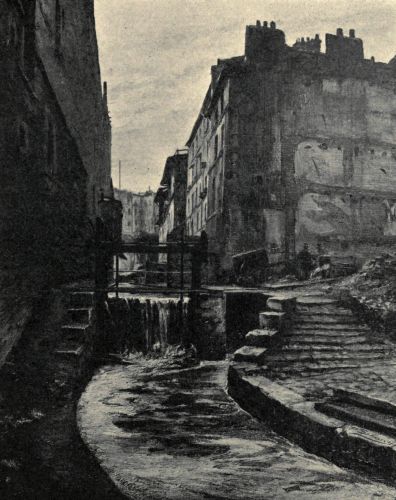
Once, these spacious grounds were one stretch of flower gardens and market gardens watered by the Bièvre.
In a most interesting book, somewhat forgotten now, Alfred Delvau tells us much of the former history, under Louis-Philippe, of the Saint-Marceau faubourg, the Butte-aux-Cailles, the Rue Croulebarde, and also the Rue du Champ-de-l'Alouette, in which last street the "Shepherdess of Ivry" was murdered, the crime by its bizarre character producing a deep impression in the Capital in 1827. It was a public-house waiter, Honoré Ulbach, who had stabbed a girl, Aimée Millot by name; she, as a keeper of goats, was popular at Ivry. Every day, she was to be seen, with a large straw hat on her head and a book in her hand, tending her mistress's goats. The "Shepherdess of Ivry" she was called in the neighbourhood; in 1827, there were still shepherdesses in Paris!
The trial that followed excited the whole town; the crime was one of love and jealousy; the victim was nineteen; she was virtuous and a shepherdess; women "cursed the murderer, even while pitying him perhaps," wrote the newspapers of the time; and even the giraffe but recently arrived at the King's Garden was neglected for the Ivry drama.
On the 27th of July, Ulbach, who seems to have been half-mad, was condemned to death; and, at four o'clock in the evening on the 10th of September, he was executed on the Grève Square.
A Municipal Crèche, in the Rue des Gobelins, occupies, at No. 3, a fine Louis XIII. mansion, once inhabited by the Marquis of Saint-Mesme, a lieutenant-general and the husband of Elizabeth Gobelin, close to a handsome lordly-looking building which in the quarter bears the name of Queen Blanche's Mansion.
The legend attaching to the latter is false, affirms Monsieur Beaurepaire, the learned and amiable librarian of the City of Paris. "It was," he says, "simply Catherine d'Hausserville's home, where Charles VI. was nearly burnt alive during the performance of a ballet, his fancy dress having caught fire." The edifice, with its noble appearance, forms a strange contrast in this poor yet picturesque district.
Another fine mansion, in the Rue Scipio, is the one built by Scipio Sardini, in the reign of Henri III., with terra-cotta medallions, rare Parisian specimens of the exceedingly pretty decoration that pleases us so much at Florence, Pisa, and Verona. This Scipio Sardini was a peculiar man, and his story deserves to be told. Of Tuscan origin, he came to France after the death of Henri II., just when Catherine de Medici seized the reins of power. Amiable, witty, ingratiating, a great financier, clever in his enterprises, and unscrupulous, he quickly gained a preponderant position in the frivolous, dissolute, mirth-loving Court. He excelled in combining business and pleasure. An illustrious marriage seemed to him essential to people's forgetting his low origin and the rapid rise of his fortunes. He married the "fair Limeuil," one of the most seductive beauties of the Queen's flying squadron—"All of them capable of setting the whole world on fire," said Brantôme. This attractive person had been successively courted by the most noble lords of the Court before effecting the conquest of Condé, by whom she had a child. At Dijon, during one of the Queen's receptions, Mademoiselle de Limeuil was taken ill and was delivered of a boy. "It is inexplicable," writes Mézeray, "that such a prudent woman should have so miscalculated." There was a scandal; the Queen Mother was indignant; the fair Isabella was imprisoned; but Condé who was still amorous, succeeded in effecting her escape. The Protestants, however, were on the watch, and induced their leader to give up his too compromising mistress. Then it was that Scipio Sardini came forward, the richest man of the period, the King's banker, as also the nobles' and clergy's. He managed to get himself accepted; the marriage took place; and he settled in this pretty mansion that we still admire, and that is mentioned by Sauval as one of the most beautiful in Paris, amidst vineyards, orchards, and fields bordering on the Bièvre. There he lived, surrounded by luxury, works of art, books and flowers, and died there about 1609. As early as 1636, the mansion was converted into a hospital, which in 1742 was once more transformed, this time into a bakery. To-day, it is the Bakery of the City of Paris Hospitals.
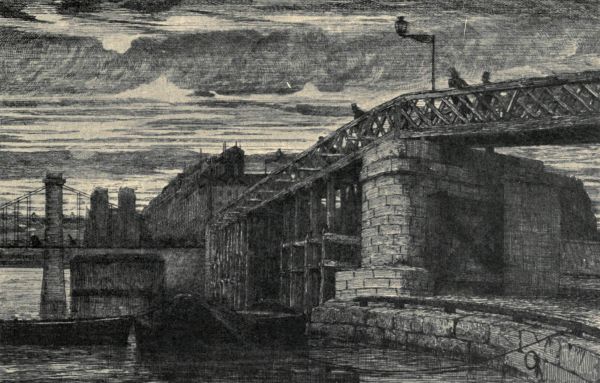
Let us keep along by the Wine Market, and, before crossing to the right bank of the river, respectfully pause on the Stockade Bridge, close to the small monument erected to the famous sculptor Barye by his admirers,—to the great Barye who, misunderstood and mocked, sold up by his creditors, often came in the evening, after leaving his modest studio on the Célestins Quay, to forget his sufferings and muse in this same place before the splendid panorama of Paris crowned by the grand silhouette of the Panthéon. Here, too, is one of the City's best views.
Nothing is more relative than an impression felt. To certain minds in love with the Past, this or that ruin is much more affecting than the most modern palace; it is the same with streets, houses, and pavements.
An exquisite hour to call up the soul of old Paris is at twilight.
The colour peculiar to each object has melted into the general shades and tints spread by the day which is departing and the night which comes.
Delicate lace-work outlines stand out against the sky, while huge violet, black, and blue masses of atmosphere bathe whole streets in fathomless mystery. Then thought awakens, souvenirs revive and grow clear; scenes are lived through again of which these streets and houses were the silent witnesses. One hears cries of fury or of joy; drums beat, bells ring, groups pass singing 'mid these dream visions that rise again!
In order to enjoy such an experience no better spot could be chosen than the Stockade Bridge, which, with its barrier of black beams, as it were shuts off to the east Paris of the olden days.
The City slumbers in the calm of evening, the smoke curls lazily up. Afar sound bells; swallows sweep crying in the air embalmed by falling night; noises ascend vague and weird, interpreted according to the fancy of one's musings. All life seems to sleep; the soul of the past awakes. It is the hour desired.
THE CONSTANTINE BRIDGE AND STOCKADE Etching by Martial
THE PONT ROYAL IN 1800 Boilly, pinxit (Carnavalet Museum)