BORDERLAND
Reading edition
The outline of Warwickshire is something in the form of a turnip, and the stem of it, which, like an isthmus, projects into Gloucestershire and Oxfordshire, contains many old-world places.
Long Compton, the most southern village of all, is grey and straggling and picturesque, with orchards on all sides, and a fine old church, amid a group of thatched cottages, whose interior was restored or mangled at a period when these things were not done with much antiquarian taste. We have pleasant recollections of a sojourn at the "Old Red Lion," where mine host in 1880, a typical Warwickshire farmer, was the most hospitable and cheery to be found in this or any other county: an innkeeper of the old school that it did one's heart good to see.
But this welcome house of call is by no means the only Lion of the neighbourhood, for on the ridge of the high land which forms the boundary of Oxfordshire are the "Whispering Knights," the "King's Stone," and a weird Druidical circle. These are the famous Rollright Stones, about which there is a story that a Danish prince came over to invade England, and when at Dover he consulted the oracle as to the chances of success. He was told that
"When Long Compton you shall see, You shall King of England be."
Naturally he and his soldiers made a bee-line for Long Compton, and, arriving at the spot where the circle is now marked by huge boulders, he was so elated that he stepped in advance of his followers, who stood round him, saying, "It is not meet that I should remain among my subjects, I will go before." But for his conceit some unkind spirit turned the whole party into stone, which doesn't seem quite fair. "King's Stone" stands conspicuous from the rest on the other side of the road, and, being very erect, looks as if the prince still prided himself upon his folly. The diameter of the circle is over a hundred feet. In an adjoining field is a cluster of five great stones. These are the "Whispering Knights"; and the secret among themselves is that they will not consent to budge an inch, and woe to the farmer who attempts to remove them. The story goes that one of the five was once carted off to make a bridge; but the offender had such a warm time of it that he speedily repented his folly and reinstated it.
There is a delightful walk across the fields from Long Compton to Little Compton, with a glorious prospect of the Gloucestershire and Warwickshire hills. This village used to be in the former county, but now belongs to Warwickshire. Close to the quaint saddle-back towered church stands the gabled Elizabethan manor-house, with the Juxon arms carved over the entrance. Its exterior has been but little altered since the prelate lived here in retirement after the execution of Charles I. A gruesome relic was kept in one of the rooms, the block upon which the poor monarch's head was severed. This and King Charles' chair and some of the archbishop's treasured books disappeared from the manor-house after the death of his descendant Lady Fane. Internally the house has been much altered, but there are many nooks and corners to carry the memory back to the hunting bishop, for his pack of hounds was one of the best managed in the country. Upon one occasion a complaint was made to the Lord Protector that Juxon's hounds had followed the scent through Chipping Norton churchyard at the time of a puritanical assembly there. But Oliver would hear none of it, and only replied, "Let the bishop enjoy his hunting unmolested."
CHASTLETON.
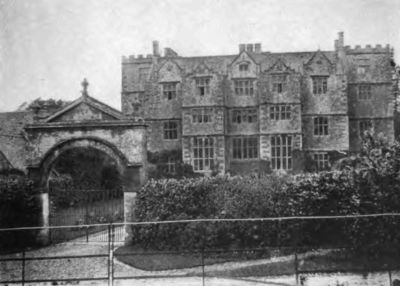
When Little Compton church had an Independent minister to hold forth to the congregation, the prelate held divine service every Sunday at Chastleton, the grand old home of the loyalist family of Jones. This stately Jacobean mansion is close to Little Compton, but is really in Oxfordshire. It has an old-world charm about it entirely its own; and few ancestral homes can take us back to the days of Cavalier and Roundhead with such realism, for the old furniture and pictures and relics have never been disturbed since the house was built by Walter Jones between the years 1603 and 1630. He purchased the estate from Robert Catesby, the projector of the Gunpowder Plot, who sold the manor to provide funds for carrying on that notorious conspiracy.
The great hall is a noble apartment, with raised dais and carved screen; and the Royalist Joneses looking down upon you on all sides, conspicuous among whom is Thomas Jones and valiant Captain Arthur Jones, whose sword beside him shows the good service he did at Worcester fight. When the day was lost, and Charles was journeying towards Boscobel, the captain managed to ride his tired horse back to Chastleton. But a party of Cromwellian soldiers were at his heels, and his wife had only just time to hurry him into an ingeniously contrived hiding-place when the enemy confronted her, and refused to budge from the very bedroom behind whose panelled walls the fugitive was secreted. But Mrs. Arthur Jones had her share of tact, and in preparing her unwelcome guests some refreshment, she added a narcotic to the wine, which in time had effect. Her husband was then released, and with a fresh horse he was soon beyond danger. The little oak wainscoted chamber and the adjoining bedroom may still be seen where this exciting episode took place. The drawing-room is very rich in oak carvings, and the lofty marble chimney-piece bears in the centre the Jones' arms. The ceiling with its massive pendants is a fine example of the period.[16] The bedrooms are all hung with the original tapestry and arras that was made for them. One of them contains the State bed from old Woodstock Palace; and there are everywhere antique dressing-tables, mirrors, and quaint embroidered coverlets, and old chests and cabinets innumerable containing queer old dresses and coats of the Georgian period, and, what is more remarkable, the identical Jacobean ruffs and frills which are depicted in the old portraits in the hall. Then there are cupboards full of delightful old china, and decanters and wine glasses which were often produced to drink a health to the "King over the water." But of more direct historic interest is Charles I.'s Bible, which was given by the widow of the last baronet of the Juxon family—a grand-nephew of the archbishop—to the then proprietor of Chastleton, John Jones. It is bound in gold stamped leather, and bears the Royal arms with the initials C. R. It is dated 1629, and is full of queer old maps and illustrations, and upon the fly-leaf is written—"Juxon, Compton, Gloucestershire."
Some of the ancient cabinets at Chastleton are full of secret drawers, and in one of them some years ago a very curious miniature of the martyr king was discovered. It is painted on copper, and represents Charles I. with the Order of St. George, and a set of designs drawn on talc, illustrating the life of the ill-fated monarch from his coronation to his execution. They are thus described by one of the past owners of Chastleton: "They consist of a face and bust in one miniature, in a case accompanied with a set of eight or nine pictures drawn on talc, being different scenes or dresses, which are to be laid on the miniature so that the face of the miniature appears through a hole left for that purpose: and thus the one miniature does duty in every one of the talc pictures. These were accidentally discovered some twenty years ago.[17] The miniature was well known, and was supposed to be complete in itself; but one day whilst being handled by one of the family, then quite a child, it fell to the ground, and being in that way forced open at the back, those talc pictures were brought to light. The careful manner in which they had been concealed, and the miniature thereby made to appear no more than an ordinary portrait, seems to warrant the suggestion that they were in the first instance the property of some affectionate adherent of Charles, whose prudence persuaded him to conceal what his loyalty no doubt taught him to value very highly. There is no direct evidence to show that they belonged to Bishop Juxon; nor is there any tradition that I ever heard connected with them. The two concluding pictures of the series represent the decapitated head in the hand of the executioner, and a hand placing the martyr's crown upon the brows."
There are two huge oak staircases running up to the top of the house, where is the old gallery or ballroom, with a coved ceiling of ornamented plaster-work, and above the mullioned windows grotesque monster heads devised in the pargeting.
The grounds and gardens are quite in character: not made to harmonise, as are so many gardens nowadays, but the original quaint cut box hedges and trim walks. The grand old house in the centre with its rusty roof of lichen, and hard by the little church nestling by its side with the picturesque entrance gateway and dovecot, form together a delightful group. Chastleton church contains some good brasses. The tower is oddly placed over the south porch.
A couple of miles to the north, and the same distance beyond, are two other interesting manor-houses, Barton-on-the-Heath and Little Woolford. The former, a gabled Jacobean house, was once the seat of the unfortunate Sir Thomas Overbury, who was done to death in the Tower by the machinations of that evil couple, Carr, Earl of Somerset, and his countess. Overbury, it will be remembered, had written the Court favourite's love letters and poems, and knew too much of that guilty courtship.
There are some good monuments to the Overburys in the church: a Norman one with saddle-back tower. Near here is the Four-Shire Stone, described by Leland as "a large bigge stone; a Three-Mile-Stone from Rollerich Stones, which is a very mark or line of Gloucestershire, Whichester (Worcestershire), Warwickshire, and Oxfordshire."
Little Woolford manor-house, the old seat of the Ingrams, is now, or was some years ago, used as a school. It is very picturesque, and its gables of half-timber, facing the little courtyard, remind one of the quadrangle of Ightham Mote. Opposite the Tudor entrance-gate is the hall, with its open timber roof, minstrels' gallery, panelled walls, and tall windows, still containing their ancient painted glass. Barton, which properly should have its ghost, presumably is not so favoured; but here there are two at least,—a certain "White Lady," who, fortunately for the juvenile scholars, does not appear until midnight; and the last of the Ingrams, who has a restless way of tearing about on horseback in the adjacent fields. This gentleman could not die decently in his bed, but must needs, upon the point of dying, rush into the stable, mount his favourite steed, and plunge into the raging tempest to meet his adversary Death. What a pity there are not more educational establishments like this. They might possibly make the pupils less matter-of-fact and more imaginative. But we had almost forgotten a moral lesson that is to be learned from a rude projection in the masonry on the left-hand side of the entrance gateway. This is the oven, which opens at the back of a wide hearth; and here some seventeenth-century I O U's are said to have been found for money lost at play; while some Cavaliers were concealed there in the time of the Civil Wars. But the punishment for gambling was providentially arranged. Some Cromwellian soldiers dropping in at the manor-house, lighted a tremendous fire, and gave the unfortunate fugitives a roasting which they did not readily forget. This is roughly as the story goes; indeed it goes further, for by local report King Charles himself was one of the victims.
Brailes, a few miles to the north-east, is famous for its church, the cathedral of southern Warwickshire; but it is principally interesting exteriorly, the old benches having been long since cleared away and many nineteenth-century "improvements" made. Still there are parts of the fourteenth-century roof and a fine font, some ancient monuments, particularly melodious old bells; and the lofty embattled fifteenth-century tower is exceptionally graceful.
Buried in a hollow, and hidden from view by encircling trees and hills, is that wonderful old mansion Compton Wyniates. The name (derived from the ancient family of Compton and Wyniates, a corruption of vineyard, for at an early period the vine was here cultivated) is suggestive of something quaint, and indeed a more curious old house could not be found. Its innumerable gables and twisted chimneys seem to be heaped up in the most delightful confusion, in abandoned opposition to any architectural regularity. The eye wanders from tower and turret until it becomes bewildered by so many twists and angles. Look at the square box of a house like Moor Park, for example, and wonder how it is that having arrived at such picturesque perfection, taste should so degenerate. But half the fascination of Compton Wyniates is its colour; its time-worn dark-red brick and the grey-green lichens of ancient roofs. Upon one side the curious gables and countless chimney clusters are reflected in the moat, part of which now does service as a sunken garden.
Passing through the bullet-battered door of the main entrance, over which are the Royal arms of England supported by a griffin and a dog, we enter a quadrangular court and thence pass into the great hall, with its open timber roof black with the smoke of centuries. The screen beneath the music gallery is elaborately carved with leaf tracery, grotesque figures of mounted knights, and the escutcheon of the Compton arms. Above the gallery we notice the huge oak beams which form the half-timber portion of one of the principal gables, and cannot help comparing these tremendous oak trunks with the modern laths plastered in front of houses: a futile attempt to imitate this popular style, without aiming at its object—strength.
The screen of the chapel, like that of the hall, is ornamented with grotesque carvings, including a battle royal between some monks and his Satanic Majesty, who by the way has one of the ninety rooms all to himself, and reached by a special spiral staircase. Near the "Devil's chamber" is another small room whose ghostly occupant is evidently a member of the fresh-air league, for he will persist in having the window open, and no matter how often it is closed it is always found to be open. What a pity this sanitary ghost does not take up his abode where oxygen is scarcer. But these are by no means the only mysterious rooms at Compton Wyniates, for not a few have secret entrances and exits, and one dark corridor is provided with a movable floor, which when removed, drawbridge fashion, makes an excellent provision for safety so long as you are on the right side of the chasm. Such ingenious arrangements were as necessary in a private residence, miles from anywhere, as the bathroom is in a suburban villa. There are secret "barracks" in the roof, with storage for a regiment of soldiers, if necessary. The popish chapel, too, has ample provision for the security of its priest. There are four staircases leading up to it, and a regular rabbit-warren between the beams of the roof and the wainscoting, where if needs be he could run in case of danger.
"Henry VIII.'s room," and "Charles I.'s room," are both pointed out. The latter slept a night here prior to the battle of Edgehill, and the bluff king honoured the builder of the mansion, Sir William Compton, with a visit in memory of old days, when his host as a boy had been his page. Dugdale tells us that Sir William got his building material from the ruinous castle of Fulbrooke, so his bricks were mellowed with time when the house was first erected. The knight's grandson became Baron Compton in Elizabeth's reign, and his son William, Earl of Northampton in 1618. A romantic episode in the life of this nobleman was his elopement with Elizabeth Spencer of Canonbury Tower, Islington. The lady was a very desirable match, being the only daughter of Sir John Spencer, the richest heiress of her time. Notwithstanding her strict seclusion at Canonbury, Lord William Compton, of whom she was enamoured, succeeded in the absence of her father in gaining admission to the house in the disguise of a baker, and carried her off in his basket. To perform so muscular a feat was proof enough of his devotion, so at the end of a year all was forgotten and forgiven. Their son, the valiant second earl, Spencer Compton, won his spurs and lost his life fighting for the king at Hopton Heath. His portrait by Janssen may be seen at Castle Ashby.
His son James, the third earl, also fought for Charles, and attended his son at the Restoration; but his younger brother Henry, Bishop of London, aided the Revolution, and crowned Dutch William and his queen.
Only within the last half-century has the mansion been occupied as a residence. For nearly a century before it was neglected and deserted. The rooms were bare of furniture, for, alas! its contents, including Henry VIII.'s State bed, had been removed or sold. That delightful writer William Howitt in 1840 said the house had not been inhabited for ninety years, with the exception of a portion of the east front, which was used by the bailiff. The rooms were empty and the walls were naked. His concluding wish fortunately long since has been realised—namely, that its noble owner would yet cause the restoration and refitting of Compton Wyniates to all its ancient state.
Warwickshire is rich in ancestral houses and mediæval castles. Take, for example, the fortresses of Kenilworth, Warwick, Maxstoke, and Tamworth, or the fine old houses Coombe Abbey, Charlecote, and Baddesley Clinton. The last named perhaps is least known of these, but by no means the least interesting. This old moated Hall of the Ferrers family is buried in the thickly wooded country on the high tableland which occupies the very heart of England. As to the actual centre, there are two places which claim this distinction; but oddly enough they are quite twelve miles apart. The one between Leamington and Warwick, the other to the west of Coventry. The latter spot is marked by the village cross of Meriden, and the former by an old oak tree by the main road. Baddesley Clinton is nearly equidistant from both, south of Meriden and north-west of Leamington and Warwick.
Few houses so thoroughly retain their ancient appearance as Baddesley. It dates from the latter part of the fifteenth century, and is a singularly well-preserved specimen of a moated and fortified manor-house of that period. Like Compton Wyniates, its situation is very secluded in its densely wooded park, and formerly there was a double moat for extra defence; but for all its retiredness and security, the old house has a kindly greeting for those who are interested in such monuments of the past. A stone bridge across the moat leads to a projecting embattled tower with a wide depressed archway, showing provision for a portcullis with a large mullioned window over it. In general appearance the front resembles the moated house of Ightham, with which it is coeval, and the half-timbered gables of the courtyard are somewhat similar. Unlike Charlecote, the interior is as untouched as the exterior. Everywhere there are quaint old "linen" panelled rooms and richly carved chimney-pieces—windows of ancient heraldic glass, and old furniture, tapestry, and paintings. The hall is not like some, that never look cosy unless there is a blazing log fire in the hearth. There is something particularly inviting in this old room, with its deep-recessed mullioned window by the great freestone Jacobean fireplace. What pictures could not the imagination conjure up in this cosy corner in the twilight of an autumn day! On the first floor over the entrance archway is the "banqueting-room," with high coved ceiling and tapestry-lined walls. Beyond this is "Lord Charles' room," haunted, it is said, by a handsome youth with raven hair. Many years ago this spectre was seen by two of the late Mr. Marmion Ferrers' aunts when they were children, and they long remembered his face and steadfast gaze. A mysterious lady dressed in rich black brocade is occasionally encountered in the corridors in broad daylight, like the famous "Brown Lady" of Raynham Hall.
The ancient chapel was set up by Sir Edward Ferrers when the little parish church was taken from the family at the Reformation. In the thickness of the wall close at hand there is a secret passage which leads down to a little water-gate by the moat beneath which a narrow passage runs, so that there were two ready means of escape in troublous times; and in the roof on the east side of the house there is a priest's hole provided with a fixed bench. Marmion Ferrers above alluded to, who died in 1884, was the eighth in descent from father to son from Henry Ferrers of Elizabeth's time. Both were learned antiquarians. Marmion Ferrers was a typical squire of the old school, and we well remember with what pride he showed us round his ancestral home. But his pride ended there, as is shown by the following anecdote. One day he encountered an old woman in the park who had been gathering sticks without permission. She dropped her heavy bundle and was about to offer apologies for trespassing, when the good old squire, seeing that her load was too much for her strength, without a word slung the burden on his shoulder and carried it to the woman's humble dwelling.
This calls to mind a story of a contemporary squire who lived some fifty miles away in the adjoining county, an antiquary who was also known for his acts of kindness and hospitality. In the vicinity of his ancient Hall a tramp had found a job, and the baronet was anxious to test his butler's honesty. He therefore offered to lend the man a hand and help him carry some bundles of faggots into an adjacent yard, if he would share profits. This was agreed upon, and when the work was done the tramp went off to the Hall to ask for his money, promising to join his assistant in a lane at the back of the house. Meanwhile the squire hurried to his study, and when the butler made his appearance handed him five shillings. Then donning his shabby coat and hat he hastened back. Presently the tramp came up with beaming countenance and held out half a crown, saying they were both well rewarded with one and threepence each. But the assistant grumbled, and said it was miserable pay, and at length persuaded the man to return and ask to see the squire and explain the amount of work that had been done. Again he returned to his sanctum, and hearing the bell ring told the butler to admit the man, and he would hear what he had to say. Having enjoyed the fun—the tramp's surprise and the butler's discomfort, he dismissed them both—one with half a guinea, the other from his service.
Baddesley Clinton church, shut in by tall trees a bow-shot from the Hall, is famous for its eastern window of heraldic glass, which shows the various noble families with whom the Ferrers intermarried. By the union of Marmion Ferrers' father with the Lady Harriet Anne, daughter of the second Marquis Townshend, the Chartley and Tamworth lines of the family were united with that of Baddesley. The altar tomb of Sir Edward Ferrers, Knight, the founder of the family at Baddesley, his wife Dame Constance, and son who predeceased him, has above shields of the alliances with the Bromes, Hampdens, etc. He was the son of Sir Henry Ferrers, Knight, of Tamworth Castle, and grandson of William, Lord Ferrers of Groby. Marmion was the thirteenth in descent from this Sir Edward, not many links between the fifteenth and end of the nineteenth century. The day of the good old squire's burial on August 25, 1884, fell upon the three hundred and forty-ninth anniversary of the death of the first Ferrers of Baddesley.