Chapter VIII · ADLINGTON AND ITS EARLIER LORDS—THE LEGHS—THE LEGEND OF THE SPANISH LADY’S LOVE—THE HALL. (continued 2)
Reading edition
This weary day, when I had almost past, I came vnto Sir Urian Legh’s at last. At Adlington, neer Macksfield, he doth dwell, Belou’d, respected, and reputed well. Through his great loue, my stay with him was fixt, From Thursday night till noone on Monday next. At his own table I did daily eate, Whereat may be suppos’d did want no meate. He would have giu’n me gold or siluer either, But I with many thankes receiued neither. And thus much without flattery I dare sweare, He is a knight beloued farre and neere. First, he’s beloued of his God aboue, (Which loue he loues to keep beyond all loue), Next with a wife and children he is blest, Each hauing God’s feare planted in their brest. With faire Demaines, Reuennue of good Lands, He’s fairely blest by the Almightie’s hands. And as he’s happy in these outward things, So from his inward mind continuall springs Fruits of deuotion, deedes of Piety, Good hospitable workes of Charity; Iust in his Actions, constant in his word, And one that wonne his honour with the sword. He’s no Carranto, Cap’ring, Carpet Knight, But he knowes when and how to speake and fight. I cannot flatter him, say what I can, He’s euery way a compleat Gentleman. I write not this for what he did to me, But what mine eares and eyes did heare and see, Nor doe I pen this to enlarge his fame, But to make others imitate the same. For like a Trumpet were I pleased to blow, I would his worthy worth more amply show, But I already feare haue beene too bold, And craue his pardon, me excusd to hold. Thanks to his Sonnes and seruants euery one, Both males and females all, excepting none.
Sir Urian Legh, as we have said, died in 1627; and his eldest son, Thomas, was approaching the meridian of life when he succeeded as heir to the family estates. It was a memorable epoch in English history, for in that year Buckingham, the King’s favourite, by his inglorious expedition to France, had brought dishonour on his country’s arms, and was impeached in Parliament; and in the following year the Commons, before they would grant the supplies necessary to retrieve the disaster, extorted from Charles the Petition of Rights, confirming the liberties that were already the birthright of Englishmen—a measure which, had it been accepted by its authors as final, would have spared the country the calamities of civil war. Thomas Legh had married in his father’s lifetime (1610) a rich heiress, one of the daughters of Sir John Gobert, of Boresworth, in Leicestershire; with whom he acquired considerable property, including the estate of Clumber,[34] forming part of the royal manor and forest of Sherwood, which subsequently passed into the possession of the Pelham-Clintons, Dukes of Newcastle; so that by the time he came into his patrimony he had added considerably to the territorial possessions as well as to the social status of his house. On the death of Sir John Gobert, dame Lucy, his widow, appears to have resided with her daughter and son-in-law at Adlington, and to have remained with them up to the time of her death in 1634. In 1628–9 Thomas Legh was chosen to fill the office of high sheriff of the county, a distinction that was again conferred on him in the year 1642–3. The year of the second appointment was a portentous one, for the seeds of civil strife which had been sown in previous years had ripened, and King and Commoner—sovereign and subject—were then placing themselves in open array against each other. The Royalists of Cheshire, though in a minority, were prompt in obeying the King’s summons. Thomas Legh, in whom the blaze of youth was then sinking into the deep burning fire of middle age, for fifty summers had passed over his head, at once placed himself at the disposal of his sovereign, and had a colonel’s commission in the Royalist army; Thomas, his eldest son, had a lieutenant-colonel’s commission; whilst his four younger sons—John, Charles, Peter, and Henry—and his brother Urian, who had previously been in the wars in the Low Countries, had also commissions.
The attempt to maintain the neutrality of the county by the Treaty of Pacification, as it was called, having failed, the commission of array was issued, requiring the receivers to see that the tenantry and others in their respective districts were mustered and properly armed and accoutred, and each of the hostile parties set to work to procure military stores in anticipation of approaching conflict. The King’s troops were at Chester under the command of Sir Thomas Aston, and the Parliamentarians, led by Thomas Legh’s relative, Sir William Brereton, of Honford, established themselves at Nantwich, which subsequently became the scene of important military operations. In March, 1643, the rival forces met at Middlewich, when an engagement took place in which the Royalists were defeated, Sir Edward Mosley, of Manchester, and several Cheshire men of mark being made prisoners; but Sir Thomas Aston and Colonel Legh, who was present with him and at the time sheriff, being more fortunate, succeeded in making good their escape. Before the close of the year the Royalists suffered a series of reverses. At Nantwich they sustained a defeat at the hands of General Fairfax; on the 4th of February, 1643–4, Crewe Hall was attacked and taken; three days later Doddington Hall shared the same fate; in the same month Adlington was besieged by a force under Colonel Duckinfield, and a few days after its surrender Mr. Tatton’s house at Wythenshawe, was also stormed and taken.
The probability of an attack on their home must have been foreseen by the Leghs, and, consequently, the house was put in a state of defence on the outbreak of hostilities, and stores of provisions and ammunition for the use of the garrison collected in anticipation of any attack that might be made upon it. Colonel Legh appears to have been absent at the time of Duckinfield’s assault, being probably with the King’s forces in some other part of the country, and the defence, therefore, fell to the lot of his eldest son—a brave scion of a brave ancestry, who must have conducted it with considerable energy and judgment, for the garrison held out a whole fortnight, notwithstanding that the siege was carried on with a good deal of vigour. The attacking party appear to have encamped on the south side of the hall, and the assault must have been made from that direction, for the door on the south front is pierced in several places where the bullets and cannon shot passed through. The garrison, by their obstinate bravery, must have won the respect of their assailants, for, unlike the case of Biddulph, which surrendered a week afterwards, when quarter for life only was granted, the defenders of Adlington when they did capitulate (Feb. 14) had full leave to depart. Burghall, the Puritan vicar of Acton, thus records the circumstance in his “Diary”:—
Friday, February 14th.—Adlington House was delivered up, which was besieged about a fortnight, where was a younger son of Mr. Legh’s and 140 souldiers, which had all fair quarter and leave to depart, leaving behind them, as the report was, 700 arms and 15 barrels of powder.
By an order of the Parliament, dated March 18, 1643, Sir William Brereton, of Honford, Thomas Legh’s second cousin, and then major-general of the Cheshire forces, entered upon possession and seized the family estates into his own hands, so that the owner of Adlington could hardly say of Sir William what, according to the old ballad, his kinsman Lord Brereton said when he espied him on the hill overlooking Biddulph—
Yonder my uncle stands, and he will not come near, Because he’s a Roundhead and I am a Cavalier.
The house was pillaged, though the fabric itself does not appear to have sustained any very serious injury considering the quantity of powder that was burned and the efforts that were expended upon it. Shortly afterwards it was retaken and held for the King, but it must have been stormed and taken a second time by the Parliamentarian soldiers, for when Colonel Legh’s widow appealed to Sir William Brereton to be allowed to occupy the hall, and to have a portion of her late husband’s estates assigned to her for the maintenance of herself and children, the request was denied, so far as the occupancy of the house was concerned, on the plea that as Adlington Hall had been garrisoned twice against the Parliament it was not judged fitting it should be ventured a third time.
Colonel Legh’s active zeal in the Royalist cause made him so obnoxious to the Parliament party that in the preliminary propositions for the abortive Treaty of Uxbridge he was specially named as one of those to be excluded from the councils of his sovereign, and from holding any office or command from the crown under pain of forfeiture of his estates and the penalties attaching to high treason. The stipulation was unnecessary, for before the commissioners had assembled he had entered into his rest. It is not known with certainty when or where his death occurred; the Prestbury registers for this period are imperfect, and no entry of burial can be discovered; it is not unlikely, however, that he found an unknown grave at some place distant from his home where he may have lost his life in the service of the King.
His widow took up her abode at the Miln House—the picturesque old black and white gabled structure, now occupied as a farmhouse, standing near the railway midway between Adlington and Prestbury, built in the time of Sir Urian Legh—which she held in jointure. She could hardly have been as uncompromising a Royalist as her husband, for in a petition to the committee for compounding with “delinquents,” praying that she might be allowed to compound for her deceased husband’s estates, she sets forth that “she had long before the death of her husband misliked the course of the enemy (i.e., the Royalists) in the parts where she resided, and had departed thence into the Parliament’s quarters, where she had ever since remained and conformed herself to all the orders of Parliament.” The statement was no doubt made in good faith, for some little time after Thomas Legh’s death she married an ardent Republican, who had been as active in furthering the Parliament’s interest in Lancashire as her first husband had been in defending that of the King in Cheshire—Sir Alexander Rigby, of Middleton-in-Goosnargh, a lawyer, statesman, magistrate, and colonel, and eventually one of the barons of the Exchequer. Rigby, who represented Wigan in the Long Parliament, was head and heart and hand and almost everything else of importance in Lancashire; his activity was unwearied; his energy irrepressible, and his influence unbounded. He was engaged in every important action; he commanded at the siege of Lathom, the fight in Furness, the capture of Thurland Castle, and the defence of Bolton-le-Moors; and he was nominated one of the King’s judges, but declined to act, the only occasion in his life, it is said, in which he hesitated to do his worst against royalty. Dr. Halley, in his “Lancashire Puritanism,” describes him as “rash, impetuous, rude, haughty, severe, implacable; admired by many, esteemed by few, and loved by none,” and the same writer adds, “he is said to have contrived a scheme and bargain by which the Royalist masters of three Cambridge colleges—St. John’s, Queen’s, and Jesus’—were to be sold for slaves to the Algerines.”
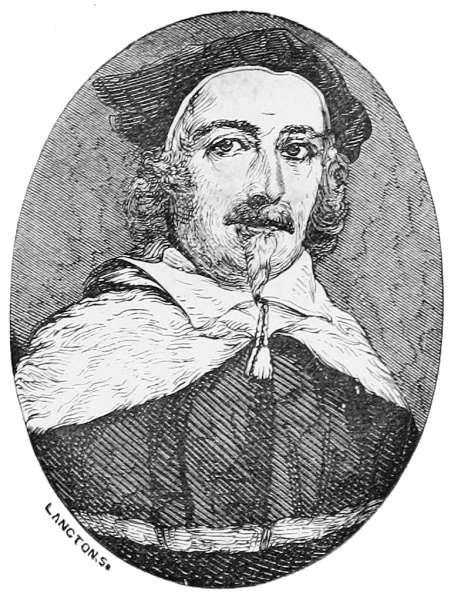
SIR ALEXANDER RIGBY.
The “insolent rebell, Rigby,” as Charlotte Tremouille, the heroic Countess of Derby, designated him when he was besieging Lathom House, though possessed of only a small estate, was connected by birth and marriage with many of the best families in Lancashire; he was also closely allied with the Leghs, of Adlington, having married for his first wife Lucy, the daughter of Sir Urian, and sister of Thomas Legh, so that he stood in the relationship of brother-in-law to his second wife.
The marriage of their mother with the “insolent rebell” could hardly have been viewed with much satisfaction by the sons, who were all fighting on the side of the ill-fated Charles, and, therefore, accounted “delinquents,” one of them being specially mentioned as “very active against the Parliament” and continuing “extreamelie malitious,” though, in other respects, it was fortunate, as Rigby’s influence as a member of the House of Commons in the Parliament interest was no doubt used in protecting the estates from the more ruinous exactions to which they would otherwise have been subjected, as well as the illegal challenges which might have wrested them absolutely from their rightful owners.
Sir Alexander Rigby died in 1650, having caught the gaol fever of the prisoners while on circuit at Croydon, and some time after his widow, who appears to have had a penchant for matrimony, again entered the marriage state, her third husband being John Booth, of Woodford, in Over, the uncle of Sir George Booth, of Dunham Massey, the head of the Presbyterian interest in Cheshire. John Booth was also a staunch Puritan; like the knight in “Hudibras,” he had ridden out “a-colonelling” in the interest of the Parliament, and may have been the identical Puritan whom “Drunken Barnaby,” when on his “Four Journeys to the North of England,” saw and thus immortalised:—
I came to Over—O, profane one— And there I saw a Puritane one, A-hanging of his cat on Monday For killing of a mouse on Sunday.
The marriage with John Booth could not have been a very felicitous one, for, according to Sir Peter Leycester, husband and wife lived apart from each other. She resided at the Miln House, and died there in February, 1675–6, and was buried at Prestbury. By her first husband, Thomas Legh, she had five sons, all of whom served in the Royalist army, one of them, John, losing his life in the war; and seven daughters, one of whom, Margaret, became the second wife of the eldest surviving son of her mother’s second husband, Alexander Rigby the younger, who, like his father, was an active soldier on the Parliament side, and the representative for Lancaster in the House of Commons in 1658.
At the time of Colonel Legh’s death, in 1644, his eldest son and heir, Thomas Legh, was a prisoner of war at Coventry, having been captured in the engagement at Stafford in May in the preceding year, where he was detained until June, 1645, when he was exchanged for his brother-in-law, Alexander Rigby,[35] who had been taken prisoner during the siege of Lathom House. He had then been married some few years, his wife being Mary, the daughter of Thomas Bolles, of Osberton, in Nottinghamshire.
Civil war has ever a devouring and insatiable maw, and in those days of political trouble and disturbance, when hostile armies were marching and counter-marching through the country, neither persons nor property were safe. It was the time—
When nobles and knights so proud of late, Must pine for freedom and estate,
especially if they were suspected of having any political partialities, whether on the “malignants” or the “roundheads” side. The Leghs were all active partisans, and no family in Cheshire sustained heavier losses or endured greater hardships in defending what they believed to be the rights of their sovereign. While Thomas Legh was a prisoner at Coventry his young wife petitioned the sequestrators that some provision might be made for her, and eventually she had allotted to her a small portion of her husband’s lands. In June of the following year she again memorialised the sequestrators that her husband might be allowed to compound for his estates, pleading that since his release he had foreborne to repair to the enemy’s quarters, and setting forth the miseries which she and her children were enduring, being destitute of the means of livelihood until relieved. Mr. Legh also presented a petition praying that he might be allowed to compound, when a statement of his “delinquencies” and a report upon his estates was submitted, which is preserved among the State papers in the Record Office. The charges exhibited against him were—
(1.) That he led a company of musquetiers into Adlington Hall when it was first garrisoned against the Parliament, and brought some who were well affected to the Parliament prisoners into the garrison, and kept them there till they compounded with him.
(2.) That he bore arms in that garrison; was governor of it; and gave directions to the inferior commanders therein.
(3.) That he refused to deliver up the said house to Colonel Duckinfield for the use of Parliament.
(4.) That he went from that garrison to Shrewsbury, thence to Chester, and thence to other garrisons of the enemy, and that he associated himself and held intercourse of intelligence against the Parliament with them.
On the 10th March, 1645–6, the Committee of Sequestrators agreed that Thomas Legh should be permitted to compound on payment to them of the sum of £2,000. This amount having been secured he, in July, obtained his discharge, and in the succeeding year sued out a pardon under the great seal for himself and his three surviving brothers, Charles, Peter, and Henry (John having been killed in action), who had also been admitted to compound. But his troubles were not yet ended. In November, 1648, he was required by the commissioners to settle the tithes of Bosley in Prestbury parish, valued at £56 a year, in trust for the minister of Bosley, the following being the minute of the Commissioners of Augmentation:—
Thomas Leigh, of Adlington, in ye said countie (Cheshire), by deeds dated ye 16th of November, A.D. 1648, hath settled ye tithes of Prestbury, of ye value of £56 per ann. upon George Booth, Esq., in trust for ye minister of Boseley, and his successors for ever. Consideration £560.
Before the close of the year, in pursuance of an order of Parliament, he was ordered to pay £220, being an assessment of one-twentieth part of the estate. Subsequently he was required to furnish a particular account of his real and personal estate, which being done, it was submitted to Major-general Worsley and the Commissioners then assembled at Middlewich, in February, 1655.
In November, 1656, he had the misfortune to lose his wife, who had borne him a family of six sons and four daughters. She was buried at Prestbury, November 22, and at the very time she lay dead his estate was again decimated and himself secured. Whereupon he presented a petition to the Lord Protector, alleging that he had behaved peaceably under the then government, and praying that he might no longer be looked upon as an enemy, but might partake of the Protector’s grace and favour. The petition was referred to Worsley and the Commissioners for securing the peace of the county, who in January, 1656–7, reported that since his composition he had behaved peaceably and respectably to the Parliament party, soldiers and friends, and had not been concerned in any plots against the Protector or Parliament to their knowledge; that he had constantly paid all taxes for the use of the Commonwealth; had sent forth such forces, both horse and foot, for the service of the late Parliament as required; and had, moreover, offered his personal assistance for them at the battle of Worcester; and, finally, that they considered him a person capable of favour. From this time he appears to have been left in undisturbed possession of his property. He survived these troublous times, and lived to see the overthrow of the Commonwealth and the restoration of monarchy in the person of Charles the Second. In 1662 he was nominated sheriff of his native county—the only recognition he ever received of the losses sustained and the great services which he and his family had rendered to the cause of the Stuarts. Fortunately for his house, those losses were in some measure made up from another source. In the year in which he served the office of sheriff his late wife’s mother, Dame Mary Bolles, who, in 1635, had been created a baroness in her own right, the only instance of such a creation, died, leaving property, to the value, it is said, of £20,000 to be divided between her two sons-in-law, Sir William Dalston and Thomas Legh—in the case of the latter a welcome addition to an estate which during the usurpation had been so greatly impoverished. The fortune thus acquired he seems to have employed in improving and extending his territorial possessions, for about the year 1669 he is found purchasing from Sir Thomas Brereton the old manor-house of Handforth, which one of his progenitors, Urian Brereton, erected in 1557, and subsequently (1681) he became the owner, also by purchase, of lands in Newton, adjoining Butley, that have since descended with the other Adlington properties. Thomas Legh survived all his brothers, and died in December, 1687, being then in his seventy-third year. In accordance with his expressed desire, his remains were “decently buried amongst his Ancestors in the Chancell of the parish church of Prestbury.”
Thomas Legh, the third of that name, was in his forty-fourth year when he succeeded to the Adlington estates—those in Leicestershire and Nottinghamshire passing under his father’s will to his two surviving brothers, Edward and Richard. Shortly after the Restoration (1666) he chose himself a wife from the historic house of Maynard—Johanna, the daughter, and eventually heir, of the distinguished statesman and lawyer, Sir John Maynard—a match that must have brought him considerable wealth, and have added to his social influence. Sir John had been an active member of the Long Parliament, in which he distinguished himself as one of the prosecutors of Strafford and Laud, but afterwards, for his opposition to the violent acts of the army and the unconstitutional proceedings of Cromwell, he was twice committed to the Tower. At the conference between the Lords and Commons at the time of the Revolution he displayed considerable ability, and warmly advocated the abdication of James II. He was appointed one of the Commissioners of the Great Seal in 1689, being then eighty-seven years of age. He had frequently to submit to the coarseness of Jeffries’ ribald tongue. On one occasion, when addressing the court, that unjust dispenser of justice interrupted him with the rude remark, “Mr. Serjeant, you’ve lost your knowledge of law; your memory is failing you through age.” “It may be so,” responded Maynard, “but I am sure I have forgotten more law than your lordship ever knew.” And it is said of him that when William III., alluding to his great age, remarked that he must have outlived all the lawyers of his time, he happily replied, “Yes, and if your highness had not come over to our assistance I should have outlived the law itself.”
Political prudence was not always a distinguishing characteristic of the lords of Adlington, and Thomas Legh does not seem to have profited greatly by his father’s and grandfather’s experiences of political partisanship, for he contrived to get himself involved in the troubles which fell upon Cheshire in 1683, the year of the notorious Rye House Plot, when he was suspected of conspiring with others to place the Duke of Monmouth upon the throne.
Monmouth, who had been expatriated, had returned a year or two previously to find himself hailed as the “Protestant Duke,” and exalted into a popular hero. He made a partisan progress through Cheshire, with the view of ingratiating himself with the men of the county; while at Chester, courting popularity, a violent “No Popery” mob broke into the Cathedral, and, amongst other outrages committed upon the contents of the sacred building, wholly destroyed the painted glass of the east window of the Lady Chapel, broke up the organ, and knocked the ancient font to pieces. Enquiries were instituted as to those who were believed to sympathise with the action of Monmouth, when Thomas Legh’s name was included in the list of persons, who, being suspected, it was deemed expedient should give security for their good behaviour. He must, however, have regained the Royal favour, for he retained his commission as colonel of militia, and the year following that in which he entered upon possession of his patrimonial lands he was honoured with the shrievalty of the county. He did not live long to enjoy the estates, having met his death by an accident on the 6th April, 1691, as thus recorded in a MS. diary, preserved at Tabley:—
1691, April 6th.—Col. Legh, of Adlington, layning on a raile in Adlington, whch breaking he fell and broak his neck and dyed.
His wife, who survived him several years, resided at the Miln House, in Adlington, and died about November, 1700. The bulk of her personal property was, in accordance with her directions, invested in the purchase of lands for the benefit of her second surviving son, Robert, who married Mary, daughter of Sir Richard Standish, of Duxbury, and settled at Chorley, in Lancashire, on the lands purchased under his mother’s will. Thomas Leigh, by his wife had, inter alia, Anne, his co-heiress, who became the wife of Thomas Crosse, of Crosse Hall and Shaw Hill, in Lancashire, by whom she had a son, Richard Crosse, of Shaw Hill, who, through failure of direct male heirs, eventually succeeded to the Adlington estates, and took the name and arms of Legh by Royal license.
Thomas Legh, who died in 1691, was succeeded in the estates by his eldest son, John, who was then thirty-two years of age, having been born in 1668. Two years after he entered upon his inheritance (July, 1693) he married Isabella, the daughter of Robert Robartes, Viscount Bodmin, and granddaughter of the first Earl of Radnor. During his time some important additions were made to the family estates. In the year of his marriage he purchased from William Sherd, of Sherd and Disley, the descendant of an old companion in arms of his grandfather, the estate of Sherd-fold, on the confines of Adlington; three years later he purchased Hope-green from Edward Downes, and in 1696 he acquired the property known as “Day’s Tenement,” in Prestbury. In 1705 he was nominated sheriff of the county, and he appears to have succeeded his father as colonel of the militia, in which capacity he was called upon to aid in suppressing the political disturbances that arose in Lancashire on the occasion of the Hanoverian succession.
At the dine of Queen Anne’s death, in 1714, the country was divided into two powerful factions, a large number of the people, with that old English feeling of which we see traces even yet, preferring as their monarch the son of an English king to the son of a petty foreign prince. The flames of rebellion were kindled, and a determined effort was made to restore the direct succession to the throne, in the person of the Chevalier de St. George, the eldest son of James II., and a half-brother of the deceased queen. On the 10th June, 1715, the birthday of the Chevalier, a Jacobite mob, headed by “Tom” Syddall, a peruke maker, attacked the Nonconformist Chapel in Cross Street, Manchester—the only dissenting place of worship at that time in the town—smashed in the doors and windows, pulled down the pulpit and pews, and carried away everything portable, leaving only the ruinous walls; and, a few days later, sacked and destroyed the meeting-houses at Blackley, Monton, and Greenacres. In October of the same year the Earl of Derwentwater and General Foster, with the Earls of Wintoun, Nithsdale, and Carnwath, and Lords Widdrington and Nairne, raised the standard of the Pretender, and, with a small army, crossed the border, passed through Kendal and Lancaster, and as far as Preston—that “Capua” of Scotchmen, as it has been called—on their way south. In the last-named town, if we are to believe the Jacobite journalist, Peter Clarke, they were so fascinated by the good looks and the gay attire of the Lancashire witches that “the gentleman soldiers from Wednesday to Saturday minded nothing but courting and feasting.” While they were thus “courting and feasting” the news of their advance reached General Willes, who was then in command of the garrison at Chester, and he at once set out to attack them, passing through Manchester on his way. Finding a strong Jacobite feeling existing there, he caused several of the more influential leaders of the faction to be secured, and disarmed the others, leaving a troop behind him to overawe the disaffected. Before leaving he wrote to the Earl of Cholmondeley, the lord lieutenant of Cheshire, urging him to send on the militia while he with his regular forces marched against the insurgents, and in the “Memoires of the family of Finney, of Fulshaw,” written by Samuel Finney in 1787, it is recorded that in October a warrant from three of the deputy lieutenants was directed to John Legh, of Adlington, or, in his absence, to John Finney, his captain-lieutenant, requiring them to give notice to the constables of Macclesfield Hundred to order all persons charged with any foot soldiers to send on the same by the 17th of the month, “every Soldier to appear compleatly armed with musket, bayonet to fix in the muzel thereof, a Cartooch Box, and Sword, to bring pay for two days, and the Salary for the Muster Master. Every Muskateer to bring half a pound of powder, and as much (sic) Bullets, and the said Constables to appear and make returns.” On the 27th October another warrant was issued requiring them to assemble the forces at Knutsford on the 7th November, when, as we are told in the “Memoires,” “having exercised their appointed time, and the Rebells advancing, the Regiment was ordered to advance northwards and secure the town of Manchester, whilst Generals Willes and Carpenter advanced with the horse to attack the Rebells at Preston. When,” it is added, “the Cheshire Regiment was advanced to the Top of Deansgate, the Entrance of the Town, they made a Halt to wait for Billets from the Constables, which were so long in coming and the Weather extremely wet and cold, and the road Miry, that both Officers and Men grew so impatient that a messenger was despatched to the Constables to tell them that if they did not immediately send them Billets they would fire the Town; this had an immediate good Effect; they soon got into warm quarters. The King’s Head in Salford fell to the share of Sir Samuel Daniel, Coll. Legh, and Captain Finney, intimate Friends, and jolly brave Fellows, who, instead of saying their prayers and going to bed like good Folks, expecting to be killed next day, sat drinking, laughing, and taking Spanish Snuff till the morning, when they expected to come soon into action; but Willes and Carpenter soon eased them of that trouble, by forcing the Town of Preston.”
Mr. Legh’s military experiences were not of a very sanguinary character, and this appears to have been the last occasion in which he was employed in any soldierly capacity. He died in 1739, and on the 12th December was buried in the family vault at Prestbury, having had in addition to a son Charles, who succeeded, two daughters, who pre-deceased him; Elizabeth, who died unmarried, and was buried at Westminster, August 20th, 1734, and Lucy Frances, second wife of Peter Davenport (afterwards Sir Peter), of Macclesfield, who died in November, 1728, leaving an only daughter her sole heiress, Elizabeth Davenport, who became the wife of John Rowlls, of Kingston, in Surrey, Receiver-General, who afterwards assumed the surname of Legh.
Charles Legh, who succeeded as heir on the death of his father, John Legh, in 1739, was born at Adlington, September 17, and baptised at Prestbury, October, 1697, so that he must have been in his forty-fourth year when he entered upon his inheritance. He had then been married some years, his wife being Hester, daughter of Robert Lee, of Wincham, in Bucklow Hundred, who by the death of her brothers, Robert and Clegg Lee, and her sister, Elizabeth, without issue, became heir to the manor of Wincham.
In earlier years the Leghs had evinced their piety by important additions made to their parish church, as well as by the erection of a chapel on their estate for the convenience of their more immediate dependents; and Charles Legh, on first coming into his patrimony, applied himself to the work of enlarging the old church of Prestbury by the rebuilding of the north aisle and the Legh chapel, to the cost of which he was the chief contributor. He could not, however, have felt much appreciation of the beauties of the original design, or he would not have replaced a Gothic structure with the unsightly, barn-like erection which has happily within the present year been superseded by one of more ecclesiastical character.
The following year was one of considerable excitement, for it was that in which Prince Charles Edward, the Young Pretender, renewed the attempt to recover the throne of his ancestors—the fatal ’45. On the 28th November the rebel army reached Manchester, which, as the story goes, was taken by “a sergeant, a drum, and a woman;” three days later the march towards London was resumed, Macclesfield being chosen as the terminus of the first day’s journey. The Prince marshalled his forces in two divisions, and, leading one of them, forded the Mersey at Stockport, and then marched through the level country, by way of Woodford, Adlington, and Prestbury, to Macclesfield. The story is told that as they were passing through Adlington they came up with a carter, named Broster, returning from Stockport, who was forthwith “pressed” into the service and ordered by the soldiers to convey their baggage to Macclesfield. Among the chattels put into Broster’s cart was a heavy chest evidently containing treasure, the money possibly in which the Manchestrians had been mulct, and which poor James Waller, of Ridgefield, the borough-reeve, had been compelled to gather in. The darkness of a December night had fallen upon the scene by the time they approached Prestbury, and, the baggage guards not being over vigilant, Richard Broster watched his opportunity and made the most of it when it came. Suddenly turning up a bye-lane, he whipped his horses briskly, and succeeded in reaching his home at Old Hollin Hall Farm, near Bollington, before he was missed; arrived there, the box was quickly tipped into the yard pit as a hiding-place from the troopers who might be sent in search of the lost treasure, and there it lay until the rebels had started upon their march to Derby, when it was fished up.[36]
Though the Leghs of Lyme, who were suspected of favouring the cause of the Pretender, might not be able to wipe out altogether from their hearts the old Stuart affection, their kinsman of Adlington could not have had much sympathy either for the young Chevalier or the cause he represented, or, if he had, his Jacobitism must have been under the control of a very cautious possessor, and not so demonstrative as to imperil his personal and family interests, for when Joseph Ward, the Vicar of Prestbury, preached a sermon on the occasion of the “General Thanksgiving” for the suppression of the “unnatural rebellion” it was published, as by the title-page appears, “at the request of Charles Legh, of Adlington, Esquire.”
In 1746 Mr. Legh added to his territorial possessions by the purchase, from Thomas Pigot, of the estate of Bonishall, which for several generations had been the residence of a younger branch of the Pigots of Butley, the representative of which had then migrated to Fairsnape, near Preston, and from that time Bonishall has descended to the successive owners of Adlington with the other estates of the family. In the following year Mr. Legh had the shrievalty of Cheshire conferred upon him, a dignity that, as we have seen, had been enjoyed by his ancestors in six consecutive generations previously. He does not, however, appear to have devoted much attention to public matters, preferring to reside upon his own estate and there discharge the duties devolving upon him as a country gentleman. In the later years of his life he occupied his time in remodelling, and in part rebuilding, the home of his fathers; in doing so, however, it is to be regretted that, influenced by the then prevailing fancy for works of classic type, he was led to adopt a style so much at variance with the character of the original structure, and which, outwardly at least, robbed it of its most picturesque and interesting features. In commemoration of his work he inscribed his own name and that of his wife with the year of its completion, 1757, upon the frieze of the portico, and on the pediment above affixed a shield of arms—Legh quartering Corona, with Lee of Wincham, on an escutcheon of pretence.
While engaged in the re-edification of his house the barony of Kinderton became extinct, when Mr. Legh set up a claim to be considered heir male of the family, in right of his descent from Gilbert Venables, the first baron, and, as such, entitled to bear the Venables coat without any mark of decadence. The claim was never admitted, but Mr. Legh assumed the arms notwithstanding, and, in assertion of his supposed right, caused them to be placed conspicuously in the hall at Adlington, and also on the chancel screen in the church at Prestbury, where they may still be seen.
Unlike his mother, who, if we may judge from the directions she gave respecting her funeral, had as little respect for the blazonments of chivalry and that ancient and respectable guild, the College of Arms, as Macaulay’s old Puritan who wished to have his name recorded in the Book of Life rather than in the Register of Heralds, Mr. Legh had a great fondness for heraldry, and was much given to the study of the “noble science.”
The boast of heraldry, the pomp of power,
was with him no meaningless phrase, and before he began the rebuilding of the south front of his mansion he had been at considerable pains to adorn the interior of the great hall of Adlington with the armorial ensigns of his progenitors and the families with which they had severally become allied, like the lord of Gray’s “ancient pile” at Stoke-Pogeis, upon
The ceiling’s fretted height Each panel in achievements clothing.
The fine series of armorial shields which still appear were painted under his directions, and are in place of a series, one hundred and eighty-one in number, which were affixed shortly after the rebuilding of the mansion by Thomas Legh, in 1581,[37] about which time that assiduous worthy, William Flower, Chester Herald, and subsequently Norroy King of Arms, was corresponding with and enjoying the friendship and hospitality of the owner of Adlington, and his kinsman, Sir Peter Legh, of Lyme.
In 1758, the year following the rebuilding of the south front of Adlington, Charles Legh’s only son, Thomas Legh, was united in marriage with Mary, daughter of Francis Reynolds, of Strangeways, Manchester, who represented Lancaster in Parliament for the long period of forty-five years, and the sister of Thomas and Francis Reynolds, who inherited successively the barony of Ducie of Tortworth. The young couple took up their abode at Wincham, which had come to Thomas Legh’s mother by inheritance, and there he died, in his forty-first year, on the 15th June, 1775, without surviving issue—thus terminating a line which had maintained an unbroken succession for more than four centuries. His widow survived him for the long period of forty-three years, her death occurring March 26, 1818.
Charles Legh is said to have been somewhat autocratic and austere in his bearing, and to have ruled his little kingdom with a strong hand, dispensing justice in a summary fashion, and not scrupling at times to administer correction to the refractory with his own hand. Many curious stories concerning him are related and still find credence in the cottage homes around Adlington. There is a tradition that it was his daily practice to perambulate the boundaries of his domain with the object of discovering and expelling any marauder or sturdy rogue who might be prowling about his lands. Notwithstanding these little peculiarities, he kept up a style of true old English hospitality, and was greatly esteemed and respected by his neighbours. With his fondness for heraldry, he united a love of music; and he had, moreover, some claim to rank as a poet, though his muse, it must be confessed, was at times a little halting. When Handel[38] was in the zenith of his popularity he was for some time a guest at Adlington, and there is a common belief that while there he composed his charming piece, “The Harmonious Blacksmith,” in response to a request made by his host for an original composition, the melody being suggested by the natural music of the smiths plying their vocation at Hollinworth smithy, close by the park gates.[39] The original score is said to have been preserved at Adlington until the sale of the library in 1846, but the music is undoubtedly a variation of an old French air. There is also preserved in the drawing-room at Adlington a hunting song written by Charles Legh, and set to music by Handel, which may find a fitting place in the anthology of the county:—
HUNTING SONG.
The words by Charles Legh, Esq. Set by Mr. Handel.
The morning is charming, all Nature is gay! Away, my brave boys, to your horses, away; For the prime of our pleasure and questing the hare, We have not so much as a moment to spare. Chorus of the Hunters. Hark! the merry loud horn, how melodious it sounds To the musical song of the merry-mouth’d hounds! In yon stubble field we shall find her below, So ho! cries the huntsman; hark to him, So ho! See, see, where she goes, and the hounds have a view! Such harmony Handel himself never knew. Gates, hedges, and ditches to us are no bounds, But the world is our own while we follow the hounds! Hold, hold! ’tis a double; hark! hey, Tanner, hey! If a thousand gainsay it, a thousand shall lie; His beauty surpassing, his truth has been try’d— At the head of a pack an infallible guide. To his cry the wild welkin with thunder resounds The darling of hunters, the glory of hounds! O’er high lands and low lands and woodlands we fly, Our horses full speed and the hounds in full cry; So match are their mouths and so even they run, As the tune of the spheres and their race with the sun. Health, joy, and felicity dance in the rounds, And bless the gay circle of hunters and hounds! The old hounds push forward, a very sure sign That the hare, though a stout one, begins to decline. A chase of two hours or more she has led; She’s down, look about ye; they have her; ’ware dead. How glorious a death, to be honoured with sounds Of the horn, with a shout to the chorus of hounds! Here’s a health to all hunters, and long be their lives! May they never be cross’t by their sweethearts or wives May they rule their own passions, and ever at rest, As the most happy men be they always the best! And free from the care the many surrounds, Have peace at the last when they see no more hounds!
Hunting was a favourite pursuit of Mr. Legh’s. In Prestbury churchyard, near the lych gate, is a flat stone, with an inscription recording the death of one of his huntsmen, and a couplet, which he no doubt wrote.—
Here lye the Remains of Thomas Bennison, Head Huntsman many years to Charles Legh, of Adlington, Esq. He died the 17th of February, in the year of our Lord 1768. Aged 75. The Joys of his Heart were good Hounds and good Nappy, Oh! wish him for ever still more and more Happy.
On the 26th July, 1781, Mr. Legh, who had attained the ripe age of 84, was removed by death, and on the 3rd August his remains were committed to the family vault which he had himself erected at the east end of the north aisle of Prestbury Church. His wife survived him some years. By her will, which bears date September, 1787, the manor of Wincham passed to her second cousin, Colonel Edward Townshend, of Chester, whose great grandson, Edward Townshend, Esq., is the present possessor.
By the death of Charles Legh without surviving issue the direct succession ceased, and the manor and dependencies of Adlington reverted to his niece Elizabeth, the only child of Lucy Frances Legh, by her husband, Sir Peter Davenport, who was then married to John Rowlls, of Kingston. She assumed, by royal licence, the surname of Legh, as did also her eldest son John, who had married Harriet, daughter and co-heir of Sir Peter Warburton, of Arley. He pre-deceased his mother, and, his two sons dying in infancy, the estates, with the exception of Butley Hall and some lands adjacent, which were alienated to his daughter Elizabeth Hester, who married, in 1800, Thomas Delves, third son of Sir Thomas Delves Broughton, Bart., and died in 1821, reverted in 1806, on the death of Mrs. Elizabeth Rowlls Legh, to Richard Crosse, of Shaw Hill, Lancashire, great grandson of Robert, the third son of Thomas Legh, of Adlington, who took the name and arms of Legh by royal licence. He served the office of sheriff of Lancashire in the succeeding year, and died on the 11th August, 1822, at the age of sixty-eight, leaving by his wife Anne, only surviving daughter of Robert Parker, of Cuerden, who pre-deceased him, two sons and three daughters. Thomas (Crosse) Legh, the eldest son, succeeded to the broad lands of Adlington; the Lancashire estates of Shaw Hill, Chorley, and Liverpool devolving upon his younger brother, Richard Townley Crosse, who died, unmarried, February 27, 1825, when they reverted to his sister Anne Mary, married to Thomas Bright Iken, of Leventhorpe House, Yorkshire, who assumed the name of Crosse, the father of the present possessor.
Thomas Crosse Legh, of Adlington, was accidentally drowned in crossing the river at Antwerp, April 25, 1829, being then only thirty-six years of age. By his wife, Louisa, daughter of George Lewis Newnham, of New Timber, Sussex, who survived him, and married, May 12, 1830, the Hon. Thomas Americus, third Lord Erskine, the grandson of the distinguished Lord Chancellor of that name, he had, with other issue, Charles Richard Banastre Legh, the present representative of this ancient stock. Esto perpetua.
As previously stated, the hall of Adlington stands in the midst of an undulating and well-timbered park, from the higher parts of which the views are extensive and pleasingly diversified. It is a remarkably fine example of the ancient manorial residence of the time when the power of the feudal chief had waned and the great landowners were no longer under the necessity of cooping themselves up in their fortified strongholds—a type of building that is rapidly passing out of existence, and, with the exception of the part rebuilt in the middle of the last century, furnishes an excellent illustration of a style of architecture which, if not altogether peculiar to, was certainly nowhere else practised so commonly or on so extensive a scale as in Cheshire and Lancashire. The timber-work is remarkable for its strength and solidity, an evidence that our forefathers were by no means economists in the use of their building materials; and, though the lighter ornaments of architecture which give grace and beauty to the more stately fabrics of brick and stone raised in other parts of the country, may not be apparent, there is yet a rude magnificence and ingenuity of construction, as well as excellence of decoration, that make it well deserving of examination.
The principal front has a southward aspect; it is the latest built and most pretentious part of the mansion, but, withal, the least interesting. It is of brick, with a portico of four columns in the centre, surmounted by a frieze, bearing the inscription, “Charles and Hester Legh, 1757,” with a pediment above, in which is a shield with the Legh arms quartered with those of Corona, and an escutcheon of pretence over all on which is the coat of Lee of Wincham.
On entering, the first thing that meets the eye is the ponderous oaken door, thickly studded with iron nails and black with age, which stirs the fancy with images of the strife with Roundhead and Cavalier, for it bears abundant evidence of the rude assaults of Colonel Duckinfield’s troopers in the shot-holes with which it is pierced in several places. Over the door within the vestibule is written, Sic vos nunc vobis mellificatis apes, one of the four lines by which Virgil exposed the imposture of Bathyllus. At the further end of the corridor we enter the courtyard, on the opposite side of which is the great hall, one of the finest in the county, if, indeed, it has its equal, with its projecting porch, its long lofty windows, its high-pitched roof, and quaint chequer work of black and white. Over the doorway as we enter we notice the old black letter inscription which Thomas Legh placed when, as he tells us, he “made this buyldinge in the year of or lorde god 1581.”
The “hall” itself is an admirable and almost perfect specimen of the period when that apartment constituted the chief feature of every mansion, serving not only as an audience chamber on occasions of state and ceremony, but as the place where the owner and his family, with his guests and dependents, assembled daily at the dinner hour, and where, in fact, the public life of the household was carried on. Though perhaps not so large as in some of the baronial mansions of the country, it is yet a noble apartment, and sufficiently spacious for the hospitalities which in bygone days the lords of Adlington maintained. It occupies the entire height of the building, the form being that of a parallelogram, and, being the master feature of the house, is superior in architectural adornment, as well as in the amplitude of its dimensions, to any of the other rooms. The floors are laid with polished oak, and the walls, which are elaborately carved and ornamented, support a roof of dark oak acutely pointed and open to the ridge piece. The framework of this roof is divided by massive principals into bays, the collar braces being so arranged as to form a series of fine Gothic arches, springing from bold projecting hammer-beams that terminate in carved figures of angels holding heraldic shields, each being in turn connected by a hammer-brace with the main timbers of the walls. The daïs, or high place, which undoubtedly had its position at the further end, and where the master and mistress with their chief guests sat above the salt, as Chaucer relates in his “Marriage of January and May”—
And at the feste sitteth he and she With other worthy folk upon the deis
has disappeared, and the screen which separated the lower end from the passage communicating with the buttery and the kitchener’s department has been subjected to considerable alterations, though the original form may be distinctly traced, and much of the exquisitely ornamental panel work remains, though now well-nigh hidden from view. These panels, though mutilated in places, are deserving of careful examination; the design of the tracery is very beautiful, and the carving, where not broken, remains almost as sharp and as fresh as the day it left the workman’s hands, save that time has given that sombre tint which so well harmonises with the ancient character of the house. Above the screen a gallery, the front of which is ornamented in arabesque work, extends the entire width of the apartment; in it is an organ elaborately painted and decorated, which, from the two shields of Corona and Robartes on the top, would appear to have been erected during the occupancy of John Legh, who married Isabella Robartes, and died in 1739, and no doubt it was at this time the original screen was subjected to so much injury. In addition to the organ gallery there are two small side galleries near the opposite end, each lighted by a dormer window, to which, in time past, the ladies of the household and the more honoured guests could retire to witness the revelries of the assembled retainers below.
Though it can no longer be said that—
With heraldry’s rich hues imprest On the dim window glows the pictured crest
for every trace of the “storied pane” has disappeared, the want of this species of decoration is in some measure compensated for by the remarkable series of armorial shields with which the upper end of the hall is adorned. At this end the roof is coved and divided into square panels, each panel containing the arms of one of the Norman Earls of Chester, the barons of their court, or of some Cheshire family with whom the Leghs could claim kindred. There are eight rows of panels in all. The upper ones contain the heraldic insignia of the seven Norman Earls of Chester in their successive order; immediately beneath are the arms of the eight Norman baronies—Halton, Montalt, Nantwich, Malpas, Shipbrooke, Dunham, Kinderton, and Stockport; and below these again, and separated by an elaborately carved oak cornice, the coats of the chief Cheshire families, including those with which the Leghs are allied—fifty-four in all. In the centre is placed an achievement of arms—quarterly (1) Corona impaling Venables (for Legh, of Adlington), (2) Honford, (3) Arderne, and (4) Belgrave; over all an escutcheon of pretence bearing the coat of Legh of Wincham, with a crescent for difference. Beneath is the motto Da gloriam Deo, and, to give effect to his work, the artist, with scant regard for the laws of heraldry, has added a couple of unicorns as supporters; honourable accessories which it was not in the power of Garter King or even the Earl Marshal himself to bestow. On the knots of the framework of the panels is an inscription in single letters carved in relief—
Thomas Legh & Catarina Savage uxor eius Ao Doi Mo CCCCC Vto R.R.H. vij., xx.
The walls on the west and north sides are adorned with paintings of scenes from the “Æneid”—the one on the west end, which occupies the entire width, representing Hector taking leave of Andromache, and those on the north Venus presenting Æneas with armour, and Andromache offering presents to Ascanius. The wall spaces on each side of the organ at the west end are similarly decorated, one representing St. Cecilia and the other a figure playing upon the harp.
Nash, in his “Ancient Mansions,” has given a characteristic view of this glorious old banquetting room, and it requires little stretch of the imagination to picture it as it must have appeared in its pristine state in the days of bluff King Hal and the maiden Queen—of Thomas Legh who built it, and his son, the valorous Sir Urian, when banners gay with many a proud device floated overhead; when the huge fire blazed cheerfully upon the halpas, and the long windows shed a profusion of light and dyed the pavement with the reflected hues of the heraldic cognisances with which they were dight; when the walls were draped with richest arras, and the screen, wrought with all the nicety of art, was hung with arms and armour—halberds, bills, and partisans, and the spreading antlers of deer captured in many a memorable chase; to re-people it with the departed forms of sturdy warriors and sober matrons, of gallant youths and lovely maidens; to see again the figures and faces of those who have long ago returned to dust, and listen in imagination to the lusty laugh and the jocund song of the nameless men who, at the trumpet call of “boot and saddle,” were ready to mount and ride away wherever their lord might lead,
Alike for feast or fight prepared, Battle and banquet both they shared,
Giving the rein to fancy, we may see the stately owner with his dependents seated at the well-spread table, and hear the thrice-told tale, while
flagons pass along the board, Filled to the brim with foaming ale; And goblets flash with ruby wine, And merrily speeds the glad wassail.
The hall was proverbially the place of festivity, and many a scene of jocund mirth and roystering revelry, unrestrained by the laws which modern civilisation imposes, has, doubtless, here been witnessed, as the nut-brown ale, the mead and the sack, the Malmsey, and the Rhenish, the mazer-bowl, and the highly-spiced claret cup passed from hand to hand, and the “top beam of the hall” was enthusiastically toasted as symbolising the health of the lordly owner, whose armorial ensigns occupied that elevated position, for
Merry swith it is in halle When the berdes waveth alle.
On the north side of the hall, near what was the “high-place,” a doorway communicates with the dining-room and some of the principal apartments, and also with the staircase leading to the drawing-room and the corridor which extends the entire length of the south front; but these parts of the mansion have been greatly modernised, and, with the exception of the dining and drawing rooms, remodelled by Charles Legh about the middle of last century, and in each of which are some exquisite carvings, said to be by Grinling Gibbons,[40] but more probably the work of Sephton, which well deserve examination, do not call for any special description.
In 1846 a large portion of the contents of Adlington, including many family portraits by Vandyke, Lely, and Kneller; books, manuscripts, and curiosities, were sold by auction. Some of the books and manuscripts are now in the Chetham Library, and others were purchased for the Portico in Manchester. Fortunately many of the family portraits have since been recovered and restored to their original positions, among them being the one of Sir Urian Legh already referred to, and a large-sized picture in the dining-room by Cornelius Janssens; a full length of Thomas Legh, the Royalist soldier, and his wife Mary, daughter of Thomas Bolles.
Apart from its memories, its traditions, and its associations as the home of an ancient Cheshire stock, Adlington possesses a deep interest as an example of old English domestic architecture. Whilst retaining many of the more striking and important of its ancient features comparatively unimpaired, it marks the growth and development of human society, and expresses the needs and ideas of changeful centuries, the varied and somewhat rude magnificence of the Tudor and Stuart periods and the classic forms of the earlier Georgian era mingling in curious contrast, and carrying the mind rapidly through a long series of years. Happily, within the present century the house has been subjected to but little change or innovation, and has escaped, in a great degree, the evil influences of “renovators” and “improvers.” It is one of the comparatively few old places that have remained to the descendants of the ancient worthies by whom they were erected, and we may venture to indulge the hope that as it has endured for centuries past, so for centuries to come it may be preserved a genuine relic of mediæval England—a monument and a memorial of what men call “the good old times.”
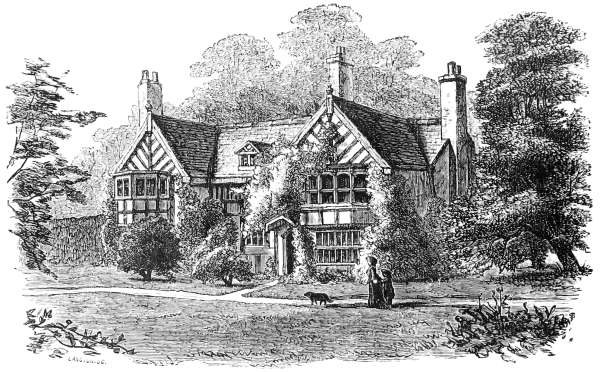
KERSALL CELL.
