Chapter V · THE COLLEGE AND THE “WIZARD WARDEN” OF MANCHESTER. (continued 2)
Reading edition
Reconciliation was thus effected, but it was not long before there was a renewal of hostilities, for, under date Sept. 11, we find—
Mr. Holland, of Denton, Mr. Gerard, of Stopford (Stockport), Mr. Langley, &c., commissioners from the Bishop of Chester, authorised by the Bishop of Chester, did call me before them in the Church abowt thre of the clok, after none, and did deliver to me certayne petitions put up by the fellows against me to answer before the 18th of this month. I answered them all codem tempore, and yet they gave me leave to write at leiser.
Amid these harassing anxieties and unseemly disputations with the unruly Fellows, Dee’s alchemical studies were not neglected. He had secured another medium in the place of Kelly—Bartholomew Hickman, who turned out to be nearly as great a knave, though not nearly half so clever as his predecessor, and, losing confidence, Dee discharged him and burnt all the records of what he had seen and heard in the wonderful show-stone. The next day Roger Kooke, who had previously been in the service of the philosopher, and to whom he had revealed “the great secret of the elixir of the salt of metals,” offered “the best of his skill and powre, in the practises chymicall.” He was quickly set to work, but young Arthur Dee finding by chance among his papers what seemed a plot against the father, he was charged with the conspiracy, when Dee cried, “O Deus libera nos a malo! All was mistaken, and we are reconcyled godly;” and he again dreamed of his “working the philosopher’s stone.” He would appear, however, to have subsequently parted with Kooke, for before his death Hickman had been restored to favour.
Though devoted to scientific pursuits, it must not be supposed that the Warden neglected his official duties, or that he was by any means unmindful of the secular interests of the Collegiate body. His business exactitude and active zeal in this direction, however, did not always meet with the approval of his neighbours, or at least of such of them as happened to be tithe-farmers or College tenants. In May of the year following his induction we find him with his curate, Sir Robert Barber (clerics commonly affected the prefix of “Sir” in those days), Robert Tilsey, the parish clerk, and “diverse of the town of diverse ages,” making a careful perambulation of the bounds of the parish with the view of determining its exact limits, a procedure that somewhat alarmed Mr. Langley, the rector of the adjoining parish of Prestwich, who smelt litigation in Dee’s anxiety “for avoiding of undue encroaching of any neighbourly parish, one on the other.” On another occasion he was careful to note that—
At midnight (January 22, 1599), the College gate toward Hunt’s Hall did fall, and some parte of the wall going downe the lane—
the “lane” being the narrow passage that led from the north side of the church, by the venerable tree where bulls were baited, and past the prison to Irk Bridge, then known as Hunt’s Bank, a name it retained until modern times, when it was superseded by the present Victoria Street. The gate-house, which, as before stated, was at one time used as a workhouse, stood on this, the westerly side of the great quadrangle, the gates opening into Hunt’s Bank. Though they have long since disappeared, the evidences of their former existence may still be traced in the wall.
After an absence in London he paid an official visit to the Grammar School, where he “fownd great imperfection in all and every of the scholers, to his great grief,” a record that must be taken as reflecting on Dr. Cogan, the head master, whose time appears to have been divided between the teaching of youth and the practice of physic. In August, 1597, the “Erle and Cowntess of Derby” having taken up their abode at Aldport Lodge, Dee entertained them at “a banket at my lodging at the Colledge hora 4½.” There are many other entries of visits from distinguished personages, among them Sir Urian Legh, of Adlington, the reputed hero of the ballad of “The Spanish Lady;” Sir George Booth, sheriff of Cheshire; Mr. Wortley, of Wortley. Probably, also, Camden, the historian, for it is recorded that when that distinguished antiquary visited the town, Dee pointed out to him the inscription of some Roman remains at Castle Field, attributable to the Frisian cohort, which occupied the station there. While dispensing his hospitalities the poor old man was suffering from lack of money, his financial difficulties being as great as ever, and we find him raising loans on the security of his diminished stock of plate, &c.—
Feb. 17, 1597.—Delivered to Charles Legh the elder (the receiver of College before referred to), my silver tankard with the cover, all dubble gilt, of the Cowntess of Herford’s gift to Francis her goddaughter, waying 22oz., great waight, to lay to pawne in his own name to Robert Welshman, for iiijli tyll within two dayes after May-day next. My dowghter Katherin and John Crocker and I myself were at the delivery of it and waying of it in my dyning chamber—it was wrapped in a new handkercher cloth.
Many similar transactions are recorded—indeed, he appears to have been continually borrowing money from his friends, and almost as frequently lending his books to them. Dee was certainly not one of those who believe that “imparted knowledge doth diminish learning’s store,” for he was ever ready to place his literary treasures at the service of others, and frequent entries occur of his lending rare and valuable works to those he thought capable of understanding and appreciating them.
It was some little relief to him when, on the 2nd December, 1600, his son Arthur had a grant of the chapter clerkship, though before he could pay £6 for the patent he
Borrowed of Mr. Edmund Chetham, the schoolmaster (the uncle of Humphrey, the founder) £10 for one yere uppon plate, two bowles, two cupps with handles, all silver, waying all 32oz. Item, two potts with cover and handells, double gilt within and without, waying 16oz.
The Warden’s pecuniary embarrassments kept him in discredit with his parishioners, who naturally looked with disfavour upon an ecclesiastic that did not pay his debts, especially when, as they believed, it required only a very little closer intimacy with the evil one to enable him to do so. The fellows maintained their hostility, his neighbours became more and more unfriendly, the urgency of his creditors was oppressive, and on every hand he was assailed with suspicions of sorcery. The nine years he was in Manchester was the most wretched portion of his life. Unable to bear the odium attaching to him, he petitioned King James that he might be brought to trial, “and by a judicial sentence be freed from the revolting imputations” his astrological and other inquiries had brought upon him; but Elizabeth’s wary successor, who detested his mysteries, would have nothing to say to him. Weary with the struggle, he quitted Manchester in November, 1604, and once more sought shelter in the house at Mortlake. Of the closing years of his chequered life little is known, but that little is sad enough. The friends of former years had died or forgotten him, and the new generation of Court favourites left him to pass his few remaining days in poverty, sickness, and desolation. After all his tricks and conjurations the once haughty philosopher was reduced to such miserable straits that he oftentimes had to sell some of his books before he could obtain the means wherewith to purchase a meal. The prediction of the Earl of Salisbury that he “would shortly go mad” was nearly being realised, for in the midst of his poverty, and while on the very verge of the grave, he resumed his occult practices, in which he was aided by the formerly discarded Bartholomew Hickman. At last, in poverty and neglect, wearied and worn out, the miserable wreck of an ill-spent life, he, in 1608, passed away at the advanced age of 81, and was buried in the chancel of the church at Mortlake without any tombstone or other memorial to preserve his name.
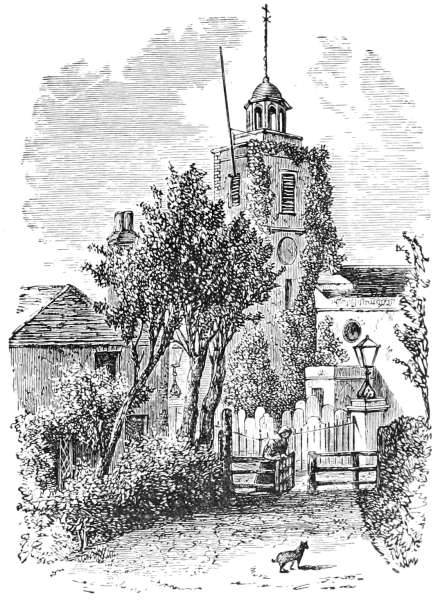
MORTLAKE CHURCH.
Of the numerous family that had once gathered round his hearth few remained at the time of his dissolution, death or estrangement having removed nearly all. His son Michael had died in infancy. His busy, shrewish wife died on the 23rd March, 1605. Of the other seven children Katherine was the only one who clung to him to the last. Rowland, on completing his studies at the Manchester Grammar School, obtained an exhibition at Oxford, but of his subsequent career nothing is known, nor, with the exception of Arthur, can we trace anything of the after-history of the others. Arthur, his first-born, resided in Manchester for some time, and subsequently practised as a physician. He married Isabella, one of the daughters of Edmund Prestwich, of Hulme Hall, and afterwards was chosen physician to Michael III., the first Czar of Russia, and for many years he resided in that country, where his wife died, July 6, 1634, after having borne him 12 children. Returning to England, he was sworn physician to Charles I., and located himself at Norwich, where he continued to reside until his death, September, 1651. Anthony à Wood, in his Athenæ, mentions that Arthur Dee, when an old man, spoke in full confidence of his father’s goodness and sincerity, and affirmed that in his youth, when he had initiated him in some of his mystical pursuits, he had seen enough to satisfy him that he had discovered many marvellous secrets, and only lacked the means to make them available. The son may not have been altogether an impartial witness, but it would be unfair to judge the father by the standard of the present day.
Dee lived in an age when everybody believed in the occult sciences, and in the power of summoning visitants from the world of shadows by incantations and other mysterious means. Half a century before his death he had been pre-eminent for his learning, his eloquence, and his scientific attainments, and he was undoubtedly one of the great lights of his era. Camden styled him nobilis mathematicus, and he may fairly be accounted the prophet of the arts which Bacon and Newton were afterwards to reveal. A ripe scholar, well skilled in chemistry, mathematics, and mechanics, and the master of the whole circle of the liberal arts as then understood—
He sought and gathered for our use the true.
He was one of the first who accepted the theory of Copernicus, and he successfully performed the labour of correcting the Gregorian calendar. He was, moreover, a good linguist, an earnest antiquary, and a diligent searcher of those records which tend to elucidate the history of the country, and to him is due the credit of first suggesting the formation of a “National Library,” for the preservation of those ancient writings in which lie “the treasures of all antiquity, and the everlasting seeds of continual excellency.” Paradoxical as it may seem, there was with the splendour and universality of his genius much childlike simplicity; and his credulous confiding nature often exposed him to the iniquitous arts of those about him; while his reckless extravagance, his love of ostentatious display, his debts, and his carelessness of the method which brought relief, kept him in continuous disquiet. He was part of the age in which he lived in that he was fond of alchemy, a believer in the divining-rod, and a devout practitioner of the astral science; but it is to be feared that his straitened circumstances sometimes prompted him to have recourse to tricks and artifices that his better judgment condemned. He was a strange mixture of pride and gentleness, of goodness and credulity. He discoursed learnedly with foreign philosophers, tended his little folks in their sicknesses, and soothed them in their childish griefs and sorrows; gazed into the glittering depths of his magic mirror and smiled good temperedly at his shrewish wife’s scoldings; dispensed his hospitalities and gossiped freely with the aristocratic personages who sought his society, and pawned his property to pay for their entertainment; contended with an archbishop and sought peace with the irrepressible Carter and his unruly associates; but we willingly forget the weaknesses and the foibles of the man when we remember the genius and the learning of the philosopher. With all his failings Dee possessed much kindness of heart, and though Manchester may not have been greatly advantaged by the ecclesiastical supervision of the “Wizard Warden,” he was yet, in many respects, much to be preferred to the needy Scotch courtier whom King James appointed as his successor.
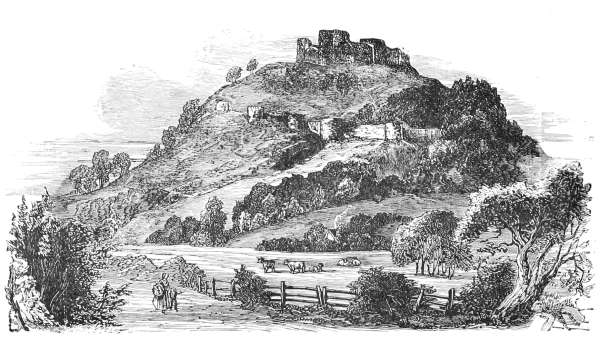
BEESTON CASTLE.
