CURIOSITIES OF HATFIELD.
Reading edition
his noble seat has been incidentally noticed in the preceding pages.[77] Although the Princess Elizabeth was kept a prisoner at Hatfield, she occasionally went to London to pay her court to Queen Mary; and in 1556 she was invited to court, and proceeded thither with great parade. Elizabeth, however, preferred the quiet and pleasant scenery of Hatfield. The hall of the old palace now accommodates about thirty horses. The combination of old trees, the rich-coloured brickwork, and the curiously-wrought ironwork of the flower-garden gate, independent of its historical associations, forms a pleasing scene.
The noble park is eleven miles in circuit: here the new house, finished, in 1611, by Cecil, Earl of Salisbury, comes boldly to view. The river Lea passes through the park. Nor far from the house are a racket-court and riding-school, both large buildings: near here is an ancient oak of extraordinary size, called the "Lion oak," a venerable tree, which, although deprived of many branches, is still crowned by large masses of green foliage and numerous acorns, is upwards of thirty feet in circumference, and reputed a thousand years old.
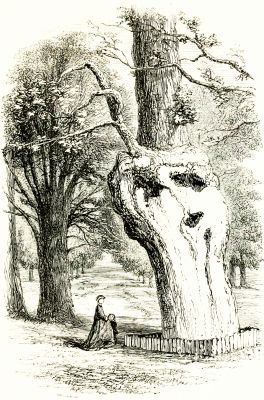
A long and noble avenue of trees, with sunlight glistening on the grey mossy trunks and boughs, leads to the kitchen-garden. Here is an old oak, now much stunted, under which the Princess Elizabeth was sitting when the messengers brought to her the news of Queen Mary's death, and saluted her as Queen. With pomp, and amid great rejoicing, Queen Elizabeth progressed to London—a journey accomplished with much greater trouble three hundred years since than at present. Decayed parts of this historical oak, the "Lion oak," and some others, have been, from time to time, covered with cement; and this has not only had the effect of stopping the progress of destruction, but also been the means of producing both new wood and vegetation.
At the further end of the avenue just mentioned is a building of two or three centuries old, but which has been much disguised by alterations: it is now used as the gardener's lodge. Through this we reach the vineyard,—a curious example of the trim gardening of former days. From a terrace a bank descends by a deep gradient to the river Lea. On the upper portion of the terrace are yew-trees planted at intervals, and dressed into singular shapes; in other parts the yew-trees are so cut, that up to a considerable height they seem as straight and solid as a wall: openings are left here and there which lead to dark avenues, cunningly formed by the arching of the branches. From the centre a broad flight of steps, covered with turf, leads to the Lea. On the opposite side of the river, an opening has been made in the trees, which shows a picture that stretches away in long perspective. Descending the steps, and looking upward, the view is very striking, and we perceive that the design is intended to imitate a fortress, with its towers of defence, loopholes, and battlements,—in fact, vegetation is made to assume an architectural form, which has an extraordinary effect. The vineyard is admirably kept.[78]
"QUEEN ELIZABETH'S OAK," IN HATFIELD PARK.
Of the many fine ancestral mansions in England, Hatfield, the seat of the Marquis of Salisbury, is, perhaps, the most interesting for its historical documents, and other illustrations of English history. Here are preserved the forty-two articles of Edward VI., with the superscription of that pious Monarch; the first Council Book of Queen Mary; Cardinal Wolsey's Instructions to the Ambassador sent to the Pope by Henry VIII., with that eminent churchman's autograph; the original draft of the Proclamation Secretary Cecil used at the Accession of James I.; and a very amusing Pedigree of Queen Elizabeth, emblazoned (dated 1559), by which the ancestry of that Sovereign is exhibited as traced to Adam. Here also are several manuscript letters of Elizabeth, and the celebrated Cecil Papers; the cradle of Elizabeth, of oak, ornamented with carving, decidedly Elizabethan; also James I.'s purse, and the first pair of silk stockings introduced into England, worn by Queen Elizabeth.
In the long gallery of the mansion is a state chair, said to have been used by Queen Elizabeth; and in a black cabinet is preserved a hat with a broad circular brim, which, we are told, was worn by the Princess Elizabeth, when seated under the oak in the park just mentioned. This historical tree is inclosed by a dwarf fence. When Queen Victoria and Prince Albert visited Hatfield, in 1846, Her Majesty was much interested with this memorial oak; and, as a memento of her visit, had a small branch lopped from the tree.
In each bedchamber of the mansion are wardrobes and closets carved in the style of the reign of James I.; the carved mantelpieces are very large; some supported by massive pillars entwined with flowers, others supported by caryatides and figures. The bedsteads and much of the furniture are of the same date as the other fittings. King James's bed-room has the fittings, it is said, exactly as when the king last used them: the hangings, of deep crimson, are profusely ornamented with tassel-work and fringe; the quilted coverlid has wrought flowers in the centre, and at the top of the bed are a royal crown, and other ornaments. It should be mentioned that many of the rooms throughout Hatfield House are fitted with woods of different kinds, and are named, in consequence, "the Oak-room," "the Rose-room," "the Walnut-room," "the Elm-room," &c. The chapel and a suite of ten rooms completed by the present Marquis of Salisbury in the old baronial style, have panelling of various woods, some being of oak, walnut, ash, sycamore, &c.
Among the historical pictures at Hatfield is Zucchero's famous portrait of Queen Elizabeth:—She wears a robe embroidered with eyes and ears, a favourite device of hers to express her ubiquitous and sleepless intelligence; and not satisfied with the symbolic eyes and ears, she grasps a rainbow, with the motto, "Non sine sole Iris."
In the recent exhibition of National Portraits at South Kensington were nineteen portraits of Queen Elizabeth, wonderful examples of her fantastic and execrable taste. "It was a bad time for the arts of portraiture. The costume, in which the Queen led the taste of both sexes, and was a keen critic of it after her fashion, was over-laden, stiff, and unbecoming. The monstrous ruffs, high-shouldered leg-of-mutton sleeves, long-pointed stomachers, and broad-hipped Spanish fardingales of the women are not redeemed from deformity by all their wealth of lace, embroidery, pearls, and jewels; while the round hats of the men—their long-waisted doublets, their hose, wide-swelling at the thigh, and tight to the knee, would defy even a Titian to make them picturesque, in spite of silk and satin and velvet, lace and slashes, ropes of pearl, rich pendants, jewelled belts, and hatbands of goldsmiths' work. There never was a time when foppery ran so rampant, and the Queen was the worst of all in the bad taste and extravagance of her attire. Melville, the Scottish Ambassador, tells us how she had weeds of all countries, and would appear in a different one at every audience—how she talked to him of millinery and dress-making, hair and head tires, and seemed more anxious for his opinion on such matters than on affairs of State. We have her wardrobe books when she was 68, and find among her stores of finery, exclusive of 99 State dresses, Coronation, mourning, Parliament, and Garter robes, French gowns 102, round ditto 67, loose ditto 100, kirtles 126, foreparts 136, petticoats 125, cloaks 96, safeguards 13, jupes 43, doublets 85, lap mantles 18, fans 27, pantofles 9. And we may see among her 19 pictures here wonderful examples of her fantastic and execrable taste. The Hatfield Zucchero looks true, but, after all, it is to the Hampton Court picture of her at 16 that we turn with pleasure when she was still King Edward's 'sweet sister Temperance,' and the docile pupil of Roger Ascham in the pleasant shades of Ashridge, or Hatfield, and not that withered, gray old woman, her mind heavy with black and bloody memories, who sat on the cushions for ten days and nights, and for the last 24 hours silent, staring on the ground, with set tearless eyes, and her finger in her mouth."—Times journal.
In the collection at South Kensington, too, was the portrait of the man who brought the news of Mary's death to Elizabeth at Hatfield, one of her commanders in Scotland in 1547, and one of the many who supped once too often with my Lord of Leicester, and died in 1570, after eating figs at that table, where the wariest guests were careful only to taste the same dishes as my lord ate of.
Among the pictures, which are hung through the house, are the portraits of the great Lord Burghley, and his two sons; various portraits of Queen Elizabeth and Queen Mary of England; and Queen Mary of Scotland, at the age of sixteen. Here are the Earl of Leicester of Elizabeth's reign; James I. and Charles I.; Philip of Spain: Van Tromp; the famous Charles of Sweden, and Peter the Great of Russia; various members of the Salisbury family; and the curious picture of Horselydown Fair, described at pp. 254-258. In the Great Hall, which has a minstrels' gallery, ornamented with carvings of figures and animals, heraldry, &c. are a picture, life-size, of the white horse on which Queen Elizabeth rode at Tilbury Fort: and ten large paintings of Adam and Eve.
The Lady Elizabeth kept her state at Hatfield with no small cost and splendour. At a subsequent period, after her imprisonment at Woodstock, her Highness obtained permission to reside once more at Hatfield, under the guardianship of Sir Thomas Pope, who not only extended to her the kindest care and most respectful attention, but devised, at his own cost, sports and pastimes for her amusement. "The fetters in which he held her," says Agnes Strickland, "were more like flowery wreaths flung lightly around her, to attract her to a bower of royal pleasaunce, than aught which might remind her of the stern restraint by which she was surrounded during her incarceration in the Tower, and subsequent sojourn at Woodstock." Thus, we read of maskings in the Great Hall at Hatfield, banquets, and "the play of Holophernes," which Queen Mary misliked.
When Queen Mary visited her sister at Hatfield, Elizabeth adorned her great state chamber for Her Majesty's reception, with a sumptuous suite of tapestry, representing the Siege of Antioch, and had a play performed after supper, by the choir-boys of St. Paul's; at the conclusion of which one of the children sang, and was accompanied on the virginals by the Princess herself.
Hatfield, during Elizabeth's reign, remained vested in the crown. At her decease, however, her successor, King James, exchanged it with Sir Robert Cecil for the palace of Theobalds, and thenceforward Hatfield has continued uninterruptedly in the possession of the noble family of Salisbury. Sir Robert Cecil was styled by his royal mistress, Elizabeth, "the staff of her declining age," and was so highly esteemed by King James, that his Majesty created him successively Baron Cecil, Viscount Cranbourne, and Earl of Salisbury; conferred on him the blue riband of the Garter, and finally appointed him Lord High Treasurer of England. About this period, his lordship laid the foundations of the present mansion of Hatfield, which he finished in 1611, in a style of equal splendour with that of Burghley, which his father had erected in the preceding reign. The year after the completion of Hatfield, worn out by the cares of state the Earl of Salisbury died at Marlborough, in Wiltshire, on his way to London: he was interred in Hatfield Church, under a stately monument. How striking an example does the closing year of his life present! In his last illness, he was heard to say to Sir William Cope: "Ease and pleasure quake to hear of death; but my life, full of care and miseries, desireth to be dissolved."
He had some years previously (1603) addressed a letter to Sir James Harrington, the poet, in nearly the same querulous tone: "Good Knight," saith the minister, "rest content, and give heed to one that hath sorrowed in the bright lustre of a court, and gone heavily on even the best seeming fair ground. 'Tis a great task to prove one's honesty, and yet not mar one's fortune: you have tasted a little thereof in our blessed Queen's time, who was more than a woman, and, in truth, sometimes less than a woman. I wish I waited now in your presence-chamber, with ease at my food, and rest in my bed. I am pushed from the share of comfort, and know not where the winds and waves of a court will bear me. I know it bringeth little comfort on earth; and he is, I reckon, no wise man that looketh this way to heaven."
Hatfield is a very interesting seat, not only for its association with the past, but for its presenting, at this moment, a picture of the baronial life of two centuries and a half since. The Hall of the ancient Palace remains; the historic Oak is preserved; the vineyard was in existence when Charles I. was conveyed here a prisoner to the army, and its famous yew walk is left; and the deer are still numerous. The mansion has been restored to its pristine magnificence; the landscape gardening is fine. The noble owner of Hatfield has devoted a portion of his domains to the pastimes of the people; and on every occasion, whether it be the reception of royalty, or the entertainment of the toilers of the country, it is carried out in the generous spirit of olden English hospitality. And this princely place lies within a score of miles of the metropolis and its three million of people, who are brought almost to the park gates within an hour's railway journey.