Pennsylvania Railroad Conductors’ Excursion to California. (continued 3)
Reading edition
With breath of flame and lungs of iron those powerful iron steeds puff and cough and climb, and the long ten-car train, following their laborious lead, winds and worms in and out and around those narrow paths, traced and hewn in the mighty Sierra Nevada’s rugged sides by persistent resistless Progress, ever guided, ever urged by the indomitable will, restless perseverance, mechanical ingenuity, and scientific skill of man. We climb and climb and worm and wind until Sisson’s heights are reached, at an elevation of 3555 feet, and then we rest awhile—rest to feast our eyes on Shasta’s indescribable majesty and grandeur.
This is the nearest point the railroad runs to that gigantic mound, and it is twelve miles on an air line from where we sit and stand to the glistening, snow-crowned crest of that mighty monarch. Why we should so sensibly feel his presence and he so far away is a conundrum no one asks; we only look and feel, and silently wonder what it is we feel. It must be awe, for that which is great, we are told, inspires awe, and Shasta is very, very great. Fourteen thousand four hundred and forty-two feet is the estimated height of this colossal giant that pokes his apex in the sky. Were it possible to grade him down or slice him off to one-half his height he would make a plateau 75 miles in circumference and 25 miles across; but it is time to go. The manager says, “Git on,” and bidding adieu to Shasta we “git.”
One mile from Sisson Conductor Morgan points to a little mountain spring that wouldn’t slake the thirst of a nanny goat, and says, “There’s the head waters of the Sacramento River, which is 307 miles from where it empties into the bay.” The road now is making some wonderful curves and bends to get around insurmountable heights and across unbridgeable chasms. We have just finished a run of about eight miles, described almost a complete S, and are only one mile and a half from where we started. At Edgewood helper engine No. 1902 is detached, for it is now down grade to Hornbrook, a distance of 40 miles, with a drop at places of 170 feet to the mile.
At Hornbrook engine No. 1907 was attached to assist to Siskiyou, a distance of 24 miles, with an ascent of 190 feet to the mile. As we approach State Line we cross the old Portland stage trail, and at 3.03 P. M. Eastern (12.03 Pacific) time we cross the State Line and enter Oregon, having traveled 1136 miles through the State of California. We pass Gregory Siding, where two freight wrecks had recently occurred. The wrecking crew are still on the ground, having evidently just put engine No. 1503 on the track, for it is standing there as we pass, covered with mud. We here have in view Pilot Rock, a great bare bluff that stands out and alone like a huge sentinel guarding the gateway of the valley, and famous in the early history of this locality as the scene of stirring Indian warfare. Manager and Mrs. Wyman are on the engine enjoying an unobstructed view of this marvelous mountain ride. We have just had our last look at California scenery, for rounding a bend as we pass Pilot Rock, the last view of majestic Shasta bursts upon our vision, reposing in sublime and solemn grandeur 50
HERCULES’ PILLARS, COLUMBIA RIVER OREGON.

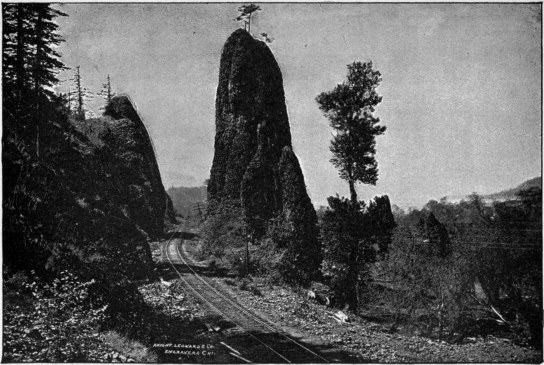
miles away. Another curve, the picture fades, the curtain falls, and exit California.
Still climbing the rugged sides of Siskiyou, and drawing nearer and closer to its summit, our train, as though despairing of ever reaching the top, plunges suddenly into its rocky ribs. The depths of despair can be no darker than the gloomy obscurity of this yawning hole in the mountain wall; for 3700 feet through “Tunnel 13” our train pierces the heart of Siskiyou before emerging into daylight on the opposite side. Here the summit of the grade is reached at an elevation of 4130 feet. Leaving engine No. 1907 behind we now commence the descent of the northern slope of the Siskiyou Mountain, amidst scenery of beauty and grandeur. Arriving at Ashland 5.10 P. M. Eastern (2.10 P. M. Pacific) time, a stop of twenty minutes is given and a change of engines is made.
Bidding goodbye to Conductor Morgan and his crew, who deserve our highest praise for the able manner in which our train was handled, and who did much toward making the trip interesting by the useful information imparted, we speed on our way again with engine 1361 in charge of C. C. Case and fired by Robert McCuan; Conductor Edward Houston, Baggagemaster R. W. Jameson, Brakeman H. Ballard, who take us to Portland, 341 miles. Leaving Ashland, we pass a number of gold mines in operation on the rugged hillside, and swing around into Rogue River Valley, a rich farming and fruit-growing district, producing, it is said, some of the finest fruits grown in Oregon. A stop of a few minutes is made at Grant’s Pass, attaching engine No. 1759 to assist up the hill to West Fork, 47 miles. Twenty minutes is allowed at Glendale to enable the passengers of the “Portland Flyer” and the crew to partake of lunch at “The Hotel Glendale.” Soon after leaving Glendale we enter a wild ravine, inclosed by towering hills covered to their summits with great pine timber. “Mr. Jameson,” I ask of the baggagemaster, an agreeable old gentleman, “has this wild spot a name?” “This is Cow Creek Cañon; the stream of water you see is Cow Creek, which runs the entire length of the cañon, 35 miles,” is the answer.
The farther we penetrate this narrow gorge the more are we impressed with the solitude of its mighty pine-clad sides, that commence at the creek on one hand and at the railroad on the other and rise upward in a steep slope for over 2000 feet, covered to the very crests with giant Oregon pines. We arrive at the little station of West Fork, the only station in the cañon, and engine No. 1759 is detached and sidetracked. There is gold hidden in these mighty hills, and here and there we see a mine, the principal one, the Victoria, being located near West Fork. Two miles north of this point we are shown where occurred in 1890 the largest landslide ever known in the history of railroads. An immense section of the mountain side becoming loosened, slid down into the bottom of the cañon, burying 900 feet of the railroad to the depth of 100 feet, and damming the creek, formed a lake 60 feet deep and one mile long. The buried track was abandoned and the road built across the creek along the foot of the opposite sloping wall of the cañon. We can plainly see the great mass of earth and rocks and trees that cover the buried track, and which forms a striking instance of what might occur at any time to roads that run through such mountain cañons. It is growing dark as we emerge from the fastness and solitude of this Oregon wilderness, but can easily discern that it is a change for the better, for we enter a valley teeming with fields of waving grain and orchards of thrifty trees. We stop at Roseburg for ten minutes, where another change of engines is made, and when we start on our way again at 12.10 A. M. Eastern (9.10 P. M. Pacific) time, it is quite dark.
Leaving Roseburg, we have engine No. 1355, with Engineer Montgomery at the throttle. Having a grade for 15 miles between Drains and Cottage Grove, we get Engineer Connelly, with engine No. 1516, as helper. Conductor Houston and his crew continue with us to Portland.
TUESDAY, MAY 25th.
Arrived at Portland this morning at 8.00 Eastern (5.00 Pacific) time, and after breakfast we met Morton Young, Esq., of Portland. Mr. Young is a member of Mt. Hood Division No. 91, O. R. C., and an earnest and enthusiastic member of the order, though not in railway service at the present time, having been fortunate in real estate speculation and able now to retire from active business cares. Brother Young kindly escorts a number of our party over the East Side Electric Railway to Oregon City, which is a pleasant ride of 14 miles. We climb the great wooden stairway leading up to the bluffs that overlook the city and obtain a magnificent view of all the surrounding country. Looking down upon the falls of the Willamette River, we are impressed with the grandeur of this Niagara of the Pacific. Descending from this alluring point of observation, we visit the great electric plant located at the falls, deriving its power from the waters of the Willamette and supplying Oregon City, Portland, and all the outlying districts with light and power. From the windows of the power house we obtain a much nearer view of the falls. The Willamette River at this point is about half a mile in width and the falls, in the form of a semi-circle, extend from shore to shore with an average height of 40 feet. It is estimated that the horse-power capacity of this great volume of leaping, dashing, roaring water is second in the world to that of Niagara. The great power house, with walls of solid concrete, is located on the west side of the river, just below the falls, and has a capacity of 12,000 horse power. It is owned and operated by the Portland General Electric Company, a corporation organized in 1892 with a capital of $4,250,000.
We cannot remain long in one place and are unable to give this interesting city the attention we would like, but we can see as we traverse one of its principal thoroughfares that it is up to date in its accommodations and improvements. We pass the Electric Hotel, and from its appearance we are sure it is first class in every respect, and had we the opportunity or occasion to partake of its hospitality we are confident we would be well taken care of by the proprietors who manage the establishment, Mr. and Mrs. W. M. Robinson. We visit the fish market and are interested in the salmon just brought in, that range in weight from five to fifty pounds, the streams through this part of the country abounding with this species of fish. The ladies, intent on
THE COLUMBIA RIVER.
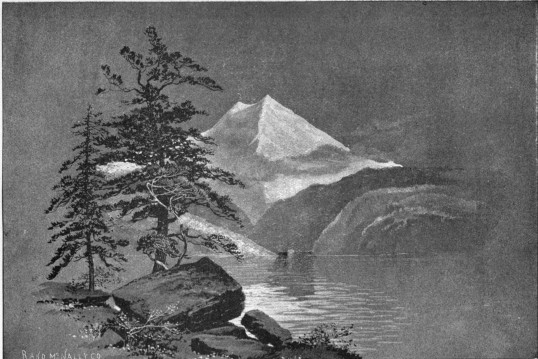
procuring souvenirs, visit a number of the stores as we go along. On the river banks are located numerous mills and factories. Arriving at the point where we take the electric line for Portland and finding a car waiting, we get aboard and start again on the delightful 14-mile trolley ride. Among the passengers in the car is a lady whose pleasant countenance invites confidence, and Mrs. Shaw has entered into conversation with her. I am busy looking off across the country, enjoying the beauty of the landscape, and have given their talk no attention. Brother Young has just pointed out Clackamas Heights and is now trying to show us the snow crown of Mt. Hood, but his Honor is so mixed up with the vapory clouds that hang around the horizon that he cannot be located. A nudge from Mrs. S. invites my attention, and as I turn she introduces her new-found friend, Mrs. Robinson, of the Electric Hotel, Oregon City. Mrs. Robinson is a bright conversationalist and entertained us with some facts about the city and its surroundings.
“Do you like Oregon City?” some one asks. “I not only like it,” answers Mrs. Robinson, “but I am proud of it. It is a town with a history. The site of Oregon City was first located in the year 1829 by Dr. John McLoughlin, an agent of the Hudson Bay Company, who established a trading post here. It was here a few years later that the Methodists built the first Protestant church erected on the Pacific slope. The Oregon Spectator, the first newspaper published on the Pacific coast, was printed here in 1846 on a press brought from the Sandwich Islands. We have a climate,” she continued, “that never goes to extremes; we seldom have freezing weather, and snow, if it comes, only lasts a few hours. I have gathered roses in my yard on Christmas, for very rarely the cold is severe enough to destroy our flowers. We have not grown so rapidly as some of the younger cities of the Northwest, but we have all the natural advantages and facilities to insure and encourage progress and development. We have excellent graded schools that are well attended, and as an evidence of the educational importance of our city, the Willamette Valley Chautauqua Association holds its annual convention or assembly at Gladstone Park, not far from Oregon City. These meetings are largely attended, thousands coming from all parts of the Pacific coast. The people will commence to gather for these meetings next week, and I expect we will have our hands full; but here’s where I get off,” and rising as the car stops she bids us goodday and steps off.
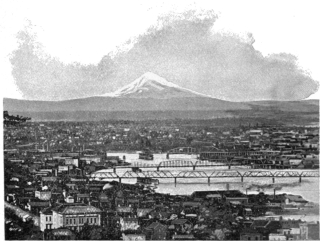
We have reached Portland, and after proceeding a few blocks under the guidance of Brother Young, we leave the electric road and board a cable car for Portland Heights, a high eminence overlooking the city and commanding a magnificent view of all the surrounding country for many miles. We gaze down upon three rivers, the Columbia, Willamette, and Clackamas, and follow with our eyes their sinuous windings as their waters gleam and glimmer in the sun. We can plainly see the hoary crests of Mt. Adams and Saint Helens, but clouds still hovering on the eastern horizon keep Mt. Hood hidden from our sight. With the perversity of human nature, that is always hankering for what is beyond its reach, we want a look at Mt. Hood. “We came up here to see it,” says Mrs. Dougherty, “and if
J. P. O’BRIEN, SUPERINTENDENT RAIL LINES, OREGON RAILROAD AND NAVIGATION COMPANY.
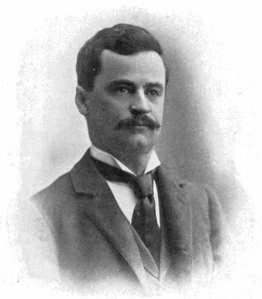
it’s only a wee glimpse I want it.” So do we all, and we keep our gaze riveted on the spot where Brother Young says it will appear, if it shows at all.
“Mt. Hood is 70 miles away,” says Brother Young, “but on a perfectly clear day a person from here can see it very plainly.” The clouds showing no inclination to favor us, we descend from the Heights, get aboard a car, and start for the station, where we arrive about 1.30 P. M., and find the most of our people gathered there; they also have spent a very pleasant morning taking in the sights of Portland and gathering souvenirs.
Brothers Maxwell and Reagan, of the excursion executive committee, have not been idle, but calling upon Superintendent J. P. O’Brien, of the Oregon River and Navigation Company Rail Lines, have arranged for an excursion this afternoon up the banks of the Columbia River to Cascade Locks and return.
Getting lunch at a near-by restaurant, we are soon all ready for the start. Our three sleepers are attached to a regular train that leaves at 2.45 P. M. “Are all our people here?” asks Manager Wyman, surveying the crowd. “There are four or five that are absent, I believe,” answers Secretary Maxwell, as he nips the northeast corner off a plug of tobacco. “Sloane and Haas are not here, I know,” speaks out Brother Terry, “for they went out with a boy in a boat to watch the salmon shoot the falls of the Willamette and haven’t got back yet.” “Time’s up; can’t wait; all aboard,” shouts the conductor, and away we go, bound for a trip of 45 miles through the marvelous and unsurpassed scenery of the Columbia River. Superintendent O’Brien is with us, his private car being attached to the train. Chief Dispatcher E. N. Campbell, C. R. Holcomb, Esq., and Brother M. Young also accompany the party. L. J. Hicks, photographer, of Portland, is along in his professional capacity; we are also accompanied by the Portland Hotel orchestra, comprised of the following gentlemen: G. H. Parsons, J. Seltenraick, F. Boyd, William Livinston, Prof. E. F. Fleck, who render admirable and pleasing music. Many are the expressions of delight as we catch fleeting glimpses of the wonderful scenery. “You will have a better view on the return trip,” advises Mr. O’Brien, “for we will then run slow and make an occasional stop.” Arriving at Cascade Locks, we are given twenty minutes to visit the great locks which the Government is about completing, at a cost of nearly $1,500,000, to enable vessels to reach the highest navigable point of this most remarkable river.
Time is up to start on our return trip, and reaching the train we find O. R. & N. engine No. 73 coupled to the train, with Engineer A. Curtis and Fireman Jo. Wilson in the cab and Conductor J. A. Allison standing near ready to move off as soon as we are ready to go. In a minute we are all on, and the train goes slowly down the great Columbia, whose current, always rapid, is augmented and increased twofold by the melting snows in the mountains, and surges past in an angry, turbid torrent. From the rushing waters of the mighty river on one side we look up on the other side to the towering cliffs and crags and peaks that rise in majesty and grandeur 3000 feet in the air, their summits fringed with pines that look like ferns as they wave against the sky, while here and there, from out those walls of rock, mountain streams gush forth, and falling hundreds of
MT. ADAMS, WASHINGTON.
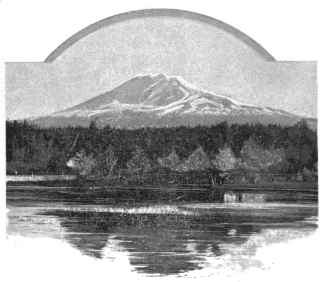
MT. ST. HELENS, FROM PORTLAND.
feet, their waters descend in showers of rainbow-tinted spray.
“Well,” remarks Mr. O’Brien, as he sees we are almost speechless with rapture and delight, “that’s something you don’t see in Pennsylvania or Jersey every day in the year.” “No,” I respond, “nor anywhere else in the world on any day of the year.” “I really believe there is no scenery in the whole wide world more intensely absorbing than your Columbia River scenery, Mr. O’Brien,” says Mrs. Mattson, and the Doctor, standing near, smiles down upon her his approval. “We will now turn our attention to something more practical than towering mountains and leaping waterfalls,” says Mr. O’Brien, as the train comes to a stop. “We will show you how our salmon are coaxed out of the water.”
Leading the way, we follow him down the river bank to its edge and on to a platform or wharf extending for several feet into the water, where a large wheel is slowly revolving that looks something like the side wheel of an old-fashioned ferryboat or the large overshot water wheel of an old-time sawmill, except that it turns backward, and as the scoops or buckets rise out of the water they bring the fish along, should any of them be so unfortunate as to get caught. When the scoop rises to a certain height the fish slip out into an incline trough or chute (something like the “boys” had fun with at Sutro’s) and are dumped into a bin under the platform. “We are not catching many at the present time,” says the man who is operating the trap, “the river is too high and muddy and the fish are not running very lively.” Opening a trap door, he allows us to peer down into the bin, where we see a lot of fish of various sizes. He kindly gave us several for our dining car, an act we all highly appreciate.
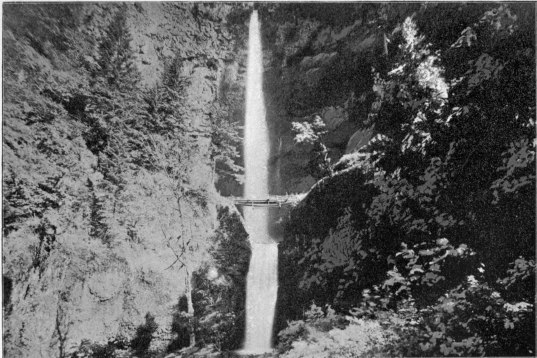
We next stop at Multnomah Falls, where one of those mountain streams pouring over the face of a cliff has a sheer descent of 950 feet. Here the party is arranged in a group on a grassy slope, with the falls as background, and photographed by Mr. Hicks. “Mr. Hicks, will all those beautiful rainbows we see there show in the pictures you have taken?” asks Mrs. Matthews of the photographer. “No,” replies Mr. Hicks, “that is beyond our art. No camera will picture nor can artist paint the gorgeous coloring and beautifully blended tints that you see in the dashing spray of Multnomah Falls.” “I don’t know about that,” answers Brother Mart. Houston, who is always of a practical turn of mind. “I believe George Cope, of Chester County, could do it, for a man who can paint the pretty spots of a trout or all the colors of autumnal foliage and never miss a tint can come pretty close to Multnomah Falls.” “He ought to come out here and paint it, then,” responds Brother Bob Foulon; “for a reproduction of Multnomah Falls on canvas as we see it to-day could not be surpassed by any painting in the world.” We all echo Brother Foulon’s sentiments, and feel as we get aboard the train that it has been our privilege to look upon a scene of unequaled loveliness and grandeur.
We again stop and are photographed at the Pillar, an enormous column of rock standing alone between the river and the railroad, upon the summit of which is growing a great pine tree, 1000 feet in the air. We get back to the depot about 7.30 and find McDonald has a sumptuous dinner awaiting us, which we all
MULTNOMAH FALLS, OREGON.
heartily enjoy. Mr. O’Brien and Brother Young take dinner with us, and our people show their appreciation of the courtesy and kindness of these gentlemen by giving them three rousing cheers. After supper Manager E. Lyons, of the Union Depot, escorts a number of the “boys” to the luxurious quarters of the Commercial Club, where we are royally entertained for three hours, returning to the train about midnight.
WEDNESDAY, MAY 26th.
Everybody is astir in good time this morning, for we are soon to bid adieu to this great city of the far Northwest, where we have been so kindly treated and royally entertained. The warmhearted brothers of Mt. Hood Division No. 91, O. R. C., along with the officers of the different transportation companies, will long be remembered for their generous manner toward us. “Views of Portland, Oregon, and the Columbia River,” a beautiful pamphlet souvenir issued by Mt. Hood Division, was presented to each member of our party, and is highly prized. In connection with the pamphlet is “a ticket of welcome” of coupon form, and is quite lengthy, but all right, the first clause of which reads, “This contract with coupons attached entitles the holder to a hearty welcome and a first-class reception on entering the State of Oregon, and the courtesies of the Southern Pacific Company, the Oregon Railroad and Navigation Company, and the Northern Pacific Railway.
R. Koehler,E. P. Rogers,
General Manager S. P.A. G. P. A., S. P.
E. McNeill,B. Campbell,
Pres. & Mgr. O. R. & N.Traffic Mgr. O. R. & N.
W. H. Hulburt,J. W. Kendrick,
G. P. A., O. R. & N. Co.Genl. Mgr. N. P. Ry.
J. H. Hannaford,C. S. Fee,
Genl. Traffic Mgr. N. P. Ry.G. P. A., N. P. Ry.”
There are five clauses in the contract. The last clause reads, “The Reception Committee will not be responsible for the loss of any diamonds (kings and queens excepted), baggage, meals, or sleep on this run.
J. M. Poorman,J. W. Crocker,
Sec. & Treas.C. C.
“Mt. Hood Division No. 91, O. R. C.”
There are six coupons, each reading to and fro over a line between different points of interest, and bearing at the bottom the name of the superintendent over whose line it reads. The whole is a nicely gotten up affair and a valued addition to our collection of souvenirs.
We leave here at 8.45 A. M., and the hour of departure being at hand (as is always the case), a number of our new-found friends are at hand to see us off. All along our route we have been constantly reminding the people who we are by a yell we give in concert, with a vim that would drown the racket of a college football team; and now, gathered in a bunch, we let go:—
“Who are we? O. R. C.
“Pennsylvania employé.
“Rah! rah! boom—ah!” The ladies of our party are ready and let go:—
“Who are we? Who are we?
“The wives and the daughters of the O. R. C.
“Rah! rah! boom—ah!”
And now the cooks and waiters gathered at the windows and on the platform of the “Lafayette” let go:—
“Who are we? P. P. C.
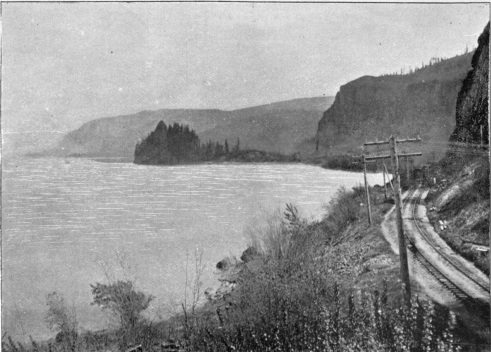
ALONG THE COLUMBIA RIVER.
“The cooks and the waiters of the O. R. C.
“Rah! rah! boom—ah!”
With all this din ringing in their ears the good people of Portland see our train pulling away from their beautiful station. As they wave their adieus we pass from their sight on a run of 146 miles over the Northern Pacific Railway to Tacoma, Wash. N. P. engine No. 617 is drawing us, managed by Engineer F. W. Bockerman and fired by H. Deam. The conductor is Henry Buckley and the brakemen are H. Harkins and Tom Martin; Mr. Martin is a young man from Chester County, Pennsylvania, who has come West to seek his fortune, and has accepted the position of a brakeman with the expectation of rising in the ranks, and we wish him success.
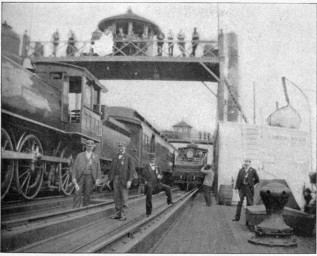
From Portland to Goble, 39 miles, we follow the Columbia River, which is very high, and much of the low land is submerged. We can see buildings surrounded by water that have been vacated, and we are reminded of the El Paso flood. We look beyond this desolating waste of water and in the far distance can see the glistening summits of Mt. Hood and Saint Helens. Reaching Goble, our train is run on to the great ferry steamer “Tacoma,” transported across the Columbia River to Kalama, and into the State of Washington. Leaving Kalama, we pass through a fine farming country, where agricultural industries seem to be extensively carried on. After passing Centralia, which is a flourishing town of about 3000 inhabitants, we have a splendid view of Mt. Rainier for several miles while we sweep across the Yelm prairie. A short stop is made at Roy to pick up Brothers B. W. Johnson and S. H. Ewalt, of Mt. Tacoma Division No. 249, O. R. C., who are members of committee on entertainment, and who promise to show us the city of Tacoma after our arrival there. The country through here seems to be rich in natural resources, for bordering the fertile valleys can be seen heavily timbered hills and here and there a coal mine in operation.
Arriving in Tacoma at 4.40 P. M. Eastern (1.40 P. M. Pacific), we are immediately taken out by Brothers Johnson and Ewalt to see the town and are joined by A. F. Haines, passenger agent of Northern Pacific Railway, Capt. A. Thompson, of the Portland Oregonian, C. P. Ferry, Esq. (who bears the distinguished title of “Duke of Tacoma”), and a member of the Chamber of Commerce, L. Ceasar, Esq., president of Tacoma Bank and a member of the Board of Trade. The first place we visit is the County Court House. “This,” says Mr. Ferry, “is one of the finest buildings in Tacoma, which, you know, is the county seat of Pierce County. We had to have a court house and thought we would build a good one; it cost $400,000.” We amused ourselves looking through the museum located in this building, many of the relics and works of art having been contributed by Mr. Ferry, who collected many of them in foreign countries through which he has traveled. We spent half an hour in the Court House and then entered into a street car, which took us a much-enjoyed ride through the city to Point Defiance Park.
To form a true conception of a Washington forest one has but to visit this wonderful park. Such majestic trees we never saw before, many of them six and eight feet in diameter and estimated to be 300 feet in height, great
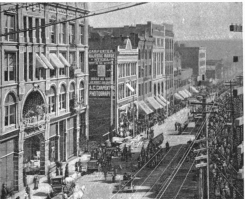
C STREET, TACOMA, WASHINGTON.
BRIDGE, POINT DEFIANCE PARK, TACOMA, WASHINGTON.
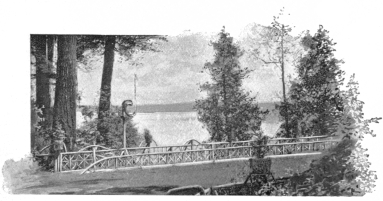
pines and cedars, natural growth of the soil, and amongst them, growing in wild profusion, great ferns six feet in height. In inclosures can be seen deer, elk, and bear, natives of the wilds. Through this great forest park bridle paths lead in all directions, and about 80 miles of bicycle track is built. The park is situated on a high eminence overlooking Puget Sound. By a series of steep paths and stairs we descend to the beach. The sound is a great body of water with hardly a ripple on its surface. A half hour is spent here gathering pebbles and shells, and then we head for the smelter, half a mile up the beach.
A boathouse furnishes rowboats for those who want them, and a number avail themselves of this opportunity to avoid a tiresome walk. Those who walk ascend again the steps and steep pathway, and going along the forest walk they arrive at the smelter the same time as those who rowed. We are taken through the great hot, smoky building and shown the treatment ore receives in all its stages from the smelter to the crucible. This immense plant, owned and operated by the Tacoma Smelting and Refining Company, handles gold, silver, and copper ore, and has an annual output of over $900,000. A train of cars await us when we emerge from the works, flat cars, fitted up with seats for the occasion; upon these we climb, and find as we are slowly taken along the sound front that no conveyance could afford a better view. Tacoma has 12 miles of a water front, upon which splendid wharves, great warehouses, monster elevators, immense saw and flour mills are built, the whole 12 miles being lined with industries of this character.
This trip over, we return to our train and find dinner awaiting us, after which our train is run to the steamboat landing and we are taken aboard the “City of Kingston,” belonging to the Northern Pacific Railway, for a trip of 28 miles to Seattle. We can hardly realize as the boat leaves the wharf that our visit to Tacoma is over, so rapidly were we hustled along; but we are highly pleased with the treatment we received and feel that Tacoma is a wonderful place and her people will make her still more wonderful by their thrift, their push, and activity. They have our best wishes for their future progress and advancement.
The “City of Kingston” is a splendid boat and rides like a feather over the waters of the sound, and from the expressions of delight on every hand it is evident our people are enjoying the trip. The boat is in charge of Engineer G. H. Lent and a gentlemanly purser, who have won the goodwill of our party by kindly allowing us the freedom of the boat and showing us through many of the elegantly-furnished state rooms with which the boat is equipped. Arriving at Seattle, we are loaded in a large cable car and taken through the city for about four miles and back again. It is so dark we cannot see the town and can only enjoy the ride. We are taken to the station, where we wait for half an hour for our train to arrive, which has been sent from Tacoma to overtake us. We are all pretty thoroughly tired out, and are glad when at about eleven o’clock our train arrives, and we are soon making ourselves comfortable inside. M. M. Davis, Esq., a press representative of Seattle, and Conductor Thomas Doyle in search of an “item” gave us a short call just after our train came over from Tacoma. Brother Reagan and “Alfalfa” are the only ones I see as
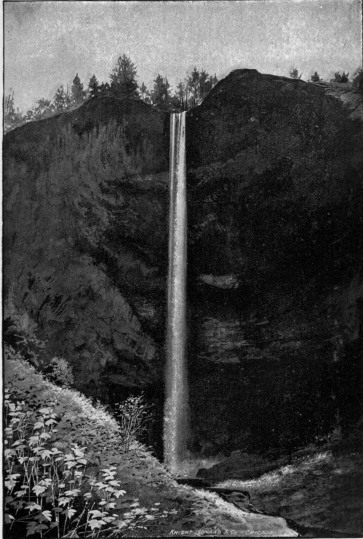
LATOURELLE FALLS, OREGON.
I leave the “refreshment corner” in the “combined” to seek repose in the “Marco.” Our train is still standing at Seattle and the hour is close to midnight.
THURSDAY, MAY 27th.
Getting up this morning about 7.30, I find we are crossing another desert—at least it has that appearance. We have left Ellensburg and are running through a dry, sandy country along the Yakima River. Here and there we pass a ranch where plots of land under irrigation are being cultivated, and from the fertile appearance of these irrigated tracts it would seem that this country needs but plenty of water to make it a blooming paradise. This much I discover by looking out the window while waiting my turn to wash and comb, for Brothers Terry, Brown, and Horner are ahead of me this morning. We work on the principle “first come first served,” and all good naturedly wait when there is nothing else to do. Completing my toilet, I go to the smoker and find the genial conductor who is running the train, and learn that he is a member of Mt. Hood Division No. 91; name, W. B. Hale.
“I took charge of your train at Ellensburg,” he says, on being asked the question, “and am going with you as far as I can. We have engine No. 333, run by Engineer Brant, who will take us to Pasco, 122 miles.” “This is a barren-looking country for stock raising,” I remark, as I see a large drove of cattle kicking up the dust in the desert as we pass them; “what do they live on?” “Those cattle are from away back toward the hills, where there is plenty of ‘bunch grass’ that they feed on, and are coming to the irrigation canal for water, or perhaps they are being driven to the railroad station for shipment. You would be surprised at the amount of stock shipped from North Yakima, Prosser, and Kennewick,” is the reply. “There seems to be no trouble about growing plenty of stuff where there is water,” I venture to assert, seeing a verdant-looking plantation, like an oasis in the desert, a short distance away. “Lack or scarcity of water is the only hindrance to agricultural industry,” is the answer, “and this drawback is being rapidly overcome by the construction of large irrigating canals by companies formed for that purpose.”
“Breakfast is now ready in the dining car,” chimes the welcome voice of Conductor McDonald at the open door. Several of our people had entered the smoker during the last half hour, and all arise as one person at the music of that well-known voice, that always brings “tidings of great joy.” “I think Mr. McDonald has the loveliest voice, for a man,” is the flattering remark of Mrs. Matthews as we make a break for the diner. Not one of us but what thinks so too, but of course we know Mrs. Matthews is thinking of the song McDonald sang to us a few evenings before.
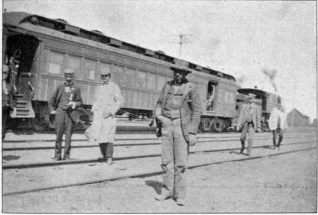
“There’s a tramp hidden between the ice chests under this car beating his way, I heard some one say awhile ago,” says Manager Wyman at the breakfast table. As we finish eating the train stops at the little station of Kiona and we all get out to see the stowaway. Sure enough he’s there. In a narrow space between the ice chests, about 16 inches wide, he has placed a board on the dining-car ladder which is kept there, and crawled in on it, a place so narrow that he cannot change his position
THE HOBO PASSENGER.
CROSSING COLUMBIA RIVER ON THE “TACOMA.”
or turn. We can see him all covered with dust, but he does not move, and we are not sure that he is alive, for this Yakima dust is something terrible and he has certainly got a dose of it. One of the dining-car boys brought him out some bread and meat, a can of water, and a sponge to protect his mouth and nostrils from the dust. We can see that he is alive when these things are pushed into him, for he reaches out a hand as far as he can to receive them. After passing Kennewick we cross the Columbia River and are soon at Pasco, where a stop is made to change engines. While this is being done we persuade our “mascot” to come from beneath the car. As he crawls from his hiding place and straightens up Brother Ristein, who has his kodak ready, takes a snap. We can see through the ginger-colored Yakima dust on his face that he is a negro. “What’s your name?” I ask. “John Bell, sah.” “Where do you live?” asks Brother Matthews. “Al’bama, sah.” “Where did you get on this car?” asks Manager Wyman. “Tacoma, sah.” “How did you get to Tacoma?” asks Brother Dougherty. “Cargo hosses, sah.” “Where do you want to go, now?” asks Conductor Hale. “Montana, sah.” “Well, crawl in your hole; we’re going to start,” replies Captain Hale, and turning to Manager Wyman continues, “We may as well allow him to keep his place, for soon as you rout him out there will be another one ready to crawl in. It’s impossible to get through this part of the country without being troubled with hoboes.”
We leave Pasco at 12.55 Eastern (9.45 Pacific) time with engine No. 405, Engineer Tom Allen and Fireman W. W. Thompson, who run us to Spokane, 146 miles. Much of the country through which we are now passing is very dry and barren-looking, but we are informed by Captain Hale that it is considered a rich grazing district. From Lind to Sprague, a distance of 45 miles, many large herds of horses and cattle are seen. Just before reaching Sprague we run for two miles on the border of Spring Lake, a fine body of water that looks very refreshing after so many miles of dry and dusty territory. We stop at Sprague a few minutes for water and notice the place has had a very serious fire not long since.
“Captain,” I ask, addressing Brother Hale, who is near by, “what has happened to Sprague?” “The town was nearly wiped out about a year ago by a very bad fire,” is the reply, “and it is a great pity, for Sprague was a pretty little place and a thriving town. It is the county seat of Lincoln County, and had a population of about 2000. It is the headquarters of the Idaho Division of the Northern Pacific Railway, and the company’s machine shops and roundhouse were completely destroyed and all those engines ruined,” and he points to where can be seen about a dozen locomotives, burned and warped, standing on the tracks that had been the interior of the roundhouse and shops.
Another run of 25 miles through good farming and grazing territory, interspersed with considerable timber land, brings us to Cheney, where we again make a short stop. Since crossing the Columbia our course has been upward, and from an elevation at Kennewick of 350 feet we have now reached 2300 feet. Cheney is a growing business place of 1200 inhabitants. It is nicely located on the great plateau of the Columbia and surrounded for many miles with rich farm land and abundant timber.
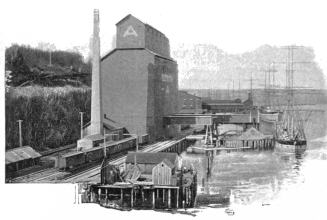
ELEVATOR A, TACOMA, WASHINGTON.
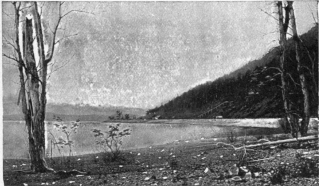
SHORE OF LAKE PEND D’OREILLE AT HOPE, IDAHO.
Here we meet Mr. H. W. McMaster, chief dispatcher of Northern Pacific Railway at Spokane, whom we find to be a very courteous and agreeable gentleman. On a sidetrack near where our train stands, Mr. McMaster shows us the largest locomotive on the Northern Pacific Railway, No. 150. Engine and tender without fuel or water weigh 106 tons; it has a 34-inch cylinder; was built in Schenectady, N. Y., since the first of the year. They have had it but a short time but find it very satisfactory. It is in charge of Engineer J. Bruce and is run in the freight service between Spokane and Pasco. Mr. McMaster accompanies us to Spokane, where we arrive at 5.20 P. M. Eastern (2.20 P. M. Pacific), and are met at the station by Dr. E. D. Olmsted, Mayor of Spokane. We are introduced to the Mayor by Mr. McMaster in a neat little speech. His Honor responds in a pleasant manner, bidding us welcome and giving us the freedom of the city. The street railway management offers us the use and freedom of their lines so long as we wish to remain in the city. We have but two hours here, and the municipal authorities and street railway managers vie with one another in their efforts to show us as much of the city as possible in the short time we will be with them. A number of carriages are sent around and quickly loaded up, accommodating about one-half of the party, the remainder board street cars, and we start on a tour of the city.
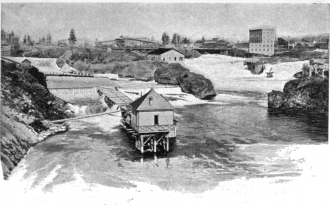
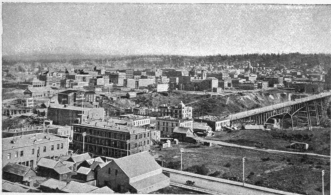
Spokane is the county seat of Spokane County, with a population of about 32,000. It occupies a remarkably picturesque location on both sides of the Spokane River, a mighty mountain torrent, the rush and roar of whose eternal, resistless energy holds the visitors to-day spellbound and speechless with admiration, amazement, and awe. We had looked upon, we supposed, during the past two weeks, all varieties and degrees of running, rushing, and falling waters, but at no time have we gazed upon such a tumbling, seething, foaming, roaring torrent as this that now fascinates us with its sublime grandeur and astounds us with its terrific force.
Right through the centre of the city, with a fall of 150 feet in the space of half a mile, this mighty torrent tears, dashing and splashing, surging and foaming against and amongst the great rocks and boulders that beset its course with a fury that is indescribable, and we feel as we gaze upon this wonderful, awe-inspiring spectacle that there is no more limit to the power of the elements than there is to the measure of eternity. This magnificent river that never freezes runs the great electric plant that lights the city and operates 45 miles of electric railway. It furnishes power for numerous flour and saw mills, factories and foundries that can be seen in operation along its banks, giving an aspect of business activity to the place that is a pleasing manifestation of prosperity and enterprise.
Its fine, substantial, costly church, school, municipal, and other public buildings and superb private residences are indications that there is wealth in Spokane. Because of the advantages and facilities of its admirable location, surrounded by vast forests of valuable timber, fertile agricultural valleys, rich mining districts, and the traffic of seven railroads, we predict for Spokane a phenomenal future. It is destined, we are sure, at an early day to be the first city of the great Northwest. Not one of the party will ever forget our short visit to
SPOKANE FALLS, SPOKANE.
SPOKANE, WASHINGTON.
Spokane. Mr. McMaster took Brothers Maxwell and Reagan around with his own team and Captain Hale took Manager Wyman. The street-car party was under the escort of James Mendenhall, Esq., an old schoolmate of Brother James Matthews. Mr. Mendenhall came West several years ago, located at Spokane, and engaged in real estate business. He is now one of the prominent citizens of the place and closely identified with the business interests and enterprises of the city. We also met Mark Mendenhall, Esq., a brother of James, who is a leading attorney in Spokane. No, we will not forget the courtesy and kindness of the good people of Spokane, and the good people of Spokane will not forget us, for they have only to remember that on the afternoon of May 27th, 1897, street-railway traffic was blocked for thirty minutes by a car abandoned by the Pennsylvania Railroad conductors and kept waiting for them while they viewed the grandeur of Spokane Falls for half an hour from the rear balcony of the brewery.
At 7.40 P. M. Eastern (4.40 P. M. Pacific) time we are all aboard our train once more, and with Engineer Secord at the throttle of engine No. 119 we quickly leave beautiful Spokane far in our rear. Captain Hale is still with us, his brakeman being A. S. Harding. A hobo is discovered lying on the truss rods of the combined car; he can be seen by looking around the side of the car; his position seems a perilous one, but our train makes no stop till it gets to Hope, 84 miles, so he is allowed to remain and take his chances. For several miles we pass through magnificent cattle ranges and fine farming lands. As we approach Hope the road skirts the shores of Lake Pend d’Oreille for about three miles, giving us a fine view of this beautiful body of water. We arrive at Hope 10.00 Eastern (7.00 Pacific) time and stop twenty-five minutes to change engines. Here a change is also made in time; it changes from Pacific to Mountain time, one hour later than Pacific and two hours earlier than Eastern time. Hobo No. 2 changed his position from the truss rods of the combined car to a pile of ties when the train stopped at Hope. He was given a lunch by one of the dining-car boys and advised not to anchor himself in the same place again, as the position was not only a dangerous one, but very conspicuous. When asked his name he said it was J. W. Kelsey, that he was trying to get home, had been away for two years, and wanted to see his mother. Hobo No. 1 lays low, for he knows should he for a moment vacate his narrow quarters under the “Lafayette” there would be a scramble for his place. It is growing dusk, and through the gloom of the dying day we have counted no less than fifteen skulking forms about the train, watching for an opportunity to secrete themselves underneath or about the train for the purpose of obtaining free transportation.
Bidding adieu to big-hearted, genial Captain Hale, who has been with us for 357 miles, we leave Hope at 10.25 P. M. Eastern (8.25 P. M. Mountain) time with N. P. engine No. 438, with Engineer Jim Bailey at the throttle, whose fireman is John Ryan. Conductor William Gilbert has charge of the train and his brakemen are T. S. McEachran and F. R. Foote. This crew runs us to Helena, 297 miles. Ten miles from Hope we cross Clark’s Fork, a branch of the Columbia River,
W. B. HALE, CONDUCTOR NORTHERN PACIFIC RAILWAY.
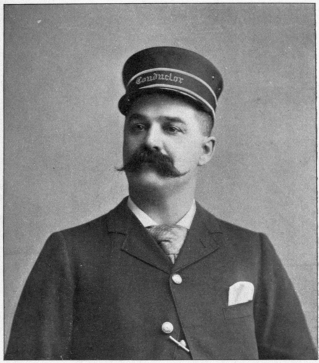
and through the gathering darkness we can see that we have entered a wild and rocky region, the road winding around and among mountain ranges and snow-capped peaks, following the course of the stream we just crossed for 60 miles.
Captain Gilbert and his brakemen are lively, interesting company, and entertain us during the evening with anecdotes and stories of Western life. “Are you troubled much with tramps, captain?” some one asks, as Conductor Gilbert, during the conversation, made some allusion to the profession. “They do not give us much real trouble,” is the reply, “yet they are a matter of concern, for we are never without them, and need to be constantly on guard; there is always a Wandering Willie around somewhere, and you never know what mischief he may be up to. There are at least a dozen on this train to-night. The trucks are full and several on top of the cars.” This is rather startling information, and I notice Brother Sheppard clap his hand on his right hip pocket to make sure the “critter” is there, and Alfalfa quietly unlocks the cupboard door, where “our artillery” is kept. I see no sign of fear on the serene countenance of Captain Gilbert and believe we’re not in danger; yet Brothers Maxwell and Terry start through the train to make sure the vestibule doors are barred and step traps fastened down. At Trout Creek, a small station 48 miles from Hope, we stopped for water, and F. Hartman, roadmaster of the Missoula and Hope Division, got aboard and went with us to Horse Plains. It is now near midnight, and making my way from the smoker to the “Marco” I turn in, wondering how the poor fellows who are hanging on to the brake beams are enjoying themselves, for Bailey with the “438” is switching them around the curves at a pretty lively rate.
FRIDAY, MAY 28th.
Our arrival in Helena at six o’clock this morning and the announcement of an early breakfast soon has everybody astir. After breakfast we bid adieu to jolly, whole-souled Captain Gilbert and his genial crew, and under the escort of Assistant General Passenger Agent W. Stuart, Assistant General Ticket Agent C. E. Dutton, and Conductor Dodds, of the Northern Pacific Railway, and Messrs. E. Flaherty and H. D. Palmer, of Helena Board of Trade, start out to see the town. Our time is limited, for we are scheduled to leave at twelve o’clock, and it is impossible to give all the interesting features of this remarkable city the attention they deserve. Helena is a wealthy town; it is located in the centre of one of the richest mining districts in the world; it is the capital of Montana and the county seat of Lewis and Clarke County, with a population of about 14,000; it is up to date in its financial, educational, and religious institutions, and both private residences and public buildings are models of architectural symmetry, strength, and beauty. A military post named Fort Harrison has recently been established here which will be one of the principal points for the quartering of troops in the Northwest. A ride of almost three miles on the electric line through this interesting city brings us to the Hotel Broadwater and “Natatorium,” where the celebrated hot springs are located. We are given the freedom of the bathing pool, which is one of the largest and finest under cover in the world. The most of our party take advantage of the treat, and for an hour the waters of the pool are almost churned into foam by the sportive antics of the crowd, whose capers afford great entertainment and amusement for those who do not care to “get into the swim” with the rest. This place is much resorted to by tourists, and invalids are said to be much benefited by bathing in the waters of these hot springs, which are strongly impregnated with sulphur, salt, and iron and heated by Nature’s process to a very pleasant temperature.
Leaving the Natatorium we are invited to the immense brewery establishment of Nicholas Kessler, near by, to await the coming of our train, which is to be brought here for us, as the railroad runs within a short distance of the place. Mr. Kessler is a former Pennsylvanian, one of those hospitable, generous, big-hearted Pennsylvania Dutchmen, and when he learned we hailed from his native State his pleasure was greater than he was able to express and his generosity almost boundless. In the fine pavilion adjoining his establishment he spread us a sumptuous lunch and seemed aggrieved that we didn’t eat and drink all that was placed before us, which was enough for 500 people. When at last our train comes and we bid the old gentleman farewell there are tears in his eyes as he tells us how happy he is that we called to see him, and that he would never forget the Pennsylvania Railroad conductors. He accompanies us over to the train (so do several of his men with boxes on their shoulders), and as we steam away and leave behind us the city of Helena and our generous-hearted new-made friends, we notice in the “refreshment corner” of our combined car a pile of boxes bearing the trade mark of “Nic” Kessler, and another box containing fine oranges that bears the mark of H. S. Hepner, a merchant of Helena.
The space between the ice chests beneath the dining car is vacant; our mascot has fled, having ridden in that uncomfortable position for 782 miles.
It is 12.55 P. M. Helena time when we leave here for Butte over the Montana Central branch of the Great Northern Railway. We have G. N. engine No. 458, Engineer Pete Leary, Fireman R. Hanna, Conductor M. Sweeney, Brakemen F. W. Minshall and F. J. Chapman, who take us to Butte, a distance of 75 miles. As a guest we have with us Trainmaster J. W. Donovan, of the Montana Central, who will accompany us to Butte. We find Mr. Donovan an agreeable and entertaining gentleman who tells us much that is interesting of the country through which we are passing. “This branch was built,” says Mr. Donovan, “for almost the sole purpose of developing the mining interests of the country. You will see very little of any other industry from here to Butte than mining.”
After leaving Clancy we ascend a steep grade, from which we look down into a pretty valley that Mr. Donovan tells us is called Prickly Pear Cañon. Passing Amazon we follow Boulder River for 12 miles as it courses through the beautiful valley of the same name. Four miles from Amazon we pass through Boulder and can see that it is a thriving town. “Boulder is the county seat of Jefferson County,” says Mr. Donovan, “and has a population of about 1200. It ranks as one of the important cities of Montana, being in the centre of a rich mining region.”
This is a wonderful mining district through which we are passing, all the hills and mountain sides being literally honeycombed with the gaping mouths of mines. Eight miles from Boulder we come to the town of Basin, “the largest city,” says Mr. Donovan, “in Jefferson County, having a population of about 200 more than Boulder.” The railroad runs close to the ruins of what had apparently been a large building recently destroyed by fire, and we inquire of Mr. Donovan what it had been. “Two years ago,” he replies, “the Basin and Bay State Smelting Company erected an immense plant that was destroyed by fire as soon as it was in operation. To build and equip the plant cost over $100,000, and its destruction was not only a heavy loss but a serious blow to the mining industries of Basin and all the adjacent country; but I hear it is to be rebuilt if the output and value of the ore in this section will warrant it.”
Our progress has become very slow and engine No. 458 is laboring very hard. “We are now ascending a grade,” says Mr. Donovan, “of 116 feet to the mile and have eight miles to go before we reach the summit.” It is a tedious climb, but we do not weary of viewing the wondrous mountain scenery. As we slowly approach the top of the grade we obtain an excellent view of Bison River Cañon, an exceedingly wild, rugged, and picturesque region. At last we reach the summit at an altitude of 6350 feet above sea level; this is the dividing line between the Atlantic and Pacific slopes. From this point the waters flow westward to the Pacific and eastward to the Atlantic Oceans. I look at my watch; it is 7.55 P. M. in Philadelphia and 5.55 here. We now make better time, and in twenty minutes we arrive in Butte, and are met by Brother O. L. Chapman, C. C., and Brother H. C. Grey, secretary and treasurer of Butte Division No. 294, also Brothers J. H. Dunn and A. H. Elliott, of same division, who introduce us to Major Dawson, “the man who knows everybody in Butte,” and to Mr. J. R. Wharton, manager of Butte Street Railway, who gives us the freedom of his lines. Our people are escorted by the kind brothers who met us, by carriages and street cars, to the Butte Hotel, where refreshments are served, after which we are loaded into two large band wagons and driven through the principal streets of the city. Butte is a wonderful city, worth a trip across the continent to see. It is strictly a mining town and has a population of over 38,000. It is situated near the headwaters of Clark’s Fork of the Columbia River, on the west slope of the dividing range of the Rocky Mountains. Butte is the county seat of Silver Bow County, a county marvelously rich in its mineral products, the aggregate value of its gold, silver, and copper product for one year reaching the enormous sum of $9,060,917.59; and yet it is claimed the mining industry in this district is still in its infancy.
Butte is a city of fine, substantial buildings that are up to date in style and beauty of architecture, and yet it is a bald and barren town, for not a tree, a leaf, a bush, a flower, or a blade of grass can we see anywhere within the length or breadth of its limits. It is surrounded on every hand by smoking smelters and grinning mines, and its streets are filled with rugged, stalwart miners. The eight-hour system of labor is in vogue here, and the mines and smelters run day and night. The great Anaconda Mine, owned and operated by the Anaconda Company, the richest mining corporation in the world, extends, we are told, under the very centre of the city of Butte, the Butte Hotel standing directly over it. The pay rolls of the mining industries of Butte aggregate $1,500,000 yearly. We are driven out to the Colorado Smelter, and on the way pass the Centennial Brewery, where a short stop is made to obtain some souvenirs. We are shown through the great smelter, and when we come out it has grown quite dark. Our drivers are old stagers and understand handling the reins. To one wagon are attached six white horses, driven by W. M. McIntyre, of the New York Life Insurance Company, and to the other wagon are four bays, driven by Hanks Monk, a well-known character of the West. Hanks is an old stage driver, and claims to be a son of the celebrated Hanks Monk of Horace Greeley and Mark Twain fame. Mr. Monk tells us that he is a Mormon, and a deacon in Salt Lake City Church, but has only one wife, and has found one to be plenty. He is a genial, good-hearted fellow, who, notwithstanding the hardships of his rugged life of fifty-seven years, looks but forty. Hanks claims he followed the trail for many years and never got far astray, but he will have to acknowledge that he got off the trail once, when he ran the wagon load of Pennsylvania Railroad conductors into a sand bank in going from the Colorado Smelter to the station in Butte on the night of May 28th, 1897. Hanks, however, redeemed himself by the dexterous and graceful manner in which he guided those bewildered horses until he struck the proper trail again, and brought us to the station all O. K. It is 10 o’clock P. M. in Butte and time for our train to start. We bid our kind and generous friends and brothers adieu and get aboard. Engine No. 305, in charge of Engineer J. Else, is drawing us, and Conductor J. A. West has charge of the train; C. Dunham is our brakeman. We have as a guest on the train Mr. H. E. Dunn, traveling agent of the Oregon Short Line. After a delay of an hour at Silver Bow, waiting to get a helper engine to assist up a grade, we start on our way again at 1.15 A. M. Eastern (11.15 P. M. Mountain) time, and I make my way to my berth in the “Marco.”
SATURDAY, MAY 29th.
Was awakened this morning between two and three o’clock by a jar that almost tumbled me out of bed; thought at first our train had left the track and had run into the side of a mountain; I lay quiet a moment, expecting another crash. It didn’t come, and I realized our train was standing still. “Guess I was dreaming,” I said to myself, as I reach over, raise the window blind, and look out. A freight train is moving past and our train is motionless. Mrs. S. is awake, and my movement informs her that I am in the same condition. “What was that?” she quietly asks, referring to the shock that awakened us. “I don’t know, my dear, but I’m sure it was something,” I reply, satisfied now that it wasn’t a dream. We believe the danger is over; that there is nothing to worry about, and are soon asleep again.
Arose this morning about the usual time and find we have just left Pocatello, Idaho, 262 miles from Butte City. We have come through much interesting country while asleep, and have missed seeing the beautiful Idaho Falls. The shaking up we received last night was caused by Engineer Oram coupling engine No. 760 to our train at Lima. Oram miscalculated the distance and banged into our train with more force than he intended. At Pocatello engine No. 760 is exchanged for O. S. L. engine No. 735, with Engineer J. Andrews and Fireman Standrod in the cab, Conductor G. W. Surman and Brakeman H. Hewett, who run us to Ogden, 134 miles.
Pocatello is located in Fort Hall, Indian Reservation, and while passing through this district we see a number of the natives. Much of the country is level and covered with sage brush and bunch grass, constituting immense cattle ranges, with here and there a plot of land under cultivation, watered by irrigation, while at a distance on either side can be seen great ranges of snow-capped mountains. We are reminded of Chester County and home as we see the familiar name of “Oxford” above a little station door as we fly past, midway between Dayton and Cannon. We cross the State Line and enter Utah. Coming to Cache Junction, we are in view of Bear River, that feeds the great irrigating canal constructed by the Bay State Canal and Irrigating Company at a cost of $2,000,000. This canal is about 80 miles long, the waters from which irrigate many thousand acres of land; it is converting this dry and barren desert country into a land of fertility, fruits, and flowers.
As we approach Ogden this great improvement is very noticeable in the beautiful, productive farms and homesteads that are seen on every hand. The most of the settlers through this locality, we are told, are Mormons, but the aspect of their condition and surroundings show them to be a thrifty, industrious, enterprising people. We arrive in Ogden at 11.20 A. M., where a stop of only twenty minutes is allowed. We are met by Conductor E. S. Croker, C. C. of Wasatch Division No. 124, and J. H. McCoy, of same division, who is yardmaster for the Union Pacific Railroad at this point. Much as we desire to make a tour of this interesting city, our limited time will not allow it, but we can see that it is a thriving business place. It is situated on the western slope of the Wasatch Range, at an elevation of 4301 feet above sea level, on a triangle formed by the Weber and Ogden Rivers, which, uniting a short distance west of the city, flow across the famous historic valley and empty into the Great Salt Lake.
At Ogden, going west, the Union Pacific Railroad time changes from Mountain to Pacific time. At 1.40 P. M. Eastern (11.40 A. M. Mountain) time we start on our way again with R. G. W. engine No. 41, in charge of Engineer J. Stewart, Conductor George King, and Brakeman J. Crompton. From Ogden to Salt Lake City we are in continual view of the Great Salt Lake, and pass a number of evaporating dams, where a large amount of salt is procured through the process of evaporation. We arrive in Salt Lake City at 12.30 P. M. Mountain time, and leaving the train we are again hustled into wagons and driven over the city, the places of interest being pointed out and explained by the drivers. Time and space will not permit me to note and describe all the interesting features of this historic and truly wonderful city. We passed through the famous Eagle Gateway and halted on a lofty promontory overlooking
“DAN,” SALT LAKE CITY RAILROAD STATION, UTAH.
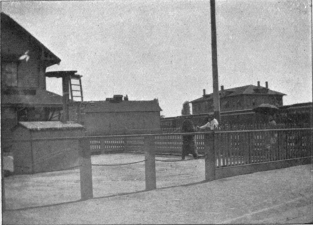
GRAVE OF BRIGHAM YOUNG, SALT LAKE CITY, UTAH.
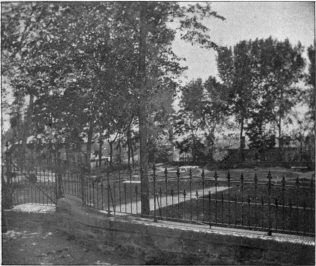
Temple Square, where we had a grand view of the magnificent $10,000,000 Mormon Temple. Near the Temple is the Tabernacle, an immense, singular-looking affair, with a roof like the shell of a huge tortoise. We are shown the Lion House and Beehive House, former residences of Brigham Young and his large family, and pass the grave where the remains of the great leader lie. It is a plain, ordinary-looking mound, inclosed with a common iron fence. The great monument erected to the imperishable fame of Brigham Young is this beautiful, remarkable city that he founded fifty years ago. For thirty years he was the temporal and religious leader of his people here, and Salt Lake City was almost strictly Mormon. It is exclusive no longer, for of its present population of 65,000 about one-half, we are told, are Gentiles or Christians. “The Christian Science faith is making rapid advances,” says our driver, “and many Mormons are being converted to that creed.” Brigham Young was the father of fifty-six children; when he died he left seventeen widows, sixteen sons, and twenty-eight daughters to mourn his loss, many of whom are living yet.
We are driven through Liberty Park, where is still standing the first flour mill built in Utah. Returning to the train we get dinner, after which our people scatter through the city to see the sights and gather more souvenirs. We are all impressed with the beauty and regularity of the streets, which all cross at right angles, are 132 feet wide, including the sidewalks, which are 20 feet in width, bordered with beautiful Lombardy poplar and locust trees. Along each side of the street flows a clear, cold stream of water, which, with the beauty of the trees and the sweet fragrance of the locust blossoms, gives to the city an all-pervading air of coolness, comfort, and repose which is exceedingly inviting to a warm and weary tourist. The hour grows late and the time arrives to return to our train, which is sidetracked for occupancy at the Rio Grande Western depot. Several of our party gather at the corner of Main and Second South Street to await the coming of a trolley car that will convey us to the depot, about two miles away. According to the schedule of the line a car should pass every ten minutes, but to-night must be an exception, for it is forty-five minutes before our car arrives, and several of the party have started to walk. It is near midnight when we reach our train and turn in for the night.
SUNDAY, MAY 30th.
We are all astir bright and early this morning, and after breakfast, through the courtesy of the managers of the Saltair and Los Angeles Railway, we are tendered a trip on their line to Saltair, one of the latest attractions on the Great Salt Lake, 10 miles from the city. We leave the Rio Grande Western depot at 9.30 on a Saltair and Los Angeles train with engine No. 2, Engineer A. M. Clayton, Fireman John Little, Conductor Joseph Risley, Brakeman F. T. Bailey. We have a thirty minutes’ pleasant ride through an interesting country. The first few miles we pass through a district of cozy homes, surrounded by fertile fields and gardens, the result of industry and irrigation; then come great level stretches of country, utilized as grazing ground, upon which can be seen feeding thousands of sheep. As we approach the “Great Dead Sea” of America we see that gathering salt is the chief industry, and we pass many basins or dams where hundreds of tons of this useful commodity are procured through the process of evaporation. Arriving at our destination we find Saltair is a magnificent mammoth pavilion built on the waters of Great Salt Lake, 4000 feet from shore. A track resting upon piles connects the pavilion with the mainland, and over this our train is run.
Saltair was erected in 1893 by Salt Lake capitalists at an expense of $250,000. It is of Moorish style of architecture, 1115 feet long, 335 feet wide, and 130 feet high from the water to the top of the main tower. It is over a quarter of a mile from shore and rests upon 2500 ten-inch piling or posts driven firmly into the bottom of the lake. It contains 620 bath houses or dressing rooms, and connected with each room is an apartment equipped with a fresh-water shower bath. Visitors who wish to drink or lunch or lounge will find at their disposal a fine apartment 151 by 153 feet, furnished with convenient tables and comfortable chairs, or if it is their desire to “trip the light fantastic toe,” they will find the ball room always open, a fine piano, and dancing floor 140 by 250 feet. At night this wonderful place is lighted by electricity, there being 1250 incandescent and 40 arc lamps, and above all, in the centre of the building, there is an arc light of 2000 candle power. The bathing season has not opened yet and the water is said to be cold, but many of us have a strong desire to take a plunge in this remarkable and famous lake. The temperature of the water is found to be about 75 degrees, and opinion is divided as to whether or not it is too cold. Manager Wyman takes off his shoes and stockings and dabbles in the water. “It is not cold,” he exclaims, “and I’m going in;” and procuring a bathing suit he is soon splashing in the brine. His example is rapidly followed by others, until the majority of our party, both men and women, are floating and floundering around in water so salt that its density enables one to swim and float with ease, but you are helpless when you attempt to place your feet upon the bottom; the water within the bathing limits averages about five feet in depth, and the bottom is hard, smooth, and sandy. “If you get water in your mouth spit it out, and if you get it in your eyes don’t rub them,” is the advice given us by the bath attendant. If you get this water in your mouth you want to spit it out right away; that part of the caution is unnecessary, for it is the worst stuff I ever tasted. If you get it in your eyes you will want to rub them, and rub them hard, but don’t do it, and you will be surprised how soon the intense smarting will cease.
We love to swim and dive and splash and sport in the water, and have bathed in many places, but in a brine like this never before. In fact, it has been said that nothing like it can be found anywhere this side of the Dead Sea of Palestine. We remained in the water for an hour and all thoroughly enjoyed its peculiar qualities. Several of the party who never swam before did so to-day, but it was because they couldn’t help it, and it was better than a circus to see them. Not one of us regret or will ever forget our trip to Saltair and our bath in Great Salt Lake. Strange as it may seem, this great inland sea occupies an altitude 4000 feet higher than the Atlantic and Pacific Oceans. It is 93 miles long, with an average width of 43 miles, containing almost 4000 square miles. It is shallow compared with the depth of other large bodies of water, its deepest places measuring but 60 feet. A number of islands rise out of its waters, the largest being Stansbury and Antelope, near its southern shore. It is between these two islands that beautiful, destined-to-be-celebrated Saltair is located.
Returning, we arrive at the Rio Grande Western depot about 12.30, and after partaking of lunch in our dining car we go in a body to attend services in the Mormon Tabernacle. They were looking for us, for we had been invited to come, and we find a section of vacant seats awaiting us near the centre of the immense auditorium. We are all favorably impressed with what we see and hear, the Mormon manner of worship being not unlike that of any other church. So far as we can discern, the speakers make no effort to expound any particular or peculiar creed or doctrine, but preach charity, love, and duty to one another and obedience to the laws of God, which is a religion good enough for the entire world. An attractive feature of the service is the singing, the choir consisting of 400 voices, accompanied by the music of what is claimed to be one of the largest church organs in the world, and led by a gentleman highly skilled in his profession, who manages his great concourse of singers with remarkable accuracy and precision. This music is aided and enhanced by the peculiar and marvelous acoustic properties of the building, which seems to convey and distribute sound in such a wonderful manner that the entire edifice is filled with the grand and charming melody. We are all delighted and highly appreciate the privilege of having been allowed to visit this, one of the noted wonders of this famous Mormon city. The Tabernacle is an oddly-constructed building, 250 feet long, 150 feet wide, and 80 feet high, covered with an oval-shaped roof that, without any visible support except where it rests upon the walls, spans the vast auditorium beneath, which will seat over 8000 people.
The place was well filled to-day, and we are told that it is not unusual to have a congregation of 10,000 within the inclosure during Sabbath service. There are twenty double doors nine feet in width, which open outward, like the great doors of a barn, and the floor being on a level with the ground outside, the vast congregation is enabled to make its exit in a very few minutes without crowding or confusion.
The services being over, we soon find ourselves outside the building, but still within the inclosure that constitutes Temple Square. This square or “block,” containing about ten acres, is surrounded by a wall two feet thick and fourteen feet high, composed of adobe bricks built upon a foundation of stone. Four great gates, one on each side, lead into the inclosure, which is ornamented with fine shade trees and beautiful flowers, and contains the three famous buildings of the Mormons, or “Latter Day Saints,” as they prefer to be called. The Tabernacle, where regular service is held each Sabbath, is the only edifice to which the public is admitted. Assembly Hall, a large granite building of unique design, erected in 1880 at a cost of $90,000, is used exclusively by Church officials for special meetings
THE MORMON TEMPLE AND SQUARE, SALT LAKE CITY.
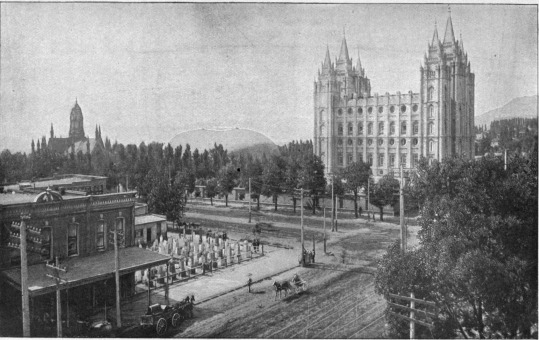
pertaining to the business of the Church. The Temple, a grand granite structure, the building and furnishing of which, we are told, has cost many millions of dollars, is as a sealed book to the outside world. Its interior is regarded as holy, consecrated ground, that has never been contaminated by an “unbeliever’s” presence. To admit a Gentile within its walls would be a fearful desecration. We cannot get inside, and gaze in admiration and curiosity upon its grand and massive walls, wondering what mighty mysteries are hidden within. Near the Temple that he designed and the corner stone of which he laid stands the statue of Brigham Young.
Leaving the grounds, our party scatters, some returning to the train and others strolling around the city. The sun shines very hot, but it is cool and refreshing in the shade. Mrs. S. and myself make a call on Mrs. Catharine Palmer, residing on State Street, a sister of Mr. C. K. Dolby, of Delaware County, Pennsylvania, an acquaintance of mine, who requested me to call on his sister had I the opportunity while in Salt Lake City. We are cordially received and spend a pleasant hour with Mr. and Mrs. Palmer, who are well advanced in years and very comfortably fixed. Their residence is surrounded by great maple trees, planted by Mr. Palmer many years ago, and he now loves to sit on his porch under their grateful shade and enjoy the fruits of his well-spent days of industry and toil.
On our return to the depot I encounter a party of the “boys” under the escort of Mr. James Devine, chief of Salt Lake City fire department, an acquaintance of Brother Leary’s, who are starting on a little tour through the town. I join them, and boarding an electric car we make a pleasant trip and are shown many places of interest. Mr. Devine is an excellent guide and entertains us with a number of anecdotes and stories of the people and their customs. “Who is the present head of the Mormon Church, Mr. Devine?” I ask. “An old gentleman by the name of W. Woodruff,” replies Mr. Devine, “but it will not be long, I think, before they will need another, for Mr. Woodruff is past ninety years of age. A short time ago, in commemoration of his ninetieth birthday, a family reunion was held, at which gathering his children, grandchildren, and greatgrandchildren numbered 90, one direct descendant for each year of his life. The old man is quite wealthy and owns some of the most fertile land in the State of Utah, if not in the world. I know it to be a fact that an experiment was made last year with an acre of his land to determine the amount of potatoes that can be raised per acre under favorable conditions, and that acre produced the extraordinary yield of 800 bushels. A like experiment in producing wheat resulted in the unprecedented yield of 82 bushels.” We can hardly credit this, but Mr. Devine declares it is true. One of the “boys” has been holding a letter in his hand, addressed to some friend in the East, and for some time has been waiting for a chance to deposit it in a letter box without getting left; at last he sees a chance, and quickly springing from the car when it stops at a corner to discharge some passengers, he tries to find an opening in what he supposes is a United States receptacle for letters. “Hold on, there,” exclaims Chief Devine, “I have a key for that if you want to get into it.” It is a fire-alarm box into which our brother is trying to insert his epistle. “Twenty-five dollars fine for tampering with a fire alarm in this town,” says Brother Maxwell, as the abashed victim of the mistake returns to the car. “Yer-hef-ner bizness to monkey with it,” chided Brother Schuler; but the proper place is soon found and the letter safely mailed.
We called on Jacob Moritz, president of the Utah Brewing Company, of Salt Lake City, who showed us over his immense establishment and entertained us in a very generous manner. During the conversation, Mr. Moritz, while speaking about the decline of polygamy on account of the vigorous enforcement of the law that forbids a plurality of wives, recited an incident that came under his observation a short time since. An old Mormon having several wives fell a victim to the stern mandate of the law. Being under indictment for a criminal offense results in disfranchisement, but the old gentleman did not know he could not vote. Pending his trial an election occurred and the old man went to the polls to cast his ballot, but was sternly challenged. He was dumfounded at first, but was soon made to understand why he was denied the privileges of citizenship. Raising his right hand toward Heaven he exclaimed, “Gentlemen, you won’t allow me to vote, but, thank God, I have twenty-four sons who can vote.” “That’s a family of boys to be proud of,” remarked Brother Leary. “If they were illegally procured,” added Brother Reilly. Mr. Moritz offered a fine cut-glass goblet to the one who could come nearest guessing the number of drams it would hold. Brother Waddington got closest to it and carried off the prize.
Bidding adieu to our kind host, we returned to our train and found dinner ready in the dining car. Chief Devine returned and took dinner with us. We also had with us as a guest Mr. Nymphas C. Murdock, of Charlestown, Wasatch County, Utah. Brother Barrett met Mr. Murdock at the Tabernacle services this afternoon, and becoming interested in his conversation invited him to visit our train. Mr. Murdock is a bishop in the Mormon Church and an intelligent and highly entertaining gentleman. Fifty years ago, when but ten years of age, he came with his parents, who were followers of Brigham Young, on that famous journey to the Great Salt Lake Valley. He has been identified with the Church since its establishment here, and was the first settler in Charlestown, which is located about 35 miles west of Salt Lake City, and he has been postmaster there for 31 years. Mr. Murdock made no effort to intrude upon us any of the peculiar doctrines or beliefs of his Church, but answered all our questions in a frank and pleasant manner, giving us a great deal of useful and interesting information. “Tell us something about your Temple, Mr. Murdock,” I requested, “and why you consider it too holy for visitors to enter?” “The Temple is considered holy because it has been consecrated to holy creeds and devoted to sacred objects,” answered Mr. Murdock in a solemn, quiet tone. “The spirits of the dead assemble in the Temple to commune with living friends.” “If that is so I don’t blame them for excluding the public,” I said to myself, “for if there is anything that will make a spirit scoot it is the presence of an unbeliever,” but I remained perfectly quiet, for I felt there was more coming. “We have a creed,” continued Mr. Murdock, “that declares the living can be wedded to the dead, and it is in the Temple that this most sacred of all ceremonies is solemnized and performed.” “I can’t see how it is possible,” I quietly remarked. “I will explain,” Mr. Murdock gently said; “to the ‘believer’ it is very plain and simple. Suppose, for instance, I am betrothed to a woman who sickens and dies before we are married; if she truly loved me in life her spirit will meet me at the Temple altar, where marriage rites will be performed that will unite us for all eternity.” I really think Mr. Murdock is a good and honest man and believes what he told us, but to us the whole matter seemed like an interesting fairy story—very pretty, but outside the realm of truth and reason. There were some pertinent questions in my mind I felt like asking, but did not wish to injure the feelings or offend a kind and entertaining guest, and so we bid him good-bye and let him depart in peace.
A number of our people went over to Fort Douglas this afternoon and were highly pleased with the trip. George “Alfalfa” was along and met an old chum over there in the person of William Barnes. William was a messenger in the employ of Mayor Fitler, Philadelphia, when George and he were buddies. He likes army life first rate and George says he is a good soldier. The troops at Fort Douglas are all colored, commanded by white officers. We are scheduled to leave this evening at nine o’clock, and it is drawing near the time; our train is at the station and Manager Wyman has ascertained that our people are all “on deck.” We must not forget “Dan,” the pet bear at the Rio Grande Western depot. He was captured several years ago when a cub and has been confined in a pen near the station ever since. He is a fine big fellow now, and has been faring well since our visit, for no one of our party thinks of passing the pen of Dan without giving him some sweetmeats, of which he is very fond. My last thoughts are of Dan, for finding I have some lumps of sugar and a few cakes in my pocket, I hasten to his pen and give them to him, and return just in time to get aboard. We leave promptly at 11.00 P. M. Eastern (9.00 P. M. Mountain) time, over the Rio Grande Western Railway, bound for Grand Junction, with the same engine and crew that brought us from Ogden to Salt Lake City. As a guest we have with us Train Supervisor Frank Selgrath, who will go with us to Grand Junction. At Clear Creek, 83 miles from Salt Lake City, we get a ten-wheel engine, No. 132, to help us up a six-mile grade with a rise of 200 feet to the mile. This is a fine, picturesque country, we are told, through which we are passing, but not being able to see in the dark, we cannot judge of its beauty, and finding it is near midnight I hie away to my little bed and am soon fast asleep.
MONDAY, MAY 31st.
Awakened this morning about six o’clock by Mrs. S. remarking, “I never saw the beat! Who would believe that so much of our country is desert?” I thought she was talking in her sleep, but turning over I find her gazing out of the window at the rapidly-fleeting landscape. We have drifted away from the mountains and rocks and are crossing a level, barren plain. For miles we see no sign of habitation or cultivation, but now in the distance we catch sight of an irrigating canal, with here and there a plot of land under cultivation whose fertility and verdure
CHAS. E. HOOPER, OF THE DENVER AND RIO GRANDE RAILROAD.
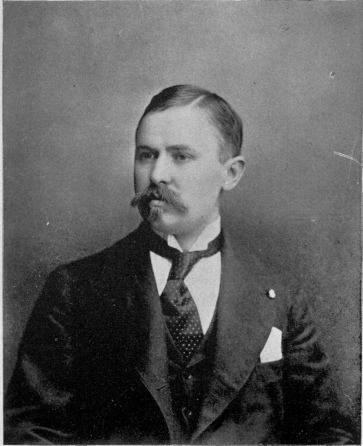
break the hard lines of the desert monotony. We pass a station and upon the name board we see the word “Fruita,” a singular name, we think, for a station; but in the two seconds’ glance we have of its surroundings we can but feel that it is appropriate. Irrigating ditches, fertile fields, thrifty orchards, and blooming gardens are all seen in that fleeting glance, and we are more than ever impressed with the fact that it needs but water to convert these desert tracts into verdant fields. A number of our people are astir, and we too “turn out.” We find we are in Colorado, having crossed the State line at Utaline, a little station 35 miles west of Grand Junction, which we are now approaching, and where we arrive about seven o’clock. We halt here only long enough to change engines, but in our brief stay we can see that Grand Junction is quite a town. It has a population of about 4000; is located at the confluence of the Gunnison and Grand Rivers, with an elevation of 4500 feet; it is quite a railway centre, being the terminus of both the broad and narrow-gauge lines of the Denver and Rio Grande, the Rio Grande Western and the Colorado Midland Railways.
At 9.08 A. M. Eastern (7.08 A. M. Mountain) time we leave Grand Junction, on the Denver and Rio Grande Railroad, with engine No. 522, Engineer “Cyclone” Thompson, Fireman Bert Roberts, Conductor William M. Newman, Brakemen J. Grout and O. McCullough. Conductor Hugh Long, of Salida Division No. 132, and Charles E. Hooper, advertising agent of the Denver and Rio Grande Railroad, met our train at Grand Junction, and we find them a pleasing and entertaining addition to our party. They present us with descriptive time tables, illustrated pamphlets, and souvenir itineraries of our trip over the wonderful scenic route of the Denver and Rio Grande Railroad. From Grand Junction to Glenwood Springs we follow the Grand River through the Valley of the Grand, amid grand and beautiful scenery. As we approach Glenwood Springs and pass the little stations of Rifle and Antlers, Brother Sloane grows very enthusiastic, for this is a noted hunting district, with which our brother is familiar. From Newcastle to Glenwood Springs, a distance of 12 miles, we traverse closely the north banks of the Grand River, and parallel with the tracks of the Colorado Midland Railroad on the opposite side.
Arriving at Glenwood Springs at 9.40 A. M., we go direct from the train to the springs under the escort of Mr. Hooper, who has made arrangements to give our party free access to the bathing establishment, where we are very courteously received, and each one who desires to bathe is furnished with a suit and a dressing room. Steps lead down into the pool, which is about an acre in size and filled with warm, sulphurous water to the depth of four to five feet. The hot water, at a temperature of 120 degrees, gushes into the pool on one side at the rate of about 2000 gallons per minute, and on the opposite side an ice-cold mountain stream pours in at about the same rate, keeping the water at a pleasant bathing temperature.
We spent an hour in the pool and enjoyed it mightily. How much fun we had we can never tell, but we know we had fun, and other people knew it, too, for the following item appeared in to-day’s Avalanche, an afternoon Glenwood Springs paper:—
BATHING POOL AT GLENWOOD SPRINGS, COLORADO.
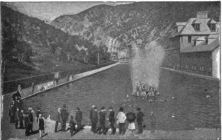
IN THE POOL AT GLENWOOD SPRINGS.
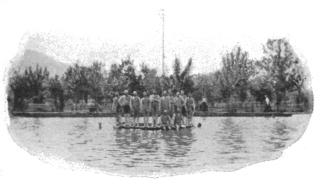
“Conductors in the Pool.
“The Pennsylvania Railroad conductors who arrived in Glenwood Springs this morning from the West had more fun in the pool than a lot of wild Indians. Their shouts of mirth and their laughter could be heard at Cardiff, three miles south. If the Indians ever had as much fun in that pool as those Pennsylvania Railroad conductors, then, Wampam woopham longheir spookham.”
We all feel that this item does us great honor, but we are puzzled for awhile to understand the meaning of the closing expression, until one of our party who had made a study of savage classic lore interpreted it as meaning, “Yankem, spankem, daredevil blankem.”
After leaving the pool, another hour was spent in visiting the sulphur springs and vapor cave and in writing and mailing letters. The latter we did in the beautiful Hotel Colorado, which is located near the bathing establishment and is said to be one of the finest-equipped hotels between the Atlantic and Pacific. The Grand River separates the baths from the town, and is crossed by a double-decker bridge, the lower deck for vehicles, the upper for pedestrians. We recrossed the bridge and after a short wait for our train to be brought to us we again got aboard, and at 3.00 P. M. Eastern (1.00 P. M. Mountain) time left Glenwood Springs bound for Salida.
For 16 miles we wind through the cañon of the Grand River, and view with feelings of admiration and awe those towering walls of rock of such peculiar construction and varied colors that we wonder what remarkable process of Nature could have ever formed them thus. At Gypsum, 25 miles from Glenwood Springs, Grand River disappears from view and we come in sight of Eagle River, following it for several miles. We pass great beds of lava and can see, away in the distance, a burned and blackened course where the lava had flowed down a chasm in the mountain, perhaps thousands of years ago. On the plateaus, at the foot of towering cliffs, are numerous little farms in a thrifty state of cultivation. We stop at Minturn to change engines, and bid “Cyclone” Thompson and his trusty fireman, Bert Roberts, good-bye.
We leave in a few minutes with engine No. 524. Engineer Al. Philliber and Fireman Charley Wilcox are in the cab, “Billy” Newman and his brakemen remain with us. Conductor Newman is a member of Denver Division No. 44 and an enthusiastic lover of the order. He is a model conductor and an entertaining companion. E. A. Thayer, Esq., superintendent of hotel, dining, and restaurant service, is our guest from Glenwood Springs to Salida, and we find him an interesting gentleman. Brother Dougherty has found an old friend in Brother Hugh Long, and he has much enjoyment in his company. Charley Hooper is everybody’s friend and always has an admiring, interested group around him, and if we could only remember all that Charley tells us we could write an intensely interesting volume. He is perfectly familiar with all of this wonderful country and is an exceedingly interesting companion.
Soon after leaving Minturn we enter Eagle River Cañon, whose sloping, pine-fringed walls rise to the height of over 2000 feet on either side, almost shutting out the light of day. A heavy shower adds to the gloom, but does not detract from the interest, for these mighty mountain sides are honeycombed with hundreds of mines and dotted with the cabins of the miners. It is very curious and wonderful to see a human habitation hanging, as it were, a thousand feet in the air, on the side of a mountain, where it would seem a mountain goat could hardly obtain a foothold; yet there they are, and many of them—in one place an entire village of red and white cottages, so very high up that they look like miniature houses or dove cots suspended in the air. The products of the mines are lowered to the railroad tracks by means of tramways operated by endless chains or cables, and material is conveyed to the lofty residents by the same novel arrangement.
For four miles we wind up through this marvelous mountain ravine, deeply interested in the wonderful sights and scenery of this extraordinary mining industry. A short stop is made at Belden, where extensive gold mines are in operation, but so high up on the mountain side are the shafts or entrances to the mines that it is impossible to visit them in the limited time we have. Since leaving Minturn our course has been gradually upward, and we have Engineer Amberson, with helper engine No. 513, to assist us up the grade. Emerging from the famous and never-to-be-forgotten Eagle River Cañon, we shortly come to the mining town of Red Cliff. It is a lively, thrifty place of about 1000 inhabitants, has an elevation of 8671 feet, and is surrounded by grand mountain scenery. From this point Mr. Hooper directs our attention to a view of the Mount of the Holy Cross, but only a glimpse is obtained of the great white cross and then it is lost to view. “Distance lends enchantment to the view,” quotes Mr. Thayer. “Do you know,” he continues, “were it possible to transport you to the summit of yonder mount, 20 miles away, and set you down, you would see no semblance of a cross? You would only see rugged rocks, desolate peaks, and snow-filled ravines; you would look in vain for the sublime and typical beauty that you so easily discern 20 miles or more away. You would see, were you in a proper location, the conditions and materials that make your beautiful picture. A great valley or ravine extends down the mountain side, into which the snows of many Winters have drifted. This is one of Nature’s perpetual ice houses, whose supply never becomes exhausted. Across the face of the mountain, near the summit, crossing this ravine at right angles, is another great depression or fissure, likewise filled with perpetual ice and snow. All the surroundings are rugged, rough, and broken, and you would never think of looking for the likeness of a cross in the wild, bleak desolation of ice-bound, snow-filled mountain chasms. Distance, however, obliterates the rocks and roughness and smooths the rugged features of the mountain side, and the great white cross of snow stands out in bold relief, as though formed of carved and polished marble. It is a pretty picture, and one that the imagination and sentiment of man have almost rendered sacred.”