Pennsylvania Railroad Conductors’ Excursion to California. (continued 2)
Reading edition
parts of their limbs and bodies painted and tattooed with bright and varied colors, increasing tenfold their natural ugliness, which showing to its best advantage, unassisted by art, is far above par. Yuma Bill, the biggest, oldest, and ugliest of the lot, seems to claim the most attention, and as I see him coming down the station platform and entering the waiting-room door, bareheaded and barefooted, with a bright-striped blanket about him, I think of Mark Twain’s story of his visit to the camp of Sitting Bull. “The old chief saw me coming,” says Mark, “and he came to meet me. I had pictured him in my mind as an old warrior covered with glory; I found him clothed with the nobility of his race, assisted by an old horse blanket, one corner of which hid his approach and the other corner covered his retreat.” Similar characters are Yuma Bill and his pals, and if ever “Mark” encounters them he will be strongly reminded of his notable interview with the famous Sitting Bull.
We all buy trinkets of Bill, for we never expect to see him again and we don’t want to forget him. We are told that he is a good old Indian, but was not always so. Years ago, when there were battles to be won, Bill made a record as a fighter. He will fight no more; there are only a few of him left; and Uncle Sam has given him and his comrades a refuge in a little reservation across the river where they hope to live and die in quietness and peace.
A short distance back of the station can be seen the territorial prison or penitentiary, on a bluff overlooking the Colorado River. We thought it was a fort until told that it was a prison. Our train is about to start, and we find a large car or tank of water attached on the front end next the engine and a freight caboose on the rear. We find that a freight crew has charge of us, that the tank of water will be needed to supply the engine, as there is a run of 120 miles through a country devoid of water, and that the crew will need the caboose when they leave us, for they expect to take back from Indio a train of freight. We have S. P. engine No. 1609, with Engineer W. Hayes at the throttle, fired by George McIntyre, Conductor H. J. Williams, Brakemen H. J. Schulte and R. M. Armour. As our train moves slowly off across the bridge that spans the Colorado we take a last look at Yuma and its picturesque surroundings, and in two minutes we are in California and crossing the Colorado Desert.
We are disappointed. We thought California a land of beauty, fertility, and flowers—a desert waste is all we see, bald mountains and barren plains on every side. Our course is upward for about 25 miles, until an elevation of 400 feet is reached, and then we begin to descend, and when we pass the little station of Flowing Well, 60 miles west of Yuma, we are only five feet above the level of the sea. Ten miles farther we stop at Volcano Springs and are 225 feet below the sea level. After leaving Flowing Well our attention was called by Mr. Steere to what was apparently a large lake of clear, sparkling water ahead, and to the left of our train, about half a mile away. We were running toward it but got no closer to it. It remained there, the same distance from us, a bright, sparkling, rippling body of water; not one on the train but what would have said, “It is water.” Mr. Steere says, “No; it is not water;
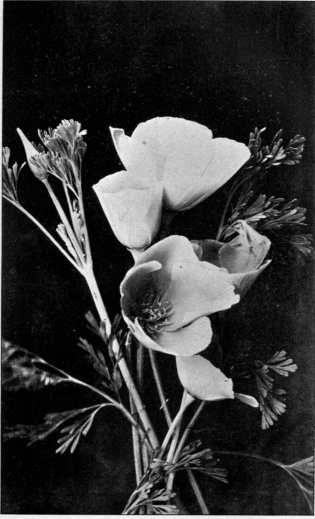
THE CALIFORNIA POPPY.

it is a delusion, a mirage caused by the glare of the sun on the shining salt crust of this alkali desert. There is not much doubt,” continued Mr. Steere, “but what ages upon ages ago all this immense basin was the bottom of a great sea. You can see upon the sides of these barren bluffs and upon those walls of rock the mark of the water line that for thousands of years perhaps have withstood the ravages and test of time. This little station is called Volcano Springs because of the number of springs in this locality that are apparently of volcanic origin. They are not in operation at the present time, but certain seasons of the year they are very active and spout up mud and water to a height of from 10 to 25 feet.”
A thermometer hanging in the doorway of the station, in the shade, registers 101 degrees, and it is not unusual, we are told, for it to reach 125. It is actually too hot in the sun to stand still; it almost takes one’s breath away. We feel relieved when our train starts and we are in motion once more. We create a breeze, a sea breeze, as it were, wafted to us o’er the mummified saliniferous remains of an ancient sea 3000 years a corpse. But the “mirage” still is there, a wonderful delusion, a monstrous deception, a gigantic “Will o’ the wisp,” whose alluring promises have led hundreds of men and animals a fruitless chase that ended in horrid death.
Sixty-five miles ahead of us we can plainly see San Jacinto Mountain, towering 11,500 feet in the air, with its summit covered with ice and snow that glistens in the noonday sun. Twenty-four miles from Volcano Springs we pass Salton, noted for its great salt industry. This is the lowest point on the line of the Southern Pacific Railroad, being 263 feet below sea level. About three miles to the left of the railroad we see the great white salt marsh or lake, containing such a vast deposit of this useful substance that the supply is thought to be inexhaustible. Steam plows are used for gathering the salt, and the works erected here have a capacity of nearly 1000 tons per day.
Twenty-five miles from Salton we reach Indio, where a short stop is made to change engines. Indio is a veritable oasis in the desert. After miles and miles of desert dust and glaring sand, it is very refreshing to see again trees and grass and flowers. We are still 20 feet below the level of the sea, but good water has been found here, and plenty of it applied to the soil has worked wonders. Whatever is planted grows with rapidity and in profusion, and with an abundance of water Indio can look forward to fast increasing beauty and prosperity. It has been discovered that the climate here is very beneficial to consumptives, and Indio has already become noted as a resort for those afflicted with pulmonary trouble, and it is claimed some very remarkable cures have been effected.
We leave Indio at 4.15 P. M. Eastern (1.15 P. M. Pacific), with S. P. engine No. 1397. Engineer Ward Heins, Fireman J. A. Shanehan; Conductor Williams and his brakemen will continue on to Los Angeles with us, 130 miles further.
Soon after leaving Indio we ascend a grade of 120 feet to the mile and pass along the base of San Jacinto Mountain, with its summit frowning down upon us from a height of 11,500 feet. The snow can now be plainly seen upon its highest peaks, and rivulets and cataracts can be seen in places dashing and leaping down its seamed and rugged sides.
At Rimlon we get Engineer Eli Steavens and Fireman M. Anderson with engine No. 1963 to assist us up a steep grade to Beaumont, a distance of 35 miles.
At Palm Springs a short stop was made to take aboard some guests who came to meet us from Los Angeles. They were Mr. G. L. Mead, Mr. H. Kearney, and Mr. J. E. White. Mr. Mead is a merchant of Los Angeles who heard of our coming and came to meet us to bid us welcome to the “Paradise of America,” and to emphasize his expressions of good feelings, presented the tourists with a case of very fine California wine. Mr. Mead could have done nothing more in accord with the feelings of the party. No wine ever tasted better, no wine ever did more good; it is a medicine our systems crave after 150 miles of the scorching, glaring, waterless Colorado Desert; a right thing in the right place; it is appreciated far more than Mr. Mead will ever know. Mr. Kearney is a promoter of stage lines and is about to establish a route between Palm Springs and Virginia Dale, a distance of 71 miles. He is an interesting gentleman to converse with, being perfectly familiar with all the surrounding country. Mr. White is a transfer agent doing business in Los Angeles, and is on hand to render aid to any of the party who may need his services.
We arrive at Beaumont and have reached the summit of the grade. In the 50 miles we have come since leaving Indio, we have made an ascent of 5280 feet. Our helper engine No. 1397 has left us; and we commence our descent of the western slope of the San Bernardino Range. Mr. J. Jacobs, a civil engineer in the employ of the Southern Pacific Railroad Company, was invited to get aboard at Beaumont and accompany us to Los Angeles. We find him a very agreeable guest, giving us a great deal of entertaining information.
We have passed from desert wastes into a rich agricultural district; farmers are engaged in harvesting hundreds of acres of barley, which in this region is cut while in a green state and cured for hay. We pass many large fruit orchards of different varieties, while away in the distance on every hand the mountains rear their snow-clad peaks to the clouds. It is a grand and wonderful transformation from the scenes through which we have lately passed, and needs to be seen to be appreciated.
“This section of country through which we are now passing,” observed Mr. Jacobs, “is the famous Redlands district, a country that has shown far greater development and been subject to more rapid improvements in the same number of years than any other known section of its size in the world. Ten years ago it was almost barren, and known only as a vast sheep range; to-day, owing to a thorough system of irrigation, there are nearly 30,000 acres of reclaimed land that bloom and blossom and bear fruit with all the fertility, the beauty, and abundance of a tropical garden.”
We have now entered the orange district, and large groves are seen on every hand, golden with the luscious fruit. At Pomona a halt of sufficient length is made to allow several baskets of oranges to be put on the train, which are distributed amongst the party and found to be delicious and refreshing. We are unable to ascertain who are the thoughtful donors, but all the
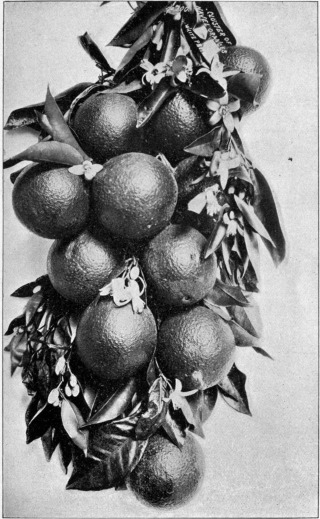
A CLUSTER OF NAVEL ORANGES, CALIFORNIA.
same they have the most sincere thanks of the entire party for their kindness and generosity.
For 25 miles we pass through a fairyland of blooming loveliness, and at 8.45 P. M. Eastern (5.45 Pacific) our train rolls into the station in Los Angeles, five days, five hours, and forty-five minutes late. On an adjacent track a train is loading, and we learn it is the New York Central excursion about ready to start for home. We exchange greetings and cards with many of them before their train pulls out, bound for its journey through the heat and dust of desert and plain, for they return by the route we came, and we know what is in store for them.
We begin to realize what we have missed by thus coming in at the eleventh hour. We find we were saved from a watery grave in the raging Rio Grande only to discover that we are here just in time to be too late to participate in the “good times” all the other visitors have had. The twenty-sixth session of the Grand Division of the “Order of Railway Conductors” that we had expected to attend is about ready to adjourn; the pleasure trips planned for the entertainment of members of the order to all the surrounding points of interest have been taken, and we weren’t “in it.” ’Tis rather a discouraging outlook, but with the true Yankee spirit of self-reliance we quickly determine to make the best of it, trusting our future to luck and Providence.
Brothers Houston, Haefner, and myself start for Music Hall, No. 234 South Spring Street, where the Convention is in session, and arrive five minutes before its adjournment. We hear Brother Grand Chief Conductor E. E. Clark make his closing speech. As the members of the Convention commence to pour out of the hall into the street the greater part of our folks arrive on the scene, and for more than an hour an impromptu meeting is held on the sidewalk and on the street in front of the building, where old friends are greeted and new friends are made; everybody wants to exchange cards with everybody else; all are good-natured, good-humored, and happy, and “perpetual friendship” seems to be the ruling spirit of the hour. The crowd gradually disperses and becomes scattered over the city, members of our party mingling with the rest, seeing the sights and looking for souvenirs.
Brother Ristein received a telegram that had been lying in the Los Angeles office four days awaiting his arrival, telling him of the serious illness of one of his children far away in his Delmar home, and he is at the office now, anxiously awaiting a reply to a message of inquiry sent as to the present condition of the child. Brother Ristein fears the worst, and we all share his anxiety. Promptly the answer flashes back, “The child is better and thought to be out of danger.” The words make light a heavy heart, and we are all glad for Brother Ristein’s sake.
Our train occupies a track in the Arcade Station train shed for our convenience, and by ten o’clock there are very few but what have turned in. A few of the “boys” are still out, of course, but it is a hopeless task to try and “keep tab” on them. We cannot do it. These nocturnal outings of theirs will have to be noted down as “unwritten history.” How much of it there will be we cannot tell. There has been considerable already, of which we might mention one night at Fort
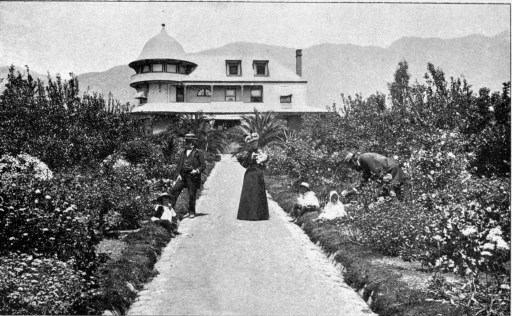
WINTER IN SOUTHERN CALIFORNIA.
Worth, testing the efficacy of police protection while attempting to follow a “blind trail”; four or five nights in El Paso chasing the fleeting phantom of merry luck to the musical whirl of the wheel of fortune. They are all right, these “boys” of ours, and they know a good thing when they see it.
WEDNESDAY, MAY 19th.
We are all up bright and early this morning, and after breakfast parties are formed to take in the sights. A number of us have decided to take a tally-ho ride, and Brother Wyman has gone to procure the outfit. In a short time he returns with the information that “the wagon will soon be here.” It is not long until a fine roomy coach, drawn by six white horses, reins up in front of the group, and we clamber in. There is just room enough. We count the party and find there are fourteen, including the driver. The team is from the Panorama Stables and driven by “Mac,” the veteran stager and coachman, who knows every crook and turn in all the highways and byways and drives and trails throughout Southern California. “Mac” is a character; we try to draw him out, but he won’t talk about himself, won’t even tell you his name, only that it is “Mac.” He will tell you about everything else, and he is thoroughly posted. He takes us through the principal streets of this most wonderful city, rightly named “The town of the Queen of Angels.”
Los Angeles lies amongst the foothills of the Sierra Madre Mountains, with an average elevation of 300 feet above sea level, only 15 miles from the coast, with an active, bustling business population of about 75,000 inhabitants. The beauty and magnificence of this tropical profusion through which we are passing is something we have heard of, but never saw before, and we find we are helpless when we attempt to describe it. In fancy and in dreams we have pictured “The Land of Sunshine and Flowers,” but now, brought face to face with this marvelous reality, the beautiful pictures of dreams and fancy pale into crudeness and insignificance. Through avenues shaded on either side by rows of palms, eucalyptus, and pepper trees, past rose-embowered cottages and lawns filled with tropical plants, surrounded by hedges of roses and calla lilies, we continue on our way out through the suburbs into the rural districts, through the avenues of vast orange groves, the trees loaded with luscious golden fruit, through beautiful Pasadena, and on until “Mac” draws up at the famous ostrich farm, where we alight and go in to look around.
We spend about half an hour looking at the birds and two and a half dollars in the purchase of feathers. Loading up, we start on our way again, bound for “Lucky Baldwin’s” ranch, “the largest individual tract of land,” says “Mac,” “in Southern California. It comprises 50,000 acres, nearly all under a condition of cultivation and improvement.” Here it is our pleasure to behold the largest and most wonderful orange grove in the world. For miles we see nothing but orange trees and oranges; the trees are loaded and the ground is covered with the yellow fruit. We feast upon the beauty and grandeur of this unusual sight, with lots of oranges thrown in. It is needless to state that we ate all we could and loaded up the hack.
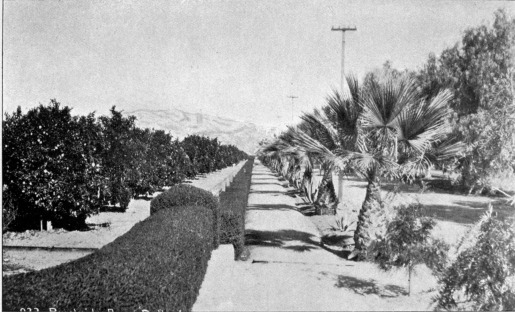
BROOKSIDE AVENUE, REDLANDS, CALIFORNIA.
A few miles further on we arrive at the Bonita Hotel, belonging to the ranch kept by Mrs. Warner, where the horses are taken from the coach and fed and the party takes lunch. Large lawns surround the buildings filled with many varieties of flowers, and we are given the privilege of plucking all we want, and when we leave each lady carries a large bouquet in her hand and each gentleman a smaller one in his buttonhole.
Starting on our way again, the horses refreshed with rest and food, we speed along lengthy drives and avenues, shaded by large Lombardy poplar and eucalyptus trees, for about two miles, when we pass through a large gateway over which is an arch in the form of an immense horse shoe, and enter the stable grounds where Baldwin’s famous blooded horses are kept. We are kindly received by the stableman, shown through the stalls, where a number of the celebrated equines are seen. Brother Layfield evinces such a surprising knowledge of horseflesh and shows so much interest in the history of the different animals as related by the stableman that he is presented by that courteous gentleman with a mule’s shoe as a souvenir of the visit. Brother Kilgore is also interested in the horses and would like to have a shoe; a search for one is unsuccessful, and so long did Brother Kilgore remain in the stable looking for the much-desired relic that he came near being left.
Leaving the stable grounds, we drive a mile further to the palatial residence and magnificent grounds of the renowned ruler of these domains. Mr. Baldwin is not at home at the present time, but the place is in charge of trusted employes. Leaving the coach, we walk through the spacious grounds surrounding the princely mansion. Paradise can hardly be more beautiful and grand—the largest, the sweetest, the reddest roses that ever delighted the sense of sight or smell, the grandest trees, the most beautiful shrubbery bearing flowers of every kind and color. Bordered with blooming lilies are lakes of water, clear as crystal, on the surface of which graceful swans are swimming and in whose depth gold and silver fish dart and dive. Fine fountains and statuary intersperse the lawn, adding to its richness and beauty. Mounted above a pedestal in a conspicuous spot we notice an old bell. It is possessed of no beauty, and we wonder what it is for. We inquire of an old man working near by, “Uncle, what is the old rusty bell for?” “That old bell,” answered the old gentleman, removing his hat with a low bow as he turns toward the object in question, “is the most valued thing you see. It is a relic that money cannot buy. Mr. Baldwin prizes it very highly, and we people all adore it.” As the old servant utters the last words he makes another low courtesy. We begin to think he is a little daft and are about to move on, when, straightening up and with outstretched arm he points toward the old bell a bony, trembling finger, and continues slowly and with emphasis, “That old bell came from the chimes tower of the San Gabriel Mission. That is why we prize it; that is why we love it.” We thought at first the old fellow bowed to us; we know now that he bowed to the old bell out of respect and reverence, for whatever is connected or associated with those old missions is looked upon as something almost sacred by many of the people here, especially those of the Roman faith.
A whistle from “Mac” informs us we must be going,
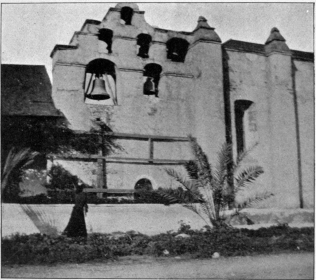
SAN GABRIEL MISSION, CALIFORNIA.
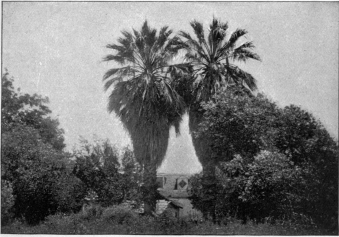
GIANT PALMS ON THE ROAD TO SAN GABRIEL.
and climbing into the ’bus the horses start off on a brisk trot and we soon leave “Lucky Baldwin’s” ranch behind and enter “Sunny Slope” vineyard, owned by L. J. Rose. This immense vineyard contains 1500 acres and is traversed by beautiful avenues which divide this vast acreage of grapevines into great squares.
We are soon across this interesting tract and enter the grounds of the vintage plant of the San Gabriel Wine Company. We were very courteously treated and shown through the large establishment, the capacity of which is 1,500,000 gallons of wine per year. Upon leaving we pass through their vineyard, containing 1000 acres, which is near the vintage plant.
As we approach the old San Gabriel Mission and “Mac” reins up his steeds in front of the low, quaint building, I instinctively glance up at the ancient belfry and find that two of the niches or arches where bells once had swung are vacant. “Lucky Baldwin” has one of the bells; I wonder who has the other. At this moment another tally-ho drives up and stops, and we find it is a coaching party of our own people. We all alight and enter the historic and sacred edifice. Those who are of the faith render their acknowledgment with quiet, humble reverence; we who are not stand silently by in an attitude of mute veneration. San Gabriel stands fourth in the line of the twenty-one missions established in California from July 16th, 1769, to April 25th, 1820, the date of its establishment being September 8th, 1771.
The party we encountered consists of Mr. and Mrs. Mitchell, Mr. and Mrs. Maxwell, Mr. and Mrs. Reilly, Mr. and Mrs. Matthews, Mr. Reagan, Mr. McCarty, Mr. Waddington, Mr. Taylor, Mr. Williams, and Mr. Suter. They occupy one of Hoag’s White Livery tally-ho coaches, followed by Mr. and Mrs. Horner in a buggy. Our party consists of Mr. and Mrs. Wyman, Mr. and Mrs. Kilgore, Mr. and Mrs. Layfield, Mr. and Mrs. McKernan, Mr. and Miss Barrett, Mr. Crispen, Mrs. Shaw and myself.
As we bowl along the level drive toward the city, after leaving the old Mission, our conversation turns upon the pleasures of the day and of the interesting and beautiful things we have seen. We are all well pleased with our day’s outing, especially the Colonel, who is in a high good humor, for had he not obtained what no one else could get, a substantial memento of his visit to the famous Baldwin ranch? “I am going to have this shoe decorated with ribbon and hung up in my parlor,” asserts the Colonel, as he searches in the bottom of the coach for his prize. “I guess not,” exclaims Mrs. Shaw, as she gives him a dig in the ribs with her elbow, “that’s my shoe you’ve got hold of.” “But where’s my horse shoe? Has any one got it? Has any one seen my horse shoe?” excitedly inquires the Colonel, as he makes another dive into the bottom of the coach. “I think it flew away,” quietly remarks Mrs. Wyman, as she draws her feet up and out of the way. “Who ever saw a shoe fly,” snaps the Colonel, as he continues rummaging in the bottom of the vehicle. “I have,” answers Manager Wyman, removing his hat, exposing a pate as devoid of hair and as bald as a door knob, from which he brushes an imaginary fly. “I saw a horse fly, but didn’t notice if he had shoes on,” observes Mrs. McKernan, keeping her eye on the Colonel, who is growing desperate in his failure to find
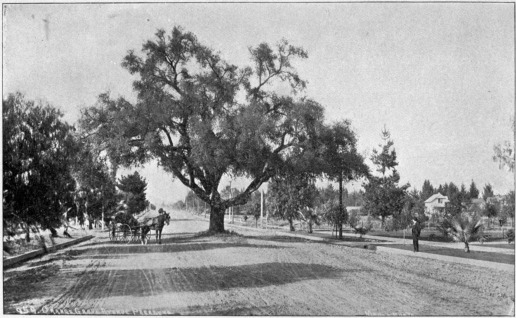
AN AVENUE IN PASADENA, CALIFORNIA.
his treasure. But it was gone; it had escaped from the bottom of the coach in some way, and we all sympathize with Brother Layfield in his bereavement, now that we find he has actually lost his valued souvenir.
We enter the city through East Side Park, which is a most beautiful and delightful drive. We bid goodbye to “Mac” and his spanking team and hurry to our dining car, where we arrive just in time for one of McDonald’s dandy dinners, which we heartily enjoy after such a busy day. We find a number of our party had taken trips similar to our own, and over nearly the same route; others had ascended Mt. Lowe, been away above the clouds; some had taken a run down to Santa Monica and sported in the surf of the Pacific; some to Santa Catalina Island, the alleged “Garden of Eden” of the Pacific coast. All express themselves as having had an exceedingly good time and are laying plans for the morrow. There are many places we would like to visit and many things we would like to see, but our time is too limited “to take it all in,” for we are to leave here to-morrow at 2.00 P. M. We have friends in San Diego we had intended to visit and there are fish at Catalina Island we had expected to catch; both friends and fish will have to charge their disappointment or pleasure, as the case may be, to the turbid waters of the Rio Grande.
Dinner being over, the most of our people take a walk up town and enjoy a promenade through the brilliantly-lighted streets, admiring the handsomely-furnished stores, with goods and wares arranged and exposed in so tempting a manner that many trinkets and knicknacks are purchased for souvenirs. Returning to the train at an early hour and hearing such a favorable account of the trip to Mt. Lowe from some who were there to-day, we conclude to join a party that is going in the morning and “take it in.” One by one and two by two our people keep dropping in like unto the oft-mentioned fowls that “come home to roost,” until only a few of the “boys,” as usual, are left outside the fold, and to them I need again ascribe “unwritten history.” As I leave the smoker to retire to my berth in the “Marco” I see our faithful George H. (Alfalfa) Anderson making up his bed, under the pillow of which he carefully places our “artillery,” and I feel we are as safe as though surrounded by a cordon of Gatling guns.
THURSDAY, MAY 20th.
Arose early this morning and found the weather not very favorable for our contemplated trip to Mt. Lowe, being cloudy and somewhat foggy, but we concluded to go, so after breakfast the party, consisting of Mr. and Mrs. Wyman, Mr. and Mrs. Layfield, Mr. and Miss Barrett, Mr. Kilgore, Mr. Sloane, Mr. Haas, Mr. Crispen, Mr. Denniston, two guests—Miss R. Stradling and Mr. A. L. Bailey—George H. Alfalfa Anderson, and myself, under the escort of Brother Ed. Butcher, of Los Angeles Division No. 111, who is a passenger conductor on the Los Angeles Terminal Road, boarded a car at 10.00 A. M. Eastern (7.00 A. M. Pacific) on the Pasadena and Los Angeles Electric Railway, conducted by W. A. Brown, and started on a never-to-be-forgotten trip to Mt. Lowe.
Out through the suburbs of Los Angeles, with its
GREAT CABLE INCLINE, MT. LOWE RAILWAY.
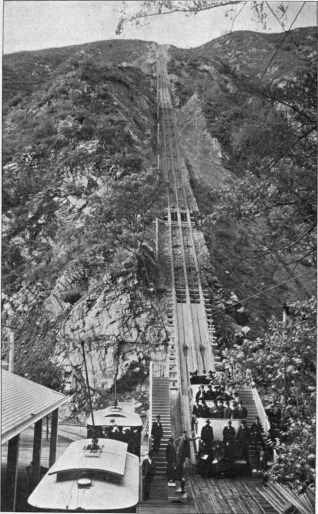
beautiful rose-embowered cottages and palatial residences and lawns of palms and tropical shrubbery, on through miles of country districts, rich with groves of golden fruit, through eden—Pasadena to Altadena, where we change cars for another electric road that carries us for about three miles over hill and dale, through ravines and across frightful-looking chasms, but always tending upward, until at an elevation of 2200 feet Rubio Cañon is reached and we are at the foot of the great cable incline, claimed to be the most wonderful cable road in the world, extending from Rubio Pavilion to Echo Mountain, a distance of 3000 feet. It makes a direct ascent of 1350 feet. Looking up at the wonderful construction it seems to almost pierce the sky; its summit is enshrouded in a veil of fog that hides it from our view.
“I don’t quite like the looks of that,” ventures Brother Kilgore, looking over his glasses with a scrutinizing glance, as his eyes follow the great incline up to where it is lost in the fog. “I guess it’s all right; I don’t think we’ll find it as terrifying as it looks to be; anyhow, the proof of the pudding is in eating it, and I for one am going up,” answers Brother Sloane. “Charlie, if you go I will go,” responds his bosom friend and chum, Brother Haas. “There is no danger I will not share with you, and perhaps we can see some mountain goats.”
“Or capture a deer,” adds Brother Denniston, who is keeping pretty close to Miss Stradling, for that young lady looks as though she needs sympathy and companionship in this trying ordeal.
“Do you think it’s safe, Charlie?” quietly inquires Mrs. Wyman of her husband as we start to ascend to the landing where we board the car. “Yes, perfectly safe,” replies Manager Wyman. “Human skill and ingenuity can make it no safer. They claim they never had an accident since the road has been in operation. The cable by which these cars are drawn has been tested to stand a strain of 100 tons, and the cars when loaded do not weigh five tons, so there is no danger at all.” “If I thought there was the least danger I wouldn’t go up,” utters Brother Layfield, “but I know there isn’t a bit.” Mrs. Layfield makes no comment, but clings nervously to the Colonel’s arm. The rest of the party follow without any apparent trepidation with the exception of “Alfalfa,” who looks a trifle pale.
We are all comfortably seated in the “White Chariot” car, which is constructed without canopy or covering, with seats arranged in amphitheatre style, one above the other, facing the foot of the incline, an excellent arrangement for affording an unobstructed view.
The signal is given, the machinery is set in motion, and quietly and smoothly we start on our trip toward the sky.
“Those mountain peaks you see just beyond Rubio Cañon are called the ‘Rubio Amphitheatre,’ ” explains the guide who accompanied the car. “You will notice that as we ascend those mountains seem to rise one after another and follow us.” We did notice them; we were looking right at them and couldn’t help it. It was an optical illusion that was rather startling. We thought at first that the mountains would overtake us, but they didn’t. “This is ‘Granite Gorge,’ ” continues the guide, as we enter a great cut that rears its granite walls on
ECHO MOUNTAIN HOUSE AND CAR ON THE 48 PER CENT. GRADE, MT. LOWE RAILWAY.
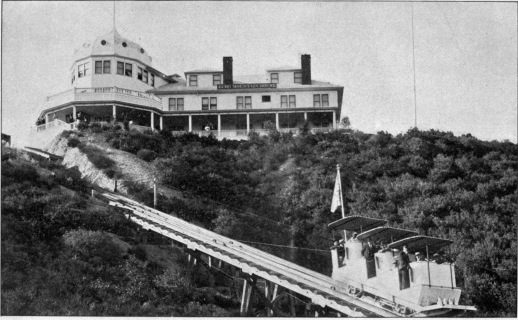
either side of us and lose sight of the mountains that are chasing us. “The workmen on this road were eight months in hewing this passage through these rocks, and before a tie or rail was laid they had to clamber to these rugged heights and carry their implements with them, and much of the material used in the construction of the road, such as water, cement, and lumber, had to be carried on the backs of burros and on the shoulders of men. This bridge that we are now crossing is called the MacPherson Trestle, and there is no other bridge like it in the world. It is 200 feet long and 100 feet higher at one end than the other. If it were not for the clouds you could obtain a good scenic view from here.” Clouds! We had not thought of it before, so interested were we in the talk of our guide, but we notice now that the sun is shining, and looking up we see no vestige of a cloud in the bright, blue sky above.
Looking again, beneath and beyond us, such a sight meets our gaze as our eyes had never rested on before. A vast white sea of billowy vapor overhangs the great San Gabriel Valley and hides it from our view. This alone is worth the trip to see—an immense heaving sea of clouds, an ocean of fleecy vapor billows that surge and roll and toss as though seeking for a shore of sand and rock upon which to spend their restless force. Halting at the summit of the great cable incline, we find we have arrived at the Echo Mountain House, where we change cars, taking an electric road called the Alpine Division of the Mt. Lowe Railway, which extends from Echo Mountain to Mt. Lowe Springs, where “Ye Alpine Tavern” is located.
As we board the Alpine Division observation car I again cast my eyes over toward the San Gabriel Valley, where a few minutes before we had beheld the battle of the clouds. What a grand transformation! The clouds have been dispersed as though by magic, and lying spread out in the valley 3500 feet beneath us is a panorama of such incomparable and inconceivable beauty and loveliness that we gaze for a moment enraptured, speechless, spellbound, dazed. They must be all looking, for there hasn’t been a word uttered for a minute. I am feasting my eyes on the supreme beauty of the scenery and drinking deeply at the fountain of delight; at the same time I’m trying to count the squares in the city of Pasadena and the orange groves that dot the valley. “It’s all there, but it’s a good ways off,” remarks Charlie Sloane, breaking the spell of silence. “My gracious! isn’t that fine? It beats looking across Jersey through the crown of Billy Penn’s hat,” exclaims George Alfalfa in a guarded tone.
The electric current is turned on, our car starts quietly off, and for four miles we pass over the most wonderfully constructed railway in the world. We do not go very fast—in fact, we would rather not, for taking everything into consideration this is not very good ground for “scorching,” and going at a gentle, easy pace lessens our chances of being rolled a few thousand feet down the side of a mountain. Not that any of us are afraid of being “dumped”; we didn’t come up here to be scared, but out of curiosity to see what it is like, and the more slowly the car moves the better able we are to see and the longer we can look at what we do see.
This entire roadbed, hewn out of the sides of the mountain, forms a solid granite ledge upon which the
MT. LOWE RAILWAY, CALIFORNIA.
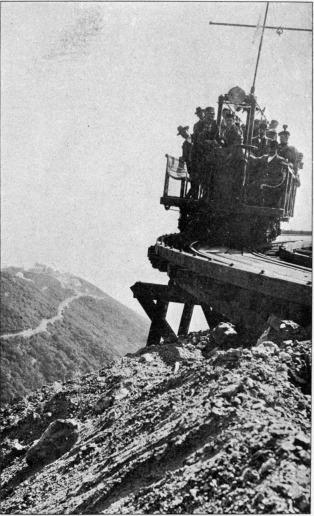
road is built, and it is always a towering wall of rock on one side and a yawning chasm on the other. To this there is but one exception, the “Grand Circular Bridge.” From this structure you can look from both sides down into the depths. If you don’t want to look you can shut your eyes.
Professor Lowe has constructed this railway at a cost of many hundred thousand dollars to enable tourists to penetrate the heart of the Sierra Madre Mountain, that they may form some conception of what an isolated mountain wilderness is like. It is all here and ever-present, in boundless, grand profusion—mountains, wilderness, isolation—an awe-inspiring, infinite trinity of grandeur, that almost makes your head swim and your heart stand still. Our tracks shelve the very summit of the sloping walls of mighty cañons, and you can look down 3000 feet into their wooded depths.
We arrive in due time at Mt. Lowe Springs, the terminus of the road, and are 5000 feet above the level of the sea. From here we can see the summit of Mt. Lowe, two miles away and 1000 feet above us. It is intended to extend the tracks to this point in the near future. A bridle path leads to it, and you can make the trip now on the back of a burro. A pathway leads to “Inspiration Point,” half a mile away, from which it is said magnificent views can be had. Our time is limited; we hasten to the famous spring, drink of its ice-cold water, and then visit the homelike, cozy club house, “Ye Alpine Tavern,” and give it a hurried inspection.
Nestling among giant oaks and pines, it occupies a romantic and picturesque location; in style of architecture it is attractive and unique, being something on the order of a Swiss chalet. It is two and a half stories in height, with ground dimensions of 40 by 80 feet; contains 20 bed rooms, a large dining room, billiard hall, and kitchen. It is built of granite and Oregon pine, finished in the natural color of the wood. The design of the main hall or dining room is the most striking feature connected with the construction of the building. Artistically located around the room in uniform order are five cheerful open fireplaces, in the largest of which swings a mammoth iron pot on a huge crane. It is 7 feet high and 12 feet wide. Blocks of granite have been placed in its corners for seats, and over the mantel above it is the somewhat flattering but old-time hospitable inscription, “Ye ornament of a house is ye guest who doth frequent it.” On one side of this mantel is a brick oven of ancient design; on the other side is a receptacle of peculiar and unique construction and suspicious appearance, which no doubt contains the liquid nourishment of the establishment.
“I wonder what they keep in this funny-looking cupboard,” whispers Brother Kilgore in my ear, as we were looking around in the dining room.
“Suppose we look and see,” I reply, as I attempt to open the door. “No, you don’t; it’s fastened. I’ll see who’s got the key,” is the rejoinder as he hurriedly walks away. Passing outside, I notice a number of the party are getting aboard the car, and as I join them the motorman shouts “All aboard.” “Are our people all here?” asks Manager Wyman, as he casts his eyes over the crowd. “Brother Denniston isn’t here. I think he went to Inspiration Point,” replies Brother Barrett. “Nor Brother Kilgore,” I add. “He went to look for a
CIRCULAR BRIDGE, MT. LOWE RAILWAY, CALIFORNIA.
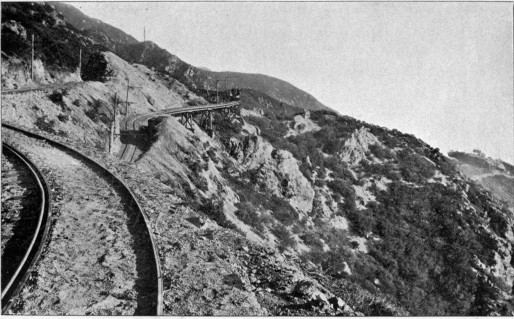
man with a key.” “I’m here,” says Brother Kilgore, as he emerges from the door of the “Tavern,” wiping his mouth in a suspicious manner; at the same time Brother Denniston and his “company” are seen coming from toward the “spring” and soon we are “all aboard” and “homeward bound.” At one point on our descent three or four mountain goats are seen on the track ahead of us, but on our approach they quickly disappear from sight in the thicket. It is with difficulty that Brothers Sloane and Haas can be restrained from leaping overboard and giving chase. Thirty minutes stop at Echo Mountain gives us an opportunity of visiting the beautiful hotel at this point, the “Echo Mountain House,” which is located on the summit of Echo Mountain and is said to be one of the finest equipped mountain hotels in the world. From its veranda and balcony hundreds of visitors daily view with rapture and delight the wonderful scenery of the San Gabriel Valley and its surroundings. A small cannon fired off on the lawn has a startling effect, and proves that the mountain is not misnamed. The report echoes from peak to peak and then seems to go bounding and tumbling down the cañons and ravines, growing fainter and fainter until it gradually dies away in the distance.
The great “World’s Fair search light,” purchased by Professor Lowe and established on Echo Mountain, is operated nightly for the pleasure and entertainment of visitors. The power of its light is that of 3,000,000 candles and its rays can be seen for 150 miles on the Pacific Ocean. Its beams falling upon a newspaper 35 miles away will enable a person to easily read it. Our time is up, and boarding the “White Chariot” we commence our descent of the great cable incline, reaching the bottom in safety. A photographer is on hand and “pressed the button” on the car and contents.
On our trip to and fro to-day we passed in sight of the beautiful home of Professor Lowe, near Pasadena, and returning I had the pleasure and honor of meeting and conversing with him during the twenty minutes we rode together on the Pasadena and Los Angeles Electric Railway. I was introduced to the professor by Brother Edward Butcher, and we took a seat together. He is a large man of fine appearance and carries himself with the graceful mien of a brigadier-general; his eye is bright and kind, his voice gentle and agreeable, and we are the best of friends in a minute. “Professor,” I remarked, “there are but a very few of the people, I warrant, who ascend that marvelous cable incline, who enjoy the pleasure and excitement of that unequaled ride among the wild, magnificent mountain scenery of your Alpine Division on a comfortable trolley car, that ever give a second thought to the men who endured hardships and risked their lives to even survey a road like that. I have thought of this several times to-day, and would like to ask how you ever induced men to traverse those cliffs and peaks and cañon walls, where a mountain goat can hardly secure a footing?” “Well,” answered the professor, “you know there are no hardships so severe they will not be endured, no risks so great they will not be taken, if only men have a leader to follow and are well paid for following him. Long before a measurement was taken or a stake was driven, when the idea that such a road were possible first entered my mind, I spent many days with only an employed attendant my companion,
YE ALPINE TAVERN, MT. LOWE, CALIFORNIA.
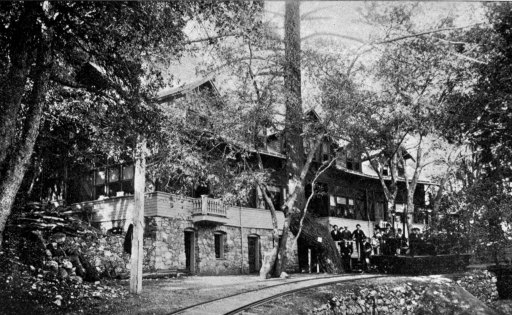
in making my way from Rubio Cañon to the crest of the highest peak along the route which you traveled with so much pleasure to-day in less than 90 minutes. I headed every surveying party that went out in the interest of the enterprise. I have personally directed all the operations that have required engineering skill and experience; I have expended almost one and a half millions of dollars, and my work isn’t completed yet.” “That is an enormous sum of money to invest in a venture, or rather an experiment, that you don’t know will pay till you try it,” I ventured to assert, while secretly admiring the indomitable courage and spirit of the man. “Yes, it is a great deal of money,” was the reply, and I imagined that a sigh accompanied the words. “As a financial scheme I believe it will be a failure. I have no hope of ever getting out of it what money I have put in it, but to me this is only a secondary matter. I’ve watched a vague visionary dream grow into a bright reality; I’ve had cherished theories, condemned as insane and impracticable, converted into substantial facts; I have solved the greatest engineering and mechanical problems that ever taxed the brain of man; I’ve won the hardest, toughest intellectual battle that ever was fought; I’ve had an all-absorbing ambition gratified, and I feel that I have, in a measure, got the worth of my money.” As the professor ceased speaking there was a bright look in his eye and a happy expression on his countenance as though it were a great pleasure to reflect on the great work he had accomplished. The car was approaching his destination; he arose to go and extended his hand. As I took it he said, “When you come again you can extend your ride to the summit of the mountain, for I propose to complete the work in a short time; and you must stay longer, for in your hurried trip to-day there is much you didn’t see, and I would wish that you could see it all; goodbye.” The car stopped and he was gone. As he disappeared from view I said to myself, “There goes a wonderful man.”
Continuing a few blocks further we left the car and visited the Chamber of Commerce and spent half an hour among its interesting relics and curiosities. When we reach our train the most of our people are there, the time for starting being almost up. We bid adieu to the kind friends we have made while here, and who did all they could to make our short stay a pleasant one, and at 5.00 P. M. Eastern (2.00 P. M. Pacific) we pull out of the station at Los Angeles bound for San Francisco and the “Golden Gate,” 482 miles away.
We are still on the Southern Pacific’s famous “Sunset Route,” which we have followed since leaving Sierra Blanca. S. P. engine No. 1826 is pulling us, with Engineer Charlie Hill at the throttle. She is fired by E. Homes, who has a hard task on hand, for there are steep grades to climb and our train is heavy. William Perkins is conducting the train; the brakemen are J. B. Freet and F. W. Bunnell. These three gentlemen are brothers of the “Order” and members of El Capitan Division No. 115, of San Francisco. They are members of the entertainment committee from that division and have been selected to run our train that they may be able to look after our welfare. J. C. Fielding, also a member of El Capitan Division and of the committee, is a guest on the train, along with Brother Twist,
T. S. C. LOWE.
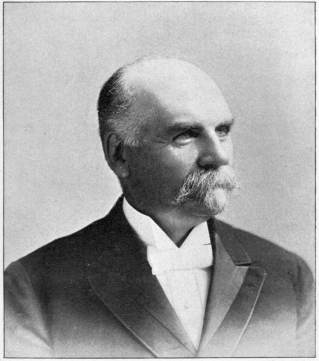
of Golden Gate Division No. 364, of Oakland, Cal., also a member of the committee.
Following the course of Los Angeles River as we leave the “City of Angels” behind us, we pass for quite a distance through a fine farming country, where hundreds of acres of barley are being gathered for hay into great heaps and stacks.
“Brother Freet,” I ask, as we sit near the wide-open door of the baggage compartment looking out on the fleeting landscape, “do they feed their stock altogether on barley hay in California?” “Not entirely. What makes you think so?” is the inquiring answer. “It looks so from the fact that in all the arable country we have passed through since entering this State, outside of fruit and flower culture, I have noticed no other product than barley, with the exception of a few patches of alfalfa grass,” I reply. “You are right,” is the response, “so far as concerns that part of the country you have seen; although if you traverse the State from end to end you will see comparatively little of it. There are sections of California where abundant crops of corn are raised, but while it has never achieved distinction as a corn producing State, it is second to no State in the Union in its yield of wheat. The entire area of the State of Indiana would be insufficient to cover the wheat fields of California, which yielded last year almost 40,000,000 bushels; but speaking of barley, cut as it is in a green state after the grain has formed and cured for hay, it makes a valuable and nourishing food for stock, upon which they will fatten without additional grain feed.”
Since leaving Los Angeles our course has been upward, and now as we pass the little station of Fernando, we are close to the San Fernando Range, 25 miles northwest of Los Angeles and over 1100 feet above it. A tunnel one and one-quarter miles in length pierces the above-named range, and into this we now plunge. It is a dark hole, an undesirable place to be; our train runs slowly, and the cars become filled with smoke and gas that is almost suffocating; we do no talking and as little breathing as possible for an interval of ten or twelve minutes, when we again emerge into the open air and sunshine and breathe freely once more. We have left the scenes of agricultural industry behind us and again enter a region of unproductive sterility and aridity. We pass through the little town of Saugus, from which place a branch road runs to Santa Barbara, yet the country don’t improve. We are strongly reminded of the Colorado Desert: alkali dust, glaring sand, stunted sage brush, and cactus on every hand. The elevation here is about 3000 feet higher than the Colorado Desert, but the conditions seem about the same.
Midway between Saugus and Mojave we enter the western border of the Great Mojave Desert, which we follow for several miles; here we are treated to novel, interesting, and remarkable scenery. On the right as far as the range of vision extends stretches the vast Mojave Desert, with its lavish growth of magnificent giant cactus, many of them from 25 to 40 feet in height, with branched and bushy tops, from the centre of which in many cases can be seen protruding an immense pinkish bloom.
This great desert, with its wonderful and peculiar plant life, extends, we are told, away off hundreds of miles into Nevada and Arizona. On the left the scenery is different. You gaze off and across the great Antelope Valley, 80 miles in width, level as a floor and almost devoid of tree or bush. It looks brown and barren, but we are informed it is considered good grazing territory. The grass, though dead and dry at certain seasons of the year, like that of the San Simon Valley in Arizona, retains all its nutritious qualities and flavor, and stock feed upon it with apparent relish.
Owing to unfavorable natural conditions and surroundings, it is hardly expected that we will encounter a very extensive population, but what few people we do meet who are residents of the country are principally employees of the railroad company, around whose stations usually cluster a group of snug and neat-looking cottages built by the company for the use of the men and their families. Good water can be obtained at a reasonable depth, and wind mills are used for pumping. Patches of ground are irrigated and cultivated, upon which are grown flowers, fruit, and vegetables. Our train slows up and stops for water at one of these oases in the desert, and looking out the window I discover that it is quite a town. A number of our people have left the train and are looking around.
Alighting from the train in front of the station I look up and see the old familiar homelike name of Lancaster above the door. Everything bears evidence of thrift and good living, even to an almost empty ice-cream can that sits inside the waiting-room door, and which, with other things, is being inspected and investigated. Time is up, “All aboard” is shouted, we scramble on, and as the train moves off Brother Houston, who is fast in the ice-cream can, came near being left. At Mojave, another thrifty town of considerable size, where connections are made with the Atlantic and Pacific Railway, our train stops to attach a helper engine. After a delay of five minutes we resume our journey, assisted by Engineer Cain and Fireman Curren with engine No. 1808.
As we leave Mojave it is growing dusk, and by the time we reach the summit of the grade and stop at Tehachapi it has become quite dark. This we all exceedingly regret, for we are now about to enter upon the most wonderful and interesting 33 miles of road on the whole Southern Pacific system, where we drop from an elevation of 4025 feet to that of 672. Making the descent of 3553 feet requires an almost continual application of the air brakes, which heats the brake shoes red hot and makes the fire fly. We feel concerned and wish we could see. We know at one time we are going around a sharp curve and at another time pitching down a grade much steeper than usual, and very often we find we are doing both at one and the same time. We look out of the window on one side and see a towering mountain wall, so near you can touch it with your hand; we look out on the other side, and see nothing, only a seemingly illimitable depth, filled with darkness and uncertainty; and this is the grand, picturesque Tehachapi Pass, whose sinuous windings, devious ways, complex maneuvering, and bewildering curves compels the railroad to run over top and underneath itself, forming the extraordinary famous Loop.
We had heard much of it, and we all expected to see it; our only hope and desire now is to get safely away from it and beyond it to straight track and level country once more. All good things must have an ending, and bad things can’t last forever, so the novelty and excitement of our toboggan-like mountain ride and its two hours’ suspense is over as our train stops at Bakersfield, where another change of engines is made.
It is now past midnight in Philadelphia, 12.50 A. M.; at Bakersfield it is only 9.50 P. M., but many of our people are retiring, for it has been a day fraught with pleasure and excitement, wearing both on the mind and body, and we all need rest and plenty of it to prepare us for the approaching morrow. “Captain,” I said, as Brother Perkins came down the curtained aisle of the “Marco,” while I was wrestling with a refractory collar button preparing to turn in, “will you kindly give me the number of the engine that is drawing us and the names of the engineer and fireman? I am trying to keep a record of the engines and crews that handle us, and I don’t wish to miss any.” “Certainly,” is the response; “we have engine No. 1417 that runs to Mendota, 140 miles; the engineer’s and fireman’s names are Cole; the Cole Boys we call them—good, lively fellows.” “With two live Coles in the cab and lots of them in the firebox, I guess we will reach Mendota on time,” came the smothered comment in a drowsy tone from the berth of Manager Wyman.
FRIDAY, MAY 21st.
Awakened this morning about six o’clock by Mrs. S., always an early riser, who exclaims, “Get up! get up! we’re almost there.” “Almost where, my dear?” I sleepily inquire. “I don’t know where, but Mr. Terry, Mr. Brown, Mr. Horner, and Mr. Springer are all up, and they say we are nearly there,” she answers. I turn over, raise the blind, and look out of the window. “And Mr. McDonald says we’re going to have an early breakfast,” she adds, as she retreats down the aisle. That last information she knows will fetch me if nothing else will, but I’m still looking out of the window wondering where we are; thought at first we had lost our way in the intricate descent of the Tehachapi Range, got tangled up in the Loop, turned around, and were again entering Los Angeles.
What magic had been at work during the night? The world outside is teeming with verdant vegetation. Fruit-laden trees, rose-burdened bushes, green grass, and flowers everywhere. I quickly roll out of my berth and dress, or rather I nearly roll out of my berth while quickly dressing, for one inconvenience of this way of living is, you’ve got to dress and then get out of bed, watching yourself very closely that you don’t involuntarily get out before you’re ready, for when, with one leg in your pants and about to put the other one in, your car hits a curve, look out.
The first person I meet as I enter the smoker is the conductor who is running the train. “Good morning, captain; where are we?” I ask. “We are entering Port Costa, 25 miles from Oakland,” he answers. “Have you time to give me the number of your engine and the names of your crew?” I inquire, with every-ready notebook in hand, as he was about turning away, for the train is stopping at the station. “We left Mendota this morning at two o’clock with engine No. 1408, Engineer Edwards, Fireman Duran, Brakemen Owen and Todd,
GEORGE W. BROWN, OF THE COMMITTEE.
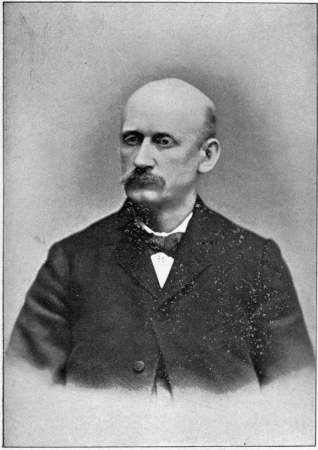
and my name is Schu,” he hurriedly said as he left the car and enters the telegraph office. In a short time Conductor Schu comes out of the office with train orders and our train is soon on its way again.
At 10.30 A. M. Eastern (7.30 Pacific) we reach Oakland (Sixteenth Street), where we lay for an hour and a half. It is a tedious wait. We cannot leave the train, for we do not know at what minute it might conclude to go, and none of us want to get left. We stroll around, first on one side of the train and then on the other, keeping one eye on it for fear it will get away from us and careful not to get too far out of its reach. We can see that Oakland is a large and beautiful city, and learn that it has a population of 60,000 inhabitants; a place where flowers bloom on the lawns, fruits mature in the orchards, vegetables grow in the gardens, and grains are harvested in the fields each and every month in the year. It has mountain scenery back of it and an ocean view in front of it; another blooming paradise where desolating storms are unknown and frosts and snows are never seen.
Finding our train about to move we all get aboard and in a few minutes are landed at Oakland Pier, where we wait half an hour for a boat to convey us eight miles across the bay to San Francisco. We employ the time in looking about the large, commodious waiting room that overlooks the harbor. We can’t help noticing that this apartment contains something that is never seen in a station waiting room on the Pennsylvania Railroad system. A profusion of advertisements of all kinds literally cover the walls, and occupying a space in the centre of the floor is a large glass case containing a pyramid of bottles filled with liquors of various kinds and brands, advertising the goods of a whiskey firm down on Front Street. It is needless to say that there is a railing around the exhibit and the door of the case is locked. One of the ticket collectors, an active old gentleman, quick in his movements as a boy, informs us that he has been in his present position for nineteen years; and although seventy years old, the climate is so healthy he feels that he is growing younger every day.
It is announced that the boat is now ready, and we “walk the plank” leading to the deck of the “Oakland,” which is soon plowing a furrow in the waters of the bay as she heads for the “Queen City” of the Pacific. It is not such a boat ride as one can term “lovely”; it is not even agreeable. A chilly gale sweeps the deck that almost lifts you off your feet. “Golly, it’s worse than a trip from Camden to Philadelphia in December,” exclaims Brother Goff, as he turns up the collar of his coat. “Or one from Jersey City to New York in February,” adds Brother McKernan, seeking refuge behind a post. The most of us retire to the more comfortable quarters of the cabin, where we find enjoyment in viewing from the windows the immense bay and harbor, where are anchored hundreds of vessels of all kinds and sizes. As the “Oakland” pokes her nose against the San Francisco dock I look at my watch; it is 9.55 A. M., Pacific time. We have just been twenty minutes coming across. A speed of a mile in two and a half minutes is a pretty lively gait for a ferryboat, but we are told the “Oakland” does it every trip. Under the escort of Brother Perkins, we are loaded into cable cars and start on our way to Sutro Garden and Golden Gate Park.
I believe there’s hardly three squares of a level street in the whole city of San Francisco. Such hills as we go up and such hills as we go down we never saw in any city before. “Why, this is ten times worse than Baltimore, and it’s bad enough, dear knows,” exclaims Mrs. Kalkman as she catches Brother Cohee around the neck to save herself from falling off the seat as the car shoots up an unusually steep acclivity. “Here, here, don’t be so affectionate; Brother Kalkman and Mrs. Cohee are looking at you,” warns Brother Cohee. “As if I’d hug you on purpose,” she retorts, giving him a look of scorn. In many streets a horse and wagon has never been seen; it would be impossible for a horse to draw a wagon up those abrupt granite-paved hills. With the cable car almost on end, we are descending one of those “shoot the chute” like declivities extending for about three blocks, when I overhear a passenger, evidently a resident of the neighborhood, say to Mrs. Shaw, who has “struck up” a conversation with her, “We had a fire here in our neighborhood a short time ago, and a driver of one of the fire engines tried to bring it down this hill, when one of the horses fell down and the engine ran over it and killed it, and it broke the engine all up and hurt the man; it was just awful.” The car stops at the next corner and the woman gets off; glancing back at the hill we have just descended her closing words, “just awful,” strike me as being very appropriate.
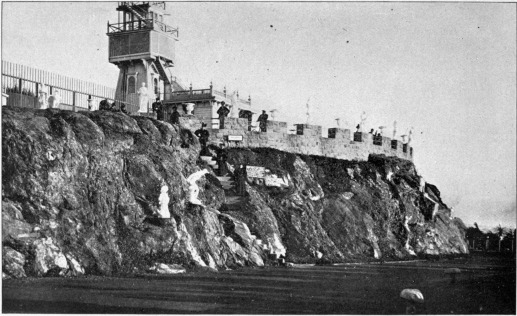
A few squares further and we abandon the cable cars and take a little steam road called the “Ferries and Cliff” Railroad that carries us to Sutro Park and bathing pavilion, owned by Adolph Sutro, a retired millionaire merchant of San Francisco, and to the celebrated Cliff House, near which are the far-famed Seal Rocks. We wandered for a time through the beautifully laid out statuary, shrubbery, and flower-adorned grounds of Sutro, then to the great pavilion, that not only contains a large museum of interesting relics and curiosities, but it is here that the noted Sutro baths are located, said to be the finest equipped artificial bathing pools in the world.
We cannot stand the temptation, and soon many of us are robed in bathing suits and are diving, plunging, rolling, and splashing in the salt waters of the Pacific, brought here and warmed to the proper temperature, permitting bathing to be indulged in the entire year. It is needless to say that we have lots of sport, and those who decline to indulge will regret it. There are several strangers in the pool, and Brother Sheppard has taken quite a fancy to one young fellow, whom he is trying to learn to swim and dive. In an adjoining pool is rather a forlorn-looking duck; it must be tame, for it is quietly swimming around undisturbed by the noise we make. “I think it’s hungry,” says Brother McCarty, “I wish I had some crumbs.” The creature must have heard him, for we imagine it gave him a grateful look.
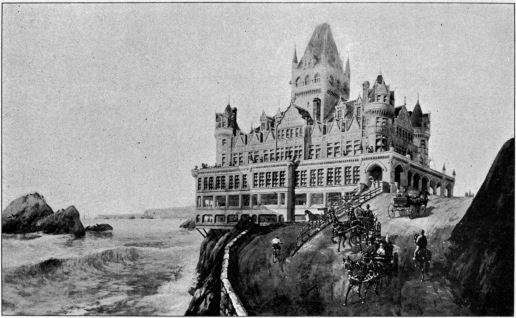
From the baths we go to the Cliff House, and from the windows of the inclosed balcony, that almost overhangs the waves that dash and roar on the rocks beneath, we watch with interest the monster seals that by the hundreds climb and crawl and slip and slide over the crags that rise from the bay, while we regale ourselves with pork and beans and coffee. There is a strong, chilly wind blowing, and we do not tarry long on the bluff outside that overlooks the bay and seals.
NEW CLIFF HOUSE AND SEAL ROCKS, SAN FRANCISCO.
It is twenty minutes past two as we get aboard a train on the Park and Ocean Railroad that will convey us to Golden Gate Park. We do not find this world-famed park very different in appearance from other parks we have seen. It is all nice—very nice; beautiful trees and plants and shrubbery, velvety green grass and bright blooming flowers, fine fountains and lakes of shimmering water. All this we see and enjoy, but we have seen the like before, time and time again. Some are bold enough to so express themselves, and it catches Brother Perkins’ ear, who good-naturedly says, “My dear friends, there is but one Golden Gate Park in all the world. There are 1040 acres here of as fine a park as there is anywhere under the sun, and when we consider that 25 years ago this was all a barren tract of drifting sand hills, that everything you see growing has been planted and is kept alive and green and blooming by a regular and almost constant application of water, when you remember this, then you will feel and think that this park is a little different from any other that you have seen.”
We had already commenced to think it was. Amongst groves of trees are great inclosures containing native buffalo, elk, and deer, with so much room to roam that they hardly feel the restraint of captivity. We enter the immense aviaries, where many varieties of birds and squirrels flit and chirp and scamper and chatter with all the freedom and unconcern of an unlimited out-door life. As we leave this great cage with its sprightly, vociferous occupants I hear Brother Reilly say, “McCarty has got a ‘mash.’ ” I don’t quite know what it is that Brother McCarty has got, but suppose it is some escaped animal or bird he has captured. I turn and look, to find him surrounded by ladies of our party, who seem to be trying to protect him from impending harm. Looking closer, I see disappearing among the shrubbery McCarty’s “mash,” the cause of all the trouble, and it is only the poor bedraggled duck of Sutro’s bath that Brother McCarty had thought looked hungry, and our ladies had scared it off. Brother Reagan would have recaptured it but for Miss Ella’s restraining hand, and the curiosity is lost.
We are all pretty tired when at last the street cars are boarded and we are on our way to the ferry. Some are going to return to our train, which lies in Oakland, and some will remain in this city. Mrs. S. and myself called on Mrs. David Chambers, who, with her son and daughter, Willie and Effie, live on Mission Street. Years ago Mrs. Chambers and her family were neighbors to us in West Chester, Pa. Willie, when but a lad, was advised to try the climate of the Pacific coast for his health. He found both health and lucrative employment. Ten years ago he sent East for his mother and sister. We find them to-day enjoying excellent health and nicely and comfortably fixed. We are given a warm, cordial welcome and persuaded to spend the night with them.
In the evening after dinner Willie took me out to see the town. The ladies declined to go, preferring to remain indoors and talk over old times. Met Leslie Collom, a young gentleman friend of the Chambers’, but he having other engagements could not go. Willie knows the town and I follow where he leads. It has long been a desire with me to see San Francisco’s
PARAPET, SUTRO HEIGHTS, SAN FRANCISCO.
“Chinatown,” and for three hours we explore its darkness and its mysteries. We do not attempt to go very far up and we don’t try to get very far down—we steer about on a level; but we see enough to convince me that Chinatown is all that it is said to be. You don’t have to ascend into rickety, reeking lofts or descend into gloomy, foul dens to witness their degradation, weakness, and misery; far back in dark, forbidding alleys and bystreets, which make your flesh creep to traverse, you can find them huddled together on benches and shelves, like chickens on a roost, enveloped in disgusting, stupefying smoke.
On our way home we dropped into a private museum and saw one of the rarest and most wonderful pieces of Japanese art in the world, a realistic, life-size statue of a man carved from wood. It is claimed that this work has been examined by learned scientific men, skilled in anatomy and physiology, and not a line or lineament of the skin surface of the human body has been omitted in this delicate, intricate carving. The finger nails are there and all the fine lines that can be traced on the inside of the hand and fingers. There are many lines on the surface of the human body that require the aid of a magnifying glass to discern; with the glass all these lines can be seen carved on this wonderful piece of art. It is midnight when we get home, and, thoroughly tired, we are soon in bed and in the land of dreams.
SATURDAY, MAY 22d.
Arose this morning about half-past six, and after breakfast, accompanied by Leslie Collom, went to the Palace Hotel, where we met Brothers Wyman and Layfield with their ladies. Brother Wyman had planned a trip to San José and was expecting others of the party, but a number of them being exhausted, worn out by an all night’s effort to explore the length, breadth, height, and depth of Chinatown, were still in bed. The others were too much interested in the beautiful city of Oakland and its environments to come, for we hear the good people over there are showing them a royal time, the municipal authorities giving them the freedom of the city and the railway company the freedom of their lines. Finding that no others are coming, we six board a Southern Pacific train on the Coast Division, that extends from San Francisco to Monterey, bound for San José, a ride of fifty miles. Mr. Collom is a very much appreciated member of our little party, as he points out from time to time much that interests us. As the train pulls out through the city he shows us the church where Blanche Lamont and Minnie Williams were found murdered and a little further on he points out the house where Durrant, the convicted murderer had lived.
The road runs between the ocean and the bay and as we pass the station of Ocean View a broad expanse of the Pacific greets our vision. At Baden we get pretty close to the shore of the bay and follow it until we leave Burlingame, a distance of about eight miles. We pass Menlo Park and Palo Alto, when our attention is called by Mr. Collom to a group of low-built, red-roofed, substantial-looking buildings, a short distance from the road on our right, almost hidden from view by the trees that cluster about them. “That,” says Mr. Collom, “is the renowned Leland Stanford University, founded in 1885 by the multi-millionaire Leland Stanford and his wife as a monument to the memory of their only child, Leland, Jr., who had died a short time before. Eighty-three thousand acres of land, valued at $20,000,000, was dedicated by a deed of trust for the establishment of this institution. Mr. Stanford selected the site for the location of the buildings, and the corner stone was laid in 1887, ten years ago. Last year the school register showed an enrollment of 1100 pupils. Tuition is free, both males and females are admitted, and the students are from all parts of America.”
As we leave Mountain View Station Mr. Collom suggests that we now give the scenery on the left of the train our attention, at the same time pointing out in the far distance a mountain peak, saying, “San José is 10 miles from here, and almost on a direct line with this point, and the crest of that mountain, 30 miles away, is Mt. Hamilton, where the famous Lick Observatory is located. It has an elevation of almost 4500 feet, and if you only had time to go up there it is a trip worth taking.”
Leaving Santa Clara Station we pass near a large, fine park, among the trees of which can be seen beautiful, substantial buildings. “That is Santa Clara Female College,” said Mr. Collom.
The train now enters San José, and we alight at the station. A “Vendome” hack is in waiting, which we enter, and are driven to that superb hostelry, said to be one of the finest hotels in California. It is situated in the centre of a beautiful 12-acre park, only a short distance from the railroad station. Not having long to stay, after a few minutes rest we bid the genial host good-day and start out for a little walk.
“We will return by the narrow-gauge road,” says Brother Wyman, “if we can find the station.” “A man told me a little while ago that it is only five blocks over in this direction,” replies the Colonel, indicating with his finger the way we should go. “Yes, the narrow-gauge road runs through that part of the town, but I think you will find it farther than five blocks,” remarks Mr. Collom. “Well, we want to see the town, anyway, and we’ll take our time,” responded the Colonel. “This is a pretty large town as well as a pretty old one, is it not, Mr. Collom?” I ask. “Yes,” is the answer. “It was first settled when Santa Clara Mission was founded, 120 years ago. It has now a population of about 25,000, and is the county seat of Santa Clara County, one of the richest counties in agricultural products and fruits in the State. Because of the wealth of fertility surrounding it San José has long been known as the ‘Garden City’ of California.”
Sauntering along, with our eyes wide open for the sights of the town, and keeping as much in the shade as possible, for the sun shines very warm, we are getting all the enjoyment out of the situation possible; but things are becoming less interesting. We are all hungry and the ladies are becoming tired; we have already come seven blocks, and the Colonel says, “We are nearly there; but to be sure of it I will ask this man,” he adds, as a man leading a horse came around the corner toward us. “My good man,” says the Colonel, “can you tell us how far it is to the narrow-gauge railroad station from here?” “Yes, sir; ’bout five blocks,” is the answer. “You’re sure it’s not ten?” retorts Brother Wyman; but the man and horse, never stopping, were out of range, and the shot missed the mark.
“I’m hungry,” exclaims Mrs. Wyman. “So am I,” I add. “I guess we can all eat if we have a chance,” asserts Brother Wyman. “We’ll look for a restaurant,” says the Colonel. A walk of two squares farther brings us to the looked-for establishment, which we enter, and after partaking of a substantial lunch, I ask the man at the desk, and I try to do it without feeling or agitation, making just the plain, quiet inquiry, “Will you tell us, please, how far it is to the narrow-gauge railroad station?” “Five blocks straight ahead,” is the pleasant, quiet reply, as he waves his hand in the direction we are to go. Not a word from one of our party. I take a second look at the man to see if I can discover in that pleasant countenance the least shadow of deception; it is as innocent and guileless as the face of day.
We silently leave the place, and as we start up the street Mrs. Layfield, taking the Colonel’s arm, gently asks, “John, are we going to walk to San Francisco?” “Not if we can find the station,” says the Colonel.
We enter the large store of a wine merchant to look around, and are courteously treated by the gentlemanly proprietor, who gave the ladies each a bottle of wine. We have come four blocks and a half since lunch and are looking for the station, when suddenly the Colonel exclaims, “There’s the road; I thought that last fellow was telling the truth.” “But that’s not the road we want; that’s a trolley road,” replies Brother Wyman. “So it is,” admits the Colonel; “but there’s a man; I’ll ask him,” he adds, referring to a man in uniform who was leaning up against the fence.
“For Lord’s sake,” pleads the Colonel, “will you tell us how far it is to the narrow-gauge railroad station?” “About a square and a half,” answers the man, smiling at the Colonel’s earnestness, “Are you sure it’s no further than that?” asks the Colonel. “Quite sure,” is the reply. “How soon can we get a train for San Francisco?” inquires Manager Wyman. “In about an hour and a half. Where’re you from?” he answers and asks at the same time. “From Philadelphia, Pennsylvania. Where’s your road go?” imitates Brother Wyman. The man laughs. “I’m unable to take you home, for I don’t go that far,” he replies, “but I can take you several miles and back through as fine a fruit country as you ever saw. I am waiting to relieve the man on the car you see coming, and in a few minutes I will be going back. The fare is only a nickel,” he adds, as a hint that we musn’t expect to “deadhead” it.
We conclude to go, to pass the time away, for we can easily get back in time to catch our train. So we get aboard the car, pay our nickel, and ride for several miles to a place called the Willows, which is the terminus of the road. Here is located an immense cherry orchard, where the crop is being gathered and crated ready for shipment to Eastern markets.
We are invited to help ourselves; it is half an hour before our car starts back and we have time to accept the invitation. The ripest cherries are the ones the packers reject, so we assisted the packers for several minutes picking out the ripe cherries and packing them while the packers packed the ones we didn’t pick. When we got tired of packing we quit picking, and thanking the good people for the treat, we board the car again and are soon spinning up the line among the apricot and cherry orchards, the trees loaded with fruit.
Arriving at our destination, we bid our friend, the conductor, goodbye, and in a few minutes we reach the much-inquired-for “narrow-gauge railroad station,” where we wait half an hour for the train. We find the track composed of three rails; and as though to demonstrate to us the use of the third rail, a freight train comes along made up of both narrow and broad-gauge cars. It looks odd, for it is something we had never seen before, and as the strange combination passes down the road the Colonel remarks, “There is nothing but what we may expect to see.”
In due time our train pulls into the station and we are soon seated in a comfortable narrow-gauge coach and speeding toward Oakland. There are many beautiful towns and residences located on this line, and as we draw nearer its termination this fact becomes more noticeable, the town of Alameda, through which we pass, possessing all the loveliness of a fairyland with its palatial residences and magnificent lawns.
Oakland, the “Athens of the Pacific,” is reached at last, and knowing how fascinating and grand it is and how royally our people are being treated, I am loath to leave; but our friends on the other side await our coming, and bidding the manager, the Colonel, and the ladies good night, Mr. Collom and I hie away to the ferry and across the bay, nor stop until we are seated in Mrs. Chambers’ cozy dining room, appeasing our appetites while recounting the incidents of the day. After dinner Willie took his mother, Mrs. Shaw, and myself out to give us a view of the city lights from “Park Heights.” A ride on the cable cars and several changes brought us in about forty minutes to the “Heights.”
From this high eminence we look down on a sight of unusual novelty and grandeur. Spread out far beneath us is almost the entire city of San Francisco, but the buildings are not visible, not one, only the millions of bright, star-like lights that enable you to trace the streets and mark the squares, and that twinkle and gleam from beneath like unto the gems that beam down upon you from above. We look up, through a cloudless atmosphere, and behold a firmament filled with brilliant, glittering gems; we look down, and see what almost seems a reflection of what we see above. Man, we know, is the author of all this grandeur that we see beneath, but as to the Author of that magnificence far above we can but speculate.
Willie sees we are growing serious and says we need a change, so he leads us around to the entrance that admits to the scenic railway, chutes, haunted swing, and skating rink, where for an hour we have a world of fun; so pleased are the ladies with the toboggan and the chutes that it is with difficulty we get them started home. We have had another full day, and when at eleven o’clock I find myself in bed, I discover that I am very tired. After the excitement and exertions of the day are over, when the tension and strain of over-taxed nerves and muscles relax and reaction comes, then you understand in its fullest measure the meaning of the expression, “I’m tired.”
SUNDAY, MAY 23d.
Feeling that we need rest, and finding the full enjoyment of our need in the pleasant home of Mrs. Chambers, we do not go out to-day until it is time to leave
JOHN H. REAGAN, OF THE COMMITTEE.
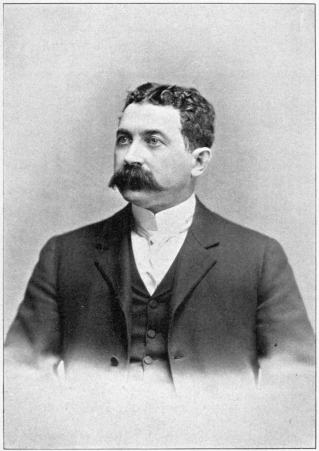
for the ferry, from which the boat will bear us to Oakland and to our train, which is scheduled to leave this evening at seven o’clock. Willie’s engagements had called him from home in the early morning. Mrs. Chambers, Miss Effie, and Mr. Collom accompany Mrs. Shaw and myself to Oakland and take dinner with us in the “Lafayette”; they are warm in their praises of the comfort and luxury of our train and our enjoyable manner of traveling.
The hour of departure is drawing near and the many friends we have made are gathered around to see us off. Mrs. T. E. Gaither, a former Pennsylvanian, now a resident of Oakland, presents each one of the tourists with a bouquet of fine roses gathered from her splendid, spacious lawn of ever-blooming sweetness. The inevitable “All aboard” is shouted, the last hand shake is given, and our train leaves behind another garden spot of grandeur.
So far as present indications point, our people have all made good use of their time and thoroughly enjoyed themselves. The kind brothers, of Golden Gate and El Capitan Divisions and the many good people of Oakland and San Francisco who contributed so much toward our pleasure are at the present time subjects of the warmest praise and most flattering comments, as incidents connected with our visit are being talked over and discussed. I hear Brother Springer telling in a pleasing and animated manner of a visit he and some others made to the palatial residence and grounds of Lucius Booth, Esq. “Mr. Booth gave us,” says Brother Springer, “the freedom of his magnificent lawn and park, that were beautified and adorned with all kinds, varieties, and colors of plants, fruits, and flowers. We were shown by Mr. Booth what he told us is the greatest curiosity to be found, located in his park, two strong natural springs, only eighteen inches apart; the flow of water from each is about equal. From one spring gurgles a stream of sulphur water, pungent to the smell and taste, with no indications of iron in its composition, while from the other flows a stream strongly impregnated with iron, but with no sign of a particle of sulphur in its ingredients. It is a puzzle to the scientific world, and naturalists pronounce it a ‘marvelous freak of nature.’ ”
I hear many of our people speak in the highest terms of Brother R. L. Myers, secretary and treasurer of Golden Gate Division 364, who devoted himself so faithfully and earnestly to the interests of our party. Brothers Maxwell, Reagan, Waddington, and a number of others also speak in glowing terms of the courtesy shown them by members of the Board of Trade.
We leave Oakland at 7.40 Pacific time (10.40 Eastern), attached to a five-car train called the “Portland Flyer,” which makes the trip from Oakland to Portland every five days. Engine 1793, in charge of Engineer J. Edwards, is drawing the train, which is conducted by D. H. McIntire; the brakemen are W. J. Mitchell and H. B. Stewart. A ride of 26 miles brings us to Port Costa, where the engine and ten cars are run on to the ferryboat “Salina” and transported across the strait of Carquicons to the old town of Benicia, at one time the capital of California.
The “Salina” is the largest ferryboat ever constructed, being 424 feet long, 116 feet wide, and 18 feet deep; its capacity is forty-four cars and an engine, regardless of size or weight. So smoothly does the “Salina” run that there is not a tremor, jar, or motion to tell you she is moving. Engine 1793 will run us to Davis, a distance of 77 miles.
It has grown dark, a matter we always regret, for we never get tired watching the fleeting, ever-varying landscape. With prospects of mountains for to-morrow, we seek our little bed.
MONDAY, MAY 24th.
Arose early this morning while it was hardly yet light, not wishing to miss any of the grand scenery that I know we must be nearing. Very few of our people are up, and making my way to the smoker I find the conductor who is running the train. He is a newcomer, an entire stranger, but I find him a very agreeable gentleman. “Where are we, captain?” I inquire. “Well,” he answers pleasantly, “you are on the famous Shasta Route of the Southern Pacific Railroad, bound from San Francisco, Cal., to Portland, Ore., a distance of 772 miles. You have traveled about 200 miles in your sleep. We left Red Bluff a short time ago and are now approaching Redding, 260 miles from San Francisco and over 500 from Portland.” “Where did you take charge of our train, please, and what is the number of your engine and the names of your crew?” I ask; “I’m trying to keep a little record of things as we go along,” I add by way of explanation, as he looks askance at me. “I took your train at Red Bluff; have engine 1769, Engineer J. Clark. I can’t tell you the fireman’s name; my name is G. E. Morgan, and my brakemen are J. Cook and J. Duncan. We take you to Ashland, a run of 206 miles. It will be necessary for us to get a helper engine shortly, for we have uphill work through here.”
“What stream of water is this, captain?” I ask, as I look out of the window and see a large surging, gurgling, dashing stream of water that seems to be rushing past at a mile a minute gait. “That is the Sacramento River, a stream whose course you ascend for 307 miles and cross eighteen times between Sacramento and Sisson,” he answers, rising and leaving the car as the train slows up and stops at a station.
I follow, get off, and look around. On the right the leaping, tumultuous waters of the Sacramento throw spray in your face as you stand and watch them churning and foaming in resistless might as they sweep madly onward toward the bay; on the left is the station and town of Redding. Several of our people are up and out on the ground. We can see that the town is a thriving business-looking place, and the station is a neat, substantial building. Our engine is taking water and the men are loading the tender with wood. “Why do you burn wood instead of coal in your engines?” I ask Conductor Morgan, who is standing near. “For the sake of economy, I suppose,” he replies. “Wood is plenty and cheap, while coal is very scarce and expensive.”
As we continue on our way I am reminded of Conductor Morgan’s assertion that “wood is plenty,” for we see thousands of cords piled up along the railroad track ready for use or awaiting shipment, and all the hills and slopes and mountain sides within our range of vision are covered with immense forests of pine and spruce. It is wild, picturesque mountain scenery and we all enjoy it.
Our train stops again, and looking out we see a name above the little station door that makes us think of home. It is the beloved, familiar Chester county name of Kennet. We notice that it is spelled with only one “t,” but it is “Kennett,” all the same. Stepping off, I see them attaching a helper engine and get its number, 1902.
As we start again I step on board, and entering the smoker encounter Brakeman Cook. “I suppose we have some climbing to do,” I remark; “I see you’ve got an extra engine.” “Yes,” he responds, “from here to Sisson is 61 miles, and in that distance we make an ascent of 2884 feet, at one point having a grade of 168 feet to the mile.” Passing Castle Crag we see in the distance its bald, bare bluffs and peaks of rugged, towering granite, and nestling in the shadow of the ridge can be seen its picturesque hotel, a resort where those needing mountain air for health, or mountain solitude for repose or pleasure, can find a safe, secure retreat.
From this point we catch our first glimpse of grand Mt. Shasta, 60 miles away. We stop at Dunsmuir twenty minutes for our engines to renew their supply of wood and water, and several passengers from the “Portland Flyer,” taking advantage of the delay, went into a nearby hotel and got lunch. A boy on the station platform with a large four-pound trout that he had just caught, and which was still flapping its tail, attracts the attention of Brothers Sloane and Haas, who want the train held four hours while they go fishing, but the proposition is voted down. A beautiful large lawn slopes from the Dunsmuir Hotel to the railroad, on which tame mountain deer are browsing. Three miles from Dunsmuir we reach Mossbrae Falls and Shasta Soda Springs. Our train stops, and with cups, mugs, jugs, bottles, buckets, and pitchers we make a break for the fountain. There is plenty of water there, and oh, how cold and sparkling and invigorating it is! We drink our fill and fill our vessels and load the train, but it would not be missed had we taken ten thousand times as much. A roofed and stone-walled well that is inexhaustible is fed by hundreds of little streams and rivulets and jets that flow and spurt from the moss-covered mountain side, while here and there a spring more powerful than the rest sends its slender column full fifty feet in the air and then descends in a shower of mist around you.
Where is the artist that can picture the beauty of Mossbrae Falls, a mighty mountain side covered to its summit with giant pines, terminating at its base in a sheer wall a hundred feet in height, its face covered and festooned with bright green moss, through which descends in a silvery sheen of spray the outpour from a thousand gushing springs? From here to Sisson, a distance of 25 miles, our engines have trying uphill work. There are mountains everywhere, mountains ahead of us and mountains behind us, mountains above us and mountains below us, mountains to the right and mountains to the left, but they are not the bald, bare, treeless kind, for everywhere you look, except when you cast your eye to Shasta’s crown, you will see a magnificent growth of pines and cedars, shrubbery and ferns. You have always to look up or else look down. Looking up you can scarcely ever see the pine-clad summits, for your eye rests on the top of the car window before it reaches half way up the mountain side; looking down you are all right, if you don’t get dizzy, for in many places you can look down upon the tops of the tallest trees a thousand feet below.