Volume 1 — NEW YORK JOURNAL OF PHARMACY. OCTOBER, 1852.
Reading edition
UNITED STATES CUSTOMS.
NEW YORK, September 25, 1852.
MR. GEORGE D. COGGESHALL.
Dear Sir,—Your kind and courteous favor of the 16th instant, on behalf of the Publishing Committee of the New York Journal of Pharmacy, asking “information respecting the character of imported drugs and medicines coming under my supervision; and also, information in reference to the general working and effect of the drug law of 1848,” has been before me for several days, waiting such response, in the shape of a full and lengthy communication in detail, as it was my wish to furnish; but pressing and increasing official duties compel me, from want of time (not material), to forego that pleasure and confine myself to a brief statement of facts and data, which, together with some general observations, I am in hopes may, nevertheless, be found interesting to your readers.
As an evidence of the beneficial effects of the wise sanitary measure, in the success of which, we have all taken so much interest, I am pleased to say that the character and quality of the more important articles of drugs, medicines and chemical preparations, connected with medicine at present presented for entry from abroad, is greatly improved, and of a far higher standard of strength and purity than formerly; notwithstanding, as will be seen, I still have occasion to apply the “veto power”—a labor of love, which must, of necessity, be {290} performed in order to arrest the unhallowed strides of deception and fraud which will ever be practised, to a greater or less extent, as long as we have those among us, engaged in any department of the drug trade, who, to put money in their purse, would endanger, if not sacrifice the lives of their fellow men. The law in question has now been in operation at this port something more than four years; and, with the exception of some eleven months, the duties and responsibilities of its administration have devolved upon me. On the 21st day of April, 1849, I made a report to the New York Academy of Medicine, on the practical operation of this law, and stated therein the more important articles of drugs and medicines, with the quantities annexed, rejected by me up to that date; but as that report is doubtless familiar to most of your readers, I have not deemed it necessary to repeat them here. The following are the more important articles, with the quantities annexed, that I have since rejected and condemned as not of the requisite strength and purity to be safely and properly used for medicinal purposes, viz:―
Senna, 31,838 lbs.
Jalap root, 37,121 lbs.
Rhubarb root, 5,782 lbs.
Sarsaparilla, 65,374 lbs.
Mezereon bark, 1,353 lbs.
Opium, 3,164 lbs.
Kino, 230 lbs.
Scammony, 1,483 lbs.
Aloes, 12,375 lbs.
Squills, 1,626 lbs.
Spurious Peruvian bark, 304,135 lbs.
Spanish Saffron, 360 lbs.
Ergot, 475 lbs.
Chamomile flowers, 1,896 lbs.
Assafœtida, 3,700 lbs.
Worm seed, 230 lbs.
Colchicum seed, 2,246 lbs.
Valerian root, 650 lbs.
Guaiacum, 9,300 lbs.
Cream of Tartar, 7,673 lbs.
Magnesia (carb.), 2,867 lbs.
Magnesia (calc’d.), 1,560 lbs.
Althea root, 1,117 lbs.
Liquorice root, 9,430 lbs.
Bistort root, 140 lbs.
Gentian root, 7,572 lbs.
Gentian root, in powder, 430 lbs.
Lavender flowers, 3,042 lbs.
Poppy flowers, 190 lbs.
Hellebore root (white), 460 lbs.
Pareira Brava root, 730 lbs.
Cantharides, 1,276 lbs.
Creosote, 140 ozs.
Bromine, 430 ozs.
Sulphate of Quinine, 3,200 ozs.
Iodine, 6,864 ozs.
Hydriodate of Potass, 3,720 ozs.
Making altogether some five hundred and twenty thousand pounds, to say nothing of various articles in small quantities rejected from time to time, which I have not considered of sufficient importance to note down. This, together with the ninety thousand pounds previously rejected, as stated in an early report above alluded to, makes some six hundred and ten thousand pounds of various articles of drugs and medicines condemned by me as unfit for medicinal purposes since the law took effect at this port. What articles and in what quantities, were rejected during the eleven months that I was absent from the office, I am not advised, neither am I at this time able to say what has been done under the requirements of this act at the other ports of entry. I hope, however, that the special examiners can give a good account of their stewardship, and that they will not hesitate to do so, whenever the information is desirable as a means of pushing on the column of medical and pharmaceutical reform. {292}
It will be seen by the above statement, that by far the largest quantity of any one article rejected, is that of spurious Peruvian bark, or as it is generally known in commerce, Carthagena and Maracaibo bark; and that too, as a general thing of the poorest and most worthless quality. The best of this bark affords on analysis only an exceedingly small percentage of quinine, not unfrequently, but a mere trace; while, at the same time, it yields as high as two, and occasionally with choice samples, two and a half per cent of a peculiar alkaloid which has been named quinidine, in contra-distinction to quinine, cinchonine, and aricine, (the three alkaloids heretofore obtained from the different varieties of the cinchona tribe of plants,) from which it differs essentially in several respects.
What is quinidine, medicinally understood? How does sulphate of quinidine compare with sulphate of quinine (from which it is very difficult to distinguish it by the naked eye,) medicinally, as a remedial agent in cases where the use of the latter salt is particularly indicated? These are important questions, and the subject is one very properly at the present time calling for prompt, patient, and persevering investigation by all those whose mission it is to prepare, dispense or prescribe the most efficient means wherewith to combat disease; the more so for the reason, that I have detected in most of the sulphate of quinine lately imported from abroad, more or less of this non-officinal, and (in my opinion) as compared with quinine, non-efficient substance yclept quinidine; a fact readily accounted for, when it is known that for the last year or two immense quantities of the bark in question, good, bad, and indifferent, have been exported from New Grenada, (as well as much from this port that had been rejected) and purchased by foreign manufacturing chemists, for the purpose, as I have reason to believe, of mixing it with the true bark in the manufacture of sulphate of quinine; hence the hybrid salt now too frequently presented to entry; a practice that, if not speedily abandoned, will ruin as far as this country is concerned, the formerly well deserved reputation of more than one of the {293} foreign manufacturers of sulphate of quinine I could name. The argument maintained by some of them that the article is used in their hospitals and found equal to pure quinine, will not answer on this side of the water; it smacks too much of the almighty dollar, even as I must believe (until further advised) at the expense of truth.
This comparatively inert substance, quinidine, is readily detected by using the method adopted by Zimmer, and published in the March number of the Pharmaceutical Journal (London), and, as I was happy to see, transfered to the columns of the May number of your valuable Journal. It is a test so perfect, so scientifically practical, and so simple withal, that any one possessing only a moderate share of chemical and analytical acumen can successfully apply it, even though perchance he may not be able to boast of wearing the mantle of the departed Berzelins, or of having been a favorite pupil of Liebig.
The law went into operation at this port on the 12th day of July, 1848, and it is worthy of remark, as a cause of gratulation, on the part of the early friends of the measure, that the importation of inferior and worthless qualities of many important drugs and medicines, has since gradually and greatly decreased in quantity. For instance, I rejected during the first seven months of the working of the law 19,989 pounds of Rhubarb root; but I have since rejected only 5,782 pounds, being but a fraction over one third of the quantity. For the past eighteen months, I have not had occasion to reject a single pound. I rejected during the first nine months 3,347 pounds of opium; but have since, during a period of more than two years and a half of my administration of the law, as will be seen by the above statement, rejected only 3,164 pounds. For the past thirteen months I have rejected only nine hundred and fifty two pounds, while I have passed during that period not less than 70,000 pounds. During the first two months of the operation of the law, I rejected 1,414 pounds of gamboge, but have since met with that only which I was ready {294} to pass without any hesitation. During the first nine months I rejected 2,977 pounds of gum myrrh, but all that has since been presented to entry at this port, I have found satisfactory. Thus might I continue, but time and space will not permit. Enough I opine, has been said and shown to satisfy even the most prejudiced and sceptical opponent of this wise measure, that if faithfully and judiciously administered, and seconded with becoming zeal and honesty of purpose by the medical profession, the pharmaceutist and dispensing apothecary, it is calculated and destined to effect most beneficial and lasting sanitary reforms throughout the length and breadth of our vast and glorious land. In a word, the law has operated thus far remarkably well considering the hasty manner in which it was framed and passed through Congress. It is, in some respects imperfect, as must ever be the case with all new measures of legislation until their utility is tested by practical operation; but these imperfections were, some time since, brought to the attention of the Secretary of the Treasury, who, with his accustomed promptitude soon after instructed me to report to the Department such manifestations and suggestions as my experience in the administration of the law should dictate as most desirable, practicable, and judicious; and, notwithstanding this important and responsible trust has necessarily been made the subject of the few occasional leisure moments I could from time to time command, apart from other official duties, it is nearly completed, and, in a manner too, as I have reason to believe, that will render the law, when amended as proposed, satisfactory to all honorable dealers, importers, owners, and consignees, and, at the same time do away with the not unreasonable objections entertained by our marine insurance companies; while its efficiency instead of being in any manner impaired by the amendments, will be more perfectly guarded and essentially strengthened. The particulars and details connected with this duty I must defer until another time; but I must be permitted before closing this communication to say, that to the present able and distinguished {295} head of the Treasury Department, Hon. Thomas Corwin, is due a debt of gratitude, from all true friends of this important measure, not easily cancelled. Soon after he was called to take upon himself the responsibilities of one of the most important, and by far the most arduous offices under the general government, the downward and fatal tendency of a maladministration of the law was brought to his notice; when, rising above all minor considerations, he rescued it from impending danger, and placed it upon what he deemed a safe basis; and has since, on all occasions, lent a willing ear to every suggestion calculated to render it more perfect, to add to its efficiency, or perpetuate its usefulness. A noble example truly, and one well worthy of the man.
To conclude, I beg to say, that although I have not the honor of belonging to any Pharmaceutical Association, I nevertheless take great interest in everything calculated to advance the good cause and noble calling in which you have so long been engaged; and, I hope the day is not far distant, when every city and town of importance throughout this wide extended country, will be favored with an organization of the kind, radiating from a National Pharmaceutical Association as a common center. It would be of vast benefit to the community at large, as well as eminently useful to the medical profession; for as all must admit, it is of the most vital importance to the success of the physician, that his remedial agents are properly prepared by a well-bred and perfectly educated chemist and pharmaceutist; and, I may add my conviction, that medical and pharmaceutical chemistry, a part of medical education that has thus far been most unpardonably neglected, should be universally and efficiently taught in our Schools of Medicine.
I am, dear Sir,
Very respectfully, your obd’t. serv’t.,
M. J. BAILEY, M. D.,
Special Examiner of Drugs, Medicines, Chemical Medicinal Preparations, &c.
{296}
ON THE USE OF COAL GAS AS A SOURCE OF HEAT FOR THE LABORATORY. BY EDWARD N. KENT.
Having recently fitted up a new laboratory in which I have introduced coal gas as a source of heat, I have thought a description of the apparatus and manner of using it, would be interesting to chemists and pharmaceutists, as it has not been very generally applied to this purpose as yet in this country, although in England, where alcohol is dear, it has long been used as a substitute.
In the use of coal gas as a source of heat, the principal difficulty to be avoided, is its tendency to smoke; this I have accomplished in a variety of ways. The ordinary argand gas burner, fixed permanently upon a branch pipe passing up through the table, is one of the cheapest, and a convenient arrangement for many purposes, and to prevent smoke, a tall glass chimney, or a short sheet iron chimney, with every other hole in the burner plugged, so as to make separate and distinct jets for the air to pass through, is all that is necessary. A tripod or sheet iron cylinder, for supporting vessels over the flame, is an indispensable addition to this burner. There is one objection to this form of apparatus, which is, that it is fixed, and cannot be moved about like a lamp. To avoid this inconvenience, I have had a number of burners constructed in different ways, and connected with flexible tubes, so as to admit of a change of position, to any place within the length of the tube.
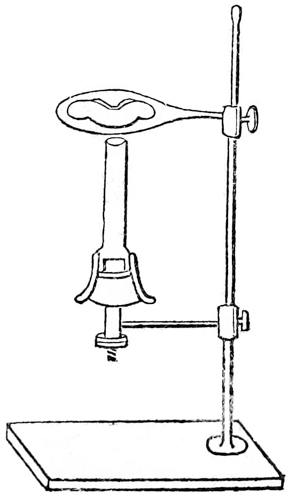
Fig. 1.
Figure 1, is a gas burner designed as a substitute for the Rose Lamp, and when connected to the gas pipe by means of a flexible tube, answers every purpose of that excellent lamp without being liable to the danger of catching fire, or to the necessity of replenishing during an operation, as is the case with most alcohol lamps. The above arrangement consists of an ordinary argand gas burner, with every other hole plugged, fixed to an arm with a socket and {297} thumb screw, by means of which it can be raised to any height on the rod attached to a moveable wooden foot. The lower part of the burner is provided with a screw to which the flexible tube is attached, by means of a Hare’s gallows screw connector. The other end of the flexible tube should be provided with a stopcock, at its union with the fixed gas pipes for regulating the supply of the gas. Above the burner is a moveable ring, with socket and thumb screw, for supporting retorts, flasks, etc., at any desired height. A glass chimney is represented in the figure, but this may be replaced with a short sheet iron chimney, when part of the holes in the burner have been plugged as before mentioned. The above burner is well adapted for use with the wire gauze chimney, as the moveable ring with the addition of a wire tripod, answers as a support for a platina crucible. To insure a perfect combustion of the mixture of gas and air, I find that the sheet iron cylinder should be about ten inches high and two inches diameter. Over such a cylinder, with the upper end covered with wire gauze, it is an easy matter to fuse carbonate of soda, or other substance requiring a bright red heat. When the combustion is perfect with the above cylinder, the flame is of a pale blueish white color, like that of a solid flame from alcohol but much hotter. With the addition of a small conical chimney of sheet iron, placed over the mixed gas-burner, so as to bring the blue flame to a smaller compass, I find it a very convenient and powerful flame for bending glass tubes, by which tubes of any diameter, or the neck of a retort, may be easily softened and bent.
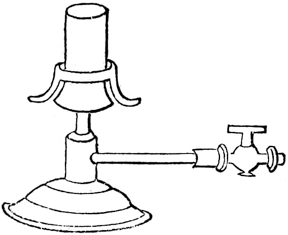
Fig. 2.
Figure 2, is an argand burner, with every other hole plugged, attached to a heavy brass foot, and with an arm and stopcock, to which a long flexible tube is attached, the other end of which is connected to a pendant above the table. This burner is well adapted for use on any part of the table, and may be used with an ordinary retort {298} stand, or with a sheet iron cylinder, for supporting vessels over the flame. It has all the conveniences without the disadvantages of a Berzelius’ Lamp, as it requires no wicks or replenishing, and cannot take fire; and the stopcock is not liable to get out of order, as is the case with the rack and pinion of the alcoholic lamp.
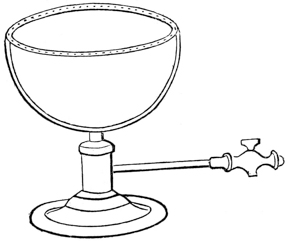
Fig. 3.
Figure 3, is a large burner, six inches in diameter, with the holes placed far enough apart to form distinct jets of the burning gas, by which means smoke is entirely prevented without the use of any chimney. This burner, like the preceding, is attached to a heavy brass foot, and with an arm and stopcock, to which a long flexible tube is attached, by means of which it can be moved to any part of the table.
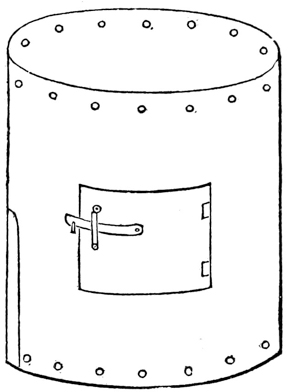
Fig. 4.
This burner is provided with a large sheet iron cylinder, (figure 4) with air holes at the top and bottom, a slit at the side, to go over the arm of the burner, and a door in front for convenience in lighting the gas, and thus forms a powerful and convenient gas furnace, by means of which a gallon of water can be easily boiled. With this arrangement the confined heat is so great, that it is necessary to protect the table from burning, by means of sheet iron, or other suitable material.
In point of economy, coal gas is cheaper than alcohol for fuel, even in America where the latter is so cheap, and the price of gas is comparatively high; and, it is to be hoped, that the price of the latter will be reduced, so that coal gas may yet be used with economy, as a source of heat for domestic as well as for chemical and pharmaceutical purposes. The present price should be no detriment to its free use, as it is, {299} undoubtedly, the most cleanly and convenient fuel which can be used in the laboratory; and, as such, I would strongly recommend it to those, for whom the above description has been prepared.
NOTE UPON CICUTA (CONIUM MACULATUM) AND CONICINE.
Since Stoerck, who first extolled the virtues of Hemlock, this plant has undergone numerous alterations of credit and neglect which may be explained by the want of certainty, or rather by the irregularity, of its action.
An important work has just appeared on this subject, executed conjointly by a physician and pharmacien of Lyons, MM. Devay and Guillermond. This work, which developes and completes what has been said upon the medicinal virtues of hemlock, furnishes a new element which will fix, we believe, the therapeutic value of that substance. It is the substitution of the seed like fruits for the other parts of the plant. We will briefly explain the motive of that preference.
The principle to which cicuta owes both its toxicological and therapeutic powers has received the names of cicuta, coneine and conicine, the last of which is now generally adopted. It is a volatile alkaloid, of a sharp penetrating, disagreeable smell, somewhat like that of mice. It is of an oily consistence, and easily decomposed by heat. In these respects it resembles nicotine. But, a characteristic readily recognized and which distinguishes it from the latter, when shaken with water it again floats upon the surface, while nicotine is immediately dissolved by that liquid.
The volatility of conicine, the readiness with which it is {300} decomposed by heat or time alone, are such that the Lyonese experimenters do not hesitate to propose the abandonment both of the herb itself, and of all the pharmaceutic forms prepared by the aid of heat, or in which the conicine is susceptible of undergoing decomposition. We think this is going rather too far. The extracts of cicuta prepared with care, and particularly those prepared in vacuo, are of daily service. We have been able to verify by trituration with potassa, the presence of conicine in a hydro-alcoholic extract, a number of years old. But, notwithstanding, recognizing the fact that the preparations of cicuta of this kind are often inert, we agree with the experimenters that it is of consequence to escape from such a state of things.
The tincture of cicuta prepared with the fresh plant, is a very beautiful product, but made from parts of the plant containing but a small proportion of conicine, or at all events containing it in very variable proportions, may be inert or irregular in its action. What then is to be done? employ conicine itself? But the preparation of the alkaloid is difficult; it is promptly decomposed by contact with the air and light, and the apportionment of its dose, offers serious inconveniences.
There is a organ of the plant in which its active principle is found in larger and more constant proportion, and under conditions in which it is better preserved than in any other; that organ is the fruit. It is at the moment of its most perfect development, when the plant commences to flower, that it contains the largest proportion of conicine, and that the principle is most perfectly elaborated. At a later period it disappears and is fixed in the fruit, in which it is concentrated in great quantity. It is in the fruit that we seek it when we wish to extract it. It is in the fruit we should seek it for medical use.
PHARMACEUTICAL PREPARATIONS. FORMULÆ.—“Having shown by experiment as well as by reasoning, that the fruit of the cicuta (akène) should henceforth replace all the preparations of the plant employed in medicine: we have to make known the use we have made of this fact. It is important in the first {301} place, that the fruit employed should be that of the great cicuta, and that it should not be mingled with seeds of the other umbelliferæ. They may be known by being almost globular with five crenelated sides.
When the fruit is divided, the sides fold in the form of a crescent. They do not possess like most of the other umbelliferæ, a peculiar aromatic odor. This appears to be covered by that of conicine. The fool’s parsley, (æthusa cynapium,) the phellandrium aquaticum, the anise, bear fruits which, physically, have much resemblance to that of the cicuta; but, when the latter is pulverized, the characteristic odor which is developed is sufficient to enable us readily to recognize it. Another precaution to be taken is in relation to the time at which the fruit should be collected. Those which were employed in our experiments and preparations had reached the perfection of their maturity. It is then it should be collected for medical use, because then it is isolated, so to speak, from the plant which produces it; the active principle exists then in them in a true state of concentration and permanence.
1st. FORMULÆ FOR INTERNAL USE.—“The fruit of the cicuta does not need any complicated pharmaceutic preparation. It is active enough of itself to be employed in its natural condition. A very simple manipulation only seems necessary to facilitate its use. It is to reduce it to powder and to form it into pills, which, coated with sugar, may be preserved an indefinite time. We have thought best to give the pills two degrees of strength according to the following formulæ.
“Pills of Cicuta, No. 1.—Take one gramme of the fruit of the cicuta recently pulverized; make with a sufficient quantity of sugar and of syrup a mass, to be divided into 100 pills. These are to be covered with sugar; each pill will weigh about 10 centigrammes. These are suited to persons who are not yet habituated to the use of the drug, and who are of a delicate constitution. We commence with two pills the first day, and the dose is augmented day by day to 10, 15, or 20. It is then most convenient to employ pills No. 2. {302}
Pills No. 2.—Take 5 grammes of the recently powdered fruit of the cicuta; incorporate them with a sufficient quantity of gum and sugar; divide as before into 100 pills, which are to be enveloped with sugar, each pill will weigh about 25 centigrammes.
“We will finish the series of internal medicines by the formula of a syrup of conicine, which will be of the greatest utility to practitioners.
“Exhaust 10 grammes of the fruit of the cicuta, with alcohol at 28° C. (82 F.) so as to obtain 60 grammes, to which 3000 grammes of syrup, aromatised, ad libitum, are to be added.
“Thirty grammes of this syrup represent 1 decigramme of the fruit or a milligramme of conicine. A teaspoonful being the equivalent of 30 grammes of syrup, the patient who takes one pill of No. 2. will be able to take half a teaspoonful of the syrup.
FORMULA FOR EXTERNAL USE.—Balm of Conicine.—The process which we employ to prepare the balm of conicine authorizes us to give it that name. It is in effect, a true solution in lard freed from the principles which retain it in combination, and as pure as the processes we have proposed for its extraction will permit. Thus, after having exhausted the fruit by alcohol, and after having separated as completely as possible the conicine by means of ether and caustic potash, confining ourselves to the precautions indicated below, we take: the ether of cicuta, obtained by the exhaustion of 100 grammes of the fruit, and 300 grammes of recently washed lard. We begin by evaporating the ether in the open air, that is, by pouring it little by little in a plate, and as soon as the greater part of it has been eliminated, and the conicine commences to appear upon the plate in the form of little yellow drops, separating themselves from the vehicle, the lard is to be incorporated with it by degrees, the whole being constantly stirred to facilitate the evaporation of the ether. A balm of conicine is thus obtained, exceedingly active and convenient for use. {303}
The following is the mode of preparing the ether of cicuta: “The alcoholic tincture obtained by the complete exhaustion of 100 grammes of the fruit, is to be evaporated to the consistence of a syrup, and the alcohol is to be replaced by a small quantity of water. This leaves undissolved a thick green oil, entirely soluble in ether, and of which the quantity reaches the weight of 30 grammes. After having separated this green oil, we wash with ether the product of the alcoholic evaporation and obtain a yellowish resinous substance, which has no action on litmus paper and which has a strong odor, sui generis, different from that of conicine.
After having submitted the mother waters of the alcoholic extract to this preliminary treatment, we have introduced them into a flask having a capacity three times as great as their volume, and treated them successively with a concentrated solution of caustic potash and rectified sulphuric ether. Immediately after the addition of the potash, a well marked odor of conicine was manifest in the mixture, and the ether became strongly alkaline. We left the same ether, (about 20 grammes) upon the mixture for twelve hours, often agitating it. It was then decanted and replaced by fresh ether, and this was replaced until the ether became nearly insensible to litmus paper. We remarked that the first 20 grammes of ether took up nearly all the alkaloid. One hundred grammes of well rectified ether was sufficient to remove almost completely the alkaloid from the extractive and alkaline mixture derived from 100 grammes of the fruit of the cicuta.
SOLUTION OF CONICINE FOR INJECTIONS.
Tincture of the fruit, 100 grammes.
Lime water, 900 grammes.
Filter at the end of a few minutes.
“In this preparation we have thought best to employ lime water instead of simple water. We have remarked previously that the tincture of cicuta possessed no smell of conicine, but when lime water was added, the odor was instantly developed in a high dagree. The conicine is disengaged by the lime {304} from its saline combination, and remains free, dissolved in the water.”
MM. Devay and Guillermond, who, in their work, have been so just in their deductions, fail here, we think, in denominating syrup, injection, &c., of conicine, the various preparations of the fruits of the cicuta. It is only perhaps a matter of form, but it is important to avoid in materia medica a matter of form which may give rise to a false idea of things, which may in a word, induce error.
We have only occupied ourselves with the pharmacological part of the work of MM. Devay and Guillermond. The Bulletin de Therapeutique will soon offer an appreciation of its therapeutical portion.—Dorvault.—Bulletin de Therapeutique.
[The facts on which the preference of the seeds of conium to the preparations in ordinary use are founded, are by no means new. They have been long known and frequently commented on. From six lbs. of the fresh and nine of the dried fruit, Geiger obtained an ounce of conia, or, as the French chemists prefer to call it, conicine; while from 100 lbs. of the fresh herb, he procured only a drachm. The fresh dried herb exhibited only traces of it. The extract prepared from the herb partakes necessarily of its uncertainty and inactivity. Most of what is found in the shop is entirely inert; while the best, that of Tilden or of Currie, which are superior to the best English extract we have seen, possess comparatively little power. If conium is to be retained in the materia media, it is evident that we should employ that part of the plant in which the active principle is contained in the greatest quantity, and in a condition least liable to alteration. We are as yet, however, very imperfectly acquainted with the properties, either medicinal or poisonous of conium; and, as the continuation of the memoir of MM. Devay and Guillermond promises us a solution of the question, we await it with much interest.]—ED. NEW YORK JOURNAL OF PHARMACY.
{305}
ON THE MANUFACTURE OF WRITING INKS.
In the manufacture of good writing ink, more nicety is required in the choice of materials, as well as greater skill in manipulation, than is generally bestowed upon it.
The proportion of the various ingredients used is a matter of considerable importance, affecting in a great degree the durability of the ink.
DR. LEWIS’S WRITING INK.—Dr. Lewis, who instituted a series of very careful experiments on the manufacture of writing ink, found that equal parts of sulphate of iron and of galls gave an ink, which, although of a good color when first used, became yellowish-brown when the writing was kept for a moderate length of time, and that in proportion to the quantity of the sulphate, the inks were less durable in color, and that those in which the galls were in excess, were most durable.
He, therefore, recommended the following proportions as best suited for the manufacture of good writing ink:—Powdered sulphate of iron, 1 oz.; powdered logwood, 1 oz.; powdered galls, 3 oz.; gum arabic, 1 oz.; white wine or vinegar, 1 quart.
Water will answer for common purposes, but white wine formed a blacker ink than water, and vinegar formed one still blacker than wine. The addition of spirit injured the color, and occasioned a precipitation of coloring matter—a decoction of logwood, instead of water, improved both the beauty and deepness of the black. The ingredients are to be put in a glass or other convenient vessel, not metallic, and the mixture shaken four or five times a day. In ten or twelve days it will be fit for use, and sooner if in a warm situation; but it continues for a long time to improve if left without decantation. When it is separated from the powdery residue, it will be kept in a good state with greater certainty, if some broken galls freed from the powder and some pieces of iron are put into it. Iron, however, is the only metal which it is safe to retain in contact with the ink.
Dr. Lewis gave the preference to distilled or rain water in {306} the manufacture of ink, but it seems probable that a water containing a certain proportion of carbonate of lime is more suitable. In dyeing a black color by means of galls or sumach and copperas, hard spring water is preferred by some dyers. To produce in a liquid a given depth of color, distilled water requires more dyestuff than common spring water. This is illustrated in the following experiment, devised by Mr. Phillips: into two glass jars of the same size, each half-filled with distilled water, introduce equal quantities of infusion or tincture of galls or sumach, and an equal number of drops (only three or four) of a solution of copperas; a faint purplish color will be developed in both jars, but if one is filled with spring water, the color in that rapidly becomes dark reddish-black, and one-half more water is required to reduce it to the same shade of color as the other. The water which is found by experience to be best adapted for dyeing with galls and sulphate of iron, differs from distilled water in containing sulphate of lime, carbonate of lime held in solution by free carbonic acid, and chloride of calcium. The beneficial ingredient seems to be the carbonate of lime, which possesses slight alkaline properties, for if the smallest quantity of ammonia or of bicarbonate of potash is added to the distilled water in the above experiments, the purple color is struck as rapidly and as deeply as in the spring water; chloride of calcium and sulphate of lime, on the contrary, produce no sensible change either in the depth of color or the tint. The effect is no doubt referable to the action of the alkali or lime on the proto-sulphate of iron, by which the sulphuric acid of the latter is withdrawn, and hydrated protoxide of iron set free, for protoxide of iron is much more easily peroxidized and acted upon by tannic and gallic acids (the dyeing principles of galls) when in the free and hydrated state, than when in combination with sulphuric acid. Neither the caustic fixed alkalies (potash and soda) nor their carbonates can be well introduced in the above experiments, as the slightest excess reacts on the purple color, converting it into a reddish-brown. Ammonia, lime-water, and the alkaline {307} bicarbonates also produce a reddening, and if applied in considerable quantity a brownish tinge. It is very probable that the above-mentioned principle is applicable to the preparation of writing ink.
RIBANCOURT’S WRITING INK.—M. Ribancourt, who paid much attention to the preparation of inks, stated that none of the ingredients should be in excess. “If there be a want of the matter of galls, part of the vitriol will not be decomposed; if, on the contrary, there be too much, the vitriol will take as much as it can decompose, and the remainder will be nearly in the state of the decoction of galls, subject to change by becoming mouldy, or to undergo an alteration after writing which destroys its legibility much more completely than the change undergone by ink containing too small a portion of the galls.
“It is doubtful whether the principles of the galls are well extracted by cold maceration, and it is certain that inks made in this way flow pale from the pen, and are not of so deep a black as those wherein strong boiling is recurred to.”
From all the foregoing considertions, M. Ribancourt gives the following directions for the composition of good ink:―
“Take 8 oz. of Aleppo galls (in coarse powder); 4 oz. of logwood (in thin chips); 4 oz. of vitriol of iron; 3 oz. of gum arabic (in powder); 1 oz. of vitriol of copper; and 1 oz. of sugar-candy. Boil the galls and logwood together in 12 lb of water for one hour, or till half the liquid has evaporated. Strain the decoction through a hair sieve or linen cloth, and then add the other ingredients. Stir the mixture till the whole is dissolved (more especially the gum), after which leave it to subside for twenty-four hours. Then decant the ink, and preserve it in bottles of glass or stoneware well corked.” The sulphate of copper must be omitted in the preparation of an ink required for steel pens.
DR. BOSTOCK’S INSTRUCTIONS FOR THE MANUFACTURE OF INK.—A few years since, Dr. Bostock presented to the Society of Arts the following, valuable communication “On the Properties of Writing Inks,” which will be read with interest. {308}
“When the sulphate of iron and the infusion of galls are added together, for the purpose of forming ink, we may presume that the metallic salt or oxide enters into combination with at least four proximate vegetable principles, viz: gallic acid, tan, mucilage, and extractive matter, all of which appear to enter into the composition of the soluble part of the gall-nut. It has been generally supposed that two of these, the gallic acid and the tan, are more especially necessary to the constitution of ink; and hence it is considered, by our best systematic writers, to be essentially a tannogallate of iron. It has been also supposed that the peroxide of iron alone possesses the property of forming the black compound which constitutes ink, and that the substance of ink is rather mechanically suspended in the fluid than dissolved in it.
“Ink, as it is usually prepared, is disposed to undergo certain changes, which considerably impair its value; of these, the three following are the most important:—Its tendency to moulding; the liability of the black matter to separate from the fluid, the ink then becoming what is termed ropy; and loss of color, the black first changing to brown, and at length almost entirely disappearing.
“Besides these, there are objects of minor importance to be attended to in the formation of ink. Its consistence should be such as to enable it to flow easily from the pen, without, on the one hand, its being so liquid as to blur the paper, or on the other, so adhesive as to clog the pen and be long in drying. The shade of color is not to be disregarded; a black approaching to blue is more agreeable to the eye than browner ink; and a degree of lustre or glossiness, if compatible with due consistence of the fluid, tends to render the characters more legible and beautiful.
“With respect to the chemical constitution of ink, I may remark that, although as usually prepared it is a combination of the metallic salt or oxide with all the four vegetable principles mentioned above, yet I am induced to believe that the last three of them, so far from being essential, are the principal {309} cause of the difficulty that we meet with in the formation of a perfect and durable ink.
“I endeavored to prove this point by a series of experiments, of which the following is a brief extract.
“Having prepared a cold infusion of galls, I allowed a portion of it to remain exposed to the atmosphere, in a shallow capsule, Until it was covered with a thick stratum of mould, the mould was removed by filtration, and the proper proportion of sulphate of iron being added to the clear fluid, a compound was formed of a deep black color, which showed no further tendency to mould, and which remained for a long time without experiencing any further alteration. Another portion of the same infusion of galls had solution of isinglass added to it, until it no longer produced a precipitate; by employing the sulphate of iron, a black compound was produced, which, although paler than that formed from the entire fluid, appeared to be a perfect and durable ink.
“Lastly, a portion of the infusion of galls, was kept for some time at the boiling temperature, by which means a part of its contents became insoluble; this was removed by filtration, when, by addition of sulphate of iron, a very perfect and durable ink was produced.
“In the above three processes, I conceive that a considerable part of the mucilage, of the tan, and the extract, were respectively removed from the infusion, whilst the greatest part of the gallic acid would be left in solution.
“The three causes of deterioration in ink, the moulding, the precipitation of black matter, and loss of color, as they are distinct operations, so we may presume that they depend on the operation of different proximate principles.
“It is probable that the moulding more particularly depends ©n the mucilage, and the precipitation on the extract, from the property, which extractive matter possesses of forming insoluble compounds with metallic oxides.
“As to the operation of the tan, from its affinity for metallic salt we may conjecture that, in the first instance, it forms a {310} triple compound with the gallic acid and the iron, and that in consequence of the decomposition of the tan, this compound is afterwards destroyed. Owing to the difficulty, if not impossibility, of entirely depriving the infusion of galls of any one of its ingredients without in some degree affecting the others, I was not able to obtain any results which can be regarded as decisive; but the general result of my experiments favors the above opinion, and leads me to conclude that, in proportion as ink consists merely of the gallate of iron it is less liable to decomposition or to experience any kind of change. The experiments to which I have alluded above, consisted in forming a standard solution by macerating the powder of galls in five times its weight of water, and comparing this with other infusions, which had either been suffered to mould, from which the tan had been extracted by jelly, or which had been kept for some time at the boiling temperature, and by adding to each of these respectively both the recent solution of the sulphate of iron, and a solution which had been exposed for some time to the atmosphere.
“The nature of the black compound produced was examined, by putting portions of it into cylindrical jars and observing the changes which they experienced with respect either to the formation of mould, the deposition of their contents, or any change of color. The fluids were also compared by dropping portions of them upon white tissue paper, in which way both their color and their consistence might be minutely ascertained. A third method was to add together the respective infusions, and the solutions of the sulphate of iron, in a very diluted state, by which I was enabled to form a more correct comparison of the quantity and of the shade of the coloring matter, and of the degree of its solubility.
“The practical conclusions which I think myself warranted in drawing from these experiments are as follows:—In order to procure an ink which may be little disposed either to mould or to deposit its contents, and which at the same time may possess a deep black color not liable to fade, the galls should be {311} macerated for some hours in hot water, and the fluid filtered; it should then be exposed for about fourteen days to a warm atmosphere, when any mould which may have been produced must be removed. A solution of sulphate of iron is to be employed which has been exposed for some time to the atmosphere, and which consequently contains a certain quantity of the red oxide diffused through it. I should recommend the infusion of galls to be made of considerably greater strength than is generally directed, and I believe that an ink formed in this manner will not necessarily require the addition of any mucilaginous substance to render it of a proper consistence.
“I have only farther to add, that one of the best substances for diluting ink, if it be in the first instance too thick for use, or afterwards become so by evaporation, is a strong decoction of coffee, which appears in no respect to promote the decomposition of the ink, while it improves its color and gives it an additional lustre.”
Dr. Ure recommends the following formula for the manufacture of writing ink. To make twelve gallons take: 12lb of nutgalls; 5lb of green sulphate of iron; 5lb of gum Senegal; 12 gallons of water. The bruised nutgalls are to be put into a cylindrical copper, of a depth equal to its diameter, and boiled during three hours, with three-fourths of the above quantity of water, taking care to add fresh water to replace what is lost by evaporation. The decoction is to be emptied into a tub, allowed to settle, and the clear liquor being drawn off, the lees are to be drained. The gum is to be dissolved in a small quantity of hot water, and the mucilage thus formed, being filtered, it is added to the clear decoction. The sulphate of iron must likewise be separately dissolved and well mixed with the above. The color darkens by degrees, in consequence of the peroxidizement of the iron, on exposing the ink to the action of the air.
But ink affords a more durable writing when used in the pale state, because its particles are then finer and penetrate the paper more intimately. When ink consists chiefly of tannate {312} of peroxide of iron, however black, it is merely superficial, and is easily erased or effaced. Therefore, whenever the liquid made by the above prescription has acquired a moderately deep tint, it should be drawn off clear into bottles and well corked up. Some ink-makers allow it to mould a little in the casks before bottling, and suppose that it will thereby be not so liable to become mouldy in the bottles. A few bruised cloves or other aromatic perfume, added to ink, is said to prevent the formation of mouldiness, which is produced by the ova of infusoria animalcules.
The ink made by this prescription is much more rich and powerful than many of the inks commonly sold. To bring it to the common standard a half more water may safely be added. Even twenty gallons of tolerable ink may be made from the above weight of materials.
SCOTT’S WRITING INK.—Mr. Scott’s method of manufacturing writing ink, as patented by him in 1840, is as follows:—Take 48lb of logwood chips, and let them be saturated two days in soft water, then put the same into a close covered iron cauldron, and add 80 gallons of soft water; let these be boiled one hour and a half, when the wood must be taken out and the fluid left, to which add 48lb of the best picked Aleppo galls in coarse powder; boil these half an hour longer, then draw off the fire, and let it remain in the cauldron twenty-four hours infusing, during which it is to be very frequently agitated; when the properties of the galls are sufficiently extracted, draw off the clear fluid into a vat, and add 40lb of pulverized sulphate of iron; let these ingredients remain a week (stirring daily), after which add four gallons of vinegar. Next take 71⁄2lb of the best picked gum arabic, and dissolve it in sufficient water to form a good mucilage, which must be well strained, and then added to the fluid by degrees; let these stand a few days longer, when pour into the same 20 ounces of the concentrated nitrate of iron; let the whole stand by again until it has arrived at its height of blackness; next pour the clear fluid off from the sediment, and add to it the following substances, each prepared and ground separately:― {313}
First, take half a pound of Spanish indigo, which grind very fine between a muller and stone, adding by degrees portions of the ink until it is made into an easy soluble paste; next take well-washed and purified Prussian blue five pounds, which prepare as the former, except grinding it in distilled water in lieu of the fluid, until it is formed into a soluble paste; also next take four ounces of gas black which results from the smoke of gas burners received on surfaces of glass, as is well known, which grind in one ounce of the nitrate of iron; when each is sufficiently fine, let them remain a few hours unmixed, when the whole may be incorporated with the fluid, and kept agitated daily for a week. The clear may then be poured off for use. The above will make eighty gallons of ink.
DR. NORMANDY’S BLACK INK.—In order to supersede the use of nutgalls, Dr. Normandy patented the following process for making black ink:―
Take either sumach, elm wood, elder, chestnut, beech, willow, oak, plum, sycamore, cherry, poplar wood, catechu, or any other wood or berry, or extract of vegetable substances, containing gallic acid and tannin, or either, and put this, previously reduced to powder, into a copper full of common water, and boil it until a sufficiently strong decoction be obtained.
The quantity of water must of course vary according to the sort of vegetable substance employed; catechu, for example, requiring less water than sumach, on account of the former being almost totally soluble. To this add a certain quantity of Campeachy wood, of acetate and hydrate of deutoxide of copper, of sulphate of alumina and potash, of sulphate of protoxide of iron, in quantities which vary also according to the vegetable material first employed, and gum arabic, or the best sort of gum Senegal, in the proportion of eighty pounds or thereabouts for 340 gallons of liquid; also a variable quantity of sulphate of indigo; the whole of these last ingredients, depending on the shade of the color intended to be produced, it is impossible to indicate absolutely the proportions in which they are to be used, as the taste and fancy of the operator must {314} decide. Supposing, however, a blue black to be the color desired, and sumach, for example, the vegetable ingredient selected for the purpose, the proportions should be for 240 gallons: sumach, from 12 to 15 sacks, of four bushels each; Campeachy logwood, 2 cwt. or thereabouts, according as new or old chip is used; gum arabic, 80 lb. to 1 cwt.; sulphate of protoxide of iron, 1 cwt.; acetate and hydrate of deutoxide of copper, 4lb; sulphate of alumina and potash, 37lb; sulphate of indigo, 6lb, or even more, according to the intensity of the blue cast desired. If catechu were to be used instead of sumach, 1 cwt. would be required, the proportions of the other materials remaining the same.
The variously colored precipitates which salts of iron form in the solutions of the above-cited vegetable astringent substances, all of which precipitates vary from the green to the brown (the decoction of nutgalls yeilding with salts of iron only a dark purple,) are the obstacles which have hitherto prevented the use of these vegetable substances, with a view to supersede nutgalls; but by means of the sulphate of indigo in various proportions, from the above-cited substances a liquid may be obtained, of different shades of color, from dark blue to most intense black, applicable to dyeing, staining, or writing, and which may be used with every description of pen.
DR. NORMANDY’S PURPLE INK.—To produce a purple-colored ink called the “King of Purples,” Dr. Normandy recommends the following proportions to be observed:—To twelve pounds of Campeachy wood add as many gallons of boiling water; pour the solution through a funnel with a strainer made of coarse flannel, on one pound of hydrate or acetate of deutoxide of copper finely pulverized (at the bottom of the funnel a piece of sponge is placed), then add immediately 14lbs. of sulphate of alumina and potash, and for every 340 gallons of liquid add eighty pounds of gum arabic or gum Senegal. Let these remain for three or four days, and a beautiful purple color will be produced.
DR. NORMANDY’S BLUE INK.—Dr. Normandy’s blue ink is made by operating upon Chinese blue or cyanoferruret of {315} iron. The cyanoferruret of iron is to be ground in water with oxalic acid or bin-oxalate of potash, adding gum arabic in the following proportions: to seven ounces of water add three drachms of Chinese blue, 1 drachm of bin-oxalate of potash, and 1 drachm of gum arabic; to these ingredients a solution of tin may be added.
GIROND’S SUBSTITUTE FOR GALLS.—The substitute for gallnuts, patented by M. Girond, of Lyons, in 1825, is an extract from the shell of the chestnut, and also from the wood and sap of the chestnut-tree. The extract is denominated Damajavag, and the mode of preparing it is by reducing the chestnut-shell into small pieces, and boiling them in water.
One hundred-weight of the shells of chestnuts broken into small pieces is to be immersed in about 180 or 200 quarts of water, in a vessel of copper or any other material, except iron, and after having been allowed to soak in this water for about 12 hours, the material is then to be boiled for about three hours, in order to obtain the extract. The wood of the chestnut tree may be cut into small pieces or shaved thin, and treated in the same way.
The extract is now to be drawn off from the boiler, and filtered through a fine sieve or cloth, after which the water must be evaporated from it until the extract is reduced to the consistence of paste.
It may now be cut into cakes of any convenient size, and dried in an oven of low temperature, and when hard, may be packed for sale, and used for any of the purposes in the arts to which gallnuts have been heretofore applied. The quantity of damajavag obtained from the above will be about 8 or 10 lbs.
In using this damajavag, it is only necessary to pound or otherwise reduce it to powder when it may be mixed with other ingredients as pulverized gall nuts.
The same chemical properties belong to the sap of the chestnut-tree, which may be extracted by tapping the trunk, and when so obtained, may be used for the same purpose as gallnuts.
STEPHENS’ BLUE INK.—Stephens’ blue ink is prepared as follows:—Take Prussian blue, whether produced from a combination of prussiate of potash and salts of iron, or the Prussian {316} blue of commerce, as commonly manufactured, and put this into an earthen vessel, and pour over it a quantity of strong acid, sufficient to cover the Prussian blue. Muriatic acid, sulphuric acid, or any other acid which has a sufficient action upon iron will do. If sulphuric acid is used it should be diluted a little, that is, with a quantity of water equal to about its bulk. The Prussian blue is allowed to remain in the acid from twenty-four to forty-eight hours or longer, and then the mixture is diluted with a large quantity of water, stirring it up at the time, for the purpose of washing from it the salts of iron. When in this state of dilution, it is allowed to stand until the color has subsided, when the supernatant liquor is drawn off with a syphon and more water added to it. This process is repeated until the acid, with the iron, has been completely washed away, which is known by testing it with prussiate of potash, which will show if it yields any blue precipitate; if not, it is sufficiently washed. The product is then placed upon a filter, and suffered to remain until the liquid has all drained away.
The Prussian blue, thus prepared, is reduced to a state containing less iron than the Prussian blue of commerce, in which state it is more readily acted upon, and rendered soluble than in any other condition.
This Prussian blue may then be placed in evaporating dishes, and gently dried. To form the Prussian blue, so operated upon, into a solution, oxalic acid is added, and carefully mixed with it, after which cold water is added (cold distilled water is best) a little at a time, making it into a dense or dilute solution, according to the color required. The quantity of oxalic acid may vary according to the quantity of water used. It will be found that the Prussian blue that has undergone the process of digestion, as described, requires but a small quantity of oxalic acid to dissolve it: about one part of oxalic acid will dissolve six parts of Prussian blue, the weight taken before digesting in the acid. This will answer for a concentrated solution, but for a dilute solution more acid will be required.
(TO BE CONTINUED.)
{317}
VARIA—EDITORIAL.
QUINIDINE.
—Sulphate of quinidine is advertised, “eo nomine,” for sale in the London Journals. What we get, as yet, occurs only as an adulteration of the sulphate of quinine. The same virtues, and to an equal extent, are ascribed by the advertisers to the new article, that are possessed by quinine. We do not know what authority there is for this statement, but it is exceedingly desirable that careful and well conducted experiments should be made to determine the properties and relative value of quinidine, quinoidine, and cinchonine. The great importance of quinine and its immense and constantly increasing consumption, long ago created a well founded anxiety lest the sources whence we obtain it should become exhausted or materially diminished. If the allied alkaloids will in any degree replace it, it is a fact of the highest value. Quinidine, in particular, is contained in some varieties of bark in which little or no quinine is found, and if the statements which have been made of the identity of its effects with quinine, probably without any better foundation than the closeness of resemblance of the two substances, should prove correct, the destruction of the cinchona Calisaya which is going on, may be in some measure stayed.
EXTRACT OF BARK.
—A new article has appeared in our markets under the name of Extract of Bark. The specimen that came under our observation was a dark brown substance, homogenous, and about the consistence of dry opium. It was very little soluble in water, much more so in alcohol, and completely so in diluted sulphuric acid. From chemical examination it would appear to contain about 46 per cent of quinine, with perhaps traces of quinidine and cinchonine. At the price at which we hear it is offered it will be sought for by the manufacturers of sulphate of quinine.
SYRUP OF TURPENTINE.
—M. Trousseau often uses the syrup of turpentine in chronic catarrh of the bladder and the lungs, in old copious suppurations, etc., but as the standard works contain no formula, the preparation intended is not always obtained.
{318}
The following is the formula which has been published by M. Dorvault, according to the indications furnished by M. Trousseau, as being at once the most rational, and as furnishing a product preferable in all respects to that of the two formulæ given in the officine.
Turpentine,24 100 grammes.
Water, 375 grammes.
Digest during two days, taking care to agitate frequently; afterwards make a syrup after the manner of the balsam of Tolu, by adding
White sugar, 750 grammes.
This syrup contains besides the resinous principles, the nature of which is not well ascertained, from 1-40 to 1-100 of its weight of the essence of Turpentine.
It is limpid, of an aromatic odor—very sweet, and of an agreeable taste; it may be employed pure, or used to sweeten appropriate drinks.
Dose: from one to a number of tablespoonsful per day.—Bulletin de Therap.
ALOINE.
—Our readers will recollect that Dr. Pereira has found Aloine, the chrystalline neutral principle recently discovered in Barbadoes aloes, by Mr. Smith of Edinburgh, in Socotorine aloe juice, (New York Journal of Pharmacy, No. 6, p. 177.) Since then Mr. Smith has succeeded in procuring it from Socotorine aloes. It was much longer in crystallizing than when obtained from Barbadoes aloes, but did so at last. When the impure product is recrystallized from rectified spirits it presents the same appearance as the purified crystal of Barbadoes aloes (the crystals obtained by Dr. Pereira which were spontaneously deposited from the juice, were much smaller) and seems identical with that substance. It has not yet been obtained from Cape aloes, but undoubtedly exists in that substance, though probably from its inferior activity in much smaller quantity.
Aloine has been introduced into the practice of medicine in Edinburgh, and the Messrs. Smith have already (June) sold a quarter of a hundred weight of it. It is five times more active than good aloes—a single grain producing all the effect of a large aloetic pill; the Edinburgh physicians describe it as acting “tuto, cito, et jucunde,” safely, speedily, and pleasantly. If this is meant altogether seriously, in the second of the characteristics it presents a marked contrast with the crude drug. From the convenience with which it may be exhibited, it bids fair to come into general and extensive use.
Action of Sulphuric Acid on the insoluble residue left by Opium, exhausted by water. Formation of a new Alkaloid, by M. STANISLAS MARTIN.
—The smallest object added to a kaleidoscope produces new shades and different images; so it is
{319}
with vegetable chemistry; every practical man knows that a foreign body, an hours delay in executing a work already commenced, changes the nature of the products. Two experiments on the inert residue of opium, exhausted by water give another illustration of this truth.
The residue of opium submitted to fermentation, affords us a substance which has a great analogy to paramorphia; this substance has since been studied by M. A. Guergy. The account of the labor of that chemist has been reproduced in the review of the Journal de Pharmacie, 1849.
Our second operation consists in treating the residue of opium exhausted by water, with water acidulated with sulphuric acid. The result is the formation of an alkali which has many of the chemical properties of narcotine, but which differs from it completely by its insolubility in ether.
This alkali has no relation with codeine or narceine; besides we obtain an extractive matter, soluble in all proportions in water, to which it communicates the property of frothing like soap.
The following is the method of proceeding. The residue of opium, exhausted with water, is boiled in distilled water acidulated with sulphuric acid, after ten minutes ebullition it has the appearance of a thick magma; it is strained with strong expression; when the colature is cold it is filtered through paper.
The colature is highly colored; its odor is similar to that of opium, its taste is exceedingly bitter.
Ammonia is added until litmus paper is no longer altered; the liquid is filtered, the precipitate washed with distilled water, and permitted to dry; afterwards it is boiled with a sufficient quantity of rectified alcohol and again filtered. The alcoholic solution deposits on cooling, numerous needle like crystals, colored by a brownish bitter resin. It is purified in the ordinary manner.
What are the therapeutic properties of this alkaloid, of the extractive saponaceous matter, and of the brown bitter resin! Do they partake of the properties of opium? We know not; the physician alone can determine their value.—Bulletin de Therapeutique.
GELATINIZATION OF THE TINCTURE OF RHATANY.
—Mr. Editor,—Some years ago having occasion to prepare some saturated Tincture of Rhatany, about eighteen, ounces were put aside in a glass stoppered bottle. The tincture being examined but a short time since, was found to be gelatinized, as is generally the case with old tincture of kino. Having never seen such a change before, I sought information, and ascertained through the United States Dispensatory that a French Pharmaceutist in Paris has remarked the same phenomenon, What is the cause of this remarkable change, attended as it is, with the loss of astringency? Is it not, perhaps, caused by the same action which produces peculiar exudation from the bark of certain trees possessed of tannin, retaining it for a
{320}
while and afterwards, when cut up in logs, losing their tanning properties and exuding a species of ulmine? Is it not the same process which takes place in the decomposition of the kino and rhatany? But why is catechu exempt from such a decomposition? If you can enlighten me, and especially can explain how to prevent this change, you will much oblige myself and numerous readers.
LIST OF DELEGATES TO THE CONVENTION.
—On the Sixth of this month the National Convention will meet in Philadelphia, and we see that our Philadelphia friends, with a reference to the convenience of the Delegates, have fixed upon 4 o’clock in the afternoon as the hour for assembling. The meeting will be held in the Hall of the College of Pharmacy, in Zane Street, above Seventh, which has been placed at the disposal of the Convention. As far as heard from, the following is a list of Delegates:―
Philadelphia College of Pharmacy, DANIEL B. SMITH, CHARLES ELLIS, WILLIAM PROCTER, JR.,
Massachusetts College of Pharmacy, JOSEPH BURNETT, SAMUEL COLCORD, SAMUEL R. PHILBRICK,
Richmond Pharmaceutical Society, ALEXANDER DUVAL, JOHN PURCEL, JOSEPH LAIDLEY,
Maryland College of Pharmacy, GEORGE W. ANDREWS, DAVID STEWART, M. D.
Cincinnatti College of Pharmacy, WILLIAM B. CHAPMAN, EDWARD S. WAYNE, CHARLES A. SMITH,
College of Pharmacy of the City of New York, GEORGE D. COGGESHALL, L. S. HASKELL, JOHN MEAKIM.
{321}