Volume 1 — NEW YORK JOURNAL OF PHARMACY. DECEMBER, 1852.
Reading edition
ON THE PRESERVATION OF IODIDE OF IRON. BY HENRY WURTZ.
There can be no doubt that imperfections exist in many of the methods at present in use for the preservation of various articles of the materia medica. Wherever the fault may be in these cases, the evil is generally shared between the physicians and the patients, much the larger share of course, falling to the latter. The iodide of iron is one of these articles, and it will appear probable from the sequel that, in a multitude of cases, this remedy is administered to the patient in quantities which are inconstant and much too small to produce the effect contemplated by the physician in his prescription.
One method, extensively employed, of preserving iodide of iron, for use in medicine, is in the form of an aqueous solution in which a coil of iron wire is kept immersed. This method is given by Pereira,27 as proposed by Hemingway. Pereira also remarks in another place that “it is important to know, that by keeping a coil of iron wire in a solution of the protiodide, as suggested by Mr. Squire, no free iodine or sesquiodide of iron is formed although the liquid may be fully exposed to air and light; sesquioxide of iron is formed, but if the solution be filtered it is found to contain protiodide only.”
In a paper previously published in this journal, I have remarked with reference to this matter, that I should strongly {354} suspect in this case a formation of a subiodide of iron and consequent abstraction of iodine from the solution.28 Since that time I have been enabled to confirm this supposition by experiment. Pieces of iron wire placed in contact with a colorless solution of iodide of iron caused, in the course of a few hours, the deposition of a precipitate, which had a dark orange color quite distinct from the dark brown color of hydrated sesquioxide of iron precipitated from a solution of the protochloride of iron by metallic iron. This precipitate, being washed with distilled water until the washings gave no indication of the presence of iron, was still found to contain much iodine. No quantitative analysis of the precipitate, however, was attempted, for it was found that the washings which no longer contained a trace of iron still gave with nitric acid and starch, a strong iodine reaction, thus indicating that the subiodide of iron upon the filter, whatever its composition, was decomposed by the action of water and oxygen as soon as the neutral iodide of iron was washed out. This is probably the reason why previous observers have mistaken this precipitate for pure sesquioxide of iron, having continued washing the precipitate until the washing no longer gave an iodine reaction, instead of an iron reaction as in the plan adopted by me, and consequently until all the subiodide of iron was decomposed and nothing but sesquioxide of iron was actually left upon the filter.
The washings, however, after the removal of the iodide of iron, gave no iodine reaction with starch until after the addition of nitric acid; iodine, therefore, could only have been present in the form of hydriodic acid and the reaction by which the unknown subiodide of iron was decomposed may be represented as follows:—2 Fe I1x + 1xH O + (3−1x)O = Fe 2O3 + 1xHI.
Since the above experiments were made, I have found that I have, after all, merely been in a measure confirming an observation of the illustrious Berzelius. Gmelin’s Handbuch under the head of Einfachiodeisen, has the following, “Nach Berzelius ist das braune Pulver welches sich beim Aussetzen des {355} wässrigen Einfachiodeisens an die Luft absetzt, nicht reines Eisenoxyd, sondern ein basisches salz.”29
It appears, therefore, that the method of preserving iodide of iron in solution, in contact with metallic iron is perfectly fallacious. This remedy, if preserved in solution at all, should be kept in bottles hermetically closed.
OBSERVATIONS ON THE VOLATILITY AND SOLUBILITY OF CANTHARDIN IN VIEW OF THE MOST ELEGIBLE PHARMACEUTICAL TREATMENT OF SPANISH FLIES. BY WILLIAM PROCTER, JR.
Cantharides have been used in Pharmacy since the days of Hippocrates. It was not till 1810, however, that the principle giving them activity was isolated by Robiquet (Annal. de Chimie lxxvi. 302,) and subsequently named Cantharidin by Dr. Thomas Thompson. Since then various experimenters have been engaged in the chemical investigation of these flies, and in the more recent treatises they are stated to consist of cantharidin, yellow fixed oil, green fixed oil, a yellow viscous substance, a black matter, ozmazome, uric acid, acetic acid, phosphoric acid, and the phosphate of lime and magnesia. It is proverbial among apothecaries and physicians, that the pharmaceutical preparations designed to produce vesication, vary very much in their power as prepared by different individuals, and from different samples of cantharides by the same recipes. Is this variableness of power due to the inequality of strength of the commercial drug? or, are we to attribute it to the treatment employed by the apothecary? The real importance of these queries demands an answer. To proceed {356} properly, the investigator should examine cantharidin in a pure state, ascertain how far the statements of writers are correct, then by a series of analyses, quantitative as regards that principle, determine whether its proportion varies, and to what extent, in different specimens of cantharides of fair quality; and finally to test the preparations derived from the same samples and see how far they correspond with the inferences drawn from the ascertained properties and proportion of the active principle. I have at present undertaken to resolve but a part of these queries—yet by far the most important ones—as will be seen.
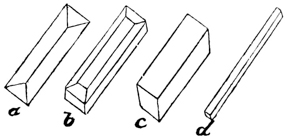
Cantharidin is a white, neutral substance, of which the formula according to Regnault is C10 H O4. Gmelin considers it of the nature of a solid volatile oil. As usually seen it has the form of minute flatted four-sided prisms (c,) much broken up, so as to appear like scales. When deposited from an ethereal solution of cantharides by slow evaporation, or from its solution in hot acetic acid by cooling, it assumes the form of flattened oblique four-sided prisms with dihedral summits, derived from the rectangular prism by the bevelment of its edges (see fig. a and b from c.) The crystals by slow sublimation are four-sided rectangular prisms of great brilliance and sometimes iridescent, c and d.
SOLUBILITY.—Pure cantharidin is insoluble in water, hot or cold. It is slightly soluble in cold alcohol, readily so when hot. Ether dissolves it to a greater extent, yet much more easily hot than cold. Chloroform is its best solvent, cold or hot, as shown in a former essay (Am. Jour. Pharm. vol. xxiii. 124,) and will remove it from the aqueous infusion of the flies. Acetic ether dissolves cantharidin, especially when hot, but does not retain much on cooling. When one part of cantharides is mixed with 20 parts of olive oil and heated to 250° Fahr. it is completely dissolved. As the solution cools, the cantharidin rapidly separates in shining needles in such quantity as {357} at first to give the oil a pulpy consistence. The clear cold oil retains sufficient to act as an efficient rubefacient but not as an epispastic. One part of cantharidin requires 70 parts of oil of turpentine to dissolve it at the boiling temperature, the greater part separating, as the solution cools, in long asbestos-like needles. A piece of paper saturated with the cold solution and applied to the skin under adhesive plaster did not vesicate. Acetone (from the distillation of acetate of lime) dissolves cantharidin with great readiness and ranks next to chloroform in this regard. The solution deposits the substance in crystals by evaporation. The commercial methylic alcohol or wood naphtha also dissolves cantharidin, but to a much less extent than acetone. When acetic acid sp. gr. 1.41 (U. S. P.,) is added to cantharidin, it but slightly acts on it in the cold; heat much increases its solvent power, which is lost on cooling and the substance deposited by standing, though not immediately. One part of cantharidin was mixed with 40 parts of crystallizable acetic acid and agitated together during five hours, but a small percentage was dissolved; but on applying heat the crystals were dissolved quickly. On standing, nearly all of the cantharidin was slowly deposited in regular crystals. To ascertain whether, as has been asserted,30 a combination was effected, and an acetate of cantharidin produced, an acetic solution of cantharidin was evaporated to dryness and the crystals mixed with strong sulphuric acid and heated till dissolved, while the nose was held near, without the slightest evidence of acetic odor; one twentieth of a grain of acetate of potassa was then added, which instantly evolved the well marked smell of acetic acid. Formic acid dissolves but a trace of cantharidin, cold or hot; and muriatic acid sp. gr. 1.18 hardly can be said to act on it in the cold, but when boiling a minute portion is taken up. The same is true of phosphoric acid dissolved in five parts water. Sulphuric acid sp. gr. 1.840, when heated readily dissolves pure cantharidin without being discolored, {358} and deposits it in crystals unchanged by cooling. Hot nitric acid sp. gr. 1.38, dissolves cantharidin readily, and deposits the greater part of it on cooling in brilliant crystals, unchanged. A concentrated solution of ammonia slowly dissolves cantharidin to a small extent, and yields it up on evaporation in crystals. Solutions of pottassa and of soda also dissolve this principle.
ITS VOLATILITY.—About ten grains of pure and perfectly dry cantharidin was spread on the pan of an Oertling’s balance, (sensitive to 1-150th of a grain,) and the equilibrium carefully adjusted with platina weights. After exposure for a week to the action of the air, a vessel of lime being present to keep the air dry, no change in the adjustment had occurred. To further test the volatility of cantharidin, a portion of it was put at the bottom of a dry test tube, through a paper funnel so as not to soil the sides, which was then fixed so as to dip half an inch in a mercurial bath having a thermometer suspended in it. It lost nothing appreciable after being kept at 212° F. for half an hour, no sublimate being visible with a lens. At 220° F. no visible effect was produced. Kept at 250° F. for twenty minutes, a very slow sublimation commenced. At 300° F. the vaporization was but slightly increased. The heat was then raised to 360° F., when the sublimation became more decided, yet still slow. Between 402° F. and 410° F. it fused, and rapidly sublimed at a few degrees higher. Cantharidin at this temperature volatilizes with great ease and condenses in beautiful well defined crystals like salicylic acid.
The specific gravity of cantharidin is considerable, as it sinks in nitric acid sp. gr. 1.38; it is exceedingly acrid; its powder applied to the skin with a little oil, produces speedy vesication, and taken internally it is an irritant poison of the most virulent kind.
Such are some of the more prominent characters of this remarkable substance, which exhibits a permanence and want of affinity extraordinary in an animal principle. Let us now see how far experiments with cantharidin as it exists in the flies in substance, correspond with its behaviour in an isolated state. {359}
1st. Is cantharidin, as it exists in Spanish flies, volatile at common temperatures, or at the temperature usually employed in making the cerate; and if so to what extent?
a. Six hundred grains of powdered cantharides were put into a quart flask, a pint of water poured on, and macerated two hours. The flask was then adapted to a glass tubulated receiver by means of a long glass tube, the joints made tight, and the tube refrigerated throughout its length by a current of cool water, the receiver itself being surrounded by water. A sand-bath heat was then applied and the materials in the flask kept boiling during several hours, until half a pint liquid had distilled. The product in the receiver was opalescent, with white particles floating through it, and had a strong odor of spanish flies. It was decanted into a bottle, and agitated repeatedly with half an ounce of chloroform, which dissolved the particles and removed the opalescence. The chloroform, when separated with a funnel, and evaporated spontaneously, yielded a colorless semi-crystalline residue, having a waxy consistence and a strong odor different from that of the flies. It fused at 120° Fahr., was volatile per se, but was partially decomposed and condensed in drops which subsequently solidified. This substance is soluble in alcohol, ether and chloroform, is decomposed and dissolved by sulphuric acid, produces no signs of vesication after forty-eight hours’ contact with the skin under adhesive plaster, and is most probably the same volatile principle that has been noticed by Orfila.
The long glass tube was then examined for a sublimate, by rinsing it thoroughly with chloroform, which, on evaporation, afforded more of the same substance obtained from the distilled water, and like it did not produce vesication.
This experiment shows conclusively that cantharidin does not volatilize to an appreciable extent with water evaporating from cantharides.
b. More water was added to the residue in the flask, again boiled for fifteen minutes and thrown on a displacing filter, and water added to the solid residue, after the decoction had {360} ceased to pass, until the absorbed liquid was displaced. The decoction was much less odorous than the distilled water, and had a deep reddish-brown color. Half of this was agitated repeatedly with chloroform. The latter decanted and evaporated yielded a crop of crystals intermixed with some coloring matter. A part of these heated in a tube over a lamp, gave immediately the brilliant crystaline sublimate of cantharidin well marked; another portion applied to the skin produced vesication in a few hours.
The other half of the decoction was evaporated to a soft extract by direct heat. This produced speedy and deep vesication, more effectual than that of pure cantharidin, as in the extract that principle was in a soluble state by virtue of the yellow matter of the flies.
c. The residual flies were then dried carefully and exhausted with ether, which assumed a deep green color. A green semi-fluid fatty oil was obtained by evaporation, from which a fluid yellow oil separated by standing, which produced a tardy vesication, not comparable with the aqueous extract.
d. One hundred grains of flies in powder were introduced into a test tube so as not to soil the sides. This was then kept at the temperature of 212° F. during six hours, by causing it to dip into a vessel of boiling water through a tin plate. The hygrometric water was removed as it condensed above. At the end of the experiment a minute deposit of microscopic crystals less than one thirtieth of a grain, was observed above the flies on the side of the tube.
e. Two hundred grains of flies were introduced into a two ounce retort, which they half filled, adapted to a two ounce receiver, and this again connected with a third vessel. The retort heated by a mercurial bath, was kept at 225° F., for two hours, without any product except a little odorous hygrometric water. The heat was then raised to 412° F., when a colorless oily matter flowed slowly into the receiver, mixed with water, whilst a crystalline matter mixed with oil collected in the neck. This crystalline matter mixed with the oil produced {361} vesication when applied to the skin. The heat was now rapidly increased so as to produce brown vapors, from which was condensed a dark colored empyreumatic oil, abundant crystals of an ammonical salt collected in the tubes and on the sides of the receiver, whilst the aqueous liquor in the receiver was strongly ammonical. Neither the dark oil nor the crystals produced vesication, the high temperature having probably decomposed the cantharidin.
From these experiments it must be admitted that cantharidin is less volatile than has been asserted. The effect produced on the eye of the pupil of Robiquet who was watching the crystallization of cantharidin during the evaporation of an ethereal solution, may be accounted for by the mechanical action of the dense ethereal vapor escaping near his eye, as he watched the process with a lens, carrying off some particles of cantharidin; and the readiness with which this principle may be brought mechanically in contact with the skin of the face, during a series of experiments, by want of care, will easily account for the occasional testimony of writers in favor of its volatility at low temperatures based on that kind of evidence. During the whole of the experiments detailed in this paper, the author has not experienced any inconvenience to his eyes or face except in two instances, once when decomposing cantharides by destructive distillation, during which some of the vapors escaped near his person, and again where a small capsule containing aqueous extract of cantharides was accidentally exposed to high temperature over a lamp so as to partially decompose it; he suffered slight pain for a few hours in the conjunctiva of both eyes.
It must also be admitted that the heat ordinarily employed in making the blistering cerate of the United States Pharmacopœia, does not injure the preparation by volatilizing the cantharidin, and that the recommendation to digest the flies in the melted vehicle on a water bath is not only not injurious, but decidedly advantageous, as it increases, many fold, the solvent power of the fatty matter. {362}
2d. Having ascertained the solvent powers of olive oil, oil of turpentine and acetic acid, on pure cantharidin, the following experiments were made with those menstrua, and with water, on the flies in substance:
a. One hundred grains of powdered cantharides were mixed with two hundred grains of olive oil in a large test tube, which was corked, and the mixture heated in a boiling water bath during four hours, with occasional agitation. The contents of the tube were then poured into a small glass displacement apparatus, surrounded with water kept hot by a lamp, and the saturated oil gradually displaced, without cooling, by the addition of fresh portions of oil. The oily liquid thus obtained had a deep green color, smelled strongly of the flies, and when applied to the skin produced full vesication in about twelve hours contact. After standing twenty-four hours shining needles of cantharidin gradually separated, but not in quantity.
b. One hundred grains of powdered flies were mixed with two hundred grains of pure oil of turpentine in a closed tube, heated in a boiling water bath four hours, and displaced while hot as in the preceding experiment. The terebinthinate solution had a dull yellow color, and was perfectly transparent as it passed, but in a short time numerous minute stellated crystals commenced forming, which increased in quantity by standing. The saturated cold solution, separated from the crystals after standing twenty-four hours, did not blister when applied to the skin.
c. One hundred grains of powdered flies were digested in a close vessel, at the temperature of boiling water, in three hundred grains of acetic acid sp. gr. 1.041, for six hours, and then subjected to displacement in the hot filter above noticed. A dark reddish-brown transparent liquid passed, which had very little odor of flies, even when a portion was exposed until the acetic acid had nearly all evaporated. A portion of this liquid applied to the skin produced complete vesication in about ten hours. After standing a few hours, numerous minute {363} granular crystals were deposited, which gradually increased in amount and size.
These three experiments prove that hot fatty matter is a good solvent for cantharidin as it exists in the flies, and that it retains more on cooling than either turpentine or acetic acid. That hot oil of turpentine is a good solvent for extracting cantharidin, although it does not retain much on cooling, and that officinal acetic acid at the temperature of 212° F. will remove cantharidin readily from Spanish flies, but retains but a part on cooling.
d. Five hundred grains of recently powdered flies, contained in a flask, were boiled in a pint of water, for an hour, and the clear decoction decanted, the residue again treated with half a pint of water, so as to remove all matter soluble in that liquid. The decoctions were mixed, filtered, and evaporated carefully to dryness. The extract was exhausted by repeated treatment with boiling alcohol, which left a dark colored pulpy matter, very soluble in water, from which it is precipitated by subacetate of lead. The alcoholic solution was now evaporated to a syrup, and on cooling yielded a yellow extract like mass, interspersed with numerous minute four-sided prisms. By washing a portion with water, the yellow matter was removed, leaving the crystals white and pure. The aqueous washings yielded by evaporation a residue of crystals, and does not vesicate. When the alcoholic extract was treated with chloroform the crystals were dissolved, and the yellow matter left. On evaporating the chloroform solution the crystals were re-obtained with all the characters of cantharidin. The matter left by chloroform was now treated with water, in which it dissolved, except a trace of dark substance, and was again evaporated carefully. It afforded a yellow honey-like residue, thickly interspersed with crystals and strongly acid to litmus, without vesicating power.
A portion of the yellow matter separated from the alcoholic extract by water was boiled with some cantharidin, filtered and evaporated. The residue treated with chloroform afforded no {364} cantharidin; hence it would appear that although the yellow matter enables the cantharidin to dissolve in water and cold alcohol, when once separated its solvent power ceases.
Having now studied the effects of the ordinary solvents on cantharidin in a free state, and in the condition in which it exists in the insect, we are prepared to consider with some clearness, the pharmaceutical preparations of the Spanish fly, and their action as vesicants.
a. If 1-30th of a grain of pure cantharidin, in fine powder, be placed on the skin of the arm and covered with a piece of warmed adhesive plaster, active vesication occurs in eight hours, with pain. If the same quantity of cantharidin be put on the other arm, a small piece of paper be laid over it, and then a piece of adhesive plaster with a circular hole in it be applied, so as to hold on the paper, no vesication occurs in sixteen hours, the powder remaining dry. If then a large piece of plaster be put over the whole, at the end of eight hours more no blistering action will have taken place. If now a trace of olive oil be applied to the back of the paper covering the cantharidin, and the plaster replaced, speedy vesication will occur. These experiments prove that cantharidin must be in solution to have its vesicating action, and that oily matter is a proper medium.
b. When powdered flies are stirred into the ordinary vehicle of resin, wax, and lard, so as to chill it almost immediately as was formerly directed, but little of the cantharidin is dissolved by the fatty matter, and when applied to the skin the process of vesication is retarded. If, however, the cerate be kept fluid for a length of time, say for half an hour, by a water-bath or other regular heat, no loss of cantharidin occurs by the heat, the active principle is in a great measure dissolved by the fat, and every part is impregnated and active. In the foregoing experiments it has been shown that twenty parts of olive oil will dissolve one of cantharidin when hot. If we admit with Thierry that cantharides contain but four thousandths of their weight of cantharidin, the quantity contained in a {365} pound of cerate is about eight grains, whilst the lard in the same weight of cerate is 1600 grains, or two hundred times the weight of that principle, not to speak of the influence of the wax and resin, which, in union, with the melted lard, act as solvents. Hence the whole of the cantharidin may be dissolved by the vehicle. Another advantage of employing a continued heat in digestion is the removal of the hygrometric water from the flies, which is the source of the mouldiness to which the cerate is prone in certain conditions.
In a former essay (Amer. Journ. Pharm., vol. xiii, p. 302,) I have advocated digestion in making this cerate, (a recommendation also made by Mr. Donovan, of Dublin, about the same time,) and also the use of a portion of the oil of turpentine to facilitate the solution of the cantharidin, but the foregoing experiments prove that fatty matter is quite as good, if not a better solvent alone than with turpentine.
c. It has been asserted long ago by Beaupoil, Robiquet and others, that water will perfectly extract the active matter from Spanish flies, which these experiments corroborate. Hence it is easy to understand how the condensed perspiration may facilitate the action of a blister, especially when, as was formerly much the case, its surface is coated with the dust of the flies, and the skin moistened.
It is also clear why the Unguentum Cantharidis of the United States Pharmacopœia is active although made with a decoction of flies, yet, in this preparation, care should be observed not to evaporate all the water, as on the existence of the aqueous extract in a soft state depends much of the efficiency of the preparation as an irritant dressing.
d. In the Linimentum Cantharidis, United States Pharm., in which an ounce of flies is digested in eight fluid ounces of oil of turpentine, the cantharidin is to be the menstruum as 1 to 1500, a proportion probably quite sufficient to retain it in solution. The importance of the officinal direction to digest is evident. It is quite doubtful whether this liniment, as made by the process of Dr. Joseph Hartshorne, one part of flies to {366} three parts of oil, will retain all the cantharidin after standing awhile.
e. The Acetum Cantharidis, (Lond. Ph.) made by macerating an ounce of flies in ten fluid ounces of acetic acid, 1.48, has been criticised by Mr. Redwood, (Pharm. Journal, Oct. 1841,) who arrived at the conclusion that it owed its vesicating power almost solely to the acid, he not being able to discover cantharidin in it. The inefficiency of cold acetic acid as a solvent for pure cantharidin has been proven by the above experiments, and its efficiency when hot equally shown. There can be little doubt that the London preparation would be much improved by digesting the flies in the acid for an hour in a close glass vessel at the temperature of boiling water.
f. The cantharidal collodion of M. Ilisch has been considerably used as a vesicant in this country. Ether being a good solvent for cantharidin readily keeps that principle in solution. When applied to the skin, the escape of the ether leaves a coating of ethereal extract of cantharides, admixed with collodion. This preparation sometimes fails from a deficiency of cantharidin, at other times from want of a sufficient body in the collodion excipient, and it has been found more advantageous to treat the cantharides with ether till exhausted, distill off the ether, and add the oily residue to collodion of the proper consistence. The addition of a little olive oil, and of Venice turpentine, as recommended by Mr. Rand, will give more activity to the preparation, especially if a piece of oiled silk or adhesive plaster be applied over the part.
g. Besides these, many other epispastic preparations are made in France and other countries. The acetic alcoholic extract of cantharides of Ferrari is made by digesting four parts of cantharides in sixteen parts of alcohol 36° B. mixed with one part of acetic acid 10° B. In the opinion of the author, the acetic acid tends to prevent the crystallization of the cantharidin, a statement rendered doubtful by the above experiments, as that principle separates in crystals from an acetic solution of cantharides. The alcohol dissolves the green oil {367} which gives to the extract a butyraceous consistence. This is undoubtedly an efficient preparation, and is used by spreading it on paper with a brush, and applying to the skin. Nearly all the French preparations direct digestion of from 2 to 6 hours, showing evidently that the experience of pharmaceutists is opposed to the opinion that cantharides is “a very volatile substance, even at common temperatures.”
The vesicating tafeta of the Codex, is that proposed by Messrs. Henry & Guibourt, and is made by fusing together one part of the ethereal extract of cantharides and two of wax, and spreading it on waxed paper or linen in the manner of adhesive plaster. This preparation is said to lose its efficiency by exposure to the air. How can this occur in view of the results which have been detailed above? admitting the fact, it is not probable that the change lies in the strong tendency of the cantharidin to separate in crystals? a change easily observable in the ethereal extract. This is the chief objection to some otherwise excellent preparations of cantharides for vesication, and it is far more probably the true explanation, than, that volatility should be the cause.
The recently prepared and soft aqueous extract of cantharides has been shown to be a powerful epispastic. Will this extract of the consistence of honey, associated with sufficient acetic acid, alcohol, or acetone, to preserve it, keep without the gradual separation of the cantharidin? If so, it will undoubtedly prove one of the very best blistering agents, as by simply applying a covering of it over the surface of waxed paper, or adhesive plaster, with a camel’s-hair brush, a perfect blistering plaster can be made quickly and neatly, and all tendency to change of aggregation by the action of the air on the menstruum avoided. This is a question now under trial, and should it result favorably, a formula will be published. The extraordinary tendency of cantharidin to crystallize, even under the most adverse circumstances, taken in connection with its insolubility, per se, has hardly received sufficient attention from pharmaceutists as a cause of the deterioration of {368} cantharidal preparations, and the discovery of a menstruum, that will retain that principle in solution for an indefinite period, is a problem yet to be solved, and worthy the attention of pharmaceutical investigators.
Philadelphia, September, 1852.
ON GELSEMINUM SEMPERVIRENS OR YELLOW JASSAMIN. BY WILLIAM PROCTER, JR.
Considerable attention has recently been turned to the Yellow Jassamin of our Southern States, from the accidental discovery of certain remarkable effects produced by it when taken internally. A planter of Mississippi having suffered much from a tedious attack of bilious fever, which resisted the usual medicines employed in such cases, requested one of his servants to obtain from the garden a certain root, from which he intended to prepare an infusion for drinking. By mistake, the person sent collected a different root, and administered the tea to his master, who, soon after taking it, was seized with a complete loss of muscular power, being, in fact, so completely prostrated as to be unable to move a limb or to raise the eyelids, yet he could hear, and could appreciate what was occurring around him. After some hours, during which his friends were watching him with much anxiety and little hope, he gradually recovered his muscular control, and was astonished to find that the fever had left him. Having ascertained from his servant what plant he had collected, he subsequently employed it successfully on his own plantation as well as among his neighbors. The history becoming known to a quackish physician, he prepared from it a nostrum called the “Electrical Febrifuge,” in {369} which, it was disguised by oil of winter-green, (Eclectic Dispensatory, page 186.)
The Gelseminum is not noticed by Dr. Griffith in his Medical Botany, nor in the recent edition of the United States Dispensatory, and so far appears to have been used chiefly by the “Eclectic” practitioners of Cincinnati and other parts of the Western States. The accompanying description of the plant is taken partly from a specimen sent from Memphis, Tennessee, where, in common with other parts of the south-western States, it is cultivated as an ornamental garden plant.
The Gelseminum belongs to the natural order Apocyneæ, so remarkable for the great activity of many of its genera, and the name of the genus, given by Jussieu, is one of the ancient names of the jessamine, and that of the species arises from its evergreen foliage.
GELSEMINUM belongs to Pentandria Digynia of Linnæus, and to the natural order Apocyneæ of Jussieu.
Generic characters.—Regular, calyx five parted, (the sepals of this species being furnished with bract-like appendages) carolla funnel-form, border spreading, five lobed, nearly equal, capsule compressed, flat, two partible, two-celled, seeds flat and attached to the margins of the valves, (Eaton.)
Specific characters.—The G. sempervirens is known at the South under the names yellow jasmine, wild jasmine, and woodbine. In Florida it flowers in March, and in Mississippi and Tennessee in May and June. Its stem is twining, smooth and glabrous; its leaves are opposite, perennial, lanceolate, entire, dark green above, paler beneath; with short petioles. The flowers, which are esteemed poisonous, are yellow, about an inch long and half an inch wide at the top, of a fine yellow color, and have an agreeable odor, which perfumes the air when they bloom. It grows luxuriantly, climbing from tree to tree, forming a delightful shade. According to Eaton, from whose botany we glean part of the above botanical notice, there is a variety called inodorum which has scentless flowers.
The Gelseminum is indigenous to the Southern States, and its beauty has caused its introduction into the gardens. {370}
Medical properties and uses.—The root is the part used, and the tincture is the preparation most usually employed, and, as made, must be a saturated tincture. The roots, in a green state, well bruised, are introduced into a suitable vessel, and covered with whiskey, or diluted alcohol. After standing two weeks, the tincture is separated by expression and filtered. It has a dark red color, and a pleasant bitter taste. The dose is from ten to fifty drops. The following account of its medical properties and effects is taken from a paper in the “Eclectic Medical Journal,” August, 1852, page 353, by F. D. Hill of Cincinnati:
“Gelseminum is stimulant, tonic, and anti-spasmodic. By its relaxing effect it produces gentle diaphoresis, and is said to be narcotic. Its effect in large doses, or doses too frequently repeated, is extreme relaxation, and general prostration of the whole muscular and nervous system. It will suspend and hold in check muscular irritability and nervous excitement with more force and power than any known remedy. It is of a pleasant bitter taste, and performs its wonder-working cures, in all febrile diseases, without exciting either nausea, vomiting, or purging. When enough has been given to produce its specific effect, the eye is dimmed, the vision clouded and double, the head light and dizzy. When these effects follow the administration of this remedy, no more should be given until the patient has entirely recovered from its influence. ‘It maybe used in all species of fevers, nervous and bilious headache, colds, pneumonia, hemorrhages, leucorrhea, chorea, ague-cake, asthma, and many other diseases: but its efficacy has been most admired in all forms and grades of fevers.’ It should always be used with great care and caution. The root is said to possess a resinous principle, which, when extracted by pure alcohol, will produce death in very small doses. But no such effect need be expected from the proper dose of the common tincture. There is danger of carrying it to such an extent as to suspend involuntary muscular action, and when this is the case, death must ensue. ‘It is incompatible with no known substance, and may follow any preceeding treatment with perfect safety.’ The dose is forty drops for an adult, and children in proportion to age and temperament. It is given either with or without quinine. It has been used alone for chronic rheumatism, in doses of forty drops, three times a day, with marked effects. Three or four doses, with a mild cathartic, will remove the redness and swelling attending inflamed sore eyes. Special attention should be directed to the general health and constitution of the patient before giving gelseminum. If the bowels be constipated they should be moved by a gentle aperient, and kept in a relaxed condition. It requires double the quantity to produce the effect on some that it does on others; and should the practitioner ever produce too great a degree of relaxation, he should lose no time in stimulating and toning up his patient.” {371}
The alleged effects of this plant on the human system, taken in connection with its medico-botanical relations, mark it out as being probably one of the most valuable of our indigenous remedial agents, and render it well worthy of the investigation of regular physicians.
ON THE MANUFACTURE OF WRITING INKS. (Concluded from page 316.)
Prussian blue, that has not undergone digestion in acid in the way above pointed out, will require a much larger proportion of oxalic acid, from twice to three times its weight; and even then it will be greatly liable to precipitation after standing; but when treated in the way described, it is not liable to precipitate, but remains a permanent solution.
STEPHENS’ RED INK.—Stephens’ red ink is prepared as follows:—Take a quantity of common soda, potash or carbonate of ammonia, to which is to be added, at intervals, twice its weight of crude argol in powder.
When the effervescence, arising from this combination, has ceased, pour off the solution, or filter it from the insoluble matter; to this, add by measure half the quantity of oxalate of alumina, or oxalo-phosphate of alumina, prepared by adding to precipitated alumina or phosphate of alumina, in a damp state, as much oxalic acid as will dissolve. Into this mixture, put, when cold, as much cochineal, first bruised or powdered, as will give it a fine red color, varying the quantity according to the shade of color required; and after letting it stand for the space of forty eight hours, strain it off for use.
PROFESSOR RUNGE’S WRITING FLUID.—One of the least expensive formulas for the manufacture of a writing ink, is that given by Professor Runge, who says: “I have for some time {372} endeavored to find a black fluid possessing the properties of forming no deposit, of adhering strongly to the paper, of being unaffected by acids, and lastly, what is of great importance, not acted upon by steel pens.
“After many experiments, I have succeeded in obtaining a composition of the kind required, very simple in its preparation, containing nothing but logwood, chromate of potash, and water, and free from vinegar, gum, copperas, blue vitriol, and even nutgalls. The low price of this writing fluid is also in its favor. It is prepared by simply adding one part of chromate of potash to 1000 parts of decoction of logwood, made by boiling twenty-two pounds of logwood in a sufficient quantity of water to give fourteen gallons of decoction; to this decoction, when cold, the chromic salt is gradually added, and the mixture well stirred. The addition of gum is injurious. In the preparation of this ink, it must be remembered that the yellow chromate and not the bi-carbonate of potash is employed, and great care is required to ensure due adjustment of the relative proportions of the ingredients used. The best way is to make a decoction of logwood, and gradually add to it, well stirring the mixture, as much solution of chromate as will give the shade required.
“It appears astonishing what a small quantity of the chrome salt is required to convert a large quantity of decoction of logwood into a black writing fluid; the fact is however certain, and care must be taken not to allow the proportion of chrome salt to exceed half a part for each 500 parts of decoction of logwood, as a larger quantity exercises a prejudicial effect in destroying the coloring matter of the liquid, whilst in the proportion above mentioned, a deep blue black writing ink is formed, which, unlike the ink made with tannogallate of iron, is perfectly fluid, forming no deposit. This writing fluid possesses another advantage; the paper which has been written upon with it may be washed with a sponge, or be left twenty-four hours under water, without the writing being effaced. Weak acids do not destroy the writing, nor do they even change the {373} shade, whilst that made with gallnuts is effaced, and the ink prepared with logwood and copperas is turned red.
“New steel pens are coated with a greasy substance, which prevents the ready flow of the ink; this should, therefore, be removed previous to use by moistening the pens with saliva, and then washing them in water. The application of an alkaline solution is still preferable to remove this greasy matter. The cleansing of the steel pens is absolutely essential in the case of using the ink above mentioned. I have used this ink upwards of two years, and my steel pens are not in the least degree affected. No rust is formed on the pens, so that after years of service the only wear experienced is that from constant use on the paper, thus rendering unnecessary the use of pens tipped with iridium and other hard substances.”
ON THE GROWTH OF VARIOUS KINDS OF MOULD IN SYRUP.
Professor Balfour, the Professor of Botany in the University of Edinburgh, has read a valuable paper on this subject, at the Botanical Society in that city, in which he states that mould of various kinds, when placed in syrup, has a tendency to spread out and form a flat, gelatinous, and leathery expansion. This he shows by experiments, as follows:—Mould that had grown upon an apple was put into syrup; and in the course of two months there was formed upon the syrup a cellular, flat, expanded mass, while the syrup was converted into vinegar.
Mould that had grown upon a pear was also put into syrup, and the same result was produced. He also experimented in the same manner with various moulds that were growing upon bread, tea, and some other vegetable substances; the effect {374} produced, in most cases, was to cause a fermentation, resulting in the production of vinegar. In another experiment, a quantity of raw sugar, treacle, and water, were put into a jar, without any mould being introduced. When examined, after a lapse of four or five months, a growth like that of the vinegar plant was visible, and vinegar was formed. This plant was removed, and put into fresh syrup, which was followed again by the production of vinegar. It appears that, when purified white sugar only is used to make syrup, the plant, when placed in it, does not produce vinegar so speedily; the length of time required for the changes varying from four to six months. Dr. Balfour thinks this may possibly be owing, to the presence of some ingredient in the raw sugar and treacle, which may tend to promote the production of vinegar.
In connection with this subject, I may refer to the Vinegar Plant, which is considered by some eminent botanists to be an unnatural and peculiar form of some fungus. This plant, which has a tough gelatinous consistence, when put into a mixture of treacle, sugar and water, gives rise to an acetous fermentation. The vinegar, which is the result of this acetous fermentation, is of a syrupy nature; and when evaporated to dryness, a large quantity of saccharine matter is left. Various conjectures have been hazarded as to the origin of this vinegar plant; some stating that it came from South America, or other distant regions; and others that it is a spontaneous production. Dr. Lindley is of opinion that it is a peculiar form of penicillum glaucum, or common blue-mould. The general opinion appears to be, that it is in an anomalous state of mould, or of some fungus: and the peculiar form and consistence it assumes on different occasions, seems to depend upon the nature of the material in, or upon which, it makes its appearance.
{375}
CONSTITUTION OF THE AMERICAN PHARMACEUTICAL ASSOCIATION.
Whereas, The advancement of pharmaceutical knowledge and the elevation of the professional character of apothecaries and druggists throughout the United States are objects that are dear to us in common with all well disposed pharmaceutists; and, whereas, a large portion of those in whose hands the practice of pharmacy now exists, are not properly qualified for the responsible offices it involves, chiefly by reason of the many difficulties that impede the acquirement of a correct knowledge of their business;―
Therefore, We, the members of a Convention now met at Philadelphia, composed of apothecaries and druggists from different sections of the Union, and from all the Colleges and Societies therein existing, with the object of deliberating on the condition of our profession, do hereby resolve and constitute ourselves into a permanent asociation, to meet annually at such times and places as may hereafter be determined, for more effectually accomplishing the objects for which we are now assembled; and do now adopt the following CONSTITUTION:
SECTION 1.
This association shall be called “The American Pharmaceutical Association.”
SECTION 2. Of the Members.
Article I. All pharmaceutists and druggists who shall have attained the age of twenty-one years, whose character, morally and professionally, is fair, and who, after duly considering the obligations of the Constitution and Code of Ethics of this Association are willing to subscribe to them, shall be eligible for membership.
Article II. The members shall consist of delegates from regularly constituted Colleges of Pharmacy, and Pharmaceutical Societies, who shall present properly authorized credentials, and of other reputable Pharmaceutists feeling an interest in the objects of the Association, who may not be so delegated, the latter being required to present a certificate signed by a majority of the delegates from the places whence they come. If no such delegates are present at the Association, they may, on obtaining the certificates of any three members of the {376} Association, be admitted, provided they be introduced by the committee on credentials.
Article III. All persons who become members of this Association shall be considered as permanent members, but may be expelled for improper conduct by a vote of two thirds of the members present at any annual meeting.
Article IV. Every member in attendance at the annual meetings shall pay into the hands of the Treasurer the sum of two dollars as his yearly contribution.
Article V. Every local Pharmaceutical Association shall be entitled to five delegates.
SECTION III. Of the Officers.
The officers of this association shall be a President, three Vice Presidents, a Recording Secretary, a Corresponding Secretary, a Treasurer, and an Executive Committee of three, which may include any of the members except the President, all of whom shall be elected annually.
Article I. The President shall preside at the meetings and preserve order. He shall nominate all committees, except a majority of the members present direct a resort to balloting or other means. He shall sign all certificates of membership, approve of all foreign correspondence, and countersign all orders on the Treasurer drawn by the Executive Committee. And he shall, at least three months previously to the annual meeting publish a call in all the pharmaceutical and in such medical and other Journals as he may select, stating therein the objects of the Association, and the conditions of membership.
Article II. In case of the temporary absence, or inability of the President, his duties shall devolve on one of the Vice Presidents.
Article III. The Recording Secretary shall keep fair and correct minutes of the proceedings of the Association. He shall keep a roll book of the members, and see that it is corrected annually, and he shall furnish to the Executive Committee a correct transcript of the minutes of the meeting for publication in the Transactions of the Association.
Article IV. The Corresponding Secretary shall attend to the official correspondence directed by the association with other bodies, or with its members, all of which correspondence shall be approved by the President. {377}
Article V. The Treasurer shall receive and take care of the funds of the Association; shall pay its money only on the order of the Executive Committee, countersigned by the President; and shall present a statement of his accounts annually that they may be audited.
Article VI. The Executive Committee shall take charge of the publication of the proceedings of the Association, including such papers on scientific subjects as it may direct to be published; attend to their distribution; pay the expenses incurred on behalf of the Association at its meetings or in the interim, and report a statement of their transactions to the next meeting.
SECTION IV. Of the Meetings.
Article I. The meetings shall be held annually, at such time and place as shall be determined at the adjournment of the previous meeting, observing that no two meetings shall be held consecutively at the same place.
Article II. The meetings shall be organized by the President of the previous year, or, in his absence, by either of the Vice Presidents in the order of their election, or, in their absence, by the Recording Secretary, who shall act pro tempore until the nomination and election of officers for the session.
Article III. Immediately after the temporary organization of the Association the roll shall be called, when a committee on credentials shall be appointed from the members present, to whom the certificates of delegates shall be submitted, and who shall examine the claims of all other applicants for membership before they are submitted to the Association.
SECTION V.
This Constitution may be altered or amended by a vote of three-fourths of the members present at any regular meeting, and notice to alter or amend the same shall be given at least one sitting before a vote thereupon.
{378}
CODE OF ETHICS OF THE AMERICAN PHARMACEUTICAL ASSOCIATION.
The American Pharmaceutical Association, composed of Pharmaceutists and Druggists throughout the United States, feeling a strong interest in the success and advancement of their profession in its practical and scientific relations, and also impressed with the belief that no amount of knowledge and skill will protect themselves and the public from the ill effects of an undue competition, and the temptations to gain at the expense of quality, unless they are upheld by high moral obligations in the path of duty, have subscribed to the following Code of Ethics for the government of their professional conduct.
ART. I. As the practice of pharmacy can only become uniform by an open and candid intercourse being kept up between apothecaries and druggists among themselves and each other, by the adoption of the National Pharmacopœia as a guide in the preparation of officinal medicines, by the discontinuance of secret formulæ and the practices arising from a quackish spirit, and by an encouragement of that esprit du corps which will prevent a resort to those disreputable practices arising out of an injurious and wicked competition;—Therefore, the members of this Association agree to uphold the use of the Pharmacopœia in their practice; to cultivate brotherly feeling among the members, and to discountenance quackery and dishonorable competition in their business.
ART. II. As labor should have its just reward, and as the skill, knowledge and responsibility required in the practice of pharmacy are great, the remuneration of the pharmaceutist’s services should be proportioned to these, rather than to the market value of preparations vended. The rate of charges will necessarily vary with geographical position, municipal location, and other circumstances of a permanent character, but a resort to intentional and unnecessary reduction in the rate of charges among apothecaries, with a view to gaining at the expense of their brethren, is strongly discountenanced by this Association as productive of evil results.
ART. III. The first duty of the apothecary, after duly preparing himself for his profession, being to procure good drugs and prepartions, (for without these his skill and knowledge are of small avail,) he frequently has to rely on the good faith of the druggists for their selection. {379} Those druggists whose knowledge, skill and integrity enable them to conduct their business faithfully, should be encouraged, rather than those who base their claims to patronage on the cheapness of their articles solely. When accidentally or otherwise, a deteriorated, or adulterated drug or medicine is sent to the apothecary, he should invariably return it to the druggist, with a statement of its defects. What is too frequently considered as a mere error of trade on the part of the druggist becomes a highly culpable act when countenanced by the apothecary; hence, when repetitions of such frauds occur, they should be exposed for the benefit of the profession. A careful but firm pursuit of this course would render well-disposed druggists more careful, and deter the fraudulently inclined from a resort to their disreputable practices.
ART. IV. As the practice of pharmacy is quite distinct from the practice of medicine, and has been found to flourish in proportion as its practitioners have confined their attention to its requirements; and as the conducting of the business of both professions by the same individual involves pecuniary temptations which are often not compatible with a conscientious discharge of duty; we consider that the members of this Association should discountenance all such professional amalgamation; and in conducting business at the counter, should avoid prescribing for diseases when practicable, referring applicants for medical advice to the physician. We hold it as unprofessional and highly reprehensible for apothecaries to allow any per centage or commission to physicians on their prescriptions, as unjust to the public, and hurtful to the independence and self-respect of both parties concerned. We also consider that the practice of some physicians, (in places where good apothecaries are numerous) of obtaining medicines at low prices from the latter, and selling them to their patients, is not only unjust and unprofessional, but deserving the censure of all high-minded medical men.
ART. V. The important influence exerted on the practice of pharmacy by the large proportion of physicians who have resigned its duties and emoluments to the apothecary, are reasons why he should seek their favorable opinion and cultivate their friendship, by earnest endeavors to furnish their patients with pure and well-prepared medicines. As physicians are liable to commit errors in writing their prescriptions, involving serious consequences to health and reputation if {380} permitted to leave the shop, the apothecary should always, when he deems an error has been made, consult the physician before proceeding; yet in the delay which must necessarily occur, it is his duty, when possible, to accomplish the interview without compromising the reputation of the physician. On the other hand, when apothecaries commit errors involving ill consequences, the physician, knowing the constant liability to error, should feel bound to screen them from undue censure, unless the result of a culpable negligence.
ART. VI. As we owe a debt of gratitude to our predecessors for the researches and observations which have so far advanced our scientific art, we hold that every apothecary and druggist is bound to contribute his mite towards the same fund, by noting the new ideas and phenomena which may occur in the course of his business, and publishing them, when of sufficient consequence, for the benefit of the profession.
VARIA—EDITORIAL.
THE JOURNAL.
—With the present number, the first volume of the Journal is completed. In a pecuniary point of view its success has fully equalled the expectations of its originators; it is no longer an experiment, but is established on a firm basis, and will be continued with increased energy and a larger experience in the art of journalism. We have tried to keep faithfully in view the objects with which the Journal was commenced; while we have endeavored to present to our readers whatever of general interest or importance has been published abroad, we have the gratification to believe that some contributions to the general stock have first appeared in our pages which would otherwise never have seen the light. But those who confine the benefit of a journal solely to the information it imparts have but a limited view of its usefulness; an account of what is done abroad excites but little emulation compared with far humbler efforts made by our own friends, and in our own neighborhood, and the encouragement and promotion of such efforts is a large good, quite independent of the results that may be attained. The mere attempt to write on a subject like scientific pharmacy leads to a close scanning of the foundation of our opinions, to renewed experiments to ascertain their justness, to more enlightened views of the connection and bearing of our science. In this way we hope to see the good done by the
{381}
Journal greatly increased. The contributors to its pages have hitherto been but few in number, but its columns are open to all. They are controlled by no clique, are subservient to no views of merely personal advancement, and we will gladly, welcome communications from all quarters, judging of them only by their merit and usefulness.
THE DRUG INSPECTION LAW.
We had intended to have made some remarks on the debate which took place in the Convention regarding the admission of certain articles, under the law for the inspection of imported drugs, which, though possessing medicinal properties are, we believe, merely used for the purpose of adulterating other and better articles, but willingly give place to the subjoined communication from Dr. Guthrie, which, on the whole, advocates views similar to our own. With regard to the Carthagena barks, as they are termed, we confess to a desire for further information. Those barks vary very much from each other. Though not rich in quinia, some of them contain a large per centage of alkaloids, which are closely allied to it. We hope that the committee to whom the subject was referred by the Convention will not only cause proper analyses to be made of the commercial varieties of these barks, but will have experiments instituted regarding their comparative therapeutic value. The Hospitals of our country afford abundant cases of malarious disease, and, we have no doubt, the physicians attached to them would be ready to institute trials which would afford a satisfactory solution to this important question.
GEO. D. GOGGESHALL,
My Dear Sir,—The proceedings of the National Pharmaceutical Convention have just come to hand, and been perused by me, with no ordinary degree of interest.
You have known somewhat of my anxiety concerning these preliminary and forming stages of an Association of this character, and will readily believe that I have awaited the results of the late Convention, from which, most unfortunately for myself, I was compelled to be absent, with great solicitude. That solicitude has been relieved, and in its stead I have the assurance that a good foundation to a National structure has been laid, towards which hope points and expectation looks with joyous anticipations of future good.
I may be permitted to congratulate you upon the successful labors of the convention, and more especially upon the fact that you have avoided any untenable false ground both in the convention and organization of the Association.
That old stumbling block of “all drugs good of their kind,” in reference to our Drug Law, I see made its appearance again, but this time from a quarter I {382} little expected. But it had, notwithstanding its new paternity and eminent godfathership, only, so far as I can see, the same lame, diffuse and weak conclusions to back it.
I was the more surprised at seeing the resolution in the form offered as coming from my friend Dr. Stewart, of Baltimore, because I had considered him as one who held entirely opposite opinions, and from this fact, that in a communication made to me in January last, as special agent of the Treasury Department, charged with the examination of the practical workings of the Drug Law, he says, “I have inspected several hundred thousand dollars worth of one drug which requires some particular notice, as I understand your views and mine correspond with regard to it, and you have succeeded in arranging a uniform system of examination at the different ports.
The prominent principles upon which its value is based vary from about one to four per cent. The commercial article of the best varieties is graduated by the quantity of valuable element above referred to, but with regard to the inferior kinds this is not the case, as I have found upon repeated analyses that what are called bastard varieties (which are not used for extracting the valuable principles above referred to) sell at higher prices in proportion to their resemblance to the officinal kinds. Even in cases where they contain no valuable medicinal constituents they are invoiced at 3 to 4 times the price of the other varieties on board the same vessel containing 3 per cent. Now if our object in this law is to discourage the introduction of those articles that are used for the purpose of adulterating medicines, it is manifest that the true interest of all will be served by admitting those only of the bastard varieties that are equal to the inferior officinal varieties, particularly as they happen to be at a lower cost and are very abundant.” This is Dr. Stewart, Jan. 9, 1852. The whole of his report to me, a very interesting and able document, I intend publishing, and have delayed it for the purpose of accompanying it with some other matter of the same nature, not yet in hand.
If I understand him correctly, he took entirely opposite ground in the Convention, and I certainly shall look with no ordinary interest for some explanation of a change so entire, in one whose position and well earned reputation give him importance and great influence in the final settlement of this matter. What new light has shone upon his path? What new facts has he to offer? I say final settlement, because I see by the appointment of a committee to whom the matter was referred, that the whole subject is but laid over. Although the convention negatived the resolution, as it did a similar one a year ago in New York, they seem disposed to endow the question with as many lives as are fabled of the cat.
Notwithstanding all the reasoning of the author of the resolution, backed by the eminent professor, and aided by other reasons, thick no doubt as blackberries, you practical men who buy and sell these articles, were not convinced and never will be. They may cry out for “tooth powder,” until the demand for dentrifice shall quadruple, and tell us of the legitimate use of Carthagena or Maracaibo barks; (what is its legitimate use?) all in vain, for it is too well {383} known that the main use of the article is to adulterate the genuine barks. Why does the Drug examiner at Baltimore, Dr. Stewart, say that the “bastard varieties sell at higher prices in proportion to their resemblance to the officinal kinds?” Why this demand for such as resemble the genuine, but to supply it to the buyers of Peruvian bark for the genuine and officinal. There can be no other conclusion. If more proof is wanting I take the remark of the gentleman from New-York, that the “house he was connected with sold large quantities in powder, and the parties purchasing did so knowing its origin.” No one could doubt this statement, at least as to the quantity annually purchased, who will go through half-a-dozen drug stores in any of the country villages or small towns any where in our country from Maine to Louisiana.
He will have offered prime, best quality cinchona bark for 40 to 100 cents almost any where, and in one half the cases the venders believe they are selling what they offer, for they bought it for that. Is this not so, or is it all bought for “tooth powder?” One half the druggists who go to our large cities, buy “pale yellow” and red bark, and never think to enquire for the inferior barks, and once drive these last from our seaboard cities, and we shall have done with them.
You are aware that I have had some opportunity of becoming acquainted with the drug trade of our country, and I assure you that throughout its length and breadth there is more worthless Peruvian bark sold and consumed by far than of the genuine, mostly, I hope through ignorance, but many times knowingly on the part of the dealer.
The same that has been said of these false barks, may be said of English rhubarb; when it is not sold for and in the place of Turkey, it is used to make powdered Turkey out of. But the resolution does not stop short at these two articles, as the discussion seemed to. There is “false jalap” undoubtedly good of its kind, but unfortunately for the buyer the kind is good for nothing, although it makes extract of jalap, that in looks cannot be told from the genuine.
There is also Egyptian opium, and a false Sarsaparilla and many other important drugs, that should have received the attention of the friends of this resolution, all of which, I beg to assure them, are undoubtedly good of their kind.
But I have written more than I designed by far, as the subject grows upon my hands, though I regard it a very important one, and vitally so to the drug law which lies at the very foundation of all beneficial results to grow out of this association, and the position of the association as to the whole subject is equally important, for if we unfortunately commit ourselves to a wrong principle in the start, and especially upon this standard of purity as applicable to our Drug examiners, which is now regarded as a test question by the community at large, we lose all hold upon their confidence, and with it all hope of effecting any good either to ourselves as a profession or to the community in general.
My chief object in addressing you this communication (intended for the New York Journal of Pharmacy, if you choose so to use it) is to record my experience as differing in toto from those of Dr. Stewart and Prof. Carson, and to elicit a full discussion of the whole matter. Let us have light! light! light enough to {384} settle this question, especially about the barks, for they are the source of this whole contention after all. There must be data enough to be had, upon which to form an opinion, and a correct one as to the medicinal virtues of Maracaibo, and Carthagena barks, as well as of English rhubarb, false jalap, Egyptian opium etc., etc.
I shall be perfectly satisfied if the labors of this committee result in fixing a definite standard of strength, or amount of alkaloids required to be found in barks before consumed for medicine, and therefore admissible under the act, but satisfied at nothing short of this, for till that is done there will never be any uniformity in the action of the law. I had designed to make some remarks upon the requirements of the law and its needed emendation which I must defer to more leisure.
Yours, etc., C. B. GUTHRIE.
Memphis, Tenn., November 2, 1852.
A DISCOURSE ON THE TIMES, CHARACTER AND WRITINGS OF HIPPOCRATES, READ BEFORE THE TRUSTEES, FACULTY AND MEDICAL CLASS OF THE COLLEGE OF PHYSICIANS AND SURGEONS, AT THE OPENING OF THE TERM, 1852, BY ELISHA BARTLETT, M. D., PROFESSOR OF MATERIA MEDICA, AND MEDICAL JURISPRUDENCE.
Published by the Class.
Introductory lectures are generally very common-place affairs. Custom has prescribed that every year the different medical schools shall be opened with them; and custom, too, has prescribed for them a certain limited range of topics. Year after year, in a hundred places, the same round is gone over, and the same good advice is listened to, and neglected. Dr. Bartlett has broken through all this. He has chosen for the subject of his discourse the Character and Writings of the Father of Medicine, and he has illustrated them well and thoroughly. This is not the place for a detailed notice of the lecture. Yet we cannot but call attention to the playful humour, the kindly and genial spirit which set off and enliven its details, and which, breathing from the whole air and features of the man, render him one of the most agreeable lecturers to whom we have ever listened.
EXCHANGES.
—Hitherto the exchanges of this journal have not been conducted with proper regularity. It has neither been transmitted punctually to other journals, nor have they been received regularly in return. For the future this will be corrected; the journal will be forwarded immediately on its publication; and we hope our contemporaries will observe a like regularity with us.
{385}