Front matter (continued 3)
Reading edition
Bufo coniferus — — X — — —
Bufo cristatus — X — — — —
Bufo gemmifer X — — — — —
Bufo haematiticus — — X — X X
Bufo kellogi X — — — — —
Bufo luetkeni X — — — — —
Bufo marinus X — X X X X
Bufo marmoreus X — — — — —
Bufo mazatlanensis X — — — — —
Bufo melanochloris — — X — X X
Bufo perplexus X — — — — —
Bufo typhonius — — X — X —
Atelopus varius — — — — X X
Diaglena reticulata X — — — — —
Diaglena spatulata X — — — — —
Table 7.—Continued
Associate S. baudini S. cyanosticta S. phaeota S. puma S. sila S. sordida
Hyla boulengeri — — X — — —
Hyla colymba — — — — X —
Hyla ebraccata X — X — — —
Hyla elaeochroa — — X X — —
Hyla eximia X — — — — —
Hyla legleri — — — — — X
Hyla microcephala X — X — — —
Hyla phlebodes — — X X — —
Hyla picta X — — — — —
Hyla robertmertensi X — — — — —
Hyla rosenbergi — — X — — —
Hyla rufioculis — — — — — X
Hyla smithi X — — — — —
Hyla staufferi X — — — — —
Hyla walkeri X — — — — —
Phrynohyas inflata X — — — — —
Phrynohyas spilomma X — — — — —
Phrynohyas venulosa X — — — — —
Phyllomedusa callidryas X — X — — —
Phyllomedusa dacnicolor X — — — — —
Phyllomedusa moreleti X X — — — —
Pternohyla fodiens X — — — — —
Smilisca baudini X X — — — —
Smilisca cyanosticta X X — — — —
Smilisca phaeota — — X — — —
Smilisca puma — — — X — —
Table 7.—Concluded
Associate S. baudini S. cyanosticta S. phaeota S. puma S. sila S. sordida
Smilisca sila — — — — X X
Smilisca sordida — — X — X X
Triprion petasatus X — — — — —
Cochranella fleischmanni — — — — X X
Centrolene prosoblepon — — — — X —
Gastrophryne elegans X — — — — —
Gastrophryne olivacea X — — — — —
Gastrophryne usta X — — — — —
Hypopachus alboventer X — — — — —
Hypopachus caprimimus X — — — — —
Hypopachus inguinalis X — — — — —
Hypopachus maculatus X — — — — —
Hypopachus oxyrrhinus X — — — — —
Hypopachus variolosus X — — — — —
Rana palmipes X — X X — —
Rana pipiens X — — — — —
Rana warschewitschi — — X — X X
Chorus structure.—Limited observations on some of the species of Smilisca show a definite organization of the calling behavior of individuals. Smilisca baudini and S. phaeota call in duets. This is especially noticeable in S. baudini, in which the members of a duet often call from sites separated by only a few centimeters. The call of S. baudini consists of a series of like notes (see description of call in following section); the duration of each note is about equal to the interval between notes. Normally one individual utters one note, pauses, and utters a single note again, or series of two or three notes. If there is no response, the first individual often waits several seconds or even several minutes and then repeats the call. The second individual usually responds after the first or second note of the sequence. The notes of the second individual usually are spaced so that they are emitted in the intervals between the notes of the first individual. This can be shown diagrammatically by having the figure "1" represent notes of the first individual and figure "2," the notes of the second; an empty interval is represented by "0":
1-0-1-2-1-2-1-2-1-2-1-2
Usually a chorus is initiated by one duet and is quickly picked up by other individuals also calling in duets. A numerical representation of a chorus of eight frogs would approximate the following organization:
1-0-1-2-1-2-1-2-1-2-1-2-1-2 3-0-3-4-3-4-3-4-3-4-3-4-3 5-6-5-6-5-6-5-6-5-6-5-6 7-8-7-8-7-8-7-8-7-8-7-8
After the first one or two duets are initiated, the second individuals in the following duets usually call immediately after their respective partners have given the first notes. The other noteworthy aspect about the organization is that the entire chorus usually stops abruptly. Normally the first duet stops calling shortly before the others, but this is not invariable. Often one duet or one individual will emit several notes after the rest of the frogs have become silent. An interval of several minutes sometimes elapses before the chorus begins again. Successive choruses apparently are initiated by the same duet. Responses can be initiated artificially by imitating the call, and sometimes any loud noise will start a chorus.
Similar duets have been observed in S. phaeota. In this species the intervals are often much longer than the notes, and if two males are calling in close proximity, their calls can be mistaken for those of one individual. Smilisca phaeota does not congregate in large numbers; usually only two males call from one restricted site.
Smilisca sila has a call consisting of a primary note followed by one or more secondary notes. Males often call in duets, but not necessarily so. In a duet, the first male usually utters only primary notes until the second individual responds; then each individual produces a rapid series of secondary notes.
Smilisca puma also produces primary and secondary notes. Although individuals sometimes call alone, duets, trios, or quartets were more common. The chorus is initiated by one individual uttering primary notes until joined by the second, third, and fourth frogs. In one quartet in a marsh 7.5 kilometers west of Puerto Viejo, Costa Rica, on February 19, 1965, the same individual initiated four consecutive choruses. Each time the second member of the chorus was the same; the third and fourth frogs joined the chorus nearly simultaneously.
Individuals of S. sordida are usually irregularly situated along a stream. No duets or other combinations of individuals are apparent in the chorus structure, but once an individual calls, a frog nearby calls almost immediately; then a frog near the second individual calls, and so on. The resulting series of calls gives the impression that the sound is moving along the stream as successive individuals join the chorus and the first callers become quiet. It is not known if the same individual initiates successive choruses or if the order of calling is the same in subsequent choruses.
These limited observations on chorus structure in Smilisca show the presence of behavioral organization. The methods of establishing the organization and the significance of the call-order in breeding have yet to be discovered.
Calling males of S. baudini are often close together; some individuals have been observed almost touching one another, but no indication of territoriality or aggressive behavior has been witnessed. The more distant spacing of the stream-breeding species S. sila and S. sordida may be a function of calling-territories, but no direct evidence is available to substantiate this supposition.
Sex recognition and amplexus.—Observations on Smilisca baudini indicate that the calls of males attract females. At Tehuantepec, Oaxaca, México, a female was first observed about two meters away from a male calling at the edge of a rain pool; in a series of short hops she progressed directly towards the male, although vegetation obscured him until she was less than a meter away. When she approached to within about 20 centimeters of the male, he took notice of her, moved to her, and clasped her. At Chinajá, Alta Verapaz, Guatemala, a female swam directly across a pool about three meters wide to a calling male. Her line of movement took her within a few centimeters of a silent male, to whom she paid no attention. She stopped just in front of the calling male, which immediately clasped her. At a large muddy pond 4 kilometers west-northwest of Esparta, Puntarenas, Costa Rica, a female was observed swimming toward a small submerged tree; a male was calling from a branch about one meter above the water. The female climbed to a branch about 20 centimeters below the male, which upon seeing her there immediately jumped down and clasped her. These few observations of S. baudini show that in this species females are capable of locating calling males by means of phono-orientation; visual reception on the part of females seems to be secondary. Contrariwise, males apparently become aware of the proximity of females by seeing them; once a male sees a female he usually tries to clasp her. Possibly the males receive stimuli by means of chemo-reception, but in each observed instance the male obviously looked at the female.
Amplexus is axillary in all members of the genus. Normally amplexing males hunch their backs and press their chins to the females' backs. Clasping pairs are usually found at the edge of the water, but sometimes amplexus takes place in trees or bushes.
Egg deposition.—Oviposition has been observed only in Smilisca baudini. On the night of June 28, 1961, at Chinajá, Alta Verapaz, Guatemala, a clasping pair was observed at the edge of a shallow rain pool. After sitting for several minutes in shallow water, the female (with male on her back) swam part way across the pool and grasped an emergent stick with one hand. The female's body was nearly level with the surface of the water, and her hind legs were outstretched as deposition commenced; eggs were extruded rapidly. After a few seconds the female moved slowly to another twig a few centimeters away and deposited more eggs. This process was repeated until the female was spent. The spawn resulted in a surface film covering roughly one square meter. It is doubtful if this type of egg deposition occurs in any other species in the genus, especially those that lay their eggs in streams.
Breeding Call
The breeding calls of the six species of Smilisca are alike in their explosive nature. Calls are emitted quickly with a short burst of air filling the vocal sac, which immediately deflates. Phonetically the calls can be described as a single "wonk" or series of such notes in S. baudini and S. cyanosticta, a low growl in S. phaeota, a relatively high pitched rattle in S. sordida, and a low squawk usually followed by one or more rattling secondary notes in S. puma and S. sila. Quantitatively, the calls of the six species differ in number of notes, duration of notes, and in pitch (Table 8, Pls. 10 and 11). Although no measurements were taken on the intensity of the calls, we observed in the field that each of the species has a loud voice. The call of S. baudini seems to carry farther than any of the others.
Table 8.—Comparison of Breeding Calls in Smilisca. (Observed Range Given in Parentheses Below Mean. In Species Having Primary and Secondary Notes, Only the Primary Notes Are Analyzed Here.)
Species N Notes per call group Duration of note (seconds) Pulses per second Fundamental frequency (cps) Major frequencies (cps)
Lower Upper
S. baudini 20 8.0 0.11 174.7 166.2 351 2507
(2-15) (0.09-0.13) (140-195) (135-190) (175-495) (2400-2725)
S. cyanosticta 10 1.2 0.38 147.0 145.1 841 1894
(1-2) (0.25-0.45) (110-180) (135-160) (480-975) (1600-2100)
S. phaeota 10 1.6 0.31 116.0 143.0 372 —
(1-2) (0.10-0.45) (100-130) (110-165) (330-495)
S. puma 28 3.7 0.13 208.2 145.6 743 1868
(2-10) (0.06-0.35) (187-240) (125-200) (495-980) (1456-2240)
S. sila 15 2.4 0.16 108.5 103.0 899 2218
(1-6) (0.06-0.28) (97-120) (90-115) (665-1180) (1980-2700)
S. sordida 19 1.7 0.29 104.7 123.1 1216 2694
(1-6) (0.18-0.45) (78-135) (90-140) (1150-1540) (2340-2990)
Call rate.—The rate at which call-groups are produced varies from one every few seconds to one in several minutes. In S. baudini, cyanosticta, phaeota, and sordida, call-groups are produced as frequently as every 12 seconds, but usually more time elapses between call groups. In S. sordida, five or more minutes sometimes elapse between call-groups. The interval is somewhat less in S. phaeota. Calls are repeated at much shorter intervals in S. puma (5-55 seconds) and S. sila (4-20 seconds).
Notes per call-group.—Except for S. puma and S. sila, the series of notes produced in any given call of a species of Smilisca is essentially the same; there is no differentiation into primary and secondary notes. Smilisca cyanosticta and S. phaeota emit only one or two relatively long notes per call-group, whereas S. baudini and S. sordida produce as many as 15 and 6 notes, respectively. Males of S. puma and S. sila often produce only the primary note; sometimes this is done several times before the secondary notes are produced. For example, one S. puma (KU 91711; tape No. 379) produced the following number of notes in consecutive call-groups: 1, 1, 1, 1, 2, 2, 3, 1, 4; secondary notes are present in only four of the nine call-groups. A typical series of consecutive call-groups in S. sila (KU 91852; Tape No. 385) has 1, 1, 1, 2, 4, 2 notes per call-group; secondary notes are present in only half of the call-groups. Smilisca puma apparently always produces at least two primary notes before emitting secondary notes; sometimes only primary notes are produced in one series of calls. The number of secondary notes following a given primary varies from one to nine; the modal number is one, and the mean is three in 27 call-groups. Smilisca sila frequently begins a series of calls with two or more primary notes, but sometimes the first primary note is followed immediately by two or more secondary notes. The number of secondary notes following a given primary varies from one to five; the modal number is one, and the average is two in 13 call-groups.
Duration.—The average duration of call-groups consisting of two or more notes is 1.18 seconds in S. baudini; 1.02 in cyanosticta, 0.91 in phaeota, 1.32 in puma, 1.48 in sila, and 1.29 in sordida. Although there is considerable variation in the lengths of the notes (only primary notes in S. puma and sila are considered here), S. cyanosticta, phaeota, and sordida have noticeably longer notes than do the other species (Table 8). The secondary notes are longer than the primary notes in S. puma (average 0.27 secs. as compared with 0.13 secs.) and in S. sila (average 0.25 secs., as compared with 0.16 secs.).
Note repetition rate.—The rate at which notes in call-groups containing two or more notes are produced varies in S. baudini from 2.5 to 7.1 (average, 3.7) calls per second; cyanosticta, 1.8-2.1 (1.9); phaeota, 2.0-2.4 (2.2); puma, 1.9-2.9 (2.2); sila, 1.3-2.4 (1.8); and sordida, 1.5-2.6 (2.1). Smilisca baudini, which has notes of short duration (0.09 to 0.13 seconds), has the fastest note-repetition rate. Although the individual notes of S. cyanosticta and S. phaeota are relatively long (average, 0.38 and 0.31 seconds, respectively), the intervals between the notes is short; consequently, their note-repetition rates do not differ greatly from those of S. puma and S. sila, which have shorter notes (average, 0.13 and 0.16 seconds, respectively) but longer intervals between notes.
Pulse rate.—Pulses vary in frequency from 78 to 240 per second in the calls analyzed (only primary notes in S. puma and S. sila), but the variation in any given species is much less than that in the entire genus (Table 8). Smilisca puma is outstanding in having a high pulse rate, which is approached only by that of S. baudini. Even in the species having the lowest pulse rates, the pulsations are not audible. The secondary notes produced by S. puma and S. sila have a slower pulse rate than the primary notes; often the pulses are audible. In S. puma the pulse rate of secondary notes is sometimes as low as 48 pulses per second, and in S. sila still lower (as low as 40 pulses per second). The upper limits of pulse rate in the secondary notes in these species merge imperceptibly with the rates of the primary note; consequently, on the basis of pulse rate alone it is not always possible to distinguish primary from secondary notes.
Frequency.—Smilisca produces noisy (as opposed to more musical) calls, and the energy is distributed throughout the frequency spectrum; the calls are poorly modulated, except in S. sordida, in which two usually discrete bands of frequency are present (Pl. 11C). For the most part the calls of Smilisca consist of little modified energy of the fundamental frequency and of its harmonics, some of which are emphasized.
The upper frequency range varies within each species and even within the calls of one individual. Smilisca phaeota has the lowest upper frequencies; no calls ranged above 4400 cycles per second (cps.), and half of the calls never exceeded 3000 cps. Smilisca cyanosticta produces calls in which the upper frequency is below 7000 cps. and usually below 6000 cps. Likewise, S. puma produces calls that are below 7000 cps., whereas S. sila has frequencies of up to 8400 cps. In both S. baudini and S. sordida, the highest frequencies attained are about 9100 cps. Variation in the highest frequencies in a series of consecutive calls by one individual frog was noted in all species. Such variation is especially prevalent in S. puma; for example one individual (KU 87771; Tape No. 376) recorded at a temperature of 24° C. at 7.5 kilometers west of Puerto Viejo, Heredia Province, Costa Rica, on July 31, 1964, produced three consecutive primary notes having upper frequencies of about 6000, 4000, and 4000 cps., respectively. Apparently in a given species the production of the higher frequencies in some notes and not in others is correlated with the amount of distention of the vocal sac and is not dependent upon the structure or tension of the vocal cords.
Although the dominant frequency in S. sordida is lower than that in S. baudini and S. cyanosticta, the call of the former is audibly higher-pitched. This is due primarily to the emphasis on certain harmonics at a high frequency (sometimes as high as 9000 cps.) in S. sordida, whereas in S. baudini and other species, if harmonics are present at those frequencies, they are not emphasized.
The fundamental frequencies are as low as 90 cps. in S. sila and S. sordida and as high as 200 cps. in S. puma (Table 8). The fundamental frequency seemingly is relatively unimportant in determining the general pitch of the call, a characteristic most dependent on the dominant frequency and emphasized harmonics in the higher-frequency spectrum. In none of the species is the fundamental the dominant frequency. In the low-pitched call of S. phaeota the dominant frequency is the third harmonic (the second harmonic above the fundamental frequency, which is the first harmonic). In all other species a much higher harmonic is dominant; for examples, in S. cyanosticta harmonics from 10 to 15 are dominant; in S. baudini, 15-19; and S. sila, 20-30.
A glance at the audiospectrographs and their accompanying sections (Pls. 10 and 11) reveals the presence of two emphasized bands of frequency in all species except S. phaeota, in which only the lower band is present. These two bands of emphasized harmonics are part of a continuous, or nearly continuous, spread of energy throughout the frequency spectrum, except in S. sordida in which the bands are usually distinct. As shown in the sections, certain harmonics in each of the bands are emphasized with nearly equal intensity. Therefore, with the exception of S. phaeota, the calls of Smilisca are characterized by two major frequencies, one of which is the dominant frequency and the other is a subdominant frequency (Table 8). The upper major frequency is dominant in all calls in S. baudini and S. cyanosticta, but either major frequency may be dominant in other species. The upper major frequency is dominant in 65 per cent of calls by S. puma, 87 per cent in S. sila, and 68 per cent in S. sordida. Individuals of these three species sometimes produce a series of calls in which the dominant frequency changes from one of the major frequencies to the other. Four consecutive notes emitted by an individual of S. sordida recorded 13 kilometers east-northeast of Golfito, Puntarenas Province, Costa Rica, had dominant frequencies of 910, 1950, and 750 cps., respectively. In each case, an alternation of major frequencies took place in respect to dominance. An individual of S. puma from 7.5 kilometers west of Puerto Viejo, Costa Rica, produced a primary note followed by one secondary note; each note had major frequencies at 600 and 1800 cps.; the dominant frequency of the primary note was at 1800 cps., whereas in the secondary note the dominant frequency was at 600 cps. The difference in emphasis on the major frequencies is so slight that shift in dominance is not audible.
Effect of temperature on calls.—The present data are insufficient to test statistically the correlation between temperature and variation within certain components of the calls in Smilisca, but even a crude graph shows some general correlations. The widest range of temperatures is associated with the recordings of S. baudini. Three individuals recorded at a temperature of 30° C. at Tehuantepec, Oaxaca, had pulse rates of 180 pulses per second and fundamental frequencies of 160-180 cps., as compared with an individual recorded at a temperature of 17° C., which had a pulse rate of 140 and a fundamental frequency of 135 cps. All individuals of S. baudini recorded at higher temperatures had faster pulse rates and higher fundamental frequencies. Pulse rates differ in the other species in the genus but less strikingly (probably owing to narrower ranges of temperatures at which recordings were made). In five recordings of S. sordida made at 20° C. the pulse rate is 80-90, as compared with four recordings made at 25° C. having pulse rates of 120-135. Thirteen recordings of S. sila made at 17° C. have pulse rates of 97-112 (average 105); one individual recorded at 26° C. has 120 pulses per second. Seemingly no correlation exists between temperature and other characteristics of the calls, such as duration and rate of note-repetition.
The breeding call as an isolating mechanism.—Blair (1958), Bogert (1960), Duellman (1963a), Fouquette (1960), Johnson (1959), and others have provided evidence that the breeding calls of male hylids (and other anurans) serve as isolating mechanisms in sympatric species. In summarizing this discussion of the breeding calls of Smilisca we want to point out what seem to be important differences in the calls that may prevent interspecific hybridization in sympatric species of Smilisca.
The genus is readily divided into two species-groups on morphological characters; this division is supported by the breeding calls. In the species of the baudini group the calls are unmodulated and lack secondary notes. In the sordida group the calls either have secondary notes or are modulated.
Smilisca baudini occurs sympatrically with S. cyanosticta and S. phaeota; where they occur together, both species sometimes breed in like places at the same time. We are not aware of these species breeding synchronously at exactly the same site, although S. baudini and S. cyanosticta were calling on the same nights and less than 100 meters apart in Oaxaca in June, 1964. Regardless of their respective breeding habits, sympatric species have calls that differ notably. Except for the higher fundamental and dominant frequencies, the calls of S. cyanosticta and S. phaeota closely resemble one another, but the calls of both species differ markedly from that of S. baudini. The geographic ranges of S. cyanosticta and S. phaeota are widely separated.
The calls of the allopatric species S. puma and S. sila are not greatly different. Smilisca sordida has a distinctive call and occurs sympatrically with S. puma and S. sila. In the streams in southern Costa Rica S. sordida and S. sila breed synchronously, but the high-pitched modulated call of the former is notably different from the lower, unmodulated call of S. sila.
The data indicate that the calls of related sympatric species differ more than the calls of related allopatric species. We postulate that these differences evolved to support the reproductive isolation of the sympatric species. The data are insufficient to determine geographic variation in the calls and to determine if differences in the calls are enhanced in areas of sympatry as compared with the allopatric parts of the ranges.
Other calls.—As stated previously, there is no direct evidence of territoriality in Smilisca; we have heard no calls that can be definitely identified as territorial. Single notes of S. baudini, phaeota, and sila have been heard by day, just prior to rains, or during, or immediately after rains. Such calls can be interpreted as "rain calls," which are well known in Hyla eximia and Hyla squirella. Distress calls are known in several species of Rana and in Leptodactylus pentadactylus; such calls result from the rapid expulsion of air over the vocal cords and with the mouth open. Distress calls have been heard from S. baudini. At Charapendo, Michoacán, México, a male that had one hind limb engulfed by a Leptodeira maculata emitted several long, high-pitched cries. A clasping pair of S. baudini was found in a bush at the edge of a marshy stream 2 kilometers northeast of Las Cañas, Guanacaste Province, Costa Rica. When the pair was grasped, the female emitted a distress call.
Eggs
Eggs of S. baudini, cyanosticta, and phaeota have been found in the field, and eggs of S. sila have been observed in the laboratory. The eggs of S. puma and sordida are unknown. Insofar as known, Smilisca baudini is unique in the genus in depositing the eggs in a surface film. Each egg is encased in a vitelline membrane, but individual outer envelopes are lacking. The eggs are small; the diameter of recently-deposited eggs is about 1.3 mm. and that of the vitelline membrane is about 1.5 mm. The eggs of S. cyanosticta and phaeota are deposited in clumps, and the eggs are larger than those of S. baudini. Diameters of eggs of S. cyanosticta are about 2.3 mm., and those of the outer envelopes are about 4.0 mm. Artificially fertilized eggs of S. sila raised in the laboratory have diameters of about 2.4 mm.; the diameter of the outer envelopes is about 4.9 mm.
In order to determine the reproductive potential of the six species, ovulated eggs were removed from females and counted. The numbers of eggs recorded are: 3 S. baudini—2620, 2940, 3320; 1 S. cyanosticta—910; 3 S. phaeota—1665, 1870, 2010; 1 S. puma—518; 3 S. sila—369, 390, 473; 3 S. sordida—524, 702, 856. These limited data indicate that the large species (S. baudini, cyanosticta, and phaeota) have more eggs than do the smaller species. The stream-breeding species (S. sila and sordida) have relatively few eggs by comparison with the pond-breeders. Possibly this is a function of size of eggs rather than a correlation with the site of egg-deposition.
Tadpoles
The acquisition of tadpoles of all of the species of Smilisca has made possible the use of larval characters in erecting a classification and in estimating the phylogenetic relations of the several species. Furthermore, developmental series of tadpoles of four species allow a comparison of the growth and development in these species. Throughout the discussion of tadpoles we have referred to the various developmental stages by the Stage Numbers proposed by Gosner (1960).
General Structure
Tadpoles of the genus Smilisca are of a generalized hylid type, having 2/3 tooth-rows, unspecialized beaks, mouth partly or completely bordered by papillae, lateral fold present in the lips, spiracle sinistral, anal tube dextral, and caudal musculature extending nearly to tip of caudal fin. Although minor differences exist in coloration, proportions, and mouthparts, no great modifications of the basic structure are present.
Comparison of Species
The larval characters of the species of Smilisca are compared below and illustrated in Figures 11-15.
Shape and Proportions.—The bodies of S. baudini, cyanosticta, phaeota, and puma are rounded and about as wide as deep; the eyes are moderately large and directed dorsolaterally, and the nostrils are about midway between the bluntly rounded snout and the eyes. The mouths are medium-sized and directed anteroventrally. The bodies of tadpoles of S. sila and sordida are slightly compressed dorso-ventrally. The snout is moderately long and sloping; the eyes are larger and directed more dorsally than in the other species, and the nostrils are closer to the eyes than the snout. The mouths are moderately large and directed ventrally.
The tail is about half again as long as the body in S. baudini, cyanosticta, phaeota, and puma; in these species the caudal musculature is moderately heavy, and the caudal fins are deep. The caudal musculature is upturned distally in S. baudini and phaeota, and the dorsal fin extends anteriorly onto the body in these two species and in S. puma. The tail is about twice as long as the body in S. sila and sordida. In both species the caudal fins are shallow in comparison with the depth of the caudal musculature, especially in S. sordida (Fig. 14); in neither species does the dorsal fin extend anteriorly onto the body.
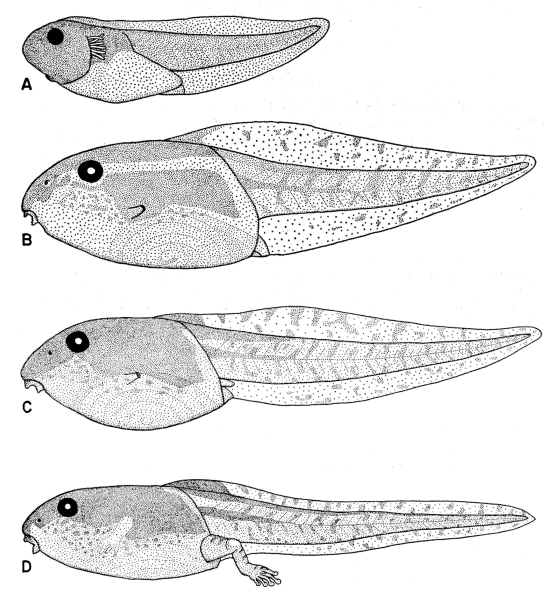
Fig. 11. Tadpoles of Smilisca baudini: (A) Stage 21 (KU 62155) × 10; (B) Stage 25 (KU 68467) × 5; (C) Stage 30 (KU 60018) × 4; (D) Stage 41 (KU 60018) × 3.
Mouthparts.—The mouth of S. sordida is completely bordered by two rows of papillae, whereas in the other species the median part of the upper lip is devoid of papillae. Smilisca baudini and puma have two rows of papillae; S. sila has one complete row (except medially on the upper lip) and one incomplete row, and S. cyanosticta and phaeota have only one row (Fig. 15). All species have numerous papillae in the lateral fold; the fewest lateral papillae are found in S. cyanosticta and phaeota. Although all species have two rows of teeth in the upper jaw and three rows in the lower jaw, specific differences in the nature of the rows exist between certain species. The second upper tooth-row is narrowly interrupted medially in S. sila and sordida and broadly interrupted in the other species. The first upper row is strongly arched in S. puma, moderately arched in S. baudini and sila, and weakly arched in the other species. In all species the third lower tooth-row is the shortest, only slightly so in S. sila and sordida, but only about half the length of the second lower row in S. puma.
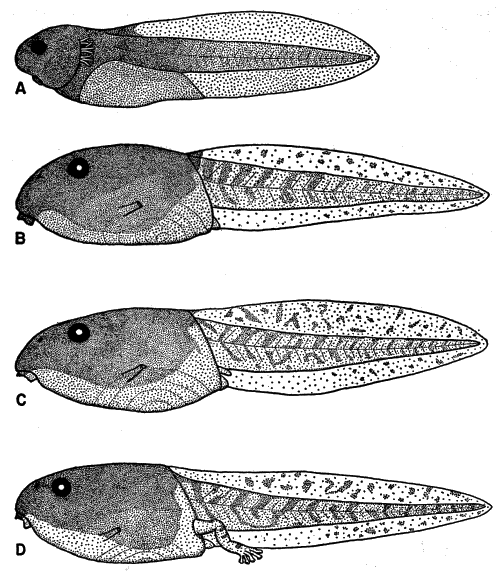
Fig. 12. Tadpoles of Smilisca cyanosticta: (A) Stage 21 (KU 87648) (B) Stage 25 (KU 87651) × 5; (C) Stage 30 (KU 87652) × 4; (D) Stage 40 (KU 87650) × 3.
The beaks are well developed and finely serrate in all species. The lower, broadly V-shaped, beak is slender in S. puma, rather robust in S. baudini and sila, and moderately heavy in the other species. The lateral processes of the upper beak are shortest in S. puma and longest in S. baudini and sordida. In the latter the inner margin of the upper beak and lateral process have the form of a shallow S, whereas in the other species the inner margin of the upper beak forms a continuous arch with the lateral processes (Fig. 15).
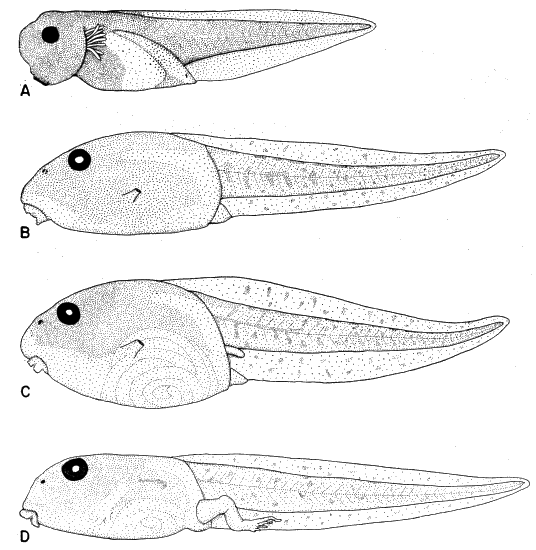
Fig. 13. Tadpoles of Smilisca phaeota: (A) Stage 21 (KU 68479) × 14; (B) Stage 25 (KU 68480) × 5; (C) Stage 30 (KU 68482) × 4; (D) Stage 40 (KU 68483) × 3.
Coloration.—The tadpoles of Smilisca lack the bright colors or bold markings characteristic of some hylid tadpoles; even so, the subdued colors and arrangement of pigments provide some distinctive markings by which the species can be distinguished from one another. The species comprising the baudini group (S. baudini, cyanosticta, and phaeota) are alike in having the body brown or grayish brown dorsally and transparent with scattered brown pigment ventrally. A cream-colored, crescent-shaped mark is present on the posterior edge of the body; this mark is usually most noticeable in S. baudini and least so in S. cyanosticta. Other differences in coloration in members of the baudini group are relative and subtle. Smilisca phaeota usually is more pallid than baudini, and cyanosticta usually is darker than baudini; both species have larger dark markings on the tail than does S. phaeota. Smilisca baudini has a dark streak on the middle of the anterior one-fourth of the tail (Figs. 11-13).
Smilisca puma is distinctive in having a grayish brown body and dark gray reticulations on the tail. Smilisca sila and sordida are distinctive in having pairs (sometimes interconnected) of dark marks on the dorsal surfaces of the caudal musculature, and in dorsal view the tail appears to be marked with dark and pale creamy tan transverse bars. These dark marks, as well as the small flecks on the tail, are brown in S. sila and red in sordida. Smilisca sila has dark brown flecks on the dorsal surface of the body and small white flecks laterally; these markings are absent in S. sordida (Fig. 14).
Descriptions of the coloration of living tadpoles are given in the accounts of the species.
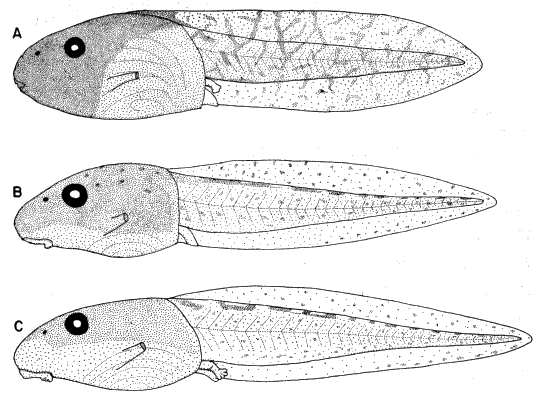
Fig. 14. Tadpoles of Smilisca; (A) S. puma, Stage 30 (KU 91807); (B) S. sila, Stage 25 (KU 80260); S. sordida, Stage 30 (KU 68475). All × 3.5.
Growth and Development
Information on the growth and development of Middle American hylids is scanty. Adequate descriptions have been published for Phyllomedusa annae (Duellman, 1963b), Phrynohyas venulosa (Zweifel, 1964), and Triprion petasatus (Duellman and Klaas, 1964). Material is available for adequate descriptions of the developmental stages of four species of Smilisca (Tables 9-12, Figs. 11-13). Because none of the tadpoles was raised from hatching to metamorphosis, the rate of growth and duration of the larval stages are unknown.
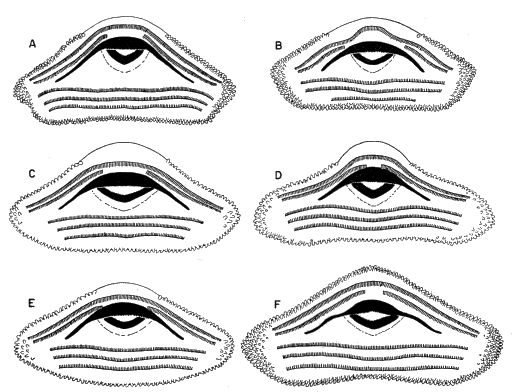
Fig. 15. Mouthparts of tadpoles of Smilisca; (A) S. baudini (KU 60018); (B) S. puma (KU 91807); (C) S. cyanosticta (KU 87625); (D) S. sila (KU 80620); (E) S. phaeota (KU 68482); (F) S. sordida (KU 68475). All ×17.
Table 9.—Growth and Development of Tadpoles of Smilisca baudini. (Means Are Given in Parentheses After the Observed Ranges.)
Stage N Total length Body length Tail length
21 10 5.1-5.4 (5.22) 2.6-2.7 (2.54) 2.5-2.7 (2.58)
24 10 6.0-6.5 (6.20) 2.3-2.6 (2.45) 3.5-3.9 (3.69)
25 10 7.2-8.3 (7.78) 3.0-3.3 (3.14) 4.2-5.0 (4.64)
27 10 18.5-21.5 (20.22) 8.0-9.0 (8.38) 10.4-13.0 (11.84)
29 10 21.5-24.5 (22.60) 8.5-10.0 (9.25) 12.5-14.5 (13.35)
37 3 28.5-31.0 (30.00) 11.0-12.5 (11.67) 17.5-19.0 (18.00)
38 10 35.0-37.5 (35.50) 12.0-13.5 (12.80) 21.5-24.0 (22.70)
40 2 34.0-37.0 (35.50) 12.5-13.5 (13.00) 21.5-23.5 (22.50)
41 10 34.0-37.0 (35.50) 12.5-13.5 (13.00) 21.5-23.5 (22.50)
42 3 24.0-30.0 (27.00) 12.5-13.0 (12.67) 11.5-17.0 (14.33)
45 6 14.0-24.0 (17.58) 12.5-14.0 (13.37) 1.5-10.0 (4.17)
46 23 —— 12.0-15.5 (13.34) ——
Table 10.—Growth and Development of Tadpoles of Smilisca cyanosticta. (Means Are Given in Parentheses After the Observed Ranges.)
Stage N Total length Body length Tail length
21 10 5.8-6.5 (6.28) 2.8-3.1 (3.00) 3.0-3.5 (3.28)
25 10 7.9-9.2 (8.44) 2.7-3.2 (2.96) 4.8-6.0 (5.48)
30 7 22.5-25.0 (23.50) 8.5-9.5 (9.00) 14.0-15.5 (14.57)
36 10 27.0-30.0 (28.75) 9.5-11.5 (10.80) 17.0-18.5 (17.95)
42 2 26.0-27.0 (26.50) 10.00 16.0-17.0 (16.50)
46 2 — 14.00 —
Hatchlings of three species (S. baudini, cyanosticta, and phaeota) are available. These larvae have non-functional eyes and large oral suckers. By the time the larvae have developed to stage 21, external gills are present, the caudal musculature and caudal fin have been differentiated, and the head is distinguishable from the body. In stage 21 oral suckers and a large amount of yolk are still present.
The developmental data on the four species show no significant variations; consequently, we will describe the development of only one species, Smilisca phaeota (Table 11, Figs. 13 and 16).
Stage 21.—Bulging cream-colored yolk mass, transparent cornea, and moderately long, unbranched filamentous gills, and oral suckers present; mouth having irregular papillae on lower lip; teeth and beaks absent; caudal myomeres distinct; pigmentation uniform over body and caudal musculature; caudal fin transparent with scattered small flecks.
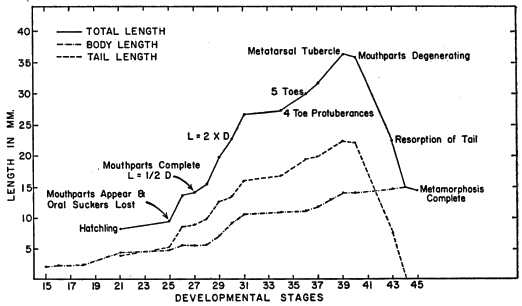
Fig. 16. Relative rate of growth in tadpoles of Smilisca phaeota as correlated with developmental stages. Formulas for the limb bud refer to its length (L) in relation to basal diameter (D).
Stage 25.—Operculum complete; gills absent; sinistral spiracle apparently functional; cloacal tail-piece, nasal capsules, and external nares present; gut partly formed; mouth bordered by single row of papillae, except medially; small papillae present in lateral fold of lips; two upper and three lower tooth-rows present, but not fully developed; beaks apparently fully developed; depth of dorsal and ventral fins less than depth of caudal musculature: tip of tail upturned; pigment on body most dense on dorsum and sides; faint, nearly pigmentless crescent-shaped mark on posterior edge of body; concentrations of pigment forming small spots on tail.
Stage 28.—Mouthparts complete; limb bud about half as long as thick; other structural features and coloration closely resemble those in stage 25.
Stage 30.—Limb bud approximately twice as long as thick; body as deep as wide; dorsal fin deepest just posterior to body; ventral fin deeper than caudal musculature; tail sharply upturned distally; anal tube dextral; brown pigment sparse on flanks.
Table 11.—Growth and Development of Tadpoles of Smilisca phaeota. (Means Are Given in Parentheses After the Observed Ranges.)
Stage N Total length Body length Tail length
15 10 — 1.9-2.1 (1.97) —
16 8 — 2.0-2.2 (2.07) —
18 4 — 2.2-2.6 (2.31) —
21 3 7.9-8.6 (8.21) 4.1-4.5 (4.31) 3.8-4.1 (3.92)
25 10 8.7-10.6 (9.69) 4.5-4.8 (4.64) 4.3-6.0 (5.05)
26 11 12.3-16.1 (14.01) 4.2-6.3 (5.60) 6.7-9.8 (8.41)
27 10 13.0-15.7 (14.28) 4.9-6.2 (5.40) 7.7-10.5 (8.88)
28 13 13.9-20.9 (15.62) 5.2-8.3 (5.75) 8.5-12.6 (9.85)
29 8 17.8-22.3 (19.79) 6.3-8.4 (7.19) 11.5-14.0 (12.60)
30 9 20.3-24.8 (22.85) 8.1-10.5 (9.32) 10.5-15.5 (13.53)
31 5 24.1-28.5 (26.61) 9.4-11.2 (10.59) 14.7-17.3 (16.02)
34 5 24.8-29.4 (27.31) 9.2-11.6 (10.73) 15.6-18.5 (16.80)
36 3 30.0-30.1 (30.07) 10.1-12.2 (11.15) 18.9-20.0 (19.44)
37 4 28.9-34.1 (31.75) 11.5-12.4 (11.88) 17.4-22.5 (19.88)
38 1 28.98 12.88 16.10
39 2 35.6-36.9 (36.25) 14.00 21.6-22.9 (22.25)
40 2 32.3-39.8 (36.05) 14.00 18.3-21.8 (20.05)
43 2 21.5-23.0 (22.25) 14.2-14.8 (14.45) 6.8-8.8 (7.80)
44 4 — 14.5-15.6 (15.08) —
46 11 — 12.7-16.7 (14.26) —
Table 12.—Growth and Development of Tadpoles of Smilisca sordida. (Means Are Given in Parentheses After the Observed Ranges.)
Stage N Total length Body length Tail length
25 6 25.5-28.0 (26.1) 9.0-9.5 (9.3) 16.2-18.5 (16.7)
33 2 28.5-30.0 (29.3) 10.2-10.5 (10.4) 18.0-19.8 (18.9)
36 8 29.5-34.5 (32.3) 10.2-11.7 (10.8) 19.3-23.0 (21.5)
37 7 31.6-37.5 (34.6) 11.0-12.5 (11.5) 21.6-25.0 (23.2)
41 3 33.0-37.2 (35.2) 11.6-12.2 (11.9) 21.4-25.2 (23.2)
43 1 —— 12.4 ——
46 9 —— 13.1-15.7 (14.9) ——
Stages 34, 36, 37, and 38.—Stage 34, foot paddle-shaped with four toe buds; stage 36, five toe buds; stages 37 and 38, lengthening of toes. In all four stages, spiracle persistent, and pigmentation resembling that of early stages.
Stage 39.—Metatarsal tubercle present; greatest total length (36.9 mm.) attained.
Stage 40.—Subarticular tubercles prominent; skin over forelimbs transparent; cloacal tail-piece and spiracle absent; outer tooth-rows degenerating; caudal fins shallower than in preceding stages; distal part of tail nearly straight; size of dark markings on tail decreased; pigment present on hind limb.
Stage 43.—Forelimbs erupted; larval mouthparts absent; corner of mouth between nostril and eye; transverse bands present on hind limbs; tail greatly reduced (about 8 mm. in length).
Stage 44.—Sacral hump barely noticeable; tail reduced to a stub; corner of mouth at level of pupil of eye; dorsal surfaces pale olive-green; venter white.
Changes proceed in a definite pattern during the growth and development of tadpoles. Larval teeth are absent in hatchlings; the inner tooth-rows develop first, and the third lower row last. At metamorphosis the third lower row is the first to be lost. The tail increases gradually in length relative to the body. In stage 25 the tail is 52.1 per cent of the total length, and in stage 36, 64.6 per cent. In later stages the tail becomes relatively shorter through resorption. Duellman and Klaas (1964:320) noted a great size-variation in Triprion tadpoles in stage 25. No such variation is apparent in any stage of any of the species of Smilisca studied.
The growth and development of the other species of Smilisca do not differ significantly from that of S. phaeota. The tadpoles of S. sila and sordida from streams have relatively longer tails at hatching. For example, in tadpoles of S. sordida the average length of tail is 64.0 per cent of the body-length in stage 25, and in stage 37, 67.0 per cent.
Behavior
The tadpoles of S. baudini, cyanosticta, phaeota, and puma are pelagic inhabitants of shallow ponds. Early stages of S. baudini in which external gills are present have been observed to hang vertically with the gills spread out at the surface of the water, a behavior noted by Zweifel (1964:206) in tadpoles of Phrynohyas venulosa, which also develop in warm, standing water having a relatively low oxygen-tension. When disturbed the pelagic tadpoles usually dive and seek shelter amidst vegetation or in mud on the bottom. This behavior was observed in S. baudini, cyanosticta, and phaeota by day and at night. No tadpoles of S. puma were observed by day; those seen at night were near the surface of small water-filled depressions in a grassy marsh; they responded to light by taking refuge in the dense grass. Perhaps tadpoles of this species are negatively phototactic and remain hidden by day.
The stream-inhabiting tadpoles of S. sila and sordida live in clear pools in rocky streams, where they were observed to cling by their mouths to rocks in the stream and to seek shelter amidst pebbles or beneath rocks and leaves on the bottom. These tadpoles are not found in shallow riffles.
We have not found tadpoles of two species of Smilisca in the same body of water and therefore cannot offer observations on ecological relationships in sympatric situations.
PHYLOGENETIC RELATIONSHIPS
Identifiable hylid remains are known from the Miocene to the Recent, but these fossils are mostly fragmentary and provide little useful information regarding the phylogenetic relationships of living genera. Frogs of the genus Smilisca are generalized and show no striking adaptations, either in their structure or in their modes of life history.
Interspecific Relationships
In attempting to understand the relationships of the species of Smilisca we have emphasized osteological characters. The phylogeny suggested by these characters is supported by other lines of evidence, including external morphology, tadpoles, and breeding calls.
Our concept of the prototype of the genus Smilisca is a moderate-sized hylid having: (1) a well-developed frontoparietal fontanelle, (2) frontoparietal lacking lateral processes, (3) no bony squamosal-maxillary arch, (4) a fully ossified ethmoid, (5) paired subgular vocal sac, (6) moderately webbed fingers and toes, (7) relatively few supernumerary tubercles on the digits, (8) eggs deposited in clumps in ponds, (9) anteroventral mouth in tadpoles bordered by one row of labial papillae, but median part of upper lip bare, (10) tail relatively short and deep in tadpoles, and (11) a breeding call consisting of a series of like notes.
Two phyletic lines evolved from this prototype. The first of these was the stock that gave rise to the baudini group. The evolutionary changes that took place in this line included increase in size, development of a lateral curvature of the maxillary, and an increased amount of cranial ossification, especially in the dermal roofing bones. This phyletic line retained the larval characters and breeding call of the prototype. The second phyletic line gave rise to the sordida group and diverged from the prototype in the development of an angular maxillary and a breeding call consisting of a primary note followed by secondary notes. The frogs in this phyletic line retained the moderate size of the prototype and did not develop additional dermal bone. Our concept of the phylogenetic relationships is shown graphically in Figure 17.
Within the baudini group one stock retained separate nasals and did not develop a bony squamosal-maxillary arch, but broad lateral processes developed on the frontoparietals. The tadpoles remained unchanged from the primitive type. This stock evolved into S. phaeota. In the other stock the nasals became fully ossified and a bony squamosal-maxillary arch developed. One branch of this second stock retained tadpoles having only one row of labial papillae and did not develop lateral processes on the frontoparietals; this branch evolved into S. cyanosticta. The other branch diverged and gave rise to S. baudini by developing relatively shorter hind legs, large lateral processes on the frontoparietals, and tadpoles having two rows of labial papillae.
Within the sordida group the cranial features remained unchanged in one line, which gave rise to S. sila, whereas in a second line the nasals were reduced, and their long axes shifted with the result that they are not parallel to the maxillaries; the amount of ossification of the ethmoid was reduced, and the tadpoles developed two rows of labial papillae. In this second line one branch retained the pond-breeding habits and gave rise to S. puma, whereas a second branch became adapted to stream-breeding and gave rise to S. sordida.
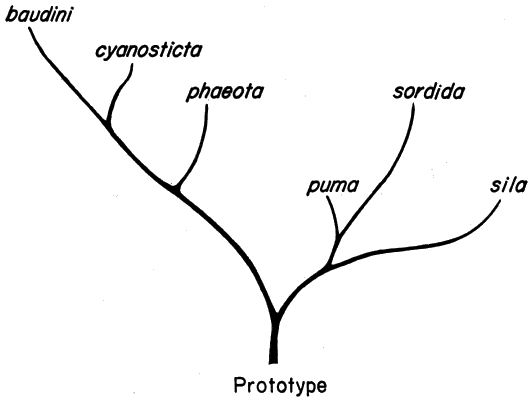
Fig. 17. Hypothesized phylogenetic relationships of the species of Smilisca.
Certain aspects of this proposed phylogeny warrant further comment. Features such as the deposition of additional bone that roofs the skull or that forms lateral projections from the frontoparietals, like those in S. baudini and phaeota, are minor alterations of dermal elements and not basic modifications of the architecture of the skull. Consequently, we hypothesize the independent development of these dermal changes in S. baudini and phaeota. Similar kinds of dermal modifications have evolved independently in many diverse groups of frogs.
Likewise, we propose the parallel development of stream-adapted tadpoles in S. sordida and sila; in both cases the tadpoles adapted to changing environmental conditions (see following section on evolutionary history). Tadpoles of S. sordida already had two rows of labial papillae before entering the streams; subsequently the tadpoles developed complete rows of papillae, ventral mouths and long tails having low fins. Possibly the tadpoles of S. sila had two rows of labial papillae prior to their adapting to stream conditions; in the process of adapting they developed ventral mouths and long tails having low fins. Similar modifications in tadpoles have occurred in many diverse groups of Middle American hylids, such as Plectrohyla, Ptychohyla, the Hyla uranochroa group, and the Hyla taeniopus group.
Our lack of concern about coloration is due to the fact that, with the exception of the blue spots on the flanks and posterior surfaces of the thighs in some species, the coloration of Smilisca, consisting of a pattern of irregular dark marks on a paler dorsum and dark transverse bars on the limbs, is not much different from that of many other Neotropical hylids. Blue is a structural color, rare among Amphibia, which is achieved by the absence of lipophores above the guanophores. Thus, the incident light rays at the blue end of the spectrum are reflected by the guanophores without interference by an overlying yellow lipophore screen. According to Noble (1931), lipophores are capable of amoeboid movement that permits shifts in their positions, between or beneath the guanophores. We do not know whether this behavior of lipophores is widespread and is effected in response to environmental changes, or whether it is a genetically controlled attribute that is restricted in appearance. If the latter is the case we must assume that the prototype of Smilisca possessed such an attribute which was lost in S. baudini, phaeota, and puma. The development of blue spots is not constant in S. sordida and S. sila; in S. cyanosticta the spots range in color from blue to pale green.
The coloration of the tadpoles is not distinctive, except for the presence of dorsal blotches on the tails of S. sila and sordida. However, the similarity in pattern cannot be interpreted as indicating close relationships because nearly identical patterns are present in Hyla legleri and some species of Prostherapis. This disruptive coloration seems to be directly associated with the pebble-bottom, stream-inhabiting tadpoles.
In the baudini group, S. phaeota and cyanosticta are allopatric, whereas S. baudini occurs sympatrically with both of those species. The call of S. baudini differs notably from the calls of S. phaeota and cyanosticta, which are more nearly alike. Although in the phylogenetic scheme proposed here S. sila is considered to be more distantly related to S. puma than is S. sordida, the calls of S. sila and puma more closely resemble one another than either resembles that of S. sordida. Smilisca sila and puma are allopatric, whereas S. sordida is broadly sympatric with both of those species. We assume that in their respective phyletic lines the differentiation of both S. baudini and sordida was the result of genetic changes in geographically isolated populations. Subsequently, each species dispersed into areas inhabited by other members of their respective groups. Selection for differences in the breeding calls helped to reinforce other differences in the populations and thereby aided in maintaining specificity.
Evolutionary History
With respect to temporal and spatial aspects of evolution in Smilisca, we have tried to correlate the phylogenetic evidence on Smilisca with the geologic data on Middle America presented by Lloyd (1963), Vinson and Brineman (1963), Guzmán and Cserna (1963), Maldonado-Koerdell (1964), and Whitmore and Stewart (1965). Likewise, we have borne in mind the evidence for, and ideas about, the evolution of the Middle American herpetofauna given by Dunn (1931b), Schmidt (1943), Stuart (1950, 1964) Duellman (1958, MS), and Savage (MS).
According to Stuart's (1950) historical arrangement of the herpetofauna, Smilisca is a member of the Autochthonous Middle American Faunal Element, and according to Savage's (MS) arrangement the genus belongs to the Middle American Element, a fauna which was derived from a generalized tropical American unit that was isolated in tropical North America by the inundation of the Isthmian Link in early Tertiary, that developed in situ in tropical North America, and that was restricted to Middle America by climatic change in the late Cenozoic.
Savage (MS) relied on the paleogeographic maps of Lloyd (1963) to hypothesize the extent and centers of differentiation of the Middle American Faunal Element. According to Lloyd's concept, Middle America in the Miocene consisted of a broad peninsula extending southeastward to about central Nicaragua, separated from the Panamanian Spur of continental South America by shallow seas. A large island, the Talamanca Range, and remnants of the Guanarivas Ridge formed an archipelago in the shallow sea. The recent discovery of remains of mammals having definite North American affinities in the Miocene of the Canal Zone (Whitmore and Stewart, 1965) provides substantial evidence that at least a peninsula was continuous southeastward from Nuclear Central America to the area of the present Canal Zone in early mid-Miocene time. South America was isolated from Central America by the Bolivar Trough until late mid-Pliocene.
Thus, in the mid-Tertiary the broad peninsula of Nuclear Central America, which consisted of low and moderately uplifted regions having a tropical mesic climate, provided the site for the evolution of Smilisca. It is not possible to determine when the genus evolved, but to explain the differentiation of the species it is unnecessary to have the ancestral Smilisca present prior to the Miocene.
We view the Miocene Smilisca as the prototype described in the preceding section, and suppose that it lived in the mesic tropical environment of the eastern part of the Central American Peninsula (in what is now Costa Rica and western Panamá). Two stocks differentiated, probably in middle Miocene times; one of these, the ancestral stock of the baudini group, was widespread on the Caribbean lowlands from the Nicaraguan Depression to the Bolivar Trough, and the other, the ancestral stock of the sordida group, was restricted to the Pacific lowlands of the same region. In late Miocene time the ancestral stock of the baudini group dispersed northwestward around the deep embayment in the Nicaraguan depression into upper Central America (in what is now Honduras and Guatemala) and thence into southern México. Apparently differentiation took place on each side of the Nicaraguan Depression; the frogs to the south of the depression evolved into S. phaeota, whereas those to the north of the depression represented the stock from which S. baudini and cyanosticta arose. Prior to the uplift of the mountains in the late Miocene and the Pliocene the baudini-cyanosticta stock probably was widespread in northwestern Central America. The elevation of the mountains resulted in notable climatic changes, principally the development of sub-humid environments on the Pacific lowlands. The frogs living on the Pacific lowlands became adapted to sub-humid conditions and developed into S. baudini. The stock on the Caribbean lowlands remained in mesic environments and evolved into S. cyanosticta.
Possibly in the middle Miocene before the Talamanca Range in Costa Rica and western Panamá was greatly uplifted, the ancestral stock of the sordida group invaded the Caribbean lowlands of what is now Costa Rica. The subsequent elevation of the Talamanca Range in the Pliocene effectively isolated the ancestral stock of S. sila on the Pacific lowlands from the puma-sordida stock on the Caribbean lowlands. The former was subjected to the sub-humid conditions which developed on the Pacific lowlands when the Talamanca Range was uplifted. It adapted to the sub-humid environment by living along streams and evolving stream-adapted tadpoles. On the Caribbean side of the Talamanca Range the puma-sordida stock inhabited mesic environments. The stock that evolved into S. puma remained in the lowlands as a pond-breeding frog, whereas those frogs living on the slopes of the newly elevated mountains became adapted for their montane existence by developing stream-adapted tadpoles and thus differentiated into S. sordida.
Probably the six species of Smilisca were in existence by the end of the Pliocene; at that time a continuous land connection existed from Central America to South America. The climatic fluctuations in the Pleistocene, and the post-Wisconsin development of present climatic and vegetational patterns in Middle America, brought about the present patterns of distribution of the species. From its place of origin on the Caribbean lowlands of lower Central America, S. phaeota dispersed northward into Nicaragua and southward along the Pacific slopes of northwestern South America. Perhaps in the late Pleistocene or in post-Wisconsin time when mesic conditions were more widespread than now, S. phaeota moved onto the Pacific lowlands of Costa Rica. Its route could have been through the Arenal Depression. Subsequent aridity restricted its range on the Pacific lowlands to the Golfo Dulce region. Climatic fluctuation in northern Central America restricted the distribution of S. cyanosticta to mesic habitats on the slopes of the Mexican and Guatemalan highlands and to certain humid areas on the lowlands. Smilisca baudini was well adapted to sub-humid conditions, and the species dispersed northward to the Rio Grande Embayment and to the edge of the Sonoran Desert and southward into Costa Rica. In southern México and Central America the species invaded mesic habitats. Consequently, in some areas it is sympatric with S. cyanosticta and phaeota.
Smilisca puma dispersed northward onto the Caribbean lowlands of southern Nicaragua. Its southward movements probably were limited by the ridges of the Talamanca Range that extend to the Caribbean coast in the area of Punta Cahuita in Costa Rica. Smilisca sila dispersed along the Pacific lowlands and slopes of the mountains from eastern Costa Rica and western Panamá through eastern Panamá to northern Colombia. Climatic fluctuation in the Pleistocene evidently provided sufficient altitudinal shifts in environments in the Talamanca Range to permit S. sordida to move onto the Pacific slopes. From its upland distribution the species followed streams down to both the Caribbean and Pacific lowlands, where it is sympatric with S. puma on the Caribbean lowlands and S. sila on the Pacific lowlands.
The evolution of the species-groups of Smilisca was effected through isolation by physical barriers in the Cenozoic; the differentiation of the species was initiated by further isolation of populations by changes in physiography and climate. Present patterns of distribution resulted from Pleistocene and post-Wisconsin climatic changes. Today, sympatric species have different breeding habits and breeding calls which reinforce the differences in morphology.
SUMMARY AND CONCLUSIONS
The genus Smilisca is composed of six species of tree frogs; each species is defined on the basis of adult morphology, larval characters, and breeding behavior. Keys are provided to aid in the identification of adults and of tadpoles.
Analysis of the characters and examination of type specimens indicates that several currently-recognized taxa are synonymous, as follows:
1. Hyla beltrani Taylor, 1942 = Smilisca baudini. 2. Hyla gabbi Cope, 1876 = Smilisca sordida. 3. Hyla manisorum Taylor, 1954 = Smilisca baudini. 4. Hyla nigripes Cope, 1876 = Smilisca sordida. 5. Hyla wellmanorum Taylor, 1952 = Smilisca puma.
Smilisca phaeota cyanosticta Smith, 1953 is elevated to specific rank, and one new species, Smilisca sila, is named and described.
The skeletal system of developmental stages and the adult of Smilisca baudini is described, and the skull is compared with that of other members of the genus.
The tadpoles are described, compared, and illustrated; the larval development of Smilisca phaeota is described.
Breeding behavior and breeding calls are described and compared. Some species of Smilisca have breeding choruses. Two species, S. sila and sordida, breed in streams, whereas the others breed in ponds.
The genus is considered to be part of the Middle American Faunal Element; the species are thought to have differentiated in response to ecological diversity and historical opportunities provided by Cenozoic changes in physiography and climate.
LITERATURE CITED
Baird, S. F.
1854. Descriptions of new genera and species of North American frogs. Proc. Acad. Nat. Sci. Philadelphia, 7:59-62. April 27.
1859. Reptiles of the boundary. United States and Mexican boundary survey. Washington, D. C., p. 35, pl. 41.
Baldauf, R. J.
1959. Morphological criteria and their use in showing bufonid phylogeny. Jour. Morph., 104:527-560. May.
Barbour, T.
1923. Notes on reptiles and amphibians from Panama. Occas. Papers Mus. Zool. Univ. Michigan, 129:1-16. January 25.
Blair, W. F.
1959. Call structure and species groups in U. S. treefrogs (Hyla). Southwest. Nat., 3:77-89. June 1, 1959.
1962. Non-morphological data in anuran classification. Syst. Zool., 11:72-84. June.
1963. Evolutionary relationships of North American toads of the genus Bufo: A progress report. Evolution, 17:1-16. March.
Bogert, C. M.
1960. The influence of sound on the behavior of amphibians and reptiles. in Lanyon, W. E. and Tavolga, W. N. (Eds.) Animal sounds and communication, pp. 137-320.
Brattstrom, B. H.
1957. The phylogeny of the Salientia based on skeletal morphology. Syst. Zool., 6:70-74. June.
Breder, C. M., Jr.
1946. Amphibians and reptiles of the Rio Chucunaque drainage, Darien, Panama, with notes on their life histories and habits. Bull. Amer. Mus. Nat. Hist., 86:375-436, pls. 42-60. August 26.
Brocchi, P.
1877. Note sur quelques batrachiens hylaeformes recuilles au Mexique et au Guatemala. Bull. Soc. Philom. Paris, ser. 7, 1:122-132.
Carvalho, A. L.
1954. A preliminary synopsis of the genera of American microhylid frogs. Occas. Papers Mus. Zool. Univ. Michigan, 555:1-19, pl. 1. July 16.
Cochran, D. M.
1961. Type specimens of reptiles and amphibians in the United States National Museum. Bull. U. S. Nat. Mus., 220:xv + 291 pp.
Cope, E. D.
1862. Catalogues of the reptiles obtained during the explorations of the Parana, Paraguay, Vermejo and Uraguay rivers.... Proc. Acad. Nat. Sci. Philadelphia, 14, pt. 9:346-359.
1865. Third contribution to the herpetology of tropical America. Proc. Acad. Nat. Sci. Philadelphia, 17:185-198. October.
1871. Ninth contribution to the herpetology of tropical America. Proc. Acad. Nat. Sci. Philadelphia, 23, pt. 2:200-224.
Copland, S. J.
1957. Australian tree frogs of the genus Hyla. Proc. Linnean Soc. New South Wales, 82, pt. 1:9-108. September.
Duellman, W. E.
1956. The frogs of the hylid genus Phrynohyas Fitzinger, 1843. Misc. Publ. Mus. Zool. Univ. Michigan, 96:1-47, pls. 1-6. February 21.
1958. A monographic study of the colubrid snake genus Leptodeira. Bull. Amer. Mus. Nat. Hist., 114:1-152, pls. 1-31. February 24.
1963a. A review of the Middle American tree frogs of the genus Ptychohyla. Univ. Kansas Publ. Mus. Nat. Hist., 15:297-349, pls. 11-18. October 18.
1963b. A new species of tree frog, genus Phyllomedusa, from Costa Rica. Rev. Biol. Trop., 11(1):1-23. October.
1964. A review of the frogs of the Hyla bistincta group. Univ. Kansas Publ. Mus. Nat. Hist., 15:469-491. March 2.
1965. Frogs of the Hyla taeniopus group. Copeia, no. 2:159-168. June 25.
Duellman, W. E. and Klaas, L. T.
1964. The biology of the hylid frog Triprion petasatus. Copeia, no. 2:308-321. June 30.
Duméril, A. M. C. and Bibron, G.
1841. Erpétologie Générale ou histoire naturelle complète des reptiles, vol. 8, 792 pp.
Dunn, E. R.
1931a. The amphibians of Barro Colorado Island. Occas. Papers Boston Soc. Nat. Hist., 5:403-421. October 10.
1931b. The herpetological fauna of the Americas. Copeia, no. 3:106-119. October 30.
1944. Herpetology of the Bogotá area. Rev. Acad. Colombiana Cien. Exact., Fis. Nat., 6:68-81.
Fouquette, M. J., Jr.
1960. Isolating mechanisms in three sympatric tree frogs in the Canal Zone. Evolution, 14:484-497. December.
Funkhouser, Anne
1957. A review of the neotropical tree-frogs of the genus Phyllomedusa. Occas. Papers Nat. Hist. Mus. Stanford Univ., 5:1-89. April 1.
Gadow, H.
1908. Through southern Mexico. London, Witherby and Co. xvi + 527 pp.
Gaige, H. T., Hartweg, N. and Stuart, L. C.
1937. Notes on a collection of amphibians and reptiles from eastern Nicaragua. Occas. Papers Mus. Zool. Univ. Michigan, 357:1-18. October 26.
Goin, C. J.
1961. Synopsis of the genera of hylid frogs. Ann. Carnegie Mus., 36:5-18. July 14.
Gosner, K. L.
1960. A simplified table for staging anuran embryos and larvae with notes on identification. Herpetologica, 16:183-190. September 23.
Griffiths, I.
1959. The phylogeny of Sminthillus limbatus and the status of the Brachycephalidae (Amphibia, Salientia). Proc. Zool. Soc. London, 132:457-487, pls. 1-4.
Guzmán, E. J. and Cserna, Z.
1963. Tectonic History of Mexico. Amer. Assoc. Petrol. Geol., Mem. 2:113-129.
Hecht, M. K.
1962. A reevaluation of the early history of the frogs. Part I. Syst. Zool., 11:39-44. March.
1963. A reevaluation of the early history of the frogs. Part II. Syst. Zool., 12:20-35. March.
Johnson, C.
1959. Genetic incompatibility in the call races of Hyla versicolor Le Conte in Texas. Copeia, no. 4:327-335. December 30.
Lloyd, J. J.
1963. Tectonic history of the south Central-American Orogen. Amer. Assoc. Petrol. Geol., Mem. 2:88-100.
Maldonado-Koerdell, M.
1964. Geohistory and paleogeography of Middle America, in Wauchope, R. and West, R. C. (Eds.). Handbook of Middle American Indians, vol. 1, Univ. Texas Press, Austin, 570 pp.
Maslin, T. P.
1963. Notes on some anuran tadpoles from Yucatán, México. Herpetologica, 19:122-128. July 3.
Mittleman, M. B. and List, J. C.
1963. The generic differentiation of the swamp treefrogs. Copeia, no. 2:80-83. May 29.
Noble, G. K.
1931. The biology of the amphibia. McGraw Hill, New York, 577 pp.
Orton, G. L.
1957. The bearing of larval evolution on some problems in frog classification. Syst. Zool., 6:79-86. June.
Peters, W.
1863. Mittheilungen uber neue Batrachier. Monats. Konigl. Akad. Wiss. Berlin, pp. 445-471.
1873. Uber eine neue Schildkrötenart, Cinosternon Effeldtii und einige andere neue oder weniger bekannte Amphibien. Monats. Konigl. Akad. Wiss. Berlin, pp. 603-618, pl. 5. October 16.
Rivero, J. A.
1961. Salientia of Venezuela. Bull. Comp. Zool., 126:1-207. November.
Savage, J. M. and Carvalho, A. L.
1953. The family position of Neotropical frogs currently referred to the genus Pseudis. Zoologica, 38:193-200.
Schmidt, K. P.
1941. The amphibians and reptiles of British Honduras. Zool. Ser. Field Mus. Nat. Hist., 22:475-510. December 30.
1943. Corollary and commentary for "Climate and Evolution." Amer. Midl. Nat., 30:241-253. July.
Schmidt, O.
1857. Diagnosen neuer Frösche des zoologischen Cabinets zu Krakau. Sitzungb. Konigl. Akad. Wiss. Math.-Natur. Cl., 24(1):10-15. March.
1858. Deliciae Herpetogicae Musei Zoologici Cracoviensis. Denkschr. K. K. Akad. Wiss. Math.-Natur. Cl., 14(2):237-258, pls. 1-3.
Smith, H. M.
1953. A new subspecies of the treefrog Hyla phaeota Cope of Central America. Herpetologica, 8:150-152. January 30.
Smith, H. M. and Taylor, E. H.
1950. Type localities of Mexican reptiles and amphibians. Univ. Kansas Sci. Bull., 33:313-380. March 20.
Starrett, P.
1960. A redefinition of the genus Smilisca. Copeia, no. 4:300-304. December 30.
Stebbins, R. C. and Hendrickson, J. R.
1959. Field studies of amphibians in Colombia, South America. Univ. California Publ. Zool., 56:497-540. February 17.
Stokely, P. S. and List, J. C.
1954. The progress of ossification in the skull of the cricketfrog Pseudacris nigrita triseriata. Copeia, no. 3:211-217. July 29.
Stuart, L. C.
1935. A contribution to a knowledge of the herpetology of a portion of the savanna region of central Petén, Guatemala. Misc. Publ. Mus. Zool. Univ. Michigan, 29:1-56, pls. 1-4, 1 map. October 1.
1948. The amphibians and reptiles of Alta Verapaz, Guatemala. Misc. Publ. Mus. Zool. Univ. Michigan, 69:1-109. June 12.
1950. A geographic study of the herpetofauna of Alta Verapaz, Guatemala. Contr. Lab. Vert. Biol., 45:1-77, pls. 1-9, 1 map. May.
1954. Herpetofauna of the southeastern highlands of Guatemala. Contr. Lab. Vert. Biol., 68:1-65, pls. 1-4. November.
1958. A study of the herpetofauna of the Uaxactun-Tikal area of northern El Petén, Guatemala. Contr. Lab. Vert. Biol., 75:1-30. June.
1961. Some observations on the natural history of tadpoles of Rhinophrynus dorsalis Duméril and Bibron. Herpetologica, 17:73-79. July 11.
1964. Fauna of Middle America, in Wauchope, R. and West, R. C. (Eds.). Handbook of Middle American Indians, vol. 1, Univ. Texas Press, Austin, 570 pp.
Taylor, E. H.
1942. New Caudata and Salientia from México. Univ. Kansas Sci. Bull., 28:295-323. November 15.
1952. The frogs and toads of Costa Rica. Univ. Kansas Sci. Bull., 35:577-942. July 1.
1954. Additions to the known herpetological fauna of Costa Rica with comments on other species. No. I. Univ. Kansas Sci. Bull., 36:597-639. June 1.
Taylor, E. H. and Smith, H. M.
1945. Summary of the collections of amphibians made in México under the Walter Rathbone Bacon Traveling Scholarship. Proc. U. S. Natl. Mus., 95:521-613, pls. 18-32. June 30.
Tihen, J. A.
1962. Osteological observations on New World Bufo. Amer. Midl. Nat., 67:157-183. January.
1965. Evolutionary trends in frogs. Amer. Zoologist, 5:309-318.
Vinson, G. L. and Brineman, J. H.
1963. Nuclear Central America, hub of Antillean Transverse Belt. Amer. Assoc. Petrol. Geol., Mem. 2:101-112.
Whitmore, F. C., Jr. and Stewart, R. H.
1965. Miocene mammals and Central American seaways. Science, 148:180-185. April 9.
Zweifel, R. G.
1956. Two pelobatid frogs from the Tertiary of North America and their relationships to fossil and Recent forms. Amer. Mus. Novitates, 1762:1-45. April 6.
1958. Results of the Archbold Expeditions. No. 78. Frogs of the Papuan hylid genus Nyctimystes. Amer. Mus. Novitates, 1896:1-51. July 22.
1964. Life history of Phrynohyas venulosa (Salientia: Hylidae) in Panamá. Copeia, no. 1:201-208. March 26.
Transmitted March 14, 1966.
31-3430

UNIVERSITY OF KANSAS PUBLICATIONS MUSEUM OF NATURAL HISTORY
Institutional libraries interested in publications exchange may obtain this series by addressing the Exchange Librarian, University of Kansas Library, Lawrence, Kansas. Copies for individuals, persons working in a particular field of study, may be obtained by addressing instead the Museum of Natural History, University of Kansas, Lawrence, Kansas. When individuals request copies from the Museum, 25 cents should be included, for each 100 pages or part thereof, for the purpose of defraying the costs of wrapping and mailing. For certain longer papers an additional amount, indicated below, toward some of the costs of production, is to be included.
* An asterisk designates those numbers of which the Museum's supply is exhausted.
Vol. 1. Nos. 1-26 and index. Pp. 1-638, 1946-1950.
*Vol. 2. (Complete) Mammals of Washington. By Walter W. Dalquest. Pp. 1-444, 140 figures in text. April 9, 1948.
Vol. 3. *1. The avifauna of Micronesia, its origin, evolution, and distribution. By Rollin H. Baker. Pp. 1-359, 16 figures in text. June 12, 1951.
*2. A quantitative study of the nocturnal migration of birds. By George H. Lowery, Jr. Pp. 361-472, 47 figures in text. June 29, 1951.
3. Phylogeny of the waxwings and allied birds. By M. Dale Arvey. Pp. 473-530, 49 figures in text, 13 tables. October 10, 1951.
*4. Birds from the state of Veracruz, Mexico. By George H. Lowery, Jr., and Walter W. Dalquest. Pp. 531-649, 7 figures in text, 2 tables. October 10, 1951.
Index. Pp. 651-681.
*Vol. 4. (Complete) American weasels. By E. Raymond Hall. Pp. 1-466, 41 plates, 31 figures in text. December 27, 1951.
Vol. 5. Nos. 1-37 and index. Pp. 1-676, 1951-1953.
*Vol. 6. (Complete) Mammals of Utah, taxonomy and distribution. By Stephen D. Durrant. Pp. 1-549, 91 figures in text, 30 tables. August 10, 1952.
Vol. 7. Nos. 1-15 and index. Pp. 1-651, 1952-1955.
Vol. 8. Nos. 1-10 and index. Pp. 1-675, 1954-1956.
Vol. 9. Nos. 1-23 and index. Pp. 1-690, 1955-1960.
Vol. 10. Nos. 1-10 and index. Pp. 1-626, 1956-1960.
Vol. 11. Nos. 1-10 and index. Pp. 1-703, 1958-1960.
Vol. 12. *1. Functional morphology of three bats: Eumops, Myotis, Macrotus. By Terry A. Vaughan. Pp. 1-153, pls. 1-4, 24 figures in text. July 8, 1959.
*2. The ancestry of modern Amphibia: a review of the evidence. By Theodore H. Eaton, Jr. Pp. 155-180, 10 figures in text. July 10, 1959.
3. The baculum in microtine rodents. By Sidney Anderson. Pp. 181-216, 49 figures in text. February 19, 1960.
*4. A new order of fishlike Amphibia from the Pennsylvanian of Kansas. By Theodore H. Eaton, Jr., and Peggy Lou Stewart. Pp. 217-240, 12 figures in text. May 2, 1960.
5. Natural history of the Bell Vireo, Vireo bellii Audubon. By Jon C. Barlow. Pp. 241-296, 6 figures in text. March 7, 1962.
6. Two new pelycosaurs from the lower Permian of Oklahoma. By Richard C. Fox. Pp. 297-307, 6 figures in text. May 21, 1962.
7. Vertebrates from the barrier island of Tamaulipas, México. By Robert K. Selander, Richard F. Johnston, B. J. Wilks, and Gerald G. Raun. Pp. 309-345, pls. 5-8. June 18, 1962.
8. Teeth of edestid sharks. By Theodore H. Eaton, Jr. Pp. 347-362, 10 figures in text. October 1, 1962.
9. Variation in the muscles and nerves of the leg in two genera of grouse (Tympanuchus and Pedioecetes). By E. Bruce Holmes. Pp. 363-474, 20 figures in text. October 25, 1963. $1.00.
10. A new genus of Pennsylvanian fish (Crossopterygii, Coelacanthiformes) from Kansas. By Joan Echols. Pp. 475-501, 7 figures in text. October 25, 1963.
11. Observations on the Mississippi kite in southwestern Kansas. By Henry S. Fitch. Pp. 503-519. October 25, 1963.
12. Jaw musculature of the Mourning and White-winged doves. By Robert L. Merz. Pp. 521-551, 22 figures in text. October 25, 1963.
13. Thoracic and coracoid arteries in two families of birds, Columbidae and Hirundinidae. By Marion Anne Jenkinson. Pp. 553-573, 7 figures in text. March 2, 1964.
14. The breeding birds of Kansas. By Richard F. Johnston. Pp. 575-655, 10 figures in text. May 18, 1964. 75 cents.
15. The adductor muscles of the jaw in some primitive reptiles. By Richard C. Fox. Pp. 657-680, 11 figures in text. May 18, 1964.
Index. Pp. 681-694.
Vol. 13. 1. Five natural hybrid combinations in minnows (Cyprinidae). By Frank B. Cross and W. L. Minckley. Pp. 1-18. June 1, 1960.
2. A distributional study of the amphibians of the Isthmus of Tehuantepec, México. By William E. Duellman. Pp. 19-72, pls. 1-8, 3 figures in text. August 16, 1960. 50 cents.
3. A new subspecies of the slider turtle (Pseudemys scripta) from Coahulia, México. By John M. Legler. Pp. 73-84, pls. 9-12, 3 figures in text. August 16, 1960.
*4. Autecology of the copperhead. By Henry S. Fitch. Pp. 85-288, pls. 13-20, 26 figures in text. November 30, 1960.
5. Occurrence of the garter snake, Thamnophis sirtalis, in the Great Plains and Rocky Mountains. By Henry S. Fitch and T. Paul Maslin. Pp. 289-308, 4 figures in text. February 10, 1961.
6. Fishes of the Wakarusa river in Kansas. By James E. Deacon and Artie L. Metcalf. Pp. 309-322, 1 figure in text. February 10, 1961.
7. Geographic variation in the North American cyprinid fish, Hybopsis gracilis. By Leonard J. Olund and Frank B. Cross. Pp. 323-348, pls. 21-24, 2 figures in text. February 10, 1961.
8. Descriptions of two species of frogs, genus Ptychohyla; studies of American hylid frogs, V. By William E. Duellman. Pp. 349-357, pl. 25, 2 figures in text. April 27, 1961.
9. Fish populations, following a drought, in the Neosho and Marais des Cygnes rivers of Kansas. By James Everett Deacon. Pp. 359-427, pls. 26-30, 3 figures in text. August 11, 1961. 75 cents.
10. Recent soft-shelled turtles of North America (family Trionychidae). By Robert G. Webb. Pp. 429-611, pls. 31-54, 24 figures in text, February 16, 1962. $2.00.
Index. Pp. 613-624.
Vol. 14. 1. Neotropical bats from western México. By Sydney Anderson. Pp. 1-8. October 24, 1960.
2. Geographic variation in the harvest mouse. Reithrodontomys megalotis, on the central Great Plains and in adjacent regions. By J. Knox Jones, Jr., and B. Mursaloglu. Pp. 9-27, 1 figure in text. July 24, 1961.
3. Mammals of Mesa Verde National Park, Colorado. By Sydney Anderson. Pp. 29-67, pls. 1 and 2, 3 figures in text. July 24, 1961.
4. A new subspecies of the black myotis (bat) from eastern Mexico. By E. Raymond Hall and Ticul Alvarez. Pp. 69-72, 1 figure in text. December 29, 1961.
5. North American yellow bats, "Dasypterus," and a list of the named kinds of the genus Lasiurus Gray. By E. Raymond Hall and J. Knox Jones, Jr. Pp. 73-98, 4 figures in text. December 29, 1961.
6. Natural history of the brush mouse (Peromyscus boylii) in Kansas with description of a new subspecies. By Charles A. Long. Pp. 99-110, 1 figure in text. December 29, 1961.
7. Taxonomic status of some mice of the Peromyscus boylii group in eastern Mexico, with description of a new subspecies. By Ticul Alvarez. Pp. 111-120, 1 figure in text. December 29, 1961.
8. A new subspecies of ground squirrel (Spermophilus spilosoma) from Tamaulipas, Mexico. By Ticul Alvarez. Pp. 121-124. March 7, 1962.
9. Taxonomic status of the free-tailed bat, Tadarida yucatanica Miller. By J. Knox Jones, Jr., and Ticul Alvarez. Pp. 125-133, 1 figure in text. March 7, 1962.
10. A new doglike carnivore, genus Cynaretus, from the Clarendonian Pliocene, of Texas. By E. Raymond Hall and Walter W. Dalquest. Pp. 135-138, 2 figures in text. April 30, 1962.
11. A new subspecies of wood rat (Neotoma) from northeastern Mexico. By Ticul Alvarez. Pp. 139-143. April 30, 1962.
12. Noteworthy mammals from Sinaloa, Mexico. By J. Knox Jones, Jr., Ticul Alvarez, and M. Raymond Lee. Pp. 145-159, 1 figure in text. May 18, 1962.
13. A new bat (Myotis) from Mexico. By E. Raymond Hall. Pp. 161-164, 1 figure in text. May 21, 1962.
*14. The mammals of Veracruz. By E. Raymond Hall and Walter W. Dalquest. Pp. 165-362, 2 figures. May 20, 1963. $2.00.
15. The recent mammals of Tamaulipas, México. By Ticul Alvarez. Pp. 363-473, 5 figures in text. May 20, 1963. $1.00.
16. A new subspecies of the fruit-eating bat, Sturnira ludovici, from western Mexico. By J. Knox Jones, Jr., and Gary L. Phillips. Pp. 475-481, 1 figure in text. March 2, 1964.
17. Records of the fossil mammal Sinclairella, Family Apatemyidae, from the Chadronian and Orellan. By William A. Clemens, Jr. Pp. 483-491, 2 figures in text. March 2, 1964.
18. The mammals of Wyoming. By Charles A. Long. Pp. 493-758, 82 figures in text. July 6, 1965. $3.00.
Index. Pp. 759-784.
Vol. 15. 1. The amphibians and reptiles of Michoacán, México. By William E. Duellman. Pp. 1-148, pls. 1-6, 11 figures in text. December 20, 1961. $1.50.
2. Some reptiles and amphibians from Korea. By Robert G. Webb, J. Knox Jones, Jr., and George W. Byers. Pp. 149-173. January 31, 1962.
3. A new species of frog (Genus Tomodactylus) from western México. By Robert G. Webb. Pp. 175-181, 1 figure in text. March 7, 1962.
4. Type specimens of amphibians and reptiles in the Museum of Natural History, the University of Kansas. By William E. Duellman and Barbara Berg. Pp. 183-204. October 26, 1962.
5. Amphibians and Reptiles of the Rainforests of Southern El Petén, Guatemala. By William E. Duellman. Pp. 205-249, pls. 7-10, 6 figures in text. October 4, 1963.
6. A revision of snakes of the genus Conophis (Family Colubridae, from Middle America). By John Wellman. Pp. 251-295, 9 figures in text. October 4, 1963.
7. A review of the Middle American tree frogs of the genus Ptychohyla. By William E. Duellman. Pp. 297-349, pls. 11-18, 7 figures in text. October 18, 1963. 50 cents.
8. Natural history of the racer Coluber constrictor. By Henry S. Fitch. Pp. 351-468, pls. 19-22, 20 figures in text. December 30, 1963. $1.00.
9. A review of the frogs of the Hyla bistincta group. By William E. Duellman. Pp. 469-491, 4 figures in text. March 2, 1964.
10. An ecological study of the garter snake, Thamnophis sirtalis. By Henry S. Fitch. Pp. 493-564, pls. 23-25, 14 figures in text. May 17, 1965.
11. Breeding cycle in the ground skink, Lygosoma laterale. By Henry S. Fitch and Harry W. Greene. Pp. 565-575, 3 figures in text. May 17, 1965.
12. Amphibians and reptiles from the Yucatan Peninsula, México. By William E. Duellman. Pp. 577-614, 1 figure in text. June 22, 1965.
13. A new species of turtle, genus Kinosternon, from Central America. By John M. Legler. Pp. 615-625, pls. 26-28, 2 figures in text. June 20, 1965.
14. A biogeographic account of the herpetofauna of Michoacán, México. By William E. Duellman. Pp. 627-709, pls. 29-36, 5 figures in text. December 30, 1965.
15. Amphibians and reptiles of Mesa Verde National Park, Colorado. By Charles L. Douglas. Pp. 711-744, pls. 37 and 38, 6 figures in text. March 7, 1966.
Index in preparation.
Vol. 16. 1. Distribution and taxonomy of mammals of Nebraska. By J. Knox Jones, Jr. Pp. 1-356, plates 1-4, 82 figures in text. October 1, 1964. $3.50.
2. Synopsis of the lagomorphs and rodents of Korea. By J. Knox Jones, Jr., and David H. Johnson. Pp. 357-407. February 12, 1965.
3. Mammals from Isla Cozumel, Mexico, with description of a new species of harvest mouse. By J. Knox Jones, Jr. and Timothy E. Lawlor. Pp. 409-419, 1 figure in text. April 13, 1965.
4. The Yucatan deer mouse, Peromyscus yucatanicus. By Timothy E. Lawlor. Pp. 421-438, 2 figures in text. July 20, 1965.
5. Bats from Gautemala. By J. Knox Jones, Jr. Pp. 439-472. April 18, 1966.
More numbers will appear in volume 16.
Vol. 17. 1. Localities of fossil vertebrates obtained from the Niobrara Formation (Cretaceous) of Kansas. By David Bardack. Pp. 1-14. January 22, 1965.
2. Chorda tympani branch of the facial nerve in the middle ear of tetrapods. By Richard C. Fox. Pp. 15-21. June 22, 1965.
3. Fishes of the Kansas River System in relation to zoogeography of the Great Plains. By Artie L. Metcalf. Pp. 23-189, 4 figures in text, 51 maps. March 24, 1966.
4. Factors affecting growth and production of channel catfish, Ictalurus punctatus. By Bill A. Simco and Frank B. Cross. Pp. 191-256, 13 figures in text. June 6, 1966.
5. A new species of fringe-limbed tree frog, genus Hyla, from Darién, Panamá. By William E. Duellman. Pp. 257-262, 1 figure in text. June 17, 1966.
6. Taxonomic notes on some Mexican and Central American hylid frogs. By William E. Duellman. Pp. 263-279. June 17, 1966.
7. Neotropical hylid frogs, genus Smilisca. By William E. Duellman and Linda Trueb. Pp. 281-375, pls. 1-12, 17 figures in text. July 14, 1966.
More numbers will appear in volume 17.
Transcriber's Note
With the exception of the corrections listed below and several minor corrections not listed, the text presented is that which appeared in the original printed version. The list of Kansas University publications has been compiled at the end of the article. The cover displayed was compiled from a image of the original cover with graphics from the article added.
Typographical Corrections
Page Correction
287 cleared ⇒ cleaned
292 Data based of => Data based on
298 CNMH ⇒ CNHM
299 Acahuitzotla ⇒ Acahuizotla
304 cyanostica ⇒ cyanosticta
305 Quatemala ⇒ Guatemala
307 cyanostica ⇒ cyanosticta
313 Matagalapa ⇒ Matagalpa
322 Carribean ⇒ Caribbean
323 Centralia ⇒ Centrali
336 proportionaely ⇒ proportionately
346 noticably ⇒ noticeably
372 Carvaljo ⇒ Carvalho
375 Dumeril ⇒ Duméril
ii trutles ⇒ turtles