Chapter VI · The Draining of the Black Belt
Reading edition
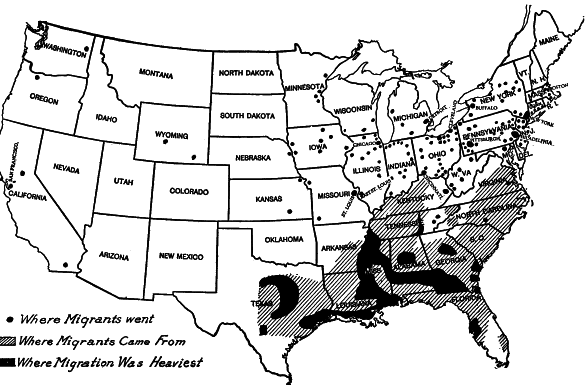
In order better to understand the migration movement, a special study of it was made for five adjoining States, Georgia, Florida, Alabama, Mississippi and Louisiana, from which came more than half of all migrants. The negro population of these five States was 4,115,299, which was almost half of the negro population of the South. In the particular sections of these States where the migration was the heaviest, the one crop system, cotton, was general. As a result of the cotton price demoralization resulting from the war, the labor depression, the ravages of the cotton boll weevil, and in some regions unusual floods, as already stated, there was in this section of the South an exceptionally large amount of surplus labor. The several trunk line railroads directly connecting this section with the northern industrial centers made the transportation of this labor an easy matter.
In 1915, the labor depression in Georgia was critical and work at remunerative wages was scarce. In Atlanta strong pressure was brought to bear to have the negroes employed in cleaning the streets replaced by whites who were out of work. It was reported that the organized charities of Macon, in dealing with the question of the unemployed, urged whites employing negroes to discharge the blacks and hire whites. Mr. Bridges Smith, the mayor of the city, bitterly opposed this suggestion. When the 1915 cotton crop began to ripen it was proposed to compel the unemployed negroes in the towns to go to the fields and pick cotton. Commenting editorially on this, the Atlanta Constitution said:
As soon as the exodus got well under way, Birmingham became one of the chief assembling points in the South for the migrants and was one of the chief stations on the way north. Thousands came from the flood and boll weevil districts to Birmingham. The records of the negro industrial insurance companies showed the effects of the migration both from and to Birmingham. The Atlanta Mutual Insurance Company lost 500 of its members and added 2,000. Its debit for November, 1916, was $502.25; for November, 1917, it was $740. The business of the Union Central Relief Association was greatly affected by the migration. The company in 1916 lost heavily. In 1917 it cleared some money.
Jackson, the capital of Mississippi, seriously felt the migration. The majority of the "lower middle class" of negroes, twenty-five per cent of the business men and fully one-third of the professional men left the city—in all between 2,000 and 5,000. Two of the largest churches lost their pastors and about 200 of each of their memberships. Other churches suffered a decrease of forty per cent in their communicants. Two-thirds of the remaining families in Jackson are part families with relatives who have recently migrated to the North.
Greenwood, with a population evenly balanced between the white and black, had passed through the unusual crisis of bad crops and the invasion of the boll weevil. The migration from this point, therefore, was at first a relief to the city rather than a loss. The negroes, in the beginning, therefore, moved into the Delta and out to Arkansas until the call for laborers in the North. The migration from this point to the North reached its height in the winter and spring of 1916 and 1917. The migrants would say that they were going to Memphis, but when you next heard from them they would be in Chicago, St. Louis or Detroit. The police at the Illinois Central depot had been handling men roughly. When they were rude to one, ten or twelve left. Young men usually left on night trains. Next day their friends would say, "Ten left last night," or, "Twelve left last night." In this manner the stream started. Friends would notify others of the time and place of special trains. The type of negro leaving is indicated in the decline in the church membership. Over 300 of those who left were actively connected with some church. During the summer of 1917, 100 houses stood vacant in the town and over 300 were abandoned in the McShein addition. As the crops were gathered people moved in from the country, from the southern part of the State and from the "hills" generally to take the places of those who had left for the North.
There was no concerted movement from Clarksdale, a town with a population of about 400 whites and 600 blacks; but families appeared to slip away because of the restlessness and uneasiness in evidence everywhere. From the rural district around there was considerable migration to Arkansas, but considerable numbers were influenced to leave for Buffalo and Chicago. Mound Bayou lost some of its population also to Arkansas and the North, as they could buy land cheaper in the former and find more lucrative employment in the latter. Natchez did not suffer a serious loss of population until the invasion of the boll weevil and the floods.
The owners of turpentine industries and lumber plants in southeastern Mississippi were especially affected by the exodus. In Hinds, Copiah, Lincoln, Rankin, Newton and Lake counties, many white residents rather than suffer their crops to be lost, worked in the fields. It was reported that numbers of these whites were leaving for the Delta and for Kentucky, Tennessee and Arkansas. Firms there attempted to look in the North that they might send for the negroes whom they had previously employed, promising them an advance in wages.
At the same time the Illinois Central Railroad was carrying from New Orleans and other parts of Louisiana thousands into Indiana, Illinois and Michigan. At the Illinois Central Railroad station in that city, the agent had been having his hands full taking names of colored laborers wanting and waiting to go North. About the first of April, 1917, there came also the reports from New Orleans that 300 negro laborers left there on the Southern Pacific steamer for New York, and 500 more left later on another of the same company's steamships bound also for New York, it was said, to work for the company. Thousands thus left for the North and West and East, the number reaching over 1,200.
It is an interesting fact that this migration from the South followed the path marked out by the Underground Railroad of antebellum days. Negroes from the rural districts moved first to the nearest village or town, then to the city. On the plantations it was not regarded safe to arrange for transportation to the North through receiving and sending letters. On the other hand, in the towns and cities there was more security in meeting labor agents. The result of it was that cities like New Orleans, Birmingham, Jacksonville, Savannah and Memphis became concentration points. From these cities migrants were rerouted along the lines most in favor.
The principal difference between this course and the Underground Railroad was that in the later movement the southernmost States contributed the largest numbers. This perhaps is due in part to the selection of Florida and Georgia by the first concerns offering the inducement of free transportation, and at the same time it accounts for the very general and intimate knowledge of the movement by the people in States through which they were forced to pass. In Hattiesburg, Mississippi, for example, the first intimation of a great movement of negroes to the North came through reports that thousands of negroes were leaving Florida for the North. To the negroes of Florida, South Carolina, Virginia and Georgia the North means Pennsylvania, New Jersey, New York and New England. The route is more direct, and it is this section of the northern expanse of the United States that gets widest advertisement through tourists, and passengers and porters on the Atlantic coast steamers. The northern newspapers with the greatest circulation are from Pennsylvania and New York, and the New York colored weeklies are widely read. Reports from all of these south Atlantic States indicate that comparatively few persons ventured into the Northwest when a better known country lay before them.
For the east and west south central States, the Northwest was more accessible and better known. St. Louis and Cincinnati are the nearest northern cities to the South and excursions have frequently been run there from New Orleans, through the State of Mississippi. There are in St. Louis, as in other more northern cities, little communities of negroes from the different sections of the South. The mail order and clothing houses of Chicago have advertised this city throughout the South. The convenience of transportation makes the Northwest a popular destination for migrants from Mississippi, Alabama, Louisiana, Texas and Tennessee. The Illinois Central Railroad runs directly to New Orleans through Tennessee and Mississippi.
There were other incidental factors which determined the course of the movement. Free trains from different sections broke new paths by overcoming the obstacles of funds for transportation. No questions were asked of the passengers, and, in some instances, as many as were disposed to leave were carried. When once they had advanced beyond the Mason and Dixon line, many fearing that fees for transportation would be deducted from subsequent pay, if they were in the employ of the parties who, as they understood, were advancing their fares, deserted the train at almost any point that looked attractive. Employment could be easily secured and at good wages. Many of these unexpected and premature destinations became the nucleuses for small colonies whose growth was stimulated and assisted by the United States postal service.