Chapter XVII · MY ESKIMOS[5]
Reading edition
CHAPTER XVII MY ESKIMOS[5]
Plump and rounded figures, emphatically expressive countenances, bronze-skinned, keen-eyed, black-maned inhabitants of an icy desert; simple and honest, occasionally sulky; wandering, homeless people: these are my children, the Eskimos.
Their origin, no one can tell to a certainty; but their appearance indicates the strong probability of the correctness of the theory advanced by Sir Clements Markham, distinguished President of the Royal Geographical Society of London, that these people are remnants of an ancient Siberian tribe, the Onkilon. Many of them are of strikingly Mongolian type of countenance.
What first impresses one is their inquisitiveness. Dr. Hayes records the case of an Eskimo woman who had subjected herself to a temperature of thirty-five degrees below zero, with the liability to be caught in a gale; she had travelled forty miles over a track, the roughness of which frequently compelled her to dismount from the sledge and walk; she had carried her child all the way; her sole motive being her curiosity to see the white men, their igloo (hut), and their strange treasures.
376Imagine, then, the arrival of a box—which most probably in a civilised community, would be looked upon as a cartload of rubbish. Placed within the vision of the unspoiled Eskimo, it becomes transformed into Dantes’s grotto filled with “such stuff as dreams are made of.” With fox-like inquisitiveness, the object is approached. Each article is touched, felt and examined; and later, as the “village gossips” get together, we listen to the cheery verboseness of “Sairy Gamp” and Megipsu, discussing the riches of the Koblunah (white man).
In a country where men, women and children exist in complete isolation, where vegetation, mineral matter and even so common a thing as salt are unknown—the people’s capacity for imitation would ordinarily be wholly a matter of conjecture; but when brought in contact with my expedition the Eskimos have shown wonderful characteristics of Oriental imitation and adaptation. If given a gun, a hatchet, or a knife as a model they will reproduce these in miniature, in walrus ivory, with a faithfulness and accuracy that seems almost startling in view of their tools and previous lack of training. The men also pick up with great ease and celerity the use of the tools of the blacksmith and the carpenter.
In 1897, an Eskimo boy was brought to New York, partly because of his unquenchable thirst for novelty and adventure, and also because we had here a good opportunity for studying the effects of outside influence upon primitive innocence. Within a comparatively short period, this lad acquired a good understanding of the English tongue; and, in studies as well as in athletics, he has been considered a match for the average American youth of his age.
377
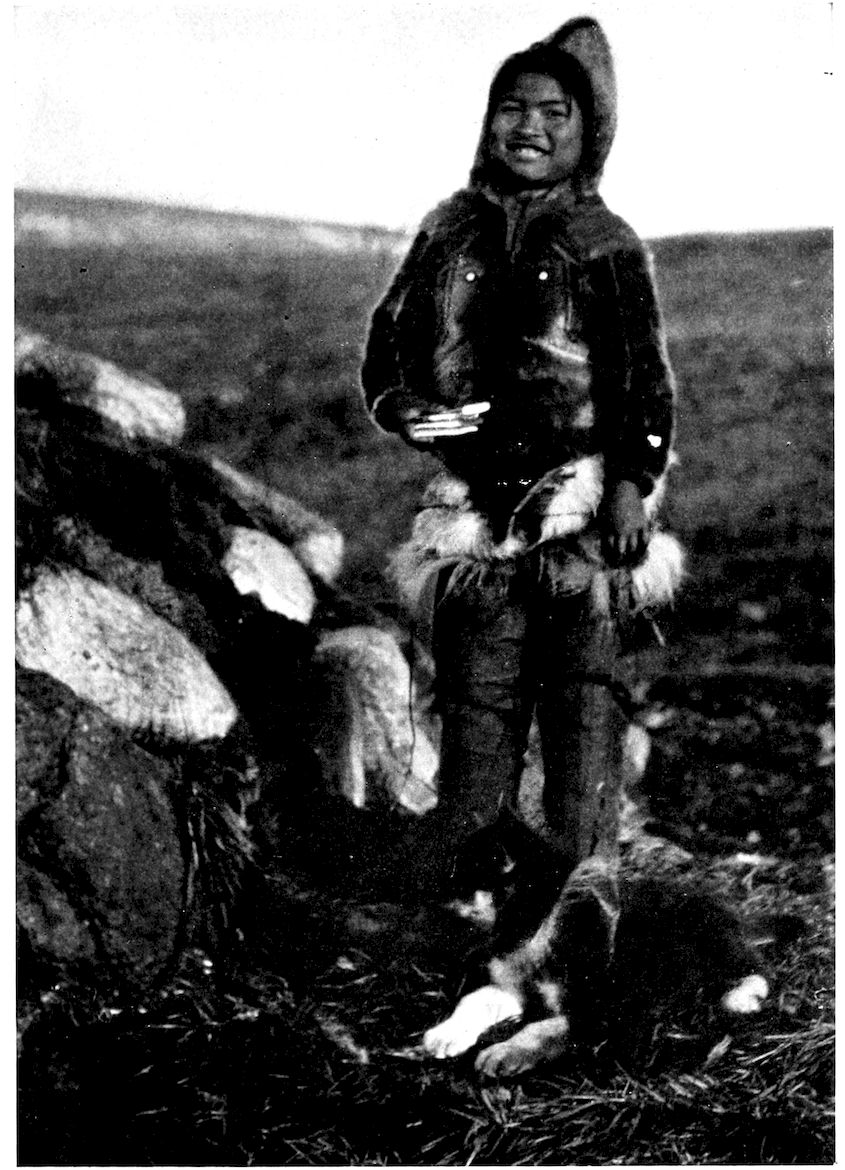
INUAHO Eskimo girl and dog
378
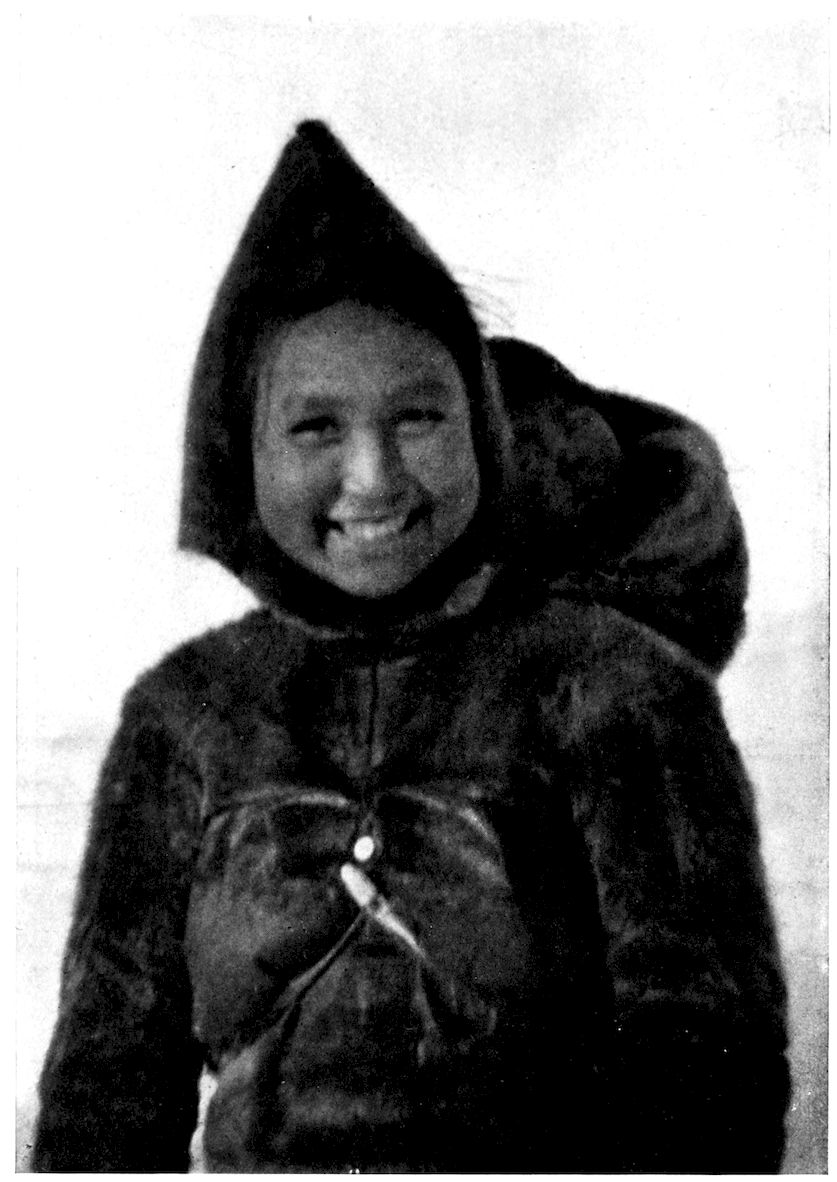
AKATINGWAH Wife of Ooblooyah, with baby
379In their own country, Eskimos care little or nothing about acquiring the use of our language. The fact is, their savage environment and continuous struggle for existence is hardly conducive to learning of any kind, beyond the absolute necessaries. Some of the tribe were taught the use of numerals, the alphabet, and a few easy words; and, parrot-like, these pupils had an embarrassing aptitude for picking up the loose words of the sailors. But as to a common means of communication, their good sense argued that it was much the simpler for us to learn their language.
Their vocabulary is composed of many complicated prefixes and suffixes, and roughly speaking, several hundred radicals. Naturally quick-witted, they find no difficulty in expression; and throughout their conversations, the features and the entire body are brought into play. I have often observed the remarkable animation of the eye, the sudden twitching of the mouth, the laggard or the swift movement of the arms and legs, when an Eskimo tells his story. It is thus he excites interest, and the audience is held by the unstudied dramatic effect.
Shall we mention it? In the Arctic regions as is the case all over the universe, Woman holds the reputation for loquacity; hers is the “last word.”
Churches, schools, and governments are unknown quantities. Yet in every home a perfect system of training goes on for the benefit of the rising generation. At the earliest age an Eskimo lad will be taught the use of his arms in the throwing of a harpoon; a little 380later he learns the hitching up of dog-teams to sledges; and by the time he has lived twelve winters, he is taken to the walrus hunting ground to learn to be a man.
An Eskimo mother loses no time in teaching her daughter the requirements of a good wife. Household duties are as carefully practised (allowing for differences in materials) as in any domestic circle. Sewing is taught by the fond parent, with as much patience as was ever evinced by Griselda. At fourteen or earlier, the young Miss is ripe for marriage.
During my fifteen years of experience with the Eskimos, I have seen little of the savage treachery which is so frequently alluded to. Quite the contrary. These people are subservient to us in a most gratifying way. It is true that in the beginning of our adventures, they were inclined to scoff at our awkward adaptation to Polar conditions; but as we acquainted them with the use of compass, etc., their laughter soon changed to expressions of admiration and wonder.
The position of the sun and the movements of the stars, are the Eskimos’ gauges for time and location. Thus it will be seen that their ideas of astronomy are definite, though necessarily limited. For the benefit of those who have not read my previous work, I shall retabulate what significance celestial bodies have to Eskimos. They recognise the Great Dipper as a herd of reindeer; the three triangular stars of Cassiopeia are the three stones supporting a celestial stone lamp; the Pleiades are a team of dogs in pursuit of a bear; the three glittering brilliants of the belt of Orion are the steps cut by some celestial Eskimo in a steep 381snow-bank to enable him to climb to the top; Gemini are the two door stones of an igloo; Arcturus and Aldebaran are personifications; and the moon and the sun are a maiden and her pursuing lover. Less observant than were the Arab shepherds, they have not noticed that one star is the centre about which all the others move, nor have they set apart the planets, which to them are simply large stars. Probably this is due to the fact that the movements of the stars can be observed during only three months of the year.
Amongst themselves, punctuality is a thing of small value. Yet, I have never known the time when I could not thoroughly trust my “old guard,” among these people, for carrying out my orders. When told to get ready for a certain time—say, daybreak, next morning—sledges would be found packed, and everything arranged with the utmost precision.
Their sense of humour is very pronounced. It is seen in their nicknames for each other, and particularly for the white men, and again in their drawings. These latter, crude as they are, leave no doubt as to the victim. Bow-legs, hooked nose, protuberant stomach, such deformities as these are gleefully pounced upon by the local artists, and emphasised in their portraiture.
Much skill is shown in their carvings. To look at the minute walrus teeth, one-half inch in length, which have been wrought upon, one is reminded over and over again of the dexterity of the Chinese and the Japanese. Notwithstanding all this ingenuity in ornamentation, Eskimos find little pleasure in trinkets or personal frills of any kind. Remembering the stories of 382Captain John Smith and the Indians, bracelets, beads and rings were taken North in our first trips, in the expectation of finding appreciation. At most, these were received with gratitude for the good will. None of the women wore them or seemed particularly to care for them. Occasionally they were brought forth from a peg in the wall where they had hung for some time, and examined with a certain air of curiosity. But as for adorning themselves—such vanities did not occur to them.
The tupiks (tents) and igloos (winter-houses) are all built after the same plans. There is only the superiority of workmanship to distinguish the abode of one man from another. We sometimes see an interesting form of competition when two huts commence building simultaneously: One man, Nupsah, has discovered a huge stone and succeeds in placing it in position. The neighbours, by their approving glances, proclaim him master builder. Presently, Pooadloonah finds a larger stone than any secured by his rival. This is placed in position, silently. Throughout the proceeding not a word has been spoken; yet within that conqueror’s breast there thrills an indisputable note of triumph and satisfaction. It is the peculiarity of this silent competition that, even when extended to greater deeds than the hauling of stones, the best of good nature is preserved on both sides.
Duels and battles never take place; and there is only one case of Eskimo murder which comes within my experience.
Kyo was an angakok (medicine man). He knew exactly how many sinnipahs (sleeps) would elapse 383before this or that man would die—almost as well as our weather bureau can prophesy the coming of a storm. Often he went into trances, for this is necessary when one is an angakok. But people do not like to be told that they are about to expire, particularly when time proves that the medicine man must have miscalculated. Such was the case with our Eskimos. Those of a more optimistic frame of mind took exception to a man who could inspire the sick with so much terror; accordingly, a plot was set for the riddance of his evil spirit.
Their “plot” was nothing more than a scurvy trick; they reasoned between them that it was justice. One day, Kyo was asked to accompany a hunting party, little suspecting that he was to be the object of the hunt. About five miles from camp he was struck from behind, and fell, hardly realising what had taken place. Then, lest his spirit should escape, he was buried and weighted with stones.
An Eskimo execution is always done after this manner. Lacking government and laws of any kind, even subsisting without a leader, the avenger is at liberty to decide the fate of the criminal. There is this peculiarity; the execution is never done in open fight; always by stealth. Yet Eskimos are far from cowardly—as proved when attacking the polar bear and musk-ox.
The life of an Eskimo rarely exceeds sixty years. It is amazing that it should persevere to this extent, despite the malignity of Nature.
There is a particularly touching case of a native who has been dependent upon his fellow men for the past fifteen years. When we first saw him he seemed 384troubled with a slight touch of rheumatism—a malady not infrequent in those parts. But year after year his condition grew worse, until to-day he lives practically ossified—all but his head. Through all these years he has received consideration; the devotion shown by his people—is it not wonderful? Nothing is thought about the matter in that community. Neither age nor infirmity go neglected; they are cared for without thought of reward.
The main causes of death are lung and bronchial troubles.
There exists among these people a form of hysteria known as piblocto (the same name as given to the well-known madness among their dogs), with which women, more frequently than men, are afflicted. During these spells, the maniac removes all clothing and prances about like a broncho. In 1898 while the Windward was in winter quarters off Cape D’Urville, a married woman was taken with one of these fits in the middle of night. In a state of perfect nudity she walked the deck of the ship; then, seeking still greater freedom, jumped the rail, on to the frozen snow and ice. It was some time before we missed her, and when she was finally discovered, it was at a distance of half a mile, where she was still pawing, and shouting to the best of her abilities. She was captured and brought back to the ship; and then there commenced a wonderful performance of mimicry in which every conceivable cry of local bird and mammal was reproduced in the throat of Inaloo. This same woman at other times attempts to walk the ceiling of her igloo; needless to say she has never succeeded.
385A case of piblocto lasts from five minutes to half-an-hour or more. When it occurs under cover of a hut, no apparent concern is felt by other inmates, nor is any attention paid to the antics of the mad one. It is only when an attempt is made to run abroad, that the cords of restraint are felt.
Of alcohol, and other artificial drinks, there is none. No excess of any kind—unless we can call “excess” the hearty eating which is necessary to the Eskimos’ existence. On the other hand, hunger is no particular hardship to these people. Their bodies are well-rounded, seemingly to answer the purpose of the camel’s hump.
Generosity and hospitality are characteristic. There is no such thing up North as individual poverty and riches. It is an unwritten law that when one man has been particularly fortunate in a hunting expedition, his tribe will share the net results. It is this feeling of good fellowship which preserves the race. In other matters, each family is practically independent. Each man for himself, a Jack-of-all-trades.
As a rule no Eskimo family lives in one place more than two consecutive years. The reasons are several; perhaps the most important being a natural feeling of unrest. The Eskimo feels more keenly than any other people that it is not possession, but acquisition which gives men pleasure and sense of power. Then, too, there is the desire for change of food. A prolonged diet of bear flesh has quite as much irksome sameness for him, as hard tack has for the sailor. Scarcity of game is another vital consideration. After a siege of several months’ duration, the food supply is likely to 386become exhausted and then nothing is left for the man to do, but shift.
The seal is the Eskimo’s staple food. It is also his most valuable resource in that it supplies him with material for clothing, boots, tents, harpoon lines, heat, light, and food for his dogs. Winter is calculated upon as nicely in the northern parts, as in any thrifty community. The Eskimo moderates his appetite during these months of animal hibernation, according to the supplies on hand—cuts the coat after the cloth, as it were.
One is grieved to note a state of reckless abandon in the matter of dirt. It is quite beyond the comprehension of these simple folk why washing should be considered necessary for the comfort of humans. When we were caught using a tooth-brush, this was too much. We must indeed be a filthy tribe! “If the mouth is unclean, what part of us is clean?” Was ever injured innocence expressed in more sober language?
In the very water in which a walrus feast is about to be prepared, may often be found the drippings of greasy garments hanging above: or perhaps excited by civilisation, the good woman of the place will take to washing her hands at this moment.
We despair of ever civilising these people, permanently. While we are in their midst, they seem to be progressing. But out of sight, out of mind—so far as civilisation (and hair-combing!) are concerned.
“From many children and little bread, good Lord deliver us.” This would seem to be the Eskimo’s prayer, for in no family will be found more than six children. Though not lacking in warmth of blood 387they are not a prolific people. “The females arrive at the age of puberty neither very early nor very late, but according to their own statements they rarely have children, even with every possible provocation, till at least three years later, and I am inclined to think the statement is substantially correct.
“As the males are considerably in excess there is a constant demand for wives, and girls frequently marry while still as flat-chested and as lank-hipped as a boy.
“As regards morals, these people do not stand high according to our scale. The wife is as much a piece of personal property, which may be sold, exchanged, loaned, or borrowed, as a sledge or a canoe. It must be said in their favour, however, that the children as well as aged and infirm members of the tribe are well taken care of, and that, for the former the parents evince the liveliest affection.
“There seems to be no ceremony for marriage (and there is none for birth). The matrimonial arrangement is frequently perfected by the parents while the parties are children.
“As the female is eligible for marriage much earlier than the male, a girl may be appropriated by a man whose wife has died, before her intended is old enough to marry. This arrangement may continue, or her intended may claim her when he is old enough. This is largely a matter of mutual agreement.
“Young couples frequently change partners several times in the first year or two, till both are suited, when the union is practically permanent, except for temporary periods during which an exchange may be effected with another man, or the wife loaned to a friend.
388“Motherhood and the various female functions cause them hardly if any more inconvenience than is the case with animals.
“The causes of death among the men come largely under the terse Western expression, ‘with their boots on.’
“A kayak capsizes, and the occupant is hurled into the icy water; a hunter harpoons a walrus or bearded seal from the ice, a bight of the line catches round arm or leg, and the big brute drags him under to his death; an iceberg capsizes as he is passing it; a rock or snowslide from the steep shore cliffs crushes him; or a bear tears him mortally with a stroke of his paw: and so on. Occasionally, in the past, starvation has wiped out an entire village.
“On the death of a man or woman, the body, fully dressed, is laid straight upon its back on a skin or two, and some extra articles of clothing placed upon it. It is then covered with another skin, and the whole covered in with a low stone structure, to protect the body from dogs, foxes, and ravens. A lamp with some blubber is placed close to the grave; and if the deceased is a man, his sledge and kayak, with his weapons and implements, are placed close by, and his favourite dogs, harnessed and attached to the sledge are strangled to accompany him. If a woman, her cooking-utensils and the frame on which she has dried the family boots and mittens, are placed beside the grave. If she has a dog, it is strangled to accompany her; and if she has a baby in the hood, it too must die with her.
“If the death occurred in a tent, the poles are removed, allowing it to settle down over the site, and it 389is never used again, but rots or is finally blown away. If the death occurred in an igloo, it is vacated and not used again for a long time.
“The relatives of the deceased must observe certain formalities in regard to clothing and food for a certain time; the name of the dead person is never spoken, and any other members of the tribe who have the same name must assume another until the arrival of an infant, to which the name can be applied, removes the ban.
“Of religion, properly speaking, they have none. The nearest approach to it is simply a collection of miscellaneous superstitions and beliefs in good and evil spirits. It may be said, in relation to this latter subject, that information in regard to it is extremely difficult to obtain, and probably, the bottom facts of the matter will be known only when some enthusiast is willing to devote five or six years of his time to living with them and doing as they do, becoming in fact, one of them.
“Their amusements are few. In summer there are tests of strength between the young men of the tribe, consisting of wrestling, pulling, lifting, and a rude kind of boxing. In winter the sole amusements are marital pleasures, and the songs and improvisations of the angakoks, or medicine men, of the tribe. In the choruses of these the entire assembled company join.”
At these choruses which are sometimes all-night affairs, a sort of tambourine is used to keep time to the “music.” It is made of membrane from the throat of a walrus, stretched across the antlers of a reindeer. Dancing is practised only among some of the southerly 390Greenland folk. These people, without impediment of clothing are often charmingly graceful; and like negroes, are indefatigable.
I have often been asked: Of what use are Eskimos to the world? They are too far removed to be of value in commercial enterprises, and furthermore they lack ambition. They have no literature, nor, properly speaking, any art. They value life only as does a fox, or a bear, purely by instinct.
But, let us not forget that these people, trustworthy and hardy, will yet prove their value to mankind. With their help, the world shall discover the Pole.
391
CENSUS OF THE SMITH SOUND ESKIMOS[6] SEPTEMBER, 1906
COMPILED BY ROSS G. MARVIN
Accomadingwah
Acrah
Acutah
Adareingwah
Adareingwah
Adareingwah
Adareteah
Adareteah
Adashungwah
Adicka
Adingnedu
Agootah
Ahcreah
Ahmahmie
Ahmungwah
Ahnenah
Ahnighite
Ahpedah
Ahpelah
Ahwaktungwah
Ahweagoodlu
Ahweah
Ahwegingwah
Ahweingohna
Akageah
Akatingwah
Akatingwah
Akpudashawhu
Akpudashawhu
Akpudie
Akpudingwah
Aleta
Alnadu
Alnaduah
Alnaghite
Alnalnaweah
Alnalnaweah
Alnanungwah
Alnawingwah
Alningwah
Amah
Anahwe
Anowka
Asayu
Ashuah
Atinganah
Atinganah
Atita
Atita
Awatingwah
Awitackshua
Cadahuh
Cahateah
Cahweahshua
Cahweingwah
Cahweingwah
Cahweingwah
Calwahsooh
Clayingwah
Clayouh
Clayouh
Congwah
Contigito
Conughito
Conughito
Cowluhtoo
Cowangwah
Egeah
Egingwah
Egingwah
Ekeah
Emenyah
Etokshawsui
Evalee
Evalee
Eykapingwah
Ewe
Idingwah
392Illyah
Ilquah
Ilquahwishah
Ilquyenah
Ilyatee
Ilyatingwah
Ilyatingwah
Inadleah
Inaloo
Ingyapadoo
Inughito
Inughito
Inughito
Inutah
Inutah
Inuwahsu
Ienah
Ioshowty
Ircra
Isheata
Itookishoo
Itookishoo
Iyakpungwah
Kashadu
Kepehocshaw
Kepeingwah
Keshu
Keshu
Keshungwah
Kudeah
Kudla
Kudla
Kudlanah
Kudlooktoo
Kudlutinah
Kudlutinah
Kulitingwah
Kyangwah
Kyangwah
Kyangwah
Kyooh
Kyoohtah
Makshangwah
Maksingwah
Maksingwah
Mamonah
Mayshowna
Meetil
Meetil
Mehootiah
Mercrah
Merkrisha
Mickeyshoo
Mickgipsu
Moneyshaw
Mooney
Mooney
Mucktah
Mucktoo
Myooh
Nedickta
Nedingwah
Nehatalahow
Nelikateah
Nepsingwah
Netooh
Neuah
Neuahateah
Neuakina
Neuakingwah
Neuakingwah
Neucapingwah
Neuktah
Ongmalooktoo
Ongudablaho
Ongudloo
Ongudloogipsu
Ongwah
Oobluyah
Oobluyah
Oogwhi
Oohasingwah
Ootah
Ooyah
Ouatingwah
Ouheah
Ouweak
Oushakupsie
Oweah
Panikpah
Peowahtah
Poohtah
Puadloonah
Puadloonah
Puadloonah
Publa
Publa
Qouyoupee
Quoyoupee
Seadacuteah
Seakingwah
Segwah
Shakupsungwah
Shatooh
Siglu
Sihmeah
Silmah
Silmingwah
Sineungwah
Sipsu
Socrah
393Sohningwah
Songwah
Taacheah
Taachingwag
Teddylingwah
Tongingwah
Tookamingwah
Tookumah
Touchingwah
Tungwhi
Un-named
Un-named
Un-named
Un-named
Un-named
Un-named
Un-named
Un-named
SUMMARY
119 Males, 85 Females, [6]3 Infants sex un-learned. Total 207
August 31, 1895, this tribe numbered 253—males 140, females 113
R.E.P.
397