Introductory material
Reading edition
Nature’s Carol Singers.
THE CUCKOO.
“Not the whole warbling grove in concert heard When sunshine follows shower the breast can thrill Like the first summons, Cuckoo, of thy bill.” —Wordsworth.
he soft, far reaching notes of the Cuckoo are loved by young and old alike, because they tell a tale of hope and gladness, of warm sunshine and sweet spring flowers. It has been regarded as “the darling of the year” all down the ages since the oldest known English lyric, in which it figures, was penned:
“Sumer is icumen in, Loude sing Cuckoo.”
The Cuckoo is a strange, mysterious bird whose history is not yet fully known in spite of all the careful attention it has received at the hands of naturalists for generations.
It arrives in this country during April, and departs again in July, leaving its uncared-for young ones to follow, in August and September, to the winter quarters of the species in Africa’s sunny clime.
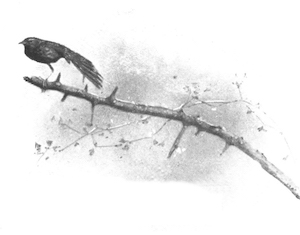
FOSTER MOTHER TREE PIPIT STRETCHING HERSELF AFTER HAVING FED YOUNG CUCKOO.
The bird makes no attempt whatever at nest-building, but deposits its eggs singly, as a rule in those of small birds, and allows the little dupes to hatch out and rear its young. From its similarity in appearance to a small hawk the ancients believed that in the winter it changed into one. They were also firmly convinced that young Cuckoos not only swallowed all the other chicks in the nests in which they were hatched out themselves, but, as a mark of ingratitude, finally devoured their foster-parents. Although this was, of course, quite wrong, the real facts of the bird’s life and career are quite as romantic, as we shall see presently.
Up to quite recently, people supposed that the female Cuckoo, when about to lay, watched the nest of some small bird until the owner left it in search of food, when she stealthily sat down and dropped one of her own eggs into the structure. Unfortunately for this theory, it would not hold good in the case of domed nests built by such species as the Common Wren and Willow Warbler, both of which are occasionally victimised. This puzzle has been satisfactorily solved by the discovery of the real facts. The Cuckoo lays her eggs upon the ground, and, picking them up in her bill, deposits them in the homes of birds whose own productions they will to some extent match in colours.
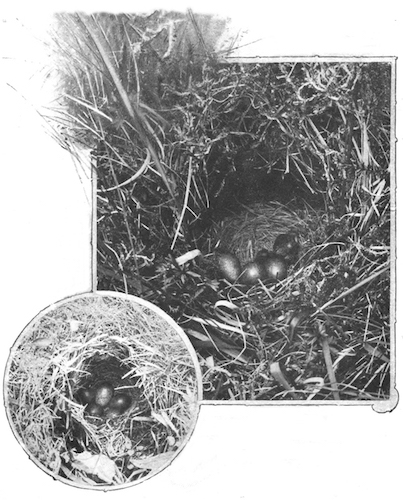
YOUNG CUCKOO IN MEADOW PIPIT’S NEST, BIRD’S OWN EGGS THROWN OUT ON TO EDGE OF STRUCTURE.
CUCKOO’S EGG IN MEADOW PIPIT’S NEST.
Cuckoo’s eggs vary very widely in point of coloration. They are usually reddish grey, mottled and spotted closely with darker markings of the same colour, or pale greyish-green marked with spots of a darker hue. I have met with them matching in colours those of the Meadow Pipit, Pied Wagtail, and Reed Warbler so closely that they were scarcely discernible except for their larger size, and a blue specimen has been found in the nest of a Hedge Sparrow.
Some naturalists are of opinion that a Cuckoo is able to lay an egg of any colour at will, whilst others favour the opinion that if an egg closely resembles in point of coloration those of the bird, say a Tree Pipit, in whose nest it has been placed, that young Cuckoo’s grandfather and grandmother were also reared by Tree Pipits.
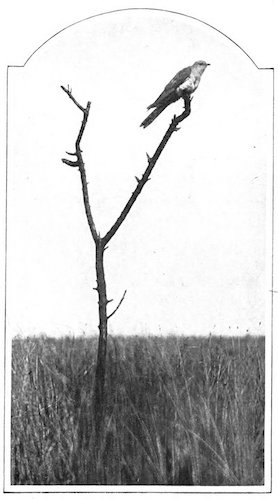
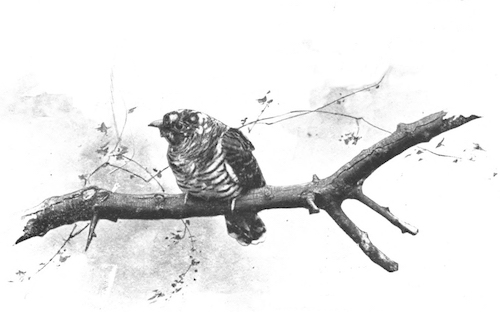
ADULT CUCKOO.
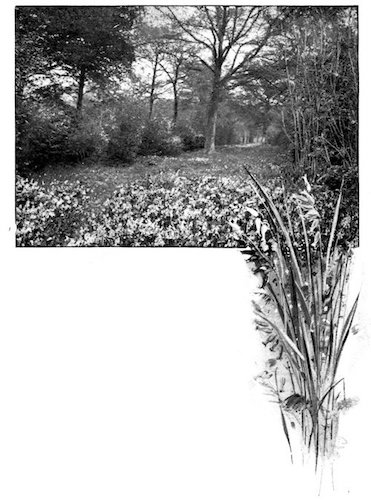
“COME AND HEAR THE CUCKOO SING. COME AND BREATHE THE BREATH OF SPRING.”
Another important fact which aids deception when trying to impose upon small birds is that a Cuckoo’s egg is only one-quarter the size of what might reasonably be expected from the dimensions of its layer. It is much heavier, however, than any other egg of its size, and has a thicker shell.
Competent naturalists have asserted that the Cuckoo lays as many as five eggs during a season, and although only one specimen as a rule is found in the nest of an intended foster-parent, as many as three may be met with, but whether deposited by the same individual or not, it is, of course, impossible to say. Hedge Sparrows and Robins are the greatest victims, but even the Jay, Wood Pigeon, and Carrion Crow have been successfully imposed upon.
YOUNG CUCKOO WAITING FOR ITS FOSTER-MOTHER WITH FOOD.
With a view to finding out whether the deceptive path of the bird that “tells its name to all the hills around” is a smooth one or not, some years ago I had four wooden eggs made and painted to resemble those of the Song Thrush. I tried my counterfeits upon several different species, such as Starlings, Song Thrushes, and Grasshopper Warblers, and deceived them straight away without the slightest trouble, but when I attempted to impose upon a Ringed Plover, whose eggs I found in a little declivity on a shingly beach, she detected the fraud at once, and tapping my dummy eggs with her bill, turned round and walked away in disgust.
In order to prove how easily some birds are duped, I may mention that two lady friends of mine have, for the last three or four seasons, taken a clutch of Starling’s eggs out of a hole in a stable wall, and replaced them by one common fowl’s egg, and that on each occasion the foster-mother has successfully hatched out a chick.
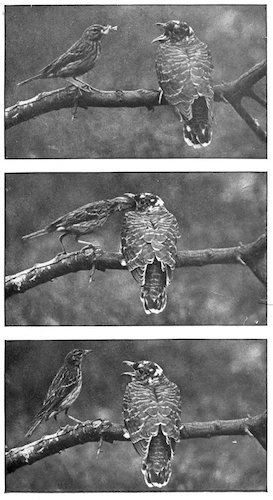
A STORY IN THREE CHAPTERS: A YOUNG CUCKOO AND HIS TREE PIPIT FOSTER-MOTHER.
The young Cuckoo arrives into the world without a scrap of down or the sign of a feather on its dusky, ugly little body. Very soon after it is hatched it begins to show signs of great restlessness and energy, endeavouring to throw out whatever else there may be in the nest in the shape of eggs or young. Nature has equipped the little monster well for its murderous task, by providing a hollow between its broad shoulders for the reception of its victims. It makes great efforts to get beneath whatever else is in the nest in which it has been hatched, and when it gets an egg or chick upon its back, with raised wings, head depressed, and a foot firmly planted on either side of the nest, it rears its burden and casts it out.
FOSTER-MOTHER TREE PIPIT COMING WITH FOOD FOR YOUNG CUCKOO.
This wonderful performance was first observed by the great Dr. Jenner of vaccination fame, and afterwards confirmed by the observations and wonderfully accurate pictures made by my friend Mrs. Blackburn. Curiously enough, her daughter, Miss Blackburn, found the Meadow Pipit’s nest from which her mother saw the rightful owners ejected by the young Cuckoo and also the nest belonging to the same species figured on page 3 of this work.
Sometimes two young Cuckoos are hatched out in the same nest, and then a great struggle takes place between them for possession.
Very odd things occasionally occur in regard to Cuckoo’s eggs. I have found one, perfectly fresh, covered over with moss and down inside a Hedge Sparrow’s nest wherein the bird had laid none of her own. I have known one lie untouched outside a Meadow Pipit’s nest, but whether left there by the layer or cast forth by the owner of the structure it is impossible to say.
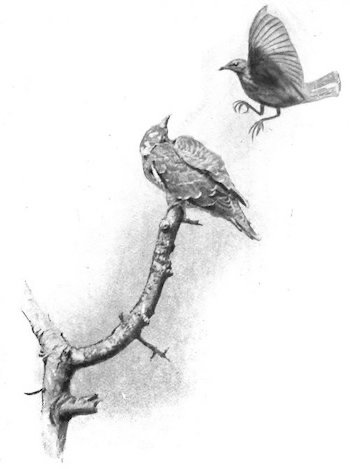
TREE PIPIT ABOUT TO ALIGHT ON YOUNG CUCKOO’S BACK WITH FOOD. PHOTOGRAPHED IN 1/500 OF A SECOND.
A short time ago a friend of mine found a Sedge Warbler’s nest near Gloucester with four eggs in it. The following day when we returned to the place the nest contained only three and a Cuckoo’s egg. As I wanted a photograph of a member of the species for the present work, I parted the thick sedge grass and, erecting my camera within a few feet, got everything ready and went into hiding beneath my apparatus. In less than two minutes she returned and, gazing into her home, suddenly grew greatly agitated and began to hammer the Cuckoo’s egg unmercifully with her bill. Fearing that she might break it before I secured a photograph, I jumped up and drove her away, at the same time calling my companion over to take care of the object of her resentment. Directly it was gone she assumed all her native gentleness of manner and sat down upon her own eggs quite happy.
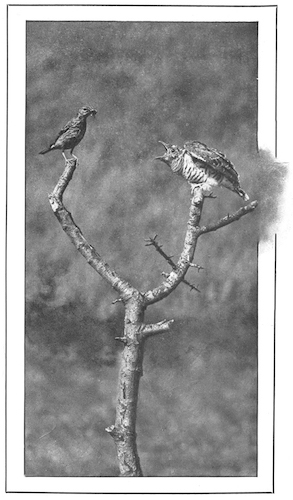
MORE, PLEASE!
Although young Cuckoos show so much sagacity in getting rid of any other occupants of the nest in which they have been hatched, they sometimes exhibit great stupidity in other directions. For instance, the young bird shown with his Tree Pipit foster-mother in the illustrations figuring in this chapter did not understand the alarm cry of the little brown bird at all. It did not matter however loudly she cried “danger” outside the nest up to a certain stage in his career, if he heard anything moving he shot up his head and opened his mouth very widely in request of food. Then, again, if a newly fledged Cuckoo happens to be resting on level ground and his foster-mother, say a Robin, Hedge Sparrow or Pied Wagtail, comes along with a supply of food, he has not the sense to accommodate himself to the stature of his wee parent, for, instead of lowering his great dappled head, he rears it as high in the air as he can, and the feeder has to stand on his shoulders, as shown in the accompanying photograph, and literally drop the food down his throat.
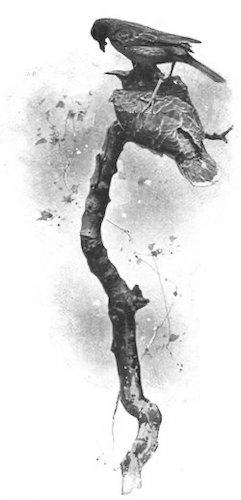
TREE PIPIT FEEDING YOUNG CUCKOO WHILST STANDING ON HIS SHOULDERS.
The food of adult Cuckoos is insectivorous, and consists largely of hairy caterpillars such as those of the Drinker Moth.
The Cuckoo sings upon the wing, and sometimes keeps up its vocal efforts all night long. It has been asserted that only the male cries “Cuckoo,” but this is not the fact, as females have been shot in the act of singing.
On the Yenisei its cry is “Hoo-hoo.”
Gilbert White, in his delightful “Natural History of Selborne,” says that some Cuckoos sing in D, some in D sharp, and some in C, and that the two former whilst performing together make a very disagreeable duet.
The notes of the bird are easily imitated by the human voice, and in the springtime I often amuse my friends by calling individuals into their gardens.
THE ROBIN.
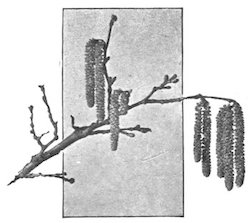
I love Robin Redbreast above all other birds. He is a bold, handsome fellow, and one of the sweetest songsters of the grove. When the Nightingale and the Blackcap have gone to their winter quarters in the faraway sunny South, and both the Thrush and the Skylark are silent, courageous Redbreast mounts to the topmost branch of some sodden, leafless tree and defiantly pours out his sweet, silvery notes.
Poets of all ages have noticed this peculiar characteristic, and one of them has expressed it very happily in the following lines:
“Each woodland pipe is mute Save when the Redbreast mourns the falling leafs; Now plaintively, in interrupted trills, He sings the dirge of the departing year.”
There can be no doubt that the conditions under which the bird sings help to rivet our attention upon its performance, just in the same way that the Nightingale gains some of its popularity by singing at night time when other woodland vocalists are silent, and the Skylark by soaring away up in the blue vault of heaven whilst pouring out its far-sounding music.
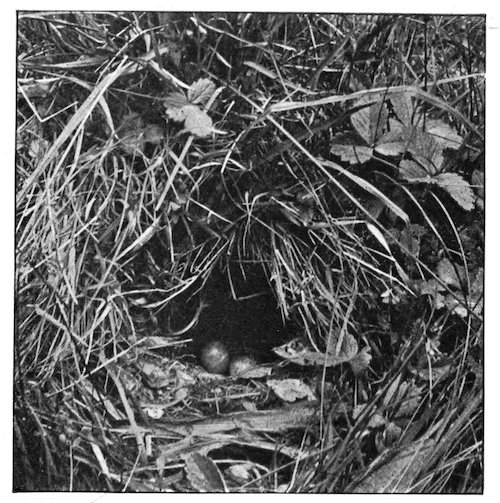
ROBIN’S NEST.
Cock Robin has received a great deal of poetic attention, and it is amusing to note how differently the bards have expressed themselves in regard to this familiar bird “that swells its little breast so full of song.” Some of them say it warbles, others it whistles, tootles, carols, chirps, sings, sobs, mourns, and so on.
Any boy or girl who has wandered through the woods in winter will at once recognise the truth and beauty of the following lines from Cowper’s “Winter’s Walk at Noon”:
“No noise is here, or none that hinders thought; The Redbreast warbles still, but is content With slender notes and more than half suppressed; Pleased with his solitude, and flitting light From spray to spray where’er he rests, he shakes From many a twig the pendent drops of ice, That tinkle in the wither’d leaves below. Stillness accompanied with sounds so soft Charms more than silence.”
Numbers of beautiful legends have been woven round the bird. For instance, its ruddy breast is supposed to be worn in memory of the day when Jesus was led forth from Jerusalem to be crucified, and the wee bird perched upon the Cross and “tried with all its little might to diminish the anguish of the crown of thorns.”
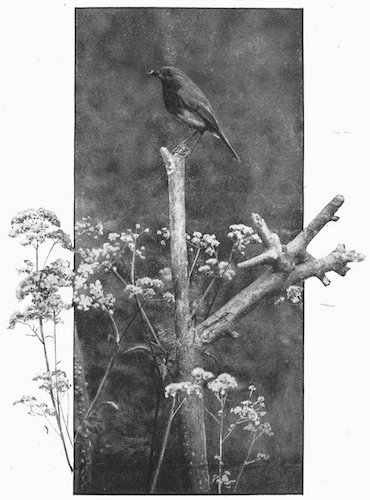
COCK ROBIN BRINGING FOOD FOR HIS CHICKS.
It was an old and popular belief that Robins covered over the bodies of dead men with leaves, hence John Webster’s ballad:
“Call for the Robin Redbreast and the Wren,[1] Since o’er shady groves they hover, And with leaves and flowers do cover The friendless bodies of unburied men”;
and the well-known one, “Babes in the Wood.”
Although Cock Robin is at all times a bold bird in defence of his rights, and at some seasons liable to be considered quarrelsome and spiteful, he undoubtedly has his good points. For instance, one has been known lovingly and diligently to feed his mate after she had sustained some injury to her bill which rendered her unable to peck for herself, and I have myself watched and even photographed a Redbreast in the charitable act of feeding a family of young Thrushes in the nest whilst their mother was away searching for very difficult-to-find food during a cold, dry spring morning.
Male Robins differ from the females only in the facts that they are slightly larger and have rather brighter orange-red breasts. These differences, however, are so very trifling that it is by no means easy for even the practised eye to notice them.
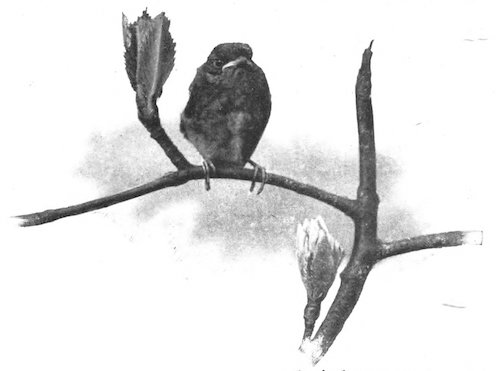
YOUNG ROBIN IN ITS FIRST COAT OF FEATHERS.
Robins commence to breed in March, and make their nests of bits of dead grass, leaves, and moss, with an inner lining of hair. At the beginning of the season building operations are conducted in quite a leisurely way, occupying as much as a fortnight, but later on no time is lost, and nests are made in a much shorter period.
Last spring I watched a female, quite unaided by her mate, who was singing very loudly morning, noon, and night in my garden, build a nest in three days. One morning she carried dead leaves and moss to her home five times in five minutes!
Although generally selecting holes in banks and walls where a brick or a stone has fallen out, this species is famed for its apparent love of odd situations in which to breed. I have found Robins’ nests in old tin cans, tea-pots, coffee-pots, kettles, jam-jars, biscuit boxes, cocoanut husks, fragments of bottles, and clock cases, and have seen them in bookcases and other places inside the much-used rooms of dwelling-houses.
Robins lay five or six eggs, as a rule, although as many as seven, and even eight, are occasionally found in one nest. They are white or light grey, blotched and freckled with dull light red. Sometimes the markings join each other nearly all over the shell, and at others they are collected round the larger end.
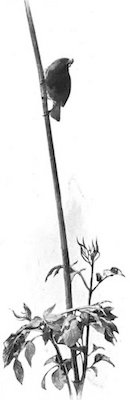
FEMALE ROBIN BRINGING FOOD TO HER YOUNG.
Young Robins, when they grow their first coats of feathers, do not have red breasts like their parents, but are dressed in varying shades of brown that render them very difficult to see when sitting still, amongst the lights and shades of a hedgerow. Directly they have donned their second coats of feathers, which happens in July and August, and become like their parents in appearance, they commence to try to sing. It is said that when they have been bred near Nightingales they borrow notes from that sweet-voiced bird, and introduce them into their own songs. I can readily believe this, because I have heard a Redbreast imitate the song of a Sedge Warbler so well that I was completely deceived until I saw the vocalist.
It is unnecessary to describe a Robin’s song, because almost everyone has an opportunity of hearing it, and seeing the bird at the same time. Its call and alarm notes, however, are frequently uttered when the creature is not visible. The former is a rapidly repeated metallic sounding tit-tit-tit, and the latter a plaintive, long-drawn chee, generally uttered when some intruder is near the nest.
The species feeds principally upon insects, and is especially fond of spiders, which are sought for in the cracks of old walls, mossy banks, and on the bark of trees. All boys and girls who have read “Pilgrim’s Progress” will remember how Mercy wondered and Christiana was disappointed to learn that Robins fed upon spiders instead of breadcrumbs, and the lesson Interpreter drew from it.
Robins differ individually in character almost as much as human beings. I have been vigorously attacked by a courageous mother bird of this species because I dared to look at her young ones in the nest. On the other hand, some individuals are quite timid and shy, and will quickly put a safe distance between themselves and the most harmless intruder.
Occasionally one meets with a Redbreast living a bachelor or old maid existence at some secluded farmhouse high up amongst the hills or on some lonely treeless island round our coast.
I have a male member of the species in my garden that always superintends my digging operations, and varies his search for upturned grubs by standing on a clod within a few inches of my spade and singing me the sweetest of little songs. May he long live to do so!
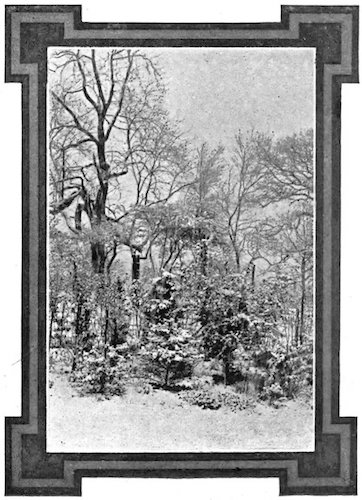
THE BLACKBIRD.
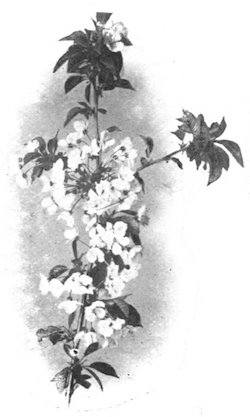
Who does not know and love the Blackbird with his sable coat, orange bill, and peculiar habit of erecting his tail when he alights? In the North of England the bird still enjoys its old name of Ouzel, and in Scotland it is called a Merle.
The hen differs somewhat in her appearance from the cock in being of a dark, rusty-brown colour instead of “so black of hue,” as Shakespeare has it of her mate.
This species is common in gardens, orchards, shrubberies, hedgerows, and woods all over the British Islands. I have even met with it breeding in a little garden close to the Atlantic in the outermost island of the Hebridean group and within sight of lone St. Kilda.
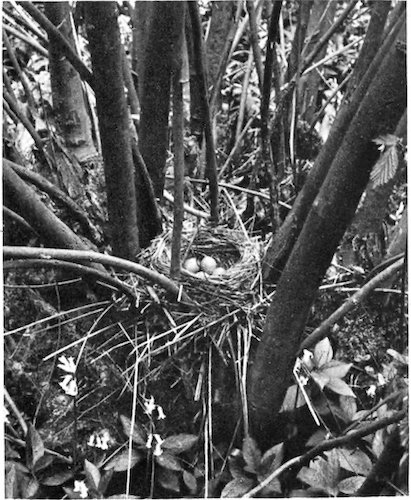
BLACKBIRD’S NEST.
Its nest is placed in isolated thorn bushes, evergreens of all kinds, hedges, in trees sometimes at a considerable elevation, in holes in dry stone walls, in sheds, and even amongst grass upon the level ground. Last spring I saw two in the grass, one inside a thrashing machine, and another joined to the nest of a Song Thrush on a wooden bar inside a cattle shed, and all of them were within a few yards of suitable hedgerows. The structure is composed of small dead twigs, roots, dry grass, and moss intermixed with clay or mud, and lined with fine, dry grass.
The eggs, numbering from four to six, are of a dull bluish-green, spotted and blotched with reddish-brown and grey. Occasionally specimens may be met with having a few hair-like lines on the larger end. The eggs vary considerably in regard to size, shape, and coloration.
Blackbirds breed from March until June, July, and even August, and have been known to rear as many as four broods in a single season. Young birds of the first brood sometimes help their parents to feed the chicks of a second family.
The glory of an Ouzel’s song consists not so much in its variety and compass as in the rich, flute-like melodiousness of its tones and the easy, leisurely manner of their delivery. They are readily distinguished from the hurried, vehement, hope-inspiring notes of the Song Thrush by their mellowness, stately delivery, and touch of melancholy.
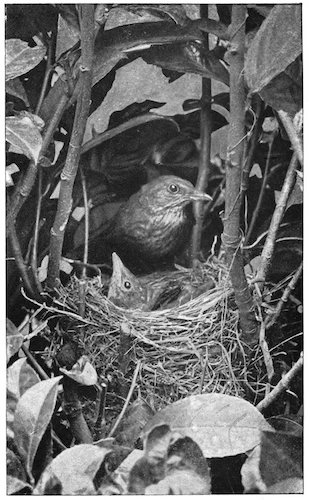
FEMALE BLACKBIRD ADMIRING HER SINGLE GIANT CHICK
Blackbirds sing principally during the morning and evening, but as a rule do not commence quite as early or go on so late as Throstles. A warm spring shower will, however, always draw the best and sweetest music from the Merle at whatever hour of the day it may fall. This species loves to sing from a dead, bare bough, standing well above the surrounding foliage, but occasionally holds forth on the wing, and I have heard one sing habitually from a housetop in the Outer Hebrides.
Although the male Blackbird helps the female to feed their nestlings, this does not put a stop to his vocal efforts. He frequently carols a few notes near the nest directly after he has delivered his catch of worms and grubs, and this fact may, to some extent, account for the chicks commencing to sing three months after they have been hatched.
Some members of this species will sing off and on as late as the end of July, and commence again as early even as September.
The Blackbird, when heard at very close quarters, may be discerned to imitate the notes of other species, as I have discovered when lying in hiding trying to obtain phonographic records of its song. It is said to be able to reproduce the crowing of a cock or the cackle of a laying hen, and even snatches of popular songs.
The bird’s call note is a tisserr, tack, tack, and its well-known ringing alarm cry, spink, spink, spink.
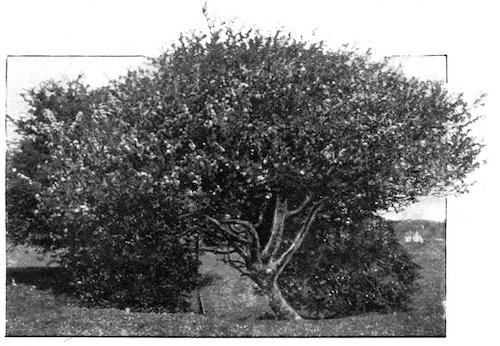
THE TWITE OR MOUNTAIN LINNET.
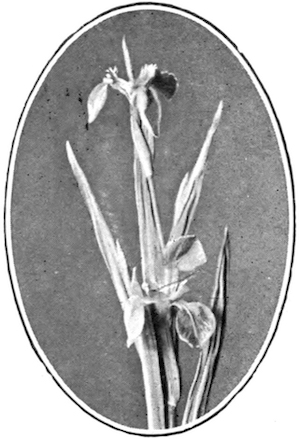
I have had many excellent opportunities of studying this wee songster whilst staying in the Outer Hebrides, where it is far more numerous than in any other part of the British Isles. In general appearance, flight, and habits it closely resembles its relative, the Common Linnet, but may be distinguished from that species by the fact that it has a longer tail and more slender form, a yellow beak, and lacks the crimson colouring on its head and breast.
The female is distinguished from the male by the fact that she is lighter-coloured, and has no crimson on her rump.
Young Twites resemble their mother in appearance.
The song of the cock is a very pleasant little performance, somewhat similar to that of the Linnet, although not equal to it either in strength or sweetness. I have frequently heard the bird singing on the top of a stone wall within a few feet of his mate sitting on her nest in the honeysuckle shown in our illustration. He occasionally varied this kind of exercise by pouring forth his music whilst fluttering through the air from one side of the garden to the other.
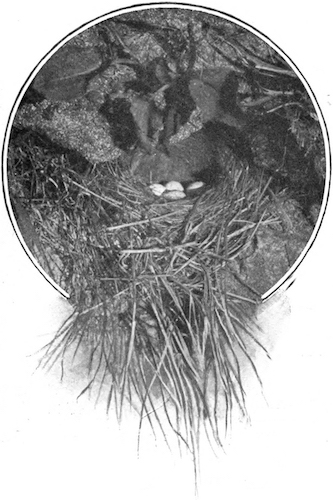
TWITE’S NEST AND EGGS.
Numbers of male Twites roost every night during the spring amongst some stunted alder bushes growing close to the house of an old friend of mine in the Western Isles, and enliven the whole place each fine evening by a volume of twittering sound.
The call note of the species is somewhat shrill, and sounds like twite, from which the bird has derived its name.
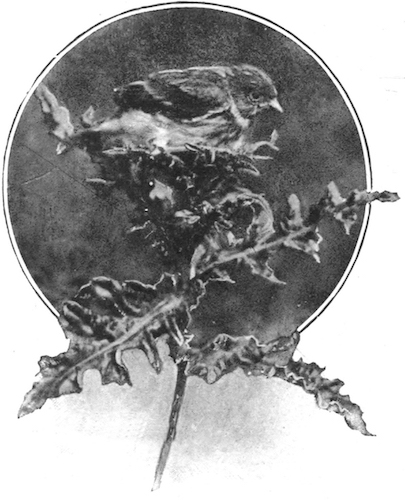
YOUNG TWITE JUST FLEDGED.
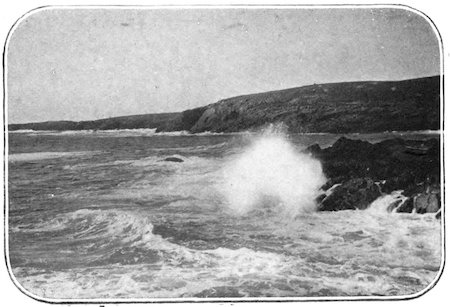
It is said to breed in the North of England, but although I have met with the bird in great flocks, both in Yorkshire and Westmorland, during the autumn, I never discovered its nest upon the Fells. I have found it breeding on several Highland mountains, but as already stated, most numerously in the Outer Hebrides. How abundant it actually is in the Western Isles may be gathered from the fact that I have found no fewer than seven nests in the course of a zig-zag walk of a mile or so from the house of one friend to that of another. As an indication of the wide variety of sites chosen by the Mountain Linnet—as the bird is sometimes called—for its little home, I will mention the places in which I discovered the above-named nests. Two were in holes in a dry stone wall, the one containing eggs, figured in our illustration, at the top of a stone wall and sheltered by a piece of overhanging turf, which had been placed there to increase the height of the fence; one in a tuft of heather growing close to a half-buried rock; one in a furze bush where a Common Linnet’s nest might have been expected; another in a stunted gooseberry bush; and the last in an ivy geranium growing inside a small greenhouse, to which the birds gained entrance through a broken pane in the roof. On more than one occasion I have found a nest, containing eggs or young ones, under an overhanging tuft of grass growing from a crevice of rock on the small piece of North Uist Coast shown in the tailpiece to this article.
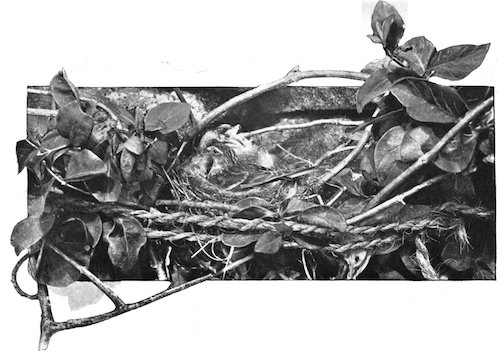
TWITE ON NEST IN HONEYSUCKLE TIED AGAINST A STORM-SWEPT HEBRIDEAN GARDEN WALL.
A Twite’s nest sometimes takes a long time to build. I remember one that occupied a whole fortnight from foundation laying to completion. It is made of fibrous roots, dead grasses, and moss, with an inner lining of feathers, fur, or hair.
The eggs number five or six, of a light bluish-green or bluish-white ground colour, marked with reddish-brown and dark brown spots and streaks.
THE WOOD WREN.
The Wood Wren, or Wood Warbler as it is sometimes called, measures just over five inches in length. On its upper parts it is olive-green tinged with yellow, except in the case of its wings and tail, which are dusky. The chin, cheeks, throat, and breast are yellow, and under parts white. A line of bright yellow runs from the base of the bill over the eye. The bird may be distinguished from its relative, the Willow Wren, by its larger size, broader yellow band over the eye, greener upper parts, and whiter abdomen, also by its longer wings. Its nest is also a safe guide to correct identification, as will be shown presently.
The female is similar to the male in her appearance.
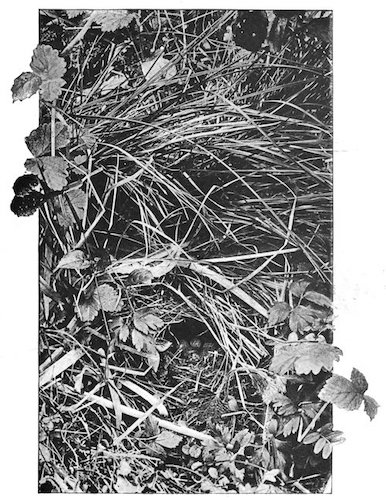
WOOD WREN’S NEST AND EGGS.
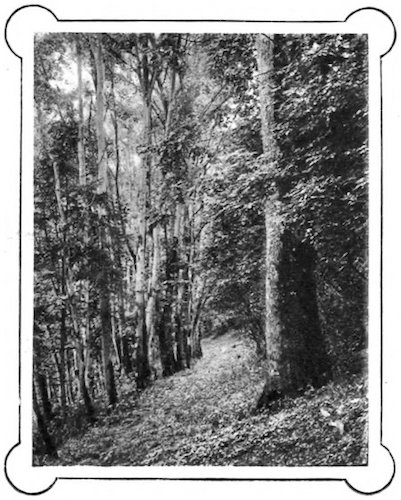
This species loves woods containing tall beech and other trees, and although of somewhat local occurrence, may be met with in nearly all suitable parts of England and Wales. It is rarer in Scotland and Ireland. It is difficult to study, except at the nest, on account of its habit of hunting for insects amongst the leaves near the tops of trees. However, its plaintive call note and very characteristic song are constantly being uttered, and can never be mistaken for those of any other bird.
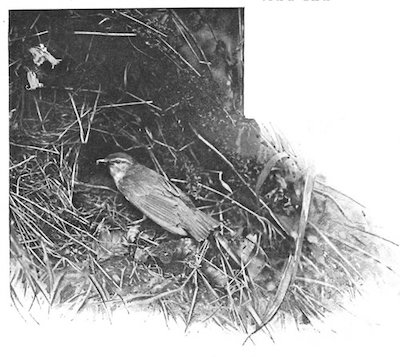
FEMALE WOOD WREN ABOUT TO ENTER NEST.
Its nest is built on the ground amongst thick herbage, is oval in shape, and domed. The outside consists of dry grass, dead leaves, and moss, with an inner lining of fine dead grass and horsehair. Although in general appearance the structure is almost exactly like those of the Willow Wren and Chiffchaff, it may always be distinguished with certainty from them by the absence of feathers.
The eggs, numbering five or six, are white, thickly spotted all over with dark purplish-brown and violet-grey.
The song, although short, is clear, loud, sweet, oft repeated, and sounds something like sit-sit-sit-sit-sit-see-eeeeeze. Each of the opening notes of the song is uttered more rapidly than that which preceded it, until they develop into a kind of trill, rising in pitch all the time, and finally end in a long, shaky, thin one. The melody is accompanied by rapid vibrations of the wings and tail, as if the loud voice shook the body of the wee singer.
The call note is a plaintive twee or tway tway, frequently used as a kind of alternative to the song described above.
Although such a small bird, the Wood Wren is very courageous at the nest. The individual figured in our illustration repeatedly attacked my hand with bill and wings when I attempted to disturb her in her maternal duties. She was very angry with me when the photograph was secured, and incidentally it shows the great length of wing in this species.
This Warbler is a late arrival upon our shores, coming about the end of April and departing again in September. It lives entirely upon insects.
THE RING OUZEL.
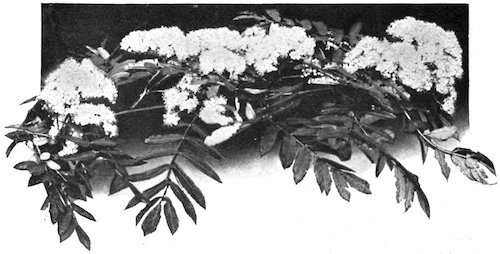
Mountain solitudes, with lonely crag-strewn glens and rough, deep gulches, “far removed from the busy haunts of men,” form the home of this brave, independent bird. If a few stunted rowan or whitethorn trees peep shyly from sheltered corners and crevices here and there the better will the situation be liked.
The Ring Ouzel arrives in this country in April and quits our shores again during September and October. It is about the same size as the Common Blackbird, and behaves more or less like a member of that well-known species. In colour it is dull black with an edging of dark grey to the feathers. Across the chest stretches a broad crescent-like band of pure white. The female is rather lighter coloured, and the white gorget on her breast is neither so broad nor so pure.
This species breeds in the West of England, in the six northern counties, and in suitable parts of Wales, Scotland, and Ireland.
Its song consists of a few clear, powerful notes that would sound out of place if heard anywhere but amongst the bird’s wild, lonely surroundings. During a calm spring evening the plaintive, lonesome notes of the Mountain Blackbird, as this species is sometimes called, can be heard at a great distance because the singer has a habit of delivering its music from a high boulder or cairn.
The alarm cry is a loud tac-tac-tac, which is uttered with great volubility and vehemence when the nest containing young ones is approached.
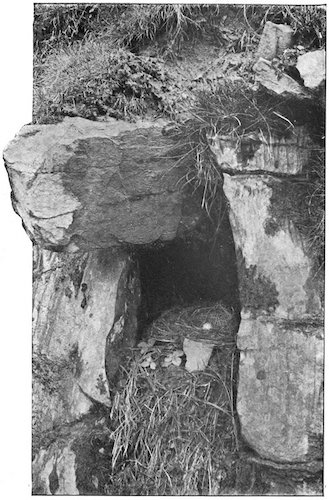
RING OUZEL’S NEST.
I have found the nest of the Ring Ouzel, which is a very similar structure to that of the Blackbird, amongst long heather growing upon a steep bank by a burn-side, amongst rocks in the face of small broken cliffs, under sheltering stones projecting from the ground, on steep hillsides, and in holes in old stone walls. I once discovered one amongst rushes on flat ground, but this is an exceptional kind of situation.
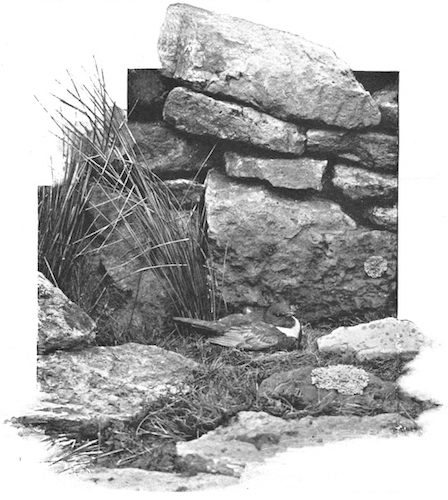
FEMALE RING OUZEL COVERING YOUNG IN NEST DURING A SHOWER OF RAIN.
Although a comparatively shy, wary bird under ordinary circumstances, the Ring Ouzel is possessed of great courage, which it rarely fails to display in the defence of its young. I have on more than one occasion watched members of the species driving stray Kestrels away from the neighbourhood of their nests. They will fly close round the head of a human intruder, uttering discordant cries if their chicks are molested.
The eggs are very similar to those of the Common Blackbird, bluish-green in ground colour, marked with reddish-brown spots. The markings are, as a rule, however, larger than those on the eggs of the above-mentioned species.
Young Ring Ouzels have no white collar or gorget on the breast. Their feathers are brownish-black, edged with dirty white, and when they sit still on a grey limestone or under a ledge they are, in consequence, difficult to see.
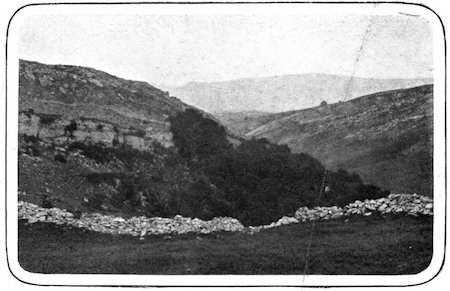
THE TREE PIPIT.
We have three Pipits breeding in the British Islands—viz. the Meadow, Rock, and Tree, which are all very well named according to their respective habits. Owing, however, to, their similarity of general appearance, the two latter species are frequently mistaken for the first, and described as Titlarks.
The plumage of the Tree Pipit is sandy brown in colour, streaked with dark brown above, light buff with streaky dark brown spots on breast, and dull white on the under parts. It is rather larger than the Meadow Pipit, its colours are brighter, and it has a curved hind claw which is shorter than the toe from which it springs, whereas in the case of its relative the Meadow Pipit the hind claw is long and nearly straight. This shows a wonderful provision of Nature. The first-named bird is wholly migratory, and perches on trees, hence the short curved claw must render it very useful for grasping branches; the second is only partially migratory, great numbers staying in this country throughout the year, and its long hind claw must prove very advantageous as a snowshoe during the winter.
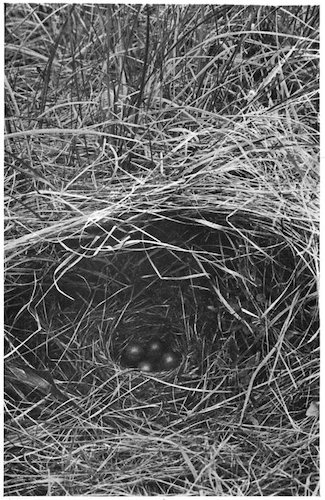
TREE PIPIT’S NEST AND EGGS.
As its name implies, the species under notice frequents parts of the country where trees grow, preferably in clumps with grassy glades between.
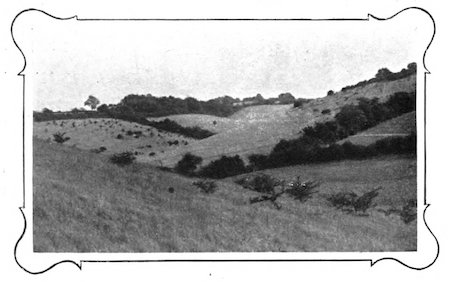
The male Tree Pipit is a very sweet singer, and makes his music more attractive by the manner in which he delivers it. He alights generally on the topmost branch of some favourite tree, from which elevation he mounts the air to varying heights of from twenty to sixty or seventy feet by a series of rapid wing beats, commences to utter his song with a chee, chee, chee, chee, when he has reached a sufficient altitude for his purpose, and delivers it whilst he is gliding down slowly in a kind of half-circle through the air with outstretched wings, expanded tail, and dangling legs.
When in full song this bird is a most energetic vocalist. I timed one upon my watch last spring, and found that on an average he sang five times per minute, and three times out of the five the music was delivered upon his favourite perch. The perching song only lasted two or three seconds, as a rule, whereas the flying one took from five to seven seconds—according to the height from which the bird started—to get through.
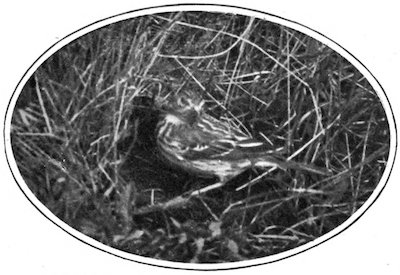
FEMALE TREE PIPIT ABOUT TO ENTER NEST.
The song of this species has been likened to that of the Canary, and in some respects it does undoubtedly resemble it. It commences with the lark-like notes already mentioned, and ends with a ringing tsee, tsee, tsee, or whee, whee, whee.
Tree Pipits vary greatly in the quality of their music. One of the very finest singers I ever heard was on a hillside near to Builth Wells, in Wales. The call note is a trit, trit, or t’sip, t’sip.
It has been said that the male birds of this species are seldom found living within hearing distance of each other during the breeding season.
The nest is built on the ground, and is generally sheltered by a tuft of herbage growing on a grassy bank. It is composed of rootlets and moss with an inner lining of fine grass and hair. The eggs number from four to six, of very variable coloration. Some are dull white, so closely mottled and spotted with dark brown as to almost hide the ground colour, whilst others have the greyish-white ground colour tinged with purple, and are spotted and clouded with purple-brown and purple-red.
The Tree Pipit arrives upon our shores in April and leaves again in September and October.
THE WOODLARK.
The Woodlark is not nearly so common or widely distributed as the Skylark, and is frequently thought to be heard and seen when the bird under observation is really only a Tree Pipit.
It is smaller than the Skylark, and has a much shorter tail and more conspicuous crest. Although of somewhat similar coloration, it has a distinct light yellowish streak running over each eye and meeting at the back of the head; the breast spots are more distinct; and its flight always appears to me to be more undulatory.
The Woodlark is a shy creature, but had it not been for the very wet and benumbingly cold weather prevailing at the time I figured the young one shown in our illustration on page 56—which could fly quite well—I feel sure that I could have photographed one or both of the parent birds feeding it.
This species is considered by many people to come next to the Nightingale as one of Nature’s Carol Singers. Its voice is certainly sweeter in tone, though it lacks both the power and variety of that of the Common Skylark. Yarrell says that “its soothing notes never sound more sweetly than while the performer is mounting in the air by wide circles, or, having attained the summit of its lofty flight, is hanging almost stationary overhead.”
That is exactly how the bird’s delightfully flute-like notes affect me, although many people find an element of sadness in them. Burns, for instance, considered the Woodlark’s song a mixture of love and sorrow, and exclaimed:
“For pity’s sake, sweet bird, nae mair Or my poor heart is broken.”
It sings whilst perched upon a tree, and sometimes its clear, tender notes may be heard ringing out during a fine summer’s night.
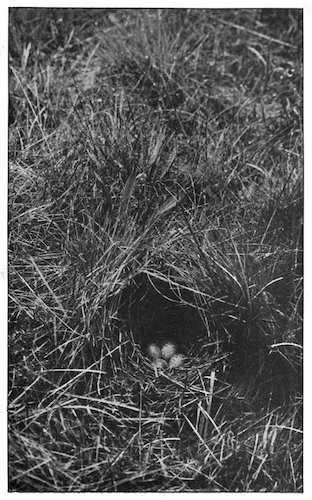
WOODLARK’S NEST AND EGGS.
The call notes of the species are a very musical double one, sounding something like lu-lu and tweedle, weedle, weedle, uttered on the wing.
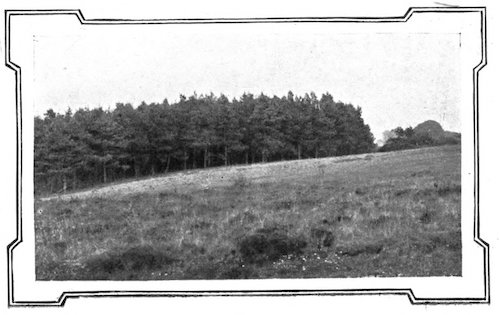
The Woodlark, like the Tree Pipit, although roosting upon the ground, procuring its food and rearing its young there, must have some kind of timber, whether it be great belts of fir, with pastures and dry, heather-clad commons between, or bare hillsides with scattered clumps of oak and bushes here and there to make its home amongst.
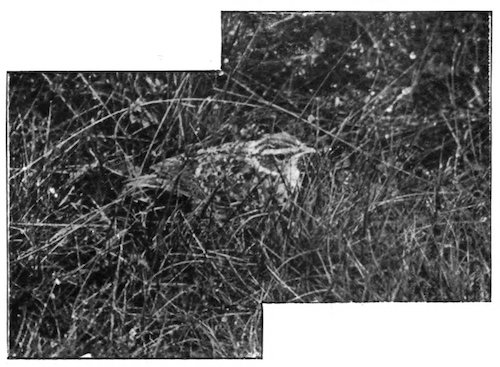
NEWLY FLEDGED WOODLARK.
It is said to breed most numerously in the southern counties of England, occasionally in the north, and rarely in Scotland and Ireland. Its nest is very similar to that of the Common Skylark, but as a rule shows a little better workmanship, perhaps, in its construction. It is situated under a tuft of grass, in heather, or at the foot of a bush. Sometimes it is simply placed in a little hollow on ground which does not grow sufficient grass to form any kind of shelter or hiding.
The eggs, numbering four or five, are reddish-white, light brownish-yellow, or greenish-white in ground colour, thickly spotted and speckled with dull reddish-brown and underlying markings of grey.
This species commences to breed in March and rears two broods during the season. It resides with us all the year, but is subject to local movement.
THE COMMON WREN.
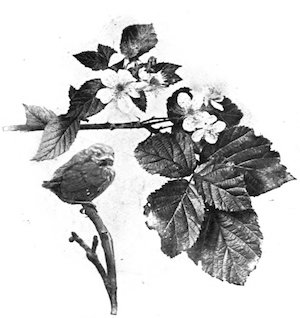
Everybody knows and loves the wee brown Wren with its active, pert ways and cheerful rattling song, which is heard nearly the whole of the year round.
“Jenny” or “Kitty” Wren, as the bird is often called, is to be met with almost everywhere by sea-shore and riverside, in the cultivated garden and on the barren waste, along the plain and on the mountain side, in thick woods and treeless deserts where there is little else than rocks for it to alight upon. Whether the sun be shining, flowers blooming, and food plentiful, or the ground be wreathed in a thick blanket of snow and the world a picture of desolation and a place of hunger, the little bird is ever cheerful, active, and gay. As the poets have it:
“When icicles hang dripping from the roof Pipes his perennial lay.”
Its song is surprisingly loud and clear for such a tiny musician, especially when heard only a few inches away, as I have heard it on several occasions whilst crouching inside some of my hiding contrivances waiting to secure a photograph of some shy bird or beast. It is delivered both upon the wing and when the musician is at rest upon a branch or stone.
A Wren’s call notes sound something like tit, tit-it, tit-it-it, tit-it-it-it, uttered so quickly as to resemble the winding-up of a clock.
Even in the depths of the very severest winter weather, “Jenny” Wren refuses to be “pauperised” like the Robin, the Blackbird, and the Song Thrush, and disdaining the help of man, hunts all day long for its own support in a spirit of hopeful independence. It does not matter whether it is an old moss-grown stone wall, a stack of loose firewood, or a shrubbery, in and out goes the little nut-brown bird from cold grey morn till glooming eve, examining every crack and cranny for some lurking morsel of insect life.
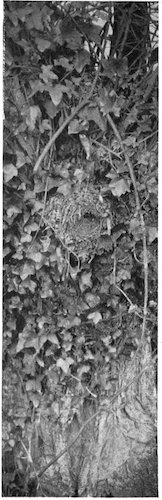
WREN’S NEST AMONGST IVY GROWING ON THE TRUNK OF A TREE.
It is strange how such an innocent and altogether praiseworthy little bird should have come to occupy such an unenviable position in bird folklore. The common names of this species in most European languages assign kingly dignity to it, and it obtained kingship of all the birds by a mean kind of trick. A parliament of birds agreed that the one that could fly highest should be king. The Eagle easily mounted to the greatest height, but when he had reached it a little brown Wren that had cunningly hidden itself on his back fluttered a little higher, and by this piece of deceit gained the much-coveted honour. Whether for this or some other equally supposed evil deed, the poor bird used to be hunted in our country every Christmas Day by boys and men armed with sticks, and its body publicly exhibited the following day whilst money was begged to bury it.
Although the Common Wren is double brooded and rears from four to eight chicks twice each season, the stock never seems to increase much from one year to another. Nobody knows clearly what becomes of all the birds. Of course, natural death must claim a certain number of victims, and I have no doubt that both Owls and rats secure many individuals whilst they are asleep in holes in the thatches of ricks. I have also found several frozen to death during very severe weather in the winter. In order to avoid this last calamity the birds resort to a very ingenious method of roosting. Although they never go in flocks by day, eight or nine members of the species will congregate together in one hole at night, and by a combination of their natural warmth sleep in snug safety.
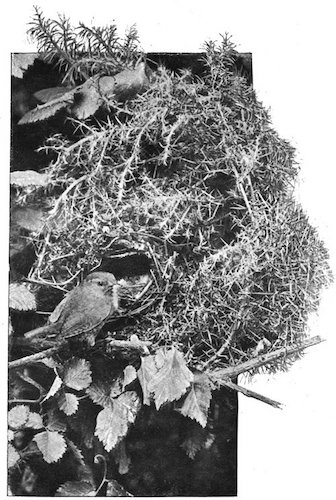
WREN ABOUT TO ENTER NEST WITH FOOD FOR CHICKS.
A Wren’s nest is very large for the size of the builder, is oval in shape, has a domed top, and a small entrance-hole in front. The bird is famous for the number of nests it builds and never occupies with either eggs or young. These structures, which are not finished inside by a lining of down or feathers, are supposed to be built by the males, and are called “cocks’” nests. Nobody knows with any degree of certainty why they are built. It has been suggested to roost in during cold winter nights, but careful investigations have convinced me that there is nothing in this theory.
Boys and girls have an idea that if they thrust an inquiring finger ever so deftly into a Wren’s nest the bird is sure to discover the fact and desert. Without wishing for one moment to do poor “Jenny” an ill turn by destroying this wholesome fear and encouraging investigation, the truth must be told. There is really nothing in the theory. If the structure be deserted, in all probability it is a “cock’s” nest, and was never intended to be anything else by its builder.
Wrens build in all kinds of situations—amongst ivy growing upon walls and round the trunks of trees, in the thatches and sides of ricks, in holes in walls, in banks amongst rocks, in hedges, amongst the rafters of barns, and even in coils of old rope and disused garments hanging up in sheds.
When the nest is built in a mossy bank the outside is generally made of moss; when in the front of a hayrick it is made of straws; and when amongst a few slender twigs sprouting from the place where some large bough has been sawn from the trunk of a tree, of dead leaves. These studied attempts, for such they would seem, at concealment do not, however, always hold good, for I have occasionally found one made of moss in the side of a hayrick.
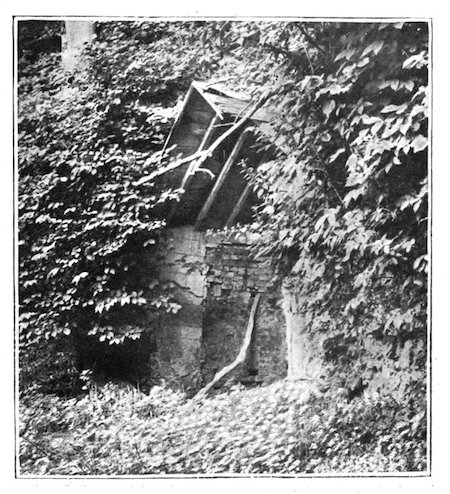
“Jenny” Wren is a very industrious builder. One day I was resting inside an old tumble-down summer-house built into a steep hillside in a Surrey park, when, to my consternation, I saw a big black feather coming straight as a partridge towards me. There was not a breath of wind blowing at the time, and the whole thing struck me as being most uncanny. Presently it stopped in a little bush, and I saw a wee brown wren behind it. The mystery was at once explained. I sat perfectly still, and in a few moments she brought the erstwhile awesome feather into the summer-house, and after considerable difficulty managed to get the awkward piece of furniture through her tiny front door. She brought along another and another with surprising speed, and before many days passed she had laid six white eggs which were spotted with brownish-red.
THE GRASSHOPPER WARBLER.
The Grasshopper Warbler is a little brown bird of about the same size and general appearance as the familiar Hedge Sparrow, but with the strangest voice and manners. It arrives in this country about the middle of April, and takes its departure again in September.
It does not appear to matter much whether the country where this species breeds be wet or dry, so long as there is plenty of dense cover in which it can hide and skulk about mouse-like and unseen. It is a great lover of old haunts, and in the absence of accidents will return season after season with the utmost regularity to some favourite clump of gorse growing on a sandy common or to an ancient reed-bed in the middle of a water-logged marsh. It is very vigilant, shy, and timid, and the slightest disturbance sends it instantly into hiding amongst the thickest vegetation it can find.
Upon his arrival in the spring the male bird commences his queer, shrill song, which sounds something like that of a grasshopper, hence the popular name given to the species.
Whilst living in a house-boat on the Norfolk Broads, studying Nature, I have had many excellent opportunities of observing the habits of this interesting bird, and have often heard it singing at night when the stars were reflected on the dark, still water around me and not a breath of wind stirred the balmy air. The best time of all, however, to hear a Grasshopper Warbler in full song is at sunrise. When the first gleam of rosy light tints the dead brown reeds with coppery red and dewdrops twinkle on every blade of grass, the bird mounts to the topmost twig of some stunted alder bush or blade of sedge, and standing quite still, with widely opened mouth and quivering body, pours forth his strange song in one incessant stream. Whilst the music lasts the head is turned from side to side, and it is this action which appears to give it a ventriloquial effect.
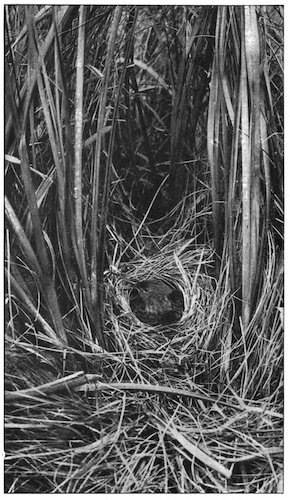
GRASSHOPPER WARBLER ON NEST.
If the bird be disturbed it instantly ceases to sing, and dropping stealthily into the undergrowth waits in silence until the danger has passed; then it recommences.
When the singer is not seen, the exact locality from which the sounds are proceeding is very difficult to discover. This arises from two facts—the shrillness of the tones, as in the case of a mouse squeaking when running about amongst grass, and the movements of the head already mentioned.
The sound, although somewhat similar to that made by a grasshopper, is much more sustained, and always appears to me far more machine-like. In fact, it is known in some parts of the country as the “Reeler,” in recognition of the fact that its notes resemble the sounds made by a reel used during the last century by hand-spinners of wool. Once the bird has been heard, its song can never be forgotten or mistaken for that of any other British Bird. Its call note is a sharp tic, tic.
The Grasshopper Warbler builds upon the ground, or very near to it. Its nest is well hidden, and is composed of dead grass and bits of moss, with an inner lining of fine, fibrous grass.
The eggs, numbering from four to seven, are of a pale rosy-white ground colour, very thickly spotted and speckled, especially at the larger end, with reddish-brown.
The bird approaches and leaves its nest in the most mouse-like manner. I have frequently taken it for one running through the rough matted grass, even when I knew the exact whereabouts of its home which I was approaching.
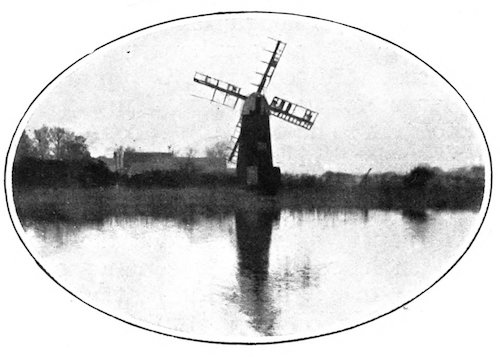
THE SKYLARK.
It seems almost superfluous to give a word of description concerning this well-known and almost universally distributed song bird. The upper parts of the Lavrock, as it is sometimes called, are of varying shades of brown, the darkest being in the centres of the feathers, and the lightest on their edges. The under parts are pale straw colour, tinged in parts with brown and spotted on the breast with a dark hue of that colour. It is about seven inches in length, and, as most of my readers will have noticed, has a greatly elongated hind claw. This interesting provision of Nature acts the useful part of a snow-shoe during severe weather in the winter.
Although it leaves its higher breeding grounds in the autumn this species stays with us all the year round, and has its numbers greatly increased by migrants arriving from the Continent.
The Skylark breeds in cultivated and uncultivated districts alike throughout the country. I have found its nest within a few yards of the open Atlantic and at an elevation of nearly two thousand feet above sea-level.
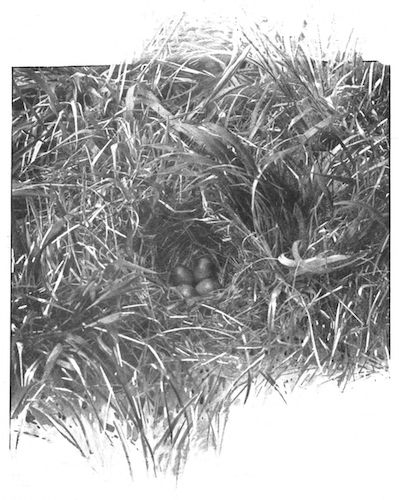
SKYLARK’S NEST AND EGGS.
The nest is placed on the ground in a slight hollow scratched out by the bird under tufts of grass, ling, heath, in corn, and amongst the sun-baked clods of fallow fields. It is made of grass rootlets and horsehair—frequently nothing but the first-named, used sparingly with the slenderest blades forming the inner lining. I have found larks’ eggs from April until the end of July. They number four or five, of a dirty white ground colour, occasionally tinged with olive-green, thickly speckled and spotted with olive-brown and underlying markings of brownish-grey.
The sprightly song of the Skylark is probably better known and remembered by most people than even the appearance of the familiar little brown bird itself. Poets of all ages have praised it in their verse, but nobody has ever excelled Shakespeare’s golden line:
“Hark! hark! the lark at heaven’s gate sings.”
In a moderate breeze the Lavrock rises almost perpendicularly, but during a calm in circles, and with rapidly beating wings pours out his loud, joyous song until he sometimes reaches an altitude of a thousand feet or more. Some people say that the bird soars until it becomes invisible, but I have never in all my life heard a Skylark when I could not see it. However, it is only right to confess that I am gifted with abnormally strong eyesight. He continues to sing upon his descent, but in a somewhat altered tone, until approaching the ground, when his carol suddenly ceases, and with closed wings he drops like a stone to the earth.
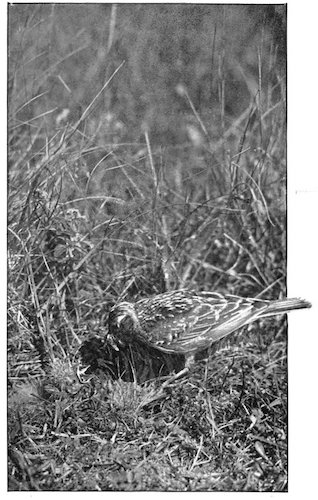
MOTHER SKYLARK FEEDING CHICKS.
Early in the season Larks rise but a small height in the air, and sing only for a brief period; but in the full tide of their joy they pour out their music for six, seven, and even ten or fifteen minutes without ceasing. During the latter part of the season the males of this species appear to grow idle and sing a good deal upon the ground. I have also heard them sing from the tops of gates, small bushes, and even stunted trees.
I fondly imagined that everybody loved the varied, sprightly, and unstinted song of the Skylark until the other day, when I happened to dip into an old book on the subject of our song birds, and discovered that the author described its notes as “harsh and monotonous in the extreme ... and when divested of all associations they are a wretched concern ... wholly devoid of melody.” I thought that the writer was preparing to justify himself for eating larks, but this practice he appeared to decry almost as much as the bird’s music.
Skylarks frequently borrow notes from other birds. In the Outer Hebrides great numbers of them introduce the sweet call notes of the Ringed Plover into their carols. Unless some enemy in the shape of a Merlin appears in the sky they always, or nearly always, end their songs with a note sounding like hear-it, hear-it, hear-it. The call sounds like tu-wit, twe-wit, or two wut.
THE REDSTART.
The Redstart has been very aptly named, for the second syllable of the word means tail. It is also known in many parts of the country as Firetail, and the bright rusty-red colour of that appendage, which is quite unlike that of any other British bird, and is constantly being shaken and quivered, renders it easy to identify whenever and wherever it may be seen.
This bird arrives upon our shores about the second week in April, and wings its way south again towards the end of August, both movements being subject to some modification in consequence of the character of the weather prevailing at the time it commences its travels.
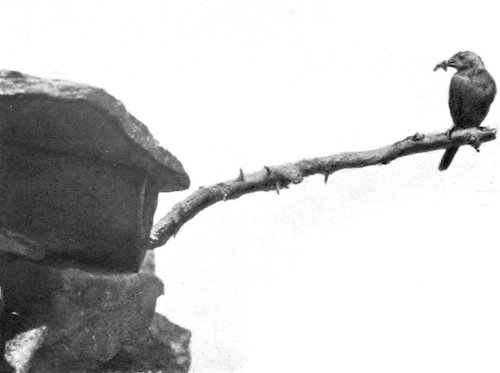
FEMALE REDSTART WITH FOOD FOR CHICKS.
It is found breeding in suitable places all over England and Wales, and less numerously in Scotland. I have met with it most commonly in certain parts of the Principality and in Westmorland and Northumberland. It appears to be partial to isolated farmhouses with a few old trees round them and plenty of straggling, dilapidated outbuildings, old ruins, and gardens surrounded by moss-grown stone walls. I have frequently found the bird, however, breeding in solitary woods, and secured the photograph showing the nest and eggs figuring in this article in the silent depths of a great Highland pine forest.
The male Redstart has a short but soft and very sweet song, much resembling that of the Pied Flycatcher. Whilst staying out all night making observations, both in South Wales and the North of England, I have heard it very late in the evening and very early in the morning. It is oft repeated, and the singer borrows notes from many other feathered vocalists, such as the Swallow, Blackbird, Whitethroat, and Nightingale.
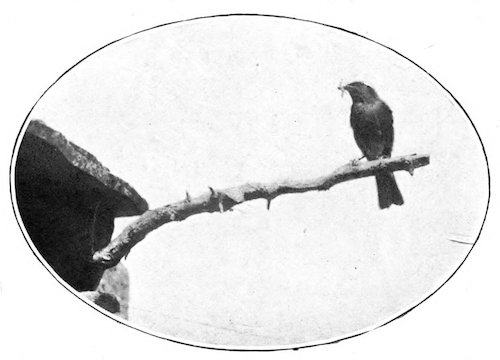
MALE REDSTART WITH FOOD FOR YOUNG.
The call note of this species sounds something like wee-tit-tit.
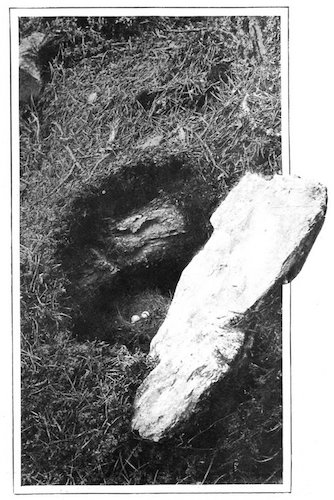
REDSTART’S NEST AND EGGS BENEATH A STONE ON THE GROUND. THE STONE WAS LIFTED TO SHOW NEST AND EGGS.
The nest is situated in a hole in a tree or stone wall, sometimes under a stone partly buried in the ground, where a Wheatear might be expected to make her home, as in the case of the one figured in our illustration on page 195. It is composed of dry grass, dead leaves, and rootlets, and lined with hair and feathers.
The eggs number from four to six or even eight, although personally I have never seen more than seven. They are pale bluish-green, somewhat lighter than those of the Hedge Sparrow, and said to be occasionally marked with light red spots. I have never met, however, with this spotted variety.
THE MEADOW PIPIT.
The Meadow Pipit, or Titlark as the bird is frequently called, is much more abundant than the Tree Pipit. It is rather smaller in size, duller in colour, has more and smaller spots on the breast, and when hunting for food has a habit of making little periodical rushes after insects in a more wagtail-like manner than its relative.
This species is partial to open pastures, and bent and heather-clad moorland districts, and is very abundant on the Fells in the North of England, where I can safely say I have found hundreds of nests during the course of my life. I have met with it breeding quite commonly as low down as the Norfolk Broad district and as high up as the most elevated mountain tops I have ever visited in the Highlands.
Its song is somewhat shrill, and not so musical as that of the Tree Pipit. It is uttered on the wing, the bird rising to a height of thirty or forty feet in order to deliver it; also often from a stone wall, stunted bush, or boulder.
The alarm note of this species when flushed sounds like peep, peep, and that of distress when disturbed at the nest trit, trit. Call note: zeeah, zeeah.
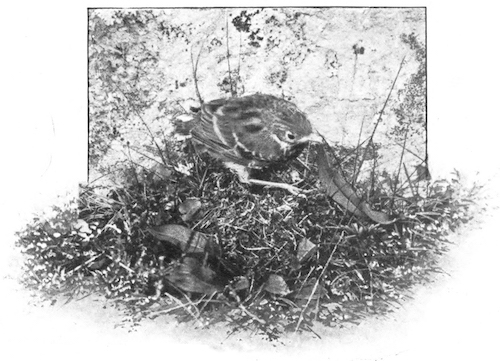
YOUNG MEADOW PIPIT PHOTOGRAPHED WHILST SHELTERING BEHIND A STONE DURING A HIGHLAND STORM.
The nest is generally built on a bank and hidden by some overhanging tuft of herbage, or amongst heather. I have, however, found two in holes amongst rough stones where a Wheatear might have been expected to breed. The structure is composed of bents, bits of fine dead grass, and horsehair, but the last-named article is frequently absent altogether.
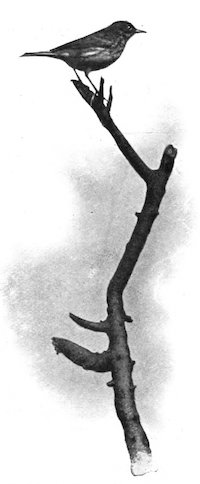
ADULT MEADOW PIPIT.
The eggs number from four to six, but five is a general clutch. They are greyish-white, sometimes tinged with pale bluish-green or pinkish in ground colour, mottled with varying shades of brown and occasionally marked with hair-like lines of dusky black on the larger end. They are smaller in size than those laid by the Tree Pipit.
This species is very frequently victimised by the Cuckoo, and I have often been surprised at the lonely, treeless, and semi-barren places the “Messenger of Spring” has visited in order to find a foster-mother for her offspring.
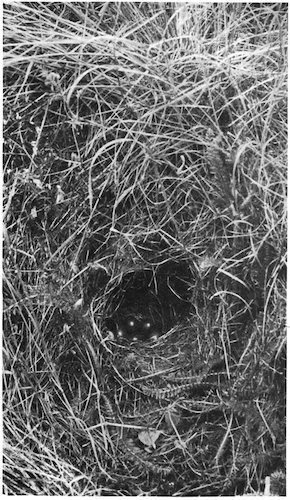
MEADOW PIPIT’S NEST AND EGGS.
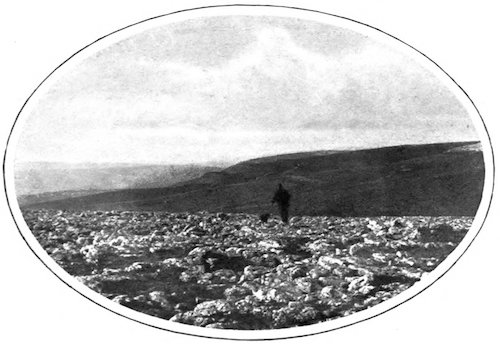
Although such a common species, the Meadow Pipit is shyer at the nest than the Tree Pipit, and a satisfactory photograph is difficult to secure. On one occasion I was shown a nest containing chicks beneath a rock in the foreground of our tailpiece, and although I built a stone hiding-house for myself and the camera, it was a long time before I exposed a plate owing to the fact that the female persisted in standing on a crag at some distance and swallowing all the food her mate brought instead of carrying it to the young ones.
THE WILLOW WREN.
The Willow Wren, or Willow Warbler, arrives in this country early in April, and takes its departure again in September, although individuals linger with us sometimes throughout the winter in the southern parts of England.
In colour it is olive-green on its upper parts, with dullish-slate brown wings and tail; chin, throat, and breast whitish-yellow, and rest of under parts greyish-white. The pale yellow line over the eye is narrower than that worn by the Wood Wren.
This species is more numerous than either the Chiffchaff or the Wood Wren, and is generally distributed over the British Islands whenever trees or bushes grow in sufficient numbers for its requirements.
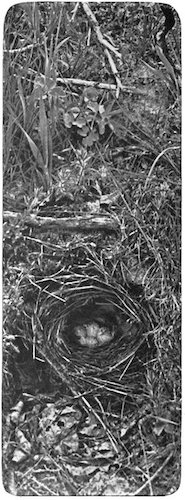
WILLOW WREN’S NEST AND EGGS.
Its nest is generally situated on the ground amongst coarse grass and weeds entwining themselves round the slender twigs of small bushes in woods, plantations, orchards, hedge-banks, and by small alder-fringed streams. I have, however, sometimes seen it in a hole in a dry stone wall at a considerable height from the ground and on one occasion found a nest amongst some ivy growing against a stable wall in the Highlands at an elevation of something like six feet from a much-used garden path. The specimen figured in our illustration was situated in the mouth of a rabbit burrow in Aberdeenshire.
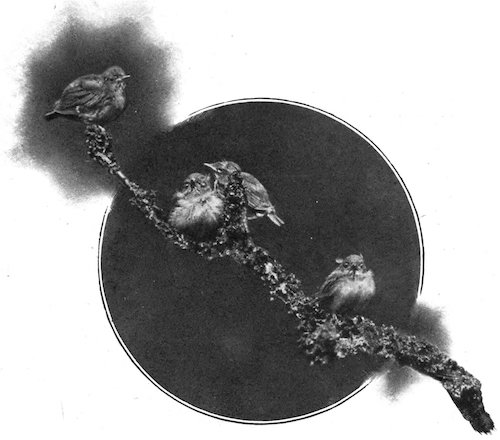
YOUNG WILLOW WRENS.
The structure is dome-shaped with a hole in front, and is composed of dead grass, moss, and occasionally a few dead leaves and fern fronds lined internally with hair and a liberal number of feathers. On one occasion I examined the lining of a Willow Wren’s nest and found that it contained feathers from seven different species of birds, and some of them had been collected by the builder at a considerable distance.
The eggs, numbering from four to eight, are white, spotted with pale rusty-red, whereas those of the Chiffchaff, with which they are most likely to be confused on account of the similarity of the nests built by the birds, are marked with dark purplish-brown.
The Willow Wren is one of the brightest and sweetest carol singers visiting our shores. Although its song is short and contains but little variety, there is a sprightliness and simplicity about it that never fails to charm. I always associate the bird’s thrice-welcome notes with the babbling alder-fringed trout streams of my youth, spring sunshine, and the sweet freshness of expanding leaves.
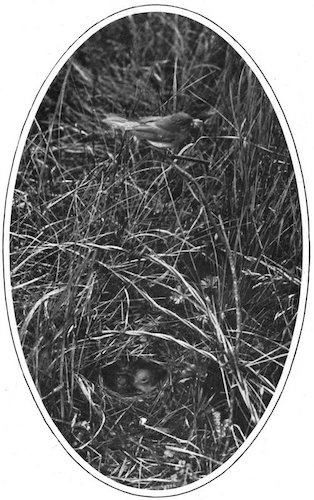
WILLOW WREN BRINGING FOOD TO YOUNG IN NEST.
John Burroughs, the great American ornithologist, who once came over here to study the song birds of our country, said, “The Willow Wren has a long, tender, delicious warble, not wanting in strength and volume, but eminently pure and sweet—the song of the Chaffinch refined and idealised.... It mounts up round and full, then runs down the scale and expires upon the air in a gentle murmur.”
Willow Wrens proclaim their presence directly they arrive in this country by commencing to sing, and continue to do so until the end of July. I have heard one, together with a Robin and a Song Thrush, carolling in my garden to-day—the 16th of August. After moulting, they commence their music again in September, so they are not long silent.
The song varies, like that of many other melodists, in different parts of the country, and is sometimes uttered on the wing. The alarm note is a plaintive t-wheet, with the first t suggested rather than sounded.
THE HEDGE SPARROW.
Although a soft-billed species, much more closely related to the Robin than the Sparrow, this bird has enjoyed its popular name so long that it is likely to be known by it to the end of time. It also has two or three others, such as Hedge Accentor, used almost exclusively by ornithologists, and Dunnock and Shufflewing, which are more or less local.
It is common nearly all over the country—though I have never met with it in either the Outer Hebrides or the Shetlands—inhabiting gardens, orchards, hedgerows, and woods.
Some people do not care for the song of the Hedge Sparrow, but I must admit that I am an admirer of this wee brown bird’s vocal accomplishments. Its notes, although soft and lacking in variety, are sweet and always have the true ring of joy and hope in them. They seem to herald the coming of spring.
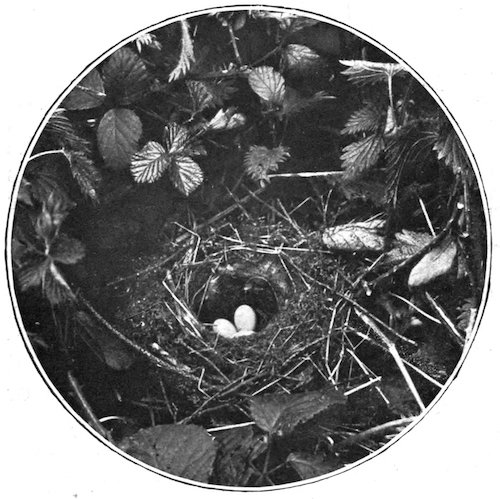
HEDGE SPARROW’S NEST AND EGGS.
This species has a peculiar habit of flirting or shuffling its wings, hence the very appropriate local name before mentioned. Its call note is a plaintive peep, peep.
The Hedge Sparrow, of course, stays with us all the year round, and in the winter hops quietly about in gardens, round fowl-houses and sinks, diligently picking up the very tiniest particles of food that other birds either do not see or consider beneath their attention. When disturbed it timidly retires beneath some bush or hedge, and waits until all is quiet, when it comes forth again with a gentleness and modesty that win it a great deal of sympathy during hard weather.
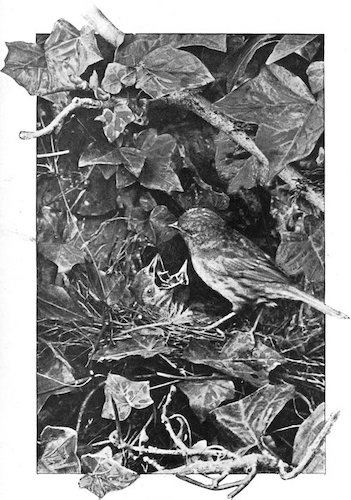
HEDGE SPARROW AND YOUNG.
It breeds early, and hides its nest, as carefully as circumstances will permit, in evergreens and thick hedgerows. Although such a common species, it has one habit which is not often mentioned in books. When laying it frequently covers over its eggs with part of the lining of the nest before leaving them.
On one occasion I photographed a Dunnock sitting on her nest in a bramble bush, and wishing for a different view of her returned the following morning in order to secure it. When I approached the place I observed the bird sitting at home, but in endeavouring to get close to her with my apparatus I frightened her off. Pathetically enough, upon looking into the structure, I discovered that the bird had been sitting inside an absolutely empty home. The Hedge Sparrow makes her nest of slender twigs, in limited numbers—sometimes these are not employed at all—rootlets, dead grass, and moss, with an inner lining of wool, hair, and feathers. The lining frequently consists of no other materials than moss and cowhair.
The eggs number from four to six, and are turquoise-blue in colour and unspotted.
Two, and even three, broods are reared in a season. Nests may be found as early as March and as late as the end of July.
THE GREENFINCH.
The Greenfinch, or Green Linnet as it is called in many parts of the country, is a thick-set little bird, about six inches, of a yellowish-green colour, shaded with ash-grey above, and bright yellow, slightly tinged with ash-grey, on its under parts. The female is not quite as large as her mate, and much duller in colour.
This species is common in nearly all parts of the country where there are cultivated fields, small woods, hedgerows, and gardens. In fact, I should say that it ranks next to the Common Sparrow amongst the finches in point of numbers.
Although a somewhat selfish bird, full of threats and warlike attitudes when a favourite item of food—such as a sunflower head full of seeds—has been discovered, it is sociable to a great extent, even during the breeding season. I have found three or four nests within a yard or two of each other in a hedgerow, and Mr. Hudson says that two or three may sometimes be found even on the same branch.
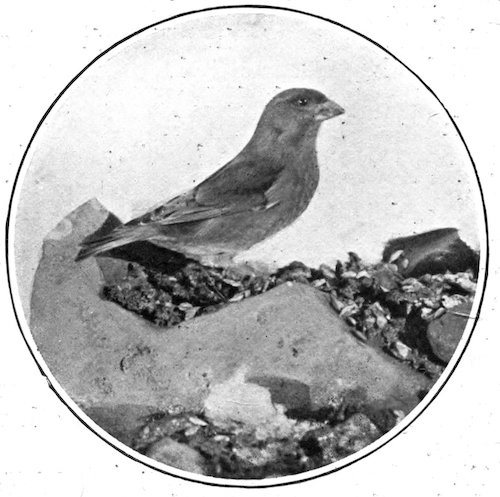
MALE GREENFINCH ON THE ALERT IN A GARDEN IN WINTER.
The nest is situated in hedgerows, gorse bushes, yew, holly, ivy, and other evergreens, in orchards, gardens, shrubberies, and on commons, and when compared with that of the Chaffinch is a rather large and slovenly structure formed of slender, dead twigs, rootlets, grass, and moss lined with hair, down, and feathers.
The eggs, numbering from four to six, are white, pale grey, or white tinged with blue, spotted principally round the larger end with reddish-brown and purplish-grey.
The male Greenfinch, although not a great feathered vocalist, has some very pleasant notes, which he trills by the half-hour together. In the early part of the breeding season he sings on the wing, but later on he grows less energetic, and is content to deliver his oft-repeated lay from some favourite treetop. Individuals differ in the quality of their notes.
In confinement the Greenfinch soon becomes very tame and docile, and is appreciated on this account, and also for its ability to imitate the notes of other species.
The call-note is a prolonged twe-e-er, and when the nest is visited the members of this species utter a very melancholy one sounding like tway.
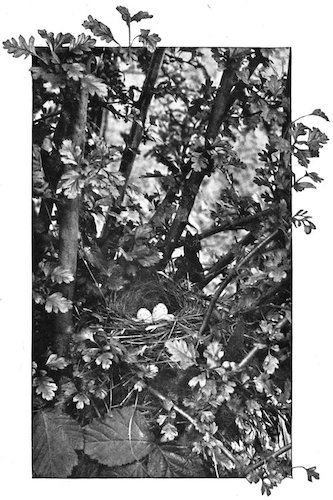
NEST AND EGGS OF GREENFINCH.
In winter Greenfinches congregate in small flocks, and hunt for seeds in stubble fields and farmyards. They will associate with Sparrows, Linnets, and Chaffinches, and during the winter months they come regularly to my garden to take their share of corn, sunflower seeds, and other food which is provided every morning for the consumption of all feathered friends. It is amusing to see one of these birds rolling a grain of Indian corn about between its short, stout mandibles, gradually reducing it to pieces small enough to be swallowed, and cleverly rejecting the thin husk in which it is enfolded, and allowing it to flutter to the ground.
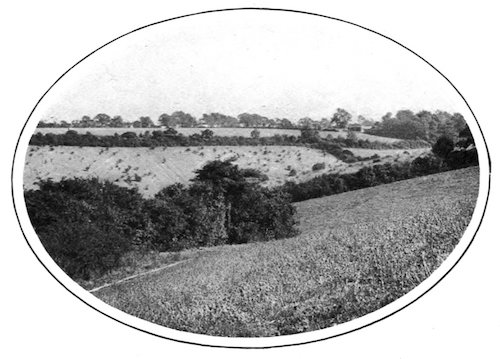
THE DARTFORD WARBLER.
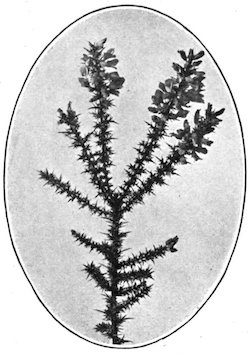
This bird received its popular name on account of the fact that it was first observed near Dartford in Kent in 1773. It is also known by the very appropriate name of Furze Wren in some parts of the country, because it has a habit of cocking its long tail like a Common Wren and is very partial to thick growths of furze.
The Dartford Warbler is about five inches long, and in addition to its habit of cocking its tail, which measures nearly half its entire length, possesses the lark-like power of erecting the feathers on the top of its head so as to form a kind of crest. On his upper parts the male is greyish-black, the wings and tail being blackish-brown and the outside feathers of the latter broadly tipped with grey; chin, throat, breast, and sides chestnut-brown; under parts white, excepting at the base of the tail, where they are grey. The female is browner on her upper parts and lighter underneath.
Furze-clad commons along the south coast of England form the home of this rare, shy, and interesting species, which there is every reason to fear is growing still rarer owing to the damage done to it by such severe winters as those of 1881 and 1895 and the depredations of egg collectors.
Although a very difficult bird to observe, and therefore liable to be overlooked, particularly during dull, wet weather, when it does not show itself on the tops of furze bushes, there is every reason to fear that it has quite vanished from many of its old Surrey and Sussex haunts, where I have sought for it day after day in vain. For obvious reasons I cannot divulge the whereabouts of the place where our photograph of the adult male opposite was secured, by the kind assistance of a friend who fed the bird on mealworms at the same place, close to his nest and young ones, morning by morning until he got into the habit of visiting the top of that particular furze bush regularly in search of his breakfast.
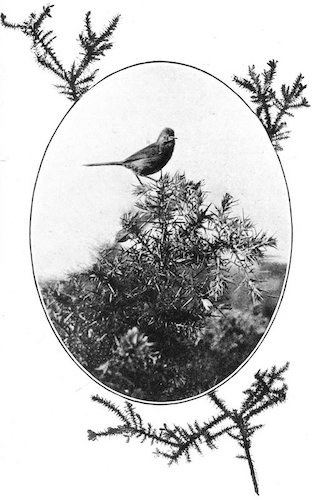
DARTFORD WARBLER.
The nest is built in the lower parts of thick furze bushes, and is composed of small, slender branches of furze, grass stalks, bits of moss, and wool, with an inner lining of fine grass and sometimes a few hairs.
The eggs number four or five, greenish- or buffish-white in ground colour, speckled all over with dark olive-brown, and underlying markings of grey.
Although a bird of weak flight, the Furze Wren is very active and nimble when searching from bush to bush for its food, which consists of flies, moths, spiders, caterpillars, and other small deer.
It has a hurried little song, which has been described as “shrill and piping” by one authority, and “an angry, impatient ditty, for ever the same,” by another. Early in the season it is delivered whilst the singer is hovering in the air like a Whitethroat, moving his head from side to side and waving his tail in all directions, but later more soberly from the topmost branch of some furze bush. The slightest disturbance instantly silences the vocalist, and he drops straight into the hiding afforded by the thick cover below.
The most frequently heard call-note of this species sounds like pit-it-chou or pitch-oo, hence its very appropriate French name of “Pitchou.” It also has another harsh note, sounding like cha, cha.
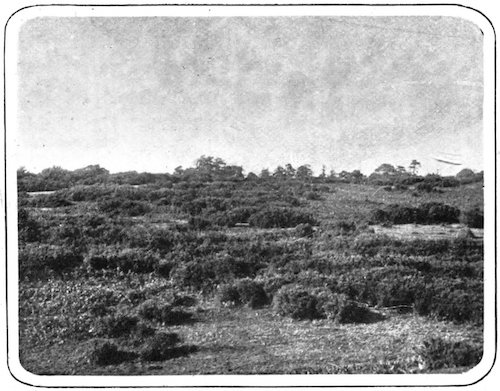
THE MISSEL THRUSH.
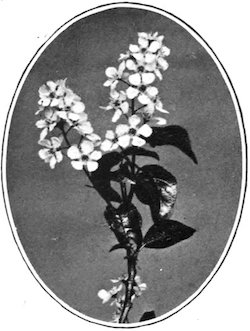
The Missel Thrush measures something like eleven and a half inches in length, and is the largest member of its family inhabiting our islands. It is, perhaps, more numerous now than it has ever been before, owing to the long succession of mild, open winters we have enjoyed and the fact that during the last century it has greatly increased its breeding range both to the North and West. In 1800 it was unknown in Ireland, but is now abundant in that country.
On its upper parts the Missel Thrush is ash-brown in colour, and buffish-white below, marked with blackish-brown spots. It may always be distinguished from the Song Thrush by its larger size, greyer colour, and by the fact that when on the wing it shows a conspicuous white stripe down either side of its tail.
This bird loves small woods, well-timbered parks, orchards, and tree-fringed streams common in the dales of the North of England. Its nest is built in the fork of a tree or on a strong horizontal branch at varying heights of from three to forty feet from the ground, but I have never seen it in such a bush as the Song Thrush would be likely to patronise. Sometimes it is small and well concealed, but at others it is large and quite conspicuous. Occasionally I have found it adorned on the outside with lichen matching that growing on the tree wherein it was built, and even with green ivy leaves harmonising with the moss clinging to the trunk of the tree in which it was situated; but, on the other hand, I have found nests ornamented with large pieces of wool waving in the wind, and even the large wing feathers of a white barn-door Fowl. The nest is constructed of a few slender twigs (sometimes these are quite absent), grass stems, moss, mud, and wool, with an inner lining of fine, dead grass. The eggs, numbering four or five, vary from greyish-green to reddish-grey in ground colour, marked with brownish-red spots.
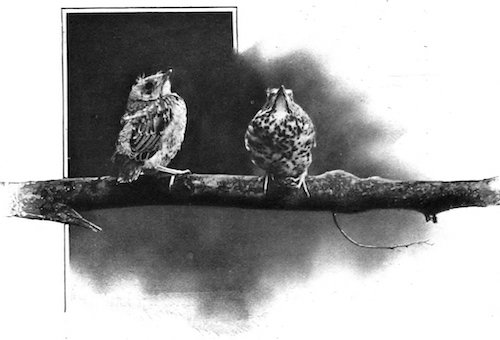
NEWLY FLEDGED MISSEL THRUSHES
The Missel Thrush, or Storm Cock as it is called in many parts of the country, from its habit of singing on the topmost branches of tall trees during wet, windy weather, is one of our very earliest feathered vocalists. I have heard it piping its bold, defiant notes as early as in December in the South of England and as late as the end of June in the Highlands of Scotland, and have found its nest and eggs from the end of February until the middle of June.
Although by no means a first-class melodist, the Storm Cock has some very sweet notes, and the unpleasant climatic conditions under which he frequently delivers them seem to enhance their value. I have often listened to him, brave bird! whilst he was swaying to and fro on the topmost branch of some wind-swept tree, and I could only catch a note here and there, the rest being carried away on a chord of the storm.
Few of our poets have given the Missel Thrush any attention whatever in their verse, but one has done it justice in the following lines:
“Whilst thou! the leader of the band, Fearless salut’st the opening year, Nor stay’st till blow the breezes bland That bid the tender leaves appear; But on some towering elm or pine Waving aloft thy dauntless wing Thou joy’st thy love notes wild to sing.”
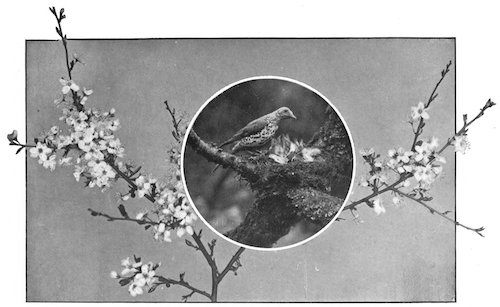
MISSEL THRUSH AT NEST.
This species sometimes imitates the notes of other birds, but not nearly to the same extent as its commoner relative, the Song Thrush, and renders them in such an undernote that they are difficult to hear on account of the singer not allowing the listener to approach very closely.
The call note is a harsh, rattling kind of cry, which, lengthened a little, and uttered with greater vehemence, becomes the alarm.
Although shy during the greater part of the year, this bird grows much bolder during the breeding season. I have known it build in a fruit tree within a few yards of the front door of a farmhouse, and have seen it attack a stuffed owl which had been placed near its nest, containing young ones, and knock it clean out of the tree.
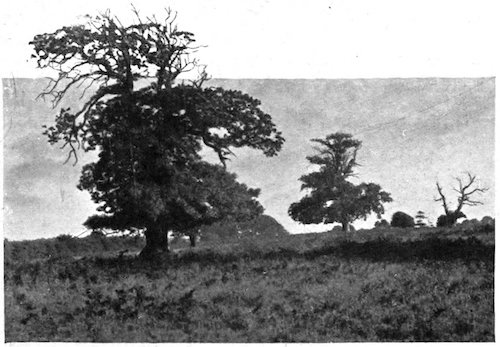
THE DIPPER.
The earliest recollections of my old moorland home in Yorkshire are of rushing mountain torrents, swirling and gurgling round limestone boulders, beneath which I used to tickle the lively little brown trout, and of white-breasted Dippers flitting up and down.
The Water Ouzel, as it is sometimes called, is not at all a sociable bird. It takes possession of some portion of a stream, often limited to a few hundred yards in length, and keeping more or less strictly to it will not allow any intruder of its own species to encroach upon its domain.
In appearance it is by no means unlike a large black Wren with a snowy-white breast and chestnut under parts. It secures its food in the most wonderful manner when the fact is taken into consideration that the bird appears to be no more adapted to the methods it employs than a Song Thrush. Alighting on some stone in the middle of a rapid stream, it deliberately walks down into the water and swims along the bottom by a series of wing-beats, picking up and swallowing as it goes caddis worms, larvæ of flies, and small molluscs. On several occasions I have disturbed young Dippers in the nest when they were ready to fly, and have seen them one by one plunge into a deep, clear pool and progress just as if they were flying slowly and heavily along under water until they came to shore or were compelled to rise to the surface from exhaustion.
The Dipper is a sweet singer, but the listener requires to be very close to the little vocalist before he is in a position thoroughly to appreciate the bird’s low, soft, warbling song, which, although of no great length, is practised even in the middle of winter.
A year or two ago I had occasion to catch an early train in Westmorland, and whilst walking through some rock-strewn pastures to the station came to an old wooden bridge crossing the river Eden. It was close upon Christmas, the air was biting cold, and everything clad in the crystal purity of a heavy hoar frost. Just as I approached the river, day was breaking, and my attention was arrested by a sweet, silvery snatch of song, which I at once recognised as that of the Dipper. I waited on the footbridge until it was light enough to see the bird standing on a moss-clad boulder in the middle of a dark, glassy pool, and shall never forget the beauty of the morning light breaking on the water, the stillness of the scene amidst the lonely hills, nor the sweetness of that exquisite little carol sent out like a flood of joy on the crisp, winter air.
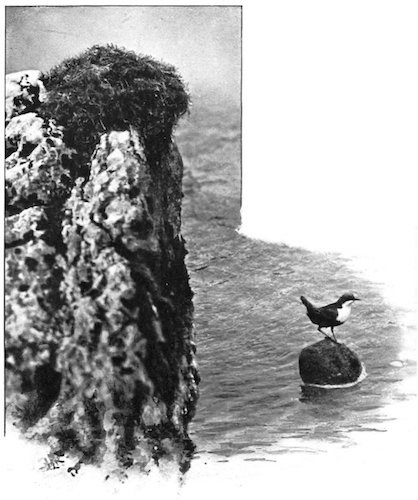
DIPPER AND NEST.
The call note of the species is zit or chit, chit, uttered both when the bird is on the wing and whilst curtseying and dipping in its own quaint way on some stone half submerged in a brawling stream.
The bird builds its nest in all kinds of positions, but never away from flowing water. It may be found in crevices of rock, in holes beneath stone bridges, on large moss-grown boulders in or on the bank of a stream, behind the falling waters of a cascade, and in trees overhanging rivers. It is quite a large structure for the size of the builder, and is made of moss securely woven and felted together on the outside and lined with rootlets, soft dead grass, and leaves placed layer upon layer inside. It is dome-shaped, with the entrance hole placed so low down that the overhanging roof forms a kind of portico which cunningly prevents any stray splash of water from finding its way inside.
The eggs, numbering from four to six, are pure white, and quite unspotted.
Young Dippers, instead of having white, conspicuous breasts like their parents, have the feathers edged with dusky black, which greatly aids concealment when they are sitting at rest.
This species breeds in the North and West of England, Wales, Scotland, and Ireland wherever there are tumbling, foaming brooks suitable to its habits.
A spring or two ago I spent several days inside a hollow, artificial rock, photographing the bird represented in our illustration, and was delighted with its interesting ways. The cock fed the hen, sitting inside the nest keeping their tiny chicks warm during some particularly cold weather for the season, and performed his task with great diligence and dispatch.
One day he heard the shutter of my camera click, and grew inquisitive. As soon as he had delivered his catch of larvæ, he hopped from stone to stone, until he finally stood upon one which allowed him to take a peep inside my hiding contrivance, one corner of which projected over the bank of the beck in such a way as to allow me to look down and see the water rushing past. Cocking his knowing little head first on one side and then the other, he looked up at me and made a most critical examination of everything he saw. He apparently came to the conclusion that I was quite harmless, for when he had satisfied his curiosity he sang a little song, and then flew away in search of more food for his mate and their chicks.
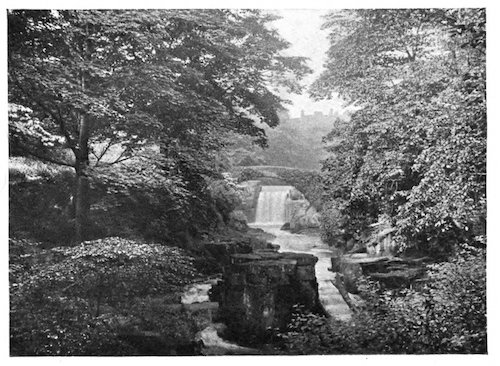
THE CHIFFCHAFF.
This tiny warbler measures only about four and three-quarter inches in length, is dull olive-green tinged with yellow above and yellowish-white below. Over the eye it wears a pale yellowish streak which grows whiter as it recedes.
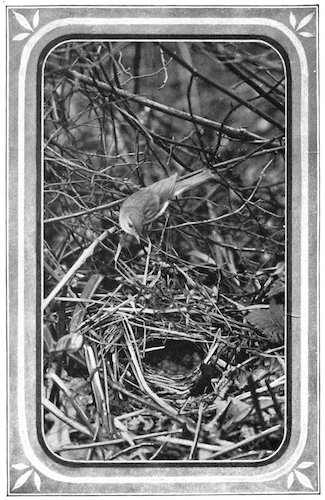
CHIFFCHAFF AND NEST.
The Chiffchaff is, with the exception of the hardy Wheatear, the first feathered wanderer to return to us in the spring, and is eagerly looked, or rather listened, for by naturalists because its welcome notes stand in their calendar as January 1 does to the rest of the world—the beginning of a New Year—not of days, weeks, and months, but of awakening life, activity, and joy. It arrives in March and departs again in October, some individuals having the hardihood to stay even through the winter in the mild south-western parts of England.
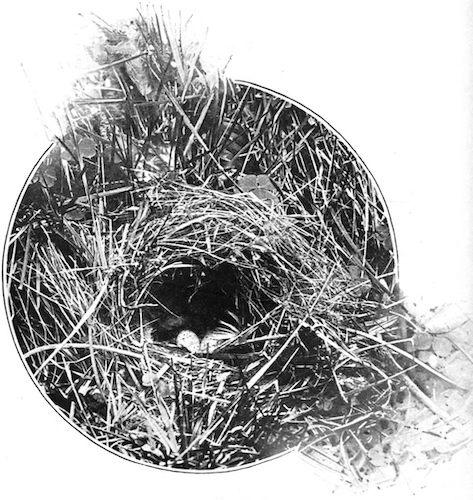
NEST AND EGGS OF CHIFFCHAFF.
This species breeds generally throughout the southern and midland parts of England, but it is not common in the northern counties or in Scotland. It is met with in all suitable districts of Wales and Ireland, but is everywhere more or less local.
Shady woods, well-timbered dells, and stream-sides with plenty of matured trees clustering round are beloved haunts of the Chiffchaff, which builds its nest on or near the ground amongst tall grass tangled with brambles and small bushes, hedge and ditch banks, and sometimes in ivy growing against trees and walls. The structure is oval, domed, and has an entrance hole in the side. It is made of dead grass, withered leaves, and moss—sometimes a few fern fronds are employed—and is lined with hair and feathers.
The eggs, numbering from five to seven, are white, sparingly spotted with dark purplish-brown.
It is by no means an easy matter for the inexperienced ornithologist to distinguish the Chiffchaff from the Willow Wren, although the species under notice is a trifle smaller and duller in colour.
Its song, if two oft-repeated notes can be dignified by such a name, is, however, quite unique and impossible to confuse with that of any other British bird. The two notes sound something like chiff chaff or chip chop, and are uttered four or five times in succession as the bird hunts from bough to bough and tree to tree after its insect food.
To some people it is said to grow exceedingly wearisome, but to me it always sounds such a part of the pleasant things of spring that it never palls.
The call note sounds something like tweet or wheet, and the alarm cry like whooid or whooit.
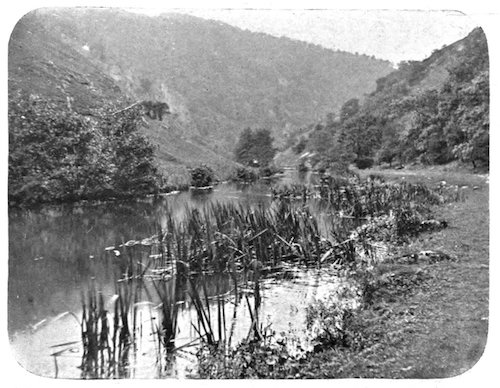
THE WHITETHROAT.
The Whitethroat, or Greater Whitethroat as it is sometimes called in contradistinction to its near and rarer relative, the Lesser Whitethroat, is a very common summer visitor to our shores, arriving about the second or third week in April and taking its departure again in September and October.
It is about five and a half inches in length. The upper parts of its body are brown tinged with grey on the head and neck, and reddish elsewhere; wings dusky, the coverts being edged with reddish-buff; tail quills dull brown, the outer ones edged and tipped with white, which is prominently shown when the bird is flying away from the observer. The chin and throat are white, accounting for the aptitude of the bird’s popular name; breast and under parts pale grey, tinged with a beautiful rosy flesh-colour.
The female lacks the grey on her head, also the rosy tint on her under parts.
This species breeds in suitable localities all over England, Wales, Ireland, and the greater part of Scotland.
It builds its nest in all kinds of low bushes, such as bramble, thorn, briar, and furze, and is so partial to nettles that it is generally known amongst country people as the “Nettle Creeper.” The structure, though deep, is of a very flimsy character, and consists of dead grass stems and horsehair, the latter being used as a lining.
The eggs number from four to six, of a dirty greenish-white ground colour, speckled and spotted with brown and grey, generally evenly distributed over the surface of the shell.
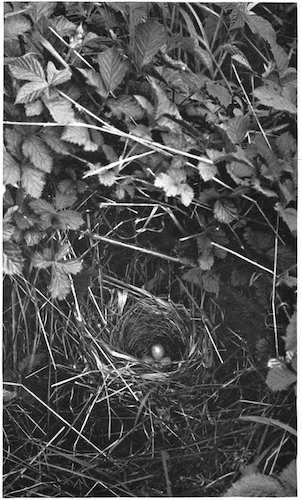
WHITETHROAT’S NEST AND EGGS.
The song consists of a few sweet and oft-repeated notes, delivered with great vehemence, not to say passion, the vocalist appearing to labour under considerable excitement whilst hurrying through his brief carol. This species commences to sing very early in the morning, and during May and June often continues until after it is dark. It also sings on the wing, as well as from the top of a hedge or bramble bush. Last summer I sat down to rest between a number of scattered thorn bushes and a wide old hedgerow on a Surrey hillside. A few moments afterwards a small bird left the hedge and took refuge in one of the bushes about twenty-five yards below me. Its notes and the white line on either side of the tail told me unmistakably that it was a Whitethroat. Presently the little songster shot up into the air to a height of some twenty or thirty feet, and with outspread tail and head and wings, performing all kinds of strange antics, bubbled out its hurried notes as it descended to the topmost spray of the bush which it had just left. This performance was frequently repeated until his mate left the hedgerow behind me and joined him, when his excitement appeared to abate to some extent.
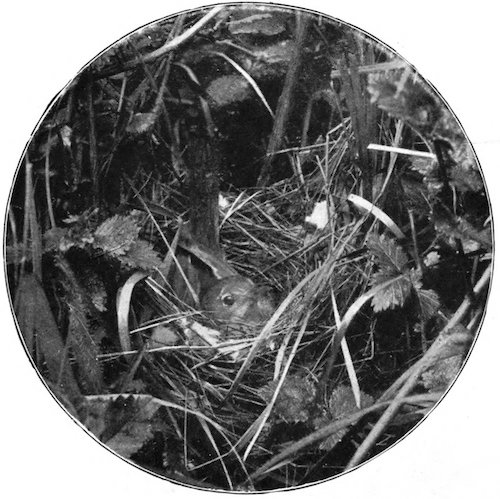
WHITETHROAT ON NEST.
The call notes of this species are very varied, and have been written down by different observers in a variety of ways. The most general are those sounding like cha, cha and purr, purr.
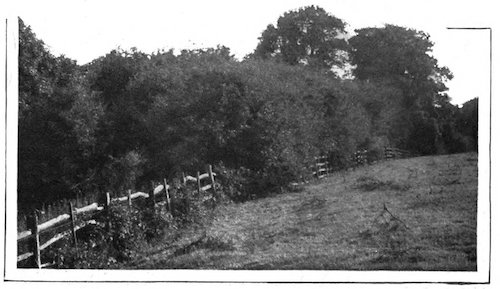
THE NIGHTINGALE.
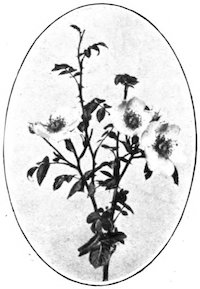
The Nightingale measures a little over six inches in length, and is of a uniform tawny-brown on its upper parts, except in the case of the tail coverts and quills, which are of a rusty-red tinge, conspicuously seen when the bird is flying away from the observer. Chin, throat, and all under parts greyish-white tinged with brown on the breast and reddish on the under tail coverts.
This thrice-welcome migrant arrives upon our shores in April, and leaves again in August. It is peculiarly limited in its breeding area, which extends no farther west than the Valley of the Exe and only to York in a northerly direction. Of course, odd specimens have been heard by trustworthy observers beyond these limits, but they are exceptional, and the species is unknown both in Scotland and Ireland. Attempts have been made from time to time to induce the bird to extend its range, but they have one and all proved futile. The late Sir John Sinclair had numbers of eggs sent from the South of England and placed in Robins’ nests in Caithness, but although the closely allied foster-mothers successfully hatched and reared the young Nightingales they went off and never returned. The experiment of turning adult birds down in certain parts of Wales beyond the localities reached by free members of the species also proved a failure. It is said to “be met with only where the cowslip grows kindly,” but this extraordinary assertion is difficult to understand, because it is hard to remember where that common and hardy plant does not “grow kindly.”
The nest is made of dry grass stalks, dead leaves, moss, bits of bark, and fibrous roots, and is lined with fine grass and horsehair. It is built on or near the ground, on a little bank at the foot of a tree, at the bottom of a hedgerow, or on the stump of a felled tree; in woods, plantations, copses, quiet gardens, and on commons where clumps of hazels, brambles, and briars grow.
The eggs number from four to six, of a uniform olive-brown or olive-green colour. Occasionally greenish-blue specimens are found.
It would be difficult to overpraise the almost perfect song of this bird, the king of all British feathered melodists; for although I greatly admire the vocal powers of the Song Thrush, Skylark, and Blackcap, I do not think that any one of them can come near the Nightingale for perfection of phrasing, rich mellowness, or the loud, clear, silvery sound of its notes. I agree with Mr. Witchell, who has studied the songs of birds more closely, perhaps, than any other living man, when he says:
“This tempestuous song, this wild melody, the triumphal song of Nature herself, pierces beyond the ear right to the heart of the listener.”
The Nightingale is the only bird I ever remember to have heard singing in a fog, and this occurred in Surrey a little before midnight during the third week in May.
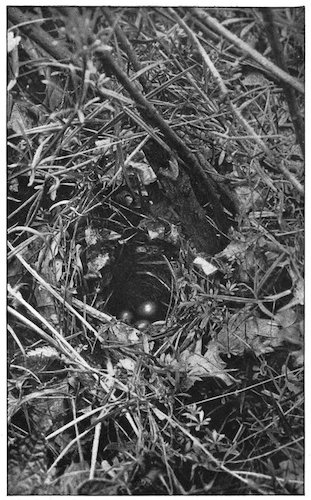
NIGHTINGALE’S NEST AND EGGS
The male members of this species arrive upon our shores from ten days to a fortnight earlier than the females, and sing by night in order to attract the latter, which travel during the hours of darkness. As soon as the young ones are hatched the superb song ceases, and both parent birds confine their energies to the wants of the chicks.
Poets of all ages have given the song of the Nightingale a great deal of attention, but how strangely they have gone astray in regard to the bird’s habits! It appears to have appealed to most of them on account of its practice of singing by night, and the touch of melancholy in the three or four lengthened notes that commence softly and gradually rise until they are so loud and strong that they may be heard at a great distance. Curiously enough, they made the mistake of thinking that their Philomel only sang by night, and was the solitary bird that did so.
Even our immortal William of Avon says:
“The Nightingale, if he should sing by day When every goose is cackling would be thought No better a musician than the Wren.”
The fact that the bird sings by day as well as by night was known, however, to the ancients, because Virgil mentions it. Readers of this little volume will also gather that other feathered musicians, such as the Sedge and Grasshopper Warblers, Woodlark, and Cuckoo, also sing by night.
Individual members of this species differ in the quality of their notes, as was observed as far back as Pliny’s time.
The alarm note sounds like wate, wate, cur, cur, or witt, krr.
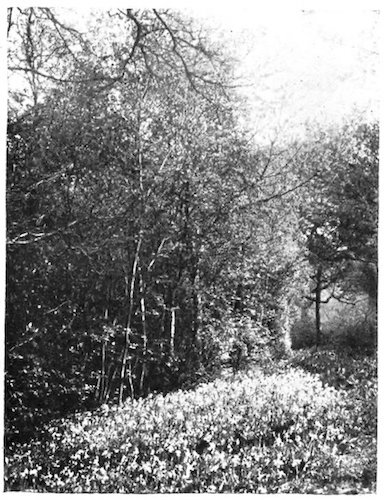
THE LESSER WHITETHROAT.
The Lesser Whitethroat arrives in April and leaves again in September. It is far less numerous than its larger relative, and is not so widely distributed over the British Islands. This bird is most plentiful in the South and East of England, becoming scarcer towards the North and West, rare in Scotland, and absent altogether from Ireland as a breeding species.
It measures just over five inches in length, and has the upper parts greyish-brown, wings and tail dusky, the feathers being edged with greyish-brown instead of chestnut, which distinguishes it from the Greater Whitethroat. The under parts are greyish-white.
This species loves high, thick hedges rather than large woods, and builds its nest, which is a slight and flimsy structure made of dead grass, stalks, and lined with horsehair, in hedges, briar, bramble, gorse, and other bushes.
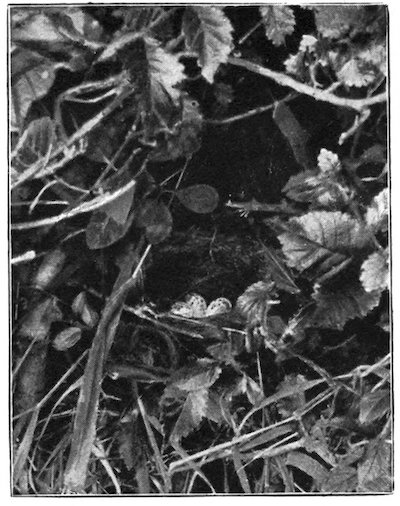
LESSER WHITETHROAT’S NEST AND EGGS.
The eggs, four or five in number, are white or light creamy white, with the faintest suggestion of green in ground colour, spotted and speckled with ash-grey and greenish-brown.
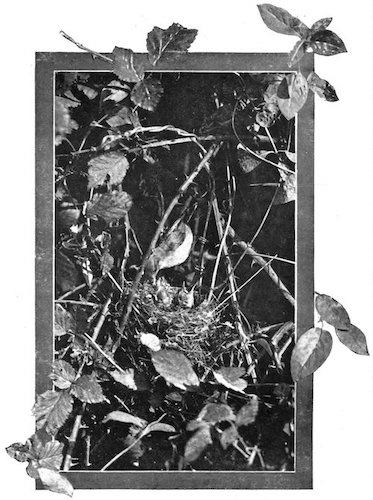
LESSER WHITETHROAT FEEDING YOUNG.
The Lesser Whitethroat is inferior to the Greater as a musician, but makes up for its deficiency in quality by its liberality in regard to quantity, for it sings almost incessantly, especially during sultry weather, and keeps on until very late in the summer. Its notes are without variation, hurriedly delivered, and sound like sip, sip, sip.
The bird’s call notes have been likened to the words check, check.
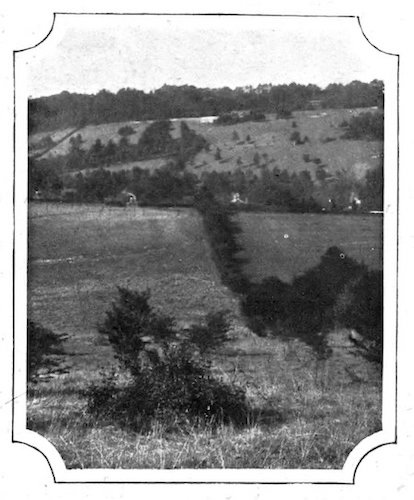
THE SISKIN.
This favourite cage pet measures a little over four and a half inches in length, has the top of the head black and the upper parts of the body greenish-olive, streaked with black, except the greater wing coverts and quills, which are brownish-black, tipped and bordered with yellow; rump yellow, upper tail coverts greenish-olive. The tail is slightly forked and dusky black, yellowish on the upper half, except in the case of the two centre feathers. A yellow streak runs over and behind the eye. Chin black, throat and breast yellowish-green, under parts greyish-white streaked with dusky black.
The female is a trifle smaller, and lacks the black on her crown and chin.
Although the nest of this species, which used to be called the Aberdevine amongst bird-catchers, has been found occasionally in various parts of England, it is chiefly known as a winter visitor, and may be seen, along with flocks of Redpolls, feeding upon the seeds of the alder, birch, and larch, from September until April. It breeds regularly, however, in the great pine forests of Scotland and in certain parts of Ireland.
The nest is generally placed on the branch of a fir at a considerable height from the ground, although specimens have been found even in furze and juniper bushes. It is composed of slender twigs, dried grass, moss, wool, and horsehair, lined with vegetable down, rabbit’s fur, and a few soft feathers.
From four to six eggs are laid, of a greyish-white ground colour, tinted with green or pale bluish-green, spotted and speckled with pale and dark reddish-brown, sometimes streaked with the latter colour.