Introductory material (continued 2)
Reading edition
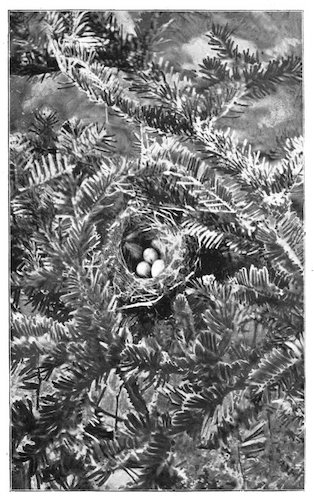
SISKIN’S NEST AND EGGS.
The song of the Siskin has been likened to the running-down of a piece of clockwork, and it used to be a great favourite amongst stocking weavers in Germany as a cage pet, on account of the fact that the tones of its song mingled so as to resemble the noise made by stocking looms.
One day I watched and listened to a cock in a Highland forest for some time. He sat for a little while on the topmost spray of a tall fir tree uttering his somewhat low but sweet and varied notes, then took an excursion into the air as if he intended to fly away, but changed his mind and his course several times, and on each occasion repeated his melody, and finally came back and alighted on the same twig from which he started.
The call notes are shrill and oft-repeated during flight, sounding something like tit, tit, tit, or tut, tut, tut.
THE SEDGE WARBLER.
The Sedge Warbler, or Sedge bird, as this restless, noisy little creature is frequently called, is by far the most numerous member of its family visiting the British Islands during the summer.
It arrives in April, and takes its departure again for its winter quarters, which extend as far as South Africa, in September, although odd specimens are said to have been seen even in winter.
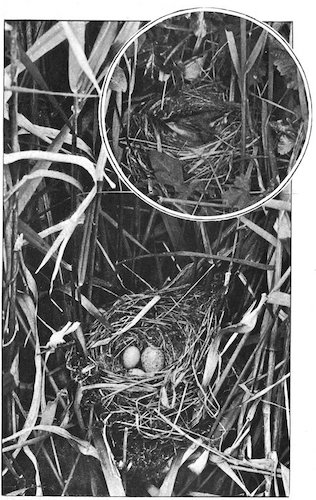
SEDGE WARBLER’S NEST WITH CUCKOO’S EGG IN IT.
(inset) SEDGE WARBLER ON NEST.
It is about four inches and three-quarters in length, greyish-brown on its upper parts, streaked with dusky brown; its chin and throat are white, and under parts pale buff. Over the eye is a conspicuous yellowish white streak, which, together with the dark stripes on its back, readily distinguish it from its relative, the Reed Warbler.
This species breeds in suitable localities nearly all over the British Islands, with exception of the Shetlands. I have met with it in tiny clumps of willows growing by small stream-sides high up amongst the Westmorland Fells.
Its home is amongst reeds, rushes, osiers, brambles, and all kinds of bushes near to lakes, swamps, rivers, ponds, and ditches, although it may occasionally be met with breeding at a considerable distance from water.
The Sedge Warbler builds its nest in rushes, brambles, bushes, and almost any kind of thick, tangled herbage. It is generally lower down than that of the Reed Warbler, sometimes quite upon the ground. I have found it on several occasions upon young pollards a yard from the ground, and once in a hedgerow at an elevation of five or six feet. The structure is loosely built and composed of grass and moss outside, lined with willow down and horsehair. It is frequently adorned with a large white feather protruding over the outside edge or bending inwards in such a way as to hide the eggs. These number five or six, of a pale yellowish-brown clay colour, clouded and mottled with darker brown, and often streaked at the larger end with hair-like black lines.
This bird is a persistent singer, with a harsh voice, an inordinate fancy for repetition, and a great faculty for mimicking the cries of other birds. It is willing to oblige anyone who will listen to its chattering, half-scolding, and always hurried song, night or day. A handful of gravel or mould thrown into any reeds or bushes wherein a male Sedge Warbler is roosting will nearly always induce the bird to pour forth a stream of melody.
I have frequently heard members of this species singing nearly all night long on the Norfolk Broads, and many times when taking my photographic plates out of wash at two o’clock in the morning I have started a chorus around me by emptying the buckets of water with a splash over the stern of the little houseboat in which I was staying.
The male has another peculiarity which is not often mentioned in books. In the early part of the season he is fond of taking little fluttering excursions in the air a few yards above the reeds whilst he bubbles forth his merry, hurried song. This is, no doubt, to attract the females during the pairing season.
I have heard members of this species imitate the notes of the Landrail, Common Sparrow, Nightingale, Whitethroat, Chaffinch, Robin, Swallow, and Blackbird. In the case of the last three species an individual mimicked all their notes within half a minute, not pausing as the Marsh Warbler does, but running straight on in a breathless hurry, and then turning back to repeat the whole over again.
The alarm cry of the Sedge Warbler when disturbed is a harsh churr. It also has another, sounding something like tut-tut. The bird makes use of a soft call resembling wheet-wheet.
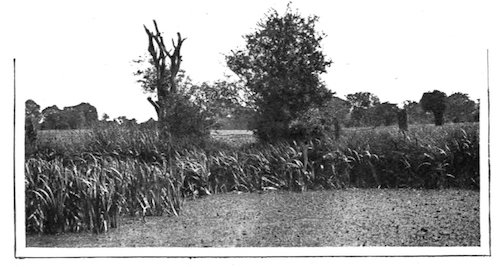
THE LESSER REDPOLE.
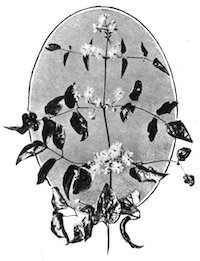
This is the smallest of our Finches, measuring only about four and a half inches in length. Its crown is crimson-red, hind part of head and rest of upper parts dark brown, the feathers being edged with reddish-brown. Upper tail-coverts tinged with crimson. Wings and tail dusky, edged with pale reddish-brown, the latter forked. Chin black, throat and breast rose-pink to vermilion, rest of under parts light greyish, streaked on the sides with dull brown. The female is rather smaller, and lacks the red on her breast and upper tail-coverts.
The Lesser Redpole has bred, somewhat erratically it is true, in nearly every county in England, but is most numerous in the northern counties and in Scotland. It also nests in Ireland, where it is scarcer in the south than the north. Its nest is a very pretty little structure made of a few slender, dead twigs (used as a foundation), dead grass stalks, moss, and rootlets beautifully lined with willow down and occasionally hair and feathers. It is built in willows, alders, firs, hawthorn, birch, hazel, and other trees and bushes. It has also been found in heather.
The eggs, which number from four to six, are of a very pale bluish-green ground colour, spotted generally about the larger end with orange-red, and sometimes streaked with a darker tint.
The song of this species is not of a high order in regard to quality, and has been variously described by different authorities. Professor Newton says, “Towards the end of winter the cocks break out in song, which, though not powerful, is lively and agreeable, and begin to indulge in the characteristic exultant flight during which it is generally uttered.” Mr. Henry Seebohm describes it as “a short, monotonous trill, clear and not unmusical”; whilst Bechstein’s judgment is that “Its feeble warblings are only a low, continued twittering.”
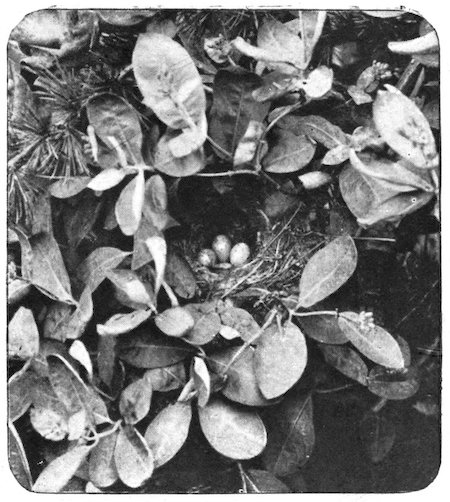
LESSER REDPOLE’S NEST AND EGGS
In spite, however, of its shortcomings as a vocalist, it is a favourite cage pet, especially with children, because of its boldness, docility, and intelligence.
It is called the Lesser Redpole, because it is rather smaller than its near relative, the Mealy Redpole, which breeds on the Continent and sometimes visits this country in winter. The breeding area of the Lesser Redpole seems to be almost restricted to the British Islands. This species flocks during the autumn, and although many remain with us throughout the winter, numbers migrate to the Continent.
The call notes are pe-weet and kreek, kreek, hayid.
THE REED WARBLER.
This species arrives upon our shores during the latter part of April, and leaves again for its winter quarters in Africa during September, although a specimen is said to have been shot in Ireland, where the bird does not breed, as late even as December.
The Reed Warbler is about five and a half inches in length, is brown on its upper parts, tinged with chestnut, which becomes more pronounced on the rump and white on the under parts, tinged with reddish buff, especially on the breast and sides. Its legs and toes are slaty-brown.
It breeds in reed and osier beds and other places where there is plenty of cover to suit its skulking habits, on the banks of lakes, ponds, and sluggish streams, and is much commoner on the east and southern sides of England than the west and north. I have met with it commonly in certain parts of Gloucestershire, and it is said to be fairly numerous in Wales. It does not, however, breed in Scotland or Ireland.
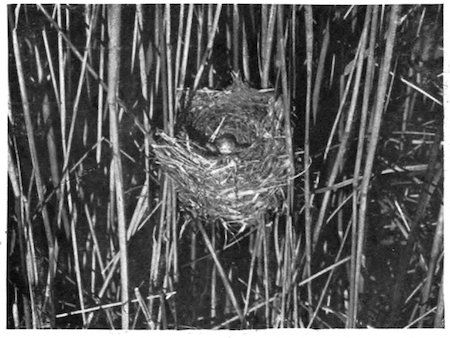
REED WARBLER’S NEST AND EGGS.
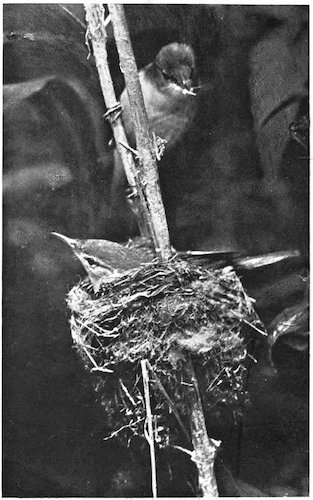
MALE AND FEMALE REED WARBLERS AT HOME.
The nest is a very beautiful structure, formed of long blades of dead grass, seed, branches of reeds, and bits of wool lined inside with fine dead grass and hair. It is cleverly suspended between two, three, four, or even as many as five reed stems at varying heights above the water. I have, however, on several occasions seen it in willow and alder bushes at some distance from that element, and it has even been found in a lilac bush in such a very unlikely neighbourhood as Hampstead.
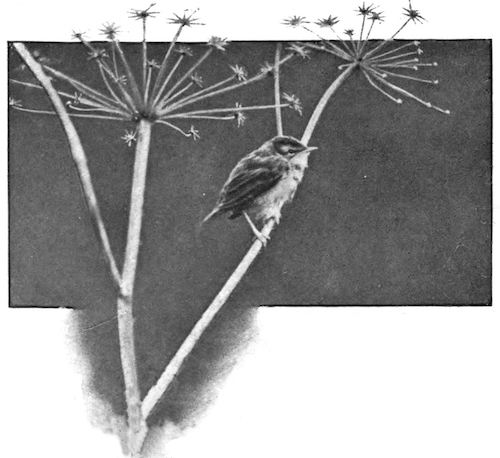
YOUNG REED WARBLER
The structure is very deep for the size of the builder, but this peculiarity of its architecture serves a very useful purpose, for when the reeds to which it is attached are violently swayed to and fro by strong gusts of wind, it prevents the eggs from rolling out and away to certain destruction.
The eggs, numbering from four to six, are of a dull greenish-white or greyish-green ground colour, spotted and blotched with darker greyish-green and light brown.
The male helps the female not only in the work of feeding the chicks, but in brooding, and it is a very pretty sight to see them exchanging places on the nest.
The song of this species somewhat resembles that of the Sedge Warbler in being full of chatter, but is not so loud or harsh, and is delivered, as a rule, whilst the singer is hiding amongst reeds. It imitates the note of the Starling, Wagtail, Swallow, and other birds, but is vastly inferior to the Marsh Warbler both as a musician and a mimic. I have heard it at its best during a calm summer evening on the Norfolk Broads, where it sings far into the night and early in the morning, excepting during windy weather, which seems to be greatly disliked by all feathered inhabitants of reed beds. The following extracts from one of my old diaries kept during a stay on Hickling Broad illustrate rather graphically the influence of wind upon the vocal activities of birds:
May 27.—“Windy, dark night; not a bird of any kind to be heard.”
May 28.—“Fine calm night. Reed, Sedge, and Grasshopper Warblers, Snipe, Water Rail, Coot, Moorhen, Peewit, and other birds all singing and calling until one o’clock in the morning.”
The song of the Reed Warbler has been represented as tiri, tier zach zerr, scherk heid tret by one authority, and as tiri yach yerr sherk heid tret by another. Each note is repeated by the singer a number of times. Its call note is a harsh turr or choh, choh.
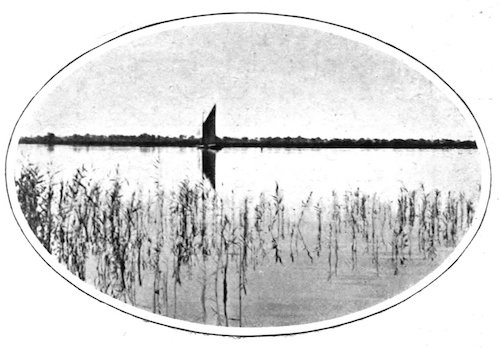
THE ROCK PIPIT.
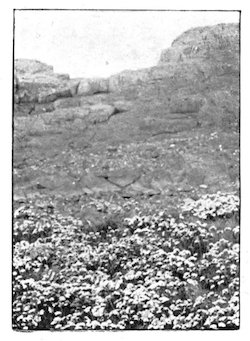
The Rock Pipit, although subject to some seasonal movement, is a resident in the British Islands, and I have never yet heard its song or seen its nest away from the sound of the restless sea. In fact, it is the only song bird the ocean can boast, for although such species as Skylarks, Twites, Starlings, and Linnets frequently breed close by the sea, their haunts are by no means confined to its shores as is the case with the bird under notice.
The Rock Pipit is the largest of the three members of its family breeding in this country. It is olive-brown above, marked with dark streaks in the centres of the feathers; has a dull white throat and under parts, the latter streaked and clouded with dark brown. The bird harmonises well with the dull brown rocks upon which it so often sits, and I have often experienced considerable difficulty in detecting it when it kept quite still whilst uttering its call notes.
This species may always be distinguished with absolute certainty from the Tree and Meadow Pipits when it is on the wing by reason of the fact that it shows no white on either side of its tail.
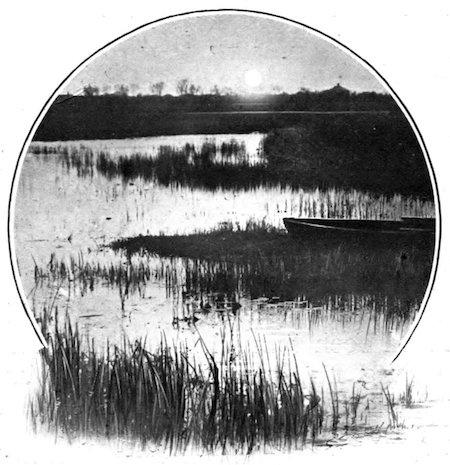
The Rock Pipit breeds nearly all round our coasts excepting between the Humber and the Thames, and loves small islands, such as those behind which the sun is setting in the tailpiece to this article.
Its song is very similar to that of the Meadow Pipit, and consists of a few short simple tinkling notes delivered with great cheerfulness, both upon the wing and whilst the bird is seated on some favourite rock. The call notes are also much like those of the Meadow Pipit.
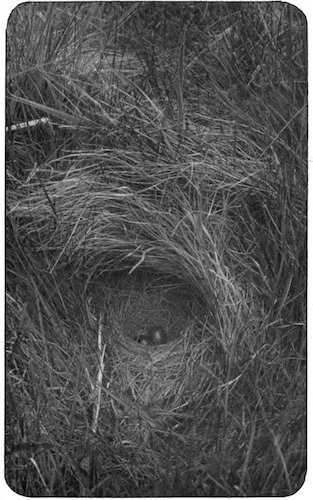
ROCK PIPIT’S NEST AND EGGS.
Its nest is situated under old matted tufts of grass, overhanging pieces of rock, and in crevices, and is made of small pieces of dry seaweed, dead grass of various kinds, and a few horsehairs. Seaweed is not always present in the structure, and horsehair frequently absent when the bird is breeding on small islands where it is not procurable.
The eggs number from four to five, and have a grey ground colour slightly tinged with green or reddish-brown, closely spotted with dull greyish- and reddish-brown. They are occasionally marked on the larger end with one or two dark brown lines, and are larger than those of the other two members of the family breeding in our islands.

THE GARDEN WARBLER.
This species is about six inches in length, and on its upper parts of a light brown colour tinged with olive. Its under parts are brownish-white, darkest on the throat, chest, and sides. The absence of black or rusty brown on the top of the head always readily distinguishes it from the male or female Blackcap, and the colour of its throat and breast from either of the Whitethroats breeding in this country.
The Garden Warbler arrives in Britain about the end of April or commencement of May, and takes its departure for Africa in September and October.
It breeds sparingly in nearly all suitable parts of England except Cornwall, in Wales, in the South of Scotland, and occasionally in Ireland.
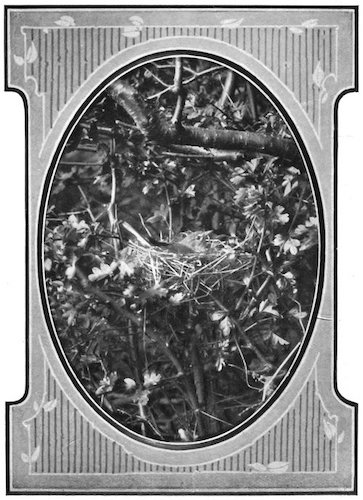
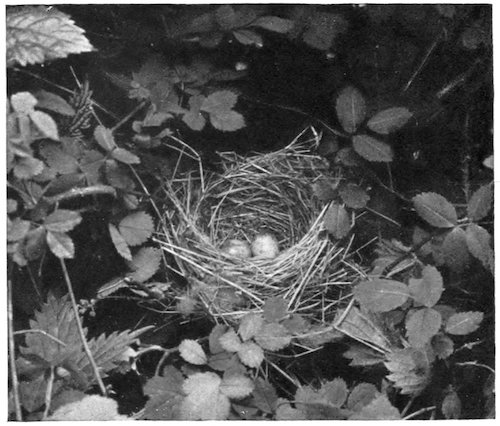
It generally builds its nest at some little height from the ground in thorn, briar, bramble, gooseberry, and other bushes growing in woods, clumps of trees in the proximity of streams, orchards, shrubberies, gardens, and hedgerows. Sometimes the structure, which is made of straws, blades of dead grass, and rootlets, lined with horsehair, is hung amongst nettles like that of a Whitethroat, or placed low down in long grass, mixed with taller wild plants.
The eggs, numbering four or five, rarely six, vary in ground colour from white to greenish-white or yellowish-stone-grey, are spotted, blotched, and clouded with underlying markings of ash-grey and buffish-brown. Some specimens are marbled with brown, and it is often a difficult matter to distinguish others from those laid by the Blackcap.
GARDEN WARBLER ON NEST.
By most people the Garden Warbler is considered to rank next to the Blackcap as a melodist, and the songs of the two species resemble each other so much that I have known a naturalist with a good ear and wide experience unable to say definitely which bird was singing until he got a sight of the vocalist. Mr. Hudson says that “the Garden Warbler’s song is like a good imitation of the Blackcap’s, but it is not so powerful and brilliant. Some of its notes possess the same bright, pure, musical quality, but they are hurriedly delivered, shorter, more broken up, as it were. On the other hand, to compensate for this inferior character there is more of it; the bird, sitting concealed among the clustering leaves, will sing by the hour, his rapid, warbled strain sometimes lasting for several minutes without a break.”
GARDEN WARBLER’S NEST AND EGGS.
The song is certainly softer, and lacks something of the wild dash and irregularity of that of its relative, but some of its notes are quite as sweet, and this fact strikes the listener, particularly when the bird is heard close at hand in some quiet, out-of-the-way corner where other vocalists do not interfere with the full enjoyment of the Garden Warbler’s song.
The alarm note is a harsh “tech,” sounding something like the noise made by two pebbles being struck together.
THE MARSH WARBLER.
On account of its great similarity of size, general appearance, and habitat, this rare British breeding species was long confounded by naturalists with the Reed Warbler.
The bird is greenish-olive on its upper parts, and lacks the rusty-red rump and sides of the commoner species. Its under parts are white, slightly tinged with yellowish-buff on the sides where the Reed Warbler is reddish buff. Its legs are pale flesh-brown in colour, whereas those of its relative are dark slaty-brown.
This species does not build its nest over water, whereas the one with which it has been confounded nearly always does so. The structure is composed of grass stems, and occasionally bits of moss intermixed on the outside with an inner lining of fine dead grass, and nearly always contains one or two black horsehairs. It is not so neatly finished as that of the Reed Warbler, and is generally suspended amongst nettles, Meadow Sweet, and Mugwood, the last plant appearing, where I have studied the species, to be first favourite.
The eggs, numbering from four to seven, are easily distinguished from those of the Reed Warbler by their lighter ground colour, which is greenish-white to greenish-blue clouded with underlying markings of grey and spotted with olive-brown.
It is as a singer of great sweetness and power, however, that the bird chiefly concerns us in this little work.
Last summer I spent several days in the West of England studying the species, and whilst I was lying hidden with my camera within three feet of a nest, had many opportunities of hearing the exquisite song of the male to perfection. Whilst the hen was sitting on the nest he frequently took up his station on a bramble spray just above and partly behind her, and regaled us both with the most wonderful programme of feathered music I have ever heard. As a mimic, the Marsh Warbler is unsurpassable.
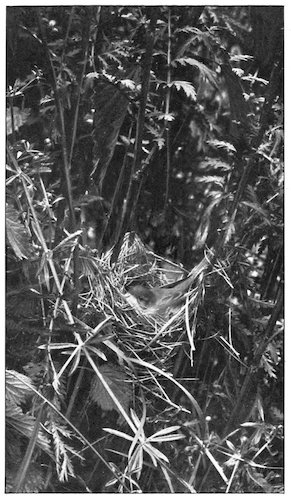
MARSH WARBLER ON THE NEST.
Several times the specimen I listened to began his concert with the alarm cry of a Song Thrush, so loud and accurately rendered that I was completely deceived into thinking that I was listening to the notes of a disturbed member of that species. After a little pause he would reproduce the warbling notes of a Swallow, then the tut, tut, tut of a Blackbird, followed by the full, rich notes of the Nightingale. He could also reproduce the call note of a Common Partridge, and the sweet little song of a Linnet with equal fidelity. He always appeared to take great care not to mix his music, for, after finishing one piece, there was a noticeable pause before the commencement of another.
In the case of another pair of birds, that had been robbed, I noticed that the male sang much upon the wing as he flew back and forth from tree to tree across an osier-grown clay pit.
This species was first discovered in Somersetshire, and has been found breeding in Gloucestershire, Oxfordshire, and Cambridge.
It is a great pity that it should be so much persecuted by egg collectors, some of whom seem bent upon ruining its chances of ever becoming a regular British breeding species. To listen to the bird’s exquisite song for ten minutes is a far greater pleasure than to gaze for a month at its empty egg shells in a cabinet.
THE REED BUNTING.
The male Reed Bunting, or Reed Sparrow as it is frequently called, can hardly be mistaken for any other British bird on account of his conspicuous velvety black head and white collar running from the base of the bill down the sides of the neck some distance, and thence right round to the back of the head. His back is brownish-black, the feathers being broadly margined with reddish-brown and tawny grey; breast and under parts white, tinged and streaked with brown towards the sides. He is rather longer than the Common Sparrow, and shows a distinct white streak down either side of his tail when flying away from the observer.
His mate is smaller and has a brown instead of a black head.
Although certainly a singer, the Reed Bunting is not a great feathered musician, its song consisting of a few simple notes which the bird delivers with considerable persistency from the top of a reed or alder bush. It sounds like te, te, tu, te, diversified by an occasional discordant raytsh. Bechstein, the great German authority on cage birds, says that it is such an admirer of music that it will approach an instrument without fear, and testify to its joy by extending its wings and tail like a fan and shaking them.
The alarm cry is a sharp twitter, and when the male is afraid to approach the nest (either to take his turn in the labours of brooding or with food for the young) on account of some real or fancied danger, he persistently reiterates three melancholy notes that sound like “Don’t hit me.”
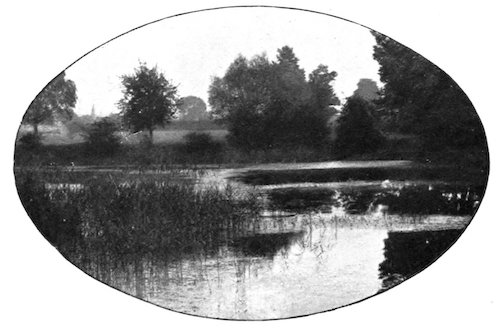
This species breeds fairly commonly near sluggish streams, ponds, swamps, and large sheets of water with reed-clad shores.
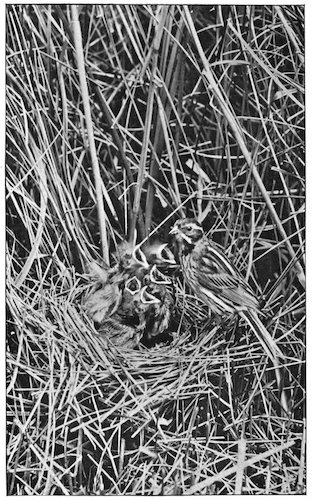
FEMALE REED BUNTING AND YOUNG.
Its nest is generally situated amongst long grass, rushes, nettles, and sedges, although I have found it in the heather in the Outer Hebrides, and in a small thorn bush quite two hundred yards away from water in Surrey. The materials used in the structure are dried grass and moss with an inner lining of fine dead grass, hairs, and the feathery tops of reeds.
The eggs number four to six or even seven, and are of a purplish-grey or pale olive ground colour, spotted and streaked with rich, dark purple-brown.
This bird resides with us all the year round, and its numbers are increased during the winter by other members of its species arriving from the Continent.
THE GOLDFINCH.
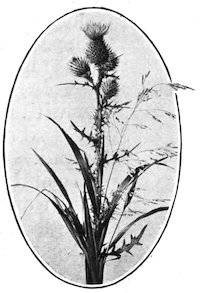
This exceedingly pretty bird measures about five inches in length. The top of its head, nape, and the feathers from the base of the bill to the eye are black; forehead and throat rich scarlet; cheeks and under parts white, tinged on the breast and sides with pale, tawny-brown. Back pale tawny-brown, wing-coverts and quills black, the latter barred across with yellow and tipped with white. Tail quills black marked with white, and buffy-white near their tips.
Seventy years ago this species was extremely abundant, and as recently as 1873 a boy caught close upon five hundred during a single morning near to Brighton; but it is now, alas! comparatively rare, on account of the reclamation of waste lands having destroyed its seed-food plants, such as the thistle and burdock, and the heavy demands made upon its numbers for cage pets. Of course, a check has now been put upon the latter source of drainage to a great extent by the Wild Birds’ Protection Acts, and the birds are obtained from Germany.
During recent years I have met with it breeding in Surrey, Sussex, Suffolk, Norfolk, Devonshire, and Westmorland. I know a place in the second-named county where as many as ten pairs bred in one season, and within the last half-dozen years I have twice seen small flocks in the autumn near London, which, let us hope, is an encouraging sign.
It is now rare in Scotland, but has been described as still common in the poorer and wilder parts of Ireland.
The Goldfinch is a migratory bird, although a few individuals winter with us, and are known in the spring from members of the species that have spent the cold season farther south by their less brilliant colours.
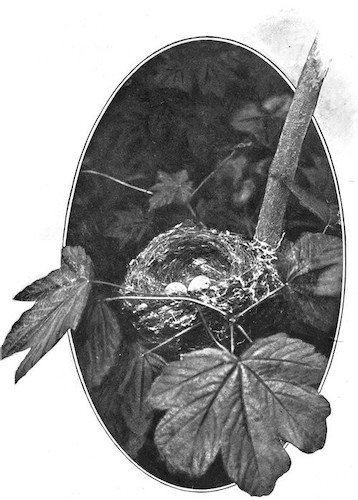
NEST AND EGGS OF GOLDFINCH.
The nest is placed in the fork of an apple, pear, or other fruit tree in orchards and gardens; sometimes in evergreens or on the bough of a sycamore or chestnut tree, and occasionally in a thick hedgerow. It is composed of rootlets, moss, dry grass, wool, spiders’ webs, and lichens on the outside, and has an inner lining of vegetable down, hairs, and soft feathers. It is a neat and beautiful structure.
The eggs number from four to six, and are greyish-or greenish-white, spotted and streaked with light purplish-and reddish-brown and grey.
Although some people do not rank the Goldfinch very highly as a feathered vocalist, its twittering song is full of melody and sweetness, and together with its striking beauty and lively manners endear it to the heart of every lover of the country and its sights and sounds.
Bechstein says, “Its agreeable song, which is only discontinued during moulting, is a mixture of tones and harmonies more or less dwelt upon.”
It sings both when perched and upon the wing. Instances are upon record of young Goldfinches taken from the nest when only two or three days old, reproducing when they grew up not the music of their own kind, but the songs of other species heard from their places of captivity.
The poets have not given the bird a great deal of attention, but our photograph of a nest and eggs proves that Grahame was a good observer, else he could not have penned the following lines:
“Sometimes suspended at the limber end Of planetree spray, among the broad-leav’d shoots The tiny hammock swings to every gale.”
The call notes have been written down as ziflit or tisflit, twee-eet or twit, oft repeated, and glit uttered quickly.
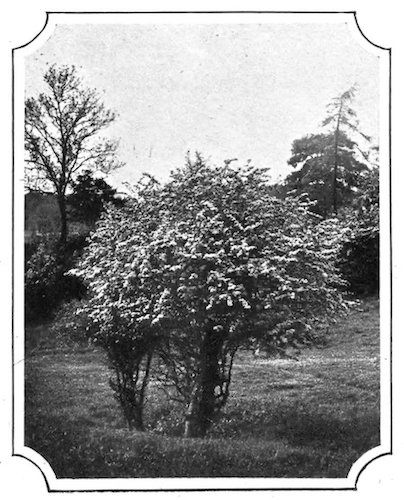
THE BLACKCAP WARBLER.
Although generally distributed in suitable parts of England and Wales, and found breeding sparingly in the Lowlands of Scotland and certain parts of Ireland, the Blackcap Warbler is not so common in my experience as the youthful student would be led to believe after reading several books I could name upon ornithology.>
It arrives in this country about the middle of April, as a rule; but, like many other migrants, is liable to some variation of date, being more influenced by the conditions of the weather than the readings of the calendar. It takes its departure again in September, although specimens have been observed during every month of the winter in the South and West of England.
The Blackcap is about five and a half inches in length, has a jet-black crown and light olive-brown upper parts, becoming greyer on the rump; throat and breast ash-grey, and under parts white. The female is somewhat similar in appearance, except for the fact that the top of her head is chocolate-brown instead of black.
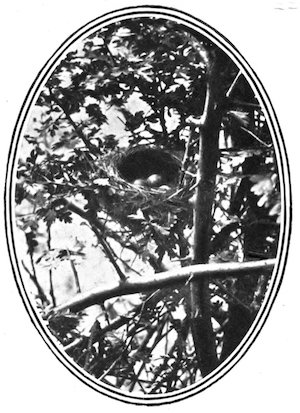
BLACKCAP WARBLER’S NEST AND EGGS.
This species loves small woods and spinnies with abundant undergrowth, shrubberies, old orchards, gardens, and bits of waste land with plenty of brambles and nettles growing thereon. If there is a sluggish stream close by, so much the better; although I have several times found it breeding far away from water of any kind.
The nest is a flimsy structure placed at varying heights from two to ten or twelve feet above the ground in brambles, nettles, briar, and thorn bushes, privet and other hedges. It is composed of straws, fibrous roots, and dead grass, frequently intermixed with cobwebs, and lined with hair.
The eggs number five or six, and may be divided into two types of coloration. In one they are of a greyish-white ground colour suffused with buffish-brown and spotted, blotched, and marbled with dark brown, similar to those of the Garden Warbler. In the other they are of a pale brick-red or crimson hue marked with deep reddish-brown.
This bird is one of our finest feathered melodists. Gilbert White was greatly in love with its vocal powers, and in his third letter to Daines Barrington says that the “wild sweetness of its song reminded him of Shakespeare’s lines in As You Like It:”
“And tune his merry note Unto the wild bird’s throat.”
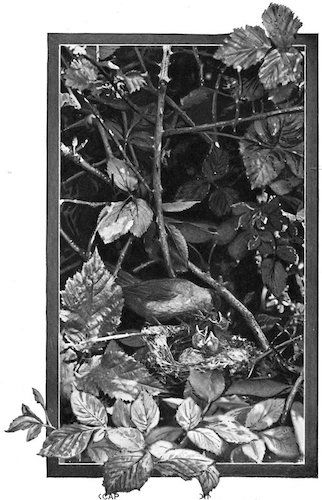
FEMALE BLACKCAP WARBLER FEEDING YOUNG.
In Letter XL. to Pennant, he says, “The Blackcap has a full, sweet, deep, loud and wild pipe; yet that strain is of short continuance, and his motions are desultory; but when that bird sits calmly and engages in song in earnest, he pours forth very sweet, but inward melody, and expresses great variety of soft and gentle modulations, superior perhaps to those of any of our warblers, the Nightingale excepted.”
Everyone who has heard and seen the Blackcap will at once recognise the truth and accuracy of this; but, strangely enough, Gilbert White never once mentions the Garden Warbler in his writings.
The estimate of a wild bird’s song is like that of the voice of a public singer—to some extent a matter of individual opinion. Personally, though by no means disposed to underrate the beauty and power of the Blackcap’s song, I do not think that it approaches so near in quality to that of the Nightingale, or is so far superior to that of the Garden Warbler as some observers appear to believe.
The Blackcap is a very shy, retiring bird, preferring to be heard rather than seen. The male takes his share of the duties of incubation, and it is said that he beguiles the tedium of his task by singing whilst sitting on the nest. I have watched him brooding on several occasions, but in spite of long vigils have never had the gratification of hearing a single note.
Curiously enough, the poets have given this superb singer very little attention, probably because they were seldom in a position to identify the vocalist, however much they admired his music.
The alarm note of this species sounds something like tack-tack or teck-teck.
THE BULLFINCH.
There is no need for me to describe the appearance of the male bird of this species, which has been rendered familiar to nearly everybody in town and country alike on account of the facts that its engaging manners and striking colours have made it a favourite cage pet. It may be necessary, however, to mention that the female differs from her mate in the following particulars. The black on the top of her head is not so intense, her back is greyish-brown, and her breast and under parts are of a dirty brown colour instead of bright tile red.
Both male and female may always be instantly identified when on the wing by the conspicuous patch of white on the rump, and when not seen the presence of the species is easily known by its unmistakable plaintive call note, which is constantly uttered whilst the birds are hunting in pairs or families for food along a hedgerow or from bush to bush in a wood. It sounds something like wheon.
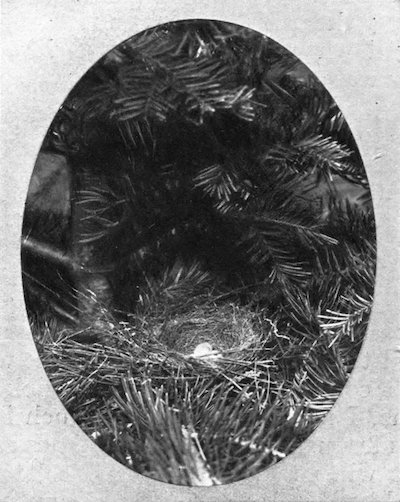
NEST AND EGGS OF BULLFINCH.
This species has profited more by the Wild Birds’ Protection Acts than perhaps any other breeding in our country. It is as much hated by some people on account of the harm it does to the buds of fruit trees, as it is loved by others as a cage pet. It has increased greatly in numbers nearly all over the country during the past ten years, as may be judged when it is mentioned that over forty were shot in one Essex garden last spring. Let us hope that the damage done to buds and branches by small shot expended during the slaughter may not be put down to the credit of the unfortunate feathered victims.
In a secluded Surrey wood, where I spend a good deal of time every July and August studying and photographing birds from the interior of a small green tent pitched near to a place where birds come all day long to drink and bathe, I notice that the Bullfinch is my most frequent visitor. Sometimes an old male will come along in silence, take a few hurried sips, and then abruptly depart, indicating that he has a sitting mate, and at others whole families arrive to quench their thirst, which appears to be abnormal in this species, and to enjoy a good bath.
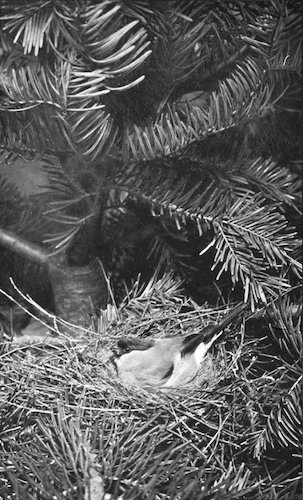
FEMALE BULLFINCH ON THE NEST.
The Bullfinch breeds in suitable localities throughout the British Isles, but, according to my experience, is commonest in the South of England. Its nest is of rather singular construction, consisting of a little platform of slender dead twigs cleverly interlaced with a somewhat shallow recess in the middle, beautifully lined with fine, fibrous roots and sometimes a little hair. The structure is placed from three to six feet from the ground, as a rule, in whitethorn, blackthorn, briar, and other bushes, also in yew and other evergreen trees growing in gardens, shrubberies, woods, and thick hedgerows.
The eggs number from four to six, of a pale, greenish-blue ground colour, spotted, speckled, and sometimes streaked with purplish-brown, most thickly at the larger end.
The female Bullfinch is a confiding creature whilst brooding, as will be gathered by my readers when I state that the one figured in our illustration became so tame through kind and gentle treatment that she would actually allow me to take her in my hand and place her in any attitude I wished upon the nest before taking a photograph of her. I secured a large series of pictures of this particular bird on and near her nest.
The song of this species is short and very soft. One day a fine male alighted on a bare branch close to my hiding tent and held forth with his head on one side, as if listening to the sound of his own voice, whilst his body seemed to throb with the effort of producing even such feeble notes as he commanded.
Bullfinches learn the song of the Canary when brought up under that bird, instead of the notes of their own species, and can be taught in confinement to whistle all kinds of airs and melodies.
THE WHEATEAR.
The Wheatear is a thick-set little bird measuring about six inches in length. It arrives in the South of England about the end of February and beginning of March, and leaves our shores again in August and September. It has the top of the head, nape, and back of a bluish-grey colour, tinged with light brown, rump and upper two-thirds of tail pure white. Wings nearly black, with buff margins and tips to some of the feathers, end of tail black; chin and throat dull white; breast pale creamy white, turning to a dull yellowish-white on the under parts. The female is somewhat browner on her upper parts than the male. The Wheatear may always be readily distinguished by the large white patch at the base of its tail, seen most conspicuously when the bird is flying away from the observer.
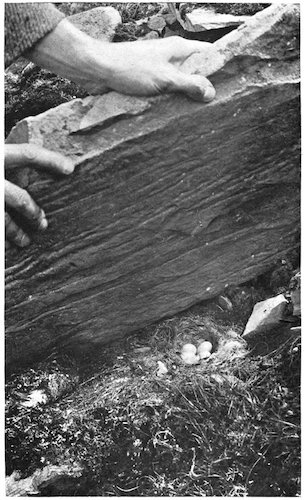
WHEATEAR’S NEST AND EGGS BENEATH A LARGE STONE, WHICH WAS RAISED IN ORDER TO TAKE THE PHOTOGRAPH.
This species inhabits high moorland districts where rocks and solitude are the most striking features of the landscape, but it is a mistake to say that the cultivation of land banishes it, for I have met with it breeding on ploughed land in the Highlands, Hebrides, and Shetlands quite commonly.
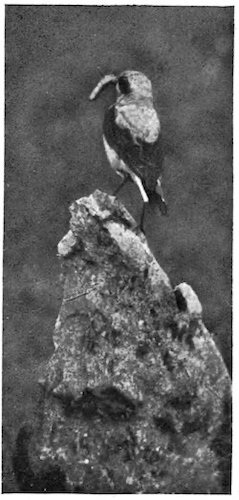
MALE WHEATEAR BRINGING FOOD FOR YOUNG.
The nest is situated under loose slabs of rock, in holes in rough, dry stone walls, peat stacks, and rocky banks. I have met with it on two or three occasions in the old nesting burrows of rabbits. It is made of dead grass, rootlets, and moss, with an inner lining of hair, feathers, and rabbits’ down.
The eggs generally number five or six, of a pale greenish-blue, occasionally spotted on the larger end with rusty red.
This species practises a short and somewhat pretty, but not very loud, song, which is enhanced in value by the weird solitude of the vocalist’s surroundings. It is frequently uttered whilst the bird is on the wing going through aërial antics, often highly suggestive of dementia.
The call note of the species may be imitated by beating two pebbles together, and sounds like chick, chack, chack.
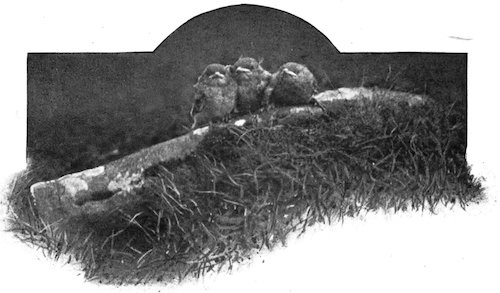
YOUNG WHEATEARS WAITING FOR FOOD.
THE STONECHAT.
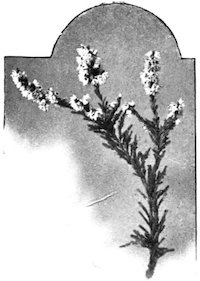
This very conspicuous and familiar little bird measures just over five inches in length. Its head, nape, throat, back, wings, and tail are black, many of the feathers being edged with rusty brown. On the sides of the neck, wings, and at the base of the tail are large patches of white. Breast dark rust colour, under parts much lighter. Its unlikeness to any other British bird, and habit of perching on the topmost sprays of gorse, juniper, and bramble bushes, render it perfectly easy to observe and identify. The female differs somewhat, being dull brown with buff edgings to the feathers on her upper parts, and having the chin buff, sides of the neck brownish-white, and breast and under parts duller.
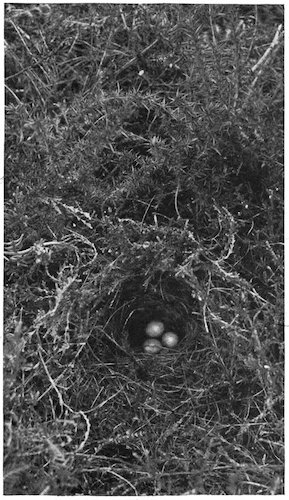
NEST AND EGGS OF STONECHAT
This species does not live, as its name might be taken to imply, in stony wildernesses, but upon furze-clad commons and uncultivated land where juniper, brambles, and other kinds of tangled vegetation grow. The nest is built upon or near the ground, and is generally well concealed. It consists of rootlets, moss, and dry grass, with an inner lining of hair, feathers, and occasionally pieces of wool. I have often seen it with very little else than fine blades of dead grass.
The eggs number from four to six, and on rare occasions even seven have been found. They are of a pale bluish-green ground colour, closely spotted round the larger end with reddish-brown. Sometimes the spots are entirely absent.
The Stonechat, although subject to local movement, stays with us all the year round. Its soft, low song, although of no great length or importance, is sweet and pleasing, and sometimes contains imitations of other birds’ notes. It is delivered both whilst the singer is at rest and hovering in the air. The male helps the female to feed the young ones, and in the case of the chicks hatched from the eggs figured on the previous page he had the whole of the domestic work to do because his mate disappeared altogether a few days after the young ones had been hatched.
The call note resembles the sound made by striking two small pebbles together in the hand, hence its name of Stonechat. It has been written down as u-tic, u-tic. After the young are hatched it changes somewhat and sounds like chuck, chuck.
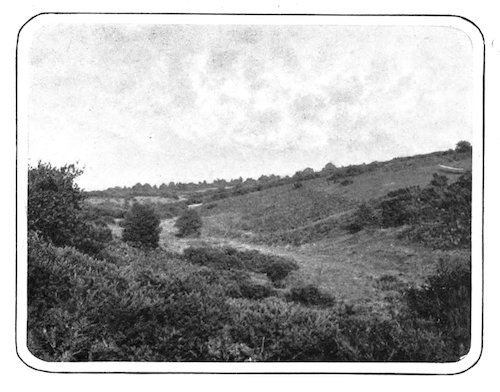
THE WHINCHAT.
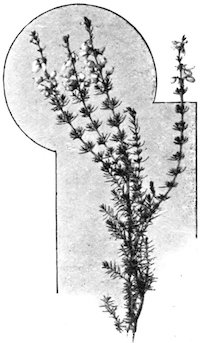
The Whinchat arrives in this country during April, and takes its departure again in September and October. It is about five inches and a quarter in length, and has the crown of the head and upper parts generally of a dusky-brown colour, the feathers being edged with sandy buff.
The wings are marked with a large white spot. Upper half of tail white, lower half dark brown edged with sandy buff. A broad white stripe runs from the base of the bill over the eye. Chin is white, throat and breast are light chestnut, under parts pale buff. In the female the white line over the eye and the spot upon the wing are less conspicuous, and the colour of her under parts is less distinctive.
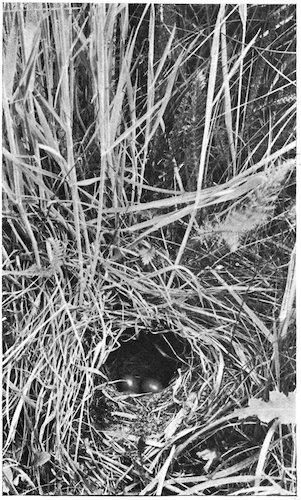
WHINCHAT’S NEST AND EGGS.
This species, although somewhat local, is met with nearly all over the British Isles. It is partial to heaths and commons, pastures, and meadows, where it makes its nest on or near the ground in thick tangled grass, heather, and at the bottom of small gorse bushes. The structure is formed of dead grass and moss with an inner lining of fine, dry grass and sometimes horsehair. The eggs number from four to six, of a greenish-blue ground colour, sometimes spotted on the larger end with reddish-brown.
The song is low, but sweet, and is delivered somewhat hurriedly, both whilst the melodist is perched and upon the wing. The call note sounds like u-tack.
THE SONG THRUSH.
“The thrush, a spendthrift of his powers, Enrapturing heaven and earth.” Montgomery.
There is, luckily, no need for me to enter into a minute description of the appearance of this well-known and greatly beloved carol singer, which is called a Song Thrush in the South, a Throstle in the North of England, and a Mavis in Scotland. It breeds commonly throughout the British Islands wherever there is any kind of cover in the shape of trees, shrubs, or bushes to give it shelter. Some people think that the Song Thrush resides with us all the year round, but this is only partially true. I know many high, bleak parts of the country where it is never seen during the depth of winter, and, as a matter of fact, those that stay with us in the lower and more sheltered regions are only a fraction of the total number bred in our country.
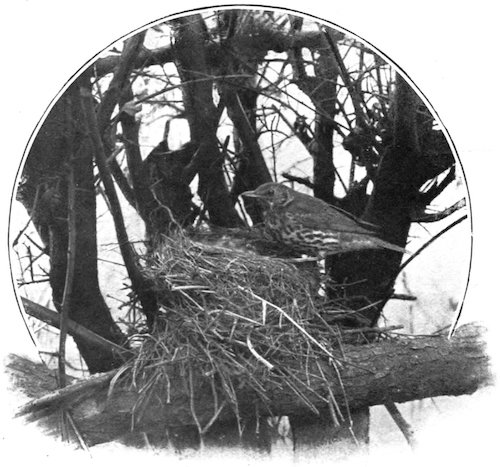
SONG THRUSH AT NEST.
The nest of the Song Thrush is built in evergreens, hedgerows, bushes, ivy growing against walls and trees, holes in stone walls, on ledges of rock, on beams in sheds, and occasionally, though not as often as that of the Blackbird, absolutely on the ground. It is quite unlike that of any other British bird in its construction, being made of twigs, coarse dead grass, moss, and clay or mud outside, with an inner lining of clay, mud, or cow-dung studded with bits of rotten wood. In some districts where decayed wood is difficult to procure, it is dispensed with altogether, and during very droughty summers I have found several nests occupied by eggs without a vestige of a hard lining. They were similar to those of the Blackbird, only not so neatly lined with fine dead grass. The mud lining is generally allowed to dry hard before the bird commences to lay.
The eggs, numbering from four to six, are of a beautiful deep greenish-blue colour spotted with black. I have on several occasions met with unmarked specimens.
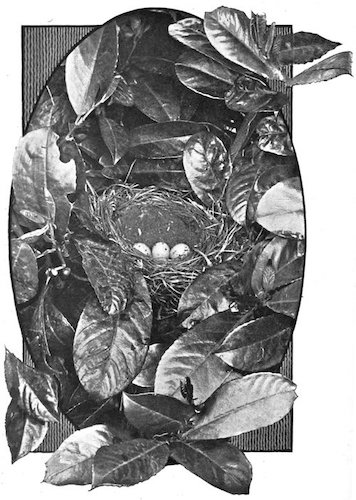
NEST AND EGGS OF SONG THRUSH.
As a melodist the Throstle ranks very high. Many people consider that it comes next to the Nightingale, for which it is often mistaken, when singing very late in the evening, by people who can claim no great acquaintance with the superb notes of Sweet Philomel.
Mr. Swaysland, of Brighton, who has had a great deal of experience amongst feathered musicians, says that the song of the Mavis is “clear, yet full of mellowness—now pealing out a phrase of wild bluff heartiness, and anon with long-drawn notes tinged with exquisite pathos—striking a responsive chord in the heart of every hearer.”
I have heard its song during every month of the year excepting August, when the bird experiences the depression of its annual moult.
During a fine April morning every wood and spinny in the part of Surrey where I reside rings with the melodious notes of the Throstle, and two or three seasons ago we had a specimen that habitually sang from the top of a cabbage in a field almost surrounded by tall trees. I have heard it sing on the ground between bouts of fighting, on the wing, and from a housetop, where a Starling might have been expected to hold forth. It has been timed, and in one instance at least has been found to sing sixteen hours in a single day, and under favourable circumstances some of its notes may be heard half a mile away.
If not the most imitative of all British birds, it comes very close to the holding of that distinction, and can not only mimic some notes as well as their owners can deliver them, but actually improve upon their volume and sweetness. The Ringed Plover and the French Partridge are two examples. I have heard the Throstle reproduce the notes of the following species: Common Curlew, Whimbrel, Dunlin, Peewit, Golden Plover, Common Tern, Redshank, Ringed Plover, French Partridge, and Common Sparrow, besides those of several others.
Thrushes vary not only individually as musicians, but in different parts of the country, I am persuaded. Some of the finest singers I have heard have been in Surrey, Cheshire, and Aberdeenshire.
The poets have given this species a good deal of deserved attention on account of the excellence of its song, and everyone who has had any experience whatever of the country and its wild life in springtime will at once recognise the truth and beauty of the following lines:
“Through the hazels thick espy The hatching throstle’s shining eye.”
The call and alarm notes of the Song Thrush are very difficult to convey by the characters of the alphabet. The former sounds something like sik, sik sik, sik, siki, tsak, tsak, and the latter quep and wich-it-tit. The song has been rendered by the words, “Go-it, go-it, stick-to-it, stick-to-it, you’ll-do-it, you’ll-do-it,” but by far the best representation is that of the great Scottish naturalist, Macgillivray, which I have quoted at length in “Our Bird Friends.”
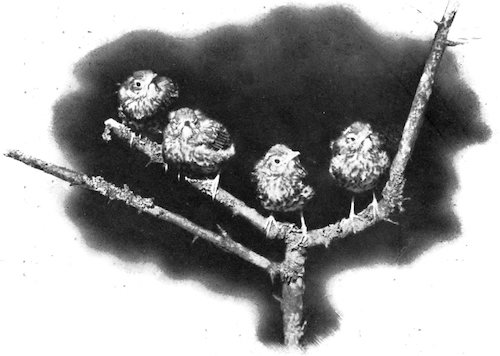
YOUNG SONG THRUSHES WAITING FOR MOTHER.
Throstles live principally upon worms, grubs, and snails, and they have a habit of taking the last-named to some favourite stone, where they hammer the shell until it is sufficiently fractured to enable them to extract the luscious morsel inside. These stones are known as “Thrushes’ Anvils.” Occasionally when they find a snail with a house upon its back too hard and strong to be broken in this way, they carry it to some height in the air and drop it on a flag or other hard substance. The shell is thus fractured, and the sensible captor descends and devours its prey. The bird also takes its share of fruit, and without any consideration for the good it does during the greater part of the year, is ruthlessly slain by gardeners, who might, in the great majority of instances, use netting instead of shot to the advantage of both fruit trees and birds.
When I hear a garden-loving neighbour’s gun going off, I frequently think of the poet’s compassionate appeal:
“Scare, if ye will, his timid wing away, But oh, let not the leaden viewless shower, Vollied from flashing tube, arrest his flight, And fill his tuneful, gasping bill with blood.”
The members of this species that stay with us throughout the winter months, when not regaling our ears with their versatile songs, amuse even the most casual observers by their quaint ways of listening for and catching worms on lawn and meadow during open weather. They also well repay feeding with soaked dog-biscuits and other edible trifles during severe weather, when it is almost impossible for them to secure even the shortest supply of natural food. They are able to foretell coming changes in the weather far earlier than human beings, and frequently sing in anticipation of a thaw.
THE YELLOW HAMMER.
Who does not know this almost universally distributed bird in our country, with its dress of almost canary-like yellow, streaked with brown, and short though oft-repeated song? On furze-clad commons, along cultivated hedgerows, and on railway embankments close to busy London town, and in far-away parts of the country alike, it may be heard morning, noon, and night persistently going over its familiar notes, which always seem to me to accord best with the drowsiness of a hot summer’s day. Indeed, I must confess that at such times its reiteration has sent me to sleep.
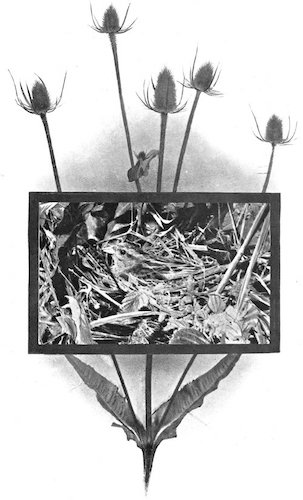
YELLOW HAMMER ON NEST.
It has been variously represented by the characters of the alphabet, as the following examples will show: tic-tic-tic-e-ereze, te, te, te, te, te, te, twyee; chick, chick, churr; chit-chit-chierre-r-r. By far the most popular rendering of it in England, however, is the somewhat hackneyed phrase, “A little bit of bread and no cheese.” In Scotland it becomes, “Deil, deil, deil tak ye,” a supposed imprecation upon boys who steal its eggs.
There is also a curious legend in the North to the effect that Satan supplies the bird with half a drop of his blood every morning wherewith to mark its eggs with the greatly varied scribbling lines that appear upon them.
The song, although more musical than that of the Corn Bunting, is considered by many people to be a monotonous performance. The poet Grahame was evidently aware of this when he wrote the lines:
“Even in a bird the simplest notes have charms For me: I even love the yellow hammer’s song.”
The call note of this species, when disturbed, is a trit, trit, trit, and on the wing tisit.
It may always be distinguished with certainty from its much rarer relative, the Cirl Bunting, by the fact that it has no black upon its chin.
The female Yellow Hammer is a trifle smaller than her mate, is much less yellow, and the markings on her head are darker. Both sexes take a share in the work of incubation.
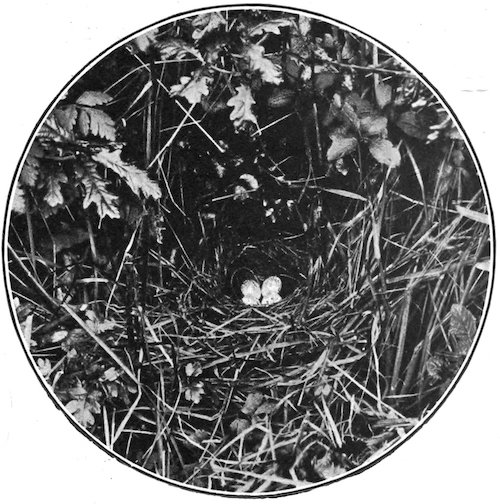
YELLOW HAMMER’S NEST AND EGGS.
The nest is built in hedge banks, at the foot of light open bushes, under brambles, and sometimes even in gorse bushes and thick evergreen hedges at a considerable height from the ground. It is composed of dry grass, rootlets, and moss on the outside, with an inner lining of fine, dead grass and horsehair.
The eggs, numbering from four to six, are of a dingy white ground colour, tinged with purple, streaked, spotted, and blotched with dark purplish-brown. The streaks or scribblings generally end in a spot, and, on account of their similarity to the marks made by a pen, the bird is known in many parts of the country as the “Writing Lark.”
This species, although commencing to breed in April, sometimes has eggs as late even as September.
THE STARLING.
It is quite unnecessary for me to describe the appearance of the Starling, for the species is so common, sociable, and unlike every other feathered friend in this country that confusion is almost impossible.
I love the brave, bustling bird, for when it has any work to do it does not go dawdling along like a lazy boy crawling halfheartedly to school, but rushes about as if the welfare of the whole universe depended upon its individual exertions.
It is a lively singer, with almost unrivalled powers of imitation, and has, I must confess, completely deceived me on several occasions. One fine spring morning, whilst on my way to a railway station in the north of London, I heard, to my surprise, the familiar notes of a Golden Plover, and immediately began to examine the heavens for a member of that species flying overhead. To my surprise, I discovered that the sounds were coming from a Starling delightedly flapping its wings on a chimney-pot not far away. On another occasion, whilst hunting for a much-desired Sandpiper’s nest on the shores of a small loch in the Outer Hebrides, I said to my brother, “Hark! I hear one calling!” But that Sandpiper proved to be a Starling standing on a rock not far off imitating to perfection the soft call notes of the little wader. I have heard different members of this species mimicking the cries and call notes of the Curlew, Whimbrel, Lapwing, Common Partridge, Redshank, Ringed Plover, House Sparrow, and other small birds.
Tame Starlings have been taught to imitate the human voice so well that one has been said to repeat the Lord’s Prayer from beginning to end, and Pliny, the historian, mentions one that was able to speak in both Greek and Latin.
The harsh alarm cry of the species sounds something like the word spate, spate.
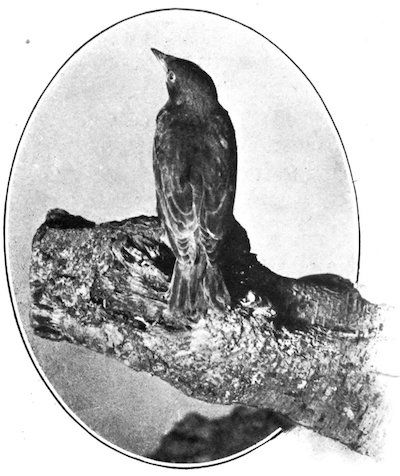
YOUNG STARLING IN ITS FIRST COAT OF FEATHERS
Although sometimes guilty, especially during very dry seasons, of taking cherries and other fruit, the damage wrought in this way is as nothing compared with the vast amount of good done by this species in the destruction of insects injurious to growing crops. It is an amusing sight to watch a flock hurrying and scurrying across a field, the hindmost members continually flying over the foremost and then running in breathless haste looking eagerly this way and that, probing every likely and unlikely place for some lurking grub, as if life did not contain one moment to be wasted.
They alight on the backs of sheep and cattle in order to destroy troublesome parasites, and at certain seasons of the year may be seen dexterously hawking winged insects over houses and tree-tops.
Starlings have greatly increased in numbers during the last forty years in our islands, and there is no season of the year when flocks, great or small, cannot be seen. Late breeders keep together until far on in May, and the broods of those that commenced housekeeping operations early in April flock together directly they meet each other in the fields. Thus I have known the same nesting hole occupied twice in one season, a fact which has given rise to the belief entertained by some people that the species is double-brooded.
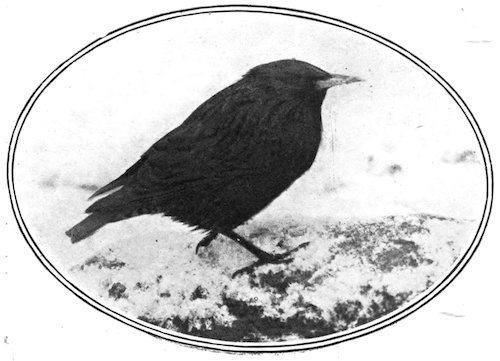
ADULT STARLING IN WINTER.
When flocked, these birds have favourite roosting places, to which they resort in tens of thousands every night with the utmost regularity. Sometimes they select a reed bed to sleep in, and do great damage by too many birds alighting on the same stems and breaking them down. Before finally settling for the night, they perform a great number of wonderful aërial evolutions, especially during fine weather. Whilst sitting in one black mass on every available branch and bough, producing an indescribable din by all chissicking and chattering to each other at the same time, they will suddenly become quite silent, and leaping into the air with a noise just like that of a truck-load of small coals being shot into the hold of a steamer, mount to a considerable height, and commence to wheel and turn as if by some magically communicated command.
At one moment they look like a thick black cloud, and at another like a long trail of grey smoke. Every turn and twist, opening and closing of the whole flock, is performed with a grace and precision of movement which is wonderful to behold.
Starlings nest in holes in trees, rocks, and old ruins; under the roofs of houses, in the thatch of ricks and outbuildings, and sometimes under large stones on steep hillsides. I have also known them breed amongst sticks forming the base of an Osprey’s eyrie which was occupied by young ones. A year or two ago I found an open-topped nest containing chicks in an evergreen, where a Blackbird or Thrush might have been expected to breed. Green Woodpeckers are constantly turned out of their laboriously dug holes by members of this species in search of suitable nesting quarters.
The nest is a loosely-put-together structure composed of straws, rootlets, and bits of moss, with a lining of hair, feathers, and occasionally a lock of wool. I have often found nests, however, with no kind of lining at all except straws.
The eggs number from four to six, of a uniform pale blue colour. This species has a curious habit of dropping its eggs about on lawns and in fields during the early part of the breeding season.
Young Starlings, in their first coats of feathers, are greyish-brown, and lack entirely the beautiful purple and steel-blue sheen which gives their parents such a handsome appearance when the sun is shining upon them.
THE CHAFFINCH.
Youthful students of ornithology are frequently at a loss to understand why Linnæus, the great Swedish naturalist, gave this bird the somewhat odd scientific name of cœlebs, signifying bachelor. He did so because he noticed that in his own country the females left the males behind in winter and migrated south in search of more hospitable climes.
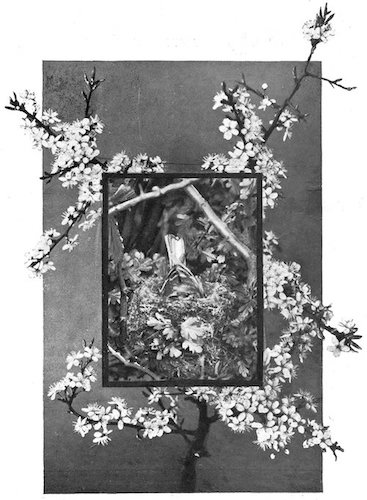
CHAFFINCH ON THE NEST
In Scotland and the North of England I have frequently observed the same kind of thing happen, and especially during severe winters, not a female to be seen for weeks together, and the males all congregated in little flocks. In the South and West of England, however, both sexes remain together, as a rule, and, associating with their relatives, the Common Sparrows, hunt farmyards and gardens for corn, seeds, and any other unconsidered trifles they may chance to pick up.
However gloomy the conditions of existence may be, the brave Chaffinch is always sprightly, vigorous, and cheerful, a characteristic which may be plainly seen in our illustration of birds feeding on the snow.
The call note of the species is a loud, ringing spink, spink, which is also used as an alarm cry. In the spring the male utters in addition a very sweet one sounding something like tu-wheet, tu-wheet. During flight the bird makes use of another note, which is difficult to render by the characters of the alphabet, but may, perhaps, be best represented by the letters tuke.
The song is repeated thousands of times per day in the early part of the breeding season. It is a very sprightly performance, like a merry old English catch, tol-de-rol, lol, chickweedo, which has been very aptly likened to the words, “Will you, will you kiss me, dear?” Some people consider it a monotonous affair, but in spite of the fact that I have heard it repeated twenty-one times in four minutes it is always to me, “A full, clear, sprightly ringing ditty.” It varies greatly in individuals, and although London bird-catchers consider an Essex Chaffinch superior to all others as a singer, I prefer to listen to some members of the species I have heard cheering the dark solitude of great Highland pine forests.
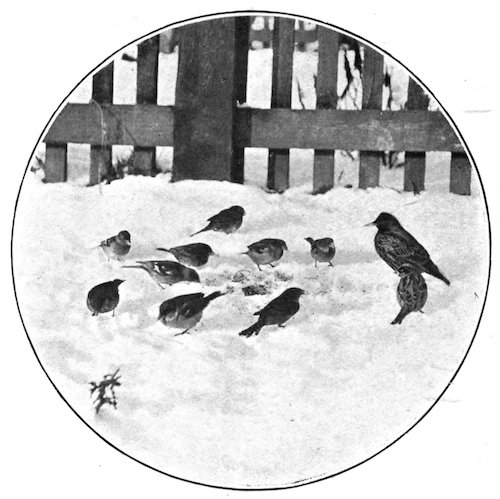
CHAFFINCHES, SPARROWS, AND STARLING FEEDING IN WINTER.
German workmen are great Chaffinch fanciers. One has been known to exchange a cow for a clever vocalist of this species, and another to live upon bread-and-water until he had saved the high price of a prime favourite.
It is, I must confess, always a saddening experience for me to hear this little songster’s notes ringing clear and sweet from the interior of a wee prison house tied up in a black cloth, and carried along some dismal street beneath the arm of a costermonger. However, it is only fair to add that these men are, as a rule, devoted to their pets, and treat them with the utmost kindness. A great authority upon the subject says that if well treated a Chaffinch will live in confinement for twenty years. It has also been asserted as a curious fact that if an adult male Chaffinch is caught before Whitsuntide he will sing in a cage, but if he should be made a prisoner after this date he will die of grief at being parted from his mate and young ones.
Chaffinches pair towards the end of February and throughout March, although flocks of “bachelors” may occasionally be seen as late as the first week in May, and commence building operations, as a rule, about the middle of April. They build deep, cup-shaped, and wonderfully neat little nests of moss, wool, lichens, and cobwebs, beautifully felted together and securely fixed in the forks of small trees in orchards, hedgerows, and woods. It is generally adorned on the outside with bits of green moss or grey lichens that will render it similar in appearance to its surroundings, and thus help it to escape detection.
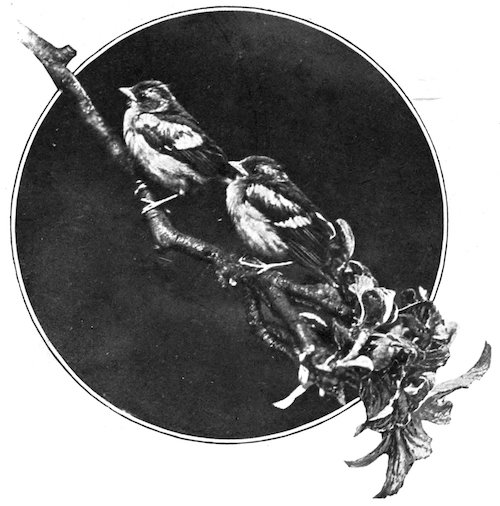
YOUNG CHAFFINCHES.
The eggs number from four to six, but clutches of five are the general rule, and are pale greenish-blue in ground colour, clouded with faint reddish-brown and spotted and streaked with dull purplish-brown of various shades.
The female Chaffinch lacks the rich colouring of her mate, especially on the head and breast, and is a trifle smaller. The young are fed upon insects by both parent birds, and resemble their mother in appearance whilst wearing the first coat of feathers.
THE PIED FLYCATCHER.
The Pied Flycatcher is a singularly well-named species, because it answers both adjective and noun exactly.
The male is not quite as large as a Robin, and is, generally speaking, black and white, as shown in our illustration on the next page. In fact, a little girl who saw the picture, exclaimed, “What a pretty wee Magpie!” The small patch of white on the forehead varies in size. In some individuals it is quite conspicuous, and in others scarcely visible. The female lacks it altogether, and is generally less pronounced in her colours than her mate.
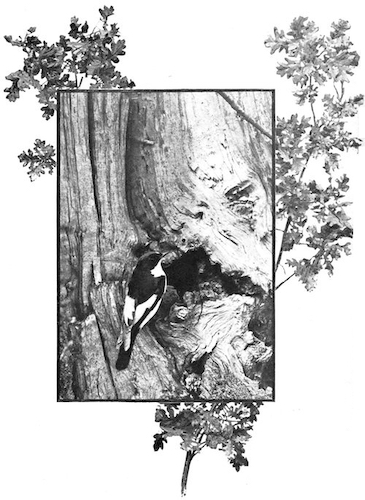
MALE PIED FLYCATCHER OUTSIDE NESTING HOLE.
This species is partial to certain parts of the country, and although by no means common is to be met with in the six northern counties of England, in Wales, and in some parts of Scotland. Some authorities say that it is most numerous in the Lake District, but I have met with far more specimens in certain parts of the Principality than anywhere else.
The male has a very pretty, though short and oft-repeated song. It resembles that of the Redstart so closely that it is difficult to say with certainty which bird is producing the music unless the singer be seen. This also applies to its call notes.
A male Pied Flycatcher is a creature of decided character. The one figured in our photograph was busy feeding his mate, sitting on six beautiful pale blue eggs, in a hole in an old tree, which had been struck and partially destroyed by lightning, when a friend of mine and I discovered him. Upon our examining the nesting site the female fluttered out, and joining her mate, they flitted about together from tree to tree until he evidently thought it was time for her to return to her maternal duties. She was, however, afraid to venture back to her nest because my camera stood within a few feet of the entrance hole, and flew nervously from one branch to another in the neighbouring trees. Her mate, with the evident intention of showing her that there was no cause for alarm, came along and, alighting right in front of my apparatus, took a leisurely peep inside the nesting hole. As this had no visible effect upon her nerves he went off and secured a fat, green caterpillar, which he would not offer her anywhere, although she shivered her little wings in supplication, excepting on the threshold of their breeding quarters.
As even this kind of inducement failed, he indignantly gulped down the food, and with a great show of anger, began to chase her round and round, up and down, until at last he forced her indoors. Later on, this female grew bolder, however, and I succeeded in photographing her on the gnarled trunk of the lightning-blasted tree.
A precisely similar kind of thing happened at another nest, but in this instance the lady was stronger minded, and refused to be bullied into the performance of her duties.
In this particular wood, which was of no great size, four pairs of these interesting birds lived within a few hundred yards of each other. The males appeared to spend the day in catching winged and other insects for the females, in singing, and chasing each other away from particular spheres of influence.
The Pied Flycatcher, like its commoner relative, the Spotted Flycatcher, is a migratory bird, arriving in this country in April and leaving again in September and October.
It builds its nest generally in holes in trees, but sometimes in old walls. The structure is composed of dry grass, dead leaves, and moss, with an inner lining of hair and feathers.
THE LINNET.
Male Linnets vary almost as much in the colour of their feathers as they do in the quality of their songs. A fine specimen, arrayed in all the glory of his summer dress, has the forehead and crown glossy blood-red, the rest of the head black, and sides of the neck brownish-grey, back and upper wing coverts deep reddish-brown; wing quills dusky, edged with white; upper tail coverts dark brown; tail quills brownish-black, edged with white, except in the case of the two centre feathers; chin and throat greyish-white, streaked along the middle with greyish-brown; breast glossy rose-red. The last-named colour varies greatly in intensity, and in some birds is almost absent. In fact, as Yarrell says, perfect specimens are not often met with, and the carmine cap and breast are generally replaced by brownish lake-red.
Some adult male Linnets have lemon-yellow breasts, and in Germany are considered old birds and the best singers.
The female is a trifle smaller than the male and lacks the red on the top of the head and breast.
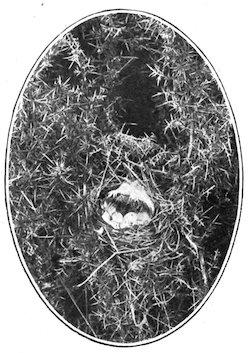
LINNET’S NEST AND EGGS.
This species is distinguished from the Lesser Redpole by having no white bar on the wings and no black upon the chin, and from the Twite, with which it is likely to be confused, by the facts that it has a shorter and less deeply forked tail and the male lacking the red on his rump.
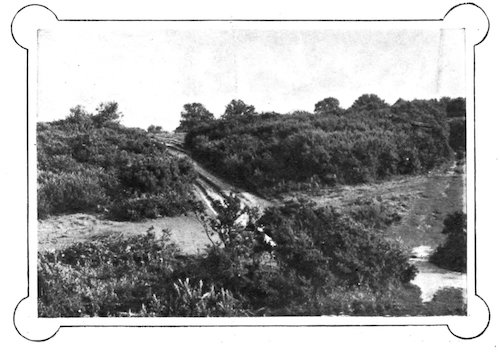
Last spring I spent two days on a Surrey common photographing the Stonechat figuring in the little picture which decorates the front cover of this book. He was bringing food to his offspring in a nest situated amongst some stunted heather growing in a sheltered dell formed by two gorse-clad ridges about eighty feet in height and a hundred yards apart. Although many Linnets were still roaming the countryside in flocks, numbers were busy love-making and pairing close around me, and I shall never forget the sweetness of the twittering and warbling that went on all day long.
The carols were generally sung from the topmost spray of some furze bush, which was a golden blaze of bloom, but occasionally the vocalist would utter his sweetest notes when dropping gracefully through the air to some intended resting-place.
This bird has received a great deal of attention from the poets, some of whom have described its song as a “careless lay” and others as a
“None-offending song of quiet prettiness.”
The call note of the species is a shrill twit, twit and wee, tye wee.
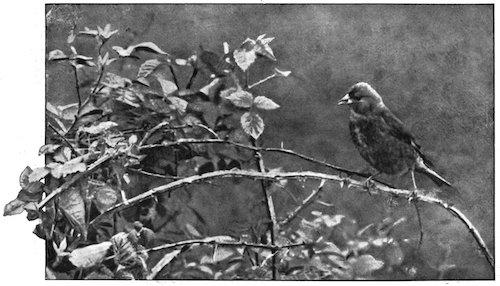
LINNET BRINGING FOOD FOR YOUNG.
A Linnet’s nest is made of small twigs, fibrous roots, dry grass, stems, moss, and wool, with an inner lining of hair, feathers, rabbit and vegetable down; and is situated in gorse, and broom bushes, white and black thorn bushes, tall heather, and juniper. I have found a nest ten feet from the ground, and two nests quite upon it.
The eggs number four to six, are greyish-white in ground colour, tinged with blue or green and speckled and spotted with purple-red and reddish-brown.
A very strange thing about this species is that it appears to grow shyer during the breeding season, whereas nearly all other birds grow bolder. This peculiar characteristic, of course, increases the difficulty of photographing the creature.
Linnets flock together as soon as the breeding season is over—some of them to migrate, and others to wander about the country visiting stubble fields and waste lands in search of seeds. It is a very pleasant sight to watch a flock resting on the sunlit top of some tall tree on a fine winter’s day, and hear the sociable little birds holding a kind of chattering concert.
It is almost needless to add that the Linnet is a great favourite as a cage pet. Specimens caught in the autumn soon adapt themselves to confinement, but those taken in the spring frequently mope and die. One has been known to live as many as fourteen years in a cage, but I have never yet heard of a specimen in confinement donning the crimson colour on its head or breast.
The species has derived its name in several European countries from its fondness for linseed.
THE SWALLOW.
This deservedly popular harbinger of spring arrives in England about the end of March and beginning of April, and departs again in September, although specimen’s have been seen during every month of the year, and one hardy individual actually managed to live right through a mild winter in Yorkshire not long ago. There is little need for me to describe the appearance of this familiar bird in detail, but it may be well to say that its forehead, chin, and throat are chestnut brown, upper parts generally and a broad bar across the chest steely blue. Under parts dull, buffy white. The adult Swallow may always be distinguished, on the wing or at rest, from either the Swift or the Martin, by its much more deeply forked tail.
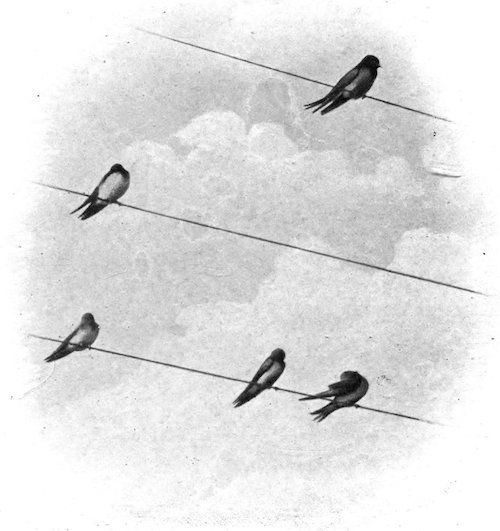
YOUNG SWALLOWS ON TELEGRAPH WIRES.
Its nest is generally built in a chimney or on a rafter in a barn, stable, or shed, although I have seen it plastered against a smooth whitewashed wall, on a dangling tendril of ivy that had grown through the roof of a shed, under a stone bridge, inside an old limekiln, on a ledge under the eaves of a shed, on a picture-frame, and inside an old tennis shoe left on a ledge in a boat-house. It is made of pellets of mud generally intermixed with straws and lined with dead grass and feathers. The structure differs in shape according to the site selected for it. Frequently it is formed like half or two-thirds of a saucer when plastered against a wall or rafter, but when on a flat surface the outside consists of a circular wall of mud.
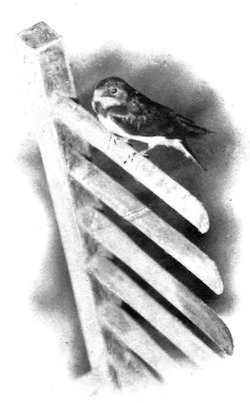
NEWLY-FLEDGED SWALLOW.
The eggs, numbering from four to six, are white, spotted and blotched with dark, reddish-brown, and underlying specks of grey.
This bird’s song is one of the most joyous and spontaneous in all the realms of Nature, and the poet might well say:
“Thou hast no sadness in thy song.”
It is uttered both whilst the melodist is flashing at lightning speed through the air and at rest on some house-top or tree, and is an exceedingly sweet and exhilarating warble frequently repeated.
During dull weather, when swallows fly low, they utter a note like wet wet, and their alarm cry has been fittingly written down as feetafeet-feetafetit. Inside buildings they also use another, which is a clear, ringing pink pink.
THE GOLDEN-CRESTED WREN.
The Golden-crested Wren, or Gold-crest, as it is frequently called, has the distinction of being our smallest British bird, measuring only three and a half inches in length. It is a widely distributed resident, and breeds comparatively close to London and other large towns. On the forehead and round the eyes it is whitish, tinged with olive-green. Crown pale orange in front and bright yellow towards the hind part. The feathers are somewhat lengthened, and form a crest bounded on either side by a streak of black. Upper parts olive-green; wings dusky black with two transverse white bars. Tail quills dusky, edged with yellowish-green. Under parts yellowish-grey, inclining to buff on throat, breast, and sides. The female is not so brightly coloured as her mate.
The nest is generally, though not always, suspended from the branch of a cedar, spruce, fir, yew, or holly tree at varying heights from the ground. I have seen it in a furze bush, and at an elevation of thirty feet or more from the ground in a fir tree. It breeds in shrubberies, plantations, and spinnies, and makes its nest of green moss, lichens, fine grass, spiders’ webs, and hair beautifully felted together and lined with liberal quantities of down and feathers.
The eggs number six or seven, as a rule, and are pale flesh or yellowish-white in ground colour, spotted and blotched with reddish-brown, the markings being most numerous at the larger end.
The Gold-crest’s song is like its singer—very small, soft, and sweet. It is difficult to hear, especially towards the end, unless the listener happens to be very close. In the neighbourhood of Birmingham I once had the pleasure of listening to a bird of this species in an evergreen hedge only two or three feet away from me, and was greatly surprised at the sweet melodiousness of its limited notes.
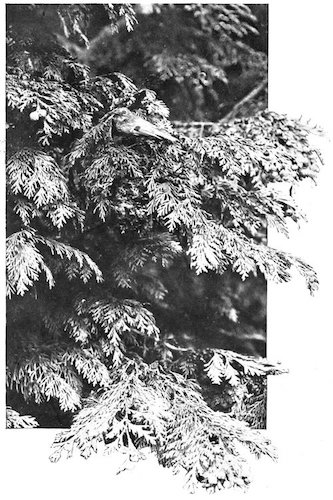
GOLDEN-CRESTED WREN AT NEST.
The sound of its call is something like tsit, tsit.
Vast flocks of this wee species occasionally hazard the perils of a journey from the Continent across the North Sea in order to visit our shores, and at such times alight upon the rigging of fishing smacks to rest, and crowd round lighthouses in incredible numbers.