INTRODUCTION.
Reading edition
Our original motive in publishing this little book, was one of self-defense, to relieve ourselves, in a measure, of a correspondence which was becoming much too large for the time at our disposal. After reading from fifty to one hundred letters per day, from people, asking all manner of questions concerning the hatching, growing and marketing of ducks, in detail, there were not hours enough in the twenty-four to answer them. This book was published to send out with our machines to meet these queries and give our patrons our method of growing, supposing it would cover all the points in duck-culture, but it does not as yet answer the ends. The questions still come in far beyond our ability to answer, and as our fourth edition is about exhausted, we now publish a fifth, revised, enlarged and illustrated; also adding a Question Bureau, which will answer many of the questions which have reached us during the past few years concerning the growing, as well as the diseases to which the Pekin duck is subject. Though we have been in this business for nearly forty years, and have been eminently successful, we do not claim to know all about it; but by persistent effort, careful selection and breeding, have succeeded in developing a mammoth strain of Pekin ducks, which, for symmetry, precocity and fecundity (experts who have visited our place from all parts of the country tell us), stand unrivalled on this continent.
Many of our customers write us that their birds average from 150 to 165 eggs per season. We would say that there is no domestic bird under so perfect control, so free from diseases of all kinds, or from insect parasites as the Pekin duck. From the time the little bird is hatched until it is full grown and ready to reproduce its own species, it is under the perfect control of the intelligent operator, who can produce feathers, flesh or bone at will, and even mature the bird and compel it to lay at four-and-a-half months old. There is no bird in existence that will respond to kind treatment, generous care and feed as the Pekin duck. On the other hand, there is no bird more susceptible to improper feed or neglect, and a sad mortality is sure to follow among the little ones, where proper food and system are wanting. It may surprise some one to know that the predisposition to disease may exist in the egg from which the little bird is hatched, or even in the condition of the parent bird which produces the egg. Strong physique in animal life, as in man, are like exotics, requiring the most assiduous care and cultivation, and are the most difficult to transmit.
Defects, like weeds, seem indigenous to the soil and will reproduce with unerring regularity, and will often crop out in all directions, generations after you think you have wiped it all out. So it is one thing to produce an egg from good, strong, vigorous stock during the winter in inclement weather, when all nature is against you, and so poorly fertilized that if it hatches at all, will hatch a chick so enfeebled in construction that no amount of petting or coaxing can induce it to live, but quite another to produce an egg so highly vitalized, that it will be sure to hatch a healthy young bird, bound to live under all circumstances. But this is not all the danger. The operator, though he may have good eggs, may be neglectful or ignorant, and the health of the young birds seriously injured during the hours of incubation; or he may have a defective machine which under no condition can turn out healthy birds. With healthy, vigorous parent stock, judicious care and food, there is no reason why good hatches of strong, healthy young birds may not be obtained, and the same matured with very little loss.
Natural and Artificial Duck Culture.
It is only within a few years that the public at large have become awake to the importance of the poultry interests in the country. Formerly it was supposed to be of insignificant proportions compared to the beef and pork product. But recent statistics show that the poultry interests in magnitude not only exceed either of the above, but are vastly on the increase year by year. Yet, strange to say, the supply, enormous as it is, does not keep pace with the demand. As a natural consequence, we are obliged to import millions of dozens of eggs from Europe, and carloads of poultry of all descriptions from Canada. (December 21, 1888, a train of twenty refrigerator cars loaded with dressed poultry, aggregating 200 tons, arrived in Boston from Canada,—$50,000 worth of dressed poultry at one shipment.) Still the demand goes on. Our large cities, which form the principal market for poultry and eggs, are growing larger every year. The rich men who inhabit them are growing richer and more numerous, and are always ready to pay the poulterer a good round price for a first-class article. Good poultry has not only become an every day necessity to the well-to-do classes, but is a common article of diet at least six months of the year on the workingman's table. It is everywhere recognized by physicians as the best and most palatable, as well as the most wholesome and nutritious, of all our flesh diets.
Duck Culture an Important Industry.
Duck culture now assumes a most important part in the poultry business, and yet, until within a few years, people did not suppose that ducks were fit to eat. But now the public appetite is fast becoming educated to the fact that a nice, crispy, roasted duckling of ten weeks old is not only a dish fit for an epicure, but is far ahead of either turkey, chicken or goose. As a natural consequence, the demand for good ducks is rapidly increasing. One of the principal poultry dealers in Boston assured me that his sales of ducks had nearly doubled each season for the past five years. Twenty years ago, when growing less than 1500 ducks yearly, I was obliged to visit the city markets personally and tease the dealers to purchase my birds in order to secure anything like satisfactory prices. Now, with a ranch capacity of nearly 20,000 ducks yearly, I cannot fill my orders.
Pond or Lake Not Necessary.
The reason is very plain. Formerly people supposed that ducks could not be successfully grown without access to either pond, stream or coast line. As a natural consequence, a large share of the birds sold in the markets were grown on or near the coasts, fed largely on fish, partially fattened, and were anything but a tempting morsel. For years there have been large establishments on the Long Island shores devoted to duck-culture. Large seines and nets were used regularly to secure the fish on which the young birds were fed and fattened. These birds grew to a large size and attained a fine plumage, but, as might be surmised, their flesh was coarse and fishy. Occasionally a person was found who relished these birds, but the majority of people preferred to eat their fish and flesh separately. Now this is all changed.
Duck-culture of today is quite a different thing from the days of yore. Then, the young birds were confided to the tender mercies of the old hen. Now, the business is all done artificially. The artificially-grown, scrap-fed duckling of the interior is a far different bird from his fishy-fed brother of the coast. He has been educated to a complete indifference to water except to satisfy his thirst. Taught to take on flesh and fat instead of feathers, his body is widened out and rounded off, and, when properly denuded of his feathers, is a thing of beauty.
Ducks In Great Demand for Food.
This sudden popularity of the duck in our markets, the great demand for them on the tables of our epicures, together with the immense profits realized from growing them, has naturally created quite an interest among poultry men; so much so that I am constantly flooded with letters filled with inquiries as to which is the best variety to raise, which are the best layers, if they can be hatched in incubators, what kind of buildings are necessary, the amount of profit realized,—in short, wishing me to give them the whole thing in detail, which, were one willing, it would be completely out of one's power to do. As there seems to be no work published in the country to meet this case and answer these queries, in pure self-defense, and through earnest persuasion of many friends, I shall, to the best of my ability, through this little treatise, endeavor to answer them, together with many other points which will naturally suggest themselves.
I shall confine myself almost entirely to an exposition of the artificial method, giving my own experience in the business for the last thirty years in detail. In doing this, the most approved buildings will be (both for brooding and breeding) described in full, together with cuts of the egg in different stages of incubation, and the living and dead germ compared, and how to distinguish each, plainly told. Just here let me say that a great deal of skepticism prevails among people in general and farmers in particular. They do not believe in the success of artificial poultry growing, or, indeed, of growing it in large numbers in any other way. As a proof of their assertions they will tell you that more than three-fourths of the people who attempt the business on a large scale make a complete failure of it. And it is the plain truth. There are few communities in this country, large as it is, but that, at some time in the past, has had a bogus incubator within its limits, or a good one that has been badly managed. The unfortunate experience of these men has spread for miles in all directions. There is but one verdict. The man is never condemned. The system is so denounced that a strong prejudice exists against all incubators, which it is difficult to combat. Every town, too, has had its representative poultry man who has erected extensive building's with a view to growing poultry on a large scale in the natural way. He, too, has met with disaster. Failure has attended his efforts, and the community is still more embittered against the whole thing, and the emphatic "It can't be done," meets you on every side.
Now, there is a cause for all this. Where is it? In the men. They do not comply with the conditions of success, and failure is the result. We will endeavor to give some of the reasons why: Nearly three-fourths of these people come from the city. Now, city people have unfortunately imbibed the impression that the necessary amount of brains and executive ability required to successfully run a mercantile, manufacturing or broker's business in the city is largely in excess of that required to run a successful poultry or agricultural ranch in the country.
Raising Poultry in the Country.
Men who have impoverished themselves by repeated failures in the city come out to retrieve their fortunes by raising poultry in the country. They visit your place and see thousands of young ducklings of all sizes and ages, each one vieing with the other as to which will consume the most food. They are completely carried away with the sight. They question you closely in regard to the profit derived from the business, and then openly avow their intention of doing the same thing themselves. You advise beginning small, and meekly suggest the possibility of failure through inexperience. The incredulous smile that plays over their features informs you that advice is wasted. "Why, haven't I read up all the poultry journals and got the whole thing down fine?"
Others, still, who, from close confinement at sedentary work in the city, are anxious to engage in a business which promises equally to restore their health as well as to provide them a livelihood. These invalids come out with their exhausted energies and dilapidated constitutions to engage in a business which, to insure success, requires a minuteness of detail and intensity of application second to none. They are unequal to the six or eight hours required of them on a revolving stool in the counting-room in the city, but are equal to the fourteen and sixteen hours indispensable to the poultry business in the country. Is it strange that a large proportion of these men fail?
Others, still, come to us wishing to engage in the business, at the same time candidly acknowledging their complete ignorance and inexperience. They frankly state their circumstances. They are poor, with families to support, and are not afraid of work, throwing themselves, as it were, upon one's mercy. They seek a good, healthy and fairly profitable occupation in which they can cultivate the physique and morals of their children away from the temptations of city life. Now you take kindly to such men; readily forfeit any advantages which may accrue to yourself through want of candor on your part, gauge their calibre, and to the best of your ability measure their chances of success, and give them the best advice you can, which advice usually is to begin small,—say with one machine, buildings in proportion, and increase their plant as their experience and judgment dictates.
Raise Ducks and Chicks.
But the reader will say: "What has all this to do with duck-culture?" Simply this: It is to give the would-be poultry enthusiast some idea of what he has to contend with before he begins. To convince him that this is no child's play—that the care of young ducks and chicks means early hours and late. The closest confinement and application is required for at least six months of the year, and if he is at all afraid of hard work or of soiling his fingers, he had better stop where he is. The theory that the poultry business furnishes a good occupation for little boys and girls, superannuated old men and invalids, has long since exploded. We advise people to secure a fair share of health before they begin and then they will be sure to keep it. As an inducement to all, I would say that there is nothing in the way of farm industry or any other legitimate occupation which will at all compare with the profits obtained from poultry when artificially conducted. There are, however, a few notable exceptions in favor of watered railroad stock, bogus mining shares, patent medicines, and the business done by our bank cashiers when guaranteed a safe transit through to Canada. I would advise all contemplating the poultry business to combine the growing of ducks and chicks together, for the reason that more profit can be realized from both than from either alone, because they do not necessarily interfere with each other, and the same buildings and machinery can be utilized for both. The brooding-house should be filled with chicks in November and December, which they will have outgrown by February, when the building will be required for ducklings. The ducklings, strange to say, though two months younger, will be ready for market as soon as the chicks (provided the latter are held for roasters, as they should be) and they will both be in the market in time to command the highest prices. This is what the poulterer should always cater for, and machinery alone will enable him to do it. He who expects to incubate with old hens during the winter will surely get left. But more of this hereafter.
Select A Good Site.
The first thing for one to do (if he is not already located), is to select a good site. It should have a gradual slope to the east or south, enough for natural drainage. No matter how poor the land, it will be rich enough before your fowls get through with it. I need not say that in those regions where snow lies upon the ground four or five months of the year, the conditions are not as favorable for the poultry grower as near the coast line, where snow, though a frequent visitor, remains but a few weeks or days at a time. In the one case it means close confinement to the fowls a great part of the winter, with want of exercise and consequent want of action in the digestive organs. The food is not assimilated, the fowls become debilitated, and though they may give a fair share of eggs, these eggs can seldom be depended upon to hatch. It is true, the active poulterer may overcome this in a measure by clearing away the snow for ten or fifteen feet in front of his buildings after each storm, and by a free use of barn chaff and chopped straw induce his fowls to go out on sunny days, but all this increases his work and makes the conditions against him. I simply mention these facts, assuming that where a man has his choice of locations, these hints may have their proper weight in the matter.
Advantages with Ducks.
The same rule holds good in a measure with breeding ducks, though not in so great a degree. For instance, your hen when closely confined seems to lose her ambition, and spends a large part of her time on the perches, apparently indifferent to all sublunary things. Not so your duck. She is in constant motion, no matter how small her quarters. No meditation for her. Indeed, the days seem too short for her to exercise in, and so she keeps it up through a great part of the night. Her greatest ambition seems to be to distribute the few quarts of water you have given her for drink, evenly all over the pen you have just covered with dry, finely-chopped straw, and make it as sloppy as possible, and it is astonishing in how short a space of time she will succeed in doing it. Again, snow and ice are the aversion of the hen.
She cannot be induced to step in either except under pressure of circumstances. Not so your duck. She likes nothing better than to be out in a snow bank during a thaw, and if she can only work it up into the color and consistency of mud it suits her exactly. She does not mind the cold if she can only keep her feet warm. She is clothed with an impenetrable coat of feathers and an equally thick coat of down. She does not take kindly to confinement in a building and will utter her constant protest, and like the average school boy of ten prefers to suffer from the cold outside to being comfortable in. Therefore, the main point in breeding early ducks and erecting buildings for the same, next to supplying them with the right kind of food, is to keep their feet warm. Cold feet affect the winter laying of the duck the same as a frozen comb affects the hen. It stops the egg production at once.
Locate Near a Railroad.
Your plant should be located on a line of railroad, in direct communication with one or more of our great city markets, and not too far from the station, as you will necessarily be in frequent and close communication with that.
Arrange the Buildings.
to secure good room in front, also good drainage, and especially with a view to reducing the labor to a minimum, both inside and out. Always remember that the labor is the most expensive part of the poultry business. Now is the time for forethought and caution—save all the steps, all the work you can. You will never suffer from want of exercise, if your fowls do. I never knew a case of gout in a man in the poultry business in my life. It is well, also, when arranging a poultry plant, to make provision for future contingencies, so that should one in the course of time and experience wish to increase his plant and the size of his buildings longitudinally he will have plenty of room to do it, by simply moving the end of his building out as far as he wishes and filling in between. I have been obliged to do this several times in the course of my experience, and have the past Fall built a double brooding house 250 feet long by 16 feet wide.
One important point in erecting poultry buildings is the difficulty in building them,
Warm, Cheap, and Rat-proof.
Formerly I built stone foundations on which were placed the buildings, cementing the stone work to the sill carefully inside and out. This proved in the end not only an expensive but a very unsatisfactory arrangement, for cement it as one would the action of the frost would always part the sill from the foundation and admit the cold air from all around just where it should be kept warm. I have since hit upon a plan which has not only met the case but is comparatively inexpensive. Place posts, with one square side to them, about four feet apart, on which place the 2x4 inch sill. Set these posts in the ground so that the tops rise but one inch above the surface, with the flat side exactly horizontal and perpendicular to the inside of the sill. Then sink a hemlock board twelve or fourteen inches wide into the ground inside of the building, and immediately in front of the two-inch sill, until the upper edge is flush with the upper side of the sill, nailing it firmly thereto, filling up inside nearly to a level of the top of the sill. This gives a warm, cheap foundation on which the frost does not act. Hemlock, too, seems to have an affinity for moisture and will last in that condition from eight to ten years, when it can be easily renewed. This arrangement is also comparatively rat-proof, as a hemlock board is a rat's aversion. It does not agree with their teeth. They cannot possibly dig under during the frozen months of the year, and as it affords them no concealment they do not care to, during the warm season.
The Outside Plan of a Breeding and Brooding House
with the exception of a little more glass in the latter, should be precisely the same both for ducks and ducklings. The internal arrangements can be made to suit. As I shall give a full description with cuts of this building later, I will now merely give the manner in which it should be arranged as a good breeding-house for ducks. This building should be fifteen feet wide and any length required. It should have an uneven double roof, five-foot posts in the rear and four foot in front. About one-quarter of this front should be glass. There should be a walk the entire length of the building three and one-half feet wide. The main body of the building should be divided into pens twenty feet long, by either lath or wire two feet high.
The walk should be separated from the pens by laths three inches apart, to allow the birds to feed and water from the walk. This method simplifies the labor very much, as it enables the operator to load his barrow, travel the whole length of a 200-foot building and feed and water 500 ducks in a few minutes. This arrangement has many other advantages besides, as it permits the birds to feed and water readily from the walk without being able to waste either, or mix the contents of food and water-dishes with filth. It also prevents the birds from sopping the straw in the bottom of their pens, or of soiling their white plumage, both of which they are bound to do if possible, and as the duck, especially the Pekin, is a very timid bird, this plan familiarizes her with the appearance of the attendant without bringing her into actual contact with him.
Use Half the Pens for Feeding Purposes.
One-half or ten feet of the twenty-foot pens should be utilized for feeding purposes. The lower board of this slat partition should not be more than three inches wide and should rest upon the ground so the birds can readily feed over it. As this ten-foot partition is but two feet high, the attendant can readily step over it to pick up a stray egg occasionally. Six feet of this partition should be portable and secured with a groove or button so it can be easily removed to allow the entrance of a barrow in cleaning out the pens; this should be done when the birds are out, never when they are in.
The remaining ten feet of the pen should be used for nest boxes, which can be fifteen inches square and one foot high. A board four inches wide may be fastened in front to prevent the nest material from being drawn out. This latter may be composed of finely cut hay or chaff. This must be perfectly dry, as the duck while laying will work it all over and cover her eggs carefully, which as they are pure white, become easily soiled and stained; this will necessitate washing unless things are kept dry and clean. This is a vital point with us, as it never did seem as if a filthy egg would hatch as well as a clean one. I abominate a machine filled with filthy eggs; it actually hurts my feelings to handle them. These nests should be covered closely and the partition above them be correspondingly high, as the birds will often mount upon the boxes. The back of the nest boxes next the walk should be closed with a board hinged below so that the attendant can let it down readily and secure the eggs from the walk.
The Room for Mixing Feed.
Some twelve feet of this breeding-house may be utilized as a cook and mixing room, and must necessarily be a little higher posted than the rest of the building,—say, two feet higher. This cookroom, with boiler, is an essential thing in a duck-house. Unlike hens, they do not take kindly to hard food and whole grain. Their digestive organs, in many points, are different from the hens, and they do not assimilate hard food readily. They require more vegetable food, and those vegetables must be cooked,—but more about this hereafter.
Of course, this building should be sweet and clean, and must be well deodorized; for, though ducks do not generate vermin like other fowl, and are not subject to as many diseases, or as readily affected by thermal changes,—in fact, a good driving rainstorm is their delight,—yet they will not thrive when confined in filthy quarters. It engenders a morbid appetite, impairs digestion, and your bird is poor before you know it. This, of course, arrests the egg production at once.
I wish here to impress upon the breeder the absolute necessity of the careful handling and feeding of his birds; and, when necessary, handle very gently, always taking the bird by the neck. This is very essential, because the bones of a well-bred, well-fatted duck seem wholly disproportioned to the size and weight of his body, and we have often seen a wing broken or a leg disjointed by the convulsive efforts of the bird to escape when caught by those members through the carelessness of the attendant.
The timidity of the Pekin is proverbial. You should move quietly among your layers if you would have them thrive, as constant agitation and disquietude will surely debilitate them and reduce their flesh. I have known a pair of heavy exhibition birds to lose a pound per day during their confinement the first four days of exhibition, and to be eight pounds lighter than they were ten days before when started for the show. Their recuperative powers are equally wonderful. I have often seen Pekin ducks, after having produced one hundred eggs in nearly as many days, on evincing a desire to sit, and being somewhat reduced in flesh, when shut up in a yard with drakes and well fed, in less than a week commence her regular contribution of an egg per day.
Water Not Needed.
The majority of people have the impression that water to bathe in is essential to secure fertility in duck eggs, but it is a great mistake. My ducks never see water, the year round, except to drink. They are confined in yards 24x100 feet, some forty in each yard, twenty-four feet being the size of the pens inside of the breeding house. They are confined in these yards for nine months, or till August 1, when they are removed in order that the land may be disinfected. This is done by plowing and growing a crop of barley or rye, when the land is ready for the ducks again.
Free Range Unnecessary.
I am constantly experimenting to see if there are defects in my system. A few years ago I had thirty breeding-yards devoted to ducks. I wished to ascertain the difference in egg production and percentage of fertility between ducks yarded close and those with free range, the feed and other conditions being the same. One lot of fifty ducks were allowed the range of a five-acre lot, in addition to their own yard. They ranged in common with our cows, there being plenty of grass. Another lot of seventy-five were allowed the range of the whole premises, with the same feed and care as the eight yards confined. The latter were liberally supplied with all the green and vegetable food needed. The egg production and the fertility of each were carefully noted. I was much surprised to find that the difference was very little, and that in favor of the birds confined.
The Mode of Feeding.
differs with the season of the year. During the autumn and early winter months feed twice each day about equal quantities of corn-meal, wheat-bran, and boiled turnips and potatoes, with about ten per cent. of ground beef scrap thrown in. At noon, give a small amount of dry food, composed of equal quantities of cracked corn, oats, and wheat. When the birds commence laying, as they will about January 1st, gradually increase the quantity of meal and animal food, proportionally decreasing the amount of bran.
The Pekin Duck.
is my favorite. I have experimented carefully during the last thirty years with all the larger breeds, crossing them in every conceivable way to obtain the best results, and am perfectly satisfied with the Pekins. I am now through experimenting, and as I grow nearly 20,000 ducklings yearly, can hardly afford to guess at it, as one cent per bird makes a difference of over $200. in my receipts,—one cent per pound, a difference of over $1200. It is readily seen that I can only afford to use the bird that will grow the greatest number of pounds of flesh in the shortest space of time. Nor is this all. It must be the bird that will give you the first eggs of the season, as this will enable you to get your birds on the market when they will command the highest price, as there is more clear profit from one early bird than from three later ones. This will be the more readily understood when it is known that the maximum price paid for early birds is thirty cents per pound in Boston and New York, the minimum price for late ones eighteen cents, the cost of production being the same for both.
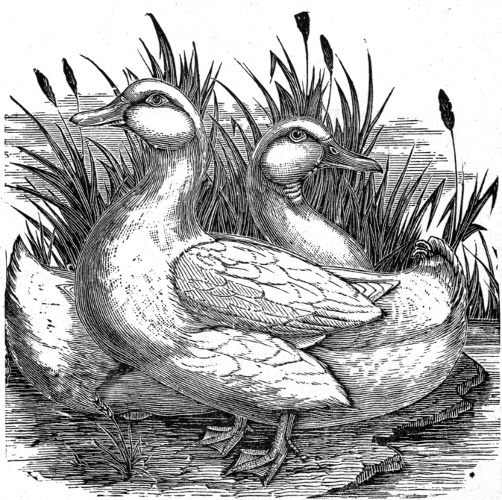
The Pekin Duck.
The Pekin Combines the Best Points.
The Pekin is the only bird that will cover all these points. It has two slight defects,—its extreme timidity and its heavy, coarse voice, which it does not scruple to use when congregated in large numbers. The former can be easily overcome by careful handling. But to off-set these defects the Pekin will not only produce the first eggs of the season, but by far the greatest number of any of the breeds, with one exception, the Indian Runner. They mature earlier, are more hardy and domestic in their habits, never wandering far, and always returning to the coops at night. They are not mischievous, and require less water than either of the other breeds.
My birds have for generations been bred in dry yards, with simply water to drink, and all desire for it for other purposes seems to have been bred out of them. When allowed their freedom in the fall, the flocks never visit the brook, fifteen or twenty rods distant, and when driven there occasionally for the purpose of purifying their feathers, get out again just as soon as possible. Indeed, after a water bath their feathers cling to their bodies, and they present the same bedraggled appearance that the old hen did many years ago after one had immersed her in a water-barrel to cure her propensity for sitting.
A wealthy New Yorker ordered a dozen of my best ducks, a year or two ago. In a few weeks he wrote that he wished to return them, as they did not answer his purpose; "for," said he, "I have an artificial lake on my lawn, near my piazza, and I wanted these ducks to disport in the water for the pleasure of my wife and children, and they will not go in the water at all unless I drive them in with a whip, and I have to stand guard over them all the time, as they get out the moment my back is turned." I wrote him in return that had I known he wanted the ducks for their aquatic performances, I should have recommended the common puddle duck, when he would have had as much trouble to get them out of the water as he had to get the Pekins in.
Feathers are Pure White.
Another advantage of the Pekin over the other breeds is their pure white, elastic feathers which are largely mixed with down. These feathers readily command from forty to fifty cents per pound, and as the reader can see, are no mean source of income, especially when the birds are grown in large numbers. These birds, as their name indicates, originated in China. They are large, beautiful birds, of a proud, erect carriage, with pure white plumage outside. The inside feathers are slightly cream colored. The neck is long and gracefully curved; the head long and finely shaped, with a full bright eye. The legs and beak are of a very dark orange, and form a fine contrast to the pure white feathers. The minimum weight of our birds when matured is about fourteen pounds per pair, while the very heaviest will tip the scales at twenty-two pounds. My first experience with ducks commenced more than forty years ago. We used the common puddle ducks and grew them for the city market. The ducks were very small and so were the profits. They were fed but little and allowed full range, consequently the home ties were not strong.
Those ducks followed the little brook in the pasture through swamps and marshes for half a mile in either direction, wholly regardless of farm limits. If we expected any eggs from those ducks they should have been safely housed at night. This task devolved upon the boys. Now our paternal head, though a kind and indulgent parent (unfortunately for us), had the impression that boys were made to work, and work we did. Now, what boy of ten or twelve years had not rather chase ducks through the mud in the swamp than to wield the hoe among the weeds in the corn field? It was our recreation, our chief solace and delight through those long, hot summer days—the anticipation of that duck hunt in the evening. I think our extraordinary love for the duck hailed from this date. Later on we used a cross between a Rouen and Cayuga. This cross made a much larger and better market bird. The flesh was better flavored. They produced more eggs and began earlier in the spring, consequently prices and profits slightly improved.
These birds did not stray as far, but were as fond of mud and water as their little predecessors. It was a pleasing and comical sight to see three or four hundred of these ducklings of all ages, when first let out in the morning, run down the hill in their eager haste to reach the swamp, a part of them right side up, then rolling over and over on their broadsides; others still reversing themselves end for end down the steep incline, apparently a matter of supreme indifference how, so long as they reached the mud first.
These ducklings always returned at night with their numbers more or less depleted, as they were the legitimate prey of skunks, minks, weasels and mud turtles; and if we reached the summer's end with sixty per cent. of the original number we were well satisfied. All this has been changed. We have learned a number of points on duck culture since then. First, that all losses by vermin can be easily avoided by yarding your little birds at home and keeping them under your own eye. Second, that mud and water externally applied are not essential to their growth and well-being, and that in fact they will thrive better without.
Ready for Market 3 Months Earlier.
Third, that it is not necessary to keep your birds till they are six months old in the fall and then put them on the market when it is sure to be glutted, but much better to market them at ten weeks, when they are nearly as heavy, and you are sure to get more than double the price, as well as save three or four months extra feed. There are many other points connected with this thing which the novice must ponder carefully before he begins, as a slight mistake in the beginning often means a great loss in the end. As pioneers in the business we have for many years been carefully experimenting with the different breeds, different treatment and variety of food. We have met with many failures, suffered some loss, but with a gradual improvement through it all, which has been very encouraging to us, and though we do not claim perfection, yet we are now reaping a rich harvest compared to which our former losses are simply insignificant. It is a source of gratification to know that success has at last crowned our efforts.
When we look back forty years—when year after year chronicled failure and our best efforts met with loss—when we were the butt, ridicule, and laughing stock of the whole community; when we were assured again and again that we were fighting against nature and never could succeed, and repeated failures only seemed to confirm that assertion,—and compare it with the present, when we can grow our birds by the thousands, regulate the growth, control the mortality, and grow flesh or feathers at will; have shortened the precocity, increased fecundity, and even educated the birds to an aversion for water, which was formerly their home; we have completely reversed the order of things and taught our birds to reproduce at a season of the year when all nature is against them, we can safely feel the victory is won. We hope that our readers will not only benefit by the experience we shall present, but that many of them will be able to take this and carry it on where, according to the natural course of things, we shall be obliged to leave it. We are no longer young, the infirmities and decrepitude of age are slowly creeping upon us and admonish us that our days of research are nearly over, and we find that our life is all too short. But there is a satisfaction in knowing that others will take this thing up where we leave off and carry it on to the end.
The Superiority of Artificial Poultry Growing.
We predict a great future for artificial poultry growing. It is yet in its infancy. The time will come when it will gradually supersede many of the regular farm crops on the sterile soil of New England, when every farmer will have his proper complement of poultry appliances, and when you can prove to the average farmer that the capital necessary to run a poultry plant (which will with less labor ensure him a greater income than that from his whole farm) is less than one-fourth of that required for any other farm investment. You will begin to see him scratch his head to evolve ideas. The beginner in starting, should recollect that this is a business of detail and that small things must be taken into account. It is not only a very essential thing to choose the best breeding stock that can be had, but, all other conditions being the same, to select the color of their feathers.
We have always had a predilection in favor of white birds, for the feathers (which are no small item in ducks) command nearly double the price of colored ones, and are always more saleable. Again, we must cater for the market with young birds, and every one knows that young birds are more or less addicted to pinfeathers, many of which it is very difficult to remove, as they have secured a lodgment just under the skin, but have not found their way through. Now a dark pinfeather is a blot upon the fair surface of a fine chicken or duck, and the thrifty housewife in selecting her dinner will always leave the pins behind. She does not like a variety of colors in her duckling, if she does in her dress. The dealer, aware of this peculiarity of the ladies (who, by the way, form a large share of his customers) will, if he buys at all, cut you on the price.
Unfortunately we started in with dark birds, but it did not matter at that time, as the Pekin had not been imported, and there were very few Aylesburys in the country. We were surrounded by vermin of all kinds. Our young birds disappeared mysteriously, and in such large numbers that we were nearly discouraged. Hawks do not trouble ducks, but rats, weasels and minks developed such a fondness for them as to completely atone for any neglect on their part. We made a free use of steel traps, guns, and phosphoretic poison. The battle raged for two years; at the end of that time I think it would be difficult to find one of the above-mentioned vermin one-fourth of a mile from the place. It was a great relief; our ducklings could range at will, even be left out during the night, and still the full complement appear at the dough-troughs in the morning.
Do Not Have Neighbors Too Near.
Another source of discomfort was our neighbors' cats. Now, we are eminently social in our disposition, and enjoy our neighbors' company very much. We like to spend a social evening with them and have them do the same by us. But not so their cats. We never interchanged civilities with them, their visits were too ill timed and frequent. Our ducklings were carried off in large numbers, and in pure self-defense we shot the cats.
Of course, this made trouble in our neighbors' families, especially the female portion, by whom it was promptly resented. The principle of "touch my dog, touch me," was illustrated here in all its force. No amount of provocation ever justified us in their eyes in killing their cats. With pater familias it was different. His affections were not engaged. He recognized the necessity of the thing, laughed it off, and said it was all right. Now, cats breed fast and are very prolific, and our neighbors were plenty, and we are unwilling to state the amount of our losses from those sources, for fear our veracity would be doubted. We endured this sort of annoyance for some twelve years, but made up our minds that if we ever selected another poultry ranch we would locate our neighbors at a distance. We have done so, and now have no trouble from this source.
We found that the Cayuga duck was a more precocious bird than the Rouen, and were better layers. The eggs were more fertile. They were also much hardier, and, as a consequence, there was less mortality among the young. But they were rather small in size, dressing only seven to nine pounds per pair. The Rouens were nearly four pounds heavier, but had their disadvantages. They were not so productive in eggs, and those did not give us the same percentage of hatch, while the mortality among the little ones was much greater. We do not like to condemn any variety of birds on one trial, as we may be unfortunate in our selection of a strain, but our subsequent experience with these birds fully confirms the above; and though they are a large, attractive bird, we do not consider them as hardy as either Pekin, Aylesbury or Cayuga.
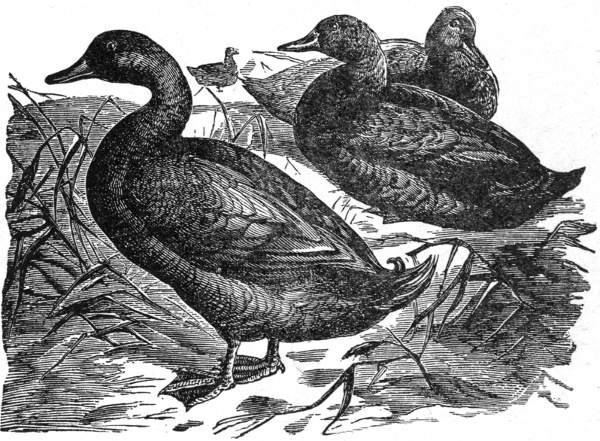
CAYUGA DUCKS.
We conceived the plan of crossing this bird with the Cayuga, with a view of increasing the size, not knowing whether the good or the negative qualities of the two birds would prevail. We were very much pleased with the results of this cross, as it gave us all the good qualities of the Cayuga with the largely increased size of the Rouen. It gave us also a good table bird, the flesh of which was far better flavored than that of the puddle duck. We made the duck business then supplementary to that of growing chickens. Our chicks were hatched out early in the winter in order to secure the high prices. Our ducks during the spring and summer were not marketed until fall. We did not expect those ducks to lay till the first of April, and they did not disappoint us. If anyone had told us that young ducks could be made to lay at four or five months old, and that we could have our young broods out by the thousands at that time, we should have called him insane. We then gave our ducklings free range, and, as a consequence, lost large numbers of them from eating injurious insects, which, in their haste, they did not stop to kill, and paid the penalty with their lives.
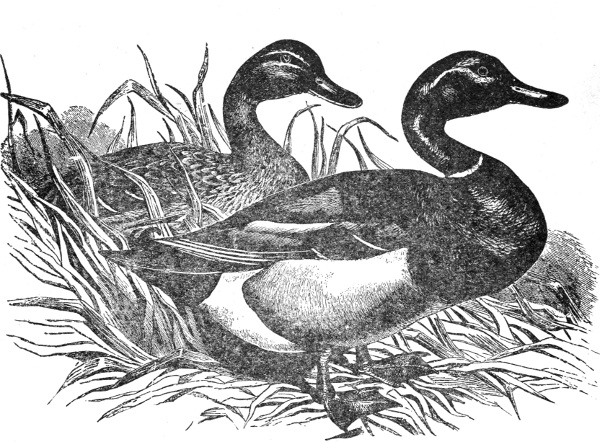
ROUEN DUCKS.
Now, the genuine duckling is proverbially stupid. He has an immense faculty for getting himself into trouble, without the first idea as to how he shall get out. As, for instance, we had taken up some old fence-posts one day, and carelessly left the holes (some two feet deep) unfilled. When feeding time came at night we missed many of our little ducklings, and, at the same time, heard a great squeaking, which we could not locate. We finally traced it to the post-holes, which we found nearly full of young ducklings, not much the worse for the adventure. When we look back at the difficulties with which we had to contend, and the losses we sustained in consequence, I often wonder that we were not discouraged. It was blunder after blunder, repeated always with the same results. We had very little idea of the systematic care and regular food required to ensure against loss and enable the young birds to attain a weight in a few weeks which we supposed required almost as many months. We still had the impression that water was essential to the welfare of the birds, both old and young, and that eggs would not be fertile unless copulation took place in the water. So we built a tank for use during the dry season of the year (which held about a hogshead), and cemented it thoroughly.
This tank we laboriously filled with water for the birds to sport in, but it did not work, as it soon became so offensive that we were obliged to renew it at least every three days, so that we soon became tired of it, and once more allowed the ducks the liberty of the swamp. We never obtained more than half of the number of eggs that we now get from our Pekins. About this time the Aylesbury duck came under our notice, and we procured a number of them at once, as they came highly recommended, but they did not meet our expectations. They were a very pretty bird to look at, and their feathers were more valuable, but there the advantage ended, for the strain we obtained was a trifle smaller than the mongrels we had been breeding,—rather more delicate to rear, and, worse than all, we found it almost impossible to pick them. In all our experience before or since we have never seen anything to equal those birds. The tenacity of those feathers was exasperating. Every one was bound to retain its complement of flesh. Of course the birds were so disfigured that the most of them were retained for family use. It was no use to think of scalding them,—that would not only seriously injure the feathers, but would completely spoil the birds for Boston market, as scalded birds are rejected at once and classed with cheap Western fowls.
While going the rounds of Boston market one pleasant June day, shortly after our experience with the Aylesburys, we noticed some fine young birds nicely dressed, that had evidently snow-white plumage. As this was before the advent of iced poultry, we supposed the birds had come from the regions of the far South, and our curiosity was excited. We interviewed the dealer and was surprised to learn that the birds were grown to the north of us, and that they were the Pekin ducks we had heard of for a year or two, but had taken no stock in. Yet here they were in the market, while ours were toddling about at home less than half grown. Here was a revelation. We procured some eggs of this party, at once, and in due time hatched out sixty lively young ducklings. They were tended with the utmost care and not one was lost. We were very much interested in these little fellows, they were so hardy, and you could fairly see them grow. It occurred to me at this time to try and experiment with these ducklings, keep a correct account of all food consumed by them, and ascertain what they cost per pound when ready for market. The average weight was taken from the rejected drakes which we did not need for breeding purposes, and which were culled out and sent to market at ten weeks old. We were very much surprised to find the cost to us (exclusive of the cost of eggs) was about 4-3/4 cents per pound. We could hardly credit our own eyes. The calculation was made again and again with the same result. The same calculation was made a year later on two yards of some three hundred ducklings with a result obtained, when ready for market, of 5-1/4 cents per pound, including cost of eggs.
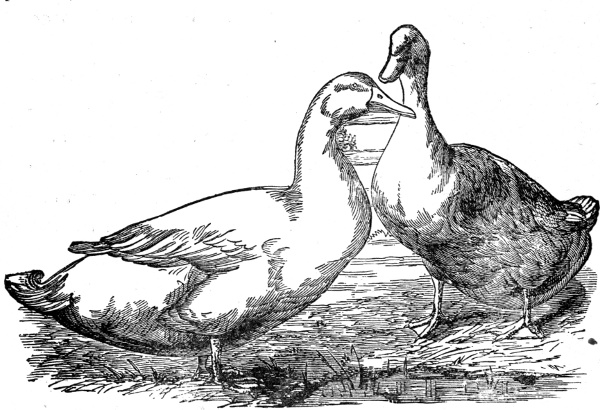
AYLESBURY DUCKS.
As I had long since left the paternal abode, and for years had ceased to superintend the establishments of others, and as the following experience will be entirely my own, I shall hereafter use the personal "I". It is needless to say that the figures arrived at from the calculations made of those ducks were startling. What! can I grow ducks in three months as cheaply as I can grow pork in a year, or beef in two years, and then get six times as much per pound for it after it is grown? Yes, if figures tell the truth. Can I afford longer to grow large crops of fruit and vegetables, working early and late, risking frosts and drouths, making a bare livelihood, when with one-tenth part of the labor and capital involved I can grow a crop which drouths and frosts do not injure, and make five times as much? No! I have not had a hog on my farm since I kept a Kemp's spreader to work over the manure, and simply grow fruit and vegetables enough for feathered thieves and home consumption. Another question arose: "What shall I do with my cows?" some sixteen or eighteen in number, bull, young stock, etc.
My Farm.
Now, I had become somewhat proud of my farm, as what man does not who had quadrupled its increase within ten years? I was cutting yearly some two hundred tons of hay on less than half that number of acres, and I knew that if I sold my cows I should, in some way, be obliged to get rid of my hay and that would mean disaster to the farm. There might be no decrease in acres, but there would be a sad diminution in the tons of hay. The result is, I keep cows for my own use. Have built two new barns, each one hundred feet long, the basements of which are utilized for box stalls, accommodating sixty boarding horses. These convert my hay and grain (for which I receive the market price) into manure. This is all I expect and all I get.
A while ago a gentleman from New York caught me hoeing in my onion patch. He expressed his astonishment at the size of the onions. (I now grow two or three hundred bushels yearly to supply my own and neighbors' wants, and just to keep my hand in.) Said he: "Your land seems well adapted to this crop." "Yes, I have some twenty or thirty acres that are level, the soil is easily worked and friable, not troubled much with maggot, and, if properly handled, is about sure of a crop." "Why don't you put it all into onions?" "I cannot afford to." "Why," said he, "if our New York farmers had that land within twenty or thirty miles of New York city it would be worth $1,000 an acre, and they would make it pay twenty-five per cent. of that, too, every year." "Possibly they could, but with one-tenth of the labor and capital employed I can raise ducks enough on one acre to buy all the onions I can raise on ten. If I am going to increase my capital and labor in any direction I should put it into ducks, not onions." He acknowledged that perhaps I was right, but at the same time thought it was poor economy to grow nothing but hay on such land as that.
The Muscovy Duck.
The Muscovy duck as its name implies is a denizen of the Mediterranean and is a beautiful bird, quiet and inoffensive in its habits, but cannot compare with the Pekin either in fecundity or in market value. It cannot be induced to lay so early in the season as the Pekin, thus forfeiting the high Spring prices. The eggs require about the same time to incubate as the goose egg (five weeks) and they do not hatch well in an incubator. It is some three weeks longer in maturing than the Pekin and does not command as high a price in the market by two cents per pound. I asked a prominent Boston market man yesterday the reason for it. He said that the flesh was coarser than that of the Pekin while the disparity in the size of the sexes made them very unpopular, for instance, while the drake will dress from eight to ten pounds the duck will rate but four or five pounds. Said he, "I want none of them." There are two varieties of this bird, white and colored.
The Indian Runner Duck.
This bird is of recent introduction, and while it can never be a first-class market bird on account of its small size and dark pins, it has many good points. Its fecundity is wonderful. There is, perhaps, no bird that will excel it as an egg producer for market. Its patrons are enthusiastic in its praise and claim an average yield of one hundred and seventy-five to two hundred eggs per year from each of their birds, but their small size, four to four and a half pounds, together with their dark pins, militates against their value as a market bird. I have always emphasized the point that size as well as fecundity is a necessary adjunct to a profitable market bird. It is no more trouble or risk to grow a large bird than a small one, while the market returns are often double. The large bird will always command at least two or three cents per pound more than a small one, as well as a more ready sale. The Runner is a parti-colored bird.
I was very much pleased with the Pekin ducks. They not only layed some weeks earlier than any other breed I had ever kept, but were precocious, maturing earlier than either of the other breeds, excepting the Cayugas, there being but little difference between the latter and the Pekins, but the Pekins laying some weeks sooner, it gave us control of the early spring markets, which are by far the most profitable of the year.
Disinfecting.
My neighbors had become much interested in the business and often visited me, and were not backward in giving their opinions. They predicted failure for me, giving as reasons that the market would soon be glutted with so much of that kind of stuff, for poultry never could be as good grown in that unnatural way, and that if I kept on growing those ducks in the same yard, year after year, the land would eventually get poisoned, and then disease would clean me out.
But I had thought this thing all over before laying out my yards. I knew that reversing land and cropping it would disinfect it, so a crop of ducks is always followed by a crop of something else; and thus I succeed each season in getting two crops of ducks and two crops of either rye, barley, or oats, so that the land has not been poisoned, and is still growing its complement of large, fat ducks every year, and as I have set it to plum trees, it is beginning to yield fine, luscious plums. Neither is the market glutted, as the demand is far in excess of the supply. The way of growing does not seem to be any objection, as the marketmen are willing to pay me, at least, two to four cents per pound more than they can possibly get for those grown in the natural way.
Perhaps a word here would not be amiss regarding the merits of artificially and naturally-grown poultry for fancy and market purposes. This is a vital question, and it is as well for the public to fully understand this thing now, as well as its origin. There is many a person who has been thoroughly convinced of the great advantages and the economy of the artificial over the natural way of doing it, and who would gladly have started in the business, but was deterred by the prevailing opinion that artificially-grown birds were always deficient in plumage, and could never win at a show, and that the flesh was inferior for table use and could not find a ready sale. It is as well to explode this thing now, and expose its utter fallacy. There is not a shadow of doubt but that much poor poultry has been put upon the market by people who have attempted its culture in the artificial way by growing hundreds of ducks and chicks in the same limited space that they formerly used for a dozen with an old hen.
These, of course, could not be otherwise than poor and the mortality great. Another reason: the fancy business in poultry is fast being overdone. The best breeds are now scattered far and wide over the entire country. There is not the demand for them that there has been, because good birds can be obtained nearer home. Many of our old and well-known fanciers are making frantic but vain efforts to keep their business up to its former standard. They have suffered considerably from competition with artificially-grown birds, and they roundly assert that it is an unnatural method, that the conditions are not right, that it affects the growth and plumage of the bird in such a manner as to preclude its ever taking a first-class premium at our shows.
Now if they can convince the public that naturally grown birds can capture premiums, and they grow all their birds in the natural way, it is easy to see how their trade would be increased.
Now, I never could see how the old hen could impart vigor to her chicks by imparting lice, or how the increased contributions of filth from the old hen, united to that from the chicks, could ever make the conditions more favorable than that from the chicks alone. It can no longer be denied that the artificially-grown fowls are fast coming to the front,—a place which they already occupy in the market. Knapp Bros., Fabius, N. Y., the greatest prize winners on White Leghorns in the country, grow their birds artificially. We could mention many others who are doing equally well. Our own Pekin ducks have, for many generations, been hatched and grown artificially, and today, for size, symmetry, and beauty of plumage they stand unrivaled in North America. They have won first from Canada to the Gulf, and have never been defeated. Three times during the past ten years we have been obliged to enlarge market boxes to accommodate the increased size of our birds; and yet we have bred only from our own stock. A number of times I have procured winning birds at the Pennsylvania and Western State Fairs, with a view to a change of blood, only to cast the birds aside on their arrival here, as I could not breed from them without deteriorating my flock in size. If this is the result of artificial growing and of in-breeding, I shall keep right on.
In-Breeding.
I have always selected the very choicest and best from the many I raised for breeding stock, and the result has been a gradual increase of size. I have seen many persons who, from a mistaken idea of introducing new blood, have reduced both the size and quality of their stock. Let it be here understood that a man who keeps but one drake and a few ducks is breeding-in fast. But the one who keeps a thousand in different yards can breed many years with impunity, because the intermingling of blood is exactly in inverse ratio to the numbers kept. I have repeatedly heard prominent marketmen in New York and Boston say that my artificially-grown poultry, both in chicks and ducks, were the best that they ever handled.... I will endeavor to secure their signatures to that effect, as convincing proof of this, as I wish the public to know the truth as it is.
I was then breeding Pekins exclusively, and found the business while growing them was far more profitable than ever before, and accordingly increased my incubating and brooding capacity, and instead of growing 1,500 to 2,000 ducklings, grew from 10,000 to 20,000. This was done during the early spring and summer, the machines and brooders being used for early chicks during the winter. I had observed that, during my experience with chicks, that crossing with the best breeds always made better layers and better market birds than either of the breeds from which they originated; also, that the first cross was always the best, and that continued breeding from crosses is sure to deteriorate both in size and quality.
Crossing.
I conceived the idea of procuring some of the best stock possible of Rouens, Aylesburys, Cayugas, and crossing them on the Pekins, with the object of increasing the size and precocity. I experimented first with Cayugas, and crossed both ways, using both Pekin and Cayuga drakes, and, in order to test the experiment fairly, the mongrel eggs were hatched in the same machine, the young birds grown in the same yards, subjected to the same care and feed, with the Pekins. The Cayuga cross was very satisfactory, with two exceptions. They were fine, plump birds, took on fat readily, and matured as early as the Pekins, while the mortality was not more than one per cent. on either, but we found that the skin was dark, the dark pins, when there were any, showing very plainly beneath.
These birds were sent to market in the same boxes with the Pekins. Our dealers to whom we shipped allowed us the same price for them as for the Pekins, as there were but few of them, but had they all been of that color would have been obliged to cut them two cents per pound on the price. This was enough for me, especially as I found that the feathers commanded but little more than half the price of the pure white feathers of the Pekins.
The experiment, though conducted in the same manner, with the Rouens, was somewhat different in result. There was a great loss from those mongrels. They evidently inherited the same weak constitutions of the Rouens. They had not the vitality of the Pekins, while they required at least three weeks longer to mature. This latter alone was sufficient to condemn them for all market purposes, especially when subjected to the same discount on dark pins and feathers as the Cayugas. This was sufficient to discard both breeds for my use as market birds.
Aylesburys.
But I expected great things from the Aylesburys. I procured the best ducks to be had in the country, while I used imported drakes from the best prize-winners in England, and I have never yet seen those drakes equaled in size; and I was unusually careful in this experiment, because I knew that the English breeders claimed for their birds a superiority in all the points essential for a good market bird, namely, delicacy and flavor of flesh, size, precocity, and greater egg production,—laying special stress on their hardiness and vitality. I bred those birds clear and crossed them, carefully noting the result. Our first batch of Pekins and those crosses numbered about 300, nearly equally divided. These were mixed and confined in two yards. For the first two weeks there was no perceptible difference, when gradually the young Pekins began to outgrow the crosses, the difference increasing with age. The former were very even in size, the latter irregular, while the mortality was as six to one in favor of the Pekins. When we began to kill those birds the Pekins were all in the market at the end of eleven weeks, while the crosses remained in the yards fully one week behind. The weight was in favor of the Pekins about one pound per pair.
The same difficulty existed as in former years—the tenacity of the feathers. The pickers grumbled, while the birds were more or less disfigured. I notified the dealers of the breeds of those ducks, and of the claim made by the English breeders, and wished them to ascertain if possible if there was any difference in favor of the Aylesburys. They said their customers found no preference, for themselves they preferred the Pekins on account of the larger size and finer appearance of the dressed birds. But I found it made a vast deal more difference than that to me. One pound per pair on 2,000 pairs of ducklings, at an average price of twenty-five cents per pound, made a difference of more than $500 to me; especially the extra ten days required to mature the Aylesburys cost more than the feed for extra pound of flesh grown upon the Pekins. I do not keep Aylesburys now, and have not since that experiment; I never shall again.
Precocity.
There is one point which I wish to impress, which is too often overlooked, and yet is of the most vital importance to the poultry grower, and that is the early maturity of his market birds. I often hear growers say that as there is very little change in the poultry market during nine months of the year, and as they do not contend for the early spring prices anyway, if their birds are three or four weeks longer in maturing it does not matter. Does is not? I have always contended that it requires just so much to sustain life in either bird or animal, and the profit consists in what we can get them to consume and digest over and above that; and if the time required to do this is protracted longer than is necessary, it is done at the expense of the grower.
If it takes ten weeks to grow five pounds of flesh on one bird and fourteen weeks on another the one must necessarily cost more than the other per pound, simply because you have to sustain life four weeks longer in one case than in the other, and that cannot be done for nothing. That is why, though I can easily grow a pound of duck for six cents, I must have eight cents to grow a pound of chicken, because the ducks will take on six pounds of flesh in ten weeks, while the chicken requires twenty weeks to obtain the same size. These appear trivial matters when a person grows only a few dozen fowls yearly, but when he makes a life business of it and grows fowls by the thousands, it is of the utmost importance.
First-Class Breeding Stock.
The above shows the necessity of first-class breeding stock to start with. I do not mean fancy stock at all, as many of the points of excellence claimed by the American standard militate directly against the market value of the birds. A few years ago several men came here to buy Pekin ducks for breeding stock. On looking at the birds and getting the price, one man said: "Those are the best birds I ever saw. I want thirty of the best birds you have." Another said: "They are fine birds, but I cannot afford to pay two dollars for a duck; have you no cheaper birds?" "Yes, I have some later birds—culls from which the rest have been selected. They are not as large as these. My late birds never attain the size of the earlier-hatched ones, and they will not lay quite as early. You can have your choice of these at one dollar each, which is about their market value."
He took those birds, and I consider when he made that choice that he threw away more than $100 of his first season's work alone, for, with a fair share of success he might easily expect to raise 100 young birds from each of his breeding ducks, and as the birds he chose were at least one-third lighter than those he rejected, their progeny would not be as heavy at a marketable age by at least one pound per bird. The excess in cost to him, had he bought the better birds, would have been but one cent on each of the young birds he raised. He lost, on making the choice he did, more than twenty cents on each bird, and this is not all; those birds will be small for generations to come. He never can get them up to the standard of the others. They will go upon the market as small birds, and as such, command at least two cents per pound less than the larger ones; in fact, his losses in this transaction will represent a large share of the profits.
How to Begin.
I will now suppose that the breeder has secured his stock, erected his building, and is ready for business. The next thing is to feed them well, keep them warm and comfortable, giving them as great a variety of green food as is obtainable during the winter months, in order to induce winter laying and insure fertility of the eggs. This matter requires close attention, because the profits in one week of the early market will always equal the profits in four or five of the late. The proportion of the sexes in the early spring should be about one drake to five or six ducks.
One point here I wish to emphasize particularly and that is in the selection of drakes. The drakes should be, at least, two months older than the ducks, as the latter will mature some two or three months earlier and begin their egg production two or three months before the drakes are ready for breeding. As a consequence, we always select our February hatched drakes for breeding purposes.
This comes a little hard, as these birds will average to dress seven to nine pounds at ten weeks old and will always bring, at least, 30c per pound at that time in the market, making them worth about $2.50 each. Would-be purchasers think we are crazy when we charge $3 each for these birds at eight months old, expecting us to keep them for six months and coop them for less than fifty cents.
Now this selection of early hatched birds is absolutely necessary for good profits, as early hatched, means early reproduction and these great profits can hardly be ignored. We sold thousands of birds the past spring for 30c per pound, having almost complete control of Boston and New York markets for at least six weeks.
Later in the season, when many of the ducks are off duty from a desire to incubate, the proportion should be about one drake to ten ducks. Be particular about this, as the eggs will be much more fertile if a part of the drakes are removed. The feeding boxes should be long and roomy; mine are 6x7 feet long, eight inches wide and three inches high. This is essential, as the birds are rapid eaters, and if there is not room, some will gorge themselves to repletion, while others will get but little. Do not keep food by them, as that will clog their appetites, and always effects the egg production, as well as the condition of the birds.
Keep the Feed Clean.
I have often visited poultry establishments where the food was lying around in all conditions,—in troughs, on the ground, trodden upon, mixed with excrement and filth; had become sour and offensive, so that the birds would not eat it. The attendant would go his rounds periodically and throw more food upon the already offensive mass; the owner looking on, passively complaining that his ducks did not lay and his ducklings would not fat.
I require my men to go the rounds after feeding, and if there is any food left, to take it up clean. If this is insisted on they will soon learn to feed just what is required and no more. Clean feeding is of the utmost importance, both for young and old birds, as neither will thrive from overfeeding, as it destroys the appetite completely. Another essential thing is that ducks will not produce their proper quota of fertile eggs on hard food alone.
The natural food of the duck is principally vegetable and animal, and is obtained in brooks, puddles, swales, and consists of flag, grass roots, small fish, pollywogs, etc. Unlike the hen, the duck has no crop,—the passage or duct leading from the throat to gizzard direct, is very small compared to the size of the bird. Consequently it does not assimilate or thrive on hard food. I am continually receiving letters from amateurs during the months of March and April, complaining that their ducks do not lay, at the same time saying that they give them all the corn they will eat. I write back suggesting soft food, giving ingredients and proportions. In an incredibly short space of time a postal will come to hand saying, "Thanks, my ducks are all laying." Success or failure in the poultry business often date their origin from just such trivial things as the above. So insignificant in themselves as to be entirely overlooked by the novice who, if he is persevering, will eventually discover both cause and remedy; but only through years of costly experiment and a loss of valuable time which he can never recall.
How to Feed Breeding Ducks for Eggs.
There should be quite a distinction between feeding ducks to obtain a supply of eggs and feeding them for market, as in one case the object is to lay on fat and the other is to furnish the most available supply of egg material. As before hinted, soft food is much more readily utilized in a duck's organization than a hen's. We make a habit of turning out our breeding ducks to pasture during the moulting season, housing them in the fall according to the nature of the season, say, from the middle of November to the first of December. We feed soft food morning and evening composed largely of bran with a little meal, keeping them purposely short to induce them to forage for themselves, but when the birds are housed this is all changed.
They are then fed on equal parts of corn meal, wheat-bran and low-grade flour, with about twelve or fifteen per cent. of animal food. One fourth of this food should be composed of vegetables cooked—say, small potatoes, turnips, etc., with all the green rye and refuse cabbage they will eat. We feed this compound morning and evening with a little corn, wheat and oats at noon. Feed all the birds will eat clean and no more. The birds, young and old, may be expected to lay in three weeks from the time they are housed. This part of the thing seems to be under perfect control. You turn in the proper variety of food and they cannot help turning out a generous supply of eggs.
The fertility however, cannot, at this season of the year be so perfectly controlled, as the standard of fertility in the first eggs is apt to be very low, but soon comes to a high point. The fecundity of these birds is wonderful. As a general thing each bird can be depended upon for 140 eggs each season, and as the eggs always command from 5 to 10 cents per dozen more than those from hens it makes the Pekin ducks more profitable for eggs alone than any other fowl.
Incubators.
With the necessary buildings constructed and the stock selected, the next thing required is the incubator, for I do not suppose the modern poultry grower is going to do his incubating with hens, for the simple reason that he cannot afford to. Hens show no desire to incubate when you want them to the most, or in time to command the high prices for ducks and chicks in the early spring, and this is attended with a loss of at least one-half of the season's profits.
I often have letters filled with questions concerning incubators. Which is the best incubator? Can a person of ordinary intelligence run one successfully? Do they require watching during the night? Is there an incubator in the market today that will hatch as well as the average hen? and many more of like import. To the first I would say that modesty forbids a candid answer. There are objections to many machines, though the same do not apply to all. It does not become me to mention their failings. But first of all do not buy a cheap incubator, as the conditions to which the material of an incubator is exposed are of the severest kind. It must be exposed constantly to a temperature of 103 degrees, and that in an atmosphere surcharged with moisture; and unless the material of which the machine is constructed is of the choicest kind, well kiln-dried and put together, the chances are that it will warp out of shape, admit drafts of air and injure, if not destroy, the regulation.
I do not think an incubator can ever be complete unless it is a double-cased machine. It requires that to effectually resist thermal changes. Years of careful experiment, and of experience in the competitive show room have convinced me of the truth of this. Extreme cold will affect the uniformity of heat in the egg-chamber of single-cased machines. Imagine if you can a single-cased machine constructed of five-eighth inch stuff, with a temperature of 103 degrees inside, and that of freezing outside. How can the eggs at the extreme corners and the thin cold sides of that machine be as warm as those in the centre? Of course that difference does not exist in warm weather, but that is the time when incubators are usually let alone and the business is given up to the old hen. Now, I say this frankly, as much for the benefit of incubator manufacturers as for their customers. I have letters every day from parties ordering circulars and saying that they have used from one to three machines of different makes, denouncing the machines and their makers in the most emphatic terms as frauds. Now, this is all wrong; one-half of the time you will find that it is the purchasers, not the makers, who are at fault. There are probably just as many honest incubator makers as there are in any other branch of business. But there is such a thing as a man being honest and yet ignorant.
Many of the manufacturers of incubators know very little about the first principles of artificial incubation. They have the idea that a simple heat regulator is all that is necessary to insure the success of an incubator, when in reality it is only one of the many requirements. I will enumerate some of the most essential points, viz.: heat regulation; uniformity of heat in egg-chamber; absolute control of heat by the operator on any given egg-tray; automatic moisture supply; accurate thermometers; thorough construction and good material to avoid warping and shrinkage, together with a safe lamp adjustment.
There are many other minor points which will come up with care of machines. I am often asked, "Why do so many fail to hatch with incubators?" I will answer by saying: "Not because it is difficult; for I have always found it a far more difficult thing to grow ducks and chicks successfully after they are hatched, than it is to hatch them." Doubtless everyone knows that an incubator, different from other machines, must run three weeks continually night and day, (and when filled with duck eggs, four weeks,) and preserve an even temperature all the while.
Some machines as described above, are not adapted to this business, and some men are not adapted to the use of machines even when they are good ones. They are not willing to bestow the little but intelligent and regular care required, and many times during the four weeks they will forget some of the most essential points, such as replenishing their lamps, or forget to attach the extinguishers, thus depriving the machine of all self-control, or they neglect to trim the lamps for days, and perhaps a week, allowing the wick to crust and the heat to decrease. Others of nervous temperament will open their machines every fifteen minutes during the day and get up many times during the night to do the same thing, necessarily creating a great variation in the temperature of the machine. Now, all these, when repeated often enough, mean disaster and grief. One man who had been very successful, said he liked the hatching very well, but there was too much confinement growing chicks and ducks, and he was not going to make a slave of himself any longer.
Another very young man who has been uniformly successful, and is running four large machines, said that the hatching and care of incubators was nothing, as he simply looked at his machines twice per day, but that the care of chicks and ducks was hard work; but there was more money in it than anything else he could do, and he should stick to it. Another man, because his machine did not run to suit him, threw his boot at it, knocking the regulation all off, which he called upon me to duplicate. (This man has done better since and increased the number of his machines). So the reader will see that there are cranks even among the poultry men, and that many of them enter the poultry business simply because they are looking for an easy job,—a sad mistake on their part. I have always noticed that the man who knows the least, but is willing to acquire knowledge and follow instructions implicitly, is the man who generally succeeds.
Best Place for Incubators.
Having secured a good machine, the next thing is to locate it where it will give you the least trouble to run it, and at the same time do you the most good. The best place for this is either in a barn or house cellar or in some building partly under ground, for obvious reasons. Though a good machine can be regulated to run in any temperature (provided it can generate heat enough), yet constant thermal changes of 30 or 40 degrees between night and day will necessitate regulating to meet them,—as the amount of flame required to run a machine in a temperature of 40 degrees, will be far in excess of that needed to run it in one of 70 degrees, for, though the change will be very slow in a nicely packed double cased machine, yet in time even that change will affect.
This, of course, could be easily overcome with a little care, yet it is just as well to avoid all unnecessary care and trouble in the beginning; there will be still enough left to keep you thinking. In a common building above ground during the winter months it will often freeze around your machine, and in turning eggs in a freezing atmosphere do it as quickly as you can, as it will always cool your eggs perceptibly, and more or less derange the temperature of your machine. This is of course decidedly injurious and will more or less impair the hatch. Now, this is a very important matter, and people do not give it sufficient consideration.
It is even advocated by some incubator manufacturers, that eggs should be cooled every day to 70 degrees, for the simple reason that the old hen does. They do not take into consideration that it is a necessity for the old hen, but may not be for the embryo chick. When the hen leaves her eggs to feed, and they become partially cold, when she recovers them and brings those eggs in immediate contact with the rapidly-pulsating arteries of her body, in fifteen minutes they have acquired their normal heat. With the machine it will require an hour or two.
To meet this difficulty, suitable instructions should be given with and to suit different machines. Where the eggs are turned automatically inside the machine, it is necessary that they should be cooled at least once a day during the last two weeks of the hatch. Taking the eggs out to turn twice each day, as in the Monarch, cools them sufficiently during the winter months; in warm weather, leaving the outside and inside doors open while turning cools them sufficiently.
Some incubator manufacturers will tell you that thermal changes, however great, will not affect their machines. Their patrons tell a different story. No machine was ever made, or ever will be, that will run as well or give as good results amid constant thermal changes as in an even temperature. It is true that they reduce the heat, but it is by admitting large draughts of air, running off the moisture and completely destroying the humidity of atmosphere in their machines. Then, how about those little ducklings which have been pipped forty-eight hours? They can never get out unless you help them.
Suitable Buildings.
Many insurance companies object to incubators being run in buildings covered by their policies, and will often cancel them. This originated from the fact that so many fire-traps, which were thrust upon the public in the shape of incubators, had consumed the buildings in which they were operated. The insurance companies were obliged in self-defence to prohibit their use in insured buildings. But the interdiction is usually removed upon the representation that the machine is safe. Sometimes a slight premium is exacted. In the event of insurance companies being obdurate, it is very easy to excavate a place in a side hill, or on level ground. Stone it up five feet high at the sides. It is not necessary to dig more than two or three feet deep, as the excavated dirt can be used to bank up with on the outside. Upon this stone-work put a simple roof. I use a building of this description. The original cost, exclusive of labor, was $15. It was large enough for two machines. My new incubator room is ten times as large, but the cost was in proportion.
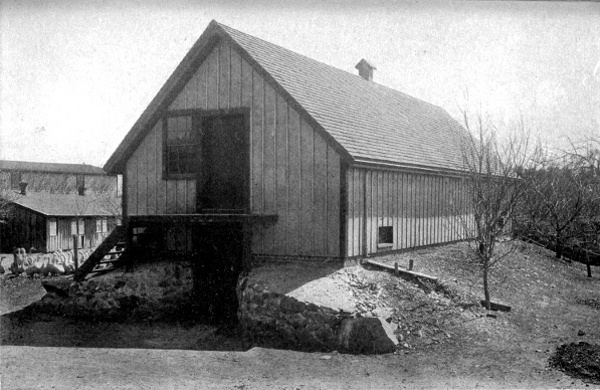
OUR INCUBATOR HOUSE.
This building never freezes in winter, and is always some ten or fifteen degrees colder than the outside temperature in summer, making a very handy place to keep eggs for incubating purposes. It is well to run your machine a few days and get the control of it. The next thing is to fill it with fresh fertile eggs. In the winter time, if one does not have eggs himself, this is sometimes a very difficult thing to do, for the eggs must not only be fresh, but fertile. The young beginner is often obliged to depend upon others for his eggs when first starting in the business, but the poulterer, as a rule, cannot afford to do this, because he can grow them a good deal cheaper than he can buy; and not only this, and what is more to the point, he, by proper care and feed during the winter months, can make his own eggs a great deal more fertile than any he can buy of others. Usually about one-third of our novices go right to the stores and purchase eggs to fill their machines with.
This is running a great risk, especially during the winter months, but will give the reader an idea of the amount of knowledge that many of our would-be poultry men have acquired to begin with, and when he knows that the incubator has to shoulder all these mistakes, he will naturally have a little sympathy for the maker. Several years ago I sold a six hundred-egg machine to a lady, who, on receiving it, filled it promptly with eggs obtained from the grocers. Now, as this was in the month of December, it was, to say the least, an exceedingly doubtful operation. As she only got about forty chicks she was naturally very much dissatisfied, and strongly denounced both the machine and the maker. Her husband suggested that possibly the machine was not to blame, and that the eggs might have something to do with it. They went to the grocer to enquire about it. He told them that he had had some of those eggs on hand for several weeks, and that they had been exposed to the cold and freezing weather, and that probably the farmers from whom he had obtained them had held them for high prices.
They found on enquiry that this was the case, and one party especially, who kept a large number of hens, and from whom he had collected the largest share of his eggs, kept no "crowers" with his hens. This threw some light on the subject, and stock on that incubator went up at once. The next time she had parties save their eggs for her, taking them in several times each day. She then obtained a hatch of ninety per cent, and was uniformly successful afterwards, getting out some 3,000 chicks and ducks during the season with her machine.
How to Keep Eggs for Incubation.
The above is only one case out of many that are constantly taking place. In nine cases out of ten, failure with good machines may be traced directly to the operator or the eggs. Occasionally there is a defect in a machine overlooked by the maker, which he is in honor bound to make good.
The best way to secure good eggs is to engage them beforehand from reliable parties, who will gather them carefully several times each day in cold weather to prevent them chilling, and turn them at least every other day. If these eggs are kept on end it is not necessary to turn them as often.
I have egg boxes for the purpose, in which the eggs are set on end, like the common market box. These boxes and contents can be turned as readily with a dozen as when full. Eggs intended for incubation should always be kept in a cool place,—duck eggs especially,—as the fertile eggs will change at a temperature of eighty-five to ninety degrees, and spoil within three or four days. One may safely calculate on one-half of them being spoiled in a week at a temperature of 80 degrees. All kinds of eggs can be safely kept three weeks for purposes of incubation, say, at forty-five to fifty degrees, though I always like to have them as fresh as possible.
In filling orders for eggs at a distance I make it a point never to send eggs more than four days old, or with less than seventy-five per cent of fertility. Transportation, even over rough roads, does not affect their hatching, except in extreme warm weather, when the contents, becoming thin and slightly evaporated through the heat, are apt to mix, when they will surely cloud and rot. I have often sent eggs 2,000 miles, with the report that every egg produced a duckling. With machine ready and running steadily the eggs may be introduced at once. They need no moisture now, and it is not necessary to disturb them for the first forty-eight hours.
How to Choose and Use Thermometers.
Place your thermometer on the eggs in middle of egg-tray. Be sure, in the first place, that you get a good glass, as all depends upon its accuracy. Do not use one with the mercury bulb lying upon a solid metal plate, as the refraction of heat upon the plate from the tank above will always run that glass one or two degrees higher than the heat in the egg-chamber, but get one, if possible, with a hole in the plate opposite the bulb, so that the heat can play around the bulb and through the plate, giving the correct heat of eggs and chamber. Do not hang your glass up over the eggs, or put it down between the eggs, but lay it on them, for the reason that, though either of these positions may be all right during the first twelve days of the hatch (if your eggs are fertile), they will surely be all wrong during the last part.