INTRODUCTION. (continued 2)
Reading edition
I will endeavor to explain this thing, so that the novice will understand how important it is. Before circulation begins in the embryo chick or duck, and there is no animal heat in the egg, the temperature of the egg chamber regulates that of the eggs. But after circulation begins, and especially during the latter part of the hatch, when the rapidly-developing young bird throws out a great deal of heat, the thing is often completely reversed. For instance, a glass may be hung one inch above the eggs and another placed immediately on the eggs beneath. The one above may register 102 degrees; the one below, on the eggs, will register 105 degrees,—conclusively showing that the eggs are now, by their own caloric, heating the egg-chamber.
I have often, during the last part of a hatch, when the thermometer was ranging from 70 to 80 degrees outside of machine, placed a glass on the hottest part of the boiler, where but one lamp was dimly burning, carefully covering the glass. In that position it would register perhaps 96 to 98 degrees, while a glass inside the machine, and on the eggs, would register 103 degrees, proving beyond a doubt that the eggs, by their own caloric, were not only heating the egg-chamber, but contributing their quota towards heating the water in the tank. Now, who will pretend to say that a glass hanging above the eggs will give the correct heat of the egg after circulation begins. So that, even in cold weather, the amount of oil consumed during the last week of the hatch is less than half the amount required during the first part.
The operator must not expect the eggs to heat up at once. On the contrary, they will cool the air in the egg-chamber very sensibly, though they will not affect the heat of the water in the tank. It will be from five to eight hours before they arrive at their normal heat.
How to Turn Eggs.
At the end of forty-eight hours they may be turned. This should be done by gathering up the eggs at the end of egg-tray and placing them upon the eggs in centre of the tray, rolling the centre ones back to the end of the tray. The tray should be reversed, and the same thing done to the other end. It is not necessary that the eggs should be completely reversed,—simply change the position, rolling over one-half or one-third.
The egg-trays should always be turned end for end, and changed from end to centre of machine. This is necessary in case there should not be a uniform heat in egg-chamber, as it will equalize matters, and, in a measure, obviate the difficulty. Now, all this, though it takes some time to describe it, can be done very quickly, requiring only a few moments for each machine. I usually allow about ten minutes for each 1,000 eggs, though it can be done much quicker if one is in a hurry. I am often requested by people to put in patent automatic egg-turning trays in my machines, it would so simplify matters. I reply:
"So it would; and when you can produce a machine with a perfect uniformity of heat in the egg-chamber, I should be most happy to use an automatic tray, but I have never yet seen that machine." In our own double-cased Monarch, in cold weather, there is at least one degree difference between the end and centre of egg-tray. In single-cased machines this difference must be largely increased, and in automatic trays the eggs must necessarily remain where they are placed through the entire hatch. Now, under these conditions, if the heat is right in the centre of trays it must be all wrong in the ends. The hatch will be protracted long after the proper time, and if those on the ends of trays come out at all it will be forty-eight hours behind time and with weakened constitutions, keeping one in constant stir with their sickly plaints. It is needless to say that there is a great mortality among birds of that description, and at the end of ten days they are usually among the things that were.
Hatching the Eggs.
The next thing is testing the eggs. This matter is essential as well as economical, with both hens and incubators. I once knew a man who ran a six hundred-egg machine for three weeks on one fertile egg. The other 599 proved infertile, and he did not know it until they refused to hatch at the end of three weeks—a great waste of oil, but a greater waste of time,—three whole weeks in the best part of the season. Another man kept forty hens sitting three weeks with an average of one fertile egg to each bird, when three of them could have done all the hatching just as well, and then, at the end of four days, could have had the rest put upon better eggs.
A great waste of hen power, you will say, with time lost, together with forty dozen eggs, which would have been just as good for table use had they been tested out in four days. It often happens in the winter, when eggs are apt to be infertile, that, after testing the contents of four trays, they can be contained in three, when the other can be filled with fresh eggs. Here is where the advantage of adjustable trays comes in. Often the operator running a large machine has not eggs enough to fill it without a part of the eggs becoming very old, and also losing ten or twelve days of valuable time; with the adjustable tray, eggs can be introduced at any time, and the same heat preserved on all. I usually test duck eggs at the end of the third day. The fertile germ is then plainly visible, and the eggs can be passed before the light, several at a time.
The novice had better postpone the operation till the fourth day, when he, too, will have no trouble in detecting the germ. The same rule will hold good with all white eggs, but dark-brown eggs should not be tested till the sixth or seventh day. This can be done much sooner, but a large machine full cannot be tested in a minute, and the eggs should be far enough advanced so that the operator can take two or three in his hand at once, and passing them before the flame, readily detect the germ. I never use a tester for duck eggs, as a simple flame is sufficient, the egg being translucent.
During the first stages of incubation the germ is very distinct, even at the third day. The clear eggs are reserved for family use or disposed of to bakers. An expert cannot distinguish them from a fresh-laid egg, either in taste or appearance. There is usually a small percentage of the eggs that are slightly fertilized, in which the germ will die during the second or third day. These can be readily detected at the end of the fifth day, and should be taken from the machine, and reserved as food for the young ducklings. Another and potent reason why all infertile eggs, and those with dead chicks in them, should be taken out of the machine, is that after the circulation begins in the egg, especially during the last part of the hatch, the temperature of a live egg is several degrees higher than that of a dead one. The one radiates heat, the other absorbs it; so that if the operator is running his machine 102 degrees, with his glass on a dead egg, he may be all unconsciously running it at 104 or 105 degrees on a live one.
I had a letter from a man some time ago stating that his thermometers were developing strange freaks,—that though they registered the same while in water, at 103 degrees, when lying on the eggs a few inches from each other in the machine, they were several degrees apart, and wishing to know by which he should run, the higher or lower. I wrote him that his glasses were all right, and that he was the one at fault, and had he followed instructions and tested his eggs he would have had no such trouble. He wrote that as his machine was not quite full, and as he had plenty of room, he neglected to test them, thinking it would make no difference.
I do not propose here to give my experience, together with the many experiments made during the last twenty years, but shall aim to give the reader simple instructions for hatching and growing ducks for market and selection of breeding stock. I would say here that the first thing for the operator to learn in turning the eggs is to do it carefully and well, without breaking or unnecessarily jarring them; and then, to do it as quickly as possible, especially if done in a cold atmosphere, so as not to derange the heat in the egg-chamber. The next thing is to maintain as even a temperature as possible during the hatch. I do not think that a variation of one degree is at all detrimental. But different people have different ideas of regularity. A man who did not have a first-class hatch, wrote me that he had kept the machine right to business, as it had run between 90 and 110 degrees during the entire hatch. Another man wrote that his machine had been as low as 100 degrees, and once up to 103 degrees, and wishing to know if I thought it would be fatal to his hatch.
There is no such thing as accuracy in the composition of some men, things are run "hap-hazard," failure and misfortune are always attributed to conditions, circumstances, or hard luck,—never to themselves,—and in case of a poor hatch, always the incubator. Instructions go for nothing with them. An enterprising incubator maker told me one day that he believed that the world was composed of cranks and fools (at least the poultry part of it). The one-half did not know anything, while the other half had all that was worth knowing and despised all instructions and common-sense.
In running your machine, the first step is to set it level and see that the glasses register alike in both ends of the machine. Next, procure good oil, 150 test (as poor oil will necessitate frequent trimming, besides crusting the wick). Do not use more flame than is necessary, as it will only be a waste of oil, and with some machines will increase the ventilation, and at the same time decrease the moisture. Be regular in both filling lamps and trimming them, as irregularity frequently involves forgetfulness, and that sometimes means disaster to the hatch. In trimming, it is well to turn on the same amount of flame in relighting your lamp as it had previously.
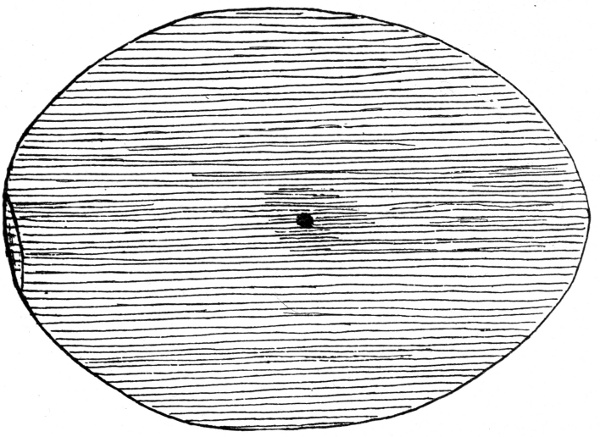
Figure 1.—Showing First Indication of Fertility.
In the Monarch Incubator this required amount can readily be seen at once by the action of the regulating bar. It informs the operator just when he has enough,—when too much and when too little. Keep both lamps and chimneys clean, and have stated periods for turning your eggs, which should be done twice each day. As I said before, an egg-tester is not required with duck eggs, as they are so transparent that the whole process can be plainly seen without in the flame of a common kerosene lamp. If a duck egg is carefully examined, after being subjected to a heat of 102 degrees for twenty-four hours, a small dark spot will be seen about the size of a large pin-head. This little spot, if the egg is gradually turned, will always float over the upper surface of the egg. This is the life germ, and the first indication of fertility in the egg, and is represented in Figure 1.
At the end of forty-eight hours this dark spot will have nearly doubled its size, and a faint haze will appear around its edges a shade darker than the surrounding contents of the egg. This haze is the first appearance of the blood veins radiating out from the germ.
Figure 2 shows how the egg appears at this stage with the air-cell slightly enlarged.
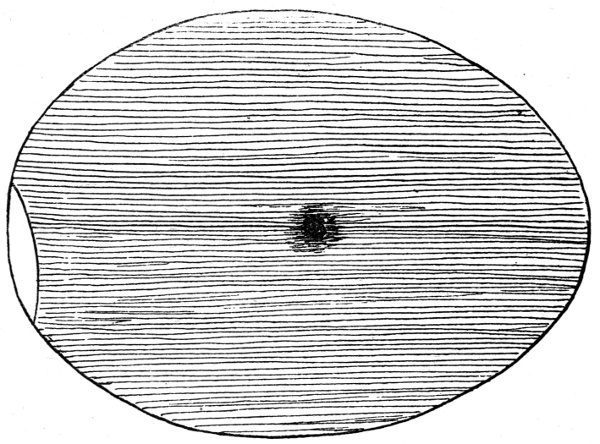
Figure 2.—Egg at End of 48 Hours.
At the end of the third day the dark spot, which is the heart of the embryo duck, can still be seen; but not so distinctly, because a dark circle some three-quarters of an inch in diameter will now appear in the upper surface of the egg, in the centre of which the dark spot is visible. This circle is several shades darker than the rest of the egg, and no matter how the egg is turned will always float in its upper surface.
Figure 3 represents the egg at this stage, with its enlarged air-cell.
Figure 4 represents the egg as it appears at the end of the fourth day. The circle surrounding and inclosing the germ will have nearly doubled in size, and is of a still darker hue; indeed, the whole contents of the egg is perceptibly darkened. If the egg is broken carefully at this date a delicate tracery of veins will be found to have enveloped the entire yolk of the egg, all originating from the centre or heart of the embryo; the pulsations of which (if the shell is removed) can now be plainly seen with the naked eye. This net work of veins cannot be plainly seen with a common lamp, but with a powerful glass are very distinct. This latter is not at all necessary in testing the egg.
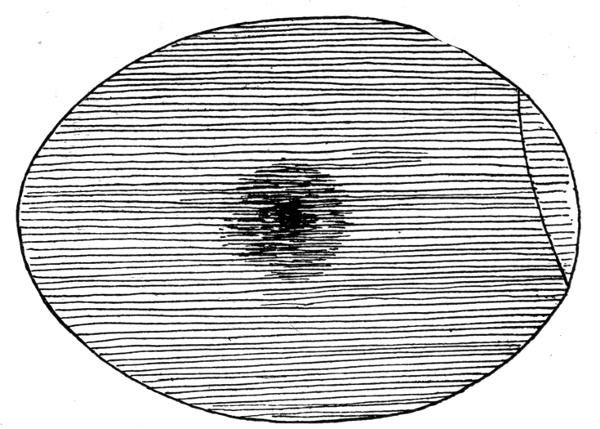
Figure 3.—Egg at End of 72 Hours.
The discovery and locations of the minute organisms may be interesting to the scientist, but not at all necessary to the operator, who simply wants to be assured of the life and health of the germ. This he can readily determine from the increased size and gradual development of the circle; it, and the contents of the egg, now assume a darker shade. Up to this time I use no moisture, and the contents of the eggs have gradually evaporated and the air-cell proportionately enlarged. This air-cell is slightly enlarged till the tenth day, when no further evaporation should take place. About three days before hatching the rapidly developing duck will gradually diminish the size of the air-cell, leaving himself just room enough to work out.
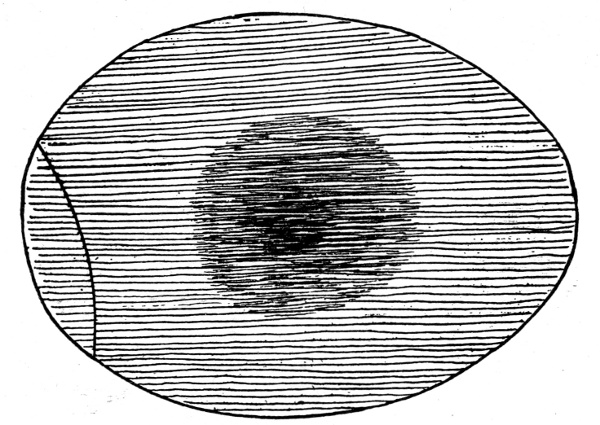
Figure 4.—Egg at End of 96 Hours.
Nature, in the case of the old hen, provides for her own contingencies, while we must resort to art to obtain the same conditions.
While incubating under the hen during the first few days, the egg evaporates rapidly. Then the pores gradually become coated with an oily secretion from the feathers of the hen until evaporation ceases. Now, we cannot successfully fill the pores of the eggs, it is too delicate an operation to attempt; but we can easily obtain the same conditions in another way, and that is to prevent the further evaporation of the egg by vaporizing water in the egg-chamber, so that evaporation will not take place. Exactly when this should be done is already known, but exactly how much is quite another thing, and depends largely upon the conditions of the atmosphere outside. The point is this: the humidity inside the egg-chamber must be the same, whatever the conditions are outside.
If your machine is in a warm, dry room, heated by a fire, far more evaporating surface will be required than in a cool, dry cellar, for the reason that water vaporizes just in proportion to its heat; and as the circulating pipes upon which the water-pans rest must necessarily be much warmer in a cold room than in a warm one, of course more surface must be exposed in a warm than in a cold one. The operator will always have to use his judgment more or less in that. It may perplex the novice somewhat, but it is easily understood when one becomes accustomed to it.
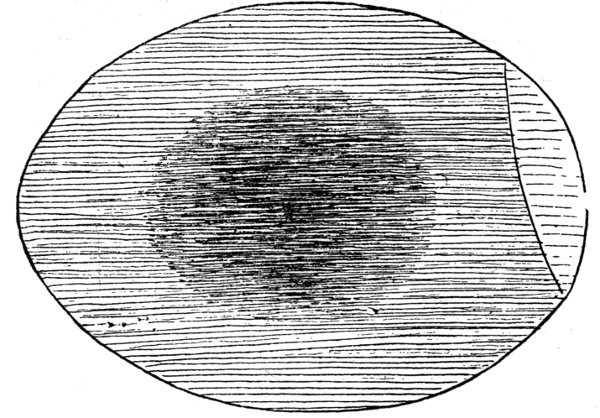
Figure 5.—Egg at End of 120 Hours.
As a rule, in our machines, we introduce one moisture pan about the 18th day for both duck's and hen's eggs. It makes some difference whether a machine is run in a humid atmosphere near the seashore or in a dry, rarified atmosphere at an altitude in the country.
Figure 5 represents the egg at the end of the fifth day, the circle enlarged, shaded darker in color; the whole egg being slightly darker in hue.
Figure 6, at the end of the sixth day, shows still more plainly the germ undergoing a gradual change in the egg, enlarging and assuming a darker hue. The outline of the circle is now gradually acquiring the form of an ellipse, and in a live embryo the line of demarkation should be distinct. If it is at all wavy and irregular in its outline, and instead, remaining intact, the contents of this ellipse show a disposition to assimilate with the surrounding liquids when the egg is revolved, it can be safely removed as a dead duck.
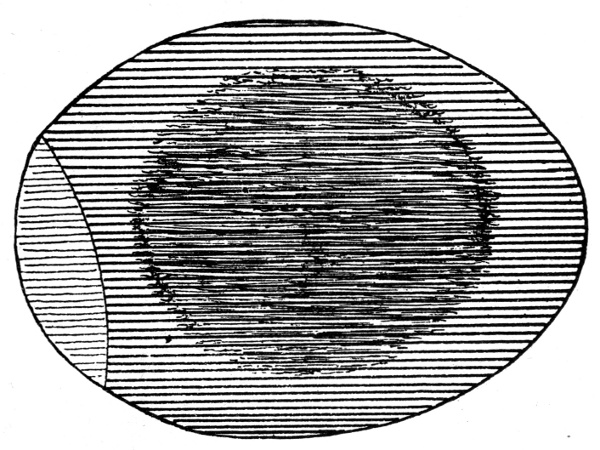
Figure 6.—Egg at End of 144 Hours.
Figure 7 represents a dead embryo, as it will appear from the seventh to the twelfth day. The germ being separated and appearing in dark irregular blotches over the entire surface of the egg; the egg having become nearly opaque over its entire surface. At this stage the egg, if it has not already become so, will soon be very offensive. These should be removed at once and handled carefully the while, as they are apt to explode and unpleasant consequences ensue. The operator should run no risks, as discoloration on the outside shell of a duck egg is a sure sign of decay, and they can safely be taken from the machine. There are always a certain number of duck eggs (especially during the month of August and the latter part of July) that have the appearance of fertility during the first three or four days of the hatch, but do not possess vitality enough to carry them through. These die at all stages of the hatch; neither operator nor machine is responsible for them. This is caused by the condition of the mother bird.
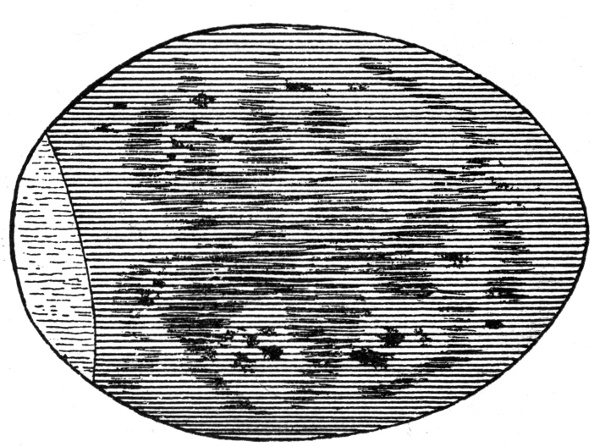
Figure 7.—A Dead Embryo.
In order to economize the room thus made by the removal of the fertile eggs, I run a small 150-egg machine, in connection with twenty-one of the largest size, using it, as it were, as a tender. When filling one of the larger machines, I always fill one tray in the smaller one so that when the eggs in the large one are tested, after the third day, there will usually be eggs enough in the small tray to replace those removed as infertile, so that the large machines are kept full during the entire hatch by the little one. Thus the small machine is made to accomplish far more than it would were it run through the hatch. I am thus enabled to have a hatch come off nearly every day, consequently our eggs are never older than that when introduced into the machine. Always date each day's quota of eggs—keep them by themselves, then there will be no mistakes made. I have known parties to keep one general receptacle for their eggs, and when filling their machine take them from the top, while the bottom ones were never disturbed, not even turned, and of course soon became worthless for any purpose.
Figure 8 denotes the appearance of the egg during the eighth day of incubation. If portions of the shell are carefully removed at this stage, the rudimentary intestines may be plainly seen, together with the gradual development of the beak and eyes, as well as the trembling of the pulsating arteries through the whole embryo.
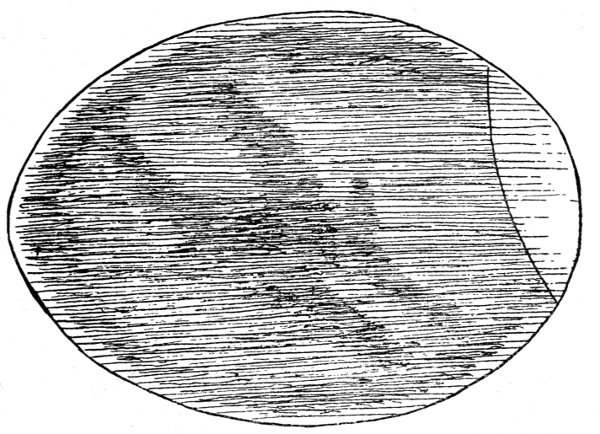
Figure 8.—Egg After 192 Hours.
At this stage the operator should mark all doubtful eggs and return them to the machine, as he will find plenty of room there. He will soon become expert, and can detect life and death in the germ at a glance. Experience alone will give the operator an insight into this business. The incipient stages of decay, though easily detected by the expert, cannot be intelligently described by him. The application of a little heat for the short space of twenty days to an inert mass, developing it into active, intelligent life, is simply wonderful. The process and effect he can easily describe, but the procreative power behind it all is beyond his ken. Should a little duckling be taken from the shell on the thirteenth or fourteenth day it will resemble Figure 9. It will kick and struggle several moments after its removal. The yolk is not yet absorbed, but the process is just beginning and will continue until the twenty-fourth day, when it will be nearly absorbed. The egg, from the fourteenth day rapidly assumes a darker hue.
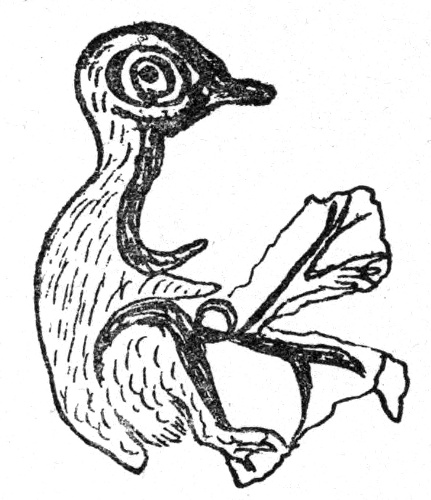
Figure 9.
The extremities of the little bird gradually develop, the feathers grow, and at the twentieth day the egg is opaque. At this stage the embryo will endure greater extremes of heat or cold than at the earlier stage of the hatch. I should not advise the operator to presume upon this, however, but just make the conditions as favorable as he can, so that the little bird will have the strength to free himself from the shell. I need not say that this is the most critical time during the whole process, and matters should be made as favorable for the little duckling as possible. About the twenty-fourth day he will be already to break the shell, but, unlike the chick, who will make his way out of the shell a few hours after he has pipped, the duckling will lay for forty-eight hours before he is ready to come out. At this time there should be plenty of moisture in the egg-chamber, for should the orifice or broken parts become dry, and the little duckling, in consequence, be attached to the inside lining so that he cannot turn, he can never get out without help.
Figure 10.
When the hatch is well underway a little more air should be allowed to circulate in the egg-chamber, and a part of the evaporating surface can be removed, for as each duckling makes its appearance he becomes a little sponge, until dried off, and furnishes plenty of moisture for the machine. When nearly dried off the duckling should be dropped into the nursery below the egg-trays. While hatching, the eggs should be kept pipped side up in the trays, as the birds sometimes get smothered when the orifice is underneath. The dry birds should be dropped below about once in four hours, for, if allowed to accumulate, they will roll the egg upside down, crowd the egg-shells over the pipped eggs, or pile themselves over the egg, smothering the young birds.
This work should be done very quickly, so as not to derange the temperature of the machine. Be sure to keep the heat up in your machine, for its tendency is always to go down during hatching, for the reason that the egg radiates a great deal of heat, while the little duckling, with its woolly covering (which is a non-conductor), retains it. Many people advocate allowing the little fledglings to remain with the eggs until all are hatched, but this is all wrong, not only for the above reasons, but for one which is far more important than either.
The amount of heat requisite to hatch the eggs is too much for the young birds already hatched and dried off. With chamber at 102 degrees, they will be seen crowding around the sides of machine with their little bills wide open, gasping for breath, when, had they been placed below, the proper temperature can be maintained in both, as the bottom of machine runs at least five degrees lower than the egg-trays.
Be sure and Follow Instructions.
Another fertile source of trouble is removing ducklings from machine, putting them behind the stove, or somewhere else to dry off. For every fifteen birds removed, the heat in egg-chamber is reduced at least one degree, as you are removing so many little stoves, and if the machine is not gauged higher, to correspond with the number of ducklings taken out, the result will be fatal to the unhatched eggs.
I corresponded a whole summer with one man on this very point before I found out what he was doing. He said he had never been able to get out more than fifty per cent. of fertile eggs. His machine ran splendidly until his chicks were about half hatched, when it would drop down to 90 degrees, and the rest would die in the shell, after they were nearly all pipped. At last a letter came from him stating that he had just had a worse experience than ever. He had a most promising hatch of three hundred fertile eggs, nearly all of which were pipped, and that, after a little more than half were hatched, he took them out as usual, about one hundred and fifty in number, and put them behind the stove to dry off, and his machine dropped to 90 degrees at once, and not another chick came out. The cat was out of the bag.
I wrote him at once that for every fifteen chicks he had taken out he had taken one degree of heat from his machine, and had he followed instructions he would not have suffered loss. He wrote back that he had shut up his machine for the season, but that he should run it one more hatch just to prove that I was wrong. At the end of three weeks a letter was received saying, "I tender you my hat. I got a splendid hatch of 88-1/2 per cent." Proving that occasionally there is danger of the operator knowing too much. After the ducklings are all out, the egg-trays should be removed, the valves opened, and the machine cooled down to 90 degrees, and the birds allowed to remain in the machine for at least twenty-four hours. I always cover the bottom of machine with an inch of fine wheat-bran, otherwise the ducklings would soon make it filthy and offensive. This acts both as absorbent and disinfectant.
After each hatch there will be more or less fertile eggs left in the trays with dead ducklings in them. There will be, comparatively, but few of these in the spring of the year, but during the latter part of the summer there will be more of them, and many of the eggs will have but little vitality in them.
Forcing the Bird Reduces the Vitality of the Egg.
The reason is this: the bird in its natural condition does not produce her eggs in our climate until April. She will lay twenty-five to thirty eggs, then show a desire to incubate, then will recuperate, and set a second time, perhaps giving a total of thirty-five or forty eggs. Now, we have completely reversed nature in this respect. By judicious feeding, good care, warm quarters, and careful breeding, we have induced the bird to produce her eggs in winter instead of summer, and, not only that, we compel her to lay three or four times as many of them; and when the poor bird shows a desire to incubate and recuperate her exhausted frame, we induce a change of mind, as soon as possible, and set her at it again.
As a natural consequence, as the warm season advances many of the birds are off duty, as it were, and the eggs not only decrease in numbers but in size as well, and during the extreme heat of summer, the later part of July and August especially, the eggs show a decided want of vitality. I never expect, at this season, to realize more than one duckling from two eggs. The same machine full of eggs that would give a hatch of 350 ducklings in the early spring, at this season will not give more than 175 to 200. The eggs appear to be as well fertilized during the first two or three days as in the early spring but evidently there is not vitality enough to carry them through, as the germs soon begin to die, and before the hatch is out you have taken nearly one-half of the eggs away as worthless. Nor is this all.
There is always a far greater mortality among the later hatched birds than in those got out earlier. They are more uneven in appearance, and never attain the size of those hatched earlier in the season,—convincing evidence that the old birds have transmitted their enfeebled, debilitated constitutions through the egg to the young ones. The natural laws of cause and effect are plainly represented here. I have tried repeatedly to overcome this difficulty by changing the feed and quarters of the old birds, dividing their numbers, but without effect. This shows the absolute necessity of selecting large, vigorous breeding stock. This principle applies equally to both land and water fowl.
The Absolute Necessity of Good Breeding Stock.
Debilitated, degenerate stock will not produce healthy and vigorous young. This is a prime cause of failure with many of our poultry breeders. They say that they cannot afford to breed from their early-hatched stock. They are worth too much in the market, so they are sent to the shambles, and their owners breed from the later-hatched, inferior birds. A few years practice of this kind soon degenerates the stock so that you will hardly recognize the original in it, and both birds and eggs are not only thus, but a very small per cent. of those eggs can be induced to hatch, and no amount of petting and coaxing can induce those that are hatched to live.
Every young breeder of poultry should inform himself of these facts before he starts in, for no living man can afford to breed from inferior stock. I passed through experiences of this kind many years ago, and always found that the laws of primogeniture cannot be lightly set aside. I invariably select the choicest of my early hatched birds for breeding stock, and no matter how high the price in market, I cannot afford to sell them. A gentleman, who is a large breeder, said to me the past spring: "How is it that your ducks are so much larger than mine? I bought stock from you four years ago, and have been breeding from it ever since, and now your birds are six or eight pounds per pair heavier than mine." "True, but you bought my latest-hatched birds, because they were cheap, and have been breeding from your latest-hatched birds ever since, while I have been breeding only from the choicest of my early birds. You have been steadily breeding your stock down, while I have been breeding mine up. There is now a wide gap between them."
Caring for the Ducklings when Hatched.
The little ducklings should be left in the machine for at least twenty-four hours longer. Be sure and open the air-valves and give them plenty of air, so that they may be well dried off. A uniform heat of 90 degrees should be held in the egg-chamber. The outer doors of the machine should be closed and the little fellows kept in darkness the first twelve hours. After that the outer doors should be let down. Then you will see some fun, for the little ducklings are far more active than chicks, and will begin to play at once. In the meantime the brooding-house should be prepared for the reception of the young brood. The heat should be started some twenty-four hours previous to use.
The brooding-house should be the same whether you are growing on a small scale or a large one, with simply the length proportioned to your needs. But always recollect that heat should radiate from above on your ducklings, as bottom heat will soon cripple them in the legs and render them helpless. In fact, I do not consider bottom heat as essential even for chicks. The most successful grower I know of, who grows 3,000 chicks each spring, getting them all out between January 1st and March 1st, and closes up the whole business by July 1st, uses top heat exclusively. He has experimented fairly with both, and says he wants no more bottom heat. If the breeder is growing on a small scale it will be economy for him to use brooders instead of a heater.
Figure 11 represents the best duck brooder I know of. As there is no patent on it anyone can make it who has the conveniences. This brooder is six and a half feet long by three feet wide, and will accommodate 150 ducklings. These brooders are of the most improved construction, are intended for both indoor and outdoor work, keeping the young ducks dry and warm in cold, stormy weather, even when located out of doors. The heat is generated in copper boilers, the water flowing through a galvanized iron tank, under which the young ducklings hover. This tank is five feet long, twelve inches wide, and about an inch thick, and is hung about eight inches from ends and back of brooder, leaving nearly eighteen inches in front the entire length of brooder, in which to feed the first day or two. The case of this brooder is made of matched boards and thoroughly ventilated and furnished with glass doors to admit light. This brooder should be used in the brooding-house during winter and early spring, after which it can be used to better advantage out of doors.
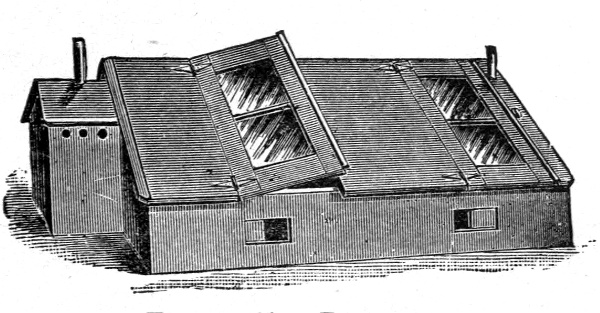
Figure 11.—Brooder.
Let it be understood that a good brooder is, next to the incubator, the most important thing in the business. It is worse than useless to get out large hatches of strong, healthy birds, only to have them smothered or chilled in worthless brooders. Numbers of the patent brooders now on the market are made by men who never raised a chick or duck in their lives, and are regular fire and death traps. Many instances have come under my personal notice where not only ducks, chicks, and brooders, but the buildings themselves have been entirely consumed by these fire traps.
Again, those brooders are always rated for higher than their actual capacity. Ignorant parties buy them, fill them up according to instructions, when a sad mortality is sure to follow from overcrowding and consequent overheating. This is especially the case with chicks. Ducklings never smother each other from overcrowding, but, of course, will not thrive when too closely packed. These 150-duck brooders can be run at an expense of two cents per day for oil. In extreme cold weather artificial heat should be kept up in these brooders for three weeks; in warm weather, a week is sufficient. The same brooders can be used over and over as fast as the new hatches come out. When brooders are removed, closed boxes can be used instead.
When the operator does business large enough to require the use of five or six brooders, it would be cheaper for him to put in a heater at once, as the original cost of the heater would be less than that of the brooders. Years ago, when the question of heaters was first agitated, the cost was enormous, and the consumption of coal in proportion. Large hot-house boilers were used, often at a cost of several hundred dollars before the thing was ready for use. Now a good heating system can be arranged for a building one hundred feet long at an expense not exceeding $100. This, of course, would be much less than a complement of brooders for the same building.
Advantages of the Heating System.
The heating system has several marked advantages over the brooders. One is, that during the extreme cold of winter the building is always warm enough for the little birds, while with nothing but brooders it would often freeze around them, necessitating feeding inside the brooders, which would not be as healthy for the ducklings. Again there would be a great saving of labor, as a self-regulating heater would require no more care than a single brooder, while the oil consumed in the brooders would fully equal the cost of coal required for the heater.
There is one point here which the beginner should always take into consideration in the selection of a heater, and that is, be sure and get one that will give you the greatest amount of heat for the fuel consumed. The patent steam and water heaters now upon the market are too numerous to mention. But there is a vast difference in the economy of these heaters.
When contemplating the purchase of a heater, several years ago, I called upon a party who was running a newly-purchased heater. He seemed very much pleased with it, and said it ran admirably,—warmed his buildings nicely, and only cost about one dollar per day for coal. I made up my mind then and there that I should run my brooders a while longer. But on interrogating another party using one of a different pattern, he assured me that his heaters warmed both brooders and buildings in good shape at a cost of fifteen cents per day. This was presenting the matter in a new phase. The difference in cost of running these heaters one year would purchase two. I am now running three heaters called the "Bramhall-Deane Heater" and am heating two brooding houses (one 250 feet long, the other 175 feet long), at half the cost per day. Either steam or water may be used. I prefer water for both safety and economy.
For instance, should the fire go out accidentally the heat would cease at once where steam was used, while water would hold its heat for hours, and would continue to circulate just so long as the water in the boiler was hotter than that in the pipes. I do not know but there are other heaters in the market just as economical as the "Bramhall-Deane," but I know of several prominent poultry men who are changing their heating principle, not because they are dissatisfied with the work done by that now in use, but solely on account of the expense attending it.
Figure 12 represents our brooding-house as it appears outside. Its dimensions have already been given. It is boarded in with closely-fitting hemlock boards, the whole being covered on the outside with the heaviest quality of "Paroid" Roofing.
This roofing is manufactured by F. W. Bird & Son, East Walpole, Mass. We have more than an acre under roofing, a large proportion of which is covered with Paroid. We find it strong, pliable, insusceptible to either heat or cold and to all appearances will be more durable than anything we have ever used. I have many buildings covered with this roofing. In applying it, begin at the eaves, lapping it 1-1/2 inches. It is so heavy that it does not require wooden strips to hold it down, simply nails and tin caps, which should be about an inch apart. A coat of the liquid, which goes with it, will glaze it over in good shape. For a flat roof, it is far better than shingles at less than half the cost.
Interior Arrangement of Brooding-House.
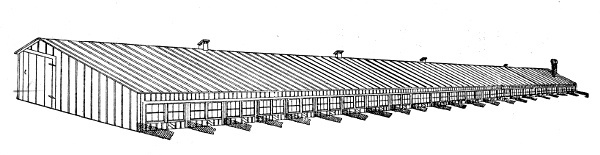
BROODING HOUSE. (Fig. 12.)
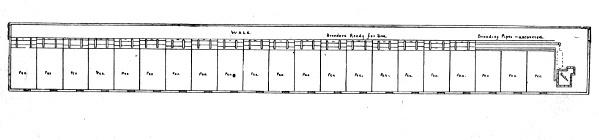
PLAN OF BROODING HOUSE. (Fig. 13.)
As the construction of this building has been already noticed, I will proceed to describe its interior arrangement for a brooding-house. In the first place, as in the breeding-house, there should be a walk three feet wide the entire length of the building on the back side. Next to the walk, and parallel with it, the brooder box should run. This box will be thirty inches wide, and like the walk, the entire length of the building. In my building the brooding arrangement is very simple, being a box with two sides resting on the ground, eight inches high in the clear, the ground being utilized as the bottom of brooder.
This brooding-box consists of two parts. The sides, seven inches wide, are nailed securely, and constitute the sides of the pipe-stand. The cover is portable, with cleats nailed across the top to strengthen it, and with strips an inch wide nailed underneath, in front and in back, to keep it in position. These strips are supposed to rest on the seven-inch strips in the sides, and, when the cover is on, make a tight brooder.
Figure 13 represents the interior of brooding-house, with these covers on the brooders and ready for use. Also, with two of the covers removed showing the heating pipes. These consist of a two-inch flow and return, running parallel with each other the entire length of the building, and lying ten inches apart from centre to centre. These pipes rest upon cross boards, whose length corresponds with the width of the brooder, and to which the sides are nailed; two-inch holes are cut out in the top of these boards into which the pipes are laid, the upper surface of which comes flush with the top of the boards, so that when the cover of brooders is in position it rests equally on pipes and boards.
The distance between these boards corresponds with the width of pens outside of brooder, and constitute partitions for the same. The partitions are simply inch boards, twelve or fourteen inches wide, fitting into ground in front of building to keep them upright and in position. The front of the brooder leading into the pens is cut out in centre of brooder four feet long and four inches deep to allow the free passage of the ducklings. These openings in the first four pens are fringed with woolen cloth, cut up every four inches, to keep the brooder warmer in cold weather. The remaining brooders are not fringed, for reasons which will appear hereafter. The heater can be located in the end of building most convenient to the operator.
The bottom of the pens should consist of sand which, when it becomes wet, and before it becomes offensive, should be covered with fine sawdust. This is a good absorbent and disinfectant as well. The inside of the four brooders next the heater should be filled up with hay chaff to within four inches of the pipes, the distance being gradually increased as you near the other end of the building, until the whole eight inches in height will be required, using simply sawdust enough to disinfect the bottom of brooder. This is my present brooding arrangement, with the exception of a common door handle screwed on each brooder cover to facilitate handling. It may not suit every one; some may want it more ornamental, more expensive; others may wish to simplify it still more. But such as it is, it is now all ready for use, with heat applied.
But those little ducklings, who have been waiting all this time in the machine, are getting both hungry and impatient, and require immediate attention. The food which has already been prepared consists of a formula composed of four parts wheat-bran, one part corn-meal with enough of low grade flour to connect the mass without making it sticky or pasty, in fact, it should be crumbly so that the little birds can eat it readily. About five per cent. of fine, sharp grit should be mixed into their first feed, after that, one or two per cent. is all sufficient. This grit should be increased in size as the birds grow older.
About the third day, a little fine beef-scrap should be introduced, soaking it a little before mixing. When a few days old, a little green rye, if obtainable, should be given them, or as a substitute, finely chopped cabbage or lettuce. When the birds are two weeks old, one part corn-meal to three parts bran should be used. This food should be scattered upon the feeding-troughs, which are simply one-half inch boards, nine or ten inches wide, by three or four feet long, with laths nailed on the sides and ends. Small water-cans, inverted in tin saucers, so that the ducklings can drink readily without getting wet, should stand convenient to the food.
How to Remove the Ducklings Without Injury.
To facilitate the removal of ducklings from the machine, I have a square basket some two and one-half feet long, by fifteen inches wide and one foot high, with close covers, hinged in the centre. In order to secure the ducklings, usually all that is necessary is to open one door of machine, hold this basket under it and make a little chuckling noise, and strange to say, the little fellows will run out over the pipes, over the glass door, down into the basket in dozens as fast as their little legs and wings can carry them. This basket will hold 100 ducklings conveniently. When full, it should be carried to the brooding-house and carefully inverted over the feeding-boards.
The little birds will begin eating at once. This process can be repeated until the machine is emptied. There will be some of the later-hatched ones that should be allowed to remain in the machine ten or twelve hours longer, as they can be cared for better there. These can be readily detected, as they are not as active as the others, and perhaps not completely dried off. The ducklings should be put out, if possible, during the middle of the day, and while the sun shines through the windows, as they can be fed in the sun and put under the brooder later in the day.
In event of there being no sun, it will not do to feed under the brooding-box, as it is too dark. I then take a one-half inch board, four feet long (to correspond with the length of opening in front of brooder) and six inches wide. I nail two pieces of the same width and height, one foot long, on to each end of this board, forming a parallelogram four feet long and one foot wide, minus one side. This is set up in front of the opening in brooder, and being of the same length, forms a little pen in front of brooder one foot wide, in which the feeding-trough can be placed with drinking fount.
The ducklings can then run out and in and feed when they wish. This board will only be needed for a day or two, when it can be taken up and reserved for the next brood. The ducklings should be fed once in two hours, scattering a little food on the troughs. Be sure that they eat clean before more is given. At the end of a week the regular feed should be four meals each day.
How to Feed.
When I can get stale baker's bread I use that in connection with, and instead of, bran. It can be profitably mixed with milk, not too sour, when it can be had for a cent a quart. But do not give milk as drink,—the young birds will smear themselves all over with it, their beaks and eyes will be stuck up, the down will come off their little bodies in large patches, and they will be a constant aggravation. I was once called upon to visit an establishment, the owner of which complained that his ducklings did not grow, and he was very anxious for me to locate the trouble. I found six to eight hundred ducklings there of all ages, and, strange to say, nearly of one size; and one lot of nearly three hundred ducklings eight weeks old would not average one pound each, when they should have weighed four pounds.
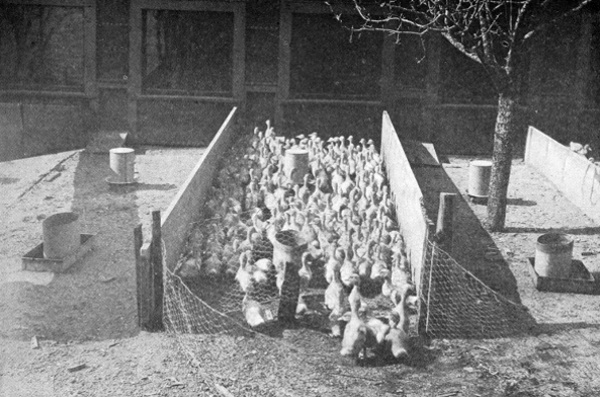
Such a sight I never saw before, and hope never to see again. Of all the miserable, squalid, contemptible looking objects, those ducklings took the lead. This man had not only mixed their food with milk, but had kept it by them in open troughs, and the birds had bathed in it and spattered it over each other until there was hardly a feather left on their emaciated bodies; and yet this man did not know what ailed his ducks.
Is it strange that some people fail in the poultry business?
When in full operation, we run twenty-one large machines, and as it requires twenty-seven days to close up each hatch, of course we have a hatch come off nearly every day. Now as each hatch is supposed to occupy two brooder-pens with the corresponding yards, in the course of five or six weeks that brooding-house will be filled with its complement of 3,000 ducklings. These will be of all ages, from the little puff-balls just from the machine, to the half-grown bird of six weeks old. The brooding pipes are supposed to radiate the same amount of heat at the extreme end of the building as they do next the heater, consequently the brooders are of the same temperature in all their parts. Not so the building.
As the heater radiates a great deal of heat, the end in which this is located is always 12 or 15 degrees warmer than the other and is thus better adapted to the comfort of the newly hatched ducklings than the other, so I always put the birds fresh from the machine next the heater, while the older ones are passed down the building. This is a very simple process. One end of the partition board is lifted up a little, food scattered in a trough in the empty pen adjoining, the ducklings will rush under in a moment, then the board is dropped. The same process is continued until all are moved and the building filled.
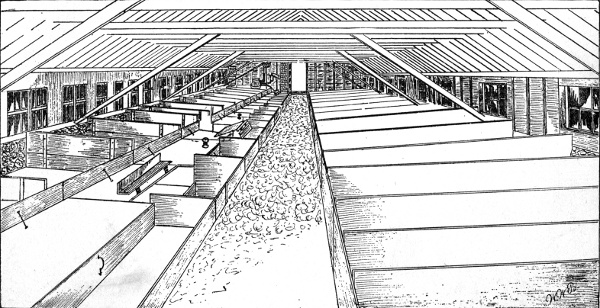
INSIDE PLAN OF DOUBLE BROODING HOUSE.
The building just described we term our nursery, and has a capacity of about 2,500 birds. When full, the older birds are probably about two weeks old, and of course these older ones must be removed to make room for successive hatches of younger birds. For this purpose, we constructed a building 125 feet long, 32 feet wide, which we style our double brooding house. It runs east and west with a walk four feet wide through the centre, with brooding-pens on each side. This building has the same capacity of a single building 250 feet long, and accommodates about 5,000 birds. On the south side of this walk our brooder boxes are arranged.
At one end of the building is a heater, from which an inch-and-a-half flow and return pipe runs under the brooder boxes the entire length of the building and furnishes heat for the little birds. The brooder-boxes are located twenty inches from the side of the walk. The ducklings are fed and watered in this space, and are not allowed in it except for that purpose. To effect this, the covers of the brooding-boxes, which are six feet long by two feet wide, are cut in the centre the entire length, and hinged with a perpendicular lip, which when closed, meets an upright board below, some two inches high, shutting brooders tight, excluding ducklings from feeding apartment, so that it is always sweet and clean.
By this arrangement, the ducklings are all fed and watered from the walk, thus reducing the labor to a minimum, while there is no danger of crushing the little birds under foot or under the troughs. The attendant is not hampered in his movements, but can work as quickly as he likes. All he has to do is to distribute the food and water, throwing the covers back as he goes, when the ducklings, which are always waiting, rush in and soon fill themselves. Twenty minutes is all that is required for them to eat and drink.
A person of good judgment can easily determine about how much the birds will consume, though it is well for him to pass along the walk, giving a little more food where their wants are not satisfied, or taking up what is left over, shutting the covers down when the birds are through.
As this building is well piped, distributing water at both ends, as well as at the mixing-box and heater, it makes the feeding almost a pastime, the work is done so easily. This building is just what we have been looking for. There are none on the place that pleases us so well. Its many advantages over a single building must be evident to all. The increased facility for doing the work, as well as its economy in housing many more birds for the money invested, are not the least.
When planning this building, we had some misgiving about running it east and west as the lay of the land required, thinking that the exposure on the north side during the inclement weather of the early spring, would confine the young birds to the building and they would suffer for want of exercise, but we were agreeably disappointed as we found that they thrived equally as well, if not better, on the north side as on the south, proving what I have always known in duck culture, that the extreme heat of summer is more debilitating to young birds than the cold of winter, and that early hatched birds will always be of larger size and more robust physique than late ones.
That is why I have always made it a point to select my early hatched birds for breeding purposes. I have never known any too good for that. I insert cuts of this double building, with the older ducklings on the north side and the younger ones on the south. Were I to build another, I should duplicate it in every respect.
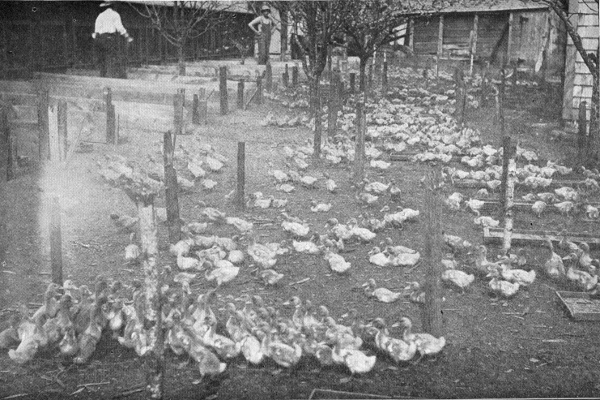
Regulation of Heat in Brooders.
Now, as the birds grow larger, they naturally need less heat, and we must contrive to fix it so they do not get so much. As stated before, no fringe is used beyond the first four brooders,—the space in front being left open; and not only that, but we gradually raise the back of the cover next the walk until it opens an inch or more the entire length of the pen. Those ducklings, before they reach the other end of this brooding-house, will weigh (if well cared for) over a pound each.
The brooder will not then be large enough to hold them, neither do they require the heat, in fact it would be injurious at this age; so before the birds reach the extreme end of the building I shut them off from the brooders entirely by placing a board in front of the opening. The young birds will always thrive better out of doors than in; and when two weeks old I always let them out during the sunny days of April, by opening the slides in front.
At this stage of growth when the birds are from two to four weeks old, especially with the early hatches when confined as they usually are during the inclement weather in winter, unless extreme care is taken, a sad mortality is sure to follow.
There is a great tendency at this stage of growth, when the birds are confined, to overfeed as well as to overheat in the brooders. This, coupled with too little exercise is sure to cripple the birds, weaken their legs and render them helpless. Even experienced growers sometimes get a little careless and lose whole hatches. We have numerous letters from all parts of the country in which people write "My ducklings are all crippled, cannot walk and are dying off fast. What shall I do?" There is only one thing; feed sparingly, and give all the exercise possible. Often, the want of grit will cause the same trouble.
(Our yards have been prepared for this the previous autumn, and are now covered with a thick coat of green rye five or six inches high.) To accomplish this, I make pens outside the building in front, ten feet long, and of a width to correspond with the pens inside. I simply use old boards a foot wide, tacking them together with wire nails, as it is only a temporary arrangement. When snow falls it must be shoveled out at once. Just as soon as the weather and the condition of the ground will allow, I set up the partition wire outside to correspond with the width of pens inside. This wire partition runs the whole length of the yard; and as the yards are 100 feet deep, it gives the ducklings a yard 6x100 feet. I always feed outside whenever the weather will permit. It is needless to say that the sanitary arrangements in this building are of the utmost importance. Indeed, it will require constant watchfulness and care on the part of the attendant.
The Sanitary Arrangements.
With several thousand ducklings confined in one building, the tendency is decidedly filthy. The capacity of the duckling for filth is wonderful, and he comes honestly by it. It is simply astonishing how soon he will manage to mix the contents of his water-tank with that of his yard and make both sloppy and offensive. The chick is nowhere in comparison. It is true, the duck is not so easily affected by it as the chick, but it will not do to presume too much upon that. At this stage the attendant will be kept busy every moment from daylight to dark.
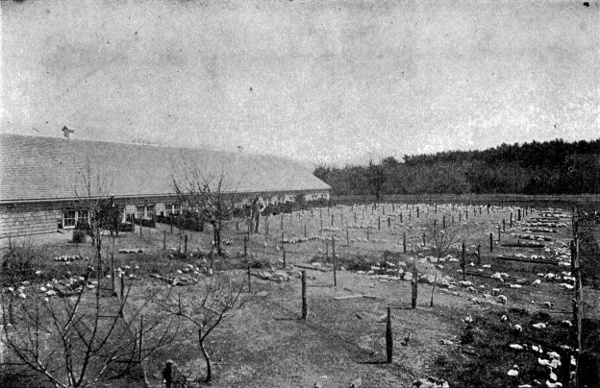
OUR DOUBLE BROODING HOUSE. (South side.)
Not only the regular feeding four times a day requires his attention, but the simple mixing of seventy-five to one hundred bushels of feed each day is quite a little job of itself, especially when the different ingredients should be exact. The water tanks also must be regularly cleaned and filled. The troughs should be carefully cleaned before feeding, as the ducks will readily eat all foreign matter together with the food. In short, the whole business must be systematized all the way through, and the attendant should understand that it is never safe to neglect a single detail.
I had always made a point of doing this duty myself. A few years ago, not feeling well and having other business requiring my attention, I engaged a man whom I considered competent to do this business for me. I took him over the yards, showed and told him just how the thing must be done; watched him to see that he did the work faithfully and complied with all its details. Things went on apparently well for a week or two, when, going home one day, I noticed a number of dead ducklings lying around, and looking under the brooder I found quite a number more. I at once interviewed the man and cautioned him. He insisted that he had followed the instructions to the letter. But the mortality did not abate, on the contrary it increased to an alarming extent; and I had lost more ducklings in one month than I had lost for ten years previous.
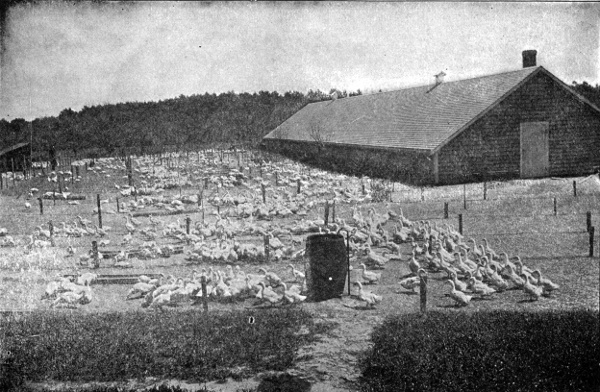
OUR DOUBLE BROODING HOUSE. (North side.)
I watched him and found that the feeding-troughs were not cleaned at all, and when the birds scattered the sawdust in them the food was thrown on that, the ducklings consuming both. The food was thrown partly in the trough and partly on the ground; apparently a matter of perfect indifference to him. The water-tanks were not rinsed out. Instead of stepping over the eighteen-inch partition wires he stepped on them, breaking down the standards and flattening down the wire, so that the birds were all mixed together promiscuously,—ducklings two weeks old with those of six weeks. The little ones were trodden down by the older ones and almost denuded of their feathers, and there was no thrift to be seen anywhere. To say that I was indignant does not express it. I had often seen such a condition of things elsewhere, but not before on my own ranch; I was absolutely ashamed to show visitors around the yards as long as this state of things existed.
That man was promptly discharged, and I undertook the feeding myself. The birds were sorted out and returned to their own yards, the wire replaced, the feeding-troughs cleaned, the pens carefully disinfected. In four days double the amount of food was consumed and things were decidedly improved. But those birds never acquired that uniformity of size and appearance which had always characterized my market birds. The best material to use in the pens inside the brooding-house is dry, fine sawdust, if it can be obtained. It is by far the best thing I know of for the purpose. The next best is finely chopped straw or hay, tanbark, etc. The brooders, like the pens, require close attention. The top should be scraped off before it becomes offensive, and new material applied. This can be easily done by simply lifting the edge of the cover next the walk and drawing it over into the walk, when it can be taken in a barrow or basket.
The Necessity of Green Food.
It must be remembered that as the broods grow older the cleaning process must be repeated oftener, as their capacity for generating filth will always be in proportion to their size. Those unacquainted with duck-culture have little idea how fast these birds will grow; how soon they will successively outgrow brooders, pens and yards, and how soon every vestige of green will disappear from yards that were thickly covered with rye. But the ducklings must be kept growing at all hazards, and a vegetable supply must be procured from outside.
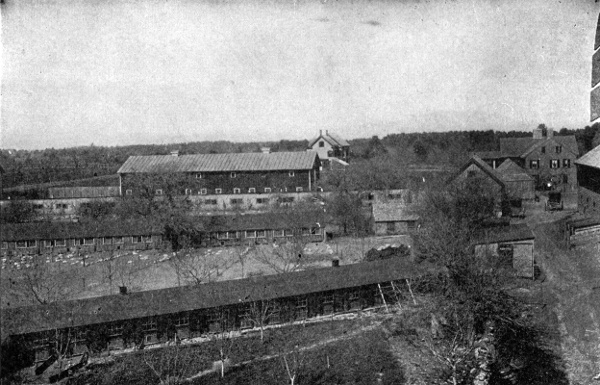
WEST SIDE OF LANE.
Rye comes first in the season (I always cultivate it for the purpose, and when coarse, it must be cut so that it can be readily eaten); then grass; and next corn fodder, which is best of all. It is astonishing how much of the latter these birds will consume—hundreds of pounds each day. It should be cut very fine, not more than one-third of an inch in length. Unlike the hen, the birds prefer the stalk to the leaf. Give them all they will eat, once each day. [But we have forgotten that empty machine. After the ducklings are taken out it will be found running at 85 to 90 degrees. I gauge it up to 102 and fill it with fresh eggs at once, not forgetting to fill one tray in the little tender.] There is one bad habit to which ducklings of four or five weeks old are addicted, and that is feather eating. First the down will begin to disappear from their backs; next, as the birds grow older, the quills which grow out from the end of the wings will disappear, and they are all exposed for tempting morsels.
These quills bleed profusely when disturbed, which, of course, seriously retards the growth and progress of the birds. This vice should be checked at once, for vice it is,—superinduced by idleness and close confinement. When the first indications of these troubles appear, the attendant should watch the birds closely for a few moments, when the aggressors can soon be detected. They should be removed at once and confined by themselves, or placed in yards with older birds already feathered out, which affords them no temptation to practice their newly acquired art.
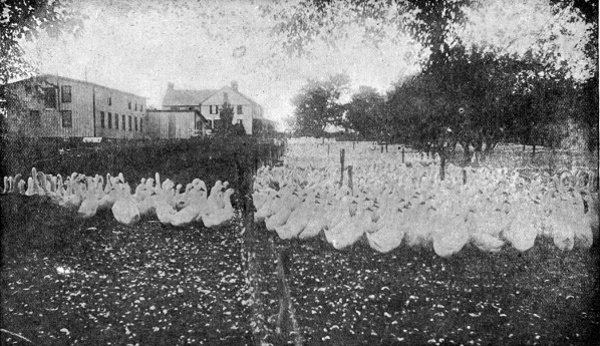
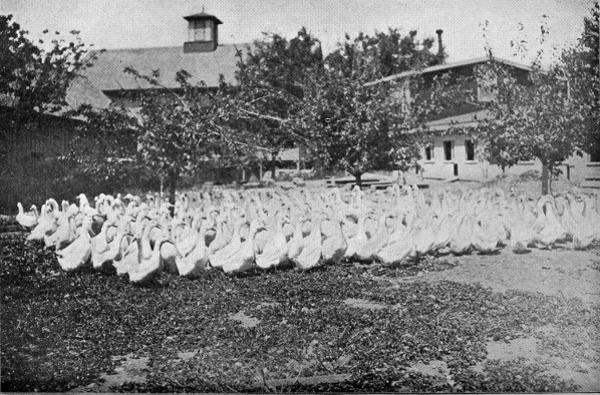
OUR TWENTY-FIVE HUNDRED BREEDING DUCKS. Kodak standing in centre of yard.
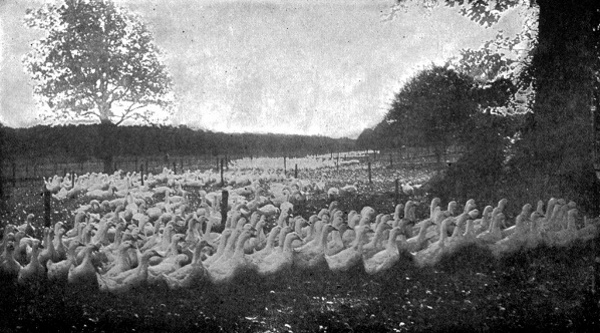
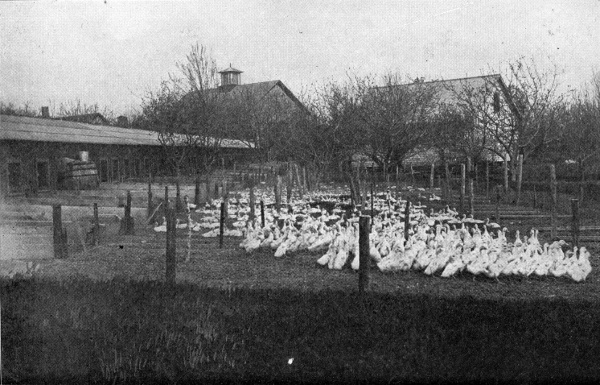
If this is not done at once the vice becomes general, and disastrous consequences are sure to follow. If it has already attained headway, before the novice detects it, he must change them to new quarters; a grassy area is best, where they usually forget all about it. This can be readily done, as the operator should always have a spare roll of eighteen-inch wire netting on hand with which he can enclose a given area in a few moments. Too much cannot be said in favor of this wire, it is so cheap, portable and convenient. It can be taken up and removed in an incredibly short time to facilitate plowing and disinfecting the yards. While it effectually separates the birds, it affords little or no impediment to the attendant during the process of watering and feeding. I fasten this wire up to short stakes driven in the ground, using small staples for the purpose. When removed it can be rolled up, stakes and all, without disturbing the staples.
It is then ready for resetting or stowing away for next season's work. This wire is now the cheapest of all fencing for poultry work,—much more so, even, than lath-fencing; and has the great advantage of being portable and far more durable than any other material. Two-inch mesh, No. 19 wire, can be had now for three-quarters cent a square foot by the single roll, and proportionately cheaper by the quantity. Never purchase No. 20 wire, as it will prove unsatisfactory in the end. It is not self-supporting and can only be kept in position by boards, both above and below. There is great difference in the quality of this wire; that made by some firms being of so soft material that it will not stand alone. The squares soon become ellipses, and your eighteen-inch wire settles to a foot. The best I have ever used is that made by the Gilbert & Bennett Manufacturing Company, Georgetown, Conn.
Previous to this our oldest ducklings will have reached the extreme end of the brooding-house, and it will be filled to its utmost capacity. In order to make room for the successive hatches I drive the older hatches out and round to my cold buildings, two in number. These buildings are each seventy-five feet long, with contiguous yards one hundred feet deep. The slides in the buildings are left open, and the ducklings are at liberty to go out or in as they see fit,—a privilege of which they avail themselves as the state of the atmosphere inclines. These yards always have a thick mat of rye growing on them. The partition wires have been set up and the young birds are quietly driven to their respective quarters.
After ducklings reach the age of six weeks, it is not necessary to confine them in buildings during the night. Indeed, they are far better not, unless it is extremely cold, or there is danger from vermin. Even severe rainstorms will not injure them. They should be watched carefully, however, as they are apt, during their antics, to fall over on their backs, when, through suction from the wet and muddy ground, they are seldom able to turn back again. Prompt assistance should be rendered, or it will surely be too late, as the back of a duckling is his most susceptible part. After the birds are six weeks old it will not be necessary to feed more than three times per day, gradually substituting meal for bran, until the birds are eight weeks old, when their food should be, at least, three-quarters meal. There should also be a steady increase of animal food after the seventh week.
Careful Watering Even More Essential Than Food.
Particular care should be taken at this time to give the birds all they need to drink, or your food will be thrown away, as they require more water during the warm weather. They will consume and waste vast quantities, and the water supply should be made as convenient as possible, to facilitate the business. Our water is forced by a windmill into a two hundred-barrel tank, and leads from there through pipes into brooding and breeding houses, into the yards and mixing room,—all with a view to saving labor and time. The water-pans in the buildings are raised six or eight inches from the ground to prevent the birds getting in or wasting the water.
At this stage, during warm, dry spells, the dried excrement of the birds will accumulate on the surface of the ground. This, as a matter of economy, as well as a sanitary necessity, should be carefully swept up before a rain, as the birds will sometimes drink water from the puddles standing around, and it will often seriously affect their appetites, as both yards and droppings are very offensive when wet. Shade is absolutely necessary at this age during warm weather, as ducklings can never be made in good condition when exposed to the sun during the extreme heat of summer. It affects their appetites at once, reducing the consumption of food by one-half. It is always well, if possible, to locate your yards so that the birds can have access to shade. If not, artificial shade must be constructed to meet the ends.
My plan is to set up four stakes, about 6x10 feet, forming a parallelogram. Sideboards should be nailed on these stakes about two feet high. These can be covered with old boards, pine boughs, bushes, or thatched over with meadow hay,—whatever is most convenient to the grower. Great care should be taken in feeding by giving all the concentrated food the birds can be made to eat, and no more, as the largest of them will be ready for market when nine weeks old. Frighten and excite the birds as little as possible while sorting them. The best way to do this is to use a wide board some ten feet long, with two holes cut in the upper side near the middle. These holes should be two feet apart, and large enough to admit the hands for convenient handling. Fifteen or twenty of the birds should be driven in a corner and confined with this board. The birds should now be taken by the neck, one at a time, the largest and choicest selected for market, the rejected ones put in a temporary yard by themselves.
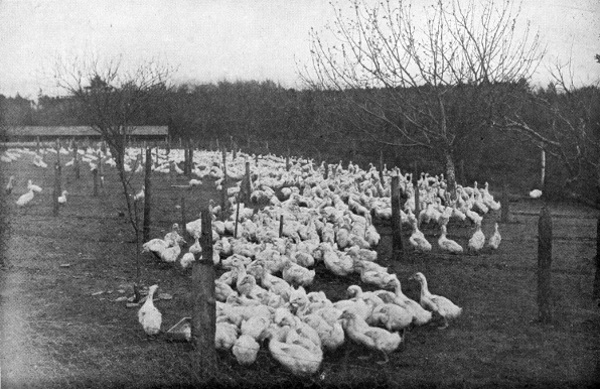
This process should be repeated until the whole hatch is sorted, when the culls can be returned to their old quarters. They will have a better chance than before, and in a few days will be as good as the others. The oldest hatches, which usually come out in February and March, are all sent to market. The price is too high to save for breeders, but from subsequent hatches, those that come out in April and May, we select our breeding stock.
How to Select Breeding Stock.
Even these birds will command a high price, but I cannot afford to wait longer. I am very particular in this selection. The birds must not only be of the largest size, but of the most perfect form. The contour of head and neck, size and shape of bill, length and width of body, all are taken into consideration. As a consequence, not more than one in ten will be found to fill the bill, and my 2,500 breeding birds will be selected from many thousands. The result of all this care and solicitude on my part has been extremely gratifying, as it has not only given me the control of the fancy market, but the birds have always commanded a higher price in the general market on account of their large size and fattening properties.
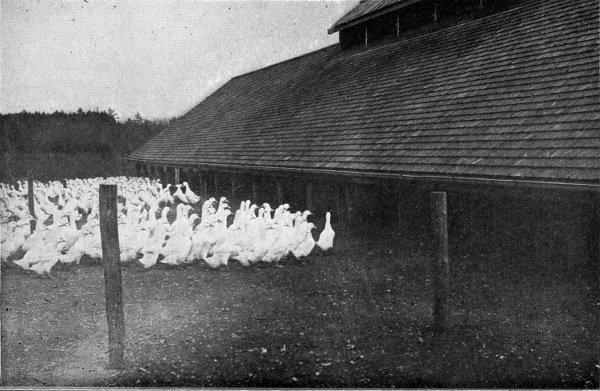
As the ducklings are now ready for market, it is necessary that the grower should make some arrangements for disposing of them. He cannot afford to sell them alive to the carts, for though this may be a great convenience to persons who grow a few fowls, the profits which enable these parties to run their collecting carts all over the country, and hire men to pick and dress their fowls, will be quite an item in the pocket of the one who grows on a large scale. The best plan for him is to hire an expert to do his picking for him, and if he cannot get one, to take lessons of one so that he can do it himself. This is a very particular business, as there is a great knack in it. Years ago I thought I knew something about picking ducks, but after watching an expert for thirty minutes I was enabled to double my day's work.
This usually has the same effect upon others. For though it may be weeks before the tyro will be able to do what would be called a fair day's work, yet if he keeps his wits about him, and is endowed with a fair share of energy, there will be constant improvement. I received a letter a short time since from a lady in Ohio, saying that she was very much interested in growing ducklings, and was satisfied that there was money in it, but that her greatest trouble was in getting them picked, as it cancelled a large share of the profits, and that she hired a woman for the purpose and paid her twenty-five cents apiece for picking; at the same time saying that she could not bear to pay the woman less, as it took her a half day to pick one duck.
Method of Dressing Ducklings.
A fair day's work for an expert is forty ducks per day, though I have had men who could pick seventy-five and do it well. The process is very simple. All that is necessary is a chair, a box 2x3 feet and 2 feet high for the feathers, a few knives, and a smart man to handle them. One knife should be double-edged and sharp-pointed, for bleeding. The bird should be held between the knees, the bill held open with the left hand, and a cut made across the roof of the mouth just below the eyes. The bird should then be stunned by striking its head against a post, or some hard substance.
The picker seats himself in the chair, with the bird in his lap, its head held firmly between one knee and the box. The sooner he gets at it the better, and if he is smart he will have the bird well plucked by the time life is extinct. The feathers should be carefully sorted while picking; the wing and tail-feathers and pins thrown away and the body feathers, with the down, thrown into the box. Care should be taken about this, as the feathers are no mean source of income, and will always pay for the picking. A dull knife should be used in connection with the thumb in removing the long pins, and, in fact, all that can be removed without tearing the skin. The down can usually be rubbed off by slightly moistening the hand and holding the skin tight. As there are often some pins which cannot be taken out without tearing and disfiguring the skin, and some down that will not rub off, they must be shaved off. A knife should be kept for the purpose. This knife should be made of the finest oil-tempered steel, and must be sharper than the best razor. The tops of the wings should be left on, and the bird picked half way down the neck. The bird should not be drawn nor the head removed. All this is in reality done in much shorter time than is required to describe it. The expert performs his duties mechanically. The feathers actually seem to stick to his fingers, and he will in seven minutes pick a duck in far better shape than a novice would in an hour. The bird on being picked, should, after the blood is washed carefully from the head, be thrown into a barrel or tank of floating ice. It will harden up so that its rotundity of outline will be preserved.
This method is far better than that practiced by some parties, who pack their birds in ice at once, where the bodies are compressed into all manner of shapes and harden up in that position, and never again can acquire that attractive appearance and rounded outline which a well-fattened duckling should present. After the birds are hardened they should be packed close in light boxes, back down, with the head under the wing, and if your market is within twelve hours ride, can be safely shipped without ice, and they will always arrive in good condition. Dealers like to have them come in this way, they look so much nicer and are far more saleable.
I have boxes for the purpose, of different sizes, holding, when closely packed, twelve, eighteen and thirty-six pairs of birds. These boxes are light, made of five-eighth inch pine, are strongly cleated at the corners and ends, and are fitted with hinged covers, fastened down with clasps and screws. I find this much the best way, as the birds always preserve their shape and arrive in good condition, while express companies return the empty boxes free, and when they "get the hang of it" soon learn to deliver promptly and handle carefully.
How to Ship Poultry.
In shipping poultry the first thing the young poulterer should do is to establish a reputation among the first-class dealers in his vicinity. This can only be done by shipping first-class stock. Never kill a bird unless it is in good condition. Pick and dress them neatly, box them carefully, and they will always command a good price and a ready sale; while equally as good stock, slovenly and carelessly thrown together, will go begging. I have often seen good stock cut several cents per pound, owing to the shipper's carelessness.
A prominent dealer in Boston said to me one day, pointing to a barrel of poultry, "The man who shipped that stuff is a fool! Look here!" He opened the barrel,—it was half full of ducks fairly well fatted and picked. But how those ducks looked. The shipper had evidently thrown those birds in head first, or any way to suit, and then had thrown a lot of ice on the top. The barrel not being very clean, he had introduced blue paper between the ducks and barrel. The ice had melted, the barrel had been capsized repeatedly during transit, and the paper had been completely disintegrated. It was stuck all over the ducks in little patches and rubbed in, while the birds had acquired a fine tint of blue that would have done credit to a laundryman.
"There," said the dealer, "I shall have to cut that man four cents per pound." If occasionally you should have poor stock always ship it by itself, and notify your dealer of its quality. He will know it soon enough without you telling him, but, at the same time, he will know that you are not trying to put a poor article on him for a good one. One or two pairs of poor birds in a box of good ones will often affect the price of the whole. Never pack a bird till after the animal heat is out. By a close observance of the above, the time will soon come when you will have no trouble in selling your stock. You will have more orders than you will be able to fill.
The past season has been a very satisfactory one to us, as we have not only largely increased our business, but the prices obtained have been better than ever before, while we have been overwhelmed with orders from dealers in New York and Boston which we have been wholly unable to fill.
But to return to the feathers. They should be taken up every day and spread out thinly on a dry floor, turned occasionally, and, in a few days, when thoroughly dry, can be thrown in a heap. Do not neglect this, for if allowed to accumulate they soon become offensive, and nothing but superheated steam will ever deordize them, and be sure that the feather firms will always take advantage of this and charge you roundly for doing it.
Disinfecting the Ground a Necessity.
When we first begin shipping for market, our yards are usually filled to their utmost capacity, and we are often crowded for room. As fast as the yards are emptied, they should be disinfected by turning them and sowing a crop of oats at once. By the time these oats are two or three inches high they can be reoccupied by young birds, so that two crops can be grown upon the same ground each season.
My plan is this: I do not heat my brooding-house artificially after the first of June, as the building will always be warm enough at that date for ducklings ten days old, without artificial heat. I locate some of my large duck-brooders a short distance apart out-of-doors, building a square pen in front of them, 8x12 feet, with boards a foot wide. Into these brooders I put the newly-hatched ducklings as they come out. They need artificial heat the first few days. Of course it would be poor policy to run the heater for the benefit of a few when it would be a decided injury to thousands.
When the ducklings no longer require heat, which will be in a very few days, I remove them at once, either to the brooding-house or to the vacated yards above mentioned, when by this time the oats will be high enough to furnish them with green food. The business is managed in this way as long as there are eggs to hatch. I use the eggs for incubating long after I cease putting them out; for, if there is but one-third fertile, it is more profitable to hatch them than to market them, as the prices on young ducklings after the middle of October usually rule some three or four cents higher per pound than during August and September.
During the spring and summer months, when things are under full headway, there is naturally great care and responsibility. It will not do to make too many mistakes or neglect necessary duties. The young birds must be fed regularly and given the differently prepared foods according to age,—water supplied, grass and corn fodder cut and distributed according to need. Lamps to trim and replenish, eight thousand eggs to turn twice each day; a new hatch of ducklings coming off nearly every day; the machine to be filled with nicely washed eggs; one to two thousand pounds of ducklings dressed and packed for market daily; cleaning and disinfecting yards; entertaining visitors, who flock here by dozens,—furnish all the occupation we need. Indeed, were it not for the immense profits attending the business, we might consider it rather more than we ought to do.
I disinfect my duck yards with rye about Sept. 1. When, in this climate, frost has destroyed all green vegetable life, then rye is in its prime. If sowed September 1, in duck yards, it will attain a height of eighteen inches, and if sowed thickly will crop many tons to the acre. When corn-fodder is gone, we use green clover, then turnip, cabbage and green rye in turn and then just before a snow storm we cut a large quantity of the frozen rye and pile it up in the shade, where, of course, it will neither heat or thaw. Should we get out before the snow is gone, we always have surplus of clover-rowen cured for the purpose.
This, together with refuse cabbage and boiled turnips, small potatoes, etc., makes a fine winter diet on which breeding ducks will always thrive if the other ingredients are properly mixed,—a diet upon which, combined with housing and plenty of exercise, the birds are bound to contribute a good quota of strong fertile eggs. I mention this particularly here, because the mortality among young birds will depend largely upon the strength and vitality of the eggs from which they come.
Natural Duck-Culture.
Doubtless some of my readers are getting impatient and saying to themselves, "Why do you not give us some ideas how to do this business in the natural way? Many of us wish to begin small. Every one has not the conveniences to use or the means to command incubators." I am coming to that. I have a vivid recollection of using hens to incubate with some twenty years ago; and the persistent obstinacy of the perverse birds, the large proportion of valuable eggs spoiled and broken, as well as the time consumed in caring for them, are still fresh in my memory. It was wholesome discipline for me. It will be the same to the reader, and enable him to appreciate a good incubator later on.
A good, quiet hen, who attends closely to her business, will always hatch as large a proportion of her eggs as a good incubator; but there are so many with dispositions quite the opposite of this that it leaves the odds largely in favor of the machine. Success with hens depends quite as much with the operator as with machines. He must begin right and hold out to the end. As ducks seldom make good incubators, he will have to rely upon hens to do that business for him. The best breeds for that purpose I have found to be the Brahma or Plymouth Rock. A cross of these birds makes a good quiet sitter.
The birds must be got out early so that they will begin laying in the fall and be ready to incubate by the time you want them. It is well to have a room for the purpose and have the sitters by themselves. The nests should be in rows around the room, the feeding and water-troughs in the centre, with the dust-bath at one end. The nest boxes should be some fourteen inches square and about a foot high. Each one should be furnished with a slide so that the bird can be confined when necessary. If the slide is planed, all the better, as the date of the sitter can then be marked on it. The first thing is to prepare the nests. There is quite a knack in this; indeed, success largely depends upon this one thing.
The best material for this is soft hay or straw, cut six or eight inches long, placed upon a soil bottom. The sides of this nest should be packed hard, the bottom smooth and slightly concaved, not too much, as the tendency then would be to break the eggs if they crowded towards the centre. There should be plenty of room in the nest for the bird's feet and legs and the eggs too, so that she can turn at will without danger of breaking them. A piece of tarred paper five or six inches square, should be placed on the soil in the bottom of the nest; the whole covered with a half inch of finely cut straw. A few porcelain eggs should be placed in the nest, and when a hen shows a strong desire to incubate she should be placed upon the nest and the slide closed, giving the bird all the air she needs.
This removal should be made after dark as the birds are always more gentle then. It is well to set a number of hens at once, if they can be had, for reasons that will shortly appear. If the birds take kindly to the porcelain eggs they can be removed the next evening and replaced with ducks' eggs. As they are much larger than hen's eggs, nine or ten will be enough in cold weather and eleven or twelve in warm; proportioned, of course, something to the size of the bird. I always take the birds from their nests at a certain time every day; they will learn to expect it. This should be done during the warmest part of the day.
Handle Your Hens Carefully.
Now is the time to exercise caution. Take your birds off carefully several at a time. If one should fly in your face, break her eggs and spatter the contents over your person, and you should feel like wringing her neck, don't do it; you would only be so much out. Take things easy, don't get mad; she may do better next time, if not, replace her with one that will. When taking your birds off in cold weather cover the eggs at once with a circular piece of heavy paper previously prepared, and they will not cool perceptibly during the fifteen minutes the birds are off. Be sure and return each bird to her own nest, for if you have an uneasy sitter, though she may spoil her own eggs, she should have no opportunity to spoil those of others.
Besides, if you do not, hens that have been sitting but a day or two may be placed upon eggs just ready to hatch when she will not take kindly to the young birds as they hatch, and a great mortality is sure to follow. If you should be running 100 sitters, the more you can take off at a time the sooner you will get through. Have a sponge and warm water handy as you will have more or less broken eggs. The rest should be washed clean at once and returned to the nest. When hatching out be sure and remove the little ducklings, as fast as they come out, to a warm place to dry off, as owing to their long necks and peculiar shape the mother hen will unconsciously crush many more of them than she would of chicks. In fact, they should never see the hen after being taken away, as they can be grown to much better advantage, and with far less mortality, in brooders.
And just here is the great economy of setting six or eight hens at the same time; the young ducklings can be all put together in one brooder and cared for with less trouble and with less mortality than that resulting from one hen with her brood. The ducklings should be confined in yards, the same care and feed given them as already recommended for artificially hatched birds. Allusion has already been made to the proverbial timidity of the Pekin duck. This sometimes causes trouble to the grower when the birds are confined together in large numbers. When six or eight weeks old, and even after they are full grown, they often get frightened, or gallied as it were, in dark nights. Being unable to see, one bird will touch another, he will spring away and come in contact with several more.
In an instant the whole are in the most violent commotion, whirling and treading each other down. It will be a perfect stampede and will sometimes be kept up the entire night. After a night of such dissipation many of the birds will appear completely jaded out, and some of them unable to rise. Of course, this must be stopped at once or the grower may bid farewell to all fattening or laying on the part of the birds. Hanging lanterns in the yards at stated distances will usually restore order. It will not be needed when there is a moon. See that there are no sharp projections in either yards or breeding-pens, as both old and young birds are often lamed for life by simply coming in contact with them in the night.
Too much care cannot be exercised on this point, as the bones of the birds are so small and their bodies so frail. As has been intimated before, ducks are not subject to so many diseases as hens,—while they are entirely free from lice or body parasites of any kind. Indeed, I never saw a louse on a duck in all my experience. Still, it cannot be denied that good sanitary conditions, together with plenty of pure air and water, will not only greatly increase the egg-production, but facilitate the growth and improve the properties of the duckling.
Ducklings when confined to yards are sometimes troubled with sore eyes. The adjacent parts become inflamed, the head slightly swelled. This is caused by feeding sloppy food, and from filthy quarters. The feathers around the eyes become filled with the food, the dust adheres to them. The eye is naturally inflamed. Washing out thoroughly and bathing the eye with a little sweet oil will usually effect a cure.
Diarrhœa.
Young ducklings are sometimes afflicted with diarrhoea. This disease is caused more by overheating brooders and the exhausted condition of the mother bird than from improper food. Do not overfeed or overheat the ducklings. Feed bread or cracker crumbs, moistened with boiled milk, into which a little powdered chalk has been dusted.
Abnormal Livers.
This disease is the most dangerous to which young ducks are subject. It is seldom prevalent except during the warm weather, and usually in young birds of from two to six weeks of age. The livers of the young birds enlarge to such an extent as to force up their backs,—a deformity which will cling to them through life. It is caused by a complete stagnation of the digestive organs, and often makes its appearance after a heavy rain, or long wet spell, when the yards are invariably wet, sloppy and offensive. The young birds will, while in constant contact with this mud, absorb more or less of it, clogging the digestive organs, and deranging their appetites. Remove the birds to some dry, shady place, feed sparingly, and give a little of the "Douglas mixture" in the drinking water.
Ducklings must be Carefully Yarded While Young.
A great mortality often occurs to young ducklings when allowed free range during warm weather, from devouring injurious insects. Bees, wasps, hornets, bugs of all descriptions, are eagerly swallowed alive but not always with impunity, and the birds often pay the penalty with their lives. Always confine them, even when designed for breeding purposes, until they are six weeks old, when they can be allowed their liberty.
The most of the diseases to which ducks and fowls are subject can usually be traced to some infraction of conditions, and of course are always more or less under the control of the careful operator. Two young men called here a short time ago wishing to know what was the trouble with their fowls. Hitherto they had occupied a cold building, so open that the snow sifted through on them, and they had never to their recollection had a diseased fowl. Within a year they had put up a nice, warm building with a glass front, and their fowls had been diseased ever since. They had shut their birds in a building that would run up to 100 degrees during the day and that would go down nearly to zero at night, subjecting their fowls to thermal changes, under which neither animal or vegetable life could possibly live, and then expect them to thrive.
The amateur poulterer should understand in the beginning that it is far easier to anticipate disease in poultry than to cure it. Where fowls are kept in large numbers, their health and well-being can only be insured by extreme care and cleanliness, together with a free use of disinfectants. Buildings should be kept dry, clean and sweet, and not too warm. The greater the variety of food the better, so long as it is healthy and nutritious; while gravel, sand, shell and granulated charcoal should be kept by them during confinement in winter.