Chapter IX
Reading edition
Rio Plata—Flocks of butterflies—Beetles alive in the sea—Aeronaut spiders—Pelagic animals—Phosphorescence of sea—Port Desire—Spanish settlements—Zoology—Guanaco—Excursion to head of harbour—Indian grave—Port St. Julian—Geology of Patagonia, successive terraces, transport of pebbles—Fossil gigantic llama—Types of organization constant—Change in zoology of America—Causes of extinction.
PATAGONIA.
December 6th, 1833.—The Beagle sailed from the Rio Plata, never again to enter its muddy stream. Our course was directed to Port Desire, on the coast of Patagonia. Before proceeding any further, I will here put together a few observations made at sea.
Several times when the ship has been some miles off the mouth of the Plata, and at other times when off the shores of Northern Patagonia, we have been surrounded by insects. One evening, when we were about ten miles from the Bay of San Blas, vast numbers of butterflies, in bands or flocks of countless myriads, extended as far as the eye could range. Even by the aid of a glass it was not possible to see a space free from butterflies. The seamen cried out “it was snowing butterflies,” and such in fact was the appearance. More species than one were present, but the main part belonged to a kind very similar to, but not identical with, the common English Colias edusa.[1] Some moths and hymenoptera accompanied the butterflies; and a fine Calosoma flew on board. Other instances are known of this beetle having been caught far out at sea; and this is the more remarkable, as the greater number of the Carabidæ seldom or never take wing. The day had been fine and calm, and the one previous to it equally so, with light and variable airs. Hence we cannot suppose that the insects were blown off the land, but we must conclude that they voluntarily took flight. The great bands of the Colias seem at first to afford an instance like those on record of the migrations of Vanessa cardui;[2] but the presence of other insects makes the case distinct, and not so easily intelligible. Before sunset, a strong breeze sprung up from the north, and this must have been the cause of tens of thousands of the butterflies and other insects having perished.
On another occasion, when seventeen miles off Cape Corrientes, I had a net overboard to catch pelagic animals. Upon drawing it up, to my surprise I found a considerable number of beetles in it, and although in the open sea, they did not appear much injured by the salt water. I lost some of the specimens, but those which I preserved, belonged to the genera, colymbetes, hydroporus, hydrobius (two species), notaphus, cynucus, adimonia, and scarabæus. At first, I thought that these insects had been blown from the shore; but upon reflecting that out of the eight species, four were aquatic, and two others partly so in their habits, it appeared to me most probable that they were floated into the sea, by a small stream which drains a lake near Cape Corrientes. On any supposition, it is an interesting circumstance to find insects, quite alive, swimming in the open ocean, seventeen miles from the nearest point of land. There are several accounts of insects having been blown off the Patagonian shore. Captain Cook observed it, as did more lately Captain King in the Adventure. The cause probably is due to the want of shelter, both of trees and hills, so that an insect on the wing with an off-shore breeze, would be very apt to be blown out to sea. The most remarkable instance I ever knew of an insect being caught far from the land, was that of a large grasshopper (Acrydium), which flew on board, when the Beagle was to windward of the Cape de Verd Islands, and when the nearest point of land, not directly opposed to the trade-wind, was Cape Blanco on the coast of Africa, 370 miles distant.[3]
On several occasions, when the vessel has been within the mouth of the Plata, the rigging has been coated with the web of the Gossamer Spider. One day (November 1st, 1832) I paid particular attention to the phenomenon. The weather had been fine and clear, and in the morning the air was full of patches of the flocculent web, as on an autumnal day in England. The ship was sixty miles distant from the land, in the direction of a steady though light breeze. Vast numbers of a small spider, about one-tenth of an inch in length, and of a dusky red colour were attached to the webs. There must have been, I should suppose, some thousands on the ship. The little spider when first coming in contact with the rigging, was always seated on a single thread, and not on the flocculent mass. This latter seems merely to be produced by the entanglement of the single threads. The spiders were all of one species, but of both sexes, together with young ones. These latter were distinguished by their smaller size, and more dusky colour. I will not give the description of this spider, but merely state that it does not appear to me to be included in any of Latreille’s genera. The little aeronaut as soon as it arrived on board, was very active, running about; sometimes letting itself fall, and then reascending the same thread; sometimes employing itself in making a small and very irregular mesh in the corners between the ropes. It could run with facility on the surface of water. When disturbed it lifted up its front legs, in the attitude of attention. On its first arrival it appeared very thirsty, and with exserted maxillæ drank eagerly of the fluid; this same circumstance has been observed by Strack: may it not be in consequence of the little insect having passed through a dry and rarefied atmosphere? Its stock of web seemed inexhaustible. While watching some that were suspended by a single thread, I several times observed that the slightest breath of air bore them away out of sight, in a horizontal line. On another occasion (25th) under similar circumstances, I repeatedly observed the same kind of small spider, either when placed, or having crawled, on some little eminence, elevate its abdomen, send forth a thread, and then sail away in a lateral course, but with a rapidity which was quite unaccountable. I thought I could perceive that the spider before performing the above preparatory steps, connected its legs together with the most delicate threads, but I am not sure, whether this observation is correct.
One day, at St. Fe, I had a better opportunity of observing some similar facts. A spider which was about three-tenths of an inch in length, and which in its general appearance resembled a Citigrade (therefore quite different from the gossamer), while standing on the summit of a post, darted forth four or five threads from its spinners. These glittering in the sunshine, might be compared to rays of light; they were not, however, straight, but in undulations like a film of silk blown by the wind. They were more than a yard in length, and diverged in an ascending direction from the orifices. The spider then suddenly let go its hold, and was quickly borne out of sight. The day was hot and apparently quite calm; yet under such circumstances the atmosphere can never be so tranquil, as not to affect a vane so delicate as the thread of a spider’s web. If during a warm day we look either at the shadow of any object cast on a bank, or over a level plain at a distant landmark, the effect of an ascending current of heated air will almost always be evident. And this probably would be sufficient to carry with it so light an object as the little spider on its thread. The circumstance of spiders of the same species but of different sexes and ages, being found on several occasions at the distance of many leagues from the land, attached in vast numbers to the lines, proves that they are the manufacturers of the mesh, and that the habit of sailing through the air, is probably as characteristic of some tribe, as that of diving is of the Argyroneta. We may then reject Latreille’s supposition, that the gossamer owes its origin to the webs of the young of several genera, as Epeira or Thomisa: although, as we have seen that the young of other spiders do possess the power of performing aerial voyages.[4]
During our different passages south of the Plata, I often towed astern a net made of bunting, and thus caught many curious animals. The structure of the Beroe (a kind of jelly fish) is most extraordinary, with its rows of vibratory ciliæ, and complicated though irregular system of circulation. Of Crustacea, there were many strange and undescribed genera. One, which in some respects is allied to the Notopods (or those crabs which have their posterior legs placed almost on their backs, for the purpose of adhering to the under side of ledges), is very remarkable from the structure of its hind pair of legs. The penultimate joint, instead of being terminated by a simple claw, ends in three bristle-like appendages of dissimilar lengths,—the longest equalling that of the entire leg. These claws are very thin, and are serrated with teeth of an excessive fineness, which are directed towards the base. The curved extremities are flattened, and on this part five most minute cups are placed, which seem to act in the same manner as the suckers on the arms of the cuttle-fish. As the animal lives in the open sea, and probably wants a place of rest, I suppose this beautiful structure is adapted to take hold of the globular bodies of the Medusæ, and other floating marine animals.
In deep water, far from the land, the number of living creatures is extremely small: south of the latitude 35°, I never succeeded in catching any thing besides some beroe, and a few species of minute crustacea belonging to the Entomostraca. In shoaler water, at the distance of a few miles from the coast, very many kinds of crustacea and some other animals were numerous, but only during the night. Between latitudes 56° and 57° south of Cape Horn the net was put astern several times; it never, however, brought up any thing besides a few of two extremely minute species of Entomostraca. Yet whales and seals, petrels and albatross, are exceedingly abundant throughout this part of the ocean. It has always been a source of mystery to me, on what the latter, which live far from the shore, can subsist. I presume the albatross, like the condor, is able to fast long; and that one good feast on the carcass of a putrid whale lasts for a long siege of hunger. It does not lessen the difficulty to say, they feed on fish; for on what can the fish feed? It often occurred to me, when observing how the waters of the central and intertropical parts of the Atlantic,[5] swarmed with Pteropoda, Crustacea, and Radiata, and with their devourers the flying-fish, and again with their devourers the bonitos and albicores, that the lowest of these pelagic animals perhaps possess the power of decomposing carbonic acid gas, like the members of the vegetable kingdom.
While sailing in these latitudes on one very dark night, the sea presented a wonderful and most beautiful spectacle. There was a fresh breeze, and every part of the surface, which during the day is seen as foam, now glowed with a pale light. The vessel drove before her bows two billows of liquid phosphorus, and in her wake she was followed by a milky train. As far as the eye reached, the crest of every wave was bright, and the sky above the horizon, from the reflected glare of these livid flames, was not so utterly obscure, as over the rest of the heavens.
As we proceed further southward, the sea is seldom phosphorescent; and off Cape Horn, I do not recollect more than once having seen it so, and then it was far from being brilliant. This circumstance probably has a close connexion with the scarcity of organic beings in that part of the ocean. After the elaborate paper[6] by Ehrenberg, on the phosphorescence of the sea, it is almost superfluous on my part to make any observations on the subject. I may however add, that the same torn and irregular particles of gelatinous matter, described by Ehrenberg, seem in the southern as well as in the northern hemisphere, to be the common cause of this phenomenon. The particles were so minute as easily to pass through fine gauze; yet many were distinctly visible by the naked eye. The water when placed in a tumbler and agitated gave out sparks, but a small portion in a watch-glass, scarcely ever was luminous. Ehrenberg states, that these particles all retain a certain degree of irritability. My observations, some of which were made directly after taking up the water, would give a different result. I may also mention, that having used the net during one night I allowed it to become partially dry, and having occasion twelve hours afterwards, to employ it again, I found the whole surface sparkled as brightly as when first taken out of the water. It does not appear probable in this case, that the particles could have remained so long alive. I remark also in my notes, that having kept a Medusa of the genus Dianæa, till it was dead, the water in which it was placed became luminous. When the waves scintillate with bright green sparks, I believe it is generally owing to minute crustacea. But there can be no doubt that very many other pelagic animals, when alive, are phosphorescent.
On two occasions I have observed the sea luminous at considerable depths beneath the surface. Near the mouth of the Plata some circular and oval patches, from two to four yards in diameter, and with defined outlines, shone with a steady, but pale light; while the surrounding water only gave out a few sparks. The appearance resembled the reflection of the moon, or some luminous body; for the edges were sinuous from the undulation of the surface. The ship, which drew thirteen feet water, passed over, without disturbing, these patches. Therefore we must suppose that some animals were congregated together at a greater depth than the bottom of the vessel.
Near Fernando Noronha the sea gave out light in flashes. The appearance was very similar to that which might be expected from a large fish moving rapidly through a luminous fluid. To this cause the sailors attributed it; at the time, however, I entertained some doubts, on account of the frequency and rapidity of the flashes. With respect to any general observations, I have already stated that the display is very much more common in warm than in cold countries. I have sometimes imagined that a disturbed electrical condition of the atmosphere was most favourable to its production. Certainly I think the sea is most luminous after a few days of more calm weather than ordinary, during which time it has swarmed with various animals. Observing that the water charged with gelatinous particles is in an impure state, and that the luminous appearance in all common cases is produced by the agitation of the fluid in contact with the atmosphere, I have always been inclined to consider that the phosphorescence was the result of the decomposition of the organic particles, by which process (one is tempted almost to call it a kind of respiration) the ocean becomes purified.
December 23d.—We arrived at Port Desire, situated in lat. 47°, on the coast of Patagonia. The creek runs for about twenty miles inland, with an irregular width. The Beagle anchored a few miles within the entrance in front of the ruins of an old Spanish settlement.
The same evening I went on shore. The first landing in any new country is very interesting, and especially when, as in this case, the whole aspect bears the stamp of a marked and individual character. At the height of between two and three hundred feet, above some masses of porphyry, a wide plain extends, which is truly characteristic of Patagonia. The surface is quite level, and is composed of well-rounded shingle mixed with a whitish earth. Here and there scattered tufts of brown wiry grass are supported, and still more rarely some low thorny bushes. The weather is dry and pleasant, for the fine blue sky is but seldom obscured. When standing in the middle of one of these desert plains, the view on one side is generally bounded by the escarpment of another plain, rather higher, but equally level and desolate; and on the other side it becomes indistinct from the trembling mirage which seems to rise from the heated surface.
The plains are traversed by many broad, flat-bottomed valleys, and in these the bushes grow rather more abundantly. The present drainage of the country is quite insufficient to excavate such large channels. In some of the valleys ancient stunted trees, growing in the very centre of the dry watercourse, seem as if placed to prove how long a time had elapsed, since any flood had passed that way. We have evidence, from shells lying on the surface, that the plains of gravel have been elevated within a recent epoch above the level of the sea; and we must look to that period for the excavation of the valleys by the slowly-retiring waters. From the dryness of the climate, a man may walk for days together over these plains without finding a single drop of water. Even at the base of the porphyry hills, there are only a few small wells containing but little water, and that rather saline and half putrid.
In such a country the fate of the Spanish settlement was soon decided; the dryness of the climate during the greater part of the year, and the occasional hostile attacks of the wandering Indians, compelled the colonists to desert their half-finished buildings. The style, however, in which they were commenced, showed the strong and liberal hand of Spain in the old time. The end of all the attempts to colonize this side of America south of 41°, have been miserable. At Port Famine, the name expresses the lingering and extreme sufferings of several hundred wretched people, of whom one alone survived to relate their misfortunes. At St. Joseph’s bay, on the coast of Patagonia, a small settlement was made; but during one Sunday the Indians made an attack and massacred the whole party, excepting two men, who were led captive many years among the wandering tribes. At the Rio Negro I conversed with one of these men, now in extreme old age.
The zoology of Patagonia is as limited as its Flora.[7] On the arid plains a few black beetles (Heteromera) might be seen slowly crawling about, and occasionally a lizard darting from side to side. Of birds we have three carrion hawks, and in the valleys a few finches and insect feeders. The Ibis malanops (a species said to be found in central Africa) is not uncommon on the most desert parts. In the stomachs of these birds I found grasshoppers, cicadæ, small lizards, and even scorpions.[8] At one time of the year they go in flocks, at another in pairs: their cry is very loud and singular, and resembles the neighing of the guanaco.
I will here give an account of this latter animal, which is very common, and is the characteristic quadruped of the plains of Patagonia. The Guanaco, which by some naturalists is considered as the same animal with the Llama, but in its wild state, is the South American representative of the camel of the East. In size it may be compared to an ass, mounted on taller legs, and with a very long neck. The guanaco abounds over the whole of the temperate parts of South America, from the wooded islands of Tierra del Fuego, through Patagonia, the hilly parts of La Plata, Chile, even to the Cordillera of Peru. Although preferring an elevated site, it yields in this respect to its near relative the Vicuna. On the plains of Southern Patagonia, we saw them in greater numbers than in any other part. Generally they go in small herds, from half a dozen to thirty together; but on the banks of the St Cruz we saw one herd which must have contained at least five hundred. On the northern shores of the Strait of Magellan they are also very numerous.
Generally the guanacoes are wild and extremely wary. Mr. Stokes told me, that he one day saw through a glass a herd of these beasts, which evidently had been frightened, running away at full speed, although their distance was so great that they could not be distinguished by the naked eye. The sportsman frequently receives the first intimation of their presence, by hearing, from a long distance, the peculiar shrill neighing note of alarm. If he then looks attentively, he will perhaps see the herd standing in a line on the side of some distant hill. On approaching them, a few more squeals are given, and then off they set at an apparently slow, but really quick canter, along some narrow beaten track to a neighbouring hill. If, however, by chance he should abruptly meet a single animal, or several together, they will generally stand motionless, and intently gaze at him; then perhaps move on a few yards, turn round, and look again. What is the cause of this difference in their shiness? Do they mistake a man in the distance for their chief enemy the puma? Or does curiosity overcome their timidity? That they are curious is certain; for if a person lies on the ground, and plays strange antics, such as throwing up his feet in the air, they will almost always approach by degrees to reconnoitre him. It was an artifice that was repeatedly practised by our sportsmen with success, and it had moreover the advantage of allowing several shots to be fired, which were all taken as parts of the performance. On the mountains of Tierra del Fuego, and in other places, I have more than once seen a guanaco, on being approached, not only neigh and squeal, but prance and leap about in the most ridiculous manner, apparently in defiance as a challenge. These animals are very easily domesticated, and I have seen some thus kept near the houses, although at large on their native plains. They are in this state very bold, and readily attack a man, by striking him from behind with both knees. It is asserted, that the motive for these attacks is jealousy on account of their females. The wild guanacoes, however, have no idea of defence; even a single dog will secure one of these large animals, till the huntsman can come up. In many of their habits they are like sheep in a flock. Thus when they see men approaching in several directions on horseback, they soon became bewildered, and know not which way to run. This greatly facilitates the Indian method of hunting, for they are thus easily driven to a central point, and are encompassed.
The guanacoes readily take to the water: several times at Port Valdes they were seen swimming from island to island. Byron, in his voyage, says he saw them drinking salt water. Some of our officers likewise saw a herd apparently drinking the briny fluid from a salina near Cape Blanco. I imagine in several parts of the country, if they do not drink salt water, they drink none at all. In the middle of the day, they frequently roll in the dust, in saucer-shaped hollows. The males fight together; two one day passed quite close to me, squealing and trying to bite each other; and several were shot with their hides deeply scored. Herds sometimes appear to set out on exploring-parties: at Bahia Blanca, where, within thirty miles of the coast, these animals are extremely unfrequent, I one day saw the tracks of thirty or forty, which had come in a direct line to a muddy salt-water creek. They then must have perceived that they were approaching the sea, for they had wheeled with the regularity of cavalry, and had returned back in as straight a line as they had advanced. The guanacoes have one singular habit, which is to me quite inexplicable; namely, that on successive days they drop their dung in the same defined heap. I saw one of these heaps which was eight feet in diameter, and necessarily was composed of a large quantity. Frezier remarks on this habit as common to the guanaco as well as to the llama;[9] he says it is very useful to the Indians, who use the dung for fuel, and are thus saved the trouble of collecting it.
The guanacoes appear to have favourite spots for dying in. On the banks of the St. Cruz, the ground was actually white with bones, in certain circumscribed spaces, which were generally bushy and all near the river. On one such spot I counted between ten and twenty heads. I particularly examined the bones; they did not appear, as some scattered ones which I had seen, gnawed or broken, as if dragged together by beasts of prey. The animals in most cases, must have crawled, before dying, beneath and amongst the bushes. Mr. Bynoe informs me that during the last voyage, he observed the same circumstance on the banks of the Rio Gallegos. I do not at all understand the reason of this, but I may observe, that the wounded guanacoes at the St. Cruz, invariably walked towards the river. At St. Jago in the Cape de Verd islands I remember having seen in a retired ravine a corner under a cliff, where numerous goats’ bones were collected: we at the time exclaimed, that it was the burial-ground of all the goats in the island. I mention these trifling circumstances, because in certain cases they might explain the occurrence of a number of uninjured bones in a cave, or buried under alluvial accumulations; and likewise the cause, why certain mammalia are more commonly embedded than others in sedimentary deposits. Any great flood of the St. Cruz., would wash down many bones of the guanaco, but probably not a single one of the puma, ostrich, or fox. I may also observe, that almost every kind of waterfowl when wounded takes to the shore to die; so that the remains of birds, from this cause alone and independently of other reasons, would but rarely be preserved in a fossil state.
One day the yawl was sent under the command of Mr. Chaffers with three days’ provisions to survey the upper part of the harbour. In the morning we searched for some watering-places, mentioned in an old Spanish chart. We found one creek, at the head of which there was a trickling rill (the first we had seen) of brackish water. Here the tide compelled us to wait several hours; and in the interval I walked some miles into the interior. The plain as usual, consisted of gravel, mingled with soil resembling chalk in appearance, but very different from it in nature. From the softness of these materials it was worn into many gullies. There was not a tree, and excepting the guanaco, which stood on the hill-top a watchful sentinel over its herd, scarcely an animal or a bird. All was stillness and desolation. One reflected how many ages the plain had thus lasted, and how many more it was doomed thus to continue. Yet in passing over these scenes, without one bright object near, an ill-defined but strong sense of pleasure is vividly excited.
In the evening we sailed a few miles further up, and then pitched the tents for the night. By the middle of the next day, the yawl was aground, and from the shoalness of the water could not proceed any higher. The water being found partly fresh Mr. Chaffers took the dingey, and went up two or three miles further, where she also grounded, but in a fresh-water river. The water was muddy, and though the stream was most insignificant in size, it would be difficult to account for its source, except from the melting snow on the Cordillera. At the spot where we bivouacked, we were surrounded by bold cliffs and steep pinnacles of porphyry. I do not think I ever saw a spot, which appeared more secluded from the rest of the world, than this rocky crevice in the wide plain.
The second day after our return to the anchorage, a party of officers and myself went to ransack an old Indian grave, which I had found on the summit of a neighbouring hill. Two immense stones, each probably weighing at least a couple of tons, had been placed in front of a ledge of rock, about six feet high. At the bottom of the grave on the hard rock, there was a layer of earth about a foot deep, which must have been brought up from the plain below. Above it a pavement of flat stones was placed, on which others were piled, so as to fill up the space between the ledge and the two great blocks. To complete the grave, the Indians had contrived to detach from the same ledge a huge fragment, and to throw it over the pile so as to rest on the two blocks. We undermined the grave on both sides, but could not find any relics, or even bones. The latter probably had decayed long since (in which case the grave must have been of extreme antiquity), for I found in another place some smaller heaps, beneath which a very few crumbling fragments could yet be distinguished, as having belonged to a man. Falconer states, that where an Indian dies he is buried, but that subsequently his bones are carefully taken up and carried, let the distance be ever so great, to be deposited near the sea-coast. This custom, I think, may be accounted for, by recollecting that before the introduction of horses, these Indians must have led nearly the same life as the Fuegians, and therefore generally resided in the neighbourhood of the sea. The common prejudice of lying where one’s ancestors have lain, would make the now roaming Indians bring the less perishable part of their dead to their ancient burial-grounds.
January 9th, 1834.—Before it was dark the Beagle anchored in the fine spacious harbour of Port St. Julian, situated about one hundred and ten miles to the south of Port Desire. We remained here eight days. The country is nearly similar to that of Port Desire, but, perhaps, rather more sterile. One day a party accompanied Captain FitzRoy on a long walk round the head of the harbour. We were eleven hours without tasting any water, and some of the party were quite exhausted. From the summit of a hill (since well named Thirsty Hill) a fine lake was spied, and two of the party proceeded with concerted signals to show whether it was fresh water. What was our disappointment to find a snow-white expanse of salt, crystallized in great cubes! We attributed our extreme thirst to the dryness of the atmosphere; but whatever the cause might be, we were exceedingly glad late in the evening to get back to the boats. Although we could nowhere find, during our whole visit, a single drop of fresh water, yet some must exist; for by an odd chance I found on the surface of the salt water, near the head of the bay, a Colymbetes not quite dead, which in all probability had lived in some not far distant pool. Three other kinds of insects,—a Cincindela, like hybrida, Cymindis, and a Harpalus, which all live on muddy flats occasionally overflowed by the sea, and one other beetle found dead on the plain,—completes the list of coleoptera. A good-sized fly (Tabanus) was extremely numerous, and tormented us by its painful bite. The common horsefly, which is so troublesome in the shady lanes of England, belongs to this genus. We here have the puzzle, that so frequently occurs in the case of musquitoes; on the blood of what animals do these insects commonly feed? The guanaco is nearly the only warmblooded quadruped, and they are present in numbers quite inconsiderable, compared to the multitude of flies.
The foundation of porphyry is not here present, as it was at Port Desire, and in consequence the tertiary deposits are arranged with greater regularity. Five successive plains of different altitudes are very distinct. The lower one is a mere fringe nearly on a level with the sea, but the upper one is elevated 950 feet. This latter is represented in this neighbourhood only by a few truncate conical hills, of exactly the same height. It was very interesting to stand on one of these flat patches of gravel, and viewing the wide surrounding country, to speculate on the enormous quantity of matter which must have been removed, thus to leave these mere points, as measures of the former table-land.
I will now give a brief sketch of the geology of the grand tertiary formation of Patagonia, which extends from the Strait of Magellan to the Bay of S. Antonio. In Europe, deposits of the more recent eras have generally been accumulated in small basins or trough-shaped hollows. In South America, however, the entire plains of Patagonia extending seven hundred miles in length, and backed on the one hand by the chain of the Andes, and fronted on the other by the shores of the Atlantic, are thus constituted. Moreover the northern boundary is merely assumed in consequence of a mineralogical change in the strata: if organic remains were present, it probably would be found to be only an artificial limit. Again to the northward (1300 miles distant from the Strait of Magellan) we have the Pampas deposit, which though very different in composition, belongs to the same epoch with the superficial covering of the plains of Patagonia.
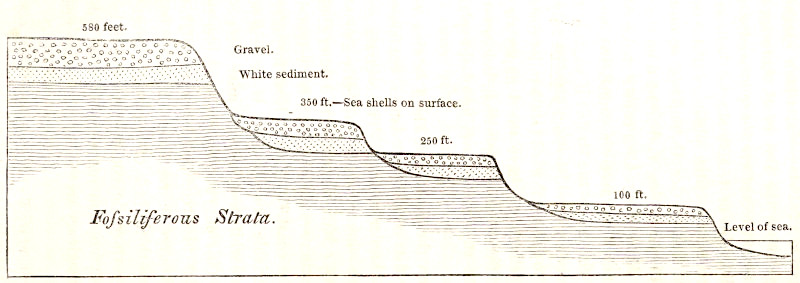
The cliffs on the coast give the following section: The lower part consists of a soft sandstone, containing large concretions of a harder nature. These strata contain many organic remains—immense oysters nearly a foot in diameter, curious pectens, echini, turritellæ, and other shells, of which the greater portion are extinct, but a few resemble those now existing on the coast.[10] Above these fossiliferous beds, a mass of soft friable stone or earth is superimposed, which, from its extreme whiteness, has been mistaken for chalk. It is, however, quite different; and closely resembles the less argillaceous varieties of decomposed felspar. This substance never contains organic remains. Lastly, the cliff is surmounted by a thick bed of gravel, almost exclusively derived from porphyritic rocks. For the sake of making the following description more easily intelligible, I have subjoined an imaginary section of the plains near the coast. It must be observed, that the width of each plain is in nature very much greater in proportion to the height, than here represented.
Fossiliferous Strata
The whole series is horizontally stratified, and I do not recollect ever seeing any signs of violence, not even such as a fault. The gravel covers the entire surface of the land, from the Rio Colorado to the Strait of Magellan, a space of 800 miles, and is one chief cause of the desert character of Patagonia. Judging from a section across the continent at the St. Cruz river, and from some other reasons, I believe the gravel beds gradually thickening as they ascend, every where reach the base of the Cordillera. It is to these mountains we must look for the parent rocks, of at least a large portion of the well-rounded fragments. I apprehend so great an area covered by shingle, could scarcely be pointed out in any other part of the world.
Having said thus much of the constitution, let us look at the external configuration of the mass. The level plains are cut off along the whole line of coast by perpendicular cliffs, which are necessarily of different altitudes, because any one of the successive terraces, which, as I have already noticed, rise like steps one above the other, may form the sea cliff. These steps are often several miles broad; but from one point of view I have seen four very distinct lines of escarpment abutting one over the other. Having observed that the plains appeared to run for great distances along the coast at the same level, I measured barometrically the elevation of some of them, and compared these measurements, and took all those made by the officers employed in the survey. I was astonished to find at how great distances, even of 600 miles, plains occurred that had, within a few feet of difference, the same elevation. I believe I can distinguish seven or eight distinct terraces which occur along the line of coast, and which include heights between 1200 feet and the level of the sea. It will be understood that they are not always present, for the lower ones have in some parts been removed by the action of the sea sooner than in others. When any broad valley enters the country, the terraces sweep round and run up on each side; in which case, the correspondence on the opposite sides is beautifully illustrated.
I have called these step-like plains level, because they appear to be absolutely so to the eye, but in truth they rise a little between the edge of one line of cliff and the base of the next above it. Their slope is about the same as that of the gradually shoaling bottom of the neighbouring sea. The elevation of 350 feet is gained by three steps; one of about 100 feet, the second 250, and the third 350. Over these three plains marine remains are frequently scattered, but they are especially abundant on the lower one. The shells are the same as the now existing littoral species, and the muscle and turbo yet partially retain their blue and purple colours.
We have now stated the problem, which is to be explained so as to connect together these various phenomena. At first I could only understand the grand covering of gravel, by the supposition of some epoch of extreme violence, and the successive lines of cliff, by as many great elevations, the precise action of which I could not however follow out. Guided by the “Principles of Geology,” and having under my view the vast changes going on in this continent, which at the present day seems the great workshop of nature, I came to another, and I hope more satisfactory conclusion. The importance of any view which may explain the agency by which such vast beds of shingle have been transported over the surface of the successive plains, cannot be doubted. Whatever the cause may have been, it has determined the condition of this desert country, with respect to its form, nature, and capabilities of supporting life.
There are proofs, that the whole coast has been elevated to a considerable height within the recent period; and on the shores of the Pacific, where successive terraces likewise occur, we know that these changes have latterly been very gradual. There is indeed reason for believing, that the uplifting of the ground during the earthquakes in Chile, although only to the height of two or three feet, has been a disturbance which may be considered as a great one, in comparison to the series of lesser and scarcely sensible movements which are likewise in progress. Let us then imagine the consequence of the shoaling bed of an ocean, elevated at a perfectly equable rate, so that the same number of feet should be converted into dry land in each succeeding century. Every part of the surface would then have been exposed for an equal length of time to the action of the beach-line, and the whole in consequence equally modified. The shoaling bed of the ocean would thus be changed into a sloping land, with no marked line on it. If, however, there should occur a long period of repose in the elevations, and the currents of the sea should tend to wear away the land (as happens along this whole coast), then there would be formed a line of cliff. Accordingly as the repose was long, so would be the quantity of land consumed, and the consequent height of such cliffs. Let the elevations recommence, and another sloping bank (of shingle, or sand, or mud, according to the nature of the successive beach-lines) must be formed, which again will be broken by as many lines of cliff, as there shall be periods of rest in the action of the subterranean forces. Now this is the structure of the plains of Patagonia; and such gradual changes harmonize well with the undisturbed strata, extending over so many hundred miles.
I must here observe, that I am far from supposing that the entire coast of this part of the continent has ever been lifted up, to the height of even a foot, at any one moment of time; but, drawing our analogies from the shores of the Pacific, that the whole may have been insensibly rising, with every now and then a paroxysmal or accelerated movement in certain spots. With respect to the alternation of the periods of such continued rise and those of quiescence, we may grant that they are probable, because such alternation agrees with what we see in the action, not only of a single volcano, but likewise of the disturbances affecting whole regions of the earth. At the present day, to the north of the parallel 44°, the subterranean forces are constantly manifesting their power over a space of more than one thousand miles. But to the southward of that line, as far as Cape Horn, an earthquake is seldom or never experienced, and there is not a single point of eruption; yet in former ages, as we shall hereafter show, deluges of lava flowed from that very part. It is in conformity with our hypothesis that this southern region of repose, is at present suffering from the inroads of the ocean, as attested by the long line of cliff on the Patagonian coast. Such we believe to have been the causes of this singular configuration of the land. Nevertheless, we confess that it at first appears startling, that the most marked intervals between the heights of the successive plains should, instead of some great and sudden action of the subterranean forces, only indicate a longer period of repose.
In explaining the widely-spread bed of gravel, we must first suppose a great mass of shingle to be collected by the action of innumerable torrents, and the swell of an open ocean, at the submarine basis of the Andes, prior to the elevation of the plains of Patagonia. If such a mass should then be lifted up, and left exposed during one of the periods of subterranean repose; a certain breadth, for instance a mile, would be washed down, and spread out over the bottom of the invading waters. (That the sea near the coast can carry out pebbles, we may feel sure from the circumstance of their gradual decrease in size, according to the distance from the coast-line.)
If this part of the sea should now be elevated, we should have a bed of gravel, but it would be of less thickness than in the first mass, both because it is spread over a larger area, and because it has been much reduced by attrition. This process being repeated, we might carry beds of gravel, always decreasing in thickness (as happens in Patagonia) to a considerable distance from the line of parent rock.[11] For instance, on the banks of the St. Cruz at the distance of one hundred miles above the mouth of the river, the bed of gravel is 212 feet thick, whereas, near the coast, it seldom exceeds 25 or 30 feet; the thickness being thus reduced to nearly one-eighth.
I have already stated that the gravel is separated from the fossiliferous strata by some white beds of a friable substance, singularly resembling chalk, but which cannot be compared, as far as I am aware, with any formation in Europe. With respect to its origin, I may observe that the well-rounded pebbles all consist of various felspathic porphyries; and that, from their prolonged attrition, during the successive remodellings of the whole mass, much sediment must have been produced. I have already remarked that the white earthy matter more closely resembles decomposed felspar, than any other substance. If such is its origin, it would always, from its lightness, be carried further to seaward than the pebbles. But as the land was elevated, the beds would be brought nearer the coast-line, and so become covered by the fresh masses of gravel which were travelling outwards. When these white beds were themselves elevated, they would hold a position intermediate between the gravel and the common foundation, or the fossiliferous strata. To explain my meaning more clearly, let us suppose the bottom of the present sea covered to a certain distance from the coast-line, with pebbles gradually decreasing in size, and beyond it by the white sediment. Let the land rise, so that the beach-line, by the fall of the water, may be carried outwards; then likewise the gravel, by the same agency as before, will be transported so much further from the coast, and will cover the white sediment, and these beds again will invade the more distant parts of the bottom of the sea. By this outward progress, the order of superposition must always be gravel, white sediment, and the fossiliferous strata.
Such is the history of the changes by which the present condition of Patagonia has, I believe, been determined. These changes all result from the assumption of a steady but very gradual elevation, extending over a wide area, and interrupted at long intervals by periods of repose. But we must now return to Port St. Julian. On the south side of the harbour, a cliff of about ninety feet in height intersects a plain constituted of the formations above described; and its surface is strewed over with recent marine shells. The gravel, however, differently from that in every other locality, is covered by a very irregular and thin bed of a reddish loam, containing a few small calcareous concretions. The matter somewhat resembles that of the Pampas, and probably owes its origin either to a small stream having formerly entered the sea at that spot, or to a mud-bank similar to those now existing at the head of the harbour. In one spot this earthy matter filled up a hollow, or gully, worn quite through the gravel, and in this mass a group of large bones was embedded. The animal to which they belonged, must have lived, as in the case at Bahia Blanca, at a period long subsequent to the existence of the shells now inhabiting the coast. We may feel sure of this, because the formation of the lower terrace or plain, must necessarily have been posterior to those above it, and on the surface of the two higher ones, sea-shells of recent species are scattered. From the small physical change, which the last one hundred feet elevation of the continent could have produced, the climate, as well as the general condition of Patagonia, probably was nearly the same, at the time when the animal was embedded, as it now is. This conclusion is moreover supported by the identity of the shells belonging to the two ages. Then immediately occurred the difficulty, how could any large quadruped have subsisted on these wretched deserts in lat. 49° 15′? I had no idea at the time, to what kind of animal these remains belonged. The puzzle, however, was soon solved when Mr. Owen examined them; for he considers that they formed part of an animal allied to the guanaco or llama, but fully as large as the true camel. As all the existing members of the family of Camelidæ are inhabitants of the most sterile countries, so may we suppose was this extinct kind. The structure of the cervical vertebræ, the transverse processes not being perforated for the vertebral artery, indicates its affinity: some other parts, however, of its structure, probably are anomalous.
The most important result of this discovery, is the confirmation of the law that existing animals have a close relation in form with extinct species. As the guanaco is the characteristic quadruped of Patagonia, and the vicuna of the snow-clad summits of the Cordillera, so in bygone days, this gigantic species of the same family must have been conspicuous on the southern plains. We see this same relation of type between the existing and fossil Ctenomys, between the capybara (but less plainly, as shown by Mr. Owen) and the gigantic Toxodon; and lastly, between the living and extinct Edentata. At the present day, in South America, there exist probably nineteen species of this order, distributed into several genera; while throughout the rest of the world there are but five. If, then, there is a relation between the living and the dead, we should expect that the Edentata would be numerous in the fossil state. I need only reply by enumerating the megatherium, and the three or four other great species, discovered at Bahia Blanca; the remains of some of which are also abundant over the whole immense territory of La Plata. I have already pointed out the singular relation between the armadilloes and their great prototypes, even in a point apparently of so little importance as their external covering.
The order of rodents at the present day, is most conspicuous in South America, on account of the vast number[12] and size of the species, and the multitude of individuals: according to the same law, we should expect to find their representatives in a fossil state. Mr. Owen has shown how far the Toxodon is thus related; and it is moreover not improbable that another large animal has likewise a similar affinity.
The teeth of the rodent nearly equalling in size those of the Capybara, which were discovered near Bahia Blanca, must also be remembered.
The law of the succession of types, although subject to some remarkable exceptions, must possess the highest interest to every philosophical naturalist, and was first clearly observed in regard to Australia, where fossil remains of a large and extinct species of Kangaroo and other marsupial animals were discovered buried in a cave. In America the most marked change among the mammalia has been the loss of several species of Mastodon, of an elephant, and of the horse. These Pachydermata appear formerly to have had a range over the world, like that which deer and antelopes now hold. If Buffon had known of these gigantic armadilloes, llamas, great rodents, and lost pachydermata, he would have said with a greater semblance of truth, that the creative force in America had lost its vigour, rather than that it had never possessed such powers.
It is impossible to reflect without the deepest astonishment, on the changed state of this continent. Formerly it must have swarmed with great monsters, like the southern parts of Africa, but now we find only the tapir, guanaco, armadillo, and capybara; mere pigmies compared to the antecedent races. The greater number, if not all, of these extinct quadrupeds lived at a very recent period; and many of them were contemporaries of the existing molluscs. Since their loss, no very great physical changes can have taken place in the nature of the country. What then has exterminated so many living creatures? In the Pampas, the great sepulchre of such remains, there are no signs of violence, but on the contrary, of the most quiet and scarcely sensible changes. At Bahia Blanca I endeavoured to show the probability that the ancient Edentata, like the present species, lived in a dry and sterile country, such as now is found in that neighbourhood. With respect to the camel-like llama of Patagonia, the same grounds which, before knowing more than the size of the remains, perplexed me, by not allowing any great change of climate, now that we can guess the habits of the animal, are strangely confirmed. What shall we say of the death of the fossil horse? Did those plains fail in pasture, which afterwards were overrun by thousands and tens of thousands of the successors of the fresh stock introduced with the Spanish colonist? In some countries, we may believe, that a number of species subsequently introduced, by consuming the food of the antecedent races, may have caused their extermination; but we can scarcely credit that the armadillo has devoured the food of the immense Megatherium, the capybara of the Toxodon, or the guanaco of the camel-like kind. But granting that all such changes have been small, yet we are so profoundly ignorant concerning the physiological relations, on which the life, and even health (as shown by epidemics) of any existing species depends, that we argue with still less safety about either the life or death of any extinct kind.
One is tempted to believe in such simple relations, as variation of climate and food, or introduction of enemies, or the increased numbers of other species, as the cause of the succession of races. But it may be asked whether it is probable than any such cause should have been in action during the same epoch over the whole northern hemisphere, so as to destroy the Elephas primigenus, on the shores of Spain, on the plains of Siberia, and in Northern America; and in a like manner, the Bos urus, over a range of scarcely less extent? Did such changes put a period to the life of Mastodon angustidens, and of the fossil horse, both in Europe and on the Eastern slope of the Cordillera in Southern America? If they did, they must have been changes common to the whole world; such as gradual refrigeration, whether from modifications of physical geography, or from central cooling. But on this assumption, we have to struggle with the difficulty that these supposed changes, although scarcely sufficient to affect molluscous animals either in Europe or South America, yet destroyed many quadrupeds in regions now characterized by frigid, temperate, and warm[13] climates! These cases of extinction forcibly recall the idea (I do not wish to draw any close analogy) of certain fruit-trees, which, it has been asserted, though grafted on young stems, planted in varied situations, and fertilized by the richest manures, yet at one period, have all withered away and perished. A fixed and determined length of life has in such cases been given to thousands and thousands of buds (or individual germs), although produced in long succession. Among the greater number of animals, each individual appears nearly independent of its kind; yet all of one kind may be bound together by common laws, as well as a certain number of individual buds in the tree, or polypi in the Zoophyte.
I will add one other remark. We see that whole series of animals, which have been created with peculiar kinds of organization, are confined to certain areas; and we can hardly suppose these structures are only adaptations to peculiarities of climate or country; for otherwise, animals belonging to a distinct type, and introduced by man, would not succeed so admirably, even to the extermination of the aborigines. On such grounds it does not seem a necessary conclusion, that the extinction of species, more than their creation, should exclusively depend on the nature (altered by physical changes) of their country. All that at present can be said with certainty, is that, as with the individual, so with the species, the hour of life has run its course, and is spent.