Chapter I
Reading edition
Porto Praya—Ribeira Grande—Dry and clear atmosphere—Effect of lava on calcareous beach—Habits of Aplysia and Octopus—St. Paul’s rock non-volcanic—Incrustations and stalactites of phosphate of lime—Insects first colonists—Fernando Noronha—Bahia—Extent of granite—Burnished rocks—Habits of Diodon—Pelagic confervæ, infusoria—Causes of discoloured sea.
ST. JAGO—CAPE DE VERD ISLANDS.
Jan. 16th, 1832.—The neighbourhood of Porto Praya, viewed from the sea, wears a desolate aspect. The volcanic fire of past ages, and the scorching heat of a tropical sun, have in most places rendered the soil sterile and unfit for vegetation. The country rises in successive steps of table-land, interspersed with some truncate conical hills, and the horizon is bounded by an irregular chain of more lofty mountains. The scene, as beheld through the hazy atmosphere of this climate, is one of great interest; if, indeed, a person, fresh from the sea, and who has just walked, for the first time, in a grove of cocoa-nut trees, can be a judge of any thing but his own happiness. The island would generally be considered as very uninteresting; but to any one accustomed only to an English landscape, the novel prospect of an utterly sterile land possesses a grandeur which more vegetation might spoil. A single green leaf can scarcely be discovered over wide tracts of the lava plains; yet flocks of goats, together with a few cows, contrive to exist. It rains very seldom, but during a short portion of the year heavy torrents fall, and immediately afterwards a light vegetation springs out of every crevice. This soon withers; and upon such naturally-formed hay the animals live. At the present time it has not rained for an entire year. The broad, flat-bottomed, valleys, many of which serve during a few days only in the season as a watercourse, are clothed with thickets of leafless bushes. Few living creatures inhabit these valleys. The commonest bird is a kingfisher (Dacelo jagoensis), which tamely sits on the branches of the castor-oil plant, and thence darts on the grasshoppers and lizards. It is brightly coloured, but not so beautiful as the European species: in its flight, manners, and place of habitation, which is generally in the driest valleys, there is also a wide difference.
One day, two of the officers and myself rode to Ribeira Grande, a village a few miles to the eastward of Porto Praya. Until we reached the valley of St. Martin, the country presented its usual dull brown appearance; but there, a very small rill of water produces a most refreshing margin of luxuriant vegetation. In the course of an hour we arrived at Ribeira Grande, and were surprised at the sight of a large ruined fort and cathedral. The little town, before its harbour was filled up, was the principal place in the island: it now presents a melancholy, but very picturesque appearance. Having procured a black Padre for a guide, and a Spaniard, who had served in the Peninsular war, as an interpreter, we visited a collection of buildings, of which an ancient church formed the principal part. It is here the governors and captain-generals of the islands have been buried. Some of the tombstones recorded dates of the sixteenth century.[1] The heraldic ornaments were the only things in this retired place that reminded us of Europe. The church or chapel formed one side of a quadrangle, in the middle of which a large clump of bananas were growing. On another side was a hospital, containing about a dozen miserable-looking inmates.
We returned to the “Vênda” to eat our dinners. A considerable number of men, women, and children, all as black as jet, were collected to watch us. Our companions were extremely merry; and every thing we said or did was followed by their hearty laughter. Before leaving the town we visited the cathedral. It does not appear so rich as the smaller church, but boasts of a little organ, which sent forth most singularly inharmonious cries. We presented the black priest with a few shillings, and the Spaniard, patting him on the head, said, with much candour, he thought his colour made no great difference. We then returned, as fast as the ponies would go, to Porto Praya.
Another day we rode to the village of St. Domingo, situated near the centre of the island. On a small plain which we crossed, a few stunted acacias were growing; their tops, by the action of the steady trade-wind, were bent in a singular manner—some of them even at a right angle to the trunk. The direction of the branches was exactly N.E. by N., and S.W. by S. These natural vanes must indicate the prevailing direction of the force of the trade-wind. The travelling had made so little impression on the barren soil, that we here missed our track, and took that to Fuentes. This we did not find out till we arrived there; and we were afterwards very glad of our mistake. Fuentes is a pretty village, with a small stream; and every thing appeared to prosper well, excepting, indeed, that which ought to do so most—its inhabitants. The black children, completely naked, and looking very wretched, were carrying bundles of firewood half as big as their own bodies.
Near Fuentes we saw a large flock of guinea-fowl—probably fifty or sixty in number. They were extremely wary, and could not be approached. They avoided us, like partridges on a rainy day in September, running with their heads cocked up; and if pursued, they readily took to the wing.
The scenery of St. Domingo possesses a beauty totally unexpected, from the prevalent gloomy character of the rest of the island. The village is situated at the bottom of a valley, bounded by lofty and jagged walls of stratified lava. The black rocks afford a most striking contrast with the bright green vegetation, which follows the banks of a little stream of clear water. It happened to be a grand feast-day, and the village was full of people. On our return we overtook a party of about twenty young black girls, dressed in most excellent taste; their black skins and snow-white linen being set off by their coloured turbans and large shawls. As soon as we approached near, they suddenly all turned round, and covering the path with their shawls, sung with great energy a wild song, beating time with their hands upon their legs. We threw them some vintéms, which were received with screams of laughter, and we left them redoubling the noise of their song.
It has already been remarked, that the atmosphere is generally very hazy; this appears chiefly due to an impalpable dust, which is constantly falling, even on vessels far out at sea. The dust is of a brown colour, and under the blowpipe easily fuses into a black enamel. It is produced, as I believe, from the wear and tear of volcanic rocks, and must come from the coast of Africa. One morning the view was singularly clear; the distant mountains being projected with the sharpest outline, on a heavy bank of dark blue clouds. Judging from the appearance, and from similar cases in England, I supposed that the air was saturated with moisture. The fact, however, turned out quite the contrary. The hygrometer gave a difference of 29.6 degrees, between the temperature of the air, and the point at which dew was precipitated. This difference was nearly double that which I had observed on the previous mornings. This unusual degree of atmospheric dryness was accompanied by continual flashes of lightning. Is it not an uncommon case, thus to find a remarkable degree of aerial transparency with such a state of weather?
The geology of this island is the most interesting part of its natural history. On entering the harbour, a perfectly horizontal white band, in the face of the sea cliff, may be seen running for some miles along the coast, and at the height of about forty-five feet above the water. Upon examination, this white stratum is found to consist of calcareous matter, with numerous shells embedded, such as now exist on the neighbouring coast. It rests on ancient volcanic rocks, and has been covered by a stream of basalt, which must have entered the sea, when the white shelly bed was lying at the bottom. It is interesting to trace the changes, produced by the heat of the overlying lava, on the friable mass. For a thickness of several inches it is converted, in some parts, into a firm stone, as hard as the best freestone; and the earthy matter, originally mingled with the calcareous, has been separated into little spots, thus leaving the limestone white and pure. In other parts a highly crystalline marble has been formed, and so perfect are the crystals of carbonate of lime, that they can easily be measured by the reflecting goniometer. The change is even more extraordinary, where the lime has been caught up by the scoriaceous fragments of the lower surface of the stream; for it is there converted into groups of beautifully radiated fibres resembling arragonite. The beds of lava rise in successive gently-sloping plains, towards the interior, whence the deluges of melted stone originally proceeded. Within historical times, no signs of volcanic activity have, I believe, been manifested in any part of St. Jago. This state of quiescence is, probably, owing to the neighbouring island of Fogo being frequently in eruption. Even the form of a crater can but rarely be discovered on the summits of any of the red cindery hills; yet the more recent streams can be distinguished on the coast, forming a line of cliffs of less height, but stretching out in advance of those belonging to an older series: the height of the cliff thus affording a rude measure of the age.
During our stay, I observed the habits of some marine animals. A large Aplysia is very common. This sea-slug is about five inches long; and is of a dirty yellowish colour, veined with purple. At the anterior extremity, it has two pair of feelers; the upper ones of which resemble in shape the ears of a quadruped. On each side of the lower surface, or foot, there is a broad membrane, which appears sometimes to act as a ventilator, in causing a current of water to flow over the dorsal branchiæ. It feeds on delicate sea-weeds, which grow among the stones in muddy and shallow water; and I found in its stomach several small pebbles, as in the gizzards of birds. This slug, when disturbed, emits a very fine purplish-red fluid, which stains the water for the space of a foot around. Besides this means of defence, an acrid secretion, which is spread over its body, causes a sharp, stinging sensation, similar to that produced by the Physalia, or Portuguese man-of-war.
I was much interested, on several occasions, by watching the habits of an Octopus or cuttle-fish. Although common in the pools of water left by the retiring tide, these animals were not easily caught. By means of their long arms and suckers, they could drag their bodies into very narrow crevices; and when thus fixed, it required great force to remove them. At other times they darted tail first, with the rapidity of an arrow, from one side of the pool to the other, at the same instant discolouring the water with a dark chestnut-brown ink. These animals also escape detection by a very extraordinary, chameleon-like, power of changing their colour. They appear to vary the tints, according to the nature of the ground over which they pass: when in deep water, their general shade was brownish purple, but when placed on the land, or in shallow water, this dark tint changed into one of a yellowish green. The colour, examined more carefully, was a French gray, with numerous minute spots of bright yellow: the former of these varied in intensity; the latter entirely disappeared and appeared again by turns. These changes were effected in such a manner, that clouds, varying in tint between a hyacinth red and a chestnut brown,[2] were continually passing over the body. Any part being subjected to a slight shock of galvanism, became almost black: a similar effect, but in a less degree, was produced by scratching the skin with a needle. These clouds, or blushes, as they may be called, when examined under a glass, are described as being produced by the alternate expansions and contractions of minute vesicles, containing variously-coloured fluids.[3]
This cuttle-fish displayed its chameleon-like power both during the act of swimming and whilst remaining stationary at the bottom. I was much amused by the various arts to escape detection used by one individual, which seemed fully aware that I was watching it. Remaining for a time motionless, it would then stealthily advance an inch or two, like a cat after a mouse; sometimes changing its colour: it thus proceeded, till having gained a deeper part, it darted away, leaving a dusky train of ink to hide the hole into which it had crawled.
While looking for marine animals, with my head about two feet above the rocky shore, I was more than once saluted by a jet of water, accompanied by a slight grating noise. At first I did not know what it was, but afterwards I found out that it was the cuttle-fish, which, though concealed in a hole, thus often led me to its discovery. That it possesses the power of ejecting water there is no doubt, and it appeared to me certain that it could, moreover, take good aim by directing the tube or siphon on the under side of its body. From the difficulty which these animals have in carrying their heads, they cannot crawl with ease when placed on the ground. I observed that one which I kept in the cabin was slightly phosphorescent in the dark.
St. Paul’s Rocks.—In crossing the Atlantic we hove to, during the morning of February 16th, close to the island of St. Paul. This cluster of rocks is situated in O° 58′ north latitude, and 29° 15′ west longitude. It is 540 miles distant from the coast of America, and 350 from the island of Fernando Noronha. The highest point is only fifty feet above the level of the sea, and the entire circumference is under three-quarters of a mile. This small point rises abruptly out of the depths of the ocean. Its mineralogical constitution is not simple; in some parts, the rock is of a cherty, in others, of a felspathic nature; and in the latter case it contains thin veins of serpentine, mingled with calcareous matter.
The circumstance of these rocks not being of volcanic origin is of interest, because, with very few exceptions, the islands situated in the midst of the great oceans are thus constituted. As the highest pinnacles of the great mountain ranges probably once existed as islands distant from any continent, we are led to expect that they would frequently consist of volcanic rocks. It becomes, therefore, a curious point to speculate on the changes which many of the present islands would undergo, during the lapse of the countless ages, which would be required to elevate them into snow-clad summits. If we take the case of Ascension, or St. Helena, both of which have long existed in an extinct condition, we may feel assured, before so vast a period could elapse, during the whole of which the surface would be exposed to constant wear and tear, that the mere nucleus or core of the island would remain; perhaps, every fragment of cellular rock having been decomposed, a mass of some compact stone, as phonolite or greenstone, would crown our new Chimborazo.
The rocks of St. Paul appear from a distance of a brilliantly white colour. This is partly owing to the dung of a vast multitude of seafowl, and partly to a coating of a glossy white substance, which is intimately united to the surface of the rocks. This, when examined with a lens, is found to consist of numerous exceedingly thin layers, its total thickness being about the tenth of an inch. The surface is smooth and glossy, and has a pearly lustre; it is considerably harder than calcareous spar, although it can be scratched by a knife: under the blowpipe it decrepitates, slightly blackens, and emits a fetid odour. It consists of phosphate of lime, mingled with some impurities; and its origin without doubt is due to the action of the rain or spray on the bird’s dung. I may here mention, that I found in some hollows in the lava rocks of Ascension considerable masses of the substance called guano, which on the west coast of the intertropical parts of South America occurs in great beds, some yards thick, on the islets frequented by seafowl. According to the analysis of Fourcroy and Vauquelin, it consists of the urates, phosphates, and oxalates of lime, ammonia, and potash, together with some other salts, and some fatty and earthy matter. I believe there is no doubt of its being the richest manure which has ever been discovered. At Ascension, close to the guano, stalactitic or botryoidal masses of impure phosphate of lime adhered to the basalt. The basal part of these had an earthy texture, but the extremities were smooth and glossy, and sufficiently hard to scratch common glass. These stalactites appeared to have shrunk, perhaps from the removal of some soluble matter, in the act of consolidation; and hence they had an irregular form. Similar stalactitic masses,[4] though I am not aware that they have ever been noticed, are, I believe, by no means of uncommon occurrence.
We only observed two kinds of birds—the booby and the noddy. The former is a species of gannet, and the latter a tern. Both are of a tame and stupid disposition, and are so unaccustomed to visiters, that I could have killed any number of them with my geological hammer. The booby lays her eggs on the bare rock; but the tern makes a very simple nest with sea-weed. By the side of many of these nests a small flying-fish was placed; which, I suppose, had been brought by the male bird for its partner. It was amusing to watch how quickly a large and active crab (Graspus), which inhabits the crevices of the rock, stole the fish from the side of the nest, as soon as we had disturbed the birds. Not a single plant, not even a lichen, grows on this island; yet it is inhabited by several insects and spiders. The following list completes, I believe, the terrestrial fauna: a species of Feronia and an acarus, which must have come here as parasites on the birds; a small brown moth, belonging to a genus that feeds on feathers; a staphylinus (Quedius) and a woodlouse from beneath the dung; and lastly, numerous spiders, which I suppose prey on these small attendants on, and scavengers of the waterfowl. The often-repeated description of the first colonists of the coral islets in the South Sea, is not, probably, quite correct: I fear it destroys the poetry of the story to find, that these little vile insects should thus take possession before the cocoa-nut tree and other noble plants have appeared.
The smallest rock in the tropical seas, by giving a foundation, for the growth of innumerable kinds of sea-weed and compound animals, supports likewise a large number of fish. The sharks and the seamen in the boats maintained a constant struggle, who should secure the greater share of the prey caught by the lines. I have heard, that a rock near the Bermudas, lying many miles out at sea, and covered by a considerable depth of water, was first discovered by the circumstance of fish having been observed in the neighbourhood.
Fernando Noronha, Feb. 20th.—As far as I was enabled to observe, during the few hours we staid at this place, the constitution of the island is volcanic, but probably not of a recent date. The most remarkable feature is a conical hill, about one thousand feet high, the upper part of which is exceedingly steep, and on one side overhangs its base. The rock is phonolite, and is divided into irregular columns. From the first impression, on viewing one of these isolated masses, one is inclined to believe, that the whole has been suddenly pushed up in a semi-fluid state. At St. Helena, however, I ascertained that some pinnacles, of a nearly similar figure and constitution, had been formed by the injection of melted rock among the yielding strata; which thus formed the model for these gigantic obelisks. The whole island is covered with wood; but from the dryness of the climate there is no appearance of luxuriance. At some elevation great masses of the columnar rock, shaded by laurels, and ornamented by a tree covered by fine pink flowers like those of a foxglove, but without a single leaf, gave a pleasing effect to the nearer parts of the scenery.
Bahia, or San Salvador. Brazil, Feb. 29th.—The day has past delightfully. Delight itself, however, is a weak term to express the feelings of a naturalist who, for the first time, has been wandering by himself in a Brazilian forest. Among the multitude of striking objects, the general luxuriance of the vegetation bears away the victory. The elegance of the grasses, the novelty of the parasitical plants, the beauty of the flowers, the glossy green of the foliage, all tend to this end. A most paradoxical mixture of sound and silence pervades the shady parts of the wood. The noise from the insects is so loud, that it may be heard even in a vessel anchored several hundred yards from the shore; yet within the recesses of the forest a universal silence appears to reign. To a person fond of natural history, such a day as this, brings with it a deeper pleasure than he ever can hope again to experience. After wandering about for some hours, I returned to the landing-place; but, before reaching it, I was overtaken by a tropical storm. I tried to find shelter under a tree which was so thick, that it would never have been penetrated by common English rain; but here, in a couple of minutes, a little torrent flowed down the trunk. It is to this violence of the rain we must attribute the verdure at the bottom of the thickest woods: if the showers were like those of a colder clime, the greater part would be absorbed or evaporated before it reached the ground. I will not at present attempt to describe the gaudy scenery of this noble bay, because, in our homeward voyage, we called here a second time, and I shall then have occasion to remark on it.
The geology of the surrounding country possesses little interest. Throughout the coast of Brazil, and certainly for a considerable space inland, from the Rio Plata to Cape St. Roque, lat. 5° S., a distance of more than 2000 geographical miles, wherever solid rock occurs, it belongs to a granitic formation. The circumstance of this enormous area being thus constituted of materials, which almost every geologist believes to have been crystallized by the action of heat under pressure, gives rise to many curious reflections. Was this effect produced beneath the depths of a profound ocean? or did a covering of strata formerly extend over it, which has since been removed? Can we believe that any power, acting for a time short of infinity, could have denuded the granite over so many thousand square leagues?
On a point not far from the city, where a rivulet entered the sea, I observed a fact connected with a subject discussed by Humboldt.[5] At the cataracts of the great rivers Orinoco, Nile, and Congo, the syenitic rocks are coated by a black substance, appearing as if they had been polished with plumbago. The layer is of extreme thinness; and on analysis by Berzelius it was found to consist of the oxides of manganese and iron. In the Orinoco it occurs on the rocks periodically washed by the floods, and in those parts alone, where the stream is rapid; or, as the Indians say, “the rocks are black, where the waters are white.” The coating is here of a rich brown instead of a black colour, and seems to be composed of ferrugineous matter alone. Hand specimens fail to give a just idea of these brown, burnished, stones which glitter in the sun’s rays. They occur only within the limits of tidal action; and as the rivulet slowly trickles down, the surf must supply the polishing power of the cataracts in the great rivers. In the same manner, the rise and fall of the tide probably answers to the periodical inundations; and thus the same causes are present under apparently very different circumstances. The real origin, however, of these coatings of metallic oxides, which seem as if cemented to the rocks, is not understood; and no reason, I believe, can be assigned for their thickness remaining constant.
One day I was amused by watching the habits of a Diodon, which was caught swimming near the shore. This fish is well known to possess the singular power of distending itself into a nearly spherical form. After having been taken out of water for a short time, and then again immersed in it, a considerable quantity both of water and air was absorbed by the mouth, and perhaps likewise by the branchial apertures. This process is effected by two methods; the air is swallowed, and is then forced into the cavity of the body, its return being prevented by a muscular contraction which is externally visible; but the water, I observed, entered in a stream through the mouth, which was wide open and motionless: this latter action must, therefore, depend on suction. The skin about the abdomen is much looser than that of the back; hence, during the inflation, the lower surface becomes far more distended than the upper; and the fish, in consequence, floats with its back downwards. Cuvier doubts whether the Diodon, in this position, is able to swim; but not only can it thus move forward in a straight line, but likewise it can turn round to either side. This latter movement is effected solely by the aid of the pectoral fins; the tail being collapsed, and not used. From the body being buoyed up with so much air, the branchial openings were out of water; but a stream drawn in by the mouth, constantly flowed through them.
The fish, having remained in this distended state for a short time, generally expelled the air and water with considerable force from the branchial apertures and mouth. It could emit, at will, a certain portion of the water; and it appears, therefore, probable, that this fluid is taken in partly for the sake of regulating its specific gravity. This diodon possessed several means of defence. It could give a severe bite, and could eject water from its mouth to some distance, at the same time it made a curious noise by the movement of its jaws. By the inflation of its body, the papillæ, with which the skin is covered, became erect and pointed. But the most curious circumstance was, that it emitted from the skin of its belly, when handled, a most beautiful carmine red and fibrous secretion, which stained ivory and paper in so permanent a manner, that the tint is retained with all its brightness to the present day. I am quite ignorant of the nature and use of this secretion.
March 18th.—We sailed from Bahia. A few days afterwards, when not far distant from the Abrolhos islets, my attention was called to a discoloured appearance in the sea. The whole surface of the water, as it appeared under a weak lens, seemed as if covered by chopped bits of hay, with their ends jagged. One of the larger particles measured .03 of an inch in length, and .009 in breadth. Examined more carefully, each is seen to consist of from twenty to sixty cylindrical filaments, which have perfectly rounded extremities, and are divided at regular intervals by transverse septa, containing a brownish-green flocculent matter. The filaments must be enveloped in some viscid fluid, for the bundles adhered together without actual contact. I do not know to what family these bodies properly belong, but they have a close general resemblance in structure with the confervæ which grow in every ditch. These simple vegetables, thus constituted for floating in the open ocean, must in certain places exist in countless numbers. The ship passed through several bands of them, one of which was about ten yards wide, and, judging from the mud-like colour of the water, at least two and a half miles long. In almost every long voyage some account is given of these confervæ. They appear especially common in the sea near Australia. Off Cape Leeuwin, I found some very similar to those above described; they differed chiefly in the bundles being rather smaller, and being composed of fewer filaments. Captain Cook, in his third voyage, remarks, that the sailors gave to this appearance the name of sea-sawdust.
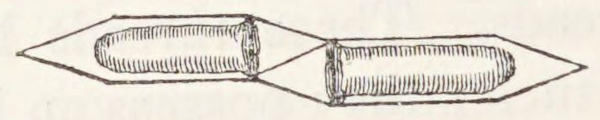
I may here mention that during two days preceding our arrival at the Keeling Islands in the Indian Ocean, I saw in many parts masses of flocculent matter, of a brownish-green colour, floating in the sea. They varied in size, from half to three or four inches square; and were quite irregular in figure. In an opake vessel they could barely be distinguished, but in a glass one they were clearly visible. Under the microscope the flocculent matter was seen to consist of two kinds of confervæ, between which I am quite ignorant whether there exists any connexion. Minute cylindrical bodies, conical at each extremity, are involved in vast numbers, in a mass of fine threads. These threads have a diameter of about 2/3000 of an inch; they possess an internal lining, and are divided at irregular and very wide intervals by transverse septa. Their length is so great, that I could never with certainty ascertain the form of the uninjured extremity; they are all curvilinear, and resemble in mass a handful of hair, coiled up and squeezed together. In the midst of these threads, and probably connected by some viscid fluid, the other kind, or the cylindrical transparent bodies, float in great numbers. These have their two extremities terminated by cones, produced into the finest points: their diameter is tolerably constant between .006 and .008 of an inch; but their length varies considerably from .04 to .06, and even sometimes to .08. Near one extremity of the cylindrical part, a green septum, formed of granular matter, and thickest in the middle, may generally be seen. This, I believe, is the bottom of a most delicate, colourless sack, composed of a pulpy substance, which lines the exterior case, but does not extend within the extreme conical points. In some, small but perfect spheres of brownish granular matter supplied the place of the septa; and I observed the curious process by which they were produced. The pulpy matter of the internal coating suddenly grouped itself into lines, some of which assumed a form radiating from a common centre; it then continued, with an irregular and rapid movement, to contract itself, so that, in the course of a second, the whole was united into a perfect little sphere, which occupied the position of the septum at one end of the now quite hollow case. The appearance was as if an elastic membrane, for instance a thin Indian-rubber ball, had been distended with air, and then burst, in which case the edges would instantly shrink up and contract towards a point. The formation of the granular sphere was hastened by any accidental injury. I may add, that frequently a pair of these bodies were attached to each other, as represented in the accompanying rude drawing, cone beside cone, at that end where the septum occurs. When floating uninjured in the sea, the formation of the spherical gemmules perhaps only takes place, when two of the plants (or rather animals, according to Bory St. Vincent) thus become attached, and married to each other. Nevertheless, I certainly witnessed this curious process in several individuals, when separate, and where there was no apparent cause of disturbance. In any case it does not seem probable, from the fixed structure of the septum, that the whole of the granular matter is transferred from one to the other body, as with the true Conjugatæ.
I will here add a few other observations connected with the discoloration of the sea from organic causes. On the coast of Chile, a few leagues north of Concepcion, the Beagle one day passed through great bands of muddy water; and again, a degree south of Valparaiso, the same appearance was still more extensive. Although we were nearly fifty miles from the coast, I at first attributed this circumstance to real streams of muddy water brought down by the river Maypo. Mr. Sulivan, however, having drawn up some in a glass, thought he distinguished, by the aid of a lens, moving points. The water was slightly stained as if by red dust; and after leaving it for some time quiet, a cloud collected at the bottom. With a lens, of one-fourth of an inch focal distance, small hyaline points could be seen darting about with great rapidity, and frequently exploding. Examined with a much higher power, their shape was found to be oval, and contracted by a ring round the middle, from which line curved little setæ proceeded on all sides; and these were the organs of motion. One end of the body was narrower and more pointed than the other. According to the arrangement of Bory St. Vincent, they are animalcula, belonging to the family of Trichodes: it was, however, very difficult to examine them with care, for almost the instant motion ceased, even while crossing the field of vision, their bodies burst. Sometimes both ends burst at once, sometimes only one, and a quantity of coarse brownish granular matter was ejected, which cohered very slightly. The ring with the setæ sometimes retained its irritability for a little while after the contents of the body had been emptied, and continued a riggling, uneven motion. The animal an instant before bursting expanded to half again its natural size; and the explosion took place about fifteen seconds after the rapid progressive motion had ceased: in a few cases it was preceded for a short interval by a rotatory movement on the longer axis. About two minutes after any number were isolated in a drop of water, they thus perished. The animals move with the narrow apex forwards, by the aid of their vibratory ciliæ, and generally by rapid starts. They are exceedingly minute, and quite invisible to the naked eye, only covering a space equal to the square of the thousandth of an inch. Their numbers were infinite; for the smallest drop of water which I could remove contained very many. In one day we passed through two spaces of water thus stained, one of which alone must have extended over several square miles. What incalculable numbers of these microscopical animals! The colour of the water, as seen at some distance, was like that of a river which has flowed through a red clay district; but under the shade of the vessel’s side, it was quite as dark as chocolate. The line where the red and blue water joined was distinctly defined. The weather for some days previously had been calm, and the ocean abounded, to an unusual degree, with living creatures. In Ulloa’s voyage an account is given of crossing, in nearly the same latitude, some discoloured water, which was mistaken for a shoal: no soundings were obtained, and I have no doubt, from the description, that this little animalcule was the cause of the alarm.[6]
In the sea around Tierra del Fuego, and at no great distance from the land, I have seen narrow lines of water of a bright red colour, from the number of crustacea, which somewhat resemble in form large prawns. The sealers call them whale-food. Whether whales feed on them I do not know; but terns, cormorants, and immense herds of great unwieldly seals, on some parts of the coast, derive their chief sustenance from these swimming crabs. Seamen invariably attribute the discoloration of the water to spawn; but I found this to be the case only on one occasion. At the distance of several leagues from the Archipelago of the Galapagos, the ship sailed through three strips of a dark yellowish, or mud-like, water; these strips were some miles long, but only a few yards wide, and they were separated from the surrounding surface by a sinuous yet distinct margin. The colour was caused by little gelatinous balls, about the fifth of an inch in diameter, in which numerous minute spherical ovules were embedded: they were of two distinct kinds, one being of a reddish colour and of a different shape from the other. I cannot form a conjecture as to what two kinds of animals these belonged. Captain Colnett remarks, that this appearance is very common among the Galapagos Islands, and that the direction of the bands indicates that of the currents; in the described case, however, the line was caused by the wind. The only other appearance which I have to notice, is a thin oily coat on the surface which displays iridescent colours. I saw a considerable tract of the ocean thus covered on the coast of Brazil; the seamen attributed it to the putrefying carcass of some whale, which probably was floating at no great distance. I do not here mention the minute gelatinous particles which are frequently dispersed throughout the water, for they are not sufficiently abundant to create any change of colour.
There are two circumstances in the above accounts which appear very remarkable: first, how do the various bodies which form the bands with defined edges keep together? In the case of the prawn-like crabs, their movements were as coinstantaneous as in a regiment of soldiers; but this cannot happen from any thing like voluntary action with the ovules, or the confervæ, nor is it probable among the infusoria. Secondly, what causes the length and narrowness of the bands? The appearance so much resembles that which may be seen in every torrent, where the stream uncoils into long streaks, the froth collected in the eddies, that I must attribute the effect to a similar action either of the currents of the air, or sea. Under this supposition we must believe that the various organized bodies are produced in certain favourable places, and are thence removed by the set of either wind or water. I confess, however, there is a very great difficulty in imagining any one spot to be the birthplace of the millions of millions of animalcula and confervæ: for whence come the germs at such points?—the parent bodies having been distributed by the winds and waves over the immense ocean. But on no other hypothesis can I understand their linear grouping. I may add that Scoresby remarks, that green water abounding with pelagic animals, is invariably found in a certain part of the Arctic Sea.