SAMUEL CHAMPLAIN. (continued 2)
Alice Wilmere translation
The ships being ready to sail from Dieppe, Champlain, and his brother-in-law, Boullé, who had been named his lieutenant, embarked on the 15th April, 1626, on board of the Catharine, of two hundred and fifty tons; and after a tedious voyage of two months and six days, again landed in new France; finding Du Pont Gravé (who had returned in the previous year, and had been extremely ill during the winter), the missionaries, and all the people in good health, but almost reduced to extremity for want of provisions; and the buildings, etc., in nearly the same state as when he left.
Champlain here complains bitterly of the carelessness of the company in not providing sufficient supplies of provisions, and of the improvidence and carelessness of the people; as, but for his arrival, the colony would probably have been abandoned, from famine.
The cause assigned for the delay in finishing the dwellings and constructions planned by Champlain, previous to his departure was, that fully one half of the men were employed during two months and a half of the best part of the year, in collecting and bringing in forage for the cattle, which they were obliged to fetch from Cape Tourmente, quite eight leagues from the settlement. To obviate this difficulty, Champlain established a farm in a favourable spot at the foot of the said cape, where the cattle could remain at pasture, and but few men be required to look after them. He also appointed an overseer to stay there permanently, and take care that the labourers did not waste their time; and every week he paid a visit of inspection to the new establishment. Considering also that the fort which he had commenced was but small, that, by and bye, as the population increased, more soldiers would be required for the defence of the colony; and that "selon l'oyseau il fallait la cage,"—he resolved to make the "cage according to the bird," and pull down and enlarge it. He pushed on the works so that they might be in a fit state of defence in the spring; and erected two bastions, well flanked, to protect the land side, by which alone it could be approached, and only then with difficulty. In the autumn, he received news of an outbreak of his old acquaintances the Iroquois, who had slain five Dutchmen, being at war with the Mahiganathicoit (Mohicans), in whose country the Dutch were settled about the fortieth degree of latitude, "near to Virginia, where the Englishmen were established." His old friend, Du Pont Gravé, who seems to have been a martyr to the gout for some time past, resolved to return to France, and he little expected ever to see him again.
About this time Champlain suffered much anxiety on account of the insufficient supplies of provisions from France, which had become most necessary,—the people, notwithstanding their long sojourn in the country, depending chiefly on the arrival of the ships for support; he had even been obliged to send some families back to France, who, instead of working or cultivating the land, did nothing but hunt, and shoot, and fish, and amuse themselves from morning till night, being idle themselves and the cause of idleness in others. He notices (January, 1627) the death of one Hebert, "the first head of a family who lived by what he cultivated." The Missionaries seem to be making progress among the natives at this time, as the Reverend (Jesuit) Father Lallemand, "baptised a little savage of only ten or twelve days old," who was buried the next day in the cemetery of the settlement.
The winter of 1626-27 was very long and severe, the snow lying very deep and long on the ground, and the usual improvidence of the settlers causing provisions to run short. In the course of it, some of the Indian tribes, of the country inhabited by the Dutch, begged the assistance of Champlain's native allies, to make war against the Iroquois, who had killed twenty-five of their people (besides five of the Dutch) because they had refused them passage through their territory, to attack the "Loups," Indians with whom the said Iroquois were at feud. The Algenquins and some other of the friendly tribes consented to the peace, which Champlain had with such difficulty made between his friends and the Iroquois, being broken to his great indignation: other tribes refused, without the consent of Champlain. He did all in his power to prevent the war, sending his brother-in-law, Boullé, with Emery De Caen, the nephew, to the rendezvous of the savages for that purpose, but to no avail; three Iroquois were taken prisoners and tormented, and the war commenced. Champlain thereupon hastened in person to the Indian camp, and with great difficulty prevailed on them to send back one of the prisoners, with presents, to propitiate the Iroquois and renew the peace. On his return to Quebec he there found, to his surprise, Du Pont Gravé just arrived, having returned to Canada at the solicitation of the elder De Caen (who was detained in France), notwithstanding his almost constant sufferings from the gout.
Champlain had returned but a few weeks to his post, when he received intelligence that "the ambassadors," who had been sent with the Iroquois prisoner, had all been murdered by the "Ouentanoronnons" (Hurons?), who were allies of the Iroquois. Among the envoys were one Pierre Magnan, a Frenchman, and a chief called "De Reconcilié." "The latter," says Champlain, "well deserved his death, for having massacred two of our men at Cape Tourmente; and Magnan, who was from the vicinity of Lisieux, had killed a man of that neighbourhood, and had been obliged to take refuge in New France. See," he continues, "how God sometimes chastises the men who seek to avoid his justice in one way, and are caught in another." All hope of peace was now at an end, and Champlain was compelled to avenge the death of his countryman, however unworthy, lest, by passing over the affront, greater injury might follow; so he prepared for hostilities, and his Indian friends recommended tormenting a wretched prisoner whom, at Champlain's intercession, they had hitherto spared, with more than usual barbarity, roasting him by a slow fire, and "every one carried off a piece of him, which they ate!"
Affairs also became more complicated from the old complaint—scarcity of provisions, the English having taken one of the company's ships; and by the resistance of the associates to the viceroy's orders and regulations, refusing to contribute to the erection of the fort, and not troubling themselves about king or governor, or how matters went on, provided they received their profits of about forty per cent. It was evident that "they who govern the purse could do, and would do at pleasure." Champlain could do nothing, save to write an account of the state of things to the viceroy, that he might act accordingly, and work at his fort and other buildings of the settlement. [21]
On the 20th of September, 1627, some scouts of the Indians informed Champlain that a great number of Iroquois were on their way to attack him, to which he replied, "that he was glad of it, but did not believe the news, as they had only courage to attack sleeping men"; and, in fact, some months later, two of his men, conducting cattle from the farm at Cape Tourmente to Quebec, were murdered during their sleep, not by the Iroquois, but by his own allies. Champlain, thoroughly roused at this treachery, peremptorily demanded that the murderers should be given up, and declared that, till that was done, he should keep three of the savages as hostages; the Indians requested three days, that they might endeavour to discover the assassin; and, in the mean time, Champlain kept on his guard, taking every precaution against surprise or open attack, the affair having now become very serious, as the settlement was completely surrounded by the tribes.
The Indians, after the expiration of the three days, sent word that they could not find the murderer, but as proof of good faith, and to make amends, offered to give Champlain three young girls, to be brought up and treated as he should please; "a thing never before known," says Champlain, "as our surgeon and many there wished to take young girls and marry them, but the savages would never consent." [22] After consultation with Du Pont Gravé, (who, while thinking that the arrangement might be good, opposed the reception of the girls, on account of the scarcity of food, [23]) the girls were accepted; but on condition, that Champlain should nevertheless be at liberty to seek for the murderer, and punish him when found. These "virgunculæ" were destined to be a source of considerable trouble and pain to Champlain, as will shortly be seen.
The colony continued tolerably flourishing and quiet, with the exception of the squabbles of the associates of the Company (now become apparently habitual) among themselves, with the viceroy and all authorities, and with everybody in short, and of the usual deficiency of provisions; till the month of July, 1628, when Champlain received a surprise of quite a different kind, and far more serious than any of his previous troubles and difficulties. On the 9th July, two of his men, coming from Cape Tourmente, told him that, according to the report of a savage, (who, on the same day, confirmed the news,) six ships had arrived at Tadoussac, and that a certain Captain Michel of Dieppe was the chief commander for the Sieur De Caen. At first Champlain thought that this commander was a certain Michel with whom De Caen was associated in the fishery at Gaspey; but on reflection, it seemed little probable, as Michel was not a fit person for such a command, and that six vessels were an extraordinary number for the trade or fishery, so that some great change must have taken place in general affairs. Champlain therefore desired a young Greek, who acted as interpreter, to disguise himself as an Indian, and to proceed with two natives in a canoe to reconnoitre. Champlain was in great doubt, fearing, what he had often apprehended, that an enemy would arrive, and that the aforesaid ships were hostile: he therefore took order both at the fort and settlement so as to receive the enemy properly, if needed.
About an hour after the departure of the Greek, he suddenly returned accompanied by two canoes which were hastening to the settlement, in one of which was Foucher, the superintendent of the farm at Cape Tourmente, who told Champlain that he had just escaped from the English, who had taken him prisoner with three of his men, a woman, and a little girl, whom they had carried off to a barque which was at anchor off the Cape, having killed all the beasts they had need of, and burned the remainder in the stables; they had also set fire to two small houses, and ravaged and pillaged everything, even the head-gear of the little girl; they had then reembarked in haste, fearing to be pursued; "which," says Champlain, "assuredly they would have been, if the savages, who all knew of their arrival, had informed us of it; but, like perfidious traitors as they are, they not only concealed this unpleasant news, but spread the report that the strangers were our own people, and that we were not to be anxious about them." It appeared that the enemy had arrived at Cape Tourmente an hour or so before daylight, and sent about fifteen soldiers ashore, thinking to surprise Foucher and his people asleep; but on approaching the habitation, Foucher met them, asking, "who they were and what they wanted?" They replied in French that they were friends: "Do you not recollect us? We were here last year, and we are now sent by Monseigneur the Cardinal and Monseigneur de Roquemont with intelligence; in passing we wished to see you." With these civilities and gentle words they saluted, gradually surrounding Foucher and his men, who were presently astonished at being seized and made prisoners, as before related, "the treacherous savages having told them of the state in which we were." Champlain, at this confirmation of his fears, immediately set everybody to work at making intrenchments around the little town, and stockades on the ramparts of the fort (which was not finished for want of workmen), appointing every man his post, to which he was to hasten when required.
On the next day, the 10th of July, about three in the afternoon, a boat was seen approaching the settlement, which, from its manœuvres, seemed to make for the St. Charles river, either to disembark men or to set fire to the house of the mission, which was there situated, or else, that the crew did not know the right channel to the town. Champlain sent some arquebusiers to reconnoitre, who found that the supposed enemies were the men with the woman and girl who had just been taken prisoners, with six Basques, who had also been captured by the English. One of the latter was bearer of a letter from the English "General" at Tadoussac, to this effect:—
"Messieurs,—I give you notice that I have received a commission from the king of Great Britain, my honoured lord and master, to take possession of the countries of Canada and Acadia, and for that purpose eighteen ships have been dispatched, each taking the route ordered by His Majesty. I have already seized the habitation at Miscare, and all boats and pinnaces on that coast, as well as those of Tadoussac, where I am presently at anchor. You are also informed that, among the vessels that I have seized, there is one belonging to the new company, commanded by a certain Norot, which was coming to you with provisions and goods for the trade. The Sieur De la Tour was also on board, whom I have taken into my ship. I was preparing to seek you, but thought it better to send boats to destroy and seize your cattle at Cape Tourmente; for I know that, when you are straitened for supplies, I shall the more easily obtain my desire, which is, to have your settlement; and in order that no vessels shall reach you, I have resolved to remain here till the end of the season, in order that you may not be re-victualled. Therefore see what you wish to do,—if you intend to deliver up the settlement or not, for, God aiding, sooner or later I must have it. I would desire, for your sake, that it should be by courtesy rather than by force, to avoid the blood which might be spilt on both sides. By surrendering courteously, you may be assured of all kind of contentment, both for your persons and for your property, which, on the faith that I have in Paradise, I will preserve as I would my own, without the least portion in the world being diminished. The Basques, whom I send you, are men of the vessels that I have captured, and they can tell you the state of affairs between France and England, and even how matters are passing in France, touching the new company [24] of this country. Send me word what you desire to do; and if you wish to treat with me about this affair, send me a person to that effect, whom, I assure you, I will treat with all kind of attention, and I will grant all reasonable demands that you may desire in resolving to give up the settlement.
"Waiting your reply, I remain, Messieurs,
"Your affectionate servant,
"David Quer.
"On board the 'Vicaille'(?) this 18th of July, 1628 (old style), and addressed to 'Monsieur Champlain, Commandant at Quebec.'"
This logical, precise, and "affectionate" letter being read, "We concluded," says Champlain, "that if he wished to see us he had better come, and not threaten from such a distance;" so replied in equally polite terms to the purport, "That he did not in the least doubt the fact of Quer (or Keith) having the commission of his king, as great princes always select men of brave and generous courage," acknowledging the intelligence of the capture of Norot and De la Tour, and also the truth of the observation that, "the more provisions there were in a fortress the better it could hold out, still it could be maintained with but little, provided good order were kept; therefore, being still provided with grain, maize, beans, and peas, (besides what the country could furnish,) which his soldiers loved as well as the finest corn in the world, by surrendering the fort in so good a condition, he should be unworthy to appear before his sovereign, and should deserve chastisement before God and men. He was sure that Quer would respect him much more for defending himself, than for abandoning his charge, without first making trial of the English guns and batteries;" concluding, that he should expect his attack, and oppose, as well as he could, all attempts that might be made against the place; and signing, "Your affectionate servant, Champlain."
This courteous, but decided, and, under the circumstances, chivalrous answer, was given to the Basques to deliver to the English commander, who, finding that Champlain was determined to hold out, and thinking that the settlement was better provided with provisions and stores than it really was, contented himself with burning all the boats and vessels at Tadoussac, and set sail again to look for ships along the coast; and well it was for Champlain that he did so, as he writes, "Every man being reduced to seven ounces of peas a day, and only having about fifty pounds of gunpowder, hardly any matches or other commodities, if they had made their point, we could hardly have resisted them."
The English admiral or chief, David Quer, or Keith (most likely Kerr), was, it is said, a Calvinist of Dieppe, the son of a Scotchman, who had married there, and who had quitted France on account of the persecutions against the Protestants. It appears that De Caen, enraged at the privileges of the company of which he was the head being annulled, and himself excluded from the new company formed under the auspices of Cardinal Richelieu, betrayed the settlement, giving the English a full and complete account of the vessels employed, the number of men in the colony, its weak points, etc. Kerr had with him also a certain Jacques Michel, a Frenchman, from Dieppe, and a former associate of De Caen. [25]
Some days afterwards a young man, of the name of Desdames, came to Quebec with ten men, bringing news of the arrival at Gaspey of the Sieur de Roquement, commanding the new company's ships, which were bringing stores, provisions, and workmen and their families for the colony. Champlain, whom the late surprise had rendered doubly cautious, asked for letters from De Roquement, before giving credence to this intelligence; surprised, moreover, that in such suspicious times, he had not written by his messenger, to say how affairs were going on in France, and tell him about this new company that had ousted De Caen and his partners, and of which Champlain knew nothing. [26] Desdames told him that he had left in such haste that De Roquement had not time to write, but in proof of the truth of his intelligence, produced a few lines from Father Lallemand, a Jesuit, who was on board De Roquement's vessel, saying that, in a short time, Champlain would see them, if not prevented by the English, who were stronger than they were. Desdames also informed him that De Roquement intended to attack the English squadron at Tadoussac, and that on his route he had heard cannon, which made him think that the battle had commenced.
Champlain severely blamed the conduct of De Roquement in attacking the English, as, being sent for the sole purpose of succouring and revictualling the fort and settlement which were in want of almost every necessary, if he were beaten, he not only ruined himself but the country, leaving nearly a hundred men, women, and children to die of hunger, or abandon the fort and settlement to the first enemy that should present himself. On the contrary, the English being stronger in ships and men, he ought to have avoided them as much as possible. "The merit of a good captain," he exclaims, "is not in his courage alone; it ought to be accompanied by prudence, which causes him to be respected, being accompanied by many cunning stratagems and inventions; many have thus done much with little, and have rendered themselves glorious and redoubtable."
While waiting with impatience for news of the combat, "Nous mangions nos pois par compte," which short allowance greatly reduced the strength of the people, most of the men becoming feeble, and hardly able to work. "We were deprived of all," says Champlain; "even salt was wanting." His ingenuity, however, provided a partial remedy for the evil of eating the peas whole; he first had mortars made wherein the peas might be pounded to a coarse flour; but the labour required being considerable, he imagined that a hand-mill would be better, but there were no mill-stones; however, as by dint of seeking most things are to be found, his locksmith discovered stone fit for the purpose. "So that," Champlain writes, "this necessity made us find that which for twenty years had been deemed impossible." When the hand-mill was finished, every one brought his little supply of peas, which they received back in flour, and which, made into a kind of soup, "did us a great deal of good, and set us up better than we had been for some time." So with the addition of a small supply of eels, from time to time, from the Indians, who, by the bye, sold them very dear, he continued to rub on as best he might. The success of his hand-mill encouraged him to have water-mills erected during the winter, which would better relieve the people, and spare labour. He also sent out men to hunt in the winter, "as the savages did, but," he adds, indignantly, "they were not so honest as those people, as having taken a very large elk, they amused themselves with devouring it like ravenous wolves, without giving us any, save about twenty pounds; which made me reproach them for their gluttony, as I never had any provisions without sharing with them; but as they were men without honour or civility, so had they acted, and I sent them no more, occupying them with other things."
Champlain's difficulties and anxieties became daily greater, as, with the utmost possible economy, the few remaining provisions would hardly last longer than the end of May, and if the annual ships with supplies were lost or taken by the English, they must all perish with hunger; so he resolved that, if the vessels did not arrive by the end of June, and the English should return as they had promised, to make the best terms he could and give up the fort, as the people could not otherwise subsist; and if neither the English nor the ships should arrive, to patch up, as well as he could, a little vessel of seven or eight tons, which had been left at Quebec as being good for nothing, and go to Gaspey, Miscou, and other places to the north, to try and get a passage for the greater part of the settlers, in the vessels which went there for the fishery, retaining in the settlement only such a number as might subsist on the grain which would be gathered in the following August from the lands of "Hebert" before mentioned, and of the "Fathers," who seemed to have taken care of themselves in all this necessity. "To exist till August," says he, "our resource would be to seek for herbs and roots, and try and catch fish." If he found that the little vessel could not be repaired, he determined to take with him as many men as possible and make war on some of the savage tribes who had aided the Iroquois; to force one of their villages and fortify it, so as to pass the rest of the summer, the autumn, and winter, rather than all die of hunger at the settlement, "hoping for better things in the spring."
While in this extreme tribulation, an Indian chief, of a tribe some eight days journey from Quebec, paid Champlain a visit for the purpose of soliciting his aid against the old foe, the Iroquois. Considering it an excellent opportunity for relieving the settlement of many surplus mouths, he agreed to help them as well as he could in that year if the vessels should not arrive, and, at any rate, in the next year he would join them with as many men as possible; at least he and his people would be fed, and if the English took possession of the settlement, his alliance with the Indians would enable him in due time to drive them out. With this promise the Indian chief departed highly pleased, and Champlain sent a confidential man to reconnoitre the enemy's country, giving his Indian friends instructions how to attack the Iroquois villages or forts till he could join them. He then sent a small boat to Gaspey to try and get some grain, and applied to "Father Joseph De la Roche," (he does not say of which mission, Jesuit or Recollet,) to know if he might hope for some supplies from their stock if the ships should not arrive; the worthy Father Joseph replied that, if it depended upon him, he would gladly consent, but that "Father Joseph Caron, the guardian, must be first applied to." Whether the said supplies were forthcoming does not appear; from the continuance, and even increase of suffering, it should seem not.
On the 20th of May, twenty Indian warriors, coming from Tadoussac, on their way to make war on the Iroquois, brought some account of the battle which had been fought between the English and French ships. Some men had been killed; the Sieur De Roquement wounded in the foot, and the French vessels taken and carried into Gaspey; the crews had been all put on board one of the ships to be sent to France, the officers kept as prisoners of war, and the English, after burning a "cache" of corn belonging to the Jesuits at Gaspey, had set sail for England.
About this time Champlain formed an alliance with an Indian chief named "Chomina," who greatly relieved his anxieties about future subsistence by promising to assist him, as much as possible, with provisions, and in case of need, against the English. Desdames also arrived from Gaspey, confirming the intelligence brought by the Indians of the total defeat and capture of the French ships, and that eight English vessels were cruising on the coast of Acadia.
On the 26th of June Champlain dispatched his brother-in-law, Boullé, with all who wished to leave the settlement, to Gaspey, with orders to seek a passage to France, by every possible means, charging him with letters for the king, the cardinal, the council of state, and the company, giving details of all that had passed, and of the strait to which he was reduced. Du Pont Gravé, who had remained at Quebec, was also desirous of returning, but on Champlain's representations of the difficulties and danger of life he would incur from his infirm state, in so hazardous a journey, he remained at the settlement, so tormented with the gout that he was almost constantly laid up.
When Boullé and his people had departed, Champlain employed those who remained in preparing the ground and sowing turnips against the winter, and, while awaiting the harvest, parties were sent every day to seek for roots, which occasioned great fatigue, having to go seven or eight leagues to find any, and even then hardly getting enough for bare subsistence. Some tried fishing, but with little success, "nets, lines, and hooks being wanting," and gunpowder so scarce, that he preferred suffering rather than use for hunting the little he had left, which was not more than thirty or forty pounds, and that very bad.
Every day also he was in expectation of the arrival of some Hurons with twenty Frenchmen, who had gone with them some time before to relieve the settlement a little—"pour nous soulager de nos pois"—as Champlain expresses it; and these expected additions to the claims on the said "pois" gave him no small anxiety, "as we had nothing whatever to give them, unless they brought flour with them." He hoped that the Hurons would take them with them again, or that he could distribute them among other tribes near him; but that was very uncertain. His troubles were, however, considerably relieved by his friend "Chomina offering to go to the Huron country to seek for flour," and, still more, by the arrival of one of his men whom he had sent to examine the country of the "Abenaquoit"(?) Indians, who gave him a full report of the rapids and other difficulties of the route thither, and, what was then better and more to the purpose, that the said "Abenaquoits" were very friendly, and had offered to take some of his people and keep them during the winter, or till he should receive supplies by the arrival of the ships or otherwise.
On the 17th of July, the Hurons and their French guests arrived, but bringing hardly any provisions, so that they were obliged to do as Champlain and his people did, "seek for roots that they might live." He deliberated about sending them to the friendly "Abenaquoits" to reside with them till the spring, "having no longer any hope," he touchingly adds, "of seeing either friends or enemies, the season being, to all appearance, past." The Hurons could only offer for sale two sacks of flour, one of which was bought by the Recollet fathers, the other by Du Pont Gravé. "As for me," says Champlain, "it was quite out of my power to have any, much or little, and they did not offer me even a plateful, either our own people or others: however, I took patience, having always good courage, waiting for the pea harvest, and some grain from the clearing of the widow Herbert and her son-in-law, who had sown some six or seven acres, not being able to apply elsewhere; and I can say with truth, that I have assisted every one as much as is possible, but they were little grateful." The Jesuits and Recollets had tolerable supplies on hand, and ground cleared and sown besides; and they promised to assist him with any supplies they might have, "but there were but few liberalities 'made.'"
At this critical time an Indian brought intelligence of the return of the English squadron. "When this news arrived," writes Champlain, "I was alone in the fort, part of my companions having gone fishing, others to seek for roots, and my servant and the two little 'sauvagesses' (the Indian girls before mentioned) had gone also. About ten o'clock some returned to the settlement, my servant bringing four little bags of roots: he told me that he had seen the English ships about a league from Quebec, behind Cape Levy." Champlain thereupon called a council, and, considering that they were without provisions, powder, match, or prospect of succour, and thus quite unable to hold out, it was resolved that they would endeavour to make the best terms they could, and see what the English would say; but determined, if they would not grant good conditions, to make them feel on landing "what it was to take away all hope."
Shortly after, the English sent a boat with a flag of truce, and a gentleman bearing a letter from the two brothers of the "General Quer" or Guer (sometimes the name is also spelt "Kertk"), who remained at Tadoussac with his ships,—one, named Louis, was to command the fort; the other, Thomas, was "vice-admiral" to his brother. The missive was as follows:
"Monsieur,—In consequence of what our brother told you last year, that sooner or later he would have Quebec, if not succoured, he has charged us to assure you of his friendship as we do of ours; and knowing very well the extreme need of every thing in which you are, desires that you should surrender the fort and settlement to us; assuring you of every kind of courtesy for you and yours, and also of honourable and reasonable terms, such as you may wish. Waiting your reply, we remain, Monsieur, your very affectionate servants,
"Louis and Thomas Guer.
"On board the Filbot, this 19th July, 1629."
To this courteous letter, Champlain replied, that it was true that negligence or risks of the sea had prevented the expected aid from arriving, and, consequently, deprived him of the power of opposing their intentions; that, on the morrow, he would let them know the terms on which he would give up the settlement, and begging them in the meantime to withdraw out of cannon-shot and not to attempt a landing. In the evening, Captain Louis Guer sent for the terms, which were:
"That Guer (Kerk) should show his commission from the king of England, to prove that there really was 'legitimate war' between England and France; also the powers of his brother, commanding the fleet, to treat.
"That a vessel should be given for passage to France, for Champlain and all his companions, with all who had been made prisoners; also all the missionaries, both Jesuits and Recollets, and the two 'sauvagesses,' who had been given to Champlain two years before (what became of the third girl is not stated).
"That all, the 'religious' and others, should be allowed to leave with arms and baggage and all their furniture, and that a sufficient supply of provisions for the passage to France should be given, in exchange for peltry, etc.
"That all should have the most favourable treatment possible, without violence to any.
"That the ship in which they were to embark for France, should be ready in three days after their arrival at Tadoussac, and a vessel provided for the transport of their goods, etc., to that place."
Soon after the reception of these conditions, the English captains sent their ultimatum, which was:
"That Kerk's commission should be shewn, and his powers to his brothers to treat. As to providing a vessel to take Champlain and his people direct to France, that could not be done; but they would give them passage to England and from thence to France, whereby they would avoid being again taken by any English cruiser on their route. For the 'sauvagesses'—that clause could not be granted, for reasons which would be explained. As to leaving with arms and baggage,—the officers might take with them their arms, clothes, and peltries belonging to them, and the soldiers their clothes and a beaver robe each. As for the holy fathers, they must be contented with their robes and books."
All these articles accepted, were duly ratified by David "Kertk" (so spelt this time) at Tadoussac on the 19th August, 1629 (new style).
On the following day the three English vessels cast anchor before Quebec, namely, the "Flibot," of one hundred tons, and ten guns, and two "pataches" (advice boats) of forty tons and six guns each, with about a hundred and fifty men.
Champlain was very desirous to know why he would not be permitted to take with him the two little Indian girls, whom he had taken care of for two years past, "having had them taught needlework of various kinds and other useful things"; so he went to Captain Louis Kerk, and so persuaded him that he consented to their going, "at which the said girls were very much rejoiced."
Then Captain Louis landed with a hundred and fifty men to take possession of the settlement; the keys of the magazine of the company being delivered to him—not by Du Pont Gravé, but by deputy—the poor man being, as usual, confined to his bed with the gout, and quite unable to act. Kerk gave the keys to a certain Baillif, a Frenchman and native of Amiens, whom he had taken as clerk, and who, with three other Frenchmen, as great rascals as himself, had joined the English voluntarily, "to serve them, and aid them to ruin us," says Champlain, indignantly. He then took possession of the fort, treating Champlain with every possible courtesy, but not allowing him to leave Quebec. He permitted mass to be said at Champlain's request, and, "with all kind of affection," gave him a certificate of all supplies and property that were found in the fort and settlement, from which it appeared that all the ammunition remaining consisted of forty pounds of powder and fifty-one iron cannon balls.
Kerk took also many articles belonging to the reverend fathers, the Jesuits and Recollets, of which he would not give any account, saying, "If they be given back, (which I do not think they will be,) nothing will be lost, so it is not worth while to mention them; and as for the provisions we have found, we will not spoil paper and ink about them, preferring rather to assist you with ours;" for which Champlain heartily thanked him, "unless he should make him pay very dear for them."
The next day the English flag was hoisted on the fort, the drums beat, the cannon and musketry of the shipping and town fired in token of rejoicing, and solemn possession taken of Quebec in the name of the king of England.
The English conducted themselves with all honour, forbearance, and honesty; not so the French renegades who had joined them, who seemed to have lost no time in filling their pockets. On the very next night, the before-named Frenchman, Baillif, took from the company's chief clerk one hundred livres in gold and silver, a silver cup, "some silk stockings, and other bagatelles," being moreover vehemently suspected of purloining a silver gilt chalice from the chapel, worth a hundred livres or more. Complaints were made to Louis Kerk, who instituted an inquiry, but without effect. Baillif of course swore that he was innocent; "but," says Champlain, "he was without faith or law, although calling himself a Catholic, as did the three others, but who did not scruple to eat flesh on the Friday and Saturday to please the English, who, on the contrary, blamed them for it. I showed him all the evil and reproaches he would one day feel, which did not trouble him much; every wickedness that he could practise against the French he did. From the English we received every kindness; from this wretch every evil. I leave him for what he is worth, expecting that one day God will chastise him for his impieties and blasphemies."
Since the English had taken possession of Quebec, "the days seemed months" to Champlain, who begged Louis Kerk to allow him to go to Tadoussac, and wait for the sailing of the ships, offering to remain with the "general," his brother, which was kindly granted; so, leaving some of his furniture for Louis Kerk's use, he embarked with the remainder of his property and his two little "sauvagesses," poor gouty Du Pont Gravé remaining with the rest of the people, as did the reverend fathers, the Jesuits, etc.
The widow Hebert and her son-in-law, who, with her deceased husband, were the first settlers in Quebec, and who seem to have been the only really industrious and provident residents in the colony, were greatly afraid that their lands would be seized or ravaged by the English; but, on the contrary, they were well treated, every assistance being afforded them, and assurance given that they might remain in as great security of person, property, and trade as before. "Louis Quer" (Kerk), says Champlain, "was courteous, having something of the French nature in him, and loving the nation. He was the son of a Scotchman who had married at Dieppe; so he desired to oblige the French families, preferring their conversation to that of the English, to whom his humour was repugnant!"
The mass of the colonists, not knowing whether to go or to stay, asked Champlain's advice. He told them that, as the exercise of their religion would no longer be free, or even possible, having no more priests, and as they would be deprived consequently of confession, and those holy sacraments which would give their souls repose for ever, they had better dispose of all their peltry, etc., getting as much money as they could for it, and return to France in the way that the English commander had offered; "for," he added, "you must care more for the soul than the body, and having money with you in France, you can keep above want." They thanked him for his counsel, which they promised to follow, "hoping, nevertheless, to meet again next year, if it pleased God."
On the 24th of July, the vessel of Thomas Kerk set sail for Tadoussac with Champlain on board. About twenty-five leagues from Quebec, a ship was discovered which, on seeing the English, endeavoured to escape. It turned out to be a vessel of the elder De Caen, commanded by his nephew, Emery, who was endeavouring to get secretly to Quebec, to bring away the peltry and other property claimed by the uncle, and to endeavour to trade with the Indians. Kerk fired a gun to bring the Frenchman to, and was answered with a broadside, which killed one of his men. The enemy still endeavouring to get the advantage of the wind, Kerk determined to board, and thereupon ordered Champlain and his companions to go below. It should appear that Kerk was badly seconded by his men, as they went below also, and he was obliged to drive them to the deck with the flat of his sword. He was in a great strait, as few even then would follow him, when, luckily, Emery De Caen, who seems to have been as much afraid as Kerk's men were, cried out for quarter, which Kerk was very glad to grant. De Caen asked to speak with Champlain, whom Kerk rather unwarrantably warned that, if another shot was fired, he should be put to death; telling him to recommend the French to surrender promptly, as if two English ships, then in sight, should come up before the flag was struck, they would all be killed. To which Champlain replied, "that Kerk could certainly kill him, being in his power, but that he would be for ever dishonoured by so retracting the pledge, which both he and his brother Louis had given for the safety of them all; that he could not command the people of the other ship, or prevent them doing their duty as brave men should do, and for which Kerk should rather praise than blame them." Kerk then desired him to offer good terms, which being done, De Caen and his lieutenant went on board the English ship to make their submission.
They then continued their route to Tadoussac, where they found the "General" David Kerk, who received them very kindly. Champlain also met his brother-in-brother, Boullé, who had been made prisoner, and the arch-traitor and rebel, Jacques Michel, who had guided the English in both their expeditions. He was vice-admiral of the fleet, which consisted of five large ships of four to five hundred tons, and about one hundred and twenty men each. "With the exception of the officers," says Champlain, "they were no great things."
The commander in chief, David Quer, Guer, Kertk, or Kerk (for his name is spelt in all these ways), proceeded up the river to Quebec, to see how matters were going on, while Champlain remained at Tadoussac, "passing the time as well as we could till his return." The "General" came back in ten or twelve days, and at supper a few days after, to Champlain's great amazement and anger, produced a letter which he had received from a certain Marsolet, a deserter from the settlement and an abominable scoundrel, who acted as interpreter to the English, to the effect that a canoe had arrived at Quebec, bringing intelligence of a council having been held by the Indians to deliberate whether Champlain should take the two little girls, whom they had given him, to France; and that the result had been that the girls were not to be allowed to go, and the General was requested to detain them.
"I judged immediately," says Champlain, "that the gallant had invented this cunning story to keep the girls," as one of them, named Espérance, had shortly before told him that Marsolet had solicited her to leave Champlain and go with him, promising all sorts of things if she would consent. Champlain represented to the "General" that the girls had been freely given him by the Indians to be brought up in the Christian faith, and that he loved them as his own daughters. He entreated him to allow them to go with him to France, otherwise "they might, by remaining in the country, fall back into the hands of the devil, from which he had extricated them"; and that Marsolet had invented the tale of the Indian council to gain his ends and ruin the poor girls, as he, Champlain, knew, that at the council which had been held at Trois Rivières, there had been no question whatever either of the girls or of Marsolet, and that two men, whom he could produce, could prove that the Indians were very glad that the girls should remain with him. The "General," however, for some reason or other which he did not mention, was not disposed to let the young "sauvagesses" go, notwithstanding the intervention of his brother Thomas and of Michel, and the bitter weeping of the poor girls themselves, "who could neither eat nor drink for crying," begging him, whom they loved as a father, not to abandon them.
"I did all I could," says Champlain, "to save their poor souls"; so he told the "General" that, supposing Marsolet's story to be true, there was still a way to settle the matter, which was to make the Indians a present, and that he would abandon for that purpose beaver-skins and other property to the value of a thousand livres; but the "General" was deaf to his entreaties. One day, however, when in good humour, he gave some hopes of their deliverance when Marsolet should come to Tadoussac; but the artful rascal, on his arrival, persuaded Kerk that the Indians would not accept any present, and that he had better keep the girls as hostages for the good behaviour of the savages; besides, if he should suffer them to depart, and if anything should happen to them afterwards, the Indians would consider it as his (the General's) fault, and much evil might come of it; whereupon the "General" "stiffened" himself anew, and would not hear of the girls' departure. The poor "sauvagesses" continued to weep and lament, but in vain; nevertheless they kept a high spirit, which manifested itself one day in the presence and greatly to the surprise of the "General" and his officers while at supper, when Espérance roundly reproached Marsolet with his indecency, his villainies and treachery. "You know," she exclaimed, "wretch that you are, that I wished to go to France with Monsieur Champlain, who has brought me up, with every possible kindness, teaching me to pray to God, and many other virtuous things, and that the whole country had consented; but you, instead of having compassion on two poor girls, behave worse than a dog to them; but, remember this, though I am only a girl, I will contrive your death, if possible; and if in future you ever shall dare to approach me, I will plant a knife in your breast, if I should die for it. A dog is better than you: he follows those who have given him existence, but you betray and destroy those among whom you received your being, selling your countrymen for money." Marsolet said that "she had learned her lesson well," and turning to her sister, Charité, sneeringly asked "if she had nothing to say to him." "All that I can tell you," she replied, "my companion has said; I can only add, that if I held your heart, I would eat it, and with better appetite than the meats on that table!"—"Every body admired the courage and discourse of this girl," says Champlain, "who did not speak at all like a 'sauvagesse.'" Some of my readers may possibly differ with him.
Marsolet was astounded at this speech from a girl of twelve years old; but for all that, the general's heart remained unmoved; so the poor young girls were raised to the dignity of hostages, to preserve the peace of the country from attacks or inroads of tribes to which they did not belong, or which might not know or care about them. Champlain consoled them, as he best might, with hopes of the return of the French, giving them such useful presents as he could, and telling them to take courage, be good and virtuous, and continue to say the prayers that he had taught them. At his request also, one of the interpreters, named Coulart, promised to let them stay with his wife, which much relieved Champlain's anxiety; as for the girls, they gratefully promised to be to Coulart and his wife, as daughters, till he should return.
About this time, the arch-renegade, Jacques Michel, "being suddenly seized with great heaviness," remained thirty-five hours without speaking, and then died, "rendering his soul," writes Champlain; "which, if we may judge from the works and actions that he had committed, even on the previous day swearing in a horrible manner, and dying in the 'pretended' religion, I doubt not, is in hell."
There was more gladness than regret among the English at Michel's death; however, he was buried with all the honours of his rank; but the "mourning" lasted but a very little while; on the contrary, the English were never more happy, particularly on board his own ship, "where," slily insinuates Champlain, "there were certain casks of Spanish wine."
The "General," or Admiral, having furnished the fort and settlement at Quebec with all that was necessary for defence and support, and careened and refitted his ships, set sail for England; and on the 20th November, 1629, anchored at "Plemué" (Plymouth), where they heard that peace had been concluded some months before, which greatly displeased the said "General." On the 27th, the Jesuits, Recollets, and all those who wished to return to France, were disembarked in Dover roads, and Champlain proceeded with the ship to London, where he arrived on the 29th.
On the morrow, he obtained an interview with the French Ambassador, to whom he gave a full account of his proceedings, and of all that had happened, complaining bitterly of his fort and himself having been taken fully two months after peace had been proclaimed; but shewing that his surrender had been solely from want of ammunition and provisions, relating the hardships endured, being obliged to seek for roots in the woods for his people's bare subsistence, etc.; all of which the ambassador laid before the king of England, who "gave him good hope of the restoration of the colony, together with all peltry and other goods which had been seized."
Champlain remained nearly five weeks in London, preparing a report for the king of all that had occurred; the capitulation with General Kerk, and a map of all the country taken by the English and claimed by the French in virtue of first discovery; and waiting for news from France, but none arriving, the ambassador allowed him to depart, giving him letters for the Cardinal (Richelieu), with the assurance that the English government had promised to give up the colony, and all property captured. He accordingly left London on the 30th December, for "Larie" (Rye), as being the nearest port to Dieppe, meeting on the road the elder De Caen, on his way to London, in the hope of recovering his peltries and other property. [27] Embarking the next day, he arrived safely at Dieppe.
After a few days repose at Dieppe and Rouen, Champlain proceeded to Paris, where he presented himself to the king, Cardinal Richelieu, and the "associates" of the company, giving a full account of his proceedings, etc. Letters were despatched from the French government, to London, to demand restitution of the fort and settlement of Quebec, and the other places captured in Canada, and on the coast of Acadia. Restitution of Quebec was promised by the king of England, but no mention made of Acadia. These promises were renewed from time to time, without any appearance even of performance, so that the company finding that "restitution" seemed as far off as ever, supplicated the king to send six ships of war, in company with four of their vessels, to the St. Lawrence, to resume possession of the colony according to agreement; and that if the English should not consent to give it up, that they "should be constrained by all just and legal methods," i.e., by force. The company proposed to pay the interest of the sum requisite for the equipment of the royal ships. This petition was granted, and the Chevalier de Rasilly was appointed commander of the fleet; and the vessels were prepared for sailing, when the English government, taking umbrage at this extraordinary armament, remonstrated; and the French king, fully occupied with his Italian wars, put off all interference till they should be over; so that the armament was countermanded, the voyage abandoned, and matters remained for the present in statu quo.
Champlain has not left any relation of his subsequent proceedings. The account of his Voyages in New France, which in fact is his autobiography for twenty-seven eventful years of the most interesting period of his life, terminates in 1629-30. He subsequently added a short notice of the events which occurred in the colony, of which he was justly styled the father, during the year 1631; and in 1632, he published the whole narrative, with the addition of a "Treatise on Navigation and of the Duties of a good Mariner," [28] and an abridgement of the Christian doctrine in the French and Huron languages. He appears to have been fully occupied during his stay in France, from the end of 1629 to 1632, with the preparation and publication of his voyages and discoveries, and with pleading the cause of his favourite colony, his own creation, which was in danger of being abandoned, some considering it as not worth preserving, having cost large sums, without having returned any adequate profit. However, he gained his point, and Canada was restored to France by the treaty of St. Germain in 1632.
In 1633 the "Company of New France" resumed all its rights; and Champlain was again named Governor of the Colony of Quebec and all its dependencies, where affairs had gone on but badly during the English occupation, and his absence. The worthy Father François Du Creux, or "Creuxius," of the Society of Jesus, thus notices Champlain's arrival at Quebec: "To the incredible delight both of the French and natives, Champlain returned. On the 11th of June, at sunrise, a great explosion of bombards was heard, which threw the settlement into great agitation, lest an English ship, whose arrival at Tadoussac had been announced three days before, should have turned out to be an enemy or a pirate; and what if the peace between England and France should be at an end? But persons sent to explore, brought back the news of Champlain's coming; then fear was changed to gratulation: all would now be well, and the proper administration of Canadian affairs would be restored to full activity by Champlain." The "father of the colony" brought with him ample supplies in men, arms, and munitions of all kinds, for the defence and support of the settlement; and, for its spiritual comfort, a reinforcement of Jesuits. He continued to govern the colony with his usual wisdom and goodness, endeavouring by all means in his power to promote Christianity among the Indians, and he succeeded in establishing a mission with the Hurons. Under his firm and equitable rule, the colony rapidly increased in numbers, wealth, and consequent importance; and at the time of his death some progress was made in the foundation of a college at Quebec.
Towards the end of the year 1635 Champlain died, after an illness of two months and a half, exhibiting during his malady the same firmness, piety, and solicitude for the colony, for which he had always been remarkable; "giving," says De Creux, "in the hour of death, such illustrious evidence of virtue and courage that everyone was astonished. His remains were followed to the grave by the whole population with unfeigned grief."
From this notice of his career, it will be seen that Champlain was no ordinary man. Unintimidated by the repeated failures of preceding attempts, he followed up his plans with as much resolution as sagacity. But for him Quebec would probably have never existed. Undeterred by the cabals and intrigues, lay and clerical, constantly going on in France; unmoved by the continual discords and quarrels of rival companies, he steered a straightforward course, avoiding giving umbrage to any, if not satisfying all. Trusting nothing to others that he could do himself, he penetrated, almost alone, to the unexplored countries of distant Indian tribes; exhibiting rare perseverance, energy, and courage, rebuking cruelty, encouraging the good, and omitting no opportunity of promulgating the truths of Christianity.
Notwithstanding a considerable dose of credulity, [29] he was endowed with rare penetration. His views were just, and no one knew better how to decide in difficulties, or to support them with more patience and constancy; no dangers daunted him, and he never lost sight of his object. His zeal for the interests of his country was ardent and disinterested. With a feeling heart he was always ready to succour the unfortunate, more careful of the welfare of others than of his own. A faithful narrator, an enterprising and active traveller; nothing escaped his attention and observation. He was a good geometrician and able navigator. The war to which he seems to have incited, or in which at least he joined, the Algonquins, Hurons, and other tribes against the Iroquois, can hardly be justified; but the result of his policy, if policy it was, proved favourable, in bringing to and confirming in his alliance the tribes more immediately surrounding the infant colony.
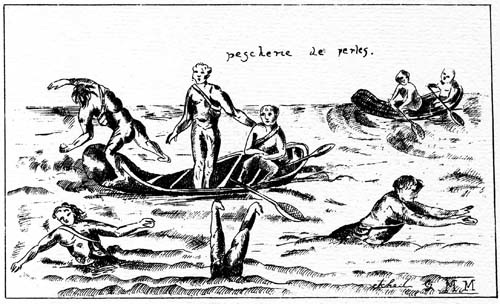
PEARL FISHERY.
BRIEF NARRATIVE OF THE MOST REMARKABLE THINGS THAT SAMUEL CHAMPLAIN OF BROUAGE, OBSERVED IN THE WESTERN INDIES;
DURING THE VOYAGE WHICH HE MADE TO THE SAME, IN THE YEARS ONE THOUSAND FIVE HUNDRED AND NINETY-NINE TO ONE THOUSAND SIX HUNDRED AND TWO,—AS FOLLOWS.
Having been employed in the army of the king, which was in Brittany, under Messieurs the Maréchal d'Aumont de St. Luc, [30] and the Maréchal de Brissac, [31] during some years in the quality of maréchal de logis, [32] until his majesty, in the year one thousand five hundred and ninety-eight, had reduced the said country of Brittany to obedience, [33] and dismissed his army; and finding myself by this means without any charge or employment, I resolved, in order not to remain idle, to find means of making a voyage to Spain, and, being there, to acquire and cultivate acquaintance, in order, by their favour and interposition, to arrange so as to be able to embark in one of the ships of the fleet, which the king of Spain sends every year to the western Indies; to the end, in so embarking, to be able at my return to make a true report to his majesty (Henry IV) of the particularities which could not be known to any Frenchman, for the reason that they have not free access there.
In order, then, to accomplish my design, I went to Blavet, [34] where at that time was a garrison of Spaniards, in which place I found an uncle of mine called "the Provençal captain," considered to be one of the good mariners of France, and who, in that year, had been engaged by the king of Spain as Pilot-General of his sea armies.
My said uncle having received the commands of Monsieur le Maréchal de Brissac, to conduct the ships in which the Spaniards of the garrison of Blavet were embarked, in order to repass them to Spain, as it had been promised, I embarked with him, in a great ship of five hundred tons, named the "Saint Julian," which had been taken, and engaged for the said voyage; and having quitted Blavet in the beginning of the month of August, we arrived ten days afterwards near to Cape Finisterre, which we could not perceive on account of a great fog which arose from the sea, in consequence of which all our vessels were separated, and even our vessel-admiral (admirande), of the fleet was nearly lost, having touched upon a rock, and taken in much water, in which ship (and over the whole fleet) the General Soubriago commanded, having been sent by the king of Spain to Blavet for that purpose.
On the following day, the weather having cleared up, all our vessels rejoined, and we proceeded to the Isles of Bayona, in Galicia, in order to refit the admiral's ship which was much injured.
Having sojourned six days at these islands, we made sail, and three days after came in sight of Cape St. Vincent; having doubled the said cape, we proceeded to the port of Callix (Cadiz), which, having entered, the soldiers were disembarked; and after the landing, the French ships that had been engaged for the voyage, were dismissed, and sent back, each one to its port, excepting the said ship, the St. Julian, which, having been observed by the General Soubriago to be a strong vessel, and a good sailer, was engaged by him for the service of the king of Spain: and thus the "Provençal captain," my uncle, remained still in it; and we sojourned at the port of Callix an entire month, during which I had the opportunity of examining that city.
Departing from the said Callix, we continued to St. Lucar de Barameda, which is at the entry of the river of Seville, where we remained three months, during which time I went to Seville, and took drawings of it, and of the other (St. Lucar de Barameda), which I have judged fitting to represent in the best manner that I could in the following.
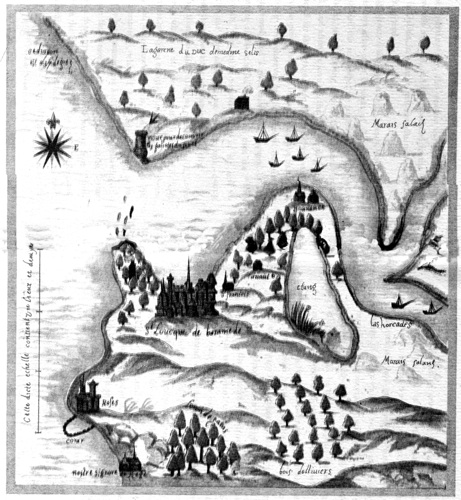
ST LUC DE BARAMEDA.
During the three months that we remained at St. Lucar de Barameda, there arrived a patache, [35] coming from Porto-rico, to inform the king of Spain that the army of England was at sea, with the design of taking the said Porto-rico: upon which advice, the said king of Spain, in order to succour it, had an armament prepared, of the number of twenty ships, and of two thousand men, soldiers, and mariners; among which ships, that named the St. Julian was retained, and my uncle was commanded to make the voyage in it, by which I received extreme joy, promising myself by this means to satisfy my desire: and for that purpose I readily resolved to go with him; but whatever diligence could be made to repair, victual, and equip the said ships, to enable them to put to sea, when at the point of departure, there arrived news by another patache, that it had been taken by the English; in consequence of which, the said voyage was broken off, to my great regret, to find myself thus frustrated in my hope.
Now, at the same time, the armament of the king of Spain, which was accustomed to go every year to the Indies, was getting ready at the said St. Lucar, where there arrived, by command of the king, a noble named Don Francisque Colombe, a knight of Malta, to be general of the said armament, who, seeing our vessel prepared and ready for service, and knowing, by the report which had been made to him, that it was strong and very good under sail for its burthen, resolved to make use of it, and take it at the ordinary freight, which is one crown per ton per month; so that I had occasion to rejoice seeing my hopes revive, and the more so that the Provençal captain, my uncle, having been retained by General Soubriago to serve elsewhere, and thus not able to make the voyage, committed to me the charge of the said ship, to have the care of it, which I accepted very willingly: and upon that we sought the said Seigneur, General Colombe, to know if he would have it for agreeable that I should make the voyage, which he freely granted, with evidence of being well pleased, promising me his favour and assistance, which he has not since denied me upon occasion.
The said armament set sail in the beginning of the month of January, in the year 1599, and the wind blowing always very fresh, in six days after we arrived in sight of the Canary Isles.
Leaving the said Canary Islands, we passed by the Gulf of Las Damas, having the wind astern, so that in two months and six days after our departure from St. Lucar, we got sight of an island named La Deseade, which is the first island that pilots must necessarily recognise in going to all the other islands and ports of the Indies.
This island is round and tolerably high from the sea, and is seven leagues in circumference, full of wood and uninhabited, but there is good anchorage on the eastern side.
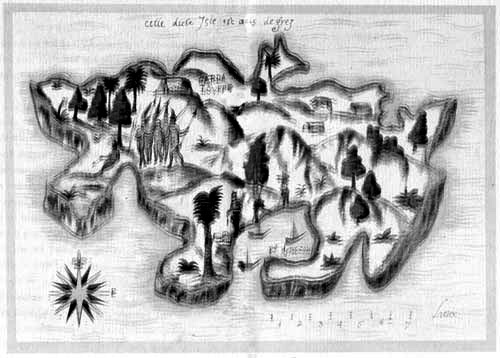
ISLAND OF GUADALOUPE.
From the said isle we passed to another island, called Guadaloupe, which is very mountainous and inhabited by savages; [36] in it there are numbers of good ports, in one of which, named Macou, we took in water, and as we landed we saw more than three hundred savages, who fled into the mountains at our approach, without it being in our power to overtake them, any one of them being more quick in running than any of our men who tried to follow them; seeing which, we returned to our ships after having taken in some water and refreshments, such as cabbages and fruits of pleasant taste.
This island is about twenty leagues in length and twelve in breadth, and its form is shown in the following figure.
After having remained two days in the aforesaid port of Macou, on the third we again put to sea, and passed between islands called Las Virgines, which are in such quantity, that their number cannot be told for certain; but although there are more than eight hundred discovered, they are all desert and uninhabited; the land very high and full of wood, both of palms and ramasques, [37] which are common, like oaks or elms. There are a number of good ports and havens in the said isles.
From these isles we sailed to the island of La Marguerite, where pearls are fished. In this island there is a good town, which is called by the same name, La Marguerite. The isle is very fertile in corn and fruits; every day more than three hundred canoes leave the harbour of the said town, which go about a league to sea to fish for pearls, in ten or twelve fathoms water. The said fishing is done by negroes, slaves of the king of Spain, who take a little basket under their arm, and with it plunge to the bottom of the sea, and fill it with ostrormes, which resemble oysters; then go up again into their canoes, and return to the port to discharge them, in a spot destined for that purpose, when the officers of the king of Spain receive them.
From this island we went to St. Juan de Porto-rico, which we found very desolate; both the town, as well as the castle or fortress, which is very strong; and the port also is very good, and sheltered from all winds, saving the north-east, which blows strait into the harbour.
The town is very mercantile; it had been, shortly before, pillaged by the English, who had left marks of their visit; most of the houses had been burnt, and there were not four persons to be found there, except some negroes, who told us that the merchants of the place had been for the greater part carried off prisoners by the English, and the others, who had been able to escape, had fled into the mountains, from whence they had not yet dared to come back, on account of the apprehension they had of the return of the English, who had loaded all the twelve ships, of which their armament was composed, with sugar, hides, gold, and silver: for we found still in the town quantities of sugar, hides, canifiste, [38] honey of cane, [39] and preserves of ginger, which the English could not take away. They carried off also fifty pieces of artillery of cast iron, which they took in the fortress, into which we went, and found all ruined, and the ramparts thrown down. There were some Indians who had retired there, and had begun to reconstruct the ramparts; the General inquired of them, how the place had been taken in so short a time? One of them, who spoke tolerably good Spanish, said, that neither the governor of the castle, nor the oldest men of the country thought that within two leagues there was any place of landing, according to the report which had been made by the pilots of the place, who had even assured them, that for more than six leagues from the said castle, there was no spot where an enemy could make a descent, which was the cause that the governor kept less on his guard, and in which he was much deceived, for at half a league from the castle, on the eastern side, there was a place where the English landed very conveniently, leaving their ships, which were of the burthen of two hundred, one hundred and fifty, and one hundred tons, in the offing, near the said spot, and took their time so well, that they arrived at night in the roads without being perceived, no one apprehending such a thing. They landed six hundred men, with the design of pillaging the town only, not thinking of making any greater effect, considering the castle to be stronger and better guarded. They brought with them three culverins, to batter the defences of the town, and found themselves at the point of daylight at the distance of a musket shot from it, to the great astonishment of the inhabitants.
The said English placed two hundred men at the passage of a little river, which is between the town and the castle, to prevent (as they did) the soldiers of the guard of the castle, who were lodged in the town, as well as the inhabitants who might endeavour to escape, from entering the fortress; and the other four hundred men attacked the town, where they found no resistance, so that in less than two hours they were masters of it; and having learned that there were no soldiers in the castle, nor any supply of provisions, on account of the governor having, by order of the king of Spain, sent all that had been there to Cartagena, where they thought that the enemy would make a descent, hoping to receive other supplies from Spain, being the nearest port to which their vessels came.
The English summoned the governor, and offered him good terms if he would surrender; if not, that they would make him suffer all the rigor of war; fearing which, the said governor surrendered, on condition that his life should be safe, and embarked with the English, not daring to return to Spain. It was only fifteen days since the English had departed from the town, where they had remained a month.
After their departure, the aforesaid Indians had returned, and endeavoured to repair the fortress, expecting the army of our general, who caused a report to be made of the recital of those Indians, which he sent to the king of Spain, and commanded the Indian who had first spoken, to go and seek those who had fled into the mountains, who, on his word, returned to their houses, receiving such contentment at seeing the general and being delivered from the English, that they forgot their past losses.
The said Island of Porto-rico is pretty agreeable, although it is a little mountainous, as the following figure shows. [40]—It is filled with quantities of fine trees, such as cedars, palms, firs, palmettoes, and another kind of tree which is called sombrade, [41] from which, as it grows, the tops of its branches, falling to the earth, take root immediately, and produce other branches which fall and take root in the same way. And I have seen these trees of such extent that they covered more than a league and a quarter. It bears no fruit, but is very agreeable, having a leaf like that of a laurel and a little more tender.
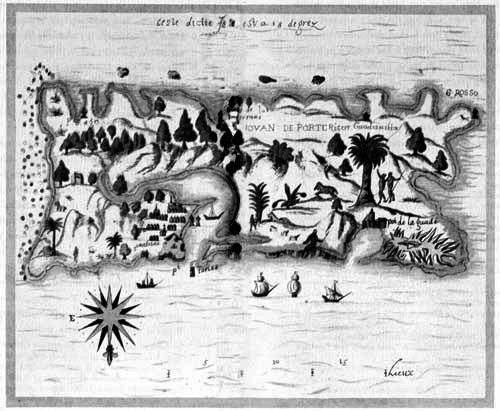
ISLAND OF PORTO RICO.
There are also, in the said island, quantities of good fruits, such as plantes, [42] oranges, lemons of strange size, [43] ground gourds, which are very good, algarobes, [44] pappittes, [45] and a fruit named coraçon, [46] because it is in the form of a heart, of the size of the fist, and of a yellow and red colour; the skin very delicate, and when it is pressed, it gives out an odoriferous humour; and that which is good in this fruit is like thick milk, and has a taste like sugared cream.
There are many other fruits which are not much esteemed, although they are good; there is also a root called "cassave" [47] which the Indians eat instead of bread.
There grows neither corn nor wine in all this island. In it there are a great quantity of cameleons which, it is said, live on air; this I cannot assure although I have seen them many times. It has the head rather pointed, the body somewhat long for its size, that is to say, of one foot and a half, and has only two legs, which are in front; the tail very pointed, the colours mingled grey and yellowish. The said cameleon is here represented. [48]
The best merchandise in the island is sugar, ginger, canifiste, honey of canes, tobacco, quantity of hides of oxen, cows, and sheep. The air is very hot, and there are little birds which resemble parrots, called perriquitos, of the size of a sparrow, with a round tail, and which are taught to speak: there are a great number in that isle.
The said island is about seventy leagues in length and forty in breadth, surrounded by good ports and havens, and lies east and west.
We remained at Porto-rico about a month; the general left about three hundred soldiers, as garrison in the fortress, and caused forty-six pieces of brass cannon, which had been at Blavet, to be placed there.
On leaving Porto-rico our general divided our galleons into three squadrons. He retained four with him, and sent three to Porto-bello, and three to New Spain, of which number was the vessel in which I was; and each galleon had its patache. The said general went to Terra-Firma, and we coasted all the Island of St. Domingo on the north side, and went to a port of the said island, named Porto Platte, to inquire if there were any strange vessels on the coast, because no foreigners are permitted to traffic there, and those who do go there, run the risk of being hung or sent to the galleys, and their ships confiscated; and to keep them in greater fear of approaching the land, the king of Spain gives freedom to any negroes who may discover a foreign vessel and give notice to the general of the army, or to the governor; and there are negroes who would go a hundred and fifty leagues on foot, night and day, to give such notice and acquire their liberty.
We landed at Porto Platte, and went about a league inland without meeting any one, excepting a negro who was preparing to go and give notice, but meeting with us, he went no farther, and informed our "admiral" that there were two French ships at the port of Mancenilla; where the said admiral resolved to go, and for that purpose we left the said Porto Platte, which is a good port sheltered from all winds, and where there are three, four, and five fathoms water.
From the above Porto Platte we proceeded to the port of Mancenilla, at which port we learned that the aforesaid two vessels were at the port of Mosquittes, near La Tortue, which is a little island thus named, opposite the entrance of the said port, where, arriving the next day about three o'clock in the afternoon, we perceived the above two ships, which were putting to sea to avoid us, but too late; seeing which, and that there were no means of escape, the crew of one of the vessels, which was fully a league at sea, abandoned their ship, and having thrown themselves into their boat, escaped to land. The other ship ran aground and broke to pieces, at the same time the crew escaped to land like the other, and there only remained one mariner in it, who, being lame and somewhat ill, could not fly. He told us that the vessels which were lost were from Dieppe.
There is a very good entrance to the port of Mosquittes, of more than two thousand paces in width, and there is a hidden sand-bank, so that it is necessary to keep near to the land on the east side in entering the said port, in which there is good anchorage; there is an island inside where there is shelter from the north wind, which strikes directly into the harbour. This place is tolerably pleasant from the number of trees which grow there; the land is rather high; but there are such quantities of small flies, like chesans, or gnats, which sting in so strange a fashion, that if a man were to go to sleep and should be stung in the face, puffy swellings of a red colour, enough to disfigure him, would rise from the sting.
Having learned from the lame mariner who was taken in the French vessel, that there were thirteen great ships, French, English, and Flemish, half armed for war, half with merchandise, our admiral resolved to go and take them at the port of St. Nicolas where they were, and for that purpose prepared three galleons of the burthen of five hundred tons each, and four pataches. We proceeded in the evening to cast anchor in a bay called Monte Christo, which is very good and sheltered from the south-east and from the west, and is remarkable for a mountain which is straight above the harbour, so high that it can be discerned from fifteen leagues at sea. The said mountain is very white and shining in the sun.
For two leagues round the said harbour the land is rather low, covered with a quantity of wood, and there is a very good fishery, and a good port under the mountain.
The following morning we proceeded to Cape St. Nicolas to seek the aforesaid ships, and about three o'clock arrived in the bay of the said Cape, and cast anchor as near as it was possible, the wind being adverse to our entering.
Having anchored, we perceived the vessels of the above mentioned merchants, at which our admiral rejoiced greatly, being assured of taking them. All the night we did all that was possible to endeavour to enter the harbour, and when morning came, the admiral took counsel of the captains and pilots as to what was to be done. They told him that the worst they had to think of was what the enemies might do to escape; that it was impossible for them to fly, saving under favour of the night, having the wind fair; that, in fact they would not hazard it in the day-time, seeing their seven armed ships; also that if they wished to make resistance, they would place their vessels at the entrance of the harbour, anchored stem and stern, with all their guns on one side, and their tops well fenced with cables and hides, and that if they saw that they were getting the worst, they would abandon their ships, and throw themselves on land. To prevent this, the admiral should advance his ships as near to the harbour as possible, batter the enemies with his cannon, and land one hundred of his best soldiers to prevent their so escaping. This plan was resolved on, but the enemies did not do as it had been expected; for they made their preparations during the night, and when the morning came they set sail and came straight towards our ships, by which they must of necessity pass, in order to get the wind of us. This resolution changed the courage of the Spaniards, and softened their rhodomontades. It was then for us to lift anchor, and with such promptitude, that in the admiral's ship they cut the cable at the hawse-hole, not having time to raise the anchor. So we also set sail, giving and receiving cannonades. At last they gained the wind on us, and we pursued them all day and the following night until the morning, when we saw them four leagues from us, which our admiral perceiving, he abandoned the pursuit to continue our route; but it is very certain that if he had wished he could have taken them, having better ships, more men and munitions of war. The foreign vessels were only preserved by default of courage of the Spaniards.
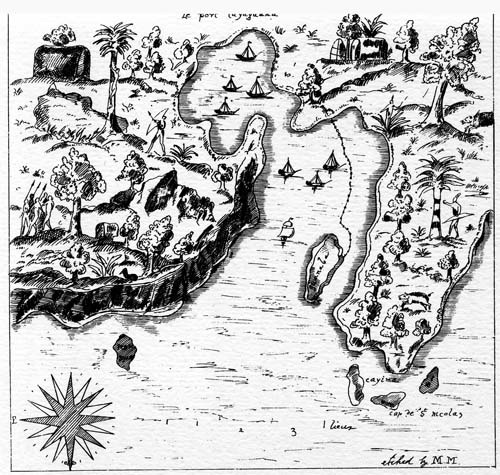
A HARBOUR IN ST DOMINGO.
During this chase, there happened a laughable thing which deserves to be related. A patache of four or five tons was seen mingled with our ships. It was hailed frequently, as to whence it came, with orders to lower the sails, but there was no reply: and although some guns were fired at it, it continued to go before the wind, which moved our admiral to have it chased by two of our pataches, which, in less than two hours, overtook and approached it, calling out always for the sails to be lowered, without any answer; nor would the soldiers board it; although no one was seen at the helm, so that the commander of the pataches said that it was steered by a devil, and forced the soldiers, as many as twenty, by menaces, to go on board, who found nothing; they only brought away the sails, and left the hull to the mercy of the sea.
A report being made of this to the admiral, and of the fright that the soldiers had shewn, it gave matter for laughter to all.
Leaving the island of St. Domingo, we continued our route to New Spain.
The aforesaid island of St. Domingo is large, being one hundred and fifty leagues long, and sixty broad, very fertile in fruits, cattle, and good merchandise, such as sugar, canifiste, ginger, honey of canes, cotton, hides of oxen, and some furs. There are numerous good ports, and good anchorage, and only one town, named L'Espaignolle, [49] inhabited by Spaniards; the rest of the population is Indian, good-natured people, and who much like the French nation, with whom they traffic as often as they can, but this is without the knowledge of the Spaniards. It is also the place where the French trade the most in those quarters, and where they have most access, although with little freedom.
This country is rather hot, and particularly mountainous; there are no mines of gold or silver, but only of copper.
Leaving, then, this island, we coasted along the island of Cuba, on the south side, the land rather high, and proceeded to reconnoitre some small islands, which are called the Caymans, to the number of six or seven. In three of them there are three good harbours, but it is a dangerous passage, on account of the shallows and banks which are there, and it is not good to adventure in it unless the route is well known.
We anchored between the islands, and remained one day; I landed on two of them, and found a very fine and agreeable harbour. I walked about a league inland, through very thick woods, and caught some rabbits, which are in great quantities, some birds, and a lizard as large as my thigh, of a grey and dead-leaf [50] colour. The island is very flat and level, and all the others the same; we also landed on another, which was not so agreeable; but we brought away some very good fruits, and there were such quantities of birds, that at our landing there rose so great a number, that for more than two hours after the air was filled with them: and there were others, which could not fly, so that we took them pretty easily; these are of the size of a goose, the head very large, the beak very wide, low on their legs, the feet like those of a water hen. When these birds are plucked, there is not more flesh on them than on a dove, and it has a very bad taste. We raised the anchor the same day, towards evening, with a very fair wind, and the next day, about three o'clock in the afternoon, we arrived at a place called "La Sonde," [51] a very dangerous place, as for more than five leagues there are only shallows, with the exception of ... [52] leagues in length, and three in width; when we were in the middle of the said channel, we lay to, and the sailors cast out their lines to catch fish, of which they took so large a quantity, that they could not find room enough for them on board the ships. This fish is of the size of a dorade, [53] of a red colour, and very good if eaten fresh, for it will not keep, or salt, but becomes putrid shortly. The lead must be always in hand in passing through this channel; on leaving which, one of our pataches was lost at sea, without our knowing the cause; the soldiers and mariners saved themselves by swimming, some on planks, others on oars, others as they best could, and returned from more than two ... [54] to our ship, which they met with very à propos, and we picked them up in our boats which were sent out for them.
Eight days afterwards, we arrived at St. Jean de Luz, [55] which is the first port of New Spain, where the galleons of the king of Spain go every year to be laden with gold, silver, precious stones, and cochineal, to take to Spain.
The said port of St. Jean de Luz is fully four hundred leagues from Porto-rico. On the island, there is a very good fortress, as well by its situation, as by its good ramparts, well furnished with all that is necessary; and there are two hundred soldiers in the garrison, which are enough for the place. This fortress comprises all the island, which is six hundred paces long, and two hundred and fifty paces wide; besides which fortress there are houses built on piles in the water; and for more than six leagues at sea, there are only shallows, which cause that ships cannot enter this port, if they do not well know the entrance of the channel, for which entrance you must steer to the south-west; but it is certainly the most dangerous port that can be found, and there is no shelter, excepting on the north side of the fortress; in the walls of the fort are numerous rings of bronze, where the vessels are moored, which are sometimes so crowded together, that when it blows from the north, which is very dangerous, the said vessels are much crushed, although they are moored fore and aft. [56]
The said port is only two hundred paces in width, and two hundred and fifty in length. The place is only kept for the convenience of the galleons which come, as it has been said, from Spain, to load with the merchandise, and gold and silver, which are drawn from New Spain.
On the other side of the castle, and about two thousand paces from it, on terra firma, there is a small, but very trading town, called Bouteron. At four leagues from the said Bouteron, there is also another town, named Vera-Crux, which is in a very fine situation, and two leagues from the sea.
Fifteen days after our arrival at the said St. Jean de Luz, I went, with the permission of our admiral, to "Mechique" (Mexico), distant from that place one hundred leagues, always going inland.
It is impossible to see or desire a more beautiful country than this kingdom of New Spain, which is three hundred leagues in length, and two hundred in breadth.
Making this journey to "Mechique," I admired the fine forests, filled with the most beautiful trees that one could wish to see, such as palms, cedars, laurel, orange, and lemon trees. Palmistes, gouiave, accoiates, [57] good Bresil, [58] and Campesche wood, which are all trees common to the country, with an infinity of other kinds, that I cannot recite on account of their diversity, and which give such contentment to the sight, with the quantities of birds of divers plumage, which are seen in the forests, that it is not possible to feel more. Next are met large level plains as far as the eye can see, with immense flocks of cattle, such as horses, mules, oxen, cows, sheep, and goats, which have pastures always fresh in every season, there being no winter, but an air very temperate, neither hot nor cold. It only rains twice in the year, but the dews are so heavy at night that the plants are sufficiently watered and nourished. Besides that, the whole of the country is ornamented with very fine rivers and streams, which traverse almost the whole of the kingdom, and which, for the greater part, are navigable for boats.
The land is very fertile, producing corn twice in the year, and in as great abundance as can be desired, and, whatever season it may be, there are always very good and fresh fruits on the trees; for when one fruit arrives at maturity, others come, and thus succeed one to the other; and the trees are never devoid of fruit, and are always green.
If the king of Spain would permit vines to be planted in this kingdom, they would fructify like the corn; for I have seen grapes produced from a stock which some one had planted for pleasure, of which every grain was as large as a plum, as long as half the thumb, and much better than those of Spain.
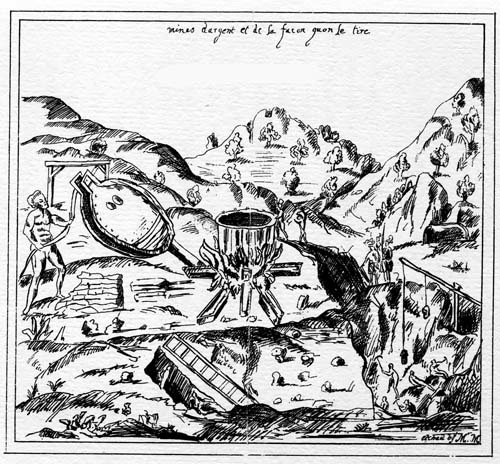
A SILVER MINE.
But all the contentment that I had felt at the sight of things so agreeable, was but little in regard of that which I experienced when I beheld that beautiful city of Mechique, which I did not suppose to be so superbly built, with splendid temples, palaces, and fine houses; and the streets well laid out, where are seen the large and handsome shops of the merchants, full of all sorts of very rich merchandise.
I think, as well as I can judge, that there are in the said city, twelve thousand to fifteen thousand Spanish inhabitants, and six times as many Indians, who are Christians, dwelling there, besides a great number of negro slaves.
This city is surrounded almost on every side by a lake, with the exception of one part, which may be about three hundred paces in length, which can be cut and fortified. On this side only is there anything to be feared, as on all the other sides it is more than a league to the borders of the lake, into which fall four great rivers from far inland, and navigable for boats. One is called the river of Terra-Firma; another the river of Chile; another the river of Cacou; and the fourth, the river of Mechique, in which great quantities of fish are caught, of the same kind as we have with us, and very good. Along this river are a great number of fine gardens, and much arable land, very fertile.
Two leagues from the said Mechique there are silver mines, which the king of Spain has farmed out for five millions of gold a year, and he has reserved also the right of employing a great number of slaves, to get from the said mines as much as he can, for his profit; and he draws besides the tenth part of all that the farmers get, so that these mines are a very good revenue to the said king of Spain.
A great quantity of cochineal is gathered in this country, which grows in the fields as peas do elsewhere. It comes from a fruit the size of a walnut which is full of seed within. [59] It is left to come to maturity until the said seeds are dry, and then it is cut like corn and beaten to have the seed, of which they sow again so as to have more. It is the king of Spain alone who has the said cochineal sown and collected; and the merchants must buy it of his appointed officers, for it is merchandise of high price, and is esteemed as gold and silver.
There is a tree in the said country which is cut like the vine, and from the place where it is cut there distils an oil, which is a kind of balm, called oil of canima, from the name of the tree which is so called. [60] This is a singular oil for all sorts of wounds and cuts, and for removing pains, principally of gout. The wood has the odour of fir-tree wood. An ounce of the said oil is worth and sells for two crowns.
There is another tree, which is called cacou, [61] the fruit of which is very good and useful for many things, and even serves for money among the Indians, who give sixty for one real; each fruit is of the size of a pine-seed, and of the same shape; but the shell is not so hard; the older it is the better; and to buy provisions, such as bread, meat, fish, or herbs, this money may serve for five or six objects. Merchandise for provision can only be procured with it from the Indians, as it is not current among the Spaniards, nor to buy often other merchandise than fruits. When this fruit is desired to be made use of, it is reduced to powder, then a paste is made, which is steeped in hot water, in which honey, which comes from the same tree, is mixed, and a little spice; then the whole being boiled together, it is drunk in the morning, warm, as our sailors drink brandy, and they find themselves so well after having drunk of it, that they can pass a whole day without eating or having great appetite. [62]