NARRATIVE, &c. &c. (continued 2)
Reading edition
111
When Mr. Hearne travelled to the N. W. in search of the long-sought passage to the Southern Ocean, he was escorted by a party of Cree Indians, and was himself an eye-witness of the massacre of an Esquimaux tribe; although he used his most earnest entreaties with his conductors, to spare an innocent-looking young girl who had supplicated his protection: the Indians frowned furiously upon him; and asking, with haughty contempt, if he wanted an Esquimaux wife, they speared her to death on the spot[17].
It is rather remarkable, that the habitations of the Esquimaux had never before been visited by the officers of the Hudson’s-Bay ships, although they had often landed in the Straits: but this may be explained in two ways. In the first place, the 112 Esquimaux are evidently anxious to conceal their places of abode; secondly, the commanders of the Hudson’s-Bay ships have directions from the Company not to go on shore amongst the Esquimaux themselves, nor to send their boats; and they have orders also to be continually on their guard, in all communications with this people. Possibly these orders have been issued since the horrid termination of an attempt to establish a permanent white whale fishery at Richmond; and probably that circumstance may have given rise to the regulation. I shall relate the dreadful story in the sequel, when I reach that part of my Narrative where it will be necessary to give a short description of the factories in Hudson’s Bay: it would be considered as too long a digression to insert it at present. We had the good fortune, therefore, to be the first Europeans who, for the last forty years, have visited the 113 habitations of the Esquimaux. I have thus been enabled to describe them fully, from my own observations. And there is another point upon which I am able to speak positively, although the circumstance did not fall under my own inspection: I allude to the manner of disposing of their dead.
His Majesty’s ship Brazen, Captain Stirling, in the year 1813, convoyed the Hudson’s-Bay ships into the Bay. Captain Stirling and some of his officers landed in the Straits, but could not find any habitations of the natives: however, in wandering about the hills, they discovered an object of no less curiosity; namely, the dead body of an Esquimaux: it was closely wrapt in skins, and laid in a sort of gully between two rocks, as if intended to be defended from the cold winds of the ocean: by the side of the corpse lay the bow and arrows, spears, and harpoon of the deceased; together with a tin pot, 114 containing a few beads and three or four English halfpence: the last articles had evidently been procured by the deceased in traffic with the Company’s ships.
The reason of the body having been laid on the surface of the earth, is in consequence of the impossibility of penetrating the flinty rock, of which the whole coast is composed; and the custom of depositing his arms by the side of the corpse of a deceased Indian, is common to many barbarous nations.[18]
115
As it may be expected that something should be said respecting the government and religion of the Esquimaux, I shall briefly state, that they did not appear to me to trouble their heads with either. They certainly paid great respect to the old man who sang to us the song before mentioned; but it does not necessarily follow that he was either a prince or a priest. It is probable that they venerated him more on account of his age, than from any civil or ecclesiastical authority with which he was invested. But the Esquimaux, and all other nations around Hudson’s Bay, have a notion of a superior spirit, whom they concur in styling Manéto, or Good Spirit. It is not known whether the Esquimaux have any idea of an Evil Being; but the Cree Indians imagine that there is a great number of that species, whose sole delight consists in tormenting mankind[19].
116
With respect to the language of the Esquimaux, I have been able to collect a few specimens: and I shall insert, against each word, in what part of the coast each expression was ascertained to be in use, and the authority from whence I derived my information.
Words. Signification. Where used. Authority.
Chymo Barter. On the shores of Hudson’s Straits. Ascertained by myself.
Pillitay Give me something.
We-we A white goose.
Wau-ve An egg.
Muck Mhameek A knife.
Kippy Swau, beck A saw.
Muck-tu A deer.
Twau-ve Go away—begone.
Tuck-tu Seal blubber.
Kiack Canoe. Churchill, and in Hudson’s Straits. Ascertained by one of the most respectable Traders belonging to Churchill Factory.
Omiack A ship.
Kannau weet ameg A dart.
Ye meck Water.
Hennelay A woman.
Aunay Far off.
Cob-loo-nak An Englishman. Churchill Factory.
Mai Good.
Nagga Mai Not good.
Karrack Wood.
Peo-me-wonga I would have. By the Natives of the Missionary Settlement. By the German Missionary before mentioned.
Ak-ka-karor mapock It shall have payment.
117
Having given a short account of the Esquimaux, their manners, and customs, I may now proceed with my Journal as before; and content myself with making a few cursory remarks, as we sail along.
August 1st.—The whole of this day we continued off Saddle Back[20]; as the Hudson’s-Bay ships had some arrangements to make, previous to their final separation, which always takes place off Mansfield Island, at the entrance of Hudson’s Bay. Towards evening, we began to ply to windward, with a fresh breeze at west. Thermometer 40° in the shade.
August 2d.—Beating to windward with a strong breeze, in the afternoon we hove-to off Icy Cove, about a mile to the westward of two remarkable hills, called the 118 Virgin’s Paps, which last lay nine leagues to the westward of Saddle Back. On firing a gun and hoisting our colours, we were immediately visited by another party of Esquimaux: there was no difference whatever in their appearance from those we had seen before. One of our officers purchased a canoe of a native, for which he paid a kettle, a lance, a saw, and a spoon. Our curiosity was considerably excited, to observe in what manner this man would contrive to reach the shore; and we really entertained serious apprehensions for his safety, when we perceived him stretch himself out upon his belly on another canoe, at the back of the man who used the paddle. He was in this dangerous position conveyed to land, not daring to lift his head, through fear of destroying the equilibrium of the canoe; which did not swim two inches above the surface of the sea.
119
After night-fall, we were compelled to tack ship about, to avoid a large patch of floating ice.
August 3d.—We continued plying to windward all this day; and in the evening we had reached Upper Savage Island. It lays about twenty-three leagues to the west of Saddle Back, in an opening which has never been explored. Thermometer 32° in the sun.
August 4th.—Towards the evening of this day we had a fair wind, the ship butting her way through immense quantities of ice. Passed by a bluff cape, called Point Look-out. This cape is eight leagues to the west of Upper Savage Island. We saw a number of Esquimaux following us among the windings of the loose ice. These poor creatures laboured hard to overtake us, hallooing and shouting “Chymo!” but we were 120 now exceedingly anxious to get forward, and therefore could not wait for them; at which their disappointment must have been great.
August 5th.—This morning forcing our way with difficulty through the ocean of ice that surrounded us; at length, being enveloped in a thick fog, and the wind dying away, we lashed our ship to a large piece of ice; and firing three guns as a signal for our convoy to do the same, we were astonished at the effect produced by the cannon, The explosion issued like thunder over the ice; then appeared to roll rumbling back towards the ship; bellowing forth again in tremendous peals. The echo died away in distant reverberation.
Shortly afterwards, we imagined that we could distinguish the sound of voices through the fog: we immediately beat the 121 drum, to point out our situation; and, in a few minutes, we plainly heard the shouting of the Esquimaux: they soon came alongside the ship, with the usual expressions of delight. It is really surprising that this people should venture so far from the land, in such frail barks, through a mass of ice which is enough to daunt an European, even in a stout-built ship.
The fog clearing away, we cast the ship loose, and endeavoured to force our way forward among the ice; until, from its increasing consolidation, we were again obliged to lash to a large piece of it. This operation is called grappling; and it is performed by running the vessel alongside of the piece of ice to which it is intended to make her fast: two men then leap on the ice: the one runs, with a sort of pickaxe, to dig a hole in it, using the precaution to stand with his back to the ship; and the 122 other man follows the first, with a serpent-like iron on his back, having a strong rope affixed to one end of it: this serpent (or ice-anchor, as it is termed) is hooked into the hole on the ice, and the rope is fastened on board the ship. Other ice-anchors and ropes are then hooked to different parts of the piece of ice; and the number of ropes is varied according to the state of the weather. In a gale of wind, we had generally five anchors a-head; and with a moderate breeze, not more than two. The whole manœuvre of grappling is generally accomplished in five minutes; and although the ship be lashed to windward of a clump of ice, yet the action of the wind on a vessel’s masts, yards, &c. turns the ice round, and she will consequently soon be under the lee of it, with water as smooth as a mill-pond.
We were employed this evening in filling 123 our casks from a pool of snow-water on the ice; and our people were highly diverted with running upon it, leaping, playing at foot-ball, and shooting at seals. At length, four of the seamen were so imprudent as to venture on a sort of peninsula which projected from the main body of the ice; when the isthmus instantly gave way, leaving them adrift on a small piece that was barely sufficient to sustain their weight. It was long after night-fall, and with the utmost exertion and difficulty, that we succeeded in getting them safe on board again, by the help of a boat.
August 6th.—In the middle of the night, the prospect from the ship was one of the most awful and sublime that I ever remember having witnessed, during a life spent entirely upon the ocean: and I regret that no language of mine can give an adequate idea of the grandeur of the scene. 124 As far as the eye could reach, a vast alabaster pavement overspread the surface of the sea, whose dark blue waters could only be seen at intervals, where parts of the pavement appeared to have been convulsively torn up, and heaped upon each other in ruined fragments. The snow-white surface of this immense plain formed a most striking contrast to the deep black clouds of a stormy night; through which, uninterrupted flashes of forky lightning succeeded each other with great rapidity, as if intending, by their fiery glare, to shew to us the horrors of our situation, and then to magnify them by leaving us in utter darkness. Add to this, the reiterated peals of thunder that burst forth, in a thousand roaring echoes, over the surrounding ice; also the heavy plashing of the rain, which poured down in torrents; the distant growling of affrighted bears, the screams of sea-birds, and the loud whistling of the wind;—the whole forming a 125 midnight prospect which I would have gone any distance to see; but having once beheld, never wish to witness again.
In the morning, we were surprised by the appearance of two Esquimaux, who had contrived to reach the ship, although we were at least seven leagues from the land, and the ice closely hemming us round on all sides: the Indians had effected their passage by dragging their canoes over the different fields of ice which obstructed their progress. At 4 A.M. we got under sail; as there appeared a possibility of our pushing through, the ice having loosened a little; however, we looked in vain for an opening. The ship running fast, with a fair breeze, struck violently upon a large field, and the shock fairly lifted up her bows. We continued butting through until 8 A.M. when we grappled to a large field of ice, as an impenetrable mass now 126 presented itself on all sides of us: the wind shifted into the N. W. and blew a heavy gale, accompanied by drifts of snow and sleet. We lay in this position all night, closely hemmed in, with five ice-anchors a-head. An inspection being made by the carpenter, he found that the heavy shocks which the ship had received this day had started the ceiling about her bows, and also twelve or fourteen of the trunnels.
August 7th.—During the whole of this day, we continued closely wedged in by the ice. It blew a hard gale from the west, attended by a heavy fall of snow and sleet. The loose ice was incessantly varying its position: at one time, we were so closely hemmed in as to be hardly able to discern any water; then, suddenly, the ice would again open to a considerable distance. This is easily accounted for; as the light pieces of ice drift much faster before the wind 127 than the heavier masses, which are deeper in the water: it will naturally occur, therefore, that the three ships would alter their position, according to the size of the clump to which they were fastened. The Eddystone was three miles to the east of us last night; and at sunset this evening, she was as far to the west; yet that ship was still grappled to the same piece of ice as before; and, from the coagulated mass which surrounded us, one would have been led to conclude that the relative distance from each other could not have been so easily altered: but it varies according to the depth and solidity of the ice to which the ships are affixed.
August 8th.—In the forenoon, the snow ceased to fall, and we had a finer day. Latitude, by an observation at noon, 62°. 54′. N. The ice loosened considerably in the course of the day, but not sufficiently for us to 128 get under sail. At night-fall, we lost sight of the Eddystone, to the west.
August 9th.—The day had just began to dawn, when an animal was observed swimming near the ship: we at first conjectured it to be a seal, and accordingly sent a quarter-master over the ice, to knock it on the head, if it attempted to get upon it; but the man was fain to make a rapid retreat, when he discovered the form of a prodigious bear emerging from the water. This enormous creature came close to the ship’s head; and had I been armed with a pistol only, it would have been easy to have dispatched him; but during the time we were all bustling for a musquet, the bear marched up the field of ice. Mr. Wells, a young midshipman, and myself, instantly pursued him, by different routes; but the grey of the twilight was favourable to him; and his hide being but a shade or two 129 deeper than the ice itself, he escaped unseen. We afterwards traced his footsteps to the edge of the ice, opposite the spot where he landed, and he must therefore have replunged into the sea from that place. I mention this circumstance to shew in what manner these animals contrive to procure subsistence: they swim, during the night, in the quiet manner now described; and drawing close to a piece of ice, they immediately smell if there be any seals upon the top of it; in which case they ascend gently on the opposite side, and suddenly springing upon the sleeping seal, they instantly tear it in pieces.—As this proved to be a fine day, we drew our seamen out upon the ice, and exercised them by firing at a target. Towards evening the ice began to loosen considerably.
August 10th.—A fine day; but the ice still close. Wind remains at N. W. During 130 the last twenty-four hours, the Eddystone again appeared in sight; and towards evening, she again neared us considerably. We believed this to be owing to her having got into a southerly current. Our latitude this day was 62°. 50′. N.; and at night-fall the thermometer stood at 28°.
August 11th.—At 4 A.M. ungrappled, and got under sail, with a fair wind, running a zig-zag course amongst the ice; the ship, at intervals, striking excessively hard. Towards evening, we again grappled to a piece of ice; and, upon inspection, we found several more trunnels started, and the ship much shaken, by her repeated blows. The Admiralty must certainly have been deceived by the Hudson’s-Bay Company, respecting a Voyage to Hudson’s Bay; or they certainly would never have sent a ship of war to perform it, without previously strengthening her for the 131 occasion. It is exceedingly dangerous for any ship to attempt a passage through the sea of ice in Hudson’s Straits, unless her bows be doubled with oak-plank and heavy blocks of wood, bolted to each side of her cutwater; as the floating masses of ice may be considered so many rocks of crystal.
This day, in a vacancy between the ice, we saw the first regular whale. On his second rising to blow, I discharged a load of small shot into his back; at which, however, he did not even seem to feel the least annoyance, though we saw him no more.
August 12th.—At day-light, ungrappled, with a light wind at south; but, to our great mortification, we were again obliged to anchor, at noon, to a field of ice about half a mile long; and both the other ships made fast to the same piece, so that we could 132 walk across the ice to visit each other. Our people were immediately set to work; and in three hours’ time, we had filled fifty-six casks with snow-water, from a large pond on the ice. We had Charles’ Island in sight, bearing W. N. W. about nine leagues distant. This small island is on the southern shore of the Straits, in the narrowest part; the channel there not being above twenty miles broad. Charles’ Island lies about twenty-one leagues to the west of Lady Lake’s Inlet; and hence the ships leave the northern shore, and steer for the south end of Salisbury Island, lying off Cape Diggs, at the western extremity of Hudson’s Straits.
The ice continuing very close all around us, we were compelled to remain in this situation, without ungrappling, for five days; in which nothing occurred worthy of notice.
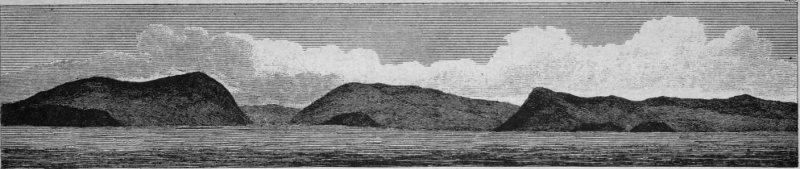
Appearance of the Entrance of Prince of Wales’s Sound, bearing S.W.½W. about nine leagues.—taken August 17, 1814.
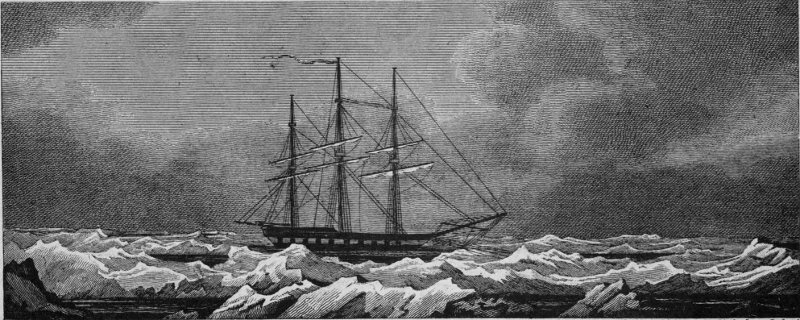
The Rosamond grappled among close Ice.
133
August 17th.—In the morning, we were opposite a deep inlet, called Prince of Wales’s Sound, on the southern shore of the Straits, which has never been explored. All this coast, as well as the northern shore, is fringed with islands; the principal of which are called King George, Prince of Wales, Maiden’s Paps, and Mannil’s Islands; and they doubtless afford shelter to many fine harbours.
August 18th.—We did not grapple during the night, but hove to, for about two hours, whilst it continued dark; and at day-light we again bore up, and continued running through loose ice. Towards noon it fell nearly calm: we observed seven large seals, basking on a piece of ice; but as soon as we approached them in a boat, they rolled into the water, and disappeared. We were visited by two Esquimaux in the afternoon: they had nothing remarkable about 134 them, except that their mustachios were rather more bushy than those we had seen before. In the evening it fell quite calm, and we grappled.
August 19th.—During the night, the other ships had fallen considerably to the eastward; but the wind coming round to the south-west, we ungrappled, and waited for their coming up. Queen Anne’s Foreland, a high cape on the north shore, bore E. N. E. nine leagues; and although at so great distance, we were visited by three canoes of Esquimaux, bringing their usual commodities for traffic. Our latitude this day was observed to be 63°. 38′. N.; longitude, 72°. 45′. W. We grappled again in the evening, and lay so until—
August 21st.—At 2 A.M. was presented one of those awful appearances which are so common in these hyperborean regions. 135 The water, for some distance around the ship, had, for a time, been partially cleared of the ice; when, on a sudden, a noise was heard like very distant thunder, and the crackling of falling beams in some immense conflagration. The loose ice, which had appeared so distant before, now approached on all sides with an unusual rapidity; the pieces driving one over another in their course, and seeming to menace the destruction of our ship. In ten minutes we were completely hemmed in, on all sides; and a person might travel for miles over a space which had just before been an expanse of water. The ice must have been forced together by some extraordinary meeting of the currents, as there was but a slight breeze at the moment.
At noon, the wind became fair: we ungrappled, and steered through loose weighty ice until 8 P.M. when a thick fog came on, 136 and we again grappled for the night. About 10 P.M. the deep darkness of the sky was suddenly changed to a bright twilight; and having continued so for about five minutes, it again relapsed into its former gloom. This singular appearance was occasioned by a streamer of the aurora borealis bursting through the thick fog which surrounded us.—Thermometer 29°.
During our stay in Hudson’s Bay, and upon our voyage home from thence, our nights were constantly illuminated by the most vivid and brilliant coruscations of the aurora borealis. Its appearance was very different from that which I have seen in more southern latitudes; resembling continual jets of meteoric fire from the northern part of the horizon, which, after darting upwards in long streamers towards the zenith, suddenly collapsed, and receded; falling back, in zig-zag, serpentine lines, with 137 diminished splendour; and ultimately dying away, and vanishing from the sight; being succeeded by other jets, as beautiful as the first. The Cree Indians inhabiting Hudson’s Bay, and indeed the European traders there, maintain, that, in the serene stillness of their severe winters, a soft rushing noise constantly accompanies these coruscations, like that which is occasioned by the quick waving of a fan, or of a winnow. The same remarkable circumstance is mentioned by Hearne, who bears positive testimony to the fact. “I can positively affirm,” says he[21], “that in still nights I have frequently heard the northern lights make a rustling and crackling noise, like the waving of a large flag in a fresh gale of wind. This is not peculiar to the place of which I am now writing (the Athapusco Lake), as I have heard the same noise very plain 138 at Churchill River: and, in all probability, it is only for want of attention that it has not been heard in every part of the northern hemisphere, where these lights have been known to shine with any considerable degree of lustre.”
August 22d.—Early in the morning we again ungrappled. The reader of this Journal may easily conceive that, by this time, our impatience was at its height, as we had now been nearly a month incessantly occupied in endeavouring to push our ship through the never-ending drifts of ice in Hudson’s Straits. I shall not, therefore, attempt to describe the joy of every person on board, when at 8 A.M. we emerged into an open sea, and, the wind blowing tolerably fresh, at ten we passed by Charles’ Island. At noon, we had lost sight of both land and ice; and we now sailed forwards at a great rate, with both our ships in 139 company. Towards night-fall, we passed by a low level island, called Salisbury Island, which lies at the entrance of Hudson’s Bay.
August 23d.—In the morning, passed to the southward of Nottingham, a long rocky island, lying north of Cape Diggs. I know not if Salisbury and Nottingham Islands are inhabited by the Esquimaux; but it is natural to suppose that this people visit them occasionally, during their periodical voyages. At 8 A.M. we were off Cape Walsingham, which is only remarkable for its being the north-west promontory of Labrador, and having a string of small islands running from it towards the sea.
In the afternoon, the Eddystone parted company; as that ship was bound for Moose Factory, at the southernmost extremity of the bay; whilst we intended to proceed with the Prince of Wales to York Factory, on the 140 western side. And now, having brought the ship safely through these formidable Straits, and conducted her into the immense gulf of Hudson’s Bay, we will leave her for a while to pursue her voyage, and take an excursion round the Bay, in order to give some short description of its factories, inhabitants, &c.
Amongst the many adventurous naval enterprises which reflect such lustre upon the last years of Queen Elizabeth, and the beginning of the reign of James the First, none, perhaps, can surpass, in intrepidity and perseverance, the voyages of Henry Hudson; undertaken for the express purpose of effecting a north-west passage to the Pacific Ocean. All that I have been able to collect respecting this brave but unfortunate man is, that he sailed in the year 1610, and discovered the Straits which now bear his name. He boldly pushed his 141 way through them; and finding that, after a length of six hundred miles, he emerged into an open sea, his heart beat high with exultation on having, as he doubtless imagined, succeeded in discovering that famous passage for which so many had sought in vain[22]. Sailing forward, therefore, four hundred miles towards the west, his disappointment was great, at finding himself suddenly stopped, in the midst of his career, by an unknown coast, extending (as has since been ascertained) from 51° to 63° N. latitude. However, the spirit of Hudson was not easily checked; and, astonishing as it may appear, he determined on remaining the whole winter on this dreary coast, so that he might be able to prosecute his voyage early in the ensuing spring. After suffering innumerable hardships, this daring adventurer sailed, early in the next year, towards the north, in search of the much-wished-for 142 outlet to the Pacific; but his crew, not feeling the same enthusiasm which animated their leader, and greatly fearing lest his ardent thirst for discovery might expose them to the horrors of another winter, or, what was still worse, to the chance of perishing amidst the terrific mountains of ice with which they saw themselves to be surrounded, they accordingly proceeded from murmurs to open mutiny; and having turned the heroic Hudson adrift in a small boat, together with the few who adhered to his fortune, they basely left their leader to perish, and sailed away for England, where they arrived in safety. As for the unhappy Captain, I grieve to add, that he was never afterwards heard of: neither have we the poor consolation of knowing that his murderers met with the punishment due to their inhuman crime. There can be no doubt that Hudson’s Bay would have remained much longer unexplored, had it not so happened that the 143 winter preceding the year in which the discovery was made must have been remarkably mild; consequently, Hudson could not have met with many obstacles in passing through the Straits;—no seaman would have endeavoured to penetrate farther, if he had found them so completely blocked up with ice as to impede a ship’s progress, even with the advantage of a favourable wind attending her;—and that this was the case with us, will appear evident, from a perusal of the preceding part of this Journal.
The Hudson’s-Bay Company’s charter is said to confirm to that body the whole and sole right of trading with the Indians, within the limits of Hudson’s Straits; and they have no less than six factories established at the mouths of as many different rivers, which empty themselves into the Bay. The northernmost of these factories is called Churchill: it stands on the 144 west side of the Bay, in latitude 58°. 50′. N.; longitude, 93°. 4′. W. The port is tolerably good, and ships of any size may anchor in it. At the entrance is a danger, called Cape Mary’s Rock; but it is easily to be avoided. On entering Churchill River, ships pass between two points of land. One of them forms a sort of peninsula; and it has a large strong fort of stone upon it, the erection of which is said to have cost the Hudson’s-Bay Company 30,000l.: it was formerly mounted with twenty 32-pound guns. The opposite Cape (Mary) has also a small battery, which formerly had six guns on it; yet, with the most culpable pusillanimity, did the traveller Hearne (who acted as chief at that time) yield this strong position to the French Admiral La Perouse, without so much as attempting a defence; who, in the year 1782, spiked the cannon, and destroyed the factory. Since that time, the fortifications of Churchill have been suffered to remain 145 in their present dilapidated state; and, as a trifling security against any sudden invasion in future, the new factory was erected at a short distance higher up the river. It is matter of surprise, that the Company do not repair the large stone fort, which is made uncommonly strong, both by nature and by art. As it stands upon the extremity of a peninsula, a body of men passing the isthmus to attack it by land, would be completely exposed to the enfilading fire of the fort. It would be difficult also for an enemy to force the gates, because there is a small half-moon battery built on that side, expressly for their defence. Besides, there are dwelling-houses in the interior of the fort, sufficiently large for the reception of the whole factory.
The shore about Churchill River is high and rocky, producing only a very few insignificant trees and shrubs. Farther north, towards the country of the Esquimaux, this 146 small vestige of vegetation dwindles away even to a simple bush or two, and these are only to be found at a considerable distance from each other.
Proceeding southward, towards a more genial country, we arrive at York Factory, standing upon low swampy ground, completely covered with wood: its latitude is 57°. 2′. N.; longitude 92°. 40′. W. This place was also visited by the French in 1782, who burnt the factory, and destroyed a small battery at the entrance of Hayes’ River. But Perouse was grievously disappointed in the chief object of his voyage: and as it is so intimately connected with the subject on which I am writing, perhaps it will not be thought improper to describe the disappointment which the French suffered in the expedition; particularly as the fitting-out of the squadron must have cost the French nation much money; and their 147 burning a few miserable mart-houses in Hudson’s Bay could only injure individuals, and most probably was not felt at all by the public.
Perouse entered Hudson’s Bay in 1782, having under his command a line-of-battle ship and two large frigates. With this force he of course insured the capture of the annual ships, together with their rich cargo of furs, oil, &c.; and as the escape of the three ships does high honour to the skill and intrepidity of their commanders, it is well worthy of notice. The ship which was bound to Churchill, was commanded by Captain Christopher; and the French admiral fell in with her at sea, just previous to her arrival at that place. A frigate was immediately dispatched in pursuit; but the night drawing on apace, Captain Christopher resolved on a bold manœuvre, which he accordingly carried into execution with 148 great success. Perceiving that the Frenchman was ignorant of the coast, and, by his following the English ship, that he was determined to govern his own vessel by her motions,—whereby he hoped to avoid all danger, and in the end secure his prize,—Captain Christopher sent his men aloft, and furled his sails, pretending to come to an anchor. The enemy immediately conjectured that it would be dangerous for him to proceed farther; therefore he directly brought his frigate to anchor in reality. Captain Christopher rejoiced that his deception had so far succeeded to his wishes; and he made sail to sea with the greatest dispatch. Night coming on, and the Frenchman being a long time in getting up his anchor, the Englishman was soon out of sight, and escaped in safety to the northward. Fired with this disappointment, Perouse burnt the factory; and proceeded to York, to secure the other ship, then lying 149 at that place, under the command of Captain Fowler. As there was not depth of water sufficient for his ships to enter York, he anchored in Nelson River, and made every disposition for an attack upon the ship and factory by the dawn of the next day; but, to his utter mortification, he found in the morning that the bird had taken wing;—for Captain Fowler had perceived three large ships at anchor in Nelson River the evening before, and, wisely conjecturing that they could have no good intentions towards him, put to sea during the night. Perouse dispatched a fast-sailing frigate in search of him, which soon had sight of the runaway; but Captain Fowler finding the Frenchman to have much superiority in point of speed, tacked about, and stood in for the land to the south of York, hoping thereby to entice the Frenchman into shallow water: the enemy, however, discovering his design, and fearing lest, 150 in further pursuit, he might incur the risk of shipwreck, put off to sea; and Captain Fowler pursued his voyage to England in safety. The season was too far advanced to attempt any other exploit; and having therefore burnt the factory at York, Perouse returned to Europe; highly chagrined, no doubt, at being thus foiled by a pair of English sailors, and at having failed of success in the principal aim of his expedition. As there are many shoals and dangerous rocks in James’ Bay[23], he did not think fit to send a ship to destroy the southern settlements: and to the credit of this unfortunate navigator, I must state, that he publickly averred, if he had been aware of the factories being the property of individuals, he would assuredly have quitted them without molestation. It is remarkable that the Bay ship (as she is called) got safe to Moose 151 Factory, and returned to England, without being at all aware how very narrowly she must have escaped falling into the hands of the enemy.
The next factory to the south of York is called Severn; but the shore at this place runs off much too shoal to allow a ship to approach the coast; therefore a schooner of about eighty tons is employed to take the furs to York, and to bring back the necessary supplies. This is also the case with Albany, the next factory towards the south; except that the latter place sends its furs, &c. to Moose, instead of York Factory.
At the very bottom or southernmost part of Hudson’s Bay, which is styled James’s Bay, we arrive at Moose Factory; standing, like all the rest, on a river, bearing the same name. This place has a good anchorage, and the climate is 152 milder than in any of the other factories. It is annually visited by a ship from England; as at Moose the furs are collected together from the lesser mart-houses of Albany, East Main, and Richmond, for the purpose of being shipped off to Europe. We must now proceed round the bottom of the Bay;—and the next settlement is at East Main River, nearly opposite to the western shore of Labrador. The factory was established at this place for the purpose of trading with the natives of that vast peninsula; but their internal mart-houses verge generally towards the south, and the marten skins from this factory are said to be the finest in quality of any which are received from Hudson’s Bay. The inhabitants around this settlement are a roving race of people, styled, by the Europeans, Mountain Indians, to distinguish them from the Esquimaux, who inhabit the sea-coast to the northward.
153
At some distance to the north of East Main is a bight, called Richmond Bay: here is a house belonging to the Company, but not a permanent establishment; as the people who arrive from East-Main Factory in the spring, return again to that place in the fall of the year, to remain for the winter. The annual voyages to Richmond are undertaken for the purpose of procuring oil, as there is a good white-whale fishery in this Bay. The white whale[24] is not much larger than a first-rate porpoise; neither does it yield any whalebone fit for use: but the oil is nearly equal in value to that of the seal; and it was sold in England, in the year 1813, at fifty-six pounds a ton. The fish itself is perfectly white.
There is also a small whale fishery at Churchill Factory, but it is not very productive: perhaps it would be more advantageous 154 for the Company if they were to convert the remains of it into a new fishing establishment in some more efficient situation.
I have now reached that part of my Journal which I before alluded to, as being the most proper place to introduce the account of the disastrous termination of two attempts made by the Hudson’s-Bay Company to settle a permanent white-whale fishery at Richmond Bay.
When first the Europeans went to settle at Richmond, the Esquimaux, who reside about this part, kept them in a continual state of alarm all the winter, by lurking about the woods, in their sledges drawn by dogs. At length an English boy was missing from the settlement; and, after some difficulty, two Esquimaux were seized, and confined in separate apartments. In order 155 to recover the absent youth, the settlers made use of a stratagem. A musket was discharged in a remote apartment; and the settlers entering the room in which one of the Esquimaux was confined, they informed him, by signs, that his comrade had been put to death, for decoying away the boy; and they gave him to understand, at the same time, that he must prepare to undergo the same fate, unless he would faithfully pledge himself to restore the absentee. The Esquimaux naturally promised every thing; and on being set at liberty, he made the best of his way into the woods, and, of course, was never afterwards heard of. They kept the other native for some time a prisoner: at length, he tried to effect his escape, by boldly seizing the sentinel’s firelock at night, but the piece accidentally going off, he was so terrified at the report, that they easily replaced him in confinement: yet either the loss of liberty, a 156 supposition that his countryman had been murdered, or that he was himself reserved for some cruel death, deprived the poor wretch of reason. As he became exceedingly troublesome, the settlers held a conference as to the most eligible mode of getting rid of him; and it being deemed good policy to deter the natives from similar offences, by making an example, they accordingly shot the poor maniac in cold blood, without having given themselves the trouble to ascertain whether he were really guilty or innocent.
Possessing only the plain leading facts of this affair[25], it is not easy to determine how far existing circumstances might have justified such an act of severity towards an ignorant being, who was also, perhaps, 157 totally innocent. The reasons ought certainly to have been weighty which induced them to put the poor man to death; and I hope they will be able hereafter to reconcile the deed to God and to their own consciences.
After this time, Richmond was abandoned as a permanent establishment; and they fell into the present method of visiting this place only during the fishing season, and returning to pass the winter at East-Main Factory. Captain Turner, however, represented to the Hudson’s-Bay Company, that, in his opinion, want of perseverance was alone necessary to render Richmond a safe and permanent settlement; and that, by having people on the spot, ready to begin fishing early in the spring of the year, much greater profit would necessarily accrue to the Company. Accordingly, he received directions to take thither seven people, who 158 were to remain at Richmond during the whole winter. In the spring of the succeeding year, the northern or Hunting Indians, who had visited Richmond in pursuit of game, came, as usual, to barter their furs at East-Main Factory; at the same time bringing the dreadful intelligence that the seven unfortunate Europeans had been murdered by the Esquimaux. The bodies of some of the settlers were afterwards found; although it be by no means certain that they were killed by the Esquimaux: such, however, is a fair presumption, as this people had before displayed a hostile disposition in the case of the boy; and the place was rifled of all the metal, of which the Esquimaux are known to be remarkably fond: add to this, that the northern Indians had long been accustomed to trade yearly at East Main, and no instance had ever been known of their behaving with treachery towards the Europeans.
159
On the other hand, we must allow, that the Hunting Indians and the Esquimaux live in a state of constant enmity, and, consequently, that their evil reports of each other should be cautiously received. It is also certain, that the northern Indians are as partial to spirituous liquors as the Esquimaux are to metals. Three bloody shirts, belonging to the murdered settlers, were found in the tent of a northern Indian, which he alleged to have taken from the bodies of the slain, after the Esquimaux had quitted them. Upon the whole, it remains uncertain whether the settlers at Richmond perished by the hands of the Esquimaux, or by those of the northern Indians: for my own part, I should be inclined to the former opinion. This catastrophe has effectually put a stop to any further attempts towards establishing a permanent settlement at Richmond Bay.
160
The following anecdote of Mr. Darby, the father of the celebrated Mrs. Mary Robinson, will shew that the Esquimaux are of a treacherous disposition, and extremely averse from any settlements being made on their coasts.
Mr. Darby had long fostered in his mind a scheme of establishing a whale fishery upon the coast of Labrador, and of civilizing the Esquimaux Indians, in order to employ them in the extensive undertaking. Hazardous and wild as this plan appeared to his wife and to his friends, Mr. Darby persevered in his resolution to prosecute it; and actually obtained the approbation and encouragement of some of the leading men at that time in power, who promoted his designs. To facilitate the execution of his plan, he deemed it necessary to reside at least two years in 161 America. His wife felt an invincible antipathy for the sea, and, of course, heard his determination with horror. The pleadings of affection, of reason, and of prudence, were alike ineffectual, and he sailed for America.
The issue of this rash enterprise proved quite as unfortunate as it was predicted. Mr. Darby had embarked in it his whole fortune; and it failed. The noble patrons of his plan deceived him in their assurances of marine protection, and the island of promise became a scene of desolation. “The Indians rose in a body, burnt his settlement, murdered many of his people, and turned the product of their toil adrift on the merciless ocean.”—This great misfortune was followed by other commercial losses; and the family of this too enterprising man were, in consequence, 162 reduced from a state of affluence and luxury to a very different condition[26].
Having now described the whole of the Factories established upon the sea-coast of Hudson’s Bay, it will be necessary to say something of the interior: this is so far from being unknown, that a man may with safety travel from Hudson’s Bay to Quebec, in Canada, by land. The Hudson’s-Bay Company have many small factories, or rather mart-houses, dispersed in all directions, for upwards of one thousand miles in the interior; to which the Indians bring furs, feathers, quills, &c. in exchange for cloths, blankets, ammunition, fowling-pieces, trinkets, &c. The furs thus collected are sent down the rivers, in large boats, to the factories on the sea-coast, whence they are shipped off for Europe, as before described. 163 There is great jealousy existing between the Hudson’s-Bay traders and the Canadian Company, styled the North-West Adventurers, respecting the traffic in peltry with the Indians. As the mart-houses of the two parties meet inland, each uses all the means in its power to induce the natives to barter furs with themselves, in preference to their opponents: nay, to such a pitch have they carried their mutual animosity, that it is not long since a man in the Company’s employ actually killed a Canadian trader, in a dispute relative to the purchase of some furs from the Indians; for which offence the culprit was tried at Montreal: and as it appeared that the Canadian had given him sufficient provocation, the jury returned a verdict of manslaughter.
The Indians have not failed to observe this competition, so impolitic on both parts, and they profit by it accordingly.
164
Each factory and mart-house has its Chief, appointed by the Company; and there is also a northern and southern Superintendant, who is directed to visit all the places of note within his district, at least once in the year. The northern department comprises Churchill, York, and Severn factories, on the coast; and the southern embraces Albany, Moose, East Main, and Richmond. To determine the interior limits of each, an imaginary line of demarcation is drawn east and west from Hudson’s Bay to the Stony Mountains.
With respect to the inhabitants of this vast desert I shall say but little, as Sir Alexander McKenzie has given a very full description of the various tribes by which it is peopled[27]. The most populous of all, perhaps, are the Cree Indians: they appear 165 to me to be the same race described by the before-mentioned author, under the name of Knisteneaux. They occupy the country from Churchill nearly as far south as Moose, and are found scattered almost as far to the west as the Stony Mountains; but their numbers have been much diminished of late, owing to the small-pox. When this dreadful malady first reached this country, as the Indians were not aware of any remedy by which they could counteract its violence, they were accustomed to leave the person afflicted in the midst of a wood, with a sufficient stock of food for two or three days’ subsistence; and when this scanty provision was expended, the unhappy victim must have necessarily perished with hunger. The banks of the rivers, for a time, exhibited a most loathsome spectacle, of bodies which had thus fallen a sacrifice to this disorder.
166
Besides the Cree or Knisteneaux Indians, there are innumerable tribes spread over the interior of this vast country; the principal of which are, the Copper, Dog-ribbed, and Hare-foot Indians, towards the north; the Swees, Bongees, Slave, and Stone Indians, towards the west; likewise a variety of tribes inhabiting the southern country around Moose, such as the Mistassins, and others. The different tribes have frequently wars with each other; and they appear to agree unanimously in one respect only, that is to say, in universal and eternal hatred of the Esquimaux. However, it fortunately happens, from the contrariety of their modes of life, that their parties seldom come into contact with each other, and consequently the battles between them are very rare.
It remains now to speak of one of the most enterprising speculations, perhaps, ever 167 undertaken by a single person; namely, the attempt lately made by Lord Selkirk to establish a colony upon the banks of the Red River, in a situation nearly equidistant from York Factory and Lake Superior, and in the latitude of 50° N.[28]
His Lordship holds this land by a grant of 12,000 square acres from the Hudson’s-Bay Company. The first settlers left Sligo in the year 1811; and arriving in Hudson’s Bay, they past the winter of that year at York Factory. In the spring of 1812, they proceeded to their destination, under the command of a Captain McDonald, formerly belonging to a veteran corps in Canada: but this gentleman seems deficient in the essential art of conciliating those who are placed under his government: however, 168 the situation of the colony is undoubtedly good, and the soil so fertile as to produce every thing almost spontaneously. The winters, indeed, are more severe than in places upon the same parallel of latitude in Europe, but much milder than at Moose, or any of the factories in Hudson’s Bay; and yet even at Moose they produce barley, if it be a fine year; and Orkney oats every year, by sowing them a short distance from the sea-beach. Still, it is extremely doubtful if ever his Lordship’s descendants will derive much benefit from their father’s mighty speculations; unless, indeed, he could prevail upon his tenants to grant him a sort of tithe from their produce, in lieu of rent. With this corn he could supply the Hudson’s-Bay settlements, which would save the Company a considerable expense, and they might repay his Lordship in the current coin of the realm.
169
The Prince of Wales took out many women and settlers for the colony, as also a Mr. White, to act as surgeon. Lord Selkirk has agreed with this gentleman, to give him a yearly stipend of 100l. together with a grant of five hundred acres of land, and a labourer four days in the week for its cultivation.
It is difficult to imagine what were his Lordship’s intentions with respect to the colony at Red River. Allowing the luxuriance of the soil to answer his fullest expectations, by what possible means could the produce be conveyed to an adequate market, so as to repay the expenses of its carriage? The communication between the colony and York Factory is kept up by boats, through the great Lake Winnepeg; a little to the southward of which runs the Asnaboyne or Red River: yet the channels of the different rivers are so full of falls, 170 rapids, portages and carrying-places, that the labour of conveying the boats is immense, and consequently quite unfit for the purposes of commerce, except it be in furs, and in such light merchandize.
It was for some time believed that a large opening to the northward of Richmond, and near to Cape Smith, was an inlet to some large inland sea; but, in the year 1786, Mr. Davison, an officer in one of the Company’s ships, was sent in a schooner to explore the same. The following extract contains the description of his progress, as expressed by himself. “On entering the bight, and perceiving no land a-head, we sat down to a bottle of wine, and drank success to the new discovery: however, we were soon chagrined by the appearance of some low islands stretching across the opening; and shortly afterwards, coming to an anchor under one of them, we 171 climbed to the top of it, and, to our great mortification, we perceived that the supposed sea was nothing more than a deep gulf, terminated at the bottom by thick clusters of islands, among which the sea ran winding in romantic mazes. Here we found the Esquimaux, who bartered away their dresses, &c. with great avidity, for any sort of metal.”—Notwithstanding this clear statement, there are experienced men who still suppose that an inland sea does exist; and for these reasons:—1st. There is a continual current setting to the east from Cape Henrietta Maria, towards the supposed opening; 2dly, The bay ship, in her voyage to Moose, has frequently observed a large glut of loose ice off Cape Henrietta Maria, which, before her return, has entirely disappeared; and whither could it have drifted with a strong easterly current, unless some opening had admitted its escape from the bay?—These 172 are the reasons for and against the existence of the supposed sea; but it is to be regretted, that the Company do not make a decisive attempt to ascertain the fact.
It will now be necessary to return to the proceedings of the ship.
August 24th.—Course run S. W. by W. ¼W. 34 miles. In the morning, past to the northward of Mansfield, a very long, low, level island, lying about seventeen leagues to the westward of Cape Diggs. Its extent from north to south is said to be full sixty miles. As it abounds with marshes and ponds of fresh water, it may be considered as the grand nursery of those innumerable flocks of wild geese and ducks which afterwards line the shores of Hudson’s Bay: however, it is but seldom visited; and the ships generally avoid going too near to it, in consequence of some 173 shoals that lay around the shore. Towards evening, we steered away W. S. W. by compass.
August 25th.—Course run S. S. W. ¾ W. 101 miles. As there is generally a glut of ice floating about the centre of Hudson’s Bay, a ship, on leaving Mansfield Island, and having a northerly wind, ought to steer for Cape Churchill, until they reach within sixty leagues of the land, when they may alter the course, and steer for York direct. It is necessary to make this angle, to avoid the body of ice in question. Another thing worthy of remark is, that if a ship steer in for Cape Churchill until she have forty fathoms water, she may be certain of being in latitude of the Cape: and when she reaches within five or six leagues of the land, she will have eighteen fathoms water. But a navigator must be cautious to make allowance for the southerly 174 current, which sets continually along the western coast of Hudson’s Bay.
August 26th.—Course run S. W. ¼ S. 56 miles. The wind this day to the S. S. W. Our latitude at noon was 60°. 11′. N. ship still standing to the westward. It has been already noticed, that the officers of the Hudson’s-Bay ships have a motive in concealing from the public the knowledge which they actually possess relative to the navigation of the Northern Seas; and I pledged myself to explain that motive at a proper opportunity. I cannot undertake this unpleasant task at a more apposite time than the present, when it may serve to enliven the dulness of a few nautical remarks, which I think it necessary to insert into this part of my Journal.
In the first place, it is proper to state, that this illiberal concealment has its 175 origin in the Company themselves, who (as I am told by their own officers) have issued the strictest and most peremptory commands to the people in their employment, “that they take especial care to conceal all papers, and every other document, which may tend to throw light upon the Company’s fur-trade.”—It is probable that the Company had no other motive in issuing these directions, than to keep themselves and their gains shrowded in a profound silence; as it appears that, above all other things, they wish their trading concerns not to become a topic of general conversation in the mother-country. Actuated by such principles, the officers of the Hudson’s-Bay ships conceive it to be their duty to conceal likewise all those remarks which their experience has taught them to make upon the navigation of the Northern Seas: consequently, nothing can be more incorrect than the Chart supplied by the 176 Admiralty for the guidance of a man-of-war in Hudson’s Straits: it absolutely bears no resemblance to the channel of which it is intended to be an exact delineation. During the time we continued in Hudson’s Straits, the Rosamond was entirely piloted by a chart belonging to the chief mate of the Prince of Wales, and one of his own making; yet he was so jealous of his performance, that he was highly offended at our Master’s having endeavoured to take a copy of it; and from thenceforward kept his charts carefully locked up. When I questioned him, with some freedom, on this mysterious conduct, the selfish motive stood at once confessed: he feared lest, from others attaining the same knowledge as himself, they might be induced to enter into the service of the Company, and thereby possibly supplant him in his situation. And such I found to be the motives which induced the majority of these experienced 177 seamen to keep their truly valuable information concealed within their own bosoms. After the foregoing statement, it will be unnecessary to explain my reasons for inserting the very few nautical observations which I was enabled to collect.
August 27th.—Course run, W. S. W. ¼ W. 87 miles.
We continued running all this day across the bay, with a fine leading wind. Our latitude at noon was 59°. 40′. N.
August 28th.—Course run W. S. W. 74 miles.
At noon this day we sounded, and found that we were in eighty fathoms water. About sun-set we observed a large body of ice to windward; our latitude at this time 58°. 56′. N.; and longitude, by chronometer, 89°. 50′. W. It is about this spot that the 178 Hudson’s-Bay ships generally calculate on seeing ice, allowing they meet with it at all.
August 29th.—Course run S. by W. ¼ W. 68 miles.
At 1 A.M. we sounded in sixty-seven fathoms water. At four in the morning, the wind suddenly increased to a violent gale, which died away again at sunset. Our latitude at noon was 58°. 6′. N.; longitude, 90° W. Towards night-fall we sounded in forty-two fathoms, with a muddy bottom; and at the same time we caught an owl and a hawk, which we considered as sure signs of the vicinity of land.
August 30th.—As we were now running in to make the land, I shall insert a Table of the Soundings, taken from the depth of water, which we ascertained last night at sun-set.
179
Table of Soundings ascertained on the 30th of August, while standing in for the Land to the Southward of York Factory.
Hours. Ship’s Course, by Compass. Distance run since last Soundings. Depth of Water. Bottom.
4 A.M. S. S. W. 20 Miles 25 Fathoms Mud
5h 0m Ditto 4 Ditto 21 Ditto Ditto
5.30 Ditto 5 Ditto 15 Ditto Ditto
6.0 Ditto 5 Ditto 14 Ditto Ditto
6.30 Ditto 5 Ditto 19 Ditto Ditto & sand
7.0 Ditto 6 Ditto 12 Ditto Sand & pebbles
Note.—At seven o’clock in the morning we saw the trees a-head, the land itself being too low to be seen. The land probably about seven leagues distant.
7.30 S. by W. 5 Ditto 9½ Ditto Ditto
7.50 Ditto 2 Ditto 7 Ditto Ditto
As we continued beating to windward, in various soundings, all the forenoon, I shall not mark them down, but proceed to 1 P.M. when Cape Tottenham bore S. by E. five leagues distant.
180
Table of Soundings ascertained on the 30th of August, while standing in for the Land to the Southward of York Factory;—continued from the preceding page.
Hours. Ship’s Course, by Compass. Distance run since last Soundings. Depth of Water. Bottom.
1 P.M. We had —— 13 Fathoms Rocky and gravelly, which denotes the Cape bearing S. by E.
2h. 0m. W. N. W. 4½ Miles 14 Ditto Rocky.
3.— Ditto 6 Ditto 23 Ditto Ditto
5.— S. S. E. 5 Ditto 26 Ditto Brown sand.
6.— Ditto 5 Ditto 17 Ditto Mud, shells, and stones.
7.30 Southward & Westward 7½ Ditto 8 Ditto Mud.
9.— Ditto 7 Ditto 11 Ditto Ditto
9.30 Ditto 2 Ditto 11 Ditto Sand.
10.— Ditto 2 Ditto 11½ Ditto Ditto
10.30 Ditto 2 Ditto 12 Ditto Fine sand.
11.— Ditto 2 Ditto 12 Ditto Very fine sand.
11.30 Ditto 2 Ditto 14 Ditto Gravelly sand, and black specks.
12.— Ditto 2 Ditto 14½ Ditto Very fine sand.
181
Table of Soundings ascertained on the 31st of August, while standing in for the Land to the Southward of York Factory.
Hours. Ship’s Course, by Compass. Distance run since last Soundings. Depth of Water. Bottom.
12h. 30m. A.M. Southward & Westward 2 Miles 14 Fathoms Grey sand with black specks.
1.— Ditto 3 Ditto 15 Ditto Ditto
1.30 S. W. ½ W. 3 Ditto 15½ Ditto Oozy
2.— S. W. 3 Ditto 15½ Ditto Mud
2.30 Ditto 2 Ditto 16½ Ditto Ditto
3.— Ditto 2 Ditto 14½ Ditto Oozy
3.30 Ditto 2 Ditto 12 Ditto Brown sand, black specks, & broken shells.
4.— Ditto 2 Ditto 7½ Ditto Sand
4.30 Standing in for York Flats 7½ Ditto Ditto
5.— Ditto 3 Ditto 7¾ Ditto Hard ground.
6.— Ditto 6 Ditto 7 Ditto Ditto
7.— Ditto 6 Ditto 8½ Ditto Ditto
8.— Ditto 7 Ditto 8½ Ditto Soft ground.
At eight in the morning, it will be observed, we were in 8½ fathoms water, on 182 York Flats; and we therefore came to an anchor, with the beacon, at the mouth of York River, bearing S. W. by compass; the land being distant about ten miles, although it could barely be discerned in a blue line above the horizon. Thus, it may be observed, we had been sixty-three days on our voyage; and that it may be compared with other voyages to Hudson’s Bay, I have annexed to this Journal a Schedule[29] of those performed by the Company’s ships since the year 1788; although I have not been able to obtain the dates of their departures from the Orkneys.
By the Sounding Table which I have inserted, it is evident that the depth of water abreast of York River, and off Cape Tottenham, to the southward, is uncommonly regular; and it may therefore be fairly concluded, that, although the western coast of 183 the Bay be very low land, yet there is no great danger in making it.
It is not expected that ships during their return to Europe will ever meet with loose ice[30]: therefore, as soon as our ship anchored on York Flats, we undid all the preparations which had been made for manœuvring whilst amongst the ice; such as, re-stowing our anchors, and putting below ice-ropes, ice-anchors, ice-axes, &c.; and we rejoiced in being rid of them.
The factory was about twenty miles distant from the anchorage of the ship, but not visible. At 10 A.M. I went, therefore, from the ship, to report our arrival to the Governor. We were met at some distance from the ship by a large boat from the factory. It appeared that they 184 had noticed the arrival of the ship; and mistaking her for the Prince of Wales, the boat was immediately despatched for letters, parcels, news, &c. &c. Finding their mistake[31], the boat returned with us to the factory, which we reached about nine at night. On landing, we were hailed by a sentinel; and a guard of honour was drawn out to receive us, with a pair of Highland bagpipes in front. The guard was composed of the traders, boatmen, and others, belonging to the factory: and through the gloom of the night I discerned the Governor and his officers, standing in a group to receive us. After the necessary business of introduction was over, we walked up to a large wooden building, surrounded by a double row of wooden palisades; and here we were regaled with venison steaks and buffalo tongue.
185
Sept. 1st.—At 2 A.M. the tide answering for our return, we quitted the factory, and reached the vessel again about 8 A.M.
Whilst we were at York Fort, we received information that the factory at Churchill had been burnt to the ground, in the month of November, 1813. The miseries which the people of that place suffered during the remainder of the winter were very great. As there were seventy-three chests of gunpowder in the warehouse at the time the conflagration took place, their whole attention was occupied in removing away the powder to prevent an explosion; and by the most strenuous exertions they succeeded in this undertaking; but the time lost prevented their being able to save a mouthful of provisions, or a single utensil, from the flames. An old out-house that had escaped destruction, and a 186 few tents which they erected of rein-deer skins, served them as habitations during the remainder of the winter; and, as if Providence had taken especial care to provide for their necessities, partridges abounded to a greater degree than had been known for many years before. Of course, these birds proved a seasonable supply to the sufferers; particularly as the partridges are so very tame, that they suffer themselves to be driven into nets, by which means large quantities are taken at one time.
A family in England would be justly esteemed objects of great pity, if they were burnt out of their home in the midst of winter, although many friendly habitations might be humanely opened for their reception. What then, comparatively speaking, must have been the situation of the Churchill people—driven out by the flames 187 in the middle of a November night, on the shores of a frozen ocean, with the thermometer 78° below the freezing point, without any shelter save that of a decayed out-house, no bedding, no cooking utensils, no immediate nourishment, and no final prospect of relief, except from a reliance on the adventitious aid of their fowling-pieces! Such a night must surely be allowed to have had its share of horrors. But heroic strength of mind is the characteristic of the European traders to Hudson’s Bay; and this alone enabled the people of Churchill to escape all the evils attendant on such a calamity.
Towards the evening of this day, the Prince of Wales came to an anchor near us.
Sept. 2d.—In the morning we weighed anchor, and ran into the mouth of the river, otherwise called Five-fathom Hole. 188 It is a very contracted anchorage, and at high water there is not more than three fathoms’ water on the bar. In running in from York Flats, the large beacon must be kept bearing S. W. by W. by compass. To moor the ship, one anchor must be laid up the stream, and another down it; and the width of swinging room at low water does not much exceed four times a ship’s length; having a dry muddy flat on the N. W. and a shoal to the S. E. The water is perfectly fresh, and fit for use, at the last quarter ebb, and first quarter of the flood-tide.
As we lay at this anchorage until the 28th instant, I shall not notice each day separately, but proceed to make such remarks as occurred during our stay; contenting myself with briefly stating, that the Prince of Wales was employed during the time in stowing away her cargo, &c.
189
The whole of the north-west part of the continent of America is so completely intersected with rivers and lakes, that Mackenzie went the greater part of his journeys by water. York Factory is situated on the bank of a river, which has sometimes been called York River; although it appears that the majority agree in giving it the name of Hayes’ River: but it undergoes many appellations in its course from the Echemamis to the sea. I shall therefore endeavour to describe the river, by tracing a journey from York Factory to Lake Winnepeg, a distance of about five hundred miles: but the fur-traders of Hudson’s-Bay are so well accustomed to the route, that two men in a slight bark canoe will undertake it without the slightest hesitation.
On leaving York Factory, the boats proceed against the stream, without meeting any obstruction, up Hayes’ River, Steel 190 River, and forty miles of Hill River; when they arrive at the first carrying-place, called Rock Portage. The obstructions from henceforward begin to augment; and at every portage, the boat, with her whole cargo, must be carried over land; which is rendered sometimes extremely difficult, by the ground being either rough or swampy.
After passing Rock Portage, the stream is contracted; and there are a number of portages intervening, before the boats can arrive at a broad part of the stream, called Swampy Lake, which contains a number of small islands; and it may be considered as a short half-way to Lake Winnepeg. Leaving Swampy Lake, the stream is again contracted into a narrow slip, called Jack River, in which are four portages. On crossing these, they enter a broader part, intersected by innumerable small islands. This space is styled the Knee Lake, and is sixty miles 191 in length. One of the small islands in the centre of Knee Lake contains so great a quantity of iron ore, as to cause the compass to spin round with uncommon velocity. At the upper end of the lake the stream gradually lessens into another slip, called Trout River, and here are four more portages: then gently extending its boundaries, the river opens on a wide expanse, called Holey Lake, from some deep holes in the bottom of it, and the great inequality of the soundings throughout. At the eastern extremity of this lake stands Oxford House, the first trading port to be met with after leaving the factory. Owing to the richness of the soil, and the geniality of the climate, this place produces a number of excellent vegetables[32].
Proceeding onwards, the boats leave the 192 main body of Holey Lake to the left hand: the stream then suddenly narrows; and after passing four more carrying-places, the last of which is called Hill’s Portage, there is a clear space, until a sudden serpentine bend in the river forms the White-fall. The current now begins to be very weak; and a little farther on, they enter a narrow part with still water. This spot is the highest part of the land between Lake Winnepeg and Hudson’s Bay; and Hayes’ River may, perhaps, be said to take its rise about seven miles to the southward of it, in a small lake called Winnepegosis. The boats now meet with a singular rock, which, from some curious Indian paintings once found there, has since been called the Painted Stone. Over this rock the boat must be dragged, and again launched on the opposite side, into a long, narrow, boggy slip of water, called the Echemamis. After emerging from this strait, the current of the river begins to 193 operate in favour of the boats; and this proves that the Echemamis is a small river, taking its rise in the morasses about the Painted Stone, and having no connection with the river which leads from the Painted Stone towards the sea. The Echemamis is, however, lost at a short distance from its source; as after the boats pass Hairy Lake, the stream falls into the Sea River; and there is a portage at their junction, called the Sea River carrying-place. The Sea River is a branch of the great Nelson River, separated from the main stream at the Play-green Lake, and rejoining it by a creek that opens near Hairy Lake.
The boats go against the current up the Sea River; and passing the little Cross Lake and Pike River, they reach Winnepeg, through the Play-green Lake. This last is a wide body of water, covered with islands; 194 and may properly be said to be merely a part of Nelson River, which holds its course from the Stony Mountains to Hudson’s Bay. The rough course from York Factory to Lake Winnepeg is about south-west; but the Nelson River makes a great angle between Winnepeg and the sea; as it first runs off N. N. E.; and then takes its course, due E. N. E. to Hudson’s Bay, where it empties itself by the side of Hayes’ River[33].
The labour of getting the boats up these rivers is amazingly great: their crews encamp on the banks every night; and they generally land also to cook their meals, except when they are compelled to subsist on pemmican, a sort of dried, husky compound, composed of pounded venison and 195 deer’s fat mixed together. This species of food is extremely nutritious: it requires no cooking, and is sometimes rendered more palatable by the addition of berries.
There are many kinds of wood growing on the banks of the rivers, and indeed the whole of the interior near the sea is covered with it: but in the country about Lake Winnepeg there are very few trees, and the inhabitants are therefore compelled to use the dung of the buffalo for fuel. Both buffaloes and horses abound in the open country. The woods on the coast are principally composed of dwarf poplars, larches, and all the varieties of the pine species.
Having thus described the communication by water between Lake Winnepeg and York Factory, I shall conclude with a statement of the respective distances.
196
Miles
Distance from York Factory to the top of Hayes’ River 50
Thence to the upper end of Steel River 35
To Rock Portage 35
To Swampy Lake 35
Length of Ditto 9
Length of Jack River 9
Knee Lake 60
Trout River 12
Holey Lake 30
To White-fall 45
Painted Stone 15
Along the Echemamis to Hairy Lake 35
Length of Ditto 4
Play-green Lake 35
It must be allowed, that the above is a mere rough statement of an old trader, who had been accustomed to traversing the route for nearly twenty years.
Nelson River is a much more noble stream than Hayes’ River, with respect to its navigation, extending about twenty miles from the sea; but from thenceforward it 197 becomes so full of obstructions, from portages, falls, and rapids, that the Company have been compelled to establish their factory upon, and give a decided preference to, Hayes’ River, although they have an establishment or two for trade on the former. The Nelson River takes its rise, according to McKenzie, in the Stony Mountains; and empties itself into Hudson’s Bay, at the same place as Hayes’ River. It is only divided from the latter, at the mouth, by a very low cape, called Point of Marsh, upon which an exceeding high wooden beacon has been erected by the Company, to enable their ships to distinguish the mouth of the river. The continual washing of the waters on either side of the Point of Marsh has enabled the sea to encroach a great deal on the land, and thereby created many dangerous shoals in the mouths of the rivers: the navigation has, by these means, been rendered extremely contracted and difficult. 198 The breaking up of the rivers in the spring tends also, in a great measure, to increase these evils: for, in the first place, the ice being driven towards the sea with an amazing velocity, it carries every thing forcibly away, and causes a general ruin upon the banks, by cutting down large bodies of earth, and hurling trees and rocks from their places. In the second place, it frequently happens that immense stones lying at the bottom of the rivers become fixed into the ice during the winter, and the freshes, in the spring, consequently bear them away towards the sea; but the ice not being able to sustain their ponderous weight for any length of time, it naturally occurs, that those masses become disengaged, and are deposited at the mouths of the rivers, where they not only incommode the passages, but likewise injure the ships’ cables by their friction.
199
On the second day after our coming, an Indian Chief arrived at the factory from Lake Winnepeg, and some of our officers brought him on board. He staid with us two days; and as he was the Chief of one of those tribes who still maintain a great part of their primeval manners, untainted by European civilization, a full description of him may not be thought unentertaining.
This man had been brought from Lord Selkirk’s colony, at Red River, to York Factory, by Captain McDonald, the chief of the colony. As far as I could collect, his tribe are properly called the Sotees, or people who go up and down the falls of rivers. But they have been styled Bongees by the British, from their being addicted to mendacity; and as they are always crying out “Bongee!” which, in their tongue, signifies “a little,” perhaps, too, the colonists may 200 have thought the appellation peculiarly adapted to the Sotees, as they are but a weak tribe in point of numbers.
The Chief in question was about five feet eight inches high, and, to all appearance, about thirty years of age. It seems that he had some claims to the territory on which Lord Selkirk’s colony now stands; but he had sold his birth-right “for a mess of pottage.” Therefore, to keep him in good humour with the infant establishment, he had been brought down on a visit to York Factory, where it was intended that he should receive an accumulation of honours. A coat of coarse blue cloth, tawdrily ornamented with tarnished lace, and adorned with shoulder-knots; a round hat, with a red ostrich feather in front; a very coarse white shirt, with frill and ruffles; a pair of red stockings, yellow garters, and black shoes, were presented to him immediately 201 upon his arrival. If we add to all this finery, his native ornaments, such as a neck-band of wampum or bead-work[34], a long string of beads suspended by his hair from each temple, and a number of large metal links of the coarsest workmanship, dangling from either ear, his appearance will naturally be imagined to have bordered upon the grotesque. His thighs were entirely naked, as he could not be prevailed upon to fetter them with breeches; and the cartilage of his nose had been perforated.
He appeared a very intelligent man, and was highly delighted with every thing he saw on board the ship. He was not particularly pleased with any of our musical instruments, except the drum. A sky-rocket struck him quite dumb with astonishment; and he afterwards observed to a person who understood his language, “That the 202 Water-Governors[35] must be very powerful, who could thus force the stars to fall from the sky.” Like most Indians, he was a great egotist, and the general tenor of his conversation ran upon his dignity. He observed that he was a Governor, like ourselves; and when the snow became deep on the ground, his tribe were going out, under his command, to make war upon the Swee Tribe; and that after quitting his own territory, he expected to meet his enemy in eight days. He exulted that he had already killed two of the Swee nation with his own hand; and he gave us to understand, that his own tribe always made war on horseback. We presented him with a cutlass, at which he was delighted, waving it above his head, and boasting what wonders he should be able to perform by its assistance. Upon the whole, he was rather a swaggerer; but, 203 perhaps, this was a little excusable; because, according to the character given of him by those Europeans who had heard of his fame, he had acquired an amazing influence amongst many savage tribes, by his courage and wisdom. Indeed, his remaining two days with us, perfectly easy and contented, is a proof that he possessed a good share of the former quality; particularly as we were all utter strangers to him, and he had neither seen the sea nor a ship before in his life: nor did he appear to be at all deficient in the more tender susceptibilities of nature. He had two wives, four sons, and six daughters; and when I presented him with a few spangles and beads, he gave me to understand, that those trifles would be received with great pleasure by his children, on his return to his native country. It surprised us much to observe with what a degree of exactness he copied all our methods of eating, drinking, &c. As we 204 desired to hear him sing, we took advantage of his imitative powers to make him comprehend our wishes: accordingly, the person who sat next to him began first, and the song went regularly round the table, until it reached the Bongee Chief; when, instantly taking the hint, he rose up, and prefaced his ditty with a long speech, which we of course did not comprehend; but, by his gestures, we could perceive that it was evidently intended as an explanation of the subject on which he was about to sing. Then he suddenly struck off into an air that gave us a much higher opinion of the strength than the harmony of his voice. The subject, we could perceive, was an appeal to the Deity (Manito), to protect the ship from all dangers, in her voyage across the waters. We had many other songs from him during the evening: and on a special application, we were favoured with a specimen of the war-whoop, a most 205 discordant howl, produced by striking the hand quick against the mouth, and shouting at the same time. But the most farcical scene of all was the business of getting him into a bed. The purser of the ship undertook the difficult task of chambermaid; but our Indian Chief disencumbered himself of all his finery in a twinkling; and having reduced himself to a state of nature, he rolled head foremost into the bed, placing his feet upon the pillow: this produced great vexation in the mind of his Abigail, who the next night succeeded, with much difficulty, in causing his Indian Highness to lie down like a Christian.
On the evening of the second day, our Indian friend left us, to return back to his native country. He seemed to feel great regret at parting with the Water-Governors; and he gave us all to understand, that if we should hereafter visit his territories, 206 he would insure us a hearty welcome, and a handsome bed-fellow to boot.
Captain Stopford having expressed a wish to observe the manner of killing the reindeer, as practised by the Indians, and a party being accordingly made to ascend the river, we left the factory early in the morning, with a small boat of Captain Stopford’s, and a birch-bark canoe to carry the provisions, tents, &c. We continued to push along shore, against the stream, until 10 A.M. when we rested at a small creek, called Dram-gat, to breakfast. Dram-gat is about seven miles from the factory: it abounds with wild-duck; and receives its name from an old custom of giving the people in the traders’ boats a dram at this spot, previously to proceeding farther on their journey up the river. The tide of the sea ceases to affect the current of the river entirely at the Dram-gat.
207
We landed upon the bank, kindled a fire, and roasted some venison-steaks after the Indian manner, called by them ponask. Having cut a long skewer of wood, they scrape off the bark, and stick the meat upon its point. The other end of the skewer is then forced into the ground, close to the fire; and by turning it round occasionally, the food is soon sufficiently cooked. I never tasted any thing more savoury than a venison-steak prepared in this manner. After making a hearty meal, we embarked again; and two men taking out a line to the beach, we were thus laboriously dragged along shore. There are many islands and shoals on the south side of the river; whilst the northern shore is, generally speaking, steep. The mouth of Hayes’ River is gradually verging towards the north, in consequence of the perceptible encroachments of the water upon the north bank, and the evident emerging of islands 208 and shoals towards the south side of the river.
As we proceeded up the stream, we met several canoes of Indians, deeply laden with venison for the factory. After receiving from us a small present of tobacco, they continued their course.
At 3 P.M. we had reached a large circular island on the south side of the river, called Rainbow Island. The view from this spot was delightfully picturesque. The northern shore was bounded with high clay banks, covered with dark forests of the spruce-pine tree. Above us, upon the southern banks, five or six remarkable mounds of earth rose majestically from the river. At the termination of a long view upwards, the stream was lost in a sudden bend to the northward; and the vista in that direction was bounded by a noble grove of poplars, 209 that stood on the declivity of the green sloping bank; and their bright yellow colour formed a fine contrast with the sable hue of a frowning forest in the back ground. Directly opposite to the place where we stood, several Indian canoes lay scattered about the shore; and the natives sat regaling themselves, around a blazing fire upon the beach. The river, glittering with the golden tints of the sun, ran smoothly beneath our feet; and a little farther down, foamed, in distant murmurs, over a shoal-bed of pebbles. Whilst we stood contemplating the varied objects in this interesting scene, a flock of wild geese flew screaming past; and a gentleman, who knew the country well, immediately observed, that we should have an “early fall;” thereby intimating that the winter would soon make its appearance. Our admiration of the fine view before us instantly gave way to other sensations; and we could not avoid wishing 210 ourselves speedily out of a country where the transition is so instantaneous, from the most oppressive heat to intense cold; where the ground is bound up in frost eight months of the year; and the miserable inhabitants are tormented to madness by heat and mosquitoes during the remaining four.
Upon leaving Rainbow Island, we approached the spiral mounds of earth before mentioned. Their formation was so regular, that an enthusiastic antiquary might easily have believed them to be antient Indian Tumuli; but upon a close inspection, we plainly perceived that they had been separated from the body of the bank by the ices in the spring; and they had probably assumed a circular form owing to the washing of the great floods which follow the breaking up of the rivers, and melting of the snows, at that season of the year.
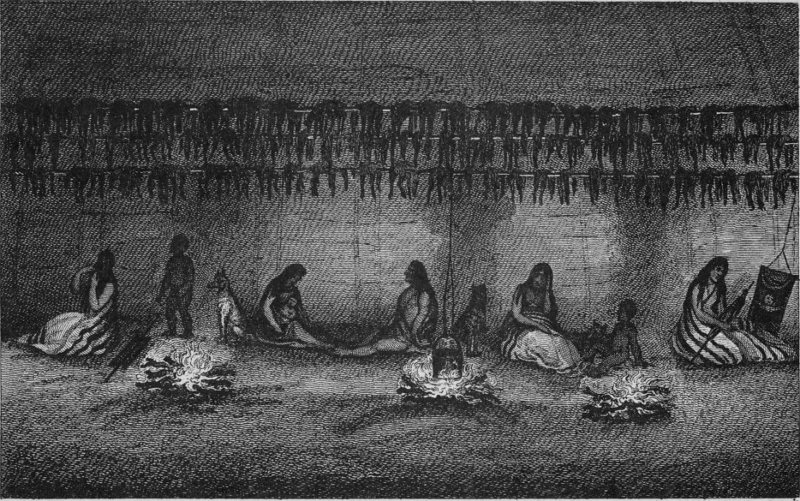
Interior of a Wigwam of the Cree Indians London Published by J. Mawman 16.th May 1817
211
About 5 P.M. we reached a place called Poplar-fall; and observing an Indian wigwam on the north bank, we crossed the river, and encamped within pistol-shot of it. We had pitched our tent within the wood; and from it we could discern the river, at intervals, through the openings of the trees. Although we were but a short distance from the Indian wigwam, yet the wood was so intricate, that we found it difficult to find our way thither. We, however, paid the natives a visit, and sat familiarly down in the wigwam. It contained one old and two young men, one old and one young woman, and five or six children of both sexes, besides two infants. The wigwam was a circular tent, constructed with three or four poles, lashed together at the top, and covered over with an inferior kind of leather, made of tanned deer-skins. In the midst of the tent was a blazing fire; and in the smoke above, a quantity of deer’s 212 flesh was suspended, after the manner of bacon in England. On the outside of the hut, there were several stages, on which their strips of venison were exposed in the sun to dry, for the winter’s consumption. After sitting a short time with the natives, and inquiring at what part of the river the rein-deer were crossing, we were at length about to depart, when the old Indian presented Captain Stopford with eight deers’ legs, which, when roasted, are considered a great delicacy, on account of the rich marrow they contain. The young woman then gave another of our party a deer’s heart and tongue; and the old squaw, whose aspect was sufficient to give any man a dis-relish to the whole sex, kindly tossed into my lap a head and a brisket. Laden with these presents, we returned to our tents, and dined heartily off a tongue and heart, ponasked. But our kind Indian neighbours had not been so exceedingly munificent 213 without entertaining strong expectations of an adequate remuneration: accordingly, the visit was soon returned by the whole horde; and the old Indian brought a kettle in his hand, which was intended as a gentle hint that he wished for a liquid equivalent. We therefore gave him about a quart of rum, mixed with three quarts of water, and a trifling supply of tobacco. Extraordinary as it may appear, this small donation was amply sufficient to intoxicate every member of the wigwam; and their voices resounded, in song, through the woods, for many hours after we had retired to rest.
Very shortly after the first dawn of day, we were awakened by the old Indian: he came to inform us, that several herd of deer had already crossed the river, and that it was high time we should repair to our stations, to intercept any more which might attempt to follow; as it is an ascertained fact, that 214 these animals, during their periodical journeys, are accustomed to follow each other’s footsteps.
According to the old Indian’s advice, we proceeded about two miles farther up the river, until we reached a place called Twenty-mile Island; so named from its distance from York Factory. Still pursuing the directions of the friendly Indian, we hauled our canoe close to the beach, on the north side of the river; as, at this season of the year, the rein-deer, in pursuance of their northern journey, cross all the rivers from the southward. The Indian proceeded with his canoe higher up the stream, and took his post opposite to the spot from whence he had seen the before-mentioned herds crossing in the morning: he then concealed himself in the high grass, by the side of his canoe; and we also followed his example. After lying 215 thus in ambush for a short time, a small herd, consisting of five deer and a fawn, appeared on the south bank of the river, exactly opposite the old Indian’s canoe. The timid and wary animals stood for some time on the bank of the river, casting an inquisitive glance across the water. We all crouched closer than before, in the grass; and we had soon the satisfaction to see the whole herd leap boldly from the shore. The Indian above us immediately pushed across the stream with his canoe, to intercept the retreat of the deer; and this he was enabled to do unobserved, as he was also a considerable distance above the deer; and the animals neither looked to the right nor to the left, but kept their eyes anxiously fixed on the shore which they were endeavouring to reach. As our lurking-place was about half a mile lower down than the place from whence the deer had taken to the water, and the rapid current of the 216 river naturally drifted them downwards, they would have attempted to land close to us, had not a shoal in the river arrested their progress, upon which they mounted; and by their superior height they immediately discovered us. The deer now stood hesitating what they should do; and so in fact did we: but our Indian co-adjutor having by this time succeeded in gaining the opposite shore, called loudly on us to rise and advance. As soon as we sprang from the grass, the affrighted herd replunged into the river, and attempted to gain the shore which they had quitted; but we pursued them across the stream with such activity, that only one effected its landing, and the remaining four again turned their heads to gain the northern bank. From this moment their deaths were considered inevitable, as the chief skill then lay in continually turning the weary animals from the shore, which we were easily enabled to 217 do, by the superior speed of our canoe. The Indian, meanwhile, followed close behind a large buck, until it approached the bank; when he deliberately speared it in the haunch; and as it emerged from the water, he fired a bullet into its body: yet the animal ran with speed into the wood, and we all naturally concluded it must have escaped;—but the skilful hunter smiled at the idea: “No, no,” said he; “I have it safe:—now for another;” on which, he wheeled about his canoe, and instantly speared to death an amazing fine doe. My gun being loaded with goose-shot only, I discharged it into the rump of the surviving doe, which bled profusely; I also again fired, and struck it on the nose, when my ramrod unfortunately fell overboard: however, we still kept turning the animal from the shore; and having now no weapon in the canoe wherewith we could kill it, I was obliged to halloo for the Indian to bring us a 218 spear; accordingly, he paddled towards the deer with all his might, and, on reaching our canoe, tossed me the spear. Following the native’s example, I made a deep thrust into its haunch, which soon put an end to its existence; and putting a cord over its head, we towed it on shore in triumph.
As the Indian had predicted, he soon found the carcase of the wounded buck, lying about ten yards within the wood. Thus we succeeded in obtaining three out of the original five: and with respect to the other two; one, as above-mentioned, made good its escape in the first instance; and the fawn also landed, whilst we were engaged with the doe.