Volume 2 — CHAPTER 5. (continued 8)
Reading edition
5. One of the most advantageous situations for obtaining specimens, and examining the relations of rocks, is in the sections afforded by cliffs on the seashore; especially after recent falls of large masses. It commonly happens that the beds thus exposed are more or less inclined; and in this case, if any of them be inaccessible at a particular point, the decline of the strata will frequently enable the collector to supply himself with the specimens he wishes for, within a short distance. Thus, in Sketch 4, which may be supposed to represent a cliff of considerable height, the observer being situated at a, the beds b, c, d, though inaccessible at that place, may be examined with ease and security, where they successively come down to the shore, at b prime, c prime, and d prime.
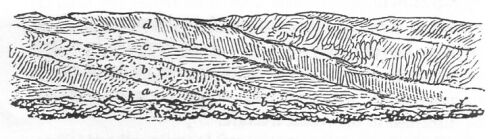
SKETCH 4: CLIFF OF CONSIDERABLE HEIGHT, IN WHICH THE BEDS, THOUGH INACCESSIBLE AT THE TOP, MAY BE EXAMINED WITH EASE AND SECURITY, WHERE THEY COME DOWN TO THE SHORE.
6. To examine the interior of an unknown country, more skill and practice are required: the rocks being generally concealed by the soil, accumulations of sand, gravel, etc., and by the vegetation of the surface. But the strata are commonly disclosed in the sides of ravines, in the beds of rivers and mountain-streams; and these, especially where they cross the direction of the strata, and be made, by careful examination, to afford instructive sections.
7. Among the distinctive circumstances of the strata, the remains of organized bodies, shells, corals, and other zoophytes, the bones and teeth of animals, fossil wood, and the impressions of vegetable stems, roots, or leaves, etc., are of the greatest importance; affording generally the most marked characters of the strata in which they occur. These should, therefore, be particularly sought after, and their relative abundance or rarity in different situations noticed. The petrified bodies should, if possible, be kept united with portions of the rock or matrix in which they are found; and where they are numerous, in sand, clay, or any moist or friable matrix, it is in general better to retain a large portion of the whole mass, to be examined afterwards, than to attempt their separation at the time of collecting.
8. The loose materials which are found above the solid rocks, in the form of gravel, silt, rolled pebbles, etc., should be carefully distinguished from the solid strata upon which they repose. And the more ancient of these loose materials, found on the sides or summits of hills, etc., should be distinguished from the recent mud, sand, and gravel, brought down by land-floods, or rivers. The bones and teeth of animals are not unfrequently found in gravel of the former description; and the collection of these remains from distant quarters of the globe, is an object of the greatest interest to geology.
9. Besides a note of the locality, there ought, if possible, to accompany every specimen, a short notice of its geological circumstances; as:
Whether it be found in large shapeless masses, or in strata?
If in strata, what are the thickness, inclination to the horizon, and direction with respect to the compass, of the beds? [If these cannot be measured, an estimate should always be recorded, while the objects are in view.] Are they uniform in dip and direction? curved, or contorted? continuous, or interrupted by fissures or veins?
Is the whole cliff, or mass of strata in sight, of uniform composition? or does it consist of different kinds of stone?
If the strata be different, what is the order in which they are placed above each other successively?
10. A label, distinctly written, should accompany every specimen, stating its native place, its relative situation, etc., etc. And these labels should be connected with the specimens immediately, on the spot where they are found. This injunction may appear to be superfluous; but so much valuable information has been lost to geology from the neglect of it, that every observer of experience will acknowledge its necessity; and it is, perhaps, in practice one of the most difficult to adhere to.
11. A sketch of a coast or cliff, however slight, frequently conveys more information respecting the disposition and relations of rocks, than the longest memorandum. If numbers, denoting the situation of the specimens collected, be marked upon such sketches, much time may be saved at the moment of collecting. But in all such cases, the memorandum should be looked over soon afterwards, and labels distinctly explaining their situation, etc., be attached to the specimens themselves.
12. The specimens should be so packed, that the surfaces may be defended from exposure to air, moisture, and friction: for which purpose, if strong paper cannot be obtained, dry moss, or straw, or leaves, may be used with advantage. Where paper is used for wrapping the specimens, they are best secured by fastening the envelope with sealing-wax.
Lastly, The collector must not be discouraged, nor be prevented from collecting, by finding that the place which he may chance to visit in a remote situation, has not a striking appearance, or the rocks within his view a very interesting character; since it frequently, and even commonly, happens, that facts and specimens, in themselves of very little importance, become valuable by subsequent comparison; so that scarcely any observation, if recorded with accuracy, will be thrown away.
The Instruments required by the geological traveller will vary, according to the acquirements and specific objects of the individual. The most essential are:
The Hammer (Sketch 5); which, for general purposes, may be of the form here represented:
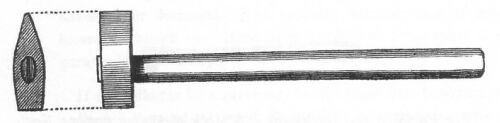
SKETCH 5: HAMMER FOR COLLECTING GEOLOGICAL SPECIMENS.
The head should be of steel well tempered, about 4 inches from the face to the edge, and 1 1/4 inch square in the middle; the face flat, and square, or nearly so; the edge placed in the direction of the handle. The orifice for the insertion of the handle oval, a very little wider on the outer side than within; its diameters, about 1 inch vertically, and 0.7 across; the centre somewhat more than 1 1/2 inch from the face. The handle should be of ash, or other tough wood; not less than 16 inches long; fitting tight into the head at its insertion, without a shoulder; and increasing a little in size towards the end remote from the head, to prevent its slipping. It should be fixed in the head by means of a thin, barbed iron wedge.
For trimming specimens, smaller hammers may be employed (Sketch 6): The form of the head, recommended for this purpose by Dr. MacCulloch,* is rectangular. The dimensions of the face may be 1 inch by 3/4; the height 2 1/4.
(*Footnote. On the forms of Mineralogical Hammers, Quarterly Journal Royal Institution volume 11 1821 page 1 etc.)
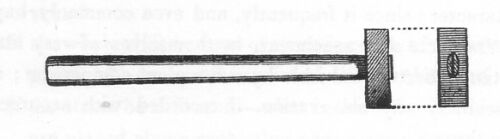
SKETCH 6: SMALL HAMMER FOR TRIMMING GEOLOGICAL SPECIMENS.
It will be expedient to have always some hammers, of different sizes, in reserve.
A small miner's pick is useful for cutting out, and splitting portions of slaty rocks; or for obtaining specimens of clays, etc.
A small stone-cutter's chisel. A chisel with a handle, of the form here represented, will often save the hand of an inexpert collector, and better enable him to direct his blow.
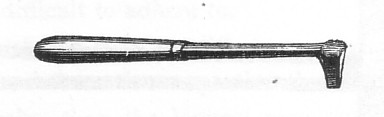
SKETCH 7: SMALL STONE-CUTTER'S CHISEL.
For packing the specimens. A stock of strong paper. Sealing-wax. Writing-paper, cut into labels. Thick gum-water, to cement the labels to the specimens.
For the Conveyance of specimens. A large bag of leather, with straps for the shoulders. Strong canvas bags, of smaller size, are very convenient for subdivision and arrangement. For the protection of crystals, or delicate petrifactions, etc., wool or cotton are necessary; and small wooden boxes (like those used for holding wafers) are sometimes required. For distant carriage, strong wooden boxes, casks, or baskets.
The following are either essential, or useful in various degrees, for obtaining and recording observations.
Pocket Memorandum-Books, of sufficient size to admit sketches. A Pocket Compass. A Measuring-Tape, of fifty feet, or more. A Telescope. A Camera Lucida. A Box of Colours.
The best maps should always be sought for: And, the true economy to the traveller being that which saves time, it is best to mark, or even colour the map, in the field. Notes inserted on imperfect maps, or deduced afterwards from memoranda, are less authentic; and the process is frequently neglected.
PORTABLE-BAROMETERS, with detached thermometers, are desirable; and the best instruments are ultimately the cheapest. But, unfortunately, barometers of every construction are very easily damaged or deranged. The accurate determination of heights, however, though very interesting to physical geography, is comparatively of little importance to the geologist.
If the collector be a surveyor, he will know best to what purpose a Pocket Sextant, or small Theodolite, is applicable: the measurement of distances, of heights, and of the inclination of strata, etc.
CONTENTS OF APPENDIX C.
GENERAL SKETCH OF THE COAST.
GEOLOGICAL REMARKS. 1. List of Rocks. 2. Rocks identical with those of Europe. 3. Aspect of the Shores. 4. Information wanting respecting Diluvial deposits: no Specimens of Limestone: no Volcanoes. 5. Recent calcareous breccia. 6. Range of the Coastlines.
DETAILED LIST OF SPECIMENS.
INSTRUCTIONS FOR COLLECTING GEOLOGICAL SPECIMENS.
APPENDIX D.
COMPARATIVE TABLE OF THE LANGUAGES OF THE NATIVES, WITH SOME GENERAL REMARKS.
COLUMN 1: ENGLISH WORD. COLUMN 2: CALEDON BAY, GULF OF CARPENTARIA. FROM CAPTAIN FLINDERS. COLUMN 3: ENDEAVOUR RIVER, NORTH-EAST COAST. PARTLY FROM CAPTAIN COOK AND MR. FORSTER. COLUMN 4: KING GEORGE THE THIRD'S SOUND, SOUTH-WEST COAST. COLUMN 5: PORT JACKSON. COLUMN 6: BURRAH BURRAH TRIBE. FROM MR. SCOTT. COLUMN 7: LIMESTONE CREEK. FROM MR. OXLEY. COLUMN 8: PORT MACQUARIE. FROM MR. HUNTER. COLUMN 9: MACQUARIE HARBOUR, VAN DIEMEN'S LAND.
Eye : Ma-il : Me-ul : Me-al : Mi, or Me, Mego : Miki-laja : Milla : Me'-e : Nam'-mur-uck.
Nose : Ur-ro, or Hurro : Emer-da, or Poteer, Bon-joo (Cook) : Tarmul, Moil (Flinders) : Nogro : - : Mor-ro : Na'-ag : Me-oun.
Lips : Ta-a : Yem-be (Cook) : Tar : Willing : - : - : - : -.
Teeth : Lir-ra : Mol-ear : Orlock : Era, or Da-ra : Yerrah : Er-ra : Te'-lah : Kouk.
Tongue : Mat-ta : Unjar : Darlin, or Thalil : Tal-lang : - : - : Mal'-way : Mim.
Cheeks : Tac-cal : - : Ny-a-luck : Yarrin : - : - : - : -.
Chin : Na-ing : - : - : Wal-lo : - : - : - : -.
Ears : Pon-doo-roo, or Po-door-roo : Mil-kah, Melea (Cook) : Duong : Co-roo, Goray, or Benne : Binning-huiy : Wha-da :Mo'-ko : Goun-reek.
Hair of the head : Marra : Morye : Ka-at : Kewarra, Dewarra, or Gewarroo : Mundar : Bulla-ye-ga : Wo'l-lack : Pipe, or Bipipe.
Neck : Mo-i-ang : Doom-boo, Forster : - : Ganga, Cadlear, or Cadleang : - : Oro- : - : Treek, or Lan-gar-ree.
Breast : Gum-mur : Coy-or (Forster) : - : Nabung : - : Be-ning : Nam-bang : -.
Belly : Goor-ro : Melmal (Forster) : Cop-bull, or Kopul : Barrong, or Bende : Binda : Bur-bing : War'rah : -.
Arm : Wan-na, or War-na : Aco, or Acol : Wor-nuck : Tarrang : - : Bar-gar : Co-pah : Yir-ra-wig.
Hand : Gong : - : - : Tam-mir-ra : Morrewalla : - : - : -.
Fingers : Mingel : Mun-gal-bah : Mai (singular), Maih (plural) : Ber-ril-le : Maranga : Nar-ra : Mah-tra : War-ra-nook.
Elbow : Le-kal, or Le-kan : Ye-er-we : - : O-nur : - : - : - : Nam-me-rick.
Posteriors : Lam-me : Booca (Forster) : Wa'l-la-kah : Bo-ong, or Bayley : - : - : - : -.
Leg : Bacca : Peegoorga (Forster) : - : Dar-ra : - : - : Woo'lo-loo : -.
Foot : Locko, or Nocka : Edamal (feet) : Ja-an, or Bangul : Manoe : Janna : Dhee-nany : - : -.
Toe : Mangel-locko : Eb-e-rah : Kea (singular) Kean (plural) : - : - : - : Teel-nah : Pe-une.
Sun : Laran-gai, or Car-ran-ghie : Gallan (Forster) : Djaat : Goona, Coing, or Con-do-in : Bun-nail, or Mo-mat : - : Too-nigh, or Win-gin : -.
Water : Lucka, or Lucko : Poorai (Forster) : - : Ba-doo : Ajung- : - : Bah-do : -.
Stone : Punda : Wal-bah : - : Keba : Wy-juck : - : - : -.
Kangaroo : Loi-tyo : Men-u-ah, Kan-goo-roo (Cook) : Beango : Tungo, Patagorang, Bag-gar-ray, Wal-li-bah, Wal-lar-roo, Bou-rou, Barro-melon, Betong, Wy-rung, Pademalion : - : - : Womboy, Pool-cot (tame), Mah-koke (the Pademalion of Port Jackson) : Raguar.
Throwing-stick : Kail lepo : Melpairo, or Melpier (Forster) : Me-a-ra : Wo-me-rah : - : - : - : -.
Nipples (of a man) : - : Coy-o-ber-rah, Cayo (Cook) : Be-ep : Mou-tral : - : - : - : Nerrinook.
Dog : - : Cotta, or Kota : Tiara : Teingo, Dingo, Worregal : Med-di-gen, War-ri-gal : - : - : -.
Nails : - : Kolke : Pera : Currungal, or Car-rung-un : - : - : - : -.
Beard : - : Wol-lar : Nyanuck : Chinis, or Wallo : - : Anany : - : Ru-ing.
Mouth : - : - : Tatah : Karga : - : Chuang : Wel'-leck : -.
Fire : - : - : - : Gwee-yong, or Too-yong : Canby : Warrenur : Cor-yal : Lope.
Membrum virile : - : - : Yaw-de-wit : - : - : - : Cool-kah : Lune.
Head : - : Wageegee (Forster) : - : Cob-bra : Ulangar, or Nattang : Cah-brah : - : -.
The preceding brief collection, of words used by the natives in various parts of the Coasts of Australia and Van Diemen's Land, has been inserted to show the great dissimilarity that exists in the languages of the several tribes: and it may be remarked, that of thirty-three objects, one only, the Eye, is expressed by nearly the same term at each place. In this list, it is true, there is a striking resemblance between the terms used to signify the hair at Port Jackson, namely, dewarra, or kewarra, or gewarroo, and those which denote the same thing in the language of some of the islands of the Eastern Seas; such, for instance, as arouroo or hooroo-hooroo of the Society Islands; lo-ooroo of the Friendly Islands; hooroo of New Zealand; and, perhaps, oouho of the Marquesas:* but at New Caledonia, which is situated between these places and Port Jackson, the same thing is expressed by poon, a sound totally distinct. And to render the anomaly still more decisive, it is only necessary to remark, that, within two hundred miles of Port Jackson, the natives of three tribes, Port Macquarie. Burrah-Burrah, and Limestone Creek, signify the hair, by the words wollack, mundar, and bulla-ye-ga.
(*Footnote. Forster Observations page 283.)
The aboriginal connexion of Australia with other lands must be proved, as far as language is concerned, by a general resemblance of the words, and not merely by a few examples of coincidence, which can only be considered as accidental: and as our knowledge of the Australian languages, except in the vicinity of Port Jackson, does not yet exceed thirty or forty words, no comparison, derived from such limited information, can be employed with any certainty to determine the question. The connexion must be sought for, probably, where the continent, at its north-eastern extremity, most nearly approaches other lands; but even then the chain will remain imperfect until New Guinea and its neighbouring islands are explored, and correct and extensive vocabularies of their languages obtained. Forster,* who has paid considerable attention to this subject, and whose opinions are the more valuable from their being the result of personal observation, seems to be convinced that the New Hollanders are not an original race, but have derived their origin from New Guinea. It is therefore to be hoped, that this subject will not be forgotten by our trans-Atlantic and Australian colonists; more particularly by those of the new settlement on the north coast at Melville Island, who, from their vicinity to New Guinea, have the best opportunities of throwing light upon the question.
(*Footnote. Ibid.)
SITUATIONS OF THE PLACES MENTIONED IN THE PRECEDING LIST WITH RESPECT TO PORT JACKSON.
King George the Third's Sound is on the South-west Coast, 1660 miles from Port Jackson.
Caledon Bay is near the north-west extremity of the Gulf of Carpentaria, 1500 miles from Port Jackson.
Endeavour River, in latitude about 15 degrees South, is on the North-east Coast, about 1180 miles from Port Jackson.
Burrah-Burrah, about 90 miles in the interior, west of Port Jackson.
Limestone Creek, about 140 miles in the interior, west of Port Jackson.
Port Macquarie, on the East Coast, 168 miles north of Port Jackson.
Macquarie Harbour, on the West Coast of Van Diemen's Land.
Bruny Island, at the south-east extremity of Van Diemen's Land.
END OF VOLUME 2.
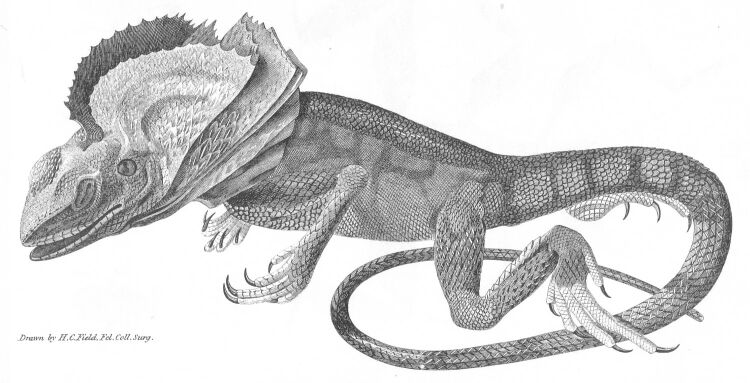
TABLE A. Chlamydosaurus kingii. The plate was engraved by Mr. Curtis, from an exceedingly correct drawing made by Henry C. Field, Esquire. Fel. Coll. Surg. Published by John Murray, Albemarle Street, March, 1826.
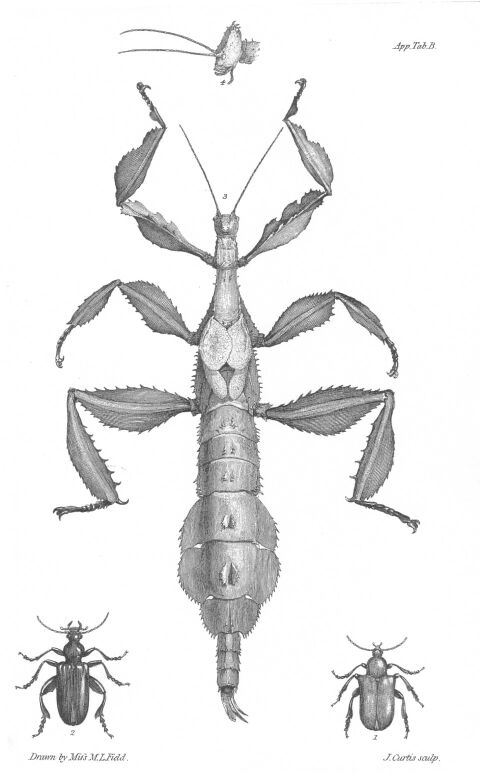
TABLE B. Carpophagus banksiae. Megamerus kingii. Phasma tiaratum. Drawn by Miss M.L. Field. J. Curtis sculp. Published by John Murray, Albemarle Street, March, 1826.
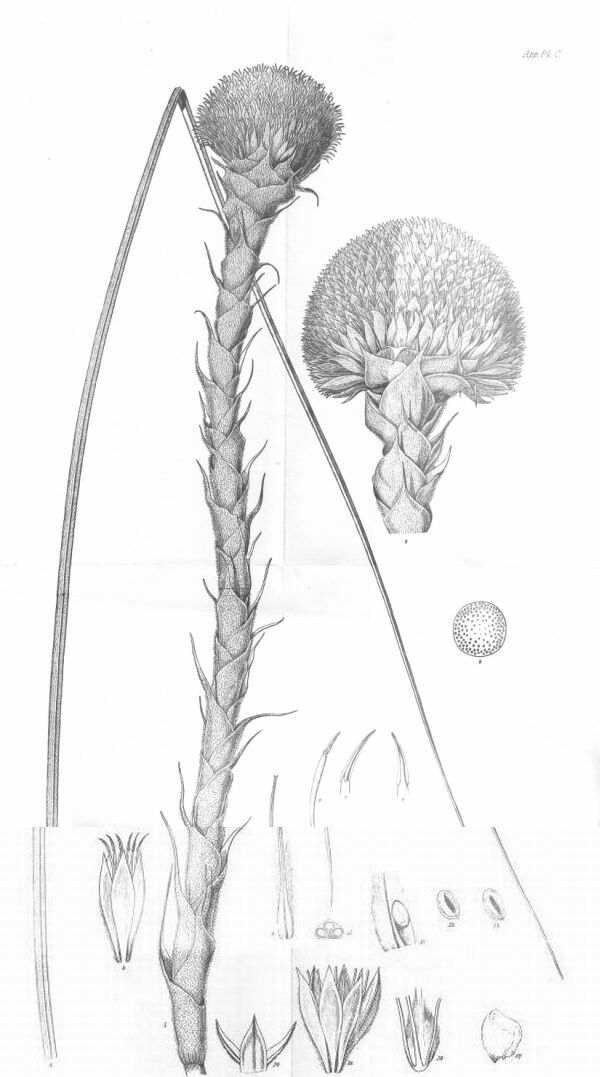
TABLE C. Kingia Australis. Curtis, Id et sculp. Published by John Murray, Albemarle Street.