MY NORTHERN EXPOSURE (continued 3)
Reading edition
"Don't go," he pleaded.
"Herman," I said, "if the Traprock expedition perishes, Traprock will be the first man to go."
I wrung his hand and departed. Four miles from the ship I fainted. Regaining consciousness I crawled on, on my hands and knees. Another spasm of dizziness seized me and I sank down to rest. As I did so, a far-off sound reached me, the faint roaring of a bull seal. Peering across the floe I saw him dimly. He must have been slightly over a mile away. At 6000 yards I fixed him tremblingly on the crossed wires of my telescopic sight. Even then his image was vague, but it was now or never.
Bang! A louder roar reached me and I saw the great brute raise himself convulsively. But would he still escape me? No! He lay still.
When I reached him two hours later I saw, somewhat to my chagrin, why he had not moved. He was a giant chap of the "phoca barbata" family, the bearded seal. His beard was frozen in the ice.
My shot had been wasted.[27]
Fate seems sometimes to play her last trick on a man and, finding she cannot down him, suddenly gives up and turns to helping him. So it was in my case.
Fortified by a draught of warm seal oil, which was like nectar to my lips, I made my way back to the Kawa with as much of the great carcass as I could carry. The rest was speedily brought aboard. The effect of the physical reinforcement was magical.
Not only did my comrades' spirits revive but such minor ailments as had put in an appearance were immediately dissipated. Triplett got well of a touch of his old scurvy which had been bothering him. Whinney's eyes cleared up completely and Wigmore who had been quite daffy since his rescue, became suddenly sane again and, I am glad to say, devoutly thankful to me for having preserved him from the fate of his companions.
The weather, too, favored us. Constantly increasing light and rising temperature brought at last the wonderful realization that we had entered the zone of spring! Never did Spring dawn so gloriously in my life.
Our progress was now rapid with the Tutbury running magnificently on a mixture of whale and seal oil, with both main and jigger drawing to a quartering breeze, we were making approximately twelve knots. A school of porpoises gamboled about us as merrily as if, as Frissell said, "school were out!" Whales and walruses spouted under our lee. The date was April third.
Sausalito, indomitable soul, who had never faltered, had climbed to her favorite place in the crow's nest. From this high perch I suddenly heard her voice, shrill with excitement.
"Land ho! Land ho!"
A sturdy cheer went up to meet her and we all scanned the low-lying cloud on the southern sky line while Sausalito modestly descended.
It was indeed land. Eight hours later we dropped anchor in a sheltered bay. The sun had sunk below the horizon and violet dusk seemed to rise from the still water.
Three miles away the lights of an eskimo village twinkled through the haze and on the falling breeze we caught the sound of the sweetest singing that had ever fallen on human ears.
It was the song of the workers in the ice fields, harvesting the new crop for our own America!
FOOTNOTES:
Chapter X
In home waters. The celebration in our honor. And what of my companions? Reveries and Recollections. The End.
Chapter X
The balance of my story is briefly told. On April twenty-third, we picked up Fire Island light and two hours later had received a clean bill of health from the quarantine station.
The trip back through Baffin Bay had been uneventful. We had come as we had gone, in a direct line. At Triplett's request we put in at St. John's. He went ashore, taking Sausalito with him. Late in the afternoon he returned, alone. His stony eye forbade cross examination, but I questioned him that night in the cabin.
"She's went back to Californy" he said. "You see, I got kinder tired of her. Besides I'm headin' back ter Noo York."
Again his slow wink expressed volumes.
I have not seen that strange woman since. She sends me a picture post card occasionally, usually a winter scene, with mica snow. It is her inarticulate way of asking forgiveness for the blow she dealt me.
THE CONSULTATION
Nothing was more characteristic of the candor and co-operative spirit of the Commander of the Traprock Expedition than his constant willingness to discuss matters with his fellow-travellers. One of the most moot of all moot questions which frequently presented itself was that of route. Having arrived at a certain or uncertain point in the vast snowfields, someone was sure to ask, "Where do we go from here?" or "Where do you think you are now?"
From the outset Dr. Traprock realized the desirability of an answer to such interrogations. His experience during numerous previous Arctic voyages convinced him that most of the bitterness of feeling which almost inevitably disrupts polar-parties springs from the unwillingness, to put it mildly, of the leader to satisfy the natural curiosity of his men in this regard. In order to avoid this difficulty he had carefully prepared maps showing the progress made during each day with the projected itinerary, points of interest, and probable weather conditions. Colored crayons added a decorative value to the charts.
We here see him explaining to Wigmore, the somewhat belligerent snow-and-ice-expert, the proposed return route. Instead of confusing the rather unscientific man with a mass of latitudinal and longitudinal figures, the Doctor states the whole matter clearly by saying, "We simply follow the green line."
The fatal results of disregarding this injunction are embodied in the text. Needless to say they fully prove the value of the Commander's cartographical skill. An interesting sidelight is the fact that their daily charts were equally accurate when based on solar observation or during the long Arctic night when the only basis of authority was Captain Triplett's amazing bump of locality, which was about the size of a hen's-egg.
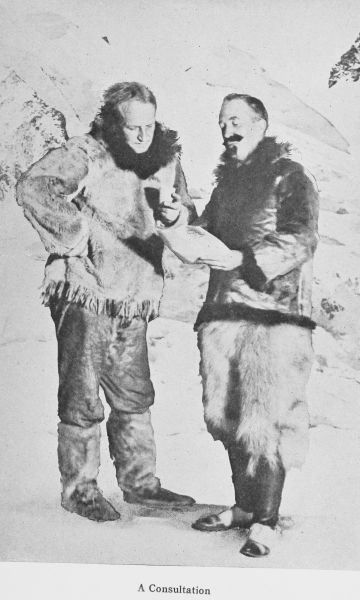
A Consultation
Just inside the three mile limit we were boarded by revenue officers from the patrol boat, W.H. Anderson. They made a careful search for liquor.
"Back to abnormalcy!" carped Swank who was panting to get ashore.
My wires from Grant Land (via Indian runners to Moose Factory) had warned the scientific world of our arrival. Further details, giving brief accounts of the deaths of Plock, Miskin and Sloff had been telegraphed from St. John's.
The same gala array and marine salutation which had sped our departure welcomed our return. But it was with a heavy heart that I stepped on the Yacht Club landing stage. My mysterious orders were still to be explained, orders which, had they reached me when intended, would have brought me ignominiously home, empty of honors and achievement.
A number of strange faces surrounded me in the club room among which I recognized Harris, the E.U. secretary, "Harmless" Harris we used to call him.
"Where is Waxman?" I asked coldly.
A shadow of pain flitted across his face.
"Of course," he murmured. "You haven't heard ... it was very sudden ... poor Waxman ... heart failure, you know ... the day after we heard of your safe arrival."
So my old friend Waxman was gone. With the receipt of this news I instantly dismissed all unkind thoughts I may have had of this benevolent old man. As I look at his photograph now, on my mantelpiece, bland and serene, it seems to breathe a benediction upon me. The pleading look in his eyes seems still to ask for peanuts. May I cherish always, as he did, a love for other explorers and an interest in their exploits.
If anything was calculated to further soften my heart it was the more joyous occasion which followed, the grand banquet given in my honor at the Hotel Commodore. That entire, mighty hive hummed with explorers and noted travellers. Overflow meetings were held in the Biltmore, Yale Club, Grand Central Station and on nearby subway platforms.
The scene in the ballroom beggared description. On the dais with me sat representatives of all the National scientific bodies and distinguished guests from abroad. Publishers, artists and editors were present by the hundreds. Famous actors forced their way to my chair, above which blossomed the words "Traprock must be true" done in thousands of Bougainvilleas and snowdrops.
The colleges of the country had sent their delegations, my own Alma Mater surpassing all with a group of two hundred bright-faced lads whose merry songs and cheers made the welkin ring. They had come by special train from New Haven, accompanied by members of the faculty, for whom the affair was a great junket, you may be sure. Harvard stood officially aloof owing to their recent ban on Eskimos, but the great sister university, as well as Princeton, was represented by individuals who made up in enthusiasm what they lacked in numbers.
When my brothers in the Phi Chapter of D.K.E. arose and sang our fraternal anthem I felt obliged to remain seated. Let me here explain that curious action. It was because my mind went back to that period of terrific strain when I had actually eaten a Brother!
But the thing which touched me most deeply[28] was the presence, at adjoining tables of the combined Boards of Trade of Derby and Shelton, sister cities of the Housatonic, and the Derby Fencibles, forty strong, accompanied by their fife and drum corps wearing the old continental uniforms. My eyes dimmed as I thought of the stirring times when I had stepped to that same inspiring music, as we practised our secret marches back of the old Sterling Melodeon factory.
The chairman of the evening was my life-long friend Irving T. Grosbeak, R.O.T.C. who was introduced by Luther Slattin the new president of the E.U. Other addresses were made by Professor Phineas A. Crutch,[29] F.P.A., S.O.S., Col. Woodwark of the Canadian Mounted and Lord Beaverboard of the South African Game Commission. The principal forensic display was by Ex-senator Wicklefield of Wyoming whom Dr. Grosbeak characterised brilliantly as "The Aurora Borealis of Oratory, the most dependable geyser in the world since Old Faithful blew up and became a brook."
But the climax of the evening came when an old man in a red shirt and fire helmet tottered to my side and with tears streaming down his face, quavered, "The world may claim Walter Traprock but we own him."
It was old "Shelly" Smith of Naugatuck Hose Co. No. 1. His father used to spade our garden.
Of course I was called upon for a speech but for the first time in my life I begged to be excused. My heart was too full. Captain Triplett stood up in my place and embarrassed me by pointing his horny finger in my direction and saying repeatedly, "He done it."
Grammatical errors in public always annoy me.
The rest is history. I shall never return to the North. I feel that I have seen all that it can offer. My work in that direction is done.
Of those who returned with me all but one has carved his niche in the rocks of time. The exception is Dane, who has never fully recovered from the blow dealt him, by my arm indeed, but due to the cowardly shove of Plock. His work in comparative ethnology, however, was accomplished before he was stricken. His object in making the trip was to discover the similarities, if any, between the surviving Eskimo tribes and the early civilization of the Nile dynasties. The only entry I find in his note books is the rather pathetic one "no report."
He is now occupying a comfortable room in the Shadyside Retreat, Walnut St., Philadelphia, where he busies himself cutting out paper dolls of Egyptian character, and where I occasionally visit him.
Frissell remains the same blithe spirit as ever. The horrors of our return voyage left no more lasting impression on this debonair youth than a passing fit of seasickness.
Swank and Whinney naturally show spiritual scars, especially the latter, though he is greatly cheered by the royalties received from the sale of his sprightly journal, written in total darkness.[30] My two close companions and I, with the occasional addition of Triplett when we can lure him from his own diggings often dine together at a cosy little tea house in Forty-fifth Street. There we plan new ventures and discuss the old. What stirring memories flock about us, what tender visions neath Tropic sun and Arctic stars!
Kippiputuona, Babai, Ikik, Lapatok, their names are a sentimental rosary, a succession of lovely chords, lost chords, but, let us hope, not the last!
At a recent meeting the recollection of Whinney's affliction evoked from him this brave comment.
"Just think!" he mused, "to love a woman, to lose her, and to never see her."
"Whinney," I said, raising my glass in his direction, "there is more in life than merely seeing."
FOOTNOTES:
APPENDIX
In reference to a note on page 180, it seems desirable to reprint below (1) a paragraph which recently appeared in a New York newspaper over the signature of Don Marquis, and (2) a copy of the letter written by Dr. Traprock to Mr. Marquis clearing up the point in question. Ed.
A great deal of doubt is cast by his strange reticences upon the recent claim of Dr. Walter E. Traprock that he reached the North Pole. Did he, or did he not, find three fingers at the Pole which were frozen off of the hand of Capt. Peter Fitzurse when the Captain grasped the Pole, more than forty years ago, being the first man to lay his hand upon it? If he did not find these fingers, he did not reach the Pole. If he found them, and has said nothing about it, his object in concealing the fact can be nothing else than an unworthy jealousy. Who is this Traprock, anyhow? Capt. Fitzurse intimates that at the proper time he has startling revelations to make. It is significant that Traprock was first heard of a year or two after Dr. Cook ceased to figure in the public prints.
On Board "Kawa" Peck's Slip, N.Y. July 21, 1922.
Don Marquis, Esq. Park Row, New York City.
Dear Sir:—
A number of my friends have called my attention to recent remarks published over your signature which by insinuation cast a veil of ambiguity over my identity. I am not used to having veils cast over me and I resent the practice.
"Who is this person, Traprock?" you ask. "Has he ever been to the North Pole?"
Let the ice-bergs answer! Let the Polar-pack groan its reply. I scorn to.
You also ask if by any chance I discovered three fingers frozen to the Pole. I did find three fingers not frozen to the Pole, but preserved in an otherwise empty gin bottle. They were cached in a rude cairn, mute memorials of some brave man who had ventured north of eighty-six. Of course I at once thought of my friend Fitzurse. Could they be his? The nails were not black enough, but I could not be sure.
I took them with me to the Pole, purposing to leave them with my records, but my plans were modified by the extraordinary attraction which the fingers had for Ikik, Snak and Yalok, three Eskimo women whom I found living at the Pole, or to be exact, under it.
How, finally, to preserve peace I divided the fingers giving one to each to wear as a talisman is an enlivening memory. A few days later, noticing that Ikik was not wearing her finger I questioned her as to its whereabouts. "Me eat" she said. The others had done likewise. I trust that any doubts you may have had in regard to my identity etc. will be dissipated by these circumstantial details.
Yours, Walter E. Traprock
The Cruise of the Kawa By Dr. Walter E. Traprock, F.R.S.S. E.U.
A delicious literary burlesque—superlatively amusing. Here are found the wak-wak, that horrid super-seamonster; the gallant fatu-liva birds who lay square eggs; the flowing hoopa bowl, and the sensuous nabiscus plant; the tantalizing, tatooing, fabulous folk music; the beautiful, trusting Filbertine women and their quaint marriage customs, as well as the dread results of the white man's coming—all described with a frank freedom, literary charm and meticulous regard for truth which is delightful.
The Cruise of the Kawa stands unique among the literature of modern exploration. Nothing like it has ever come out of the South Seas. It is the travel book of years. Strikingly illustrated, too, from special photographs, it tells pictorially, as well as verbally, the exciting, amusing and entertaining story of an exploration in the South Seas.
G.P. Putnam's Sons New York London