MY NORTHERN EXPOSURE (continued 2)
Reading edition
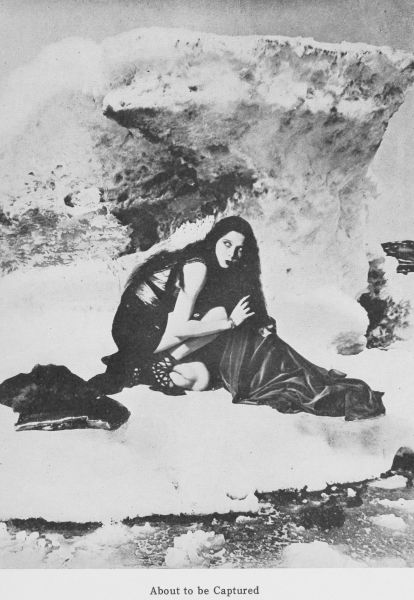
ABOUT TO BE CAPTURED
This picture represents what is probably the high-spot in Dr. Traprock's absorbing narrative, namely, the moment just before the author and his friend Swank burst from their hiding-places and captured Ikik, the Klinka maid, who is seen crouching over the bait which in this case was the scarlet hunting-coat worn by Dr. Traprock during many an exciting chase, though none, we venture to say, compared to this. Critics of this picture have said that the coat seemed unnecessarily voluminous. In explanation it may interest our readers to know that at meetings of the Derby Hounds, which organization takes its origin from the ancient Epsom Hunts of England, the M.F.H. wears the medieval hunting costume, the folds of which cover the rider, horse and at times several of the hounds as well. The thought of our intrepid friend Traprock thus clad in full cry suggests an inspiring sight. He says himself with his usual modesty, "The coat has always attracted women, but I have usually been in it."
Better than words our illustration, snapped by Swank through the eye of "Dr. Pease," gives an idea of the simple beauty of the Klinka summer-furs. Though she has thrown aside her oomiak she is plainly apprehensive. Something is in the air, she knows not what.
It was Dr. Traprock's intention to capture the maid as politely as was consistent with success. After the diving-tackle which he has described he had expected to deliver a conciliatory speech beginning, "Madame, I assure you my intentions are perfectly honorable." Makuik's arrival interrupted this program but we feel that in justice to Dr. Traprock his plan should be known lest some of our readers assume that he was unnecessarily rough. In the old Norman, "Chroniques de la Noblisse," we find significant note referring to Jean Marie Piegeroche, an early ancestor of the author. Says the historian, "Fort comme la mort, beau comme le soleil, et toujour rosse mais pas trop rosse." "Strong as death! Beautiful as the sun, rough ... but not too rough." It is indeed the Doctor.
About to be Captured
With hearty good will they sprang to their positions and we shot forward up the gentle grade.
Exactly twelve minutes later we reached the crest and below us, sparkling in the sunlight, stood the Pole itself.
How can I possibly describe the scene and the sensations of that inspiring moment? Physically the outlook was perhaps unimportant save for a feature that set my blood tingling while it stilled my heart in reverence. This feature was Peary's cairn!
It was untouched, unchanged.
From the moment the object of the Traprock Expedition was announced I had been haunted by a vague fear that some other group would head straight for my goal, dragging with them some hapenny-tuppenny ships model wherewith to wither my laurels.
It was not so.
Before us, a few hundred yards distant in the center of a shallow bowl stood the rude monument of the great Commander, just as he had left it. From the summit and flanks of the miniature mountain fluttered the tattered ensigns he had placed there, our country's flag, the red cross, the D.K.E. banner and the others.
The Stars and Stripes were nailed to a stout spar, evidently an extra yard-arm or spare jigger from the Roosevelt. This mast still stood, a graphic symbol of the Pole itself, as if the giant axis of the earth projected beyond its surface. It was slightly out of plumb and the wood toward the base was somewhat abraded.
But of the vandalism of late visitants there was not a trace. No picnic baskets or discarded lily-cups marred the snowy surroundings. No other ship, great or small, had made fast to Mother Earth's last mooring.
We rushed toward the spot in helter skelter fashion, but ten yards from the cairn a thought, almost morbid in its chivalrousness, seized me.
I must stop this mad rush.
How?
Whipping out my Colt I fired three shots in quick succession. It was the return-to-the-ship signal. The crowd hesitated, irresolute.
On the instant I dashed ahead and faced about.
"Gentlemen," I cried, "though thousands of miles from home, remember, you are gentlemen. The lady, first!"
Offering Sausalito my arm we climbed the slope together.
The others arrived en masse. Swank, Plock, Sloff, they were all like children playing a game of prisoner's base, with the Pole as home. Poor Whinney was "it."
In the excitement of the moment I had forgotten him. He was a pitiful spectacle as he came tap-tapping his way across the ice, feeling each step with his cane. We watched him in silence until I saw that he was going to miss the Pole entirely and if not stopped would soon be bound south again for an indefinite period. Tenderly Sausalito and I led him to the cairn while her rich voice murmured comfort in his ear. He was beside himself with emotion and hot tears kept welling from under his goggles.
"The touch of a woman's hand!" he sobbed, as he smoothed mine with his.
Frissell's arrival was characteristic. He made the last sixty yards between the Kawa and the Pole on a pogo stick—a new—in fact the only—record for an event of this kind.
Second only to ourselves was the Kawa and willing hands soon hauled her across the intervening distance and made her fast.
The great objective of my polar push had been gained and with a reverent heart I called the men together for short but appropriate ceremonies.
After a prayer of thanksgiving by Miskin, we sang as much of the Star Spangled Banner as we could remember and ate a silent toast to the memory of great explorers who had come and gone. I then made a few appropriate remarks, outlining the progress of polar travel from Norse days down to the present and we then proceeded to the picturesque "planting of the flags." It was a charming picture in the amber sunlight, not unlike the final chorus of some great operatic spectacle in which the nations of the earth are gathered together.
Forming in a circle we marched slowly about the cairn singing the ancient song: "Nordenskold—Nordenskold—helvig am trein," each man planting his flag at the close of a verse, in the order named:
Traprock, U.S.A., Swank, Sons of American Revolution; Whinney, Guidon of the Derby Fencibles (sometimes called the "Desperate Derbies"); Sausalito, Lucy Stone League; Frissell, Dutch Treat Club of New York; Plock, Explorers Union; Miskin, National Geographic Society; Triplett, New Bedford Chamber of Commerce; Sloff, Ass. Astronomers of America; Wigmore, Society for the Preservation of New England Antiquities; Dane, Egypt.
With the cairn thus gaily decorated and the Kawa's full alphabet of signal flags flying fore and aft spelling the word "Victory," the formal ceremonies were over and I gave the order for complete rest, relaxation and enjoyment.
How thoroughly these instructions were carried out may well be imagined. Three days' rations of every sort were dragged from the hold and spread about us. Without further urging all hands fell to. Every man had five A-P's and a bountiful supply of potted ham, herring and salt codfish.[16] This somewhat arid diet was washed down with copious draughts of melted snow thickened with A-P, and the celebration soon attained a terrific muzzle velocity. Songs echoed across the surrounding plain, merry tales were passed about, tales which brought a dull glow to Sausalito's cheeks and caused old Triplett to slap his thigh with delight.
Frissell was a host in himself. He performed tricks of magic, imitations and feats of acrobatics and ventriloquism, appearing successively in various costumes from his inexhaustible supply. The quiet Miskin disclosed an unsuspected social gift and lured us into guessing games.
"What is the distance from Bremen to Hong Kong?"
We were staggered. Miskin, from the store of his librarian experience, knew the answer. It was dull, but helped to keep the others sober for a few extra hours.
The three days' rations lasted, I think, about one full 24-hour day.
A single unpleasant incident marred the close of the entertainment.
Plock, who was enormously exhilarated, crawled toward me and pointed toward the D.K.E. flag above us.
"D.K.E. song," he said thickly.
I eyed him coldly.
"I can only sing it with a Brother."
To my disgust he stretched out a very dirty hand, and gave me the grip!
"Mew Chapter," he murmured.
It was revolting. That it should be Plock of all others!
We did the "Band of Brothers" together—my oath compelled it—but I have never voiced its loving sentiments so half-heartedly.
Quiet fell at last. So did most of my companions. One by one they toppled over. Whinney was the last to go. It is said that the loss of one function strengthens another and I suppose that the absence of eyesight gave him staying power. But he finally succumbed, smiling happily and crooning to himself—"I don't no' whish is, m' I blin'-drunk or drunk-blin'"; and he was gone.
My last memory is of Frissell saying "my next imitation" and then playing "taps" on a mouth organ. I knew the impossibility of competing with a parlor entertainer. Nothing will quiet such chaps but a dead audience. So I rolled over, and slept the sleep of a tired but happy explorer.
What awakened me I cannot say, but I am sure that it was something unusual, for my awakening was not gradual or difficult. It was the same quick instant leap to consciousness as that which rouses the suburban wife when she leans across the interim between the twin beds and whispers tensely to her husband, "Horace, someone is trying to get into the dining-room window!"
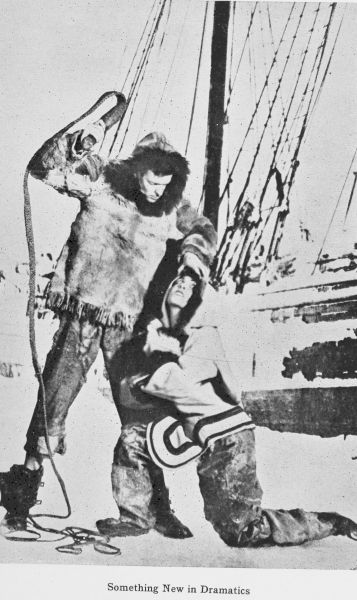
SOMETHING NEW IN DRAMATICS
A happy thought in the formation of the personnel of the Expedition was the inclusion of Frissell, the professional entertainer, who is here shown playing a leading part in the amateur theatricals which it was his delight to organize. The scene chosen for illustration is the famous shipping episode from "The Taming of the Shrew." Reginald Swank, who is no mean dramatic critic, tells us that Frissell's "Petruchio" was a spirited performance, while Snak's "Katharine" rivalled Ada Rehan at her best. The nautical background added a novel touch to the somewhat hackneyed vehicle and it is safe to say that Shakespeare is permanently established among the Klinka and Kryptok tribes.
Not content with the success of this production, Frissell plans to bring to Broadway a newly organized company, "The Polar Players." They will appear in repertoire while the B and C companies tour the provinces. The Winter Garden has already been engaged for the venture, Al Jolson obligingly shifting to the Metropolitan Opera House. Tickets for the première of this interesting novelty, which is set for November 1st, may be had by application to any of the well known speculators. Mr. Frissell has already shown photographs of some of his best scenes to prominent professional critics. A few sample opinions may be of interest.
George Jean Nathan: "Foreign and therefore good."
Heywood Broun: "Lacking in background; we like it."
Al Woods: "Niftik."
Dorothy Parker: "I hate actors, but these people are different."
Frederick O'Brien: "Taupo aloha che."
The Literary Digest: "Better than the average and more average than the best."
David Belasco: "All to the spot-light."
Bernard Shaw: "They go further back than Methusaleh."
Something New in Dramatics
I suddenly found myself sitting bolt upright, straining my ears through the lightness.
What was it?
What uncanny influence had snatched me bodily out of the depths of stupor?
All about me lay my companions. I counted them dazedly. Triplett, Sausalito, Swank,—yes, they were all there, not one missing.
"It was nothing" I thought, and stretched myself, preparatory to replacing my aching head in its original position.
And then my hair literally rose on that same head and a creeping chill crept up my spine.
Close at hand, just back of me, rose a soft, exquisite, purling sound, the sound of a woman's laughter! Whirling about I caught a fleeting glimpse of her.
It was just a flash. She was peering over the edge of the cairn. The instant my eyes met hers I knew that I had seen the most beautiful woman in the world!
Leaping silently to my feet, for I did not wish to waken my comrades, I raced toward the cairn. As I rounded the curve I heard again that silvery laughter, spiced, I thought, with a note of mockery.
"One second, my beauty!" I muttered, "and I shall have you!" Remember, I had been for months in the solitudes. My blood pounded in my temples.
Sweeping gracefully around the cairn I arrived on the opposite side.
Desolate and empty, the ice bowl curved to its rim.
Not a living soul in sight.
FOOTNOTES:
Chapter VI
Fatal procrastination. Our one-dimensional position. An extraordinary ornithological display. I confide in Swank. His plan. I capture my vision. The Klinkas. An embarrassing incident.
Chapter VI
The succeeding days were occupied with the business of getting settled. Our eight-day clock recorded July 7th before we finally got down to work. By throwing up a waist-high wall around the base of the cairn we formed a circular dugout into which we moved our belongings, a man to each segment. Already the weather had begun to moderate and I found my medium-longs comfortable.
Sections of our camp were covered with tarpaulins and of course we had the Kawa to retire to in case of need. A passing shower warned me that the short Arctic summer was waning but I figured that we had ample time to remain at least three weeks longer. We had but begun our scientific work, our food supply was generously sufficient, and moreover, my men had come a long way and were entitled to a rest.
Ah! How vainly does the mind of man delude itself with false reasoning. Back in my brain nibbled the maggot of curiosity. Deep in my man-being the age-old impulse lusted for a sight of the mysterious ice-maiden. Like the old viking in the Saga—"Moe entilgig sas, moe Tillig as var—"[17] I would have procrastinated forever. As it was my delay ... but I am now getting south of myself.
Speaking of "getting south" we were in a curious position, one previously remarked on, but which has received scant attention. I refer to the fact that there was left to us but one direction. We had nowhere to go but south. The idea seemed so fantastic that I verified it by actual test. The empiric is after all the only actual, as Spencer says. Standing close together four of us were able to touch the Pole with our backs. At a signal we all stepped forward five paces.
We had all gone south!
And yet, Triplett and I had gone in exactly opposite directions: so had Whinney and Wigmore who were assistants.
There are some things that are beyond the mind of man. Whinney said that it was very simple. He explained that since it was already possible, in a three dimensional world, to reduce motion to one direction (which is the equivalent of one dimension) he was sure that further research would show us the way to arrive at a point in which there would be no direction at all.
"How would you get back?" I asked.
Although nonplussed he started in on a wordy explanation in the midst of which I sneaked softly away, leaving him still talking under the impression that I was at his side.
My unfortunate friend had taken up writing to mitigate his black loneliness and the click of his typewriter could be heard at any time. He was writing a description of our voyage and it surprised me to see how much clearer and more interesting his account became after his eyes were stricken and he was obliged to rely for information on what was told him rather than on what he had seen. It has long been a theory of mine that too much actual experience makes a man inarticulate, while the reverse is stimulating and beneficial.[18] A realization of the devastating dullness of most polar accounts has further confirmed this view.
In the meantime our serious work was progressing. My plan was to keep one of the men with me, giving the others freedom to pursue their respective lines of research. This made it possible for me to be at home most of the time and so not miss any recurrence of the feminine phenomenon I had noted.
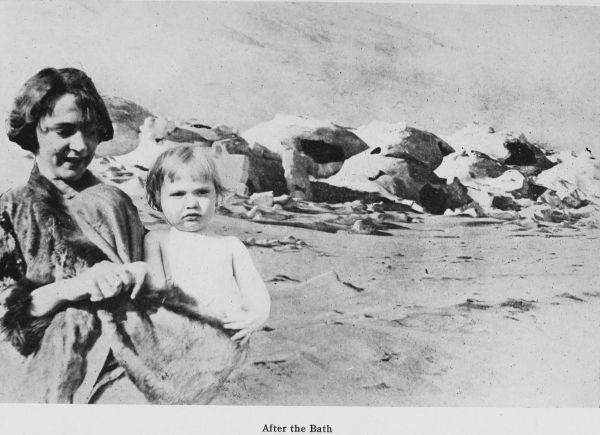
AFTER THE BATH
No libel has received wider acceptance than the often made statement that the Eskimos are an uncleanly people. It is true that during the winter season the skin is protected by frequent applications of various animal-oils such as seal, walrus, otary, sperm and pemmican. Only thus could the skin be protected against the rigors of the Polar winter. The usual specification employed by the Klinka tribe is as follows: (1) One (1) coat of otary oil thoroughly brushed in. When this has dried apply (2) one (1) coat of Makuik-mixture (1/3 otary to 2/3 whale, sperm or equal), applied hot with a soft tundra sponge or seal-flipper; (3) two (2) coats grade A pemmican, applied separately; (4) finish coat of walrus-oil rubbed to a high polish. Fastidious individuals frequently add a coat of guppy-wax which results in a soft lustrous surface. By this method the entire body is hermetically sealed (just as our New England forebears used to seal their preserves and jams with paraffin) and the skin is kept immaculately clean.
As soon, however, as the Spring sun has ameliorated the low temperature the native feels that it is time to slough his oily protection. Nature demands that his pores come up for air. This is accomplished by exposure to the sun's rays. The wax and substrata rapidly liquefy and are easily scraped-off with curved bone knives admirably adapted to the work in hand. The natives assist each other. One of the pleasantest experiences of Dr. Traprock and his men was that of watching a lovely Klinka scraping an acquaintance, aided by the friendly suggestions of her companions.
When the final oil-coat is removed and all pores are wide open the body is rolled in clean snow and rubbed vigorously with a dried salmon-fin.
The adjacent photograph shows little Kopek returning in his mother's oomiak after his Spring scouring. The snowy whiteness of his tender skin is ample proof of the hygienic wisdom of the Klinka method.
Note the iglootinous character of the background. The perforated mounds are really hives, the winter quarters of the Poks or Arctic snow-bees which lay blue honey in large quantities from June to September.
After the Bath
After a comfortable breakfast my followers departed in various directions, each carrying his luncheon which Sausalito put up for him. She, by the way, had become the uncrowned queen of all hearts and I felt more than justified in having acceded to Triplett's sinful wishes.
Plock found it difficult to make any headway with his anthropology because he could discover no inhabitants. Up to July 20th, he kept entering regularly in his journal: "Density of population 1/316 to square mile."
"It hardly seems enough," said Frissell brightly.
Plock gave him a sour look.
"I was not speaking of mental density," he said.
In zoology he was more successful, though he complained bitterly that my "no hunting" edict cramped his style.
"You can't study life without taking it," he said.
I thought he was referring to the magazine.
"My family have been taking it since Vol. 1, No. 1," I retorted, "and you know perfectly well it has always been anti-vivisection."
"Who said anything about vivisection?" he demanded, "though for that matter, that's just one of Life's kinks, something that was wished on 'em in a will. Let me kill a few animals first, and I'll cut 'em up, and maybe eat 'em afterward!"
He licked his lips greedily. In him, too, dormant appetites were stirring, the blood thirst of the tiger! Strange irony, that he should be the first to go.
Nevertheless he brought in some interesting live specimens caught with ingenious snares and traps, among other things numerous birds, ptarmigan, pelican and pemmican and a pair of polar kittens, the young of the Felis-polaris, those quaint cats which always point toward the north.[19] These charming creatures soon became our pets and took avidly to the condensed milk which Sausalito prepared for them.
The pair of nesting pemmican who had pre-empted our crow's nest were a source of constant interest. Three magnificent eggs about the size of footballs were jealously watched day and night. Plock informed us that the young birds might hatch any day now and warned us to be ready for interesting developments. Though I believed him I was unprepared for anything as novel as what took place.
Fortunately the event transpired on a Sunday—July 23rd to be exact—which was a day of rest. We had just finished divine service when Plock pointed excitedly toward the main truck.
"She's going to hatch!" he yelled.
The mother bird had risen from the nest. Between her powerful legs she clutched one of the perfect ovates. Circling the Kawa three times she uttered a piercing shriek and dropped the egg.
"Key-ryste!" ejaculated Triplett.
Plock motioned for silence.
The egg struck the floe with a deep boom off our weather lee and a dense cloud of bright orange smoke filled the air in the midst of which we saw the fledgling pemmican in full flight, rising to join its mother. The male or bull pemmican now added himself to the party and together they made off to the edge of the ice bowl where the young one alighted.
"Stand back," warned Plock. "Cover up your noses."
The saffron laying fumes were drifting toward us, and their odor was overpowering and indescribable. Even as I crouched behind our bulwarks I thought of my old friend Lucien Sentent, the nasal gourmet of Battambang and wished he were with us. He could have had my share!
Three times this curious phenomenon was repeated and though vastly diverted we were glad when it was over.
Along other lines, Miskin covered a large number of cardboards with maps. He was preparing a folio, "The Pole and its Environs," he called it. A difficulty was that of locating any other point in relation to the Pole. Triplett's science could go no further than it had.
"Son," he said to Miskin, who had been anxiously asking which direction New York was. "Son, I kin tell yer where we be, but not where we ain't."
So Miskin tried the effect of the Pole in various positions on the sheets and said he would fill in the details later.
Swank got some excellent photographs using Whinney's camera, some of which are reproduced with this book. The views from the Pole itself were particularly interesting, but his best results were to come later.
Wigmore kept adding to his collection of snow crystals and algæ which he packed carefully in cracked ice, while Whinney, even in his darkened condition found it possible to tinker with his radio outfit. Sloff helped him rig his antennae to the Pole itself and we began to get messages with increasing clarity.
Thus it will be seen that all our little band were busy and that not an hour was wasted.
But deep in my heart lurked a determination to see again my lady of mystery. As the days lengthened to weeks without my having made any progress I at last confided in Swank.
He was incredulous but logical and infinitely woman-wise.
"You were cuckoo," he said. "But if you weren't, the only way to get her is to rouse her curiosity. Then grab her."
"How?" I asked.
He pondered a moment before replying.
"See those snow men?"
I nodded. Frissell had occupied his valuable time carving effigies for what he called his "Hall of Ill-fame, or Northern Musee of the World's Worst Worms."—Volstead, Anderson, Dr. Pease, John Roach Straton, Anthony Comstock and others. While I deprecated his taste I had no suspicion how thankful I should be for its results.
"Here's the idea," Swank continued. "Get everybody else out of the way for a whole day, see? Then plant a decoy over on the other side of the cairn where you saw the woman; something bright and snappy in color."
"My old hunting coat!" I suggested.
"Just the thing. Then you and I creep into a couple of Frizzie's masterpieces, poke out their prune-stone eyes and watch."
"Swank!" I cried, grasping his hand, "you are a genius."
He shrugged his shoulders modestly.
"In more ways than one," he conceded.
The plan was simple of execution. My only problem was Whinney, Sausalito and Triplett who commonly stuck around home. This I solved by sending Sausalito off for a day's picnic with Whinney so that the Captain followed, as a matter of course. Since Reginald had been unable to see Sausalito and only heard her vibrant voice, he had become dangerously fond of her, a fact which Triplett's one eye was quick to notice. They, therefore, departed, Sausalito leading Whinney with Triplett trailing. The others had gone long ago. Swank and I at once began our preparations.
Twenty feet from the foot of the cairn I spread my M.F.H. coat on the snow. Its vivid scarlet with the Derby brown collar and turn-back cuffs made a vivid spot amid the surrounding whiteness. Swank meanwhile was burrowing into the back of Dr. Pease. A moment later I was enclosed in Volstead, a disguise which I had never thought to assume. The air was suffocating inside and to fortify myself I nibbled a fragment of A-P with ironic appreciation of the contrast between the outer man and the inner. Swank, not to be outdone, solaced himself with a smoke which must surely have irked the cold semblance of the arch anti-cigarettist. But I hissed a warning and the blue smoke spiral ceased.
From then on we waited. The time was interminable. It was probably not more than thirty minutes, but it seemed hours. My A-P was exhausted and I began to think of quitting.
Then, with a suddenness that nearly caused me to fall through Volstead's abdomen, things began to happen. I glanced at Dr. Pease; he was trembling slightly, or maybe it was my own excitement.
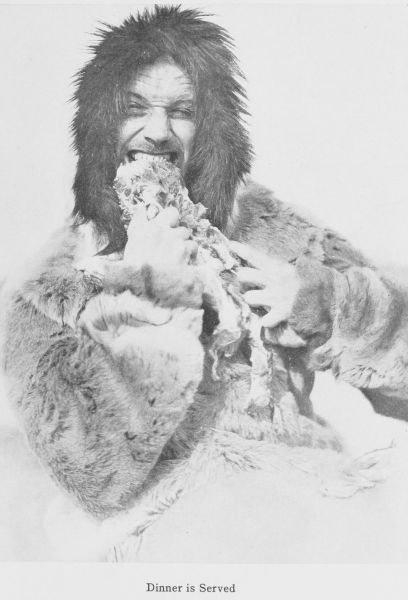
DINNER IS SERVED
The closeness of primitive man to the abysmal brute is strikingly illustrated in the accompanying photograph. Makuik at mealtime must surely remind the reader of the Bronx Park Zoo at that time which the poet beautifully describes:
"Between the dark and the daylight, When the lions release their lung-power, Comes a pause in the day's occupation Which is known as the feeding-hour."
Eskimo diet varies with the season. During the long winter it consists mainly of the fatty overcoats worn by seal, walrus and otary. Another favorite plate is made, en casserole, with alternate layers of whale-blubber and seal-flippers. The result tastes very much like stewed tennis-shoes. These wobbly dishes, garnished with seal-eyes, are served on squares of hide and are scraped-up with flippers or guppy-fins. Both hide and flipper are eaten at the close of the meal which eliminates the tedious dish-washing, wiping and putting-away of so-called civilized housekeeping. These blubberous foods supply the calories (about 2000 to the square inch) necessary to combat the absurd temperature of the winter season.
When the sun re-appears in the spring and the song of the first lapwing is heard, the Eskimo begins to think intently of raw meat. "Ukuk matok tomatok," he mutters to himself. "I must have some vitamines."
The scent of a bear two miles to windward crazes the native huntsman and speedily sets him to sharpening his spears and knives to razor-keenness. Yet so strict is his observance of Kryptok law that when a kill has been made he will touch no morsel until the meat has been divided according to the custom, for the chief the sirloins and porterhouses, for the lesser men the second and third joints and for the women the ribs, rump, neck and feet or whatever else is left.
According to Makuik bear's-meat is greatly prized because of its toughness. It is considered effeminate to eat tender meat. The sound of an Eskimo meal is not unlike a Red-Cross bandage-tearing session.
A study of the photograph under the microscope clearly shows the vitamines winding their curiously spiral course up and down the meal.
The absence of table manners is not remarkable when one considers the absence of tables.
Dinner is Served
Swiftly and noiselessly a large block of snow at the base of the cairn itself moved to one side disclosing a laughing face, the same lovely countenance upon which I had gazed several weeks before. The wearer listened for a full minute with bird-like intentness, then leaped lightly out and straightened up, a long-limbed, graceful creature wearing the conventional summer furs of the Northern Eskimo. Her hood was thrown back showing a glimpse of entrancing shoulder but what dazzled me most were the starry blue eyes, fair skin and wealth of molten, golden hair!
Her first act was to circumnavigate the cairn which she did with the same silent rapidity that marked her every motion. She then made directly for the lure, bending over it, touching it cautiously and finally raising it and burying her face in its scarlet folds, while her laughs rang out muffled but intoxicating.
This was my chance!
Bursting through my prison walls I rushed toward her while Swank, by arrangement, crashed out of Pease, darted to the entrance, slid the block into place and sat on it. I was upon her before she had a chance to move.
"Akalok!" I cried (the Northern dialect for "friend"), as we rolled over and over in the snow. My old football training stood me in good stead for I had made a perfect diving tackle. Inwardly blessing the name of Ted Coy, I pinned the lithe, palpitating body to the snow, repeating more tenderly the soft appellation, "Akalok, Akalok."
But my triumph was shortlived.
For the first time her lips moved and from between them burst a wild, frantic cry, strangely familiar to my ears.
"Makuik! Makuik!"
At the repetition I heard a shriek of pain from Swank and glanced over my shoulder in time to see him rise in the air. The ice block was shattered beneath him and I saw an ugly stub of seal-spear, thrust accurately where he had formerly sat. Directly back of him leaped an ape-like figure as swart and scowling as a Japanese war mask. He carried a terrific weapon, a keen-edged blubber cutter, with which he made directly at me.
At ten paces I recognized him but too late to stop the impending blow. Firing over my shoulder, a tricky shot at best, I shattered the bone blade into a thousand fragments, at the same instant jumping to my feet and shouting—"Makuik! Tapok!"
I had given my name, "Tapok," the Icelandic pronunciation, and at the sound he stopped like a man shot.
"Makuik!" I cried again.
His ferocious scowl faded through stupefaction to astonishment and gleeful recognition.
"Tapok!" he rumbled, spreading his arms wide. "Kata pokok Ikik nakatok!"
I regret that I cannot translate his remark which was highly improper and referred definitely to the woman, Ikik, who stood trembling beside us. She had raised her oomiak and now, to hide her blushes, folded her glorious hair across her face so that she resembled some divine being, half goddess, half skye-terrier. Back of the screen I saw her blue eyes shining and caught a suppressed gurgle of mirth. All, then, was not lost.
In the meantime the cairn was humming like a mighty hive while through a re-opened aperture crawled other individuals, first a younger Eskimo, a mere stripling, followed by four other Eskimos, all radiant blondes. One of them carried a child, slung over her shoulder in her oomiak.
At a command from Makuik, Swank was helped to his feet, the spear being extracted from his person by Snak, a slender maiden with a mischievous smile who deftly poulticed the wound with a handful of snow.
If the reader is astounded at the sudden turn of events he can imagine my feeling when my eyes rested on Makuik, mighty hunter of the Kryptok tribe, whom I had last seen twenty years ago when we had fought our way four hundred miles across broken ice from Ki, an uncharted speck north of Iceland, to Archangel. It is a long story. Suffice it to say that I had saved his life twelve times during the trip while he had done nearly as well by me. We had sworn eternal blood-brotherhood and the word of an Eskimo is as good as his bond; better, in fact.
The Kryptok tongue came back to me fluently and I quickly assembled the family group—for such it was—in our dugout where a distribution of A-P and such small presents as I could lay my hands on transformed what had been two hostile camps into one joyous assemblage.
While the women gurgled their satisfaction over their new fly swatters and empty herring boxes, vying with each other in their attempts to ease Swank's pain, Makuik explained the situation.
The women were all his wives, fruits of victorious battle. They were of the Klinka tribe, perfect blondes, as I have noted. The young man was his oldest son by an Iceland mother.
"Too old. I eat. No good wife ... good eat," he explained frankly.
The infant was his youngest. There would be others. His party had been caught at the Pole by an unexpectedly early summer. For protection from the heat they had taken to the cairn, there to await the winter freeze which would make travel comfortable and possible.
"But why did you hide?" I asked.
"Me not know," he said, smiling craftily. "You have trees."
"Trees?" I mused, then burst out laughing. Of course! He referred to my imperial and goatee, which I have worn since my service in the Bodansky Zouaves, and which he had never seen!
It was as clear as day.
Chuckling with delight, the old warrior showed me over their living quarters while I marvelled at his vigor, preserved in this world of ice. The interior of the cairn was astounding. Instead of entering a domed chamber, similar to the many igloos I have inhabited, we went down, down for a surprising distance. The entire habitation was hewn from the eternal ice to depths far beyond the reach of sun or storm. It was a three-room-and-bath arrangement, the latter consisting of a trough, at a slightly lower level than the main floor, filled with lucent seal oil. The rooms were respectively, living-room (which also served as kitchen and dining-room), bedroom, simply furnished with community sleeping-bag, etc., and storeroom, piled high with blubber, fur-steaks, walrus eyes and other Eskimo dainties. The temperature was slightly below freezing, a delightful change from the prostrating heat we had been enduring, though I will confess that I began to think longingly of mittens and bear-skins and was glad when we once more ascended into warmer atmosphere.
I reached the surface just in time to meet the returning members of my party who, needless to say, were faint with astonishment at the change in conditions.
General introductions were in order and a blithe evening meal was soon under way. But how different a feast from the man-made orgy that had disgraced our arrival. How completely the presence of these gentle savage women had altered the complexion of our enjoyment.
Sprawling about Ikik and Snak, and the other three, Yalok, Klikitok and Lapatok (whose babe had been placed in its cold storage niche), my companions engaged in all sorts of innocent foolery. Though they spoke not a word of each other's language a subtle understanding had sprung up between them. Was it the common strain of Caucasian blood or simple sex calling to even simpler sex? I cannot answer.
Frissell had produced a lavish supply of toys from his pack which made an enormous hit. Ikik had a colored doll which she nursed affectingly. Lapatok joyfully wound a police rattle, while Snak, Klikitok and Yalok sucked rubber teething-rings with evident relish.
Makuik reserved for himself a monkey-on-a-stick which he regarded as a sceptre, the mechanism of which pleased and mystified him.
At nine o'clock Whinney announced triumphantly that his radio was working. He switched it on and we listened in awe while a far-away voice, introduced as Miss Anita Scatchett of the New Jersey State Normal School, told a Bedtime story, "How the Animal Crackers Came Alive."
I say "we listened in awe." I must amend that statement. For a few moments I was mildly impressed. It did seem odd to think of a gentle spinster in Newark, thousands of miles away, speaking to these children of nature. But as far as our guests were concerned, the feature was a dud. The subject matter soon began to bore us all and we shut it off, to Whinney's disgust.
A FAR-OFF FASHION-PLATE
In the charming scene herewith depicted, Yalok, the beautiful Klinka belle, is posing as if she were a mannequin on parade in some lovely al fresco fête, as indeed she is. The background in itself is interesting, showing, at stage right, the Tarpaulin Tea-House erected and conducted during the Summer months by Herman Swank, Dr. Traprock's artistic fellow-voyager. To this picturesque châlet the Eskimo maidens turned with womanly instinct and its accommodations, limited to two, were in great demand. Mr. Whinney, when not entertaining a personal guest, sat outside. But these intimate details need not detain us.
The principal figure is Yalok who, for the purposes of photography, has donned the very latest 1922 Spring-model sports-suit. She wears, it will be noted, "a woman's crowning glory"—her own hair. The other glories are supplied by the hair of various animals indigenous to the Arctic.
Reading from North to South this snappy get-up consists of the otary over-smock or slip-in with sliding sleeves of unborn-seal, the roomy "roamers" of polar bearskin and the pliant chassures. The sleeves, another loose seal effect, modestly cover the entire arm or arms and flare back vehemently from the gauntlets, which may be eider-down or up. The roamers, again, cut loose from conventional lines and melt suavely into the retroussée wading slippers. The last mentioned articles are fashioned from the pelt of the Amok, which usefully grows hair on both sides of its hide. The fore-and-aft apron or windshield is nattily edged with ermine and at the back runs smartly into a train. A last-minute accessory is the fly-swatter, Dr. Traprock's gift to the lady, which is held at the correct angle of 45°.
More important, however, than mere costume is the art of wearing it, an art in which this lovely model is evidently entirely at home. Her position is that demanded of a debutante in the most exclusive Eskimo society, when she is presented to a distinguished foreigner, the head modestly bowed, the eyes downcast, the arms in an alluring come-and-get-me position and the feet gracefully parted in the middle.
A final touch of chic unreproduceable by photography but which has all the allure of a truly Parisian pomboire, is the perfume (Eau de Musk-ox) which adds its ineffable odor to this arctic rose, a hovery halo, and exquisite ectoplasm.
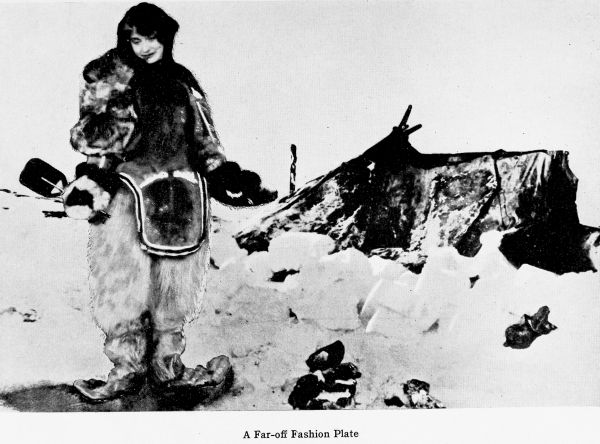
A Far-off Fashion Plate
A few moments later I rose with a start. Something in the air chilled me with horror. Glancing toward the horizon I gasped, then quickly caught myself.
The sun was half hidden below the horizon! The light was distinctly dim!
I thought no one had noticed my involuntary start, but Makuik, though seemingly absorbed in his monkey, leaned toward me and whispered, "Night come."
Night! My God! It had stolen upon us unaware. We would be caught, trapped in the deadly grip of the North King who had claimed so many brave men before us.
The darkened atmosphere suggested but one thought.
"Bed," I said. "Sleep."
My oblivious companions took it as a signal for dispersal. They rose reluctantly. Good-byes were said. Noses were rubbed affectionately.
Then an embarrassing episode took place.
Makuik, who had marshalled his flock before him, suddenly seized the lovely Ikik by the shoulder and thrust her into my arms.
"You take," he said, smiling broadly. "Me give."
Her warm body pressed against me, not unwilling. It is the Kryptok custom, as usual as giving a man a drink.
Confused and inefficient, I stood there. But my perplexity was shattered by another surprise. A compact, wiry form hurled itself between us. It was Sausalito, her face livid with fury!
"You let that woman be!" she shrieked, panting, glaring.
Makuik shrugged his shoulders and pushed the Eskimo woman roughly toward her fellow wives. Then, turning, he glanced contemptuously at Sausalito.
"No good ... you eat." He leered, swinging off toward his sub-cellar.
"Dog-face!" screamed Sausalito. "Pig's-foot...."
Triplett's great hammer fist struck her squarely on the jaw and she sank limp in his arms.
Late that night I lay tossing on my blankets, prey to a thousand conflicting emotions, fear, joy, and sickening anxiety, beneath which, like the burden of a refrain, ran the overwhelming thought: "She loves me. Sausalito loves me. What shall I do?"
It was the first time such a proposition had ever daunted me.
FOOTNOTES:
Chapter VII
Still procrastinating. Our pastimes at the Pole. An exchange of love-tokens. Ikik's avowal. Caught in the embrace of the Aurora.
Chapter VII
The longer I live the more of a fatalist I become. Looking back on the weeks which followed our meeting with Makuik and his family I see myself powerless in the grip of a force superior to my own. How else can I account for the procrastination which, day after day, week after week, held me in my perilous location. For that it was perilous my brain told me clearly.
Seven previous trips into the Arctic had taught me that its climate could be treacherous as well as friendly. If I have seemed to expatiate on the tropical warmth of an exceptional summer, the hottest on record in the meteorological archives of Iceland (which are the oldest in the world), rest assured that it is with no wish to encourage ill-equipped pleasure-parties to venture forth into these icy solitudes. I have been warned by an eminent polar authority that it would be dangerous and wrong to instill this idea. I thoroughly agree with him. Woe betide the week-end tripper or basket-picnicker who fares beyond eighty-six with no protection other than a warm sweater and a quart thermos of coffee! He is doomed before he starts or immediately thereafter. When the short summer wanes the thermometer plunges without warning to incredible depths and almost certain disaster results.
A NIMROD OF THE NORTH
A large volume might be written about this illustration alone.
Big game hunting, in the last analysis, is usually a feeble sort of sport. The stalking of itself is a beneficial form of exercise but when at last the two strong brutes, human and animal, stand face to face it is an odds-on bet on the human. An express-bullet takes little account of hide or hair. Compared with this form of target-practice, fly-swatting and mosquito-slapping are gallantry itself.
We may learn something from Makuik, the Kryptok huntsman who is seen en face in the act of capturing part of his winter's meat-supply in the person of a magnificent specimen of the ursus polaris. The method universally employed by the Eskimo is that of the surprise-onslaught. Polar bears, for some reason, do not expect to be attacked by men from the air.
Perched on a rocky eyrie the native huntsman warily scans the floe for his victim. The path beneath the precipice is baited with small cubes of seal and pemmican meat along which the prey is led by appetite just as children at birthday parties are led through the mazes of a peanut-hunt. When the bear is directly below him, the hunter springs silently into the air and descends like a falling archangel on the creature's back. A hunter's prowess is measured by the height from which he dares to jump. Makuik holds the Kryptok record in this event is 40 Kyaks (approximately 520 ft.). At the termination of a successful jump the bear breaks the fall and the fall not infrequently breaks the bear. But the risk is great and in case of a miss the Nimrod becomes forthwith data for the actuaries and food for the bear. As in all aerial feats the important part is the landing.
In the incident portrayed the result was the not unusual one of a glancing blow. Striking the bear's shoulder Makuik was thrown for a loss of seven yards, not, however, before he had pinned one of the bear's paws to the ice with his keen-edged ratak. From then on the fight was a fierce hand-to-paw affair, one round to a finish with the incessant in-fighting, knife against claw, brain against brain.
Makuik won the decision after forty-three minutes of gruelling and growling work, not without considerable damage to his person. Throughout the battle he consistently placed his knife-thrusts where they could later be made into buttonholes by his beautiful wives, beginning at the lowest button and working upward to the lapel. The bear was thus actually tailored during the process of destruction. Forest and Stream please copy.
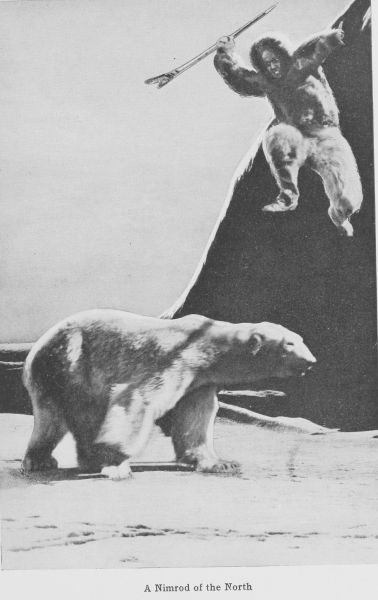
A Nimrod of the North
And yet, knowing these things, I stayed. Discarding all plans, scrapping all schedules, denying all reasons, I delayed, lingered and waited. For what? Death, perhaps, but before death, Love! Ah, love! love! mad will-o'-the-wisp, flaming with tragic intensity in the very core of a berg, destroying passion, paralyzing my will-power even as the spirit of winter laid his icy hand on my shoulder.
My companions, fatally influenced by my example, were no longer restless but completely satisfied with their surroundings and with the society of the Klinka women who, as the light waned and the temperature dropped, ventured more and more into the open.
Nowhere in the world will one find such gaiety, friendliness, and generosity as among these child-like denizens of the North. I do not except even the glorious Filbert Islanders who were my own discovery. During many a long twilight I sat with Whinney, Triplett and Swank about the Primus stove which we now found comfortable, chatting of our Polynesian friends and evoking many a tender memory. Of all who made that famous cruise only our former crew was missing, Thomas, the sailor-man whom we left behind. But I could not find it in my heart to envy him.[20]
Compared with northern tribes all Polynesians are slow and lethargic. Nothing could exceed the swift grace of these glorious Klinkas, and many a day of rare sport we had while there was still light. Our contribution to the program usually consisted of an American game adapted to local conditions: tennis, using the native snowshoes for rackets and balls of inflated fish-membrane, or golf over a sporty nine-hole course with constantly shifting snow-bunkers and water-hazards. This variable quality in the links made play extremely interesting and likewise supplied a much needed alibi for our scores. Frissell's inventiveness created extraordinary good clubs out of parts of our cooking utensils lashed to whale-bone shafts, with which it was no unusual thing to drive upwards of seven hundred yards. The idea is covered by patents.
To my amusement Makuik and his entire family were deathly afraid of the pogo-sticks. In their simple minds this contrivance was endowed with life of its own. When I finally forced one on Ikik she planted it fervently on a little cairn where it was worshipped as a God. How strangely the idea of the totem-pole persists! And speaking of poles, no outdoor sport proved more popular than tether-ball, with the ball tethered to the Pole itself.
The Eskimos were far from lacking in amusements of their own, though these naturally had a direct bearing on some ulterior object such as blubber for food-supply or furs for warmth. It has remained for the superior white races to invent games which are of no use whatever.
Time and again Makuik thrilled us by his long distance harpooning of seals which now sought the floes in large numbers.
The perfect poise, the powerful thrust, the long trajectory and the final, squashing hit just behind the ear were enough to excite the envy of an Olympic javelin thrower.[21] The feat was the more remarkable when it is considered that a seal's ear is on the inside and, therefore, invisible.
Some of the novices in my party were slightly overcome by the mad rush of Makuik's family toward the stricken carcass from which they tore and devoured long strips of blubber, but needless to say this was an old story to me. Fresh seal's eyes are a coveted tid-bit, and I was much touched when Ikik brought me one, warm and quivering, in the palm of her hand. It was plainly a love offering as I saw when I looked from her eyes to that of the seal. One should chew them, not gulp them down, in order to get the full flavor which is not unlike a Cape Cod oyster, though more salty and slightly oily.
The women were particularly fond of leading us on searching parties in quest of seal roe, which we found in large quantities in the shallow nests lined with the yellow wax which exudes from the pores of the mother. Both roe and wax are highly prized by the natives who spread them, mixed, on squares of seal hide, forming sandwiches. In winter the seal fur is also included on account of the extra warmth which is provided.[22]
It was a happy thought of mine to present Ikik with an enormous church candle which, having been blessed, had been presented to me by the Bishop Metaxis Polyphlosboios in Constantinople. Ikik and I were alone when I offered it, in return for the eye she had given me. I wish my readers could have seen her divine smile as she touched, smelled and finally tasted the white cylinder, which was so much more refined than the fresh fat and tallow which had been daily pabulum.
"Tapok, Ataki! Traprock, I adore you!" she cried, throwing herself at my feet and chewing the uppers of my moccasins, the native expression of complete devotion.
"Enough!" I murmured, raising her by her hair; "here come the others."
Though my "affaire de cœur" was progressing satisfactorily, I was forced to walk warily. Some of my fellows were infernal busy-bodies and Sausalito, poor wretch, watched over me with furious jealousy.
Innumerable were the diversions of those happy, happy days, the mad pursuit of an occasional musk-ox, of which the women were insanely fond because of the perfume derived from its peripatetic gland, and the absorbingly interesting observations of the Arctic guppys, those unique fish which bear their live and full-formed young on the ice without the tedious formality of laying an egg. The mother guppy immediately eats her offspring and the race between her and the Eskimo audience to see which could get the most, was not the least amusing phase of this quaint accouchement.
And then the long, twilight evenings, snuggled down in the deep furs of our friends, sharing the warmth of our tiny Primus under the Kawa's lee, crooning our songs, passing our plugs and our gay banter. I feel sure than I shall never be nearer heaven.
On an immemorial date, for our watches had long ago run down, we sat thus in our little Arctic circle listening languidly to a number on Whinney's radio,—"What the Sunday Schools of Kansas are Doing," I believe it was,—no; "The weather a hundred years ago today," that was it,—when I suddenly realized that it was dark; not twilight, but actually dark!
Can you realize what that meant to me? Startled, I withdrew my thumb from Ikik's soft lips and raised myself on my elbow. About me in the gloom were vague bundles, Swank and Yalok, Frissell and Snak, Whinney and Lapatok, Wigmore and Klipitok, Triplett and Sausalito, silent, rapturous, oblivious. But a strange thing was happening.
All about the circumference of the great ice bowl, of which we were the center, rose trembling, blue flames. I could hear their fluttering hiss and crackle. Now they leaped higher, shooting out giant arms toward the zenith, waving lambent fingers, shivering, interlocking, melting. My companions, aroused, sat up and I could see their startled faces lighted by an unearthly light.
The noise and glare increased. Swishing waves of fuchsia-pink swept up the sky; muffled explosions were followed by writhing snakes of lemon-yellow and far-flung globes of purple and crimson gleamed in the sky while, directly overhead, millions of miles away, the North Star looked down indifferently.
At times the wall of encircling flames, now approximately ten miles high, leaped in unison, to a diabolical rhythm; again they moved about us in procession, gigantic, towering, flapping, hissing, whistling, rippling, a night-mare of glorious colors which have no names. The very ice below me, cracking and groaning, was shot with fiery veins.
AN ARCH ARCHEOLOGIST
One of the most pathetic figures in the author's startling "exposure" is that of Bartholomew Dane, the Egyptologist who is here shown with Snak, his Klinka assistant, pursuing his speciality of comparative archeology.
A word as to Dane's previous record may bring some information to the few Americans who have not made archeology, with emphasis on Egyptology, a hobby. Born of Nordic stock (his maternal Grandmother was one of the Iceland Krakkens), educated in the more-than-usually-common schools of South Bend, young Dane showed early aptitude in geography, history and kindred studies. His passion for research work was early in evidence his every leisure moment being spent in the examination of abandoned cellar-holes, cisterns, wells, rubbish-heaps and public dumps. His parents, fearful lest their son turn out to be a rag-picker secured for him an under-janitorship at the Natural History Museum of New York City, doubtless hoping to thereby shift the blame for his development from South Bend to the Metropolis. From then on his rise was rapid. Working his way up from the cellar we next hear of him as Secretary to Prof. Thurston Mudgett of the Extinct Civilizations Dept. His course from there to the Nile delta was clearly indicated.
Six months later the young archeologist disappeared, only to reappear six months later laden with honours conferred by the Egyptian government, a full-professor in the College of Alexandria, a recognized authority abroad belatedly received with equal honors at home. His great work on Scarabs among the Arabs is in itself an enduring monument.
What led Dane northward is a mystery. That he hoped to find the missing link in the almost completed itinerary of the lost tribes of Israel we know. That he failed in this dream is a sad fact. But there is solace in the thought that amid the snowy wildernesses of the Pole he found in the companionship of the sympathetic Snak a love which could never have reached him over the hot sands of Sahara.
Due to overwork, exposure and an unavoidable blow on the head, his mind has failed considerably of late but in his lucid moments he hints darkly at having made certain interesting discoveries which have nothing whatever to do with archeology. His earlier achievements, his protracted sojourn in the Tomb of Put, his discovery of the Temple of Murad, all these he lightly dismisses. "The first year was the pleasantest," he laughs; the rest is silence, and the silence is, we trust for this courageous spirit—rest.
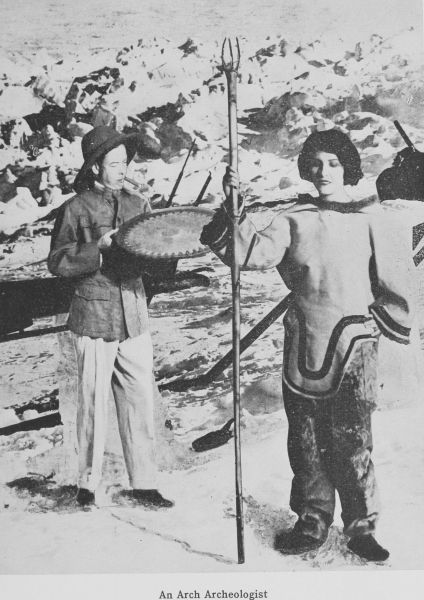
An Arch Archeologist
The Eskimos had buried their heads in their oomiaks, my companions lay face downward.
Desperately frightened, I still resolved to face the end, to see what my dazed senses told me was the final conflagration of the world.
Staggering to my feet, I glared about me, taking in the picture with all its ghastly details, the Pole and its flags, the cairn, the Kawa, every block and halyard of which was etched on this field of flame. How insignificant it all seemed.
The world had finished its trick; it was as a tiny bead, cast away by the Creator, a cinder in the eye of God!
Suddenly the flames turned incandescently white, rushed toward me and, on an overwhelming wave of siren wailing, I was swept away, billions of miles beyond the Pole-star, to Eternity....
Ikik was rubbing my forehead with a cool tundra sponge and her face above me was that of an angel.
"Did you see?" she asked. "It was beautiful."
The Eskimos were discussing the display critically.
"Too green," said Makuik. "No good. Cold come."
Peering through the darkness I saw the dim outline of the Kawa. The Pole stood intact. Nothing was harmed, nothing singed.
The astounding truth burst upon me, astounding and important to me though nothing to these ages-old Aryans.
We had been in the exact center of the aurora borealis.
Another milestone for American science!
FOOTNOTES:
Chapter VIII
The Arctic Night. The temptation of Traprock. The pros and cons of falling. We solve an age-old riddle. Our Polar Christmas. The love-philtre. Abandonment.
Chapter VIII
"Eighty-six below," announced Captain Triplett the next morning, "an' a fine, starry night."
Old Ezra was right. Night had fallen while we slept. The long Arctic blackness had followed our twilight sleep, and we were now in the grip of its intense cold.
How strangely fate works her miracles! But for my first glimpse of Ikik and our subsequent meeting, we should inevitably have perished, clad as we were in our light linen-mesh and flannels. But the Eskimos had foreseen our peril and supplied us with roomy garments from their own abundant store. No gift in their possession was withheld by these warm-hearted people. Gauntlets, socks, boots and great hooded oomiaks were pressed upon us in which, as soon as we had become accustomed to their overpowering odor, we were extremely comfortable and were able to go about during the less severe weather without danger of being frozen unawares, a very real risk for the novice.[23]
Makuik was insistent that both parties join in sharing the protection of his sub-surface home.
"My meat, yours ... my woman, yours ... you know."
His words were accompanied by the Kryptok sign of blood-brotherhood reserved for members of the clan. Were I to divulge it here I should some day feel the thrust of Makuik's salmon-spear between my shoulder blades. It was a dramatic feature of Kryptok ritual that a sin against blood brotherhood may only be washed out by the blood of the offending brother.
But though I realized the closeness of the tie which bound me to this furry friend, though every fibre of my being cried out to accept the gift which he offered so gladly, a gift which meant warmth, happiness, love!—knowing all this, I was firm in my refusal.
In the face of a temptation, the greatest perhaps of my life, I resisted, I fought, I struggled.
My reasons were many and complicated. If they were right or not I do not know, but they seemed so at the time.
To begin with I knew in my heart that the beginning of close clan relations with these magnificent Klinkas meant the end of the Traprock Expedition! That we should ever again return to civilization was absolutely unthinkable. Here, in this winter solitude, I saw the first glimmerings of the truth over which the scientific world has so long puzzled. Here was the answer to the old, old, question, "Why do explorers leave home?" Why have so many never returned?
They have been absorbed by, and eventually into, one of these magnificent tribes. They have disappeared, or if they have found their way back to civilization, having proved failures in their new environment, they are tongue-tied, evasive, ashamed.
If I accepted Makuik's hospitality, in full, I saw another inevitable result. He would eventually have to die at my hands. There is room in a small nomadic tribe for but one leader, one "Kalok" or "Strong man." This is the ancient law of evolution. Bound as I was to Makuik I hesitated to take the first step which spelt his doom.
THE BATTLE ON THE BRINK
Students of the text of this volume will recall that a distinct rivalry existed between two of the principal characters, Sausalito and Ikik. The author makes what to us seems a delicate distinction regarding the object of this rivalry. "It was," he says, "not so much me as my love." There is something almost astral in this subdivision. Be that as it may, a strong feeling of competition existed between the two ladies which vented itself in frequent passages between them similar to that illustrated.
In this case the struggle started, as usual, in the most friendly manner, its object being the possession of a stub of candle, the last of the great dip presented to Ikik by Dr. Traprock. Developing, as such things do, from playful wrestling to rough-house, it was not long before the Klinka maiden found that she was struggling for her life. Sausalito's experience in catch-as-catch-can work, gained up and down the Barbary coast, was an equal match for the supple strength of her adversary and there is little doubt that the result would have been fatal to one or both participants had it not been for the timely intervention of Makuik who, seeing how things were going and fearing possible damage to one of his favorite wives, kicked over the icy stage upon which the drama was being enacted, at the same instant throwing the carcass of a bull-seal where it would intercept the fall of the contestants. Had it not been for the skill of Makuik in throwing the bull we can well imagine what would have happened. The animal weighed 220 poks or "meals," that is, approximately 2200 lbs., a "meal" being reckoned as 10 lbs. of any form of food-supply.
After the fall described above a temporary truce was patched up but the feeling of rivalry remained acute. As the philosophical author observes, "Being in love with two women is one thing: being loved by them is another."
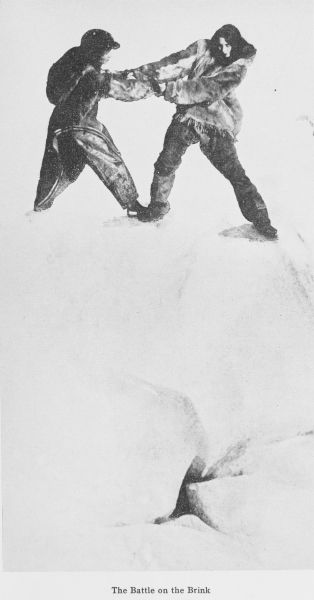
The Battle on the Brink
A final consideration, though not one which bore much weight, was that there were not enough Klinkas to go round. I have, perhaps, indicated in my previous chapter, that the process of natural selection, though far from home, had not ceased to operate. The Klinka women, while filled with joyous camaraderie, clearly had their favorites and the pairing which I noted most often was that of Swank and Yalok, Frissell and Snak, and Whinney and Lapatok.
Frissell amused Snak immensely with his outlandish noises and imitations, and Lapatok, who stayed near the cairn more than the others in order to care for little Kopek, her boy, found in the now helpless Whinney another child upon whom to lavish her affection.
Makuik smiled tolerantly at these innocent relations. The women were his, when all was said, and I have no doubt that had the faintest wave of jealousy stirred his primitive heart he would have calmed it by the old tribal method of holding the offender under water for the few seconds necessary to allow the ice-opening to freeze over.
Unfortunately the other members of the expedition did not accept the situation so calmly. Plock, Miskin and Sloff were by no means satisfied with an arrangement which so plainly left them out of it. Dane was not by nature a ladies' man, though he took the color of the others' mental attitude. On numerous occasions I was forced to intervene when a sudden minor crisis developed. Miskin took umbrage because Snak gave Frissell the largest piece of blubber, or some other tom-foolery, and before one could stop it the air was hot with suppressed antipathy.
This state of affairs frankly worried me and I was not anxious to make it worse by accentuating it in the intimacies which were bound to develop in Makuik's igloo.
I therefore issued the strictest orders that all my men should bunk on the Kawa, a regulation which I forced myself to adhere to in spite of the most terrific temptations. We had completely overhauled our running gear during the warm weather and now found that by running the Tutbury at quarter speed, thus charging the batteries, we were able to generate just the right amount of heat required to keep us comfortable.
We soon adapted ourselves to our new mode of life. All outside thermometers were hung upside down in order to read properly and whenever the temperature was above forty below we sallied forth into the night, on pleasure or profit bent.
An early inspection was made by Miskin, Sloff and myself of the rim of the ice bowl, immediately following the stupendous display of the aurora borealis, which had ushered in the winter. Makuik accompanied us and it was from the naive comments of this child of the north that we arrived at a solution of a large part of the problems in connection with this phenomenon.
As we travelled about the circumference of the bowl I was at once struck by a deep trench or moat which followed its outline. The sides of this moat, which averaged approximately 200 yards in width, were glazed with freshly formed ice which appeared at first to be black in color. A closer inspection showed that this color was derived from a sub-surface stratum of finely powdered carboniferous deposit similar to coal or cinders. At no place were we able to reach this deposit owing to the shortness of our ice picks, but both Miskin and Sloff agreed that the buried material was clearly a metallic slag which had been subjected to extreme heat.
It was at this point that Makuik injected his interesting personality into our deliberations. Observing our puzzled looks he stooped and gathered up a handful of loose snow crystals which he thrust into his mouth, at once expelling them with a mighty gust of breath. Then he clapped his stomach and said—
"Ice ... sick ... so ... pouf!" another great blast.
My mind flashed back instantly to the claims of an old scientist of whom I had heard my friend Waxman speak, one John Cleves Symmes. As far back as 1819 Symmes had advanced the theory that the earth was hollow. His exact statement reads "the earth is hollow and habitable within, being composed of a number of solid, concentric spheres." Unfortunately Symmes was unable to travel further north than the site of what is now Racine, Wis.,[24] so that his theory remained only a theory and he was eventually laughed out of court.
Now, over a century later, I was to verify a part of his suspicion. That the earth was hollow we could not doubt. Subsequent excavations in the great polar ditch confirmed what we had begun to realize. The entire section of earth crust at this end of the axis was loose! Deep in the bowels of Mother Earth still burned the terrific primal fires, occasionally venting themselves in some such upheaval as we had witnessed. Whinney later corroborated the findings of Sloff and Miskin regarding excavated specimens of the slag, namely, that they were composed of rhyolite rocks, pulverized lime and other building materials plainly produced by volcanism. The ceaseless whirl of the earth on its axis naturally throws these expanding substances toward the Pole until the bung, or world stopper, is loosened. As soon as the terrific pressure is relieved the ice cap sinks back and the melted snow at once seals the circular fissure.
It is the discovery of such long-sought truths as this which more than repays me for the hardships involved. As I pen these lines I can but bow my head in humble thankfulness to Him who knew too well to fashion this Earth without a safety valve.
The exact date of this and other discoveries is indeterminate. Since the stopping of our chronometers we had gone mainly by guesswork. I was fully aware, from the advent of the polar night, that time had slipped on to approximately September 20th. Knowing our exact position (Lat. 90°, Long. 0) it was a simple matter for Triplett to re-establish a definite day schedule by the theodolite-hygrometer method combined with astronomy. The weather was now clear and excellent views of the stars were obtainable from any given point. Altair, Vega and Betelgeuse were particularly visible, but Triplett's favorite constellation was the Dipper, the handle of which he usually triangulated with Cygnus and ourselves. Three successive observations gave Saturday, September 28th as the correct answer and I forthwith posted notices of this fact, which was celebrated by a joint feast.
Night, it is said, is the time for reflection and I now had ample opportunity for this exercise. Unfortunately for the philosophic calm which might have resulted from thought, Ikik, my lovely northern sweetheart, had other ideas as to the proper disposal of the nocturnal hours. The glances which she levelled at me across the Primus were, to say the least, importunate. Little by little I felt my icy resolution thawing beneath her tropic influence.
It was an odd situation. About me the wastes of berg and floe, the mercury skulking in the basement of the thermometer, while in my heart burned an increasing glow that would not be extinguished. Yet I fought on, a St. Anthony of the North.
Christmas came, as it will even in this distant clime. The event was marked by a general celebration. As I went about the preparations for the feast I little realized how tragically the date was to stand out in my memory.
Morning dawned dark and clear. We used the Pole for our tree, having fashioned branches of oars, pogo-sticks and other suitable materials. During what would have been the fore-noon we groped our way to the edge of the ice bowl, in groups of two or three. I was in one of the groups of two. The other half was Ikik.
Sitting in silence on the edge of the earth crater, I mused sadly. How wonderful, I thought, if the great safety valve would but open and bear my love and me away in its flaming arms. But the conflagration was to be of a more human and dangerous character.
"See," whispered the maiden. "I have brought my present for you." How like her it was, to steal away from the others for this sacred presentation. I peered at the object in her hand. It was a small sack of translucent fish membrane filled with a viscous liquid.
ODE TO THE AURORA
No more poignant moment in the history of American literature has ever been recorded by the camera than that shown with this text which portrays Whinney, the poet-scientist, in the very act of creating his immortal poem "Ode to Aurora," which John Farrar, the veteran critic, pronounces "the best classic ode ever written north of the arctic circle."
As a poet Whinney resembles Milton, in that he is blind. Though this was only a temporary affliction,—snow-blindness,—its immediate effects were heartrendingly pathetic. Not only did the unfortunate traveller miss seeing the Pole and the polar fireworks but he was also forced to master the most difficult of all literary exercises, that of operating a typewriter with mittens on. The ancient pastime of catching a flea while wearing boxing-gloves is child's-play compared with this achievement. Hour after hour, day after day, the persistent poet practised his sightless-touch system.
"What does it look like?" he would ask, submitting a page to Sausalito who had good-naturedly assumed the duties of nursing-secretary.
"Nothing," would be the invariable reply.
But with dogged perseverance Whinney struggled on, gaining a comma here, and a colon there, until he had mastered his instrument. The result all the world knows,—those deathless lines beginning:
"O Aurora! Not only East, but North as well, And West! and South! Th' extraordinary tidings tell! Flash thy bright beams And wave thy lambent paws, Clap thou thy rays In luminous applause."
For sheer glory of color the description of the aurora which forms the main part of the ode has never been equalled. And then the solemn close, touching in its modesty.
"Tell thou the world, That it remember shall The names of Traprock! Whinney! Swank! et al."
Since returning to this country Mr. Whinney has taken out a regular poet's licence and is now turning out verse of the very highest standard.
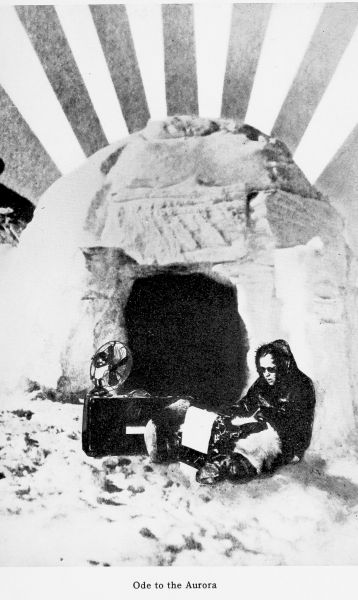
Ode to the Aurora
"What is it?" I asked tenderly.
I could feel her flush against my cheek.
"Walrus tears."
"Walrus tears?" Ah, yes, I remembered. Years ago an old woman in Bjarkoi had told me that the tears of a male walrus if caught fresh, were an infallible love potion.[25]
"Like Tristan and Isolde," I murmured. She shook her head, uncomprehendingly.
"Drink!" she whispered.
Smiling at the superstition, yet unwilling, unable, in fact, to resist the pleading look in her eyes, I loosed the thong and placed the sack to my lips.
The next instant she was in my arms!
My brain reeled. The stars danced dizzily overhead and were then blotted out. A moment later I became aware of a ludicrous and embarrassing circumstance. Locked in each other's embrace we were sliding down the icy incline of the bowl!
We struck fairly in the midst of a group composed of Triplett, Makuik and several others who greeted our arrival with roars of laughter; surely a strange ending to a "crise d'amour."
At four-thirty we lighted our tree and had carols, presents and general dancing. At six the feast was served, the heaping ice slabs being placed along the counter of the Kawa which was decked with her full suit of colors and all her extra riding-lights. Pemmican, blubber-steak, seal- and walrus-eyes, hide-salad and guppy-croquettes were supplemented from our waning stores of biscuit, herring, ham, candles and A-P. Even little Kopek was not denied a place and sat near his mother sipping a soapstone cup of modified whale's milk.
Swank had compounded a new drink for the occasion which he called "Traprock tea," consisting of A-P shavings dissolved in salad oil with a number of live guppys flapping about on the surface, "to give it animation" as the inventor explained.
The animation was certainly not lacking and the fun waxed fast and furious.
At an earlier date, late in November, an all night poker game had been instituted by Wigmore, with whom this sport was a ruling passion. Warned by me, the participants had signed an agreement to quit promptly on the 15th of March, in order to avoid the bickering which might be expected when some loser inevitably insisted that they play "just a week" or a "month more." The gaming element now drifted away, one by one, toward the table in the Kawa's cabin. Most of the others had also withdrawn into the obscurity. Little Kopek had long ago been put to bed. Makuik, I regret to say, was helpless.
It was then that I noticed for the first time the absence from my side of Ikik. She had stolen off, unobserved. Rising, I lurched steadily around the cairn. My head was aching, my heart full of unspeakable longing and sorrow. Was it the Traprock tea or the love philter? Probably both.
Resolutely turning my back on the camp I walked to the far edge of the ice bowl where I sat down. One by one the lights of the celebration flickered and went out. I heard the card players shouting their maudlin good-nights to each other. Once a voice shouted "Traprock!" and, following a remark I could not catch, came a burst of coarse laughter. Then all was silence.
An hour later I arose with a slight shiver; it was 38 below. Though my hands and feet were numb, in my veins throbbed liquid fire. Remorse gnawed at my heart. What had I said to Ikik that had turned her from me on this, of all nights, our first Christmas together?
Reaching the side of the Kawa, where all lay plunged in slumbers a sudden thrilling resolution flooded over me. I must see her!
I must whisper a tender good-night to the one who had grown to mean more to me than all the rest of the world.
Turning abruptly, my brain reeling, I made directly for the entrance to the igloo.
The door-block slid back noiselessly. A moment later I stood in the low room, hesitant. The single tundra wick gave a dim light through which I saw Makuik's beady eyes fixed on me. With a sweeping gesture he indicated a vacant space in the line of deep breathing figures. Then he too sank back and instantly began snoring.
With infinite care I crept over the human mounds until I sank into the space Makuik had pointed out.
Touching the figure next me I whispered in the lowest of tones.
"Dear one, I have come to say good-night."
She turned toward me, her face shadowed in her oomiak, soft arms twined stealthily about me as a vibrant voice murmured "Walter!"
I bounded to my feet with a cry of dismay that caused the sleepers to stir uneasily.
The woman followed me as I hurdled my way to the stairway. In the entrance I glanced back for a second on a face livid with passion.
It was the face of Sausalito!
FOOTNOTES:
Chapter IX
Sausalito's strategy. Orders must be obeyed. We turn southward. The parting. Mutiny and desertion. In the grip of the Ice King. A fight to the finish. Victory.
Chapter IX
She came directly to me in the morning. Sleep had calmed her somewhat. She was cool, but determined. In her hand she held a packet of papers, sealed with the seal of the E.U.
"Your orders," she said briefly and turned to leave the cabin.
"One moment," I said. "You others, kindly leave us. Sausalito, remain."
She sat down limply.
Plock grinned malevolently as he thumped up the companion-way. He knew what was coming, the blackguard.
As I took the packet I saw at a glance that the seal had been broken and clumsily repaired.
Walking to the hatchway I closed it.
"Where did you get these?"
"I f—f—found them," she stammered.
"Sausalito," I said gently, "you lie."
My tenderness disarmed her. Throwing herself on her knees she burst into a flood of hysterical weeping.
A MOMENT MUSICAL
It is not surprising that Triplett and Traprock were amused by the reaction of Yalok, the Klinka maiden, to the miracle of the radio. The author tells us that the "morceau" picked-up at the moment this photograph was taken was a harmonica-solo by F.P. Adams of New York. Mr. Adams holds all records for plain and fancy harmonica-work, triple-tonguing, echo-effects, vox-humana and choir-invisible. The maestro was accompanied at Newark, by D.T. Smeed on the pianoforte. Had the great artists known the joy they were bringing to the far-off ice-maiden, while they could not have put their backs into their work more thoroughly, they would doubtless have felt more amply repaid than they did when they left the offices of the Westinghouse Company.
The number tried and rendered on this particular occasion was Tristan's song from Der Erl-Kœnig, the immortal lyric beginning:
"Childe Hassam to a dark tower came," and ending with that pathetic musical fiasco
"Placing the slughorn to his lips,— He blew!"
The hitherto-unheard and unheard-of sound of a B flat slughorn, reaching into these frozen fastnesses, stirred the very depths of the Eskimo auditor, while the white strangers, unconscious of the emotional tumult they had aroused, assisted by Messrs. Adams and Smeed, laughed uproariously at the scene. Dr. Traprock's demeanor, especially, is positively mephistophelian. Can it be that he thinks of playing the satanic rôle to Triplett's Faust?
Dr. Traprock assures us that we are too imaginative. "It was a glorious performance"; he says: "Long may its frozen echoes hover 'round the Pole, to thaw out in successive Springs as the years roll on. I shall not be there to hear them but I shall be happy to think that they persist."
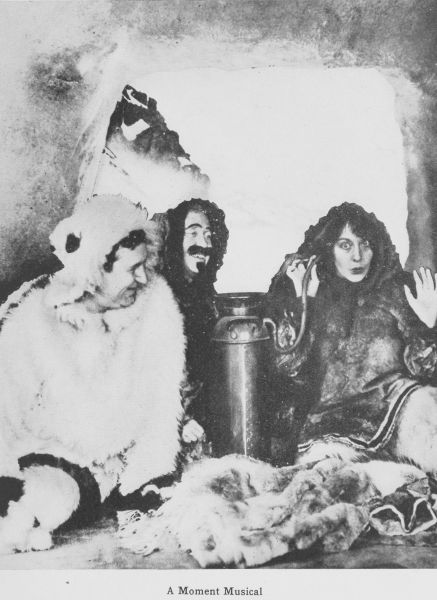
A Moment Musical
"No, no!" she wailed. "I found them. I was putting your brief-case in order, and then my curiosity got the better of me and I opened them. But read, read!"
Obeying her injunction I unfolded the papers, and sat back, thunderstruck. The orders were brevity itself. They said simply. "Sail south, at once." My face must have expressed my bewilderment for she continued. "You see! You see! the moment I read them I knew these orders were a plot, a plot to make you turn back, a plot to discredit ... the man ... I love."
Her voice sank to a low moan and her shoulders were again racked by sobs. I saw it all now. Consumed by jealousy, knowing the contents of the papers, she had withheld them until her woman's nature could stand no more. In the dim light of the cabin, her face transfigured with tenderness, she was actually beautiful.
I raised her gently from the floor. "That will do," I said.
"I am sorry ... sorry," she moaned.
I pointed to the companion-way and she went out silently.
In the quarter hour which followed I wrestled with a temptation more terrible than any trial of the flesh, the trial of my honor. Once, my hand, holding the orders, stretched toward the cabin lamp; a few ashes, and all would be solved. Then I hastily drew back as if the flame had scorched my soul. When I finally arose, spent and trembling, I could proclaim myself the victor.
"Traprock must be true," I muttered. Then striding to the hatchway I threw it open and stepped on deck.
"All hands aboard to receive orders," I bellowed.
Amid confused murmurs the company assembled.
"Sick?" asked Captain Triplett peering at my white face.
"No; well," I answered. "Men, stow your dunnage at once. We leave in four hours for New York."
Makuik was surprised, but, I think, not displeased to see us depart. Though imperturbable, he had felt the responsibility of so large a tribe. His own way lay toward Iceland, via Ginnunagap and Nivlheim. Perhaps he felt that as the spring hunting-season opened his movements would be hampered. He must soon be on the march in order to reach his destination over the solid ice before he was cut off in the land of enemy tribes from whom he had ravished their loveliest possessions.
At any rate he worked with a will to speed our departure. Though he must surely have counted on the probability of none of us ever reaching safety he remained generous, bright and smiling to the last, insisting on dividing what remained of his food supply and heaping a monumental pile of oomiaks, spears and other equipment on the Kawa's deck.
When we had turned our little craft about and cast off our moorings I stepped into the space between the two parties. It was a trying moment. I had prepared a short speech for the occasion but found I could not trust myself to deliver it.
Advancing toward Makuik I silently gave the Kryptok brotherhood sign, which he returned. I had not seen Ikik since the previous evening but I now perceived her in the background and noticed that wise old Makuik had made fast one of her ankles to a large block of ice.
Approaching her quietly I hung an oil skin tobacco pouch about her neck. It contained a book-plate bearing the Traprock arms[26] and the device "Traprock must be true." On the back of this I had written, in Klinka script, "I could not love thee, dear, so much, loved I not honor more."
Blinded with tears, I turned and for the first time in many blissful weeks, gave the old, old, command, "Mush!"
On February twelfth, we had reached eighty-five. Progress in the cold and dark was infinitely slower than it had been during the warm northward journey. The absence of mosquitoes was a compensation but on the whole travel was much more arduous. The mean temperature from Jan. 1st to Feb. 10th was 68° below, the meanest I have ever encountered.
But I was in no hurry. We were very comfortable on our admirable craft and a careful reckoning of supplies gave me no cause for alarm. According to my list, we should be able to hold out for another year if worst came to worst.
It came to worse than that.
My rude awakening came on February 17th.
It had been a wretched day with alternating snow and blizzard gales. The thermometers had gone their limit (100 below) and would have gone further if they had been longer. Cooped up in the cabin, worn with toil, frazzled with the bickering of the card players to whom I had given one week of grace for final rounds of roodles, my nerves were taut and jumpy. I ordered Swank to step aft and fetch me a plug of A-P. He was gone an unconscionable time and when he returned his face was blanched with terror.
"The bin's empty, Sir," he reported.
Empty!
I stared at him in amazement. Far into the night I went over my bills of lading promising myself a thorough stock-taking in the morning.
But the disaffected element on board were ahead of me. When I came on deck the following day, they were grouped in the waist of the ship. The only greeting I got was black looks. Bulky haversacks and walking gear lay piled behind them. Plock stepped forward and began speaking nervously and rapidly.
"Traprock," he said, "this is where we quit. We've had enough of your damned seal-skin ship and your pulling and hauling. It's dogs' work, not men's. If you want to come with us, come. If not, stay here and freeze to hell. We've taken our share of the chow, and we're off. We can make better time without you than with you."
I was unarmed and practically alone. The only other man I could count on, on deck, was Whinney and he was still half blind. But I did not hesitate a second.
Reaching upward I grasped a heavy icicle which hung from the main stay sail block and raised it high above my head. "Mutiny!" I cried. Plock dodged and treacherously thrust in front of him Dane, who received the full force of the blow. At the same instant the crack of a revolver rang out and I fell senseless to the deck.
When I regained consciousness four hours later, my first act was to stagger to my feet. The bullet had inflicted only a bone-bruise, just grazing my head, and thanks to Sausalito's prompt skill, I was still alive. She, poor creature, in her humble way, had shown naught but subservience since we had started southward.
"Where are they? Did you get them?" I shouted.
"No, sir," replied Triplett, shame-facedly. "They got away. Took most 'er the grub, too. You see we wuz unprepared. I was in my nighty."
"So was I," echoed Swank.
"Fools!" I blazed. "Idiots! Cowards! Follow me."
It took their combined efforts to hold me in the cabin. I was still too weak to put up much of a fight. But the following morning we started.
Leaving Whinney alone, with instructions to fire an answering signal if he heard our shots, I divided our party into two groups. Dane, I might mention, still lay senseless in the lazarette. Frissell went with Triplett, Swank and Sausalito, who refused to be left behind, accompanied me.
My instructions were to circle the Kawa with a half mile radius increasing this distance each time the two parties met. Five times this toilsome operation was repeated. Hundreds of times I paused to scan the horizon with my glasses. The murky daylight, of which we were beginning to have a scant two hours, was fading and I was in despair. A short distance from the ship what there had been of a trail became confused. The fugitives appeared to have separated. Perhaps dissension as to direction had already broken out. We stumbled on in despair.
Suddenly a cry from Sausalito brought me up, standing. Her sharp eyes had detected nearly a mile away, a black figure moving across the ice, the bulky form of Plock. He was running toward a narrow lead of open water of which we had encountered several on the previous day. I saw at once that his plan was to leap the intervening water and trust to the widening breach to cut off pursuit. There was not an instant to lose.
Adjusting both hind and fore sights, I took careful aim and fired.
He pitched forward in the act of jumping and lay on the very edge of the floe. So great was the impetus of his huge carcass, that, to my horror, I saw his heavy pack slide over his head and disappear into the inky waters. It sank instantly. He was stone dead when we came up to him, his body already rigid with cold.
"We shall have to take him back," I said. In my mind was a fear, born of past experience, that we might need him.
Dragging our loathsome burden we made a slow trip toward the supposed location of the Kawa. Black night had fallen and we could see nothing. A fine snow set in. I at once fired the danger signal and was immensely relieved to hear answering shots from a direction at right angles to that in which we had been travelling. Such are the narrow squeaks of polar travel.
We found that Triplett and Frissell had gotten in before us bringing the half frozen Wigmore, whom they had stumbled across by pure luck. He was without supplies or oomiak and must have perished in another five minutes. When he had recovered sufficiently to speak he confirmed my suspicions. Two hours out from the Kawa a bitter quarrel had broken out and the deserters had separated but not before Sloff and Plock had despoiled him of his food and protecting garments. "Another mouth to feed," I thought bitterly.
Sloff and Miskin were never heard of again. Somewhere in the heart of the floe their bodies lie, intact. But there can be no hell hot enough for their souls.
Of our supplies were left two cases of herring and a bale of shredded wheat, for seven men and one woman.
Now if ever had come the time for me to prove to my comrades the value of what the North had previously taught me, namely, how to live off the ice. As has been proven by travellers before me, this can be done. But the reader is asked to remember that we had embarked on our cruise with no suspicion that it would ever be necessary. Our equipment was designed for a mode of life from which only the treachery of a human element had forced us to depart.
DIRTY WORK AT THE IGLOO?
No, there is really nothing wrong with this picture. Dr. Traprock explains that a scene of this sort, while unusual is not extraordinary.
North of Eighty-six a man's rights are what he takes, a woman's what she can get. The facts of this particular case are as follows: Lapatok had captured a young pemmican in a snare of her own devising. Unaware that she was being observed by the all-seeing eye of her husband, Makuik, she began stripping off the bird's feathers and scales (with which its underside is covered) with her teeth, apparently preparatory to eating it. This is absolutely contrary to Kryptok law. All food is the common property of the family and must be instantly brought before the Aklok or Strong Man to be cached by him in the community food bin. Failure to do this means death.
Makuik was quick to act. The expression on his face leaves no doubt that he would speedily have exacted the extreme penalty (partial as he was to Lapatok) had she not been able, with her next-to-last breath, to gasp out the time-honored words "Na-pok!"—"our child."
In the few moments allowed her she explained that her intention had been merely to masticate the bird, giving the first share to Kopek, her infant, who was at that very moment desperately stricken with the teething-sickness, and bringing the remainder to her lord and master. With true womanly ingenuity she likewise pleaded that as the latest of Makuik's wives and a member of the Klinka tribe she knew nothing of Kryptok law. She thus appealed both to her husband's heart and head with the result that he let her off with nothing more serious than a severe beating which was terminated by the stern injunction, "Kapok Fakalok ook."—"A woman's place is in the Igloo." The pemmican in the meanwhile escaped and may be seen as illustrated, winging his way out of focus.
As if touched by his wife's plea and anxious to re-establish both her good-will and his own authority, Makuik later killed the fowl on the wing with sling-dart thrown from a distance of forty salmon-spears. (Approximately 280 ft.)
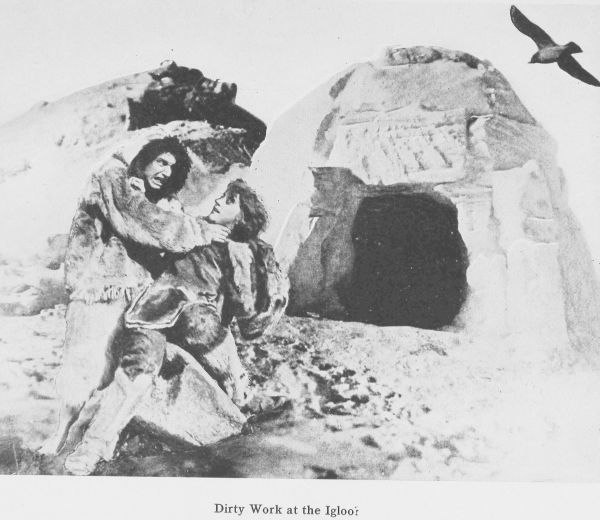
Dirty Work at the Igloo?
And now we were to experience that fatal lack of living game which as I have noted, seems to haunt the foot steps of the hunter to whom game is a dreadful necessity. The season was still early and bird life was practically extinct north of the circle. Occasionally we sighted an isolated pemmican or a tiny lapwing, too distant or too small to be shot at. Our store of ammunition was much too scarce to be wasted in pot shots. Of seals and walruses we saw absolutely none.
Day after day, in the grisly dawn of the new season, we crept on. Day after day we tightened our belts and stared each other in the face. And in the face of each stared a spectre more grisly still.
A few entries from my diary will best record the harrowing tale of what followed.
"Feb. 23rd. Ate the last of herring this noon. Reduced wheat ration to ½ cake for person. Sorted extra clothing (Plock's) for possible food.
Feb. 27th. Shredded-wheat supply fast diminishing. S. busy all day cleaning Plock's oomiak and leggins. Will it come to him?
March 3rd. Last of leggins for lunch. Whinney slightly ill, but eyesight improving. A good day's hauling. Crossed two open leads but saw no seal.
March 4th. A great day! Sighted seal herd two miles away, the first we have seen on the floe. Stalked them carefully, taking Frissell with me. By "playing seal," yooping and crawling, succeeded in getting into the very center of herd where we killed two with atomizers. A great saving of ammunition. Seal gorge tonight.
March 5th. All hands ill.
March 6th. Same.
March 12th. Finished last of seal. Plock's oomiak tomorrow.
March 14th. No food whatsoever. Very weak.
March 15th. Same. Weaker.
March 16th. (The writing is almost illegible) Plock.
March 19th. Finished Plock. Tough, as always."
March 20th dawned as a day of despair. My companions, weakened by starvation, refused to pull another ounce. We had come to a standstill. Scarcely able to stand, desperate, but still unwilling to admit myself beaten, I set forth alone.
Swank would have accompanied me but fell as he attempted to climb down to the ice and was unable to rise.