WITH A NEW ART OF CHASE IN A NEW WORLD OF LIFE
Reading edition
THREE WEEKS BEFORE THE SUNSET OF 1908—REVELLING IN AN EDEN OF GAME—PECULIARITIES OF ANIMALS OF THE ARCTIC—HOW NATURE DICTATES ANIMAL COLOR—THE QUEST OF SMALL LIFE
XXVII Coming of the Second Winter
In two months, from the first of September to the end of October, we passed from a period of hunger, thirst and abject misery into the realm of abundant game. The spell for inactivity had not yet come. Up to this time we were too busy with the serious business of life to realize thoroughly that we had really discovered a new natural wonderland. The luck of Robinson Crusoe was not more fortunate than ours, although he had not the cut of frost nor the long night, nor the torment of bears to circumscribe his adventures. In successive stages of battle our eyes had opened to a new world of life.
In searching every nook and cranny of land we had acquired new arts of life and a new perspective of nature's wonders. We slept in caves in storm; in the lee of icebergs in strong winds and on the mossy cushions of earth concavities. Here we learned to study and appreciate primal factors of both animal and plant life.
In the Arctic, nature tries to cover its nakedness in places where the cruel winds do not cut its contour. The effort is interesting, not only because of the charm of the verdant dress, but because of the evidence of a motherly protection to the little life cells which struggle against awful odds to weave that fabric wherever a terrestrial dimple is exposed to the kisses of the southern sun. In these depressions, sheltered from the blasts of storms, a kindly hand spreads a beautiful mantle of colorful grass, moss, lichens and flowery plants.
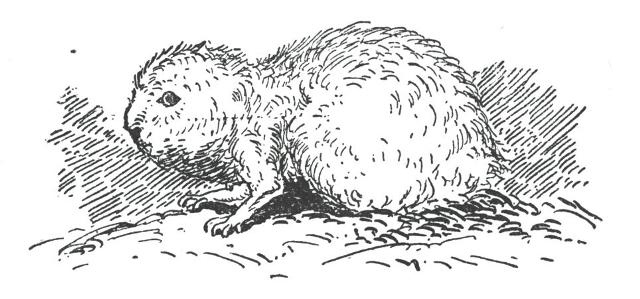
Here the lemming digs his home under the velvet cover, where he may enjoy the roots and material protection from the abysmal frost of the long night. Here in the protected folds of Mother Earth, blanketed by the warm white robe of winter, he sleeps the peace of death while the warring elements blast in fury outside.
Here the Arctic hare plays with its bunnies during summer, and as the winter comes the young grow to full maturity and dress in a silky down of white. Under the snow they burrow, making long tunnels, still eating and sleeping on their loved cushions of frozen plants, far under the snow-skirts of Mother Earth, while the life-stilling blasts without expend their wintry force.
Here the ptarmigan scratches for its food. The musk ox and the caribou browse, while the raven, with a kind word for all, collects food for its palate. The bear and the wolf occasionally visit to collect tribute, while the falcon and the fox with one eye open are ever on the alert for the exercise of their craft.
In these little smiling indentations of nature, when the sun begins to caress the gentle slopes, while the snow melts and flows in leaping streams—the sea still locked by the iron grip of the winter embrace—the Arctic incubator works overtime to start the little ones of the snow wilds. Thus in these dimples of nature rocks the cradle of boreal life.
Relieved of the all-absorbing care of providing food, I now was often held spellbound as I wandered over these spots of nature's wonders. Phases of life which never interested me before now riveted my attention. Wandering from the softly cushioned gullies, the harsh ridge life next came under my eyes. While the valleys and the gullies become garden spots of summer glory, the very protection from winds which makes this life possible buries the vegetable luxuriousness in winter under unfathomable depths of snow. The musk ox and the caribou, dependent upon this plant life for food, therefore become deprived of the usual means of subsistence. But Mother Nature does not desert her children. The same winds which compel man and feebler animals to seek shelter from its death-dealing assault, afford food to the better fitted musk ox and caribou. In summer, plants, like animals, climb to ridges, hummocks and mountain slopes, to get air and light and warm sunbeams. But the battle here is hard, and only very strong plants survive the force of wind and frosts.
The plant fibre here become tenacious; with a body gnarled and knotty from long conflict the roots dig yards deep into the soil. This leaves the breathing part of the plant dwarfed to a few inches. Here the winter winds sweep off the snow and offer food to the musk ox and caribou. Thus the wind, which destroys, also gives means of life. The equalizing balance of nature is truly wonderful.
In small, circumscribed areas we thus found ourselves in a new Eden of primeval life.
The topography of North Devon, however, placed a sharp limit to the animated wilderness. Only a narrow strip of coast about Cape Sparbo, extending about twenty-five miles to the east and about forty miles to the west, presented any signs of land life. All other parts of the south shore of Jones Sound are more barren than the shores of the Polar sea.
Although our larder was now well stocked with meat for food and blubber for fuel, we were still in need of furs and skins to prepare a new equipment with which to return to the Greenland shores. The animals whose pelts we required were abundant everywhere. But they were too active to be caught by the art and the weapons evolved earlier in the chase of the walrus, bear and musk ox.
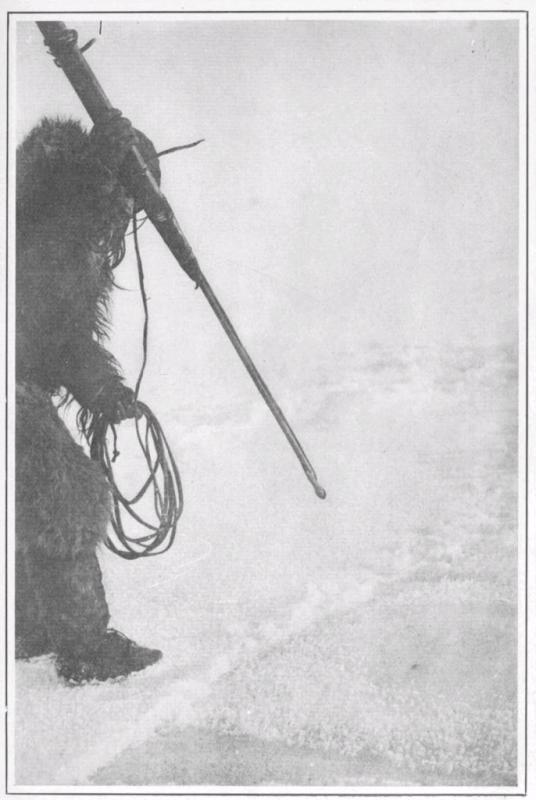
E-TUK-I-SHOOK WAITING FOR A SEAL AT A BLOW-HOLE
A series of efforts, therefore, was directed to the fox, the hare, the ptarmigan and the seal. It was necessary to devise special methods and means of capture for each family of animals. The hare was perhaps the most important, not only because its delicately flavored meat furnished a pleasing change from the steady diet of musk ox, but also because its skin is not equalled by any other for stockings. In our quest of the musk ox we had startled little groups of creatures from many centers. Their winter fur was not prime until after the middle of October. Taking notes of their haunts and their habits, we had, therefore, reserved the hare hunt until the days just before sunset.
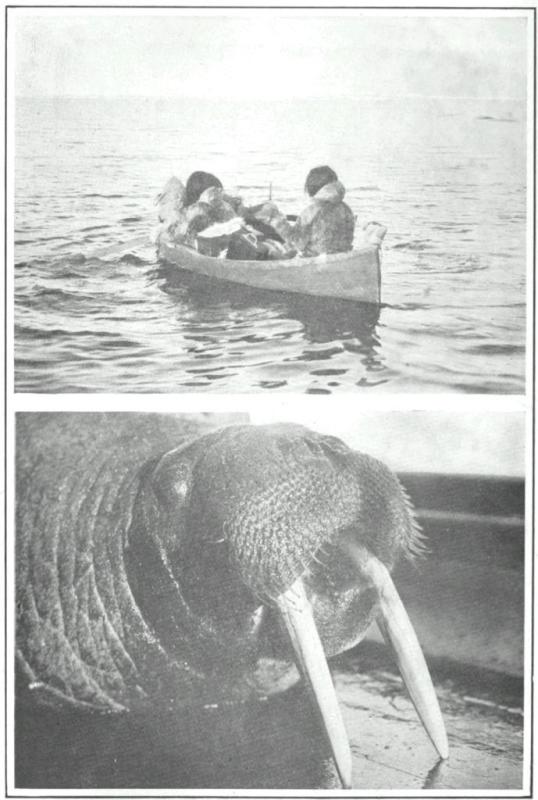
TOWARD CAPE SPARBO IN A CANVAS BOAT WALRUS—PRIZE OF A FIFTEEN HOUR BATTLE—4,000 POUNDS OF MEAT AND FAT
We had learned to admire this little aristocrat. It is the most beautiful, most delicate of northern creatures. Early in the summer we had found it grazing in the green meadows along the base of bird cliffs. The little gray bunnies then played with their mothers about crystal dens. Now the babes were full grown and clothed in the same immaculate white of the parents. We could distinguish the young only by their greater activity and their ceaseless curiosity.
In the immediate vicinity of camp we found them first in gullies where the previous winter's snow had but recently disappeared. Here the grass was young and tender and of a flavor to suit their taste for delicacies. A little later they followed the musk ox to the shores of lagoons or to the wind-swept hills. Still later, as the winter snows blanketed the pastures and the bitter storms of night swept the cheerless drifts, they dug long tunnels under the snow for food, and when the storms were too severe remained housed in these feeding dugouts.
An animal of rare intelligence, the hare is quick to grasp an advantage, and therefore as winter advances we find it a constant companion of the musk ox. For in the diggings of the musk ox this little creature finds sufficient food uncovered for its needs.
With a skeleton as light as that of the bird and a skin as frail as paper it is nevertheless as well prepared to withstand the rigors of the Arctic as the bear with its clumsy anatomy. The entire makeup of the hare is based upon the highest strain of animal economy. It expends the greatest possible amount of energy at the cost of the least consumption of food. Its fur is as white as the boreal snows and absorbs color somewhat more readily. In a stream of crimson light it appears red and white; in a shadow of ice or in the darkness of night it assumes the subdued blue of the Polar world. Nature has bleached its fur seemingly to afford the best protection against the frigid chill, for a suitable white fur permits the escape of less bodily heat than any colored or shaded pelt.
The fox is its only real enemy, and the fox's chance of success is won only by superior cunning. Its protection against the fox lies in its lightning-like movement of the legs. When it scents danger it rises by a series of darts that could be followed only by birds. Its expenditure of muscular energy is so economical that it can continue its run for an almost indefinite time. Shooting along a few hundred paces, it then rises to rest in an erect posture. With its black-tipped ears in line with its back it makes a fascinating little bit of nature's handiwork. Again, when asleep, it curls up its legs carefully in the long fur of its body, and its ever-active nose, with the divided lip, is then pushed into the long soft fur of the breast where the frost crystals are screened from the breath when storms carry drift snow. It is a fluffy ball of animation which provokes one's admiration.
Deprived as we were of most of the usual comforts of life, many things were taught us by the creatures about. From the hare, with its scrupulous attention to cleanliness, we learned how to cleanse our hands and faces. With no soap, no towels and very little water, we had some difficulty in trying to keep respectable appearances. The hare has the same problem to deal with, but it is provided by nature with a cleansing apparatus. Its own choice is the forepaw, but with its need for snow shoes the hind legs serve a very useful purpose, and then, too, the surface is developed, a surface covered with tough fur which, we discovered, possessed the quality of a wet sponge and did not require, for efficiency, either soap or water. With hare paws, therefore, we kept clean. These paws also served as napkins. To take the place of a basin and a towel we therefore gathered a supply of hare paws, enough to keep clean for at least six months.
The hare was a good mark for E-tuk-i-shook with the sling shot, and many fell victims to his primitive genius. Ah-we-lah, never an expert at stone slinging, became an adept with the bow and arrow. Usually he returned with at least a hare from every day's chase. Our main success resulted from a still more primitive device. Counting on its inquisitiveness we devised a chain of loop lines arranged across the hare's regular lines of travel. In playing and jumping through these loops, the animal tightened the lines and became our victim automatically.
The ptarmigan chase was possible only for Ah-we-lah. The bird was not at all shy, for it often came close to our den and scattered the snow like a chicken. It was too small a mark for the sling shot and only Ah-we-lah could give the arrow the precise direction for these feathered creatures. Altogether, fifteen were secured in our locality, and all served as dessert for my special benefit. According to Eskimo custom, a young, unmarried man or woman cannot eat the ptarmigan, or "ahr-rish-shah" as they call it. That pleasure is reserved for the older people, and I did not for a moment risk the sacrilege of trying to change the custom. It was greatly to my advantage, for it not only impressed with suitable force my dignity as a superior Eskimo, but it enabled me to enjoy an entire bird at a time instead of only a teasing mouthful.
To us the ptarmigan was at all times fascinating, but it proved ever a thing of mystery. Descending from the skies at unexpected times it embarks again for haunts unknown. At times we saw the birds in great numbers. At other times they were absent for months. In summer the bird has gray and brown feathers, mingled with white. It keeps close to the inland ice, making its course along the snowy coast of Noonataks, beyond the reach of man or fox. Late in September it seeks the lower ground along the sea level.
Like the hare and the musk ox, it delights in windy places where the snow has been driven away. There it finds bits of moss and withered plants which satisfy its needs. The summer plumage is at first sight like that of the partridge. On close examination one finds the feathers are only tipped with color—underneath, the plumage is white. In winter it retains only the black feathers of its tail, otherwise it is as white as the hare. Its legs often are covered with tough fur, like that of the hare's lower hind legs. The meat is delicate in flavor and tender. It is the most beautiful of the four birds that remain in the white world when all is bleak during the night.
We sought the fox more diligently than the ptarmigan. We had a more tangible way of securing it. Furthermore, we were in great need of its skin. E-tuk-i-shook and Ah-we-lah regarded fox hams as quite a delicacy—a delicacy which I never willingly shared when there were musk tenderloins about. We had no steel traps, and with its usual craft the fox usually managed to evade our crude weapons by keeping out of sight. Bone traps were made with a good deal of care after the pattern of steel traps. We used a musk-ox horn as a spring. But with these we were only partially successful. As a last resort, little domes were arranged in imitation of the usual caches, with trap stone doors. In these we managed to secure fourteen white and two blue animals. After that they proved too wise for our craft.
The fox becomes shy only in the end of October, when its fur begins to be really worth taking. Before that it followed us everywhere on the musk ox quest, for it was not slow to learn the advantage of being near our battle scenes. We frequently left choice bits for its picking, a favor which it seemed to appreciate by a careful watchfulness of our camps. Although a much more cunning thief than the bear, we could afford its plunderings, for it had not so keen a taste for blubber and its capacity was limited. We thus got well acquainted.
Up to the present we had failed in the quest of the seal. During the open season of summer, without a kayak, we could not get near the animal. As the winter and the night advanced, we were too busy with the land animals to watch the blow-holes in the new ice. When the sea is first spread with the thin sheet of colorless ice, which later thickens, the seal rises to the surface, makes a breathing hole, descends to its feeding grounds on the sea bottom for about ten minutes, then rises and makes another hole. This line of openings is arranged in a circle or a series of connecting, oblong lines, marking that particular seal's favorite feeding ground. Before the young ice is covered with snow, these breathing holes are easily located by a ring of white frost crystals, which condense and fall as the seal blows. But now that the winter had sheeted the black ice evenly with a white cover, the seal holes, though open, could not be found. We were not in need of either fat or meat, but the seal skins were to fill an important want. We required for boots and sled lashing the thin, tough seal hide. How could we get it?
From our underground den we daily watched the wanderings of the bears. They trailed along certain lines which we knew to be favorable feeding grounds for seals, but they did not seem to be successful. Could we not profit by their superb scenting instinct and find the blow-holes? The bear had been our worst enemy, but unconsciously it also proved to be our best friend.
We started out to trail the bear's footprints. By these we were led to the blow-holes, where we found the snow about had been circled with a regular trail. Most of these had been abandoned, for the seal has a scent as keen as the bear, but a few "live" holes were located. Sticks were placed to locate these, and after a few days' careful study and hard work we harpooned six seals. Taking only the skins and blubber, we left the carcasses for bruin's share of the chase—to be consumed later. We did not hunt together with the bear—at least, not knowingly.
In these wanderings over game lands we were permitted a very close scrutiny of the animals about, and it was at this time that I came to certain definite conclusions as to prevailing laws of color and dress of our co-habitants of the Polar wastes.
The animals of the Arctic assume a color in accordance to their need for heat transmission. The prevailing influence is white, as light furs permit the least escape of heat. It is evidently more important to confine the heat of the body, than to gather heat from the sun's feeble rays. The necessity for bleaching the furry raiment becomes most operative in winter when the temperature of the air is 150° below that of the body. In the summer, when the continued sunshine is made more heating by the piercing influence of the reflecting snow-fields, there is a tendency to absorb heat. Then nature darkens the skin, which absorbs heat accordingly.
The relative advantage of light and dark shades can be easily demonstrated by placing pieces of white and black cloth on a surface of snow, with a slope at right angles to the sun's rays. If, after a few hours, the cloth is removed the snow under the black cloth will be melted considerably, while that under the white cloth will show little effect.
Nature makes use of this law of physics to ease the hard lot of its creatures fighting the weather in the icy world. The laws of color protection as advocated in the rules of natural selection are not operative here, because of the vitally important demand of heat economy. If we now seek the problem of nature's body colored dyes, with heat economy as the key, our calculations will become easy. The serwah, a species of guillemot, which is as black as the raven in summer, is white in winter. The ptarmigan is light as pearl in winter, but its feathers become tipped with amber in summer. The hare is slightly gray in summer, but, in winter, becomes white as the snow under which it finds food and shelter.
The white fox is gray in summer, the blue fox darkens as the sun advances, while its under fur becomes lighter with increasing cold. The caribou is dark brown as it grazes the moss-colored fields, but becomes nearly white with the permanent snows. The polar bear, as white as nature can make it, with only blubber to mix its paints, basks in the midnight sun with a raiment suggestive of gold. The musk ox changes its dark under-fur for a lighter shade. The raven has a white under-coat in winter. The rat is gray in summer but bleaches to blue-gray in winter time. The laws of selection and heat economy are thus combined.
While thus preparing for the coming winter by seeking animals with furry pelts, the weather conditions made our task increasingly difficult. The storm of the descending sun whipped the seas into white fury and brushed the lands with icy clouds. With the descent of the sun, nature again set its seal of gloom on Arctic life. The cheer of a sunny heaven was blotted from the skies, and the coming of the winter blackness was signalled by the beginning of a warfare of the elements. All hostile nature was now set loose to expend its restive battle energy.
For brief moments the weather was quiet, and then in awe-inspiring silence we steered for sequestered gullies in quest of little creatures. This death-like stillness was in harmony with our loneliness. As the sea was stilled by the iron bonds of frost, as life sought protection under the storm-driven snows of land, the winds, growing even wilder, beat a maddening onslaught over the dead, frozen world. The thunder of elements shook the very rocks under which we slept. Then again would fall a spell of that strange silence—all was dead, the sun glowed no more, the creatures of the wilds were hushed. We were all alone—alone in a vast, white dead world.
LEMMING