OVER THE POLAR SEA TO THE BIG LEAD
Reading edition
WITH TWO ESKIMO COMPANIONS, THE RACE POLEWARD CONTINUES OVER ROUGH AND DIFFICULT ICE—THE LAST LAND FADES BEHIND—MIRAGES LEAP INTO BEING AND WEAVE A MYSTIC SPELL—A SWIRLING SCENE OF MOVING ICE AND FANTASTIC EFFECTS—STANDING ON A HILL OF ICE, A BLACK, WRITHING, SNAKY CUT APPEARS IN THE ICE BEYOND—THE BIG LEAD—A NIGHT OF ANXIETY—FIVE HUNDRED MILES ALREADY COVERED—FOUR HUNDRED TO THE POLE
XIV To Eighty-Third Parallel
Our party, thus reduced to three, went onward. Although the isolation was more oppressive, there were the advantages of the greater comfort, safety, speed and convenience that came from having only a small band. The large number of men in a big expedition always increases responsibilities and difficulties. In the early part of a Polar venture this disadvantage is eliminated by the facilities to augment supplies by the game en route and by ultimate advantages of the law of the survival of the fittest. But after the last supporting sleds return, the men are bound to each other for protection and can no longer separate. A disabled or unfitted dog can be fed to his companions, but an injured or weak man cannot be eaten nor left alone to die. An exploring venture is only as strong as its weakest member, and increased numbers, like increased links in a chain, reduce efficiency.
Moreover, personal idiosyncrasies and inconveniences always shorten a day's march. And, above all, a numerous party quickly divides into cliques, which are always opposed to each other, to the leader, and invariably to the best interests of the problem in hand. With but two savage companions, to whom this arduous task was but a part of an accustomed life of frost, I did not face many of the natural personal barriers which contributed to the failure of former Arctic expeditions.
In my judgment, when you double a Polar party its chances for success are reduced one-half; when you divide it, strength and security are multiplied.
We had been traveling about two and one-half miles per hour. By making due allowances for detours and halts at pressure lines, the number of hours traveled gave us a fair estimate of the day's distance. Against this the pedometer offered a check, and the compass gave the course. Thus, over blank charts, our course was marked.
By this kind of dead reckoning our position on March 20 was: Latitude, 82° 23ʹ; Longitude, 95° 14ʹ. A study of our location seemed to indicate that we had passed beyond the zone of ice crushed by the influence of land pressure. Behind were great hummocks and small ice; ahead was a cheerful expanse of larger, clearer fields, offering a promising highway.
Our destination was now about four hundred and sixty miles beyond. Our life, with its pack environment, assumed another aspect. Previously we permitted ourselves some luxuries. A pound of coal oil and a good deal of musk ox tallow were burned each day to heat the igloo and to cook abundant food. Extra meals were served when occasion called for them, and for each man there had been all the food and drink he desired. If the stockings or the mittens were wet there was fire enough to dry them out. All of this had now to be changed.
Hereafter there was to be a short daily allowance of food and fuel—one pound of pemmican a day for the dogs, about the same for the men, with just a taste of other things. Fortunately, we were well provided with fresh meat for the early part of the race by the lucky run through game lands. Because of the need of fuel economy we now cut our pemmican with an axe. Later it split the axe.
At first no great hardship followed our changed routine. We filled up sufficiently on two cold meals daily and also depended on superfluous bodily tissue. It was no longer possible to jump on the sled for an occasional breathing spell, as we had done along the land.
Such a journey as now confronted us is a long-continued, hard, difficult, sordid, body-exhausting thing. Each day some problem presents some peculiar condition of the ice or state of the weather. The effort, for instance, to form some shield from intense cold gives added interest to the game. That one thing after another is being met, with always the anticipation of next day's struggle, adds a thrill to the conquest, spurs one to greater and ever greater feats, and really constitutes the actual victory of such a quest. With overloaded sleds the drivers must now push and pull at them to aid the dogs. My task was to search the troubled ice for easy routes, cutting away here and there with the ice-axe to permit the passing of the sleds.
Finally stripping for the race, man and dog must walk along together through storms and frost for the elusive goal. Success or failure must depend mostly upon our ability to transport nourishment and to keep up the muscular strength for a prolonged period.
As we awoke on the morning of March 21 and peered out of the eye-port of the igloo, the sun edged along the northeast. A warm orange glow suffused the ice and gladdened our hearts. The temperature was 63° below zero, Fahrenheit; the barometer was steady and high. There was almost no wind. Not a cloud lined the dome of pale purple blue, but a smoky streak along the west shortened our horizon in that direction and marked a lead of open water.
Our breakfast consisted of two cups of tea, a watch-sized biscuit, a chip of frozen meat and a boulder of pemmican. Creeping out of our bags, our shivering legs were pushed through bearskin cylinders which served as trousers. We worked our feet into frozen boots and then climbed into fur coats. Next we kicked the front out of the snowhouse and danced about to stimulate heart action.
Quickly the camp furnishings were tossed on the sleds and securely lashed. We gathered the dog traces into the drag lines, vigorously snapped the long whips, and the willing creatures bent to the shoulder straps. The sleds groaned. The unyielding snows gave a metallic ring. The train moved with a cheerful pace.
"Am-my noona terronga dosangwah" (Perhaps land will be out of sight today), we said to one another.[12] But the words did not come with serious intent. In truth, each in his own way felt keenly that we were leaving a world of life and possible comfort for one of torment and suffering. Axel Heiberg Land, to the south, was already only a dull blue haze, while Grant Land, on the eastward, was making fantastic figures of its peaks and ice walls. The ice ran in waves of undulating blue, shimmering with streams of gold, before us. Behind, the last vestiges of jagged land rose and fell like marionettes dancing a wild farewell. Our heart-pulls were backward, our mental kicks were forward.
Until now this strange white world had been one of grim reality. As though some unseen magician had waved his wand, it was suddenly transformed into a land of magic. Leaping into existence, as though from realms beyond the horizon, huge mirages wove a web of marvelous delusional pictures about the horizon. Peaks of snow were transformed into volcanoes, belching smoke; out of the pearly mist rose marvelous cities with fairy-like castles; in the color-shot clouds waved golden and rose and crimson pennants from pinnacles and domes of mosaic-colored splendor. Huge creatures, misshapen and grotesque, writhed along the horizon and performed amusing antics.
Beginning now, and rarely absent, these spectral denizens of the North accompanied us during the entire journey; and later, when, fagged of brain and sapped of bodily strength, I felt my mind swimming in a sea of half-consciousness, they filled me almost with horror, impressing me as the monsters one sees in a nightmare.
At every breathing spell in the mad pace our heads now turned to land. Every look was rewarded by a new prospect. From belching volcanoes to smoking cities of modern bustle, the mirages gave a succession of striking scenes which filled me with awed and marveling delight. A more desolate line of coast could not be imagined. Along its edge ran low wind-swept and wind-polished mountains. These were separated by valleys filled with great depths of snow and glacial ice.
Looking northward, the sky line was clear of the familiar pinnacles of icebergs. In the immediate vicinity many small bergs were seen; some of these were grounded, and the pack thus anchored was thrown in huge uplifts of pressure lines and hummocks. The sea, as is thereby determined, is very shallow for a long distance from land.
This interior accumulation of snow moves slowly to the sea, where it forms a low ice wall, a glacier of the Malaspina type. Its appearance is more like that of heavy sea ice; hence the name of the paleocrystic ice, fragments from this glacier, floebergs, which, seen in Lincoln Sea and resembling old floes, were supposed to be the product of the ancient upbuilding of the ice of the North Polar Sea.
Snapping our whips and urging the dogs, we traveled until late in the afternoon, mirages constantly appearing and melting about us. Now the land suddenly settled downward as if by an earthquake. The pearly glitter, which had raised and magnified it, darkened. A purple fabric fell over the horizon and merged imperceptibly into the lighter purple blue of the upper skies. We saw the land, however, at successive periods for several days. This happened whenever the atmosphere was in the right condition to elevate the terrestrial contour lines by refracting sun rays.
Every condition favored us on this march. The wind was not strong and struck us at an angle, permitting us to guard our noses by pushing a mitten under our hoods or by raising a fur-clad hand.
We had not been long in the field, however, when the wind, that ever-present dragon guardian of the unseen northern monarch's demesne, began to suck strength from our bodies. Shortly before Grant Land entirely faded the monster fawned on us with gentle breathing.
The snow was hard, and the ice, in fairly large fields separated by pressure lines, offered little resistance. On March 21, at the end of a forced effort of fourteen hours, the register indicated a progress of twenty-nine miles.
Too weary to build an igloo, we threw ourselves thoughtlessly upon the sleds for a short rest, and fell asleep. I was awakened from my fitful slumber by a feeling of compression, as if stifling arms hideously gripped me. It was the wind. I breathed with difficulty. I struggled to my feet, and about me hissed and wailed the dismal sound. It was a sharp warning to us that to sleep without the shelter of an igloo would probably mean death.
On the heavy floe upon which we rested were several large hummocks. To the lee of one of these we found suitable snow for a shelter.
Lines of snowy vapor were rushing over the pack. The wind came with rapidly increasing force. We erected the house, however, before we suffered severely from the blast. We crept into it out of the storm and nested in warm furs.
The wind blew fiercely throughout the night. By the next morning, March 22, the storm had eased to a steady, light breeze. The temperature was 59° below zero. We emerged from our igloo at noon. Although the cheerless gray veil had been swept from the frigid dome of the sky, to the north appeared a low black line over a pearly cloud which gave us much uneasiness. This was a narrow belt of "water-sky," which indicated open water or very thin ice at no great distance.
The upper surface of Grant Land was now a mere thin pen line on the edge of the horizon. But a play of land clouds above it attracted the eyes to the last known rocks of solid earth. We now felt keenly the piercing cold of the Polar sea. The temperature gradually rose to 46° F. below zero, in the afternoon, but there was a deadly chill in the long shadows which increased with the swing of the lowering sun.
A life-sapping draught, which sealed the eyes and bleached the nose, still hissed over the frozen sea. We had hoped that this would soften with the midday sun. Instead, it came with a more cutting sharpness. In the teeth of the wind we persistently pursued a course slightly west of north. The wind was slightly north of west. It struck us at a painful angle and brought tears. Our moistened lashes quickly froze together as we winked, and when we rubbed them and drew apart the lids the icicles broke the tender skin. Our breath froze on our faces. Often we had to pause, uncover our hands and apply the warm palms to the face before it was possible to see.
Every minute thus lost filled me with impatience and dismay. Minutes of traveling were as precious as bits of gold to a hoarding miser.
In the course of a brief time our noses became tipped with a white skin and also required nursing. My entire face was now surrounded with ice, but there was no help for it. If we were to succeed the face must be bared to the cut of the elements. So we must suffer. We continued, urging the dogs and struggling with the wind just as a drowning man fights for life in a storm at sea.
About six o'clock, as the sun crossed the west, we reached a line of high-pressure ridges. Beyond these the ice was cut into smaller floes and thrown together into ugly irregularities. According to my surmises, an active pack and troubled seas could not be far away. The water-sky widened, but became less sharply defined.
We laboriously picked a way among hummocks and pressure lines which seemed impossible from a distance. Our dogs panted with the strain; my limbs ached. In a few hours we arrived at the summit of an unusual uplift of ice blocks. Looking ahead, my heart pained as if in the grip of an iron hand. My hopes sank within me. Twisting snake-like between the white field, and separating the packs, was a tremendous cut several miles wide, which seemed at the time to bar all further progress. It was the Big Lead, that great river separating the land-adhering ice from the vast grinding fields of the central pack beyond, at which many heroic men before me had stopped. I felt the dismay and heartsickness of all of them within me now. The wind, blowing with a vengeful wickedness, laughed sardonically in my ears.
Of course we had our folding canvas boat on the sleds. But in this temperature of 48° below zero I knew no craft could be lowered into water without fatal results. All of the ice about was firmly cemented together, and over it we made our way toward the edge of the water line.
Passing through pressure lines, over smaller and more troublesome fields, we reached the shores of the Big Lead. We had, by two encouraging marches, covered fifty miles. The first hundred miles of our journey on the Polar pack had been covered. The Pole was four hundred miles beyond!
Camp was pitched on a secure old ice field. Cutting through huge ice cliffs, the dark crack seemed like a long river winding between palisades of blue crystal. A thin sheet of ice had already spread over the mysterious deep. On its ebony mirrored surface a profusion of fantastic frost crystals arranged themselves in bunches resembling white and saffron-colored flowers.
Through the apertures of this young ice dark vapors rose like steam through a screen of porous fabrics and fell in feathers of snow along the sparkling shores. After partaking of a boulder of pemmican, E-tuk-i-shook went east and I west to examine the lead of water for a safe crossing. There were several narrow places, while here and there floes which had been adrift in the lead were now fixed by young ice. Ah-we-lah remained behind to make our snowhouse comfortable.
For a long time this huge separation in the pack had been a mystery to me. At first sight there seemed to be no good reason for its existence. Peary had found a similar break north of Robeson Channel. It was likely that what we saw was an extension of the same, following at a distance the general trend of the northernmost land extension.
This is precisely what one finds on a smaller scale when two ice packs come together. Here the pack of the central polar sea meets the land-adhering ice. The movement of the land pack is intermittent and usually along the coast. The shallows, grounded ice and projecting points interfere with a steady drift. The movement of the central pack is quite constant, in almost every direction, the tides, currents and winds each giving momentum to the floating mass. The lead is thus the breaking line between the two bodies of ice. It widens as the pack separates, and narrows or widens with an easterly or westerly drift, according to the pressure of the central pack. Early in the season, when the pack is crevassed and not elastic, it is probably wide; later, as the entire sea of ice becomes active, it may disappear or shift to a line nearer the land.
In low temperature new ice forms rapidly. This offers an obstruction to the drift of the old ice. As the heavy central pack is pressed against the unyielding land pack the small ice is ground to splinters, and even heavy floes are crushed. This reduced mass of small ice is pasted and cemented along the shores of the Big Lead, leaving a broad band of troublesome surface as a serious barrier to sled travel. It seems quite probable that this lead, or a condition similar to it, extends entirely around the Polar sea as a buffer between the land and the middle pack.
In exploring the shore line, a partially bridged place was found about a mile from camp, but the young ice was too elastic for a safe track. The temperature, however, fell rapidly with the setting sun, and the wind was just strong enough to sweep off the heated vapors. I knew better atmospheric condition could not be afforded quickly to thicken the young ice.
Returning to camp that night, we surprised our stomachs by a little frozen musk ox tenderloin and tallow, the greatest delicacy in our possession. Then we retired. Ice was our pillow. Ice was our bed. A dome of snow above us held off the descending liquid air of frost. Outside the wind moaned. Shudderingly, the deep howl of the dogs rolled over the ice. Lying on the sheeted deep, beneath my ears I heard the noise of the moving, grinding, crashing pack. It sounded terrifyingly like a distant thunder of guns. I could not sleep. Sick anxiety filled me. Could we cross the dreadful river on the morrow? Would the ice freeze? Or might the black space not hopelessly widen during the night? I lay awake, shivering with cold. I felt within me the blank loneliness of the thousands of desolate miles about me.
One hundred miles of the unknown had been covered; five hundred miles of the journey from our winter camp were behind us. Beyond, to the goal, lay four hundred unknown miles. Nothing dearly desired of man ever seemed so far away.
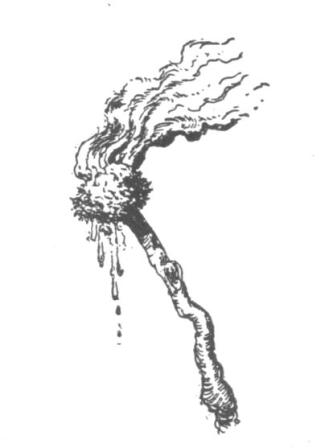
ESKIMO TORCH