PREFACE
Reading edition
NOTES ON EXPERIENCE GAINED AT THE FRONT
By General Sir O’Moore Creagh, V.C.
1. The experience gained at the front in the present campaign may be divided broadly under two heads: Firstly, the test under war conditions of the general principles upon which the British Army has been trained in peace. Secondly, knowledge concerning the tactics of the enemy and his method of employing various arms. With regard to the former of these two heads of information, it is important to note that the broad principles upon which the training of the British Army has been based are described by a General Officer as being sound, and that the need of paying strict attention to them in carrying out training is emphasized by him. On the other hand, valuable experience has been gained as to the best method of applying these general principles to the peculiar conditions which have so far prevailed in the present campaign, including the tactics adopted by the enemy. Information based on this experience, more especially so far as it concerns the employment of musketry in attack and defence, is included in these notes, as it may prove useful to officers in training their commands.
2. These notes, therefore, do not affect the general principles of training laid down in this book. They merely deal with the application of these principles to the peculiar conditions which have so far obtained in the course of the campaign. These conditions may at any time give place to others, for it must be remembered that in no two military operations is the situation exactly the same. Instructors, therefore, must avoid the mistake of training their men for any particular given conditions of warfare, and remember that general principles and broad rules alone are applicable to the leading of troops in war (Infantry Training, 1914).
3. German Musketry.2—(i) The Germans consider it unnecessary to teach men to fire at distances beyond 400 metres. Their plan of infantry attack (see diagram, p. ix) is devised to get within this range without opening fire. Accordingly, judging distance is practised by officers only, and no attention is devoted to the indication of targets, concentration of fire, or to fire direction and control generally, as practised in the British Army. To concentrate the fire of a platoon or company on one spot at 1,000 yards range was considered by Germans to be a waste of ammunition. Their training seems to have been limited to independent firing by battalions on large areas of ground.
(ii) Only some of their men were practised in rapid firing, which averaged eight or nine rounds a minute, as against the fifteen well-aimed shots a minute which British troops are trained to deliver in rapid firing. In this respect it may be mentioned that the straight bolt of the German rifle is not so easy to work as the bolt of the British rifle, nor is its clip so easy to put in. When put to the test of war, the musketry of the German infantry is characterized by British officers as poor and “lamentable.”
4. British Musketry.—On the other hand, the German officer referred to in the footnote below described British musketry under the test of war as “marvellous,” and, in doing so, expressed the views generally held in the German Army as the result of experience. He states that the Germans had counted on being able to rush the British troops by weight of numbers by the plan of attack described in the next paragraph; but they found themselves unable to do so because the British rifle fire was “so straight and so quick.” He added that “they had never had a chance against the British,” because, although they reckoned on their third line with their machine-guns being able to get within 400 yards of the enemy, they had never been able to do this over open ground against the British, because their first line was down too soon—sometimes at 800 to 1,000 yards. Again, on the Aisne, this German officer’s machine-gun battery came under the concentrated fire of British infantry at 1,000 yards, and though his men suffered heavily from it, they were unable to reply to the British, as they were unable to see them.
5. A German Plan of Infantry Attack.—(i) The diagram on page ix gives a rough idea of a German plan of infantry attack in close formations, as explained by a German officer. The first line is looked on as cover from bullets for the second and third lines, to enable these two lines to get close to the enemy with the minimum of loss. The Germans considered massed formations to be the only way to get up close to the enemy. Both ranks of each line in these formations are close together. When their third line is stopped, they have standing orders to dig in at once, and for this purpose the third line carries shovels and small picks. It has already been explained that, owing to the tremendous effect of British musketry fire, this German plan of attack has repeatedly failed after very heavy loss has been incurred.
(ii) As regards fire effect, the Germans had considered the machine-gun to be the most valuable method of discharging bullets, and an enormous amount of time, trouble, and ammunition has been expended on machine-gun training, as well as upon their artillery, upon which they relied largely in their plan of attack. Notes referring to German machine-guns will be found in Machine-Gun Training of this series.
6. German Night Attacks.—(i) The enemy’s night attacks are made without scouts or advanced parties, and the advance is made with great rapidity. Infantry in trenches must always be ready to open a burst of rapid fire at a few seconds’ notice; so long as this can be done, there will be no chance of a trench being rushed. Supports should be in the cover-trenches, and, when the firing-line is attacked, should not fire, but rely on the bayonet.
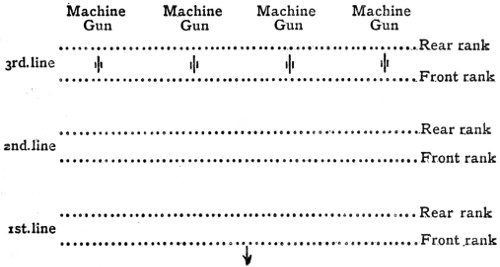
Diagram showing a German Plan of Infantry Attack in Close Formations.
(ii) The Germans usually attack about 3 p.m. (winter) or at dusk, and then entrench during the night within 200 yards of our lines. They also take advantage of fog in the early morning. They make a little progress in this way, but it is slow work, and they have lost enormously, as already stated. They shoot badly with the rifle, and the effect of their fire is chiefly obtained by artillery and machine-guns.
7. Flares to illuminate Foreground at Night.—(i) No fixed apparatus can be set in the field for the reliable lighting of foreground at night which will survive a prolonged bombardment and bad weather, or admit of renewal or attention in the close presence of the enemy. This does not apply to electric searchlights employed in carefully chosen and protected sites in connection with harbour and fortress defences, nor to flares or bonfires set for the purpose of providing a single illumination for a given purpose, such as a signal or landmark.
(ii) For the temporary illumination of foreground during an engagement with the enemy, the best method is to employ hand and rifle “illumination grenades,” which ignite on impact with the ground upon the same principle as in the detonation of the explosive or fighting grenades. By this means temporary illumination can be concentrated at the exact points at which it is most required. In siege warfare or trench fighting at close quarters there is special use for a combined incendiary and illumination bomb or grenade fired from a trench mortar. These bombs would be charged with inflammable material and liquid, such as cotton waste in petrol, together with a small charge of explosive, which would ignite and scatter the contents freely upon impact.
8. British Infantry Formations in Attack—(i) Advance under Rifle or Machine-Gun Fire.—Small columns in what are known as “artillery formations” should never be adhered to when there is a possibility of their coming under close or medium range fire of infantry or machine-guns. Troops have suffered severely from insufficient extension, and the adoption of rigid lines, and also from pushing forward in close formations without taking the proper military precautions. Loose elastic formations adapted to the ground, with men at eight or ten paces interval, are the least vulnerable.
(ii) Advance under Artillery Fire.—Several times it has been necessary to advance under unsubdued artillery fire. Small columns at 50 yards’ interval and 300 yards’ distance have been found to be the best method of avoiding casualties. The 19th Brigade lying in the open in this formation were shelled by two batteries for half an hour, and had only twenty-five casualties.
9. Cover and Fields of Fire.—(i) Owing to the effect of German artillery fire, cover from view has become more important than field of fire. It is better to have a field of fire of 100 yards and to be invisible than to have one of 600 yards and be an easy target for artillery. Owing to the enemy’s artillery fire by day, digging is nearly always done at night, and this requires much practice. Some sort of rough cover from shrapnel and head cover is made if time allows, and also if it can be made without making the trench conspicuous.
(ii) Defensive Positions and Sites of Trenches.—Whenever possible, trenches should be sited so that they are not under artillery observation. This point is regarded as of great importance, and an extensive field of fire is a secondary consideration. Trenches should therefore be sited having regard to possible observation stations on ground occupied by the enemy, and not solely with regard to the possible artillery positions of the enemy. In open country it is better to select a “back position,” behind the crest of a hill, with a field of fire of 300 or 400 yards. This compels the enemy to expose his infantry to rifle and shrapnel fire, and affords his artillery little opportunity of observation. Such positions were held on the Aisne, with slight loss to our troops and heavy loss to the enemy. A field of fire of 100 yards is regarded as satisfactory if it cannot be increased without loss of concealment from artillery observation.
10. Care of Rifles.—(i) The following directions are issued with regard to the care of rifles on service. New rifles are inclined to work somewhat stiffly at first, owing to slight roughness of the bearing surfaces of the bolt and bolt-way. This can be appreciably lessened by frequent and systematic manipulation of the bolt, the bearing surfaces being well oiled. Primary extraction—the first loosening of the fired cartridge in the chamber—can be improved by placing a fired case in the chamber, and working the bolt-lever up and down without drawing back the bolt.
(ii) Rifles must be kept clean and well oiled, and it has been found necessary to make an inspection daily or even oftener. Particular care must be taken to see that the chamber is scrupulously clean. If it is permitted to become dirty, great difficulty in extraction is likely to be experienced. It has also been found that cartridges get rusted into their clips, and that they should be moved at least weekly. Magazine springs may also become weak, if the magazine is continually kept loaded with ten instead of five rounds.
11. Conclusion.—(i) Up to the present the tactics of the enemy and the conditions of warfare of the campaign on the Continent have resulted as a rule in giving the infantryman fairly short fields of fire and more or less visible targets. This has accentuated the value of rapid, accurate fire within close range, to which particular attention should be paid in training men. On the other hand, when opportunity has afforded, the value of fire direction and control has been demonstrated by the effect of British rifle fire beyond close range.
(ii) The principles of training laid down in the Musketry Regulations and in this book as a whole should, therefore, be adhered to and carried out systematically. Above all, the sound principles that troops should be trained to make the best possible use of their weapons, not only at one but at all ranges of the battlefield, and that they should be trained to adapt their instruction to a variety of conditions, and not to any given conditions, should be observed faithfully. The correct application of general principles to the ever-varying circumstances of warfare should be the object of any sound system of military training.
(iii) The following subjects of training may be mentioned as being especially important in relation to the present campaign:
1. Rapid fire.
2. Entrenching, especially in the dark.
3. Cover from view of artillery for the trenches.
4. Bringing enfilade fire to bear on enemy’s trenches whenever possible.
5. Skilful use of machine-guns. Infantry must be careful when advancing that an enemy’s machine-gun is not hidden on the flank ready to open enfilade fire. Some regiments have lost very heavily from being caught in this way.
O’M. CREAGH.
London, 1915.
CONTENTS
PREFACE
PAGE
NOTES ON EXPERIENCE GAINED AT THE FRONT vi
DEFINITION OF TECHNICAL TERMS AND MILITARY VOCABULARY
I. Definitions xxii
II. Military Vocabulary for Indication and Recognition of Targets xxvi
CHAPTER I THE CARE AND CLEANING OF ARMS
SECTION
1. General Remarks 1
2. Wear and Fouling 2
3. Materials used for Cleaning Arms 4
4. Instructions for Cleaning Arms 7
5. Instructions for Care of Arms and Ammunition 10
6. Examination of Small Arms 12
7. Inspection of Arms on Parade 15
CHAPTER II THE THEORY AND PRACTICAL APPLICATION OF RIFLE FIRE
8. General Information 18
9. Dangerous Space—Ricochets—Firing Up and Down Hill 25
10. Effects of Barometric Pressure, Temperature, Wind, and Light 27
11. Need for Collective Fire 29
12. Dispersion of Individual and Collective Fire 31
13. Searching 35
14. The Relation of Ground to Fire Effect 38
CHAPTER III INSTRUCTION IN AIMING
15. General Remarks 43
16. Aiming Instruction 47
17. Common Faults in Aiming 50
18. Triangle of Error 51
19. Aiming at Service Targets, Aiming at Ground, and Marking Down the Enemy 53
20. Aiming-Off for Wind 55
21. Aiming Up and Down 57
22. Aiming-Off for Movement 58
23. Practice in Rapid Adjustment of Sights 60
CHAPTER IV ELEMENTARY INSTRUCTION IN FIRING
24. Hints to Instructors 62
25. Trigger-Pressing and Snapping 63
26. The Various Firing Positions 66
27. Loading and Unloading 69
28. Use of the Safety-Catch and Cut-Off 71
29. Instruction in Aiming and Firing 72
30. Firing in the Open 73
31. Firing from Cover 73
32. Muscle Exercises 77
CHAPTER V VISUAL TRAINING AND RANGING
33. General Remarks on Visual Training 81
34. Discernment of Targets 82
35. Military Vocabulary and Study of Ground 84
36. General Remarks on Ranging 89
37. Judging Distances by Eye 91
38. Range-Finding by Observation of Fire 96
39. Ranging by Auxiliary Methods and by Instruments 97
40. Range-Cards and Range-Marks 98
CHAPTER VI FIRE DIRECTION AND CONTROL
41. General Remarks 105
42. Organization for Fire Action 106
43. Effect of Fire at Different Ranges on Various Formations and Objectives 110
44. Tactical Application of Rifle Fire 112
45. Description and Recognition of Targets 119
46. Fire Orders 127
47. Fire Discipline 130
CHAPTER VII GENERAL INFORMATION REGARDING RANGE AND FIELD PRACTICES
48. Preliminary Training 135
49. Tests of Preliminary Training 136
50. Progression of Instruction in Range and Field Practices 140
51. Range Practices 141
52. Grouping and Application 146
53. Snapshooting, Rapid Firing, and Firing at Crossing Targets 150
54. Field Practices 151
CHAPTER VIII CONDUCT OF RANGE AND FIELD PRACTICES
55. Thirty Yards Ranges 159
56. Grouping Practices 159
57. Timed Practices 161
58. General Rules for Range Practices 162
59. Surplus Ammunition and Computation of Averages 166
60. Conditions of Qualification 167
61. Classification Practices and Conditions of Classification 168
62. Recruits’ Course, Regular Forces, Cavalry, R.E., and Infantry 171
63. Execution of Tables A and B in the Same Year 171
64. Trained Soldiers’ Course:
Table A—Recruits’ Course (Cavalry, Royal Engineers, and Infantry) 174
Table B—Annual Course (Cavalry, Royal Engineers, and Infantry) 177
Table A—Recruits’ Course (R.A., R.E., A.S.C., A.O.C.) 180
Table B—Annual Course (R.A., A.S.C., A.O.C.) 181
65. General Rules for Field Practices 182
66. Field Practices on Classification Ranges—Individual Practices—Collective Practices 184
CHAPTER IX NIGHT FIRING, HAND GRENADES, AND COMPETITIONS
67. Night Firing 193
68. Hand Grenade (Mark I) 194
69. Competitions 201
CHAPTER X INSTRUCTION ON MINIATURE RANGES, INCLUDING RANGE AND FIELD PRACTICES
70. General Remarks 203
71. Targets 205
72. Preliminary Training 207
73. Range Practices 213
74. Field Practices, Night Firing, and Competitions—Lectures—Demonstrations—Individual and Collective Field Practices 213
APPENDIX
I. Names of the Parts of Rifles—Short M.L.E., Mark III, and Charger-Loading M.L.E. 233
II. Directions for Use of the Legret Aim-Teacher 240
III. Directions for Use of the Aim-Corrector 241
IV. Directions for Use of the Aiming-Disc 243
V. “Harmonizing” Rifles for Miniature Range Practices 244
VI. Scoring and Signalling 245
VII. Solano Target—Marks I. and II. 248
VIII. Solano Elementary and Instructional Targets 250
INDEX 258
LIST OF ILLUSTRATIONS
FIG. PAGE
Diagram showing a German Plan of Infantry Attack in Close Formations ix
1. Wire Gauze on Pull-Through 5
2 AND 3. Illustration of Trajectory, etc. 19
4 AND 5. Dangerous Space 26
6. Cone of Fire 32
7. Diagrams illustrating the Dispersion in Depth of Concentrated Collective Fire at 1,500 Yards and its Distribution in Depth by the Use of Combined Sights 36
8. The Relation of Ground to Fire Effect 39
9. The Relation of Ground to Fire Effect 40
10. Dead Ground 42
11. Diagrams showing Correct and Incorrect Alignment of Sights 48
12. Long-Range Sights 49
13. Faults in Aiming 50
14. Triangle of Error 52
15. Method of Pressing Trigger with Forefinger 64
16. Shot Group illustrating Result of Faulty Trigger-Pressing 65
17. Showing Grip of Right Hand, and Trigger Finger 66
18. Instructor illustrating Correct Method of Pressing the Trigger 66
19. Correct Method of Using Aiming-Disc 66
20. Standing Position—Side View 67
21. Standing Position—Front View 67
22. Prone Position—Side View 68
23. Kneeling Position—Side View 68
24. Kneeling Position—Front View 68
25. Sitting Position 69
26. Sitting Position when Firing—Aiming down Steep Slope 69
27. Loading in Standing Position 70
28. Firing in the Open. Heads lowered; Observer watching Front 71
29. Firing round Cover—Correct 74
30. Firing round Cover—Unnecessary Exposure 74
31. Firing from Fold of Ground—Side View 74
32. Firing from Fold of Ground—Unnecessary Exposure 75
33. Firing from Fold of Ground—Correct Method 75
34. Firing over Continuous Cover 75
35. Firing over Continuous Cover 76
36. Firing over Continuous Cover 76
37. Firing round Continuous Cover: Lying Position—Front View 76
38. Firing round Continuous Cover: Lying Position—Side View 76
39. Kneeling behind Cover—Position when Loading 77
40. Kneeling behind Cover—Position when Loaded 77
41. Kneeling behind Cover—Position when Firing 77
42. Kneeling behind Cover—Position when Firing 77
43. Military Vocabulary—Terms describing Common Features of Ground 87
44. Simple Range Card for Attack 99
45. Simple Range Card for Defence 100
46. Example of a Foreground Range Sketch 102
47. Rough Sketch of a Field of Fire divided into Overlapping Sectors by the Use of Description Points on Deployment in Attack 108
48. Diagram illustrating Tactical Application of Fire 115
49. Description of Targets—Finger-Breadth Method 122
50. Description of Targets—Clock-Face Method 123
51. Description of Targets—Example of Field of Fire suitable for Employment of Finger-Breadth and Clock-Face Methods, combined with Description Points 124
52. Hand Grenade, Mark I 196, 197
53. Solano Target, Mark I, arranged for Elementary Practices by Eight Men firing simultaneously, showing the Targets numbered 206
54. Solano Target—Cleat Fitting with Cords which operate Mechanism attached 206
55. Solano Target, Mark I, arranged for General Instruction or for Firing Field Practices, with Scenery and Scenic Accessories (Type A), and with Solano Figures representing Troops at Different Ranges 207
56. Solano Target, Mark I, arranged for General Instruction or for Firing Field Practices, with Scenery and Scenic Accessories (Type C), and with Solano Figures representing Troops at Different Ranges 207
57. Landscape Target on Frames attached to Solano Target in Position for Firing 228
58. Landscape Target Practices—Illustration showing Method of Harmonizing Rifles and the System of Measuring Collective Grouping of Concentrated and Distributed Fire 229
59, 60. Short Magazine Lee-Enfield Rifle 234, 235
61-63. Charger-Loading Lee-Enfield Rifle 237-239
64. Legret Aim-Teacher 240
65. Aim-Corrector 242
66. Aiming-Disc 243
67. Solano Elementary Target, No. 1 251
68. Solano Elementary Target, No. 2 252
69. A Circle (3 Inches Diameter) and a Triangle (3 Inches Equilateral), showing that the Triangle as Aiming and Scoring Diagram induces closer Grouping than the Circle by allowing less Margin for both Vertical and Lateral Errors represented by the Dots 253
70. Solano Instructional Target, No. 1 254
71. Solano Instructional Target, No. 2 255
72. Solano Instructional Target, No. 3 256