Chapter XV
Reading edition
BERLIOZ AND LISZT. PROGRAMME MUSIC
THERE is no doubt that Hector Berlioz (1803-1869), however varied the appeal of his music to different temperaments, is an artistic personality to be reckoned with; one not to be ticketed and laid on the shelf. Although a century and more has elapsed since his birth the permanent value of his music is still debated, often amusingly enough, by those who seem unaware that, whatever the theoretical rights of the case, in practice his principles are the reigning ones in modern music. As Berlioz stands as the foremost representative of program music and never wrote anything without a title, it is certain that before his music or influence can be appreciated, the mind must be cleared of prejudice and we must recognize that modern program music is a condition—an artistic fact, not a theory—and that the tendency towards specific, subjective expression (whether manifested in song, opera or symphonic poem) is a dominant one among present day composers. It is true that all music is the expression in tones of the imagination of the composer; true, also, that music must fulfil certain conditions of its own being. But imaginations differ. That of Berlioz, for example, was quite a new phenomenon; and as for the working principles of musical composition, they are as much subject to modification as any other form of human experimentation. Berlioz, himself, says that he never intended to subvert the laws of music, only to make a new and individual use of them. As he was no abstract maker of music, his autobiography—one of the most fascinating in the history of art, only to be compared with that of Benvenuto Cellini—should be familiar to all who would penetrate the secrets of his style. Berlioz's compositions, in fact, are more specifically autobiographic than those of any other notable musician. Both in his music and his literary works are the same notes of passionate insistence on his own point of view, of radical dislike for accepting conditions as they were (he says of himself that he loved to make the barriers crack) and of fondness for brilliant outward effect. In considering Berlioz, one is always reminded of Matthew Arnold's lines on Byron, who resembles Berlioz so closely.
"He taught us little; but our soul Had felt him, like the thunder's roll. With shivering heart the strife we saw Of passion with eternal law; And yet with reverential awe We watch'd the fount of fiery life Which served for that Titanic strife."
Only realize that Berlioz's Fantastic Symphony was composed but twenty-one years after Haydn's death, and compare the simple, self-centered Haydn with the restless, wide-visioned Berlioz, of a mentality positively omnivorous; who, in addition to his musical achievements, was a brilliant critic and littérateur, a man of travel and wide acquaintance with the world. Then indeed you will appreciate what an enormous change had come over music. A mere mention of the authors from whom Berlioz drew his subjects: Shakespeare, Goethe, Byron, Scott, Virgil, Hugo, shows the wide range of his reading and the difference in output which would inevitably result. The previous impersonal attitude towards music is shown by the very names of compositions which, broadly speaking (till the beginning of the 19th century) were seldom more than Symphony, Sonata, or Quartet, No. so and so; while the movements, in an equally mechanical way, were known by the designations of tempo: allegro, adagio, andante, etc.—those "senseless terms," as Beethoven himself says. Beginning pre-eminently with Berlioz, composers have had more highly cultivated imaginations, much more to say; and the wider range of emotion resulting therefrom has necessitated differences of form and treatment. A frequent misconception on the part of the layman is that worthy music should be so constructed that the hearer be spared all mental exertion. As long as it was certain that a composer would present just so many themes in a prescribed order and treated in the routine fashion, listening to music was a comparatively easy task. Since Berlioz, music has made ever greater demands on the hearer; who only when his receptivity is of an equal degree of cultivation with the creative power of the composer, can grasp the full meaning of the music. The first step, therefore, toward an appreciation of Berlioz is to recognize the peculiar, picturesque power of his imagination, which was of an entirely new order, and may be called musico-poetic in distinction from purely musical activity. This form of double consciousness is equally necessary on the part of the hearer. As Debussy, the modern French composer, so well says, people often do not understand or enjoy new music because it differs from "une musique" i.e., from a conventional and unvarying type which they have in their mind. The real effect of Berlioz's "Carnaval Romain" Overture, to take a simple example, is to complement and intensify the mental picture which any well-read person—or better still, any one who has actually visited Rome—will have of this characteristic incident in Italian life. If the work be considered merely as abstract music, notwithstanding the stimulation and delight caused by the rhythmic vitality and by the orchestral effects, the real poetic purpose of the composer remains unfulfilled. This peculiar quality of Berlioz was partly the result of his fiery excitable temperament and partly the reactive effect of the environment in which he found himself. What an amazing group in Paris (beginning about 1830) was that with which he was associated! De Musset, de Vigny, Liszt, Rossini, Meyerbeer, Balzac, Dumas, Chopin, Heine, Delacroix, Géricault: young men representing every art and several nationalities, all under the lead of Hugo, that prince of Romanticists; their object being—revolt from conventional standards and a complete expression of their own personalities. Hugo, as he says in the famous preface to Cromwell, was tearing down the plaster which hides the facade of the fair temple of art; Dumas had just demolished Racine; Géricault and Delacroix, by their daring conceptions, were founding our modern school of painting. Into this maelstrom of revolution, Berlioz—he of the flaming locks, "that hairy Romantic" as Thackeray calls him—flung himself with temperamental ardor; for he was a born fighter and always in opposition to someone. The audacity and dramatic energy of his compositions are but the natural result of the tendencies of the period. Berlioz's early career is of extreme interest to us English-speaking people, because the first strong stimulus to his imagination came from his acquaintance with the dramas of Shakespeare. In 1827, some of the dramas, (such as Hamlet, and Romeo and Juliet) were played in Paris by an English company, and their effect upon Berlioz was overwhelming. He would wander about the streets raving of Shakespeare; he promptly fell in love with the most beautiful actress in the troupe—Henrietta Smithson, whom he later married[226]—and then began the frenzied period of composing and concert giving, which came to a climax in the Fantastic Symphony first performed in 1830. Berlioz's courage and perseverance are shown by his winning the Prix de Rome, after four failures! His two years in Italy (his picture may still be seen at the Villa Medici), replete with amusing and thrilling incidents, were, on the whole the happiest period of his stormy life.
But we must pass to some brief comments upon the characteristics, pro and con, of his style. In the first place it was extremely original; showed little or no connection with former composers; has had no imitators, and cannot be parodied. Berlioz likewise possessed great range of emotion—though he rarely touched the sublime; a power of laying out works on a vast scale, and, in general, of achieving with unerring certainty the effects desired. The poet Heine said that much of Berlioz's music reminded him of "primeval monsters and fabulous empires." And what a master he was of rhythm!—one of the greatest in music! Prior to his work, and that of Schumann among the Germans, the classic rhythms were becoming rather stereotyped; and the vigorous elasticity introduced by these two composers has widened incalculably the range of dramatic effect. But his indisputable claim to lasting recognition is his genius in the treatment of the orchestra. Berlioz had an inborn instinct for sensuous tonal effect for its own sake, and not as the clothing of an abstract idea. With him the art of making that composite instrument, the orchestra, give forth the greatest beauty and variety of sound became an end in itself; and from his ingenious and innovating effects has been evolved the orchestra as we hear it to-day. Berlioz thought, so to speak, in terms of orchestral color. In his melodies we do not feel that the drawing, the contour of the pure line, is the chief thing; but that the assignment of the melody to just the right instrument, and the color-effect thereby produced, are integral parts of the conception. Notwithstanding the fact that some of his effects are extravagant or at times bizarre, he must be credited with revealing possibilities in orchestral shading and color which, still further developed by Wagner, Strauss and Tchaikowsky, have become conventional means of expression. Some of his most celebrated and satisfying works, in addition to those mentioned, are the Harold in Italy Symphony, with its personification by a solo viola of the chief character; the Romeo and Juliet Symphony, for both vocal and instrumental forces (of which the ball-scene with its wondrous love-melody and the Queen Mab Scherzo—unequalled for daintiness—represent his highest attainments as a tone-poet) and, most popular of all, the Damnation of Faust based on scenes from Goethe's poem. The bewitching incidental pieces for orchestra alone, such as the Ballet of Sylphs and the Rakoczy March, are often played at symphony concerts, and are familiar to everyone. Certain blemishes in Berlioz's music are obvious and need not be over-emphasized. There is often more style and outward effect than real substance. His works excite, but how seldom do they exalt! For he was frequently deficient in depth of emotion and in latent warmth—qualities quite different from the hectic glow and the feverish passion which his French admirers, Tiersot and Boschot, claim to be genuine attributes of musical inspiration, of power to compel universal attention. We of other nations can only firmly dissent. Without question his work has never succeeded in calling forth the spontaneous love of a large body of admirers.[227] In an eloquent passage the conductor and critic Weingartner sums up the case: "Berlioz will always represent a milestone in the development of music, for he is the real founder of the modern school. He did not approach that ethical depth, that ideal purity which surround Beethoven's name with such unspeakable glory, but no composer since Beethoven, except Wagner, has enriched music with so many new means of expression as this great Frenchman. Berlioz, Liszt and Wagner are the heroes of the last half of the 19th century, just as Haydn, Mozart, Beethoven, Weber and Schubert were of the first."
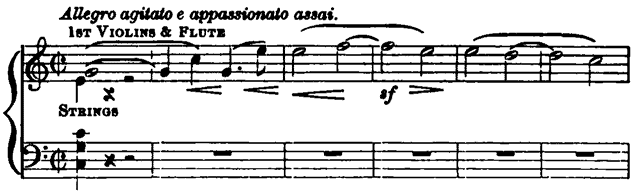
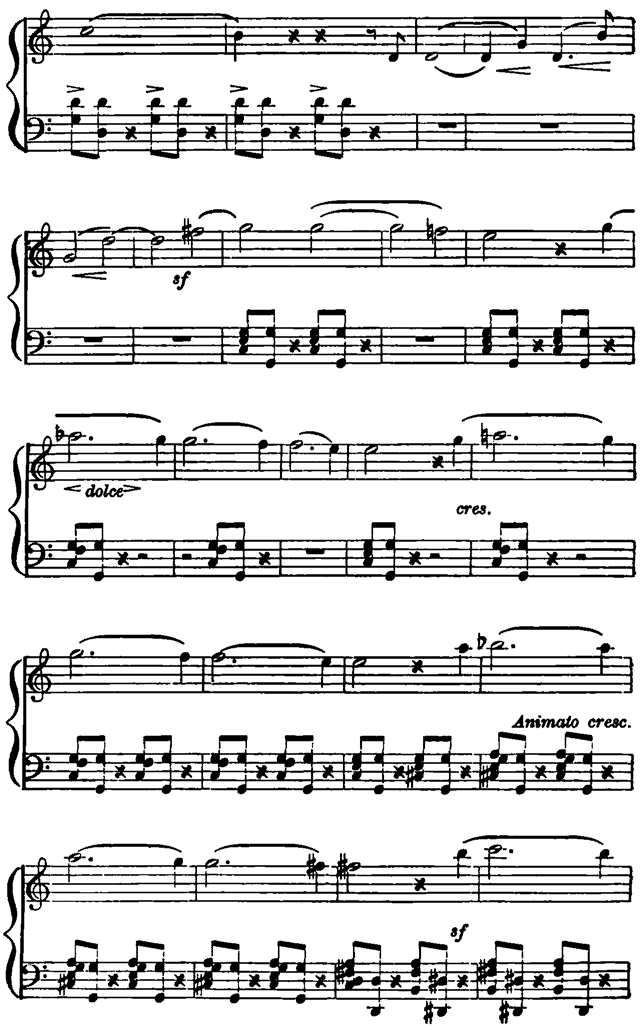
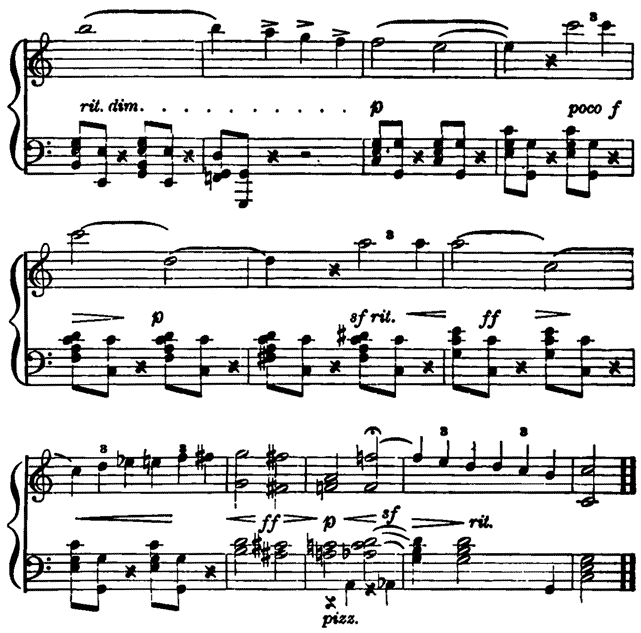
As Berlioz is, if possible, even more idiomatic for the orchestra than Chopin for the pianoforte, no conception of the real quality of his message can be gained from transcriptions, however good. His works[228] must be studied at first hand in the orchestral score and then heard in performance by an excellent orchestra. Some preliminary acquaintance and appreciation, however, of characteristic features in his style is possible from arrangements and so we select for comment the following works and movements: The Fantastic Symphony, the Carnaval Romain Overture, the Ballet des Sylphes and the Feux Follets from the Damnation of Faust, the Pilgrim's March from the Childe Harold Symphony and the Slow Movement from the Romeo and Juliet Symphony.[229] There is much valuable and stimulating reading[230] about Berlioz and his influence; for, as Théophile Gautier acutely remarks, "S'il fut un grand génie, on peut le discuter encore, le monde est livré aux controverses; mais nul ne penserait à nier qu'il fut un grand caractère." The Symphonie[231] fantastique, op. 14, épisode de la vie d'un artiste, in five movements is significant for being the first manifestation of Berlioz's conviction that music should be yet more specifically expressive, since it is founded on a characteristic theme, called l'idée fixe which typifies the heroine, e.g.
[Listen] [MusicXML]
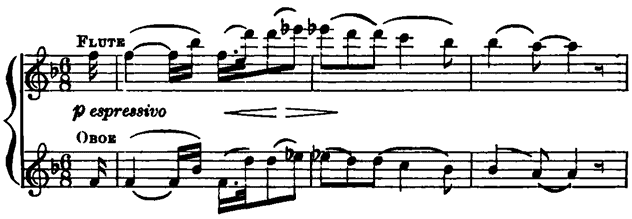
This theme, with modifications appropriate to the changes in the character and the environment, is repeated in each movement. As for the theme itself, frankly it does not amount to much; it certainly fails to take our emotions by storm or sing itself into our hearts. Berlioz's harmonization is very bald, and as to his attempts at development,[232] the less said the better. Of course whatever Berlioz writes for the orchestra sounds well; of that there is no doubt. But this is not enough; any more than we are convinced by a person's statements or arguments merely because he happens to have a beautiful speaking voice. This dramatization of a musical theme was, after all, nothing iconoclastically new and Berlioz is perfectly right in claiming that he was merely extending the possibilities of that same type of theme as is found in Beethoven himself, e.g., in the Coriolanus Overture and to a certain extent in the Fifth Symphony. If, furthermore, we look back from the dramatic and highly personified use made of themes in modern music, in the works of Strauss, Tchaikowsky, Franck and even Brahms (e.g., his First Symphony with its motto-theme) we can see that this symphony of Berlioz is an important link in a perfectly logical chain of development. This melody, then, l'idée fixe, appears in each of the five movements; undergoing, however, but slight purely thematic development, being introduced and modified primarily for dramatic purposes. In the second movement,[233] Un Bal, two phrases drawn from it are sung pp by the clarinet as an indication that, amid the gaieties of the dance, the vision of the beloved one is ever present. In the Scène aux Champs it is modified and eloquently declaimed by the flute and oboe, e.g.
[Audio content is not currently supported on your device. [MusicXML]
At the close of the movement occurs one of Berlioz's most novel and realistic effects—the imitation of the rumbles of distant thunder produced by four kettle-drums tuned in a very peculiar way (see page 75 of the orchestral score, Breitkopf and Härtel edition). In the fourth movement, Marche au Supplice, four measures of l'idée fixe are introduced just at the moment when the head of the hero is to be chopped off. This is done for purely theatric purposes and certainly makes our flesh creep—as Berlioz no doubt intended. The most spectacular effect, however, is in the last movement, Songe d'une Nuit du Sabbat, where the theme is parodied to typify the degraded appearance which the beloved one takes in the distorted dreams of her lover, e.g.
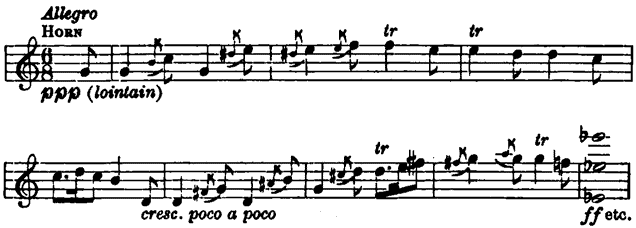
[Audio content is not currently supported on your device. [MusicXML]
The impression made by the Symphony depends largely upon the attitude of the hearer. In this work we are not to look for the sublimity and emotional depth of a Bach or Beethoven any more than we expect a whimsical comedy of Aristophanes to resemble an epic poem of Milton. But for daring imagination, for rhythmic vitality and certainty of orchestral effect, it was and remains a work[234] of genius.
The Carnaval Romain Overture (See Supplement No. 57)
This work is one of Berlioz's most brilliant pieces, with an orchestral life and color all its own. The material is taken from his opera Benvenuto Cellini;[235] the checquered career of this artist having made an irresistible appeal to Berlioz's love of the unusual and the spectacular. The body of the work is based on the Italian national dance, the Saltarello; and with this rhythm as a steadying background Berlioz achieves a continuity sometimes lacking in his work. The mere thought of the sights, sounds and colors of that important event in the life of Rome would be enough to inflame his susceptible imagination, and so here we have Berlioz at his very best. The overture begins, allegro assai con fuoco, with a partial announcement of the saltarello theme by the violins and violas, freely imitated by the wood-wind instruments, e.g.
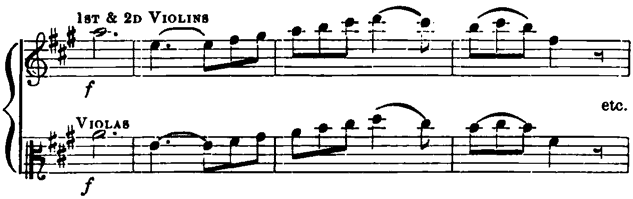
[Audio content is not currently supported on your device. [MusicXML]
After a sudden prolonged silence and some crescendo trills the first periodic melody is introduced, sung by the English horn—the tune taken from an aria of Benvenuto in the first act. The melody is soon repeated in the dominant key by the violas and then, treated canonically, by the 'cellos and violins. The canon really tells and shows that Berlioz, as is often alleged, was not altogether lacking in polyphonic skill. The rhythm is now gradually quickened and leads to the main body of the work, in 6/8 time, based on the Italian folk-dance—the Saltarello which, as its name implies, is of a "skipping" nature. The music is freely developed from the two following themes; there is no second theme proper, e.g.
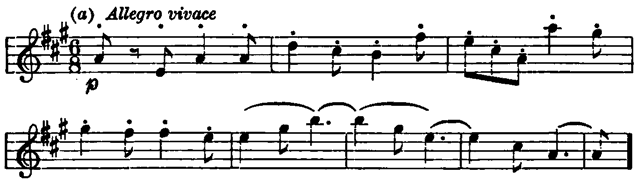
[Listen] [MusicXML]
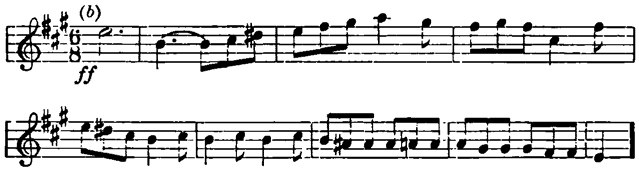
[Listen] [MusicXML]
Toward the close there is a return to the introductory melody which is treated contrapuntally by the bassoons and other wind-instruments. The saltarello resumes its sway and is worked up to a fiery ending; especially brilliant are the closing chords scored for full brass with trills on the cornets.
Two of Berlioz's most poetically conceived descriptive pieces are the Menuet des Feux-Follets and the Ballet des Sylphes, incidental orchestral numbers from the Damnation of Faust; for they illustrate convincingly what one means by the claim that Berlioz thought in terms of orchestral color and suggestion. To give a musical picture of such airy and fantastic imaginings by the mere repetition of conventional formulae would obviously be of no avail. Berlioz's genius is equal to the situation; and as we listen to the music we can really see the flickering of the Will o' the Wisps and feel the graceful swaying of the Sylphs as they hover about the sleeping Faust. To suggest the Feux-Follets Berlioz ingeniously gives the theme to two piccolos in thirds, which are supported by a rich but subdued mass of wind instruments, horns and trumpets, e.g.
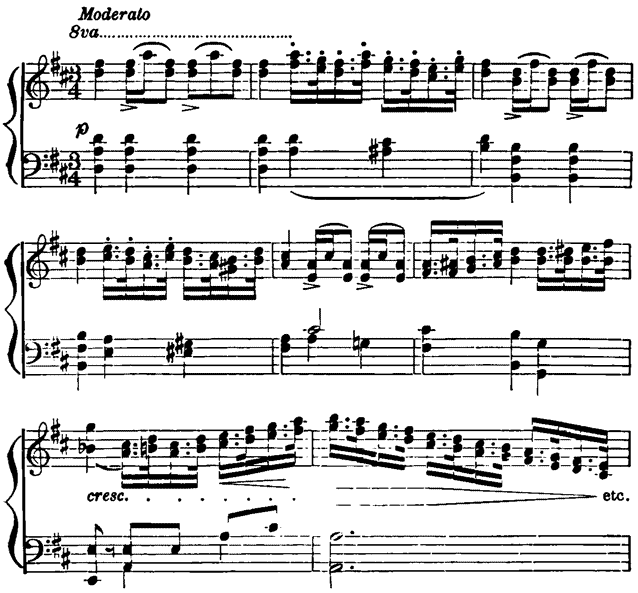
[Listen] [MusicXML]
With equal felicity does he create the picture of the delicate, graceful Sylphs. Any boisterous rhythmic activity would be quite out of place; and so, above a sustained ground tone on muted 'cellos and basses (which continues through the piece), and the slightest suspicion of motion on the second violins and violas, there floats in the first violins one of the most perfectly rounded and exquisite melodies in existence, e.g.
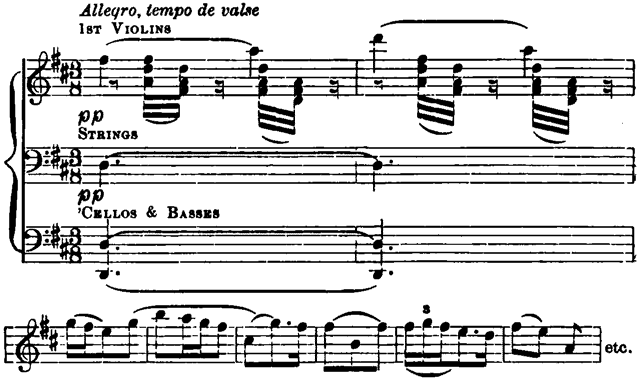
[Audio content is not currently supported on your device. [MusicXML]
In the closing measures there is a charming shadowy dialogue between kettle-drums (struck with sponge-headed sticks) and harps, in harmonics, carrying out Berlioz's stage directions—"Les esprits de l'air se balancent quelque temps autour de Faust endormi et disparaissent peu à peu." The piece ends with a chord barely whispered on the clarinets, pppp, which, as Hadow aptly suggests, reminds us of vanishing soap bubbles.
Berlioz's most sustained and perfect work, both in content and treatment, is universally acknowledged to be the Harold en Italie Symphony[236] in four movements for full orchestra and solo viola. There is little actual correspondence between the scenes of Byron's poem and the musical portrayal; and in fact, as Liszt says, "The title clearly shows that the composer wished to render the impression which the magnificent nature of Italy could not fail to make on a soul such as that of Harold languishing in sorrow." The significant features of the work are the melody for solo viola, recurring[237] in each movement, which typifies Harold—that "melancholy dreamer," e.g.,
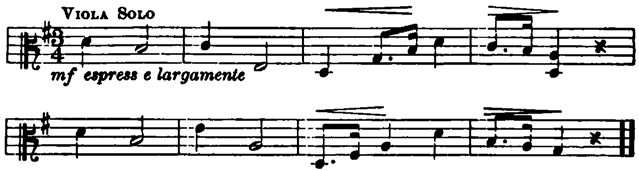
[Audio content is not currently supported on your device. [MusicXML]
and the dazzling sensationalism of the Finale (Orgy of Brigands) which, when it was once played "con amore" by a fine orchestra, called forth from Berlioz the following eulogy,—"Sublime! I thank you, gentlemen, and I wonder at you; you are perfect brigands." The finale is also notable in that the opening portion is a reminiscence, a passing in review, of the chief themes of the preceding movements. Berlioz, we may surmise, was following the precedent established by Beethoven in the finale of the Ninth Symphony, and, although his treatment is rather mechanical and lacking in any such dramatic logic as justified Beethoven, a certain organic connection between the movements is undoubtedly secured. A portion of the second movement, March of Pilgrims singing the evening prayer, is cited in the Supplement (See No. 58) chiefly because it is one of Berlioz's noblest inspirations, giving an eloquent picture of a procession approaching, passing by and losing itself in the distance—a long crescendo and diminuendo. At every eighth measure the March melody is interrupted by the muffled chant of the pilgrims, very effectively scored for brass instruments, pianissimo. In the middle of the piece a contrast is gained by the introduction of a religious chant. The closing measures of this movement are of haunting beauty—a mysterious effect being produced by an intentional mixture of tonalities (the sustained B in the flute and oboe being answered by a C on the horns and harp, while beneath are heard fragments of the March theme in the main key on the pizzicato double basses).[238] Berlioz's most pretentious orchestral composition is that called in the full title "Romeo and Juliet, dramatic symphony, with choruses, vocal solos, and a prologue in choral recitative, composed after Shakespeare's tragedy." Notwithstanding many touches of genius, it is a very uneven work and is too much a conglomerate of styles—narrative, lyrical, dramatic, theatric and symphonic—for the constructive ability of the author to weld into a living whole. There are several portions which, however noble and glorious may have been Berlioz's conception,[239] and however inspired by Shakespeare's genius, do not "come off." Two of the numbers, on the other hand, are worthy of the highest praise—the Love Scene and the Queen Mab Scherzo. Of the latter Saint-Saëns writes—"The famous Scherzo is worth even more than its reputation. It is a miracle of lightness and gracefulness. Beside such delicacies and transparencies the finesses of Mendelssohn in the Midsummer Night's Dream seem heavy." The main theme is fascinating in its daintiness and sparkle, e.g.
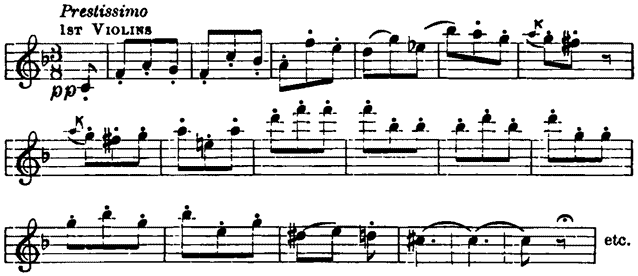
[Audio content is not currently supported on your device. [MusicXML]
Berlioz considered the Love Scene his finest inspiration and there are few pieces comparable with it for passionate utterance. The orchestration is wonderful for richness and variety.[240]
After a careful study of the foregoing examples the reader, we hope, is in a position to make a fair estimate of Berlioz's power and to realize his great significance. It should be understood that this music is intensely subjective and so requires a sympathetic and cultivated attitude on the part of the listener. To the writer at least, there remains one vital lack in Berlioz's music,—that of the dissonant element. It often seems as if his conceptions could not be fully realized for want of sheer musical equipment, largely due to insufficient early training. For what is music without dissonance? Surely "flat, stale and unprofitable" even if, in Berlioz's case, this deficiency is offset by great rhythmic vitality and gorgeous color. Yet in his best works[241] there is such a strong note of individuality, indeed such real character, that they are deserving of sincere respect and admiration, although by everybody they may not be deeply loved. We should, furthermore, always remember that, if Berlioz's poverty of harmonic effect is sometimes annoying, he never falls into the humdrum ruts of those who have had a stereotyped academic training. His genius was unhampered by any conventional harmonic vocabulary, and hence it could always express itself freely. That he was a real genius no one can fairly doubt.
All the qualities which have been enumerated as typical of the romantic temperament: warmth of sentiment, broad culture, love of color and the sensuous side of music, freedom of form, and stress laid on the orchestra as the most eloquent means of expression, reach their climax in Franz Liszt (1811-1886). Born near Vienna of a Hungarian father and a German mother, but chiefly associated with Paris, Weimar, Budapest and Rome, he is certainly the most picturesque and versatile figure in the music of the 19th century; for he worked and won fame as a pianoforte virtuoso—probably the greatest the world has known—as a prolific composer for pianoforte, orchestra and voice, as a teacher, conductor and man of letters, and withal spent a large part of his time, strength and fortune in helping young artists and in producing works which otherwise might never have seen the light. His life is of constant and varied interest, so spectacular at times that it seems like a fairy tale.[242] As a mere boy he began to receive adulation for his precocity; at the height of his career he was loaded with honors and wealth; in his old age he was a favorite with everyone of distinction and influence in France, Germany, England and Italy. Nevertheless he preserved, throughout, the integrity of his character and the nobility of his disposition. Whatever may be the final estimate of his powers as a creative artist, as a man he has earned nothing but eulogy;[243] for seldom has any one been freer from the faults of vanity, petty jealousy and envy which so often mar the artistic temperament. Liszt's generous encouragement and financial support of Wagner in the struggling days of his unpopularity have never been surpassed in the brotherhood of art.
Liszt is akin to Berlioz in many respects; we feel the same natural tendency to derive musical inspiration from external sources, poetic, pictorial or from the realm of Nature. Purely as a musician, however, Liszt was far greater, with a wider vocabulary and more power in thematic development. His work also is somewhat uneven; moments of real beauty alternating with passages which are trivial, bombastic or mere lifeless padding. When we bear in mind Liszt's unparalleled versatility, his output in quantity and variety is so amazing—there being well over 1,000 works of about every kind—that it is unfair to expect the style to be as finely wrought as the original conception is noble. A serious and unbiased study of his best compositions will convince one that Liszt is entitled to high rank as a musician of genuine poetic inspiration. The average music-lover is prone to dwell upon him as the composer of Les Préludes, the Hungarian Rhapsodies, and as the somewhat flashy transcriber of operatic potpourris, such as the Rigoletto Fantasie. But Les Préludes, notwithstanding a certain charm and the clever manner in which the music (without becoming minutely descriptive) supplements the poem of Lamartine, is yet barred from the first rank by its mawkishness of sentiment and by its cloying harmonies. The most significant among the symphonic poems are Orpheus with its characteristic crescendos and diminuendos; Tasso of great nobility and pathos, and Mazeppa, a veritable tour de force of descriptive writing. To hear any one of these masterpieces can not fail to alter the opinion of those who may have considered Liszt as exclusively given over to sensational effects. As for the Hungarian Rhapsodies, which Liszt intended as a kind of national ballade and so, for the basic themes and rhythms, drew largely on Hungarian Folk music, here again the public, with its fondness for being dazzled, has laid exclusive stress on the flashy ones to the detriment of those containing much that is noble and of enduring worth. In his transcriptions of standard songs Liszt did as valuable a public service as any popularizer, and has thereby made familiar the melodies of Schubert and Schumann to hundreds who otherwise would know nothing of them. In considering Liszt's pianoforte works we must remember that he was a born virtuoso with a natural fondness for exploiting the possibilities of his instrument, and with an amazing technique as a performer. When the sincerity of a composer is in question there is a great difference as to what should be the standard of judgment, whether the work be for orchestra or for pianoforte. In writing for orchestra the composer naturally centres himself on the pure ideas and their treatment, as the execution is something entirely external to himself. In works for pianoforte, however, the composer who is also a virtuoso will often, and quite justifiably, introduce passages of purely pianistic effect which in other circumstances would amount to a confession of deficient imagination. That Liszt at times abused his facility in decoration need not be gainsaid, and yet how poetic and eloquent are his best pianoforte compositions!—the Études, the Waldesrauschen, the Ballade and, above all, the Sonata in B minor.[244] Much unjust criticism has been expended upon Liszt for treating the pianoforte like an orchestra. As a matter of fact he widened, in a perfectly legitimate way, the possibilities of the instrument as to sonority, wealth and variety of color-effect. According to the testimony of contemporary colleagues, Rubinstein, Taussig and von Bülow who, had they not been convinced of his supremacy, might well have been jealous, Liszt was incontestably the greatest interpreter of Bach, Beethoven and Chopin; and his power as a Beethoven scholar is attested by the poetically annotated edition of the Sonatas. It is often asserted that Liszt lacked spontaneous melodic invention. This is a hard saying unless taken in a relative sense. We may grant that Liszt was neither a Schubert nor a Mozart, and yet recognize in his works some extremely haunting melodies. His creative power was acknowledged by Wagner and in a very practical manner. In fact, after a comparative study of their works, one is amazed at the number of melodies which Wagner borrowed from Liszt and at the generous complaisance of the latter. The reactive influence of Liszt and Wagner, each upon the other, is an interesting chapter in the development of modern art. Liszt was undoubtedly encouraged in his revolutionary aims by Wagner's fiery courage. Wagner, on his side, owed much to Liszt's unselfish generosity; and with his more powerful constructive gifts worked up into enduring form motives which, internal evidence clearly shows, came from Liszt himself.
Just a few closing words as to Liszt's specific contributions to the expansion of musical structure. He was an advanced leader in the "program school," being endowed with considerably more constructive power than Berlioz, who often fell between two stools: in that while his subject demanded the freest treatment, he lacked the vigor to break away from the formal routine of his classic models. In Liszt's orchestral works, however, the term "Symphonic Poem"—one of his own invention—is fully justified, i.e., they are symphonic in that they have organic unity, although this is not attained by preserving the classic number and arrangement of themes; and they are also poetic, being not a presentation of abstract tone patterns, but illustrative of some external idea which shapes the course of the music entirely to its own needs.[245] The distinguishing quality of the Symphonic Poem is its unbroken continuity. Although objective points are reached, and while there are broad lines of demarcation with reference to the varied moods of the poem to be illustrated, there are no rigid stops—everything is fused together into a continuous whole. Liszt was an advocate of persistent development, i.e., the music going out into space like a straight line instead of returning on itself. Inner evidence shows, however, that although he avoided many needless and conventional repetitions, he could not entirely throw overboard the cyclical law of restatement; for there is not one of his Symphonic Poems which does not repeat, at the end, thematic material already heard. Liszt carried the principle of theme transformation still further than Berlioz; and, as a German, tended to lay stress rather on the psychological aspects of character than on those outward theatric events which appeal to French taste. The difference is well shown by a comparison of the Damnation of Faust with Liszt's Faust Symphony, considered his most inspired orchestral work. Liszt must not be forgotten as a song-writer, especially for his settings to Goethe's poems; which, as Huneker says, are masterpieces and contain, in essence, all the dramatic lyricism of modern writers, Strauss included. In these songs the instrumental part is of special import; Liszt in pianistic treatment anticipating Hugo Wolf with his "Songs for Voice and Pianoforte," i.e., the voice and the instrument are treated as coequal factors.
The works of Liszt selected for analytical comment are the Symphonic Poem Orpheus, the Faust Symphony and the Pianoforte Étude, Waldesrauschen. The student, however, should become familiar with several others[246] of the Symphonic Poems, notably Tasso, Les Préludes and Mazeppa; with the Pianoforte Sonata in B minor in one movement, in which Liszt works on the same plan as Schumann in the Fourth Symphony; with the descriptive pianoforte pieces and études; and with the songs, of which Kennst du das Land, Die Lorelei and Du bist wie eine Blume are beautiful examples.
Symphonic Poem, Orpheus
In this work, as must always be the case in poetically suggestive music, the composer trusts to the general intelligence and insight of the listener. For a mere mention of the name Orpheus may well call up the vision of a majestic, godlike youth proclaiming his message of joy and peace to soften the unruly passions of men and animals.
It is said that Liszt's imagination was kindled by a beautiful representation of Orpheus playing on the lyre, which decorates an Etruscan vase in the Louvre. The aim of the music was thus to intensify and supplement the visual effect. The Poem begins with soft, sustained calls on the horns, creating a mood of expectancy, interspersed with modulatory arpeggios on the harp serving to complete the legendary picture. In these Symphonic Poems, we must always observe how closely the nature of the themes and the whole import of the music are involved with the orchestral dress. For Liszt, though not perhaps so brilliant and sensational as Berlioz, was equally a great master of orchestral coloring and poetic suggestion by means of appropriate instruments; often, too, more delicate and refined. In measure 15 begins for sustained strings the stately march which typifies the gradual approach of Orpheus. The second phrase of the march, beginning in measure 38, has received the compliment of being appropriated, almost literally, by Wagner in the second act of the Valkyrie for the march motive with which Wotan is ushered in. Some beautiful modulatory developments of the march theme, with which the original horn calls are united, lead to the impassioned theme in E major, sung by an English horn, which is the message of Orpheus to the sons of men, e.g.
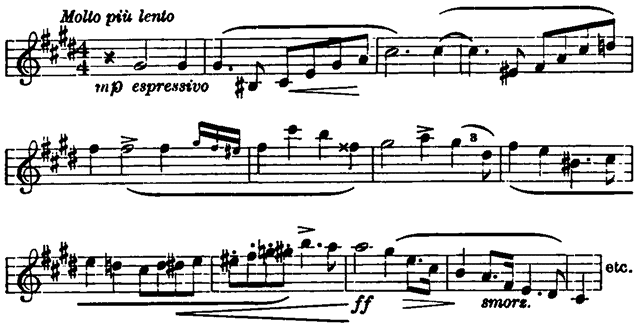
[Listen] [MusicXML]
The theme is expanded by means of striking modulations until, in measure 102, it is presented by the full orchestra. Some rather meaningless repetitions, in detached phrases, of the Orpheus theme bring us, in measure 130, to a return of the original march which is finally proclaimed ff with great power and sonority. It seems to typify the triumphant justification of Orpheus's appearance. The dissonant modulations in the following passage, beginning measure 155, (in which the double basses take a dramatic part) have been thought by some to represent realistically the uncouth roars of forest monsters. These outcries finally subside and in the Coda, beginning at measure 180, we have first a beautiful reminiscence of Orpheus's message and then a last announcement of the march theme, which is now presented in the form of a long diminuendo, as if the God-like apparition were slowly withdrawing from our sight. A series of shifting modulations (adagio and pianissimo) seems to bring a cloud before our enraptured senses, and the work closes with a long sustained chord in C major, ppp, giving an elemental idea of peace and satisfaction. From the standpoint of musical structure the work is a crescendo followed by a diminuendo and, poetically considered, is a convincing picture in terms of music of the effect made upon Liszt's imagination by the legend of Orpheus. Observe that, although the composition is free in form, it is not formless.[247] The main lines are the familiar ones of statement, contrast and restatement, i.e., three-part form, and the key-relationship is clear and carefully planned.
The Faust Symphony
This work, although embodying Liszt's favorite ideas of dramatic characterization and transformation of theme as found in the Symphonic Poems, more nearly resembles the ordinary symphony in that it is in three distinct movements—with pauses between—which stand, respectively, for the three chief characters in Goethe's drama: Faust, Gretchen and Mephistopheles. In the Faust Symphony the principle of transformation or metamorphosis of themes is of such importance that it may be defined as their rhythmic, melodic and harmonic modification for the purpose of changing the meaning to correspond with a modification in the characters for which they stand. The first movement sets before us five themes illustrative of the most prominent traits in the complex nature of Faust; the three most important being (a) typical of brooding, speculative inquiry, (b) the longing of love, (c) the enthusiasm and chivalry of Faust, e.g.

[Listen] [MusicXML]
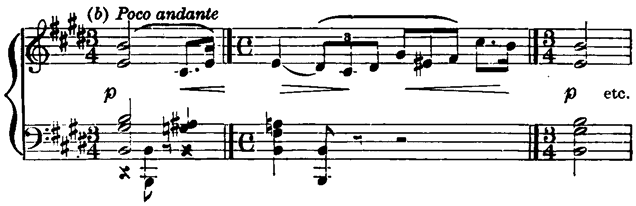
[Listen] [MusicXML]
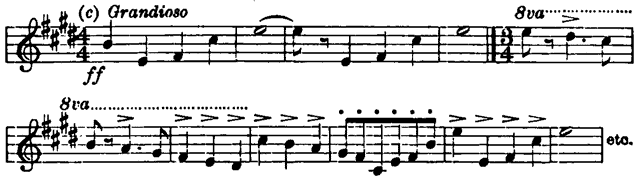
[Listen] [MusicXML]
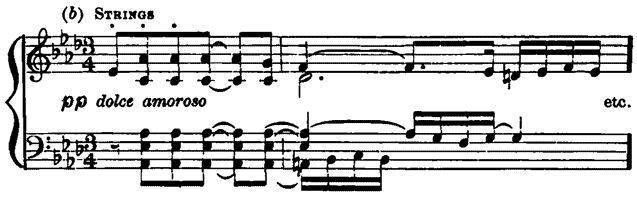
The development of these themes is entirely free, the musical texture being held together by a general application of the principle of contrast and by a logical key-scheme. The second movement has two main themes, e.g.
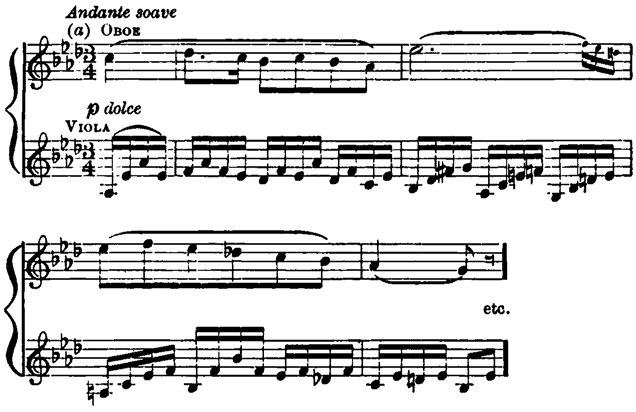
[Audio content is not currently supported on your device. [MusicXML]
[Listen] [MusicXML]
which portray eloquently the sweetness and dreamy ecstacy of Gretchen's nature. In the course of this portrayal there appear several themes from the first movement showing, by their transformation, the effect upon the introspective Faust of the awakening influence of love. Thus the love theme appears as—
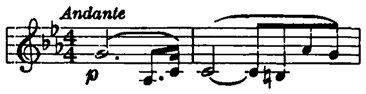
[Listen] [MusicXML]
and also later in this form—

[Listen] [MusicXML]
Towards the close of the movement there is a subtle reference to the chivalrous theme, as follows—
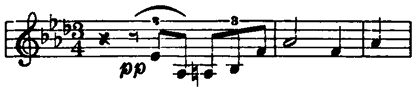
[Listen] [MusicXML]
Much of the appeal of the music depends upon the orchestration which throughout is of remarkable beauty.
In the final movement, entitled Mephistopheles, there are a few independent themes which portray the malign influence of the spirit of Evil—the movement is marked Allegro vivace ironico!—but most of the material is a transformation of the Faust themes which are here burlesqued, parodied; as if all the noble aspirations of Faust were being mocked and set at naught. This treatment is a perfectly logical result of the correspondence, for which Liszt was striving, between the music and the spirit of the underlying drama. As for the final impressiveness of his artistic message, the composer may well have felt that the effect would be indefinite without the specific meaning which words alone can give. For the style is very subjective throughout; that is, if the hearer is in a responsive condition, an effect is produced on his imagination—otherwise, not. To close the work, therefore, in the most moving and dignified manner, Liszt, with unerring instinct and following the precedent of Beethoven in the Ninth Symphony, introduces a chorus of men's voices—marked Andante Mistico—which intones the famous stanza "Alles Vergängliche"[248] at the close of the second part of Faust; while, above this chorus, a solo tenor proclaims the motto of the redeeming love of woman, "Das ewig Weibliche"—a sentiment so dear to the German[249] mind and one that plays such an important part in the music dramas of Wagner. A dramatic and musical connection between the movements is established by using, for this solo part, the melody (intensified by augmentation) which in the second movement typified the love and charm of Gretchen, e.g.

[Listen] [MusicXML]
Notwithstanding the ultra sensationalism in some of Liszt's works there is no doubt that, in the closing pages of Faust, he has produced an effect of genuine power and of inspired musical beauty.[250] Faust, in fact, may be called a great work because of the character of its leading melodies, its freedom of structure and expression and its wealth of appropriate orchestral color. For these merits we may overlook certain dreary passages where it would surely seem as if the imagination of the composer were not able to translate into tones all the phases of Goethe's stupendous drama.[251]
In a book such as this, chiefly concerned with broad principles of structure and style, it would be out of place to attempt a detailed account of Liszt's numerous and varied pianoforte compositions. But they can by no means be left out of consideration by anyone who wishes to gain a comprehensive estimate of his influence. For although the fundamental principles of pianoforte style, both in writing for the instrument and in playing upon it, are derived from Chopin and Schumann,[252] Liszt so amplified the work of these men and added so many novel features of his own in pianistic effect and especially in execution that he is rightly considered a genius of the instrument. He certainly brought out of the pianoforte a sonority and wealth of color which heretofore had been associated only with the orchestra. The chief groups of the pianoforte works are (1) the transcriptions of songs, notably of Schubert and Schumann, and of operas, particularly of Wagner. In this group should also be included the remarkable arrangement for solo-pianoforte of all the Beethoven Symphonies. (2) The Études, especially the set entitled "Études d'exécution transcendante"—a description which clearly shows the idea Liszt set before himself and indubitably attained; of this set the one in F minor is particularly fine. (3) The world-famed Hungarian Rhapsodies, fifteen in number, based on national melodies and rhythms. In these Liszt aspired to be the poet of his nation, and they are still among the most important manifestations of the national spirit so prominent in our modern music. Perhaps the most eloquent and celebrated are the 2d, the 12th and the 14th. Even if at times they are overencrusted with effects meant primarily for display, the rhythmic vitality and color of the melodies cannot be withstood.
Concert Étude, Waldesrauschen (See Supplement No. 59)
This composition begins with a swaying, cantabile theme for the left hand very characteristic of Liszt, which stands out in relief against some beautifully placed arabesque figures in the upper register of the instrument—the whole to be played una corda, dolce con grazia. It really is a poetic picture, in terms of music, of the delicious murmur of the woods. In the 15th measure the theme is transferred to the right hand, in octaves, over sonorous, widely extended groups below. The theme is expanded through a series of striking modulations and then returns, in measure 30, to the left hand in a single melodic line. This middle portion, measures 30-50, is very beautiful in its genuine atmospheric treatment. Towards its close, however, Liszt's fondness for sensational effect rather runs away with him and there is a good deal, in measures 50-60 (marked martellato, strepitoso and fff), which is rather difficult to reconcile with the poetic subject. Perhaps a mighty wind is roaring through the trees! In measure 61 the theme is once more presented in amplified form by the right hand, più mosso and molto appassionata, and worked up to a brilliant climax—ending with an interlocking trill and a long, descending passage of delightful sensuous effect. The closing measures, una corda and dolcissimo, afford a reminiscence of the haunting appeal of the chief melody. All in all, in spite of a certain admixture of alloy, here is a poetic composition, a real tone-picture of the woods and of the effects implied by the title. Certainly a piece which, in its picturesque suggestiveness and pianistic treatment, may fairly be called the ancestor of much that is beautiful in such modern composers as Debussy and Ravel.
As a final estimate of Liszt and as a suggestion for the student's attitude we cite from Niecks the following quotation, since, in our opinion, it is true and forcibly expressed:
"Liszt's works are too full of originality and striking expressiveness to deserve permanently the neglect that has been their lot. Be, however, the ultimate fate of these works what it may, there will always remain to Liszt the fame of a daring striver, a fruitful originator and a wide-ranging quickener."