Chapter XIV
Reading edition
CHOPIN AND PIANOFORTE STYLE
ALTHOUGH Chopin (1809-1849) was less aggressively romantic than others of the group we have been considering, in many respects his music represents the romantic spirit in its fairest bloom. Not even yet has full justice been done him—although his fame is growing—since he is often considered as a composer of mere "salon-pieces" which, though captivating, are too gossamer-like to merit serious attention. Chopin was a life-long student of Bach; and much of his music, in its closeness of texture, shows unmistakably the influence of that master. Together with Schumann, he broke away from the strict formality of the old classic forms and instituted the reign of freely conceived tone-poems for the pianoforte: the form being conditioned by the poetic feelings of the composer. As far as fundamental principles of architecture are concerned, his pieces are generally simple, modeled as they are on the two and three-part form and that of the rondo. When he attempted works of large scope, where varied material had to be held together, he was lamentably deficient, e.g., in his Sonatas. In fact, even in such pieces as the Études and Scherzos, in the presentation of the material we find occasional blemishes. But there are so many other wonderful qualities that this weakness may be overlooked. In spite of a certain deficiency in form, Chopin is indisputably a great genius. Far too much stress has been laid on the delicacy of his style to the exclusion of the intensity and bold dramatic power that characterize much of his music to a marked degree. Though of frail physique,[212] and though living in an environment which tended to overdevelop his fastidious nature, Chopin had a fiery soul, which would assert itself with unmistakable force. His music by no means consists solely of melting moods or languorous sighs; he had a keen instinct for the dissonant element (witness passages in the G minor Ballade); he was a daring harmonic innovator; and much of his music is surcharged with tragic significance. A born stylist, he nevertheless did not avoid incessant labor to secure the acme of finish. So perfect in his works is the balance between substance and treatment, that they make a direct appeal to music-lovers of every nation. In listening to Chopin we are never conscious of turgidity, of diffuseness, of labored treatment of material. All is direct, pellucid; poetic thoughts are presented in a convincingly beautiful manner. He was a great colorist as well, and in his work we must recognize the fact that color in music is as distinct an achievement of the imagination as profound thought or beauty of line. Chopin's position in regard to program music is an interesting subject for speculation. Few of his works bear specifically descriptive titles; and it is well known that he had little sympathy with the extreme tendencies of Berlioz and Liszt. Yet there is, in general, something more than an abstract presentation of musical material, however beautiful. The varied moods aroused by the Ballades and Nocturnes, the actual pictures we see in the Polonaises, must have had their counterpart in definite subjective experiences in the life of the composer, and so from a broad psychological standpoint—even in the absence of explanatory titles—we may call Chopin a thoroughly romantic tone-poet; indeed, as Balzac says, "a soul which rendered itself audible."
As Chopin composed so idiomatically for his chosen instrument, the pianoforte, to which he devoted himself exclusively,[213] no understanding or adequate appreciation of the subtleties of his style is possible without some knowledge of the nature and attributes of this instrument which, in our time, has become the universal medium for the rendering of music. All of Chopin's works were not only published for the pianoforte but were conceived in terms of the pianoforte; his style in this respect being quite unique in the history of musical art. For there are noble and poetically inspired thoughts of many composers which may be satisfactorily presented through a number of media: pianoforte, organ, string-quartet or voices. This fact has been the cause of many so-called transcriptions of orchestral or string-quartet music for the organ. A composer, furthermore, often publishes a work for a certain instrument when the inner evidence shows that, during the period of creation, he actually had some other medium in mind. Beethoven's Sonatas abound[214] in effects which, for their complete realization, require an orchestra; so that, notwithstanding the beauty of the thought, his style is often anything but pianistic. In certain of César Franck's pianoforte works we are conscious of his predilection for the organ, as the spirit of the music demands a sustained volume of sound which the organ, with its powerful lungs, alone can give. But if the full beauty of Chopin's conception is to be gained, his music must be played on the pianoforte and on nothing else. The pianoforte has, to be sure, several limitations; it is not per se a loud instrument in comparison with a trumpet or an organ, and the whole nature of its tone is evanescent—that is, as soon as the tone is produced, it begins to fade away, . This latter apparent limitation, however, is in fact one of its most suggestive beauties; for nothing is more stimulating to the imagination than the dying away of a beautiful sound, as may be felt in the striking of a clear-toned bell, or in the wonderful diminuendo of the horn. This effect, inherent in pianoforte tone, should be more utilized rather than deplored, especially since dwelling on a delightful harmony or a single dramatic note is a definite characteristic of "tempo rubato"—that peculiar feature of Chopin's rhythm. The pianoforte can neither steadily sustain a tone nor increase it ; achievements for which the strings and the wind instruments are so valued. On the other hand, the instrument has the merits of great sonority and marvellous coloristic possibilities; and when music is composed for the pianoforte by one who understands its secrets and, furthermore, when it is properly played, it is quite the finest[215] instrument ever yet brought under the control of a single performer. Again, the pianoforte is not meant for great rapidity of utterance, such as, for instance, we associate with the violin, the flute or the clarinet. It is, in fact, often played too fast, sounding like a pianola or a machine rather than an instrument with a soul. If there be no lingering over the notes, beautiful effects have no opportunity to be heard. Rapidity and brilliance on the pianoforte do not depend on so many notes per second but on vitality and precision of accent. These admirable qualities of the instrument are due to the great number of vibrating metal strings (in a modern concert-grand, about two hundred and thirty, i.e., three strings to each of the twelve notes of the seven octaves, save for a few of the lowest bass notes); to the large sounding board (about twenty-four square feet, on the largest model), and above all to the damper pedal which Rubinstein—so appropriately—calls the soul of the pianoforte. The very term Pianoforte implies a wealth of meaning; for a special glory of the instrument is its power of shading, its flexibility of utterance, from piano to forte or vice versa. The limits themselves, to be sure, are not so striking as in certain other instruments, e.g., the pianoforte cannot produce the almost ghostly whisper of which the clarinet is capable, nor can it equal the trumpet or the trombone in intensity or volume. But it can produce a very beautiful pianissimo; and if a sense of relativity be kept, and soft effects begun quietly enough, it can be made to sound with remarkable brilliancy. The pianoforte should always be played with a keen regard for this power of shading, of nuance; the tones should undulate like the winds or the waves. Anything like the steady sostenuto level for which the organ shows itself so fitted is, except for special effects, entirely foreign to the nature of the pianoforte. Nor should we ever attempt to make it, per se, a loud, overpowering instrument. Its forte and its brilliancy are purely relative; and, when forced to do something unsuited to its real nature, it protests with a hard, unmelodious tone.


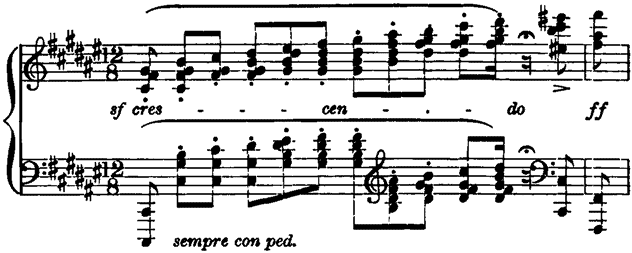
Likewise the two pedals,[216] when their technical names are understood, imply their own meaning, just as their popular designations hint at the way in which they are often abused. The pedal employed by the right foot, properly called the "damper pedal," is so named because, by its action, all the dampers of the key-board may be raised simultaneously. This allows the strings to vibrate together and to send forth great waves of colored sound like those produced by an Aeolian harp; an effect similar to that heard when a sea-shell is held to the ear. The pianoforte, in fact, has aptly been called "a harp laid on its back" to which the action of keys has been applied. Accordingly an open, flowing style (arpeggio) is one of the idioms best suited to its nature. To secure proper contrast, a massive, chordal style is sometimes employed by such composers as Schumann, Brahms and Franck—even at times by Chopin himself; but that the extended arpeggio (often merely two voices, with the body of tone secured by the pedal) is the norm may be seen from almost any page of Chopin's compositions. The resonance and carrying power of these waves are intensified by raising the lid[217] of the pianoforte; for then they are brought to a focus and projected into space. The effect produced by raising the dampers is appropriate and beautiful, not alone with consonant chords but, at times, equally with chords that are unrelated; which, were they sustained for long by an organ, would be intolerably harsh. But the tone of the pianoforte is so fleeting that such a mixture ensures great brilliance and warmth without undue jargon, and is thus akin to the blending of strange colors by modern painters. Many people, in fact, play the pianoforte with too little, rather than too much, pedal; or with too much pedal used the wrong way! A definite attempt should be made to cultivate a feeling for color and warmth of tone; a hard, colorless tone on the pianoforte being a great blemish as it is so unnecessary. The following passage illustrates the above points.
Chopin: Barcarolle
[Listen] [MusicXML]
There is really no such thing on the pianoforte as a "pure" single tone. It is an acoustical law that no tone exists by itself, but always generates a whole series of overtones[218] or "upper partials," as they are called, e.g.

[Listen] [MusicXML]
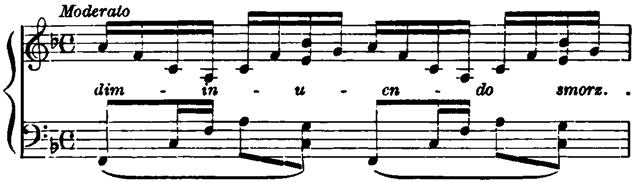
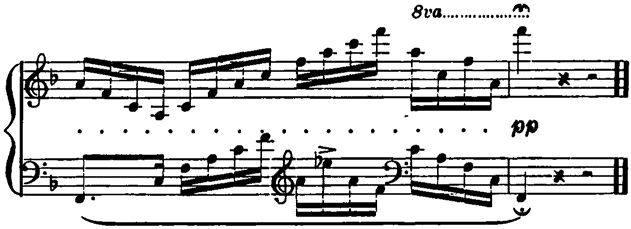
Even what we call the perfectly consonant chord of C major, e.g., [Listen] [MusicXML] would be slightly qualified and colored by the B-flat, and this effect has actually been utilized by Chopin in the final cadence of his Prelude in F major, No. 23, e.g.

[Listen] [MusicXML]
In this example the E-flat must be very delicately accented and both pedals freely used.
Let it be clearly understood, therefore, that the damper pedal—popularly but erroneously called the "loud pedal"—has nothing to do with "noise" as such. Its purpose is to amplify and color the waves of sound and these waves may vary all the way from pp to ff. The dynamic gradation of pianoforte tone is caused by the amount of force with which the hammer strikes the wires; and this power is applied by the attack and pressure of the fingers. The damper pedal will, to be sure, reinforce fortissimo effects, but logically it is only a means of reinforcement and should never be used so that a mere "roar of sound" is produced. The normal pianoforte tone, however, is that brought forth in connection with the damper pedal, and only to gain an effect of intentional coolness and dryness do we see in pianoforte literature the direction "senza pedal"; passages so marked being often most appropriate as a strong contrast to highly colored ones.[219]
An important adjunct of the instrument, though even less intelligently used, is the pedal employed by the left foot; that popularly known as the "soft pedal," but of which the technical name is the "una corda" pedal. By this device on a grand pianoforte the whole key-board is shifted from left to right, so that the hammers strike but two wires in each group of three, and the third wire of the set is left free to vibrate sympathetically. Thus a very etherial, magical quality of tone is produced, especially in the upper ranges of the instrument. In the middle register, passages played forte or fortissimo will have a richness comparable to the G string of a violin. The effect is analogous to that of a viol d'amour which has, as is well known (stretched underneath the strings, which produce the actual tone) a set of additional strings, freely vibrating. Although this "una corda"[220] pedal may be used in a dynamic sense to reduce, as it were, the size of the instrument, its chief purpose is coloristic, i.e., to make possible a special quality of tone. This statement is proved by directions in pianoforte literature as far back as Beethoven, in whose Sonatas we find the dynamic marks of f and ff coupled with the proscribed use of the una corda pedal. In any case, this left-foot pedal should not be abused; for, just because the tone quality produced thereby is so beautiful and characteristic, it soon becomes, if constantly employed, rather cloying. The dynamic gradation of tone is primarily a matter for the control of the fingers, i.e., the touch. The damper pedal is for sonority and color; the una corda for special shades, and all three factors—touch and the two pedals—are combined in pianistic effects which only a trained technique and artistic judgment can regulate.[221]
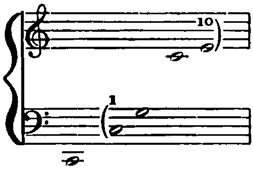
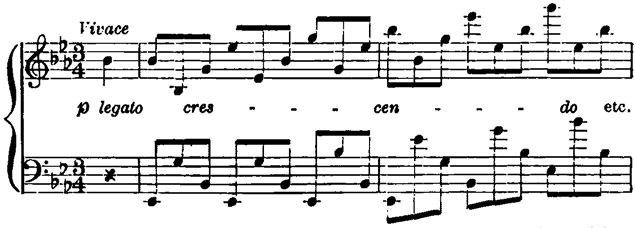
Even a slight analysis of Chopin's style proves that it is based upon logical inferences, drawn from the series of overtones as they are generated and reinforced by the very nature of the pianoforte. From the wide spacing of the lower tones of the series Chopin derived the extended grouping of his arpeggios, e.g.,
[Listen] [MusicXML]
Prelude, No. 19
[Listen] [MusicXML]
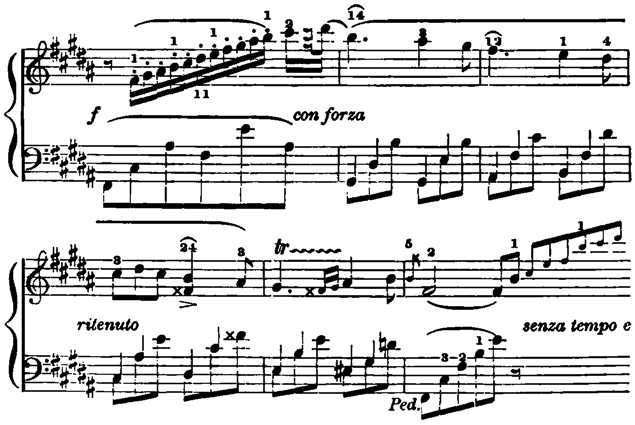
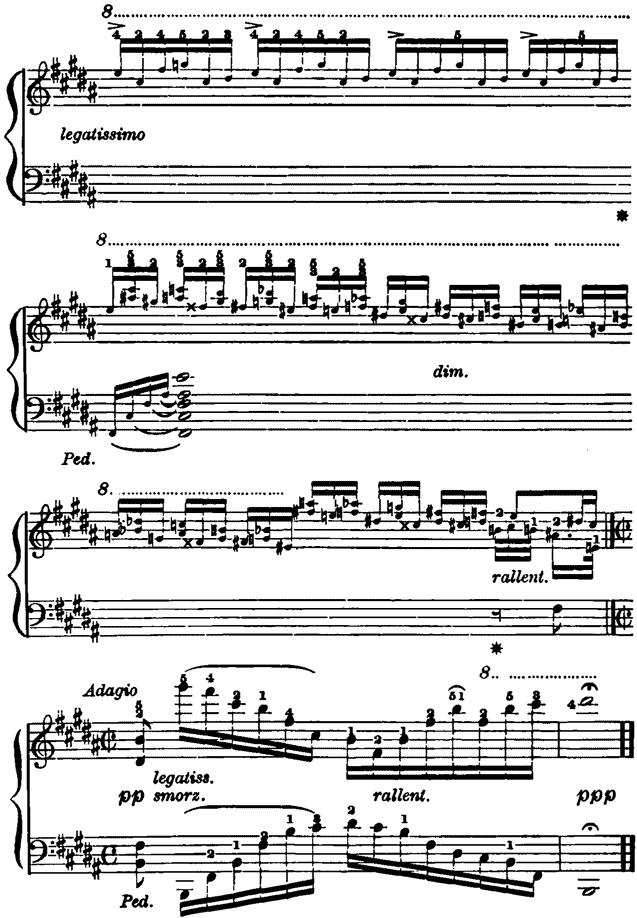
so that the chord of the 10th, instead of the former grouping within the octave, may be considered the basis of his harmonic scheme. By this means a great gain was made in richness and sonority. Another striking feature of Chopin's style is found in those groups of spray-like, superadded notes with which the melody is embellished. It is evident, in many cases at least, that these tones are not merely embroidery in the ordinary sense. Rather do they represent a reinforcement of the overtones, ideally or actually present, in connection with bass tones and chords used in the lower part of the musical fabric. As a striking example[222] see the long series of descending non-harmonic tones in the Coda of the B major Nocturne, op. 9, No. 3, and note the delicate colors in the closing arpeggio chord (to be played with a free use of both pedals).
[Listen] [MusicXML]
In general, Chopin's style is homophonic—wondrous lyric melodies which seem to float on waves of richly colored sound. But there is also much subtly used polyphony, i.e., delightful phrases in inner voices and imitative effects between the different parts. In comparison, however, with Schumann's style (which is largely on a polyphonic basis) Chopin is a decidedly homophonic composer.[223] A great deal of interesting and instructive reading on Chopin is available and the following works are especially recommended: Chopin, the Man and his Music by Huneker; the Life of Chopin by Niecks; the essay on Chopin in Mason's Romantic Composers and in Hadow's Studies in Modern Music; the volume on Chopin by Elié Poirée in the series Les Musiciens Célèbres; and the same by Louis Laloy in the series Les Maîtres de la Musique; the Life by Liszt (well known and most valuable as coming from a contemporary and brother musician); finally a somewhat rhapsodic essay by H.T. Finck in Chopin and Other Essays.
We select, as being thoroughly representative, the following works for comment: the first Prelude, the A-flat major Étude, the F-sharp minor Mazurka, the E-flat minor Polonaise, the Barcarolle and the C-sharp minor Scherzo.[224]
Prelude in C Major, Op. 28, No. 1.
This Prelude, the first of the set of 24, is an excellent example of the sonority Chopin gained from widely extended chords in the bass; by the use—characteristically bold—of dissonances (measures 13-20), and by the sensuous richness of the closing measures, in which a wonderful wave of sound is produced through the damper pedal, in connection with the blending of the tonic, dominant and subdominant chords. The prelude is a kind of intensified Bach and may well be compared with that prelude in the same key which begins the immortal well-tempered Clavichord. All the Preludes, for their poetic import, finished style and pianistic effect, are masterpieces of the first rank. Schumann well says of them: "They are sketches, eagle's feathers, all strangely intermingled. But in every piece we recognize the hand of Frédéric Chopin; he is the boldest, the proudest poet-soul of his time."
Étude in A-flat Major, Op. 25, No. 1.
This étude, deservedly popular, may be considered the example par excellence of Chopin's style. The lyric beauty of the melody, the fascinating modulations, the shades of color alike justify the following rhapsodic comments of Schumann, "Imagine that an Aeolian harp possessed all the musical scales, and that the hand of an artist were to cause them to intermingle in all sorts of fantastic embellishments, yet in such a way as to leave everywhere audible a deep fundamental tone and a soft, continuously singing upper voice, and you will get about the right idea. But it would be an error to think that Chopin, in playing this étude, permitted every one of the small notes to be distinctly heard. It was rather an undulation of the A-flat major chord, here and there thrown aloft by the pedal. Throughout the harmonies one always heard in great tones a wondrous melody, while once only, in the middle of the piece, besides that chief song, a tenor voice became prominent. After the étude a feeling came over one as of having seen in a dream a beatific picture which, when already half awake, one would gladly once more recall."
Mazurka in F-sharp Minor, Op. 6, No. 1.
As Franz Liszt says in his life of Chopin, "The Mazurka is not only a dance, it is a national poem, and like all poems of conquered nations, is shaped so as to let the blazing flames of patriotic feeling shimmer out through the transparent veil of popular melody." The chief peculiarity of the Mazurka (which is always in triple rhythm, with a latitude in speed from Presto to Mesto) is the scheme of accentuation—the normal accent on the first beat being systematically transferred to the second and third beats. We also find in the Mazurka frequent indications for the use of the so-called "tempo rubato," a proper conception of which is so essential in the performance of Chopin's music. Tempo rubato—so often abused!—literally meaning borrowed time, is simply free rhythm emancipated from rigid, scholastic bonds. As Huneker well says, "Chopin must be played in curves" with emotional freedom; just as the heart, when excited, increases the speed of its pulsations, and in moments of calm and depression slows down. The jerky, really unrhythmical playing of certain performers reminds us of a person suffering from palpitation of the heart. Liszt's description of the rubato is most suggestive: "A wind plays in the leaves, life unfolds and develops beneath them, but the tree remains the same." In Chopin, accordingly, the ground rhythm should always be preserved, though varied with subtle, and yet logical fluctuations.
Polonaise in E-flat Minor, Op. 26, No. 11.
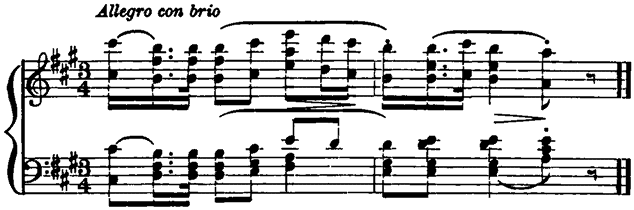
The Polonaise[225] is the great national dance of the Poles; an impassioned and yet stately pageant in which, as Liszt says, "The noblest traditional feelings of ancient Poland are represented." This dance—or rather, processional march—is always in triple rhythm and based on a definite rhythmic formula: either or . The frequent feminine endings are also a characteristic feature, e.g., the cadence in the well known military Polonaise in A major:


[Listen] [MusicXML]
To return to the example being considered,—it is in Three-part form (A, B, A, with Coda) the first part in the minor mode; the second part beautifully contrasted by being in B major—introduced by the implied enharmonic change from E-flat to D-sharp. This first part, remarkable for its passionate, headlong impetuosity, should dispel any idea that Chopin was a weak sentimentalist. Although of a delicate constitution he certainly had a fiery soul. The second part, sotto voce—note the feminine endings—reminds us of the muffled music of a military band as it passes by.
Barcarolle in F-sharp Major, Op. 60.
This composition, in many ways the most wonderful single piece we have from Chopin, is the quintessence of his genius. It seems, in fact, to contain everything: appealing melodies, wealth of harmony, bold dissonances (note in particular the 6th and 7th measures of the Coda), brilliant embellishments; and withal, it is written in a pianistic style which, for richness and warmth of color, is quite unsurpassed. It is also most sincerely conceived, intensifying the suggestiveness of the descriptive title. Would that objective program music were always so true to life and to the real nature of music! It is in free three-part form, the first part of a calm nature in which we are rocked on gently undulating waves; a more rhythmic second part where, as Kullak says, the bass seems to suggest the monotonous steadiness of oar-strokes; an interlude, marked "dolce sfogato," introduced by some delightful modulations, as if in a quiet nook the poet were dreaming of the beauties of love and nature; an impassioned return to the chief subject, together with a partial presentation of the middle portion; and finally a long and brilliant coda. The composition is unique in romantic literature for its power to arouse the imagination, or, as Schumann so well says, "to set people romancing for themselves."
Scherzo in C-sharp Minor, Op. 39.
The four Scherzos, for passion and eloquence, rank among Chopin's most characteristic works, though it seems impossible to trace a logical correspondence between the former classic meaning of the term "Scherzo" and the contents revealed to us in these poems; save that they are all in triple rhythm, hence on a dance-form basis. As Niecks well says, "There is in them neither frolicsomeness nor humor"—such, for example, as we find in Beethoven's Scherzos—and he suggests that "Capriccio" might be a less misleading designation. But, however inexplicable the title which Huneker thinks Chopin may have applied in serious jest, there is no doubt of the uncompromising dignity of the utterance, and there is often a grim irony, a wayward scorn, which a liberal interpretation might well consider attributes of humor. These were marked traits in Chopin's nature, and the Scherzos are their revelation in terms of music. Schumann's well-known comment is apropos—"How is gravity to clothe itself if jest goes about in dark veils?" This Scherzo (Presto con fuoco) is in extended three-part form; the dominant note of the first part being one of feverish agitation, which expresses itself in spasmodic outbursts. The second part, with its broad cantabile melody of a hymn-like character, reveals a calmer mood. The last note of each phrase is adorned throughout with lovely coloristic embellishments. After a return to the first theme, the second part is also repeated; this time with striking modulatory changes which strongly resemble the mood of Wotan's Farewell, in the third Act of Wagner's Valkyrie. A long and fiery coda of new thematic material closes the work. The major ending is like a shaft of light dispelling storm-tossed clouds.
Chopin's works are so instinct with genius and have proved to be so immortal that they may well be considered as ideal witnesses to the triumph of quality over mere quantity or sensational display. To-day, when we suffer from musical bombast, their refined message is of special significance.