MR. MIDSHIPMAN GLOVER, R.N. (continued 5)
Reading edition
As they passed, Jones and the Commander jumped up and sprang at them. One gave a funny hoot like an owl—it was the Commander's man, I think. The man Jones tackled never made a sound except a gurgle, and both went down like stones. I seized the lantern as it fell and blew it out, whilst they dragged the two Chinamen into the long grass.
Jones's man seemed to be giving the most trouble, so I tore up a handful of coarse grass and stuffed it in between his jaws. Then, Jones holding him by the neck all the time, I unwound a long sash or belt he had round his waist and bound his arms. Jones bound his feet together with his knife lanyard, and he lay perfectly still like a log, not making a sound.
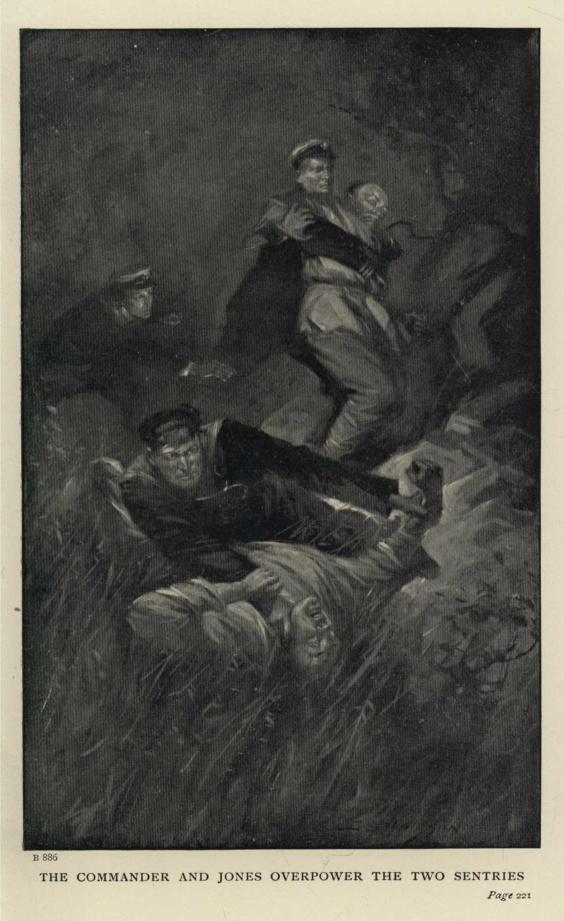
THE COMMANDER AND JONES OVERPOWER THE TWO SENTRIES
Then I crept over to help the Commander, but his man was as limp as a rag, and it was an easy job to gag him and secure his arms and legs.
"Now for the boat, boys," whispered the Commander, and we crawled to the landing-place, keeping well down so as not to show up in the light from the fire. We wriggled along, got hold of the boat's painter, hauled the boat alongside, and slid over the side into her.
There was a pair of oars in the boat and some rude rowlocks, but good enough. I was just going to shove her off into the stream when the Commander gave a chuckle, as if he had had a sudden inspiration, and said softly: "Get her close in to the bank. That's it; now haul her along."
We hauled hand over hand till we came opposite the spot where the two sentries lay gagged and bound. The Commander and Jones sprang ashore, leaving me alone in the boat, and presently reappeared out of the darkness and bundled first one and then the other into the bottom of the boat, both sliding down like sacks of potatoes.
We then let the boat drift down with the ebb tide, which was already setting out strongly, till the Commander with a couple of strokes sent her in under the bank again, where we lay in absolute darkness just above the landing-place.
"What is he going to do?" I thought. He kept chuckling to himself, so I knew that everything was all right; but why did he not get away as quickly as he could? I was tremendously anxious to know, and expected every moment that one of the fellows at the bottom of the boat would commence yelling.
We waited there, crouched down beneath the bank, till we could hear the guard-boat coming back. It ran alongside the other landing-stage, the crew talking sleepily. Presently the light came down the zigzag path again, jerking more than ever, and the steam-boat shot across into the light of the sentry fire and bumped against our jetty. It was hooked on, the bowman helped the European up the steps, and then, of course, the sentries were discovered to be missing.
The flow of language was pretty strong, I can tell you, and the European staggering about in drunken anger round that glowing fire was not a pleasant sight. He called out to the coxswain, and that man jumped ashore. Why he wanted him was very easy to see, for he could hardly stand without support, and leant heavily on him. Like this the three disappeared round the corner, and the boat was left with no one but the stoker in her.
"Now drop alongside and board," chuckled the Commander. "You take the helm, Jones, I'll manage the stoker, and Glover, you cast off the ropes."
In a moment we had shot out from the bank, and were alongside the steam-boat before the scared stoker knew we were there. The Commander laid him out in the bottom of the boat with a crack over the head with a stretcher he had found in the boat. Jones jumped aft, secured the boat's painter, unhooked the stern rope, and got hold of the helm. I sprang across her bows and unhooked the bow rope, the Commander opened the steam-valve, the propeller flew round (it went astern for a moment, but the Commander found the reversing-lever and threw it over for "ahead"). I shoved her bows off for all I was worth, nearly falling overboard doing it, and by the time I had recovered myself we were away with the boat, and our two gagged sentries, towing behind us.
Jones steered her bows round till we were in the middle, and then I wondered how ever we were going to find our way through the twisting channel.
The tide was sluicing us out as fast as it had borne us in that morning. The glare of the fire was shut out as we rushed round the corner into the channel, into absolute pitch darkness. You could almost feel the intense darkness, and I was horribly scared lest we should smash into a rock, so hung on like grim death for fear of being knocked overboard.
But then the Commander stopped the engines, and we simply drifted between the wall faces of those two forts, only standing by to shove her off if she had hit up against anything. But we were well in the middle, well in the grip of the current which was running like a millstream, swinging us round and round like a cork, and all we could do was to hold our breath and trust to being safely swept out to sea.
The only noise was the bubbling of the current, till suddenly the stoker in the bottom of the boat let fly a most piercing yell which echoed from side to side. The Commander was on top of him in a moment, and must have caught him by the neck. We could see some lights moving overhead. Somebody called out, and I jumped aft to help the Commander.
"Go back, Glover, and stoke; shove a little coal on at a time. I can manage him, and we shall want all our steam when we get outside."
I had never done such a thing before in my life, but it wasn't difficult to find a shovel, and I lifted the furnace door open, and by the light of the furnace saw where the coal was stored. I threw some on, as far back as I could, and shut up the door again, but already the alarm had been given. On each side of us I could hear men shouting and see lights hurrying up and down, and that one flood of light from the open door must have just showed them where we were.
Sentries began letting off rifles, and the shouting redoubled.
We were half-way through by this time. We began to feel the motion of the sea beneath us, and, unless they had a search-light ready, or we ran on a rock, we were almost out of danger.
They had not a search-light ready, and we never ran into a rock, but in two minutes knew by the dancing of the steam-boat and the wall of blackness that appeared behind us that we were clear of the channel and out at sea.
Suddenly the darkness was lit by vivid flashes and with horrid ear-splitting bangings—the batteries commenced firing at us from both sides of the entrance.
I was horribly frightened at first, for I thought that they must be able to see us, but I was quite wrong—they were simply firing blindly. One little shell hit the water behind us, and, bursting, showed us up for a second, but nothing else came near, and in a minute or two they ceased firing. The Commander opened out the steam, and the little steam-boat jumped nimbly along, dancing about like a duck, and taking in a lot of spray over her bows as she breasted a tide rip[#].
[#] Tide rip. This is a jumbling sea caused by the wind blowing against a strong tide.
We ran out of the tide rip in a short time, and then the stoker began groaning again, so we bound his legs and arms with rope so that he should not jump overboard. As we were doing this a search-light began sweeping the sea, then another from quite a different quarter, and we knew that Mr. Parker and Mr. Lang were looking for us.
The lights swept past us once or twice, lighting us up sufficiently for us to see each other's faces, but they were too far off for the destroyers to spot us, and presently they switched off and we were in darkness again.
With the danger over I began to feel how frightfully hungry and thirsty I was, and how cold. My feet and legs were warmed by the furnace fires, but the cold spray had soaked me through and through.
Perhaps the Commander was feeling the same, for at length he said, "I'm not going' to stay out here all night," and told Jones to steer towards where we had seen the nearer search-light.
I threw on some more coal. The glow of the fires did not matter now, and we rummaged round and found a lantern, but there was no candle in it.
Then the Commander handed me an oil-can, and I threw some of it through the furnace door, shutting it again very quickly. There was a great rush of smoke, and a flame shot out of the funnel three or four feet high.
It lasted only a few seconds, however, and then I threw in another, and then a third lot of oil.
"They've seen us, sir," Jones sang out. "One of them has hoisted position lights." And, sure enough, two bright little lights, one above the other, shone out.
Jones steered towards them, a search-light began sweeping round, swept past us, came back again, and steadied itself on us for a few seconds. We all yelled as hard as we could and blew the whistle, the light was switched off, and in a couple of minutes the black outline of one of the destroyers appeared as we ran alongside in her lee.
The crew cheered wildly, strong arms helped us on board, and by the light of a lantern I saw the cheery red face of Mr. Parker and Toddles too, of all people, looking white and scared.
They took us down below into the warm ward-room, got our things off, wrapped us in hot blankets, and gave us food.
Pat Jones was brought down too, much against his will, for there was no fire anywhere else, and we three sat and warmed ourselves and ate, till I slid off my chair, coiled myself in a corner next the stove, too sleepy even to answer Toddles's questions, and went to sleep. What a sleep that was!
CHAPTER XIX
Cummins Captures One Gun Hill
Cummins will Take the Risk—A Landing-Party—Glover Lands as A.D.C.—A Night Landing—Climbing Up-hill—We Rush the Hilltop—The First Mistake—Preparations for Defence—We are Discovered
When the dinghy with Commander Cummins, Glover, and the petty officer Jones had disappeared into the gloom, "No. 3" went back to her usual position for the night.
As dawn was breaking Mr. Parker brought her back opposite the forts, and waited with steam raised for full speed, in order to dash off out of range directly the Commander returned from spying out the forts. As the shadowy, indistinct outlines of the island became clearer, and the low-lying rocks at the entrance gradually took on a definite shape, he and Collins looked anxiously for the return of the dinghy, but could see no sign of it whatever.
He still maintained his position in the hope that the Commander was lurking behind some rock, and therefore was invisible from the destroyer, until the light gradually became so strong that he was himself able to localize the positions of most of the guns, and almost immediately afterwards knew by the running to and fro, and the shouting of men in the batteries, that "No. 3" had been observed from the two forts.
With his hand on the engine-room telegraph, Parker waited in the most keen suspense, and it was not till the forts opened fire and twice nearly struck "No. 3" that he recognized the uselessness of remaining where he was, and the imminent risk of being sunk, rang for "full speed ahead", and darted out of danger.
It was these shots which the Commander and Glover had heard from the rocky ledge inside the harbour.
To remain anywhere near the entrance was impossible, and Parker knew that the dinghy itself dare not put off from land in daylight, so, trusting that the Commander would find means of concealing himself during the day and of escaping next night, he had steamed to the rendezvous and reported the events of the night to Captain Helston.
Helston's discomfiture was great, and his mind all the more perturbed, because on Cummins he now undisguisedly relied for the successful termination of his schemes, and, in his absence, was unable to suggest any course of immediate action.
Nothing was done, though the squadron, as may be imagined, kept anxious eyes on the entrance to the harbour during the whole day, and vainly hoped to see the little black dinghy shoot out from the land, standing by, with guns trained on the forts, to open fire and cover its escape.
With feelings of the greatest anxiety, anxiety shared by every officer and man in the squadron, the bigger ships drew off again at night and left the two destroyers to return inshore, with extra injunctions to keep a good look-out.
The relief next morning when "No. 3" joined the rendezvous, towing the two pirate boats and signalling that she had the Commander's party on board uninjured, was therefore very great, and when the Commander steamed alongside the Laird in the captured steam-boat, her crew, scenting some extraordinary adventure, broke into cheers as the little man complacently climbed the accommodation-ladder and reported himself to Captain Helston, who was nervously awaiting him on the quarterdeck.
They went down below immediately, whilst officers and men crowded round the after gangway and along the side to get a view of the steam-boat—the first trophy they had won from the pirates—and to ask rapid questions from the blue-jackets of "No. 3", who now formed her crew.
"We don't know nothing about it," said the temporary coxswain. "We sees a flare, they having thrown oil on the fires, and turns our search-light on 'em, and in a few minutes alongside she comes as cool as you please—the Commander working the engines 'imself, Mr. Glover adoing stoker, an' Pat Jones a-steering of 'er, with a boat be'ind 'em chock-full o' 'arf-dead Chinamen."
"What has become of the dinghy?" somebody asked.
"It ain't come back, that's all we knows, an' ever since we've been bobbing about in this 'ere craft on our lonesome."
Meanwhile, down in the Captain's cabin, Cummins was giving an account of all that had happened since he had left the Laird. Helston's face dropped when he mentioned the 12-inch gun mounted on the hilltop, but the Commander with a decisive gesture and a glitter in his eyes said: "That is the key of the whole island, sir, and I'm going to capture it to-morrow morning if you will let me. After getting back to 'No. 3' I took a short rest, and, an hour before sunrise this morning, put a crew into the steam-boat, saw that they had plenty of coal and water, left them in charge of the other boat we had captured, and went round in 'No. 3' to the south of the island, to the foot of the hill. The sea was quite calm, and I went inshore in a Berthon boat, discovered a place where I can land, waited till there was enough light for me to make certain that it was possible to scale the hill-slopes, and then came away again, without, as far as I know, being seen. I steamed back, picked up the steam-boat and joined you. That is the reason why I am rather late at the rendezvous. If you give me fifty men, sir, I will scramble up and capture that gun without firing a shot.
"Risk, sir!" he continued as he saw indecision and doubt in Helston's face; "there are no risks. At the worst I can but destroy the gun and come back. At the best I can maintain myself there till you can reinforce me, and then we have the whole island at our mercy. These Chinese are not soldiers, sir, they are mere coolies, and will never face us. The men on board the ships are probably not much better."
Cummins with all his skill had made two mistakes. The gun, as you will learn later, did not effectively command the whole harbour, and the coolies were not by any means to be despised.
The Commander had all his plans cut and dried. Fifty men, with two days' rations in their haversacks, were to go aboard "No. 3" at sunset. Two hours before sunrise next morning he would land them at the foot of the hill, scramble up, and rush the gun. During this time "No. 2" was to demonstrate in front of the entrance, play her search-light on the forts, fire her guns, and distract their attention.
At daybreak the Sylvia was to be close in under the foot of the hill and be prepared to land another fifty men from the Strong Arm, with the Sylvia's two Maxim guns, plenty of ammunition, water, and provisions.
If the first party did not succeed in capturing the gun, or, after having captured it, could not maintain their ground, Cummins would fall back under cover of the guns of the Sylvia and "No. 3", destroying the big Chinese gun, if possible, before he left.
If, however, he found himself able to maintain his position on the top of the hill, he would signal for the Strong Arm's party to land.
"Once get that gun to bear on their ships and we shall drive them out to you, sir," he concluded, "and I have no fear of the result then."
"With a hundred men away," answered Helston doubtfully, "it may not be so easy."
"I shall take the marines, sir; none of the big guns are manned by them, either on board here or on board the Strong Arm. You know they have complained often enough about that; but I have always had this eventuality in my mind, and they will, therefore, not be so much missed in a general action."
Helston paced nervously up and down his cabin. "What will happen if the weather breaks?"
"It all depends on the weather, sir, I allow that, but such a risk one must face, and personally I am prepared to face it. Remember that you have but a month to capture this island."
"I know it, Cummins, I know it," replied Helston; and then turning suddenly with some of his old fire and animation said, "I tell you what, I'll go myself."
This was the last thing in the world that Cummins wanted.
"There'll be a lot of climbing, sir, and with your disabled arm you will be extremely handicapped; and when I drive these fellows out to sea your place will be aboard your ship in command of your squadron."
"Yes, yes, you are right; you always are, for the matter of that," he added bitterly, and his voice rising as the excitement of coming action elated him. "We shall both get our promotion. I promise you that if I get mine you shall have yours."
Lowering his voice he added, "You said the other day, Cummins, that there was not much chance of winning a wife here. I don't talk about these things, but my promotion would win me a wife."
"I think mine would also, sir—I pray it would," answered Cummins in a grave voice. Both men shook hands for a moment—dropped them—Cummins stuffed his into his pockets—both looked foolish.
"By the way, sir," stammered the Commander confusedly, "I never told you that one of these prisoners was dead when we took him out of the boat last night. It was the man Jones caught around the neck. I rather fancy young Glover, in gagging him, stuffed grass down his throat. We dropped him overboard. Glover does not know the real cause."
"Better not tell him," said Helston.
Jenkins interrupted further conversation by announcing breakfast.
* * * * *
The news that a party was to be landed quickly spread through the squadron, and there was intense excitement on the lower deck and the most extraordinary rumours. The yarn spread that the Commander, Glover, and Jones had cut their way through the whole of the pirates, disabled the guns in the forts, killed any number of men (sometimes as few as ten were mentioned), and after running the most awful perils had captured the steam-boat from alongside the Hong Lu and brought her and a host of prisoners out under fire. When they knew that the Commander himself was going in charge of the party, every man and boy wanted to go with him, and every few minutes men would knock at his cabin door and say, scratching their heads and shuffling their feet uneasily, "Please, sir, begging your pardon, sir, but I'd be much obliged if you'd give me a chance ashore, sir."
All day long the equipment of the party was being prepared, rations stowed, water-bottles and water-breakers filled, leather gear fitted, pouches filled with ammunition, and the thousand and one requirements of a landing-party carefully arranged.
During the forenoon the Commander, accompanied by A Tsi, had gone across to "No. 3" and interviewed the prisoner.
From the sentry whom he had knocked on the head (he had not throttled him as had Jones his man) he learnt that a broad path ran right along the crest of the hill and led straight towards the gun. As far as the man knew—and he seemed quite willing to tell all he knew—there were no earthworks round the gun, and no guard was left there at night.
Before he went back to the Laird he asked Glover if he would care to land with him as his "doggy", as they call a commander's A.D.C. in the navy.
"Ra—ther," said Glover, dancing with joy, and went joyfully back with him to the Laird to make preparations, and only too delighted to be able to relate to his chums his adventures of the last twenty-four hours.
Later in the day he could be seen, surrounded by his admiring and envious mess-mates, wriggling from side to side to get glimpses of himself in the broken remnants of the looking-glass in his sea-chest cover.
He had his haversack, water-bottle, and field-glasses slung from one shoulder, a rolled-up blanket went round the other, a revolver holster hung from his cartridge-belt, and a carefully sharpened cutlass (in place of a dirk) was at his side.
Quite a formidable object he looked, and he admired what he could see of himself immensely.
Two things marred his perfect happiness. One was, that neither Mellins nor Toddles was going to land; the other was, that he had to leave behind the greater part of his home-made cake.
"An ill wind that blows nobody any good," said Mellins gloomily, as he transferred the remainder to his own chest.
* * * * *
Directly it was dark the landing-party "fell in" on the quarter-deck. Helston made them a little speech, and then they were sent across to "No. 3", the rest of the ship's company crowding aft to see them over the side and wish them luck. Helston did not like the look of the weather, and said so; Cummins did not either, but kept that to himself, and only wanted to get away from the ship before orders were countermanded. For once he was as nervous as a woman. Directly, however, "No. 3" steamed away in the dark and had lost touch with the Flag-ship, all fear and anxiety left him, and he could have whooped for joy.
He called the men aft, said a few words to them, explained exactly what he wanted them to do, and finished by saying: "You have ten hours to get through aboard here. Sleep, boys, sleep all you can; you'll want it before you've finished."
But the marines were all young men—most of them Cockneys; not one had ever been under fire before, and the prospects of a fight at daybreak made sleep impossible for them. In little groups they lay down wherever they could find shelter from the cold night wind, smoking their pipes and talking with subdued excitement.
The officers lay on the ward-room deck and tried to sleep, but even they failed to do so.
Cummins himself was on deck practically the whole night, for the sun had set behind a very angry-looking bank of clouds, and the breeze showed signs of increasing and veering to the south.
A strong southerly breeze would make it almost impossible to land on the southern shore of the island, and it was this tendency of the wind to veer to the south'ard which gave him so much anxiety.
At two o'clock in the morning it was blowing quite fresh from the south-west. It was raining very heavily, with strong gusts of wind, and the outlook was most unpromising.
Parker, in dripping oil-skins, reported the barometer still falling, and for a while Cummins almost decided to abandon the enterprise.
Fortunately the wind, an hour later, went right round to the north-west, the stars came fitfully out, and a young moon, in the intervals of drifting clouds, gave light enough to see occasionally the outlines of the island.
"Carry on, Parker, the elements are with us," chuckled the Commander.
"They won't be for long, sir; the glass is still falling."
The engine-room telegraph clanged down below, the sleepy artificer answered back, "No. 3" slowly forged ahead with two of the Laird's cutters in tow, and the marines, starting to life with the movement of the engines, knew that their hour for action was approaching.
An hour later "No. 3" had steamed round to the south of the island and stopped her engines in the shadow of the big hill whose shoulder and flattened top loomed darkly above her, outlined against a faint moon.
A strong, cold breeze blew down its slopes, but the sea was only gently ruffled by it.
The first to land in the black shadows at its foot were the Commander, Glover, and two signalmen in one of the Berthon boats. With little danger or difficulty they reached the shore and jumped to land as the boat tore her bottom out against the rocky beach.
A few minutes were spent in hurriedly choosing a more suitable landing-place, and then the spot was marked by a signal lantern placed at the water's edge behind a great rock, so that its light could not be seen from shore.
This was the signal for the rest of the party to land, and in a few minutes they heard the regular beat of oars, and the two cutters, appearing out of the dark, grated up the beach. The men with their rifles slung over their shoulders began hastily jumping ashore.
"Keep your feet dry, men, and don't hurry," said Cummins, as he saw them jumping into the water in their excitement to be the first ashore.
The boats were hauled out of the water and then the order was given to "fall in". They "fell in" in three little detachments—twenty Royal Marine Light Infantry under their subaltern, a huge, jovial giant named Saunderson; ten blue-jackets under Pattison, the late skipper of destroyer "No. 1", who to his great joy had been taken out of the Sylvia and given another chance; and twenty Royal Marine Artillery under their captain, Williams, a famous cricketer and Rugby player. These artillery or Blue Marines had to bring up the rear. The light infantry or Red Marines had to lead the party.
The blue-jackets consisted of six seamen gunners, two armourers with tools to disable or repair the 12-inch gun, and two torpedo men with explosives to destroy it if necessary. Besides these fifty men and their officers there were two signalmen, Richardson, the "young doctor" of the Laird, a sick-berth steward, Glover, and the Commander.
Half the men carried axes, half Wallace entrenching spades, and every six men had a nine-gallon water-breaker to carry up between them.
Cummins went slowly from one group to another as they stood at the foot of that hill casting hurried glances upwards, and told them that it was two hours before sunrise, that they had two hours to get to the top, that there was to be no hurry, and that not a word was to be spoken.
"You have to keep together, men. If any man loses touch with the rest, make uphill; he can't go wrong."
In single file, one after another, Cummins going first, Glover sticking to him like a leech, and the two signalmen close behind, they began to clamber up, hauling themselves hand over hand, forcing their way through bushes, and always keeping upward.
It was slow work, and Cummins halted, whenever a clear spot was reached, to enable stragglers to close up. At the first halt, a quarter of an hour after the start, the little party was silently mustered. All were present, fifty-three men and six officers.
There had been a great deal of noise of breaking bushes, falling stones, and muttered oaths, but the shrieking of the wind among the trees effectually drowned it.
Presently Cummins found himself faced by an almost perpendicular cliff and called another halt. Ten minutes—it seemed like hours—went by before he found a way up, and the little column, bending to the left, struggled on again.
Now the ground became more open, covered with coarse grass up to the knees and dotted with stunted trees. Progress was more rapid.
A pheasant disturbed from sleep flew off with a "whr! whr!" which made the men's hearts leap to their mouths. Occasionally a frightened wood-pigeon darted from his roosting-place. Most scaring these noises were in the pitch darkness.
Faintly, at intervals, they could now hear the dull sound of distant firing, sometimes fast and furious, dropping again to a few single shots at long intervals, then recurring with renewed vigour. It was Lang in "No. 2" demonstrating outside the entrance and drawing the attention of the forts. These were replying savagely.
Not a sound came from above except the soughing of the cold wind.
At the next halt two marines were missing. One rejoined, bruised from a fall, but they could not wait for the second. "Who is he?" was whispered along the line. "Bolton, a Blue Marine," was passed back from the rear.
At the end of the first hour he was the only man missing. Some of the water in the breakers had been spilt, a helmet or two knocked off and lost in the darkness—that was all.
Another half-hour of slowly pushing upwards—men were breathing hard and panting; another halt was called.
A blue-jacket had sprained his ankle, and after a hurried examination by Dr. Richardson, two men were told off to assist him. Rifle straps were eased, water-breakers changed hands, and leather gear adjusted.
Looking downwards towards the sea Cummins saw the first faint glimmer of approaching dawn—far away in the east. They must push on. Bending again to the left to keep in more open ground, they still steadily pressed upwards.
Another halt; and the wind, lashing more savagely through the trees, drowned any noise, and told them that now they were reaching the crest of the hill.
Cummins went cautiously forward to reconnoitre, and reappeared, Glover panting with excitement behind him. "I've found the path, Saunderson," he chuckled, and the word was passed to move on again.
Four men were now missing besides Gunner Bolton, but there was no time to wait; already objects were becoming more visible, and daylight was fast approaching.
In another two minutes they were in the open, on a broad, well-beaten track, and a subdued "Oh! oh!" of excitement ran along the men.
The column pressed on rapidly, turning to the right uphill, and walking in the grass at the side of the path to make less noise. Every moment the men expected to be fired upon, and were already beginning to unsling their rifles as their excitement and nervousness increased.
As they turned a corner an angry gust of wind, blowing up from the harbour below, dashed cold rain in their faces—still not a sound in front except the weird noises of the wind as it swept through the trees.
Some of the youngsters were beginning to get "jumpy", and one or two began loading their rifles without orders.
Cummins caught the sound of a breech-block closing (the rifles were Martinis, not Lee-Metfords), guessed what was happening, and knew that someone would let off a rifle and give the whole "show" away.
He halted at once, sent Glover back with orders for every man's rifle to be examined, and for the name of every man, found with a cartridge in his rifle, to be taken.
This took time, but steadied the men, and whilst it was being done Cummins crept forward, followed by Glover, and a blurred, indistinct mass he had seen in front of him gradually shaped itself into a clump of trees. The path dropped slightly in front of him, ran across an open space, and then rose abruptly towards the trees.
"Our gun is up there," whispered the Commander joyously, and lay down, coolly munching a stalk of grass, his supply of toothpicks having failed him, and tried to make out whether there was any sign of life under the trees.
As they lay there another gust of wind carried up from the harbour the clattering noise of beating gongs. "Eh, boy! that's the second time we've heard that noise," he chuckled. "Run back and bring up the men. We are not a hundred yards from the gun."
As the men came up they were rapidly extended from left to right.
"Fix bayonets, men; not a sound—no cheering—no shooting," the order went in whispers from man to man.
The subdued rattle of fixing bayonets ran along the line, and Glover afterwards said it gave him the "shivers" to hear it.
He was lying watching the Commander, and thought he would never give the order to charge.
He could see the indistinct outline of the gun among the trees covered with a huge tarpaulin, and just then somebody near him whispered, "There are people moving about there, sir," and he could actually feel the men bracing themselves for a rush.
At last the Commander was "up", and trotting down the slope with a bit of grass between his teeth. Glover followed, vainly trying to draw his cutlass. The men sprang after them, breasted the rise, swept over some level ground, and with a final rush leaped over a parapet of sand-bags, swarmed around the gun, and found—Gunner Bolton doing "sentry-go" backwards and forwards in rear of the gun! There was not a Chinaman to be seen.
Some of the men simply sat down and laughed, others, furious, cried out that "They'd been jolly well had," and that "Gunner Bolton 'ad made fools of 'em all, 'e 'ad," and that "They would jolly well knock 'is blooming 'ead off, that they would, next general-leave day."
"Fall in, men," sang out the Commander, with a twinkle in his eye. "You shall have plenty of fighting presently."
Then he sent them back for the water-breakers and armourers' stores which they had dropped when fixing bayonets, whilst he and Williams, the captain of marines, took a rapid survey of the position, and Pattison and his blue-jackets commenced to overhaul the gun.
The top of the hill was flattened out into a little plateau about a hundred yards long, sloping gently towards the harbour and then falling abruptly into the steep side of the hill with a quite well-defined edge. It had its back to the sea and was facing the harbour.
At the east end, the end nearest to the entrance channel, and in the corner overlooking the sea, was the gun, an obsolete 12-inch Krupp, mounted in a deep circular pit, and poking its muzzle over a wall of sand-bags ten or twelve feet thick and about six feet high.
A little cluster of stunted trees hid the gun from view out at sea. Their trunks had already been half sawn through in preparation for felling them, and a few more strokes of the axe would bring them down.
The first thing to be done was to ascertain whether the gun could be made ready for service, as otherwise it was useless to remain there.
Already Pattison and his men had hauled away the tarpaulin covering its massive breech, and were rapidly examining the mounting and training gear.
"Rough and clumsy, sir, but we shall be able to train her round all right," he reported.
Magazines had been tunnelled out through the side of the gun-pit down into the ground, and the doors were closed with padlocks. These were wrenched off, and Pattison reported plenty of ammunition. In a corner he found boxes of friction-tubes and fuses.
His men also found the ropes and blocks to be used in training the gun. They were brought out, made fast to the great gun-carriage at one end and to huge steel rings sunk in the concrete foundations at the other, a dozen sturdy Blue Marines "clapped on" to the ropes, and with Cummins standing on the sighting-platform the ponderous mass was slowly, and with many jerks, trained across the harbour.
It was then that the Commander realized his first mistake.
From that sighting-platform he could look down towards the sea, but the other edge of the plateau shut out all view of the harbour. It was now light enough for him to make out "No. 3" below him, but, looking inland, the flat top of the hill prevented him from seeing anything except the high land on the opposite side of the island, across the harbour.
His calculations had been made from that ledge of rock on which he, Glover, and Jones had hidden all the previous day. He had forgotten that they were then sixty or more feet above the harbour level, and had not dreamt that from the water's edge the gun itself was not visible.
To destroy the gun and get back to the Laird was his first thought, and he called for Pattison to jump up with him.
Pattison's face dropped as he, too, saw that fifty yards of hilltop were in between him and the pirate ships he had hoped to sink.
Suddenly Cummins turned to him with a suggestion. "How about half-charges—eh? A pinch of powder will 'flop' them down there—eh?"
"We might try, sir."
"They won't be very accurate at first, Pattison, but we'll improve—eh?"
"Right you are, sir, I'll manage that."
"We'll ferret them out before the day is over," he chuckled again, and looking down behind him he saw the Sylvia looming in towards the shore.
"For once Bannerman is up to time. We'll have the Strong Arm's up here in a couple of hours or so."
He sent the signalmen down the hill to communicate with the Sylvia and to order the second party to land immediately, and then he and Williams made plans for placing the top of the hill in some state of defence.
"We shall have them round us like flies when once they find us sitting up here," Cummins said.
Fortunately for them, the enemy had evidently intended to mount a second gun, had indeed already marked out the site for its gun-pit, and had prepared hundreds of sand-bags to defend it. These lay scattered in heaps on the plateau, and were now used for making breastworks.
Williams and Saunderson hurriedly marked out the positions in which they were to be built, and the marines, piling arms, and stacking their greatcoats and blankets in a heap, "set to" with a will to haul the sand-bags over to the edges.
"Safer to send some men out in the long field, I think, sir," said Captain Williams, the cricketer, and ordered his taciturn sergeant-major—a martinet named Haig—to select two of the older men as sentries and place them, one along the path the column had just followed, and another down the face of the hill, on the zigzag path up which the Commander and Glover had seen the coolies carrying ammunition.
"'Square leg' and 'long on'—eh?" chuckled the Commander.
"Yes, sir, I think they will be enough for the present."
The first breast-work was to be built at the narrow end of the plateau farthest from the gun-pit.
It commanded the crest of the hill over which the little party had made its final rush, and the path they had followed ran along this ridge, dipping down for two hundred yards, and then rising steeply to the bush-covered knoll, on top of which they had extended and fixed bayonets.
One of Sergeant Haig's sentries (Williams's "square leg" man) was already standing in the gap made by the path as it disappeared into the dense bushes, and it was evident that an attacking force could take splendid cover there, and could sweep the greater part of the plateau with rifle fire.
This breast-work was therefore built right across the narrow end of the plateau, sand-bag was piled on sandbag till it was nearly three feet high, and as the men had hauled some great logs of timber across from the gun-pit to strengthen it, they called it eventually the "Log Redoubt", making loopholes in it for their rifles.
The bush-covered knoll in front of them they named "Bush Hill", and few will ever forget it.
Some of the men dragged sand-bags to the edge of the plateau, overlooking the harbour, to form two low breast-works, one on each side of the zig-zag path, as it led up to the gun-pit.
For twenty yards in front of these two breast-works the steep hillside was bare, but below this the whole hill down to the pirate village, which they could see at the bottom gradually becoming distinct as daylight increased, was covered with small trees and dense brushwood, through which the zigzag path wound its way upwards.
Men lying behind these sand-bags were somewhat protected by the Log Redoubt from rifle fire from Bush Hill, so Williams contented himself with raising them only two sand-bags high.
These being roughly completed, more sand-bags were dragged to the opposite end of the plateau, and a little redoubt constructed fifty yards beyond the gun-pit. From here fire could be directed along the farther ridges, which were devoid of cover and sloped steadily downwards, and also down both the harbour and sea slopes of the hill.
Sergeant Haig and nine Blue Marines were given charge of this work, and so it was known as "Haig's Redoubt".
Saunderson and his twenty Red Marines were told off to man the harbour breast-works, and Williams and his remaining ten Marine Artillerymen were to hold the Log Redoubt.
Every man was told off to his own special loophole, and each man laid his rifle and greatcoat on the ground behind it, the precious water-breakers were taken into the gun-pit, and the men's blankets, covered with the gun tarpaulin, were piled to form a little "zareba" in the middle of the plateau.
Meanwhile the signalmen had returned, bringing back two of the stragglers, and reported that the Strong Arm's party were already landing from the Sylvia.
It was broad daylight now, and presently the remaining two stragglers came into camp, looking very much ashamed of themselves.
For an hour both officers and men had worked like horses, and all this time the cold wind swept up to them the noises of the waking town at their feet—the dull drumming of Chinese gongs and the clanging of the ships' bells—but nothing else disturbed their work till suddenly the raucous shriek of a steam hooter startled them.
"That is the signal to start work. The coolies will be up here in half an hour," chuckled the Commander.
"What are you going to do when they do come up?" asked Williams. "If we caught them and prevented them from carrying the news back it would be a good thing. Every few minutes is valuable."
"All right, Williams, we'll try."
Then a signalman reported that the second party had already commenced the ascent, bringing with them the Sylvia's two Maxim guns.
At the same moment the sentry on the zigzag path below came running up. "Please, sir, there are fifty or sixty natives coming up from the town."
Cummins ordered everyone to conceal himself. "Don't any of you move till I sound a whistle."
Five minutes later they could hear the merry chatter of the coolies as they climbed up towards the gun, and the foremost of them appeared out of the trees in the open path below them. Something made them suspicious; they stopped and pointed upwards, jabbering rapidly. Then a young fool of a marine raised his head to look over the breast-work behind which he was lying, and, in a panic, they all took fright, threw down their tools, and scampered down hill as fast as their legs could carry them.
"Heaps of time," said Cummins gently; "we'd better go to breakfast. 'Place your field' again, Williams," he chuckled, "and we'd better have a couple of people at 'point' and 'cover point' as well—eh?"
Breakfast of ship's biscuit and corned beef, washed down with a "pull" from the water-bottles, lasted ten minutes, and then everyone set to work again.
Williams suggested that they had better start lopping down the bushes below Saunderson's two breast-works.
"It would give us a better chance if they tried to rush us, sir."
"Now, lads," sang out the Commander, "get your axes and knives and cut down the bushes in front of you—make a clear sweep of them."
They started hacking and cutting, and in half an hour had cleared three or four yards along their front, when suddenly, bang! went a shell, bursting just below them, and the fragments went shrieking overhead.
Every man "ducked", then ran back up the slope, seized his rifle, and lay down behind his own breast-work.
"Whew!" whistled the Commander, "that is their game, is it?"
CHAPTER XX
The Fight for One Gun Hill
We Must have Oil—Under Shell Fire—The Pirate Guns are Silenced—The First Attack—Hopkins Wounded—The "Strong Arm's" Arrive—The Oil Party Cut Off—A Momentary Respite—The Second Mistake—The Oil is Rescued—The Big Gun Fires
That first shell was quickly followed by two more, both of which burst below among the bushes. A fourth sang overhead, going out to sea.
Williams, Saunderson, Cummins, and the two signalmen searched through their glasses and tried to find the guns that had fired. The shells came two or three a minute—one burst near the men's blankets and covered the tarpaulin with dirt, another crushed through the trees without bursting.
"I see them, sir," yelled one of the signalmen; "right over there, sir, under those trees;" and he pointed in the direction. As they all followed his hand, outstretched towards some trees on a hill, on the other side of the harbour, overlooking the low ground near the outlet channel, they saw two little spurts of flame shoot out from beneath them. Two little thin clouds of grey smoke drifted out of sight, and almost immediately a shell burst three hundred yards in front of the breast-works, high up in the air, and sent down a hail of bullets into the bushes; the other flew overhead.
"Shrapnel," muttered Saunderson, and, seeing Glover looking nervously from one to another, added, "I wish I wasn't so immense. Hi! Glover, come and stand in front of me."
Another shrapnel tore up the ground in front of the breast-work. One or two of the men were covered with dust. They all tried to wriggle themselves into as small a space as possible.
The non-commissioned officers had at first lain down with their men, but now, seeing their officers standing behind them, rose sheepishly on one knee, one after another. Saunderson's sergeant (Wilkins by name) stood upright, walked up to Saunderson, saluted, and said, "Beg pardon, sir, it shall not occur again," marched stiffly back to his men, and stood there like a statue.
"It's pretty hard luck on these youngsters to come under shrapnel fire before they are used to rifle fire," Saunderson said to the Commander. "If I once lay down behind a sand-bag, nothing in this world would induce me to get up again. I think I should give them something to do, sir. They are not old soldiers."
The Commander told Glover to ask Captain Williams to speak to him.
Glover bolted off, only too glad to have anything to do, gave his message, and ran back.
"Never run, boy; you are apt to get overheated," chuckled Cummins.
Poor young Glover looked fearfully ashamed of himself and grew as red as a tomato.
Williams was of the same opinion. "Let them go on cutting down the brushwood, sir."
Cummins nodded assent, and the necessary orders were given, the sergeants repeated them, with many flowery additions, and the men nervously rose to their knees and in a very half-hearted way prepared to obey.
"Leave your rifles, you fools!" shouted Sergeant Wilkins. "There are no niggers to shoot you. Get out of it, all of you!"
Once they got to work, spread out at wide intervals, they became less nervous, and Blue Marines and Red Marines vied with each other as to which should clear the wider space.
Williams and Saunderson worked among their men in the bushes, whilst Cummins sat on the sand-bag breastwork, Glover nervously hovering round him, and Dr. Richardson lying down by his side, waiting for a job.
Every now and then shells burst on the plateau, but it was evident that most of them were directed towards the gun, and Pattison and his men were having a very warm time of it.
Presently Pattison came across from the gun-pit to where the Commander was sitting, saluted, and told him in a very low voice that the recoil cylinders of the gun were empty, and that he could find no oil. The gun, of course, could not be fired with empty recoil cylinders. It would probably have toppled over into the sea.
Cummins did not reply for some time, and his face grew very stern. "We must get oil from the ships," he said at length, and sent a signalman to find out from the Sylvia whether the whole of the second party had already left the beach. "They are already a quarter of the way up," the signalman reported.
"Well, I cannot send them back now. I must get Bannerman to send me a dozen hands with a couple of oil-drums, and"—his eyes twinkling again—"I'll tell you what I will do. I will send Parker round to engage those guns. I believe he could reach them over that low ground."
He sang out for the signalman.
"Excuse me, sir," interrupted Pattison, "I should suggest that you ask Commander Bannerman to go round and shell those guns with his 12-pounders, and order Parker to send up the oil. I have been aboard the Sylvia for three weeks, and I think that Commander Bannerman will be more inclined to engage those guns than to spare a dozen men to carry up oil. Parker, sir, you know; I do not think you know Commander Bannerman."
The two men looked at each other in a strange way for a few moments. Cummins smiled grimly, called for the signalman, and wrote down:
"Commander Cummins's compliments to Captain Bannerman, and would he steam off the low land to the west and engage two guns on the hill behind. They are seriously annoying him."
"Will that do, Pattison?" he asked, smiling bitterly.
"I think so, sir."
"And, signalman, also make to Mr. Parker from me, 'Send four drums of oil—urgent'."
The signalman ran hurriedly off to make the semaphore, but before he could cross the plateau a shell burst overhead, and he fell headlong.
The second signalman, at a nod from Cummins, darted out and picked up the paper with the signals on it, and jumped down the side of the hill overlooking the sea.
Dr. Richardson and his sick-berth steward ran forward, bent over the prostrate man, picked him up, and carried him behind the gun-pit out of fire.
Pattison and Glover helped them.
They came back immediately, Glover white as a sheet.
"He is dead, sir," reported Dr. Richardson; "the top of his skull was carried away."
"Cover him up and get him out of sight of the others," said Cummins slowly; "and, Richardson, I must insist on your remaining under cover."
"Very good, sir;" and Dr. Richardson went away to take shelter behind the gun-pit parapet.
Back came the remaining signalman with the replies: "Captain Bannerman will have much pleasure in supporting Commander Cummins, and will engage the two guns which are annoying him ".
Cummins tore it up contemptuously.
The second was from Parker: "Oil is being sent with utmost despatch".
Pattison asked for orders. He could do no more with the gun, and was told to finish cutting down those trees—"They are probably aiming at them as much as at the gun." A few minutes went past, and then two marines came staggering up—one with blood flowing from his head, another with his arm limp at his side. A shrapnel had burst short.
They fell down inside the breast-work, and Cummins sent them over to Dr. Richardson.
They crawled across.
Then the sentries down below on the zigzag path came running back. "Hundreds of men are coming up, sir; they look like sailors, sir."
Cummins was perfectly prepared for this news, because half an hour ago he had seen a commotion among the cruisers in the harbour at his feet, and boats pulling to and from shore, and had guessed that they were landing sailors.
"The only people they can rely upon," he thought, and told Glover to ask Captain Williams to bring his men back.
"No hurry, Glover," as Glover, wild with excitement, was rushing off.
"Wish to goodness I had never brought that boy," he muttered to himself. "If he gets bowled over his cousin will give me my marching orders like a shot. I am sure she will.
"Plucky little fellow, too," he continued, as Glover came slowly back, alongside the huge Saunderson, at the head of his men.
As they came up the slope a shell burst among them, and the smoke hid Glover and Saunderson for a moment, but the wind carried it away, and they reappeared, Saunderson steadying his men with a backward sweep of his arm.
"That's better, sir," he said to Cummins, his face glowing with pride as the Red Marines stepped quietly over the breast-work and lay down along-side their rifles. "Got 'em in hand all right now, sir."
And Williams's Blue Marines were just as well in hand, threw down their axes, and took their places without the least fuss or confusion—half of them in Sergeant Haig's redoubt, half of them with Captain Williams behind the Log Redoubt. A minute or two passed, and then a few blue-coated Chinese came into sight, and a little crowd of them halted at an open corner of the zigzag path, then rapidly deployed into the bushes on each side.
The men lying on the extreme right of the breast-work also caught sight of them, and without orders began easing off their rifles.
The whole line would have been blazing away in another minute, firing blindly into the bushes beneath them, if Saunderson, his face red with rage, had not bounded across and stopped them. Cummins chuckled.
As it was, their few shots made the Chinese scatter still more rapidly, and they vanished to cover without firing a shot.
Then came the most trying time of all, and it tested the young marines' endurance to the utmost. The two guns were firing rapidly, shells were screaming past, shells were bursting on the slope in front of them and on the plateau behind them. Every now and again a little white ball of smoke burst with a dull "puff" overhead, and a hailstorm of shrapnel bullets came splashing down. They knew, too, that the Chinamen were creeping up unseen through the bushes, and they could do nothing but wait.
The intense tension of suspense was still further increased by the sentry on the crest path running back from that gap in the bushes with a scared face.
Another party was advancing along the path they had followed in the morning, and almost before he had reported this, shots from Bush Hill came whipping past, and then from the slopes below a furious fire burst out, the bullets fortunately flying wildly.
Cummins sang out for the signalman. "Go back and signal to Mr. Parker, 'Am attacked in front and left flank. I expect you to keep my rear open'," and turning to Saunderson, who was standing near him, "Eh! Saunderson, you make me nervous standing up; I wish you'd lie down."
"I will when you do, sir."
"But I can't, you know," Cummins said, with a silly chuckle.
"For goodness' sake keep moving, then, sir," the giant answered nervously, as several bullets flew past, and one struck the sand-bag on which Cummins was sitting.
Cummins dug it out with his finger. It was a small-bore Mauser bullet.
"Hullo! that's capital!" he cried, jumping to his feet, as a faint report came from the extreme left, and a shell burst among the trees from which the two guns had been firing. "Bannerman's got round at last."
The men saw it too, and gave a joyful cheer of relief.
"Now, lads," he sang out cheerily, "you won't be bothered with those shells, and these Chinese can't hit a haystack. Save your cartridges, and never fire till you are sure of hitting. The Strong Arm's will be here with their Maxims in another hour, so don't waste a shot."
With the dreaded shells silent, the men settled down more confidently and fired very seldom, and once or twice a yell of pain below told them that a cartridge had not been wasted.
The bullets were going past in great numbers—ping-ping! flick-flick! Occasionally one struck the ground with a puff of dust, or struck a stone or an axe and went whistling away, twisted out of shape. Every now and again one buried itself in a sand-bag with a thud, but most of them were high overhead. Evidently the Chinese were too undisciplined to take aim.
Still, it was a sufficiently awkward position, with three or four hundred men attacking from below, and probably as many on the left, concealed among those bushes opposite the Log Redoubt.
Cummins had only forty-eight men left, and though they were well in hand and were steadying every minute, the odds were sufficiently serious.
He was perhaps not so anxious about himself as for the second party, which was now reported by "No. 3" as being more than half-way up the hill. If the Chinese attacked them whilst they were struggling through the thick undergrowth, encumbered with the two Maxims, ammunition, and provision-boxes, it would go hard with them. Once they joined him with their machine-guns, he was confident of holding his ground till the oil arrived and enabled him to fire the big Krupp. His right flank, too, gave him little concern, for it was comparatively open in that direction, and gave no shelter for an attacking force; and so long as "No. 3" could sweep the sea-slope of the hill, he did not worry about his rear.
But could "No. 3" do so?
The wind, which had been blowing strongly from the north-west, was already beginning to veer again to the south, and was increasing rapidly in strength, and Cummins knew only too well that neither "No. 3" could remain near the foot of the hill, nor the Sylvia near enough to the low land to smother those two field-guns if the wind remained in that quarter and brought in a heavy sea.
Unsupported by the ships, he recognized that his position would be precarious in the extreme.
If, too, the Strong Arm's party followed his route of the night before, they would run right into the Chinese massed on his flank. Fortunately he could communicate with them through "No. 3", and signalled directions for them to incline to their right and make for the shoulder of the hill on the eastern or gun-pit side of the top.
It took twenty minutes to get the signal to them and to get a reply, and it was a great relief to him when the signalman reported that the Strong Arm's landing-party had received the signal and were already altering their course.
"The oil is also on its way up," was the signalman's welcome news.
"I don't know what we should do without you, Gordon," the Commander said; "keep under cover as much as you can."
A marine now came hurriedly over to the Commander with a message from Captain Williams.
"He thinks, sir, that they are gathering for a rush beyond those bushes," pointing along the crest towards Bush Hill.
Cummins went across to the Log Redoubt, and found Williams scanning the bushes beyond him through his glasses.
"They are gathering pretty thickly behind there, sir, and I think I can make out a couple of Europeans."
Cummins could see them too, and he sent Glover to Mr. Pattison to tell him to bring his men out of the gun-pit. They swarmed over the parapet and came flying across the level ground, and lay down in the grass on the right of the Log Redoubt.
"They are using Mauser rifles, sir," said Williams.
"Yes, I know. How do you know?"
Williams held up his left arm, his handkerchief tied around the wrist and red with blood. "Two tiny holes slap bang through."
"Bones broken?" the Commander asked anxiously.
"I don't think so," Williams said, adding, as the most awful shrieks and yells came from the bushes—"they are trying to frighten us and getting up courage to rush across, but I think we can stop them in the open. Steady, men, don't waste a shot, and fire low. Loosen your belts, men, and see your ammunition clear."
Each of the ten Blue Marines loosened a couple of packets and laid them in little piles at his right-hand side.
A wild crackle and splutter of rifle firing rang out—another hideous yell. Two Europeans sprang into the open, and a crowd of blue-coated Chinamen followed them and began rushing madly across.
"Now, men, you can't miss them; fire low, fire low, and take aim. Take aim, can't you?" (this to a young marine who was shoving in cartridges and pulling the trigger almost at the same time).
Seven or eight fell before they had gone as many yards, but still they came on, the Europeans well ahead.
They covered a hundred yards, and now they were coming up the rise, the ground behind them dotted with little blue heaps.
Cummins drew his revolver. "Is yours loaded, Glover?"
"Yes, sir."
"Then don't draw it unless they get over the sandbags," he chuckled, "or you'll be shooting me."
The marines were up on their knees now, firing over the breast-work. It was absolute slaughter, but the Chinese showed no sign of slackening.
One of the white men Glover recognized—the man with the black beard.
"Two of you take that black-bearded scoundrel," Williams sang out, "and two the other white man."
Chinamen fell all around them, but still they came on.
"Take a shot yourself, Williams," Cummins ordered. (Williams was a noted rifle shot.)
He seized a rifle, rested it on a sand-bag, took careful aim and fired, loaded, and fired again.
The second European twisted round and fell. As he fell his hat came off, and Glover recognized, with a funny feeling of regret, that it was Hopkins. The Chinese following him stopped, came on again, looked back, half a dozen threw up their arms and fell, and then the others had had enough of it, could face no more, and, throwing their rifles away, ran down the hill to the right. The black-bearded man, with fifty or sixty Chinamen still behind him, got to within fifty yards. The marines began to cheer, standing up now to fire.
They dwindled to forty, to thirty, and then with a sudden shock Glover realized that they were actually up to them, and woke to the fact that men were fighting hand to hand, marines clubbing their rifles and smiting left and right (they were still outnumbered three to one), and that the Commander was standing in front of him coolly firing his revolver.
He suddenly remembered that he had a revolver too, and drew it, but Cummins seized it and handed him his empty smoking one to reload.
A cheer on the right, and Pattison and his men threw themselves into the fray; another cheer, and the mighty Saunderson with half of his Red Marines came charging over; more revolver shots rang out, the Chinese began to give way, turned tail, and rushed down the slope, the huge bearded European last of all.
As he bounded back he passed Hopkins's prostrate body, bent down, lifted him up, and staggered away with him.
"Let him go, men; don't fire at him," shouted Cummins, and he disappeared into the bushes.
Glover heard the Commander mutter, "What a silly fool I am!"
The men stood up cheering like madmen; but firing started again from the bushes, bullets came whistling over, and they were ordered to take cover.
Saunderson ran back to his breast-work with his men.
"That was a pretty close shave, sir," said Williams, coming up and painfully reloading his revolver with his wounded hand.
"A very close thing indeed," replied Cummins with a chuckle, as he reloaded his.
Pattison lay on the ground without moving, blood pouring from his head; one man was dead, lying half over the sand-bags with a bullet through his chest; one had a bayonet wound in his thigh, and was sitting up trying to stanch the flow of blood; another sat stupid and half stunned with a blow on the head from the butt-end of a rifle.
"Sing out for Dr. Richardson," said Cummins, bending over Pattison.
"Here I am, sir," the Doctor answered, coming up with an axe in one hand and an empty revolver in the other.
"I did not think it was the time to stand on professional etiquette, sir."
"My word!" Williams burst out, "I saw that axe flying round, and, man alive! you saved a beggar from running me through."
A cheer from Sergeant Haig's breast-work made them turn round, and they saw the head of the Strong Arm's party just appearing over the shoulder of the hill, beyond the gun.
If fifty men ever cheered loudly these did.
"What about Pattison?" Cummins asked, before he hurried across to greet them.
"Only stunned I think, sir; he's coming round already," answered Dr. Richardson.
* * * * *
At the head of the Strong Arm's party was Captain Hunter, looking like an enormous school-boy out for a holiday, his great red face beaming with sheer joy, and sniffing the air as stray bullets flew by.
He was followed on to the plateau by his men with the two Maxims and their tripod stands, box after box of ammunition, more breakers of water and more provision boxes, slung between them from poles across their shoulders, coolie fashion.
The Commander hurried up to him.
"Never expected to see you yourself, sir," he said, as Hunter grasped his hand.
"Well, fact of the matter is this. Helston sent me down in the picket-boat at the last moment to recall you, but I got there too late"—with a broad grin and a twinkle in his eye—"to do that, and, well, when I saw my men going ashore by themselves, I simply couldn't stay behind, and here I am. Hope we are not too late for a scrap. We didn't start till nearly seven o'clock, and we've just taken two hours and a quarter to climb up that confounded hill. My fellows are pretty well fagged out."
"Only a quarter past nine!" Cummins exclaimed. "I thought it must be past mid-day." He rapidly explained the situation. "We've just repulsed a rush from the opposite side, and we have knocked over that man Hopkins and thirty or forty of their men as well, so they won't be coming on again just yet.
"Two of our people are killed, I am sorry to say, and five or six wounded badly. Pattison is badly damaged, and Williams has a bullet through his wrist. Down below us, under cover of those trees, there are about three hundred Chinese blue-jackets, and as many more on the crest behind those bushes. Those, though, won't be worrying us for some time.
"The Sylvia is keeping down the fire of two field-guns which bothered us a good deal at first from the opposite side of the harbour, and I am depending upon Parker to keep my rear open."
"You won't be able to do so much longer," Captain Hunter replied; "the barometer is going down rapidly, and a heavy sea was coming in even before I left, and it is blowing hard now from the south."
It indeed was, sweeping up from the sea in great gusts which one turned one's back to, and bringing heavy rain-squalls with it. Several of the half-cut-through trees, which had not already been felled, had been blown down, and the remainder swayed ominously.
"I'm afraid not, sir. Where will you have the Maxims?" asked Cummins.
"My dear chap, I'm only a volunteer. You're in command, and I'm only too jolly glad to do anything you tell me."
"That can't be done, sir. You are the senior officer up here, and must take command."
Captain Hunter's jolly face clouded over. "Well, look here, Cummins, 'pon my honour I'm confoundedly sorry I've come at all if it spoils your game. Believe me, old chap, I never thought of it; I didn't, really!"
"I'm only too glad to have you, sir," Cummins said, and what he said he meant—always. "Why, you are worth a dozen men yourself, sir!"
"D' you really mean that?" Hunter answered, his face flushing with pride and pleasure, like the great school-boy he was. "We caught sight of a lot of those skunks on our way up," he continued, "but they were much too wily to come within reach of us."
"That is serious news, sir. The recoil cylinders of the Krupp gun are empty, and I had to signal to Parker to send some drums of oil ashore. They are on their way up now, with a dozen men."
"Phew!" whistled Hunter, "they'll run right into them."
Even as he spoke, the loud report of a solitary Martini was heard, half-way down towards the sea, quickly followed by more shots, and then a rattle of sharper reports—Mausers, evidently, by their short, sharp cracks.
"I must go back for them; you carry on here;" and Captain Hunter sang out for his marine officer, a dapper little subaltern, to follow him with thirty men, and, with a cheery shout of "Come along, lads," went striding down the hill he had just climbed.
Cummins now knew why bullets had almost ceased to whistle past either from Bush Hill or the trees below him. The little party painfully toiling up with its oil-drums had been sighted, and the pirate leaders, knowing probably for what purpose the oil was being brought, had sent most of their people to creep round under cover and intercept it.
* * * * *
Parker, from the unsteady platform of his destroyer's bridge, had heard the first few rifle shots from the party which he had just landed to rush those precious drums of oil to the top of the hill, and knew that they were being attacked. He could see them, too, lying in a small circle round their drums, and attempted, as best as he could, to shell the dense cover from which they were apparently being attacked.
The Commander now semaphored from the top of the hill an urgent message for him to do his utmost to protect them.
He could do nothing with his guns.
A heavy sea was driving in and pounding itself against the foot of the hill, smashing to match-wood the boats which had been left on the beach. The violent motion of "No. 3" herself made accurate shooting from any gun absolutely impossible, and though Pat Jones crawled out of his hammock down on the mess-deck to fire his beloved 12-pounder, even he, splendid old gunner that he was, could do no better.
The little shells were as dangerous to his own men as to the Chinese, and, not only had Parker to cease firing, but the necessity for immediately steaming out to sea became completely obvious. He had already hugged a lee shore too long, and must push away from these treacherous rocks.
His feelings can be imagined when he was compelled to signal, "Cannot maintain an accurate fire, and must haul out from the land".
"Hunter and Cummins will know I hung out to the last," was his only consolation as he turned "No. 3" into the fierce rain squalls which drove into his face, and plunged her bows into the heavy seas.
Cummins smiled grimly as the signal was reported to him, and anxiously watched the destroyer fighting her way into safety.
With Parker unable to remain inshore, he knew that it was only a question of minutes before Bannerman would be compelled to follow his example, and expected momentarily to find himself once again under shell fire from these two field-guns.
Another danger was also imminent—a much more serious danger.
Down in the harbour one of the older cruisers, either the Mao Yuen or the Yao Yuen, was being warped across to a spot almost under the ledge which had concealed him the day before, with the very evident intention of shelling the top of the hill from there.
Her guns would not be able to touch the Krupp gun, but with shrapnel he knew that she could sweep the greater portion of the plateau, and knew, too, that unless that oil arrived and enabled him to use his Krupp gun, he could not possibly maintain his position. Once he could drop those 12-inch shells into the harbour, however inaccurately at first, he was confident of being able to destroy that cruiser—in time.
But without that oil and without the support of the ships, the very existence of the whole party was at stake; and the possibility of cutting through the mass of encircling Chinamen, fighting his way, encumbered with wounded, along the crest of the hill, and then endeavouring to maintain his position at some other point, even the possibility of rushing one of the forts at the entrance and standing at bay there, flashed through his brain.
He could do nothing more to assist Captain Hunter at present, so he employed his men in still further strengthening the sand-bag breast-works. The Maxims were placed in sand-bag redoubts, one at the angle between the Log Redoubt and the end of Saunderson's breast-works, and the other between these two breast-works. Both swept any approach up the harbour face of the hill by the zig-zag path, and the first also commanded the bare crest between it and Bush Hill.
Sand-bags, too, were hauled to the edge overlooking the sea, and little did the men think as they cheerfully piled them up that the Commander, studying his notebook and the sketches he had taken the day before, was debating the necessity of abandoning the hill, and the possibility of rushing one of the two forts.
No rifle fire was annoying them, no shell fire alarming them. Captain Hunter, whom they idolized, had gone to rescue the oil-drums; therefore the oil-drums would be up at the top directly, and the big gun would have the pirates at its mercy, so right cheerfully they worked, despite the soaking rain sweeping the top of the hill.
Glover was standing near the Commander, blue with cold and soaked to the skin. Cummins suddenly noticed him and his condition. "Go and help with the sand-bags, boy; you can run this time," he chuckled, and turned to watch Captain Hunter's progress below him.
He and his little party of thirty marines had disappeared among the trees and bushes, crashing their way through them, but now they were hotly engaged, and their progress could be traced, as they fought their way down, by the line of smoke puffs which rose above the bushes.
The line steadily descended towards the little spot near the sea, from which the rapid firing of more Martinis comforted him with the certainty that the destroyer's men were still guarding the precious oil. The loud reports of their big-bore rifles, however, were almost drowned by the constant crackling of the small-bore Mausers.
Had he not been certain that, by a merciful dispensation, a Chinaman can seldom be made to take aim, he would have thought it impossible for any of the little band to survive.
Now the wind brought up the sound of British cheers—he could swear to Captain Hunter's above the rest. The line of smoke puffs swept downwards, and he knew that they had joined hands with the destroyer's men.
Then came the upward struggle, and slowly they fought their way, whilst the Chinese set up a shrill yell of triumph, and the Mauser fire crackled in one continuous roar.
Still the line of black powder smoke advanced, but more slowly. Then he saw, with anxious eyes, that it was stationary. The Chinese had got in above Hunter and cut him off. He watched a single tree; the little puffs of smoke came regularly behind it; the yells of triumph redoubled.
Captain Hunter and his men could advance no farther. Could he take the tremendous risk of reinforcing them and still further weakening the little garrison at the top of the hill?
His mind was made up in a moment, and he called Williams and Saunderson to him and showed them the position of affairs.
"Take forty of your men, Williams; leave me Sergeant Haig; creep down to the left till you get on a level with them, and rush their flank. There is no hurry, and don't waste cartridges."
"Thank you, sir, my men want something to warm them."
As they filed down the hill towards the left, the two field-guns again opened fire. Bannerman at last had been compelled to haul out in the face of the gale.
"Take cover, men," Cummins sang out to the few bluejackets and marines still left to him; "their bark is worse than their bite;" and he remained in the open watching and waiting for Williams to come in touch with the enemy.
He and his party had already disappeared among the trees which had swallowed Captain Hunter and his men nearly an hour before. Ten minutes went by and nothing happened. Minutes seemed like hours, and to his tense nerves it seemed that the Chinese were closing in on Captain Hunter, and that the Martini rifle fire was slackening. Surging through his brain swept the burning thought that he had made not one, but two mistakes.
To find the gun unable properly to control the harbour was bad enough, but now his second mistake was ten times more serious. The Chinese could fight, and his whole plans had been based on the opposite belief.
For a moment his own inherent optimism and resourcefulness, bred in the bone through many generations of fighting men, deserted him. He saw the failure of his scheme, the ruin it would bring to the whole squadron, and the end of poor Helston's ambitions. Of his own fate he cared nothing at that moment, but cursed himself for leaving the sea to venture a soldier's job, and for sacrificing, to his own self-assurance, the men who had so willingly followed him.
At that moment his vivid brain even pictured the final back-to-back struggle and the sobbing panting of stricken men as one by one they fell.
Would he be the last? he wondered.
A shell burst on the ridge, and the jagged fragments screaming past him woke him from his nightmare to catch sight of Glover's scared face as he stood at his side.
Putting his hand on the midshipman's shoulder he said softly: "Glover, I am sorry; get under cover, boy."
But before Glover could move away a great burst of cheering came up from below.
Williams and Saunderson, with their forty men behind them, were charging into the flank of the unsuspecting Chinamen, and, hardly firing a shot, they were driving them like sheep from Captain Hunter's path.
Yells of pain and shrieks of agony told that they were relying on cold steel. The Martini fire broke out again with a roar, and now the line of smoke began to ascend once more.
With a gasp of relief and a funny feeling at the back of his throat, the Commander saw it coming towards him rapidly now, the whole eighty of them cheering madly.
They had got the Chinamen "on the run".
"Bring a Maxim over here, Glover! Quick, boy! we shall have them when they break into the open."
The cheering redoubled. Chinese suddenly appeared among the trees below them, doubling to left and right as Hunter burst through with a dozen or more of his men. Then came the destroyer's men with their drums of oil, Collins the Sub at their head, a knot of men carrying some mess-mates, and, bringing up the rear, Williams, Saunderson, and the marines fighting slowly, running a few yards, then dropping behind a tree and shooting downhill.
Directly the oil-drums were safe and the wounded had burst through, Hunter swung his men round and went down again, his great, joyous, bellowing cheer heard above the noise of Mauser or Martini. The Chinese gave way and fell back down the hill. Some that tried to escape to the left had to pass Sergeant Haig's redoubt, and his men knocked them over like rabbits; others swept across the right towards Bush Hill, but then the Maxim spoke with its horrid "br-br-br", and brought them down in heaps.
In less than a minute not a living Chinaman was to be seen, but a desultory fire commencing again from "Bush Hill" showed that they were still under some control.
As Captain Hunter and his party, flushed with success and breathless with their exertions, swung into the plateau, a shrapnel burst above them, and the bullets, pouring down all round them, covered them with dust. A marine fell with a yell, his thigh smashed, but no one else was touched, and Hunter ran up to Cummins, who had now recovered his composure. He was simply mad with the physical joy of fighting, and this hailstone of shrapnel bullets had simply intoxicated him.
"My country! that was a pretty bit of fighting," he roared; "worth ten years of ordinary life. I've got your oil, and we've brought every man Jack back again. There's a man on the other side I'd like to shake hands with—after my own kidney, that chap—a huge fellow with a black beard; led 'em on time after time, but those skunks of Chinamen would not follow him."
"He led the first rush," Cummins answered, trying to calm him, "and led it well, too. Have you lost many men, sir?"
"What a brute I am!" he cried, the joy of battle quickly vanishing. "I don't know exactly, but we've brought them all back. Before we came ashore I told my men that if anyone fell he should not be left, and—and they are splendid fellows, Cummins."
The casualties were serious enough. Five had been killed—two of the destroyer's and three of the Strong Arm's—and eleven wounded—three of these belonging to Captain Williams's party, three to the destroyer, and the other five to Hunter's party.
"That oil is worth a good deal now," said Cummins sadly.
* * * * *
Behind the gun-pit parapet Dr. Richardson busied himself with the wounded, a lieutenant of the Strong Arm, Gibbins by name, took charge of the gun in place of poor Pattison and commenced to fill the recoil cylinders, the less fatigued of the men carried on hauling sand-bags towards the edge overlooking the sea, whilst the remainder, thoroughly exhausted, lay down behind the breast-works.
Shells were still coming from those field-guns, but the Strong Arm's, reassured by the Laird's, who had already begun to despise them, soon learnt that they were harmless so long as they kept down behind their sand-bags.
Meanwhile preparations were being made to shell the hilltop from the guns of the cruiser which had been warped across the harbour. Her guns could not at first be elevated sufficiently to reach the top of the hill, but they were overcoming this difficulty by letting water into her on one side and giving her a list to starboard, and thus tilting her gun muzzles still farther upward.
Hunter and Cummins were anxiously watching this operation—necessarily a slow one—and it was not completed before Gibbins rushed across to them and reported the Krupp ready for action.
"We'll weigh in first, old chap!" Hunter exclaimed with glee.
A great shell, grooved and lead-coated to take the rifling, was hoisted out of the magazine, the derrick raised it to the breech, a dozen men shoved it home with a long rammer, a quarter charge of powder-bags followed it, the clumsy breech-block was slowly worked across, Gibbins sprang up to the sighting-platform and jammed in the friction-tube with its lanyard, and all was ready.
Cummins coolly examined everything till he was satisfied that nothing was wrong with gun or mounting, and then the ponderous mass of steel was laboriously trained towards the spot where lay the cruiser under the cliffs, at the opposite side of the harbour. From the sighting-platform not even her masts could be seen, and the direction had to be roughly found by means of rifle cleaning-rods stuck in a line on the edge of the intervening plateau.
Clumsy this method was, but the best available.
Cummins grasped the lanyard, the gun's crew were ordered out of the pit in case of accident, the marines, lying behind the breast-work at the edge of the plateau and in front of the gun, were cleared out of danger, and he gave it a sharp tug.
A huge cloud of smoke, a huge, bellowing roar, cubes of burning gunpowder leapt down the side of the hill, some or the sand-bags were blown over the crest, the muzzle of the gun cocked itself into the air as the gun recoiled along its slides and then gently slid forward again. Everyone rushed to the edge to see where the shell fell. Half a minute of breathless anxiety, heedless of the bullets that were flying past, and then, up on the cliffs, behind the cruiser, a balloon-shaped mass of white smoke burst out, masses of rock leapt into the air and fell splashing into the sea, and the roaring of the explosion tossed from hill to hill, and, crashing from cliff to cliff with tremendous reverberations, came up to them like thunder.
"Their game is up," shouted Hunter. "Cheer, men, cheer!"
Cummins, a quaint little rain-soaked figure, standing on the parapet of sand-bags behind the gun, and with the lanyard still in his hand, simply chuckled: "You can load again, men, she is quite safe."
CHAPTER XXI
On One Gun Hill
The Hill on Fire—Gunner Bolton, R.M.A.—I Help Dr. Richardson—Doing Well—We Stir Up the Pirates—Reporting to the "Laird"—A Yarn with Collins—A Overwhelming Rush
Mr. Midshipman Glover relates his experiences
I have often wondered whether or no I was really frightened.
Certainly, whilst we were climbing up that hill through bushes and trees, in the most absolute darkness, I should have been in an utter funk if I had not been obliged to stick to the Commander and do my utmost not to lose touch with him.
As far as I can remember I thought of little else but that, and to wish that he would not go so fast. When at last we had found the pathway—just as it was getting light—I was too excited to be really frightened, and afterwards, when I had to follow the Commander about the level space on the top of "One Gun Hill", as we called it, I was kept so busy taking messages that I hardly thought of the bullets, or even the shells, and was much more afraid lest the Commander should think that I was funking.
At first it was simply horrid to have to walk across, for you could hear bullets going by and making a noise just like a crack of a thin whip, and sometimes would see one strike the ground or a sand-bag just in front of you, where you would have to pass in a few seconds, and then—well, it was jolly hard work to prevent your legs from going as fast as they could go. I seemed to take up so much room, so much more than anything else near, that it seemed actually impossible for the bullets to miss my body. In fact, when they commenced shelling us, and Mr. Saunderson, who is really an immense man, turned round and told me chaffingly to stand in front of him, I thought that I actually should shield him if I did so. That feeling explains what I mean rather better than anything else I can say.
Later, however, I became so awfully tired and sleepy that things just happened, and I did what I had to do quite mechanically. When the Chinese made their first rush I was hardly even excited, and remember that I thought it the most natural thing in the world to see Hopkins fall down wounded. I was sorry for him, just as one is in a dream, and, in fact, I kept on thinking that presently I should wake up and find myself on board the Laird, with some silly idiot of a midshipman playing a trick with my hammock. It never even occurred to me till long afterwards that all that time the Commander had been standing in front of me to protect me.
I was very cold and very wet, and stood shivering and watching Captain Hunter trying to rescue the oil-drums, and afterwards found myself hauling sand-bags and piling them round one of the Maxims, and getting warmer every minute.
Then I remembered that the Commander had told me to do this.
When a little time afterwards he put his hand on my shoulder, with a terribly sad expression on his face, and said in a strange voice, "Glover, I am sorry," I had not the least idea what he meant, and thought that it was because I was absolutely drenched to the skin.
Of course I know now what he meant, but at the time had not the faintest notion that we were in so much danger.
What did at last really wake me was the firing of that big Krupp gun and the noise of the shell bursting on the cliff on the opposite side of the harbour, just above the cruiser which was preparing to shell us, and not far from the ledge where the Commander, Jones, and I had been hidden.
Quite close to where it burst were several little groups of Koreans—white patches against the green background. They had been watching from daybreak the attempts to recapture One Gun Hill, but now vanished out of sight, and we never saw them again.
Our second shot, five minutes later, was still nearer the cruiser, but she made no attempt to move, and began firing single guns. They had been obliged to give her a tremendous list to starboard, in order to elevate their guns sufficiently, and as her gunners could not see our Krupp gun from the decks, they had men stationed high up on the cliffs, some distance away, who signalled with flags (I could see them quite plainly) after each shot, whether it was right, left, short, or over.
Most of them went right over (they were firing shrapnel), some burst very short, only the fragments of the shell coming crashing on the ground round the gun, whilst the bullets plunged into the bushes below us, beating them down.
Many actually struck the slope of the hill before bursting, and whether it was these, or whether it was the burning cubes of gunpowder which went flying down the hill each time we fired that gun, I do not know, but presently the bushes and undergrowth began to smoulder, and the smoke, all the denser because they were damp, was driven down towards the town by the wind.
This in time increased the clear space below the breastworks, but the smoke made our shooting all the less accurate, did not hide us at all, either from the two field-guns or the cruiser, and unfortunately concealed the movements of the Chinese behind it.
I suppose that Captain Hunter or the Commander never thought of that at the time, otherwise they might have stamped the fire out when it first began to burn.
"Go and get something to eat," the Commander had told me; "I sha'n't want you for half an hour." So I had gone across to Sergeant Haig's breast-work, and was lying down close to a fire his men had made, and huddled up against the sand-bags to find some shelter from the wind and rain.
I was feeling precious hungry again, so, unfastening my haversack, I broke off a big hunk of that home-made cake. It was jolly good, and I had a good pull at my water-bottle; old Mellins had filled it with weak tea. It was jolly hard work pulling out the stopper, for my fingers were so numb with the cold.
I broke off another piece of cake and gave it to the marine lying next to me. It was Gunner Bolton, with his rifle pointing through a loophole and his finger on the trigger. He turned round into an easier position, and after a few bites said: "D'ye think, sir, as 'ow I shall get into trouble about that 'ere gun?
"You see, sir, it was just like this. I'd been bringing up the rear and got rather be'ind'and, what with one thing an' another, and in them thick bushes, it being so dark an' all, I jest lost mysel' and couldn't no'ow find the rest of 'em. So I thinks to mysel', 'Jest obey orders', and when you're lost, as the Commander said, 'Jest climb and climb'.