MR. MIDSHIPMAN GLOVER, R.N. (continued 3)
Reading edition
"Daylight was now failing.
"I took the Strong Arm as far inshore as I dared, after picking up my boats' crews (they had been fired upon in the most wanton manner), and shelled her at point-blank range. In ten minutes I had the satisfaction of seeing a large explosion aft; a great gap was made in her side, she heeled to port till the water reached the base of her funnels, and half her deck was submerged. She was evidently too badly damaged to be floated.
"This being done, I returned to Hong-Kong and moored to my buoy at 9.25 P.M.
"Very little damage has been sustained by this ship, and it can be repaired without assistance from the shore.
"I regret, however, to report the following casualties:—
"Killed: One petty officer and five men.
"Wounded: Three officers, two petty officers, and thirty-five men.
"I have the honour to be, &c.,
"RICHARD HUNTER, Commander R.N.,
"Captain of H.I.M.S. Strong Arm."
CHAPTER XII
A Council of War
The "Strong Arm" Returns—Boarding the "Hai Yen"—Jenkins—The Council of War—Ping Sang's Chart—Cummins has a Plan—Ping Sang Remembers
Captain Helston, with his left arm bandaged to his side, and one empty sleeve of his monkey jacket flapping in the wind, was on deck to see "No. 1" slip from her buoy and start on her fatal voyage. No sooner had her dark hull disappeared in the morning mist than he began to regret having sent her. A fit of his old irresolution returned, and he would have recalled her had she been within signalling distance.
He sent for Cummins—a grotesque-looking object in the early morning, unshaven and wearing a pair of huge sea-boots.
"You know, Cummins," he began, "I have a feeling that something will happen to her. There is no knowing but that she will poke her nose into some trouble. What induced me to trust to their word of honour I don't know, and it may simply be a trap to recapture Hopkins."
"Ha! ha! ha!" chuckled Cummins, chewing his toothpick, "it's too late now, sir; we can't communicate with her."
"Well, don't you think it might be advisable to get up steam and follow her."
"Can't manage it, sir. They are refitting the starboard low-pressure piston-ring, and it won't be ready for another twenty-four hours. You might send the Strong Arm, though. I was always averse to trusting that Englishman's word."
Helston, to tell the truth, was somewhat nettled at Cummins's influence on board and his somewhat arbitrary manner, and the implied "I told you so" irritated him to a degree. So, saying sharply, "Very well, we'll let her go alone," went down to his breakfast.
But ten minutes later he again changed his mind, and made a signal which resulted in the Strong Arm's rapid departure.
He expected both ships back by four o'clock at the latest, and as the hours went by and there was no sign of either, he became extremely nervous and restless, pacing up and down his after-cabin all that afternoon. At dinner he scarcely touched anything, and was just on the point of going out himself aboard "No. 2" or "No. 3", when the signal midshipman reported that the Strong Arm was entering the harbour and making her number.
He ran up on deck to see for himself, and quickly a signal blinked across from the Strong Arm's mast-head lamp that she had driven a strange cruiser ashore, and rescued the crew of "No. 1", which had been sunk.
The news rushed like wildfire round the ship, and officers and men crowded on deck to see her slowly creeping to her buoy and signalling for medical assistance.
Helston went aboard her immediately, and Dr. Fox and the other doctors of the squadron worked all night with the wounded, many of whom had to be sent to the Naval Hospital next morning, including Harrington, whose condition was very grave.
Helston obtained a rapid report of the day's happenings from Hunter, and congratulated Ping Sang on his escape.
The identity of the strange cruiser was unknown, and even Ping Sang, who had more information than anyone else as to the resources of the pirates, had been unable to recognize her. However, it was a great achievement to have destroyed so powerful a vessel at the cost of one destroyer, though the loss of life was much to be regretted.
"You can't make an omelet without breaking eggs, I believe," was Ping Sang's comment, as he calmly puffed his cigar on the sacred quarter-deck.
The loss of life evidently did not worry him in the slightest degree.
Helston was most severe with Pattison, for, though praising his intrepidity and personal behaviour, he censured him strongly for his manoeuvring of "No. 1".
"What induced you to run straight at her instead of taking to your heels and escaping, I cannot think, and to leave the bridge in charge of a midshipman at the most critical moment seems to me to show a great want of judgment. You had no torpedoes on board, and it was impossible for you to damage her."
Except for the fact that his action delayed the cruiser, and ultimately led to her destruction, Helston would have sent him home forthwith.
This was not his hasty judgment, for he made no remarks at the time, but was given two days later when all the circumstances had been investigated more closely. In fact Harrington, the Sub, who had been so badly injured in his attempt to rescue people from the stokehold, was the only one belonging to "No. 1" who came in for any praise, and he was too ill in hospital to appreciate it.
This opinion was general throughout the squadron, and poor Pattison, who was sent to the Sylvia for duty, more or less in disgrace, felt it very keenly.
"I did the first thing that came into my head," he said, "and it wasn't till we were right on top of her that I remembered we had no torpedoes on board."
The morning after the return of the Strong Arm, this ship, with Helston aboard, and the two remaining destroyers in company, steamed to Sin Ling Island.
The strange cruiser was found still lying on the rocks—a melancholy-looking object. Her after magazine had evidently blown up, and she was a total wreck aft of her main-mast—a mass of warped and twisted plates and deck beams.
On her twisted stern was her name Hai Yen in Chinese characters, the gilt scorched by fire; but this name did not identify her, and her origin and history were still a mystery.
No complaint could be made of the Strong Arm's captains of guns, for their shooting had been marvellously effective, and her upper works were riddled with shell holes. Two guns had been dismounted, and her funnels were pierced in a hundred places.
Helston and Hunter had come to the conclusion that she had been escorting the three destroyers from the south, chiefly from the certain fact that they had neither guns nor torpedo-tubes aboard when first seen by "No. 1". These spare tubes and guns might still be aboard the Hai Yen. So a thorough search was made through the whole ship, and, though none of these things were found, it was discovered that the ship had been pretty thoroughly stripped of everything movable, and that the upper deck was covered with coal-dust. The coal must have been brought up after the action, because in places it covered great smears of blood, and the only inference was that the three destroyers had coaled from her bunkers during the night, removed all her remaining portable stores—even her small quick-firers had disappeared—and also taken her crew aboard them.
To make certain that the crew were not still on the island, Helston landed two hundred men and thoroughly explored it. It was but a small rocky outcrop from the Chinese coast, not a mile long, but by the time this had been done daylight was beginning to fail. No traces of the crew were discovered.
During this time the midshipmen had been allowed to inspect the ship, and, needless to say, returned with much spoil. One of them had an undamaged chronometer, another actually brought off the steering-wheel from the conning tower, two of them lowered the ship's bell into their cutter, whilst a daring youngster swarmed up to the foremast-head and secured her gilt weather-vane.
They were all vastly pleased with themselves and their trophies.
Everybody being aboard again, the Strong Arm steered to the north, and, on passing the island where "No. 1" had exchanged Hopkins for Ping Sang, sent the two destroyers inshore to reconnoitre; but though they entered the little bay where "No. 1" had been so neatly trapped, and explored the whole of the coast with their searchlights, no sign of any ship or junk could be found.
The three ships then returned to Hong-Kong, Helston taking Ping Sang back to the Laird with him.
Ping Sang and Dr. Fox dined that night with Helston, and that merry old Chinese gentleman, vastly pleased to be sitting once again in front of a good dinner, was amusing in the extreme.
He made even the surly Doctor smile at his adventures, and very droll were the descriptions of himself sweating along the main road to Aberdeen loaded down with sugar-canes ("Beastly stuff! I can't think why they eat it. Never knew what it was to earn a living of ten cents a day"); of being hauled along by his pigtail through a malodorous crowd of his countrymen to the police station ("Never knew I hated them before, till they began kicking me in the back"); of his struggles and protestations when the Englishman withdrew the charge and took him back to the junk; of his voyage to the island, shut down below in the stinking hold ("They didn't go across that night, but hid round a corner till the next"), and of his imprisonment on the island, where he was a guest of the same Englishman ("That man is a precious scoundrel, I tell you, and his food was worse; but he did give me some decent clothes, I'll say that for him").
The only one without a smile on his face was Jenkins, Helston's marine servant, who had persisted in accompanying his master; but this was due, as Dr. Fox well knew, to the fact that he had been ashore that afternoon, and was now assuming an air of extreme sobriety only to be accounted for by a too liberal consumption of beer.
He was an extraordinary man, this old soldier. He never went ashore without coming off half-drunk, and, as Helston often said, "he's always most drunk when he's most sober", and it was only by his preternatural solemness, or by noticing that he occasionally carried the dishes round the table at the double, that one knew that he had been making a brute of himself ashore.
Time after time Helston had dismissed him and sent him for'ard to rejoin the Marine Detachment, but always, next morning, he was stealthily creeping about Helston's cabin, folding up and brushing his clothes, and waking him at exactly the same time with "Six bells just gone, sir", and "'Ere's your cup of tea".
He had once managed to get rid of him by giving him "five days' cells", but before he had finished this punishment Helston's hair required cutting. No one could do this so well, so he was brought aft to do it, and, the job being satisfactorily concluded, Helston gave him one of his cigars, and twenty minutes to smoke it, before he was locked up again.
On the sixth morning it was "Six bells, sir, just gone, sir, and 'ere's your cup of tea", and he was now as much a permanent institution as the ship's bell or the ship's cat.
Ping Sang had gained much interesting but no valuable information from the Englishman.
"Hamilton is his name. I knew him well several years ago, before he disappeared, and he was always up to some devilment or other. If he could not manage to work for his living, he could certainly live by his wits.
"He gave me a very interesting account of his whole scheme. He, Hopkins, and the German, Schmidt—the 'Mysterious Three' of Tientsin—had put in fifty thousand dollars apiece, and many wealthy Chinese had subscribed very large sums in what he called 'our venture'. 'We've done pretty well. We have quite a respectable little fleet, and have captured thirty million dollars' worth of ships and cargoes, to say nothing of the ransoms some of our prisoners have paid for their freedom. We have friends throughout the country, and our prisoners know that if they talk too much when they get back, they will get their throats cut one fine night. We have had to do it to several already—just as a warning.'
"I asked him if he did not fear capture.
"'Capture!' he laughed, highly amused. 'You will never see any of us again, unless you happen to come as paying guests. Hopkins made a fool of himself, but he won't be caught napping again, and ten times your little fleet could not get into our island.'
"I asked him what became of all the crews of the many ships he had captured. Had he hanged them?
"'Hang them? Rather not!' he told me. 'One or two of the first few, perhaps, but ever since, directly they see what a fine life we are having there, they volunteer to join us, and make splendid recruits.'"
"Did you discover how he was going to get back to his precious island?" asked Helston.
"No, I did not. I asked him several times, and kept my eyes and ears open, but not a thing could I discover. He had nothing there except the junk, as far as I could see, and they gave me complete liberty to go about the island as much as I liked."
"How did you spend your time?" asked Dr. Fox.
"Playing cards with him, like a fool," said Ping Sang, wreathed in smiles; "and I lost nearly ten thousand dollars, and have promised to send them ashore directly we reach his island. He is going to send a junk for them as soon as we get there, and he had the cheek, too, to ask me to bring up all the things he had left behind him in the Victoria Hotel.
"Oh yes, I promised," laughed Ping Sang; "he amused me so, I couldn't help promising him."
Dinner being over, Hunter and the Captain of the Sylvia, Commander Bannerman, came across in their galleys, and they and Cummins of the Laird joined a council of war, to determine the future plan of operations.
It was a curiously impressive little scene in Captain Helston's fore-cabin that night—the polished table littered with documents and lighted by the hanging crimson-shaded electric lamps; the grey clouds of tobacco smoke eddying among the steel deck-beams overhead and curling through the after 12-pounder gun-ports; the glitter of the polished brass-work of the gun-mountings, one on each side of the cabin—a grim reminder of war; and the serious, eager faces of Helston and his three Commanders as they bent over the various papers and argued their plans and proposals.
The last time they had all met together round that table they had drunk success to the squadron, and gaily hoped that the pirates would give them a chance of "doing something".
Now they had done something—one of their three destroyers was at the bottom, and five of her men had gone down with her; nine of the Strong Arm's men were dead (three had died of their wounds), and thirty or more were wounded—and though they had destroyed a cruiser, still she had not previously entered into their calculations, and her appearance on the scene rudely interfered with their plans and expectations of only meeting old, half-repaired Chinese men-of-war. There might be more like her, acquired secretly, and with the memory of those nine bodies waiting to be buried in the quiet cemetery in the Happy Valley next morning, and the unknown strength of the enemy they were now going to meet, the council took their places round Helston's table with a certain solemnity.
Captain Helston himself, gaunt and thin, sat at the head, his long, thin face haggard in the electric light, his right hand nervously fidgeting with some papers in front of him, and his left arm still bandaged to his side, his empty sleeve sewn across his chest.
At the other end of the table sat Hunter of the Strong Arm, a man with a great red face and great red hands, a clumsy-looking giant, more grieved at the loss of his men than elated at the destruction of the pirate cruiser. A typical bluff, good-hearted sailor was he, not devoid of brains, but seldom troubling to use them. To see him in a football "scrum", and to hear his lusty roars of encouragement to his side, did one good, and one knew immediately what kind of man he was.
Use his brains! Why? God had given him a great body which never knew fatigue, a mind which never knew fear, and he was one of the "range-up-alongside-and-blow- the-beggar-out-of-water-and-if-he-won't-sink-ram-him" school of naval officer.
Antiquated in his ideas he may have been, but he was possessed, as are most men like him, of an enormous personal magnetism, and every man Jack of his crew would follow him to the death.
On Helston's right sat Ping Sang, bubbling over with humorous details of his escapade, red in the face, his eyes twinkling with appreciation of his good dinner. As he was beautifully dressed in his favourite colour of dark claret silk, and had a gold-knobbed skull-cap of the same colour on his head, his gay attire contrasted strangely with the more sober mess jackets of the others.
As usual, he was smoking a cigar, and had in front of him a big despatch box, from which he drew rolls of papers, spreading them in front of him with a due sense of their importance.
No one who had seen him on board "No. 1" the day before, standing calmly near the after funnel under a heavy fire, could help but praise his contempt for danger; but his first remark when he was taken off in the Strong Arm's boat and saw the destroyer slide under the sea was, "There goes four hundred thousand dollars", and when it was discovered that she had carried three men down with her, in addition to the two who had been knocked overboard, all he said was, "Men very cheap; plenty more to take their places".
It was very evident that everything was precious to him except the lives of the people whom he was paying to risk their lives for the protection of his vast trade. Already Helston and the others had lost some of their first admiration for the good-natured, plucky little man, and could not feel in sympathy with a nature so completely indifferent to death and suffering. Still, he was not a European, and allowance had to be made for the stoicism and callousness of the Celestial.
Next to him sat Cummins, an odd little figure, his tie up round his ears, smoking a stale old pipe, and chuckling to himself as some humorous fancy passed through his active brain. Nothing, however solemn or tragic, but had its amusing side for him.
Opposite him, and on Helston's left, was Bannerman of the Sylvia, a tall, restless man, with light tawny hair and cleanly-trimmed beard. He had employed all his social and service influence to be appointed to Helston's squadron, and always had a grievance that the Sylvia was only a store-ship. The other Commanders chaffed him unmercifully about his four little 12-pounders—the only guns she carried—and to ask him how much coal he had for them was always sufficient to get a "rise" out of him.
He was not popular, and when in a bad temper nagged his officers and men till they in turn were white-hot with silent rage. It was always with him: "My ship moored very smartly this morning, Cummins", or "Beat you yesterday unmooring, Hunter", or some other of the two or three evolutions the store-ship could take part in.
He did not disguise his knowledge that if anything happened to Cummins or Hunter he would get the vacancy, and, though he naturally never said so in so many words, it was quite plain he looked forward to such an event occurring.
His one idea was promotion, and he would stick at nothing to obtain it, caring not at all who suffered in the process.
Dr. Fox was there too, reading the Hong-Kong Evening Mail in an easy-chair by the side of the fire, and making some caustic remark from time to time.
A strange little group of fighting men it was: Helston, broken in health, and only eager for promotion because promotion meant his marriage to little Miss Milly; Bannerman craving for it for the power in its train; big-hearted Hunter caring not a jot, so long as he got plenty of fighting; and little Cummins, caring little for anything, so long as he could work out practically his scientific theories of modern warfare.
The island occupied by the pirates was called Hong Lu—merely a small dot on the Admiralty chart, lying in the middle of the Straits of Formosa, half-way between the Pescadores and Amoy. Ping Sang had had copies made of the rough map, drawn by the English merchant captain a year ago, and passed them round.
From these it appeared that Hong Lu was about five miles long, shaped somewhat like a horse-shoe, and that the harbour, inside the loop, was connected with the sea by a narrow passage between high cliffs, formed by the curved-in ends of the island.
At the loop end there was also another outlet to the sea even more narrow than the first.
The English captain had roughly marked the places, on each side of the entrance, where he had seen them mounting guns, and Ping Sang knew that, among the cargoes of the three steamers captured outside Nagasaki eighteen months ago, there were six 6-inch modern guns and many smaller quick-firers. As these had been intended for a new Chinese fort on the Min river, and as all their mountings and ammunition had also been on board, it would be an easy matter to mount them efficiently.
"They'll give us some trouble," smiled Hunter, gleefully rubbing his big red hands together; "take any amount of hammering if the beggars only fight 'em properly."
"I only hope they won't," muttered Dr. Fox from his easy-chair. "We've had quite enough poor fellows killed already, and I don't want any more work patching up the wounded."
"And here is the list of ships," continued Ping Sang.
This was the list of Chinese men-of-war which had been run ashore after the battle of the Yalu, and had apparently been salved by some Europeans—the "Mysterious Three".
It included the Yao Yuen and the Mao Yuen, sister ships, ten years old, and of about three thousand tons. Each carried two Krupp 8-inch and six 4.7-inch guns. Then there was the Tu Ping, somewhat larger and still older, carrying a 10-inch Krupp in the bows and nine 6-inch besides—all of them old-fashioned guns.
These were probably the three sighted by the English gun-boat whilst cruising in the Chusan Archipelago a few months previously.
In addition, two or three corvettes belonging formerly to the Yangtze squadron had disappeared. These, however, could never be made serviceable against modern ships.
"That little lot ought not to give us much trouble," said Hunter rather sadly; "they dare not come out and fight us in the open."
"They have ten or twelve torpedo-boats," interposed Cummins, who was a devoted believer in the possibilities of the torpedo, "and if those three destroyers, which must have been handed over by the Patagonian Government since we left them at Colombo, reach this precious island of theirs, they will give us no end of trouble."
"Yes, perhaps they will," said Hunter cheerfully. "It will add to the excitement, won't it? Make a more level game, eh? 'No. 2' and 'No. 3' ought to be pretty busy with that little lot. Almost wish I was in command of one myself."
"I should think it would make a more level game," came from behind Dr. Fox's newspaper satirically—"much more level."
"Well, what shall we do?" asked Helston. "Those three destroyers have at least twelve hours' start of us, and I don't suppose it will be possible to catch them, for, of course, we cannot leave until after the funeral of your men, Hunter. Directly the funeral parties have returned we will weigh and proceed north."
"Certainly, sir, we shall be ready," replied Bannerman and Hunter, the latter, adding, "Of course, sir, I could not leave till I had buried my men."
"Excuse me, sir," interposed Cummins, chuckling in his nervous manner; "those destroyers could not take all the crew of the Hai Yen and her stores without being unseaworthy. They must have had some other ship there, and if she had been a man-of-war we should have seen something of her. Don't you think that must have been so, sir?"
"Certainly; I half suspected it myself."
"Well then, sir, they must have had a merchant steamer, and a pretty small one at that, otherwise they could not have got her in close enough to transfer all those stores in one night, the water is so shallow."
"Certainly, certainly," nodded the others.
"Therefore, if she was small, there are but few such steamers that can steam more than ten knots, and this, or more probably less, will be her speed to Hong Lu, and the destroyers would be pretty certain to convoy her, and so we might catch them as well."
"You want us to start immediately?" asked Helston.
"Certainly, sir, and at your highest speed, sending 'No. 2' and 'No. 3' ahead, if possible, and with luck we might bag them and Hopkins, and the lame Englishman in addition."
"But," interposed Bannerman, "your whole plan is based on mere conjecture, Cummins, and you must remember that my ship cannot steam faster than ten knots herself."
"You can come on afterwards," replied Cummins, adding maliciously, for he loved to goad Bannerman, "You won't want an escort, I suppose. Haugh! haugh! haugh!"
"Well, well," Helston interfered, seeing that Bannerman was rapidly losing his temper, "the conjecture may turn out to be incorrect, but it is better to act upon it than upon nothing at all."
"What time can you get your funeral parties on board again, Hunter?"
"Not before noon, sir; their mess-mates would never forgive me if they could not do this."
"When I turn up my toes," said Bannerman snappishly, "I don't mind what happens to me; they can chuck me overboard if they like."
"Well, old fellow," answered Hunter, "when my turn comes, I should like to know that my own men looked after me."
"Very good, gentlemen," concluded Helston. "The Strong Arm will follow the squadron, the remainder of which will leave at daybreak."
Before Hunter went back to the Strong Arm he drew Captain Helston aside and put in a good word for Pattison of the ill-fated "No. 1", but the latter shook his head: "Plucky, of course, he was, but a man in command of a destroyer wants more than pluck—brains and common sense."
"Those two midshipmen, sir, Glover and Foote, behaved with great coolness for youngsters under fire for the first time, and Harrington, who I hear is doing well in hospital, did magnificently.
"Could you manage to send Foote to 'No. 3', sir? The two boys are great chums and he deserves another chance."
"All right, Hunter, I will not forget him; good-night."
Shaking hands with Helston the little council of war broke up, the Commanders going back to their ships, leaving him and Dr. Fox alone. Ping Sang was by this time sound asleep, unable to withstand the influence of his good dinner, so they left him where he sat, and the two old friends had a last pipe together before turning in. Going through the fore-cabin again before saying "good-night" they woke Ping Sang, who was still asleep with his head on the table.
He sat up with a start, and with a yell of triumph banged at the table till the tumblers rattled.
"Ho Ming's butler, the butler himself, I'll have his liver torn out if ever I can get him across to the mainland!"
"Whatever's the matter?" they both asked, thinking his dinner had had too much effect on him.
"He's that brute who betrayed me to the lame Englishman Hamilton. I felt sure that I had somewhere before seen the man who went aboard those junks so hurriedly, and that's the man—Ho Ming's butler, the white-livered scoundrel!"
He was in a frantic rage, and wanted to go ashore immediately and tell Ho Ming; but Captain Helston and Dr. Fox managed finally to calm him, and induced him to go to bed.
CHAPTER XIII
The Avenging of Destroyer "No. 1"
Off in Pursuit—Horribly Sea-sick—A Neck-and-Neck Race—Commence Firing!—Running into Danger—"No. 1" Avenged—The Dinghy Capsizes—Plucky Little Ogston
The Narrative is continued by Mr. Glover
We had had a jolly good day at Sin Ling Island, and Mr. Parker let me go aboard the Hai Yen with the other midshipmen, and a grand time we had scrambling about her. I brought back a scraggy cat—half-witted I think he was, for he walked about with his head on one side in the funniest manner possible, "meaowing" from morning to night. His fur was burnt off one side, but we got some ointment stuff from the medicine chest aft, and with some bandages made him ship-shape—a comical sight he looked, I can tell you.
We didn't get much sleep that night, because, after coming back, we had to fill up with coal again, get in fresh provisions, and then bring our torpedoes over from the Sylvia. It was not till three o'clock that I crept into the Gunner's bunk (he was on watch), and got a couple of hours' sleep.
Then we all unmoored, and whilst I was busy seeing everything secured aft, who should come alongside but Tommy Toddles in one of the Laird's cutters. He was wildly excited, I could see, and, after reporting himself to Mr. Parker, came dancing along the deck and told me that Captain Helston had sent him to join "No. 3". We got his chest out of the boat, but there was very little room for it anywhere, and Mr. Parker, who swore very loudly when he saw it, made him take out the things he wanted most and then sent it back to the Laird.
"You two youngsters will have to share the same chest," he said. But we didn't mind in the least, it was so jolly to have Tommy.
Well, "No. 2" and we shoved off and left the Strong Arm behind, looking very forlorn in the half daylight with her ensign at half-mast. It seemed quite strange, too, without "No. 1", and, when we were running past the Sylvia, we saw Mr. Pattison on the bridge, looking, we thought, very down on his luck.
Directly we were clear of Hong-Kong and were on our proper course, we were sent ahead at full speed, and then had not much time to think of anything else, for there was a big loppy sea and a strong breeze on our starboard bow.
We were doing twenty-five knots and began to get very lively.
I thought that nothing would ever make me sea-sick, but this did, and as I had nothing to do on deck, and neither Tommy nor I wanted to yarn, I crept into the Gunner's bunk again; but the Sub came down a few minutes after to get his oil-skins and found me there. He turned me out, ordered me on deck, and made me take the wheel from the quarter-master and steer.
We were pitching tremendously, our bows burying themselves up to the conning tower. Down, down they would go till I thought, with an awfully empty feeling inside me, that they would never stop. Up they would come again, tons of water pouring off them, and the wave catching her amidships would roll her over to leeward.
Roll! Why, several times I thought she would go right over, and once or twice, as we heeled, I caught hold of the edge of the bridge to steady myself; but Collins had his eye on me all the time, and cursed me pretty hard.
"Keep her into it, you young ass! Don't let her pay off like that," he said. And another time: "If you let her swing more than two points off her course again, I'll give you half a dozen over the ward-room table."
I would do my best, and would put the helm over to steady her, feeling horribly sick and dreadfully miserable, for I was wet through and very cold.
Mr. Parker came up presently in his oil-skins to relieve Collins, smoking a pipe, the very sight of which made me feel green, and after looking cheerily at "No. 2", which was on our beam, and having as bad a time as ourselves, said, with his body jammed securely between the chart-table and the 12-pounder; "We shall break the old girl's back if we keep at this much longer, Collins. Give me a light, old chap; all my matches are wet through."
I devoutly wished she would break her back, and actually looked aft to see if there were any sign of such good fortune.
We slowed down shortly afterwards and fell back to the Laird; but she must have been doing nearly twenty knots, and though she did give us somewhat of a lee, we had a horrible time of it.
Mr. Parker sent me down below, and I had to hold on pretty hard to get safely aft, and I found poor Tommy lying on the after 6-pounder gratings in a worse state even than I was.
This cheered me a little.
The night was almost as bad, and though I was dead tired and wet through to the skin and longed to die, it was impossible to lie in a bunk. I was thrown out of the Sub's bunk twice—you see there were not enough bunks for all, so I had to use the one belonging to the man on watch—and spent most of the night on the deck of the ward-room, clinging to the legs of the ward-room table, till even these gave way at one extra heavy lurch. We went clattering to leeward and woke the Engineer, who kicked me out and wanted to know "What I meant by choosing that time of night to play musical chairs?"
Then I crept up on deck and held on to the after steering screen, really too frightened to go below again, we were rolling so horribly. I tell you all this just to let you know what it is like to be in a destroyer in heavy weather for the first time. People see destroyers dashing in and out of harbour, and think what a jolly life it must be on board; and so it is, too, when once you are used to it, and have learnt that they can stand on their heads one moment, roll till the sea comes half-way up to their funnels the next, and be none the worse for it.
But doesn't it want a lot of hanging on?
Tommy joined me behind the screen presently, and a miserable pair we were, I can tell you, and wished ourselves back again in the Laird, swinging in our hammocks.
In the middle watch Jones, one of our petty officers and the captain of the 12-pounder, came aft to take the log and found us there.
"'Ello, sir! what be you two young gen'lemen a-doing of there?" he said.
We gulped out that we were too scared to go below, and felt better in the fresh air.
He held up his flickering lantern. "Eh! ye be sea-sick, be ye?" he said. "Well, ye do look powerful green, and be as wet as water. Just come along o' me; I'll stow you away out of 'arm."
He made us climb into the dinghy, which was in her crutches amidships, told us to lie down on some coils of rope and old canvas deck-cloths, and covered us with a tarpaulin.
We huddled up together and presently got warm again, and once we were warm and steamy we soon went to sleep.
It did not seem ten minutes later before we were roughly shaken by the shoulders, and there was Jones again.
"Turn out, you young gents; just show a leg there. It's gone seven bells (half-past seven), and it's time ye were rousing yourselves."
"Looking better the noo, ye are," he said, as we scrambled out from under the tarpaulin, feeling stiff all over but the sea-sickness gone; "and 'ere's a drop of hot cocoa for you and a bit of ship's biscuit—make men of you agin."
The sea had gone down considerably and it was broad daylight, the sun shining brightly, and Jones was smiling in a fatherly manner at us, with a couple of ship's biscuits in one hand and a bowl of steaming cocoa in the other.
Well, I should never have believed it possible. A few hours before I thought I should never want to touch a bit of food again, and now we both felt famished, and would have gulped down the lot between us, but Jones made us eat a bit of hard biscuit first, and then sandwich in a little cocoa, and so on till there was no more left of either.
"No, there ain't no more," said Jones, "and the Captain, 'e wants to see you both as soon as you've made yourselves respectable."
He was on the bridge; and after we had brushed each other down we went for'ard, feeling awfully cheap and disreputable.
"Now, you two youngsters must understand," he began. "I'll let you off this time, but don't let me ever catch you shirking your work again, whether you are sea-sick or not. Now, go below (I think I saw a twinkle in his eye) and get some breakfast. The Laird has sighted those pirate destroyers and we are chasing them, but I shall not want either of you for half an hour, so make the best of your time."
"Where are they, sir?" we asked eagerly.
"Right ahead, but we can't see them yet. They've only just sighted them from the Laird."
The range of view from a destroyer is very limited, and it was the Laird's mast-head look-out who had discovered them.
"Couldn't we stay, sir?" we asked, forgetting all about our hunger in the excitement.
"No. Go down below; and you're not to come up again for half an hour."
Even with our excitement we managed to tuck in pretty well when at last the officers' cook did send us down something to eat—some eggs and bacon—from the galley, and we made a loaf of bread and a pot of jam look precious small before we had finished.
We waited impatiently for the thirty minutes to go by and then ran up to the bridge, and by this time could see a cloud of smoke on the horizon ahead of us.
We were tearing along with a vengeance, "No. 2" coming up astern, and the Laird several miles behind us.
A lovely morning it was, for the gale of yesterday had blown itself out, and the sea was now a beautiful glittering green, with a long, quiet swell, crested here and there with "white horses", which every now and then dashed against our bows, leapt into the air, and fell in thousands of sparkling drops over the fo'c'stle.
"No. 2" kept gradually coming up, and eventually, do what we could, she drew level, and neck and neck we raced, not fifty yards apart.
Tommy and I could hardly keep still with excitement, and I felt as if I was tingling all over. Neither Mr. Parker nor Mr. Lang of "No. 2" had as yet been under fire, and now was their chance to avenge poor "No. 1"; and they were going to do it, too, if only the engines did their best.
And splendidly they whizzed round, and we were going even faster than when we chased the destroyer outside Colombo.
We now could see that there was a small merchant steamer with the pirates, almost hidden in smoke, but she seemed to be lagging behind, and presently we saw that the destroyers were steaming away from her.
"They're leaving her to her fate," said Mr. Parker, and half an hour later we caught her up, and went flying past near enough to see one stolid-looking man on her bridge staring solemnly at us. She was only an old tub of a merchantman, very deep in the water, wallowing along like a porpoise, and showing her bottom covered with barnacles and green growth as she rolled.
"She probably has the crew of the Hai Yen aboard," Mr. Parker told us, "and the Laird will catch her in an hour."
We left her as if she had been at anchor, "No. 2" forging ahead a little, whilst Mr. Lang roared insulting remarks to Mr. Parker through the megaphone, and the Sub dangled the end of their grass hawser over the stern and asked if we wanted a tow—the most deadly insult they could give.
We were now coming up to the three pirates, one of which seemed unable to keep up with the others and was falling back rapidly, whilst the other two, like huge porpoises, went rushing on.
By this time we had gone to quarters, and were standing by our guns. Tommy had to do doggy to Mr. Parker and run messages; I had to look after the for'ard 6-pounders, one on each side under the bridge.
The men took off their boots so that they could grip the deck more firmly with their bare feet, stripped off their jumpers, and stood to their guns, eagerly waiting, with rows of cartridges in the racks behind them.
Down where I was, with "No. 2" right ahead, I could not see the pirates, but almost immediately the signalman above me shouted: "They've fired, sir!" and in the twinkling of a second a shell, missing "No. 2", fell into the water close under our bows, and, bursting, covered one gun's crew with spray.
"Me mither told me niver to git wet," said the funny man of the crew, ruefully shaking himself.
"Put your big feet up, then, and keep it off, Bill," shouted one, and "Take off your 'at, 'twill make yer 'air grow", shouted another.
"Shall we load, sir?" asked the Captain of the gun, a little grey-eyed man named Clarke.
I told him to wait for orders, and so we hung on, and as plenty more shells came whistling past, the men became rather restless, the ammunition numbers picking up the cartridges and waiting for the signal to load.
The order seemed a tremendously long time coming, but "No. 2", sheering across our bows to port, gave us a good view of the pirate, and commenced firing herself.
At last Tommy, putting his head over the bridge screen, shouted down; "Stand by!" "Close up!" I yelled to the two guns' crews, and the captains of the guns, with their chin-stays gripped between their teeth, jumped to their shoulder-pieces, pressing well home, glued their eyes to the sights, and, with feet wide apart, stood ready, keeping their sights on the destroyer.
Down went the breech-blocks with a snap, in rattled the cartridges, up went the blocks again, and "Ready!" yelled the breech numbers.
"Range 1500 yards!" yelled Tommy from the bridge overhead in a funny, squeaky, excited voice, and directly afterwards I heard Mr. Parker give the order "Commence!" to Jones of the 12-pounder gun.
Tommy passed the order down to us, and with a whoop of joy the men jumped to their guns.
My aunt, what a row there was!
Destroyer "No. 2" was now well ahead of us, and as she gradually drew abreast of the pirate destroyer she got four guns to bear—the 12-pounder on the bridge, the 6-pounder just beneath it on the starboard side, the 6-pounder on the beam amidships, and the 6-pounder on the platform aft.
We could see the fierce little spurts of flames darting out, and thought she hit the pirate several times.
We too were firing very fast, and were trying to rake her stern, hoping to be able to knock away some of her rudder gear.
The pirate was dividing her attention between us, but was shooting very wildly and could not touch us; and no wonder, for presently "No. 2" had even forged ahead of her, and we could every now and then see shells bursting against her funnels and cowls and under her bridge. We all yelled with delight.
Her shooting became very feeble, and we could see the guns' crews trying to sneak away down below; but a big man, with a great black beard, and dressed as an officer, kept on driving them back, exposing himself with great bravery.
It was wonderful that he was not hit, and really, if we had been superstitious we should have thought that he bore a charmed life. But now "No. 2" had forged right ahead and was settling down after the other two destroyers, leaving this one entirely to us.
Was not that a gentlemanly thing for Mr. Lang to do?
Now that they were no longer under a cross fire, the pirates took courage again, and their shells began whistling past us in dozens. We did work hard at our guns, I can tell you, and hit her many times, but never seemed able to reach a vital spot, for we were plunging and shaking into the long swell, and it was awfully difficult to keep our sights steady.
Just then there was a faint cheer from the pirate, and we could see those still left on deck waving their arms and pointing ahead.
Tommy came jumping down the ladder in a tremendous state of excitement.
"The island of Hong Lu is in sight," he said, "and a cruiser is coming out to their rescue. Mr. Parker says we can't possibly carry on for more than ten minutes longer, and he's going to steer in more closely. You have to fire at her water-line between her funnels and try and disable her boilers."
All our guns were turned on this part, and we gradually edged in till we were not fifty yards away; but encouraged to renewed exertions by the chance of a rescue, they fired still more vigorously, and at that distance could not help hitting us. One shell bursting nearly amidships, wounded two men standing there, another pierced our foremost funnel, tearing a great rent in it, and a third burst against the conning tower, within ten feet of where I was standing, and though it stunned us for the moment, smothered us with smoke, and little pieces of it went flying round, no one was hit.
That was about their last shot, for they could take no more punishment. Ten or twelve had already been knocked over, and we could see them lying in huddled heaps on the deck. The rest took shelter below, crowding down the small hatchways, till we could see no one except the big officer.
"That cruiser is getting jolly close," said Tommy, who had been sent down to see what damage that last shell had done, "and 'No. 2' is coming back as fast as she can."
I could just see the big cruiser coming along under a dense cloud of smoke, not more than 6000 yards off, firing at "No. 2" as she flew back towards us.
I thought that Mr. Lang had had enough of it and was running away, and wondered how Mr. Parker dare carry on, but not a bit of it. Round came "No. 2", and circling about our stern, she stationed herself just astern of the pirate destroyer, on her other quarter, plugging at her for all she was worth, and then I saw that we were both safe for the next few minutes. You see we were all three in a bunch, and the cruiser could not fire without risk of hitting her own destroyer.
We ran like this, firing into her as hard as we could—we on one side, "No. 2" on the other—and now our shooting began to take effect. The pirate began to slacken speed; we could see wide rents in her side and water pouring in.
"Keep at it, men, for another minute," shouted Mr. Parker, and we poured in a regular stream of shells.
One or two of these just did the trick (we never found out which fired it, but Jones claimed it for his 12-pounder, and "No. 2" was equally certain it was her shot), for suddenly a great volume of smoke and steam rushed up from her deck, her mast and foremost funnel went over the side, and her deck opened in a great gap, as if she had broken her back.
We gave a great cheer, and heard "No. 2" cheering wildly too.
It was just about time, for the cruiser was now not two thousand yards off, and began blazing at us, apparently not caring whether she hit her own destroyer or not, now that she could not possibly get away.
One shell fell into the water just between us, and went ricocheting away with a loud hissing noise.
We had to leave her, and quickly too; so wheeling round we steered to pick up the Laird again, which now was out of sight, firing a parting broadside, which made Mr. Parker sing out, "Cease firing, men, cease firing; she's had enough, she's sinking!"
Didn't the cruiser give it to us then! Big shot came pitching all round us with the noise of an express train, and little ones went past with a "flipping" sound. How it was we were never hit I cannot imagine to this day, for she was really making splendid practice in that first five minutes, and I don't think I have ever felt in so much of a funk since, for, you see, if but one of those big shells had come aboard, it would have been death for everybody, and we should have sunk before we could have said "Jack Robinson".
But our great speed soon took us out of accurate range, and then we were practically safe, except from any chance shot.
The cruiser must have seen the Laird before we did, for she soon gave up the chase and left us alone; and mighty glad we were, too, I can tell you, and went to "clean guns" and cleared up the deck. It was littered with empty cartridge cases, in spite of many which had rolled or been thrown overboard. The two wounded men had been attended to long before this, but there was nothing very serious wrong with them, just flesh wounds from small bits of shell.
Looking back we saw that the other two destroyers had returned, and were standing by the one we had crippled; but they could not save her, for suddenly she turned turtle and disappeared, our men breaking out into cheers again.
"I hope they managed to save that big chap," Tommy said, and Mr. Parker, hearing him, added, "I hope so too; I should jolly well like to shake hands with that man."
We ran back safely to the Laird, and found her standing by the little merchant steamer, which was rolling heavily in the long swell, had a great list to port, and was apparently sinking.
We had heard no guns fired, so could not make out quite what had happened; but the Laird had evidently boarded the steamer, for, as we came in sight of her, she was hoisting her two life-boats (cutters), and it turned out that directly she had heard the report of heavy guns in our direction, she had recalled the boats which she had sent across and was coming to our rescue, judging that we had been attacked by something bigger than a destroyer.
We went as near the Laird as was safe, and sent across the two wounded men, much against their will, I must say, for they thought that once they were sent to the Laird they would never get a chance of rejoining "No. 3", and everyone expected that the destroyers would see most of the fighting.
Tommy took them over in the whaler, and as he got alongside the Laird's after accommodation-ladder, her crew came crowding to the side and gave three cheers, for by this time they had heard that we had sunk one of the pirates.
Whilst Tommy was away the little steamer gave one or two heavy lurches to port, lifted her bows out of the water, just as if she had been alive, and was struggling to keep her head up, and then sank.
Poor little thing! She had probably been thumping her way up and down the Chinese coast for years till she had fallen into the hands of the pirates, and you could not help feeling sorry for her.
By this time the Laird had lowered her boats again, and they pulled over to where we could see a lot of heads bobbing about in the water, and were evidently trying to save some of the struggling wretches.
A signal was semaphored across to us, and we had to get out our dinghy and go to their assistance as well. I went in charge with a volunteer crew, consisting of Jones, our petty officer, and another man, and hard work it was in that clumsy boat, nearly as broad as she was long, to pull across to where the steamer had sunk.
We could do no good either, for the Chinese would not let us save them, and it was dangerous work in that cranky boat getting hold of them with a boat-hook and trying to haul them over the gunwale against their will. They probably thought that we should torture them, and preferred a quick death by drowning to mutilation, of which a Chinaman has a terrible dread.
One we had nearly dragged on board, and all three of us were tugging at him, when a wave lopped in over the gunwale. We filled with water, and before we knew what had happened we were all struggling in the water, still gripping hold of the wretched Chinaman.
"Let the brute go!" I shouted, as soon as I got my head above water, and we swam to the dinghy and clung on to her keel. It was a jolly uncomfortable position, for the water was very cold, and the waves kept washing over us, and it was mighty hard work clinging to that three inches of wood keel.
With all my clothes on, and my boots too, I seemed to weigh a ton, and but for Jones catching hold of me every now and then whenever a wave came along I should have been washed away.
We were not left there long, though, for one of the Laird's cutters was quite close and came alongside, dropping down from wind'ard, Mellins—good old Mellins—with a grin of delight, standing up in the stern and taking care that we were not struck by the oars.
They hauled us aboard, and then we got hold of the dinghy's painter and towed her back to "No. 3". Mellins, being a chum of mine, and an awfully good chap, first hunted round and fished all her bottom boards and her sculls and boat-hook out of the water, for I dare not go back without them, because Mr. Parker would have been so angry.
We all were horribly cold by the time we scrambled up the side of "No. 3", and, never thinking of anything else except to change into dry things, I was just going to dive down below, when Mr. Parker hallooed out to me; "Hoist your boat immediately, you young idiot! I'll teach you to capsize my dinghy!"
We got it inboard presently, working at the little derrick winch till we were almost warm again, and then I ran down to Mr. Parker's cabin to report "all correct". "He really ought to be rather pleased", I thought, for we had lost none of the boat's gear; but I had forgotten that I was still dripping with water, and wherever I stood a puddle of water formed immediately.
Mr. Parker, seeing the mess I was making on his cabin deck, flew into a great rage, and ordered me to go on deck, take all my things off, and then report to him. "What the dickens do you mean by making my cabin in such a state?"
It didn't take a minute to slip off all my sloppy clothes, and I went down again with nothing on but my cap, which somehow or other had stuck on my head all the time I was in the water.
"You've lost everything out of her, I suppose?" he said angrily, though he seemed rather amused at my appearance. "Here I send you away to pick up people, and you have the cheek to capsize my boat and make yourself and 'No. 3' a laughing-stock!"
"I'm very sorry, sir," I told him, "but they did struggle so, and we didn't lose anything out of her, sir, not even her stern grating; we picked them all up."
"All right, Glover, don't do it again."
You can imagine that, as I stood there shivering, with my cap in my hand and not a stitch of clothes on, I wasn't very anxious to repeat the experiment.
"I didn't intend you to report to me like that," he added, smiling again. "Now, dry yourself," and he threw me one of his big bath-towels, "and when you are dry, climb into my bunk and get warm."
He went on deck, and it was glorious rubbing myself dry till my skin glowed, and Tommy came down with my pyjamas and a bucket of red-hot pea soup he had got from the men's galley.
It wasn't long before I was jolly snug under Mr. Parker's blankets, and then Tommy told me of a very plucky thing that had happened. They had told him about it when he went aboard the Laird with our wounded men.
It seems that when the Laird had overhauled the steamer, many of the crew jumped overboard and were drowned, nor would she stop her engines till the Laird had sent a shot across her bows and then another into her bridge.
This brought her to, and a couple of boats, with their crews armed, were sent across to take charge of her.
They found, as had been imagined, that the crew of the Hai Yen were aboard, but they made no resistance, and our people signalled over for some stokers and engine-room hands to work the engines.
Little Ogston, the assistant engineer—I told you before what a jolly little chap he is, and how clever—went over in charge of them, and by the time they got aboard something had evidently gone wrong with the steamer, for she seemed to be sinking.
They found that the Chinese captain had opened all his flooding valves and under-water openings, and that the engine-room and stokehold were half-full of water.
They could not close them, for the fittings were now below the water, but little Ogston made one of the Chinese stokers show him more or less where the opening and closing gear was, and what did he do but strip off his things and dive under the water, which had now risen almost as high as the cylinders, and was finding its way into the other compartments of the ship, fore and aft.
The engine-room was quite dark, Tommy told me, and there was fifteen feet of water swishing about among the machinery as she lurched from side to side, and all the grease and filth from the bilges was floating about in it.
Just fancy having the pluck to dive into that in the dark, knowing that it was only a question of a few minutes before the ship would sink!
Of course it was useless, and Ogston was jolly well exhausted after he had made three attempts. They had to carry him on deck and do the artificial respiration dodge before he came round.
He then wanted the diving apparatus sent across from the Laird, and he would have gone down again in the diver's dress had not they all been recalled to the Laird. That was when she heard the pirate cruiser's heavy guns, guessed we'd run up against something big, and was coming along after us.
"So you see," Tommy finished up dolefully, "they had to leave the steamer, which was chock-full of stores, ammunition, and the Hai Yen's small guns, and now everything has gone to the bottom. But wasn't it jolly plucky of Ogston? They're awfully proud of him down in the gun-room, and are going to give him a mess dinner to-night and a sing-song afterwards. Don't you wish we could go?"
"Rather!" I said; but it turned out that there was something to do that night much more exciting than a sing-song.
CHAPTER XIV
Night Operations
Cooky has a Grumble—A Pirate Junk—"Hup, Hoff, and Hout of it"—Creeping Inshore—Four Pirate Torpedo-boats—A Dangerous Job—A Cunning Trap—The Fourth Torpedo-boat
Told by Pat Jones, Petty Officer, First Class, Captain of the 12-pounder, Destroyer "No. 3"
I ain't no blooming scholard, an' writin' ain't much in my line.
I writes to my ole missus once in a way, and to the kiddies when their birthdays come along, having got a list of 'em all written down proper inside the lid o' my "ditty-box"[#], 'cause I can't never remember 'em, but that's all the writin' I ever does, excep' writin' up the rough log when I'm on watch. And sometimes, when I'm a bit flush of the dollars, I sends 'em a curio, for the ole woman just 'ankers arter things from furrin' parts, and shows 'em to all 'er pals in the village—living down Dorchester way, she does. I've knowed her just puff 'erself like a hen what 'as the dandiest lot of chicks in the farm-yard, just becos' I gives 'er a real Chinee dollar when I goes home from this 'ere station three years ago come next Michaelmas, and they all peers over it and 'andles it, and says "I'm blessed! I'm jiggered! Well, my never! and them there 'eathen savidges made that all along 'emselves," and I larfs to myself (and 'as to take me pipe out o' my mouth, I larf so 'earty), for all along I knowed it was made up to Birmingham in the mint there. But that's jest like wimmin folk, they's so blooming simple in some things, though you can't get round 'em in others.
[#] "Ditty-box", small wooden box in which men keep their letters and small personal effects.
But that ain't nothin' to do with this 'ere story, so I'll jest start right away.
We'd 'ad a pretty 'ard time of it a-punchin' up from 'Ong-Kong and then a-fightin' most of the forenoon with them pirates, the which was just a bit of a picnic, and makes us all the more 'earty for our meals and pipe o' baccy.
Mr. Parker, says 'e, "That was your shot did the trick", 'e says, when the pirate we'd been worrying all the morning, like my little dawg at 'ome worries the rats over to Farmer Gilroy's corn-bins, busts up; but I ain't taking all the credit, because "No. 2" was firing furious-like all the time, and maybe she did it, though, mind you, that 12-pounder of mine don't make bad shooting when we ain't jumpin' into a 'ead sea.
Then we runs back to the flag-ship, an' I has to go away in the dinghy an' try to save some o' them Chinese savidges. We gets upset, an' that 'ere midshipman, Mr. Glover, ain't very 'andy at 'anging on, an' I have to look arter 'im pretty close.
He's a rare plucked un, 'e is, an' as cheerful and bright-like as a nigger a-basking on the coral strand, with the sun a-shining in the hazure skies above 'im and bernarnas a-growing all around 'im in plenty.
It does one good to see 'is merry face, and all of us on the lower deck have just made up our minds to look arter 'im, come what may.
When you've dropped your last pipe overboard, and there ain't no more spuds to be 'ad, or ain't got no terbacco, an' no matches if you 'ad, and there ain't a dry spot anywhere, and everything is just dolesome, along 'e comes as cheerful as a blooming cricket, and it do your 'eart good just for to see 'im.
We all says when they send Mr. Foote ("Toddles", the Orficers call 'im) to "No. 3": "Now, these two young gen'l'men will be 'appy", for, you see, they be great pals, and afore 'e came Mr. Glover 'ad no one to fight.
Well, I must 'urry on with this yarn. We gets to the pirate island about six bells (three o'clock) in the afternoon, 'aving had a stand easy after dinner and a lay off the land, or forty winks, as you calls it ashore.
We was a-punchin' along easy-like astern of the Laird, "No. 2" being just a'ead, and the Sylvia a-coming up from the southward, fifty miles astern by this time, an' I was standing outside o' the galley a-passing the time o' day with Cooky, who was a-drying my wet things and Mr. Glover's, the things what we had on when the dinghy capshuted, and grumbling like ole 'Arry that a shell had bust in his galley and made a 'ole in his best saucepan and smashed a lot of the Orficers' crockery. "'Ow can I do mysel' justice," he says, "with all 'em things a-busted up. I does my best, s'elp me, for them Orficers, but, there, they always be grumbling—the spuds ain't cooked, or the entray is cold, or the blooming aigs is 'ard boiled or ain't boiled enough. And the lower deck be just as bad. Bill Williams of No. 3 mess comes a-rushing along with a meat-pie as big as a 'ouse, covered with twisted bits o' pastry, and though there ain't room on top o' the galley for a aig-cup, I shoves it on top o' somethin' else; and Nobby Hewitt of No. 5—them stokers be always the most partickler—comes an' 'e wants 'is mess's bits o' meat roasted; and, lor' love me, what with one toff wantin' 'em stooed, and another roast, an' another sings out as cheerful as if the 'ole ship was a galley, 'Boiled for us, Cooky', 'Old Fatty', or 'Carrots', or some o' their 'air-raising impertinences, why, strike me pink! there be hardly room to cook a blooming sparrah, and they all egspecs me to go on a-basting with one 'and, a-turning a joint with another, an' stirring a stoo with another, and pokin' the fire, and pitchin' on coals, and fetching water all in the same breath; an' 'ere you comes and fills me doll's-'ouse with yer dripping clothes.
"Is it any wonder," Cooky continued, wiping 'is 'ands on 'is apron, "that my countenance ain't always a-smiling like a green bay-tree, or skipping like a young ram; now, is it, I awsks you?"
He was a very religious man was Cooky, secre-tary to the Naval Temperance Society aboard us, and he played the 'armonium at church on Sunday.
"So long as we don't go a-fightin' when the galley is chuck-full o' the men's grub a-cooking, I'll come out on top,", he says patient-like; "and when I plays the 'armonium they'll join in the hymns more 'earty, and maybe sign the pledge.
"I've a great scheme," he continued, "for makin' 'em sign the pledge. I knows exactly 'ow many men in each mess are temperance men, and the more as 'ave signed on in any one mess, the more I looks arter that there mess's food be cooked proper, an', so you see, they'll all sign on afore this commission's out, just to get their food to their likin'. I tried that plan in the ole Thunderer."
"But you got yourself into trouble," I said, larfing.
"Well, I did get my leave stopped for six weeks once, and lost a badge another time, but it was all took cheerful-like. We all 'ave our burdens to bear, Jones."
An' 'e says, "I was a-watchin' o' your shootin' that 12-pounder of yours this morning, Pat Jones, and says I to mysel', ''E ain't a bad fellow is Jones, an' if 'e took up savings[#] for 'is rum 'e might 'it what 'e aimed at—sometimes'".
[#] Men who do not want their rum are allowed a little more than the actual value of it. This is called "taking up savings".
"Never you mind about that 12-pounder o' mine, Mister Cooky. I don't come 'ere telling you 'ow to cook," said I to him, and was going to put it much more plainer, for he riles me, does Cooky, when along comes the Orficers' domestic a-singing out: "'Ave you got the 'ot water for the Orficers' arternoon tea?" and Cooky, grumbling "'E can't work no blooming miracles, 'e can't", goes off to draw some water, what 'e might have done all the time he'd been jawing to me, so I saunters off with them clothes, which are pretty near dry by this time.
Well, we ar'n't getting much way on this yarn, but we'd got to the island we'd come all this way to see, a middlin'-sized piece o' land, and going in closer, according to a signal from the flag-ship, we sees a bit of a channel running into the middle of it between high cliffs on each side. A nasty-looking coast it was, as ever I saw, without no beach where you could land in comfort, but ugly great black rocks a-sticking out all round, with the big seas a-pounding themselves to pieces on 'em. "If there's to be any boat-work in this 'ere place, look out for trouble, Pat Jones," says I to myself.
We steamed close in, ginger-like, and spied a lumbering junk a-sailing clumsily out towards us, and when she gets nearer we sees her flying the white flag at the peak of her great sail made of matting; and then, strike me pink! if she didn't 'oist the "wish to communicate" flags at her mast-head. If a polar bear came up to you in the street o' Portsmouth and said, "Beg pardon, but can you tell me where I can get a ice", you wouldn't 'ave been more struck aback than we were to see that dirty junk a-'oisting signals all regular-like.
"Bless my rags," I 'eard Mr. Parker say, "but that about takes the currant biscuit for cheek;" and after a bit of rummaging in the signal-book we hoisted "Send a boat", and they answered it from the junk and sent a boat across to us, a man-of-war's whaler which they had tied up at the stern, with a crew of Chinese dressed as bluejackets—stolid-looking ruffians they were, too, as they squinted up at us from their wicked little eyes. They brought a letter for Mister Ping Sang, the fat old gent who, they tell me, forks out the dollars to keep this show going, and has come along o' Captain Helston to see the fun.
Back we goes to the Laird, and Mr. Parker takes it across in the dinghy and comes back, 'alf larfing an' 'alf swearing, with a couple of big portmanties and ten bags of dollars sealed up, and all 'eavy as you could make 'em.
We shoves off back to that junk and 'ands 'em all over to her; but it was all a mystery to me till Mr. Glover tells me afterwards that the fat Chinese gent 'ad been a-playing cards with the pirate chief when he was kept a prisoner and lost all that mint of money, an' 'ad been juggins enough to promise to pay it up and bring the luggage what that Englishman who nabbed him had left be'ind 'im at 'Ong-Kong.
Blister my heels! if it didn't fairly give me the knock-out! And that junk just 'oisted 'er boat aboard and sailed 'ome again with all those dollars, the crew maybe a-cocking snooks at us over the stern.
An', just as her big sail disappears under them cliffs, blest if the pirates didn't fire a big gun at us from the top of 'em, though we were five miles off if we were a yard. It didn't fetch up by a couple o' hundred yards, but splashed into the sea and racochied over'ead, playing ducks-and-drakes a mile the other side.
When they see'd that one go short they fires another, an' the signalman sings out that it is comin' straight for us, and lays down on 'is belly; he never done this since—we chaffed 'im so immerciful—and a good many of the youngsters would 'ave done the same if they'd had the moral courage, what they hadn't.
It did come mighty close and struck the water not fifty yards away, buzzing off again like a hive of bees out for a airing.
Well, you bet we didn't wait for any more o' them "kind enquiries and 'ow are you", but were hup, hoff, an' hout of it, hout of range.
"No. 2" came along more gently after us, for nothing short of a mad dawg would make Mr. Lang move 'urriedly unless 'e wanted to partickler, an', bless my 'eart! 'e wouldn't 'urry out of range for no pirates, though the Laird 'oisted "close on the flag-ship" and fired a small gun to make 'im pay attention.
And all the time we watched them getting his range and dropping shell, first on one side and then on the other, first a'ead and then astern, a-holding our breath, sometimes they was going so close, though they never hit 'im.
When he did get out o' range an' they ceased firing, we rather got the hump that we'd run away so fast.
"I'm taking no chances," I 'eard Mr. Parker say to the Sub-lootenant, as 'e keeps his eye on "No. 2" with great spouts of water splashin' hup all round her, and p'raps 'e was right.
It was pretty well dark afore we got back to the Laird, and both Mr. Parker and Mr. Lang had to go aboard for more orders, whilst we went to supper.
Cooky was in a great state o' mind. "That second shot," says 'e, putting 'is 'ead out, "was comin' straight for my galley. If the pirate what fired it 'ad lowered 'is sights a 'ands turn, and been a temp'rance man, it would 'ave been all U.P. with your blooming tea water, an' there wouldn't 'ave been no more cooking aboard this 'ere ship, an' no more Cooky to cook vittles an' play the 'armonium."
The Skipper comes back from the Laird, and she an' the Sylvia steam slowly away into the darkness, showin' not a single light, though we could trace them for about a mile, when they just seemed to disappear, leaving us alone for the night a-feelin' lonesome-like.
Mr. Glover came round to see every scuttle along the sides closed and the dead-lights screwed down, so that not a light should be seen, an' even Cooky's galley fire had to be raked out, for it made a tidy glow amidships.
It turns out that Captain Helston expected them pirate torpedo-boats to come out during the night, and we and "No. 2" were to go close in, at each side of the entrance, an' try an' cut some of 'em hoff.
We'd lost sight of "No. 2" by this time, as she sheered off in the dark to take up her station, and, as light after light was put out aboard us, even the engine-room 'atchways being covered hup, it seemed to make the night darker and darker, till it was just like pitch, and we put our 'ands out in front to feel where we were going, and spoke in whispers.
It was getting cold, too, and Mr. Parker goes past me on 'is way to the bridge with 'is greatcoat buttoned up round 'is neck. "More work to-night, Jones. See that your night sights are in good order, and get up plenty of ammunition," 'e says, an' I answers, "Very good, sir," and goes hoff to overhaul the gun gear, and 'ears the engine-room gong soundin' down below and them engines, with a 'ollow grating sound like a giant a-snoring, goes a'ead slow, and, though we can't see five feet in front of us, I knows by the lapping of the water against our bows that we are moving slowly in under those big guns ashore.
"If they've got search-lights ashore, they'll spot us and give it us 'ot," said one of the youngsters of my gun's crew, whispering like a fool.
"When you're awsked for your opinion you just give it," says I, speaking in my natural voice, which is rayther loud, and kicking 'im none too gentle, for all this whispering rayther gives you the fair jumps.
We was a pretty chilly crowd up on the bridge, a-standing nervous-like round the 12-pounder and staring a'ead into the darkness. Joe Smith (the signalman) and Mr. Parker had their night-glasses jammed to their eyes, and all of us egspected to feel the rocks a-crunching and grating under our bows every minute. An' not a sound 'cept the grating row down in the engine-room, which seemed to swallow everything else, and we 'ardly thought them Dagos of pirates could help 'earing of it if they had their ears shipped on proper-like.
Then someone whispers, "'Ear that, Bill", and shortly we could 'ear the booming of the swell breaking itself on the rocks; and Mr. Parker, 'e turns to the engine-room telegraph and we stops our engines, and the grating noise stopped all of a sudden and left us all more lonesome than ever, till the moaning and roaring on the rocks a'ead of us got louder, and seemed a jolly sight too close to be comfortable. The wind had dropped by this 'ere time, and the long swell just slid under us and rolled away into the night, as we listened for it to break itself with a crash and a roar. It seemed not two 'undred yards hoff of us.
There was nothing to do, that was the worst of it. Mr. Parker orders us all below, 'cept 'imself and the Sub-lootenant and the quarter-master, whose watch it was, so I just made them all eat a bit of something we 'ad left over from our suppers, and we got some pickles and sardines out o' the canteen, and felt better; but, bless you! we couldn't sleep, what with the encitement and the noise of them breakers, which we could 'ear even more loudly down below, for it seemed to come right up through her bottom. We'd got a good deal of sea-water down below, too—took it in when we were punching into those 'ead seas outside 'Ong-kong—and that fo'c'stle mess-deck war'n't the most comfortable place that night; and, as no one could catch a blessed wink of sleep, I just told the men to light their pipes, which was mighty comforting, though, by the way, 'twas strictly agin' orders, an' I got a wiggin' from Mr. Parker arfterwards for doing it.
Then I 'eard that there Cooky a-jawing to some of the youngsters about "'oping they was all prepared to die sudden-like, if so it was necessary and they got the call".
So I told 'im to let 'em go to sleep, and do 'is own dooty first and get 'em some 'ot ship's cocoa.
"'Ow can I make bricks without straw," said he, sad-like, and he had the pull of me on that, for, in course, the galley fire had been drawn.
I had the middle watch that night, from midnight to four in the morning, as you'd call it on shore, and nothing 'appened for the first two hours, 'cept that Mr. Parker and myself took it in turns to peer through the night-glass towards where we knew the island was, and stamped up and down to keep ourselves warm, for the night was most partickler cold, an' once or twice we had to move the engines to keep her from getting too close to them rocks.
Then the fun began. It was still as black as ink, you must remember, and we was supposed to be lying just off the narrow channel which zigzagged between the rocks into the big anchorage inside the island, we being on one side and "No. 2" on the other, though we could not see her, and could only guess she was there.
"If their torpedo-boats or destroyers do come out," said Mr. Parker, "they could no more find the Laird on a night like this than a needle in a 'aystack, so we can do just what we like—follow 'em and try and sink 'em in the dark, or wait till they come back in the morning and cut 'em off then."
Well, we was watching and blinking like owls through the glasses, when suddenly, down by the water edge, out blinked two little white lights, some distance apart they were, and steady as anything.
"They're lighting the channel," Mr. Parker said 'urriedly; "something will be coming out directly. Get the men on deck."
They scrambled up in no time, and by the time I'd got back to the bridge the engines were working us round with our bows pointing out to sea.
Mr. Parker was just chuckling to 'imself, "I've got a scheme, Jones, a ripping scheme. If they do come out they sha'n't get back to-night," 'e said.
Then 'e stopped talking, for, as we watched, something dark glided in front of the farther light, and shut it out for 'alf a minute. Then it shone again, and another dark thing shut it out, and so on till it disappeared four times, and then it burnt brightly again.
"Four of them," muttered Mr. Parker, and 'is voice sounded like a blooming earthquake, we was all so still and silent and excited.
It's no use telling me you can judge distances at night, for you can't, and though we thought we'd been no more than a couple o' 'undred yards from the beach, it must 'ave been nearer 'alf a mile, for we saw nothing more for, may be, three or four minutes, when someone down on deck hissed "Ah", and looking shorewards we saw some sparks come flying up. You can't imagine what the excitement was like; all the worse becos' we dursn't make a sound, and we could 'ear our 'earts a-thumping inside of us.
Another minute an' we could 'ear the noise of their engines just gently, slowly "'Ere we are, 'ere we are" they was a-saying, but getting more flurried, and, all of a sudden, with a white splashing under her bows, a long, black torpedo-boat just walked past us, and another and another and a fourth, and were swallowed up to seaward, leaving nothing but some oily smoke, which swept back into our faces.
They hadn't seen us, that seemed pretty certain, but "No. 2" had spotted them, for on the other side of the channel we saw a torrent of sparks flying up into the darkness, and knew she was going after them.
"Mr. Lang is after them, sir; shall we chase?" asked the Sub-lootenant.
But not a bit of it.
"Hard a-starboard, slow ahead starboard, half-speed astern port," were Mr. Parker's orders, and we turned in again towards the little light at the entrance.
I 'eard Mr. Parker say to the Sub-lootenant, "If you'd seen those lights when I did, both of them shining up simultaneously, you'd feel pretty sure that they must be electric and on the same circuit, too. They probably have a cable running out to those outer rocks, and I want you to take the whaler ashore with a 'destruction' party and try and cut the cable or smash the lamps."
Then I understood what we were going to do, and if so be that we doused their glim for them, those torpedo-boats could never get back till daybreak, and we could make mincemeat of 'em.
Nothing seemed moving on shore, not another light could be seen, just those two little lights down by the edge of the water.
The swell was going down fast, too, so we lowered the whaler, an' the Sub chose the five strongest men on board to pull her, and that didn't leave me on board, you may bet your bottom dollar, and we took a torpedo instructor and grapnels and axes and shoved off in the dark, the swell lifting us along towards them lights.
We lost sight of "No. 3" in a brace of shakes, the last thing I saw being Mr. Glover a-looking sad and mournful for once, because Mr. Parker wouldn't let 'im go with us.
Lonely, were we? Why, I never felt so blooming lonely in all my life; not a sound but the oars creaking and the booming of the sea a'ead of us.
"Oars! Hold water, men," whispered the Sub, an' we 'ad time to look round, and there we were, right in between the two little twinkling lights. They were electric, too, as Mr. Parker had guessed, an' they was just light enough to make the rocks they was fixed to look darker than the night itself, and with just a glimmer in the sea which boiled up agin' them below.
There was no going near 'em to wind'ard, that was plain as a pikestaff, and after we had a look at both, shoving our nose as close as we dared, the Sub tried what we could do round the back of 'em, to leeward, where the swell wouldn't trouble us so.
It might have been all right in daylight, but this was just the horridest job as ever I took on.
We did get close in once, and the bowman, as plucky a little fellow as was ever invented, got a hold on it with 'is boat-'ook, but swish swirl came the swell, lifting us up and breaking an oar, and as we dropped again and tried to keep the boat off he lost 'is 'old, for it was only seaweed 'e'd 'ooked 'is boat-'ook in.
"Back hard, men, back hard!" came from the Sub, and we all backed as if the devil was after us, and scraped our keel along another ugly piece of rock, just being lifted over it and not stove in by the next swell that came.
My! but that was a close squeak, I can tell you, and we didn't breathe freely till we had backed out between the two lights once more.
We hadn't been there a minute before we 'eard firing, a long way out to sea. "That's 'No. 2,'" the Sub said, "and we'll have to just be quick about this job before she drives those torpedo-boats home again."
Then we tried edging in as close as we could and throwing a grapnel over the rock, but that wouldn't 'old, nor could we get near the light with it, and once or twice we were nearly stove in and pretty nearly swamped by the end of it.
"It's no good, men," said the Sub-lootenant, when we'd backed out for the last time; "I'm not going to run any more risk. We must try and get hold of the cable running between these two rocks."
That meant that we 'ad to creep for it by dragging the grapnel along the bottom between the two rocks, a mighty slow job at the best, and 'orrid at night. There wasn't no 'elp for it, so we dropped the grapnel to the bottom, with a good stout rope secured to it, and slowly backed the whaler in between the two lights.
Every now and again it would catch something, and we'd get in a state of 'oly joy and 'aul at it, but, offener than not, it was only a piece of seaweed, or it had just caught a rock—you could tell that by the sudden way it gave. We went at it, 'auling the grapnel across where the cable might be, then putting to sea and backing again, for mayhaps 'alf an hour.
Rogers, the torpedo instructor, was 'andling the grapnel line, for the Sub, he says to 'im, "You've had more experience 'unting for lost torpedoes, so you take it, Rogers," which made us laugh, on the quiet, as it 'it the little man rather 'ard, 'e being mighty sore about anything going wrong with 'is torpedoes.
There was not a sound from shore, and not another light could we see. Pretty eerie it was, with every now and again the noise of guns a-firing out to sea, and we went backwards and forwards till we were well-nigh sick of it, and every moment thought one or all of them torpedo-boats would come dashing through, and probably cut us down.
Just as we were about to chuck up the business, Rogers sings out softly that he'd got 'old of something, and sure enough, as another man clapped on the grapnel rope, it came in with a steady pull, and Rogers, leaning over, with his arm in up to the shoulder, as it comes to the surface, says in a muffled voice, "I've got it, sir; right it is, sir."
We passed the grapnel aft. The Sub lashed a rope round the cable and 'auled it over the stern, Rogers coming gingerly stepping between us to cut it in 'alf, and we could just see 'im raise 'is axe, down it came, and out went both the lights.
We could do nothing but chuckle inwardly; we dursn't make a sound, and it 'urt somewhat.
The Sub-lootenant 'ad got one end in his hand, and he hung on to it like grim death, and hauled away till he'd got a couple of fathoms on board, and Rogers cut this hoff, and we dropped the rest of it in the water.
"Back to 'No. 3'," sings out the Sub, and we pulls away as cheerily as mud-larks, and then came the 'unt for her.
We'd got a signal lantern in the boat, and was just a-going to light it, when the Sub-lootenant caught sight of her and 'ailed her softly.
We were aboard in a jiffy and 'oisted the whaler in again, everyone a-patting us on the back.
They'd got some 'ot cocoa made down in the stokehold, too, and served us out some all round, which we needed pretty bad.
There was more firing just about this time, and when we'd got on deck again, after our 'ot cocoa, we were romping along in that direction. But we weren't off to 'elp "No. 2", not by a long chalk, for Mr. Parker or the Sub-lootenant, or both of them, gets another idea (real artistic, too, I called it), and he stops, and we gets out the two collapsable boats and the whaler, and we soon sees what 'is little game is, for he lashes a lantern in each of the small boats and sends the Sub inshore again. We were still, you see, quite close to the rocks, but 'alf a mile farther along.
"Take some fire-bars to moor them with, and leave them as close in as you can," he told the Sub. "Light the lanterns, and come back as fast as you can."
My! wasn't that a pretty little game? and weren't those torpedo-boats a-going to get a sur-prise?
It took pretty near a 'alf-'our to do this, and every now and agin we could 'ear shots—sometimes closer and sometimes seemingly farther off; but at last the lamps shone out, and though they did look a trifle unsteady in the swell, still they was good enough to deceive them Chinese.
When the Sub had got back we went off to where we'd heard the firing.
It was getting less dark now, and a few stars were coming out, and in a few minutes a long dark thing, with flames sputtering from the funnels, went flying past us—one of the Chinamen a-going 'ome—and another followed her, and we just laid low and let them go, chuckling to ourselves and thinking of the trap we'd laid for 'em.
"No. 2" had got hold of something now with a vengeance, for she was firing pretty fast, and, as we hurried over to her, we could see the flames of her guns and sometimes the flash of a busting shell; coming towards us too, she was.
We got our search-light cleared away, and when we were quite close we found "No. 2" a-hanging on to a poor unfortunate torpedo-boat and banging away at it; so we just slewed round her stern and turned our light on the wretched thing—an old torpedo-boat just struggling along at about twelve knots—to make it a respectable target.
That just did the trick, for she got hit by one of "No. 2's" 12-pounders, in the boiler most likely, and seemed just to double up, open out amidships, and go slithering under.
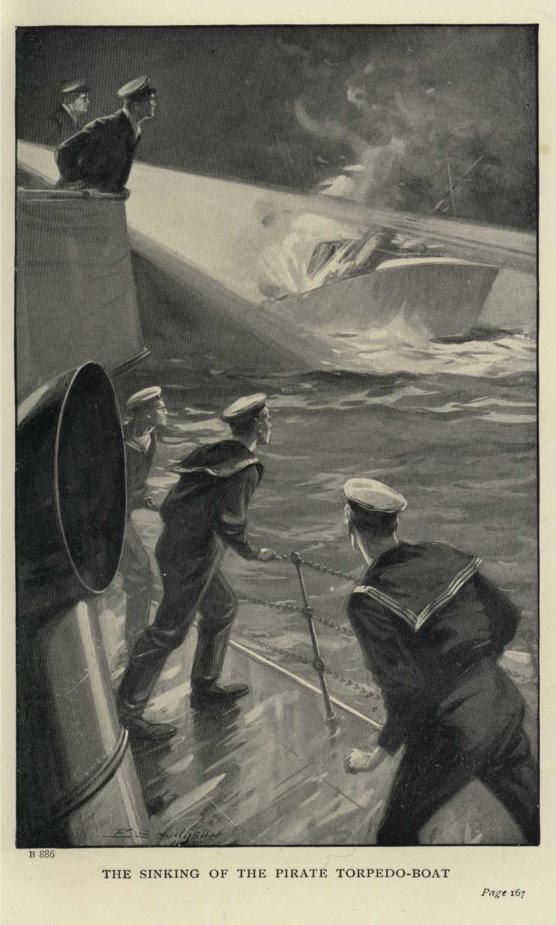
THE SINKING OF THE PIRATE TORPEDO-BOAT.
Poor wretches! an' we 'adn't the 'eart to cheer; 'twas so one-sided a show.
We stopped and tried to pick up some of her men, and did save a couple of Chinamen, more dead than alive with fright. They turned out jolly useful, as you shall 'ear afterwards.
"No. 2" hadn't seen the fourth boat, so we pushed on back to the entrance to look for her in case she tried to get in. The two lights we had left were still burning, but we couldn't see what had become of the two torpedo-boats which had passed us.
The people on shore must a 'eard that torpedo-boat blow up, for now a couple of search-lights shot out from somewhere high up on the cliff near the entrance, and began hunting round to see what all the fuss was about.
It just happened that where we'd moored the boats was a bit round the corner and out of sight of them searchlights, so we stayed abreast of them and watched the two beams a-travelling from side to side, and presently saw the missing torpedo-boat coming sneaking in. She must have gone right around the island.
Mr. Lang rushed out from behind our safe corner, and tried to wing her afore she could get into safety, and we followed 'im and tried a few long shots from the 12-pounder; but even I couldn't 'it anything under them conditions, especially as they glared their search-lights in our faces and commenced firing pretty briskly at us with small guns from the shore.