Chapter IX · MOUNTAINEERING ON SKI
Reading edition
BY ARNOLD LUNN
Winter mountaineering may be said to date from Mr. Moore’s crossing of the Strahlegg and Finsteraarjoch Passes in January 1865. The first big peak to be climbed in winter was the Wetterhorn, which was ascended in 1874 by the Rev. W. A. B. Coolidge and Miss Brevort; a few days later this party climbed the Jungfrau. These brilliant expeditions set a fashion which was, however, only followed by a select company of mountaineers, among whom a place of honour must be given to Mrs. Le Blonde. It was not until Paulcke crossed the Oberland at the end of 1897 on the ski that winter mountaineering began to be a popular sport. To wade up a big peak in deep snow on snow-shoes or on foot only appealed to a minority, but the number of those who were attracted by the chance of combining mountaineering with ski-ing steadily increased.
The English were slow to follow the new fashion; the number of British ski-runners who have a long list of glacier ski tours to their credit is still small, but abroad hundreds of experienced mountaineers have explored the High Alps on ski, and abroad the advisability of using the ski in the High Alps has passed beyond the limits of discussion.
The time is coming when most alpine huts will be provided with ski. A steadily increasing number of mountaineers realize that such peaks as Monte Rosa or the Zermatt Breithorn provide excellent ski-ing at all months of the year, and that the trouble of dragging a light pair of summer ski to the summit is well repaid by a magnificent run down to the hut.
There is no month in the year in which the writer has not enjoyed first-class ski-ing, and there is no season in the whole alpine calendar in which ski cannot be used on the loftier snow peaks in the Alps. Ski have come to stay as an indispensable adjunct to mountaineering. To the rock climber the ski are perhaps mainly useful in bad seasons; if the weather in summer were uniformly good the enthusiastic rock climber would have little use for the ski. But long spells of bad weather are not unknown, and many a climber who has engaged a guide or a couple of guides for a month has spent a week, a fortnight, or in some cases even longer without climbing a peak. I venture to assert that if he took himself and his ski to a club hut he would at least have the satisfaction of making good use even of an afternoon’s fine weather. I remember once finding myself at the Egon von Steiger hut during bad weather. It snowed all day and all night, and cleared at ten o’clock the next morning. Two parties on foot attempted the easy Ebnefluh. Both were driven back after a very brief struggle with deep soft snow. Myself and a friend reached the summit on ski in more or less normal time, and enjoyed a wonderful run back to the hut, where the disgruntled foot-sloggers had spent the day.
Let the rock climber learn to ski, and when the big rock peaks are deep in snow he will be able to snatch a Monte Rosa or Breithorn from the first fine day. In bad seasons individual fine days are often sandwiched between two or three days of bad weather. Such isolated days are useless to the foot-climber but invaluable to the ski-runner.
Technique.
I cannot spare the space to explain the technique of ski-ing.[18] Here I need only attempt to dispel a lingering belief, that dies hard, to the effect that there is one technique for ordinary ski-runners and another for mountaineers. This curious superstition is the last relic of an exploded system of ski-ing taught by an Austrian called Zdarsky, the main effect of which was to encourage timid, slow and clumsy ski-ing. The ‘Lillienfeld’ ski were short, and made straight running very difficult and turning very easy. The Lillienfeld system taught people to ski very quickly by dodging all difficulties and encouraged a free use of the stick. It was a bad system, and is now quite discredited; but there still lingers a curious belief that the Norwegian style may be all very well for small mountains but is too dashing and insecure for the High Alps. As a rule, glacier ski-ing is far easier than ski-ing among the lower mountains; the most difficult of all ski-ing country is wooded country, such as extends for miles round Christiania, the home of the ‘Norwegian style.’ Let me therefore urge the reader to master the free Norwegian style, to make all his turns and swings without the aid of the stick, and to acquire a free and dashing style. The mountaineer even more than the low-level ski-runner should have complete control of his ski, and complete control is impossible unless you have learned to control your ski not by means of the stick, but by means of the ski themselves.
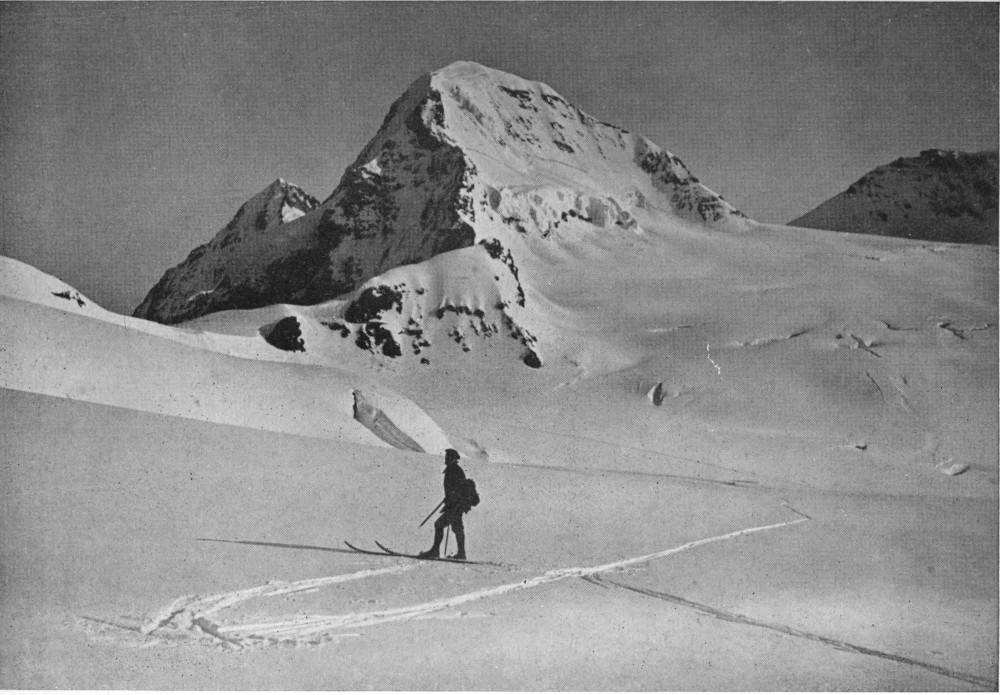
SNOW WAYS JEAN GABERELL
There are a few occasions on which the use of the stick is permissible on tour; but it is so dangerous to begin by using the stick as a brake, that I would advise the beginner NEVER to use the stick until he has at least passed the ‘Third-class Test’ which is held from time to time in all ski-ing centres patronized by British runners.
Furthermore, though of course it is absurd to take risks in the High Alps, occasions often arise where speed means safety. With bad weather or night approaching, the man who can run fast stands more chance than the man who can not, and, consequently, the higher your speed consistent with safety the better your chances. Now, a high speed consistent with safety can only be maintained by those who have lost no chance on small expeditions of raising the speed at which they feel comfortable, and this, again, can only be achieved by running just a little faster than is quite comfortable.
In the High Alps a reckless runner, who is always falling, is a danger to his companions and himself, but a man who is quite incapable of a fair speed is always a nuisance on tour, and may sometimes prove a danger. Steadiness is the first requisite in the High Alps, but speed is by no means unimportant. Any man with average balance and nerve, if he is properly taught, can learn to run steadily and to make slow turns on average snow at the end of a fortnight. To become a really expert ski-runner is, of course, another matter, but some of the finest ski-turns in the High Alps have been carried through with success by men who were not even third-class runners. Let the mountaineer learn to ski and take such chances as a snowy summer may afford. In a few hours he will begin to enjoy ski-ing, and his enjoyment will steadily increase with his experience. It is easy to become a third-class ski-runner, and very well worth while taking sufficient trouble to become a second-class runner. First-class ski-ing is, of course, not within the reach of all.
In order to make much that follows comprehensible to the reader, who, though a mountaineer, has yet to become a ski-runner, a short definition of the ski-ing turns and swings is necessary.
The object of every ski-runner is to approximate as nearly as possible in his course to a straight line between the point of departure and the goal. Obviously this ideal is impossible of attainment save on comparatively short open slopes, which can be taken straight. Hence the regrettable necessity of turns and swings which, unlike skating turns and swings, are not an end in themselves, and are only incidentally beautiful and graceful to execute and to watch.
There are three principal turns or swings: the Stemming turn, the Telemark, the Christiania.
Each of these turns can be used either as a stop turn (i.e. in order to stop more or less suddenly), or as a means of linking one tack to another. For instance, a slope may be too steep to take straight; in this case the good runner descends in a series of linked curves.
According to the condition of the snow, he will make these linked curves either by means of the Stemming, the Telemark, or the Christiania turns.
The Stemming turn is the easiest and slowest turn. It is the key to alpine ski-ing, and can be employed on snow on which a Telemark or linked Christiania would be either difficult or impossible. The beginner should try to combine Stemming with Christianias, to begin his turn as a Stem and to finish with a Christiania. This swing, which is sometimes called a Stem-Christiania or a ‘Closed Christiania’ (as opposed to ‘Open Christianias’), or by a natural abbreviation a ‘Closti,’ is the most generally useful of ski-ing swings.
The Lillienfeld system placed exclusive reliance on the Stemming turn and dismissed the other two as fancy tricks. This was absurd, for in many kinds of snow the Telemark or Christiania is much the more useful manœuvre. Either of these latter turns can be executed at a very high speed, whereas the Stemming turn cannot be done at a high speed.
The Telemark is mainly useful in deep soft snow or in soft breakable crust; in either of which the Stemming turn and the linked Christiania is difficult or impossible.
The Christiania, as a stop turn, is the safest method of stopping at high speed. Linked open Christianias are not easy to master, but are very satisfactory when mastered. Wherever a linked series of Christianias can be executed, linked Stem-Christianias are easier, and safer. The power to make a series of continuous non-stop turns with the Christiania marks out the expert; nothing is more beautiful than fast descent on glacier snow, film crust or crust slightly softened by means of a series of swift-running Christianias.
For the High Alps I consider that the Stemming turn and the Christiania should always be used in preference to the Telemark, excepting in very deep soft snow—rare in the High Alps—or in soft breakable crust.
The Telemark is a one-foot turn; all the weight is on the leading foot; consequently the Telemark is less powerful and less sure than the Christiania, which is a two-foot turn. Furthermore, the falls resulting from a Telemark which has gone wrong are more dangerous than from any other turn. From a faulty Christiania or Stemming turn one is usually thrown backwards or sideways against the slope; from a faulty Telemark one is often thrown on to one’s head or outwards from the slope. Further, the ski have a nasty habit of crossing behind in a badly timed Telemark.
To sum up: Use the stick as little as possible. Make all your linked turns by Stem-Christianias, except in deep soft snow or breakable crust, where the Telemark should be used. For a sudden stop use the Christiania in preference to the Telemark.
Equipment.
In addition to the ordinary mountaineer’s equipment, the ski-runner must have ski, sealskins, ski-sticks and repair outfit for ski.
I have no space to advise on the choice of ski, but I might warn the reader against the common illusion that ski for mountaineering should be markedly shorter than ski for short tours. They should be a couple of inches shorter, but very short ski should not be used save in the summer. I have used the longest size obtainable (2·36 in.) for quite long tours, and the next longest size (2·31 in.) in the High Alps.
Sealskin are detachable, and are fixed on to the ski to prevent the ski side-slipping while climbing a steep slope. Ski-ing boots are bigger than mountaineering boots. They should be nailed—lightly nailed, of course, but on no account entirely nailless. The nailless ski-ing boot is a superstition imported from Norway, where the hills are milder in gradient than in the Alps.
For all glacier tours crampons, or, to use another word, ‘ice-claws,’ should be taken. Eight-pointers are best, though good work can be done with six-pointers. The small four pointers are most insecure and uncomfortable.
For all further details as to equipment the reader may consult my book Cross Country Ski-ing.
The Alpine Calendar
The first winter snows usually fall in October: excellent ski-ing is often obtained at the ordinary winter sports centres in October. Glacier tours should certainly not be attempted before December, as the danger from crevasses is at its maximum in October and November. January and February are the best months for ski tours up to about ten thousand feet. The winter proper is NOT the best season for glacier ski tours, though most of the classic ski tours in the High Alps have been carried out between December and the end of February. Good ski-ing can be obtained at low levels well on to the end of April, and sometimes even later. As a rule, the snow lies down to about five thousand feet on north slopes well on into the middle of May.
May and June are the best months for glacier ski-ing, though excellent ski-ing may be obtained throughout the summer. There is no month in the year in which the High Alps do not yield good snow, but the best all-round months for mountaineering on ski are undoubtedly May and June.
Snow Craft
The expert cross-country ski-runner must not only be a fast and safe runner on all kinds of snow and ground, but he must also possess a thorough knowledge of snow craft. Unfortunately, there are nine ski-runners whose Telemarks are perfect for one whose knowledge of snow is even adequate, and the number of those whose understanding of snow in all seasons of the year is really expert is indeed small.
Snow craft in winter and in spring is even more complex than in summer, and requires a special study of its own. Even the most expert guides whose knowledge of summer snow leaves nothing to be desired require considerable winter experience before they are thoroughly competent to lead a party among the High Alps in winter. The same is true of spring; each season, in fact, requires a separate study.
The ski-runner needs to possess a more exact knowledge of snow than that which the foot-mountaineer requires. A mountaineer on foot is mainly interesting to discover whether the snow is hard enough to walk uphill without sinking in, and whether the snow is likely to avalanche. Hard snow, soft snow and avalanche snow are the three main categories in which the foot-mountaineer divides snow. He need not bother with all the delicate gradations of value that distinguish snow which is so hard that it will not take a Stemming turn, and snow which, though hard enough to bear a foot, will yet take a Christiania or even a Telemark.
The ski-runner who neglects snow craft is severely punished for his carelessness. He runs into fast and sticky snow and pitches heavily on his face, or from soft snow on to hard snow and falls heavily backwards. Even the least observant ski-runner soon realizes that an elementary knowledge of snow is essential to his comfort and his safety. His knowledge of snow needs to be instinctive. On foot a man has time to probe and to examine, but on ski he has to diagnose the snow while travelling at a high speed. He has to possess an accurate sense of direction so that he can foretell the changes of snow that occur when travelling from, say, a north-east slope on to an eastern slope, or an eastern slope on to a south-eastern slope.
Quite as many bad ski-ing falls are caused by deficient snow craft as by deficient balance.
Precisely because even the most casual ski-runner is bound to learn from the past experience of nasty falls, ski-ing inevitably teaches even the most unobservant some knowledge of snow craft. A ski-runner cannot hand over the whole strategy of the day’s campaign to a guide. He must think for himself and study for himself. In summer the real business of climbing usually begins when the glacier or the summer snowline is reached, but in winter a ski-runner can kill himself in an avalanche within an hour of the hotel. Snow craft begins in winter at the hotel door.
The careful study of snow is a fascinating branch of nature study. More can be learned from books than the reader might imagine. Once a ski-runner has grasped how snow is affected by altitude, orientation, wind and sun, he is in a better position to profit by his knowledge in practice than if he was forced painfully to unravel the laws of snow by personal observation. In the early days of ski-ing in the Alps the guides themselves were completely ignorant of the main laws of snow in winter. They are still, for the most part, ignorant of the subtleties of spring ski-ing, which is much more difficult to understand than winter ski-ing. In winter, if a snow slope holds good snow in the morning it will probably hold good snow throughout the day, but in spring the same slope goes through a regular cycle of changes. It may be unskiable at dawn, yield perfect ski-ing at midday, prove absolutely unsafe at three in the afternoon, and yield good running again in the evening.
To time a descent accurately, to forecast from a knowledge of the orientation and altitude of a given mountain that it will yield perfect ski-ing at a given hour, is to know one of the most satisfactory intellectual pleasures that the mountains afford.
Winter Snow
There are certain forms of snow which are characteristic of certain seasons. ‘Powder snow,’ for instance, is normal in winter and uncommon in the late spring; none the less powder snow is often found even in summer, just as certain forms of snow which are characteristic of spring or early summer are occasionally found even in midwinter. ‘Winter snow’ must then be taken to mean the kind of snow which is common and characteristic of, but not limited to, winter.
Powder snow.
In winter a normal snowfall is accompanied by a temperature below freezing; snow that falls with the temperature just above freezing usually descends in the form of sleet. Fortunately, such conditions are not common.
Snow will even fall when the temperature registers a degree or two of thaw. I have known dry snow fall with a temperature of two degrees above zero—centigrade, at a height of 5500 feet above the sea. Similarly, as icemakers know, water will freeze on a rink even when the temperature is above freezing-point.
The explanation for this anomaly may be sought in the well-known law that pressure lowers the freezing-point.[19] It seems a natural deduction that diminished pressure will raise the freezing-point. 0° centigrade is the freezing-point of water at sea-level. Under a pressure greater than that of the air at sea-level, the freezing-point is lowered so that the bottom of a glacier will be in a condition of liquefaction at a temperature below freezing. It should follow that an air pressure less than that of the air at sea-level should raise the freezing-point; or, in other words, that at any point above sea-level the freezing-point should be higher than zero. From my own observations I believe that water will freeze and rain turn to snow when the temperature is 2 degrees centigrade above zero at a height of 5000 feet.
Fortunately, the normal snowfall is accompanied by a temperature below freezing, for if the snow is on the point of turning to rain, it forms a crust when the temperature falls. A normal dry snowfall takes the form of small hexagonal crystals. Newly fallen snow is not compact, and contains a great deal of air, which slowly escapes as the snow settles, so that after a day or two the new snow has lost nearly a half of its apparent depth.
New snow is very soft and slow, but gives good running on steep slopes; though, of course, long steep slopes are liable to avalanche. Good running is also often obtained during a snowfall by choosing south slopes, previously covered by a hard crust; for there is nothing pleasanter than two or three inches of snow on hard crust, and during a gentle snowfall it is possible to enjoy quite good sport on such slopes. In general, expeditions—even quite short ones—are impossible till the snow stops, and unsafe for a day or two after a heavy fall. Newly fallen snow sticks badly in the sun even if the temperature is well below freezing.
Once, however, that the snow has settled it soon gives perfect running. One night’s really hard frost is sufficient to produce excellent snow. Powder snow remains good almost indefinitely in winter on northern slopes, provided it is not spoiled by wind. It steadily improves. In sheltered places the crystals gradually grow in size so that sometimes you find large leaf-like formations, which rustle under the ski like autumn leaves. Such snow is a dream of paradise.
Powder snow is the ideal running surface. It is equally good for straight running and for swings. In deep soft powder the Telemark is the best swing, but in fairly compact powder any turn or swing is easy and safe.
The ski-runner who visits the Alps in winter, and has good luck, may run for day after day on perfect powder. He is in danger of thinking himself a better runner than he is. If he concentrates on Telemarks, the first tour in the High Alps, where he will meet varieties of hard and soft crust, will find him out badly. He should therefore make a point of spending a day or two on south slopes so as to master the Stemming turn on hard snow. If he is getting pleased with his Telemarks, let him try a Telemark on the soft breakable crust to be found on south slopes at midday, and if he can do a series of fast-linked Telemarks in such crust, he may then return to his powder snow with a good conscience.
The Effect of Wind on Powder Snow.
Snow which is spoiled by the sun is never quite impossible, and is always curable by a hair of the dog that bit it; in other words, by another and stronger dose of sun. But snow which has been wrecked by the wind is the despair of the ski-runner.
The wind does not affect snow that has once been crusted, so that wind-swept snow is almost unknown in spring. The favourite victim of wind is precisely that light, dry powdery snow which is so common in winter.
The effect of wind depends on three factors, the strength of the wind, the time during which the snow is exposed to the wind, and lastly the type of snow exposed to the wind. Powder snow is the most sensitive, the quickest to spoil and the most trying when spoiled. Hard crust is entirely unaffected; heavy wet snow is very little affected.
A light wind produces on powder snow the markings which are known as ripplemark, a term which has been applied by scientists to the rippled effects which can be traced, not only in snow, but also in sand, and even in clouds which have been influenced by wind. Sand and snow behave very similarly under the influence of wind. A slightly stronger wind, or a wind blowing for a longer spell, produces caked powder, which is dense and compact, but has not quite lost its powdery quality. The ski sink in to a depth of an inch or more, and though fast running is dangerous and apt to produce broken ski points, a good runner can derive much pleasure from caked powder, and can force linked Telemarks without much trouble. The third stage in the deterioration of snow occurs when the wind produces a hard crust. Windboard is hard and slippery, but so long as it is not varied with soft patches of sticky snow or of breakable crust, windboard yields a surface which may annoy the novice but which should not prove, at any rate on slopes of moderate gradient, too troublesome to an expert who has mastered his hard snow turns. Windboard is common during the winter months in the High Alps; in appearance and texture it is not unlike the hard marble crust, which is found on south slopes after a long spell of fine weather, but it is vital to discriminate between windboard and marble crust, because the former may sometimes break away in slab avalanches whereas the latter never avalanches. Windboard betrays its origin by ripple markings, sometimes faint but seldom invisible to the practised eye. Windboard is often varied by pockets of sticky snow.
If wind produced nothing worse than caked powder or windboard, the ski-runner would have less cause for complaint. Unfortunately the wind often produces horrible surfaces which resemble each other only in their general unsuitability for ski-ing. Skavla is the generic Norwegian name for wind-swept snow, and skavla is common on the exposed fjords of Norway and Sweden, where it attains a degree of unpleasantness seldom matched in the Alps. Skavla varies. Sometimes skavla consists of patches of glittering ice varied by treacherous pockets of sticky snow; sometimes a breakable trap crust interspersed with windboard; sometimes waves of hard, icy snow which occasionally attain a height of two feet or more. The prevailing wind determines the direction of the waves and acts in precisely a contrary fashion to that of wind on water; for wind on snow has a burrowing effect, and forms these waves by excavating and eroding a slope, gradually forming a series of steps. In other words, whereas on the sea the wind will be found to be blowing up the longer slope of a wave, on snow the wind will have been blowing against the short steep side of the snowy waves.
To sum up: The effect of wind on powder snow is always bad. The stronger the wind and the longer that it blows, the worse the snow. Hence in winter avoid exposed slopes and seek out sheltered valleys. The summit slopes of winter mountains will usually be spoiled by the wind, which is one of many reasons why spring is so superior to winter as far as ski-ing in the High Alps is concerned.
The Effect of Sun on Powder Snow.
Powder snow acquires a crust if it is exposed to wind, to sun shining at a sufficiently direct angle, and to an air temperature above freezing. Wind alone has the power of forming crust without a preliminary melting of the surface. I do not know why this should be so, but no doubt the reason is to be found in the law that pressure lowers the freezing-point, so that the increased pressure caused by wind lowers the freezing-point, or, in other words, produces the effects of a thaw at the point where the wind acts even though the general air temperature may be well below zero centigrade.
At any rate, sun, wind and thaw are alike in producing a surface crust.
The effect of the sun depends mainly upon the angle of inclination. In midwinter, snow will remain unaffected by the sun on northerly slopes even though they receive several hours of sunshine in the course of the day.
In fact, in midwinter eastern and western slopes retain powder snow for a very considerable time, while a slope that is a few degrees north of west or a few degrees north of east retains powder snow throughout the winter, always providing that it is not exposed to wind or to thaw.[20]
I use the term ‘thaw’ to denote a general air temperature above freezing as opposed to the purely local melting caused by the sun’s rays, which may be, and in fact normally is, accompanied by an air temperature in the shade of several degrees below freezing.
The thermometer will often be registering more than ten degrees of frost in the shade and twenty or more degrees of warmth—centigrade—in the sun. It is, as icemakers know, quite common to find a belt of cold air, two feet in height, just above the snow and just below a strata of warm air several degrees above freezing-point.
In normal winter weather you may be uncomfortably warm in the sunshine, and yet the sun has no power to affect powder snow on any slope which has not a touch of south in it.
The steepest south slopes are the first to lose their powder snow. Afterwards, the gentler south slopes follow suit. Towards the end of February western and eastern slopes begin to crust. In March due north slopes still hold powder,—at any rate above 5000 or 6000 feet,—but slopes which are only a few degrees north of east or of west begin to crust. Finally, the level outruns get crusted, then the gentle due north slopes, and last of all steep north slopes.
Of course at high altitudes winter conditions prevail until well on into April.
In midwinter good ski-ing is usually to be had on south slopes for three or four days after a snowfall, though steep due south slopes soon crust. The time during which gentle south slopes or slopes which are just south of west or east will hold powder depends on the general air temperature and on the altitude. I have known pretty steep due south slopes hold powder below 4000 feet for three days of cloudless weather, but the temperature was about 15 degrees centigrade below freezing.
This is, however, unusual, and south slopes soon crust up even in midwinter. The sun melts the snow by day, and the melted snow refreezes at night, producing a crust. Such a crust will, at first, be soft and breakable.
Soft breakable crust is not a bad running surface. It is quite true, i.e. does not vary in pace from one place to another, and is usually soft enough to enable the ski-runner to make Telemark swings, either stop or linked, without much difficulty. Sometimes the crust is harder, and in this case the jump-round or quersprung is the only possible manœuvre.
A peculiarly villainous form of crust, fortunately rather rare, is known by the appropriate name of Trap crust. This crust is perfectly solid at one spot, and bears the weight of the ski without breaking, only to crack a few yards lower down. The ski-runner skids with great speed over the hard crust, only to be pulled up suddenly as his ski break through the soft crust below.
Trap crust is more usual in spring than in winter, especially on slopes which change in direction, so that the ski-runner passes from snow which has been sufficiently thawed to form a hard solid crust at night to slopes which have only been superficially melted. Trap crust is only found after fairly heavy falls of snow which require considerable time to form a solid crust. As a rule, trap crust covers a foot or more of powder snow.
To return, however, to more normal winter conditions. Under normal conditions the snow on south slopes in winter is gradually transformed into crust.
This crust is at first soft and breakable, but the continuous process of melting and refreezing gradually produces a solid unbreakable crust.
Unbreakable crust, as the ski-runner soon discovers, varies greatly in quality from hard crust which is so hard that the ski slip sideways without obtaining the least grip, crust which on any slope but the most gentle is almost unskiable, to the other extreme, crust which though quite hard and unbreakable is rough enough to permit even a Telemark and to make Christianias and Stemming turns delightfully easy.
The solid crust formed in winter is usually very hard and slippery before the sun strikes it. This crust is known as Marble Crust. You find marble crust on southern slopes in winter, and at high altitudes in spring. It is common in the High Alps. Even at the very end of April I have known a slope at a height of 12,000 feet remain hard, slippery and unsoftened for some little time after the sun had struck it because a bitter north wind had lowered the temperature several degrees below freezing.
In mid-winter a slope of marble crust will yield good ski-ing after the sun has struck it, unless the air temperature is several degrees below freezing. Marble crust, touched by the sun, yields a surface which will puzzle the beginner but which is pure delight to the man who has mastered Stemming turns and Christianias. The excellent running that may be obtained on south slopes is too little exploited, for winter ski-runners are firmly convinced that good ski-ing can only be found on north slopes where powder lies.
Mid-winter may be said to last till the end of January. In February you often find perfect spring snow, Telemark crust, etc., on south slopes, and in February, as often as not, the best running is obtained on southern slopes. This type of running will be dealt with later.
Summary of Winter Snow.
Winter snow may therefore be summarized as follows. The normal winter snow which is found throughout the winter on northern slopes and occasionally on southern slopes is powder snow which is perhaps the ideal ski-ing snow.
Powder snow deteriorates under the influence of wind and sun. Wind is the more mischievous. A little wind does no great harm, and the expert can even ski with pleasure on the hard crust formed by wind, but the extreme action of wind often produces varieties of snow which are all but unskiable.
The High Alps and lofty summits in general being most exposed to wind will usually yield inferior ski-ing to sheltered slopes. The best ski-ing in winter will therefore seldom be found on the glaciers.
Snow also deteriorates under the influence of sun, which forms a crust. This crust, however, once formed is often improved by a further dose of sun.
Though the best ski-ing is usually obtained on north slopes, excellent ski-ing is often obtained on south slopes by those whose knowledge of snow craft is sufficient to time their descent and to choose their route accurately.
Abnormal conditions produced by Föhn and thaw are dealt with on pp. 417-422.
Spring Snow
We have seen that good ski-ing in winter depends largely on the absence of wind. A sudden thaw may also produce a disastrous result, for snow which has once been rained on and refrozen will remain covered with crust until there is a new snowfall.
The best winter snow is without rival, but spring snow is, on the whole, safer and less capricious. In normal spring weather all snow is crusted in the early morning, for the sun is powerful enough to melt snow even on northern slopes. But this spring crust, as we shall soon show, is much less troublesome than crust in winter and yields very fine ski-ing indeed. Wind, the great enemy in winter, has no effect in spring, for wind cannot affect hard crust, and if wind blows while the snow is falling a few days of strong sun will melt any wind-formed crust and produce exactly the same surface as if the snow had never been touched by wind. It should, however, be added that, in the early spring, wind, though powerless on snow which has once been melted and crusted, is a great nuisance if it blows on snow which is still powdery, as is usually the case for twenty-four hours or so after a snowfall; snow which has once been crusted by the wind has a very strong resisting power to the action of the sun; I have known south snow in March retain irritating effects of wind action after several days of strong sun that would have been sufficiently potent to melt any ordinary crust.
Spring ski-ing is, as a rule, delightful. Snow is troublesome in the intermediate stage between powder and crust. Once a crust is formed, the more often that crust is remelted and refrozen the better, as there is nothing better than old crystalline snow which has been through the mill of melting and refreezing again and again. Unless wet Föhn blows such snow will always retain its crystalline character, even when remelted by the sun, and will always yield good ski-ing. Of course in the late spring at low altitudes the sun is powerful enough thoroughly to thaw and drench the snow, and in the middle of May below 7000 feet wet snow in the middle of the day is unpleasant. But in March and April ski-ing on melted crust is wholly delightful. Incidentally the best ‘Spring snow’ is often found at the end of or in the middle of February on southern slopes.
From the beginning of March onwards all slopes, save those at very high altitudes, begin to crust over. The process is gradual on northern slopes. There is a period when the northern slopes no longer hold the dry loose powder of winter but have not yet begun to crust.
Spring powder is common on north slopes in March. It is denser than winter powder, and is not so dry. It is slightly moist on the surface, and much heavier. It yields, however, a first-class running surface, and will take any turn or swing. Its main objection is the fact that it is peculiarly liable to avalanche.
Gradually, however, Spring powder disappears, save at great heights, and all slopes are covered by crust. In the afternoon the crust is melted, and the snow is soft and wet on all slopes. At night the snow is refrozen.
The normal cycle, then, of a normal spring (say April, at altitudes between 3000 and 9000 feet) is as follows: Hard crust at dawn; crust superficially softened between sunrise and midday; soft melted snow in the afternoon; soft breakable crust as the sun loses in strength; and solid hard crust after the sunset.
First let us consider the hard crust usually found at dawn.
This differs materially from the marble crust of winter, and from any of the crusts formed by wind action. It is, as a rule, slightly softer. What is more to the point, it is rougher. The surface of normal spring crust is perforated by numberless little holes. Sometimes these holes are quite small, mere pockmarks, sometimes they are as large as half-crown pieces. It is the presence of these holes and the roughness of the crust that makes steering easy, so that control is not difficult, and linked Christianias or Stemming turns are within the power of the good runner.
Perforated crust, in fact, is a delightful running surface. It is common at low altitudes in March, at moderate altitudes in April, and is normal in the High Alps in May, June, July and even August.
Film crust is found in May and June on the glaciers, and occasionally at low altitudes in April. It forms a delightful running surface. Unlike marble and perforated crust, it is not quite homogeneous. It is composed of a hard under-surface of solid crust, covered by a very thin, soft, and transparent film of ice, which glistens in the sun like burnished silver.
This film of soft ice is shorn away as the ski begin to come round on a turn. It provides a splendid purchase, preventing effectually all side-slip, and yet not sufficiently strong to make turns difficult.
Film crust is admirable for fast straight running, because at any moment the pace can be regulated by a swift turn. There is nothing finer than a run down the glaciers in the early morning on film crust.
We have seen that the cold nights of winter produce marble crust, which is hard and slippery. Marble crust is the kind of surface which needs crampons or a chip with the axe if it is climbed on foot.
Further, marble crust, and all forms of crust produced by winter winds, yield a very unsatisfactory surface, too slippery to give good purchase.
We have seen that the milder nights of April produce perforated crust which is much rougher and gives good ski-ing, while the even warmer nights of May and June produce film crust in which Christianias and Stemming turns are easy and safe. In fact film crust gives such a wonderful grip that even Telemarks are possible.
From this we deduce the following law:
Provided the night’s frost is sufficient to produce a solid unbreakable crust, the crust will give the best ski-ing when the frost has been least severe.
In other words, “The milder the frost the better the crust.”
This rule is important. It often happens in spring that one has to start down before the sun has produced a surface melting. Again and again the first thousand feet or so of descent have been spoiled because the crust was too hard and slippery. But the lower one ran down the better the ski-ing. The hard marble crust of winter gave way to the perforated or film crust of spring. In April, in the High Alps, winter conditions often prevail at high altitudes to give way to spring conditions lower down. You start a run on marble crust and end on perforated or film crust. The lower the altitude the milder the night frost, and hence the better the crust.
But of course the hard crust of dawn is soon changed under the influence of the sun. At first the sun produces a slight surface softening which is, however, quite sufficient to make a great deal of difference. Even marble crust, if superficially softened, yields excellent running. Gradually the melting process becomes more pronounced. Sun-touched crust with a slight surface moistening—quite sufficient to make Christianias and Stemming turns a joy—yields to crust covered by an inch or two of melted snow. Such crust is known as Telemark crust—not because Christianias are not easy, but because Telemarks are very simple, whereas Telemarks are difficult, if not impossible, on hard crust.
Telemark crust is a normal stage in the passage of hard crust to melted snow. It is the practical certainty of finding Telemark crust at certain hours in spring that makes spring ski-ing in fine weather such a delight.[21]
As the sun increases in strength all trace of the underlying crust disappears. The snow is melted through and through, and becomes dangerous on steep slopes.
This wet snow is often slow, but it never sticks like the wet snow of winter. On steep slopes it gives good running—if unsafe.
Snow sticks in the intermediate stage between freezing and thawing. Thus powder snow which is beginning to thaw sticks abominably, but snow which is melted through and through does not stick. Snow which has once been thoroughly melted and then refrozen will never stick badly again. A surface of wet snow overlying powder will, of course, stick, but melting snow which rests either on hard crust or on the hard ground does not stick. It may be slow, but it does not adhere in sticky lumps to the running surface.
Thus two inches of melted snow on top of crust (Telemark crust) gives a fine running surface, and an inch or even less of wet snow on grass also gives excellent sport.
Snow that has been melted and refrozen night after night soon acquires a crystalline character. When the crust begins to melt after the sun has struck it, the melting surface is composed of numerous wet crystals, sometimes about the size of salt crystals, sometimes much larger.
This granular snow is familiar to all spring runners, and gives an excellent ski-ing surface. Occasionally towards sunset, as the wet heavy snow that is usually found in the afternoon during the wet spring begins to freeze again, you will find the snow assuming a very marked crystalline formation, which resembles the wet hypo crystals with which photographers are familiar.
In general, so long as snow retains a crystalline formation it gives good running. Salt snow or hypo snow yields excellent sport. In May at low altitudes the sun, however, is so powerful that it dissolves the crystals and reduces all the snow to one consistent heavy wet slush. Such snow does not stick—that is to say, it does not adhere to the running surface—but it is very slow. Furthermore it is dangerous, because if you run suddenly on to a patch of this very heavy snow you are liable to be pitched on to your face. Often the snow is not only melted downwards but upwards, for the ground is very warm in spring, and thaws the snow from below, so that you will often find a patch of soft heavy snow resting in the form of a shallow bridge on an empty space. The ski break down the bridge of snow, and the ski-runner pitches heavily forward. Such hollow snow is seldom found in April, but is common in May at lowish altitudes. In May the best ski-ing at low altitudes (5000-7000 feet) is obtained before 10 a.m. and after 7 p.m. In the early morning and just after sunset I have often enjoyed first-class ski-ing right down to 5000 feet and lower, well on into the middle of May.
We may therefore sum up the normal cycle of a spring day as follows:
At dawn every slope will be covered by a hard homogeneous crust. This crust will be either marble crust, in which case it will yield very difficult and unpleasant ski-ing, or perforated crust or film crust. Perforated and film crusts give excellent ski-ing even before the sun has begun to soften the crust.
When the sun begins to gain in strength the hard crust is superficially softened, and gives good running even in the case of marble crust.
A later stage is reached when the hard crust is softened to a depth of about two or three inches (Telemark crust). This again gives good running.
Either before or after midday, according to altitude and inclination, all traces of crust disappear, and all slopes at moderate altitudes are reduced to wet, heavy and more or less water-logged snow. In the early spring this stage is perhaps only reached on southern slopes. In the late spring it is reached on all slopes at low altitudes and on north slopes, save, perhaps, at very high altitudes. In general, the ski-runner should not be abroad at such hours. Towards evening the slopes begin to refreeze. There may be an interval of hypo snow—soft hypo-like crystals in which fast running and every kind of swing is perfectly safe and easy. This is soon followed by the formation of a soft breakable crust, which gradually hardens until at last the cycle is complete by the formation of a hard solid crust.
Thus in general there are two periods of a spring day when ski-ing is easy, fast and safe. The first period is when the hard crust begins to soften, and the second period is when the wet melted snow begins to freeze. The ski-ing is least pleasant and most dangerous between midday and sunset.
The Effect of Föhn and Thaw
So far we have discussed normal winter and spring conditions. Föhn is, unfortunately, associated not only with spring but with winter. The conditions that are produced by Föhn are, however, spring conditions rather than winter conditions; for Föhn, though by no means uncommon in winter, is at least abnormal, whereas periods, more or less prolonged, of Föhn weather may be regarded as normal in spring. The peasants have a saying that, if the Föhn did not blow, the good God and the warm sun could do little with the snow. Certainly but for Föhn Switzerland would still be covered with glaciers.
Föhn, strictly speaking, should be used only for the warm dry wind that blows from the south, and which has been the cause of so many fires. The fire of Grindelwald was caused by this type of Föhn. The wind dries up the wooden chalets, and a spark from a cigar or a kitchen fire, carried on the wind, is enough to kindle wooden buildings from which the wind has absorbed every trace of moisture. But the word Föhn is also used for the warm, damp south-west wind, which is in every way utterly different from dry Föhn. They are alike only in that both dry and wet Föhn raise the temperature and melt the snow.
I propose to call the true Föhn Dry Föhn and the wet, warm south-west wind Wet Föhn.
Dry Föhn is often associated with long spells of warm dry weather. The skies are cloudless, and there is no hint of rain to be seen. You know that there is Föhn in the air by a peculiar warm dryness, a marked absence of coolness and moisture in the atmosphere.
The wet Föhn always brings rain. Sometimes dry and wet Föhn will fight for the mastery. Sometimes dry Föhn will emerge into wet Föhn and bring down the rain, only to recover its mastery a day or two later.
Föhn in Winter.
Let us consider the effect of wet Föhn in winter proper. The ski-runner is bound to detect the first hint of wet Föhn in the air by a slight stickiness in any powder snow that he may chance to be ski-ing on. If the wet Föhn is slight, copious waxing will eliminate its effects; but if it is pronounced, the snow will ball and stick atrociously.
Should the Föhn disappear, it leaves its legacy behind. All slopes of powder snow which have been affected are covered with a crust, which will be more or less thick according as the thaw has been more or less severe. I assume, of course, that the thaw had been followed by the frost at night, without which crust cannot be produced. Only a new snowfall can restore a slope of powder snow which has once been melted by Föhn to its pristine conditions.
Sometimes the Föhn is so slight that the surface of the powder snow is barely touched. It is not covered by crust, but there is a suspicion of resistance as the ski drive through due to an embryo crust. Telemarks are not quite so easy, and a very fast swing is apt to throw the ski-runner outwards, owing to the fact that the side-slip is less pronounced; for the snow gives less easily when covered by the first hint of crust. More usually the Föhn, if it once begins, is accompanied by rain. Often even in December heavy rain will fall on all slopes below 12,000 feet. Directly the Föhn disappears the usual winter frosts will convert such slopes into solid icy crust which is harder and more slippery than any marble crust produced by sun or wind. I have seen crust, formed by Föhn followed by frost, so hard that neither ski nor hobnailed boots left any perceptible trace; and on an easy slope which a beginner could take straight I have slid down helplessly on my back some hundred yards, only to be saved from a further and probably fatal fall by a guide, who thoughtfully received my head in the pit of his stomach, breaking a thumb in the effort to arrest me.
That was an extreme case of ice crust produced by Föhn, but it is not uncommon to find every slope below 10,000 feet covered by an icy crust, on which ski-ing is impossible. The wise ski-runner climbs on crampons, and selects a due south slope for the descent, and times his descent for midday. The slight surface softening produced by the sun is usually enough to produce superficial stickiness, which gives capital running, provided that you have mastered the Stemming turn and Christiania. But, except at or near midday, and except on south slopes, ski-ing is impossible during such periods.
Sometimes good ski-ing is obtained near stream beds when all other slopes are covered by hard crust. The mist that rises from the stream bed descends in hoar frost and covers the crust with a layer of crystals deep enough to take a turn. But such slopes are scarce.
Occasionally the wet Föhn is followed by a period of dry Föhn.
In this case the frost at night is much milder, and you will often find instead of marble or icy crust typical spring formations. I have found perforated crust and even film crust in January, when a period of dry Föhn with high temperatures by day and mild frosts by night had followed two or three days of rain.
For weeks together I have known the crust formed by dry Föhn to resemble perforated crust, but formed of a much smoother and more slippery texture. Imagine a hard surface pitted by numberless smooth little round hollows about the size of half-crown pieces. This type of hard perforated crust gives good running, but calls for a thorough mastery of hard snow turns.
Often the dry Föhn produced a surface-melting to a depth of two or three inches—typical spring conditions in midwinter.
This again is an illustration of the law stated on p. 414: “The milder the frost the better the crust.” In other words, once the snow in midwinter has been thoroughly spoiled by thaw followed by frost, the ski-ing will be best when the conditions approximate as nearly as possible to those characteristic of spring.
Spring snow is quite common in winter when dry Föhn follows wet Föhn, and the wise ski-runner will seize every chance of securing spring conditions once he has despaired of proper winter conditions. He will choose south slopes instead of north slopes, low altitudes instead of high altitudes, and time his descent for the sunny rather than the shady hours. “The milder the frost the better the crust.” From which it follows that the lower the altitude and the drier the Föhn the better the ski-ing—once normal winter conditions have been interrupted.
It is most interesting to observe how the same slope will be composed of typical spring crust one day and of impossible slippery winter marble crust the next day. The difference is solely due to the fact that, in the first case, the night’s frost had been mild, and in the second case severe.
After Föhn you will often, for instance, find a queer kind of surface, called Foam crust, composed of innumerable overlapping edges, miniature cornices formed by a little trickle of water, a mere drop, which has run off a thin small eave of snow. Now hard frozen foam crust is very unpleasant, but directly the dry Föhn gains the mastery, and directly the hard foam crust is exposed to a hot sun and a hot dry Föhn atmosphere, it immediately softens, and yields very fine ski-ing not unlike the best Telemark crust.
To summarize the effect of Föhn in WINTER:
Wet Föhn followed by frosts produces a crust on all slopes which have been exposed to thaw. If the Föhn is very pronounced, and is accompanied by rain, which is followed by frost, all slopes will be covered by a hard solid crust.
If a period of normal cold winter weather sets in, this crust will be very hard and very slippery, and will only yield good ski-ing on south slopes exposed to the sun.
If the wet Föhn is followed by dry Föhn, you will get spring conditions at any rate at low altitudes—a hard crust, smoother but not unlike perforated crust, in the early morning, and a soft crust, not unlike Telemark crust, on south slopes when the sun is shining on them.
Föhn in Spring.
The Föhn is less deadly in spring, because snow which has been crusted by Föhn and frost is remelted by the sun, and the sun and frost together will always produce the same surface, whatever has gone before. A wind-swept slope or a Föhn-crusted slope are affected in precisely the same way. In winter Föhn spoils all snow that it has affected, and, save for the lucky accident of dry Föhn, one has to wait for a new fall till normal winter conditions are restored. But in spring, once the Föhn has ceased, a single sunny day followed by a single cold night’s frost is sufficient to produce the normal spring conditions, hard crust in the morning passing through the normal transformations of the spring day.
Wet Föhn is, however, most unpleasant in spring while it lasts. If you are caught by wet Föhn in a club hut you are imprisoned till the Föhn passes, for the wet Föhn brings down the avalanches on every slope above 23 degrees (see p. 430). Ski-ing, while there is a touch of wet Föhn in the air, is always unpleasant. Snow which has been melted by the sun in a dry atmosphere never entirely loses its crystalline formation, excepting at low altitudes in the very late spring. And even then sun-melted snow is never so unpleasant as snow melted by the Föhn. The Föhn disintegrates the snow, destroys the crystalline formation, reduces the snow to one uniform heavy mass.
Such snow does not stick in spring, provided it has been through the usual process of melting and refreezing on previous days. But though the spring Föhn does not produce stickiness, it gives the snow a dragging, clogging grip. It may not ‘ball’ under the ski like sticky snow in winter, but on all but steep slopes it makes ski-ing desperately slow. Uphill work is most trying, for the friction between wet Föhn snow and the ski is very marked. The ski have to be thrust through the clinging surface, and the wet Föhn not only affects the snow, it affects one’s whole body and produces a general sense of lassitude.
Summer Snow
Between July and the end of September the snowline climbs ever higher. The snow above this snowline obeys the laws that we have tried to explain in the preceding pages. Snow is transformed into crust by the action of sun or thaw or wind, and the crust itself affords good or bad ski-ing, according to the conditions under which it has been produced and the conditions that affect it when once it has been formed.
In the summer you will meet with every type of snow in the High Alps. After a fresh snowfall the snow will often remain powdery for days on northern slopes at great altitudes. Between July and the beginning of the winter you will find typical winter snow, powder snow or wind-driven snow: you will find typical spring snow, such as film crust or perforated crust, but you will not find any type of snow which can fairly be described as mainly characteristic of the summer. The conditions in July and the first half of August will approximate to those of June, though of course there will be far less snow in August than in June. Towards the end of September the snow conditions will approximate to those of the winter proper, with the important difference that the snow at the end of September approaches a minimum.
Once the ski are left behind and the final climb begun on foot, there will be many complex and difficult problems of snow craft to solve which, however, hardly come within the scope of pure ski-ing. Of these the most important is the problem of safety. Once the ski are left behind, the climber’s interest in the snow is reduced to two main problems: Is the snow hard enough to make going easy and yet not so hard as to need step-cutting? Is the snow safe or will it avalanche?
The avalanche question will be treated in its proper place. Summer Ski-ing will be dealt with on pp. 468-470.
I have tried to condense this section, and, like all condensed and theoretic writing, it will no doubt prove rather dull reading. In the later sections I shall try to provide concrete illustrations of the principles here explained, and to show how the laws of snow craft may be applied in order to get good ski-ing in the months of the alpine calendar.
Snow Avalanches
Snow avalanches may be classified either as Ground avalanches or as Superficial avalanches.
Ground Avalanches—the ‘Grundlawinen’ of Continental writers—may be defined as avalanches in which the entire snow surface is stripped off a slope, revealing the underlying earth, grass or rock.
Superficial Avalanches may be defined as avalanches in which a layer of snow, more or less deep, slides off an underlying layer of snow or ice.
Before proceeding to discuss avalanches in general, and to analyse more exactly the various subdivisions of these two principal categories, it is essential to analyse the primary conditions that produce avalanches. Primary conditions may be defined as those which exist before the snow has covered a slope, originally bare of snow. These primary conditions are the contour and gradient of the slope and the nature of the surface that underlies the snow.
No avalanche has yet been observed on slopes whose gradient is less than 23 degrees, though, of course, even level slopes have often been overwhelmed by avalanches falling from steep slopes above.
Other things being equal, the stability of a snow slope depends not only on its gradient, but also on the gradient of the slopes just below and the slopes just above.
A concave slope, for instance, which has an even outflow so that there is no sudden change of gradient and so that the steeper slopes merge gradually into gentle slopes and these gentle slopes into a level outrun, is infinitely safer than a convex slope the higher portions of which are more gradual than the lower portions below. Slopes that steepen suddenly below a comparatively safe gradient should always be treated with great respect.
A slope, whose gradient would be perfectly safe if the slope petered out gradually, may be highly dangerous if the gentler slope ends suddenly in a steep slope, for the snow on the gentle slope is, so to speak, ‘in the air.’ It has lost the natural support which is afforded by a gradual concave base leading out on to the level, and there is a reasonable chance of the weight of the snow on the safer slope proving just too much to stand the strain at the point where the slope steepens. In general concave slopes are safer than convex slopes, and slopes where the gradient steadily diminishes towards the base are safer than those in which the gradient increases before the base is reached. Of course, any slope overhanging a cliff is always to be treated with very great care, as even a superficial snow slide which would be quite innocuous if the slope ended on easy safe ground may prove fatal if it carries the ski-runner to the edge of a cliff below.
The chance of surviving an avalanche depends greatly on the nature of the ground where the avalanche comes to rest. Many ski-runners have escaped unhurt after being carried down several hundred feet because they have managed to keep on the surface of the avalanche and because the avalanche has gradually spread out fan-shaped on open, gentle slopes. But an avalanche falling into the bed of a narrow V-shaped valley with steep sides is almost certain to prove fatal, for the victim of this avalanche will be buried by the snow falling above, and this snow will fill up the narrow bed of the valley and freeze solid instantaneously by pressure. Thus all narrow valleys such as the Urbachthal, or the upper Rhone valley between Gletsch and Oberwald, should only be ascended when the snow is thoroughly safe.
An analogous case is where a tributary ridge runs across a hillside. An avalanche falling down this hillside will pile itself up against the tributary ridge and a ski-runner will probably be crushed below the avalanche, squeezed in between the tributary ridge and the main slope. Often a large moraine fulfils these conditions, so that an avalanche falling from a neighbouring slope is arrested at the moraine and piled up against it.
Similarly, if you are caught by an avalanche while ascending a gully, your chance of escape is much greater if the gully widens below the point where the avalanche overwhelms you. If it contracts, the pressure of the snow forcing its way through a narrow space may crush you to death. Compare the account of the avalanche that killed Bennen quoted in Scrambles in the Alps.
The bottom of a valley is not only dangerous for reasons just stated, but also because the stream at the bottom of a valley often exercises, especially in spring, an undercutting effect on the snow slopes that end in the stream bed.
The nature of the underlying surface, apart from its contour and gradient, is a factor of vital importance, especially in the early winter and in the spring. At intervening periods most avalanches are superficial, and slide from an underlying surface of hard snow; but in the early winter and in the late spring the whole snow slope slides away, so that the nature of the underlying surface and the probable support that it affords is of great importance.
Steep grass-slopes form a dangerous under-surface, especially where it is never or seldom mown; for long unmown grass generally lies facing downwards, and offers a most slippery surface.
Grass which is regularly mown is usually short and stubby in winter, and gives better purchase to the snow. A slope covered by stony boulders, bushes or trees is usually fairly safe, though a big avalanche, once it is fairly under weigh, will sweep over shrubs and even over small trees. Fairly dense wood may usually be considered as safe, provided one avoids the long open clearings made by old avalanches, which so often run down the middle of a forest.
An elementary knowledge of geology is useful; the excellent geological maps published by the Swiss Survey can often be consulted with benefit. Rocks which suffer much surface disintegration provide a better purchase for snow than very hard and consequently very smooth rocks. The hard ‘Hochgebirgskalk,’ an alpine variety of limestone, which is very common, especially in high regions, is slippery, and instead of disintegrating gradually, as gneiss or granite disintegrates, has a habit of breaking away along vertical and horizontal joints.
The common rock known as ‘Flysch,’ common in the lower Alps, provides a much safer surface.
Glacier-polished rocks are, of course, especially dangerous, and the whole Grimsel region is consequently swept by avalanches throughout the winter.
The lie of the strata is an important factor. Where, as is usually the case, the strata are inclined, one slope of a mountain will usually be safer than the other. Diagrams I and II represent the north and south slopes of a ridge running more or less east and west. The ridge is formed by parallel but inclined bands of strata. Rock climbers know that the slope in Diagram I, though of the same gradient as the slope in Diagram II, is very much more difficult to climb. It is also much more liable to avalanche, as the outcrop of the strata provide a natural check to avalanches in Diagram II; whereas in Diagram I each outcrop forms a small steep snow slope quite unsupported. If the outcrops are of reasonable breadth, there will be belts running across the face of the slope at A’, B’, C’, D’ which will be inclined into the slope, and provide a safe line of traverse; whereas there is no safe line for a ski-runner desiring to traverse or ascend the slope A, B, C, D.
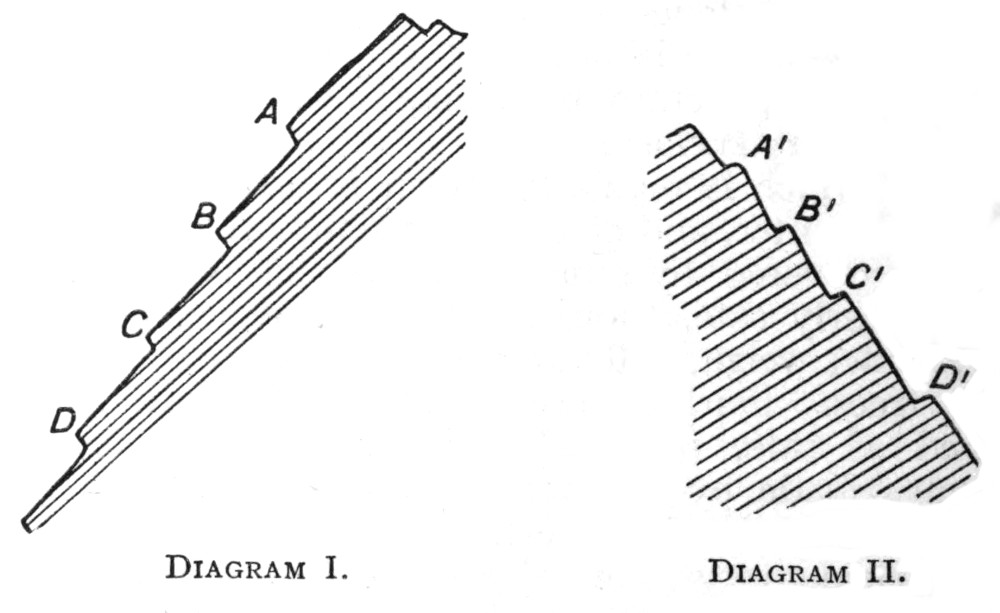
Diagram I. Diagram II.
Geological maps indicate the ‘strike’ of the strata, and therefore provide useful clues as to the varying liability of slopes to avalanche.
Loose scree guarantees the ski-runner against ground avalanches, but, as the winter advances, loose scree is soon covered with deep snow, from which later layers of snow can slide uninfluenced by the underlying scree. In fact, as the winter advances, the original underlying surface plays a smaller part in the problem of avalanches. Hard-crusted snow covered by soft snow is especially dangerous, and of course ice, as is so often met with in the High Alps, is the worst under-surface of all. Fortunately, snow often attaches itself firmly to ice, transforming an ice slope into a snow slope.
The conditions necessary for this transformation will be explained on pp. 426-427.
So far we have dealt with primary conditions, the nature of the ground before the snow has begun to fall and the gradient of the slope from which the avalanche slides. An important factor is the quantity of snow on the slope. It often happens that a shallow superficial layer detaches itself and carries a ski-runner down the slope. If the slope ends on gentle ground, no damage is done beyond the loss of height and the consequent waste of time and effort in reascending to the spot from which the avalanche started. But if the snow slide carries the ski-runner over a cliff or into a bergschrund or crevasse, it is clearly immaterial to the ski-runner whether his original snow slide was 1 inch or 6 feet in thickness.
I propose to use the word SNOW SLIDE for such small avalanches as are only dangerous where they carry the ski-runner on to dangerous ground, such as the edge of a precipice, and to reserve the word AVALANCHE for avalanches deep enough in themselves to overwhelm and possibly to kill a ski-runner.
Though a very small layer of snow—an inch or even less—is enough to produce a snow slide, especially if the shallow layer rests on ice, the amount of snow necessary to produce a real avalanche is much greater, and varies very much with the quality of the snow.
Classification of Avalanches
The old writers divided avalanches into ‘Grundlawinen’ (ground avalanches) and ‘Staublawinen’ (dust avalanches)—a misleading classification, for a ground avalanche may be composed of dry powder snow, and produce all the appearance of a ‘Staublawinen’: the clouds of white snow dust, once supposed to be peculiar to avalanches of powder snow, are really common in almost every type of big avalanche, especially where the avalanche falls over steep cliffs. I prefer to divide snow avalanches into four main classes:
I. Dry powder avalanches.
II. Wet new snow avalanches (i.e. powder snow which has begun to thaw as differentiated from old wet snow which is formed by crust which has been thoroughly melted).
III. Snow-slabs.
IV. Wet old snow avalanches—the Grundlawinen of the older authors.
I. Dry Powder Avalanches.—Newly fallen snow, which has not been subject to thaw or sun, contains a great deal of air until it settles, and even when it has settled it still imprisons a considerable quantity of air. This makes for stability, for snow is less likely to avalanche when it lacks cohesion. I have often experimented on newly fallen snow at a low temperature, and I have found it almost impossible to start an avalanche on any slope below about 35 degrees and less than about 200 feet in height. Small snow slides are common enough if the underlying surface is hard; but as a rule even snow slides come to a standstill after a few yards. The really dangerous dry powder avalanches only occur on very long and steep slopes, where the amount and mass of the snow is sufficient to produce the necessary momentum for a big avalanche. Dry powder has a strong internal friction, and, as a rule, some powerful external impact is necessary to start an avalanche. Of such impacts wind is the most dangerous. A sudden blizzard may convert a valley, safe when the ski-runner entered it, into a veritable death-trap. Further, the fall of an avalanche on one side of a valley may precipitate other avalanches on the opposite side. Partly owing to the air imprisoned in dry powder, and partly owing to the momentum of the avalanche itself, the wind caused by a big fall of snow is extremely powerful and destructive. Houses and trees are torn away by the blast, even though they may be beyond the track of the avalanche. The force of the wind is multiplied manifold when the avalanche falls into a constricted space, such as the floor of a narrow valley. I have seen a bridge just below Gletsch destroyed by a spring avalanche, or rather by the wind caused by an avalanche on the opposite side of this very narrow valley. A large part of the bridge, weighing several tons, had been thrown upwards to a height of about 150 feet!
After a heavy snowfall the danger of dry powder avalanches may last for a day or two, or even more; but as a rule two or three days of settled weather and keen frosts render most northern slopes—in winter, though not in spring—safe enough. When the powder snow has passed into the stage known as Crystal powder—i.e. when the small light dry powder has been converted into crystals of an appreciable size—the danger of avalanches is very remote. On a windless day with a temperature in the shade below freezing, I should not hesitate to cross almost any slope up to 35 degrees which was covered by genuine crystal powder snow, provided that the slope petered out gradually on to the level and did not overhang a cliff.
II. Wet New Snow Avalanches.—Directly the powder snow is exposed to surface thaw, either owing to a rise of temperature or to the sun, its weight and cohesiveness increase, and the danger of avalanches is consequently much greater. Sometimes the snow falls with a temperature above freezing. This wet new snow is dangerous, but as it is also extremely unpleasant for ski-ing, few ski-runners are likely to be abroad. On the other hand, ski-runners are often tempted to cross a southern slope where the powder is beginning to melt. Snow on a steep southern slope soon gets thawed through the bottom, so that ground avalanches are quite normal in winter on south slopes. As a rule, south slopes in winter get rid of their superfluous snow in the first two or three days of fine weather. The snow that remains is thawed by day and frozen by night, so that at the end of four or five days the south slopes have got rid of their avalanches, and the snow that remains is a crust more or less hard and slippery. This crust by day may become soft breakable crust, but once it has crusted, a slope in the winter is not likely to avalanche until there is a new snowfall. A very marked rise in temperature may make a south slope that has been crusted dangerous again; but such sudden and marked rises of temperature are rare in winter.
In general, therefore, south slopes in winter are safer than north slopes. They give rise to more avalanches, but such avalanches as fall off south slopes generally fall within two or three days after a snowfall, after which a south slope is crusted and safe in winter; and though after a few days of settled weather most north slopes are absolutely safe, very steep and very long north slopes, or short steep slopes overhanging a cliff, are always dangerous. Of course, whenever the wet Föhn is blowing, or whenever there is a general thaw, all steep slopes, and a great many moderate slopes, become very dangerous indeed. The effect of the thaw is to give the snow the cohesiveness and weight which it lacks in its pristine dry condition. The dampness in the air saturates the snow with moisture and increases its weight. During a severe Föhn you will often see huge ground avalanches almost as destructive as those that fall in spring. When the Föhn is blowing ski-ing is always extremely dangerous. Fortunately, it is also extremely unpleasant, or fatal avalanche accidents would be more frequent.
The dry Föhn (see p. 418) is much less dangerous. Unless it is very pronounced, it will hardly affect northern slopes in winter, though it may convert a south slope, usually covered by hard crust, and therefore safe, into soft wet and dangerous snow.
In spring northern slopes usually hold powder snow for a few days at high altitudes, and even at moderate altitudes in the early spring, such as March. This powder snow soon loses the dry, light, powdery characteristics of winter powder. Though it continues to yield excellent running, spring powder is very liable to avalanche. It is damper and more cohesive than dry powder, and therefore more dangerous. Dry powder often rests on the ground below. A northern slope will often be covered with a homogeneous layer of powder some feet in depth, but spring powder (see p. 413) invariably rests on a hard-crusted slope below. It therefore tends to slide away during the warm hours of the day, and should be treated with very great caution.
Avalanches composed of spring powder are, properly speaking, new wet snow avalanches. They must be carefully distinguished from old wet snow avalanches, for old wet snow is formed by the melting of crust, whereas spring powder is formed by the melting of powder snow, i.e. ‘new snow.’ Snow may be defined as ‘new’ before it has been crusted, and as ‘old’ when it has been through the crusting process. Thus powder snow is always ‘new,’ however long it may be since it fell. On the other hand, a snowfall in June may be turned into crust within twenty-four hours, and thereby become ‘old snow.’ Crust and soft snow formed by the melting of crust are both ‘old’ snow.
Spring powder is all the more dangerous, because it yields wonderful ski-ing at a time when other slopes have been spoiled by the sun. Furthermore, as spring powder is found on north slopes, ignorant ski-runners underestimate its danger; for it is a common fallacy among the inexperienced that south slopes are more dangerous than north. In spring the reverse is usually the case, for avalanches in spring are occasioned by the general air temperature just as much as by the sun. (See also below, p. 438)
III. The Wind-slab.—The wind-slab is the most treacherous of all avalanches, the most difficult to foresee, and the most incalculable in effect.
Falling snow is usually accompanied in the High Alps, and often accompanied in the lower regions, by wind. If the wind is powerful, the falling snow is driven over exposed ridges in whirlwinds, and comes to rest on the lee-side and in sheltered hollows. In this way the snowy avenues leading to glacier passes and the more sheltered snow-fields receive more than a fair share of snow. This action of the wind, denuding the exposed ridges and feeding the hollows and lee-sides, takes place on both a large and a small scale: on a large scale, when snowy valleys are fed from the snow blown off the exposed ridges that rise out of them, and on a small scale on any slope exposed to wind which is divided by ridges, however small. Any tributary ridge on a slope across which a wind is blowing will have a wind-side and a lee-side, and will accumulate snow on the lee-side and give off snow on the wind-side. A stone wall or even a hedge provides an example of this on a small scale.
Snow driven by wind and settled on lee-sides may either be more or less powdery, a denser, heavier powder than normal powder, or it may assume one of the many forms of wind-caused crust. We have described on p. 407 the various forms of winded powder, such as ripplemark, caked powder, etc., and on p. 408 the various forms of wind-formed crust, such as windboard and Skavla.
In general, the greatest caution should be exercised when crossing any slope which has accumulated much wind-driven snow. Wind-driven powder snow is heavier and more adhesive than ordinary powder. It is more detached from the underlying surface, and is much more conducive to avalanches. The ski-runner should keep his eyes open for traces of wind action, and when he finds snow which has obviously been exposed to severe wind, he should exercise the greatest possible caution on crossing over to the lee-side of a ridge dividing slopes, whence the snow has obviously been blown away, from slopes where the wind-driven snow may have fallen back to earth. Wind-driven powder may in turn be covered by a new snowfall, which adds to the difficulties of diagnosing the avalanche risk.
So far we have been dealing with wind-driven snow which still retains some suggestion of powder, which is soft and dense and caky. A still more treacherous and dangerous wind formation is the wind-slab, or ‘Schneebrett,’ of Continental authors.
Windboard, as already explained (p. 407), is a hard, slippery crust formed by wind. Windboard is common on glaciers in the winter months, and though disagreeable to ski on, it is safe enough in most cases. Sometimes, however, this windboard, instead of being homogeneous with the underlying snow, is loosely attached, and in places forms a vault with a hollow space between the windboard and the snow beneath. The windboard is, then, properly speaking, a wind-slab. The wind-slab, or, as some writers prefer to call it, the snow-slab, is formed by wind-driven snow, which eventually settles into a hard crust. As the wind-drifted snow is of a different density to the snow on which it settles, it tends to form a distinct stratum from the underlying snow. In winter the temperature is usually considerably below freezing, so that snow which falls, or snow which is drifted by the wind, cannot bind with the snow below. In order for two strata of snow of very different density to form a homogeneous whole, there must be a period when the temperature is just above freezing in order to produce the melting followed by frost, which is a necessary factor in the fusing together of two successive layers of different types of snow.
The wind-drifted snow, ultimately transformed into a hard crust, is then of a different density to the snow below, to which it is loosely attached. This underlying snow may be either soft snow or hard crust; in either case the wind-slab forms a covering layer insecurely attached to the foundation snow. This superficial layer is subject to different strains from those which affect the underlying snow; for the tension due to the expansion and contraction which follows changes of temperature affects the layers formed of snows of different density and character in varying ways. The surface layer, or wind-slab, may contract more obviously than the snow below, so that if the slope is concave in shape, the wind-slab, in contracting, tends to form an arch above a more or less shallow vault.
There is little if any surface indication to betray the fact that the wind-slab is not homogeneous with the underlying snow; the ski-runner may cross some such slope without the least suspicion that the hard, slippery crust is not quite so solid as it appears. Suddenly he will hear a sharp cracking noise; the hard crust will settle under him and cave in; the crust cracks along the line made by his ski, and the whole slope comes down on top of him in a cataract of tumbling blocks. The strata formed by the wind comes away, tearing with it much of the soft underlying snow, and pours down in a floor of hard, icy blocks of snow.
The wind-slab is the most dangerous and deceptive form of avalanche. Its hard polished surface gives a false sense of security. The temperature is no guide, for wind-slabs can avalanche at any temperature. Indeed, extreme frost tends to make the wind-slab more brittle. It can avalanche after days or weeks of fine weather when all the more obvious avalanches have fallen. Lastly, this wind-slab is to be found in the natural line of approach to glacier passes, in the long sheltered avenues that collect the snow blown off the exposed ridges.
It is of primary importance to distinguish most carefully between the crust formed by sun action and the crust formed by wind. A south slope crusted by sun followed by frost will never avalanche so long as the crust remains unmelted. Sun-formed crusts never avalanche. A careful study of south slopes will soon teach the ski-runner to recognize crust formed by sun and to distinguish it from crust formed by wind. The wind-slab is usually patchy, granulated, and often betrays the action of wind by a slight rippled appearance. The expert can detect wind-formed crust and can distinguish it from sun-formed crust.
The contrast between crust formed by sun (or by any process of alternate melting and frost) and crust formed by wind is instructive. The fact that the former is safe and the latter often dangerous is due not to any surface differences but to the difference in the nature of the connection between the under-surface of the crust and the underlying snow.
Sun-formed crust always merges gradually into the underlying snow. There is no sharp plane of cleavage. The hard crust merges into softer crust; the softer crust into soft snow. There is often, of course, a plane of cleavage between two successive falls of snow—the upper layer may be soft snow resting on crust; or it may be snow which is superficially crusted resting on crust. And directly the sun melts the superficial crust there may be danger. But so long as crust formed by alternate melting and frost remains unsoftened by the sun, it may be deemed to be absolutely safe so far as avalanches are concerned, for this sun-formed crust will merge gradually into the snow immediately below it.
Wind-formed crust is, however, often sharply separated from the snow underneath it. Wind-swept crust may overlie powder snow with no intervening and softer crust to act as a binding influence. The crust may be absolutely separate, susceptible to different strains and tensions, and forming the shallow vault described above.
Should you suspect a wind-slab, sound with the ice-axe, and try to discover whether the snow is homogeneous or rests on a soft streak of snow below. If, at the border of the dangerous slope, a sharp stamping with your ski produces a settling noise, followed by the breaking away of detached fragments of snow-slab, you will know that the slab is probably insecurely poised on a shallow vault below.
Wind-slabs are, fortunately, not very common. They can only exist under winter conditions, heavy snowfalls, severe wind and comparatively weak sun action. After April, for instance, the formation of a wind-slab would be impossible, for the May sun is strong enough to melt any crust formed by wind or by any other action. In summer they are uncommon excepting under unusual conditions. They sometimes occur in late summer, when the sun has lost much of its strength and is no longer powerful enough to thaw snow which has been converted by wind into a wind-slab.
IV. Old Wet Snow Avalanches.—For the distinction between old wet snow and new wet snow, see p. 427.
Old wet snow avalanches are very common in spring. The snow, which has been melted and frozen, and remelted again and again, gradually becomes denser and heavier. As the spring advances the power of the sun becomes very great. In the afternoon, and at lower altitudes long before midday, most snow slopes are saturated to a greater or a lesser depth by the melting power of the sun. Such old wet snow is of course extremely dangerous.
The great spring avalanches, the ‘Grundlawinen’ of Continental writers, usually select well-known tracks. Some of them have local names, and their annual occurrence is as regular as the return of spring. The long tongues of bare spaces between forests mark their track. Incredible quantities of snow are torn from the mountain side; trees are uprooted and boulders carried downwards. The avalanche comes to rest far below, and spreads out a discoloured tongue of snow-blocks, dark with the earth rooted from the mountain side, and strewn with small trees and shrubs. Sometimes, after an unusually severe winter, these big spring avalanches extend their domain, and destroy chalets, and bridges, and even villages. Roads that cross the line of these spring avalanches must be ensured against destruction by tunnels.
Superficial avalanches of old wet snow are more common than these big ground avalanches. These superficial avalanches occur daily in spring weather. The snow is saturated with water, which acts as a lubricant between one layer of snow and the harder crust beneath. Sometimes avalanches are started by the snow thawing from the ground upwards, for the ground in the late spring is warm enough to thaw the snow immediately above it. I have seen a vault one foot in height between the ground and the overlying snow.
The power of avalanches is best appreciated by those who have visited the Alps in May. It is an interesting, if annoying, experience to be confined to some high alpine club hut in May by a sudden invasion of Föhn. If the club hut can only be approached over steep ground or up a steep and narrow valley, there is nothing to be done but to wait till the Föhn disappears. Hardly a minute passes without an avalanche falling off some near or distant slope. The roar of big avalanches is varied by the hiss of the smaller snow-slides. Thousands of tons of snow are removed from the steeper slopes every hour.
Old wet snow avalanches are much more deadly than avalanches formed of new snow. Newly fallen snow weighs about 1½ cwt. the cubic yard. Old wet spring snow weighs about 15 cwt. or ¾ of a ton the cubic yard—in other words, ten times as much as newly fallen snow.
Furthermore, if you are overwhelmed by old wet snow, you will find the very greatest difficulty in freeing yourself, even if you are only covered by a layer a foot or so in depth. Powder snow contains a great deal of air, so that you can live for some time even if buried in a powder avalanche, but the wet spring snow contains nothing but water, and suffocation is a matter of minutes.
Whenever the Föhn blows in spring, all slopes above a very moderate degree of steepness immediately become extremely dangerous. In normal clear weather there is a frost at night, so that any slope, however steep, can be crossed without fear of avalanches between sunset and dawn. As soon as the superficial soft crust begins to form on the wet snow all danger of avalanches disappears.
On the lower slopes in May, the interval after the dawn during which a steep slope may be crossed with safety varies greatly. In May hard crust softens with surprising speed, and after 9 a.m., or even earlier, the risk of avalanches below the glacier level soon becomes formidable.
A vital distinction must be drawn between the kind of softening that is produced when a solid homogeneous crust softens superficially, and the melting of a superficial layer or crust resting on an older crust below. The second case occurs when a layer of soft snow, or of crust, rests on the older strata of crust. Once this new layer has melted it is very liable to slide off from the older layer below. On the other hand, a homogeneous crust softening superficially is usually safe enough so long as the underlying crust remains hard. Telemark crust, which is crust softened superficially so that Telemarks are easy (p. 415), is usually safe.
The great danger is the existence of a layer of crust formed by a recent snowfall resting on an older layer. I was once climbing the steep slopes that lead from Zinal to the Mountet glacier. It was on the last day of April, and the sun had just struck the slope. The local guide was leading, and I ventured to suggest a detour to avoid a traverse across a slope that had begun to soften. He ignored the risk, and proceeded. I remained behind and watched him. Suddenly a layer of snow about six inches in thickness, which had softened down to the old hard crust beneath, slid away with startling rapidity. The guide gave a small jump, and got his ski into the old layer, while the softened snow slid away and disappeared over the cliff below. The guide’s top ski had cut through to the old layer before the snow slipped, otherwise he would have been killed.
In May in the High Alps the risks of such avalanches is small on all save very steep slopes. Most of the big spring avalanches fall below the limits of the summer snowline. They slide off slopes which are bare of snow in summer. Once the region of the névés is reached the danger is very much less, though of course by no means non-existent, especially when the Föhn is blowing. The May ski-runner must often time his ascent to a club hut to arrive in the early hours of the morning, and wait for his descent from the glaciers to the lower valleys for the hour after sunset.
As the winter advances the danger from avalanches increases, not only because the quantity of snow increases and because the sun is more powerful and the temperature higher, but also because the inequalities on the underlying surface gradually disappear. Scree, small boulders, shrubs and other natural checks to the flow of an avalanche vanish in the ever-deepening snow. Roads and small shelving plateaus, which break up a steep slope, get buried. Each succeeding avalanche leaves some of its burden on all protruding shelves, and thereby tends to smooth out the mountain side, creating, in place of a slope broken by inequalities, one long, even flow which presents no hindrance to the avalanche. Thus big avalanches tend to take the place of the smaller avalanches which fell down part of the slope, only to be arrested at some convenient terrace, such as a road or small plateau.
In the spring avalanches often fall right across rivers, which very soon form a tunnel beneath the snow-bridge of the avalanche. Such snow-bridges should be crossed with caution. More than one ski-runner has been killed by breaking through the remains of an avalanche into a river.
It is a common illusion among the inexperienced that north slopes are safer than south slopes in spring. They are not—in fact, north slopes are more dangerous than south slopes. In spring it is the general air temperature which determines the fall of avalanches. True, the south slopes avalanche first, and for this reason north slopes hold much more snow, so that when they finally get rid of their superfluous snow they produce far and away the most destructive avalanches. Of course in spring the sun shines on all slopes, and it shines with quite sufficient force even on due north slopes to produce an avalanche. In fact, the really great spring avalanches are those which fall from northerly slopes.
Summer Snow Avalanches
During the summer months, as already explained, every type of snow can be found in the High Alps from pure winter powder to the numberless varieties of spring crusts and spring soft snow.
It follows that avalanches in summer obey the same laws as in spring. There are far fewer avalanches in summer than in spring, for there is far less snow to fall. Quite enough, however, is left to make the avalanche problem of vital importance for the ski-runner and the summer climber.