WHAT TO SEE AT MOUND STATE MONUMENT
Reading edition
The Mounds
The present-day visitor to Mound State Monument may see, on the 300-acre Monument tract, 40 mounds which are the remnants of the Moundville Indians’ great city.
The visitor will be interested in identifying these mounds as domiciliary (as distinguished from burial mounds and effigy mounds found at other Indian sites). These domiciliary mounds, which were erected as substructures for temples and other important buildings, are rectangular truncated-pyramids. Their sizes vary. The largest, called Mound “B” (see map), is 58½ feet high and covers almost two acres.
Prehistoric Lakes
The several lakes within the Monument area are restorations, made after considerable research, of prehistoric reservoirs. The forty- to sixty-foot bluff at the ancient city’s river front made the Warrior River an impractical source of water supply. These lakes, therefore, may have been used to catch and hold water for daily use and for fishing.
ERSKINE RAMSAY ARCHAEOLOGICAL RESEARCH CENTER
Already constructed through the generosity of Dr. Erskine Ramsay, Birmingham, Alabama, Honorary Chairman of the Board of Regents of the Museum, is a large and spacious laboratory building, in which all archaeological material comprising the Museum’s vast collection is suitably and adequately housed. Space is available for students to study any phase of the subject in which they may be interested. (See photograph on page 20.)
Also completed in the Research Center is one cottage in which a married student might be housed during the period of his studies.
Yet to be constructed are two cottages, a dormitory for unmarried students, and a house for the resident archaeologist.
13
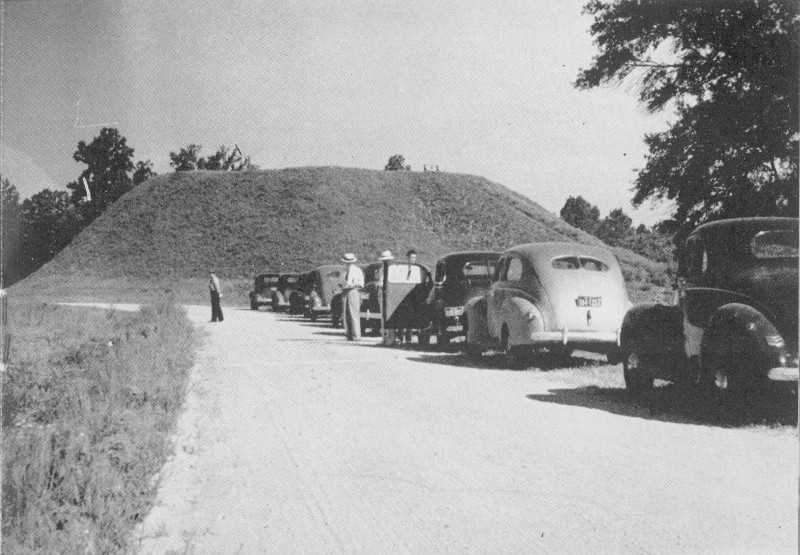
MOUND “B” AND VISITORS.
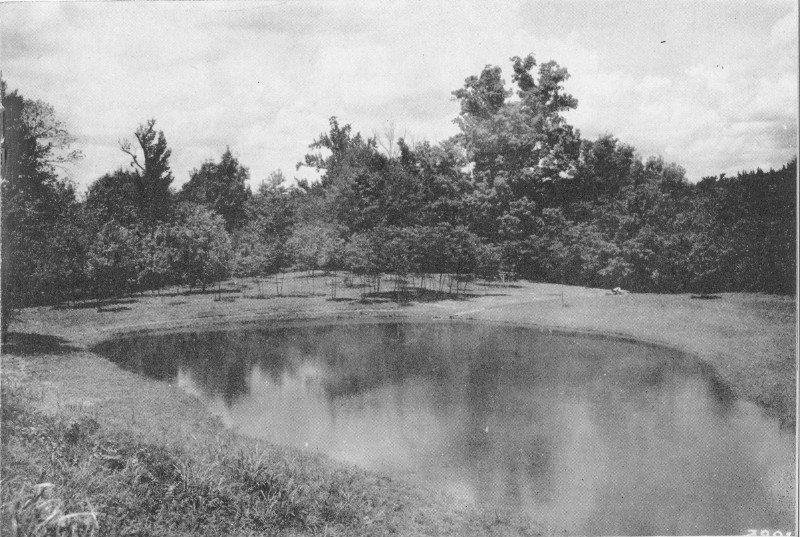
RESTORED PREHISTORIC LAKE AT MOUND STATE MONUMENT.
14
The Archaeological Museum
Arrangement.
The archaeological museum houses an exhibit hall and two in situ burial groups. The exhibit hall makes up the main part of the building. The in situ burial groups are enclosed in wings at the north and south ends of the exhibit hall.
Design.
Design of the building itself was based on ideas used by the Moundville Indian in shaping and decorating his artifacts. The classic three-step motif expressed in the three roof levels of the museum, and used over the doorway, was a favorite design element of the Moundville artist. The skull and arm-bone design making up the parapet frieze was copied from a design on a Moundville Indian pot (see photograph on p. 11). The medallion over the entrance is an enlarged reproduction of a stone pendant once owned by a Moundville Indian (see photograph on p. 4). This pendant as well as the pot from which the frieze was copied may be seen in the exhibit hall.
Main exhibit hall.
Displays in the exhibit hall are designed to illustrate (1) a brief history of prehistoric man, (2) cultural traits and physical characteristics of the prehistoric Moundvillian, and (3) physical features of Mound State Monument.
A brief story of prehistoric mankind is given in the three wall cases to the visitor’s left as he enters the museum. Cultural traits of the Moundville Indian are illustrated in the eight cases along the back wall, and in the five table cases in the exhibit hall. Physical features of Mound State Monument are depicted in the three wall cases to the visitor’s left as he leaves the museum.
Burial groups.
The north wing of the museum (to the Visitor’s left as he enters the building) encloses seventeen in situ burials. The south wing (to the visitor’s left as he leaves the building) encloses forty such burials. These fifty-seven burials, together with their accompanying pottery, ornaments and other artifacts, have been uncovered and left in the ground exactly as they were found.
These burials had been placed in a cemetery area, not a mound. Most of the burials were approximately one and one-half feet under the surface of the ground, although some were only four inches underground and others were three feet. The original ground-level is demonstrated in the exhibit by lines drawn around the edges of the pits.
Studies of Moundville skeletal remains have revealed the sex and individual age (i.e., how old the individual was at the time of burial) of each burial, as well as certain physical defects. Effects of head-flattening, a practice described elsewhere on these pages, are apparent on many of the skulls.
15
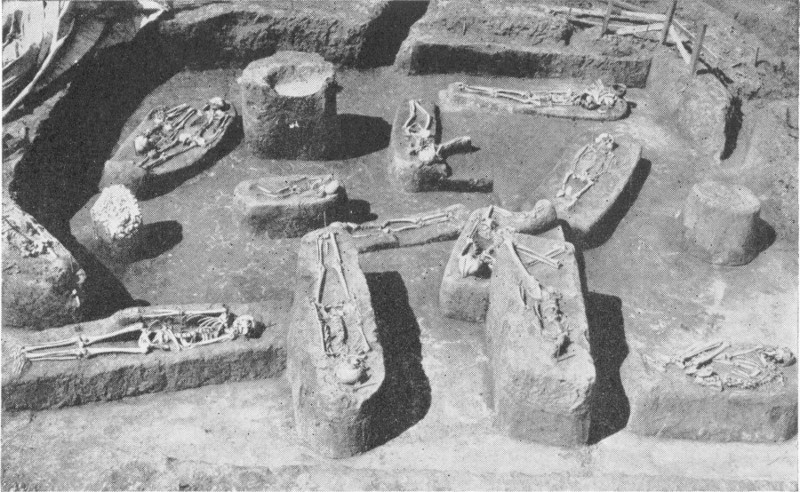
IN SITU BURIALS IN NORTH WING OF MUSEUM.
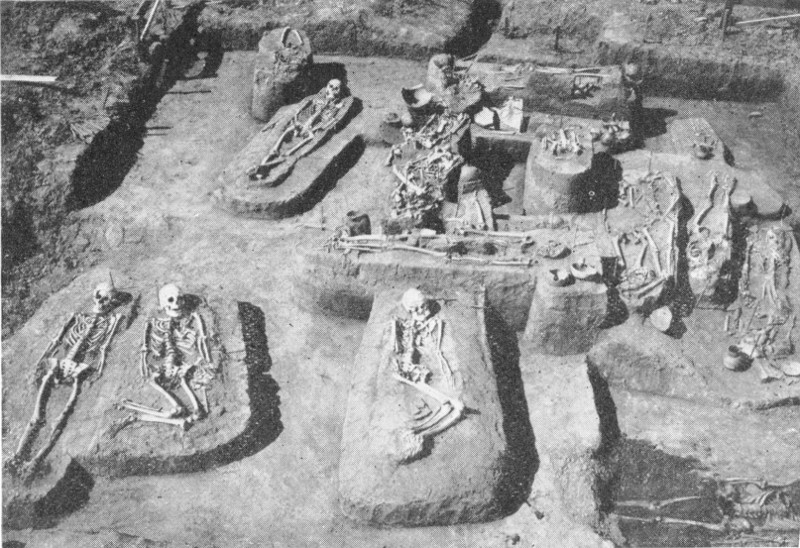
IN SITU BURIALS IN SOUTH WING OF MUSEUM. BURIALS HAVE BEEN UNCOVERED AND LEFT IN THE GROUND JUST AS THEY WERE FOUND.
16