THE PREHISTORIC INHABITANTS OF MOUNDVILLE
Reading edition
Their physical appearance.
The Indians dwelling in the ancient city, though of medium stature, were well built and muscular. Their faces were finely molded and handsome.
Considered stylish were “flattened heads”. Head-flattening was caused by strapping the young Indian to a wooden cradle board. The pressure of the leather thongs on the soft bones of the baby’s head caused a flattening which remained throughout life. Such a head seems to have become a mark of good rearing, and greatly to be desired, for many mothers went so far as to strap sand bags on their children’s heads to induce this flattening.
4
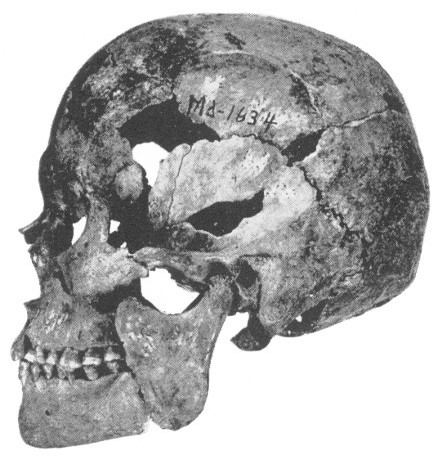
A Moundville Indian skull that was not flattened.
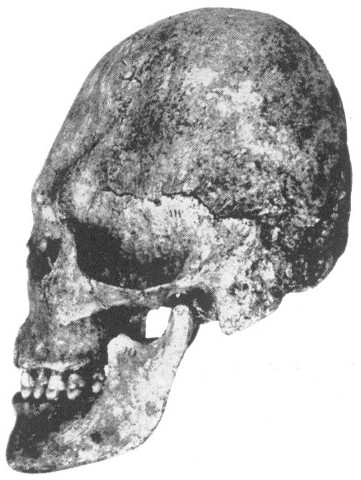
This Moundville Indian skull shows the result of artificial head-flattening.
Their dress and ornamentation.
Leather and fabrics woven of vegetable fibres were fashioned into garments. In extremely cold weather robes made of feathers may have been worn over the rest of their clothing.
The Moundville Indians, both men and women, were fond of personal adornment. They wore ear plugs, bracelets and arm bands of copper, and beads and pendants of bone, stone, shell and copper. Many of their pendants, carved with intricate and delicate designs, would invoke the envy of women of today. Long hairpins were made of bone, and considerable time was devoted to hairdressing.
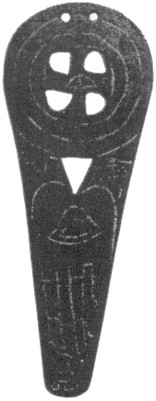
A STONE PENDANT ONCE WORN BY A MOUNDVILLE INDIAN.
Their houses.
From virgin forests the Moundville Indians gathered logs and poles to construct frameworks for their homes. Of reeds and canes gathered along the river they wove house walls, 5 plastering them with thick coatings of moistened sand and clay. Thatched roofs were made of heavy swamp grass. A hole was left in the center to serve as a chimney. The floors were of hard-packed clay frequently covered with sand. These structures were neat, comfortable and weatherproof.
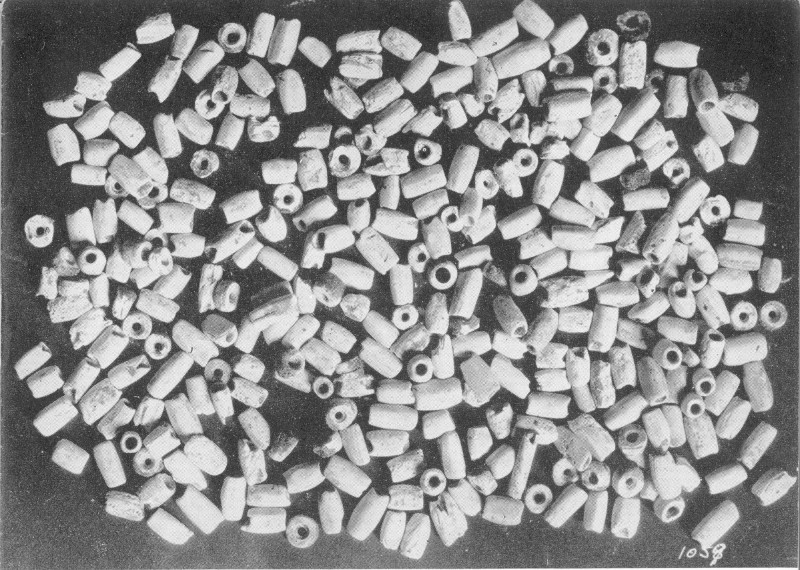
SHELL BEADS WHICH ONCE ADORNED A MOUNDVILLE INDIAN.
Their food.
Living in a temperate climate amid forests teeming with wild game and streams abundant with fish, the Moundville Indians had little difficulty, experienced few uncertainties, in obtaining their food. In addition to meat and fish obtained from forest and stream there were vegetables from fertile fields which produced with little man-made effort an ample supply of maize, squash, beans and pumpkins.
Their implements.
A community of skilled artisans, these people fashioned many tools for food-getting, shelter-making and 6 clothing-manufacture as well as for more aesthetic pursuits. With nets woven of vegetable fibre and barbless fishhooks of bone and copper they took fish from nearby streams and lakes. With small, skillfully chipped arrowheads they brought down fowl. Ingenious traps ensnared large game. Stone fleshers were used for stripping the meat and dressing the leather. With bone awls and needles sharpened on grinding stones they sewed leather garments. Stone mortars and pestles pulverized their grain. Stone chisels and axes felled, with the aid of fire, trees for their homes and temples. Cups and forks and spoons carved from shell were their cooking and eating utensils.
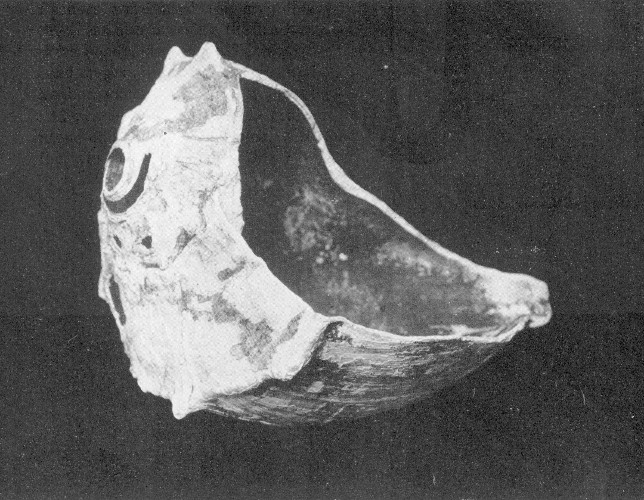
A MOUNDVILLE INDIAN’S SHELL CUP.
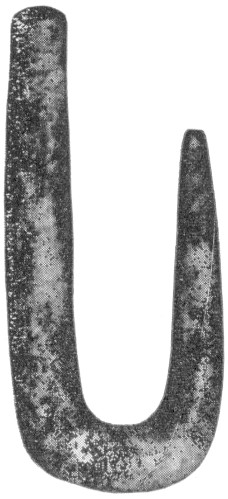
COPPER FISHHOOK USED AT MOUNDVILLE IN PREHISTORIC TIMES.
7
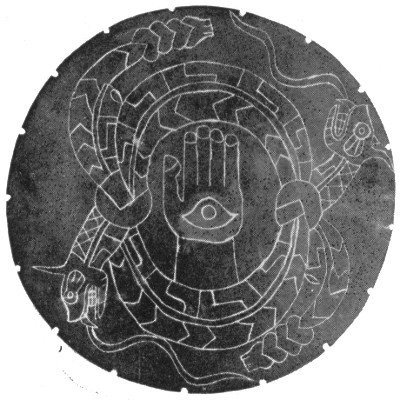
A MEMENTO OF ABORIGINAL RELIGIOUS CEREMONIES AT MOUNDVILLE.
Their religion.
Of paramount importance to the Moundville Indian was his religion. The mounds, on which he worshiped, are enduring monuments to the strength and fervor of his faith. Tons and tons of clay, loam and sand he carried to form these towering structures. Atop the earth pyramids he built great wooden temples and special dwelling houses for chieftans and priests.
Ceremonies performed in the temples were elaborate and colorful. Priests attired in symbolic costumes, and bearing numerous esoteric accoutrements, directed the rituals. Ceremonial trappings included beautiful copper breast plates, shell gorgets, and stone discs and pendants, all delicately carved with intricate, allegorical designs. Among these designs were depictions of the skull and arm-bone, the hand and all-seeing eye, entwined rattlesnakes, and the horned or plumed serpent. Similar designs are found in the symbolic art of the Indians of Central America and Mexico, the Mayas and Aztecs.
8
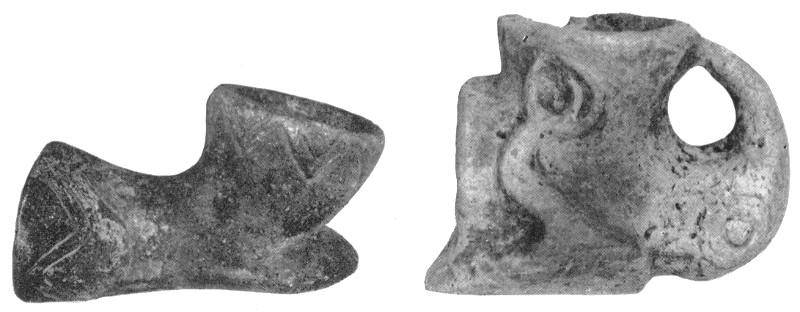
PIPES WHICH THE MOUNDVILLE INDIANS MOLDED FROM CLAY.
Other activities.
Games and contests were popular among the Moundville Indians. One favorite game had the combined features of our football and baseball. Another was similar to a combination of bowling and shuffleboard.
Tobacco-smoking was practiced not as a habit but as a ceremony. Beautiful pipes—some carved from stone, others molded from clay—were smoked through a long cane stem, the bowl resting on the ground. Some pipes were shaped to resemble the human body. Others were carved or molded in the shape of birds, animals and insects.
Their burial customs.
The dead were buried with care and respect. Belief in immortality was expressed by placing material goods near the deceased to sustain him in the other world. His treasured belongings, usually pottery vessels, beads, bracelets and other ornaments, were buried with him.
The Moundville Indian built no burial mounds. His dead were buried in cemetery areas within the city. Usually burial was made in a pit large enough to accommodate the body at full length. Sometimes, however, burial was made in a small pit, the body being drawn up in a flexed position. Burial of the skeleton after it had been stripped of flesh was sometimes practiced.