THROUGH THE HEART OF WALES
Reading edition
One may enter Mid-Wales by the Severn Valley, or by Knighton and the Teme. The probability is that one’s action in this matter is entirely regulated by circumstances, but if haply it were possible to be guided simply by charm the road across the wild hills would be the road to choose. For wide moorlands, whatever the season, whatever the weather, never fail to be attractive; whereas the valley of the Upper Severn is extremely variable in its appearance. Indeed, I have seen it look almost uninteresting: though in the spring, when on every hill the fruit blossom is mingled with the piercing green of the budding larches, I know no place where the youth of the year has a more engaging air.
In any case, we must pass through Newtown. Despite its name, despite its modern appearance, the newness of this town is only comparative; for its prosperity waxed, I believe, as that of Caersws waned; and Caersws, a little higher up the valley, was at its zenith in the days of the Romans. We pass it by and by on our right: a mere village now, of no particular attractions on the surface, though no doubt a sufficiently interesting past is buried beneath its soil, for hypocausts have been found here and tesselated pavement, and coins bearing the magic name of Marcus Aurelius and other names less honoured. Less authentic, but more moving, are the associations of the broad meadow on our left, the traditional scene of Sabrina’s flight from—
“the mad pursuit Of her enragéd stepdame Guendolen,”
and therefore connected for ever with Milton’s exquisite lyric, “Sabrina fair.” This is the “glassy, cool, translucent wave” beneath which the goddess sits; this is “the rushy-fringéd bank” from which—they say—she still sometimes rises at twilight; and here are the cowslips on which she sets “her printless feet” so lightly that they “bend not as she treads.”
Between Llandinam and Llanidloes the scene begins to grow wilder; abrupt hills bare, or patched with gorse, rise from the roadside on our left; we are drawing nearer to the slopes of Plynlimmon. At Llanidloes there is a picturesque old market-place, and the church, founded in the seventh century, has some interesting and beautiful fragments from the Abbey of Cwm Hir; a row of fine Early English arches and some quaint figures on the beams that support the roof.
At Llanidloes we leave the banks of the Severn, and, climbing all the way, pass through a prettily wooded gorge into the valley of another famous river—the river that is more renowned for beauty than any other in England—the Wye. But here at Llangurig the Wye has few charms, for we are at the foot of bleak Plynlimmon, and the river flows through a somewhat dull country that is neither fertile nor wild. Llangurig itself is a desolate, chilly little place, but it has a nice inn; and I believe the fishing is good. About eight miles beyond it we leave the Wye, now a mere mountain stream, at a point that is only four miles from its source, and after this the scenery grows more and more austere, as we skirt the bare sides of Plynlimmon.
Upon those wind-swept slopes the red dragon of Wales was once unfurled; for here Owen Glyndwr, with only five hundred men, was surprised and surrounded by fifteen hundred of the Flemings of Pembrokeshire. He cut his way through them, and left two hundred of them behind him, and left behind him, too, an unshakable belief that he was a wizard indeed.
These heights are not without grandeur. At one point, indeed, there is a very striking and unusual view, where the road is high upon the hillside, and the river, very far below, twists and curls away into the distance through a narrow but extremely level plain. The surface of this main road to Aberystwith is above reproach, but after we turn off to the left on the road to the Devil’s Bridge it is not so good and there are some rather steep hills.
“If pleasant recollections,” says George Borrow, “do not haunt you through life of the noble falls, and the beautiful wooded dingles to the west of the Bridge of the Evil One, and awful and mysterious ones of the monks’ boiling cauldron, the long, savage, shadowy cleft, and the grey, crumbling, spectral bridge, I say boldly that you must be a very unpoetical person indeed.”
The falls, and the wooded dingles, and the monks’ boiling cauldron are still beautiful enough to rouse any poetical feelings that we may possess; but the bridge, alas! is neither crumbling, nor spectral, nor in the least poetical. Three bridges now span the rushing waters of the Mynach, built closely one above the other. The lowest of all, dapper and shining with the cement of the restorer, is the original bridge built by the monks of Strata Florida in the eleventh century and ascribed to the Devil, not from any uncomplimentary feeling towards the monks, but merely because the bridging of the Mynach was no easy matter and demanded a simple explanation. The bridge above this is the one that Borrow calls modern, though it was built in 1735, and now looks older than the first; the topmost and newest of all is quite a recent achievement, and might well appropriate the name of the original structure, since it entirely destroys all the picturesqueness of the scene. No doubt, however, its existence is necessary, for this is the only way across the gorge: and these beautiful wooded hills and deep valleys, with the two tempestuous streams, the Rheiddol and the Mynach, are by no means dependent for their charm on the famous bridge.
The road from this spot to Aberystwith is of a most striking and uncommon character. It is raised high on one side of the bare hill, and overlooks a deep valley, through which the Rheiddol twists and curves. The great hills beyond the valley are richly green in summer, but in the spring are chiefly reddish brown, with streaks of the vivid larch, and here and there a shining patch of gorse. A run of twelve miles, mostly downhill, brings us to Aberystwith.
At the first glance, seen from a distance, it is not unpicturesque. It lies at the end of a valley, with the sea beyond it, and in the heart of it the castle tower stands up conspicuously to remind one that Aberystwith was once something more interesting than a popular watering-place. For once all the resources of England were combined in an attack upon this castle. Guns came from Yorkshire, and timber from the Forest of Dean; huge supplies of arms and various murderous concoctions were sent from Hereford, and a shipload of carpenters landed in the bay to turn the timber into machines of war. There was not a young spark in the country, apparently, but thought it incumbent on him as a man of fashion to join Prince Hal outside the walls of Aberystwith.
Yet the end of all this effort and display was merely comic. Glyndwr’s garrison at last, half starving, agreed to yield the castle upon a certain day unless Owen meanwhile relieved it. The Prince, too hasty, as he sometimes was, went off to London joyfully and received the thanks of Parliament for having secured Aberystwith—at the very moment, had he but known it, when Owen and a relieving force were quietly entering the besieged castle!
This was but one of many sieges suffered by Aberystwith, which was always regarded as a place of much importance; so much so, indeed, that Strongbow’s castle on this spot had been battered into uselessness before the days of Edward I., who had to build another. Prince Henry and Oliver have left little enough of that. What there is of it—some round towers and a piece of the curtain-wall—is more tidy than romantic. To tell the truth, Aberystwith is not a romantic place.
It has been my happy fortune to read some manuscript letters written by a lady from Mid-Wales towards the end of the eighteenth century. This is what she says of Aberystwith—
“I have inquired about Aberystwith, where the Sea is very rough, and no Apothecary near, and most ignorant people in regard to illness, which they are so happy to know nothing of, as the Sea is their ownly Physition.”
This might be useful as a house-agent’s advertisement, if the next sentence were suppressed.
“I think the Sea fogs very unwholesom, but dare not say so, as they are for ever talking about the purity of their air.”
The sea is no longer the only physician at Aberystwith; but the purity of the air is still a topic of conversation.
One of its advantages is that it is only fifteen miles from Ystradfflur or Strata Florida; and though this does not lie upon our route, so short a run is but a slight tribute to pay to a place of such great memories. The drive, moreover, will itself repay us. The road follows the Ystwith most of the way, and crosses it at Trawscoed, where splendid beeches overhang the river and masses of rhododendrons line the banks. There is one formidable hill, with a gradient of 1 in 8, from the top of which there is a fine view of winding river and wooded hills. Soon after leaving the Ystwith we join the Teify near its source.
In the Abbey itself there is little to see, but very much to remember. It was founded in the twelfth century by some Cistercian monks on land given by a Norman; but its foundation is often ascribed to that great prince of South Wales, the Lord Rhys, who was one of its chief benefactors. Once it was the grandest house of worship in all Wales, the burial-place of her southern princes, the depository of her archives; but there is little left to show its past greatness but the unique west doorway and the remains of six side chapels—roofed now with corrugated iron! Behind the south transept is a wedge-shaped strip of ground that was the monks’ cemetery, where, under a stone carved plainly with a cross, lies Cadell, the brother of the Lord Rhys. The large cemetery that holds the dust of eleven Welsh princes is between the Abbey and the river. “The cœmiteri wherin the cunteri about doth buri is veri large,” says Leland, “and meanely waullid with stoone. In it be xxxix great hue trees.” There were originally forty of these yew-trees, and now there are but two or three, so it is hardly likely that one of the survivors should be the tree underneath which Dafydd ap Gwilym, the greatest of Welsh poets, was buried; the tree of which Gruffydd Gryg, his rival, wrote—
“May lightnings never lay thee low Nor archer cut from thee his bow.”
Mr. Baring-Gould tells us how these two bards were constantly in a state of feud and bitter rivalry, till an ingenious friend put an end to their quarrels by simply telling each of them that the other was dead, and was to be buried at Strata Florida on such-and-such a day—mentioning the same day in both cases. Each of the poets, in the glow of generosity consequent on the death of a hated rival, composed a beautiful ode in praise of his enemy, and proceeded to the churchyard to read it beside the grave. There, of course, they met; and each, determined to read his ode at any cost, forthwith read it to the hero of it, and buried his enmity instead of his enemy.
It was somewhere within that “meanely waullid” cemetery that this quaint scene took place; and it was somewhere within these precincts that a thousand frightened children crowded together long ago, waiting to be carried away from their parents and homes in Cardiganshire to the exile in England to which Henry IV. had doomed them. That is an ill-omened name in Ystradfflur—the name of Henry Bolingbroke—for in his fury at the rebellion of Glyndwr he fell upon this sacred place and ruined it, and drove out its monks, and stabled his horses at its High Altar.
To reach Machynlleth, which is our object, we must return to Aberystwith—but we may do this by a slightly different road, diverging at Trawscoed. The surface is better than that of the other, and the road is wider, but there is one bad hill, with a nominal gradient of 1 in 7. As we approach Aberystwith we see, beyond the river, a little place called Llanbadarn Fawr. Here, in very early times, long before the great days of Ystradfflur, there was a famous monastery, founded by St. Padarn, a contemporary of St. David. Like St. David’s own monastery, it was laid waste by the Danes.
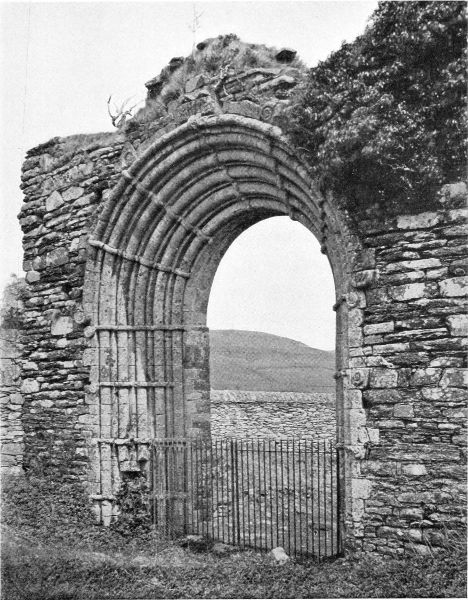
ARCHWAY AT STRATA FLORIDA.
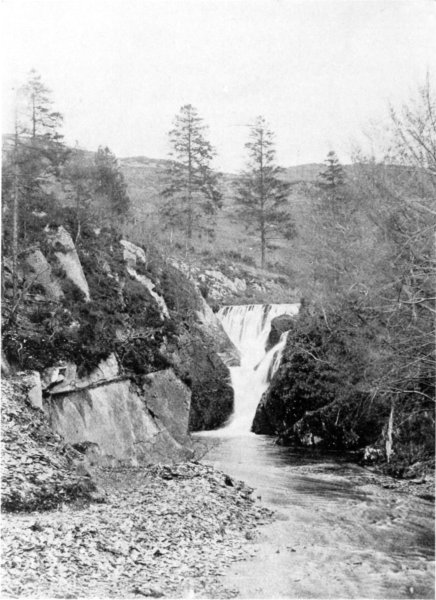
NEAR GLANDOVEY.
Passing through Aberystwith we climb out of it on the further side by a long hill. Except the wide view from this hill there is nothing of special attraction in any way till we have passed Tal-y-bont. Then suddenly there comes into sight the headland beyond the Dyfi (Dovey). Far away on the left is the sea, and between us and it lies a wide and absolutely level plain, with Borth showing darkly on the shore. Soon we pass Tre-Taliesin, named from the great bard of Arthur’s day, whose grave is said by some to lie on this hillside to the right, and by others to be beside the waters of Geirionydd. Beyond this village we climb through lovely woods of birch and larch, and then we run down, leaving the trees behind us, into the beautiful estuary of the Dyfi. A wide sea of gorse is at out feet; the river winds through the shallows beyond; and, bounding the valley and the view, rises the mighty wall of North Wales.
This is on the left—a wide and splendid landscape; and meanwhile on the right are wild hills rising from the road, cleft here and there by narrow wooded gorges or tumbling mountain streams. At Ysgubor-y-coed the water dashes down between sharp rocks, and makes a lovely picture with the great mill-wheel and mossy-tiled building that stand beside it; and just beyond Glan Dovey station we catch a momentary glimpse of the steep sides of the beautiful Llyfnant Valley. Thence four level miles bring us to Machynlleth.
There is a charm about Machynlleth. Its wide central street is planted with trees. In most Welsh towns, History, though she has lived in them so long, has rather an uneasy air: tales of valour, or of treachery on a large scale, blend rather incongruously with prim grey houses and slate roofs. But in Machynlleth we are quite prepared to learn that these quaint and quiet streets—and some of the houses, even—are bound up very closely with the picturesque life of the last of the Welsh princes: so closely indeed, that Owen Glyndwr’s royal seal figures in the arms of the town. In those low, whitewashed cottages he held his first parliament; and in that little corner-house in the next street he rested the uneasy head that wore a crown for such a brief and troublous time. It is the oldest house in Wales, they say, but much renovation and a new chimney have destroyed any picturesqueness it ever had; and it is now neither as venerable nor as interesting in appearance as the Old Mayor’s House, a timber-and-plaster building at one end of the main street, with gables leaning in all directions. Neither do the whitewashed Houses of Parliament show any signs of their distinguished past—yet here Glyndwr accepted his crown and very nearly lost his life. For among the members of this his first parliament was one who was his enemy, and the sworn man of the House of Lancaster. Davy Gam, “the Crooked,” a little red-haired, squinting man who, whatever he was, was no coward, came to this house with the intention of killing Glyndwr, but being betrayed, was thrown into prison for ten years, while his house near Brecon was burnt to ashes. Owen, with unusual forbearance, spared his life, perhaps in acknowledgment of the man’s courage in coming among his enemies single-handed. He showed his courage more honourably at Agincourt. “There are enough to kill,” he said of the French just before the battle, “enough to be taken prisoners, and enough to run away.” He died on that field, and was knighted by Henry V. as he lay dying. “He lived like a wolf and died like a lion,” it has been said of him.
Now, on leaving Machynlleth, supposing it to be our intention to go on to Dolgelley and so to Bala, we have a choice of roads. All the ways are so beautiful, however, that we can hardly go wrong; but those who fix upon the shortest way, by Corris, should know that they will find it well worth while to run down the estuary to Aberdovey and back again. For this estuary of the Dyfi is second only to that of the Mawddach in beauty.
Its best time, certainly, is in the summer, for the hills are thickly wooded; but at all seasons there is a lovely view at every turn of the road. One of those that haunt the memory is from the point where the road to Aberdovey, after passing through Pennal, comes again within sight of the river. In the foreground is a wide expanse of rich colouring, of red and brown, green and gold and russet; beyond it shines a thin line of silver; and beyond that again rise the hills of South Wales—not so imposing by any means as that massive bulwark of mountains that we saw from the other side and are now close under, but yet very beautiful in colour and bold in outline. As the estuary widens a succession of headlands stretch out before us, one beyond another, and round these the road curves, sometimes very sharply. At the extreme mouth of the estuary lies Aberdovey, in the shelter of the hills.
The same eighteenth-century lady whom I quoted before describes a visit to “Aberdove Seaport,” as she calls it. “Down we set at the window,” she says, “... to see the Sea hempty it self in to a Beautifull serpentine river, at the beginning of which lay ten ships at harbour.” One cannot marvel that any one should sit down at a window to watch so strange a phenomenon as the sea emptying itself into a river. Unfortunately this interesting sight cannot now be promised to visitors at Aberdovey; but the “beginning” of the river still owes much of its picturesque effect to the little quays that jut out into the stream, and the ships of considerable size that lie “at harbour.” The best hotel, and it is an extremely nice one, is a short distance beyond the little town, and is perched on the hillside above the golf-links, facing the sea.
It was somewhere in this estuary, probably on the shore of the Traeth Maelgwyn, that a strange scene took place between thirteen and fourteen hundred years ago. Maelgwyn, that King of Gwynedd whose name recurs so often in the history of North Wales, that gigantic man of fitful valour and still more fitful piety, determined to unite all the strength of the west under one ruler, the better to oppose the conquering Saxons. It was agreed that all the princes and knights who had any pretensions should meet together in the estuary of the Dyfi, the dividing-line between North and South Wales; that they should there seat themselves on chairs upon the shore, and he who contrived to keep his seat the longest should be the king. Then Maelgwyn, having settled these preliminaries, had a wonderful chair made for himself of the wings of birds, waxed. As the tide rose the seats of the other princes were overturned, but Maelgwyn’s chair floated on the surface of the sea. So Maelgwyn became chief of all the princes of the west.
From Aberdovey, as I said before, we may, if we choose, drive straight on round the coast by Towyn and Fairbourne, and up the southern side of the Barmouth estuary to Dolgelley. Or we may turn eastward at Towyn, and reach Dolgelley by way of Tal-y-llyn. Or, thirdly, we may return to Machynlleth and drive thence to Dolgelley by Corris.
No motorist should really rest satisfied till he has driven on all these roads, so beautiful are the three. Towyn, I believe, has charms for many, but on the surface it is singularly unattractive. It has a very ancient church, however, built in the twelfth century by Gruffyd ap Cynan, of whom it was said that he built so many that his country “glittered with whitewashed churches as the heavens are bright with stars.” Near it are some extremely interesting old memorial stones; but here, to all appearance, the interest of Towyn begins and ends. Beyond it there are some fine views of the hills as the road turns inland; and again when it turns to the coast and, high on the side of the cliff, curves round into the Barmouth estuary, the effect is really fine. It must have been of this part of the road that a traveller once wrote: “We ascended a precipice, frightful beyond description, on one side of us was the highest ragget Rock I have seen, the stones to appearance lose, and look as if just droping on your heads, some of which have fell a few years ago. The Precipice down to the Mean (Main) Ocean not less than thirty yards, and us travlers not a yard from the side of it, where the waves dash and tide rores, till it made me tremble.” Grand as these “ragget” cliffs are, however, the most beautiful part of this drive is in the Barmouth estuary, under the shadow of Cader Idris. But to many travellers in Wales this valley of the Mawddach is thoroughly familiar, and to them I heartily recommend the road by Corris.
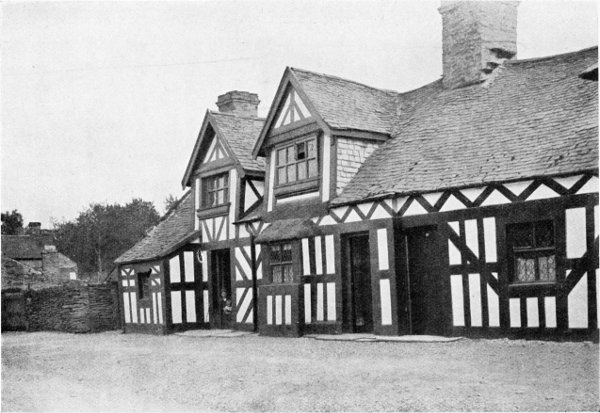
THE MAYOR’S HOUSE, MACHYNLLETH.
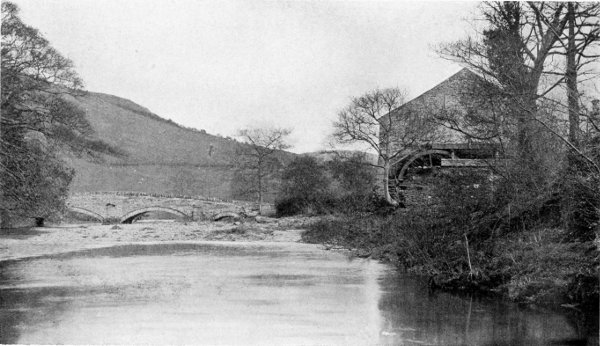
THE RIVER DULAS.
From Aberdovey one drives back to a point in the Dyfi Valley almost opposite to Machynlleth. The river Dulas, near the point where it joins the Dyfi, is spanned by a fine old bridge, whose arches have resounded to the tramp of Henry Tudor’s followers, as he and they marched eastwards to fight for the crown; and to the tramp of Cromwell’s men as they marched westwards to fight, if not for the crown, for everything that goes with it. It is at this point that we turn sharply to the left and follow the course of the Dulas. This opening of the valley of Corris is very lovely, for the river, which has all the impetuosity of a mountain stream, is overhung by splendid trees, and through their stems in the spring we may see the further bank, steep and mossy, and thickly jewelled with primroses. The whole of this narrow and wild valley, indeed, is full of beauty. The road rises gradually to a considerable height; then beyond Upper Corris, where the landscape is defaced, as so often in Wales, by enormous banks of slate, it drops down by some very steep gradients, amid fine mountain scenery, to the level of Tal-y-llyn.
It is only the eastern extremity of the lake that we see, and this we leave behind us, turning at this point sharply to the right into a defile of extreme barrenness. This narrow gorge, with its towering sides reft and lacerated by landslips, its huge boulders poised as though about to fall, its grey slopes softened only here and there by patches of short grass, is the most utterly, the most desolately savage spot I have seen in Wales. As we leave it and emerge into more open country, we realise that those wild slopes were the foot of Cader Idris, for looking back we see the heavy grey shoulder of the mountain. Soon we reach Cross Foxes, and thence run down through beautiful woods on a delightful gradient to Dolgelley, with the purple hills of the Mawddach estuary showing in a long line above and behind the vivid green of the trees.
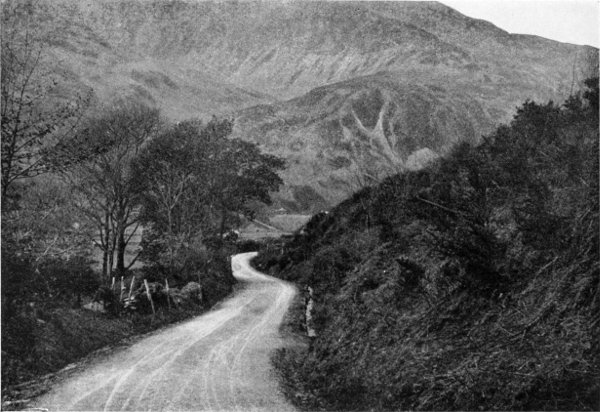
THE PASS OF CORRIS, NEAR TAL-Y-LLYN.
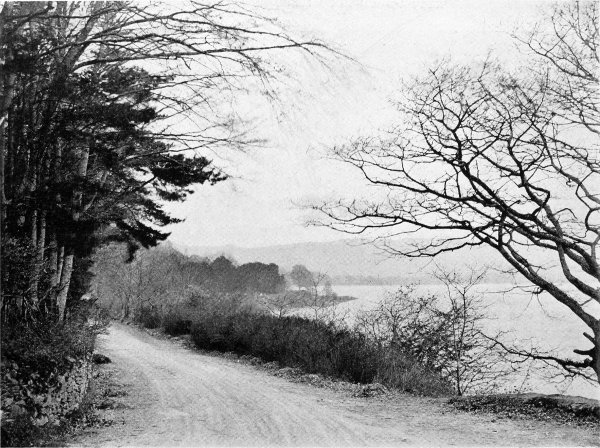
BALA LAKE.
In Dolgelley, as we saw before, all the historical interest is concentrated on a lamp-shop. There is nothing to keep us there, unless we wish for a meal, or perchance a bed, at the “Golden Lion,” or unless we mean to use the place, as many do, as a centre for expeditions. But at present our concern is to turn towards the English frontier, and to reach it through Bala and Llanrhaiadr.
For ten miles after we leave Dolgelley the road ascends, persistently but never steeply. The backward views of mountain, wood, and stream are unfailingly lovely on this road, as on all others that converge at Dolgelley; and no less attractive in its own way is the wilder scenery at the top of this hill, which is practically a pass. From the summit we descend to the shores of Bala Lake, and after driving for three miles close beside its waters we reach the little town.
It is not an especially attractive place. The neighbourhood of the lake is of course pleasant, but the hotel—which, by the way, like many Welsh inns, contains some lovely old furniture—looks out over the street. The scenery of the lake is pretty rather than grand.
Bala must have been more interesting, I think, in Pennant’s day. It must certainly have presented an appearance all its own; for he assures us that the entire population—men, women, and children—spent all their time in knitting stockings. They knitted in their doorways, they knitted as they walked about the streets, and on fine days they sat together on the tumulus at the end of the town, and knitted there. On Saturdays the fruit of all this industry was sold, to the value of four or five hundred pounds, in a special stocking-market. This must have been a sight worth seeing.
We may still see the Tomen-y-Bala, the tumulus where the knitters used to sit and sun themselves, and where, very long ago, a little castle stood. The mound has been made very neat, with gravel paths and rhododendrons; and by paying a small sum we may climb to its modest summit and give a thought to the Romans who made the tumulus, and the Britons who made the castle, and the past generations who made stockings.
Leaving Bala, we may follow the Dee to Corwen, and there join the great London and Holyhead road; and this is by far the simplest route we can choose.
The route we should certainly not choose is the so-called road from Bala to Lake Vyrnwy, the reservoir of Liverpool. The scenery round this lake is very beautiful, it is true, and an excellent hotel stands high on the hillside above the water; and since there is no railway among these wild hills, this is one of the places that show the uses of the motor-car most strikingly. But Vyrnwy should be approached from Shropshire, by way of Llanfyllin. The road that connects it with Bala is a narrow, precipitous pass, cut on the side of a slope that is at some points almost a precipice, unprotected by any kind of fence, sloping downwards on the outer side, and crossed at short intervals by natural water-channels. It is a discouraging picture, and the reality is, to put it mildly, uncomfortable.
As an alternative to the Corwen road we may cross the Holy Dee at the very spot where the “wizard stream,” as Milton calls it—that stream that had the gift of prophesying good or evil fortune to the cause of Wales—flows from the parent waters of Llyn Tegid or Bala Lake, and following a mountain road of many “dangerous” hills, visit the waterfall at Llanrhaiadr before we pass into Shropshire.
The fall is at a lonely spot about four miles beyond the village of Llanrhaiadr, which is itself a pretty place with a nice inn. The road that leads to Pistyll-y-Rhaiadr is little more than a lane, but one may drive up almost to the very foot of the fall. “Prodigious high,” says the letter-writer I have so often quoted: “and seemingly the hend of the world.” There is really some excuse for this dramatic statement. An abrupt mass of rock rises before us impassably. On each side of it are pine-woods, climbing the craggy slopes. There is an air of finality about the place: it is “seemingly the hend of the world.”