SHORT RUNS IN SHROPSHIRE
Reading edition
There was once a tramp who said—“Och, now, it’s true what I’m tellin’ ye; I never got a bit o’ good out o’ me life till I took to the road!”
He was quite serious about it. He was a nice tramp, with a fine sense of romance and a large trust in the future, and on this first day of the tour his words ring in my head above the rush of the wind and the throbbing of the engine. For though all the days will be good, this first day is surely the best. To be on the road again; to have one’s luggage behind one and all the world in front; to watch the villages slipping by and mark their changing character; to saunter through strange towns and swing across great, desolate moorlands; to pause at some attractive inn, or eat sandwiches and sunshine by the wayside—this is the first day. History and the camera must wait; the first day must be given up to the sheer joy of the road.
So, as we shall not be able to hurry in Shropshire, seeing that there history cannot be ignored, we shall do well to cross its border in the evening, and spend the night in Ludlow. We will drop gently down the hill by Ludford House, and cross the Teme when the light is growing dim, and we can only tell by the deepening of the shadows in the trees on the left that the castle stands among them. Then we will climb a short, steep hill into the town through the only one of the old gates that is still standing, turn to the right through the Bull Ring, and draw up before the famous carved front of the “Feathers.”
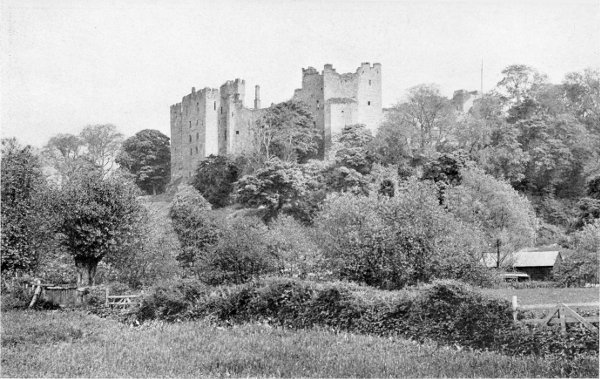
LUDLOW CASTLE.
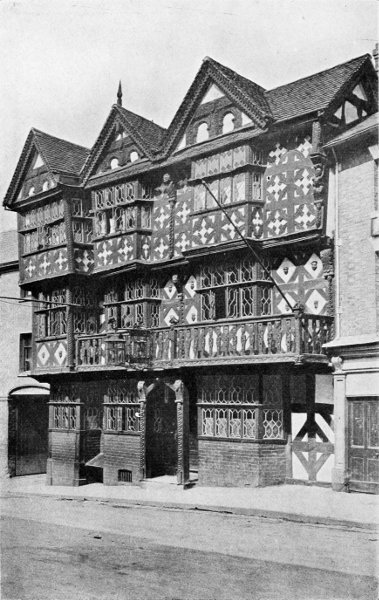
THE FEATHERS HOTEL, LUDLOW.
Here in this little town, in its historic inn, in its church and its great castle, we may find the concentrated essence, as it were, of the glamour of Shropshire—that borderland where the local stories have helped to make the history of England, and the quiet towns have seen wild deeds of courage and horror, and the fields have been red with blood; where every tiny village has its own tale of love or battle, of fair lady or fugitive king. This very house, the “Feathers,” has a world of romance in its timbered walls and panelled rooms, for it is far older than the beautiful Jacobean chimney-piece before which we shall presently dine. These moulded ceilings and elaborate carvings, it is said, were once the property of a member of that Council of the Welsh Marches that Edward IV. established to bring order into the affairs of this stormy neighbourhood, where the “Lords Marchers” had hitherto taken what they chose, and kept it if they could. It is said that the English King once asked by what warrant the Lords Marchers held their lands. “By this warrant,” said one of them grimly, drawing his sword—and the inquiry went no further.
The President of this Council lived in the great castle that still stands so imposingly above the Teme, with its outer and inner baileys, its Norman keep and curious round chapel, and all its long, long memories.
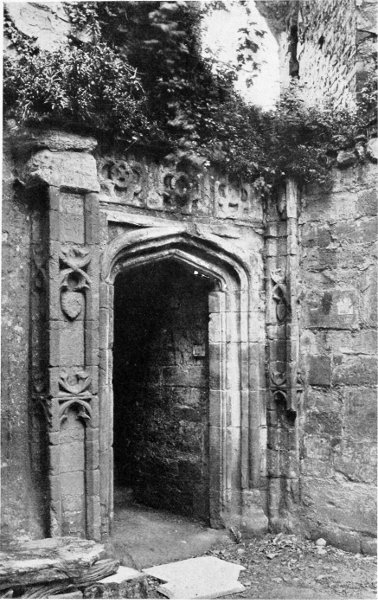
TUDOR DOORWAY, LUDLOW CASTLE.
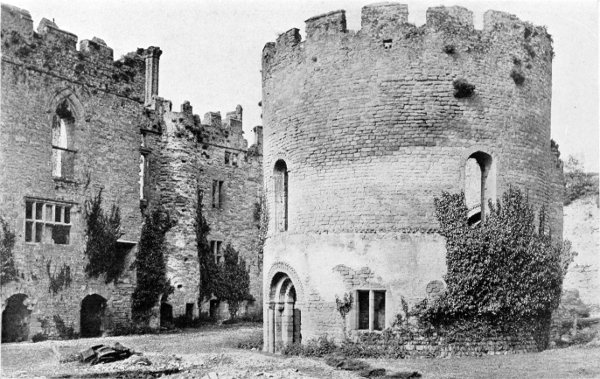
THE ROUND CHAPEL, LUDLOW CASTLE.
Within these grey walls we may dream of many things, both pitiful and gay: of all the children who have played and the poets who have written here; of young Prince Arthur, who died here; of his bride, Katherine of Arragon; of poor Princess Mary—“my ladie Prince’s grace,” as they called her quaintly—the Queen of blood and tears. Edward IV. and his brother Edmund, dressed in green gowns, played in these courts as boys, and wrote a letter to their “right noble lord and father,” begging him daily to give them his hearty blessing, and to send them some fine bonnets by the next sure messenger; and here on the right is the roofless tower whose crumbling walls are haunted by the most touching memories in all Ludlow. For these weed-grown stones have echoed to the voices of Edward IV.’s little sons, who lived and laughed here with no thought of that grimmer Tower that is connected for ever with their names. There is still existing a wonderful letter written by the King to “his Castle of Lodelowe,” in which he gives the most minute instructions as to the education and general deportment of the Prince of Wales—not forgetting the baby’s bedtime. His Majesty, indeed, was definite on all points.
“We will that our said son have his breakfast immediately after his mass; and between that and his meat to be occupied in such virtuous learning as his age shall suffer to receive.”
His age at this time was three years. Not only was the virtuous learning to occupy him from breakfast till dinner, but during the latter meal “such noble stories as behoveth to a prince to understand and know” were to be read aloud to him; and “after his meat, in eschewing of idleness,” he was to be “occupied about his learning” again. It is a relief to read that after his supper he was to have “all such honest disports as may be conveniently devised for his recreation.” At eight o’clock his attendants were “to enforce themselves to make him merry and joyous towards his bed”; and, indeed, after so hard a day of virtuous learning and noble stories and honest disports, the poor child must have been glad to get there!
Later on, when Sir Henry Sidney was President of the Council, this ground where we are standing was trodden by his son Philip, the pattern of chivalry, who “fearde no foe, nor ever fought a friend”; and it was through that doorway at the top of the inclined plane—then a flight of marble steps—that little Lady Alice Egerton, not knowing that she was on her way to immortality, passed on the evening that she took part in the first performance of Comus, which Milton had written for her.
It is curious that in this venerable town so many of our thoughts should be claimed by the very young. Ludlow Castle, as one sits here thinking of the past, seems to be peopled with the ghosts of children. And even in the church whose great tower gives Ludlow so distinguished an air, the church where the solemn Councillors of the Marches have their pompous tombs, we find the grave of Philip Sidney’s little sister. “Heare lyethe the bodye of Ambrozia Sydney, iiijth doughter of the Right Honourable Syr Henrye Sydney ... and the Ladye Mary his wyef.” It is sometimes said, too, that Prince Arthur, Henry VII.’s young son, is buried here, but this is not the case. There is a cenotaph that was, perhaps raised in his memory, but his body was taken to Worcester Cathedral.
These are the gentler memories of Ludlow. Of the fiercer kind there is no lack, from the old fighting days of the de Lacy who built the keep, and the de Dinan who built the round chapel, down through centuries of siege and battle to the time of the Civil War, when the King’s flag flew here longer than on any other castle of Shropshire.
Ludlow might well be chosen as a centre for motor drives in Herefordshire, Shropshire, and Worcestershire. But for the moment we are concerned with Shropshire only, and the centre of that county, in every sense, is Shrewsbury; and so, sad though it is to leave Ludlow so soon, we must glide away down the steep pitch beyond the door of the “Feathers,” past the railway station, past the racecourse, and over the twenty-nine miles of excellent and level road that lie between Ludlow and Shrewsbury.
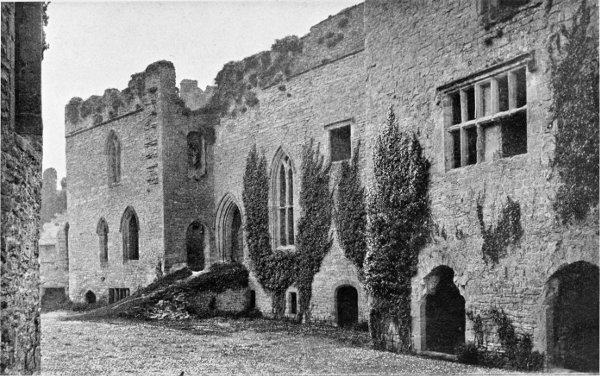
ENTRANCE TO HALL IN WHICH “COMUS” WAS FIRST PERFORMED.
The first village on this road, Bromfield, is very typical of the villages of Shropshire at their best. The black-and-white cottages seem to have been set in their places with an eye to pictorial effect; the stream and bridge are exactly in the right spot; and to complete the picture, a beautiful old gatehouse stands a little way back from the road. It is built half of stone, half of timber and plaster, and was once the gateway of a Benedictine Priory which is mentioned in Domesday Book as being of some importance. It leads now to the church, and is one of those unexpected touches of beauty and interest that may meet one’s eye at any turn of a Shropshire road.
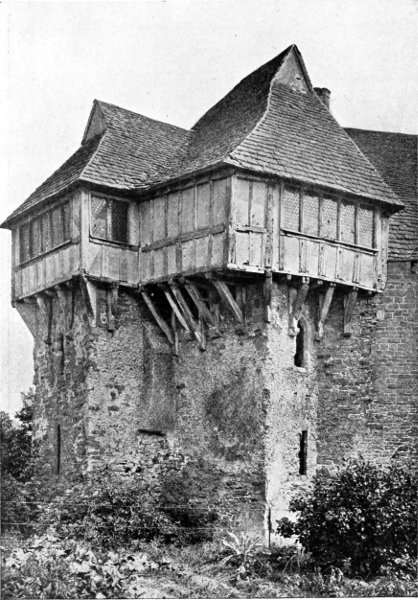
Photo by]
[W. D. Haydon.
STOKESAY CASTLE.
At Onibury we cross the line and the river Onny, and about a mile and a half further on we should begin to look for Stokesay Castle on the left. As it is a little way from the main road, and partly hidden by trees, it is easy to miss it when travelling at a good pace; but it is perhaps the most attractive ruin in Shropshire from an artist’s point of view, and should on no account be neglected. It is really a fortified house rather than a castle, and the mingling of the warlike with the domestic gives it a peculiar charm. The northern end, with its irregular roof and overhanging upper storey, the “Solar Room,” with its magnificent carved chimney-piece, and even the timbered gateway, are all merely suggestive of a dwelling-house; and it is only when we turn to the curious polygonal tower that we remember how in the old days an Englishman’s house was either very literally his castle or was likely to become some other Englishman’s house at an early date. As far as I know, however, the only time that Stokesay had to make any use of its defences was when it was garrisoned for the King during the Civil War, and on that occasion it seems to have yielded without much ado.
It is by very pleasant ways that this road is leading us—between wooded hills and over quiet streams. The valley narrows and is at its prettiest near Marshbrook and Little Stretton; then the pointed hill of Caradoc became conspicuous, and beyond it the famous Wrekin appears—famous not for its beauty, but because, being in the centre of the county, it can be seen by nearly every one in Shropshire, and so has gathered round it the sentiment of all Salopian hearts. “To friends all round the Wrekin!” is the famous Shropshire toast, and there, far away to the right, is the isolated rounded hill that means so much to those born within sight of it. At Stretton we leave the hills and wooded valleys behind us, and pass through a few miles of rather dull country. It is at the village of Bayston Hill that we first see, dimly blue against a background of hills, the slender spires—almost unrivalled in beauty—of that fair town which long ago the Welsh named Y Mwythig, the Delight.
The history of Shrewsbury is stirring, and very, very long. When England was still in the making she stood there on her hill, looking down at the encircling river that has defended her for so many centuries. Nearly every street is connected in some way with history; every second house is haunted by some great name. Many large and solemn books have been written about Shrewsbury, and not one of them is dull. Even in these few hundred yards between the river and our hotel how many memories there are! As we turn on to the English Bridge to cross the Severn we should glance backwards to the right at the red tower and great west window of the Abbey founded by the Conqueror’s kinsman, Roger de Montgomery, a man of mark; and then, having crossed the steep rise and fall of the bridge, we climb into the heart of the town by the hill called the Wyle Cop. It was up this steep hill that, not so very long ago, the London coach used to dash, turning into the yard of the Lion Hotel at a pace that is still spoken of with awe and admiration. If we were to do the like we should probably have to pay five pounds and costs, so we will ascend the Cop in a way more conducive to dreaming of the past: of Harry Tudor on his way to “trye hys right” at Bosworth, with the welcoming citizens strewing flowers before him; of the more stately procession that wound up the hill when he came back as Henry VII. with his Queen and young Prince Arthur; of Robert Dudley, Earl of Leicester, and his stepson Essex, after their reception by bailiffs and aldermen, “and other to the number of xxiiij scarlet gowns, with the scollars of the freescoole,” listening wearily “at the upper end of the Wylde Coppe,” to three orations! Henry Tudor, when he reached the Wyle Cop, was glad to take shelter for the night in that picturesque little black-and-white house with the overhanging top storey and the tiled roof—it is on the left, rather more than half-way up the hill—for he had not won his way into the town without difficulty. “The gates weare shutt against him and the portculleys lett downe,” and a bailiff of the town—“a stout, wise gentleman,” we are told—vowed that Henry should only enter over his prostrate body. So, when Henry had made it clear that he did not mean to hurt the town, “nor none therein,” the only way for the stout, wise gentleman to keep his word was by lying down on the ground and allowing his future king to step over him. Thus did Henry of Richmond come in triumph to the little house on the Wyle.
If we are going to the “Raven,” or the “Crown,” as is probable, we turn to the right near the top of the hill, and pass the beautiful old timbered house—which stands on the right hand, a little back from the street—where Princess Mary stayed on her way to Ludlow after she had been created Prince of Wales; and a little further up, on the left, is the many-gabled house where Prince Rupert lived for a time when he was here with Charles I. On each side of us rises one of the slender spires that are the pride of Shrewsbury. St. Alkmund’s Church, on the left, was founded by Alfred’s daughter Ethelfleda, known as the Lady of the Mercians; a lady, it would seem, of some force. “A woman of an enlarged soul,” William of Malmesbury calls her; and adds: “This spirited heroine assisted her brother greatly with her advice, and was of equal service in building cities.” It is gravely recorded in a serious chronicle that in 1533 “the dyvyll apearyd in Saint Alkmond’s Churche there when the preest was at highe masse with greate tempest and darknes, so that as he passyd through the churche he mountyd up the steeple in the sayde churche, teringe the wyer of the sayde clocke, and put the prynt of hys clawes uppon the iiijth bell.” This steeple on our left was the very scene of this feat; but the body of the church was rebuilt in the eighteenth century. Another old Shrewsbury church, St. Chad’s, had fallen down, and the congregation of Saint Alkmund’s feared a repetition of the disaster. In the case of St. Alkmund’s, however, it was the rebuilding that was the disaster.
The story of St. Mary’s lovely spire, on our right, is full of incident. In 1572 it was “blown aside by wind”; in 1594 “there fell such a monstrous dry wind, and so extreme fierce ... that the like was never seen of those that be living ... the force whereof removed the upper part of St. Mary’s steeple out of his place towards the south about five inches”; in 1662 the steeple was “taken down six yards from the top”; in 1690 it was damaged by an earthquake; in 1754 it was “shattered by a high wind”; in 1756 the newly-built part was again “blown aside”; in 1818 the upper part “became loose”; and during a terrific storm in 1894 fifty feet of its masonry fell through the roof of the nave shortly after the evening service. Most wonderfully this last disaster did no damage to the stained glass, which is St. Mary’s great glory and has itself had an eventful existence; for some of it was in old St. Chad’s when it fell, and much of it, long ago, filled the windows of religious houses in Germany.
The slender columns and pointed arches of this lovely church have rung to the voice of Charles I., who once proclaimed his good intentions within these walls, and knelt, harassed and nearly uncrowned, before this altar. It was in St. Mary’s, too, that James II. touched for the King’s Evil.
Just beyond the church is the Crown Hotel, and whether we stay there or at the “Raven,” a hundred yards away, we shall hear the bells of St. Mary’s, once described as “the comfortablest ring of bells in all the town,” and the chiming clock that was the bequest of Fanny Burney’s Uncle James, and the curfew, which still rings every night at nine. And after the curfew we shall hear the number of the day of the month rung out—a relic of the times before cheap almanacs existed.
There is no doubt that the most satisfactory way of seeing Shropshire is to spend a few nights in Shrewsbury, and make it the basis of operations; for Shrewsbury lies exactly in the centre of the county, and is the meeting-point of a particularly large number of good roads. The old town itself, too, does not deserve to be hurried through. The longer one stays in it the more one feels the charm of its gentle old age.
The Old School Buildings are within a stone’s-throw of us, with all their memories of the wise and great: memories that are, as a matter of fact, older than themselves; for though Charles Darwin was educated within these very walls, it was in an older building of wood, standing on the same spot, that Philip Sidney was a schoolboy—gentle and grave, and as much loved then as he was destined to be all his life, and is still. It was while he was here that his father wrote him a “very godly letter ... most necessarie for all yoong gentlemen to be carried in memorie,” which his mother, who added a postscript “in the skirts of my Lord President’s letter,” considered to be so full of “excellent counsailes,” that she begged Philip to “fayle not continually once in foure or five daies to reade them over.” The counsels were certainly excellent. “Be humble and obedient to your master,” says Sir Henry, “... be courteous of gesture.... Give yourself to be merie ... but let your mirth be ever void of all scurrillitie and biting words to any man.... Above all things, tell no untruth, no not in trifles”; and he ends quaintly: “Well, my little Philip, this is enough for me, and I feare too much for you.” If my Lord President had not also been my Lord Deputy of Ireland one might have loved him nearly as much as his son.
Neither he nor Philip ever saw the timbered gatehouse that stands opposite to the Old School Buildings, but in the red Council House to which it leads, Sir Henry always stayed when he made official visits to Shrewsbury. There were fine doings on these occasions; banquets and processions, with “knightly robes most valiant,” and many scarlet gowns; masquerades, too, by the boys of the school, who appeared now as soldiers, now as nymphs, and made orations in both characters. Later on the same red house sheltered Charles I., when he came here to collect men and money. Half the plate in the county disappeared into his mint, which was set up, some say, in a little tottering house that may still be seen in an alley on Pride Hill—a fragment of green and weather-worn stone that is one of the most picturesque things in Shrewsbury. Some of the money that Charles “borrowed” on this occasion was well spent in repairing the Castle, which is quite near the Council House. The Castle is now a private dwelling, and one cannot walk about the grounds without permission; but the oldest part of it is the great entrance-gate, which all may see; the gate that was built by Roger de Montgomery and attacked by Stephen; the gate through which Henry IV. rode out to the famous Battle of Shrewsbury. The Castle itself, as it now stands, was probably mostly built by Edward I.; but it suffered so much through the centuries from siege, and treachery, and time, that many repairs were necessary to secure it a peaceful old age as a dwelling-house. Every motorist who is properly grateful to his benefactors, will be interested to know that it was the engineer Telford who carried out these repairs. He actually lived in the Castle for a time, I believe, and he certainly built the “Laura” tower, which stands on the foundations of the old watch-tower. Telford was in Shrewsbury when the tower of Old St. Chad’s showed signs of collapsing, and, on his advice being asked, said the church should be repaired without delay. The Parish Vestry begged him to meet them in St. Chad’s to discuss the matter, and demurred so long at the expense that at last Telford walked out of the church, saying grimly that he would rather talk the matter over in some place where there was less danger of the roof falling on his head. Two or three days later it fell.
Not far from the fragments of this ruined church is the High Street, where are some of the oldest and prettiest houses in the town; and hard by is the Tudor marketplace, with its statue of Richard, Duke of York. The claims of the Unitarian chapel in the same street are not based on beauty, but on the fact that Coleridge’s voice once rose in it “like a steam of rich distilled perfumes,” according to William Hazlitt, who had walked ten miles to hear Coleridge preach here, and was as much delighted, he says, “as if he had heard the music of the spheres.” Charles Darwin attended the services of this chapel as a boy, but was baptized in New St. Chad’s, the eighteenth-century church near the Quarry, within whose classical walls Dr. Johnson once worshipped. The Doctor’s famous rolling walk, too, of which we have all heard so much, was once seen under the splendid limes of the Quarry.
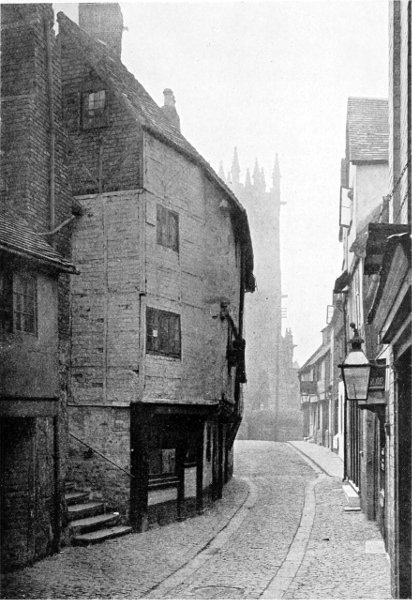
Photo by]
[W. D. Haydon.
OLD STREET IN SHREWSBURY.
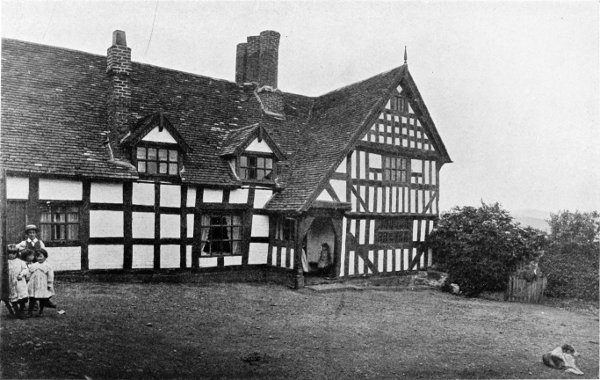
RICHARD BAXTER’S HOUSE, EATON CONSTANTINE.
As we entered Shrewsbury by the English Bridge we caught a glimpse of the Abbey behind us. Leaving the town by the London Road, on our way to see something of the eastern side of the county, we shall pass close by the old red building that was partly spared when Roger de Montgomery’s great monastery was dissolved. It will be worth while to stop the engine for a moment, and to look at the massive Norman piers of the nave, the fine altar-tombs, and the fragment of St. Winifred’s shrine. The founder himself was buried here, after a long life of storm and stress, and three days in a monk’s habit; but the knightly figure that has been thought to represent him is said by the best authorities to be of a later date than his. This Roger is very prominent in Shropshire history, and is, indeed, not unknown in that of England, for he figured in the Battle of Hastings, and wherever he figured he made himself felt. We hear many conflicting things of his character, but from them all we gather that he was a typical man of his day, spending his time chiefly in acquiring his neighbour’s goods, and his leisure moments in building abbeys. Having built this Abbey of Shrewsbury he was careful to see that other people enriched it, and it soon became one of the most important in England. Its actual buildings covered ten acres: yet now all of it that we can see is this restored church, and, across the road, a relic of a later date. There, in the din and dust of a coal-yard, stands the graceful stone pulpit that was once in the refectory wall. From under its delicately carved canopy a lay brother read pious works aloud to the monks while they ate.
As we drive up the Abbey Foregate, between the trees and old houses, the memory of the Benedictines is with us still; for it was down this road that the monks, with their abbot at their head, came once in solemn procession with the bones of St. Winifred. These, by the combined use of a smooth tongue and a stout spade, they had brought triumphantly away from the churchyard of a Welsh village, knowing full well that no wealth of lands and churches enriched a monastery so surely as a handful of saintly dust.
At the top of the Foregate is the column on which Lord Hill stands above a list of his battles. Here we keep to the London Road, and are soon in the open country. We are bound for Boscobel, but as there is a good deal to be seen on the way, a round of forty-three miles is not as short as it seems. Between Shrewsbury and Atcham the scenery is not particularly interesting, but the road is level and the surface good, so we have our compensations. From the picturesque bridge at Atcham there is a lovely view of distant Caradoc, with the Severn in the foreground, and on the river bank the old church that is said to have been largely built, like that at Wroxeter, of the stones from the Roman city of Uriconium. We are very near that city now. If we take the first turn to the right after leaving Atcham, we shall soon be actually passing over the ashes of “the White Town in the Woodland,” as it was called by the Welsh poet who sang of its tragic end; and a moment later we shall see, near the roadside, a fragment of the wall of its basilica. By asking for the key at a cottage close at hand, and by paying sixpence, we may see also the remains of its public baths, and a piece of tesselated pavement that might have been laid down yesterday. Many relics of this town that was built by the Romans, inhabited by the British, and burnt by the Saxons, have been found within the limits of the hundred and seventy acres that it once covered: skeletons of men and women crouching where they had vainly sought safety in the hypocausts of the burning baths; coins scattered by fugitives; pathetic trifles of women’s dress—hairpins, buckles, and a brooch whose pin still works. Older than these are the urns and tombstones found in the Roman cemetery; the tombstone of Petronius, who is thought to have taken part in the victory over Boadicea; and that of “Placida, aged fifty-four, raised by the care of her husband.” Most of the relics have been moved, for safe keeping, to the Museum in Shrewsbury.
From Uriconium a very pretty road leads us to Buildwas. The Severn winds below us on the right, and on the hillside to the left is the little village of Eaton Constantine, which Constantine the Norman—who also gave his name to the Côtentin in France—held in the days of Domesday Book at a rental of a pair of white gloves, valued at one penny. Even at this distance is visible the black-and-white gable of the farmhouse that was once the home of Richard Baxter, author of “The Saints’ Everlasting Rest,” and an amazing number of other books—enough, said Judge Jeffreys, “to load a cart.” Dr. Johnson, however, pronounced them to be “all good.” Here, we learn, Baxter “passed away his Childhood and Youth, which upon Reflection he, according to the Wise Man’s Censure, found to be vanity.” In spite of these austere views, however, his childhood was not without its wild oats, for we are told that he “joyn’d sometimes with other Naughty Boys in Robbing his Neighbours’ Orchards of their Fruit, when he had eno’ at home ... and was bewitched with a love of Romances and Idle Tales.”
Presently, after passing through the pretty village of Leighton-under-the-Wrekin, we see Buildwas, the Shelter near the Water, on the further side of the river. Perhaps this is the most striking view of the fourteen massive pillars of this roofless nave, in which the Cistercians of the twelfth century austerely worshipped; but we can visit the ruins if we wish to do so by crossing the bridge that has quite recently superseded one built by Telford. There is not very much more to be seen at close quarters than from here: the great charm of Buildwas lies in its effect as a whole, in its simplicity and strength, and in its position by the river.
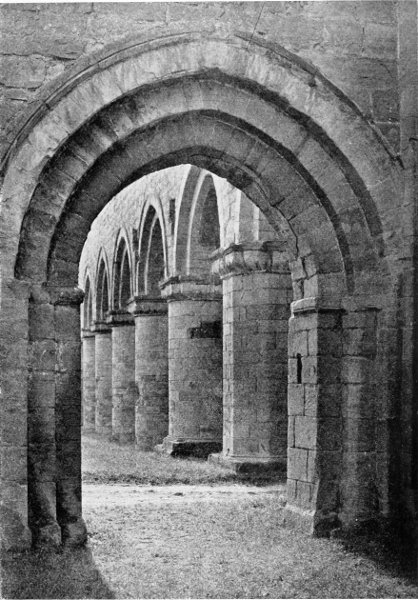
Photo by]
[W. D. Haydon.
BUILDWAS ABBEY.
MADELEY COURT.
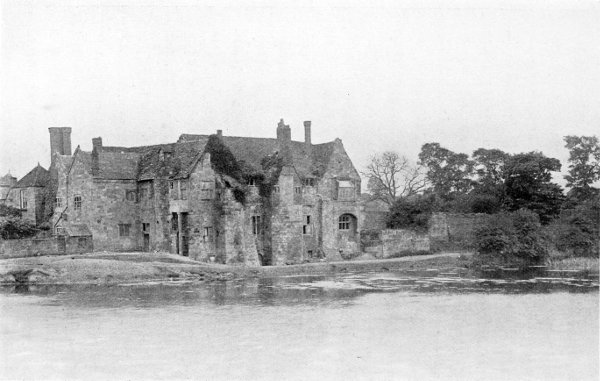
About a mile beyond Buildwas is Ironbridge, named from the first bridge ever built in England of iron, which here spans the Severn at a height of forty feet, by a single arch of a hundred feet in width. It was the work of Abraham Darby, the third of his name, and was finished in 1779. A gradient of 1 in 10 takes us through Ironbridge, and less than two miles further on is Madeley, which appears at first sight the very type of all that is unromantic, a prey to coal-dust and miners; yet if we turn off the main road to the left we shall presently find, hidden in a hollow near Madeley Court Station, as poetic a spot as we shall see in many a day’s journey. Perhaps its very contrast to its surroundings adds to its charm; perhaps to some it may not seem charming at all, but merely a tumble-down, ill-kept house. But to others this little nook, with the weather-stained, crumbling walls and tiled gables of the Court House, the swinging ivy, the still pond, the bulrushes and water-lilies, and the red-and-black timbered barn that once sheltered a fugitive king, are a “faery land forlorn,” the very home of glamour and romance. Here Charles II. arrived one night, dressed in green breeches and a noggen shirt. He was tired and hungry, his hands and face were smudged with soot, and he answered to the name of William Jones. He was refreshed in this house, and spent the next day in the barn with Richard Penderel, one of the five brothers to whom he owed his safety. When night fell he walked to Boscobel.
It was hours before he was there, whereas we, if we were as much hurried as he was, might be there in half an hour or so. But though there is nothing to keep us at Shifnal we must pause at Tong, where there are some especially pretty timbered cottages and a church that is really remarkable, for it contains a collection of tombs which I should imagine to be unequalled in a village church. They are those of the Vernon family, and among them is that of Dame Margaret Stanley, the sister of Dorothy Vernon, of Haddon Hall. Charles Dickens said himself that it was of Tong Village he was thinking when he wrote the end of “The Old Curiosity Shop,” and those to whom Little Nell appeals may think of her and her grandfather in the porch of this church. Some of us, however, will take more interest in the shot-marks that have scarred the northern wall ever since the days of the Civil War.
In a park near the village stands the astonishing structure called Tong Castle. It was once a real castle of stone; in the sixteenth century Sir Henry Vernon rebuilt it of brick; in the eighteenth a new owner thought that Moorish cupolas would make a pretty finish to it. When, in 1643, it was in the possession of the Parliamentarians, it was said on that account to be a “great eye-sore to his Majesty’s good subjects who pass’d yt road.” For other reasons it is so still.
A writer of the seventeenth century describes Boscobel as “a very obscure habitation, situate in a kind of wilderness”; and no doubt it was to this obscurity that Charles II. owed his safety. Even to-day it is wonderfully isolated, and we reach it by a series of rather circuitous by-roads; but we can drive right up to the house, and leave our car in a safe enclosure, while we walk a hundred yards to the Royal Oak—not the original “asylum of the most potent prince King Charles II. ... the oak beloved by Jove,”[1] which was mostly made into snuff-boxes and other treasures for the loyal—but an oak grown from an acorn of that “fortunate tree.” When Charles reached Boscobel at three o’clock in the morning he was taken into the big panelled room that we shall presently see, and was refreshed with bread and cheese and a posset of milk and beer. Colonel Carlis, another fugitive from Worcester, “pulled off his Majesty’s shoos, which were full of gravel, and stockens which were very wet,” and at daybreak went with him into the wood, where they both climbed into the oak—here, where we are standing—with a cushion for his Majesty to sit on. Here, for a great part of the day, the tired King slept with his head on Colonel Carlis’s knee. “He bore all these hardships and afflictions with incomparable patience,” says a contemporary historian. At night he was hidden in the house, buried beneath the garret floor in a box-like priest’s-hole, with a load of cheese on the lid. We may climb the stairs and see it; get into it if we will—and ask ourselves if, after spending a night in it, we should be as lighthearted as this man who at any moment might lose his life and had already lost everything else. In the morning he called for a frying-pan and butter, and, having first despatched Colonel Carlis with a dagger to slaughter a neighbour’s sheep, he gaily cooked himself some mutton collops, while the Colonel, “being but under-cook (and that honour enough too), made the fire and turned the collops in the pan.”
From Boscobel we strike due north to Ivetsey Bank, where we shall find an inn capable of providing a good, if homely, luncheon or tea. Thence sixteen miles on Watling Street will bring us without a pause (unberufen!) through Wellington to the point where we left the main road on our outward journey. It is worth while, by the way, to avoid the unpleasant bit of road through Oakengates by striking across to the main road from Shifnal; to do which we must take a turn in St. George’s, where a lamp-post stands out prominently. We enter Shrewsbury, as we left it, by the London Road.
A slightly longer run, covering about fifty miles altogether, will show us something of the northern part of the county on its western side. We drive out of the town past the station and through the squalid suburb of Ditherington, where, for love of our springs and of humanity, we must perforce drive slowly, by reason of the bumpiness of the surface and the phenomenal number of children. Over this ground rode Henry IV. and Prince Hal to the Battle of Shrewsbury, and there on our right is Haughmond Hill, the “busky hill” to which Shakespeare refers. Presently there appears on the left, a few hundred yards away from the road, the church of Battlefield, raised, with the exception of the tower, quite soon after the battle on the spot where the fight raged most fiercely, in order that masses might be sung perpetually “for the prosperity of the King and the souls of the slain.” Here Harry Hotspur died, and with him thousands of others both gentle and simple, for this was a very notable fight and many interests were concerned in it. Beneath the mounds that we see on the south side of the church are the bones of many of the slain. The King “had many marching in his coats,” as Hotspur puts it in “Henry IV.,” and as they were killed in mistake for him he saved himself by a device more ingenious than kingly.
There is nothing of special note between Battlefield and Hawkestone, which is about twelve miles from Shrewsbury, and is a private park, open to visitors. In the rhododendron season it is well worth while to leave one’s car at the extremely nice hotel at the outskirts of the park, and to walk about a mile through pretty grounds swarming with black rabbits, to see the blaze of blossom for which Hawkestone is famous. And yet I think they will fare still better who choose the time of bluebells. These should drive through the park by the public road. Beyond the gate, where the stream is close to them on the right and woods slope to its edge, they will see, bright in the near foreground but fading away into the distance under the trees in a misty cloud, a soft, ethereal veil of grey-blue. Here and there the green breaks through, and the flowers look like wisps of smoke trailing across the grass. This wonderful sheet of mystic blue borders the river and the road for some way, till the wood ends suddenly, and Hodnet Hall comes in sight.
One really grows a little tired of recording the picturesqueness of Shropshire villages. They are nearly all pretty: for the houses, when they are not of timber and plaster, are often built of the warm red sandstone that is the stone of the county and acquires such soft, mellow colours in its old age. But I sometimes think Hodnet is the prettiest village of them all. Half the houses are black-and-white; and near the church gate a group of timber gables, with the octagonal tower in the background, forms a complete and perfectly composed picture. Bishop Reginald Heber, the author of “From Greenland’s icy mountains,” was rector of Hodnet for some years before he sailed for “India’s coral strand.”
From Hodnet we may either drive back to Shrewsbury or turn to the left in the middle of the village and take a run of about thirty-four miles by Market Drayton and Newport, two picturesque old towns with a good road between them. The scenery in this part of the county is pleasing, but not especially striking. If we choose this way we shall, as we draw near Shrewsbury, pass the ruins of Haughmond, one of the great Shropshire abbeys.
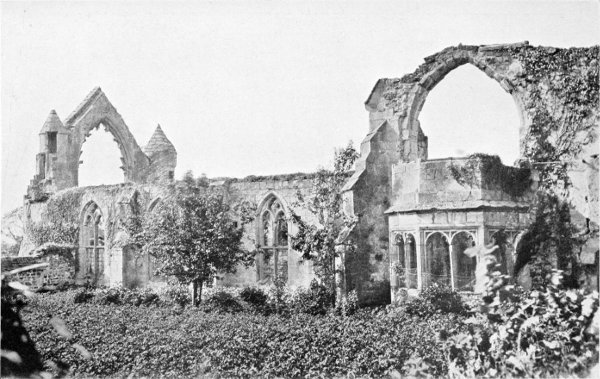
Long ago there was a hermitage at the foot of this “busky hill”; before William FitzAlan’s monastery for Austin Canons rose here, with the great church that has practically disappeared,[2] and the tall gable with the turrets that are so conspicuous to-day, and the chapter-house with the beautiful doorway. This Abbey was greatly patronised by royalty. Stephen gave it a mill, Matilda gave it lands “for the remission of her sins,” Henry II. gave churches, and Henry III. more land, and Llewelyn of Wales “a moiety of Kenwicke.” The list of other benefactions is endless: mills and fisheries, churches and markets, woods and hogs and herds. Many were the “privileges of flesh and fish” enjoyed by the canons of Haughmond; and Abbot Nicholas, in Edward III.’s time, desiring to make the most of all these luxuries, built a new kitchen for the brethren and “appointed them a cook to dress their food.” It was in 1541 that Henry VIII., as his manner was, took possession of Haughmond and all its riches, “beyng mynded to take the same into his own handes for a better purpose”; and so the minster, for which he had no use, gradually vanished. Nothing is left of it but a fragment of wall and a doorway. Two tombs that were once within the chancel now lie open to the sky on the hillside, where their appeal for the prayers of the passers-by is of far more pathetic force than it ever was under the shelter of the Abbey’s roof:—
“Vous Ki Passez Par Ici Priez Pur L’Alme Johan Fitz Aleine Ki Git Ici. Deu De Sa Alme Eit Merci. Amen.”
“Isabel De Mortimer Sa Femme Acost De Li. Deu De Lur Alme Eit Merci. Amen.”
HAUGHMOND ABBEY.
From this road near Haughmond we have perhaps the loveliest view of distant Shrewsbury. The pale hills rim the horizon, the river winds in the foreground, and between them rise the clear outlines of the two incomparable spires that crown The Delight.
Another of the Shropshire monasteries that must certainly be seen is Wenlock Priory, which lies on the way to Bridgnorth. It is a fairly level road that leads to it by Cross Houses and Cound and pretty Cressage, which in Domesday Book is Cristes-ache, or Christ’s Oak. Christianity was preached here, it is said, under an old oak-tree, in days so early that when St. Augustine visited the place he found it already Christian. Between Harley and Wenlock there is a hill which the Contour Book describes with perfect accuracy as “a precipitous hill on which innumerable accidents have happened.” The accidents, I fancy, have mostly happened to horse-drawn vehicles and bicycles—especially the latter—when descending the hill, for it is a mile long and has a turn in the middle. There is no reason why it should inconvenience a good car, for the average gradient is nothing more alarming than 1 in 8, and it is well worth climbing for the sake of the wide view from the top, just beyond which Much Wenlock lies.
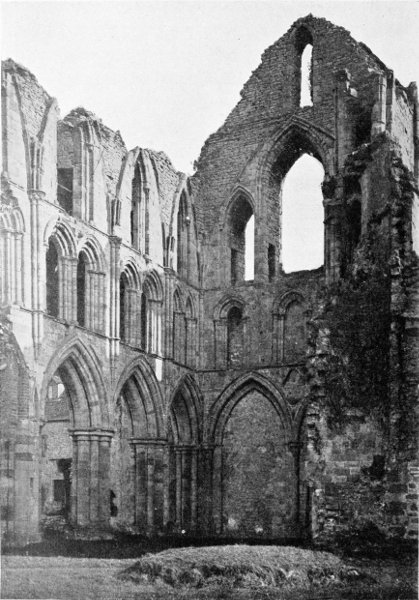
Photo by]
[W. D. Haydon.
WENLOCK PRIORY, ST. JOHN’S CHAPEL.
Milburga, Saxon princess and saint, built the first religious house at Wenlock, and became its abbess, and was finally buried within its precincts. William of Malmesbury tells us how, long after her death, she enriched the place to which she had given her life and all she possessed. “Milburga,” he says, “reposes at Wenlock ... but for some time after the arrival of the Normans, through ignorance of the place of her burial, she was neglected. Lately, however, a convent of Clugniac monks being established there, while a new church was erecting, a certain boy, running violently along the pavement, broke into the hollow of the vault, and discovered the body of the virgin, when a balsamic odour pervading the whole church, she was taken up, and performed so many miracles that the people flocked thither in great multitudes. Large spreading plains could hardly contain the troops of pilgrims, while rich and poor came side by side, one common faith compelling all.”
The convent of Clugniac monks in question was built by that notable man Roger de Montgomery, and was the same whose ruins speak so plainly to-day of the ornate tastes of the monks of Clugny. We saw no arcaded walls such as these of the chapter-house, nor richly moulded doorways, nor any such elaborate ornament at Cistercian Buildwas, whose lands marched with the lands of this Priory, and whose monks found the Rule of Clugny too soft, the tastes of Clugny too enervating. Go to Wenlock in the spring, when its slender columns rise above a sea of sweet-scented flowers, and its old wall is bright with rock-plants—for the Priory stands in private grounds and is cared for like a garden. It is the third religious house that has stood on this spot, for between the days of Milburga, the royal saint, and those of Roger and his Clugniacs, there was another monastery founded here by Leofric of Mercia and his wife Godiva, a well-loved woman whom we are glad to connect with this beautiful spot. The picturesque old Prior’s Lodge is inhabited, and it is only on Tuesdays and Fridays that the world at large is admitted to the ruins. Perhaps nothing recalls to one so vividly the daily life of the monks in this place as the long causeway that stretches across the field near the Priory garden. It was here that the brothers took their daily exercise, raised above the surrounding marsh—a long procession of dark figures, walking slowly to and fro—and among them, unsuspected, that interesting swashbuckler of whom we long to hear more, that man of extremes whose strange career is all summed up for us in one short, pregnant sentence. “In 1283,” we learn, “a brother of Wenlac became a captain of banditti.” We hear no more of him, alas! except that he was hanged.
The road to Bridgnorth is a continuation of the one by which we entered the town, so we must drive back, past the beautiful old Guildhall and market-place, up the street to the Gaskell Arms, where we may have luncheon if, as may well occur to motorists, we are too hungry to wait till we reach the more imposing “Crown” at Bridgnorth. At the Gaskell Arms we turn sharply to the left, and thence eight or nine miles of good road, with several steep hills, will bring us to Bridgnorth.
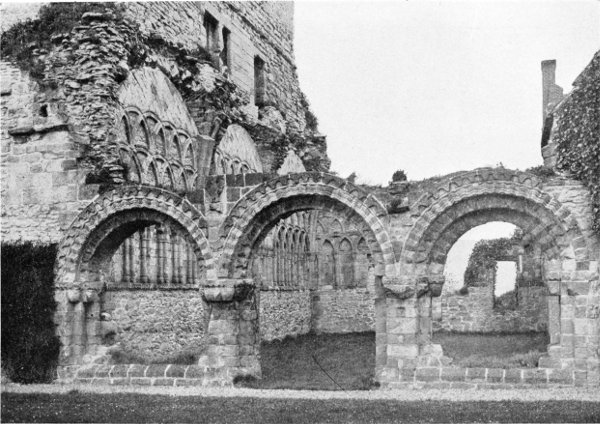
Photo by]
[W. D. Haydon.
WENLOCK PRIORY, CHAPTER HOUSE.
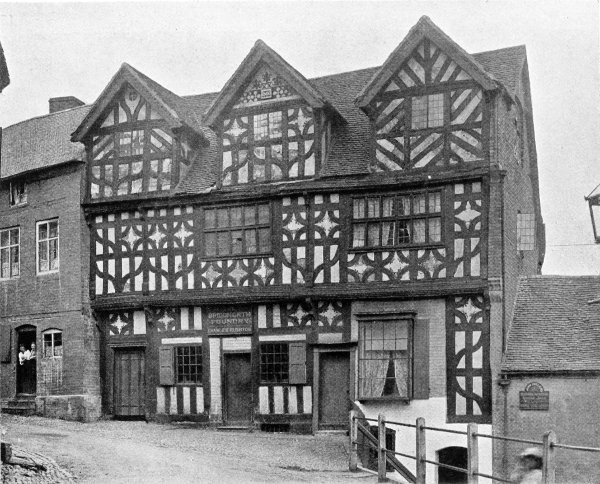
BISHOP PERCY’S BIRTHPLACE, BRIDGNORTH.
Ever since the Danes built a fort here this town, nearly as consistently as Shrewsbury and Ludlow, has concerned itself with history. It has been visited by half the kings of England. Henry I. besieged it; Henry II. defended it; John and Edward I. stayed in it; Edward II. took refuge in it; Henry IV. gathered his army here on his way to the Battle of Shrewsbury; Charles I. was besieged here by Cromwell, who narrowly escaped death before the walls. The Castle, of course, was the centre of interest on all these occasions—the Castle that was built so hurriedly by Robert de Belesme, Roger de Montgomery’s son, and is now so conspicuous on account of its leaning tower. Round its ruins is a path that must be practically the same as that which Charles I. declared to be as pleasant a walk as any in his kingdom. Robert de Belesme, who has been described with apparent justice as “an implacable villain,” also founded the church of St. Mary Magdalene, but the present building was designed by Telford. Another interesting church is St. Leonard’s, where in the churchyard the Roundheads once beat the Royalists in a skirmish, and where Richard Baxter was a curate. He lived in the little black-and-white cottage close at hand, and seems to have had a poor opinion of his flock. “He found the people here generally ignorant and dead-hearted,” he says, “... so that though by his first Labours among them he was Instrumental in the Conversion of several Persons, and was generally Applauded, yet ... Tippling and Ill Company rendred his Preaching ineffectual.” If his preaching was ineffectual it at all events began early, for “when he was a little Boy in Coats, if he heard other Children in Play speak Profane Words he would reprove them, to the wonder of those that heard him.” At this time—when he was a little Boy in Coats—he lived at Rowton in this county; it was not till he was ten years old that he moved to Eaton Constantine and indulged in dark deeds in his neighbours’ orchards.
An extremely steep dip with an awkward corner in the middle of it will take us to the birthplace of another famous divine, Bishop Percy, best known in connection with “Percy’s Reliques.” The house, which stands in the Cartway, may be approached quite comfortably from below, and is worth seeing for its own sake, being a good example of black-and-white work.
Our best way home from here is by Ironbridge and Buildwas, on the road by which we drove to Boscobel. Between Bridgnorth and Ironbridge some of the country is pretty, and at Broseley especially it must have been lovely in its natural state, before it was ruined by the potteries. We cross the river by Abraham Darby’s iron bridge.
A run of forty-seven miles or so, by Wem, Whitchurch, and Ellesmere, will show us a good deal of the north-west part of the county, and if, when we reach Whitchurch, we choose to lengthen the distance to fifty-four miles by slipping over the Welsh border to Overton and Erbistock, we shall not regret it.
We leave Shrewsbury by the road that branches to the left immediately opposite to the station. Almost at once, at the point where the road touches the Severn, we pass a long, low house of timber and plaster on our right. It was from this house that Admiral Benbow ran away to sea. He was living here as an apprentice, to his father or another, and, since it was the custom to entrust the house-key to the care of the apprentice, he had, fortunately for himself and England, special facilities for making his escape. He hid the key in the tree that is marked with a ring of whitewash, and stands between the house and the railings; and there to this day it hangs.
Between Shrewsbury and Whitchurch there is nothing of particular interest except the old farmhouse called Albright Hussey, which stands in a field on the right about three miles out of Shrewsbury. It is a pretty old moated house, partly black-and-white; but its greatest beauty is within, where there is as charming a room as one need wish to see, a room to make a housewife weep tears of covetousness—low, oblong, oak-panelled to the ceiling, with seats in the mullioned windows and a carved fireplace. The house is inhabited, but I believe there is never any difficulty in obtaining leave to see it. Its sixteenth-century walls were once threatened by a party of Parliamentarian horse. There were only eight men to defend the place, but their leader was a crafty man, and shouted his orders aloud within hearing of the enemy. “Let ten men stay here, and ten go there, and twenty stay with me!” he cried; and the attacking force, dismayed by the number of mythical defenders, rode away and left the stone and timber, the mullioned windows and oaken wainscotes, to be a joy to us to-day.
In Wem, however, through which we presently pass, it was the “Parliament men” who were in the ascendent. The place acted a prominent part in the Civil War, and has a history many centuries long, but on the surface is commonplace enough. In the List of the Owners of the Manor of Wem the twenty-fourth name is the grim one of “Sir George Jeffreys, Knight and Baronet, and Lord Chief Justice of the King’s Bench, created in 1685 a peer of England by the style and title of Baron Jeffreys of Wem.”
At Whitchurch we must draw up at the door of St. Alkmund’s Church; not because it is old or beautiful, for the original church fell down in 1711 and was entirely rebuilt; nor because Dean Swift subscribed to the rebuilding of it; but because it contains the dust of the great Talbot, first Earl of Shrewsbury, “the scourge of France.” His valiant heart lies beneath the white stone in the porch, where careless thousands have trodden it underfoot. It was found there in an urn when the church was rebuilt, and with it were some figures of Christ and the Virgin Mary from Talbot’s rosary. His bones are in the chancel, whither, about fifty years after his death, they were brought from the battlefield of Chastillon, where a little chapel had been raised on the spot where he fell.[3] His effigy lies on a tomb that is an exact copy of the original one. While this restoration was in progress the bones of the great soldier were shown to the public, with the skull cleft by the axe that killed him. “This is that terrible Talbot,” says Thomas Fuller, “so famous for his sword ... which constantly conquered where it came, insomuch that the bare fame of his approach frighted the French from the siege of Bordeaux. Being victorious for twenty-four years together, success failed him at last.... Henceforward we may say ‘Good-night to the English in France,’ whose victories were buried with the body of this earl.”
From Whitchurch we drive about fourteen miles in a westerly direction to Overton Bridge, by Hanmer and Overton village, a pretty little place with a churchyard surrounded by yew-trees. Having crossed the bridge, which is about two miles beyond the village, we turn to the left at right angles and approach Erbistock by a road whose greatest recommendation to inveterate lovers of speed will be that it is short. After one experience, however, most of us will agree, I think, that this by-road needs no recommendation but the fact that it leads to Erbistock. A tiny church and a tiny inn at the brim of the Dee—that is all that there is at Erbistock. But it is all enclosed in trees, and the trees dip into the river, and the river is rather big and gentle and gurgles sweetly at one’s feet, and the woods on the other side are tangled and mysterious and full of fairies. One may have one’s tea close beside the water, or one may cross the river in a ferry, and soon be quite alone in the woods. There is no need to hurry, for when we leave Erbistock we need not stop again till we reach Shrewsbury.
For Ellesmere, “wher was a castelle,” says Leland, “and very fair polis yet be,” has now nothing left of its castle but the memory of it, and the fair pools may be seen as we pass. More than once Ellesmere was given as a dowry to the daughters of English kings, on their marriage with Cymric princes; for as the rulers of the two countries were sure to fall out soon after the wedding the gift was quickly taken back by the donor, and so was ready for the next bride. Thus, though Henry II. gave it to his sister Emma, there was nothing to prevent King John from giving it to his daughter Joan, twenty-seven years later, when she married Llewelyn the Great.
I think it must have been beside the lake, where on the level ground there would be room for the dramatic scene, that Rupert, halting here at Ellesmere, made his prisoners cast lots upon the drum to decide which of them should die. Thirteen were doomed; but at the last moment one of them was saved by Sir Vincent Corbet, who as he rode past interceded for the man, who had been a servant in his family. The rest were hanged there and then. Yet it is not they who haunt the rushy banks of the mere; but the White Lady of Oteley. Long ago, it is said, she robbed and ruined a monastery, and built herself a home here with the spoils—a home that she has never left since then, except to walk by night along the margin of the water. She was not even allowed to move to the new house when it was built about a hundred years ago, for a fragment of the old one was left standing in the park on purpose for her accommodation. The new house faces us very conspicuously as we drive close beside the water on the opposite side of the mere, and go on our way to Shrewsbury, which is about sixteen miles away.
In the south-west, which is the hilliest, and therefore the prettiest, part of Shropshire, there is a variety of little runs, which may be lengthened or shortened according to circumstances and tastes. A pretty round of about fifty miles is by Chirbury and Bishop’s Castle, whence either of two lovely roads will bring us back to Shrewsbury. Nineteen miles of nearly level road lead to Chirbury through several villages—Westbury, Worthen, Marton, and others—all of which are fairly picturesque, but with nothing very noteworthy about them. Just before Marton is reached there is an exceedingly sharp turn, which should be borne in mind. At Chirbury our road turns to the left in the middle of the village.
The name of this obscure little place has been known to the world for some centuries in connection with that strange person Lord Herbert of Chirbury, half ruffler, half scholar, who in a house only a few miles from here, across the Welsh border, wrote the famous autobiography that Horace Walpole called “perhaps the most extraordinary account that was ever given seriously by a wise man of himself.” His home for the greater part of his life, when he was not seeking adventures and duels in France or London, was in Montgomery Castle, whose ruins we may see by driving four miles further. Nothing but a fragment is left of it now, but when the Herberts lived there it must have been a fine sight on its wild crag; a more fitting home for Edward the soldier than for his gentler and still more famous brother George. Chirbury itself had a castle and a priory once; but of the castle, which was built by the ever active Ethelfleda, nothing remains but the site; and of the monastery there are only fragments left, for the present church, ancient as it is, was not used by the monks, but was then, as now, the parish church.[4] It has seen strange doings. It is hard to realise, when the bells ring in this lonely little village, and the quiet country folk take their seats for the morning service, that here within these very walls the congregation of Chirbury was once electrified by the clashing of armour and the clatter of horses’ hoofs in the aisle. It was during the Civil War, and Mr. Edward Lewis, “a very goodly man, did preach twice a day”; a rash thing for a Puritan to do when Captain Corbet was no further off than Caus Castle. A party of Royalist horse “rode into the church to the great fright and amazement of the people; and with their pistols charged and cocked went up into the pulpit and pulled down Mr. Lewis, pulling and tugging him in a most unworthy manner ... and so left the people without their pastor because they would not be content with one sermon a day.”
It was this same Edward Lewis who brought to Chirbury the chained library that almost certainly belonged to George Herbert; for Isaac Walton tells us of “a choice library which Mr. Herbert had fastened with chains in a fit room in Montgomery Castle.” This choice library contains books dating from 1530 to 1684, and among them is a black-letter folio copy of Chaucer. They are kept in the vicarage, and I believe may be seen by any one.
Turning to the left in Chirbury we soon pass Marrington Hall, or Havodwen, the White Summer-house, as the Welsh call it; a very fine example of sixteenth-century black-and-white work. The lovely little valley beyond it is Marrington Dingle, and a mile or two further on is Churchstoke. It is in this pretty part of Shropshire that the uses of the motor-car are especially noticeable, for railway stations are few and distant from each other, and the hilliness of the country is not encouraging to bicyclists. Of Bishop’s Castle there is little to be said, for pretty as the country is all round it, the town itself is unattractive, and the castle is no more. But all the ways back to Shrewsbury from here are lovely. We may join the Stretton road, which we already know, at Marshbrook, and so see one of the most charming little bits of wooded country in Shropshire; or we may follow the hilly road through the wild scenery near Ratlinghope, down Cothercott Hill, and through Longden and Hookagate. Cothercott Hill is very steep and has a bad surface, but it is only for a short way that the gradient is really severe, and the view from the top is one of the wildest in the country. Personally, however, I should recommend the third way back to Shrewsbury—over the moor to the Roman Gravels, and down through the woods of the winding Hope Valley to Minsterley.
As there is nothing in the whole of this little run to delay us, we may lengthen it, if our car is good on hills and we are of an enterprising temperament, by going on from Bishop’s Castle to Clun, or even to Knighton, and round by Leintwardine to join the Ludlow road. This is a beautiful bit of country, and full of interest. Leland tells us of the “faire forest of Clun.” “Cumming from Bisshop’s Castelle to Clunne lordshippe,” he says, “cummeth doune a greate woode grouing on a hille.” Much of this great wood is gone now, but there is still enough to make the country very “faire,” and to compensate a motorist for the climbing of a long hill. Suddenly, as we round a corner, Clun comes into sight between two hills, with the stern tower of its castle standing conspicuously above the river. “Clunne Castell,” says Leland, “longynge to the Erle of Arundel, sumewhat ruinus. It hath bene bothe stronge and well builded.” It is more than somewhat ruinous now, which is hardly surprising when one considers all it has gone through at the hands of Welshmen and Roundheads since it was built in Stephen’s reign. There is a story that the stones of which it is made were passed from hand to hand by a chain of men, from the quarry, a mile away, to the river-bank where the castle stands; but be that as it may, these crumbling stones, with their soft tints of grey and yellow, embody enough romance to satisfy us, I think, seeing that they are connected with all the greatest names of Wales. They have been stormed and burnt by Rhys of the south; they have been attacked in vain by great Llewelyn of the north; they have been overcome by Owen Glyndwr. They are connected with modern romance, too, for it is supposed that the “Garde Dolareuse,” in the “Betrothed,” represents the Castle of Clun, and the Buffalo Inn claims to have sheltered Sir Walter Scott while he was writing part of the book.
Everything is old at Clun: the church; the fine old bridge, of whose building there is no record; and the “Hospital of the Holy and Undivided Trinity at Clunn,” which was founded by the Duke of Norfolk in 1614 for distressed tradesmen, who were each to receive yearly “a gown ready-made of strong cloth or kersey, of a sad colour.”
The road between Clun and Knighton is not one to be undertaken lightly by small cars of uncertain hill-climbing powers, for it is mostly composed of long and precipitous hills, with gradients varying from 1 in 8 to 1 in 10; but the surface is good, and though the scenery is not particularly interesting at first, it becomes really lovely as we draw near Knighton, which lies in a valley, surrounded by wooded hills. Here we turn to the left, and by way of compensation the road from Knighton to Leintwardine is particularly level, along a narrow valley between green hills that belong to Shropshire on the left and to Herefordshire on the right. As the valley widens out into open country we reach Brampton Brian, associated for ever with the name of Brilliana, Lady Harley. That gallant-hearted lady was alone in her husband’s castle of Brampton when it was threatened by the forces of Charles I., for the Harleys were “Parliament men.” “I acknowleg,” she writes, “I doe not thinke meself safe wheare I am.” Safe she certainly was not, but she thanked God that she was “not afraide”; and when the Royalists bade her surrender she simply answered, “I must endeavour to keep what is mine as well as I can, in which I have the law of nature, of reason, and of the law on my side, and you none to take it from me.” The siege lasted some weeks, and Lady Harley, always delicate, suffered greatly; but when pressed to yield said “she would rather choose an honourable death.” She died; but this first siege was raised before her “heavenly and happy end,” and so she never knew that the castle was besieged again, was surrendered, and burnt to the ground.[5]
A few miles further on is Leintwardine, which I believe to be full of antiquarian interest, and know to be picturesque as an artist’s dream; and here, if we care to face a narrow byway with a rough surface, we may leave the main road and take the more direct route to Craven Arms by way of Clungunford. At Craven Arms we rejoin the road from Ludlow to Shrewsbury.
Of the many main roads that converge in Shrewsbury I have left to the last the one that is in some ways the most important, the one that is certainly the most famous; that road of great memories and great achievement, by which so many Royal Mails have travelled breathlessly at the dashing pace of eleven miles an hour, and by which we may travel to-day at a pace that nothing shall induce me to betray: Telford’s road to Holyhead. It is the road by which, if we are fortunate, we are going into North Wales. If, however, it is our sad fate to turn our backs on that most beautiful land, we must on no account neglect to run over to Llangollen, a distance of thirty miles: for though I have left it to the last on the assumption that we are going on to Wales, it is one of the most enjoyable drives in this neighbourhood.
We leave Shrewsbury by the Welsh Bridge, the scene of Henry VII.’s remarkable entry into the town over the body of the stout, wise bailiff; and as we reach the top of the hill beyond it we pass on the right the house in which Charles Darwin was born. At the corner where the Holyhead road turns sharply to the right, about half a mile beyond the last houses of the town, there stands in a private garden a famous tree known as the Shelton Oak. I mention it merely because its fame rests on a libel. There are those who will tell you—cheerfully taking a great man’s name in vain—that Owen Glyndwr sat in this tree watching the Battle of Shrewsbury when he should have been taking part in it. Our knowledge of this fiery prince’s characteristics might be enough, one would think, to discredit the tale, without the proved fact that he was extremely occupied in South Wales at the time! But still the tale is told.
Soon, at Montford Bridge, we cross the Severn, white with water-weeds in the summer, and fringed with purple wild-flowers, and then, with what speed we may, spin happily towards the Welsh hills. We can see them on our left; the striking outline of the Breidden, with Rodney’s Pillar on its topmost point, and beyond it a long blue range that limits all the western horizon. At one spot only we have a choice of roads. Telford’s road goes by Oswestry, an ancient town with an immense history but few relics; but if at the “Queen’s Head,” fourteen miles from Shrewsbury, we turn to the right, following the telegraph-posts, we shall cut off more than a mile of distance and shall see Whittington.
There are some places that are peculiarly haunted. One is infinitely more conscious in them of the past than of the present. Such are Hay and Beaupré—both of which we shall see later on. But Whittington is not so much haunted as haunting. Hay and Beaupré are enchanted: Whittington is itself the enchantment. It stands in a clump of trees by the wayside, in the middle of the village, and one comes upon it suddenly: a great fortified gateway of pale grey stone, reflected in the weed-grown water of what was once its moat—and leading nowhere. One thinks, not of its history, but of itself. One cannot believe that it is merely the entrance to a vanished mediæval castle; it is rather the Gate of Dreams, through which every man sometimes passes in search of his heart’s desire.
There is an old Norman-French romance that tells us how the White Tower was built by William Peverel of the Peak, and how he promised it as a dowry to Melette, the fairest of his nieces. “But none found favour with her. And William reasoned with her, and besought her that she would discover unto him if there was in the world any knight whom she would take for lord.... ‘Certes, Sire,’ said she, ‘no knight is there in all the world that I would take for the sake of riches and the honour of lands, but if I ever take such an one he shall be handsome, and courteous, and the most valiant of his order in Christendom.’” So William proclaimed a tourney at the Peak, with Melette and the White Tower for the prize; and among those who came to try their fortune was one Guarin de Metz, well clad in red samite, with a crest of gold. “To record the blows and the issues I am not minded,” says the story, “but Guarin de Metz and his company proved that day the best, the fairest, and the most valiant, and above all, Guarin was the most praised in all ways.” So Guarin won the fastidious Melette of the White Tower, “and with great joy did he take her, and the damsel him.”[6]
This romance is not very reliable history, I fear, but it is true that Whittington belonged at one time to the Peverels, and later to the Fitz-Warines or Guarins, of whom it was probably the third who built this gate in the reign of John.
Two miles beyond Whittington is Gobowen, where we rejoin the main road; and soon afterwards we dip into the narrow valley below Chirk, and with the railway and the canal high above us on the left, cross the little Ceiriog into Wales.
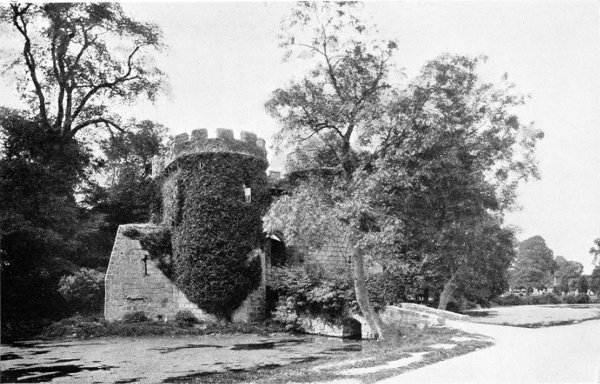
WHITTINGTON CASTLE.
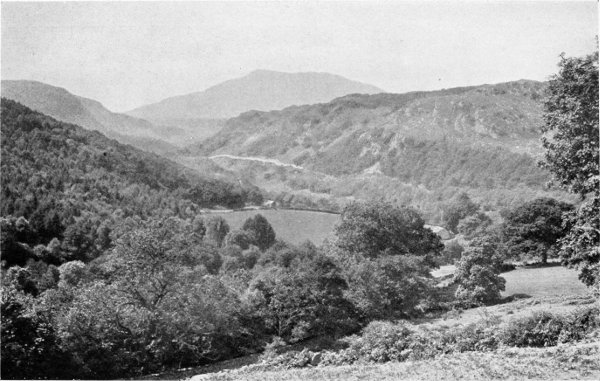
THE LLEDR VALLEY, FROM THE HOLYHEAD ROAD.