RANDOLPH, '64
Reading edition
"For the good and the great, in their beautiful prime, Through thy precincts have musingly trod—"
The roll of the national anthem died away and the veterans stood with bowed heads while the chaplain pronounced the benediction. Then the color bearer elevated the regimental flags, the drums tapped, and the gray-haired soldier boys, in straggling twos, marched slowly out of Saunders's Theater, through the flower-bedecked transept, and into the broad sunshine of Memorial Day. Ralph and I lingered in our seats until the crowd had thinned. In the flag-draped balcony above the platform the members of the band were hurriedly departing with their impedimenta; here and there little old ladies dressed in gray, were making their way with tardy steps toward the side exit; while all around the theater the open windows poured in a battery of mote-filled sunshine upon the deserted benches. The air was heavy with the soft fragrance of the elms outside, the faint odor of starched linen, of pine dust, and of flowers.
"There's a pair for you!" whispered Ralph, as an erect old gentleman accompanied by a white-haired negro came up the aisle. "I wish I knew who they were." He offered to wager large sums, based upon his alleged capacity for divination, that they were an "old grad," a Southerner, probably, and his body servant—"Old Marse" and "Uncle Ned." He instantly saw visions of them as characters in a story he was writing for one of the college papers. He is an imaginative boy.
We followed them out into the transept, and waited in the jog by the entrance while they made the round of the tablets, the white man reading the various inscriptions to his companion, who now and then would nod as if in recollection, and once furtively wiped his eyes with a frayed red-bordered silk handkerchief. The last we saw of them, they were picking their way across the car tracks of Cambridge Street in the direction of the Yard.
All the long spring afternoon, as we lay on the grass with our backs against the tree trunks, pretending to study, but really only watching the little gray denizens of the Yard intent upon their squirrel business, Ralph was making up stories about "Old Marse" and "Uncle Ned." I don't believe the chap read a line of his Stubbs on "Mediæval Architecture," and he was very loath to join me when I dragged him to his feet and said that it was time for supper.
Darkness had fallen when, two hours later, we joined the group of men gathered under the elms around the main entrance of Holworthy, where the Glee Club had assembled for one of its evening concerts. Everywhere the old buildings gleamed with light, for the examinations were on, and each window had its cluster of coatless occupants, who from time to time vociferously participated in mournful, lingering calls for "M-o-r-e." The odor of pipe smoke mingled with the sweet, humid breath of the grass and the subtle perfume of professors' gardens from distant Quincy Street; in the western sky a crescent moon, just peeping from behind the tower of Massachusetts Hall, shyly nestled in the tree tops; while between the great elms we could look, as we lay flat upon our backs, into an infinity of faintly twinkling worlds. Between songs you could hear the creaking of the pump in front of Hollis Hall, and the tinkle of the cup upon its chain as it was tossed heedlessly away by the thirsty wayfarer after he had availed himself of its humble services. Ralph and I, joyously entangled in the anatomy of a dozen classmates, drank in with rapture the never cloying melodies of "Johnnie Harvard," "The Miller's Daughter," "The Independent Cadets," and "A Health to King Charles," none of which old favorites escaped without a second rendition, and it was well on to nine o'clock when with a last
Here's a health to King Charles, Fill him up to the brim!
the assemblage broke up, in spite of savage disapproval from the windows.
Then only did we surrender to our miserable apprehension of the imminent, deadly "exam." in Fine Arts 4, and with the earnestly avowed purpose of really mastering the difference between a gargoyle and a lintel before we retired to rest, reluctantly mounted the stone steps recently vacated by our musical brethren. Our room was Number 10, the first as you go in on the right, and the flickering gaslight in the hall showed that the door, in accordance with inviolable custom, was still ajar.
"Wait a second while I light the lamp," I remarked to Ralph, and, feeling my way across the room to my desk, stood there fumbling for the matches. As I did so I was startled to hear a voice from the darkness in the direction of the fireplace.
"I beg your pardon," it said. "I'm afraid I have usurped your room, but the door was open and its invitation was too attractive to be refused."
The match flared up and I saw before me Ralph's "Old Marse."
"Oh—of course—certainly," I replied. He had arisen from the armchair in which evidently he had been listening to the singing. Then the wick caught, and by the increased light I saw that the man before me looked older than he had in the morning. His hair was almost white, and his face about the eyes finely wrinkled, but its expression was full of kindly humor, and I felt somehow that this stranger quite belonged there, and that it was I who was the intruder.
"You see," he continued with a smile, "I feel that I have a certain right to be here. This used to be my room. Let me introduce myself. Curtis is my name—Curtis, '64."
"Glad to meet you, Mr. Curtis," said I. "I'm Jarvis, 190—. Was this really your room? That seems an awfully long time ago."
He smiled again.
"I'm afraid it seems longer ago to you than to me. Would you mind if I should smoke a cigar with you? I'd like to ask you some things about the old building."
"Please do," said I. "And let me introduce my roommate, Ralph Hughes."
Ralph shook hands with Mr. Curtis, and we all sat down around the fireplace. It seemed rather inhospitable not to be able to offer him any refreshments, but there was only one bottle of beer in the papier-maché fire pail in my bedroom, and it was warm at that. Hence we accepted our guest's cigars with some diffidence and awaited his first interrogation. I could see that Ralph was brimming over with eagerness to ask about "Uncle Ned" and a hundred other things which that romantic ostrich of a boy had invented during the afternoon, and I felt quite sure that before Mr. Curtis got away he would be obliged to pay heavily for the temerity of his visit by being offered up upon the altar as a sacrifice to Ralph's bump of acquisitiveness.
"Yes," said Mr. Curtis, "this was my room for four years. If you look over on the windowpane I think you'll find my name scratched on the glass in the lower left-hand corner. I wonder if that old picture of the Belvoir Fox Hunt, that I left, is still here?"
"Oh, was that yours?" exclaimed Ralph. He darted into the bedroom and unhooked a framed lithograph which had been the joy and pride of the occupants of the room for the past four decades. Mr. Curtis turned it round and pointed to his name in faded ink upon the back at the head of a long line of indorsements, each of which represented a temporary possessor.
"The old room seems about the same. The wall-paper has been changed, but that big crack over by the bedroom I remember well. And there ought to be a bullet hole in the frame of the door."
"A bullet hole!" exclaimed Ralph and I in unison.
"Yes," said Mr. Curtis quietly, "a bullet hole—a thirty-two caliber, I should judge."
Ralph seized the lamp and, holding it high above his head, carefully scrutinized the woodwork of the door.
"There it is!" he cried eagerly. "Right in the middle; and, by George, there's the bullet, too! There's a story about that, I bet—isn't there? Who fired it? How did it get there?"
He replaced the lamp, quivering with interest.
"A story if you like," responded Mr. Curtis, looking curiously out of his laughing brown eyes at my impetuous roommate. "Yes, quite a little story. I could hardly tell you about it unless I told you also something of the man who fired the shot. Did you ever hear of Randolph? Randolph, '64?"
The blank look which came into our faces rendered answer unnecessary.
"Never heard of Randolph, '64! Sic fama est! I suppose some Jones or Smith or Robinson now holds his place. Outside of Prex himself, there wasn't a better-known figure in my time. Why, he occupied this very room. He was my roommate."
"Did he, though!" ejaculated Ralph. "How did he come to be firing a pistol around? Didn't he fall foul of the Yard policeman?"
"There were no Yard policemen in those days," said Mr. Curtis.
"What luck!" ejaculated Ralph. "Do tell us about Randolph!" he pleaded in the same breath.
"Certainly. If you really wish it. I trust you fellows haven't any examinations to-morrow."
"Examinations be hanged!" exclaimed Ralph.
"Well," began Mr. Curtis meditatively, "I remember as if it were only yesterday being awakened one bright September morning in '60 by the sound of a rich negro voice singing in time to the scuff-scuff of the blacking of a pair of shoes. The sound entered the open window through which the autumn sun was already pouring, and penetrated the stillness of my bedroom, over there. I sprang out of bed and, thrusting my head out of the window, beheld, seated comfortably upon the topmost step, a comically visaged darky, clad in a pair of brown overalls and battered felt hat, busily engaged in putting the finishing touches to a highly polished pair of russet riding boots. Piled indiscriminately upon the sidewalk, in front of the windows of the room opposite, lay several huge trunks, while at the foot of the steps reposed a long wicker basket, before which were ranged in order of height an astonishing collection of riding boots and shoes of all varieties, upon which the disturber of my dreams had evidently been hard at work, since they shone with a luster glorious to behold. The negro, having critically examined the boot upon his arm, and evidently satisfied with its condition, arose to place it by the side of its mate, and in so doing caught sight of me. Instantly he had doffed his old gray hat and was making a grave salutation.
"'Good mornin', suh.'
"For a moment this vision of darky courtesy deprived me of my ordinary self-possession. Then his grin became contagious.
"'I heard you singing and thought I'd look out to see who it was. Do you know who those trunks belong to?'
"'Dose? Why, dose is Marse Dick's. Oh, p'r'aps you ain't met Marse Dick—Marse Dick Randolph, ob Randolph Hall, Virginny, suh.' He drew himself up with conscious pride. 'We-uns jes' come las' night. Marse Dick's rooms is in dar'—nodding toward the window—'en I wuz jes' a-lookin' ober some ob his traps. Anyt'ing I kin do fo' you, suh? Glad to be of any service, suh. I'se Marse Dick's boy—Moses—Moses March, suh.'
"'Well, Moses,' I answered, 'I'm glad to make your acquaintance. You can tell Mr. Randolph that if he is going to be a neighbor of mine I shall call upon him at the earliest opportunity.'
"'Yah, suh. T'ank you, suh,' responded Moses.
"Just then the old bell on Harvard Hall began to clamor for the morning chapel service, and realizing that the master of my new acquaintance might be unfamiliar with college regulations, I called out:
"'You'd better wake Mr. Randolph or he'll be late for chapel.'
"'Call Marse Dick!' exclaimed the darky in apparent horror. 'Golly, I darsn't call Marse Dick 'fo' ten o'clock. Why, he'd skin me alive. 'Sides, he tole me to bring roun' Azam 'bout ten o'clock.'
"'Azam?' I queried.
"'Yah, suh; Azam's Marse Dick's hunter. Bes' Kentucky blood, suh. Sired by ole Marse's stallion Satan, out o' White Clover. Dar's a hunter fo' you, suh. You jes' ought ter see Marse Dick a-follerin' de hounds. 'Scuse me, suh, fo' keepin' you a-waitin'. No, suh, t'ank you, suh; I won't forgit de card, suh.'
"Hastily retiring to my bedroom I threw on my clothes and then hurried off to chapel. The shades of Number 9, the room across the hall, were still tightly drawn."
Mr. Curtis stopped and relit his cigar. The yellow sash curtains on their sagging wires softly bellied in the night breeze, and through the open windows came the distant chanting of the Institute march and the tinkle of the pump.
"This very room!" repeated the old gentleman half to himself. "And this very window!" His voice sank dreamily and he seemed for the moment to have forgotten our presence. "Those were happy times. As I look back over the forty years, the time I spent here seems one long vista of glorious autumn days. The same old red-brick buildings; the same green velvet sward; that old tolling bell; the gravel walks; the pump—I remember there always used to be a damp place about ten feet square about the pump; the old creaking stairs outside this very door; the quiet evenings on the steps where those jolly chaps were singing; the long talks before this very fireplace under the lamplight with Dick; and then that fatal rupture with the South! How little it means to you! Why, it is isn't even a dream. It's just tradition. I suppose you feel it—you can't help feeling it. But if you had sat here, as I did, with the fellows going away, and the company drilling on the Delta over there—what do you call it now: the Delta?—and had shared the feverish enthusiasm which we all felt, tempered by the sorrow of losing our comrades; the little scenes when they went off one by one, and we gave each fellow a sword or some knickknack to carry with him; and the long, sad, anxious days when you waited breathless for news—and then, when it came, often as not, had felt a pang at your heartstrings because some fellow that you loved had got it at Bull Run, or Antietam, or Cold Harbor! No, you can never know what that meant, and thank God you can't. The rest is about the same. I see you have squirrels in the Yard now. We never had any squirrels. I suppose you sit in these windows and watch 'em by the hour. Busier than you, I guess.
"But apart from the squirrels and the new buildings, the old place is about the same—bigger, more imposing, of course, with its modern equipment of museums and laboratories and all that, and best of all that splendid monument with its transept full of memories. But it's not the same to me. It's only when I turn toward the corner by Hollis and Stoughton, as I did this afternoon, with Holden Chapel just peeping in between, and the big elms swinging overhead, and, shutting my ears to the rattle of the electric cars, listen to the sound of the same old clanging bell, with the sun gilding the tree trunks and slanting along the gravel pathways, that I can call back those dear old days. Then, it seems as if I were back in '61."
In the pause which followed Ralph volunteered that we all did feel somewhat of the same thing, only in a minor degree. He had often imagined the fellows going off to the war and had wondered if it was anything like what he supposed. He pattered on in his own peculiar way trying to put our guest at ease and, as he expressed it later, to cheer him up. It would never have done, he averred later in his own defense, to let "Old Marse" get groggy over the "sunlit elms." However, Mr. Curtis changed the tone himself.
"And now to come to that first time that I ever saw Randolph. I had just come from tea and was sauntering along the Yard in front of Stoughton when I became conscious that my customary place upon the steps, out there, had been usurped. The trunks and paraphernalia of the morning had disappeared, and although Moses was absent, I knew somehow that this could be no other than 'Marse Dick.' He was tall, with muscular back and shoulders, and his clothes of dark-blue serge hung on him as if they had grown there. His feet were encased in long-toed vermilion morocco slippers, and the other elements of his costume which caught my eye were a yellow corduroy waistcoat, very faddish for those days, and a flowing red cravat. A broad-brimmed black slouch hat was well pulled down over his eyes, while from beneath protruded a long brierwood pipe from which voluminous clouds of smoke rolled forth upon the evening air without causing any annoyance, so it seemed, to an enormous mastiff, who sat contentedly between his master's knees, blinking his eyes and thumping his tail in response to the caresses of the hand upon his head. As I drew near the dog stalked over to meet me, sniffing good-naturedly, and the stranger stepped down, removed his hat, and held out his hand with a smile of greeting.
"'Mr. Curtis, I believe, suh?' he said in a low but agreeable drawl. 'My boy Moses gave me the card you were kind enough to send by him this morning. We are neighbors, are we not?'
"I had rather expected to see the face of a dandy, but instead a pair of black eyes under almost beetling black brows burned steadily into mine. He looked nearer thirty than twenty, and this appearance of maturity was heightened by a tiny goatee. His smile was straightforward and honest, the forehead, under the curly black locks, low and broad, the nose aquiline and the skin dark and ruddy. Yes, he was a very pretty figure of a man—as handsome a lad as one would care to meet on a summer's day—part pirate, part Spanish grandee, part student, and every inch a gentleman. Later there were plenty of fellows who said that no man could dress like that (we were all soberly arrayed in those days) and be a gentleman; or that no one could come flaunting his horses and dogs and niggers into Cambridge, as Randolph undoubtedly did, and be one; or could parade around the Yard smoking real cigars and keep dueling pistols on his mantel and rum under the bed, as Dick did, and be one. But he was, boys, he was!
"Perhaps he did talk too much about his niggers and his acres; too much about his old mansion and its flower gardens, about stables, fox-hunting and fiddlers—what of it? The point was that we were a lot of soul-starved, psalm-singing Yankees, talking through our noses and counting our pennies; while Randolph was a warm-hearted, hot-headed, fire-eating, cursing Virginian.
"We shook hands and I joined him on the steps. It was just such a night as this—calm and sweet, the stars peeping through the boughs, and the windows shining. And that's how I like to think of him.
"He'd never been away from home before except to go to Paris. He talked like a feudal baron, seeming to think that life was just one long holiday; that no one had to earn a living; that things in general were constructed by an amiable Deity solely for our delectation; and there was in his attitude a recklessness and disregard for established usages that left me totally at a loss. Imagine a fellow like myself taught to regard card playing, the theater, and dancing as mortal sins, with a father who believed in infant damnation and predestination; a fellow brought up to gaze in silent admiration at Charles Sumner; and who was allowed a silver half-dollar a week pocket money—imagine me, I say, sitting out there with this free-thinking, free-hating, free-handed slave owner! Why, I loved him with my whole heart inside of five minutes. God bless my soul, how my father used to frown when they told him about my new friend's latest escapade! But with all his freedom of ideas he was as simple as a child. I don't believe the fellow ever had a mean or an impure thought. I believe that as I believe in God.
"Well, I told him about my life—what there was to tell—and he told me about his; how his father had died three years before, leaving him the owner of very large estates and a great many hundred slaves—I forget how many. His mother was still living down on the plantation. They were Roman Catholics—'Papists,' my father called them. The doctrines of the Church, however, didn't seem to bother him at all, that I could see. His father had evidently been the big man of the county, and had shared all his sports and studies, cramming him with the most extraordinary amount of miscellaneous reading and curious Chesterfieldian ideas of honor and manners.
"I can remember, now, just how he described the old place to me, sitting out there on the steps. He thought it the finest home in all the land. Perhaps it was. I never had the heart to go there afterwards. One thing I remember was a grand old garden laid out in terraces, the walks bordered by box two hundred years old and as high as your head, where little red and green snakes curled up and sunned themselves—a garden full of old-fashioned flowers and fountains and sundials, and a water garden, too, with lilies of every sort; and there was a family graveyard right on the place where they had all been buried—where his father had been—with a ghost—a female ghost—named Shirley, I recall that, who flitted among the trees on misty mornings. Oh, it was a great picture! I'll never see that old place. Perhaps it's just as well. It couldn't have been as beautiful as he painted it. You see I'd been born in a twenty-one-foot red-brick house on Beacon Hill.
"Then as we were sitting there on the steps, I broad awake but in fairyland, out from under the trees shuffled Moses's quaint, crooked figure. Wanted to know if eb'ryt'ing was all right with young Marse. Azam and Bhurtpore was fixed first-class, suh. An' he'd done got a little cubby-hole down in the stable to sleep in. Wuz dere any orders to-night, suh? An' what time should he bring Azam roun' in de mornin'?
"'Go 'long with Moses, Jim,' said Randolph. The dog obediently arose, stretched himself, and descended the steps.
"'Good night, Marse Dick,' said Moses.
"'Good night, Moses,' replied Dick. And the two, the darky and the dog, disappeared under the shadow of the elms."
Mr. Curtis knocked the ash from his extinct cigar and relit it at the top of the lamp chimney.
"I should just like to have seen him," remarked Ralph enthusiastically. "And to think that he really lived in this room. How did that happen? And which bedroom did he have?"
"The one on the left, nearest the door," replied Mr. Curtis.
Over in Stoughton some fool was strumming a banjo, singing "I'm a soldier now, Lizette"—rottenly. And some one else, of the same mind as myself apparently, leaned out of the window in the room above us and holloed:
"Oh, quit that! Try being a freshman a while! Lizette won't care."
Evidently the singer decided to follow the advice thus gratuitously given, for the banjo ceased. Then came one of those long silences when you felt instinctively that in a moment something might happen to spoil the excellent opportunity of it, throw us off the key as it were, or break its placid surface like an inconsequent pebble. But Ralph, in a singularly moderate tone, as if leading the theme gently that it might not become startled and break away, continued:
"You said something about dueling pistols, you know."
Mr. Curtis looked at him with that same quizzical smile which my roommate had called forth before.
"That's it. All you want is gunpowder, treason, and plot. My feeble attempt at character sketching has been a failure. Well, now to your dessert."
"You are entirely wrong," said Ralph, rather mortified. "Randolph must have been a perfect corker. I wish we had some chaps like that in 19—. But the Southerners nowadays all seem to go to Chapel Hill, or William and Mary, or Tulane, or some of those God-forsaken places where I don't believe they even have a ball nine. Only, naturally, I wanted to make sure of the bullet hole. You see," he added cunningly, "that bullet hole is the thing that links us together. That's how we'll know when you've gone that it wasn't all a dream."
Mr. Curtis laughed outright.
"You're a funny boy," said he. "Well, two or three days later I asked Randolph to room with me. The matter was easily adjusted, and Moses spent nearly a week in fixing up this den here with what he called 'Marse Dick's contraptions.' Save the old picture there, there's not a thing in the place that suggests the room as it looked then. From extreme meagerness, if not poverty, of furniture it sprang into opulence—almost ornately magnificent it seemed to me with my conservative New England tastes and still more conservative New England pocketbook. I remember a silver-mounted revolver was always lying on one end of the mantelpiece, while in the center was a rosewood case of pistols, curious affairs, with long octagonal barrels, and stocks inlaid with mother-of-pearl and silver.
"Randolph soon became a celebrity. He could no more avoid being the most conspicuous figure in Cambridge than he could help addressing his acquaintances as 'suh.' And in spite of his natural reserve, a quality which was curiously combined with entire ease in conversation, he soon acquired a large acquaintance and rather a following.
"Needless to say, I became his almost inseparable companion. Dick's second hunter, Bhurtpore, had been placed entirely at my service, and scarce a day passed that autumn without our scouring the country roads for miles around, followed by three or four of the hounds. Jim, the mastiff, while we were absent on these excursions, spent his time lying beneath the ebony table in 10 Holworthy awaiting our return.
"Randolph tried unsuccessfully to organize a hunt. It soon appeared that Azam and Bhurtpore were the only hunters in Cambridge, and polo had not yet been introduced into this country. Frequently we would take a circle of twenty miles in the course of an afternoon, galloping up quiet old Brattle Street, out around Fresh Pond, until we struck the Concord turnpike, which we followed over Belmont Hill, down past an old yellow farmhouse with blue blinds, at the juncture of the highway to Lexington and what we called the 'Willow Road,' and then under the overarching boughs, through soggy fields full of bright clumps of alders, until the fading light of the afternoon warned us that it was time to turn our horses' heads in the direction of Cambridge."
"We have a Polo Club," said Ralph, "but we haven't any horses."
"Well, now, to get down to your bullet hole," continued Mr. Curtis. "Hazing, of course, was an ordinary affair, and it was not uncommon to see a pitched battle of fisticuffs going on behind some college building.
"Now, mind you, the hazing was not done by the best men, but by the worst, and it was always the tougher elements in the sophomore class that availed themselves of this method of showing that they were feeling their oats. Every one of us looked forward, sooner or later, to getting his dose, and any freshman who smoked cigars and kept a nigger might have expected it as a matter of course. But Dick was a chap that did just as he pleased, and did it with such a confounded air—the 'bel air,' you know—that you'd have thought we were all a parcel of cavaliers walking in a palace garden. I don't blame them for feeling that he ought to be taken down a peg, when you take everything into consideration.
"For example, imagine his kissing old Mrs. Podridge's hand at a faculty tea! Of course the antiquated thing liked it, but it was so conspicuous. And worse than all, inviting Prex into his room to have a cigar and a glass of Madeira! Think of that! The queer part of it was that Prex nearly accepted the invitation.
"'Why not?' said Dick, in answer to my expostulation. 'Do you mean that in the North one gentleman cannot, without criticism, extend to another the hospitality of his own room?'
"It was all in the point of view. What could you say?
"Some carping fellows spread a canard that Randolph was trying to introduce slavery into Cambridge. Dick did not even notice it sufficiently to direct Moses to display his manumission papers. Of course there was a deal of talking about him, mostly good-natured chaff, and had it not been for Watkins I doubt if anything would have happened. This person was an ill-conditioned, dissatisfied fellow who had come from a small town in Rhode Island with a considerable amount of the initial velocity arising out of local prestige, which, wearing off, left him in a miserable state of doubt as to what to do to rehabilitate himself in the garments of distinction. As you would say, he 'had it in' for Randolph for no reason in the world. Dick was just too good-looking, too prosperous, too independent—that was all. He had an idea, I suppose, that if he could knock the statue off its pedestal he might perhaps occupy the vacant situation.
"One evening I inquired carelessly of Randolph what he should do if the sophomores tried to haze him. He replied, nonchalantly, that he should exercise the sacred right of self-defense as circumstances might require. If anyone tried to interfere with him he must take the consequences. In certain situations the only thing to do was to shoot your aggressor. I looked up to see if he were joking, but his face was entirely serious.
"Another chap who was sitting there laughed and slapped his knee. I can see now that it was just this kind of thing that gave Randolph's enemies some color for saying that he was a sort of crazy fool. Perhaps I was playing Sancho Panza to his Don Quixote, after all.
"Presently a lot of other fellows joined us, and by the time Moses appeared we had disposed of a couple of bottles of old Port, from under Dick's bed, and were loudly declaiming our loyalty to the Old Dominion and consigning the class of '63 to eternal torment. In the midst of the uproar some one grabbed Moses and shoved him upon the steps, shouting 'Speech! Speech!' What put the idea into his head I can't imagine—probably antislavery speeches in the square which he had overheard.
"'Gem'men,' he began, 'I'se not 'customed ter makin' speeches outa meetin', 'specially ter gem'men like you-all, but I'se got suthin' I'se been a-studyin' ober an' what's a-worryin' me, what I'd like ter say. It's des' 'bout Marse Dick. I des' come from down de street whar I done hear some gem'men a-speechifyin' 'bout him an' me. Dey says' (his voice rose indignantly) 'dat Marse Dick didn't hab no business fo' ter hab me here. Dat he didn't hab no right ter hab me work fo' him nohow, or Old Marse; an' dey calls Marse Dick some mighty mean names. Now I des' 'ud like ter know ef I ain't Marse Dick's boy an' why he ain't got no right fo' ter hab me work fo' him. Didn't I work fo' Old Marse 'fo' he died, an' didn' my ole man work fo' him, an' ain't I allus been a-workin' fo' Ole Miss and Missy Dorothy? Him an' me's been bred up togedder; I'se been a-totin' with him eber since he wuz born, ain't I, Marse Dick?'
"He paused amid a dead silence. None of us spoke. I looked at Randolph and saw that he was gripping his pipe hard between his teeth.
"'Well, gem'men, I doesn't want leab Marse Dick, ef I is a free nigger, an' I doesn't want you ter let 'em tek me away from him, cuz he got no one else ter look out fo' him, an' Azam an' Bur'pore an' de dogs, an' Ole Miss say when I lef' de Hall how I was neber to leab Marse Dick—nohow. An', gem'men, you won't let 'em, will yer?'
"He waited for our assurance. Oh, the constraint of generations of New England character! It was so difficult for us to say what we felt. Dick was staring out under the trees with glistening eyes. Some fellow made a few halting remarks and said we'd stick up for him and Moses to the last man, and then we all pounded Moses on the back, and Dick got out some more Port and we had another toast, but something had hit us hard."
Mr. Curtis closed his eyes and leaned back his head for a moment as if trying to recall some forgotten memory.
"The next evening," he continued presently, "we were both sitting before the fire. Jim lay as usual beneath the table, his head pointing toward the door. The lamps had not yet been lit and the windows, I remember, were open, for the day had been warm—one of those Cambridge Indian-summer days. From the lower end of the Yard came a confused murmur of voices, mingled with occasional shouts. The voices grew louder, and shortly there came a loud cheer, followed by the tramp of many feet. I stepped to the window and saw through the dusk a cluster of men moving slowly up the sidewalk by Massachusetts Hall. In a moment I realized that the time might be at hand for the application of my roommate's recently declared principles. With a distinct feeling of apprehension I drew in my head and was about hurriedly to suggest a walk, when there came the sound of flying feet, and Moses, with scared face and starting eyes, burst into the room.
"'Oh, Marse Dick,' he cried in a trembling voice, 'dey's a-comin' ter kill yer an' tek me away from yer. Dey's goin' ter hurt yer drefful! Doan' let 'em do it, Marse Curtis!'
"Dick had risen quietly and was now engaged in lighting the lamp upon the center table, while I shut and locked both door and windows. Jim got up from his place beneath the table and watched us uneasily. The noise of the crowd grew nearer. Then suddenly I heard a sharp click behind me and turned to see Randolph holding one of the silver-mounted pistols which he had taken from its case upon the mantel. He was calmly engaged in loading.
"'Look here, Dick!' I cried, 'for Heaven's sake put that back!'
"Before I could say another word our assailants entered the hallway of the building. There came a babel of voices, followed by a loud pounding upon the door. We returned no answer. Then there were shouts of:
"'Run him out!'
"'Liberty forever!'
"'No slaves in Harvard!'
"'Smash in the door!'
"This last suggestion was accompanied by a yell and a rush against the door, which swayed inward, and, the lock snapping, burst open. There was an instant's hesitation on the part of the men outside; then they began to surge through the narrow doorway. Randolph quickly raised his pistol.
"'Back!' he shouted. 'Leave the room!' Instinctively they retreated. I can see them now, crowding out through the doorway. Just here, where I am sitting, in the full light of the lamp, stood Randolph, the barrel of his pistol glistening wickedly. There was a cold gleam in his eyes and a drawn look about his mouth. Before him stood Jim, tail switching, and lips curled back in a snarl that showed all his sharp teeth, while in the background cowered Moses, fear pictured upon every feature, his eyeballs gleaming white in the shadowy doorway of the bedroom.
"'I warn you, gentlemen,' said Randolph haughtily. 'I order you to leave the room. I shall shoot the first man that crosses my threshold.'
"'Bosh!' cried a voice. 'Hear him!'
"'D——d slave owner!' shouted another.
"'Throw him out!'
"Watkins thrust himself forward.
"'Bah! I'm not afraid of any rum-drinking Southerner! He hasn't the nerve to shoot!'
"'Look out!' called some one.
"There was a sudden rush from outside and Watkins either sprang or was pushed, probably the latter, through the door. At the same instant there was a flash, a report, a snarl, a loud cry, a tumult of feet. The smoke cleared slowly away, showing the door empty. Across the threshold lay a sophomore, while over him stood Jim, motionless, with his feet on the man's chest and his teeth close to his face.
"Randolph laid the smoking pistol upon the table and pointed grimly to a splintered crack in the strip above the door.
"'Come here, Jim!' he called. The dog unwillingly drew away, still eying the man on the floor, who, finding himself unhurt, began to blubber loudly.
"'You are free, suh,' remarked Randolph scornfully. 'Don't let me detain you.'
"Watkins slowly and fearfully scrambled to his feet, and then, like a flash, vanished into the darkness.
"'Golly, Marse Dick,' exclaimed Moses in an awestruck voice, 'I thought you'd killed that gem'man, sho'!'
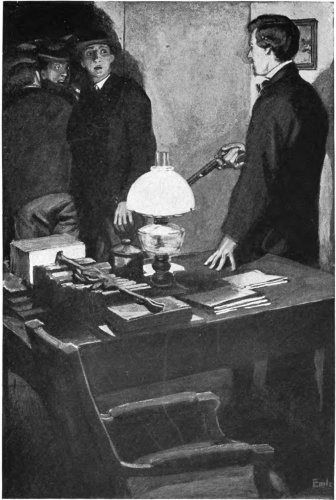
"'Back,' he shouted."
"'Give us a glass of brandy, Moses!' said his master, extinguishing the light. 'Where are they, Jack?'
"I raised the window and looked out. The sophomores were gathered in an excited group about Jim's victim, gazing at our window, and talking loudly among themselves. Randolph reloaded the pistol and stepped to the door.
"'Pleased to see you at any time, gentlemen,' he said. 'But just now I want to go to bed and don't like noise. Don't let me keep you. While I sometimes miss a single bird I'm not so bad at a covey. Now off with you!'
"Again he whipped up the pistol into position. It looked even more wicked in the starlight than it had done inside. With one accord the crowd broke and ran, Watkins well in the lead.
"Randolph came inside, lighted the lamp, and tossed off the brandy.
"'By Gad, suh,' he drawled with a laugh. 'They really thought they were going to be murdered. You Yankees don't seem gifted with any sense of humor. Here, Moses, run around to my friends' rooms and give them my compliments and invite them all to the tavern for a bowl of punch.'"
Ralph clapped his hands together.
"Right in this very room!" he cried, "right in this room!" Then he jumped to his feet and again critically examined the door. "Just as fresh as ever!" he remarked delightedly. "Why, but that Randolph was a ripper! And to think it all happened right between these four walls and we never have heard a word about it before!"
"Tell us some more about him," said I. "What did the faculty say?"
"The faculty considered the case," replied Mr. Curtis, "but we never heard from them in regard to it. Of course the story got all around the college and Watkins was unmercifully guyed. But he had his turn."
"How was that?" inquired Ralph. "Do go on."
"I don't know," returned Mr. Curtis. "What do you think of Randolph?"
"The best ever!" pronounced Ralph with conviction.
"It's hard to resist such an enthusiastic audience—and so insistent," smiled Mr. Curtis. "Well, they let him alone after that, and he pursued the even tenor of his way and increased in wisdom and stature and in favor—at least with man.
"I can only tell you about Randolph's leaving college, and that takes me to those sadder times of which I spoke. It was late in the spring, when none of us had any longer time or inclination to think of college distinctions or college jealousies. We were all overwhelmed at the thought of the impending conflict. Already most of the Southerners had departed for their homes.
"You see, I'm trying to give you an impression—a picture of a chap I believe to have been one of the truest gentlemen that ever came here—I feel you're entitled to know whose room it is you occupy and to share in these memories, which are, after all, the best thing left in my lonely old bachelor existence. When I tell you the rest and how we parted never to meet again you won't be able to get a true understanding of it unless you can grasp the real spirit of the times, the environment, the intensity of the whole affair.
"Here I was rooming with a flamboyant Southerner who fully intended to enlist as soon as his native State should declare herself, when four of my uncles had already joined the Union army. Of course I wanted to go, but my father wouldn't hear of it. The whole miserable business only drew Randolph and me the closer together. I do not think that his performance with the pistol had increased his popularity; in fact, the sympathies of the undergraduates seemed on the whole to be with Watkins, and the general sentiment that he was the aggrieved party. If Dick had taken his medicine in good part it would doubtless have been better for him in the end. You see, it gave his slanderers a handle and they made the most of it. Neither did he abate any of those idiosyncrasies of which I have spoken, but simply out of bravado, I suppose, rather let himself go. His cravats increased in brilliancy, his waistcoats multiplied their colors, and he was always careering around on Azam through the Yard and Harvard Square. He had a trick of riding suddenly out of nowhere, and appearing at recitations on horseback, turning his beast over to Moses at the door until the lecture had concluded. I have known Randolph at this period to keep his horse waiting an hour in order that he might ride him the length of the Yard. Don't get the impression that I am criticising him unfavorably; I am merely endeavoring to give you the point of view of the outsiders who didn't like him. By April the class was pretty evenly divided on the Randolph question. To half of us he was a rather Quixotic hero—to the rest a sort of cheap poseur. Watkins was untiring in his innuendoes, and in this he was aided to a considerable extent by the bitterness of the feeling between North and South. Of course, everything possible was being done to conciliate the Southern States, and it was the aim of the entire North to avert if possible an open rupture. At the theaters the most popular music was the old Southern airs and plantation melodies, and the audiences conscientiously cheered when 'Dixie' was played. Naturally this was vastly gratifying to Randolph, who failed, it seemed to me, to realize its significance. I don't think that anyone really believed actual hostilities would occur.
"Then like a lash across our faces came the firing on Sumter. The whole North gasped and then the blood boiled in our veins. Right here under these trees the war fever burned hottest.
"That night will never be forgotten by the class of '64. A huge gathering of students filled the Yard, lights twinkled in all the windows, torches flared here and there among the tree trunks, while between Stoughton Hall and where Thayer now stands, just in front of these very windows, the fellows concentrated in a solid mass, cheering the Union again and again, as flights of rockets burst high above the trees, sending down their floating canopies of sparks. Into that big elm, out there, some of the seniors were hoisting a transparency, bearing upon one side the words, 'The Constitution and Enforcement of the Laws,' and upon the other, 'Harvard for War.'
"I was sitting in this window—Randolph in that. Perhaps I should have been out on the grass shouting with the others, but the loneliest fellow in Cambridge was at my side. Poor old chap! No wonder he was gloomily silent. Outside the cheering continued and the rockets roared away over the tops of the old buildings, until the students, forming into an irregular procession, marched away singing patriotic airs, some to go to their rooms, but most to pass the remainder of the evening at the tavern, discussing the President's proclamation.
"Dick got up quietly and came over to the window. 'Jack,' he said sadly, 'the game's about up with me. I can't stay here any longer. Now that war is an actuality, I must go home, and the sooner the better.'
"'But Virginia hasn't seceded,' I answered, 'and most likely won't. If she does there will be time enough for you to go.'
"'Virginia will secede,' he replied, 'and blood will be shed in this cursed quarrel within two weeks. I can't stay here when I might be at home helping on the cause. I shall think you are acting from interested motives,' he added, smiling.
"'What does your mother say?'
"'That's the trouble. She wants me to stay.'
"I read the letter which he handed me. It was plain enough. The good lady desired to keep her only son out of harm's way just as long as possible, although through it all I could perceive her consciousness of the futility of any idea of preventing a Randolph from taking an active part, in the event of the secession of his native State. I urged parental duty and the foolishness of taking for granted something that might not happen at all. He, of course, was keen for fighting anyhow, but he was prepared to stand by his State's decision.
"Of course, you couldn't blame a woman for wanting to keep her only son from throwing his life away. From the very first I had a presentiment that that was what it would amount to, and I was for doing all I could to help her carry out her purpose.
"But as the days dragged on it became harder and harder to keep Randolph in Cambridge. You see, by that time he was practically the only Southerner left there, and he found himself in a strangely awkward, not to say painful, position. Even some of his friends, while their manner toward him remained the same, ceased to come as frequently to our room.
"We kept trying to deceive ourselves all along about the seriousness of the crisis. None of us did much studying—Randolph, none at all. He rode about the country or sat in his room reading his last letters from the Hall, fretting to get away from Cambridge. Nor did his continued presence pass uncommented upon by the more fiery of our student patriots.
"Several anonymous letters suggesting that his presence in Cambridge was undesirable had been left at his room, while, quite accidentally of course, it frequently happened that the sidewalk in front of our windows was selected as the forum for vehement denunciation of the South, of slavery and slaveholders. Randolph gripped his pipe grimly between his teeth and held his head higher than ever. Once he actually tried to address a meeting in front of the post office on the Inherent Right of Secession. But he was groaned down. While few of us had been Abolitionists we were now all Unionists, and 'Harvard was for war.'
"After this experience I noticed a change in his demeanor, for there were among that shouting, hissing crowd several who had been his friends. Although he must have known that Virginia's supposed loyalty was but a pretext on the part of his mother to keep him out of danger, his devotion to her was such that he remained without a word to bear the whips and scorns of time and the humiliation of his position, waiting manfully until the official action of the government of Virginia should set him free.
"It must have been exquisite torture for a chap of his high spirit to be obliged to hear his principles and those of his father denounced on every side, and the South that he really loved with all his heart charged with treachery and infidelity.
"In those days the top story of Dane was used by the upper classmen and the members of the Law School as a debating hall, their discussions being frequently marked by personalities and a bitterness of invective unparalleled even in the national Senate and House of Representatives. After the firing upon Sumter these meetings grew more and more turbulent, and were held almost daily.
"Randolph had at last made up his mind that he would wait but a week longer at the latest, and had notified his mother of his decision. He intended to leave Cambridge on April 18th, and nothing that I could say had been able to shake his determination. I am inclined to believe that the action of Virginia on the question of secession would not have made any difference to him at this time. We had watched the departure of the Sixth and Eighth Massachusetts regiments for Washington, and you can easily imagine how irksome his enforced inaction must have been. All his arrangements had been completed and he and Moses were to leave Boston on an early morning train for the South.
"The morning of the 17th dawned clear and brilliant. I left Dick and Moses packing books and dismantling the room, and walked across the Yard to a recitation in Massachusetts Hall. After that I remember I attended a lecture in some scientific course, chemistry, I believe, in University, and about eleven o'clock wandered over to the square to see if there were any fresh war bulletins. A group of excited people was gathered about the telegraph office gesticulating toward a strip of foolscap pasted in the window, and it was really unnecessary for me to push my way among them and read what was written there: 'Virginia secedes.' The words had almost a familiar look—we had waited for them so long.
"With the intention of telling Randolph the news I hurried across the square. I did not get far, however. Just on the other side, tethered to a post in front of the door of Dane Hall, stood Azam. He whinnied when he saw me, for by this time we were old friends. His presence there could only mean that Dick was inside, and with a qualm of apprehension I pushed open the door and started up the stairs. From above came the hum of voices followed by confusion and silence. Then as I reached the landing I caught the tones of a familiar voice—Randolph's—and hurrying up the flight leading to the second story breathlessly opened the door into the hall. It was packed with students and hot almost to suffocation, while the grins on most of the faces of those near me showed plainly the state of their feelings toward the speaker.
"In the middle of the room, in a sort of cleared space, stood Randolph, dressed with his customary braggadocio in riding boots, spurs, and gauntlets. Whip and hat lay before him on the floor. The crowd were jeering, and his face was flushed with an angry red—a thing I'd never seen before.
"'Virginia has seceded,' he shouted, challenging the whole room with a defiant glance. 'I thank God for it! Had she remained three days longer in the Union I should have felt my native State humiliated. She has been the last to take up the sword against oppression. Now may she be the last to lay it down. For the last decade the rights of Virginia and of the South have been trampled under foot. She has borne slander and insult. She has bowed to an unlawful interpretation of the Constitution and unjust administration of the laws. She has seen her lawful property snatched from her outstretched hands. They tell me she has rebelled—I rejoice that Virginia has resisted! Who dares say that a sovereign State, who by her assent alone was joined to a union of other States, has not the right to separate herself from them when such a partnership has become intolerable!'
"He was being continually interrupted by hisses and groans and sarcastic comments from all sides, but he continued unabashed:
"'Do you realize that you who once threw off the yoke of England have yourselves become oppressors and are trampling the sacred rights of others wantonly under foot? That you have become destroyers of liberty? Virginia!—Virginia—' His voice broke. Absurdly theatrical as it all was, I believe he had some of the fellows with him. Then Watkins shouted:
'She is a traitor!'
"'That's a lie!' replied the orator fiercely.
"I never quite knew how Watkins had the nerve, but I suppose he thought that Randolph was down and out, and he may have really believed that poor Dick was just a swaggering braggart, after all. Anyhow, before any of us realized what had happened, he had sprung forward and struck Randolph in the face with his cap, exclaiming:
'Take that, you Reb!'
"An extraordinary stillness fell upon us. I thought for a moment that Randolph would fall, for he turned deathly pale and his hands twitched as if he were going to have an epileptic fit. He swayed, recovered himself, tried to speak, choked, and finally said in a hoarse whisper:
"'I suppose you understand what that means?'
"Then in the silence he stooped, picked up his whip and hat, and looking straight before him strode out of the hall. I followed automatically.
"The door behind us shut out a tremendous roar of laughter, in which could be distinguished cries of 'You're done for now, Watkins!' 'Better make your will, old chap!' We were hardly clear of the building before the whole meeting adjourned with a rush, pounding down the stairs with such impetuosity that it is a wonder they didn't carry the rickety structure along with them.
"Shades of John Harvard and Cotton Mather! A duel was to be fought in Harvard College! The rumor flew from the college pump to the tavern; it sprang from lip to lip—from window to window; sneaked by professors' houses in silence; and burst into garrulity upon the steps of Hollis and Stoughton. If you had asked one from the jocular groups gathered in front of the different buildings and upon the gravel paths what was to pay, he would probably have replied with a twinkle in his eye, 'Virginia has seceded.'
"I must confess to you that I felt like a fool. It was the same feeling that I had experienced in a lesser degree when my cavalier had kissed the hand of old Mrs. Podridge, but now it was clear I was playing Sancho Panza in earnest. I had followed Dick to the room and pleaded with him in vain. He was impervious to argument. There could be only one thing done under the circumstances. There was no question about it at all. He failed utterly to comprehend my alleged attitude in the case, or at any rate pretended to do so. Why hadn't he thrashed Watkins then and there? Simply because by so doing he'd have made himself nothing more nor less than a common brawler. It was not a case of a street fight, but of insulting a man's honor.
"Of course I might have thrown him over. But somehow I couldn't leave Randolph to face the music all alone, and I knew well enough that laughter would be far harder for him to bear than the actual hatred or disapproval of his associates. And then he was going away the following morning and I might never see him again.
"I'd hoped, and in fact expected, that Watkins would laugh in my face when I submitted Randolph's challenge. It would have been quite in keeping with the fellow's character and past performances, but he took the wind entirely out of my sails by the gravity with which he listened to what I had to say, and unhesitatingly chose 'pistols at twenty paces.' Up to that time I'd felt merely that Dick had made an ass of himself and had rather unnecessarily dragged me into it, but now the other aspect of the thing—that I might become the accessory to a homicide—caused me a feeling of revolt against having anything to do with the affair.
"I completed my arrangements with Watkins's second, a fellow named Scott, as quickly as possible, leaving to him most of the details. And then Dick and I took a long ride together in the country, supping at a farmhouse and not reaching home until after nine o'clock.
"Randolph roused me from fitful slumbers early next morning by holding the lamp to my face, and I saw that he was fully dressed.
"'You haven't been to bed at all!' I cried in reproach.
"'I had no time. I've been writing,' he replied, as he replaced the lamp in the study. A dim suggestion of the dawn came through the windows, and the complete silence was broken only by the snapping of the fire which Moses had kindled and over which he was boiling coffee. While I hurried into my clothes Dick reëntered my room with a packet in his hand and sat down upon the bed.
"'Jack,' said he, cheerily enough, 'of course there's no use disguising things. The beggar may wing me, and if anything happens I want you to take this to my mother. I'd like you to have the horses and—and Jim. You'll see that Moses gets back, won't you?'
"O Dick!' I almost sobbed. 'Of course I'll do exactly as you say, but it's not too late, and perhaps Watkins will apologize or agree to fight it out with fists. What's the use of shooting at each other?'
"'You can't understand!' he sighed. 'Well, here's the packet. Don't forget now.' He began to whistle 'Dixie' and oil his pistols. Two years later I learned that his father had been killed in a duel at Paxton Court House.
"'Coffee's ready,' announced Moses. 'Look out, Marse Curtis, it's hot.' He laid two smoking cups upon the table, and Dick poured a finger of brandy into each.
"'To the cause!' said he with a gay laugh.
"'To the cause!' cried I.
"And we drained them—each to his own.
"From a distant steeple came four widely separated and mournful notes.
"'We must be off!' exclaimed Dick, throwing on his greatcoat. 'Have the horses at the bridge, Moses, in twenty minutes.'
"He thrust his pistol into his pocket and linking his arm through mine led me into the Yard. A cold mist hung over the lawn and the red buildings looked black in the vague light. A silence as of the grave was everywhere. At certain angles the windows looked out like blank, whitish, dead faces.
"'On a morning like this,' remarked Dick, 'my great-aunt Shirley should be about. Joyful, isn't it?'
"I was in no mood for joking. Already the effect of the brandy had vanished and a chill was creeping through my body. My arm trembled and Randolph felt it.
"'Dear me, Jack!' he cried as we passed out into the Square, 'this will never do! Cheer up, man! Ague is contagious at this hour of the morning.'
"I made a heroic effort to restrain the dance of my muscles. Our steps made a loud rattling on the cobblestones of the Square, but we met no one and were soon well on our way to the river. As we trudged along the sky grew lighter, and crossing the bridge I noticed that the roofs of old Cambridge showed black against the whiteness of the dawning. Everywhere the mist covered the downs with a thick mantle, and a light breeze had sprung up, which set it drifting and swirling fantastically. The creaking of the draw was the only sound in the heavy silence, save the lapping of the water against the sunken piles, and behind us the faint clatter of hoofs which told us that Moses was on his way.
"We left the road and started across the downs, and the mist thinned as the day neared its breaking. A quarter of a mile away three figures moved slowly along the river.
"Who's the third man?' asked Randolph.
"'Watkins wanted a doctor,' I replied. He gave no answer, but strode rapidly over the harsh grass and dry reeds of the marshy fields. No note of bird added touch of life to the gray scene, and the three dim shapes before us seemed more like phantoms than fellow-creatures. Although warm from our half-mile walk, a cold perspiration broke out all over my body and I once more lost control of my muscles. Indeed, had not Dick pulled me somewhat roughly on, I doubt if my legs could have held me up, so intense was my fear of what was coming.
"Scott, as we approached, came to meet us, and without further formality paced off the distance. Then, quite as if it were a common affair with him, he examined the priming of our pistols and offered them to me for selection. I took one, almost dropping it in my nervousness, and passed the weapon to Dick, who pressed my hand for a moment before relinquishing it. Hardly a word had been spoken, and before I knew it the two were in their places. The spot chosen was in a bend of the sluggish river, and at this point the mist had entirely blown away. Each raised his pistol and took aim, just as the first claret streaks of dawn shot up into the east. The water swept by, oily and purple, with here and there a swirl of iridescent color. A heron rose with a roar of flapping wings and rustled away into the mist, squawking harshly, and the strong, salt breath of the sea floated across the marshes and set me sneezing.
"'One!' called Scott sharply. 'Two—three— Fire!'
"The two reports seemed but as one, two tiny spurts of white smoke leaped from the pistols, there was a sharp groan, and Watkins reeled, staggered, and fell upon his back among the reeds, his left hand grasping convulsively at a tuft of grass beside him. Randolph stood motionless with the smoking pistol in his hand, his eyes riveted upon the body on the ground, over which both the doctor and Scott were bending anxiously. Then the latter raised himself with a look of horror on his face, and said wildly:
"'O God! You've killed him!'
"'How is he, doctor?' asked Randolph unemotionally.
"The doctor placed his hand to the heart of the man on the ground. Then he announced:
"'He is dead. His heart has ceased to beat.'
"I don't know exactly what happened after that. I think I fainted, for I have a dim recollection of some one thrusting a handkerchief strong with ammonia into my face. But the first thing I rightly recollect is striding hand in hand with Randolph over the downs toward the bridge, where Moses was in waiting with the two horses.
"I was conscious of a hurried parting with Dick, of his saying that of course he could never come back, and that I must not think the less of him for what he had done, and that we must never forget one another. And then he leaped on Azam's back and galloped away in the direction of Boston with Moses riding hard behind him, just as the sun burst red above the roofs of Harvard College through the mist.
"I stood there for a moment and then I ran, ran anywhere, until I thought that I should drop; until the pain in my side seemed eating me up; and when I really came to my senses I found myself wandering on the high road hard by Lexington. I sneaked into the back door of a farmhouse and asked for some milk and bread, but the woman refused me and, I thought, looked at me with suspicion. Probably they were already arranging for my arrest and a warrant had been issued. Visions of a trial as an accessory for murder in the East Cambridge court house, and of a judge with a black cap—a hanging judge—nearly crazed me with apprehension. But I had only myself to blame. I could have prevented it. He could not have fought alone. And I remember feeling rather sorry for Watkins—that he hadn't been such a bad fellow, after all. I lay under a tree most of the afternoon, and I can't say which emotion was uppermost, fear or regret. It never entered my mind that I should escape with anything less than a long term in State's prison.
"It came back to me again and again throughout that interminable afternoon, how, as I was hurrying with Dick across the downs after the fatal shot, and the sun had jumped above the roofs before us, I had turned for an instant and seen the doctor and Scott still bending over Watkins's body. Then, somehow realizing that flight was impossible, and feeling so utterly wretched that I cared nothing for what became of me, I begged a lift from a passing teamster most of the way back to Cambridge, and shortly after nine o'clock stealthily entered the College Yard. The dismantled room opened bare and empty like a sepulcher before me, and in its gravelike silence my steps echoed loudly as I crossed the floor and threw myself upon the window seat. With a rush the vanished happiness of our life together came over me. Never had any days been half so sweet as those we had passed in this very room. And now he had fled—a murderer—leaving me, his accomplice, to face the consequences alone.
"Presently a group of fellows came strolling up the walk and seated themselves upon the step by the window, where Dick and I had always sat. I resented their presence, for it only served to heighten my desolation. One of them was evidently telling a funny story. For a moment or two I purposely paid no attention; then like a douche of cold water I recognized the voice. The revulsion of feeling almost sickened me.
"'Yes,' the jubilant Watkins was saying, 'didn't I always say he was an ass? Why, the trick would've been impossible on any less of a fool. Curtis can't be much better. When the pistols were produced Scott merely turned his back and had no difficulty in reloading them with graphite bullets, for the mist was pretty thick, and he says Curtis was shivering like a wet dog. All I had to do was a little play-acting and, while I assure you it is easier to play dead than to play doctor, Hunt carried out his part to perfection. In fact, the whole thing went off like a full-dress rehearsal. Randolph must be half-way to Virginia by this time. I reckon they'll make him colonel of a regiment when they hear he's killed a Yankee in a duel!'"
Mr. Curtis spoke with a shade of asperity in his voice, and from where I sat I could see disappointment in Ralph's face.
"Why go further?" continued Mr. Curtis. "I brazened it out as best I could and denounced the whole wretched performance as a piece of unmitigated cowardice which should brand Watkins forever as unworthy the society of self-respecting men. The college, as a whole, however, did not take that position, although I never suffered very heavily for my part in the proceeding.
"And now, boys, you've had the whole story, and you know, in part at least, something of what Randolph was like."
"I bet I know that Watkins!" exclaimed Ralph. "Was his name Samuel J. Watkins? There's a fellow in our class named Samuel J. Watkins, Jr. He makes me tired. Sometimes his father comes out to see him—an old fellow with bedspring whiskers. He looks just mean enough to put up a trick like that."
"That was Watkins's name," admitted Mr. Curtis. "But he wasn't a bad fellow, after all, and later we became good friends." He took out his watch. "Heavens, it's half-past twelve! And to think I've been sitting here, the night before one of your examinations probably, dreaming away three hours and a half and boring you chaps to death. I had no idea it was so late."
"I am awfully glad you did," said Ralph. "I tell you we don't have men like that nowadays. At least I don't know of any. But what became of Randolph—afterwards?"
"Dick got it at Antietam!" he answered.
Both of us felt very much embarrassed. But then, as Mr. Curtis lit another cigar, picked up his hat and cane, and held out his hand, Ralph's insatiable curiosity got the better of him.
"And Moses—was that he with you to-day at the memorial service? We saw you, you know."
"Yes," replied Mr. Curtis. "After Mrs. Randolph's death Moses came North to live with me."
I thought Ralph had gone far enough, but I was rather glad afterwards that, as he took our guest's hand in parting, he said impulsively:
"I think Mr. Randolph was a splendid gentleman!"
THE END
Transcriber's Note: The following typographical errors, present in the original text, have been corrected.
"A shiver of terrror" was changed to "A shiver of terror".
A quotation mark was removed before "Flynt was not here, was he?"
"he in-inquired of 'Dooley'" was changed to "he inquired of 'Dooley'".
"cabs, lan aus, and wagons" was changed to "cabs, landaus, and wagons".
A quotation mark was added before "Sorry to have the game broken up".
A misspaced quotation mark was moved from after "turning to the court" to before "that he would like to have his pistol".
"in acordance with inviolable custom" was changed to "in accordance with inviolable custom".
Some words, in particular Chinese place names, were spelled inconsistently in the original text.