A STUDY IN SOCIOLOGY
Reading edition
"I move the case of the People against Ludovico Candido, indicted for murder," announced the assistant district attorney, addressing the court.
"Bring up Candido," shouted the captain to one of the attendants.
"Where's his lawyer?" inquired the clerk, glancing along the benches.
"I haven't seen him since morning," answered the assistant.
"Send to Mr. Fellini's office, at once," ordered the judge impatiently. "He has no business to delay the court."
At this moment the door in the rear of the room opened to admit a small dusty-looking Italian, stumbling along in advance of a tall, muscular policeman, and clutching nervously in both hands a battered, brick-stained felt hat. He was an emaciated, gaunt little fellow of about forty-five, with a thin mustache, pointed nose, and wild, rapidly shifting brown eyes. Under his open coat a red undershirt, unbuttoned at the neck, disclosed his sinewy chest. The nondescript trousers, which reached only to his ankles, terminated in huge, formless, machine-made shoes, the original color of which had entirely disappeared in favor of a dull whitish-green streaked with red.
He muttered beneath his breath as he saw the throng of strange faces, not knowing what was to happen next; but the attendant shoved him on without ceremony. Five years in America had taught him only twenty words of English, and for aught that he could tell this might well be the place of public execution. The rough, imperious lawyer who had consented to take his case on the instalment plan had not been to see him in over a week. This was because Maria had spent the first instalment on a little feast of chicken which she had cooked and brought to the Tombs in a newspaper for her husband, instead of taking the money to the attorney's office.
As Candido was half dragged, half pushed to the bar, a plump, white-skinned, clean-shaven man in a surtout entered the court room and thrust his way forward. Suddenly the prisoner uttered a choking cry and sank trembling to his knees, his locked hands raised to the judge in piteous appeal, while the attendants strove unsuccessfully to lift him to his feet.
"Madonna!" he cried in his native tongue. "O Madonna! I confess that I took the life of Beppe! Salvatemi!"
The begoggled, piebald-bearded interpreter who had taken his stand beside the defendant began to translate in a dramatic, stilted bellowing.
"He says: 'O Madonna, I confess——'"
"Here! Stop him! Stop that! Tell him to keep still. That won't do," interposed the assistant.
The interpreter gesticulated at the Italian, chattering volubly the while. Candido, staring like a frightened animal, allowed himself to be placed upon his feet, and stood clinging to the rail.
"Are you ready to proceed to trial?" sternly asked the court of the plump man in the surtout.
"I am not, your honor," replied the man. "I have not been paid."
Candido raised his hands in supplication. "O giudice! Confesso——"
The lawyer glanced at him contemptuously. "Shut up, you fool!" he growled in Italian.
"You have not been paid? That makes no difference. This is no time to throw over your client."
"I do not represent the prisoner," replied the other stubbornly. "If your honor cares to assign me as counsel, I shall be pleased to do so."
Candido, hearing the severity of the judge's tones, shook in every limb.
"So that is your game!" exclaimed his honor wrathfully. "You have induced this man to retain you as his lawyer, in order that now, on the plea that you have not been paid, you may induce me to assign you as counsel, and thus secure the five-hundred-dollar fee allowed by the State. A fine performance! I order you to proceed to trial!"
"Then I respectfully decline," retorted the other, turning toward the door.
The judge bit his lips in well-controlled anger. "Mr. District Attorney, prepare an order at once and serve it upon this attorney to appear before me to-morrow morning and show cause why he should not be punished for contempt of court. I will assign ex-Judge Flynn to the defense. Adjourn court until to-morrow morning." The judge rose and strode indignantly from the bench, while the jurors surged toward the entrance.
"Come on there," ordered the attendant. "You're goin' to get new lawyer. Lucky feller!"
But Candido with a shriek threw himself on the floor, clutching at the feet of the officers. "Madonna! Madonna! Is it indeed all over? Have they ordered me to execution? Salvatemi! Madonna!"
The grizzled interpreter stooped down and muttered in his ear: "Courage, my countryman! Nothing has occurred. They are to give you a better and more learned advocate."
Clinging to the arm of the attendant, Candido staggered toward the door leading to the prison pen. His face, ashen before, was now a dusky white. He understood nothing of this talk of advocates and adjournments. Let them but terminate his suspense. He was ready to expiate his offense. He had explained that to the lawyer. It was the will of God.
Close to the wire gate stood a young Italian woman with a shawl thrown about her slender shoulders, her hand holding that of a little child. "Ludovico! Ludovico mio!" she cried passionately. "Is it over? What has happened?"
Candido answered with a great gasping sob. "Maria! Figlio mio! I do not know!"
Candido sat at the bar by the side of the lawyer assigned to defend him. Over night in the Tombs he had been informed exactly what had been the meaning of the mysterious proceedings of the day before. The great advocate had intimated that there might still be a chance for him. After all, he had only killed another Italian, and American juries were merciful.
The case, the assistant told the jury in opening, was simple enough—plainly murder in the first degree. Giuseppe, or "Beppe" Montaro, the deceased, and Ludovico Candido, the prisoner, had both come from the same town in Calabria and had been very old friends, although Beppe was the younger by some ten years. When Ludovico had sought his fortune in America, his wife Maria had remained behind; so had Beppe. Candido had been gone for five years, and had then sent for his wife. Beppe had come, too. In New York they all had lived together, Maria keeping house and taking a number of boarders. Then there had been a quarrel. The neighbors had said that Beppe did not always go out to work, or that sometimes he returned while Ludovico was away. One night Candido had closed the door in the face of his friend, who had sought lodgings elsewhere.
It appeared that, the day before the homicide, Candido had purchased a revolver which he had exhibited to his wife. A neighbor later had overheard her crying, and had asked what was the matter, to which she had replied: "Ludovico has bought a pistol. I fear it is for Beppe!" The next Sunday evening the defendant and Montaro had met in a wine shop, walked to Candido's house together, and in front of the door had had violent words. Then the husband had shot the lover.
It was as plain as daylight. There was the motive, the premeditation, the deliberation, and the intent. At the conclusion of the evidence the prosecution would ask for a verdict of murder in the first degree.
Candido's eyes strayed away from the young prosecutor, furtively seeking the corner where Maria and the child were sitting. He could not see them, owing to the throngs of neighbors huddled upon the benches. There were Petulano the baker, Felutelli the janitor, little Frederico the proprietor of the wine shop, Condesso, Pettalino, and Mantelli, with their wives, their sisters, and friends.
"Pietro Petrosino!" called the prosecutor. A lithe youngster slipped off the front bench smiling and made his way behind the jury box. The jury brightened instinctively as they caught sight of his picturesque figure, the round curly head, and the flush of the deep-olive complexion. Candido knew him for a gambler, cock-fighter, and worse. What plot could be brewing now? How did it come that this man was going to be a witness against him? How had the prosecution got hold of him?—this scum from Sicily, this man who knew less than nothing of the affair.
Pietro's black eyes sparkled innocently as he took the oath and threw himself gracefully across the armchair on the platform, the center of collective observation.
O Dio! He knew the defendant, yes, to his cost, he knew him! And Beppe, also. Alas! Poor Beppe! A fine statue of a man, a good man, a peaceable man! He also had been with them in the wine shop when the two had talked together apart from the others. No doubt Candido had had the pistol in his pocket at the very moment. They had whispered between themselves, their heads close together, "like one who is being shriven," and Beppe had kissed the hand of Ludovico in friendship. Ludovico had returned the caress. Then the three had walked homeward, and from the darkness of the hallway Candido had shot out at Beppe—shot him come un sacco (like a bag). Pietro illustrated, taking the part of Beppe. He whispered, he kissed an imaginary hand, he walked, he fell—"like a bag!"
The jury listened entranced. It was like going to the theater, only better—much better, and cost nothing. Besides, afterward, they could turn down their thumbs or turn them up, as they might see fit. For a moment the jury saw or thought they saw the whole thing—the perfidious hand-kissing assassin—then—
"Bugiardo! Bugiardo!" shrieked Candido, rising hysterically and tearing the air in impotent rage. "Liar! Liar! He was not there! He knows nothing! He is an enemy!"
"Silenzio!" cried the fantastically bearded interpreter.
"Keep still!" ordered a court officer, shaking the prisoner roughly by the shoulder. The jury were delighted. Pietro was entirely unconcerned. A rapid fire of Italian ran quickly along the benches.
Ludovico subsided into a little heap, his head sunk beneath his shoulders, the tears coursing down his cheeks. Madonna! Would they take the word of an enemy? Did they not know he was a Sicilian? What other hidden motive might not Pietro have? Candido stiffened and again turned to where he knew his wife must be sitting. Ah, that wretch! He had noticed his looks and glances. Candido ground his teeth, then dropped his head upon his arms.
"Maria Delsarto!" shouted the attendant.
Candido shivered and groaned aloud. They were calling his own wife to testify against him! He grew cold with terror. There was a conspiracy to get rid of him. The two had a secret understanding! What if she admitted having seen the pistol in his hands? And his threats! Now in truth it was all over! He settled himself stolidly, his eyes fixed upon the varnished table before him.
Maria came forward, carrying her babe in her arms—Ludovico's "piccolo bambino!" She was still young and slight; but cheeks a little sunken and lips a little set told the story of her dire struggle with poverty. In her eyes glowed the beauty of her race, and their long lashes drooped on her pale cheeks as her lips moved automatically, repeating after the interpreter the words of the oath.
Candido did not raise his own eyes. For him all desire for life had vanished. His wife was about to sacrifice him for a new lover, a Sicilian! He sat motionless. The sooner it was done the better.
Maria let one hand lie gently on the arm of the witness chair, while with the other she caressed the sleeping child in her lap. Her gray shawl fell away from behind her head and showed a white neck around which hung a slender gold chain bearing a little cross. She looked neither at Candido nor at the jury. Then she took the little cross in her hand and glanced down at it.
"Your name?" asked the prosecutor.
"Maria Delsarto." Her voice was soft, musical, distinct.
"You are the wife of the defendant?"
"Yes, signore, and this is his child."
"Do you remember that the day before the homicide of Montaro your husband brought home a revolver?"
Candido's head disappeared beneath his arms and his body shook convulsively.
"No, he had no pistol."
The prisoner raised his eyes and shot a quick, puzzled look at his wife.
"What?" cried the assistant. "You say he had no revolver? Did you not swear that you saw one and sign a paper to that effect?"
Maria looked steadily before her. "I did not understand the paper. I saw no pistol." The words came quietly, positively.
The prosecutor looked helplessly toward the judge and nervously fingered an affidavit.
"You cannot impeach your own witness, Mr. District Attorney," admonished his honor.
The prosecutor turned again to Maria. "Did you not tell Sophia Mantelli that you were weeping because your husband had purchased a revolver with which to kill Beppe?"
"Objected to!" shouted Flynn.
"I will allow it," said his honor, "on the ground of refreshing memory. The witness may answer."
"No," answered Maria in the same quiet voice.
The prosecutor threw down the affidavit in disgust. That was what you got for taking the word of one of these Italians! Well, it would be a lesson! No, he had no more questions. Candido began to chatter at his lawyer and fell to nodding and smiling at Maria, who seemed to see him no more than before.
Flynn rose deliberately, cleared his throat, and elevated and stretched his arms as if to secure freer action, exhibiting during the operation a large pair of soiled cuffs.
"Do you know Pietro What's-his-name?" he inquired sharply.
Maria flushed and her head sank toward the child. "Yes," she murmured.
"You have heard him testify that he saw the killing of Montaro?"
"Yes."
"Do you know where he was at that time?"
Maria's head fell so low that her face could not be seen, and her hand sought the cross upon her bosom.
"Answer the question!" cried Flynn roughly.
"He was with me when we heard the shots below." Her voice dropped to a whisper. "He had been there for an hour. He was not with Ludovico at all. He saw nothing."
An excited chatter flew around the benches. The handsome Pietro sat dumfounded.
Candido started from his chair, his face livid with passion, his eyes glaring. "Traditrice! It is thus you deceive me! It is well that I should die. Faithless betrayer!"
In the hysteria of the moment he entirely overlooked the value of the testimony in his behalf. The attendant and the distinguished Flynn thrust him down, and the interpreter hurled at him a torrent of remonstrances. Once more the prisoner buried his face in his hands. Maria, still hanging her head, left the chair, and with her babe in her arms sought a distant corner of the court room.
With the testimony of an officer that a button photograph of Maria had been found pinned inside the coat of Montaro, the prosecution closed its case. The assistant district attorney sat down. The jury shifted their positions. The distinguished Flynn rose to make motions that the case be taken from the jury. It was plain, he argued in sonorous and reverberating tones, that the prosecution had impeached its principal witness by the testimony of the defendant's wife, Maria Delsarto. It had raised a reasonable doubt on its own evidence. There was nothing upon which the jury could predicate a verdict. He asked that they be directed to acquit. Was his motion denied? With an expression of well-simulated surprise, he made the other stereotyped motions. The court denied them all.
Candido saw and trembled. That shaking of the head could mean only one thing! Well, they would let him see the priest first—before they did it.
"Take the chair!" came Flynn's harsh voice from above.
"The chair!" La sedia! Madonna! He knew that word. So soon then? He stiffened with horror. A chilly perspiration broke out all over his body. The room swam and darkness surged across his bewildered vision.
"Take the chair!" repeated the voice.
"La sedia!" bellowed the interpreter. "La sedia!"
Candido shivered as with ague. His teeth chattered. Dio! Now?
The attendant placed a hand upon his shoulder. Candido uttered a terrible cry, and fell senseless to the floor.
A long adjournment, a talk with the priest, an explanation from the interpreter, and Candido "took the chair," telling his own story in a fluent but listless monotone. He spoke of his father and mother, of his home in Calabria, of Maria whom he had known from childhood. His speech was soft and dejected. Then he told of Beppe—Beppe, the great, coarse, bullying brute who had tormented and abused him! Yet he had never retaliated until the other had sought to ruin his home. Then he had refused him access. Montaro had publicly sworn to be revenged, declaring that he would kill him and marry his widow.
Candido gritted his teeth and shook his curved fingers, uttering various staccato adjectives. Then he recovered himself, and in a different tone began to speak slowly and with great care, pausing after each sentence. From time to time he looked to observe the effect of his testimony upon the distinguished Flynn. That night in the wine shop Montaro had called him aside and in the most insulting manner warned him of his approaching fate. He would be dead within a week, and Maria would belong to another. Then in mockery Montaro had bent over his hand as if to administer a caress and had bitten it—the deadliest of affronts. Candido had hurried out of the shop toward his home, closely followed by Montaro. At the door of the tenement his enemy had rushed upon him with a drawn knife from behind, and to save his own life Candido had fired at him.
"He was a bad man—un perfido. He would have killed me and taken my wife from me had I not killed him," continued the defendant. As for this Pietro, he had not been there at all. He was an enemy, a Sicilian.
In response to a question of the assistant, he explained that the pistol was an old one. He had not bought it to kill Montaro. He had had it for four or five years. Had procured it for safety when working on the railroad.
By degrees Candido recovered from his listlessness. He no longer seemed careless as to the result of the case. A new strong thirst for life had taken possession of him. There was an air of frankness about the weather-beaten little countenance, and a trustful look in the brown eyes that served far better than "character witnesses" to convince the jury of his ingenuousness. There was no doubt as to his having made an impression.
The distinguished Flynn patted him on the back as he took his seat and felt greatly encouraged. These Italians were great actors—and no mistake!
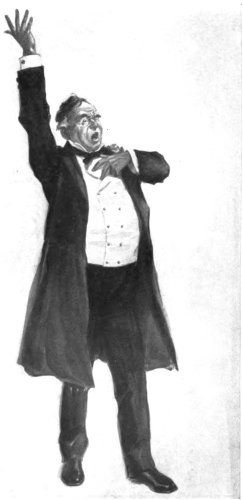
"The distinguished Flynn burst into a deluge of oratory."
But the prosecution had reserved a bombshell for the last, intended to annihilate the testimony of the defendant and neutralize the effect of his personality upon the jury. The assistant called in rebuttal a salesman from a large retail fire-arm store, who testified positively that the pistol in evidence had been purchased the day before the homicide. Flynn turned to the attendant, whom he knew well and cursed. These Guineas! Bought the day before! He had all the air of one who has been grossly and inexcusably deceived. He scowled at Candido, who quailed before him.
"How long do you want to sum up, gentlemen?" inquired the court. "Will twenty minutes each be sufficient?"
The distinguished Flynn burst into a deluge of oratory in which Self-Defense and The Unwritten Law played opposite one another, neither yielding precedence. His client was a hero! The instinct of every true American, of every husband, of every father, must stamp his deed as one blameless in the eyes of the Almighty, and worthy not of censure but of the approval of all honest men and lovers of virtue. At the risk of his own life he had preserved the integrity of his home and the honor of his wife. At the same time he had rid the community of a villain. Never, while the Stars and Stripes floated above their heads would an American jury on this sacred soil, consecrated by the blood of those who sacrificed their lives to liberty, etc.— He subsided, panting and mopping his forehead.
The assistant rose to reply. This explanation of the defendant that he had killed in self-defense was the last despairing effort of a guilty man to escape the consequences of his horrible crime. Of course the prisoner's own evidence was valueless. Jealousy! Calm, calculating jealousy! That was the key to this awful act. The tell-tale picture on Montaro's coat, the crimson admissions of the defendant's wife, the purchase of the pistol—all spoke for themselves. The prosecutor paused.
"Sympathy is not for the assassin," he concluded. "Think rather of his innocent victim! On the sunny shores of Calabria sits a woman, old and gray, to whom this Beppe is her joy, her pride, who thinks of him by day working in the great America across the seas, and whose heart, as the time for the harvest draws near and the exiles are coming back to work in the fields, will beat with expectation. The others will come. Father will meet daughter, and mother will meet son, and they will tell of their life in the great country of Freedom; but for her there will be no gladness—her Beppe will return no more."
The assistant sank into his seat. Candido was staring at him with wide eyes. He knew the avvocato had been talking about Calabria. Madonna! Would he ever see it again?
"Gentlemen of the jury," began his honor. "I shall first define the various degrees of murder and manslaughter."
The sun fell lower and lower over the Tombs as the judge continued his charge. The jury twisted uneasily in their chairs. Candido grew tired. This interminable flow of talk! Why did not the judge say what should be done to him at once? Millions of motes swam in the sun, and with his head resting on his forearms he watched them idly. He had always loved the sun. A warm lassitude stole over him. On Sundays he had spent whole mornings curled up on a bench in Seward Park with Maria and the bambino beside him. How funnily the motes danced about! He smiled drowsily at them. Some were so tiny as to be almost invisible, and some were really large—if you half closed your eyes and one got near it seemed almost as big as a cat—fluffy like a cat. Those little, tiny motes would float out of nowhere into the band of sunshine and sink and dart across it, vanishing into nothingness. Candido amused himself by blowing millions of them into eternity. He himself was just like that. Out of the black, into the warm sun for a little while, and then—pouf!
There was a tremendous scuffling of feet beside him, and the jury rose and filed out. The noise brought him back out of his dream to the realities again. They were going away! Judgment had been pronounced! The judge bowed solemnly to the retreating foreman. Again the fierce chill of overwhelming animal fear seized him. An officer approached. Madonna! He could not pass into the black like the motes, he could not! And he was as yet unshriven! With his frail little body vibrating like a framework of slender steel, he turned and faced the officer, panting with fear, his eyes darting fire.
"Aw, come along!" growled the attendant, raising his hand to seize him by the arm.
"I cannot die unshriven!" shrieked Candido, and flung himself furiously upon the officer, biting, kicking, scratching, until, nearly fainting from his paroxysm of terror and in a coma of exhaustion, he allowed himself to be carried away by three burly Irishmen.
"Bring up the defendant!" directed the court. The jury were already in and waiting for the prisoner. The Italians had all been hustled out into the corridor. His honor had no mind for any sort of demonstration. The light still poured through the great windows, and the sky was a deep sunny blue over the Tombs. Resisting, clutching at sills and railing, hanging by his arms, Candido was carried in and held bodily at the bar.
"Jurors, look upon the defendant. Defendant, look upon the jurors. How say you, do you find the defendant guilty or not guilty?" asked the clerk grandiloquently.
"Not guilty," answered the foreman distinctly, and with a shade of defiance in his voice.
"Listen to your verdict as it stands recorded," continued the clerk, unaffected. "You find the defendant not guilty, and so say you all."
"Any other charges against the prisoner?" inquired his honor.
"Not yet," replied the assistant with sarcasm.
Suddenly Candido began again. "Madonna! Save me! I confess that I killed Beppe, my countryman——"
The bifurcated interpreter jabbered furiously at him. An expression of dumb amazement overspread the dusty little face.
"You are free, acquitted, discharged; you may return to your home!" announced the beard dramatically, waving a hand in the direction of the door. The officers lowered Candido slowly to his feet. He picked up his hat. Abject wonder was painted upon his countenance. He gazed from the judge to the jury, and back again to the prosecutor.
"Madonna! I am pardoned for killing Beppe? O giudici, I kiss your hands." He seized that of the interpreter and devoured it with kisses. Then with a smile he added: "Ah, you see I could not but kill him! He had ruined my home! He had deprived me of honor!"
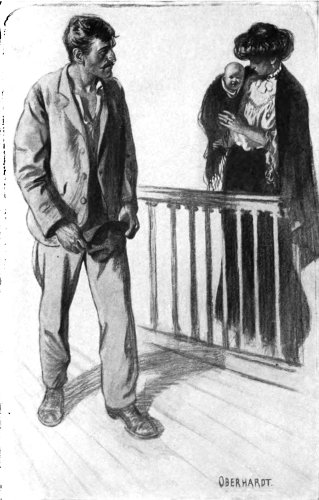
"He caught sight of the waiting Maria."
The attendants faced him toward the door, and he started slowly away; but before he had taken half a dozen steps he caught sight of the waiting Maria. His face changed. Once more he turned to the interpreter and muttered something hoarsely beneath his breath.
"He says," translated the interpreter, turning to the court, "that he would like to have his pistol."