SIMPLE CARD TRICKS
Reading edition
AN EASY METHOD OF FINDING A SELECTED CARD
Throw the pack on the table and request some one to select a card. Then gather up the rest of the cards and request your friend to show his card to his neighbour, to avoid mistakes. While this is being done bend the pack slightly while pretending to shuffle it, and cause the card to be returned and the pack shuffled. The selected card can then be easily detected among the bent cards by its being perfectly straight. A good way to finish the trick is to bring the card to the top of the pack and cause it to project about an inch over the right side; cover the front end of the pack with your four fingers so that the edge of the projecting card is concealed, and, with your thumb at the other end, hold the pack firmly about eighteen inches above the table. Request the person who drew the card to call it by name. On this being done, drop the pack on the table, when the projecting card will be completely turned over by the air in its descent and lie perfectly square on the top of the pack. Another good finish is to bring the chosen card to the bottom of the pack, and requesting the person who selected it to hold the pack by pinching it tightly between his finger and thumb close to the corner, you give 10 the pack a sharp rap, when all the cards will fall excepting the one chosen.
TO BRING A CHOSEN CARD FROM THE BOTTOM OF THE PACK AT ANY NUMBER REQUESTED
Ask a member of the company to take a card, look at it, and return it to the pack. Make the “pass” (Hercat’s Card Tricks, p. 7); “palm” the card (Card Tricks, p. 18) and hand the pack to be shuffled. While this is being done transfer the palmed card to your left hand, and on receiving the pack back, place it over the concealed card, and tell the company you will produce the latter from the bottom of the pack at any number they may name. Supposing some one says, “Let it be the fifteenth card.” You push the pack forward in your left hand, allowing the bottom card to project about an inch toward you, and proceed to draw out the cards above it with your right hand, one at a time, until the fourteenth is reached, when you push the bottom card forward and produce it as the fifteenth.
A CHOSEN CARD SHAKEN THROUGH A HANDKERCHIEF
Request a member of the company to select a card and return it to the pack, which you proceed to wrap up in a large pocket handkerchief, and on the person calling the card by name you shake the handkerchief and the selected card falls on the table.
Explanation.—If you are not an adept at sleight-of-hand 11 it is advisable to use a “forcing pack” which is composed of only three or four cards, of a kind (i.e. ten kings of hearts, ten five of spades, ten eight of diamonds, etc.) with backs to match your ordinary pack. If you can make the “pass” and can “palm” (Hercat’s Card Tricks, pp. 7 and 18) the following is the correct modus operandi. On the card being returned to the pack, carry it to the top by the pass, palm it, and hand the pack back to be shuffled. Place the palmed card face upward on the left hand and cover it with a large white handkerchief, and cause the pack to be placed face down on the handkerchief exactly over the concealed card. With your right hand throw the back hem of the handkerchief over the pack and with that hand grasp the four sides underneath. Then reverse the position of your hands, moving the right hand toward the right on top and taking the left hand away, which will leave the selected card concealed in the fold of the handkerchief (Fig. 1). Ask the person who took the card to name it and request it to leave the pack and pass through the handkerchief. When he does so shake the handkerchief gently and the card will slowly come into view. If you use a “forcing pack” retain a duplicate of the card you intend to force; conceal it in your left hand and proceed as above described.
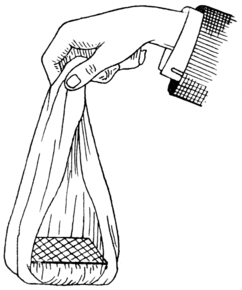
Fig. 1.
12
A SELECTED CARD FOUND IN A LIGHTED CIGARETTE
Roll a card, say the seven of hearts, in a cigarette paper and stuff a small piece of tobacco in each end. Have this in one of your pockets, where it will not get crushed, ready for palming. Previously arrange with a friend to act as your confederate, and request him when you ask him to select a card to take the duplicate of the one in the cigarette. When ready to present the trick, hand the pack to your friend and ask him to shuffle it, select any card he likes, show it to his neighbour, replace it in the pack, and again shuffle the latter thoroughly. While this is in progress produce some tobacco and a cigarette paper and roll a cigarette, which substitute for the one prepared. If you are not an adept at palming I would suggest the following easy method: Lay your handkerchief across your knees, and on it place the prepared cigarette. While reaching for a match, drop the cigarette you have just made on your lap, as if by accident, and pick up the one containing the card. You can afterwards pick up your handkerchief and put it and the genuine cigarette in your pocket. You then light the prepared cigarette and ask your friend to hand you the pack and name his card; when he does so, tell him you will produce the card in any place he may name.
By previous arrangement he must say, “In the cigarette you are smoking.” You then pick up the pack and “ruffle” it over the cigarette; take the latter from your mouth, extinguish the fire, and tearing the paper in the centre, produce the seven of hearts from it.
13
A STICKING CARD
Obtain a short “drawing-pin” with a small head, and having painted the head black, stick it through the centre of the ace of clubs. Put this in your pocket and “force” another ace upon a member of the company. Hand the pack to the person upon whom you have forced the card, request him to replace it and shuffle the pack. Then take the pack from him, and as you turn your back slip the card with the pin through it on the top of the pack. Holding the pack in your right hand with its face toward the palm, ask your friend to name his card. When he does so throw the pack sharply against the door. The top card will be held there by the pin and the rest of the pack will fall on the floor.
This trick was shown by a conjurer before the late King Edward a few years ago, and His Majesty was reported in the daily papers to have expressed “great surprise.”
TWO SELECTED CARDS CAUGHT IN THE AIR
Two cards are selected and returned to the pack, which you then make a pretence of shuffling, taking care not to lose sight of the chosen cards; “slip” (Hercat’s Card Tricks, p. 10) one of the latter to the top of the pack and the others to the bottom face upward. Have a small piece of wax on your right finger and thumb and press the pack between them. Obtain the names of the selected cards, and then throw the pack in the air, moving your hand away quickly, with, of course, the selected cards sticking 14 to your thumb and finger. As the cards descend thrust your hand in among them, and then, separating your thumb and finger, show the cards adhering to them, which you will appear to have caught.
AN EASY BUT PUZZLING TRICK
Any card may be drawn—not “forced”—and returned to the pack. In pretending to shuffle the cards, bring the selected card to the bottom of the pack, and then slip another card in front of it. Show your friend this card at the bottom and ask him if it is his. Of course he will say “No.” Lower the pack, and with the fingers of your left hand draw the bottom card back about half an inch, and with your right hand draw out the next card—which is the one chosen—and place it face down on the table. Shuffle the pack and again show the bottom card, “Is this your card?” “No.” “Then I will place this one on the table”—which you do. Repeat this, and place a third card from the bottom of the pack on the table. Then say, “I am sure your card must be one of the three. No? Look and see for yourself.” He turns the three cards over, and of course finds his card is one of them.
TRAVELLING CARDS
Give the pack to a member of the company, and request him to count off between twenty and forty cards, place the pack on the table, and hand the cards he has counted to you. You then hand the pile to a second person and 15 request him to count off about one-third of the number, lay them in a pile on the table, and hand you the remainder, which you give to the first person, requesting him to place them in his pocket. Taking up the second pile, you request the second person to place it in his pocket. We will suppose the first person selected thirty and the second person abstracted ten cards from them, which should leave twenty now in the pocket of the former. Then announce your intention of causing a certain number of cards to leave the pocket of person number one and travel invisibly into the pocket of person number two. Open a pocket-handkerchief, and covering number one’s pocket, flick it in the direction of person number two, exclaiming, “They have gone!” On the two piles being produced and counted, those from the pocket of number one person will number only fifteen, and the same number will be found in the second pile.
Explanation.—When you receive the thirty cards from the first person, you palm off five or six cards (the number is immaterial) and retain them concealed in your hand, handing the remainder to the second person. When he has counted off ten and placed them on the table, you take those that are left from him and hand them to person number one. When picking up the pile of ten from the table, while pretending to square it, you add the palmed cards and hand the pile thus increased to person number two. You must be careful not to allow the two persons to count the cards after the changes have been made. If you see they are inclined to do so, take the piles from them and place them in their pockets yourself.
16
TO NAME ALL THE CARDS IN THE PACK
Ask some one to shuffle the pack, and, on receiving it back, glance at the bottom card. Put the pack behind your back, and then turn the top card round with its face toward you; bring the pack in front of you, the bottom card facing the audience and the turned card facing you. Having already glanced at the bottom card, you can tell them its name, and you now know the card on top. Put the pack behind you again, and move the top card to the front, and turn the one now on top round. Again hold the pack up and name the front card, at the same time noting the card facing you. By repeating this process you can name all the cards in the pack. Take care to have all your audience in front of you, or the turned card will be seen.
A NEW METHOD
Here is an absolutely new method of performing the same trick blindfolded, but with the aid of a confederate. You tell your friends that by placing your hands on a person’s head you can see with his eyes. To illustrate this, tell your assistant to seat himself at a table, and you then stand behind him blindfolded, with your fingers lightly touching his temples. The cards are spread out faces down on the table, and no matter which card he picks up and looks at, you at once say what it is. Of course, you take the tip from him; but how? I will tell you.
He must keep his mouth shut and his teeth together. The slightest pressure between his upper and lower teeth—so slight that it is quite imperceptible—will cause his 17 temples to throb—try it on your own temples—and, of course, by the arrangement of a very simple code he can communicate to you the name of each card. Say one throb stands for hearts, two for diamonds, three for clubs, and four for spades. We will say his temples throb twice. You say, “You are looking at a diamond.” Then we will suppose they next throb five times. You say, “It is the five of diamonds,” and so on. When you come to an ace, of course one throb will suffice; when he picks up a knave, let him give two throbs in rapid succession—a kind of postman’s knock; a queen, a postman’s knock and one throb over; and for a king, a double postman’s knock—rat-tat, rat-tat. With a little practice and a more elaborate code, you can describe all kinds of articles which may be selected—keys, watches, books, etc. It is a capital trick and one which no one can possibly discover.
THE SENSE OF TOUCH
This is an improvement upon the two preceding tricks which I invented several years ago, and have shown scores of times without the modus operandi being once detected.
Effect.—The pack is handed to the audience to be shuffled, and, without even glancing at it, the performer places it behind his back and names each card (presumably by the sense of touch) before he draws it. He can hand the pack back to the audience to be shuffled as many times as desired.
Execution.—Before handing the pack to be shuffled, ascertain which card is on the top, and palm it in the right 18 hand; receive the pack back in the palm of the left hand and cover it with the thumb.
Put both hands behind you and slip the palmed card between the tips of your left first and second fingers; then palm the top card and take the card originally palmed between the right thumb and the forefinger with your thumb on top. While doing this, explain to the audience that you have with considerable practice acquired a marvellously keen sense of touch which enables you to ascertain the name of each card by simply feeling it. You proceed to say: “I will name each card before showing it to you, and you are at liberty to shuffle the pack as many times as you may desire.
“The card I am now feeling appears to be (say) the queen of spades.” You then show the card held between your thumb and finger, at the same time glancing at the palmed card. Throw the former on the table, and putting your hand behind your back again, nip the palmed card with the first two fingers of the left hand, and palm the top card as before. You can go through the whole pack in this manner, but each time you hand it to be shuffled, be sure to have one card palmed. This trick should not be attempted until it has been thoroughly rehearsed.
WHERE IS THE ACE?
Select the ace and five of hearts and two other cards of the same suit and conceal the five behind one of the latter so as to make it appear you have only three cards. Hold the two cards (with the concealed five) faces down, a little distance apart and showing the ace place it deliberately 19 behind them so that the pip shows between (Fig. 2) when the cards are held up. Having shown the cards in the latter position to the company, lower them again and defy any one to lift up the ace. A member of the company does so and naturally looks at the card, when you say, “But you must not look at it. Take the card off and place it face down on the table, and I will then tell you whether your attempt has been successful. We will try again?” Re-arranging the cards, substitute the five for the ace and place it so that the centre pip alone is visible between the two cards. Repeat your challenge and request your friend to remove the ace, place it on the table, and cover it with his hand. When this is done ask him if he still has the ace, and he will naturally say “Yes.” Tell him to raise his hand, and to his astonishment he will find the five.
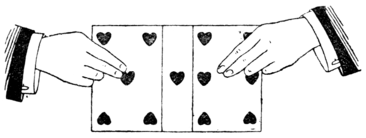
Fig. 2.
TO MAKE A PERSON NAME A CARD WHICH YOU HAVE YOURSELF SELECTED
Take any card from two to ten, say the five of hearts, and lay it face down on the table without permitting any one 20 to see its face. Then announce your intention of examining a number of the company as to their knowledge about cards. Ask for a volunteer, and on one consenting to act tell him to answer your questions rapidly and to make his replies short. Then put the following questions: “How many cards are there in a full pack?” Answer, “Fifty-two.” “How many suits?” “Four.” “What are their colours?” “Red and Black.” “Now name one of those colours.” “Red.” If he should say “black,” you must say, “You select black so I take red. How many suits are there in red?” “Two.” “What are they?” “Hearts and Diamonds.” “Name one of those suits quickly.” “Hearts.” If he should name diamonds say, “Then I take hearts.” “How many cards in the suit?” “Thirteen.” “How many between the ace and knave?” “Nine.” “How many below six and how many above six?” “Four below and four above.” “Name either below or above?” “Below.” If he says “above,” say, “That gives me those below six. What are the numbers below six?” “Two, three, four, and five.” “Name two of those numbers.” “Four and five.” If he should say “two and three,” or “three and four” you remark, “That leaves me four and five. Name one of those numbers.” If he says “four,” you say, “Which leaves five.” The suit you selected was hearts, and now we have come down to five. So you have actually selected the five of hearts; and I am sure you will admit I have not influenced your choice in any way. Please turn over the card on the table.” He does so and, of course, finds it is the five of hearts.
21
THE CLOCK
Select twelve cards of any suit, ace to ten and king and queen; arrange them in a circle to represent the figures on the face of a clock, the king as twelve and the queen as eleven (Fig. 3), and request a member of the company to think of one of the numbers. You then explain you will tap the cards with a pencil and he is to mentally add your first tap to the number he thought of and count your succeeding taps until twenty is reached, when he is to call “Stop,” and your pencil will then rest upon his number. For instance, we will suppose he thinks of twelve; he must count your first tap as thirteen and continue counting mentally until twenty is reached.
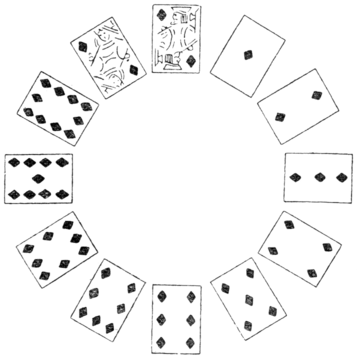
Fig. 3.
22
Explanation.—Touch the cards at random during the first seven taps and allow your pencil, on its eighth tap, to rest on the king (twelve). Eight and twelve being twenty he will of course say “Stop.” Supposing he thought of a lower figure—seven, for instance. Tap at random as before until your eighth tap, which must always be on twelve; then touch the cards in rotation, making the queen your ninth tap, the ten your tenth tap, nine your eleventh, and so on until you reach seven, which will be your thirteenth tap, which number added to seven, the number thought of, will make twenty, and your friend will say “Stop.”
Another effective trick can be worked with the card dial, but it requires the assistance of a confederate. Having previously instructed him what to do, you tell the company that any one is at liberty to touch one of the cards during your absence from the room, and on returning you will indicate the card he has touched. Upon your returning hand a pencil to your confederate and request him to touch the cards in rotation until you say “Stop,” when the pencil will rest on the right card. Your confederate must hold the pencil in his right hand with his forefinger resting on top. When he touches the right card he must raise that finger slightly. It is a signal no one would notice, and the trick always creates a great deal of wonder.
HOW TO GUESS CARDS THOUGHT OF
Allow the pack to be shuffled freely and then place it on the table face down. Take the three top cards, and holding them up with their backs towards you, ask some one to 23 think of one. Then spread them face down on the table in front of you. Take three more cards, and ask a second person to think of one, and lay these on top of the other three. Show three more cards to a third person, and after he has thought of one, lay these on top of the others. You have now three parcels on the table, each containing three cards. Hold up one parcel, and say to each person: “Is the card you thought of in this lot?” Proceed in the same way with the other parcels, and then tell each person the name of the card he thought of. As the cards shown to the first person were laid on the table first, it stands to reason that the cards he thought of must be at the bottom of the parcel he has said “Yes” to; the second person’s card will be the middle one in the parcel, and the third person’s the top card.
AN INGENIOUS CARD TRICK
Select ten cards, regardless of suit, the ace, and from deuce to ten, arranging them as follows: Lay the ten face down on the palm of your hand, the nine next, and the others in rotation, finishing with the ace, which you call “one.” Give the cards so arranged to a friend, and tell him you will leave the room while he moves cards one at a time, not to exceed nine, from top to bottom, and when you return you will tell him how many he has shifted. You may repeat this feat successfully several times, and finish by requesting him to make up his mind how many cards he intends moving before you leave the room and you will tell him which card will indicate the number he 24 has selected. On returning you immediately refer him to the card which gives the correct answer. This is really a most puzzling trick and yet an easy one to perform. Commence by showing how the cards are to be moved by shifting a few yourself, noting how many you move, so you will remember which card you leave at the bottom. When you return to the room you subtract the number of pips on that card from ten and the product will show the number of the card from the top, the pips on which indicate the number of cards your friend has moved. We will suppose that, in illustrating, you move four cards, which will, of course, leave the four at the bottom; you subtract four from ten, which leaves six, and no matter how many cards have been moved the pips on the sixth from the top will indicate the number. Taking the pack in your hand face downward, count off the first six cards, and glancing at the sixth say, “You moved —— cards.” When you repeat the trick add the number originally at the bottom to the number your friend has moved, which will give the number now at the bottom, which you again subtract from ten. In predicting the number of cards your friend means to move you tell him the number of the card from the top which will show it. We will suppose the bottom card is eight and your friend mentally decides upon moving five cards, you subtract eight from ten, which leaves two, and tell him the number he is going to move will be indicated by the pips on the second card from the top after he has moved the cards.
25
TO NAME A CARD WHICH SOME ONE HAS THOUGHT OF
Spread six cards before a member of the company and ask him to think of one. Place these cards at the bottom of the pack and give the latter a “false shuffle,” i.e. shuffle them in such a manner that the bottom cards are not disturbed. Then take the four top cards, and spreading them on the table, faces upward, ask your friend if his card is among them. Of course, he will say “No.” While he is looking at the cards on the table “slip” (Hercat’s Card Tricks, p. 10) one of the bottom cards to the top of the pack. To do this moisten the tips of the two middle fingers of the left hand, and holding the pack in that hand with the moistened fingers against the face of the bottom card, with the thumb and two middle fingers of the right hand raise the rest of the cards slightly and the card adhering to the moistened fingers will be carried to the top of the pack. Again spread the four top cards on the table and repeat the enquiry. If he says “No,” repeat the former process until he says, “Yes, my card is in that lot.” You, of course, know it is the card you “slipped” from the bottom of the pack. You then tell him to gather up all the cards and shuffle them thoroughly; then place the pack on the table, put his hand over it and look you steadily in the eye. You place your hand over his and say, “I can read your thoughts, you took the ——,” naming his card. This is an easy trick to perform and causes great amazement.
26
THE REJECTED RECRUITS—A LAUGHABLE TRICK
Select a king and the four knaves and lay the king on the table face upward. Tell the company that the king is recruiting for the army and accepts the knave of clubs, which you place on the king’s right. The knave of spades, which you place on the left, he rejects. The knave of diamonds is accepted and placed on the right. The knave of hearts is declined, and placed on the left.
Now ask your audience how it is that the king, being in want of recruits, accepts two and refuses two.
The answer will puzzle those not acquainted with the trick. It is as follows: Two of the knaves have but one eye each, and are consequently medically unfit.
A NOVEL CARD EFFECT
Effect.—A five-spot card is passed for examination, a two spot of the same suit is then placed face down on the five; after rubbing the cards slightly and separating them a spot is found to have passed from the centre of the five on to the two spot, making a four spot and a three spot. The pack is afterwards shown to be quite an ordinary one without any apparent preparation.
Preparation.—Remove from the pack the five, four, three, and two of any suit. Place the remainder of pack face down on the table. Now place the five spot face up on the back of the pack, the two spot face down on the five, the four face up on the back of the two, and the three spot face down on the four. Then remove the three top 27 cards, without in any way altering their order, and place them on the face of the pack so that the two spot is showing, and turn the five spot face down, so that the pack appears to be without preparation.
Presentation.—Show pack held in left hand and call special attention to the two spot on the bottom of the pack, then lift off the five-spot card and pass it to a spectator with the remark that the centre spot is loose and can be transferred at will to any other card; while the card is being examined you secretly count off the three other prepared cards at the bottom of the pack and keep them separated from the rest with the index finger of left hand. Now take back the five-spot card and place it on the back of the pack, with its face side toward audience. Then with the first two fingers and thumb of right hand take the three other cards from bottom of pack and show them as one card only: namely, the two spot. This movement is best executed by slightly pushing down the three cards with the index finger of left hand until a sufficient amount of projection is obtained for the fingers and thumb of right hand to grip. Now place the apparent two-spot card face toward, and on to the five spot; proceed by gently rubbing the back card with the index finger of right hand, and lift the top card and show it to be a three spot, while the card facing is found to be a four spot, which you also remove. The back of the two-spot card will then be seen and the pack appear to be an unprepared one.
28
AN ARTFUL CARD FORCE
Presentation.—First secretly note what the top card of the pack is. Then proceed by asking a spectator to state what card he wishes you to use by giving you a number. After having received the number you proceed to count the cards face down on to a table until you reach that number, at the same time mentioning that the last card counted is the one you are to use. You pause for a moment, apparently thinking, then say, it is possible that the spectator may think that you already know the card as you counted them yourself, you consider that it would only be fair to allow him to count them himself. At the same time you replace the counted cards, and hand the pack to spectator, with the request that he counts down to the number previously stated. This, of course, has the effect of bringing the known top card into position at his number, so that it is quite an easy matter to follow on with any trick in which the sleight-of-hand force is necessary. This seems very simple, but try the effect; even our advanced friends will find it extremely useful.
ANOTHER EASY CARD FORCE
Requisites.—An ordinary pack of cards and two extra cards stuck securely together.
Place the double card below a previously noted card. Hold the pack in the left hand so that the thumb can pass readily down the cards at the upper corner. Now pass the thumb of the right hand down the cards so as to ruffle them. You will find that the thumb is automatically 29 stopped at the double card. By requesting a spectator to take the card immediately above the break in the pack, you can then proceed with any trick in which a forced card is necessary. Numerous other uses for the double card will readily occur to my readers from the hint given.
A SIMPLE BUT PUZZLING CARD TRICK
Place the pack face down on the table and cover it with a serviette. Then request a member of the company to put his hand under the serviette and take a card at random; to be careful not to let you see it but show it to the company and then return it to the pack and to square the pack through the serviette after the card has been replaced. You then lift up the side of the serviette nearest to you and at once produce the card.
Explanation.—When the company are looking at the card slip your hand under the serviette and turn the pack over, and, of course, you can at once detect the “faced” card when it is replaced. On withdrawing it with your right hand turn the pack over with your left and lift off the serviette.
30