MATCH PUZZLES
Reading edition
EXPERIMENT WITH TEN MATCHES
Lay ten matches side by side (Fig. 7) and request some one to lift each match singly, and passing it over two matches, cross a third match with it until there are five crosses on the table (Fig. 8). Two matches (and only two whether crossed or single) must be passed over at a time.
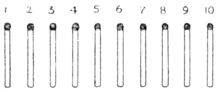
Fig. 7.
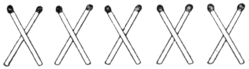
Fig. 8.
The secret is that No. 1 must be crossed first and No. 9 second, or the trick cannot be accomplished.
The following are the correct moves: 4 over 2 and 3 60 and crossed on 1; 6 over 7 and 8 and crossed on 9; 8 over 7 and 5, crossed on 3; 2 over the 3 and 5, crossed on 7; the 10 over the 9 and 7, crossed on 5.
THE MAGIC NINE
Make the figure 9 with a long tail with matches (Fig. 9) and tell a member of the company to think of a number, which must exceed the number of matches in the tail; and, commencing at the first match in the latter, count mentally round the figure, stop when he reaches the number thought of, and then, recommencing at the match he stopped at, count the reverse way, this time avoiding the tail, and continuing on the upper part of the 9 until he again reaches the number he selected, when you will point to the match he has stopped at. This you can do very easily, for if there are seven matches in the tail he will, of course, stop at the seventh match on the left from the tail, as will be seen by the numbering on the diagram, which assumes he thought of fifteen. Each time the puzzle is tried vary the length of the tail by taking some matches out of the latter and adding them to the upper part of the figure, or vice versa. If this is not done the 61 stop will always be made at the same match, which will give the trick away.
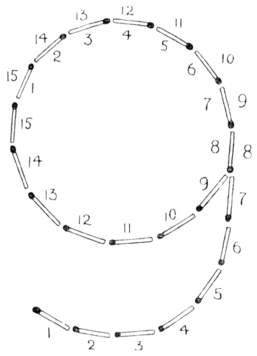
Fig. 9.
TRIANGLES WITH MATCHES
Make three equilateral triangles with six matches. Of course, two can be made with five matches; but then there is one over, and how to make a third triangle with only one match is a puzzler. It is as easy as possible. Make a triangle with three matches, and stand the other three upon end inside the triangle in the form of a tripod (Fig. 10).
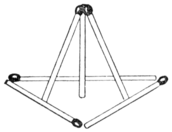
Fig. 10.
Here is another triangular puzzle. With five matches form two equilateral triangles. Tell the company they are to remove three matches; then add two and make two more equilateral triangles. This is only a “sell.” You do not say where the two matches are to be added. You add them to the three removed, and form the same figure over again (Fig. 11).
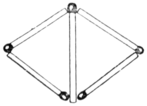
Fig. 11.
MATCH SQUARES
Make nine squares with twenty-four matches (Fig. 12). 62 Then request some one to remove eight matches, and without touching those left, to leave two perfect squares.
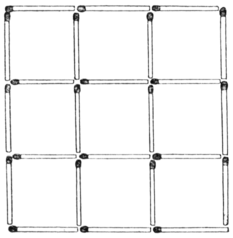
Fig. 12.
Fig. 13 shows the solution.
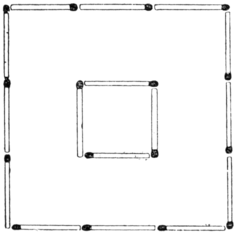
Fig. 13.
YOUR OPPONENT MUST TAKE THE LAST MATCH
Place twenty-five matches in a row on the table. Request some one to select one end of the row and to take one, two, or three matches from it, you having the same privilege at the other end; and you guarantee he will be compelled to take the last match no matter how he may vary the number he takes.
The secret is to remove four matches each time between you. For instance, if your opponent takes three you take one; if he takes two you take two; if he takes one you take three and so on. It is obvious if four matches are taken six times one match will be left on the table, which your opponent must take.
63
A SHAKESPEAREAN QUOTATION
Lay five matches on the table and request a member of the company to form a well-known quotation from Shakespeare by the addition of three more matches (Fig. 14). “But,” some one will say, “how does KINI represent a Shakespearean quotation?” Your reply is obvious: “Can’t you see KINI is ‘a little more than kin, but rather less than kind’?”
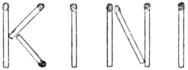
Fig. 14.
NUMERAL
Place five matches on the table and challenge any one to make them into thirteen without breaking any of them, and then, without moving them, to make eight by the use of a card. The solution will be found in Fig. 15.
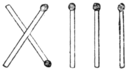
Fig. 15.
To make eight, hide the lower half of the row from sight, and it of course shows viii.
SIX AND FIVE MAKE NINE
Place six matches on the table and request a person to add five more in such a manner as to make nine. The solution is shown in Fig. 16.
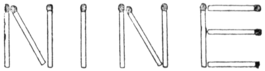
Fig. 16.
64
THE ARTFUL SCHOOLBOYS
At a certain school were four long dormitories, built in the form of a square, in which thirty-two boys occupied beds, as shown by matches in Fig. 17.
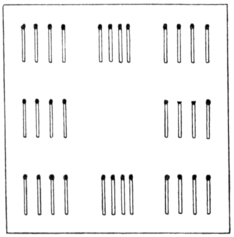
Fig. 17.
By this arrangement the master, in going his rounds at night, counted twelve boys in each corridor. One night four boys absented themselves from the school, and the remaining boys rearranged themselves in such a manner that the master was still able to count twelve boys in each corridor, and the absence of their four comrades was not noticed. How they did it is shown in Fig. 18.
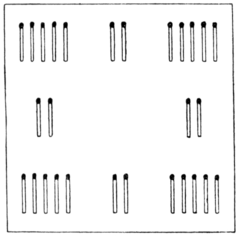
Fig. 18.
The four absentees returned on the following night, accompanied by four friends; but the master was unable to notice the addition, for he again counted twelve boys in each dormitory. The new arrangement was as Fig. 19.
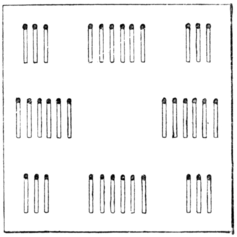
Fig. 19.
There were now thirty-six boys sleeping in the dormitories, and next night they were joined by four more, which brought the number up to forty, and yet the master 65 only counted twelve in each dormitory on his rounds that night. How the new distribution was made is shown in Fig. 20.
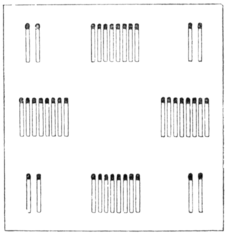
Fig. 20.
Next night four more chums popped in for a snooze, making a total of forty-four, and again the master was bamboozled by the following readjustment (Fig. 21).
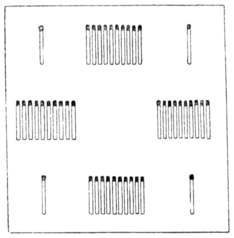
Fig. 21.
History is silent upon the subject of the arrangement at the breakfast-tables.
The proper way to present this puzzle to your friends is to lay forty-four matches on the table, and after showing the initial arrangement, allow them to work the rest out for themselves.
66
WHAT ARE MATCHES MADE OF?
Arrange fourteen matches as in Fig. 22, and tell your friends to take away any three matches they may select without disturbing the others, and replace one in any position they may choose in such a way as to show what matches are made of. They will endeavour to form the word “wood”; but Fig. 23 gives the correct solution.
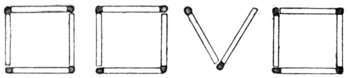
Fig. 22.
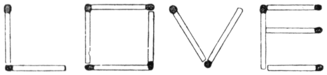
Fig. 23.
A SHEEP PEN
Arrange eight matches as shown in Fig. 24, and state that this enclosure, formed by eight hurdles, is supposed to hold one hundred sheep. Ask your friends how many 67 more hurdles would be required to enable the enclosure to contain two hundred sheep? The reply is generally eight more, and your friends will be surprised to learn that only two more hurdles are required—one at each end across the enclosure. Three hurdles being moved to admit of the introduction of the additional two, the pen will, of course, be doubled in size.
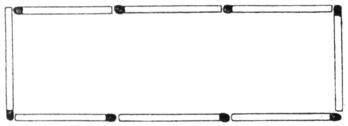
Fig. 24.
POST AND RAIL PUZZLE
Put the following question to the company: Supposing there was a tunnel through a hill and a post and rail fence was constructed through it, and another fence was made exactly above it, over the hill, how many more posts would be required for the latter route, supposing they were the same distance apart by both routes?
After several calculations have been made you can astonish the company by telling them that exactly the same number of posts would be required for both routes, which you can prove by making a rough sketch of the diagram, Fig. 25, and placing matches on it to represent the posts.
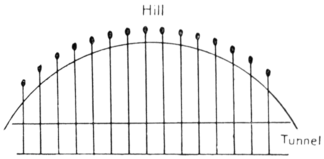
Fig. 25.
68