THE HYDROSTATIC BED FOR INVALIDS.
Reading edition
We are favoured by Dr. Arnott, the author of ‘The Elements of Physics,’ with an unpublished extract from the fifth edition of his work, now in the press. The invention here described promises to be such a real blessing to humanity, that we feel great pleasure in assisting to make known an improvement of such importance in the healing art; particularly as its value is not a matter of speculation, and as its benevolent author freely allows its use wherever the wants of his fellow-creatures require its application:—
In many of the diseases which afflict humanity, more than half of the suffering and danger is not really a part of the disease, but the effect or consequence of the confinement to which the patient is subjected. Thus a fracture of the bone of the arm is as serious a local injury as a fracture of one of the bones of the leg; but the former leaves the patient free to go about and amuse himself, or attend to business as he wills, and to eat and drink as usual—in fact, hardly renders him an invalid; while the latter imprisons the patient closely upon his bed, and brings upon him, first, the irksomeness of the unvaried position, and then the pains of the unequal pressures borne by the parts on which the body rests. These, in many cases of confinement, disturb the sleep and the appetite, and excite fever, or such constitutional irritation as much to retard the cure of the 215original disease, and not unfrequently to produce new and more serious disease. That complete inaction should prove hurtful to the animal system, may by all be at once conceived; the operation of the continued local pressures will be understood from the following statements. The health, and even life, of every part of the animal body depends on the sufficient circulation through it of fresh blood, driven in by the force of the heart. Now when a man is sitting or lying, the parts of his flesh compressed by the weight of the body do not receive the blood so readily as at other times; and if from any cause the action of his heart has become weak, the interruption will both follow more quickly and be more complete. A peculiar uneasiness soon arises where the circulation is thus obstructed, impelling the person to change of position; and a healthy person changes as regularly, and with as little reflection, as he winks to wipe and moisten his eye-balls. A person weakened by disease, however, while he generally feels the uneasiness sooner, as explained above, and therefore becomes what is called restless, makes the changes with much fatigue; and should the sensations after a time become indistinct, as in the delirium of fever, in palsy, &c., or should the patient have become too weak to obey the sensation, the compressed parts are kept so long without their natural supply of blood that they lose their vitality, and become what are called sloughs or mortified parts. These have afterwards to be thrown off, if the patient survive, by the process of ulceration, and they leave deep holes, requiring to be filled up by new flesh during a tedious convalescence. Many a fever, after a favourable crisis, has terminated fatally from this occurrence of sloughing on the back or sacrum; and the same termination is common in lingering consumptions, palsies, spine diseases, &c., and generally in diseases which confine the patients long to bed.
It was to mitigate all, and entirely to prevent some, of the evils attendant on the necessity of remaining in a reclining posture, that the hydrostatic bed was contrived. It was first used under the following circumstances.
A lady after her confinement, which occurred prematurely, and when her child had been for some time dead, passed through a combination and succession of low fever, jaundice, and slight phlegmasia dolens of one leg. In her state of extreme depression of strength and of sensibility, she rested too long in one posture, and the parts of the body on which she had rested all suffered: a slough formed on the sacrum, another on the heel; and in the left hip, on which she had lain much, inflammation began, which terminated in abscess. These evils occurred while she was using preparations of bark, and other means, to invigorate the circulation, and while her ease and comfort were watched over by the affectionate assiduity of her mother, with numerous attendants. After the occurrence, she was placed upon the bed contrived for invalids by Mr. Earle, furnished for this case with pillows of down and of air of various sizes, and out of its mattress portions were cut opposite to the sloughing parts; and Mr. Earle himself soon afforded his valuable aid. Such, however, was the reduction of the powers of life, that in spite of all endeavours, the mischief advanced, and about a week later, during one night, the chief slough on the back was much enlarged, another had formed near it, and a new abscess was produced in the right hip. An air-pillow had pressed where the sloughs appeared. The patient was at that time so weak that she generally fainted when her wounds were dressed; she was passing days and nights of uninterrupted suffering, and as all known means seemed insufficient to relieve her, her life was in imminent danger.
Under these circumstances, the idea of the hydrostatic bed occurred to me. Even the pressure of an air-pillow had killed her flesh, and it was evident that persons in such a condition could not be saved unless they could be supported without sensible inequality of pressure. I then reflected, that the support of water to a floating body is so uniformly diffused, that every thousandth of an inch of the inferior surface has as it were its own separate liquid pillar, and no one part bears the load of its neighbour—that a person resting in a bath is nearly thus supported—that this patient might be laid upon the surface of a bath over which a large sheet of the water-proof India-rubber cloth were previously thrown, she being rendered sufficiently buoyant by a soft mattress placed beneath her—thus would she repose on the face of the water, like a swan on its plumage, without sensible pressure anywhere, and almost as if the weight of her body were annihilated. The pressure of the atmosphere on our bodies is of fifteen pounds per square inch of its surface, but, because uniformly diffused, is not felt. The pressure of a water-bath of depth to cover the body, is less than half a pound per inch, and is similarly unperceived. A bed such as then planned was immediately made. A trough of convenient length and breadth and a foot deep was lined with metal to make it water-tight; it was about half filled with water, and over it was thrown a sheet of the India-rubber cloth as large as would be a complete lining to it if empty. Of this sheet the edges, touched with varnish to prevent the water creeping round by capillary attraction, were afterwards secured in a water-tight manner all round to the upper border or top of the trough, shutting in the water as closely as if it had been in bottles, the only entrance left being through an opening at one corner, which could be perfectly closed. Upon this expanded dry sheet a suitable mattress was laid, and constituted a bed ready to receive its pillow and bed-clothes, and not distinguishable from a common bed but by its most surpassing softness or yielding. The bed was carried to the patient’s house, and she was laid upon it; she was instantly relieved in a remarkable degree: sweet sleep came to her; she awoke refreshed; she passed the next night much better than usual; and on the following day, Mr. Earle found that all the sores had assumed a healthy appearance: the healing from that time went on rapidly, and no new sloughs were formed. When the patient was first laid upon the bed, her mother asked her where the down pillows, which she before had used, were to be placed; to which she answered, that she knew not, for that she felt no pain to direct: in fact, she needed them no more.
It may be here recalled to mind, that the human body is nearly of the specific gravity of water, or of the weight of its bulk of water, and therefore, as is known to swimmers, is just suspended or upheld in water without exertion, when the swimmer rests tranquilly on his back with his face upwards. He then displaces water equal to his own body in weight as well as in bulk, and is supported as the displaced water would have been. If his body be two and a half cubical feet in bulk (a common size), he will just displace two and a half cubic feet of water, equal in weight to his body. If, however, instead of displacing the water with his mere body, he choose to have something around or under him which is bulky with little weight, as the mattress of the bed above described,—when his weight has forced two cubical feet of that under the level of the water around, he will float with four-fifths of his body above the level, and will sink much less into his floating mattress than a person sinks in an ordinary feather-bed. It thus appears that by choosing the thickness of the mattress, and if unusual positions are required, by having different thickness in different parts, or by placing a bulk of folded blanket or of pillow over or under the mattress in certain situations, any desired position of the body may be easily obtained.
This bed is a warm bed, owing to water being nearly an absolute non-conductor of heat from above downwards, and owing to its allowing no passage of cold air from below. From this last fact, however, less of the perspiration, whether sensible or insensible, will be carried off by the air than in a common bed, and unless the patient can leave the bed daily to let it be aired, it is necessary to lay an oiled silk or other water-proof cloth over the mattress, to prevent the perspiration from descending to be condensed on the cloth below; or to place a blanket below to be changed occasionally; or, finally, to lay under the mattress a layer of cork, cut into small pieces, and so connected as to leave passages between, for any desired degree of ventilation. This bed is in itself as dry as a bed can be, for the India-rubber cloth (of which bottles can be made) is quite impermeable to water, and the maker is now preparing cloth expressly for this purpose. Then, as Sir Humphry Davy recommended that his safety lamp should be double, some persons may prefer a double sheet, to obviate the possibility of accident. Unlike any other bed that ever was contrived, it allows the patient, when capable of only feeble efforts, to change his position, almost like a person swimming, and so to take a degree of exercise, affording the kind of relief which in constrained positions is obtained by occasional stretching, or which an invalid seeks by driving out in a soft-springed carriage. It exceedingly facilitates turning for the purpose of dressing wounds, for by raising one side of the mattress or depressing the other, or merely by the patient’s extending a limb to one side, he is gently rolled over, nearly as if he were simply suspended in water; and it is possible even to dress wounds, apply poultices, or place vessels under any part of the body, without moving the body at all; for there are some inches of yielding water under the body, and the elastic mattress may at any part be pushed down, leaving vacant 216space there, without the support being lessened for the other parts. Then, with all the advantages which other invalid beds possess, and with those which are entirely its own, it may yet be made so cheaply, that even in hospitals, where economy must prevail, it may at once be adopted for many of the bed-ridden. Mr. Earle, within a few days of seeing the first one, had others made for patients in St. Bartholomew’s Hospital, and has been as much pleased with the results of them as of the first. The bed has since been introduced into St. George’s Hospital by Mr. Keate, and elsewhere.—The author has now seen enough of the effects of this bed to make him feel it a duty at once to publish a notice of it. With it, evidently, the fatal termination called sloughing, now so common, of fevers, and other diseases, need never occur again. And not only will it prevent that termination, but by alleviating the distress through the earlier stages, it may prevent many cases from even reaching the degree of danger. Then it is peculiarly applicable to cases of fractured bones, and other surgical injuries; to palsies, diseases of the hip joint, and spine; and universally where persons are obliged to pass much time in bed. And in all classes of curvature of the spine, either actually existing or threatened, it affords a means of laying a patient in any desired position, and with any degree of pressure incessantly urging any part of the spine back to its place. If used without the mattress, it becomes a warm or a cold bath, not allowing the body however to be touched by the water; and in India, it might be made a cool bed for persons sick or sound, during the heats which there prevent sleep and endanger health. There are numerous other professional adaptations and modifications of it, which will readily occur to practitioners sufficiently versed in the department of natural philosophy (hydrostatics) to which it belongs. Before reflection a person might suppose a resemblance between it and an air-bed or pillow, calling this a water-bed or pillow; but the principles of the two are perfectly distinct or opposite. An air-pillow supports by the tension of the surface which encloses the air, and is therefore like a hammock or the tight sacking under the straw mattress of a common bed, and really is a hard pillow; but in the hydrostatic bed there is no tense surface or web at all: the patient is floating upon the water, on which a loose sheet is lying, merely to keep the mattress dry, and every point of his body is supported by the water immediately beneath it. To recall the difference here described, and which is of great importance, the bed is better described by the appellation of hydrostatic bed than of water-bed.
The author has given no exclusive right or privilege to any person to make this bed. He has hitherto employed the carpenter nearest to him, Mr. Smith, 253, Tottenham-court Road, at the back of Bedford Square, and the manufacturers of the water-proof cloth, Mackintosh and Co., 58, Charing-Cross; but any carpenter or upholsterer may learn to supply them, and he gives free permission to all.
The preceding paragraphs are intended as much to direct in the choice and use of common beds for the sick, as to announce and describe the hydrostatic bed for the cases where it may be required. At present the medical attendant often leaves whatever regards the bed to the judgment of friends or nurses; but evidently he who perceives clearly how much the course and events of a malady may depend on the patient’s being supported, so that no pain shall arise from local pressure, and as little weariness as possible from the constrained position, will be better able to use any bed to its greatest advantage, and where a choice of beds is allowed, to choose the best. There is a bed formed of spiral springs which diffuses the support more than any bed except the hydrostatic bed; and had professional men generally known it, it would have been more extensively used than it is, and would have received modifications of which it is susceptible for medical purposes. It has been long known, but chiefly as a mechanical curiosity or as an object of luxury,—but so little known, that a few years ago an English manufacturer took out a patent for it, believing it a novelty. It is now made by upholsterers generally, and the same principle is applied in the construction of sofas, chairs, and carriage cushions.
It is one of the many striking facts illustrative of the benefits attending the commercial intercourse of mankind, that India-rubber, or caoutchouc, for many years used only to rub out pencil-marks, has become an important article in the manufacture of cloth; and it is pleasing to think that probably one of its most extensive applications will be in the mitigation of human suffering.
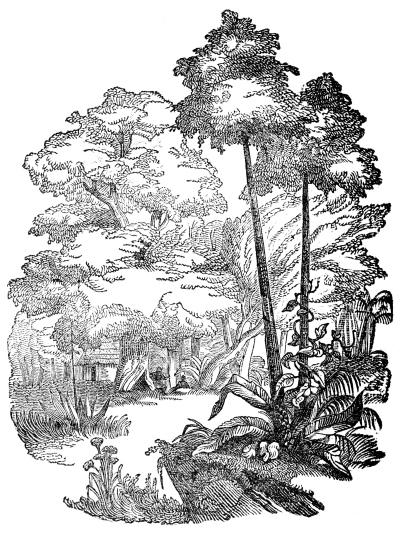
[Trees producing Caoutchouc.]
[Advertisement.]
We deviate, for once, from our plan of excluding Advertisements, to give extended circulation to the following Notice, which we believe will interest many of the readers of The Penny Magazine.
Under the Superintendence of the Society for the Diffusion of Useful Knowledge.
EXTRACT from the REPORT to the GENERAL MEETING, dated 30th June, 1832:
“The success of the Penny Magazine has induced the Committee to undertake the publication of a
PENNY CYCLOPÆDIA,
in Numbers and Monthly Parts. A work of such magnitude and novelty requires all the assistance which can be afforded it by the Members of the Society, both in London and in the Country, in order to give it publicity and circulation.”
The Committee think it right to announce that the “Penny Cyclopædia,” advertised by them in their General Report, is in preparation.
THE FIRST NUMBER WILL NOT APPEAR TILL JANUARY, 1833.
The Committee have come to this determination, from their anxiety that a work of such labour and importance may be properly executed, and that no possible interruption may take place when the publication is commenced.
It is necessary to guard the Public against an attempt to impose upon them a surreptitious publication, in consequence of an Advertisement in the Morning Papers of this day, stating that the “Penny Cyclopaædia, No. 1,” is now ready.
By order of the Committee, THOMAS COATES, Sec.
Lincoln’s-Inn-Fields, August 16, 1832.
⁂ The Office of the Society for the Diffusion of Useful Knowledge is at 59, Lincoln’s Inn Fields.
LONDON:—CHARLES KNIGHT, PALL-MALL EAST.
Shopkeepers and Hawkers may be supplied Wholesale by the following Booksellers:—
London, Groombridge, Panyer Alley, Paternoster Row.
Bath, Simms.
Birmingham, Drake.
Bristol, Westley and Co.
Carlisle, Thurnam; and Scott.
Derby, Wilkins and Son.
Doncaster, Brooke and Co.
Falmouth, Philip.
Hull, Stephenson.
Leeds, Baines and Newsome.
Lincoln, Brooke and Sons.
Liverpool, Willmer and Smith.
Manchester, Robinson; and Webb and Simms.
Newcastle-upon-Tyne, Charnley.
Norwich, Jarrold and Son.
Nottingham, Wright.
Sheffield, Ridge.
Worcester, Deighton.
Dublin, Wakeman.
Edinburgh, Oliver and Boyd.
Glasgow, Atkinson and Co.
Printed by William Clowes, Stamford-Street.
Transcriber’s Notes
New original cover art included with this eBook is granted to the public domain. Itemized changes from the original text:
p. 212: Replaced comma with period after phrase “the experiment would not succeed if the person lifted were placed upon a board.”
p. 212: Replaced comma with period after phrase “thin plates of brass of an elliptical form, exactly resembling each other.”
p. 212: Replaced “fo ding-doors” with “folding-doors” in phrase “The folding-doors remain shut, and the drawer is returned empty.”
p. 212: Added period after phrase “seen through an iron railing from Newgate-street.”
p. 215: Added period after phrase “because uniformly diffused, is not felt.”