STATUE OF JAMES WATT.
Reading edition
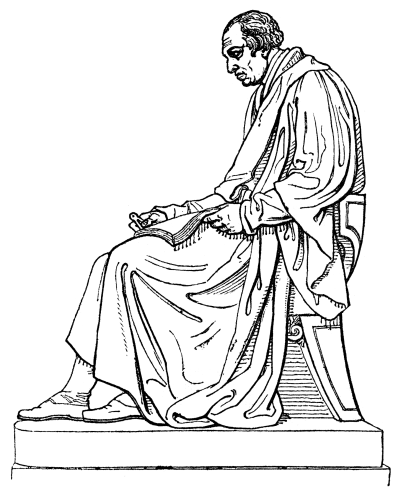
[Statue of James Watt, to be erected in Westminster Abbey.]
The people of this country have not been ungrateful to the memory of the great improver of the steam-engine. A bronze statue has been erected by subscription at Glasgow: another, of white marble, has been placed in the Hunterian Museum in the same large commercial town; and a third, also of white marble, which is completed, is about to adorn Westminster Abbey. From the latter statue the above drawing has been taken, by permission of Mr. Chantrey, who has been judiciously selected to execute these three important works. Independently of his high excellence as a sculptor, Mr. Chantrey had the advantage of modelling Watt some time before his death. Nothing can be finer in art, or more characteristic of the philosopher, than this statue. The perfect simplicity and repose of the composition, so expressive of the calm and reflecting mind of this extraordinary man, are beyond all praise.
The public meeting, at which it was determined to erect a statue to the memory of Watt, was perhaps one of the most interesting that ever was held in the metropolis. It took place on the 18th June, 1824; and the late Lord Liverpool, then Prime Minister, presided. A foreigner who was present, M. Dupin[1], was particularly struck by the announcement from the first minister of the Crown, that the distinguished persons who met that day were assembled to pay a solemn tribute of gratitude and respect to the memory of an illustrious countryman. He says,—“The simple applications of industry, which, among the nations of antiquity, appeared unworthy of the study of philosophy, are now the final object of the most sublime theories. The mechanical arts, whose practice would have made the great geometers blush, who, like Archimedes, contributed to their advancement, have become a title of honour, in the nineteenth century, amongst the British nation.” It would be singular, indeed, if it were not so; and a minister of the Crown would be unfit for the government of our industrious community, if he did not feel that the great inventions which have grown out of our commercial superiority, and which have in a large degree created that superiority, were not eminently calculated to claim the noblest rewards that the people could bestow.
At this meeting Sir Humphry Davy moved the following resolution:—
“That the late James Watt, by his profound science, and by the original genius exhibited in his admirable inventions, has, more than any other of his contemporaries, demonstrated the practical utility of knowledge, increased the power of man over the material world, and extended the comforts and enjoyments of human life.” This resolution was seconded by Mr. Boulton, the son of Mr. Watt’s distinguished partner.
The second resolution, that the services of James Watt to the civilized world demanded a national tribute of gratitude from his own country, was proposed by Mr. Huskisson, and seconded by Sir James Macintosh. We cannot forbear to quote a passage from the speech of this philosophical orator, whose words are now heard no more with reverence and delight: “In less than half a century, from the Mississippi to the Ganges, the name of Watt has been pronounced, and the benefits of his invention have been proved. If such a vast progress has been made in so small a number of years, what hopes may we not entertain of the future;—seeing that the combination of the useful and the fine arts has spread general information amongst such a multitude of minds—that knowledge has been placed within the reach of the humblest artisan—and that this class of men, for the most part remarkable for their intelligent, ingenious, active spirit, are full of the desire of instruction.”
The third resolution, that a monument to the memory of Watt should be erected in Westminster Abbey, was proposed by Mr. Brougham, and seconded by Mr. Peel. We cannot better close this notice, than with the concluding paragraph of Mr. Brougham’s speech:—“It is to honour the rare and excellent qualities of his character and genius, that we are assembled with the intention to erect a monument to the memory of the great engineer. Not that his memory has need of a monument to become immortal, for his name will last as long as the power which he has subjected to the use of man; but we are assembled to consecrate his example in the face of the universe—and to show to all our fellow-subjects that a man of extraordinary talent cannot better employ it than in rendering services to the human race. And where could we more fitly place the monument of this great man, than within a temple of that religion which preaches peace to all men, and instruction for the poor! The Pagan temples were decorated with the statues of warriors who had spread desolation amongst the people. Let ours be adorned with the statues of men who have contributed to the triumphs of Science and of Humanity; and above all by the statue of one who, without ever having given pain to any of his fellow-creatures, has been able to accomplish works which remain a lasting honour and benefit to society.”
210