Part 2 — SHIPS THAT LIFT TALL SPIRES OF CANVAS[159]
Reading edition
SHIPS THAT LIFT TALL SPIRES OF CANVAS[159]
By RALPH D. PAINE
(1871—). An American author and journalist, especially noted for excellent work as a war correspondent. Among his many books concerning the sea are the following: The Praying Skipper, and Other Stories; The Ships and Sailors of Old Salem; The Judgments of the Sea; The Adventures of Captain O'Shea; The Fighting Fleets; The Fight for a Free Sea. He is a frequent contributor to magazines.
Ships That Lift Tall Spires of Canvas is practically a poem, although it is written in prose. It is an emotional expression of admiration for the sailing vessels of the past, and for the gallant sailors who manned them. It is evident that the author is familiar with many stories of romantic voyages and grim adventure on the deep, and that his emotion springs from his knowledge. That genuineness of feeling did much to lead him to choose suggestive words and to write in balanced and rhythmical sentences. All good style comes in large part from earnestness of thought or depth of emotion, and in smaller degree from knowledge of the rhetorical means of conveying thought or emotion.
Oh, night and day the ships come in, The ships both great and small, But never one among them brings A word of him at all. From Port o' Spain and Trinidad, From Rio or Funchal, And along the coast of Barbary.
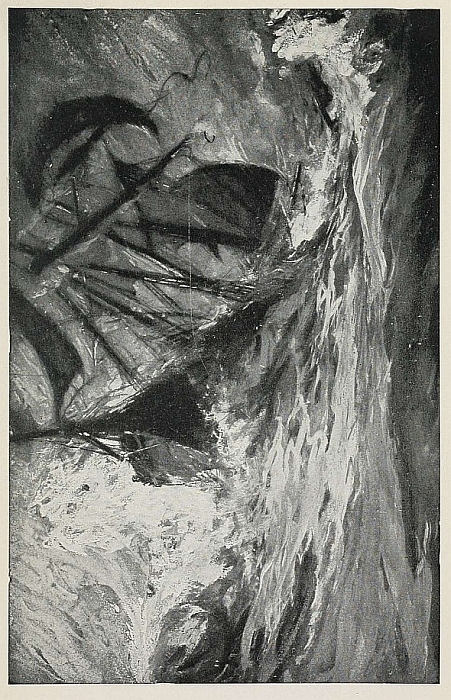
Steam has not banished from the deep sea the ships that lift tall spires of canvas to win their way from port to port. The gleam of their topsails recalls the centuries in which men wrought with stubborn courage to fashion fabrics of wood and cordage that would survive the enmity of the implacable ocean and make the winds obedient. Their genius was unsung, their hard toil forgotten, but with each generation the sailing ship became nobler and more enduring, until it was a perfect thing. Its great days live in memory with a peculiar atmosphere of romance. Its humming shrouds were vibrant with the eternal call of the sea, and in a phantom fleet pass the towering East Indiaman, the hard-driven Atlantic packet, and the gracious clipper that fled before the Southern trades.
A hundred years ago every bay and inlet of the New England coast were building ships that fared bravely forth to the West Indies, to the roadsteads of Europe, to the mysterious havens of the Far East. They sailed in peril of pirate and privateer, and fought these rascals as sturdily as they battled with wicked weather. Coasts were unlighted, the seas uncharted, and navigation was mostly guesswork, but these seamen were the flower of an American merchant marine whose deeds are heroic in the nation's story. Great hearts in little ships, they dared and suffered with simple, uncomplaining fortitude. Shipwreck was an incident, and to be adrift in lonely seas or cast upon a barbarous shore was sadly commonplace. They lived the stuff that made fiction after they were gone.
SUGGESTIVE QUESTIONS
Make a list of the most effective adjectives in the selection.
Make a list of the words that do most to suggest the sea.
Read aloud the most effective sentences.
Point out examples of balanced construction.
Show that the author has indicated the entire field of the subject.
In what ways is the selection poetic?
What famous books tell stories of sailing vessels?
What books of the sea did Fenimore Cooper write?
SUBJECTS FOR WRITTEN IMITATION
1. Old Gardens 11. My Grandmother
2. Farm Houses 12. Old Letters
3. My Childhood Home 13. A Happy Day
4. Mothers 14. The Old Soldier
5. Flowers 15. A Relic
6. Memories 16. A Familiar Street
7. Old School-books 17. Changes
8. Old Friends 18. Souvenirs
9. Childhood Games 19. Skating
10. Favorite Stories 20. Summer Days
(page 287)
“Its humming shrouds were vibrant with the eternal call of the sea.”
DIRECTIONS FOR WRITING
The subject that you select must be one concerning which you know a great deal. It must be one that exists not only in your brain but also in your heart.
When you have selected your subject make a list of the points that appeal to you most, and that will represent every side of the subject.
When you write, let your emotion guide your pen. At the same time make every effort to select words that will be full of suggestive power. Write easily and rhythmically, and let your work end, as Mr. Paine's does, in an especially effective sentence.
FOOTNOTES:
PERSONALITY IN CORRESPONDENCE
By THEODORE ROOSEVELT and AUGUSTUS SAINT-GAUDENS
(1858-1919). Twenty-sixth President of the United States. One of the most vigorous, courageous and picturesque figures in the public life of his day. Soon after his graduation from Harvard, and from Columbia Law School he entered public life, and gave invaluable service in many positions, becoming President in 1901, and again in 1904. His work as an organizer of the “Rough Riders,” his skill in horsemanship, his courage as an explorer and hunter, and his staunch patriotism and high ideals all made him both interesting and beloved. His work as an author is alone sufficient to make him great. Among his many books are The Winning of the West; The Strenuous Life; African Game Trails; True Americanism.
(1848-1907). One of the greatest American sculptors. His statues of Admiral Farragut, Abraham Lincoln, The Puritan, Peter Cooper, and General Sherman are noble examples of his art. Many other works of sculpture, including the beautiful “Diana” on Madison Square Garden Tower, New York, attest his rare skill. He excelled in what is called “relief.” His influence on American art was remarkably great. His portrait-plaque of Robert Louis Stevenson is especially interesting to lovers of literature.
The essay and the friendly letter are closely related. It is natural for one who writes a friendly letter to express himself freely and intimately, to make wise or humorous comments on life, to write meditatively of all the things that interest him,—in fact, to reveal himself in full. To do all that, even within the limited form of the letter, is to write an approach to an essay. Almost any one of the essays in this book might have been written as part of a friendly letter.
The spirit of the essay, that of personality, should enter into all letters except those that are purely formal in nature. In fact, the amount of personality expressed in a letter is, often, a measure of the success of the letter.
The following letters written by Theodore Roosevelt and Augustus Saint-Gaudens are, in a sense, business letters. In 1905 Mr. Roosevelt was president of the United States. He believed that the coins of the United States, like the coins of the ancient Greeks, should be beautiful. That he had the highest respect for the great sculptor, Augustus Saint-Gaudens, is shown by a letter that he wrote in 1903 concerning the impressively beautiful statue of General Sherman, that now stands at the 59th Street entrance to Central Park, New York City. In 1905 Mr. Roosevelt met Mr. Saint-Gaudens at a dinner in Washington and talked with him concerning the coinage of the United States and the possibility of improving it. The letters given in this book are part of the correspondence that followed this conversation.
Both men had serious purpose in writing and both were intensely practical; yet each man wrote in a manner that is exceedingly personal. The letters have something of the spirit of the essay.
The Statue of General Sherman
White House Washington
Oyster Bay, N. Y. August 3, 1903.
Personal
My dear Mr. Saint-Gaudens:
Your letter was a great relief and pleasure to me. I had been told that it was you personally who had opposed ——. I have no claim to be listened to about these matters, save such claim as a man of ordinary cultivation has. But I do think that ——, like Proctor, has done excellent work in his wild-beast figures.
By the way, I was very glad that the Grant decision in Washington went the way it did. The rejected figure, it seemed to me, fell between two schools. It suggested allegory; and yet it did not show that high quality of imagination which must be had when allegory is suggested. The figure that was taken is the figure of the great general, the great leader of men. It is not the greatest type of statue for the very reason that there is nothing of the allegorical, nothing of the highest type of the imaginative in it. But it is a good statue. Now to my mind your Sherman is the greatest statue of a commander in existence. But I can say with all sincerity that I know of no man—of course of no one living—who could have done it. To take grim, homely, old Sherman, the type and ideal of a democratic general, and put with him an allegorical figure such as you did, could result in but one of two ways—a ludicrous failure or striking the very highest note of the sculptor's art. Thrice over for the good fortune of our countrymen, it was given to you to strike this highest note.
Always faithfully yours, Theodore Roosevelt.
Mr. Augustus Saint-Gaudens, Aspet, Windsor, Vermont.
The Roosevelt-Saint-Gaudens Correspondence Concerning Coinage
The White House Washington
Nov. 6, 1905.
My dear Saint-Gaudens:
How is that old gold coinage design getting along? I want to make a suggestion. It seems to me worth while to try for a really good coinage; though I suppose there will be a revolt about it! I was looking at some gold coins of Alexander the Great to-day, and I was struck by their high relief. Would it not be well to have our coins in high relief, and also to have the rims raised? The point of having the rims raised would be, of course, to protect the figure on the coin; and if we have the figures in high relief, like the figures on the old Greek coins, they will surely last longer. What do you think of this?
With warm regards.
Faithfully yours, Theodore Roosevelt.
Mr. Augustus Saint-Gaudens, Windsor, Vermont.
Windsor, Vermont, Nov. 11, 1905.
Dear Mr. President:
You have hit the nail on the head with regard to the coinage. Of course the great coins (and you might almost say the only coins) are the Greek ones you speak of, just as the great medals are those of the fifteenth century by Pisanello and Sperandio. Nothing would please me more
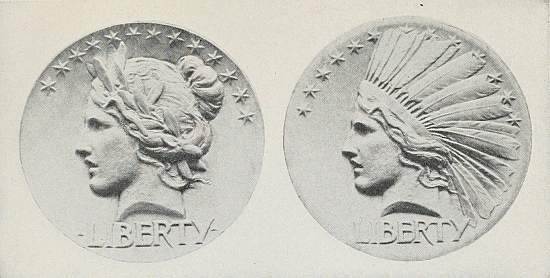
Obverse of the ten-dollar gold piece, in high relief, and before the addition of the head-dress, on President Roosevelt's suggestion. Obverse of the ten-dollar gold piece with the Roosevelt feather head-dress. Before the relief was radically lowered for minting.
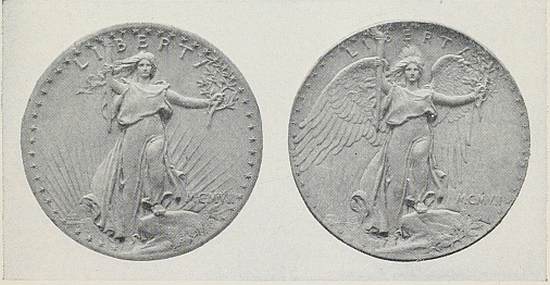
Liberty obverse of the twenty-dollar gold piece as finally designed. The relief, however, was made lower before minting. Liberty obverse of the twenty-dollar gold piece. The head-dress, President Roosevelt's idea, was later eliminated on this figure as too small to be effective on the actual coin.
than to make the attempt in the direction of the heads of Alexander, but the authorities on modern monetary requirements would, I fear, “throw fits,” to speak emphatically, if the thing was done now. It would be great if it could be accomplished and I do not see what the objection would be if the edges were high enough to prevent rubbing. Perhaps an inquiry from you would not receive the antagonistic reply from those who have the say in such matters that would certainly be made to me.
Up to the present I have done no work on the actual models for the coins, but have made sketches, and the matter is constantly in my mind. I have about determined on the composition of one side, which would contain an eagle very much like the one I placed on your medal with a modification that would be advantageous. On the other side I would place a (possibly winged) figure of liberty striding energetically forward as if on a mountain top holding aloft on one arm a shield bearing the Stars and Stripes with the word “Liberty” marked across the field, in the other hand, perhaps, a flaming torch. The drapery would be flowing in the breeze. My idea is to make it a living thing and typical of progress.
Tell me frankly what you think of this and what your ideas may be. I remember you spoke of the head of an Indian. Of course that is always a superb thing to do, but would it be a sufficiently clear emblem of Liberty as required by law?
I send you an old book on coins which I am certain you will find of interest while waiting for a copy that I have ordered from Europe.
Faithfully yours, Augustus Saint-Gaudens.
The White House Washington
Nov. 14, 1905.
My dear Mr. Saint-Gaudens:
I have your letter of the 11th instant and return herewith the book on coins, which I think you should have until you get the other one. I have summoned all the mint people, and I am going to see if I cannot persuade them that coins of the Grecian type but with the raised rim will meet the commercial needs of the day. Of course I want to avoid too heavy an outbreak of the mercantile classes, because after all it is they who do use the gold. If we can have an eagle like that on the Inauguration Medal, only raised, I should feel that we would be awfully fortunate. Don't you think that we might accomplish something by raising the figures more than at present but not as much as in the Greek coins? Probably the Greek coins would be so thick that modern banking houses, where they have to pile up gold, would simply be unable to do so. How would it do to have a design struck off in a tentative fashion—that is, to have a model made? I think your Liberty idea is all right. Is it possible to make a Liberty with that Indian feather head-dress? Would people refuse to regard it as a Liberty? The figure of Liberty as you suggest would be beautiful. If we get down to bed-rock facts would the feather head-dress be any more out of keeping with the rest of Liberty than the canonical Phrygian cap which never is worn and never has been worn by any free people in the world?
Faithfully yours, Theodore Roosevelt.
Mr. Augustus Saint-Gaudens, Windsor, Vermont.
Windsor, Vermont, Nov. 22, 1905.
Dear Mr. President:
Thank you for your letter of the 14th and the return of the book on coins.
I can perfectly well use the Indian head-dress on the figure of Liberty. It should be very handsome. I have been at work for the last two days on the coins and feel quite enthusiastic about it.
I enclose a copy of a letter to Secretary Shaw which explains itself. If you are of my opinion and will help, I shall be greatly obliged.
Faithfully yours, Augustus Saint-Gaudens.
[Hand-written postscript.]
I think something between the high relief of the Greek coins and the extreme low relief of the modern work is possible, and as you suggest, I will make a model with that in view.
Windsor, Vermont, Nov. 22, 1905.
Hon. L. M. Shaw, Secretary of the Treasury, Washington, D. C.
Dear Sir:
I am now engaged on the models for the coinage. The law calls for, viz., “On one side there shall be an impression emblematic of liberty, with an inscription of the word 'liberty' and the year of the coinage.” It occurs to me that the addition on this side of the coins of the word “Justice” (or “Law,” preferably the former) would add force as well as elevation to the meaning of the composition. At one time the words “In God we trust” were placed on the coins. I am not aware that there was authorization for that, but I may be mistaken.
Will you kindly inform me whether what I suggest is possible.
Yours very truly, Augustus Saint-Gaudens.
The White House Washington
Nov. 24, 1905.
My dear Mr. Saint-Gaudens:
This is first class. I have no doubt we can get permission to put on the word “Justice,” and I firmly believe that you can evolve something that will not only be beautiful from the artistic standpoint, but that, between the very high relief of the Greek and the very low relief of the modern coins, will be adapted both to the mechanical necessities of our mint production and the needs of modern commerce, and yet will be worthy of a civilized people—which is not true of our present coins.
Faithfully yours, Theodore Roosevelt.
Mr. Augustus Saint-Gaudens, Windsor, Vermont.
The White House Washington
Jan. 6, 1906.
My dear Saint-Gaudens:
I have seen Shaw about that coinage and told him that it was my pet baby. We will try it anyway, so you go ahead. Shaw was really very nice about it. Of course he thinks I am a mere crack-brained lunatic on the subject, but he said with great kindness that there was always a certain number of gold coins that had to be stored up in vaults, and that there was no earthly objection to having those coins as artistic as the Greeks could desire. (I am paraphrasing his words, of course.) I think it will seriously increase the mortality among the employees of the mint at seeing such a desecration, but they will perish in a good cause!
Always yours, Theodore Roosevelt.
Mr. Augustus Saint-Gaudens, Windsor, Vermont.
The White House Washington
October 1, 1906.
Personal
My dear Mr. Saint-Gaudens:
The mint people have come down, as you can see from the enclosed letter which is in answer to a rather dictatorial one I sent to the Secretary of the Treasury. When can we get that design for the twenty-dollar gold piece? I hate to have to put on the lettering, but under the law I have no alternative; yet in spite of the lettering I think, my dear sir, that you have given us a coin as wonderful as any of the old Greek coins. I do not want to bother you, but do let me have it as quickly as possible. I would like to have the coin well on the way to completion by the time Congress meets.
It was such a pleasure seeing your son the other day.
Please return Director Roberts' letter to me when you have noted it.
Sincerely yours, Theodore Roosevelt.
Mr. Augustus Saint-Gaudens, Windsor, Vermont.
The White House Washington
December 11, 1906.
My dear Mr. Saint-Gaudens:
I hate to trouble you, but it is very important that I should have the models for those coins at once. How soon may I have them?
With all good wishes, believe me,
Sincerely yours, Theodore Roosevelt.
Mr. Augustus Saint-Gaudens, Windsor, Vermont.
Windsor, Vermont, December 19, 1906.
Dear Mr. President:
I am afraid from the letter sent you on the fourteenth with the models for the Twenty-Dollar Gold piece that you will think the coin I sent you was unfinished. This is not the case. It is the final and completed model, but I hold myself in readiness to make any such modifications as may be required in the reproduction of the coin.
This will explain the words, “test model” on the back of each model.
Faithfully yours, Augustus Saint-Gaudens.
The White House Washington
December 20, 1906.
My dear Saint-Gaudens:
Those models are simply immense—if such a slang way of talking is permissible in reference to giving a modern nation one coinage at least which shall be as good as that of the ancient Greeks. I have instructed the Director of the Mint that these dies are to be reproduced just as quickly as possible and just as they are. It is simply splendid. I suppose I shall be impeached for it in Congress; but I shall regard that as a very cheap payment!
With heartiest regards,
Faithfully yours, Theodore Roosevelt.
Mr. Augustus Saint-Gaudens, Windsor, Vermont.
SUGGESTIVE QUESTIONS
Why should a great statue have in it something of the allegorical?
Describe Mr. Saint-Gaudens' statue of General Sherman.
What does the first letter show concerning Mr. Roosevelt's opinion of the art of sculpture?
In what ways are the old Greek coins beautiful?
Point out essay-like freedom in the use of English.
Point out passages that are notably personal.
What were Mr. Roosevelt's plans for the making of United States coins?
What were Mr. Saint-Gaudens' plans?
Draw from the letters material for an essay on coinage.
Show in what respects the letters have something of the spirit of the essay.
SUBJECTS FOR WRITTEN IMITATION
A letter suggesting an inter-school debate.
A letter inviting a graduate of the school to act as judge at a debate.
A letter inviting a prominent citizen to address a society of which you are a member.
A letter telling of your experiences in a place that you are visiting for the first time.
A letter giving your opinion of a book that you have read recently.
A letter telling your plans for the coming vacation.
A letter concerning the use of an athletic field.
A letter inviting the graduates of your school to come to a school festival or entertainment.
A letter concerning music in your school.
A letter giving an excuse for absence.
A letter concerning work in photography.
A letter concerning the work of prominent athletes.
A letter concerning arrangements for class day exercises.
A letter concerning graduation week.
A letter to a teacher who has left the school.
A letter to a person much older than you.
A letter to a school in a foreign country.
A letter to a school in another State.
A letter written, in the name of your class, for publication in the school annual.
A letter of congratulation.
DIRECTIONS FOR WRITING
Write your letter so that it will express a definite and practical proposal. Express your own individual opinion modestly and tactfully. Use language that will thoroughly represent yourself. Try, in all ways possible, to avoid making your letter heavy, “cut-and-dried,” conventional, and purely formal.
THE SYMBOLIC STORY