MEMORIES OF CHILDHOOD
Reading edition
By WILLIAM HENRY SHELTON
(1840-). An American patriot and author. He served in many battles in the Civil War, and had thrilling experiences as a prisoner of war, escaping no less than four times. He is author of A Man Without a Memory; The Last Three Soldiers; The Three Prisoners.
Every one has happy memories of childhood. He loves to conjure up the old familiar scenes, the kindly people, and the days that were days of wonder.
The two sketches by Mr. Shelton are extracts from a long essay called Our Village, in which he recalls delightfully all his early surroundings and all his old companionships.
In these extracts, as in the entire essay, Mr. Shelton avoids formal autobiography. He merely recalls the things that impressed him most. As far as possible he lifts himself back into the spirit of the past, and sees once again, but with added love, the things that have gone forever.
My First School
One day in the summer when I was four years old I was taken to the village school at the foot of the hill below the tavern. I have no recollection of how I got there, but my return to my grandmother's was so dramatic that it has impressed itself indelibly on my memory. Perhaps I was taken to school by the sentimental schoolmistress herself, who was a girl of sixteen and an intimate friend of my aunt, to whom, in after years, when she became a famous novelist, she used to send her books. Her maiden name was Mary Jane Hawes, but there was a red-haired, freckle-faced boy in one of the pretty houses facing the side of the church, who went to Yale College and gave her another name.
The school-house consisted of one room, with an entry without any floor where the wood was cut and stored. The school-room was square, with a box-stove in the center. A form against the wall extended around three sides of the room, affording seats for the larger pupils, and in front of these a row of oak desks for slates and books was fantastically carved by generations of jack-knives, and made against the backs of a second row of desks was a low front form for the A-B-C children. On the fourth side, flanking the door, were a blackboard on one hand and on the other the schoolma'am's desk, usually decorated with a bunch of wild flowers or a red apple, either the gifts of a sincere admirer or the would-be bribe of some trembling delinquent.
On the occasion of my first visit to the school I wore a blue-and-white dress of muslin-de-laine that was afterward made into a cushion for a rocking-chair in my mother's parlor. I was evidently dressed in my very best in honor of the occasion, and all went well until recess came. There was a rumble of thunder, and the sky had been growing dark with portent of storm, and the leaves and dust were flying on the wind when the children were released for play. I wanted to do everything that the other boys did, and so, when they scampered out with a rush, I followed without fear. Just as we came into the open the thunder-storm burst upon us. The wind blew off one boy's hat and whirled it in the direction of the village, and all the other boys joined in the chase. As I started to follow them a gust of wind and rain beat me to the ground, and drenched my dress with mud and water.
I was promptly rescued by the schoolma'am and taken into the entry, where she undressed me on the wood-pile and wrapped me in her own woolen shawl, which was a black-and-red pattern of very large squares. Thus bundled up and rendered quite helpless except as to my lungs, I was laid on the floor near the stove, where I remained for the amusement of the children until the shower was over, when a bushel-basket was sent for to the nearest house, which was the house of shoemaker Talmadge. Into this basket, commonly used for potatoes and corn, I was put, wrapped in the black-and-red shawl and packed around with my soiled clothes, and two of the big boys, John Pierpont and John Talmadge, carried me up the hill and through the village to my grandmother's house.
In the summer following I went to school again, and again to the sentimental schoolma'am, who loved to teach, but abhorred to punish. Her gentle punishments rarely frightened the youngest children.
She would say, “Henry, you have disobeyed me, and I shall have to cut off your ear,” and with these ominous words she would draw the back of her penknife across the threatened ear. I must have been very small, for on one occasion she threatened to shut me up in one of the school desks.
Our mad recreation out of school was “playing horse.” We drove each other singly and in pairs by means of wooden bits and reins of sheep-twine, and some prancing horses were led, chewing one end of a twine string, and neighing and prancing almost beyond the control of the infant groom.
In the congressman's woods, close by the school-house, we built stalls and mangers against logs and in fence corners, and gathered horse-sorrel and sheep-sorrel for hay. The stalls were bedded with grass and protected from the sun by a roof of green boughs, and the horses were watered and curried and groomed in imitation of that service at the stage stables, and the steeds themselves kicked and bit like the vicious leaders.
Other teachers followed the young and sentimental one, and the surplus of the dinner-baskets, thrown out of the window or cast upon the wood-pile, bred a colony of gray rats that lived under the school-house and came out to take the air in the quiet period after the door was padlocked at night and even ventured to come up into the school-room and look over the books and otherwise nibble at learning. When I had advanced to the dignity of pictorial geography, as set forth in a thin, square-built, dog-eared volume, which not having been opened for a whole day by a certain prancing horse, he was left to learn his lesson while the teacher went to tea at the house below the tavern, and the wheat stubble under the window was soon alive with gray rodents that looked like the colony of seals in the geography.
About this time the rats, having taken formal possession of the old school-house, a new school-house was built in our village just beyond my grandmother's house and facing her orchard.
(page 97)
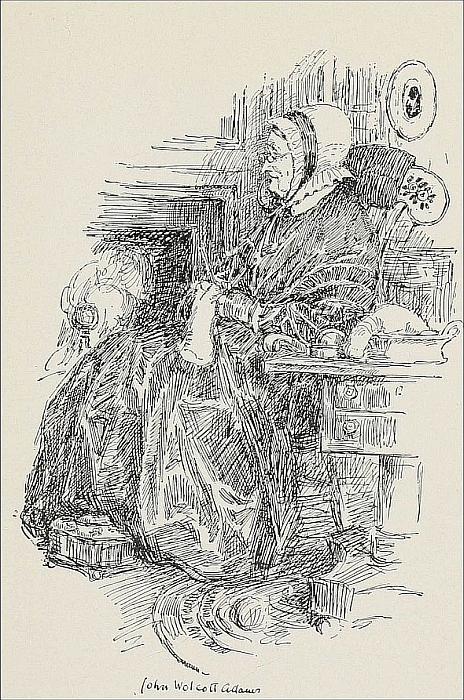
“My great-grandmother.”
My Great-Grandmother
My great-grandmother was the widow of an Episcopal clergyman, the Rev. Titus Welton, whose son was the first rector of the village church. My only acquaintance with my great-grandfather was connected with the white headstone that bore his name in the graveyard. With the exception of a quaint water-color portrait in profile of my grandmother in a mob-cap bound with a black ribbon, which was equally a portrait of the flowered back of the rocking-chair in which she sat, she survives in my memory in a series of pictures. I see her sitting before the open fire, knitting, with one steel needle held in a knitting-sheath pinned to her left side, or taking snuff from a flat, round box that contained a vanilla bean to perfume the snuff. Her hands were twisted with rheumatism, and she walked with a cane. On one occasion I trotted by her side to church and carried her tin foot-stove, warm with glowing coals.
She slept in a high post bed in her particular room over the sitting-room, which was warmed in winter by a sheet-iron drum connected with the stove below, and in one corner was a copper warming-pan with a long handle. When I sat at table in my high-chair eating apple-pie in a bowl of milk, she sat on the side nearest the fire eating dipped toast with a two-tined fork. The fork may have had three tines, but silver forks had not yet made their appearance.
My great-grandmother lived just long enough to have her picture taken on a plate of silvered copper by the wonderful process of Daguerre,[29] a process so like something diabolical that she protected her soul from evil, as all sitters in that part of the country did, by resting her hand on a great Bible, the back turned to the front, so that the letters “Holy Bible” could be read, proving that the great book was not a profane dictionary. The operator who took her daguerreotype traveled from town to town, hiring a room in the village tavern furnished with a chair, a stand on tripod legs, a brown linen table-cloth, and the aforesaid Bible, and when such of the people as had the fee to spare, the courage to submit to a new-fangled idea, and no fear that the face on the magical plate would fade away like any other spirit face when they opened the stamped-leather case with the red plush lining after it had lain overnight in the darkened parlor, he moved on like the cracker baker or any other itinerant showman.
My great-grandmother had never sent or received a message by telegraph or ridden in a railway-carriage, and died in peace just before those portentous inventions came to destroy forever the small community life in which she had lived.
SUGGESTIVE QUESTIONS
Why does the writer employ such simple language?
What sort of events does he narrate?
Why does he give so few details concerning his early schooldays?
How does he look upon his early misfortunes?
Why does he do little more than present the picture of his great-grandmother?
Point out examples of gentle humor.
What do the sketches reveal concerning life in the past?
What spirit characterizes both sketches?
SUBJECTS FOR WRITTEN IMITATION
1. My First Schooldays 11. Punishments I Remember
2. My Grandparents 12. Queer Old Customs
3. An Early Misfortune 13. My First Superstitions
4. Some Vanished Friends 14. A Wonderful Day
5. My Old Home 15. Gifts
6. Playmates 16. My First School-books
7. Old Toys 17. Pictures of Childhood
8. My First Games 18. My Relatives
9. A First Visit 19. A Great Event
10. My First Costumes 20. Relics of the Past
DIRECTIONS FOR WRITING
Throw yourself back into the past. Conjure up the people with whom you used to associate. See once again the places where you played and where you lived. Think how happy it all was, and how good it is to look at it once more. Then put down on paper the things that you remember with the greatest interest. Write in such a way that you will give the reader the very spirit that you have. Remember: you are not to communicate facts; you are to communicate emotion.
FOOTNOTES: