MODERN GERMAN JEWELLERY. By CHR. FERDINAND MORAWE.
Reading edition
MY opportunities of surveying the German jewellery market, and of making acquaintance with the ins and outs of the jewellers' business, have been limited; but it is certain that both are flourishing; at least, the German jewellers do not look as if they starved! Moreover, the demand for precious ornaments seems to increase year by year, and the display in the jewellers' windows grows more and more luxurious, as is the case with most other businesses. Nobody will store superfluous and unmarketable goods, least of all the jeweller, who is always a business man. You will be thoroughly aware of this fact if you start discussing art with him. He is cautious and suspicious of anything in the shape of novelty. He seems to say to himself: "This artist has ideas; he wants to show something new; but we cannot agree with these ideas, for we do not know if we shall be able to do business." This is a great pity, for the trade in women's ornaments offers more artistic scope than almost any other. It is not enough nowadays just to set some nicely polished stones neatly, or to be so lavish of material that the ornament produced represents an immense value; for the result will probably be something not at all artistic. Indeed, this generally occurs. The lot of the artist who designs women's ornaments is not a happy one, and it is almost like a message from heaven when a jeweller tells him that he will really condescend to carry out an original design. Even then he must sometimes put up with the fact that his design, which was intended for one person or purpose only, is repeated, like a manufactured article, a hundred and a thousand times again.
Happily there are some artists in Germany, as in England, France, and Belgium, who are above the fashion, and whose artistic individuality is so strong that they are bound to succeed in other spheres of art as well as in that of women's jewellery.
Two of the first to show activity in this direction were the Berlin artists, Hirzel and Möhring. Both chose for their ornaments the same manner and methods which Eckmann and his fellow-workers had previously employed in decorative art; they adhered as closely as possible to simple natural plant-forms, especially Hirzel. Thallmayr, of Munich, is still working in the same style, but with more individuality than Hirzel. Thallmayr will certainly spend his life studying the leaves and blossoms of the trees and the flowers in his garden, while the other will doubtless produce new results, departing somewhat from the real forms of nature. Möhring's works already showed this tendency when he produced them nearly at the same time as Hirzel his. Subsequently these artists were occupied less with women's ornaments than with other things coming within the category of decorative art,—this owing to lack of intelligence and enterprise on the part of the jewellers and manufacturers. Tables, chairs, and other necessary household articles found a much wider market. But we are now dealing exclusively with women's ornaments. Two circumstances in this connection are very strange. In the first place, it seems that the artists of the present time (I speak of Germany) are not successful in designing finger-rings. Here and there one sees an attempt made to design characteristic shapes, but the sphere of the ring is so confined that nobody has succeeded in producing anything really elegant and novel. Mostly one sees extravagant examples, of confused design. The second peculiar fact is, that one very seldom finds an artist devoting himself to designing earrings. The whole artistic movement in relation to women's ornaments is still somewhat puerile. This may be recognised by the absence of the ear-ring, that most superior ornament, which, unlike all others, has an independent language of its own. Although in the list of female ornaments the clasp and the brooch occupy the foremost place, the pendant for the breast should not be forgotten. The mission of the pendant is to show by its fancy and its tastefulness how and in what degree the German is distinguished from the Englishman and from the Frenchman.
I will mention in this connection two artists living in Germany who are not Germans, but by their manner of life and work might be such. Both these artists, in their several ways, will exercise great influence on the development of our ornaments. I refer to Van der Velde and Olbrich. It is well known that the first is a Belgian, while the other is a foreigner, inasmuch as he comes from Austria.
Olbrich's pendants and pins are very characteristic. He takes a hammered gold-plate, enriches it with precious stones and enamel, and adds a rim set with long pearls. It is easy to see that he is fond of rummaging among the treasures of the old cathedrals and convents; he knows the secret of their effect, and, besides this, he has an extraordinary talent for inventing new things himself. His jewellery is the best we have now in Germany, because it is superior to fashions and periods. His jewels are pure, thoughtful works of art. When worn, they produce a most sumptuous effect; but their richness has nothing tawdry about it. These jewels show us how we ought to deck our wives, both at home and at the theatre; moreover, they suggest things fit for the lady superiors of religious orders, for abbesses, even for our queens. They show us too how our burgomasters' chains, with their insignificant crosses and stars, might be improved. These ideas are perhaps at present as intangible as a beautiful dream, but that is no reason why we should not indulge our fancy in this direction. For the moment, however, we must be satisfied if the jeweller is inclined to carry out our designs.
Looking further among our artists, we find Karl Gross, of Dresden. Mr. Gross, who formerly lived in Munich, delighted us while there with a good many beautiful designs for jewellery. He produced not only female ornaments, but also paper-cutters, seals, and so on. He always displayed good taste and a fine sense of form, having, like Olbrich, the capacity to carry out his designs quite independently, without consideration of his predecessors' effects. A hair-pin of Gross's may be regarded as quite an independent work, although it relies on an old tradition. Those artists, indeed, show the most freedom who have adapted the beautiful examples of past generations.
Examining our new jewellery, we find very little work which has the appearance of having been done by a strong hand. Most of it in time becomes unbearably monotonous. Still, it is something that we in Germany have at least two artists who design in so fresh and characteristic a manner that their works are always looked at with the greatest interest. I already have mentioned them—Olbrich and Van der Velde—and I fall back again upon them, though I have already taken them in consideration.
We have other artists, too, who follow sound principles in other branches of decorative art. One of the most individual of these is Riemerschmid, of Munich. Others there are who are nearly on the right way, but whose personal artistic sense is not broad enough to make them produce something really good. This general mention is, therefore, all their work demands.
In addition to finger and earrings our jewellery artists are responsible for other objects, such as the bracelet, the watch, and the fan. I think it is very difficult to rescue the bracelet from conventionality. We must hope the best for the future. But what about watch-cases, especially those of ladies' watches? This art is quite neglected, not so much by the manufacturers as by the artists. At this year's Darmstadt Exhibition there were two watches displayed. One of them had the case enamelled, if I mistake not, in the form of a chrysanthemum, and on the other was modelled the figure of one of the "Fates." The effect of the chrysanthemum watch was fairly good, but the less said about the "Fate" the better. Why is it not possible to design an ornament with taste and furnish it with precious stones and enamel? It is the greatest pity that our sculptors have no imagination. Having arrived at the determination to think of a watch, the artist has no idea beyond depicting one of the "Fates" with the thread and the scissors. I said just now that the watch was neglected less by the manufacturers than by the artists. Nowadays you may find watches indeed with gaily-coloured cases, but the decorations are miserable, like everything else that is invented by the manufacturers. They don't want to pay a good price for the artist's sketch, and they are proud of the inspiration of their own Muse. In this case one cannot avoid the conclusion that the artists are themselves to blame for their neglect of this branch of the jeweller's art.
The condition of affairs with regard to the fan is also very astonishing. Why do our artists not supply our ladies with nice fans? Please do not confound "nice" with "precious." The fan as we know it now is so utterly "played out" that scarcely anything can be done with it. New arrangements of the feathers are invented; the handle is trimmed in different ways; new materials are used, but a really new and artistic idea cannot be devised. Titian's "Lady with the Fan" is admired; the fan is known very well, but nobody thinks of making use of it. Meanwhile another kind of fan is being more and more extensively employed. I refer to the palm-leaf of the Japanese and the Chinese. People are very fond of being fanned by these leaves, but nobody observes their artistic possibilities. An artist who can afford to be independent of mere fashion is therefore wanted to give new life to the fan. Such an artist will win lasting success.
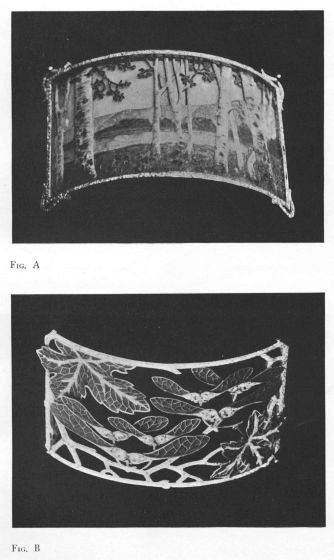
A. Collar Ornament in Gold, Enamel, Onyx, and Brilliants
B. Collar Ornament in Gold, Enamel, and Brilliants
ROBERT KOCH
PLATE 1
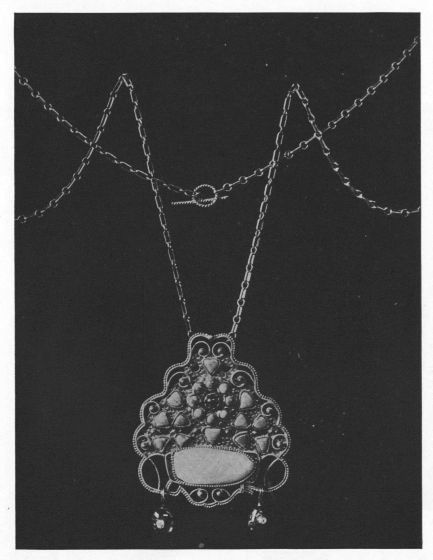
Gold Pendant, set with Lapis Lazuli, Pearls, and Rubies
Designed by JOSEPH M. OLBRICH
Plate 2
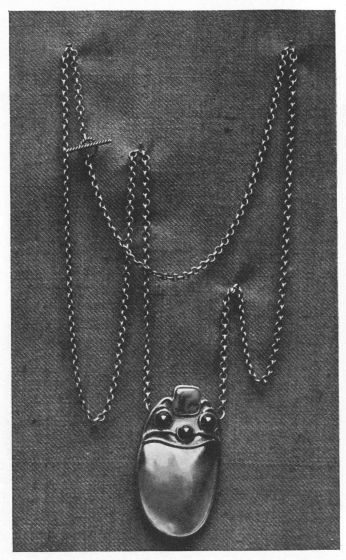
Silver Pendant, set with Bloodstones and a large Pearl
Executed by D. & M. LOEWENTHAL
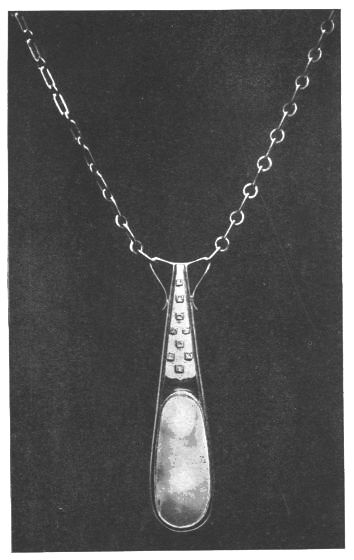
Pendant in Gold, Silver, Enamel, and Pearl
Executed by THEODOR FAHRNER
Both designed by J. M. OLBRICH
Plate 3
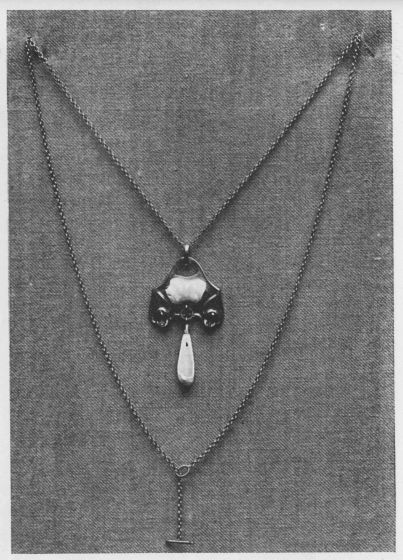
Gold Pendant set with Amethysts and Pearls
Executed by D. & M. LOEWENTHAL
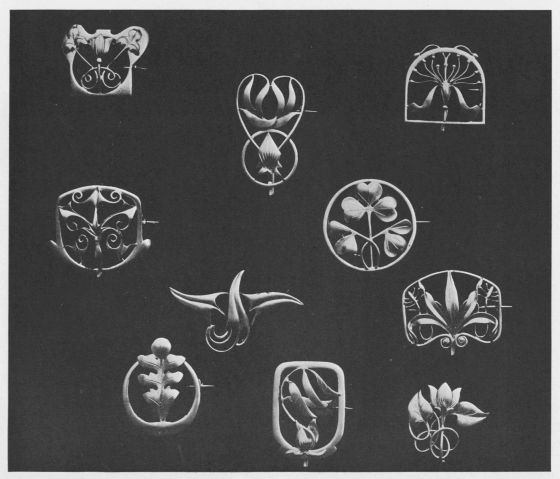
Gold Brooches
Designed by HERMANN R. C. HIRZEL
Executed by LOUIS WERNER
Plate 4
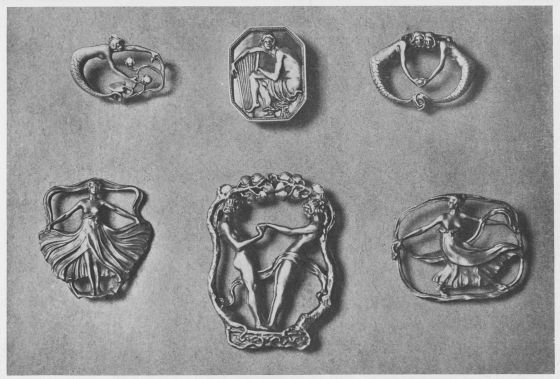
Gold Brooches
Designed by THEODOR VON GOSEN
Executed by "VEREINIGTE WERKSTAETTEN," MUNICH
Plate 5
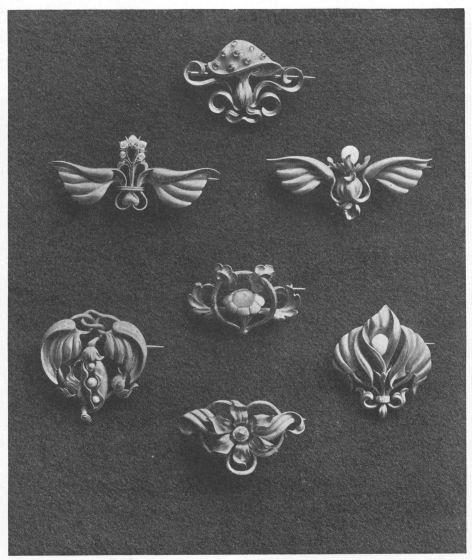
Gold Brooches
Designed by BRUNO MÖHRING
Executed by F. H. WERNER
Plate 6
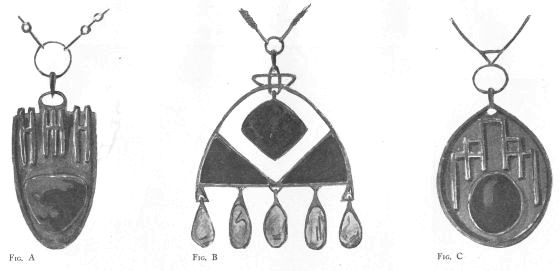
A and C. Gold Pendants set with a Turquoise
B. Gold Pendant set with Turquoises and Moss-Agates
CHR. FERDINAND MORAWE
Plate 7
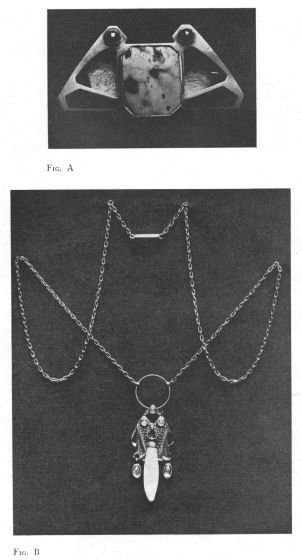
A. Silver Brooch set with Turquoise and Enamel
Executed by THEODOR FAHRNER
B. Gold Pendant set with Pearls and Sapphires
Executed by D. & M. LOEWENTHAL
Both designed by JOSEPH M. OLBRICH
Plate 8