MODERN BELGIAN JEWELLERY AND FANS. By F. KHNOPFF.
Reading edition
RECENT Salons in Belgium have been notoriously unsuccessful, and it cannot be disputed that the public is becoming less and less interested in the large exhibitions of Fine Arts. Notable artists have been conspicuously absent; new works have been as scarce as old ones have been abundant; and, lastly, the general arrangements have been altogether lacking in attractiveness. Despite the violent opposition of interested persons, official and otherwise, the type of display started some time ago in Brussels by the "XX" club, and continued by the "Libre Esthétique" and "Pour L'Art" societies, has succeeded in attracting the attention of connoisseurs and art lovers generally, with, apparently, every prospect of retaining it.
The combination of works of painting and sculpture with the most exquisite productions of ceramic art, glass-ware, and all that is most delicate in jewellery and goldsmith's work, adds a special attraction to these exhibitions, which are always looked for with the utmost interest. It is, indeed, the jewellers, who, among all our Belgian art workers, have succeeded in making themselves and their productions the best known and most widely appreciated; the more so as in their case one was able to compare their works closely and determine their relative merits. It may truly be said that their most notable characteristic is diversity—a diversity which is shown, not only by the amateurs, so to speak, but also among the professionals.
No remarks on Belgian sculpture—particularly in its decorative sense—are complete without mention being made of Charles Van der Stappen. True, he has executed but a small number of detached ornaments, but in the arrangement of the hair in his exquisitely fanciful busts he has lavished a wealth of fine modelling, the influence of which is still widely felt.
In the works of M. Paul Dubois we discover the sculptor modelling the details of his buckles and clasps as he would so many powerful muscles. M. Fernand Dubois seems to be a chercheur of a more subtle kind; but this very excess of ingenuity sometimes mars the plastic effect of his jewels.
From Victor Rousseau we have had so far nothing more than a gold bracelet. The subject is quite simple—two hands holding a pearl; but the work is in every way worthy of the young Brussels artist, whom I regard as one of the most remarkable personalities in the domain of contemporary Belgian sculpture.
The decorator Van de Velde, who has left Brussels, and is now settled in Berlin, exhibited at some of the "Libre Esthétique" salons a series of jewels remarkable for their firm and consistent construction.
The jewels displayed recently by M. Feys are distinguished by grace and felicitous appropriateness; but even more striking is the perfection of their execution, which is really extraordinary in its suggestion of suppleness.
Other jewels displayed recently at the "Libre Esthétique" by M. Morren and Mlle. de Bronckère also deserve notice.
In the course of a very interesting study on M. Ph. Wolfers, M. Sander Pièrron, the sagacious Brussels critic, thus described the work of this remarkable specialist in the "Revue des Arts Décoratifs":—
"M. Wolfers seeks his inspiration in the study of the nature and the forms of his marvellous domain, and his vision of things is specially defined in his jewels. The detail therein contributes largely to the spirit of the entire work, which borrows its character from the decoration itself or from the subject of that decoration. He never allows himself to stray into the regions of fancy; at most, he permits his imagination to approach the confines of ornamental abstraction. Nevertheless, he interprets Nature, but is never dominated by it. He has too true, too exact a sense of the decorative principle to conform to the absolute reality of the things he admires and reproduces. His art, by virtue of this rule, is thus a modified translation of real forms. He has too much taste to introduce into the composition of one and the same jewel flowers or animals which have no parallel symbol or, at least, some family likeness or significance. He will associate swans with water-lilies—the flowers which frame, as it were, the life of those grand poetic birds; or he will put the owl or the bat with the poppy—that triple evocation of Night and Mystery; or the heron with the eel—symbols of distant, melancholy streams. He rightly judges that in art one must endeavour to reconcile everything, both the idea and the materials whereby one tries to make that idea live and speak. Inspired, doubtless, by the fact that the ancients chose black stones for the carving of the infernal or fatal deities, M. Wolfers uses a dark amethyst for his owls, which gives them a special significance. The Grecians used the aqua-marina exclusively for the engraving of their marine gods, by reason of its similarity to the colour of the sea, just as they never carved the features of Bacchus in anything but amethyst—that stone whose essence suggests the purple flow of wine."
M. van Strydonck expresses himself to me in the following terms on the subject of his art:—
"I am of opinion that the jewel can be produced without the aid of stones, enamels, etc. I do not exclude them entirely, but they should not be used unless it be to give the finishing touch, or occasionally to relieve an ensemble lacking in vigour of colour. My preference is for oxydations, for in general effect they are more harmonious to the eye, and by careful seeking one can find all the tones required. I think you will share my opinion that it is much easier to use enamels, by means of which one's object is instantly attained. Yet it is seldom one produces a beautiful symphony of colour. Enamel can only be employed in small quantities. Why? Because, in the first place, he who uses it must have a profound knowledge of colours and a special colourist's eye; he must remember, moreover, that he is appealing to a clientèle composed principally of ladies, who in most cases regard the jewel simply as a means to complete such and such a toilette.
"It seems to me, indeed," continues M. van Strydonck, "that translucent enamel is the most suitable because it simply serves as an auxiliary—a basis necessary to the completion of the ensemble—and adds value to workmanship and design; and there is nothing to prevent its alliance with the beautiful oxydations which come almost naturally from gold."
Note how, little by little, enamel is being abandoned in favour of stones, such as onyx, agate, and malachite, materials of no special value, which can be cut in different ways, and whose colour gives fine effects infinitely preferable to those of inferior enamels.
Of course, I do not despise the fine stone, which, by its bold colour, often relieves the work, but this is not altogether the object of the jewel, unless profit be the sole object of the maker; and I ought to add that the revival of the jewel in recent years has not been favourably regarded by certain firms, who saw therein a distinct diminution of gain, the fact being that their large stock of fine stones—beautiful in themselves, but out of place in works such as I have mentioned—threatens to remain on their hands.
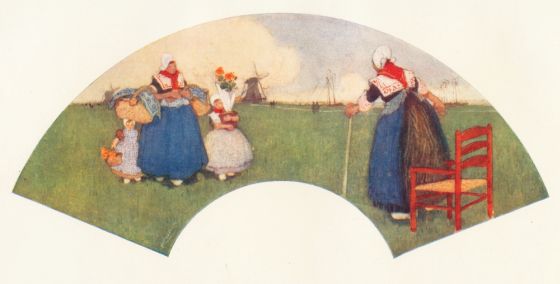
One cannot truly say that Belgian eventaillistes exist, for it is only very occasionally that such water-colour painters as MM. Cassiers, Stacquet, and Uytterschaut carry out their delightful landscapes and seascapes in the shape required for a fan.
Something has been done in lacework in connection with the fan, and on this point I should mention in terms of praise M. Van Cutsem, a Brussels designer, who has made numerous models for M. Bart and M. Sacré, amongst which may be noted several happy experiments in the direction of the "modern style."
To conclude, let me refer to the lace by Mlle. Bienaimé, admirably mounted by M. Goosens, of Brussels.
(Belgian)
A FAN PAINTED ON SILK
BY
H. CASSIERS.
Plate 1

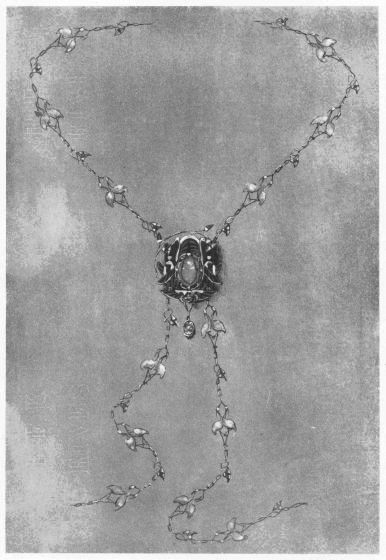
Design for a Necklet in Silver and Enamel
L. VAN STRYDONCK
Plate 2
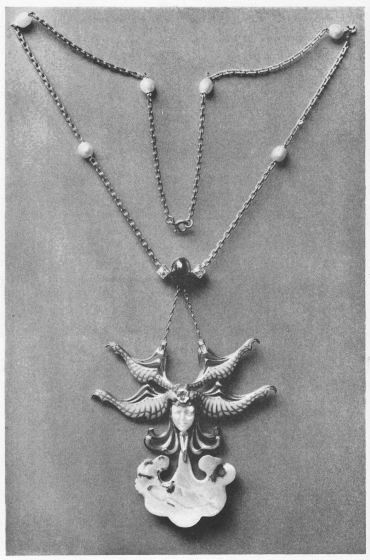
Pendant with Chain. The masque is an Iris with red Enamel for the hair. The Orchid's petals are in translucent Enamel of opalescent tones
PH. WOLFERS
Plate 3
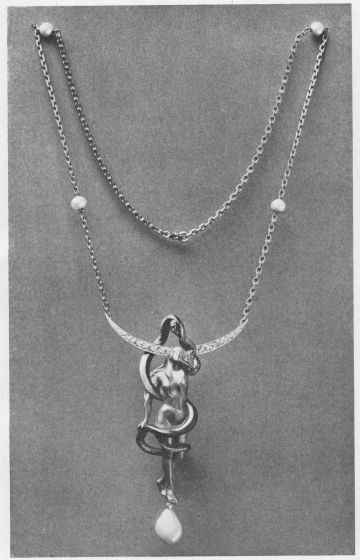
Pendant and Chain set with Brilliants and Pearls. The Figure in Gold, the Serpent in black and brown Enamel
PH. WOLFERS
Plate 4
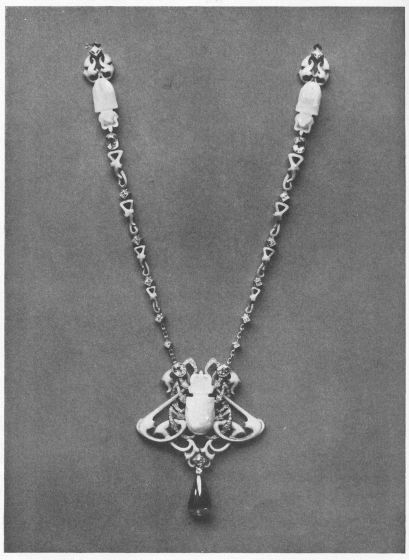
Necklet, with Ornaments of transparent Enamel
PH. WOLFERS
Plate 5
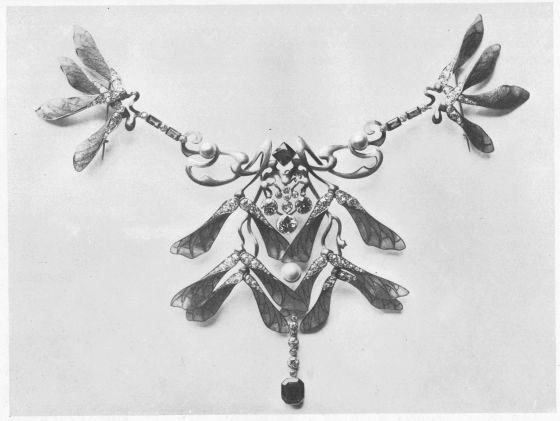
Parure de Corsage, set with Emeralds, Brilliants and transparent Pearls
PH. WOLFERS
Plate 6
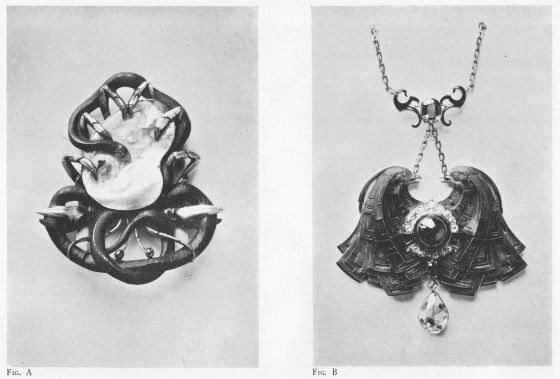
A. Waist-band Buckle. The Serpent in green Bronze, the Crab in Silver-gilt
B. Pendant. The Pheasants in green and yellow-brown Enamel, the centre Stone a pale-green Ceylon Sapphire
PH. WOLFERS
Plate 7
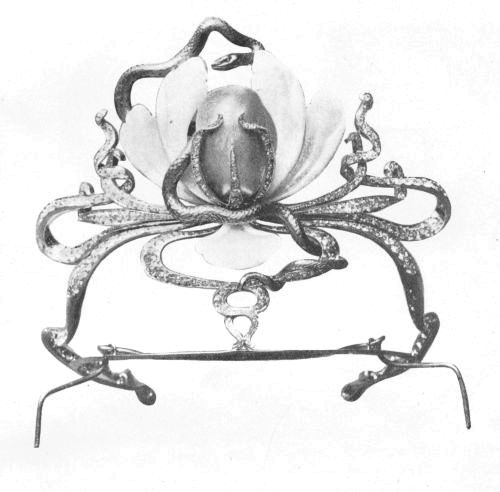
Coiffure, set with Brilliants; the petals in Opal, the Serpent in Gold touched with a slight patina
PH. WOLFERS
Plate 8
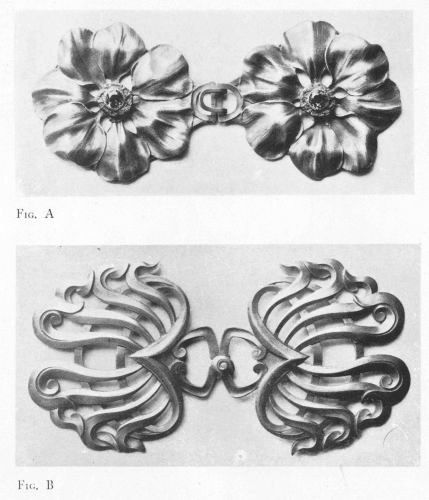
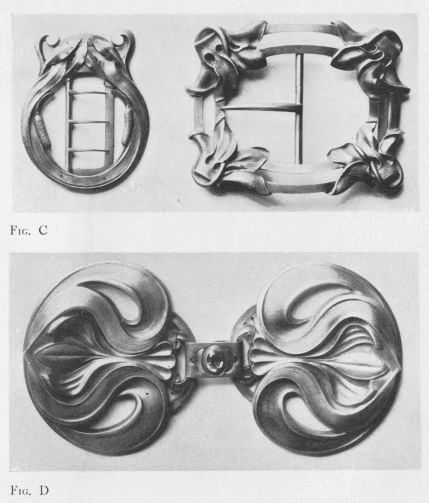
A, B, and D. Silver Belt-Clasps C. Silver Buckles
PAUL DUBOIS
Plate 9