Chapter IV · The Microscopic and Optical Characters of Minerals. (continued 2)
Reading edition
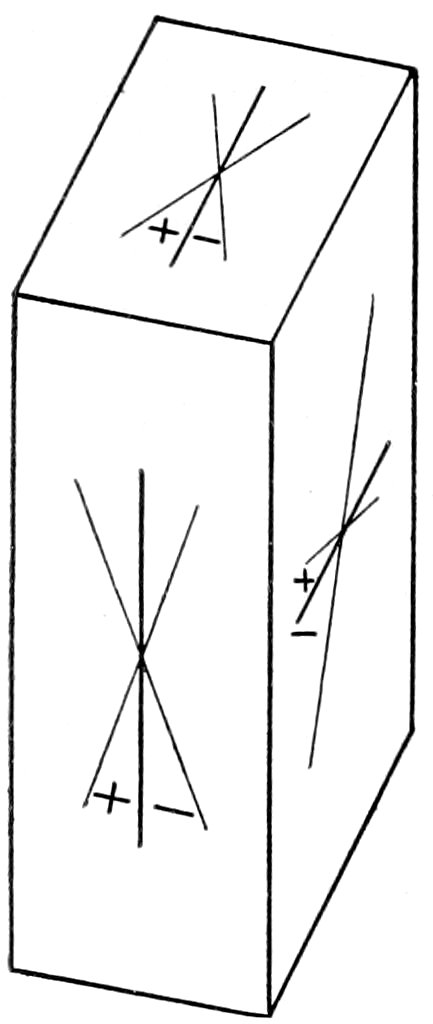
Fig. 73.—Showing conventional signs of extinction angles.
Maximum Extinction Angles in Sections Perpendicular to Albite Twins.
Albite 16°
Oligoclase, Ab4An1 5°
Labradorite, Ab1An1 27°
Anorthite 53°
In the determination of rod-like microlites,[112] oligoclase extinguishes almost parallel to its length, while anorthite may show extinction angles of over 27°. When these microlites show Albite twinning use the method just described.
(3) Fouqué’s method[113] can be used when the optical orientation 109of the section is known (as the result of a test with convergent light). The extinction angles of these known sections are of great diagnostic importance.
The best sections are those at right angles to the two bisectrices, and these may be obtained by rapidly testing those sections, in the rock, which show an interference color about half as high as the maximum color in the rock section, in this way avoiding the sections parallel to the optic axes.
Having found such a section, test it with a gypsum or ¼ undulation mica plate to prove whether the bisectrix is ⟂ a or c. If ⟂ a (these sections show sharp twinning striations) measure extinction angle between trace of axial plane and albite twinning; if ⟂ c measure extinction angle between trace of axial plane and basal cleavage cracks.
Extinction Angles in Sections:[114]
⟂ a, Measured from Albite striations. ⟂ c, Measured from cleavage cracks.
Albite 74° 19½°
Oligoclase, Ab4An1 88° 5°
Labradorite, Ab1An1 60° 22°
Anorthite 55½° 48°
When both extinction angles can be obtained, the determination of the plagioclase is very certain, but the result cannot be regarded as definite when only one is found; and the method becomes more difficult as the crystals become smaller.
The position of the axial plane should be determined by convergent light test and not simply by the direction of extinction in parallel polarized light.
(4) Michel Lévy’s method[115] can be employed when twinning is present after both Carlsbad and Albite laws.
110
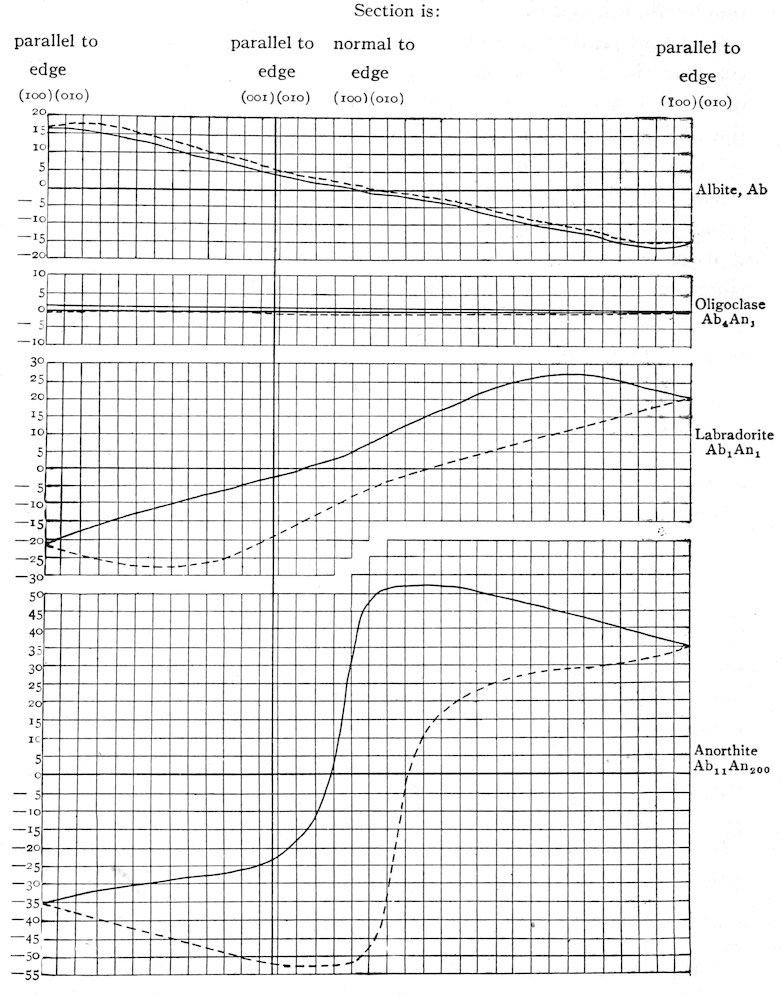
Fig. 74.—Extinction Angles in the Zone normal to (010) in Carlsbad Twins of the Plagioclases.
111The section to be tested should be in the zone perpendicular to (010). Such sections show sharp boundary lines between the twin lamellæ and, between crossed nicols, the Albite lamellæ show the same interference color when the trace of (010) is parallel to the cross-wires of the ocular, and also in the 45° position the lamellæ are the same color and no dividing lines show. The two parts of the Carlsbad twin exhibit different interference colors in the 45° position, this difference being more marked as the composition approaches that of Anorthite. The extinction angles are measured from the trace of the Albite twinning plane (010), paying regard to the + and − signs, and the concurrent series of angles are to be obtained from the two parts of the Carlsbad twin. The range of these angles (for four type compositions, Ab, Ab4An1, Ab1An1 and An) is given in the accompanying diagram for all positions of the section in the zone normal to (010).
In the curves of this diagram (Fig. 74) the vertical distances are the extinction angles for every ten degrees measured from the trace of the Albite twinning plane, and the horizontal distances represent varying positions of the section in the zone normal to (010) for every ten degrees of rotation from the position ∥ to the edge (100)(010) (that is ∥ ć axis), through a revolution of 180° to again ∥ to the same position. The concurrent angles in one part of a Carlsbad twin are represented by a heavy line and in the other part by a broken line. It will be observed that the difference between these concurrent angles is very small in Albite (3°) and increases markedly towards Anorthite (60°).
Table for Becke Method.[116]
Orthoclase α < ω Quartz
Microcline β
Albite γ
Oligoclase, Ab4An1 α < ω; γ > ω Quartz.
Labradorite, Ab1An1 α >ε Quartz
Anorthite β
γ
112(5) Becke’s method may be employed to identify the feldspar, by determining the relative values of the indices of refraction of the feldspar grain when it lies in contact with a quartz grain (best results) or with the balsam (not such good results.) The grains should have vibration directions in parallel position.
Other methods that may be employed are here simply referred to: Determination (in convergent light) of the emergence of an optic axis with reference to a known plane, the basic plagioclases show an optic axis about parallel to ć of the crystal; determination of total reflection by Wallerant’s total reflectometer; determination of the value of the mean index of refraction of crushed isolated grains by Schrœder van der Kolk’s method;[117] determinations by specific gravity separations with use of heavy solutions, and by chemical and micro-chemical tests (for the relative amounts of K, Na and Ca).[118]
Remarks: The plagioclases may have the same two general habits as orthoclase, being glassy and colorless in the younger eruptive rocks, and dull and cloudy in the granular and porphyritic, older, massive and schistose rocks. They occur in rocks of intermediate and basic composition.
Albite is found in granite (commonly intergrown with orthoclase), gneiss, etc., and frequently as a secondary constituent (secondary feldspar[119]) in the feldspar-quartz mosaic of mechanically metamorphosed rocks. It may also be present in acid eruptive rocks.
Oligoclase is very frequent in granite, syenite, gneiss, diorite, trachyte, andesite, diabase, etc.; and particularly accompanies orthoclase.
Labradorite is confined more to the gabbros,[120] basic eruptive rocks and crystalline schists, rich in amphibole and pyroxene.
Anorthite occurs in gabbros, the most basic porphyrites, basalts, etc.
Chemical corrosion and mechanical deformation[121] may take place as in orthoclase.
Anorthite and labradorite are more or less decomposed by hydrochloric acid, while albite and oligoclase are not acted on by the acid.
Especially interesting is the alteration of the plagioclase that takes place in 113gabbros, accompanied by “uralitization” of the pyroxene, forming “saussurite.” This consists of a white to greenish confused aggregate, chiefly of zoisite, grossularite, vesuvianite, chlorite, secondary feldspar (albite), etc.
Anorthoclase (a Na K, triclinic, feldspar).—Shows between crossed nicols intersecting areas of exceedingly fine composite twin structure and others of homogeneous structure, producing a watery or “moiré” appearance. The twin structure may be only seen in very thin sections. All possible kinds of perthitic intergrowth occur. Further distinguished from orthoclase by small extinction angle (4°) on base and by smaller axial angle (2E = 72° to 88°).
Replaces orthoclase in the Na rich eruptives. Found in augite-syenite and “Rhombenporphyr” of Norway (with rhombic cross-section), acid augite-andesite of Pantelleria and in the porphyries of the Hartz.
CYANITE, Disthene.
Anisotropic. Biaxial. Triclinic.
Composition: Al2SiO5. Elongation ∥ c′.
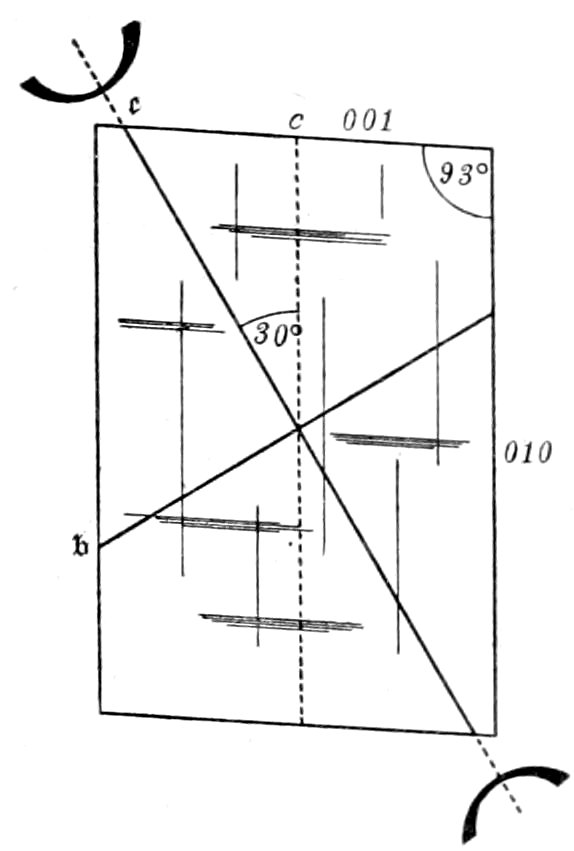
Fig. 75.—Cyanite, macro pinacoid cleavage section.
Usual Appearance in Sections: Blade-like crystals without terminal planes, but with cross-section (six-sided) showing two long parallel edges and four shorter edges; also in columnar aggregates. Twinning common, with generally twinning plane parallel to macro pinacoid (100). Colorless or bluish and spotted. The index of refraction is high (n′ = 1.720, α = 1.712, γ = 1.728), hence relief marked and surface rough. Cleavage perfect, parallel to macro pinacoid (100), appearing as sharp cracks, parallel to longest edges in cross-sections; less distinct, parallel to brachy pinacoid (010). Fibrous parting parallel to base (001), Fig. 75. Pleochroism (colorless to blue ∥ c′) not noticed except in colored crystals.
Crossed Nicols: Double refraction quite strong (γ − α = 0.016). Interference colors upper first order, yellow, red, violet, etc. Extinction angles observed in all sections (being triclinic), reaching a maximum of 30° on macro pinacoid (100), Fig. 75. Extinction on base, about parallel to most perfect cleavage. In convergent light axial angle large; axial plane and Bxa. about perpendicular to best cleavage (100); optical character (−).
Alteration: Seldom observed, but may take place to mica.
Distinguished from:
(a) Amphibole by cleavage (intersecting cleavages at 124° in amphibole and 90° in cyanite) and by (100) cleavage plates of cyanite showing emergence of acute bisectrix.
(b) Corundum by being biaxial.
114Distinction from similar appearing minerals may be difficult.
Remarks: Found in gneiss, granulite, metamorphic schists, ecolgite, etc., commonly associated with garnet. It is not attacked by acids. H., 5 to 7. Sp. gr., 3.6.
SERPENTINE.
Aggregate.
Elongation (of fibers) ∥ c′.
Composition: H4Mg3Si2O9, with replacement by Fe.
Usual Appearance in Sections: Dense, fibrous (chrysotile) or scaly (antigorite) aggregates.
Color.—Colorless to light greenish, except the Fe rich variety which is green.
Index of Refraction.—n′ = 1.55 to 1.56 (α = 1.56, γ = 1.571 for antigorite), hence no relief and surface smooth.
Polarized Light:
Pleochroism.—Not seen or very feeble, except in the Fe rich variety.
Crossed Nicols:
Double Refraction.—Rather weak (γ − α = 0.009 to 0.011).
Interference Colors.—Middle first order, gray, white, yellow, etc. Anomalous colors do not appear. The aggregate structure is distinctly seen between crossed nicols. Due to compensation aggregates may appear isotropic.
Distinguished from: Chlorite.—By more usual absence of color, pleochroism and anomalous interference colors; but this distinction may be very difficult.
Remarks: Serpentine (both antigorite and chrysotile) is essentially a secondary mineral, resulting in most cases from the alteration of chrysolite (olivine), Fig. 22, more rarely of pyroxene or amphibole.[122] The alteration of olivine to antigorite leads to the characteristic “lattice structure,” the alteration to chrysotile to “mesh structure.” In the case of the “mesh” formation the alteration starts from the surface and cracks, producing fibres of chrysotile, which stand at right angles to these edges and cracks. As serpentinization proceeds new cracks form, due to increase in volume, and the process may continue until complete pseudomorphism takes place. When this subsequent serpentinization of the meshes takes place the resulting serpentine may appear almost isotropic[123] and is certainly different from the chrysotile of the first formed veins (Weinschenk). Pieces of the parent mineral are often present.
115Serpentine is found in ophiolites, the altered basic igneous rocks, pyroxenites, peridotites, etc., and as a primary mineral in the Central Alps peridotite, intergrown with fresh olivine (Weinschenk). It may also form a rock by itself. Serpentine is attacked quite strongly by hydrochloric acid, still more so by sulphuric acid. Common serpentine is not altered by heating (distinction from chlorite), but the Fe rich variety becomes brown and opaque. H., 2.5 to 4. Sp. gr., 2.5 to 2.7.
CLAY, Kaolin.
Composition: H4Al2Si2O9 (kaolinite). Aggregate.
Usual Appearance in Sections: Fine, scaly, colorless aggregates, which appear opaque (due to porous structure). The scales show basal cleavage. Index of refraction is about the same as balsam (n′ = 1.55), hence no relief. The double refraction is weak (γ − α = 0.008).
Distinguished from: Colorless Mica and Hydrargillite [(Al(OH)3), which as an alteration product of the feldspars is often confused with clay] by weak double refraction.
Remarks: Clay results from the alteration of the feldspars (especially the plagioclases), elæolite, scapolite and other silicates. Kaolinite is insoluble in hydrochloric but decomposed by sulphuric acid. H., 2.5. Sp. gr., 2.6.
117